




Abstract

All living things will die. Understanding the pathogenesis of diseases and conditions present at death could lead to clarity about causes of death, the disease itself, and mechanisms of aging. Aging is the culmination of a lifetime of events within a cell, tissue, organ, or organism. After conception, animals (including humans) attain a life span that is defined by genetics, environment, and accidents. Aging encompasses molecular, cellular, and organ-specific phenomena that change with exposure to life’s events. As animals age, cellular and tissue degeneration and atrophy, cellular senescence and dysregulation, neoplasia, chronic inflammation, and tissue repair and scarring occur and often manifest as diseases. 7,34 Diseases may be non-degenerative age-related or degenerative age-related. Environmental exposures may modify the natural course of all these changes and include diet, composition of the air and water, exposure to toxins and other harmful materials, infectious agents, and lifestyle. Chance (replicative mutations) may also play a major role in cancer development. Each species has natural or induced subsets of genetic lines, which result in strains, breeds, subpopulations, or races. Individual life span is determined by these multiple factors. Aging research aims to define and study the causes of age-related diseases. 22,23,31,49
When an individual develops a potentially life-threatening disorder, it may be fatal more commonly in some environments depending on access to resources. Medical diagnosis and treatment can modify outcome. Some of these interactions may be initially beneficial but end up producing an adverse event. Death is the final culmination of normal or abnormal molecular, biochemical, and other pathologic events in an individual.
Medically, diseases can be diagnosed by clinical history with physical examination, imaging, laboratory tests, and other techniques; together, these often result in specific diagnoses. Clinical diagnostic techniques and postmortem examinations often reveal gross and histopathologic lesions that are related to causes of death (CODs), contributing CODs (CCODs), and determinants of life span. 45 In this special issue of Veterinary Pathology, a collection of papers addresses the pathology of aging in various animal species and how some age-related lesions develop and may lead to disease and death. In addition, spontaneous and transgenic animal models of human age-related diseases are discussed. 22 –24,34,49,55 References in this introduction are to these special issue papers and to others in the literature.
Role of Pathology in Determining the COD
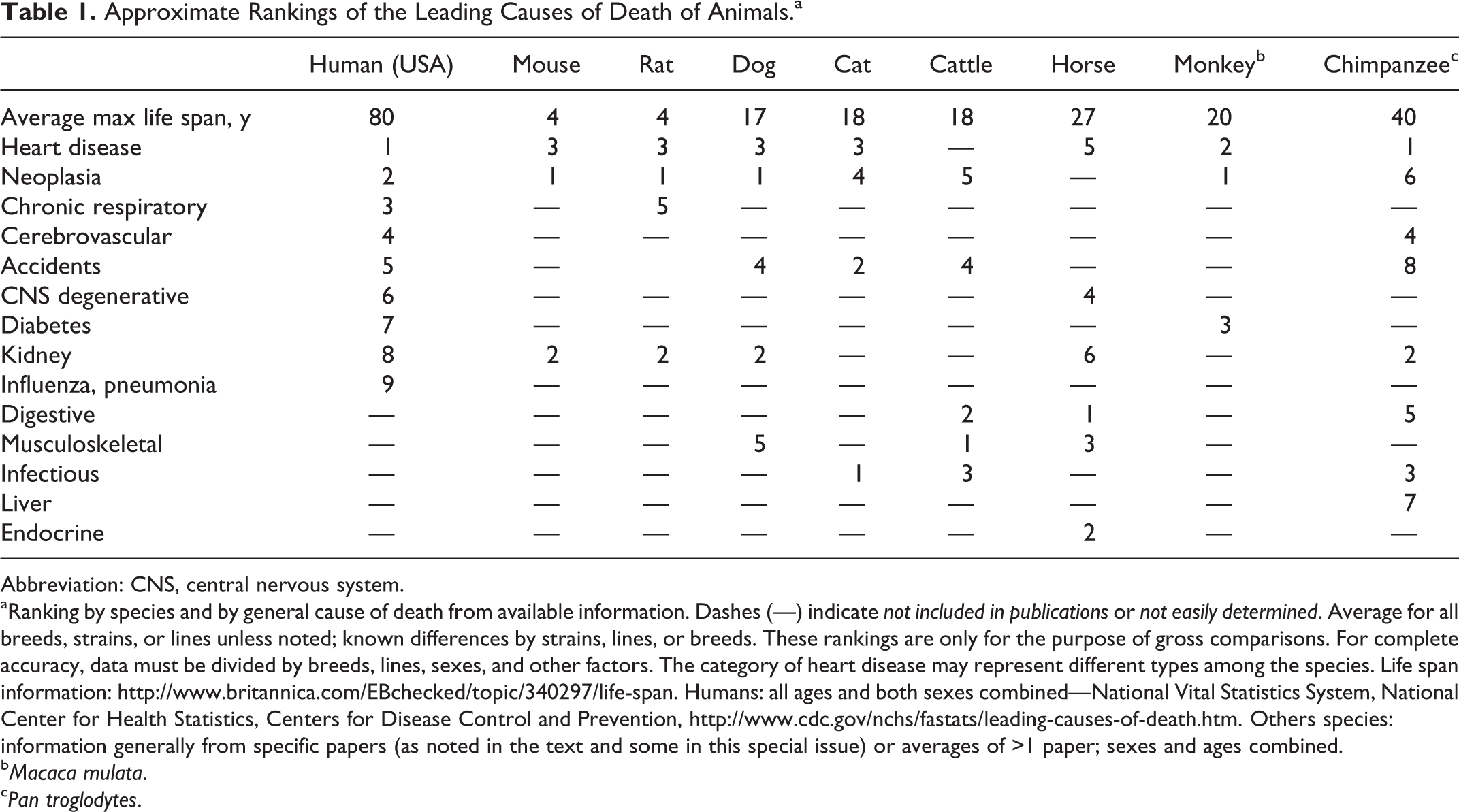
The COD of humans and animals is often determined from clinical findings and medical laboratory results. 33,35,45 Autopsies of humans and domestic animals are a less common method for establishing the COD, in part, due to cost and the labor involved. 32,36 Because of these limited procedures and unless a detailed clinical, surgical biopsy, and clinical pathology workup was done, the exact COD cannot often be ascertained unless an autopsy and postmortem ancillary tests are performed. Pathology plays a major role in determining final CCOD or COD. There have been few thorough necropsy surveys of noninfectious CODs in any animal species. They have been best studied in rats and mice. 11,45 Examples of major CODs for common veterinary species and humans are ranked in Table 1. These are derived from an incomplete literature, as there are few well-designed studies reviewing CODs in veterinary species and the data used to determine CODs in humans often lack input from pathologists. However, the literature gives some insight and allows for educated speculation on the major noninfectious and age-associated lesions that may contribute to or cause death.
Approximate Rankings of the Leading Causes of Death of Animals.a
Abbreviation: CNS, central nervous system.
aRanking by species and by general cause of death from available information. Dashes (—) indicate not included in publications or not easily determined. Average for all breeds, strains, or lines unless noted; known differences by strains, lines, or breeds. These rankings are only for the purpose of gross comparisons. For complete accuracy, data must be divided by breeds, lines, sexes, and other factors. The category of heart disease may represent different types among the species. Life span information: http://www.britannica.com/EBchecked/topic/340297/life-span. Humans: all ages and both sexes combined—National Vital Statistics System, National Center for Health Statistics, Centers for Disease Control and Prevention, http://www.cdc.gov/nchs/fastats/leading-causes-of-death.htm. Others species: information generally from specific papers (as noted in the text and some in this special issue) or averages of >1 paper; sexes and ages combined.
b Macaca mulata.
c Pan troglodytes.
Fatal Conditions in the Individual Species
Categories of COD in Americans have been reported by the US National Vital Statistics System, National Center for Health Statistics, Centers for Disease Control and Prevention. These include, heart disease, malignant neoplasms, chronic lower respiratory disease, cerebrovascular disease, congenital abnormalities, unintentional injury, Alzheimer disease, diabetes mellitus, nephritis, influenza and pneumonia, and suicide (http://www.cdc.gov/nchs/fastats/leading-causes-of-death.htm). Heart disease in humans is due mostly to diet and genetics, but these causes are probably less common in animals. Malignant neoplasms are of many types in humans, with breast, colon, prostate, skin, and lung cancer being most common in Americans. Of comparative interest, neoplasms are also common in many animal species, particularly in dogs, cats, and rodents. 1,3,4,8 –11,43,46,53
Common cancer types differ between human and animal species probably due to genetics and etiologic factors, such as cigarette smoke, diet, and infectious agents. Chronic respiratory diseases in humans occur from cigarette smoking and other environmental exposures and do not usually occur in animals. Cerebrovascular conditions are mostly due to stroke, which are rare in animals. Neurodegenerative disorders are common in aged humans and can be found in some animal species. Injuries occur in humans and animals, especially from motor vehicle accidents.
Similar categories can be used for animals, with a few obvious exceptions (Table 1). 9,10,41 The main problem with determining COD for any animal species is the common occurrence of euthanasia for various reasons not related to COD (ie, death before its time), as well as enzootic infectious diseases, which can cause havoc in a population of animals. Table 1 summarizes only some age-related findings as reported for each species. The pathology of aging has been best studied in rats and mice with defined aging populations. 8,11,19,36 A few publications on dogs 5,6 and nonhuman primates 17,18 do exist. As noted previously, CODs for each species vary by breed, environment, vaccinations, and so on. These conditions may be caused by accidents, 42 infectious agents, 48 exposure to toxins, diet, and genetics. Age-related changes in cells and tissues caused by unknown factors (including changes in gene expression and function with age) are discussed in papers in this special issue.
For a large study of dogs and the use of a veterinary medical database, investigators (geneticists and a clinical veterinarian) classified CODs into categories of 9 pathophysiologic processes: congenital, degenerative, infectious, immune mediated, metabolic, neoplastic, toxic, traumatic, and vascular. 33 They found that the major causes of death generally varied among the canine breeds studied. Tumor types varied greatly by dog breed. 33 Companion animals, including dogs and cats, are often maintained by owners for their natural life spans, although many are euthanized when prognosis is poor and expenses to maintain the animal are high. Many breeds of dogs commonly develop tumors and kidney and heart disease. 5,6,9,10,14,26,28,50,51 Cats often succumb to infectious disease, despite availability of vaccinations, as well as to accidents, heart disease, renal disease, and cancer. 25,29,30,37,39 Renal pathology in aging dogs and cats is described in this issue. 3,5,12,16 Infectious diseases, including panleukopenia, lymphomas, and feline infectious peritonitis, may be common in certain cat populations.
Aged animals, particularly dogs, cats, and primates, show neurodegenerative lesions (eg, brain atrophy, amyloid plaques, and tauopathies) that are comparable to those of aged humans. 55 However, the pathogenesis and clinical consequences of these lesions are largely unknown. Cognitive dysfunction syndrome of aged dogs and cats is the most commonly investigated age-related neurologic condition and is considered to be a good model for Alzheimer disease. Animals affected with cognitive dysfunction syndrome develop Alzheimer disease–like signs, and they can succumb to dementia and severe neurologic deficits that eventually lead to death or euthanasia. Age-related lesions in the brain of different species and animal models of neurodegenerative conditions are described and reviewed in this issue. 55
Laboratory animals include a diverse group of rats and mice, nonhuman primates, rabbits, guinea pigs, ferrets, and other animal species. Mice are most often used in medical research, and papers in this special issue discuss their natural CODs and methods used to determine COD. 45 Neoplasms are the major CODs in most commonly used inbred, outbred, and other lines of mice and rats, but strain-related nonneoplastic CODs are also found (diabetes, kidney disease, immune-mediated diseases, among many others). 11,19,36 Retroviruses can play a major role in the development of leukemias, lymphomas, and mammary tumors in mice, but most lines do not possess infectious retroviruses today. Macaques develop neoplasia, cardiovascular disease, and diabetes, 17,18,24,38,44 while chimpanzees develop cardiac disease, which is not similar to the common heart diseases of humans. 13,15,38
Farm animals—including cattle, horses, pigs, sheep, and other species—are not usually maintained for their life spans but rather as food animals or working companions. Thus, publications on pathology of aging and COD of these species are limited, except perhaps for infectious disease and tumors. Aged cattle develop disorders of the gastrointestinal tract and musculoskeletal system, succumb to infectious diseases, and suffer accidents. 21,40,47,54 Aged horses have gastrointestinal, pituitary, musculoskeletal, and cardiovascular disorders. 27,41 Musculoskeletal disorders in large farm animals often lead to euthanasia because the likelihood of return to normal functioning is limited after diagnosis. 21,47,52,54 Humans and pet animals are maintained on therapy for much longer periods than those of other animals. Publications on the pathology of aging and causes of death in aged sheep, goats, and pigs are rare.
The diversity of wildlife, some of which can be observed and studied in zoos and related facilities, makes it difficult to summarize their CODs. Infectious diseases play a major role in causing illness and death in these animals. 48 Some of these animals are also used in medical research, including ferrets, 2 nonhuman primates, 13,15,24,38,44 and fish. 20 This special issue reviews the pathology of aging animals and their relationship to causes of death.
Footnotes
Declaration of Conflicting Interests
The author(s) declared no potential conflicts of interest with respect to the research, authorship, and/or publication of this article.
Funding
The author(s) received no financial support for the research, authorship, and/or publication of this article.