




Abstract
Expertise in the pathology of mice has expanded from traditional regulatory and drug safety screening (toxicologic pathology) primarily performed by veterinary pathologists to the highly specialized area of mouse research pathobiology performed by veterinary and medical pathologists encompassing phenotyping of mutant mice and analysis of research experiments exploiting inbred mouse strains and genetically engineered lines. With increasing use of genetically modified mice in research, mouse pathobiology and, by extension, expert mouse research-oriented pathologists have become integral to the success of basic and translational biomedical research. Training for today’s research-oriented mouse pathologist must go beyond knowledge of anatomic features of mice and strain-specific background diseases to the specialized genetic nomenclature, husbandry, and genetics, including the methodology of genetic engineering and complex trait analysis. While training can be accomplished through apprenticeships in formal programs, these are often heavily service related and do not provide the necessary comprehensive training. Specialty courses and short-term mentoring with expert specialists are opportunities that, when combined with active practice and publication, will lead to acquisition of the skills required for cutting-edge mouse-based experimental science.
Laboratory mice offer a unique opportunity in that they are anatomically and histologically very similar to other mammalian species except for a few structures found only in rodents but rarely in other species. As veterinary pathologists are trained to diagnose diseases in many diverse species, there is really no additional special skill set needed to work up the laboratory mouse diagnostically. This is a greater challenge for human (medical) pathologists, as they are not traditionally trained to consider interspecies variation or unique anatomic and physiological differences. At the same time, human pathologists may be in a better position for providing advice on the pathogenesis of human diseases and relevance of mouse models to specific human diseases. Nevertheless, training in either veterinary or human pathology provides the pathologist with sufficient theoretical background and practical skills needed to learn the peculiarities of mouse anatomy and biology and to carry out high-quality mouse pathology. Collaboration between experts on particular diseases, with inclusion of pathologists experienced in mouse pathology, creates teams that can correctly diagnose and relate comparative diseases in mice, humans, and other species. Such collaborative efforts are essential for working out the molecular pathophysiology and pathogenesis of these diseases, validating mouse models, and thereby ensuring advances of biomedical research.
Formal training programs in pathology are designed to train pathologists in the requisite skills and to pass the specialty board examination. There is no subspecialty in mouse pathology recognized by the professional boards; mouse pathology is therefore not a formalized discipline and, with a very few exceptions, there is no specific training provided in traditional pathology residency core courses, although some training programs at medical or veterinary colleges offer some exposure to pathology of mice. To date, we have all learned by experience, ideally under the guidance of an experienced mentor (senior pathologist or others with expertise in various areas). 13 However, the opportunity to learn like this is rarely available, as experienced mentors are few and widely scattered.
Groups around the world have recognized the need for more expertise, and several are proposing special training programs in which candidates can carry out a year or so of training under a mentor and take a series of formal courses in mouse pathology. 3 While this seems reasonable, few, if any, veterinary or medical schools have sufficient mouse-oriented research programs to provide exposure to all aspects of this field. Simply reading slides and understanding the macroscopic and microscopic differences between mice and other species is not adequate training to prepare a comparative pathologist to be a real asset in biomedical research, whether as a principal investigator or collaborating scientist. A thorough understanding of basic mouse biology, such as husbandry, pathogens, strain-specific diseases, and so forth is what most people think of as the required diversity of knowledge for this field. In fact, a competence in principals of modern biomedical research, basic Mendelian genetics, complex genetics (quantitative trait analyses), nomenclature (both mouse strains and genes), advanced histomorphological and immunohistochemical techniques, and grantsmanship are all parts of the skill sets needed; these are often lacking. While year-long fellowships working in a service laboratory focusing on mouse pathology supporting basic research scientists are a reasonable approach to obtain broad-based histopathology expertise, it is by no means the only approach and in many ways can be extremely limiting. One of the major problems with this strategy is that none of the veterinary or medical schools in North America or Europe can alone provide comprehensive programs. At best, they usually only have one or two pathologists with experience in this field, and the program or, more specifically, the institution as a whole is not focused on the mouse as a research tool. As such, training is very limited to traditional gross and histopathology without providing a comprehensive experience in gene mapping (simple and complex traits), nomenclature, molecular assays, and so on. Training for a year will produce someone with basic biology knowledge and adequate technical skills but not one who is equipped to guide a research team, interpret data, and recognize the unexpected.
There are other options. These can range from a staff position with the flexibility and financial support to take a number of courses and work with several mentors off site in addition to, or part of, an existing pathology residency. Finding a mentor focused on mouse pathology is not as difficult as it may appear. Participating in specialty meetings will expose students to senior investigators who might be willing to serve as a mentor. A number of foundations provide mentorship grants (North American Hair Research Society, http://www.nahrs.org/home/; Council for Nail Disorders, http://www.nailcouncil.org/; and others) that cover the cost of transportation, room, and board for a resident or junior pathologist to work with an expert in that field. While working with a mentor, the trainee can get exposure to many advanced research and diagnostic techniques as well as develop networks with such experts.
As one-on-one intensive mentorship opportunities are still rare and the mentors are in high demand, consultation is another avenue through which different approaches to mouse pathology may be learned. Many academic specialists will often freely help junior pathologists with difficult cases. Inviting senior pathologists for adjunct appointments, to give special seminar series, or as part of a meeting on campus provides opportunities for faculty and students alike to meet with these people, review cases, discuss research, and establish good collaborative relationships with the intent of broadening exposure of trainees to experts in diverse locations.
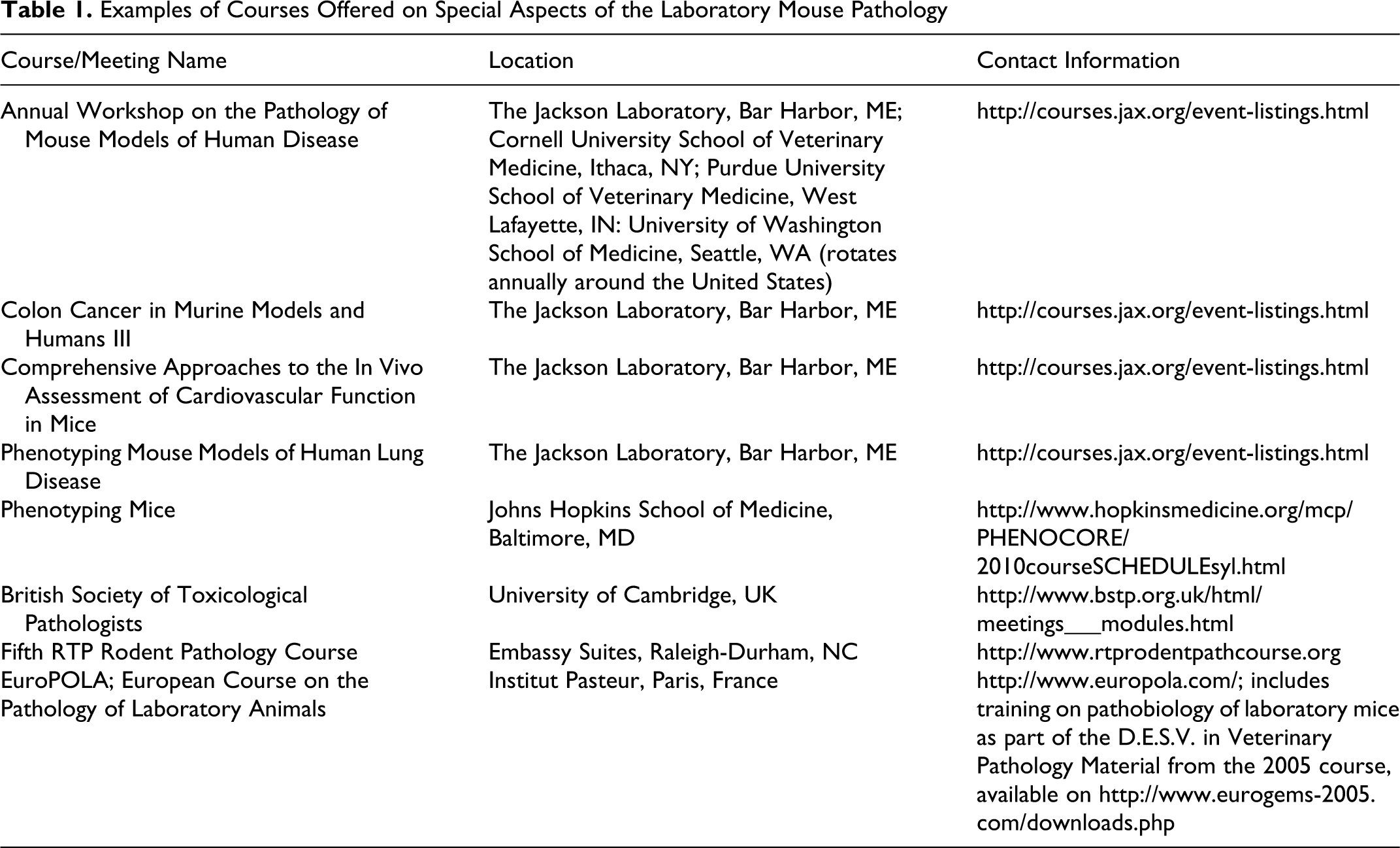
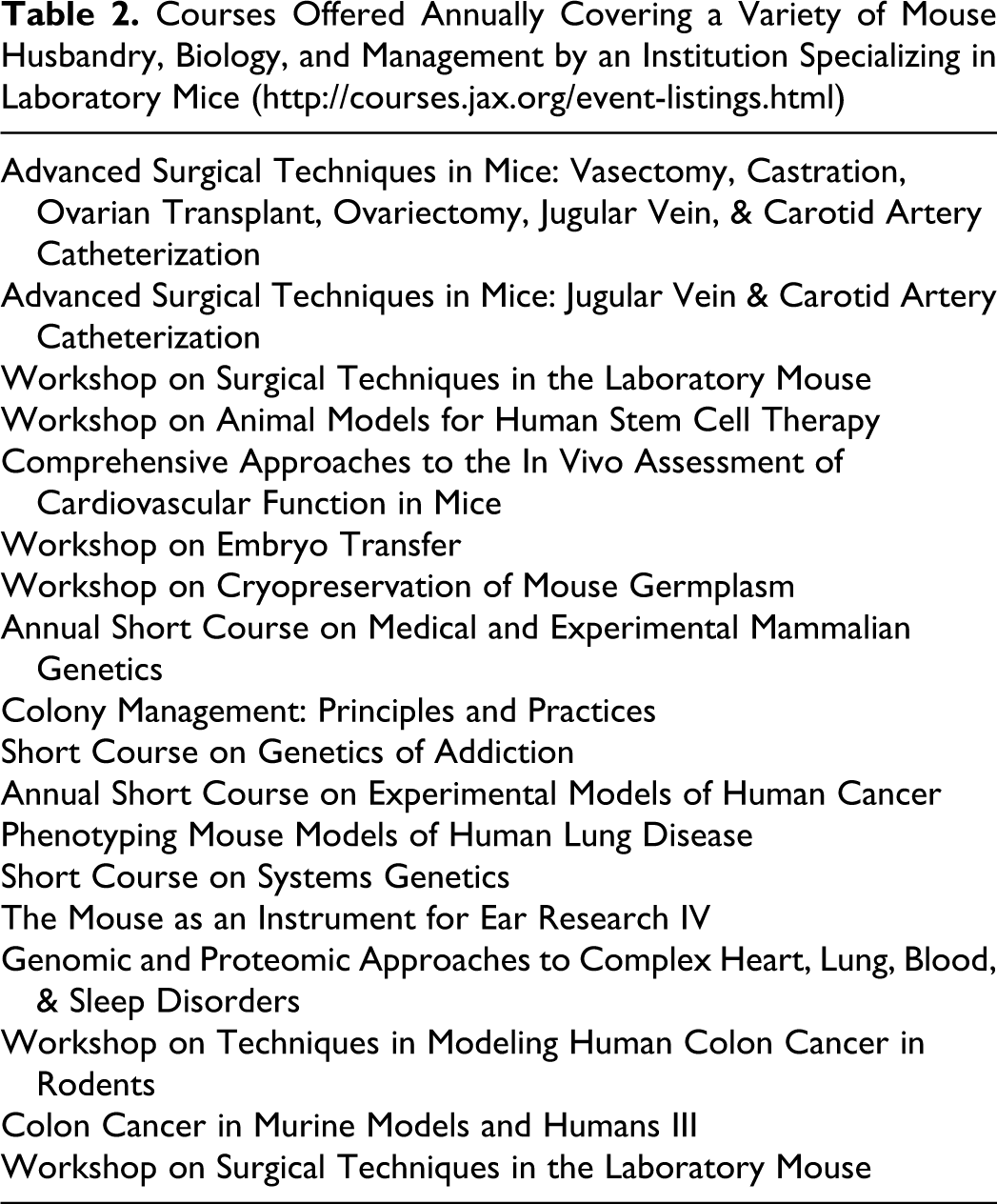
Specialty meetings (Table 1) provide training in mouse pathology and research methods in mouse pathobiology and give attendees the opportunity to work closely with the faculty. While this is what most people think of for complete training in mouse pathology, it is actually only a small part of the training needed to be an effective and knowledgeable mouse pathologist. A more comprehensive understanding of mouse pathophysiology is really needed. Understanding mouse genetics 11 and genetic nomenclature 16 is needed to be able to understand the experimental design to determine if valid controls were provided. A knowledge of strain-specific background diseases or where to find such information is important to differentiate background lesions from those induced by the mutation or experimental manipulation.14,19 Understanding of basic molecular pathobiology and production of increasingly complex genetically engineered mice 15 will allow the comparative pathologist to effectively communicate with molecular biologists and other life science investigators. A mouse pathologist should also have a basic understanding of advanced techniques for in vivo and in vitro imaging and molecular analysis of disease processes. Although the use of such techniques is not limited to experimental mouse work, they are commonly used in mice in conjunction with pathology. Courses that focus on these and many other issues are offered regularly by institutions that specialize in working with laboratory mice (Table 2). 12
Examples of Courses Offered on Special Aspects of the Laboratory Mouse Pathology
Courses Offered Annually Covering a Variety of Mouse Husbandry, Biology, and Management by an Institution Specializing in Laboratory Mice (http://courses.jax.org/event-listings.html)
During the past century, the mouse has been extensively used for pathology studies in some disciplines, such as genetics, infectious diseases, cancer research, and particularly for toxicology (drug safety studies, which continue to be a major practice in the field). However, with development of modern genetic tools, over the past 20 years, the concept of mouse pathology has become far more appreciated in the broad field of contemporary life sciences. The immediate consequence of this situation has been the rapidly increasing demand for appropriately qualified pathologists versed in both mouse pathology and research.
As the demand for experienced research-oriented mouse pathologists has grown, the value of networks has also grown. In 1999, a group of United States–based human and veterinary pathologists formed a Pathology and Laboratory Medicine Standing Committee within the Mouse Models of Human Cancers Consortium (MMHCC, National Cancer Institute, National Institutes of Health). The work of this committee resulted in a number of meetings followed by publication of comparative classification of mouse neoplastic lesions as well as the first web site featuring comprehensive collections of virtual slides of mouse and human proliferative lesions.4,6,10 Likewise, in 1999, the first meeting on this specific topic was held, Pathology of Genetically Engineered Mice, which led to a book on this topic 20 and annual meetings that continue and have been copied worldwide. 12
The European Mouse Pathology Consortium was started in 2000 as a loose grouping formed as a consultative body for Pathbase, an online image database for pathologists working with laboratory mice.7,9 Later, due to the rising importance of mouse pathology in large-scale phenotyping, this group became integrated with the EUMORPHIA Consortium (http://www.eumorphia.org/index.html) and has now formed the basis of a working party looking at the systematic characterization of targeted mutant mice for every gene in the mouse genome as part of the International Mouse Phenotyping Consortium. 1 The informal mouse consortium within the American College of Veterinary Pathologists provides a similar network for sharing information and resources.
Pathbase provides an online “virtual second opinion,” which is especially useful when linked via a pathology-based database for recording phenotyping data.17,18 While these databases and software such as the Mouse Disease Information System (MoDIS) are available free online, they can and are being used in part to create new software that is institution specific, building on the Mouse Anatomy Ontology and Mouse Pathology Ontology. This provides a structured reference vocabulary that can be expanded, thereby standardizing mouse pathology nomenclature.
A program, such as the one developed by the British Society for Toxicologic Pathology (http://www.bstp.org.uk/html/about_the_modules.html), utilizes weeklong courses, where over several years, a fairly complete coverage of the field can be obtained. This type of course, combined with traditional pathology training, is a more accessible means to obtain the broad training needed for a successful career in mouse pathology. However, there is no alternative to experience, which is the ultimate teacher. Sabbaticals or even short visits to institutions that exclusively focus on the laboratory mouse as a model system, such as The Jackson Laboratory, are ways to get a more complete exposure to this field.
For people with little flexibility or financial means, online training and distance learning is yet another option. Many useful reference web sites are freely available, 19 while others need society membership or require a fee. The Academy for Genomic Pathology (http://ctrgenpath.net/main) offers a structured online Pathobiology of The Laboratory Mouse course in 3 tiers aimed at technical staff, PhD scientists, and board-certified pathologists (http://extension.ucdavis.edu/unit/heakth_sciences/course/description/index.asp?type=I&CourseID=35794). This award-winning extension course at UC Davis was designed to address the lack of training opportunities together with the widely distributed nature of mouse pathology expertise in the United States by bringing trainers and students together in a virtual environment.
These online resources have been greatly enriched by the extensive use of zoomable, whole slide digital images in the course reflecting the technological-advances facilitating online training and standardization. Other resources are increasingly using this digital whole-slide technology, for example, The Jackson Laboratory Mouse Tumor Biology Database and Pathbase. These sites provide reference images,17,18 attempt to integrate computational phenotyping and data-mining tools, and provide training through access to term definitions and examples of lesions in genetically engineered or inbred mice with specific diagnoses illustrated with photomicrographs or whole digital slides provided by expert research-oriented comparative pathologists.
The resources now becoming available reflect both the concerns of the biomedical community about the availability of expertise and, to an extent, the facilitating nature of the new technologies. However, there is no substitute for hands-on experience in a laboratory with expertise. Many of the most senior people in the field are very generous with their time and skills to help with this process, but the problem still remains the funding for these opportunities. Furthermore, it should be recognized that pathologists with their own research programs are frequently unable to contribute to extensive teaching and training activities because of time-consuming efforts on securing essential research funding. At this moment, there are few funding mechanisms specifically compensating pathologist scientists for their contributions to teaching mouse pathology.
More importantly, veterinary and medical schools in general and pathology training programs in particular need to recognize that there is a need for curriculum development to encompass this new field. Inclusion of the pathobiology of laboratory mice as a recognized specialty would not only improve the world’s pool of expertise at a time when demand is rapidly expanding but also encourage young pathologists to enter into this career path during training. This will be challenging to traditional concepts of pathology training; for example, the comparative pathology usually taught in veterinary schools needs to be expanded to include more comparison to human pathology with the involvement of human pathologists as instructors. Of no less importance are efforts aimed at more active involvement of pathologists in closer interactions with mouse modelers of human disorders, thereby exposing residents to the realities of mouse modeling. Such challenges are exciting and stimulating and will put our veterinary pathologists at the cutting edge of the biological sciences. Earlier this year, the National Institutes of Health announced a strategic funding of large-scale mouse phenotyping efforts by the Common Fund (http://commonfund.nih.gov/KOMP2/) for the Knockout Mouse Phenotyping Program (http://www.komp.org/).1,5 As the mouse becomes increasingly central to our understanding of human disease, ambitious programs such as this will expand, as will the need for experts to interpret and translate the mouse findings. From where will the expertise come?2,8 It is the responsibility of the pathology community and funding agencies; it is by coming together, articulating, and responding to the needs of biomedical research that we can meet our mutual aspiration, which is the deeper understanding of the nature of human and nonhuman animal diseases.
Footnotes
The authors declared that they had no conflicts of interest with respect to their authorship or the publication of this article.
This work was supported in part by grants from the National Center for Research Resources and National Aging Institute at the National Institutes of Health (RR17436).