




Abstract
Immunohistochemical staining for cell cycle proteins and heat shock proteins was performed on 17 canine gastric carcinomas. The immunoexpression of p53, p21, p16, Hsp27, and Hsp70 was investigated. A study was conducted to determine the histological type and parameters related to tumor malignancy. Possible associations and trends were assessed between the immunoexpression of each protein and tumor type as well as specific parameters of malignancy. High intratumor frequency of cellular p53 immunostaining was observed (61.96% average), but lower frequencies of p21 and p16 expression were present (34.65% and 10.41%, respectively). The p53 overexpression was associated with tumor infiltration (P = .0258). Expression of p21 was lower in undifferentiated carcinomas, and the loss of expression was associated with histopathological parameters characteristic of a poor prognosis such as lymphatic vessel invasion (P = .0258). The lack of p16 immunoreactivity was related to histopathological characteristics of malignancy such as the presence of evident and multiple nucleoli (P = .0475). In contrast, deep tumor infiltration was observed in those carcinomas with a high p16 index (P = .0475). Hsp70 appeared to be overexpressed in all gastric neoplasms included in this study. This is in contrast to Hsp27, because a group of tumors showed complete lack of Hsp27 immunoexpression, whereas the others displayed extensive Hsp27 immunostaining. The differences in Hsp27 did not correlate with any of the histopathological parameters, but Hsp27 immunoexpression was higher in the undifferentiated carcinoma. No significant differences in the expression of the proteins were found in canine gastric carcinomas according to their histological type. These findings may be useful for establishing a prognosis for canine gastric carcinoma.
Gastric carcinoma is the most common neoplasm in the canine stomach. Although its incidence is around 1% of the neoplasia diagnosed in dogs, it usually results in death. Sixty percent to 70% of gastric tumors are malignant. 9,12,13,15,32,33,43 The World Health Organization (WHO) classifies gastric carcinomas in domestic animals according to the growth pattern of the carcinomas, dividing them into 5 types: tubular carcinoma, mucinous carcinoma, signet ring cell carcinoma, undifferentiated carcinoma, and papillary carcinoma. 15 The relationship between the histological type of carcinoma and other characteristics of malignancy related to the prognosis has not been previously described.
Studying the cell cycle and factors involved in its regulation has become a goal in terms of improving prognosis and survival in human cancer. Previous studies have shown that tumor suppressor genes play an important role in the progression of different types of neoplasia, including gastric carcinoma. 6,8,31
Mutated p53 occurs in many human cancers and is present in up to 60% of human gastric carcinomas. 16 Moreover, the increased expression of mutated p53 has been associated with pathological parameters of tumor aggressiveness and poor prognosis in human gastric carcinomas. 1,8,26,30,47 Such a relationship has not been demonstrated in canine gastrointestinal tumors, although high p53 expression has been reported. 10,27,44
On the other hand, a reduced p21 expression, an inhibitor of cyclin-CDK complexes that mediates some of p53 suppressor effects, has been related to tumor infiltration, undifferentiated types of carcinomas, the presence of metastases and a lower survival period in human gastric carcinomas. 1,16,37,47 No studies have been published regarding p21 expression in canine gastric carcinomas. The lack of p21 expression, as well as an over expression have been reported in other types of neoplasms in the dog. 18,19,45
The protein p16, which specifically inhibits cyclinD-CDK4/6, has been studied for its possible relationship to tumor progression and prognosis in human cancer. Similar to p21 expression, the loss of p16 expression has been associated with malignant characteristics and poor prognosis in human gastric carcinomas. 5,16,28,46 There are no studies of p16 immunoexpression in canine gastric carcinoma. One study of canine melanomas reported that the lack of p16 expression might be related to tumor pathogenesis. 23
The main function of heat shock proteins (HSPs) is to protect cells during stressful stimuli. Furthermore, some HSPs have been demonstrated to have a relationship with both malignancy and prognosis in human cancer. Increased expression of Hsp27 and Hsp70 has been described in human gastric carcinomas, and some authors have shown relationships to poor prognosis, lower survival rate, and histological parameters of malignancy. 3,22,40 To date, no study of Hsp27 and Hsp70 expression in canine gastric carcinomas has been published.
In this study, the expression of both cell cycle proteins (CCPs) and HSPs was determined. The immunoexpression of p53, p21, p16, Hsp27, and Hsp70 was detected using the streptavidin–biotin–peroxidase complex (SABC) method. All tumors were categorized according to the WHO classification. 15 A variety of histological parameters were established and used to analyze each carcinoma to retrospectively investigate the relationship that may exist between general characteristics of canine gastric carcinomas, malignancy parameters, and immunoexpression of the these proteins.
Methods
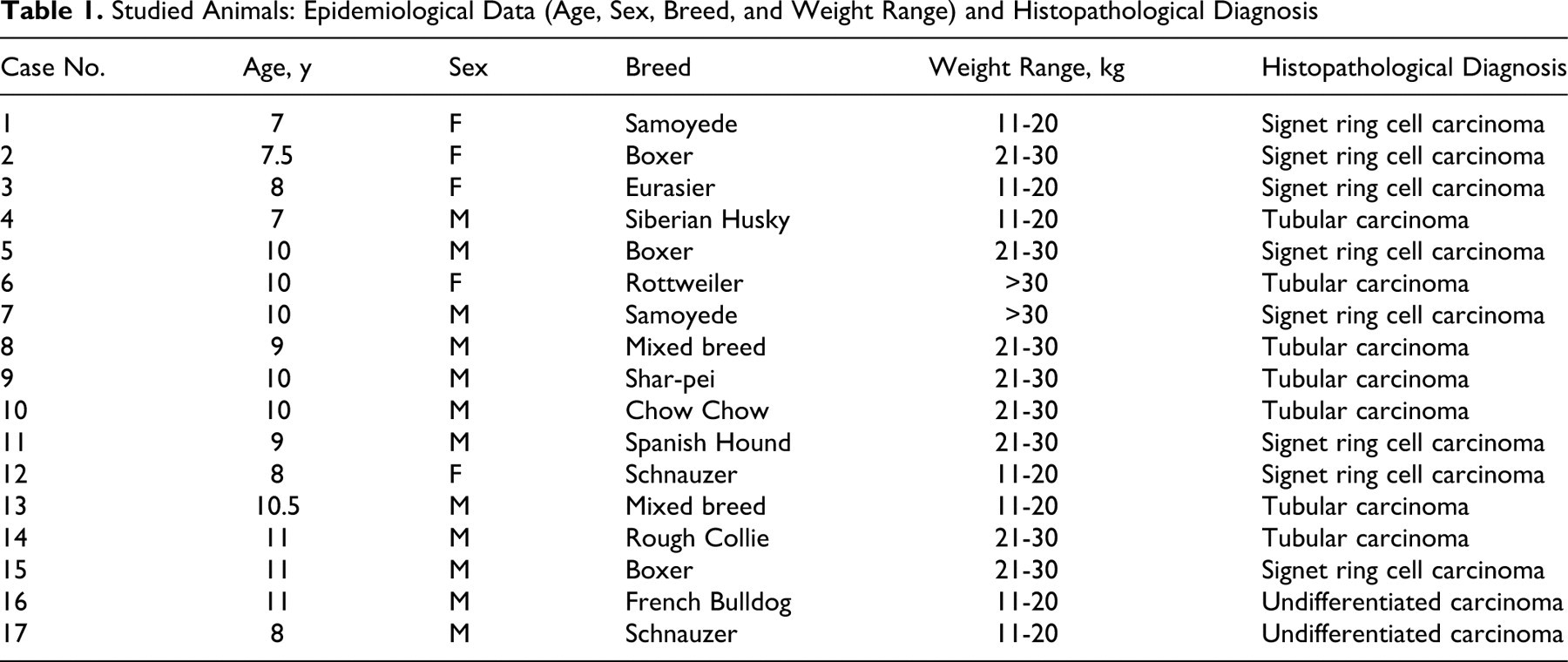
Seventeen cases of canine gastric carcinomas diagnosed at the Veterinary Teaching Hospital of Complutense University of Madrid from 1995 to 2007 were evaluated in this study. The dogs ranged in age from 7 to 12 years with a mean age of 9.2 years. The male to female ratio was 12:5. Medium to large breeds, 10–30 kg, were the most common (93%). No small dogs (<10 kg) and only 1 large dog (>30 kg) were within the study group (Table 1). Tumor samples were obtained either at necropsy or by endoscopy. All tissues were routinely formalin fixed and paraffin embedded.
Studied Animals: Epidemiological Data (Age, Sex, Breed, and Weight Range) and Histopathological Diagnosis
Sections from each tumor were stained with hematoxylin and eosin (HE), Masson’s trichrome, and periodic acid-Shiff (PAS). Tumors were categorized according to the WHO classification. 15
Eighteen histological parameters, including some parameters of malignancy, were assessed in all the tumors: mitotic index, metaplasia, dysplasia, evident and multiple nucleoli, pleomorphism, deep infiltration, glandular cyst formation, vascular dilatation, vascular invasion, distal metastases, ulceration, necrosis, edema, fibrosis, congestion, hemorrhage, type of inflammation, and the presence of secondary lymphoid follicles 2,7,11,21 (A. Benito, unpublished doctoral dissertation, 2007; M. García-Sancho, unpublished doctoral dissertation, 2005; Teseo Database: http://www.educacion.es/teseo).
Immunoreactivity of p53, p21, p16 Hsp27, and Hsp70 was investigated by using the SABC method on deparaffinized sections. The following antibodies were used in this study: polyclonal rabbit anti-p53 antibody (CM1, Novocastra); monoclonal mouse anti-human p21 Waf/Cip1 (clone SX118, Dako Glostrup, Denmark); mouse monoclonal anti-human p16 (clone 432, Novocastra Newcastle Upon Tyne, United Kingdom); mouse monoclonal anti-human Hsp27 (clone 2B4, Novocastra Newcastle Upon Tyne, United Kingdom); and monoclonal anti-human Hsp70 (clone 8B11, Novocastra Newcastle Upon Tyne, United Kingdom).
Antigens were unmasked by placing slides in a steel pressure cooker containing 2 liters of 10 mM sodium citrate buffer (pH 6.0) and heating for 3 minutes after the maximum pressure been reached. The slides were cooled to room temperature (RT) in the citrate buffer for 20 minutes and then washed in distilled water followed by Tris-buffered saline (TBS) (0.1 M Tris base, 0.9% NaCl, pH 7.4). Sample were then incubated for 15 minutes with 1% hydrogen peroxide to block endogenous peroxidase activity followed by a 5-minute wash in distilled water and a 5-minute wash in TBS. For p53 detection (CM1), sections were incubated for 30 minutes with protein-blocking sera (normal swine serum code no. X0901, Dako) at a 1:30 dilution. Otherwise, protein-blocking sera were not used.
The slides were then incubated overnight at 4°C with the primary antibodies. The following dilutions were used: anti-p53, CM1, 1:400; anti-p21, SX118, 1:50; anti-p-16, clone 432, 1:20; anti-Hsp27, clone 2B4, 1:20; and anti-Hsp70, clone 8B11, 1:20. Positive and negative control slides were included with each batch of slides. Specific, positive-control human tissues were used for Hsp27 (normal human skin) and Hsp70 (lobular breast carcinoma and colorectal carcinoma) immunostaining according to the data sheets. Additionally, we included HSP-positive canine tissue from a squamous cell carcinoma (skin) 35 and an intestinal tubular carcinoma. Canine tissues from intestinal carcinomas with known antigen profiles (A. Benito, unpublished doctoral dissertation, 2007.) were used as positive controls for p53, p21, and p16. Negative control slides were incubated with TBS without primary antibodies.
The slides were then incubated with anti-mouse biotinylated secondary antibody (Vector, Burligame, CA, BA 2000, 1:400, 30 minutes at RT) or swine anti-rabbit biotinylated secondary antibody (Dako clone no. E0353, 1:200, 30 minutes at RT). This was followed by incubation with SABC (Zymed, San Francisco, CA, P50242, 1:400, 30 minutes at RT). Slides were washed 2 times for 5 minutes between each step with TBS. Immunoreactivity was visualized by reaction with 3′′3-diaminobenzidine (Sigma Chemical Co., St. Louis, MO D5050) and H2O2 (0.01%) in distilled water. Slides were washed in tap water for 10 minutes, counterstained for 2 minutes with Carrazzi’s hematoxylin, washed again in tap water, dehydrated, and mounted.
Light microscopic evaluation of immunoexpression was performed by counting positive and negative tumor cells in each tumor section (40× magnification). The immunoexpression indexes were calculated as the average of percentage of positive cells in 5 representative fields for each tumor. 3,10,18,19,23,26,35,44 For each tissue section, staining was scored as absent (grade 0), mild (grade 1: <10% positive cells), moderate (grade 2: 10–50% positive cells), and high (grade 3: >50% positive cells). Grades 0 and 1 were considered to be negative. Nuclear immunostaining was considered positive for p53, 10,44 p21, 18,19 and p16, 23 whereas both cytoplasmic and nuclear staining were deemed positive for Hsp27 and Hsp70. 3,26,35,36
Statistical analyses were performed using the chi-square test or the Fisher exact test to compare expression indexes with pathological parameters. Correlation among different variables was determined using the Spearman rank correlation analysis. A P value ≤.05 was considered statistically significant.
Results
Histological Classification
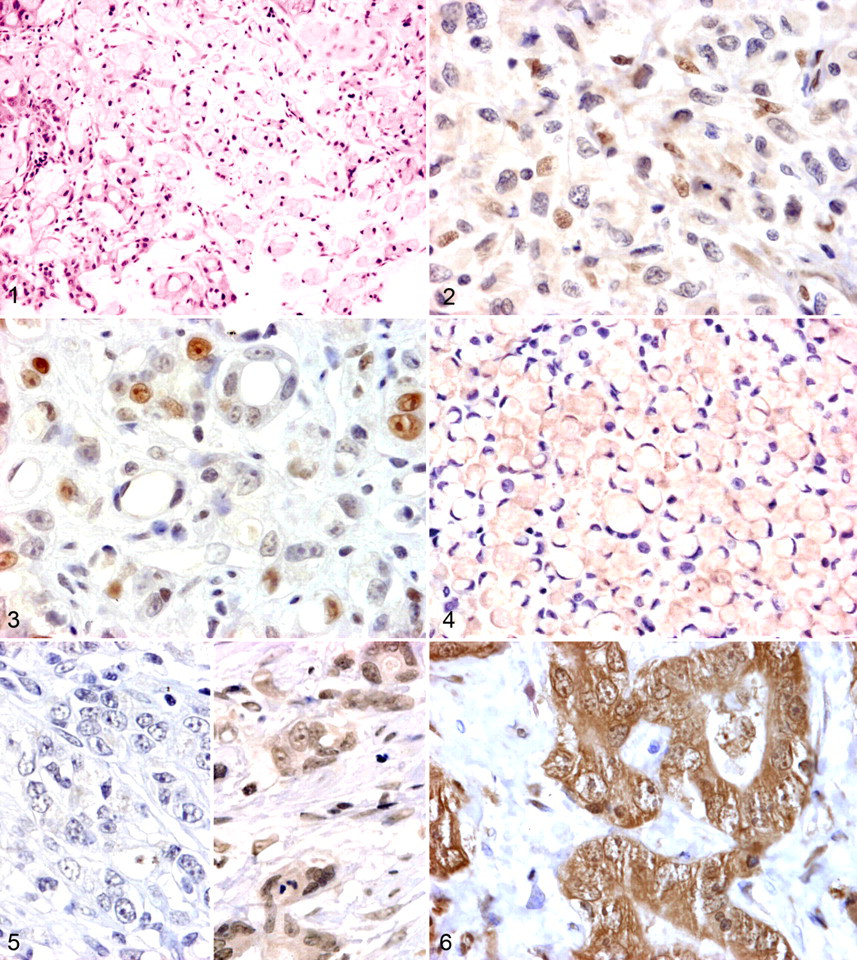
According to the WHO classification for domestic animals, 15 47.05% of the tumors were signet ring cell type (Fig. 1 ), 41.18% were tubular type, and 11.76% were undifferentiated type. No papillary or mucinous type carcinomas were present in this study. No significant differences in CCP and HSP immunoexpression were found in canine gastric carcinomas according to their histological type.
Immunohistochemistry
Expression of p53
Positive nuclear p53 staining (defined as >10% of positive cells) was observed in 94.1% of the tumors (Fig. 2), with a mean p53 index of 61.96%. The mean p53 immunoreactivity was significantly higher in the group of tumors with deep tumor infiltration (P = .0258). The mean p53 immunoexpression was 69.92% in those tumors that exhibited deep infiltration and only24.83% in the rest.
Expression of p21
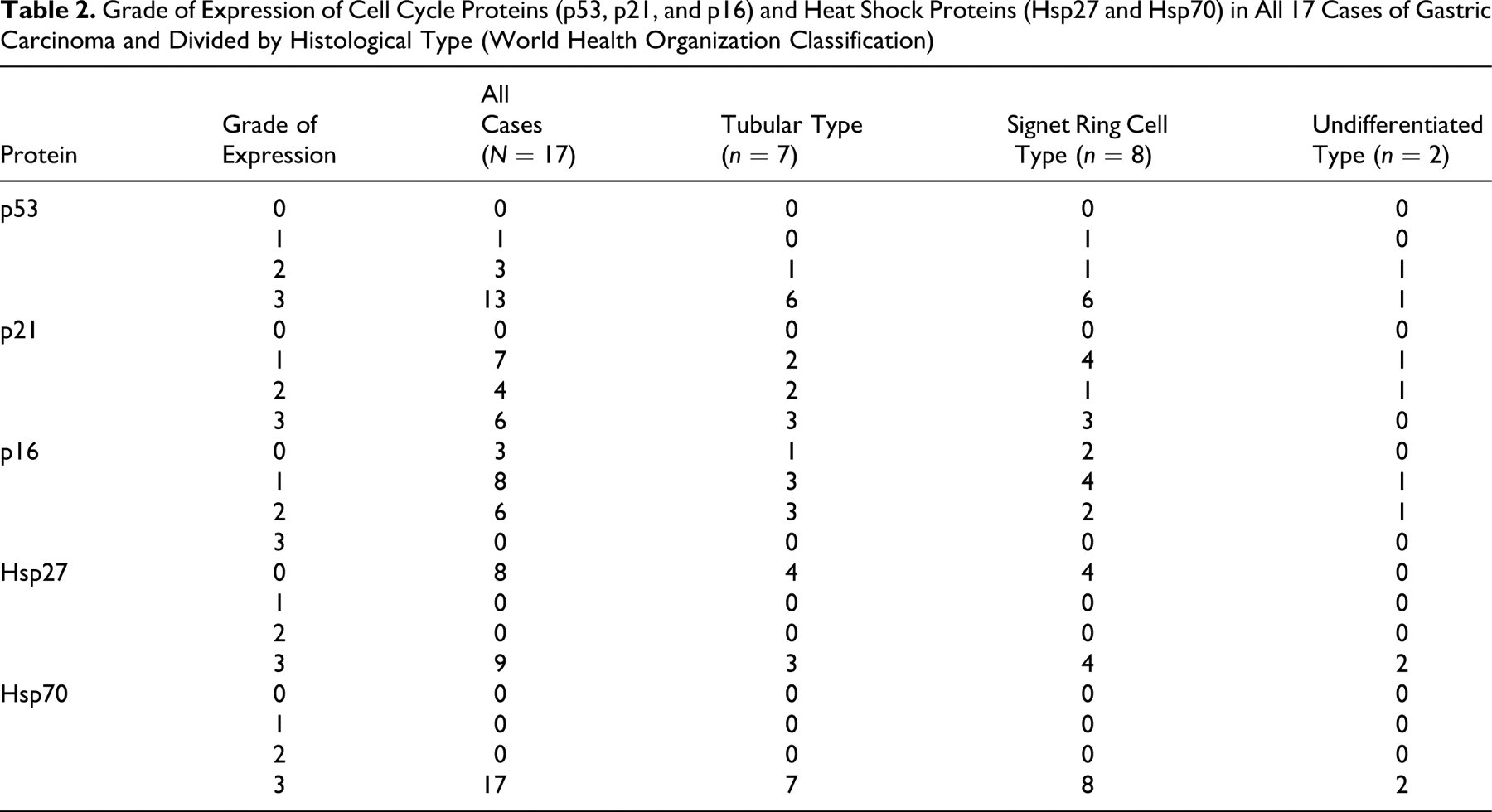
The mean p21 immunoexpression index was 34.65%. However, 58.8% of the cases had positive p21 nuclear immunoreactivity (grades 2 and 3: >10% positive cells), 33.5% of all tumors expressed high-grade staining (Fig. 3), and 23.5% had moderate-grade staining. Our results demonstrated a lack of p21 expression (grade 1, <10% of positive cells) in 41.2% of the dogs. There was a negative association between p21 immunostaining and vascular invasion (P = .0258). Moreover, undifferentiated carcinomas displayed lower p21 indexes than tubular or signet ring cell types, even though this was not statistically significant. There was a 16.1% p21 expression in undifferentiated carcinomas, in contrast to 31.79% in the signet ring cell type, and 29.5% in the tubular type (Table 2).
Grade of Expression of Cell Cycle Proteins (p53, p21, and p16) and Heat Shock Proteins (Hsp27 and Hsp70) in All 17 Cases of Gastric Carcinoma and Divided by Histological Type (World Health Organization Classification)
Expression of p16
Immunoreactivity to p16 was mild in the majority of the carcinomas studied (Fig. 4), with a mean expression index of 10.41%. Positive immunostaining was found in 33.5% of the tumors, but high-grade expression was not observed. The lack of p16 immunoreactivity was related to some histopathological characteristics of malignancy, such as the presence of evident and multiple nucleoli (P = .0475). However, deeper tumor infiltration was observed in those carcinomas with an increased p16 index (P = .0475). Our results demonstrate a positive correlation (r = 0.5988, P = .0142) between p16 index and p21 index in canine gastric carcinomas.
Expression of Hsp27
Two groups of gastric carcinoma were evident based on Hsp27 expression. One group showed lack of Hsp27 expression (41.2%), whereas the other had high-grade (Fig. 5) immunoreactivity within the cytoplasm and the nucleus (58.8%). Hsp27 staining was less intense than the staining obtained with human tissue and also less intense than Hsp70 (Figs. 5 and 6). Differences in Hsp27 immunoexpression were not related to any of the histopathology parameters. However, it appeared that the undifferentiated type of carcinomas displayed a higher Hsp27 immunostaining (93.97%) than the other types (44.36% and 45.27%, respectively), even though it did not reach statistical significance.
A negative correlation was observed between the Hsp27 and p53 indexes (r = –0.6400, P = .0057). The group of tumors that displayed a lack of Hsp27 expression exhibited a higher mean p21 expression, 47.36%, whereas those with high-grade Hsp27 immunoexpression had a mean p21 index of only 25.75%.
Expression of Hsp70
Similar to Hsp27, Hsp70 immunostaining was both nuclear and cytoplasmic. However, the staining appears much more intense than staining observed for Hsp27 (Fig. 6). Hsp70 immunoexpression was high grade (Fig.6) in all gastric carcinomas in the current study with a mean expression index of 88.66%. This high immunoexpression trended toward association with malignancy parameters such as presence of mural infiltration, but statistical significance was not achieved (P = .054). A relationship between Hsp70 and p53 expression was observed, although statistical significance was not achieved in this limited cohort. The mean Hsp70 expression was 90.7% in high, p53-index carcinomas (grade 3) versus 83.05% in the rest of the tumors.
Discussion
Our study confirms that gastric carcinoma most commonly affects older dogs: all dogs in this study were 7 years of age or older, and only 3 of the 17 dogs were between the ages 7 and 8 years. 32 Our results show a male to female ratio of 12:5, similar to proportions reported in previous studies and possibly indicating a male predisposition. 9,12,13,39 The mean ages of males and females with gastric carcinoma were 9.7 and 8.1, respectively.
The WHO classification for tumors in domestic animals 15 has previously been used in several studies of gastric carcinoma. The percentages of canine gastric carcinoma types vary between studies, but tubular, signet ring cell, and undifferentiated carcinomas are the most common. 9,14,24 In this study, the most frequent tumor type was signet ring cell (8 cases), which is consistent with a previous study in dogs 9 and studies of human gastric carcinoma. In our study, the frequency of signet ring carcinoma was closely followed by tubular carcinoma (7 cases).
Expression of p53 has been widely reported as a prognostic marker in human cancer. The mean p53 index in the gastric carcinomas of this study is 61.96%, higher than the percentages reported in previous studies of canine gastrointestinal tumors. 10,44 Although no relationship has been found between p53 expression and histological parameters of malignancy in canine gastrointestinal tumors, 10,27,44 such an association has been frequently documented in human gastric carcinomas. 1,8,47 The results of the present study show an association between p53 staining and the depth of tumor invasion (P = .0258). This particular association is also described in human gastric carcinoma. These data may confirm the utility of p53 immunoexpression as a prognosis factor in canine gastric carcinomas.
Both increased expression and absence of expression of p21 have been described in human gastric carcinomas. 16,41,47 Our study revealed that 58.8% of cases displayed moderate to high p21 staining, whereas the rest (41.2%) showed a lack of expression. There was a statistical association between the loss of p21 expression and lymphatic vessel invasion (P = .0258). A trend of low p21 index was found in the undifferentiated type of carcinomas, but this did not reach statistical significance. Our results with regard to p21 agree with the data reported in human medicine, where the lack of p21 expression has been related to histological parameters of poor prognosis. 1,31,47 This is especially true of the undifferentiated type of carcinomas. 6,38,47
In human gastric carcinoma, analyses of levels of expression of p16 reveal similarity to those of p21: as a whole, there is increased expression of p16, but loss of expression has been associated with histopathological features of malignancy such as infiltration and undifferentiated type. 17,28,34,46 In contrast, we found low p16 immunoexpression with a mean of 10.41%. Sixty-five percent of the tumors were classified as negative for p16, that is, either 0% or less than 10% immunoexpression. In veterinary medicine, Koening et al 23 reported a loss of p16 expression in canine melanomas. In human medicine, a high level of p16 expression is associated with mutations in genes encoding the retinoblastoma proteins (Rb) and p53. The overexpression of Rb and p53 might also occur in a few of our cases in which a positive association was found between moderate p16 index and depth of tumor infiltration (P = .0475). Still, lack of p16 expression in human cancer is a bad prognostic indicator, similar to our findings that lack of p16 expression is statistically associated with malignant histological criteria like the presence of evident and multiple nucleoli (P = .0475). These different mechanisms suggest the existence of several pathways of p16 activation, so that we can not exclude the hypothesis of a different pathway, yet unknown, in dogs compared with humans.
A positive correlation between p16 and p21 was found (r = 0.5988, P = .0142) that might be attributed to their common, p53-dependent, transcriptional activation pathway. Under conditions of DNA damage or stress, wild-type p53 is activated by phosphorylation and induces the expression of p21 and p16 (inhibitors of the phosphorylation of the cyclin–cdk complex that regulates the progression of the cell cycle) in an attempt to stop the cell cycle and repair DNA damage. Thus, cells with wild-type p53 protein either repair their DNA or undergo apoptosis. Mutations in p53 can contribute to neoplastic transformation because it is unable to induce p21 and p16 expression. Moreover, a mutated, nonfunctional p53 protein tends to accumulate in cancer cells, causing apparent increases in immunodetection. The loss of p21 and p16 expression and increased p53 immunodetection have been related to histological features of malignancy and poor clinical outcome in human gastric carcinomas. 1,4,8,17,28,30,31,34,38,46,47
High-grade expression of Hsp70 was present in all tumors in this study. In contrast, Hsp27 expression was not detected in 7 tumors, but the remaining 10 tumors exhibited high-grade immunoexpression. Increased Hsp27 and Hsp70 indices are commonly described in human gastric carcinomas, 3,5,20,25,29,42 although absence of Hsp27 immunoexpression has not been reported. No relationship was found between Hsp27 expression and any of the histopathological parameters. However, the undifferentiated carcinomas had high-grade Hsp27 expression. In contrast, Romanucci et al 35 reported that Hsp27 expression seems to vary directly with cellular differentiation in canine squamous cell carcinoma.
In our study, Hsp70 overexpression seemed to be linked with malignancy parameters, such as the depth of mural infiltration, but statistical significance was not demonstrated. In several studies of human gastric carcinomas, correlations between Hsp70 expression and malignancy parameters of poor prognosis have been reported, 3 but there are no published studies reporting correlation in veterinary medicine.
Our results suggest a trend toward a positive correlation between Hsp70 and p53, but statistical significance was not achieved. However, a negative correlation exists between Hsp27 and p53 (r = –0.6400, P = .0057). It has been reported that p53 mutation contributes to tumor transformation; mutated p53 is unable to play its suppressive effect and therefore allows HSP transcription. With regard to the negative correlation between Hsp27 and p53 immunoexpression, we hypothesize that might be due to induction of HSP expression by p53-independent mechanisms, which may differ between humans and dogs. Additional studies are necessary to support this theory. Factors such as p53 or Hsp70 immunoreactivity could be significant prognostic indicators for veterinary clinicians.
Footnotes
Acknowledgement
We are grateful to Fernando Gallardo for his excellent technical assistance, to Santiago Cano for statistical data management, and to Michael Kainz for his assistance with scientific English.
The authors declared that they had no conflicts of interest with respect to their authorship or the publication of this article.
PhD fellowship of V Carrasco was supported by the Spanish Ministry of Science and Education.