




Abstract
The early consequences of global climate change (GCC) are well documented. However, future impacts on ecosystem health, and on the health of humans, domestic animals, and wildlife, are much less well understood. Evidence of increasing frequency of extreme weather events (the 2003 trans-European heat wave, extended droughts in Australia and South America), of geographic changes in vector-borne disease (bluetongue and hanta viruses emerging in northern Europe, dengue virus expanding in central and northern America), and of altered animal behavioral responses (changes in bird migration patterns and fishery numbers) warrants action. To make valid choices, however, practitioners and decision makers must understand what is known about GCC and what is only theory. There will be a multitude of microbial, vector, and host responses to climate change, for example, and not all organisms will respond similarly or across equal time scales. Unfortunately, for many organisms and ecosystems the scientific community has a relatively poor understanding of current effectors and balances, making it problematic to describe the current situation, let alone to validate future predictions. The need for enhanced basic research and systematic surveillance programs is obvious, but putting such programs into place is daunting. However, the threats are real and fast approaching. What is done in the next few years may be decisive, whether for the good or the ill of all.
The universe is not required to be in perfect harmony with human ambition.—Carl Sagan
Controversy has swirled around global climate change (GCC) for decades. Some countries made firm commitments to mitigate its effects in the 1990s, but others have joined only recently. There is strong scientific evidence to support GCC and its direct relationship to anthropogenic greenhouse gases (GHGs), primarily carbon dioxide (CO2), methane (CH4), and nitrous oxide (N2O). 32,37 The progressive consequences and ripple effects of GCC are less certain but are likely to include a wide array of impacts on emerging diseases of plants and of animals, human or otherwise. 28
GCC is not a simple process of steadily and regularly warming land, sea, and atmosphere. A variety of climatic dynamics arise, including changes in precipitation, ocean chemistry, and the frequency and intensity of extreme weather events as well as seasonal and geographic ecosystem shifts. 33 Furthermore, there is a difference between “climate” and “weather.” Weather is what happens at a given locality over a short period; climate is the combination of such local effects into large and long-term trends. Climate determines ecosystem health over time, but weather drives immediate outbreaks and disasters.
Veterinarians, public health officials, agriculturalists, political leaders, and the general public need to be aware of the potentials for GCC to effect changes in ecosystem health, biodiversity, and disease ranges. Because earth’s life forms have evolved for the environment in which we now exist, changing that environment quickly (ie, within decades) will strongly influence survival rates of species at all levels, having ripple effects on health impacts for all. This article addresses these issues by describing what is generally understood and/or theorized about GCC and health effects, what general conclusions can be derived, and what the future may portend. The intent is not to prescribe response plans but to lay the groundwork for identifying critical information needs and improve decision making for prevention and mitigation.
Examples of Emerging Climate Change
What We Know
Climate change is occurring
For at least the past 35 years a wide and growing bank of compelling and high-quality evidence has developed that the planet is warming. 4,8 Most of earth’s land mass has experienced a 0.20–1.00°C average temperature increase since the 1970s, with midlatitude and high-latitude areas seeing the largest changes. Arctic temperatures have increased at almost twice the mean global rate. Although land has warmed faster than oceans, the oceans are carrying nearly 80% of the total global heat increase, which is melting ice and causing thermal expansion, both of which raise sea levels. Other GCC-induced changes include earlier timing of spring events, higher elevation and higher latitude migrations of plants and animals, saltification of coastal habitats and fresh water sources, and expanded algal and zooplankton ranges in aquatic ecosystems. Extreme weather events (heat waves, droughts, floods, poor snowfall) that directly damage ecosystems and livelihoods have become more frequent. 8
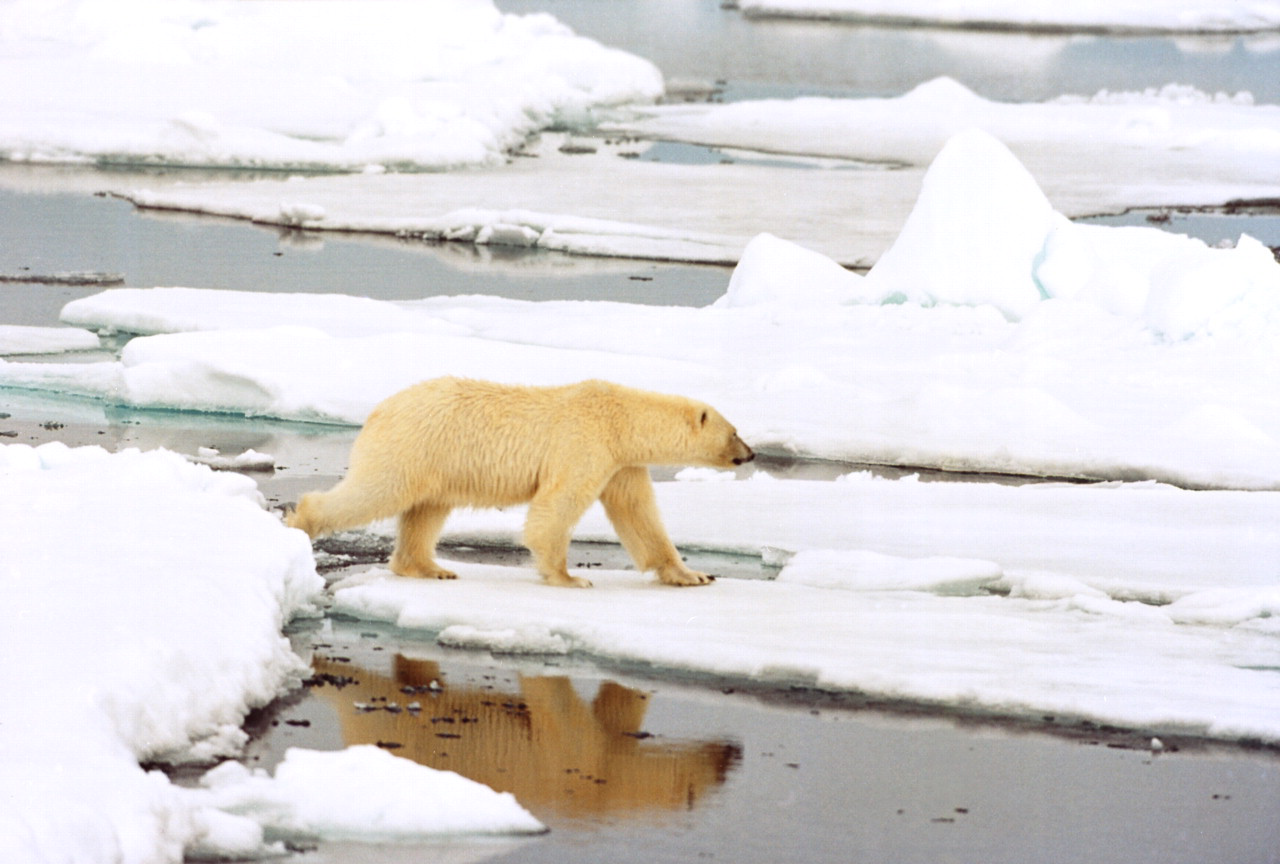
Polar bear crossings could become more complicated with global warming, as ice floes diminish and bears must swim farther to hunt, increasing mortality in the young and the old. Photo courtesy of Dr. Sharron Martin.
This warming trend closely follows rising atmospheric concentrations of GHGs, primarily CO2 from burning fossil fuels, although CH4 and N2O from agriculture, fuels, and natural processes are also major contributors. 37 Thermal actions are not the only effects of these GHG accumulations; the increased atmospheric concentration of GHGs induces biologic change as well. For instance, elevated CO2 levels selectively decrease crop growth, increase growth of weeds and/or invasive species, and depress the function of popular herbicides. 36 Increased atmospheric concentration of CO2 causes oceanic acidification, which damages estuary and coral reef systems, resulting in mass perturbations of food chains and fisheries. 5,22
Animal health and human health are tied to climate
As ecosystems are altered, our relationship to those systems is changed as well. Health impact is one such relationship. Current health events driven by weather include African Rift Valley fever outbreaks, which can be predicted based on Indian Ocean weather some weeks to months before the outbreaks; 21 recent bluetongue and hantavirus movements into and across Europe as a result of warmer habitats for vectors; 7,16 the expanding range of fungus-induced destruction of amphibians; 26 and altered human food and water accessibility. 2 Water-borne disease incidence increases as extreme rainfall events become more frequent. Data demonstrate that more than two thirds of such outbreaks follow rain events in the upper quintile of intensity. 9 GCC also directly affects the 2 major systems of photosynthesis, characterized as C3 (includes potatoes, rice, soybeans, wheat, most vegetables, and most trees) and C4 (includes mostly tropical-origin plants such as maize, millet, sorghum, and sugarcane). C3 plants are likely to have higher photosynthetic productivity under increased atmospheric CO2 concentrations, all else being equal, whereas C4 plants will not. Tropical regions and other areas and sectors dependent on C4 crops may therefore have greater losses than others, 3 with reductions in crop yields and availability of wildland feed resources. The enhanced C3 productivity potential of winter wheat, potatoes, and many vegetables may be more than offset by the temperature-induced simultaneous loss of their required winter vernalization (cold temperature induction of flowering), however, leading to decreased output despite the increased CO2, making predictions problematic. 24 The uncertainty surrounding which of these effects may predominate, and what areas of the planet will be most affected, makes prediction uncertain and GCC risk management exceptionally difficult.
What We Think We Know
GCC impacts will vary across the globe
From 2000 to 2004, more than 98% of the people who suffered from natural disasters, many of which were caused by extreme weather events, lived in developing countries. 34 The effects of GCC will likely continue to be unequally distributed around the world. It is obvious that rising ocean levels and greater frequency of storms will disproportionately affect low-lying coastal areas. Temperature- and precipitation-induced changes in higher elevation ecosystems may produce less obvious differential effects. Habitats of beneficial or foundation species may shrink, removing longtime physical barriers to disease migration and allowing pathogens and vectors access to new populations or areas. 19 For instance, generalized warming will allow vectors to survive at higher elevations, allowing them to cross mountain ranges that currently limit their distribution. Changes in rain patterns and intensity, combined with shifts in temperature ranges, will change local environments allowing vectors to survive and migrate across areas that previously were barriers. The effects of GCC in a region may also drastically change over time. It is predicted that river systems originating in the Hindu-Kush/Himalayas and the Andes (serving a large proportion of the human population) will first experience floods and extreme high flows as glaciers and mountain ice melts but will later suffer low flows and resulting water insecurity for the same populations. 34 These water-related impacts may occur very soon. It is projected that within 2 decades, yields from rain-fed agriculture in some regions (including much of Africa) could decrease by as much as 50%, adversely affecting food security and exacerbating malnutrition. 8 The consequences of such resource losses on human health and welfare, social unrest, and the stability of governments and infrastructure are unambiguous and sobering.
It is also apparent that human capabilities to mitigate the above GCC effects will vary. Most likely, developed nations will have more economic and technological flexibility to adapt to GCC effects than developing nations. People in the industrialized West spend, on average, 12–16% of their income for food, whereas citizens of poor countries may spend nearly 70% of their incomes for food so will have far fewer options when facing rising food prices or medical needs due to GCC. 11,35 Technological advantages of developed cultures will also reduce their risks of disease, as demonstrated by the significantly lower dengue virus–related disease rates in border towns of Texas versus Mexico. The difference is attributed to the higher availability of air conditioners and window screens in Texas, decreasing people’s exposure to vectors. 30
Not all diseases or species will respond alike
Not all organisms will respond similarly to climate changes. In general, disease agents with external (eg, nonhost) portions to their life cycles are most apt to experience direct biological impacts from GCC—in general, parasites and food-, water-, and vector-borne diseases. Argulus corregoni, an ectoparasite of salmonids, for example, undergoes 2 annual generational cycles under modest temperature rises, yielding a stairstep increase in disease incidence. 20 Bluetongue, an arthropod-borne viral disease of ruminants that has recently entered northern Europe, is another example. 27 GCC will indirectly affect disease agents whose transmission depends primarily on close host-to-host contact. Such agents may therefore change little except in instances where naive and infected populations are forced together. This has happened in Chile, where an endangered deer species (Huemul deer, Hippocamelus bisulcus) now carries antibodies to cattle-derived parainfluenza-3 virus following economically driven ranching expansion into deer habitats. 25 Other such diseases include foot and mouth disease, hemorrhagic fevers, and tuberculosis. Last, diseases predisposed by host stress, debilitation, malnutrition, or postdisaster injury (which includes nearly all diseases) will see periodic spikes as populations respond to larger climatic effects and localized weather-based disasters.
However, outcomes can be very agent and habitat specific. It is expected that some vector and pathogen life cycles, or agent and host cycles, may lose synchrony by any number of causes, as in a case where a vector life cycle might be most sensitive to temperature changes but the pathogen might be most sensitive to moisture variation. As climate change progresses, the typical correlation between a warming season and increasing rainfall could vanish, thereby ending the synchrony between the vector and pathogen. Climate change has already been shown to create asynchrony between migratory bird nesting and peak food abundance. 13 The inadequate food availability during nesting is a great stressor that increases disease prevalence. At the same time, climate change may narrow available habitats, forcing birds of several species to crowd into ever smaller areas of remaining resources and increasing the chance of within-species and cross-species disease transmission. This scenario is a likely explanation for the recent dispersion of highly pathogenic H5N1 avian influenza. 12,14
Paradoxically, disease incidences could actually decrease in certain areas and for different populations as a result of GCC. For instance, as ambient temperatures rise, some ticks (Ixodes ricinus) are beginning questing behavior earlier in the year, before their mammalian host numbers rise via spring birthing. This increases tick mortality and decreases overall tick-borne disease incidence in those hosts. 29 Along the same lines, increasing temperatures may decrease the incidence of plague. Yersinia pestis, the causal agent of plague, must “block” the infected flea’s proventriculus through mass bacterial growth for transmission to occur. However, the ability to block is temperature dependent. Although roughly one third to one half of fleas at 20°C ambient temperature will block, the numbers drop by more than half at 25°C, and at 30°C the percent of fleas blocked reaches zero. 15 This change in the agent–vector relationship induced by rising ambient temperatures will likely limit the frequency and size of plague outbreaks via a change in the agent and vector relationship.
There are several other circumstances in which GCC may not increase disease prevalences: Exceeding species' upper or lower temperature ranges may cause species to shift habitats or die—but a shift does not guarantee an increase in disease spread. Improved habitat suitability for agents or vectors does not guarantee they will enter, because other limiting factors may exist, such as competition, physical barriers, or predation. Recent work on the incursion of the Asian tiger mosquito (Aedes albopictus) into the southeastern USA demonstrated that its larval stages, smaller than indigenous treehole mosquitoes (Aedes triseriatus), are taken by predators at much higher rates, for example. The higher predation limits the specie's ability to establish itself.
1
Habitat degradation may overwhelm “improvements” from temperatures and precipitation. GCC will decrease biodiversity, and pathogens, vectors, or hosts could be early victims.
6,17
What We Do Not Know But Need to Find Out Soon
We do not have sufficient climatological data or basic ecological information to make accurate localized estimates of disease risks. Current weather data are insufficient to resolve below 30-km blocks and often exist only for inhabited altitudes, 33 leaving large parts of the Earth’s biosphere as terra incognita regarding climate and change. Similarly, databases and surveillance capabilities for human health in much of the world are less than optimal. Information on domestic animals and wildlife is often entirely lacking. 2,4 Furthermore, climate and epidemiological models often carry assumptions that do not scale or transfer to other regions. 10 Even though certain arthropods are competent disease vectors in a well-characterized region, the same or similar arthropods may not be as competent in another region, for example. The converse assumption that apparently dissimilar ticks or insects will fail as vectors is also dangerous.
With such a lack of basic data, any conclusions drawn are speculative at best, but the situation is not hopeless. Some groups have successfully analyzed diseases of humans, livestock, and wildlife by scrupulously collecting long-term data, isolating climate effects, using sophisticated models, and including effects on vectors and reservoirs. 23
Our ability to predict the future is based on past experiences. But global climate change is a threat with which we have no experience, and we likely do not yet recognize some of the potential fragilities it will uncover. We do not know or understand what potentially catastrophic discontinuities or cascade effects may result from GCC. 31 As an example, we do not know the cumulative effects of polar ice cap and tundra melting. They will coincide with permafrost thawing, allowing sudden major releases of stored GHG, accelerating more melting and GHG release, in a potentially rapidly intensifying, nonlinear cycle. 38 Science has also yet to understand what combinations of crowding, stress, malnutrition, and disease trigger population collapses. 14 Domestic honeybees and wild bees, responsible for pollinating 35% of US crops, 84% of all cultivated plants, and many species of wild flowering plants, are under stress from several factors now and are shrinking in total population. 18 Under GCC, their synchrony with floral resources could be further destabilized, leading to crop failures and losses of important feedstuffs for wildlife, with tremendous multiplier effects beyond the bee populations themselves. We do not know whether these events are a short-term perturbation or are the start of major systemic failures. 18 Increasing ocean temperatures and acidification due to GCC and elevated CO2 concentrations are damaging estuarine and marine kelp and microalgae, shellfish, and coral reefs. This is another example of ecologically important populations showing signs of decline. 5 These are foundation species supporting food chains and nursery habitats. Their failures could precipitate cascading extinctions, but the thresholds for such a catastrophe are unknown. 28
Conclusions
The evidence that our planet is experiencing global climate change and that this change is directly related to anthropogenic GHG in the atmosphere is now widely accepted. Whether humans have the will and capability to slow, let alone stop, anthropogenic climate change is not nearly as certain. Likewise, the implications that GCC holds for ecosystem health, and therefore for the health of humankind and other animals, are at best murky. Nonetheless, we must understand to the best of our capabilities what is happening now—and what may happen in the future—to make appropriate decisions aimed at mitigating GCC’s direct and indirect effects.
We can make some reasonable extrapolations. Weather will likely become more variable, although generally warmer, with more extreme events. This variability will alter ecosystem health largely by decoupling long-standing relationships and feedback systems. Unstable conditions will promote species losses and the migrations of plants and animals to novel areas with new characteristics and vulnerabilities. In some areas the synergy of increased temperatures, higher greenhouse gas accumulations, and variable water supplies will cause the productivity of land and aquatic ecosystems (including agriculture) to precipitously decline. In higher latitudes, growing seasons may be extended; however, immigrant plant species may not adapt to the different photoperiods of higher latitudes and therefore cannot be expected to perform as well in the new areas, even if the temperature is accommodating. Evolved balances between disease agents, vectors, and hosts will very likely change. In some instances, these changes could limit disease incidence, but in other cases they will increase the disease load of already stressed populations.
The potential runaway or amplifying effects resulting from the varied combinations of multiple insults to ecosystems and populations can give rise to numerous plausible regional and global scenarios. Many of these scenarios could easily lead to ecological tipping points after which recovery, if possible, will take millennia.
Epidemiologists have long battled the relationship of information quantity and quality relative to the stage of a disease outbreak. Early in an outbreak our information is limited, incomplete, and often inaccurate, making it difficult to find the right path along the decision tree toward control. Late in the outbreak the information is often voluminous, broad, and validated. The irony is that it is during the early situation, where uncertainty is highest, that we make our most important decisions. The same is true regarding climate change and its future effects on public and animal health—doubt and uncertainty are no excuse to put off response to another day. That day is here.
Footnotes
The authors declared that they had no conflicts of interests with respect to their authorship or the publication of this article.
The authors declared that they received no financial support for their research and/or authorship of this article.