




Abstract
The expansion of global trade has ensured that the global economy continues to improve and that political liberalization promotes changes toward democracy and enhanced world peace. However, the inherent risks due to pathogens moving from one country to another within this global trade have expanded accordingly as well. International guidelines for safe trade, promulgated by the World Trade Organization, and interpreted by the World Health Organization, the Food and Agriculture Organization, and the World Organization for Animal Health, have undergone fast-paced changes in an effort to stay current with rapidly evolving emerging disease concerns. But serious gaps remain, and the threat of pathogens moving to new areas or emerging in new ways is considerable.
Keywords
If we have to rethink the way this world works, and overhaul some of our international systems, I personally believe that health deserves careful consideration for a leading role. —Margaret Chan, Director General, World Health Organization
The huge volumes of people, goods, and services moving from country to country, termed the global express, is an ever-expanding and increasingly complicated conduit supplying the least expensive options for a myriad of products to the widest possible market. 9 This global express, representing the core of what is known as globalization, has forged new links across continents and cultures and has helped to create the most prosperous period in human history. There are many modalities for measuring economies of nations and the world. One of these, the gross domestic product (GDP), is the sum of all purchases plus taxes generated within an economy. Today the world’s GDP stands at $69T, and it has increased steadily, averaging 2–4% increases annually for more than 15 years. 1,6 International trade has become an important part of the world economy, growing at 5–10% per year, and accounts for much of the GDP increases. 20 Global commerce is a major contributor to improved livelihoods and the emergence of a huge middle class in developing nations all over the world.
An unintended result is that although the world is prospering through the unprecedented expansion of the global express, this same route to prosperity also provides a plethora of possibilities for pathogens to find new places and hosts. Over the last 2 decades, the world has averaged at least 1 new extensively emerging disease every year. West Nile virus (WNV) moved across the Atlantic, perhaps in a stowaway mosquito, and became established in almost every country in the western hemisphere. SARS shocked the international health world, as it went from bats in China to farmed civet cats to a human who happened to travel to a hotel in Hong Kong, seeding 4 other continents and engendering a planetary public health panic. H5N1, the not-yet-ready-for-human-pandemic “bird flu,” moved around in backyard poultry, from China through southeast Asia into Europe along major transcontinental transport routes and flyways. And that story is not over yet, because H5N1 is now classified as endemic in several countries. Fast on the heels of bird flu was H1N1, originally dubbed “swine flu” and shortly thereafter known as the century’s first pandemic, with rapid establishment on multiple continents, where new cases were closely linked to air travel. 8
World Economy: It’s Not Your Father’s Oldsmobile
The trend to an interdependent and globalized economy began in the 1960s. Invention of freight containers allowed for large quantities of goods to be moved long distances in an orderly fashion. Satellite communications enabled those goods to be tracked in real time, without the need for slow or undependable postal services. Modification of aircraft to accommodate these freight containers made it possible to send quantities of materials in rapid fashion, especially fresh products. In the 1980s, 2 champions of neoliberalism emerged, Margaret Thatcher in Europe and Ronald Reagan in the USA, and their cries of “Let the trading begin!” rang ’round the world. There were trends to deregulate and expand the private sector, and transactions proceeded apace, quickly taking on a very international character. Facilitation of trade occurred through the multilateral treaty known as the General Agreement on Tariffs and Trade, but this mechanism did not allow for sufficient participation by developing nations and so was eventually retired, with the World Trade Organization (WTO) replacing it in 1995. The WTO quickly became the “mother of all international organizations” overseeing trade and ensured the ever-expanding and profitable flows of goods and services. Today the WTO has 153 members, which account for 97% of world trade. 19 An additional 29 countries are seeking accession. WTO member nations must abide by the regulations set out by the organization. A central tenet of the WTO is “most favored nation” status, which means that all countries within the WTO must interact with each other as most favored nation concerning trade. No member country can treat another member country in a discriminatory or preferential fashion. What follows from this is that consumers have unfettered access to the best value products from the global community, even if their governments or peoples are not enamored of each other, ensuring that trade continues to flow as easily as money.
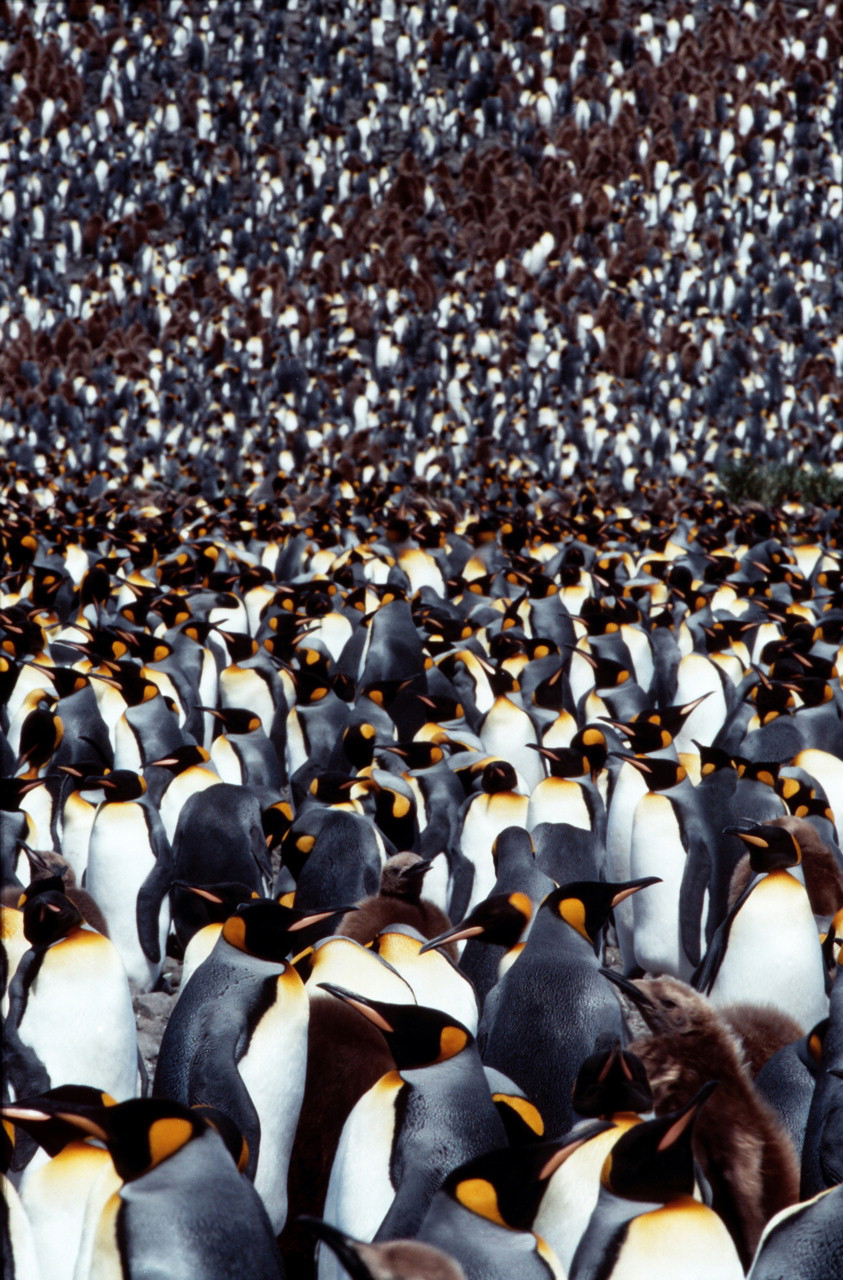
King penguins, stretching as far as the eye can see, South Georgia, part of the South Georgia and South Sandwich Islands, a British overseas territory in the South Atlantic Ocean. Photo courtesy of Dr. Sharron Martin.
As a result of all of this liberalized trade, all large corporations have expanded to become international, and the value of these multinational corporations now often exceeds the worth of many nations. Twenty-nine of the world’s 100 largest economies are corporations. Exxon-Mobil, the world’s largest corporation, has a value that exceeds 148 of the world’s 193 countries. 15 The nation-state, as a core economic and political institution, has decreasing control regarding flows of goods and services.
The unfortunate corollary of trade liberalization is that as the private sector began to run the engine of the world’s commerce, there was less investment in the public sector. With deregulation and dwindling trade tariff revenues, governments had less to invest in public health, whether it be the health of humans or the health of animals. But as a disease hits an area, it is usually public health or regulatory veterinary medicine that has to step in to control disease and protect susceptible populations. And as trade grew, so did disease risk. The inadequate response to foot-and-mouth disease seen in the UK in 2001 and the initial response to WNV in the USA are examples of faltering government programs for disease control. Put another way, private sector economics has not provided enough public resources to keep our herds and crowds safe from trade’s pathogens.
Complex Interdependence: How It Started and Why It’s Not Going Away
As a result of globalization, all countries in the world are enmeshed in a system in which they are all dependent on or affected by all other countries, to variable extents, and this matrix is known as “complex interdependence.” For a visual analogy, a giant pool table can be imagined, with each of the world’s 193 nations represented as billiard balls on that table. Prior to globalization, actions by a country could spark reactions in many neighboring countries and even in a far-flung corner of the table. One billiard ball could be sent flying, perhaps as a result of external impact and then, irrespective of control by any of the other balls on the table, create great changes in the positions on the table. These changing configurations could be considered as economic impacts, sanctions, or armed conflict. Now, because countries are tethered together by the hefty economic bonds of trade, that billiard table can be envisioned as having a heavy net draped over it. Any one ball that is struck cannot move very much without exerting slight tugs on many others and all the balls are quite constrained from making large impacts elsewhere. This is complex interdependence, and countries are connected to each other not just by treaties and culture but by the economic bonds of trade, which are more costly to break.
This complex interdependence is promoting peace and prosperity. Countries strongly connected by interdependence do not go to war with one another. The economic bonds are too costly to break so rather than swinging at an enemy when insulted, the corporations encourage governments in a very indirect way to find a way to work it out. So as the web of interdependence grows, so does world peace. The world is currently experiencing the most prolonged peaceful period in recorded history, although this is difficult for US readers to understand, given the country’s involvement in 2 international conflicts. Complex interdependence also promotes democratization. Enhanced trade is associated with improvement in the standard of living. Because corporations are reluctant to invest in countries with autocratic or irrational regimes, preferring nations that support economically favorable policies, the populace pushes for more liberalization in the government. Trade liberalization fosters economic growth, which in turn fosters more liberalization. So there has been a positive association between the development of complex interdependence and democratization. In 1900, there was not a single country in the world that could be defined as a democracy using today’s definition, that is, a government created by elections in which every adult citizen has suffrage. In 1975, there were 30 countries in the world that fit the definition. 5 Today 123 countries in the world have an electoral democracy, representing 64% of all countries in the world. 21 Democratization also further promotes peace given that no 2 modern democracies have gone to war with each other, a phenomenon known as the “democratic peace.”
These trends of prosperity and democratization have a tremendous momentum that is unlikely to be reversed. And they in turn rely on the global express, which shows no signs of slowing down. As a result, there are increasing possibilities of pathogens slipping off the rails to take hold in new locations.
Some of the Statistics Involving Global Trade in People, Animals, and Animal Products
What is it that gets moved around and how? Trillions of dollars of goods per year are moved from one country to another, and much of that is equipment and minerals. 1 However, plenty of animals, people, and food are moved as well, all entities that can take a disease from Point A to Point B.
Trade in agricultural products has increased 4% per year for the last 10 years. 20 Huge numbers of animals and animal products are moving around the world. The livestock revolution is a term derived from 2 concurrent studies completed in the late 1990s, documenting a large increase in demand for animal-based protein and predicting that sources of that protein would be in the developing world, with radical changes in animal agriculture, mostly to more intensive systems. 3,4 The term livestock revolution was a counterpoint to the green revolution of the late 1960s, an international donor-sponsored program that saw phenomenal growth in production of rice and wheat, largely as a result of improved breeding varieties, use of irrigation, and application of fertilizers, which greatly expanded crop yields. The livestock revolution refers to the continually increasing demand for animal protein and also the means in which that protein is grown and distributed. A shift to more intensive agriculture, often based in feed grains, vertical integration, and introduction of large supermarkets, is happening in developing countries. 12 And those countries are exporting more animals and meat. For 2008, a whopping 7M metric tons of beef, 6M metric tons of pork, and 8M metric tons of chicken meat were moved from one country to another. 14 Foot-and-mouth disease in the UK in 2001, which cost that country $11B, occurred as a result of a contaminated shipment of imported meat. 13
Wild animals are also frequent passengers in international traffic given that wildlife traders are robust users of the global express. Whether for pets, food, or collections, large numbers of wild species are constantly being moved across international borders. A recent assessment analyzing shipment data in the period 2000–2006 for the USA alone revealed more than half a million shipments of wildlife containing >1.48 billion live animals entered the USA. 11 Most imports were designated for the pet trade, which have no mandatory testing for pathogens before or after shipment. And, of course, 1 of these shipments contained giant Gambian rats carrying monkeypox.
Human travel is also at all-time high. People are moving from one country to another for purposes of tourism, education, or employment (legal or otherwise) in increasing numbers. International arrivals are expected to reach nearly 1.6B by 2020, which is roughly equal to the entire population of the world in 1900. 18 Of these worldwide travelers, 1.2 billion will be intraregional and approximately 350 million will be long-haul travelers. 18 The old adage—“the time it takes to circumnavigate the world today is less than the incubation period of most infectious diseases”—holds special resonance when multiplied by 350 million possibilities.
International trade moves on ships and in airplanes and, for those international shipments between countries sharing a land border, by truck. Most of the international trade is maritime. Air cargo may account for a much smaller portion but is the fastest growing portion of international trade because consumers are more willing to pay for perishable items from afar. It may have been a cargo plan landing at a New York City airport that unleashed a WNV-carrying mosquito into this hemisphere. Once maritime and air cargo is unloaded at the ports, whether seaports or airports, it is moved into trucks, which overall are responsible for 70% of the value in the movement of all goods.
Each node in this transport chain can be the source of a disease emergence. Aedes albopictus, the Asian “tiger mosquito,” was imported into the USA as an unexpected passenger in a shipment of used tires from northern Asia that arrived in Houston in 1985. Within 10 years, the insect had spread to 678 counties in 25 states, with distribution following interstate highways. 10 A. albopictus is known to be capable of vectoring 22 arboviruses.
Governance of Trade—National and International: Who Is Keeping Us Safe?
Because diseases can cross borders and oceans, there is a growing need for health practitioners of all sorts to understand the systems, rationale, and mechanics of public policy on national and global scales. How are all the trade and traffic regulated and what keeps us safe from diseases coming in as a result of this movement?
The World Health Organization (WHO), an arm of the United Nations, is the largest international body overseeing health. When the WHO began in 1948, the International Sanitary Regulations set out members' responsibilities for reporting diseases in an attempt to manage health risks spread through international trade and travel. These International Sanitary Regulations were later renamed International Health Regulations (IHRs) and for years covered only some key diseases, such as cholera, yellow fever, and plague. With the advent of SARS, the WHO rewrote the IHRs, completing the revision in 2005, with implementation in 2009. Under these new IHRs, countries have an enforceable obligation to report any severe or emerging disease, and travel restrictions can then be imposed. Because there are abundant disincentives to broadcasting the presence of a devastating disease, the IHRs 2005 go further and allow for the WHO to conduct an investigation of any rumor of disease. If confirmed, the WHO then has the authority to announce to the global community, which in turn can justify trade and travel restrictions, thereby limiting spread. 16
With respect to trade in animals and animal products, years ago each country could decide based on its own policy what to accept as imports. There were 2 philosophies—“When in doubt, keep it out” and “Don’t have a clue, let it through.” Developed countries usually fell into the former camp, promulgating overly stringent policies on accepting imports, whereas lesser developed countries would often migrate to the other extreme. Neither of these positions is tenable in today’s regulatory trading environment. In 1995, the establishment of the WTO took a very political, country-specific process of trade policy development and regularized it, so that international rules would apply to all. Today, trade embargoes can only be placed when there is a scientifically justifiable reason that animal or human health could be endangered from the entrance of specific goods. The guidelines for deciding whether there is a health risk are contained in a brief document written by the WTO’s lawyers, the Sanitary and Phytosanitary (SPS) Measures Agreement. The WTO charged more scientifically technical international organizations with drafting extensive regulations to support the SPS Agreement. For trade in live agricultural animals, the World Organization for Animal Health (formerly known as the Office International des Epizooties and still recognized by the acronym OIE) sets the scientific standards for the SPS Agreement. For many food products, the Codex Alimentarius, a commission run jointly by the Food and Agriculture Organization and the WHO, sets the standards.
The OIE, located in Paris, France, consists of a core staff and a veterinary representative from each of the 175 member countries. 17 The veterinary representative is usually the top-ranking government veterinarian in each country, referred to as Chief Veterinary Officer (CVO). The requirements for health of animals are spelled out in almost 2,000 pages of text in the Codes and Manuals written by the OIE and agreed to by all member CVOs. Any trade restrictions placed must have a scientifically justifiable reason in accordance with OIE standards. Such nontariff trade barriers are increasingly difficult to sustain, because countries unfairly embargoed can take their case to the WTO, with resulting economic penalties levied against the offending nation.
The OIE also serves as an equivalent of the WHO when it comes to reporting diseases. Reporting of 134 listed animal diseases is a requirement of OIE member nations, and since January 2005, any emerging disease or any new zoonotic disease must be reported immediately to the international community. The rationale is that rapid, accurate, and transparent reporting should allow all importing countries to understand the animal disease risks from their export partners. However, there are no equivalent IHRs for animal diseases; that is, although reporting is “required,” there are no hard mechanisms for rumor investigation and, as with human diseases, there are abundant disincentives for reporting.
The Codex Alimentarius, which is Latin for “food code,” is a set of internationally recognized standards specific for food, especially food labeling, food hygiene, food additives, and pesticide residues. It is administered jointly by 2 arms of the United Nations, the Food and Agriculture Organization and the WHO. 2 In a similar manner to the OIE, the Codex serves as the WTO arbiter regarding the SPS Agreement, but for food items rather than agricultural animals. It contains harmonized food standards that are aimed at protecting consumer health while supporting international trade. As with the OIE, if a country wishes to embargo a certain product, there must be evidence that the harmonized food standards are not being followed in the exporting country. For instance, according to Codex, melamine is not approved for adding to any food, and so a country can embargo any food containing this additive.
For wild animals, there are a myriad of international and national regulations over trade. The Convention on International Trade in Endangered Species (CITES) is an international treaty banning cross-border movement of any endangered species, live or dead. But for other wild animals, regulations are national in character and, for the USA, consist of statutes administered by several federal agencies, including the US Department of Interior, the US Department of Agriculture, and the US Department of Health and Human Services. Many believe that this patchwork nature of laws creates a system of multiple insufficiencies, which some have dubbed “broken screens.” The result is a very large number of imported wildlife for which there is not any assessment of health or invasive potential. 7
The Future: “It Ain’t What It Used To Be”
The global express continues to speed along, carrying all kinds of furred, feathered, scaled, and clothed sentient beings, as well as trillions of tons of cargo goods. The WTO system created mechanisms for enhanced trade, generating considerable prosperity, especially for poor nations, but was the equivalent of tearing down any detours, toll booths, and barricades on this international highway. That there are serious disparities in capacities to recognize, contain, or announce a new disease means that no new health issue can remain local for long. There is a yawning void at the edge of the global express. Our systems for determining disease status, whether a disease be new or established, are increasing, but the entire world remains quite vulnerable. Pathogens will continue to circulate, become established in new areas, or emerge as new entities. Knowledge concerning the tremendous increases in international commerce as well as the existence and status of global systems for protection and reporting will help to expand awareness of threats, vulnerabilities, and responsibilities. Opportunities abound for recognition of emerging diseases, participation in sound policy formation, and promotion of programs to protect the agricultural and public health. That yawning void at the edge of the global express will benefit from informed input by the entire biomedical community. With their broad training in comparative medicine, veterinary pathologists can be well positioned to contribute.
Footnotes
The authors declared that they had no conflicts of interests with respect to their authorship or the publication of this article.
The authors declared that they received no financial support for their research and/or authorship of this article.