




Abstract
Many emerging diseases in animals are initially recognized by diagnostic pathologists in animal health laboratories using routine laboratory submissions, in conjunction with clinical veterinarians and wildlife biologists. Familiar recent examples are chronic wasting disease, bovine spongiform encephalopathy, West Nile encephalomyelitis in North America, and postweaning multisystemic wasting syndrome in pigs. The recognition of new diseases in animals requires that the curiosity of diagnosticians be articulated with the capacity of animal health laboratories to create effective diagnostic teams, solicit additional cases from the field at minimal cost to clients, and develop relationships with basic researchers. Bovine neosporosis is used as an example to illustrate how a disease investigation triggered by routine clinical accessions can have international ramifications. Between the late 1980s and 1995, diagnosticians with California’s animal health laboratory system identified neosporosis as a cause of reproductive wastage in cattle, characterized the lesions, isolated the agent, defined routes of transmission, met Koch's postulates, and developed diagnostic assays. Diagnostic pathologists catalyzed the process. The neosporosis investigation in California suggests useful attributes of veterinary diagnostic laboratories that pursue emerging diseases identified through routine laboratory accessions.
Cha dèan brògan tioram iasgach [Dry shoes don’t catch fish]. —Gaelic proverb
This article addresses the role of state- and province-funded diagnostic laboratories in recognizing new and emerging disease. Its original title was “Passive Surveillance as a Core Activity of Diagnostic Laboratory Necropsy Services.” A reviewer pointed out that the term surveillance has a specific meaning among epidemiologists, who define it as the systematic collection, analysis, and consolidation of data, followed by its dissemination in processed form to contributors. 11,20 This may come as a surprise to diagnostic pathologists, not to mention law enforcement agencies. Diagnosticians tend to use the term surveillance in its original French sense, of “keeping watch.” It is therefore separate from the process of analyzing, processing, and disseminating information, other than to the client who submitted the case. Yet it is reasonable to yield hegemony of the word surveillance to epidemiologists. It is not uncommon for pathologists to take ownership of medical terms and to insist on strict definitions. The article’s amended title reflects this.
I use the term monitoring to signify the continuous generation of data in the form of completed laboratory reports on individual animals, based on routine (passively acquired) laboratory submissions. This is one form of applied public veterinary medicine and a major source of surveillance data. It is something of a red-headed stepchild in the biomedical sciences, given that so much of the work is routine and uncharismatic. Public veterinary medicine is spoken of loudly and often by veterinary college administrators in pursuit of federal subsidies for veterinary education; however, it is sometimes forgotten when those funds arrive.
In spite of its successes, there is surprisingly little published literature on the history and discipline of investigating new diseases (infectious and noninfectious) by animal health laboratory personnel. Few formal mechanisms exist to transform trained veterinary pathologists into effective diagnosticians, other than mentoring by colleagues, parts of their residency training, and seminars such as those run by the C. L. Davis Foundation. It rarely includes epidemiological training or principles of diagnostic test validation and test accuracy. This is odd, given that many emerging diseases in livestock and wildlife were characterized by diagnostic pathologists. Successful investigations by diagnosticians provide researchers with field strains of infectious agents, as well as access to serum banks, archived tissues, and DNA from spontaneous cases of disease. Pathologists are in a strategic position to direct additional diagnostic testing, based on their experience of the likely etiological significance of lesions. They often drive the decision to shift from a diagnostic to an investigative mode. It helps when diagnostic pathologists have a clinical and epidemiological background. In my experience, some of the best diagnostic pathologists are those who spent part of their career as clinicians and understand and respect the world inhabited by clinical colleagues.
Perhaps it is oxymoronic to characterize the process whereby diagnostic laboratory personnel monitor and pursue new diseases as passive. In human medicine, there is a mature network to ensure that data from routine laboratory reports are synthesized and disseminated to policy makers and the medical community. It is rare for an important emerging human disease to be identified and worked up by a single laboratory and rare indeed for that to be a state-based public health laboratory. This is not the case on the animal side. With the exception of reportable diseases and their mimes, as well as nascent efforts such as the US Department of Agriculture’s National Animal Health Monitoring System, the recognition of emerging diseases in animals in the United States rests largely on the initiative, curiosity, and creativity of veterinary and nonveterinary diagnosticians. Often these are pathologists based in state-funded diagnostic laboratories.
Laboratory-Based Monitoring of Emerging Disease
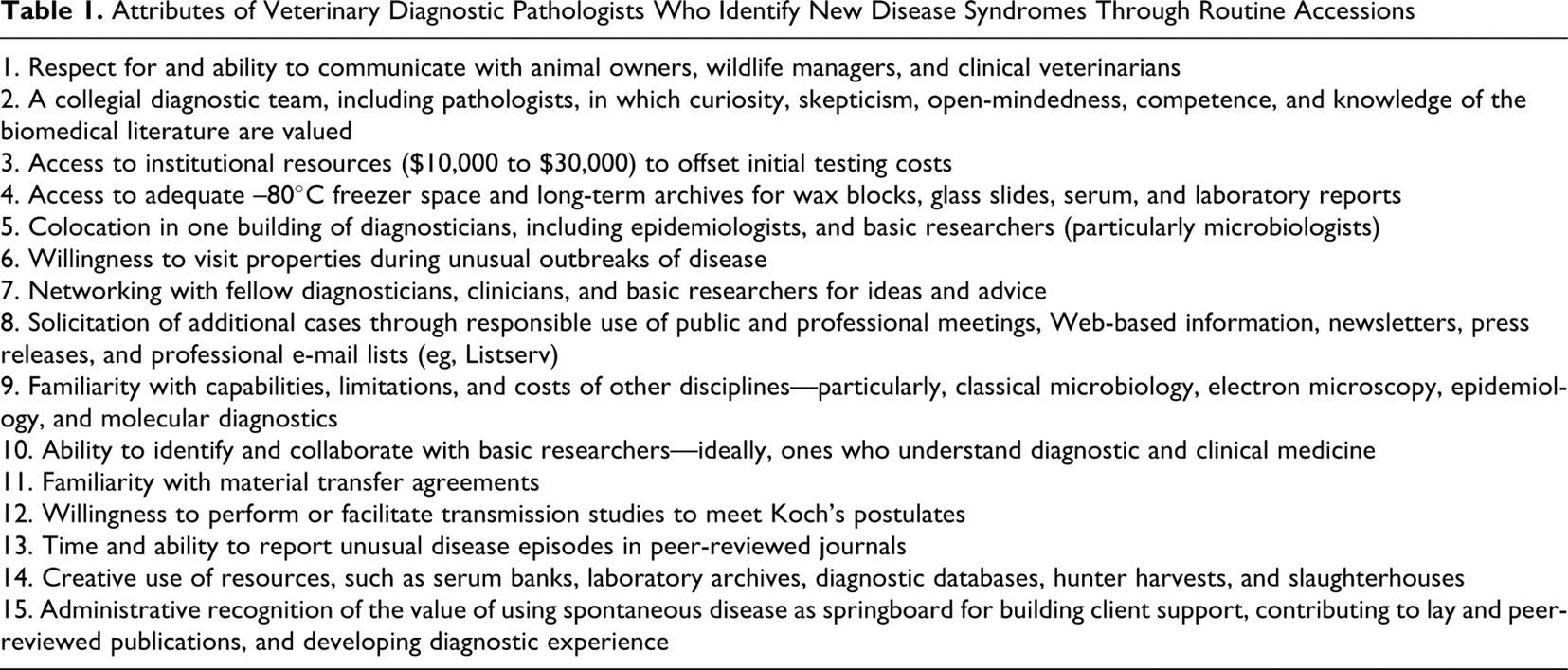
Some newly identified diseases that were recognized by veterinary pathologists will be familiar to readers of Veterinary Pathology: G. A. H. Wells at the Ministry of Agriculture, Fisheries and Food’s (MAFF’s) Central Veterinary Laboratory (CVL) in England and the emergence of bovine spongiform encephalopathy in the United Kingdom; T. McNamara with the Wildlife Conservation Society and the spread of West Nile virus to North America; E. S. Williams at Colorado State University and chronic wasting disease in captive and free-ranging deer; E. G. Clark and J. Ellis in the Western College of Veterinary Medicine in Saskatchewan and the recognition of postweaning multisystemic wasting syndrome in pigs. Interested readers might consult Saunders's biographical history of veterinary pathology to see how often creative investigation by diagnostic pathologists led to the characterization of new diseases. 24 Table 1 lists factors that may facilitate this process. One example of effective pathology-driven diagnostic investigation is bovine neosporosis.
Attributes of Veterinary Diagnostic Pathologists Who Identify New Disease Syndromes Through Routine Accessions
Case Example: The Recognition of Neospora caninum Abortion in Cattle
Neosporosis is now recognized as an important cause of abortion in dairy cattle worldwide. The causative agent, Neospora caninum, was identified but not named when pathologists at the Norwegian College of Veterinary Medicine reported encysted sporozoa in a canine encephalomyelitis and myositis syndrome. 8,9 Earlier reports recorded a similar agent in calves in New Zealand, Australia, Italy, the United States, and England. 21 The disease in cattle was variously identified as toxoplasmosis, toxoplasmosis-like, sarcocystosis, and sarcocystosis-like. It is likely that many diagnostic pathologists saw the lesions of neosporosis before the 1980s. They either did not recognize their significance or elected not to pursue the problem. For example, MAFF diagnosticians at the CVL in Weybridge, England, and in regional disease investigation centers in England and Wales recognized protozoa in the brains of aborted and congenitally abnormal calves throughout the 1980s. Characterization was hampered by two factors. First, MAFF’s disease investigation system had a spoke-and-wheel organization. Almost all postmortem examinations were performed in veterinary investigation centers. Depending on the capabilities of the center, fixed tissues were either examined in-house by veterinarians with some training in histopathology 16 or submitted to pathologists at the CVL who contended with the disadvantages of proxy necropsies. There was little incentive for MAFF pathologists to visit source properties or talk to practicing veterinarians. Second, the organization of MAFF diagnosticians, along disciplinary lines in separate buildings at the CVL, limited interaction among diagnostic pathologists, microbiologists, and epidemiologists. As a result, no interdisciplinary team was established to pursue a recurring disease syndrome unless MAFF was confronted with something truly awful, such as bovine spongiform encephalopathy. It is one thing to see a distinctive lesion or disease once or twice; but when seen recurrently, it cries out for something more than a report stating, “We see this all the time and are uncertain of its significance.”
The same lesions were seen by diagnostic pathologists at the California Veterinary Diagnostic Laboratory System (CVDLS; now the California Animal Health and Food Safety Laboratory System) shortly after a branch diagnostic laboratory was opened in Tulare, California. Tulare’s pathologists quickly identified it as a distinctive abortion syndrome in drylot dairies. At the time, veterinarians in San Joaquin, California, were so familiar with abortion rates approaching 20% that they began to wonder whether they might be normal. Diagnostic pathologists M. L. Anderson, B. C. Barr, and P. C. Blanchard performed necropsies on fetuses and routinely sampled brains as well as skeletal muscles. This was at a time when few laboratories did this, because it was considered futile to examine autolysed brains. The pathologists recognized that many aborted calves had distinctive nonsuppurative lesions, many of which contained intralesional protozoa. 1,2 Blanchard noticed a resemblance to the lesions of toxoplasmosis but ruled out that disease by serological testing. Barr undertook a retrospective study of archived slides and established that protozoan cysts were present in a high proportion of affected fetuses. The suspicion that a new agent was involved was strengthened when J. P. Thilsted in a New Mexico diagnostic laboratory reported a similar syndrome. 26 Some years earlier Thilsted’s coauthor J. P. Dubey isolated and named N caninum after examining dogs with a neurological disease. 12,13 The report by Thilsted and Dubey was the first to establish a role for N caninum in bovine abortion.
The New Mexico investigation, supplemented by reports from Washington and Maryland, 14,15,23,25 encouraged Anderson, Barr, and Blanchard to report neosporosis as an important cause of bovine abortion in California. 1 The CVDLS pathologists involved Dubey and another veterinary parasitologist, D. S. Lindsay, who provided advice and reagents. They were fortunate that Lindsay had recently described the in vitro development of N caninum and published a method to demonstrate the agent in fixed tissue. 17,18 The salient diagnostic lesions and the ultrastructural appearance of the organism in bovine fetuses were well illustrated in a series of publications from the CVDLS, alerting diagnosticians elsewhere to the syndrome. 1-3,5,6 The CVDLS’s director, A. Ardans, recognized that a successful investigation of the syndrome would demonstrate the value of the laboratory network to clients and policy makers. Ardans waived testing costs and encouraged diagnosticians to present their findings to veterinarians at county meetings. These meetings were helpful for soliciting cases of additional outbreaks and for exchanging information with clinicians who worked with the disease firsthand. The CVDLS provided laboratory space for a veterinary protozologist, P. A. Conrad, so that isolation of the protozoan could be attempted. A university epidemiologist, M. Thurmond, and a CVDLS molecular diagnostician, S. Hietala, began working with the pathologists. After processing more than 100 brains supplied by diagnostic pathologists from throughout the CVDLS system, Conrad’s laboratory isolated N caninum. 10 Isolation of the protozoan facilitated the production of improved diagnostic reagents, as well as experimental reproduction of the disease. Although hesitant at first to declare that the “Neospora-like” agent from cattle was identical to N caninum in dogs, 5,6 it gradually became clear that they were the same. Koch's postulates for its role in bovine abortion were met in 1994. 7 A useful immunofluorescent antibody test developed by Conrad was supplemented by an enzyme-linked immunsorbent assay developed in Hietala’s laboratory in 1995. 22 Serological tests facilitated larger-scale surveillance of infected herds. The CVDLS used this approach to assess the relative roles of vertical and horizontal transmission and the conclusion that vertical transmission was important. 4 A pathologist working in the California system and later in Wyoming, M. M. McAllister, was stuck by the apparent point source nature of some outbreaks. This prompted him to wonder whether dogs served as definitive host species. McAllister confirmed his suspicion in 1998. 19
The recognition of neosporosis in bovine abortion was triggered by routine laboratory submissions, but the process that it catalyzed was not passive. Once they recognized that something unusual was occurring, CVDLS pathologists solicited cases, visited dairies, exchanged ideas with veterinarians and dairy farmers, preformed retrospective studies of archived cases, compared the ultrastructure of the Neospora-like agent from cattle to that of N caninum from dogs, encouraged the development of laboratory tests, published findings, and worked with anyone who might help, including epidemiologists, molecular diagnosticians, serologists, parasitologists, and graduate students. Many diagnostic laboratories are efficient at generating reports but tend to defer to owners or veterinarians when they see something puzzling. Others, such as the CVDLS, accept the challenge of actively pursuing emerging disease syndromes and encourage laboratory personnel to take the initiative. Of course, laboratories must strike a balance between routine diagnosis and an investigative mode. But any laboratory that does not initiate disease investigations from time to time will lose touch with its client base. The bond between laboratories and clients is already tenuous owing to the anonymity of faxed/Web-based pathology reporting and the ease with which diagnostic samples can be shipped nationally. Diagnostic pathologists and their diagnostic colleagues tend to develop strong rapport when dispatched to a farm or ranch to conduct an on-site investigation. It is effective public relations for the laboratory; it is good mental preparation for a serious disease outbreak; and it is stimulating, educational, and—dare one say it—fun. There is a reason the Journal of Veterinary Diagnostic Investigation was so called and appropriate because much of the early work on bovine neosporosis was published in that journal. It was a model of integrated disease investigation by diagnosticians.
Sustaining Disease Investigation by Diagnostic Pathology Services
Some diagnostic veterinary pathologists assume that the heyday of the discipline has passed and that hard-won skills are being made redundant by molecular diagnostic medicine. Sometimes this comes with a fear-biting attitude to molecular diagnosticians. Yet new diseases continue to be presented to pathology services, and diagnostic pathologists occupy the strategic nexus to pursue them, provided they take the initiative. The increased importance of molecular diagnostics means that diagnostic pathologists need to understand basic principles of diagnostic test validation and accuracy, as well as the strengths and weakness of individual assays. For their part, molecular biologists who are willing to work on natural diseases can use diagnostic pathologists as a bridge to spontaneous outbreaks. Vibrant long-term investigative/experimental partnerships can be forged between molecular biologists and diagnostic pathologists, as occurred in bovine neosporosis. It helps when diagnostic pathologists understand what academic collaborators in the basic sciences need when they accept the challenge of working on an emerging disease: extramural grants, high-impact publications, ideas for graduate students, veterinary input, and proof from the field that the problem matters.
I teach an undergraduate course in diseases of food animals and horses. Students are shown, at the start of each semester, a list of “new” diseases identified since I graduated as a veterinarian in 1977. This is done to alert the class that, whereas common things are common, each year a typical state- and province-funded diagnostic laboratory sees at least one new disease. Many are minor, such as a novel genetic disease or a familiar infectious agent in the “wrong” species. But most diagnosticians should expect to encounter, at least once in their careers, an emerging disease of regional, national, or international significance. It should be part of their training to be alert to the encounter and to know what to do when it happens. Diagnostic veterinary medicine in North America has two strengths that are missing in much of the world: First, its laboratories employ trained pathologists, rather than veterinary generalists; 16 second, there is such diversity of institutional cultures between laboratories. It is noteworthy that in spite of a large private-laboratory sector, so many new diseases continue to be identified in diagnostic submissions by workers in state-funded diagnostic laboratories—particularly, university-affiliated ones. This exercise requires discretionary investment, such as the perennially threatened 1887 Hatch Act funds. These earmarked federal funds support applied agricultural research in land grant colleges in the United States and are often tapped to defray part of the cost of testing early in a disease investigation. An institutional culture that values field investigation among its personnel is critical, particularly when employees are assessed for promotion. It is helpful when diagnosticians and basic scientists share a common workspace so that ideas and observations can be shared and challenged.
Veterinary pathologists can make good field investigators, particularly when they have a clinical background and an awareness that they hunt best in collegial packs. It helps when they are in a workplace that encourages creative use of diagnostic accessions. Perhaps the American College of Veterinary Pathologists and the American Association of Veterinary Laboratory Diagnosticians should consider jointly offering a short course in disease investigation by diagnostic teams, focused on the role of pathologists. Regardless of formal training, there is no substitute for encouraging veterinary pathologists, especially when newly minted, to think bigger than the role of simply turning cases around quickly and efficiently. Sometimes it is the lesion that causes a pathologist to pause and curse his or her luck at seeing something unfamiliar that opens the door to a new disease.