



Abstract
Carbohydrate antigen 19-9 (CA19-9) and cytokeratin 19 fragment (CYFRA21-1) are widely used as tumor markers in clinical practice and are increased in many neoplasms. However, although increased serum CA19-9 levels have been found in some Japanese patients with renal urothelial carcinoma (UC), they have not been detected in patients from other countries or regions, and increased serum CYFRA21-1 levels haves not been reported in patients with renal UC. We analyzed serum CA19-9 and CYFRA21-1 levels in two patients with renal UC and monitored the changes in levels during postoperative follow-up. Both cases with renal pelvis UC had high levels of serum CA19-9 and CYFRA21-1, which decreased to within normal ranges after successful surgery, suggesting a causal relationship between renal UC and increased serum CA19-9 and CYFRA21-1. Because serum levels of CA19-9 and CYFRA21-1 are increased in many neoplastic diseases, they may not be reliable tumor markers for the screening and diagnosis of renal UC. However, they may be useful noninvasive indicators for assessing treatment effects in patients with renal pelvis UC with elevated pretreatment serum CA19-9 or CYFRA21-1.
Keywords
Introduction
Carbohydrate antigen 19-9 (CA19-9) is the most widely used tumor marker for pancreatic cancer, but elevated serum levels of CA19-9 have also been found in patients with other malignancies, such as gastric, colorectal, liver, and gynecological carcinomas. Cytokeratin 19 fragment (CYFRA21-1) is another important tumor marker for some neoplastic diseases, especially non-small cell lung cancer.1–4However, although increased serum CA19-9 has been found in some Japanese cases of renal pelvic urothelial carcinoma (RPUC),5–14 it has not been detected in cases from other countries or regions, and dynamic monitoring of the changes in serum CYFRA21-1 has not been reported in patients with RPUC.
Here we present two patients with RPUC who had high pretreatment levels of serum CA19-9 and CYFRA21-1. Levels of both markers gradually decreased to within normal ranges after successful surgery, suggesting the existence of a causal relationship between RPUC and increased serum CA19-9 and CYFRA21-1.
Case report
Case 1
A 54-year-old Chinese male patient presented with a 4-year history of recurrent right lumbar aching pain. He had no medical history and no episodes of urgency, odynuria, or fever. Physical examination found no palpable abdominal mass or renal percussive pain. Contrast-enhanced abdominal computed tomography (CT) showed a space-occupying lesion with multiple enlarged lymph nodes in the right renal pelvis (Figure 1). The left kidney, bowel, liver, pancreas, spleen, and both adrenals appeared normal. There were no abnormalities on chest CT. The results of routine blood tests and liver and kidney functions were also normal. Urine microscopy showed three to four red blood cells per high-power field. Detection of tumor markers was requested by the patient, and laboratory tests revealed high levels of serum CA19-9 (5163.12 U/mL) and CYFRA 21-1 (29.06 ng/mL). Other tumor markers, including carcinoembryonic antigen (CEA; 2.7 ng/mL), alpha-fetoprotein (AFP; 2.04 ng/mL), and CA72-4 (1.99 U/mL) were within normal ranges.

Preoperative radiological image of primary disease (white arrow) in Case 1: a 54-year-old male patient with a space-occupying lesion in the right renal pelvis.
Laparoscopic right radical nephroureterectomy (RNU) was performed, and based on histopathological examination of the specimen, the renal pelvic tumor was diagnosed as a high-grade UC (pT3N0M0). Serum CA19-9 and CYFRA 21-1 levels had fallen to 1958.87 U/mL and 2.27 ng/mL, respectively, on the 3rd postoperative day. Serum CA19-9 levels were further decreased to 71.38, 28.85, 28.64, and 28.58 U/mL at 6 weeks, 10 weeks, 6 months, and 12 month postoperatively, respectively (Figure 2a). Postoperative serum CYFRA21-1 levels were repeatedly within the normal range (Figure 2b). There was no evidence of recurrence or metastasis on CT and cystoscopy for 12 months after surgery.

Graphs of the time course of CA19-9 and CYFRA21-1. (a) CA19-9; (b) CYFRA21-1. RNU, radical nephroureterectomy.
Case 2
A 69-year-old Chinese female patient presented with a 10-day history of recurrent gross hematuria. Physical examination was non-informative. The patient had been healthy all her life and her family history was unremarkable. A contrast-enhanced CT scan of the abdomen and pelvis showed a heterogeneous enhancing mass arising from the lower pole of the left kidney, measuring 5.8 × 4×3.5 cm (Figure 3). The right kidney, bowel, liver, pancreas, spleen, and both adrenals appeared normal, and there were no abnormal findings on chest CT. The results of routine blood tests and liver and kidney functions were normal. Gross hematuria was evident and urine microscopy showed 2922 red blood cells per high-power field. Tumor markers were detected at the patient’s request, and showed high levels of serum CA19-9 (176.422 U/mL) and CYFRA 21-1 (24.97 ng/mL). Other tumor markers, including CEA (2.66 ng/mL), AFP (2.84 ng/mL), CA72-4 (0.73 U/mL) CA12-5 (23.3 U/mL), and CA153 (16.0 U/mL) were within normal ranges.
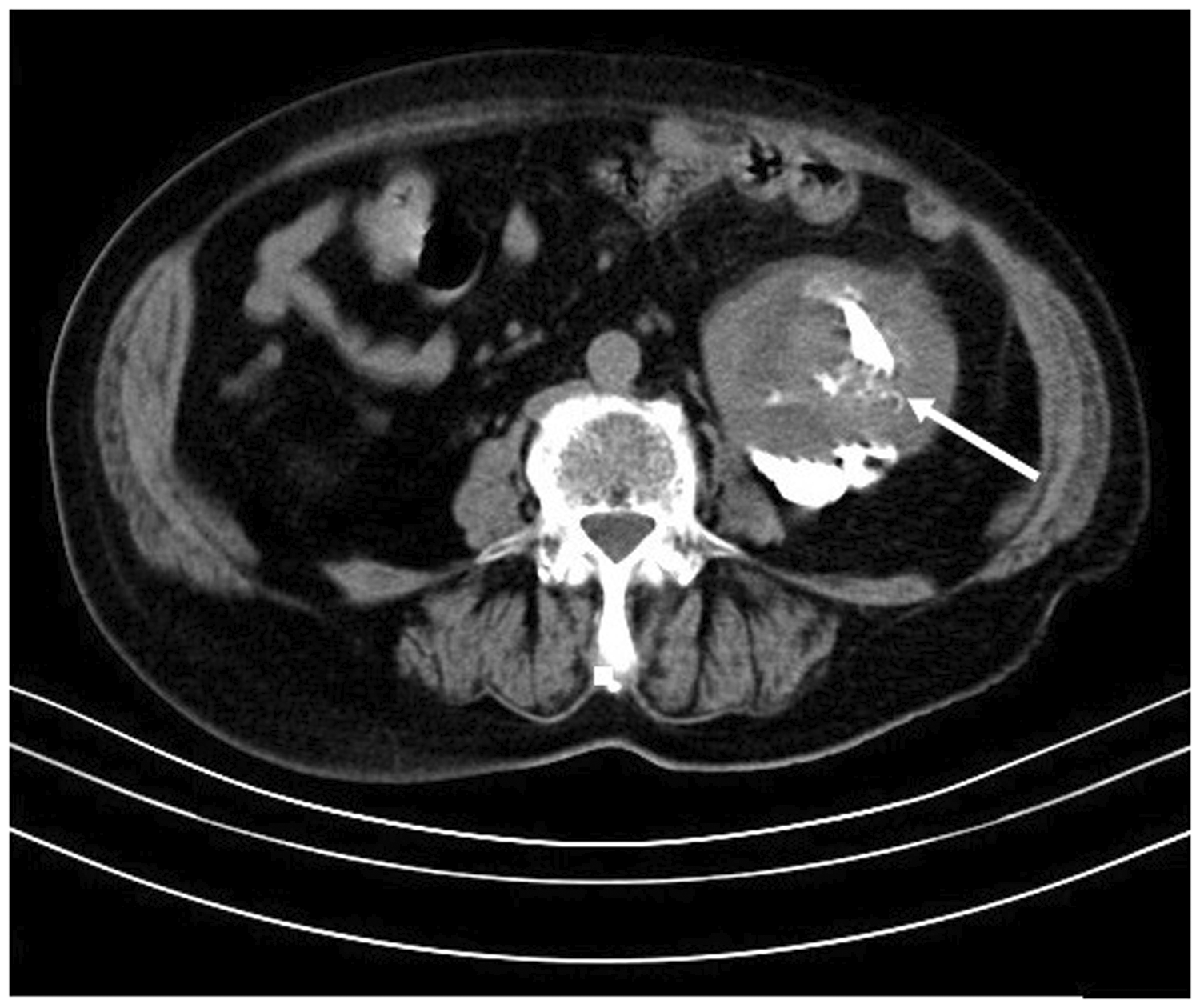
Preoperative radiological image of primary disease (white arrow) in Case 2: a 69-year-old female patient with a heterogeneous enhancing mass arising from left renal pelvis.
Laparoscopic left RNU was performed and histopathological examination of the specimen led to a diagnosis of the renal pelvic tumor as high-grade UC (pT3N0M0). Serum CA19-9 and CYFRA 21-1 levels had fallen to 112.97 U/mL and 2.94 ng/mL, respectively, at 2 days post-surgery, and 47.61 U/mL and 3.05 ng/mL 1 week later. Serum CA19-9 was further decreased to 17.84 and 4.41 U/mL at 6 weeks and 6 months postoperatively, respectively (Figure 2a). Serum CYFRA21-1 levels remained within the normal range (Figure 2b). There was no evidence of recurrence or metastasis on CT and cystoscopy at 6 months after surgery.
Discussion
We searched PubMed for reports of patients with RPUC and elevated serum levels of CA19-9 and CYFRA21-1. Eleven publications reported 21 cases of RPUC with increased serum CA19-9.5–15 All the cases were from Japan, with no reports from other countries or regions. We also found one publication suggesting that baseline serum CYFRA21-1 levels could predict the prognosis in patients with upper urinary tract UC. 16 However, the authors did not monitor dynamic changes in serum CYFRA21-1 levels after treatment. The current study thus provides the first reports showing that increased serum CYFRA21-1 levels may fall gradually to within the normal range after RNU in patients with RPUC. This is also the first report of increased serum levels of CA19-9 in Chinese patients with RPUC. Our results suggest that increased serum CA19-9 and CYFRA21-1 may be caused by RPUC, and that changes in their levels may be used for post-RNU monitoring.
UC, previously called transitional cell carcinoma, arises from the urothelium at any site in the urinary tract. UC is the fourth most common type of renal tumor, whereas RPUCs are rare and account for less than 10% of all renal tumors. According to the updated guidelines of the European Association on Upper Urinary Tract Urothelial Carcinoma, the diagnosis of RPUC mainly depends on CT urography, ureteroscopy, and selective urinary cytology. 17 Tumor stage, grade, and lymphovascular invasion are closely associated with UC prognosis. Patients with invasive tumors are at significant risk of tumor progression to either regional or distant metastases, leading to a grave prognosis. However, there is currently a lack of noninvasive, sensitive, specific, easy, and cost-effective markers for determining the anatomical pathological characteristics of UC and for predicting prognosis in daily clinical practice. Several studies 18 have reported a number of biomarkers, including NMP-22, some micro RNAs, and circulating tumor DNA, which may be helpful for monitoring postoperative conditions; however, their generally poor performance, marginal clinical utility, and potential harm make them unsuitable for inclusion in regular clinical practice. In contrast, serum CA19-9 and CYFRA21-1 are common tumor markers that are widely and regularly used in clinical practice, indicating the potential value of the current findings suggesting that these markers may be useful for monitoring patients with RPUC.
The mechanisms responsible for the elevations in serum CA19-9 and CYFRA21-1 in RPUC patients remains unknown. Hiroshi et al. 15 suggested that CA19-9 might either be produced by the tumor itself, or might be induced by high pressure in the renal pelvis. They accordingly found that hydronephrosis could contribute to CA19-9 elevation. 15 However, neither of the current patients had hydronephrosis. Furthermore, serum CA19-9 levels gradually fell to within the normal range after RNU, suggesting that the tumor itself may have been a major contributor to the elevated levels of CA19-9. CYFRA21-1 is expressed in various epithelial cells including the urothelium, and higher levels have been found in some carcinomas, such as non-small cell lung cancer, bladder carcinoma, and UC.6–8 Accordingly, the elevations in serum CYFRA21-1 levels in the two current cases may have been due to the release of CYFRA21-1 into the blood by the RPUC itself, given that levels gradually fell to within the normal range after RNU. However, the mechanisms require further study.
The current study was limited by the fact that it was a report of only two cases, and could therefore not provide statistical evidence to support the use of CA19-9 and CYFRA21-1 as tumor markers for monitoring treatment effects in patients with RPUC. The small number of cases was partly because RPUC is rare, with no more than four cases a year in our hospital. Furthermore, CA19-9 and CYFRA21-1 are not widely recognized as tumor markers for RPUC and are therefore not routinely tested for in clinical practice; these markers were only measured at the patient’s request in both cases in the present study. Given that CA19-9 and CYFRA21-1 have only demonstrated clinical significance for RPUC in a few cases, further studies on their usefulness as biomarkers for monitoring treatment effects in patients with RPUC are warranted. We were also unable to investigate the relationships between serum CA19-9 and CYFRA21-1 levels and anatomical pathological characteristics, and the prognostic values of these two tumor markers for RPUC, because of the limited number of cases. However, Mahander et al. 19 previously investigated the association between serum CA19-9 and the anatomical pathological characteristics and prognosis of general UC (UC of bladder and upper urinary tract), and found that increased serum CA19-9 levels were associated with higher stage and metastasis of UC, suggesting that serum CA19-9 may be a useful prognostic marker for UC.
Conclusion
Increased serum levels of CA19-9 and CYFRA21-1 have been detected in many neoplastic diseases, making them unreliable tumor markers for the screening and diagnosis of RPUC. However, the current study suggests that they may be useful noninvasive indicators for assessing treatment effects in patients with RPUC with elevated pretreatment serum levels of CA19-9 or CYFRA21-1.
Footnotes

Ethics statement
This study was approved by the ethics committee of Taizhou First People’s Hospital and both patients gave written informed consent for the publication of this report.
Declaration of conflicting interest
The authors declare that there is no conflict of interest.
Funding
The author(s) disclosed receipt of the following financial support for the research, authorship, and/or publication of this article: This study was supported by two grants from Medical Health Science and Technology Project of Zhejiang Provincial Health Commission [grant numbers 2019KY241 and 2020KY1040].