




Abstract
Objective
The long-term effect of extracorporeal shock wave lithotripsy (SWL) is still controversial. A previous meta-analysis showed no association between new-onset hypertension and entire upper urinary urolithiasis after SWL. Recently, there have been some reports on this topic. Therefore, we aimed to examine the association between new-onset hypertension and nephrolithiasis after SWL therapy.
Methods
Embase, the Cochrane Central Search Library, and PubMed were used to search for reports on new-onset hypertension and patients with nephrolithiasis after SWL. A meta-analysis of the association between new-onset hypertension and nephrolithiasis after SWL was carried out. The data of relevant research were synthesized and the relative risk was computed.
Results
Seven eligible studies were included in our meta-analysis. There was a significant association between nephrolithiasis after SWL and new-onset hypertension. The overall relative risk with a 95% confidence interval was 1.21 (1.11–1.31) in a fixed-effects model.
Conclusion
Our meta-analysis suggests an association between new-onset hypertension and patients with nephrolithiasis after SWL, which is in contrast with the finding of a previous meta-analysis.
Keywords
Background
Since the introduction of shock wave lithotripsy (SWL) in the 1980s, 1 it has been widely used because it is minimally invasive and convenient for patients in urology departments. According to the European Association of Urology guidelines, SWL is recommended in patients with urolithiasis <20 mm. 2 However, the long-term side effects of SWL remain controversial. Therefore, the side effects in patients with urolithiasis after SWL need to be evaluated. Currently, the following four mechanisms are thought to be involved when SWL breaks a calculus: the Hopkinson effect, cavitation, quasi-static squeezing, and dynamic fatigue. 3 Among these four mechanisms, the Hopkinson effect and cavitation are considered as the main causes of tissue damage. 3 Ischemic injury in the kidney caused by SWL is regarded as the reason why hypertension occurs after SWL. 4 Because of the different anatomical positions of nephrolithiasis and ureterolithiasis, we hypothesized that patients with nephrolithiasis after SWL therapy are more likely to develop hypertension. A previous meta-analysis examined the association between new-onset hypertension and entire upper urinary urolithiasis after SWL, 5 in which there were confounding factors. Therefore, the present meta-analysis was performed to examine recent and older literature on hypertension and nephrolithiasis after SWL.
Methods
Search strategy
We registered this meta-analysis in the International Platform of Registered Systematic Review and Meta-analysis Protocols (registration number: 202090045). Consistent with the PRISMA guidelines, 6 Embase, the Cochrane Central Search Library, and PubMed were used to review relevant published papers. The PICO search tool was applied as follows: P: patients with nephrolithiasis; I: SWL; C: patients with nephrolithiasis without underwent SWL; and O: new-onset hypertension. The terms nephrolithiasis, extracorporeal shock wave lithotripsy, SWL combined with hypertension, and blood pressure were used to search for related literature. Additionally, other related papers were manually searched from the references in the related papers on the topic. Literature retrieval was conducted by two independent reviewers (Qiao Wu and Rui Liang). The full text and abstracts of the literature on this topic were reviewed. If there was any disagreement between the two reviewers, it was sent to a third reviewer (Yi Huang) and resolved.
Inclusion and exclusion criteria
The inclusion criteria of related articles were as follows: (1) cohort study that evaluated the association between new-onset hypertension and nephrolithiasis after SWL therapy; (2) direct or indirect data could be extracted in the SWL group and control group; (3) articles written in English published between 1980 and January 2021; and (4) the hazard ratio, relative risk (RR), or rate ratio was reported in the study, or there were sufficient data to compute them. The exclusion criteria of related articles were as follows: (1) duplicate articles and articles without sufficient data; and (2) patients with ureteral calculi. The process of selecting and identifying articles is shown in Figure 1.
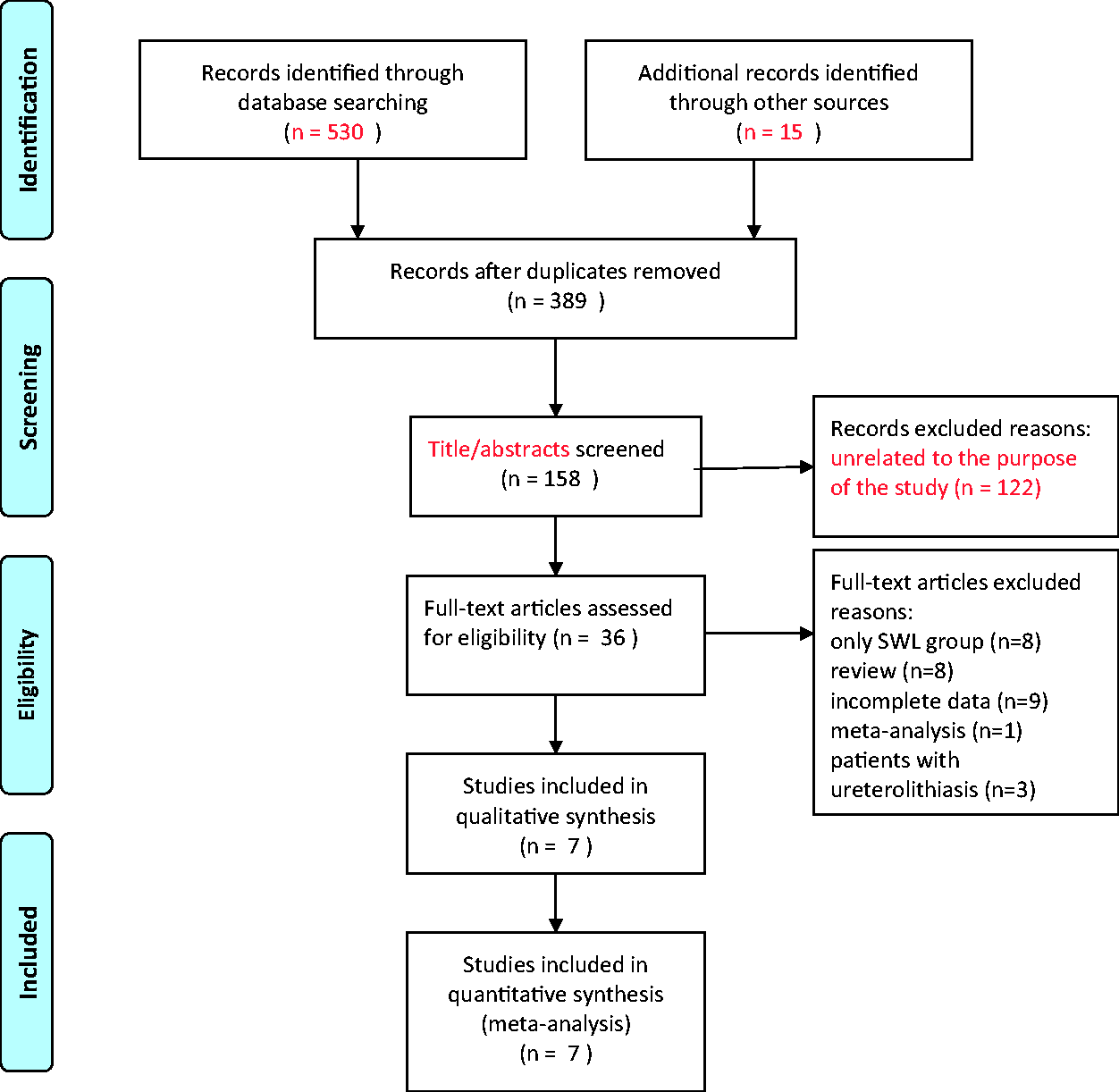
PRISMA 2009 flow diagram.
Data extraction and quality assessment
Two reviewers (Qiao Wu and Rui Liang) independently evaluated and extracted the data from each article. If there was any disagreement between the two reviewers, a third reviewer (Yi Huang) was invited to resolve the problem. No authors of original articles were contacted to obtain missing data. The data required for extraction were as follows: the last name of the first author, study design, publication year, sample size, time of follow-up, the number of patients in the SWL and control groups, and the number of patients with new-onset hypertension in the SWL and control groups. The quality of each included study was evaluated by the Newcastle–Ottawa Scale.
Statistical analysis
Review Manager (RevMan) Version 5.3 (Copenhagen: The Nordic Cochrane Centre, The Cochrane Collaboration, Denmark, 2014.) was used for data analysis. Tests for heterogeneity between the seven included studies were performed.7–13 Heterogeneity was defined as P < 0.10 or I2 > 50%. When homogeneity was adequate (P ≥ 0.10 or I2 ≤ 50%), a fixed-effects model was used for meta-analysis. Otherwise, a random-effects model was used for meta-analysis. The risk of hypertension for nephrolithiasis after SWL was assessed by the RR and 95% confidence interval (CI). P < 0.05 was considered as statistically significant.
Results
Eligible studies
Seven studies were included in the meta-analysis after our inclusion criteria were applied.7–13 The characteristics of the included studies are shown in Table 1. The publication year of the included studies ranged between 1990 and 2016. Among the seven studies, four 7,10,12,13 showed a significant association between new-onset hypertension and patients with nephrolithiasis who underwent SWL therapy. However, three studies8,9,11 did not show any significant association between new-onset hypertension and patients with nephrolithiasis who underwent SWL therapy. The Newcastle–Ottawa Scale score of each study is shown in Table 1.
Characteristics of patients in the included studies.
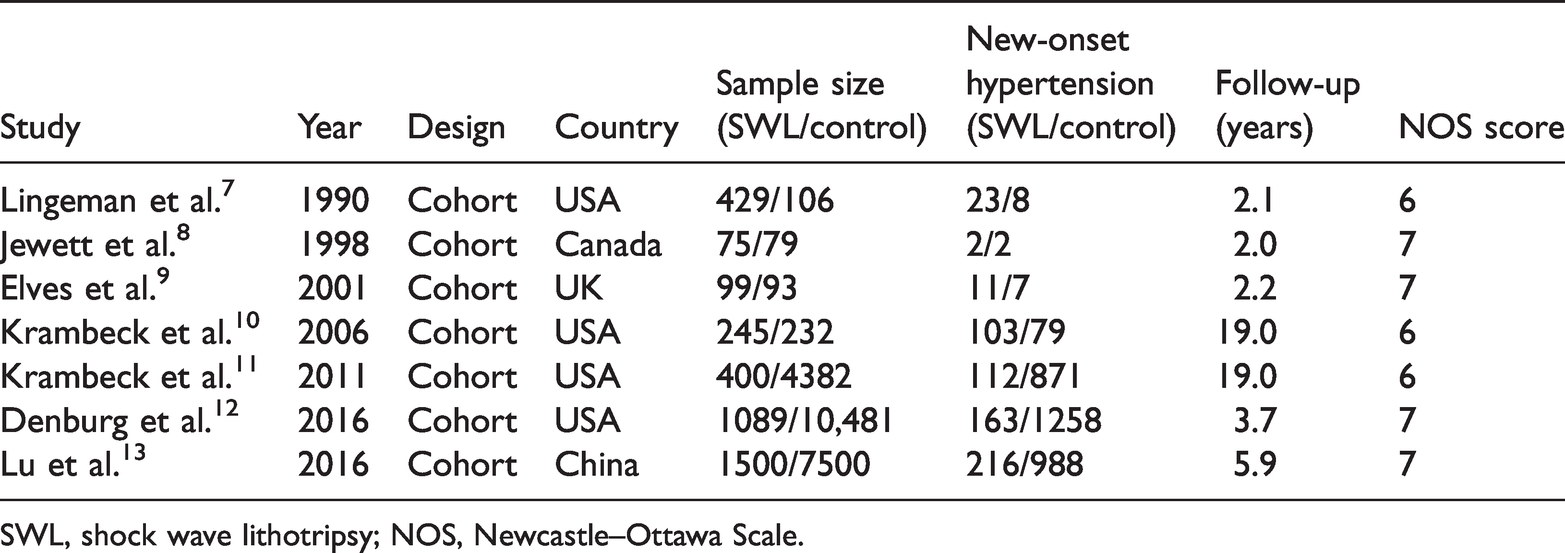
SWL, shock wave lithotripsy; NOS, Newcastle–Ottawa Scale.
Quantitative synthesis
As shown in Figure 2, a significant association was found between new-onset hypertension and SWL. The overall RR with 95% CI was 1.21 (1.11–1.31) in the fixed-effects model. There was no significant heterogeneity among the included studies in our meta-analysis (I2 = 20%, P < 0.001). We did not perform subgroup analysis because of the low homogeneity.

Forest plot.
Discussion
A previous study showed that arterial hypertension in middle-aged men was a significant predictor of nephrolithiasis. 14 Another 5-year follow-up study showed that, there was a greater risk of nephrolithiasis in patients with hypertension compared with those with normal blood pressure. 15 Furthermore, a recent study indicated that patients with hypertension were more likely to suffer from coronavirus disease 2019 infection. 16 Therefore, investigating whether nephrolithiasis after SWL increases the risk of new-onset hypertension is necessary.
A previous meta-analysis was conducted to examine the association between new-onset hypertension and patients with urolithiasis who underwent SWL in 2014. 5 This previous meta-analysis showed no significant association between new-onset hypertension and patients with urolithiasis who underwent SWL. In contrast, we found a significant association between new-onset hypertension and patients with nephrolithiasis who underwent SWL in our meta-analysis. The reasons for this discrepancy between these two studies are summarized as follows.
First, the latest date for the included studies of the previous meta-analysis was 2014. 5 In our study using our inclusion criteria, two new articles were included.12,13 Both of these included studies showed a significant association between new-onset hypertension and patients with urolithiasis who underwent SWL. An update of the literature may be the cause of the inconsistency in the findings between the two meta-analyses. Second, the heterogeneity of the previous meta-analysis 5 was high (I2 = 80%). However, the heterogeneity in our meta-analysis was relatively low (I2 = 20%). High heterogeneity may be due to loose inclusion criteria and a lack of proper controls. The previous meta-analysis comprised patients with nephrolithiasis and patients with ureterolithiasis. 5 Previous studies have shown that a shock wave can cause changes in renal hemodynamics, causing renal tubule and microvascular damage. 4 Therefore, our study that only focused on the association between new-onset hypertension and nephrolithiasis after SWL was more likely to exclude confounding factors caused by ureterolithiasis. Several studies have shown that there is a high correlation between urolithiasis and high blood pressure.17–20 These results indicate that there must be an appropriate control group, which comprises patients with nephrolithiasis, but they are untreated. Additionally, patients already suffering from hypertension should be excluded in advance in the experimental and control groups.
There are several limitations to our study. We suggest that readers interpret our results with caution. First, only seven original articles were included, which is a relatively small number. Second, many factors lead to high blood pressure, such as environmental factors21–23 and genetic factors. 24,25 Because of the different times of follow-up, verifying whether life and diet habits of patients after an SWL operation have changed is impossible. We cannot attribute only new-onset hypertension to SWL. Our study is important because we updated and revised the inclusion criteria on the basis of the original meta-analysis and reached an entirely opposite conclusion. This may provide a specific reference for clinical decisions.
Conclusion
Our study suggests that there is a significant association between new-onset hypertension and patients with nephrolithiasis who undergo SWL. A large-sample, multicenter, randomized, controlled trial with a longer follow-up is required to obtain a more definitive conclusion on this association.
Footnotes
Availability of data and materials
The datasets generated and analyzed during the current study are available in Embase, the Cochrane Central Search Library, and PubMed.
Declaration of conflicting interests
The authors declare that there is no conflict of interest.
Funding
The authors disclosed receipt of the following financial support for the research, authorship, and/or publication of this article: This work was supported by the Application and Basic Research Program of Sichuan Science and Technology Department (2020YJ0185).
Author contributions
All authors contributed to the study conception and design. The literature search was performed by GZ, YC, LC, BZ, XL, HW, and XW. Data analysis was performed by YH and CT. Data collection was performed by QW and RL. The first draft of the manuscript was written by QW. All authors commented on previous versions of the manuscript. Revision of the first draft and the final draft of the manuscript was performed by TT and TW. All authors read and approved the final manuscript.
