




Abstract
Objectives
Utilization of self-pay vaccines worldwide is very low, especially in China; the reasons for this are unclear. We aimed to identify factors that impact the decision among Chinese mothers to utilize self-pay vaccines for their children.
Methods
Mothers who were hospitalized at two hospitals in Zhanjiang City and who agreed to participate by completing the required questionnaire were eligible for this study.
Results
In total, 7518 respondents (n = 7592) completed the questionnaire and were included in this survey. The self-pay option was largely elected by mothers with one child, compared with those who had two or more children. Similarly, utilization by workers at government agencies and organizations was higher than that among factory workers or unemployed respondents. Mothers with a college degree or above had higher utilization than those with a high school level education or lower. The main issues affecting maternal decisions to utilize self-pay pediatric vaccines were safety, the protective effect, and the high cost.
Conclusion
Mothers with higher socioeconomic status were more inclined to self-pay for pediatric vaccines. Steps taken to enhance public awareness about the safety and protective benefits of self-pay vaccines, as well as lowering their cost will likely encourage broader utilization of these vaccines.
Introduction
Immunization is an important and cost-effective public health measure for nationwide protection from infection, especially in children. To broaden overall utilization, the government of China has established the Expanded Program on Immunization (EPI), providing vaccines for various diseases.1–3 Since implementation, this program has been an important step in controlling infectious diseases, especially at community level. However, many self-pay vaccines, not yet incorporated into the EPI program but introduced in the EPI program, are also available at clinics offering EPI vaccines. These optional vaccinations may be purchased individually by anyone willing and able to do so. However, until now, there is no legal documentation in China to define which kinds of self-pay vaccines are recommended, and only some documents provide expert recommendations.
Currently, utilization of self-pay vaccines worldwide is very low, especially in China, but the reasons for this are unclear. It is reported that among provinces in the eastern, central, and western parts of China (Jiangsu, Hubei, and Gansu), utilization rates in children are quite low. For example, utilization rates in Shanghai are: influenza vaccine, 11.38%; Haemophilus influenzae type b conjugate vaccine, 30.06%; varicella attenuated live vaccine, 20.84%; rotavirus oral attenuated live vaccine, 17.03%; 4 and pneumococcal vaccine, slightly >10%. 5 Studies have found that self-pay H. influenzae type b and pneumococcal vaccines have distinctly lower utilization rates than the diphtheria–tetanus–pertussis (DTP) vaccine offered at no charge through the EPI. 6 , 7
Some regions of China, especially the west, remain economically depressed and continue to face a unique set of challenges in terms of self-pay vaccines; primarily, the challenges are economic and psychological, but social challenges exist as well). 2 The World Health Organization estimates that China accounts for 14% and 5.1% of the global burden of H. influenzae type b infections and deaths, respectively, and 12% and 3.6% of Streptococcus pneumoniae infections and deaths, respectively.8–10 It is also estimated that >80% of all rotavirus-related deaths involve children in low-income countries of South Asia and sub-Saharan Africa. 11 In China, approximately 47.8% of hospitalizations in children <5 years old are attributable to rotavirus. 12 To formulate a wide-range, long-term strategy that tackles these issues in children’s health care, the inherent dynamics must be understood.
Until now, there has been no systematic investigation of factors, such as socioeconomic status or the advice of health professionals, impacting decisions on utilization of self-pay pediatric vaccines in China, which is the largest developing nation globally. 13 With such a large population, group immunity is very important to control infectious diseases at community level in China.
The aim of this study was to investigate factors that influence maternal decisions regarding self-pay vaccination of their children, providing useful data for future national health policy development and drawing attention to the importance of these optional vaccines.
Methods
Study population
All mothers hospitalized between March 2018 and December 2019 in the Maternal and Child Care Service Center of Xiashan District, Zhanjiang City or the Affiliated Hospital of Guangdong Medical University and who agreed to participate by completing the questionnaire were eligible for this study. Exclusion criteria were mothers who did not agree to participate in this survey and those who did not complete the required questionnaire.
We recruited a sufficient number of participants to assure that the sample size was adequate to address our research questions in this survey, conducted from 2018 to 2019. To calculate the appropriate number of survey respondents, we sought the assistance of a statistics expert to determine the sample size/power analysis and justification of the sample size in this survey. 14
Epidemiological study design
We followed a standard procedure consisting of oral interviews to query the following. 1) Personal information (number of children, place of work, highest level of education). 2) Awareness about self-pay vaccines for children; if none, we presented an introduction to the types, cost, and benefits of self-pay vaccines. 3) Willingness to pay for at least one vaccine for their children; if none, we assessed participants’ chief concerns, such as expense, safety and protective effect, availability, and other issues.
To ensure that the survey results were accurate, reliable and complete, all the investigators were supervised and trained in strong communication skills. Additionally, we ensured that all mothers involved in the oral interviews fully understood the interview questions. All authors had access to information that could be used to identify individual participants during or after data collection.
Ethics approval and consent to participate
This survey was approved by the Maternal and Child Care Service Center of Xiashan District, Zhanjiang City and the Affiliated Hospital of Guangdong Medical University (No. 20188265947). All participants provided their written informed consent.
Data analysis
All statistical analyses were conducted using SPSS version 15.0 (SPSS Inc, Chicago, IL, USA). Willingness of mothers to utilize self-pay vaccines for their children was defined as the dependent variable. Independent variables were recorded for each mother, including the number of children, workplace, level of education, and knowledge and availability of self-pay vaccines, among others. Independent samples t-test and one-way analysis of variance were applied for between-group comparisons and multi-group analysis, respectively. Quantitative data are expressed as mean ±standard deviation (SD) and categorical data as frequency and percentage. Statistical significance was set at p<0.05.
Results
Maternal participants
In total, 7518 mothers (median age, 27.3±9.6 years; range 18–39 years) completed the questionnaire and were included in this survey. Among them, 60.72% (4565/7518) had one child, 27.11% (2038/7518) had two children, and 12.17% (915/7518) had three children or more. Respondents’ workplaces were government agencies and organizations (2059/7518, 27.39%) and factories (4182/7518, 55.63%), with 16.99% (1277/7518) unemployed. Education levels included master’s degree (1217/7518, 16.19%), college degree (4133/7518, 54.97%), high school diploma (793/7518, 10.55%), and primary or middle school completion (1375/7518, 18.29%).
Factors involved in electing self-pay pediatric vaccinations
As shown in Figure 1, utilization of self-pay vaccines was highest among mothers with only one child (3273/4565, 71.70%), as opposed to those with two (876/2038, 42.98%) and three or more (326/915, 35.63%) children.

Influences on self-pay vaccine utilization according to number of children.
Most mothers surveyed (1539/2059, 74.75%) who were employed at government agencies and organizations utilized self-pay vaccination of their children, more so than factory workers (2451/4182, 58.61%). The lowest utilization rate was among unemployed mothers (485/1277, 37.98%) (Figure 2).

Influences on self-pay vaccine utilization according to maternal workplace.
Mothers holding a master’s or college degree (bachelor’s or associate’s) were more likely to pay for vaccinations (992/1217, 81.51% and 2561/4133, 61.96%, respectively) than mothers with a high school diploma (334/793, 42.12%) or those with primary or middle school education levels (588/1375, 42.76%) (Figure 3).

Influences on self-pay vaccine utilization according to education level.
Concerns regarding safety and the protective effects of self-pay vaccines (1656/3040, 54.42%) as well as their high cost (687/2740, 25.07%) were the two primary deterrents to vaccine utilization. Some respondents also reported lack of availability as an obstacle to utilizing self-pay vaccines (761/3040, 25.01%); only a few mothers (173/3040, 5.69%) expressed other reasons for refusing to pay for pediatric vaccines (Figure 4).
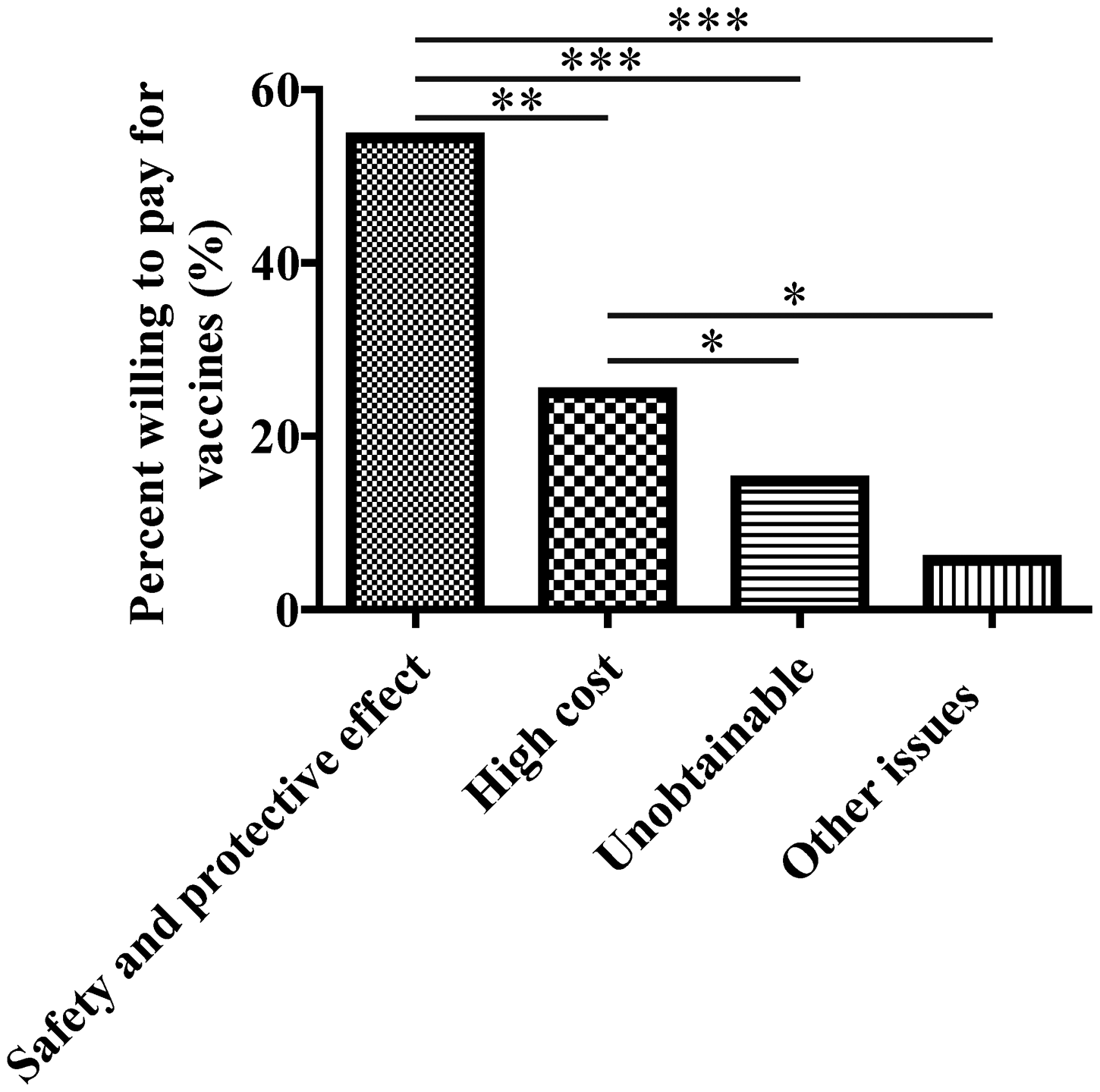
Primary influencing factors on self-pay vaccine utilization.
Discussion
Vaccinations are fundamental in preventing a host of infectious diseases. Hence, their utilization provides an indirect measure of child health care from a public health standpoint. 15 During the past several years, the implications of self-pay vaccines are substantially enhanced group immunity and control of infectious diseases at community level. One study in Spain found that influenza vaccination was effective in preventing hospitalization among older individuals age ≥ 65 years in the community. 16 A cross-sectional study, also in Spain, showed that pneumococcal polysaccharide vaccination for older adults was an important factor in limiting the impact of pneumonia in the community. 17
In China, the cost of vaccines that are not offered by the EPI must be absorbed by individuals. Among the available self-pay vaccines are those to prevent influenza and pneumococcal infection, as well as varicella, H. influenzae type b, rotavirus, adenovirus, and rabies. 4 ,18–20 Utilization of such vaccines is a matter of personal choice and circumstances. Some researchers contend that economic 21 , 22 or psychological factors 23 as well as social influences24–26 affect the decision to immunize. However, few studies have focused on the relationship between willingness of mothers in China to pay for pediatric vaccinations and social status, education level, or number of children. For many reasons, it is important to determine the chief factors influencing self-pay vaccination.
A survey conducted in France on the determinants of influenza vaccine utilization found that participants living in homes where the head-of-household was a college graduate or a high-level managerial worker were more likely be vaccinated. 27 Researchers in the United States found that lower knowledge levels and unfavorable attitudes toward vaccine safety and efficacy were barriers to influenza vaccination in pregnant women. 28 Another survey of pandemic influenza A (H1N1) vaccination in the French adult population also identified vaccine safety as a major issue. 29
In this study, mothers with only one child were more likely to utilize self-pay pediatric vaccines, compared with those who had two and three or more children. Moreover, mothers employed at government agencies and organizations were more apt to pay for vaccines than factory workers or unemployed participants. Education level had an important role in these decisions as well. College-educated mothers are more often willing to pay for pediatric vaccines than mothers with high school or lower education levels. This can also introduce social differences between wealthier and poor families in the utilization of self-pay pediatric vaccines. However, all mothers should be encouraged to utilize self-pay pediatric vaccines for their children, no matter their socioeconomic status or how many children they have. Cost is a major barrier to self-pay vaccine utilization. Data from the National Immunization Survey (1995–2013) showed that vaccination rates were increased across all ethnicities and income groups following implementation of the Vaccines for Children program in the United States, which aimed to increase vaccination uptake by removing financial barriers. 30 In this regard, gradual incorporation of these vaccines into the EPI would be extremely helpful. Furthermore, self-pay programs should be more tailored going forward, focusing on young parents with low incomes and more than one child.
Several other strong influences on the willingness of mothers to opt for self-pay vaccines have been reported elsewhere. Typically, sources of information on self-pay vaccines (e.g., influenza) have been the media (e.g., newspaper, Internet, television), doctors (obstetricians), nurses, and midwives. 29 , 31 However, public forums have a limited ability to communicate the importance of vaccination (e.g., influenza and human papilloma virus); however, this could be greatly improved with minimal professional input. 32 , 33 Immunization rates can also be improved with the help of health and public health systems and input from community members. 34 People are known to question the protective effect and relative risk of these vaccines (e.g., tickborne encephalitis) owing to the lack of large-scale epidemiologic investigations. 35 One particular survey in China on general willingness to pay for the seven-valent pneumococcal conjugate vaccine or the influenza vaccine found that economic status and psychosocial factors were the chief barriers to utilization. 1
Clearly, it seems that encouragement to utilize self-pay vaccines is needed. The government and clinicians should work together, placing greater emphasis in public campaigns on the importance of protecting children from preventable infectious diseases. Reducing the associated high costs also will likely increase vaccine utilization.
We could not reasonably exclude all sources of bias in this study. Although the two institutions involved are the largest and most authoritative governmental and specialist hospitals in the survey area, many other maternal hospitals exist in Zhanjiang. Additionally, nearly all mothers who were invited agreed to participate and completed the questionnaire, for a total of 7518 mothers over a 1-year period. Participant selection from maternal health clinics was not random, and the questionnaires used were distributed consecutively. Other limitations include our inability to tease out differences according to vaccine type (some are very expensive, some are annual vaccinations), our inability to assess which single factor was most important using multivariate analysis, and limited representativeness (both to women who do not seek health care as well as to other parts of China). Finally, there are many additional variables or covariables with the potential to influence immunization willingness in this setting that were not taken into consideration.
In conclusion, our results indicate that mothers with higher socioeconomic status and those who have only one child are more inclined to utilize self-pay pediatric vaccines. By increasing public awareness that self-pay vaccinations are safe and protective and by reducing their high cost, utilization rates in China will likely increase.
