




Abstract
Objective
Hepatocellular carcinoma (HCC) is one of the most common causes of cancer-related deaths worldwide. This study investigated the relationship between cyclin-dependent kinase inhibitor (CDKN)3 and prognosis and pathological characteristics in HCC patients to determine whether it could be used as a prognostic factor and/or therapeutic target for HCC drug development.
Methods
We previously showed that CDKN3 is deregulated in HCC tumor samples. Here, bioinformatics analysis was used to assess the relationship between CDKN3 gene expression and the characteristics of HCC patients from Gene Expression Omnibus and The Cancer Genome Atlas databases. Additionally, CDKN3 expression was silenced by small interfering RNA to determine its effect on HCC cell proliferation and on HCC cell sensitivity to adriamycin chemotherapy.
Results
Bioinformatics analysis showed a negative correlation between CDKN3 expression and both disease-free survival and overall survival. CDKN3 silencing did not significantly suppress the proliferation of HCC cells, but did decrease their sensitivity to adriamycin.
Conclusions
CDKN3 may have a dual role during the development of HCC, and could be used as an independent prognostic factor and therapeutic target for HCC treatment.
Keywords
Background
Newly diagnosed hepatocellular carcinoma (HCC) cases in China account for half of all cases worldwide, with the resulting deaths accounting for 51% of the global aggregate. 1 Although surgery is the preferred treatment option, the recurrence rate of small HCC after 5 years of treatment can be up to 70%. 2 Adriamycin, a type of anthracycline antibiotic with a similar structure to daunomycin, acts on DNA by intercalation and the disruption of its biosynthesis, and is widely used in the treatment of a variety of cancers including HCC. 3 However, after a period of adriamycin use, treated cells acquire a level of tolerance leading to tumor recurrence and treatment failure. Targeted therapy is a current hot spot in drug discovery, and although several developed drugs have shown favorable clinical outcomes, choices remain limited. Therefore, exploring undiscovered genes that affect tumor occurrence, development, and drug resistance, and identifying their mechanisms of action are of great importance in finding appropriate therapeutic targets.
Cyclin-dependent kinase inhibitor 3 (CDKN3) is a member of the protein kinase family with Krüppel-associated box repression domains that have synergistic and inhibitory effects on zinc finger proteins. CDKN3 plays a dual role in cell cycle control, either blocking or promoting cell cycle progression in specific tumors or tumor stages as well as in chemotherapeutic treatment.4,5 Unfortunately, few studies have investigated CDKN3 function in HCC so its relationship with HCC prognosis is unclear. Here, we used CDKN3 gene silencing in HCC cells to investigate its role in the regulation of cell proliferation and colonization, combining this with adriamycin application to assess cell sensitivity to chemotherapy. We also analyzed clinical data to verify the relationship between CDKN3 expression and the clinical prognosis of HCC patients.
Materials and methods
Cell culture
The HCC cell line QGY7701 was purchased from the Cell Bank of Type Culture Collection of the Chinese Academy of Sciences (Beijing, China). Cells were maintained in RPMI 1640 medium (Thermo Fisher Scientific Inc., Rockford, IL, USA) containing 10% fetal bovine serum (Thermo Fisher Scientific, Inc.) and 2 mM L-glutamine at 37°C with 5% CO2. This study does not use samples from patients or animals so ethics committee approval is not required.
RNA interference
CDKN3 small interfering (si)RNA was purchased from Shanghai Genic Pharmaceutical Co., Ltd. (Shanghai, China). QGY7701 cells were grown in 24-well plates until 70% confluent, then 20 pmol siRNA was transfected into each well using Lipofectamine RNAiMAX according to the manufacturer’s instructions (Thermo Fisher Scientific, Inc.).
Clone formation assay
Cells were transfected with siRNA-CDKN3 or siRNA-Ctr (Shanghai Genic Pharmaceutical Co., Ltd.), then collected and seeded into 6-well plates at 500 cells/well. These cells were treated with or without 1 µg/mL of adriamycin and cultured for 7 to 10 days in cultivation, then the culture medium was removed and the cells stained with 0.1% crystal violet for 5 minutes and air-dried at room temperature. The number of colonies was then calculated by ImageJ software, version 1.46 (NIH, Bethesda, MD, USA).
Clinical baseline data analysis based on dataset
HCC gene expression profile datasets
The GSE20238 dataset includes 214 HCC specimens obtained during 1995 to 2006 from three medical centers (Mount Sinai School of Medicine [New York], Hospital Clinic [Barcelona], and Instituto Nazionale dei Tumori [Milan]), including 79 in a training set, which are all hepatitis C virus (HCV)-related, and 135 in a validation set, of which 54 are HCV-related, 45 are hepatitis B virus (HBV)-related, and nine are alcohol-related. Clinical data are shown in Table 1 (quoted from Minguez et al. 3 ). The relationships between CDKN3 mRNA expression and various clinical parameters, such as alpha-fetoprotein (AFP) levels, alanine aminotransferase levels, Barcelona Clinic Liver Cancer (BCLC) staging, Cancer of the Liver Italian Program (CLIP) staging, tumor–node–metastasis staging, and macrovascular and microvascular invasion, were investigated. GeneMANIA (http://www.genemania.org/) was used to predict possible interaction pathways between proteins and CDKN3.
Association between risk factors and CDKN3.

HR: hazard ratio; CI, confidence interval; ALT, alanine aminotransferase; AFP, alpha-fetoprotein; BCLC, Barcelona Clinic Liver Cancer; CLIP, Cancer of the Liver Italian Program; TNM, tumor-node-metastasis; HBV, hepatitis B virus; AVRCC, active viral replication chronic carrier.
aAFP level information was unavailable in three patients.
bTumor size information was unavailable in one patient.
cBCLC stage information was unavailable in two patients.
dCLIP stage information was unavailable in two patients.
eTNM stage information was unavailable in two patients.
fHBV stage information was unavailable in three patients.
The GSE14520 dataset includes 256 HCC specimens obtained during 2002 to 2003 from the Liver Cancer Institute of Fudan University, of which 96.31% are HBV-related. The dataset includes full clinical information such as the age, sex, histologic tumor type and grade, staging, and survival of bladder carcinoma patients. We tested the relationship between clinical characteristic and death outcome using the multivariable-adjusted regression model. The survival of patients with high or low CDKN3 gene expression was determined using the Kaplan–Meier plotter (http://www.kmplot.com). Clinical samples with high and low CDKN3 gene expression were later screened out for total survival analysis based on the therapy method of HCC patients. Propensity score matching (PSM) between two groups (high and low expression) was applied using a 1:1 nearest-neighbor matching method with a caliper of 0.1.
Protein–protein interaction predication
GeneMANIA (http://www.genemania.org/) software was used to predict the possible pathways by which proteins interact with CDKN3 to evaluate their correlations.
Data are expressed as means ± standard deviations. One-way analysis of variance and Tukey’s honestly significant difference test were carried out to compare differences between groups. Characteristic differences between groups were presented as odds ratio and 95% confidence intervals. Statistical analysis was performed using Prism 5.0 software (GraphPad Software, Inc., La Jolla, CA, USA) with P < 0.05 representing a statistically significant difference.
Results
CDKN3 expression predicates poor prognosis of HCC
To analyze the relationship between the CDKN3 expression profile and clinical parameters in HCC tissues, we extracted transcriptional and clinical data from the GSE14520 dataset. CDKN3 expression was found not to be significantly correlated with tumor diameter, tumor number, alanine aminotransferase levels, BCLC stage, CLIP stage, or TNM stage; however, it was significantly correlated with cirrhosis (P<0.019) and AFP levels (P<0.024) (Table 1). Of note, low CDKN3 expression was associated with a significantly longer overall survival time (P = 0.026, Figure 1a). As Figure 1c shows, CDKN3 expression levels were significantly upregulated in HCC tissues compared with para-carcinoma tissues (P<0.001). PSM of the two groups (high and low expression) and nearest neighbor matching (Caliper = 0.1) in sex, age, AFP, and BCLC staging were performed. Figure 1d shows the histograms of the density of propensity scores for the original and matched cohorts. Specimens that might not complete the matching were removed. As expected, survival time in the CDKN3 low expression group was significantly longer than in the high expression group after PSM (P<0.05, Figure 1b).
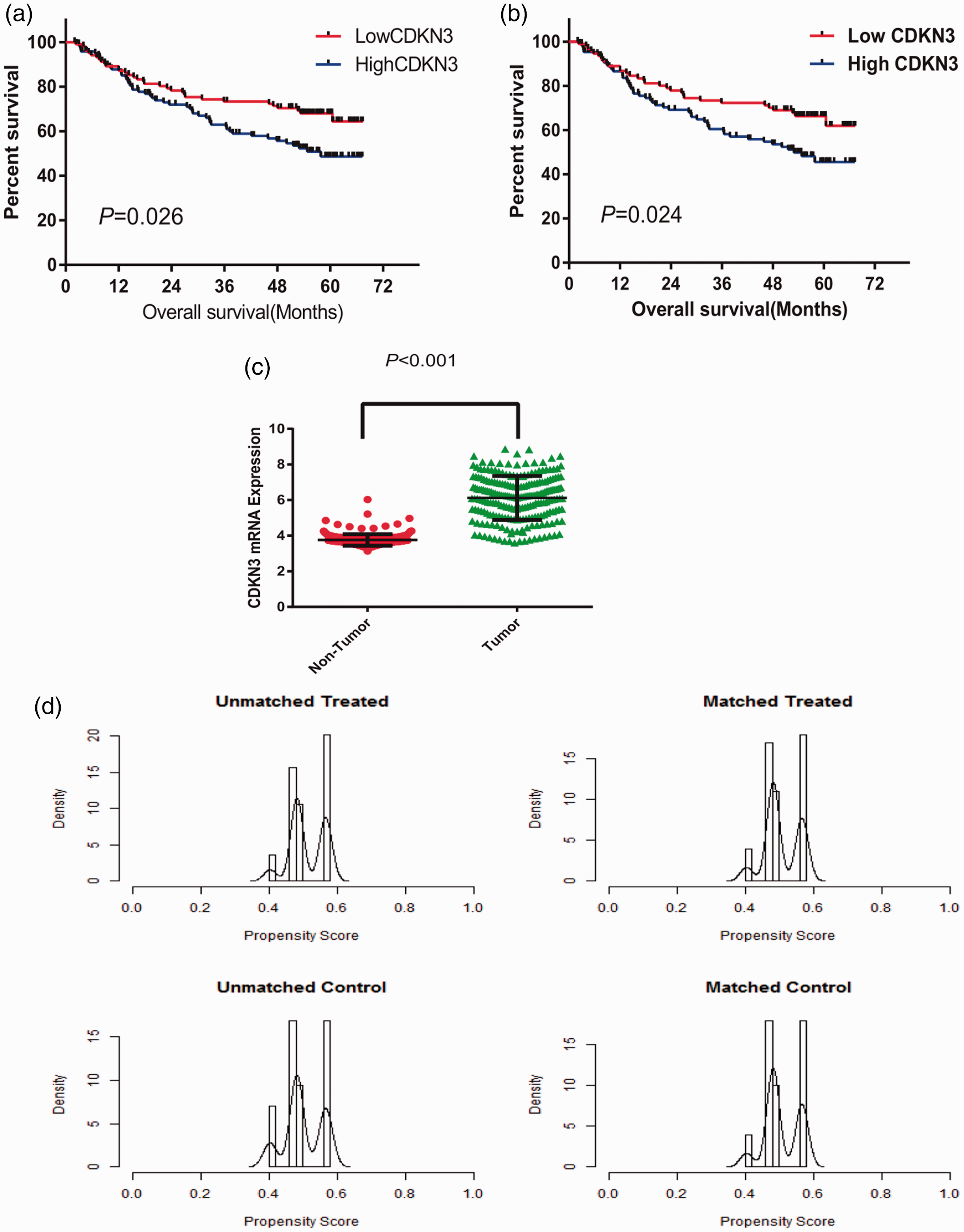
CDKN3 expression predicates poor prognosis in HCC. (a) Survival analysis of HCC patients with different CDKN3 expression levels in the GSE14520 dataset. (b) Survival analysis of HCC patients with different CDKN3 expression levels in the GSE14520 dataset after propensity score matching. (c) CDKN3 expression levels in HCC tumor and non-tumor liver tissues. (d). Propensity score matching of the two groups with different expression levels of CDKN3.
CDKN3 gene expression is correlated with vascular invasion and GeneMANIA interaction networks
Using the GSE20238 dataset, multivariable-adjusted logistic regression was used to test the risk of CDKN3 causing death in cancer. The death rate was significantly correlated with cirrhosis (P<0.001) and BCLC stage (P<0.049). We further demonstrated that high CDKN3 expression is positively correlated with cancer death (P<0.021, Table 2). To further understand whether CDKN3 participates in cancer metastasis, we reanalyzed GSE20238 data. The training dataset revealed a significant relationship between CDKN3 mRNA expression and macrovascular and microvascular invasion (Figure 2a), as HCC specimens with vascular invasion had a significantly higher level of CDKN3 expression (P = 0.004). This was supported by similar findings in the validation set (P = 0.005, Figure 2b). Further, it was found that CDKN3 expression is significantly positively related to CTNNB1 expression in HCC tissues (Figure 2c; R = 0.339, P = 0.001). GeneMANIA analysis also indicated that CDKN3 shared pathways with CDK2, CDKN1B, CTNNBIP1, and CTNNB1 (Figure 2d), suggesting that CDKN3 probably contributes to cancer metastasis.
Multivariable-adjusted regression.

HR: hazard ratio; CI, confidence interval; AFP, alpha-fetoprotein; BCLC, Barcelona Clinic Liver Cancer.

CDKN3 gene expression is correlated to vascular invasion and GeneMANIA interaction networks. (a). CDKN3 correlation analysis with HCC vascular invasion in training sets of the GSE20238 dataset. (b) CDKN3 correlation analysis with HCC vascular invasion in validation sets of the GSE20238 dataset. (c) CDKN3 expression is positively associated with CTNNB1. (d). GeneMANIA interaction networks of CDKN3.
CDKN3 interference decreased HCC cell sensitivity to adriamycin
To investigate the relationship between CDKN3 expression and tolerance to adriamycin of HCC cells, we silenced CDKN3 expression using RNA interference. CDKN3 knockdown reduced the total number of clones but improved the ability of cells to form colonies compared with the control group. The CDKN3 siRNA interference group demonstrated larger colonies, which indicates that CDKN3 silencing promotes HCC cell proliferation (Figure 3a). Adriamycin was then introduced for further validation. As shown in the controlled trial, QGY7701 cells that had undergone CDKN3 silencing developed larger colonies (Figure 3b), although the total number was significantly smaller than in the control group or the non-interference group (p<0.01). These results show that CDKN3 inhibition promotes the proliferation of HCC cells and reduces their sensitivity to adriamycin chemotherapy.

CDKN3 interference decreases HCC cell sensitivity to adriamycin. (a) A tumor clone formation assay was performed to test the clone formation capacity of different tumor cells. (b) Clone formation assay data. Statistical significance is indicated as *P < 0.05, ***P < 0.001.
Discussion
CDKN3 is thought to play a complex dual role in control of the cell cycle in the occurrence and development of HCC. It acts as a cyclin-dependent kinase inhibitor that selectively binds CDK2 and reduces its ability to phosphorylate Rb protein.6,7 Unphosphorylated Rb binds to transcription factor E2F1, inhibiting the production of proteins at the G1/S phase of the cell cycle and blocking cell progression from G1 to S.6,8 CDKN3 is also known as an MDM2 binding protein that forms a complex with p53 and Mdm2, suppressing induction by p21 and facilitating the cell cycle. 9
Srinivas et al. 10 showed that CDKN3 inhibits cell cycle control by blocking the formation of abnormal spindles through binding to the MSP1 region of the centrosome. CDKN3 was reported to be highly expressed in a variety of cancer cells. One study indicated that CDKN3 is generally highly expressed in cervical carcinoma patients, of which 68.2% died 2 years after diagnosis. Of note, only 19.2% of cases with lower CDKN3 expression died within 2 years. 11 CDKN3 expression has also been negatively correlated with the survival of cancer patients including those with lung carcinoma, cervical carcinoma, and leukemia.12,13 However, Nalepa et al. 14 found that CDKN3 expression was downregulated in brain tumors, and that it inhibited cell cycle progression through the CDC2 signal axis, involving phosphorylation of the centrosome and serine in spindles. Yaqinuddin et al. 15 reported that knockdown of the DNMT1 gene inhibited the proliferation of gastric carcinoma cells, and that increased CDKN3 expression promoted the invasion of gastric carcinoma, suggesting that CDKN3 suppresses the proliferation of gastric carcinoma while promoting cancer metastasis. Lin et al. detected abnormally high CDKN3 expression in alcohol-related hepatoma carcinoma, and showed that its overexpression promoted human HCC cell proliferation both in vitro and in mice. 16 Although several studies have reported high CDKN3 expression in HCC and a negative correlation with prognosis, we previously only measured low-to-medium expression in HCC compared with other cancers. 17 However, highly differentiated cells had significantly higher expression of CDKN3, suggesting that CDKN3 promotes the differentiation of HCC cells.
In this study, to further investigate the role of CDKN3 in HCC, we used siRNA to determine the effect of CDKN3 expression on the clonality of QGY7701 cells. We found that CDKN3 silencing increased cell survivability and the size of the colony, suggesting that it promoted the proliferation of HCC cells. Adriamycin application of CDKN3-silenced cells increased the size of the colonies although the total number was small, indicating that reduced CDKN3 expression increased QGY7701 cell proliferation and survival and down-regulated sensitivity to adriamycin chemotherapy.
Within the GSE20238 dataset, CDKN3 mRNA expression was found to be related to macrovascular and microvascular invasion, whereas the low CDKN3 expression group in the GSE14520 dataset showed superior overall survival to the high expression group; this was supported by nearest neighbor matching of the two groups. Although no relationship was found between CDKN3 expression and lymphatic metastasis or TNM staging in HCC, we detected increased HCC cell proliferation and survival and reduced sensitivity to chemotherapy after down-regulation of the CDKN3 protein. Hence, it appears that CDKN3 is associated with the occurrence of HCC and could be used as a novel diagnostic marker or therapeutic target in the treatment of HCC. Predicted protein–protein interactions between CDK2, CDKN1B, CTNNBIP1, and CTNNB1 with CDKN3 could help understand its functional associations. However, the bioinformatics methods used to determine this rely only on existing networking processor and online data analysis websites. Therefore, the lack of experimental evidence constitutes a limitation of this study.
The CDKN3 expression profile in tumor and non-tumor tissues varies in different tumors.18,19 In HCC cells, mutation or deletion of the CDKN3 gene can cause tumorigenesis, leading to increased clonability and drug resistance. This may explain the rapid growth of HCC even before metastasis and spread, with greater tolerance to non-molecular targeted drugs. Most reports have shown different findings, which could be explained by the use of quantitative reverse transcription PCR in some studies because mRNA expression is not consistent with that of the protein. Additionally, although cells with high CDKN3 expression grow fast, resulting in poor prognosis, they are more likely to be killed by chemotherapeutic drugs. Those cells with lower CDKN3 expression survive instead and develop drug tolerance leading to recurrence. We therefore, speculate that CDKN3 is associated with the resistance of tumor cells to chemotherapeutic drugs. Because sample collection may contain a bias regarding where more highly differentiated tumors are collected from, CDKN3 may be a preferred target for the treatment of HCC and an indicator in related prognostic tests. As bioinformatics analysis of a dataset from GEO and The Cancer Genome Atlas databases revealed, CDKN3 shares different relationships with survival, AFP, and staging of HCC patients, suggesting some dual action in the occurrence and development of HCC. For the sake of clarifying the specific role CDKN3 plays in different tumors, specimens from multiple sources are needed for studies of functional and molecular mechanisms. Cases from different regions and areas could also be used to elucidate possible functional pathways and molecular actions.
Conclusions
The discovery of HCC-dominant targeted therapeutics and an understanding of drug resistance is a promising strategy for prolonging survival time in HCC patients. Here, we identify CDKN3 as an independent gene for the prognosis of HCC, and as associated with advanced HCC malignancy. CDKN3 was also demonstrated to contribute to the progression of HCC, although in many cases following its downregulation, which impedes adriamycin sensitivity and may result in a relapse. Our results provide an insight into the dual nature of CDKN3, and its role in both HCC progression and drug resistance.
Footnotes
Acknowledgements
We thank Zhang Qinyu for valuable discussion.
Declaration of conflicting interest
The authors declare that there is no conflict of interest.
Funding
This research was supported by grants from the Guangdong Basic and Applied Basic Research Regional Foundation (A2019529), Zhanjiang Science and Technology Program (2016A01011), The Youth Foundation (2019A1515110155), and Guangdong Medical Scientific Technology Foundation (A2019529).
