




Abstract
With the increasing use of joint replacement surgery, the prevalence of periprosthetic joint infections (PJI) has also increased. However, treating PJI has become a challenge for orthopaedic surgeons because of the prevalence of multi-drug resistant (MDR) bacteria and the formation of protective biofilms. Numerous studies have shown that garlic extract (GE) has antibacterial activities and might be a good candidate for PJI treatment. This review explores the antibacterial and antibiofilm activities of GE and its potential to be used in the treatment of PJI.
Keywords
Introduction
Periprosthetic joint infection (PJI) is a serious complication for both patients and surgeons after total joint arthroplasty.1,2 The prevalence of PJI after total hip arthroplasty and total knee arthroplasty is approximately 1% and 2%, respectively.3,4 This complication may occur during the immediate postoperative period or even decades after surgery.3,5 However, treating PJI remains a challenge even for an experienced orthopaedic surgeon due to the limitation of many factors. The most important reason is the prevalence of multi-drug resistant (MDR) bacteria, also known as ‘superbugs’, and the formation of bacterial biofilms, which significantly reduces the efficacy of antibiotics or even renders them ineffective. 2 Alternative treatments, therefore, especially for biofilm-associated infections need to be developed urgently.
Recently, some naturally occurring products have attracted widespread attention because of their antimicrobial properties or their ability to not induce drug resistance. Garlic is an example of such a naturally occurring compound. It has been reported that garlic extract (GE) has many biological activities including antibacterial,6,7 antiviral, 6 antifungal6,8,9 and antiparasitic activities; 10 especially anti-MDR bacterial and antibiofilm activities.6,11,12 Additionally, with the development of drug-loaded nanoparticle technology,13,14 the prospect of the clinical application of garlic extract has been greatly improved. This review explores the antibacterial and antibiofilm activities of GE and its potential to be used in the treatment of PJI.
Literature review search strategy
Searches of the PubMed and EMBASE (Elsevier platform) databases were performed independently by the authors (X.Z. and Y.Z.) in September 2019. Comprehensive strategies, including both Medical Subject Headings and terms, were used and publication date of articles was not restricted. The language was limited to English. In addition, a manual review of the full reference lists of relevant articles was undertaken. The PubMed database search was performed as follows: (“infection”[MeSH] OR Infection[Ti ab] OR Infections[Ti ab] OR Prosthesis-Related Infections[Ti ab] OR Prosthesis Related Infections[Ti ab] OR Infections, Prosthesis-Related[Ti ab] OR Prosthesis-Related Infection[Ti ab] OR periprosthetic Joint Infection[Ti ab] OR “PJI” [Ti ab] OR “biofilms”[MeSH] OR Biofilms[Ti ab] OR Biofilm[Ti ab] OR “bacterial adhesion”[MeSH] OR Bacterial Adhesion[Ti ab] OR Bacterial[Ti ab] OR Bacterial Adhesions[Ti ab]) AND (“garlic”[MeSH] OR Garlic[Ti ab] OR “allium”[MeSH] OR Allium[Ti ab] OR Alliaceae[Ti ab]). The same search strategy was used for the EMBASE database. The eligible articles were discussed and selected by the two authors.
The active ingredients of garlic and their biological characteristics
The two main active components of garlic are allicin and ajoene, with allicin playing the most prominent role.13,15 Allicin (diallylthiosulphinate), a sulphur-containing naturally occurring compound, is produced by tissue damage that causes enzymatic reactions and it is responsible for the typical smell and taste of garlic. 15 Allicin has a variety of biological activities, including antimicrobial,6,7,16 antibiofilm12,13 and antifungal activities.6,8,9,16 However, allicin is rapidly oxidized, volatile and unstable, so it breaks down rapidly as soon as the garlic is damaged, which is why allicin cannot be widely used. 14
Fresh garlic extract (FGE) or garlic oil is more stable compared with allicin, due to the hydrogen bonding between water and the reactive oxygen atom, which increases the stability of allicin. 6 Numerous studies have reported the good antimicrobial activity of water-based extract of FGE.6,7
Ajoene, a sulphur-containing compound derived from allicin, is biologically active and more stable than allicin. 17 Therefore, more and more researchers have begun to pay close attention to it and have demonstrated its ability to inhibit the quorum sensing (QS) system.17,18
In addition, garlic compounds have also been shown to prevent cardiovascular disease,19–23 decrease cholesterol and fatty acid levels,24–26 reduce blood pressure,23,25,27,28 regulate the immune system,15,28 prevent and treat tumours,15,29–31 and resist parasites. 32 The similarities and differences between allicin and ajoene are shown in Table 1.
The similarities and differences between the two main components of garlic allicin and ajoene.

Characteristics of prosthesis-related infections
As the number of total joint replacements increases, so does the risk of infection around the prosthesis.2,3 PJI can be divided into bacterial and fungal infections according to the different pathogenic organisms involved. The main bacterial pathogens are Staphylococcus aureus and S. epidermidis, 5 while the most common fungal pathogen is Candida albicans. 33 PJI can also be categorized based on the time period of the infection into an acute or chronic infection. 3 Systemic antibiotic treatment is the main treatment strategy for acute infections, while the current gold standard of treatment for chronic infection is second-phase revision. 3 Chronic infection is more common in the clinic, but the failure rate of its treatment remains high. 2 The most important cause of PJI is the emergence of MDR bacteria and the development of biofilms, resulting in poor or even ineffective antibiotic treatment.2,3 Therefore, new drugs with a broad spectrum of antibacterial activity that can not only destroy biofilms but also kill resistant bacterial strains are needed urgently.
Antibacterial effect and related mechanism of GE
Garlic extract has a broad spectrum of antibacterial activity, which includes inhibiting or killing antibiotic-resistant strains of bacteria in a dose-dependent manner. 34 A study demonstrated that FGE exhibited significant inhibitory properties on methicillin-resistant S. aureus and C. albicans, while inhibition of Pseudomonas aeruginosa was weak. 6 Another study also showed that pure garlic essential oil had a stronger antibacterial effect on Gram-positive bacteria than Gram-negative bacteria. 35 An in vitro study compared the antibacterial effect of fresh garlic juice on Escherichia coli, Klebsiella pneumoniae, Proteus mirabilis, P. aeruginosa and S. aureus, and it demonstrated S. aureus and E. coli were the most sensitive organisms. 7 Another study reported the good antimicrobial activity of FGE against five MDR strains, which included E. coli, P. aeruginosa, K. pneumoniae, Serratia marcescens and MRSA. 36 These studies have demonstrated that FGE has extensive antibacterial activity, including against drug-resistant bacterial strains.6,34–36
At present, studies on the specific antibacterial mechanism of GE are scarce. A study demonstrated that garlic essential oil had good antimicrobial activity against S. aureus, P. aeruginosa and E. coli, and that the allyl group was fundamental for this activity. 37 S. aureus responds to allicin by global S-thioallylation. 38 Another study showed that disulphide and vancomycin have synergistic effects against vancomycin-resistant S. aureus by causing dispersal of biofilms and decelerating the metabolism of S. aureus. 39 The authors suggested that pyridyl disulphide, representing a new class of antimicrobial agent with different antibacterial mechanisms, could be used as antibiotic adjuvants for vancomycin-resistant S. aureus infections. 39 The mechanisms of action of GE remain to be elucidated. The antibacterial effects and related mechanisms of action of GE are listed in Table 2.6,7,14,35–37,39,40
Examples of the antibacterial activity and related mechanisms of action of various garlic extracts.6,7,14,35–37,39,40

Antibiofilm effect and related mechanism of GE
The most prominent feature of PJI is the emergence of MDR bacteria and biofilms.2,3 Due to the protection provided by the biofilm, the bacteria inside the biofilm are very difficult to kill. 2 Therefore, effectively destroying the biofilm becomes a key aim of the treatment of PJI. Many studies have shown that GE, as a naturally occurring antibacterial substance, has a good antibiofilm effect.11,17,41,42 A previous study reported the eradication of biofilms of MDR bacteria. 36 Garlic ointment prevented biofilm formation of S. aureus, S. epidermidis, P. aeruginosa, Acinetobacter baumannii and K. pneumoniae. 12 In addition, the anti-staphylococcus activity of garlic ointment was very stable and could be maintained for more than 3 months at room temperature. 12
There are many reports about allicin inhibiting bacterial adherence and preventing biofilm formation in vitro.11,41,42 However, whether this property still works in vivo remains unknown. A previous study established an artificial knee joint infection model in rabbits and divided the rabbits into four groups, which were lavaged with normal saline, allicin, vancomycin or allicin plus vancomycin for 14 days. 11 The study demonstrated that intra-articular allicin could not only enhance the bactericidal effect of vancomycin but it also inhibited biofilm formation in vivo. 11 Therefore, the authors suggested that allicin combined with vancomycin might be an effective anti-infection strategy for the treatment of PJI.
The components of GE, such as allicin and ajoene, interfere with the formation of bacterial biofilm in multiple ways.17,41–44 Among them, polysaccharide intercellular adhesin (PIA) and QS are the two most studied areas. For example, PIA (poly-β(1-6)-N-acetylglucosamine), which is a positively charged, partially deacetylated molecule, is an important component of the Gram-positive bacterial biofilm matrix network. 44 Subminimum inhibitor concentrations of allicin could not only reduce bacterial adhesion and extracellular polymeric substance secretion, but they could also inhibit the synthesis of PIA in S. epidermidis. 42
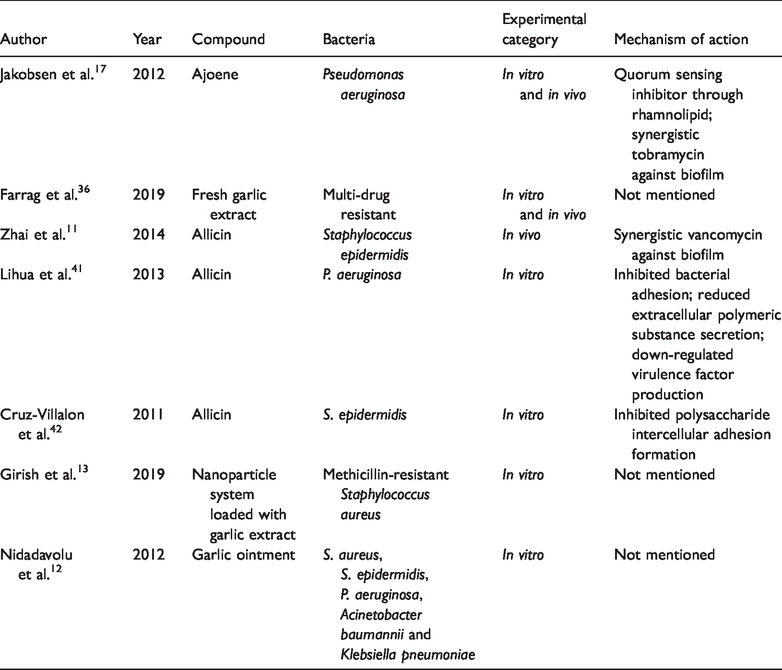
Quorum sensing, an information exchange system used by pathogenic bacteria, plays an important role in biofilm formation and disseminating bacteria to new infection sites. 45 Therefore, interfering with the QS system may be an effective measure for the treatment of biofilm-associated infection. 44 A previous study demonstrated that allicin extensively participated in downregulating the production of various virulence factors, such as exotoxin A, elastase and rhamnolipids, all of which are widely involved in QS. 41 Through bioassay-guided fractionation of FGE, it was found that the primary QS inhibitor in garlic was ajoene. 17 Ajoene not only downregulated the gene expression involved in bacterial rhamnolipid synthesis and prevented the lysis of polymorphonuclear leukocytes so as to enhance the host immunity against infections, but it also downregulated the expression of small regulatory RNA molecules involved in the production of important QS virulence factors, such as chitinase, cytotoxic lectin and chitin binding protein.17,43 Currently, the QS system remains the focus of research in the field of antibiofilm treatments. The antibiofilm effects and related mechanisms of action of GE are listed in Table 3.11–13,17,36,41,42
Antifungal effect and related mechanism of GE
Compared with the antibacterial actions of GE, there are few studies on the antifungal actions of GE.6,8,9,16,46 A previous study reported that GE had inhibitory properties on C. albicans. 6 The antifungal mechanisms of GE mainly include the abilities to penetrate the cell membrane, 9 destroy the cell structure and alter gene expression of microorganisms.8,9 A previous study showed that garlic oil could destroy the cellular structure by penetrating into hyphae cells and their organelles, leading to the leakage of intracellular substances. 8 It was also shown that garlic oil could exhibit antifungal effects by altering the expression of some crucial genes and proteins involved in normal metabolism, pathogenesis and oxidation-reduction processes. 9
Development of a GE carrier
Although GE has strong antibacterial properties, it is easily degraded because of its susceptibility to oxidation, volatilization and heat. 35 There is a need to improve the stability and maintain the antibacterial performance of GE. A microencapsulation method that used β-cyclodextrin (βCD) to thermally protect garlic oil was developed. 14 The garlic oil retained significant antibacterial properties after the thermal treatment of the βCD-garlic oil complexes. 14 Meanwhile, βCD, a sugar structure, is non-toxic and can be completely absorbed. The authors suggested that βCD was a carrier that could enhance heat resistance, reduce volatility, provide protection from oxidation and increase the durability of the antibacterial properties of GE. 14
Extracellular polymeric substances can inhibit the penetration of immune cells and antimicrobial agents into biofilms. 13 Therefore, the survival abilities of bacteria inside biofilms would be, even in high concentrations of antibiotics, significantly improved.2,3 The long-term exposure of bacteria to antibiotics increases the incidence of drug-resistant strains. The extracellular matrix is another substance that can influence therapeutic efficacy. 44 Additionally, the physicochemical and mechanical properties of the biofilm as well as the charge compatibility of the drug influence the outcomes of anti-infective treatment. 13 Different bacterial biofilms have different characteristics, so different therapeutic measures should be selected in order to effectively penetrate the biofilms.13,14 Therefore, the ideal drug is one that can not only penetrate a biofilm matrix but can also eradicate all of the bacteria within it. If a delivery system that had both properties could be developed then it will have broad applications.
A sol-gel based nanoparticle system has been developed and it not only penetrated the bacterial biofilm but it also delivered different types of therapeutic agent. 13 The authors reported an excellent antibiofilm activity against MRSA with the GE loaded in nanoparticles (GE-np) in vitro. 13 Compared with GE and mupirocin, GE-np was more effective in killing MRSA and biofilm, probably because GE-np slowed down the degradation of GE and exposed it to the inner layers of the biofilm. 13 The authors also demonstrated the advantages of a sol-gel nanoparticle system. 13 First, surface charge, hydrophobicity and particle size could be manipulated in order to penetrate different biofilms. 13 Secondly, different types of antibiotics could be loaded into the nanoparticles for different types of infections. 13 Finally, the slow release of the loaded antimicrobial drugs allowed the drugs to be easily delivered to the inner layers of the biofilms, which significantly increased the antibacterial effect. 13
Currently, precoating prostheses with antimicrobials is one of the important strategies for inhibiting bacterial adhesion and biofilm formation. 2 Therefore, GE-np coated prostheses could be developed in the future. 13
The safety of GE
Although GE has already exhibited potentially antibacterial and antibiofilm activities both in vivo and in vitro, its toxicity is still a barrier against its clinical usefulness. In recent years, several researchers have reported on the safety of GE.36,47,48 In order to assess the safety, different concentrations of GE were given to rats intraperitoneally for 38 days. 47 As the dose of GE increased, the levels of liver enzymes and serum creatinine also increased. 47 At the same time, the structure and function of related organs also began to be destroyed. 47 Therefore, it was concluded that GE was safe at low levels (250–350 mg/kg/day). 47 A separate study recommended that the safe dose of GE was 350 mg/kg. 48 Similarly to these previous studies, another study injected GE into the abdominal cavity of mice systemically infected with P. aeruginosa and MRSA at two different doses (either 100 or 200 mg/kg) for 7 days. 36 There were no significant changes in haematological and biochemical parameters, as well as the histological architecture of the organs. 36 Therefore, low doses of GE appear to be safe, but the specific threshold remains to be studied.
Difficulties about GE applied to PJI in the future
Research on the application of GE to PJI has made considerable progress. However, there are still many difficulties to be resolved, including the following questions: (i) how can the biological activity of GE be effectively maintained?; (ii) which administration of GE is more effective, local or systemic?; (iii) what are the pharmacokinetics of GE under different conditions of administration?; (iv) what kind of administration frequency would be more effective?
Conclusion
In conclusion, in view of the increasing prevalence of infections caused by MDR bacteria, new promising alternative antimicrobials should be developed as a priority. The antibacterial and antibiofilm activities of GE suggest wide clinical applications in the future. The evidence to date suggests that GE will be a promising candidate for the treatment of PJI, although more research is required.
