




Abstract
Objective
To explore training-related independent factors affecting the awareness of cardiopulmonary resuscitation (CPR) in senior high school students in Shanghai.
Methods
Questionnaires measuring CPR-related knowledge were distributed to 430 senior high school students in Shanghai.
Results
The overall CPR qualification rate was 7.7%. Qualification rate increased significantly with training frequency (5.5% vs. 9.3% vs. 20%), personal willingness to perform CPR (3.7% vs. 9.5%) and smaller training intervals (12.8% vs. 5.3% vs. 1.8%). After adjustment, training interval <6 months (odds ratio [OR] 6.078, 95% confidence interval [CI] 1.367–27.014) remained an independent predictor of qualifying rate. In unqualified students, willingness to implement CPR (72.4% vs. 66.2% vs. 54.8%) and training interval <6 months (23.8% vs. 15.8% vs. 6.8%) decreased as school grade increased. Worries about CPR not meeting professional standards, especially in females (OR 1.72, 95% CI 1.065–2.776), and legal responsibility for failed CPR were the main reasons for reduced willingness to implement CPR.
Conclusion
The CPR qualifying rate of senior high school students in Shanghai is low. It could be improved by reducing training intervals to consolidate learning. It may also be necessary to promote laws about first aid to senior high school students.
Keywords
Introduction
Out-of-hospital cardiac arrest (OHCA) is a major threat to human life. There are about 544,000 sudden cardiac deaths in China annually (more than 1500 each day), about 70% of which occur out-of-hospital.1–3 However, the post-OHCA survival rate in China is lower than 1%, which is much lower than that of the United States (about 12%). 4 Previous studies have shown that bystander cardiopulmonary resuscitation (CPR) effectively increases the survival rate after OHCA.5,6 Bystander CPR after OHCA can also significantly reduce the risk of brain injury or nursing home admission, as well as the risk of all-cause mortality within 1 year. 5 It is generally agreed that CPR education and adequate training should be provided to the community to improve patient outcomes. However, to date, less than 1% of the national population in China possess CPR skills. 4
About 50% of exercise-related sudden deaths occur in school students, 1 and these have a large impact on society. Several factors suggest that it would be useful to promote CPR training in schools. Students have a greater learning ability and find it easier to accept new knowledge than older individuals. Students who have received CPR training are not only able to initiate basic life support, but may also convey their knowledge to their family members, generating an information cascade.7,8 Xu et al. have suggested that providing training to specific groups such as students should be a high priority. 4 Our previous study found that the CPR qualification rate among student groups is very low, 9 indicating that first aid training, including CPR skill training, among student groups is insufficient. Our previous study also showed that CPR knowledge mostly depends on previous training. However, CPR training for students in China is mainly theoretical, and tends to be short-term or to occur in other contexts such as military training. Given the lack of practice experience combined with a general lack of social experience in students, it is unclear whether training can improve students’ awareness of CPR. Therefore, this study aimed to explore the relationship between training history and CPR knowledge among senior high school students.
Methods
Subjects
A total of 430 students from three senior high schools in Jiading District of Shanghai were recruited. The schools were the High School Affiliated to Shanghai Jiao Tong University (Jiading), Shanghai International Studies University Jiading Foreign Language Experimental High School and Shanghai Municipal Jiading District Zhongguang Senior High School, which have 420, 780 and 625 students, respectively. Questionnaires assessing CPR knowledge were distributed by the Jiading District of Shanghai Red Cross Society.
Questionnaire design and survey methods
The questionnaire design was based on the 2015 American Cardiopulmonary Resuscitation and Cardiovascular First Aid Guideline Update. 10 The questionnaire (Supplemental material) was jointly developed by the Emergency Department of Shanghai Jiading District Central Hospital, Jiading District of Shanghai Red Cross Society and the Asian American Advisory Council (Chicago, Illinois, USA). The questionnaire recorded general information (sex, age, school name, grade, number of CPR training sessions attended, willingness to perform CPR and interest in CPR learning), and also contained items on CPR knowledge: identification and initiation of emergency response (two questions), chest compression (five questions), artificial respiration (three questions) and electrical defibrillation (three questions). Each correct answer was awarded 1 point, with a total possible score of 13 points. Completed questionnaires were collected and scored by the Jiading District of Shanghai Red Cross Society. A total of ≥60% correct responses were considered to indicate CPR qualification.
Statistical analysis
Statistical analysis was conducted using SPSS 19.0 software (IBM Corp., Armonk, NY, USA). Normally distributed data were expressed by means ± standard deviations (SD) and compared using Student’s t-test (e.g. age). Numerical data were expressed by frequency and compared using the χ2 test. Multiple logistic regression was conducted to identify the factors that influenced students’ CPR awareness. Variables that were meaningful in the univariate analysis were included in the regression analysis, and age and sex were also included in the analysis. Values of P < 0.05 were considered statistically significant.
Ethics approval
The study protocol was approved by the ethics review board of Jiading District Central Hospital (2017-ZD-03). The need to obtain written informed consent was waived by the ethics review board owing to the nature of the study. The data were anonymized.
Results
A total of 562 questionnaires were administered. Of these, 509 (90.6%) were returned and 430 (84.5%) of these were valid. Data from the 430 returned questionnaires indicated an overall qualification rate of 7.7%. The pass rate for identification and activation of the emergency response system was 74.2% (319/430), that for chest compression was 19.5% (84/430), that for artificial respiration 15.1 (65/430) and that for electric shock defibrillation was 9.5% (41/430). A total of 88.1% (379/430) of students had participated in at least one CPR training session, 90.7% (390/430) expressed willingness to learn CPR and believed that regular training should be conducted, but only 68.4% (294/430) were willing to preform CPR.
The qualification rate increased with greater training frequency (5.5% vs. 9.3% vs. 20%, P for trend = 0.013), decreased significantly with longer training intervals (12.8% vs. 5.3% vs. 1.8%, P for trend <0.001) and was significantly higher for students who were willing to perform CPR than for students who were not (9.5% vs. 3.7%, P = 0.034) (Figure 1).
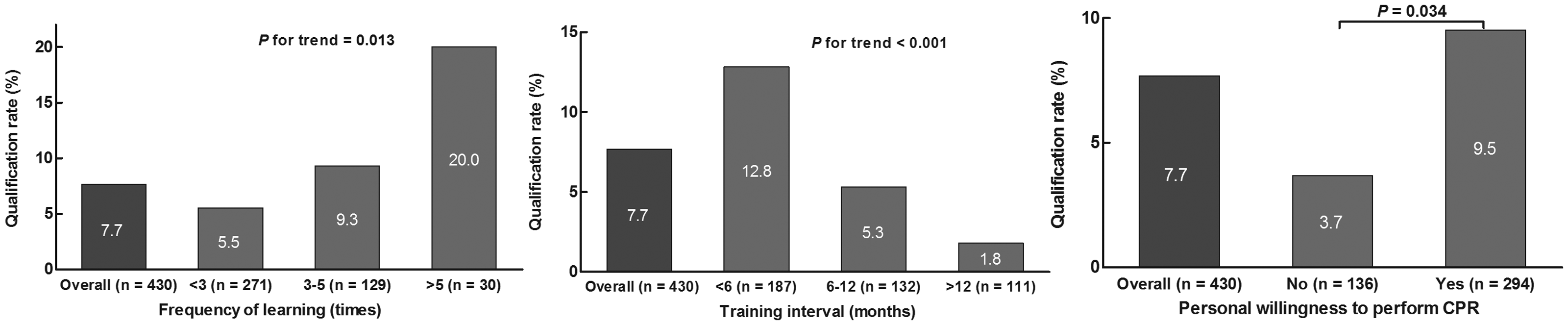
The qualification rate trend under different conditions.
Factors influencing the CPR pass rate were low frequency of learning, short training interval, willingness to implement CPR, use of popular science books and brochures, and on-the-spot teaching. After adjustment for relevant factors, the multivariate logistic regression analysis (with qualification as the dependent variable) showed that training intervals <6 months (odds ratio [OR] 6.078, 95% confidence interval [CI] 1.367–27.014, P = 0.018) remained an independent factor for eligibility (Table 1).
Logistic regression analysis of CPR awareness in students.

CPR: cardiopulmonary resuscitation; OR: odds ratio; CI: confidence interval; SD: standard deviation.
Further analysis of the unqualified students showed that worries about CPR failing to meet professional standards (78.1%, 310/397) and legal responsibility for any failure (66.8%, 256/397) were the main reasons for reduced willingness to implement CPR. Willingness to implement CPR decreased as school grade increased (72.4% vs. 66.2% vs. 54.8%, P = 0.009), and training intervals <6 months decreased as school grade increased (23.8% vs. 15.8% vs. 6.8%, P = 0.001) (Table 2). Compared with males, females tended to worry that the CPR would not meet professional standards (OR 1.72, 95% CI 1.065–2.776, P = 0.026) and that CPR should be conducted by medical staff (OR 1.771, 95% CI 1.144–2.741, P = 0.010) (Figure 2).
Analysis of variables across different grades in unqualified students.

EMS: emergency response system; CPR: cardiopulmonary resuscitation.

Analysis of the factors influencing CPR awareness by sex in unqualified students.
Discussion
In this study, we found that the CPR qualification rate among senior high school students in Jiading District, Shanghai, was unsatisfactory, and that shortening the training interval may increase the qualification rate. At the same time, it is necessary to provide more opportunities for high school students to practice, to implement the Shanghai Municipal Emergency Medical Services Regulations 11 and to increase CPR publicity to mitigate concerns about the legal consequences of performing out-of-hospital CPR.
The dissemination rate for first aid knowledge and skills in China is less than 1%, 4 which is far lower than in developed countries. Research on first aid-related training in the general population and in senior high school students is inadequate. One previous study found a low awareness of CPR knowledge among senior high school students in Japan compared with students in the USA, Europe and Japan. 9 The present findings also indicate low CPR awareness; the CPR qualification rate was only 7.7%. Efforts should be made to enhance the dissemination of CPR knowledge.
Most first aid training in China places a strong emphasis on theoretical training rather than practicing the relevant techniques, 12 which means that students may not be able to independently handle sudden emergency situations. 13 These factors indicate that more effective training is needed for students using high-quality lessons that include both theoretical and practical training.
Although training institutions in China have conducted public CPR training for decades, an estimated less than 1% of the national population are CPR qualified, a much lower figure than that of the United States (33%). 4 There is evidence that senior high school students can fully acquire CPR skills through systematic learning and training,13,14 and that training experience is an important factor in mastering CPR knowledge. 9 However, a lack of regular skill consolidation training may an important reason for the low quality of bystander CPR. 10 Therefore, in this study we aimed to investigate the association between training experiences and CPR awareness in senior high school students, and the reasons for the high fail rate.
We found that greater learning frequency and shorter training intervals were associated with qualification rate. This indicates that CPR awareness could be increased by increasing the number of training experiences and shortening the training intervals. The present findings also suggest that a strong willingness to perform CPR and on-the-spot coaching may enhance CPR learning, and that the use of a range of learning pathways may not increase mastery of CPR knowledge. After adjustment for the relevant factors, only shorter training intervals with existing learning methods improved the pass rate; an increase in training frequency and the addition of different types of learning methods did not effectively increase awareness. These findings emphasize the importance of regular CPR retraining, and suggest that more effective training methods should be explored to further enhance CPR awareness among senior high school students.
Furthermore, we found that a fear of failing to meet the required standard of performance and the possible legal consequences were the main reasons for high school students being unwilling to implement CPR. High school students work to increase their grades under pressure from college entrance examinations, which leaves little time for CPR practice opportunities. The frequency of first aid courses such as CPR should be appropriately increased to improve students’ self-confidence in CPR. Increased exposure to negative social events has gradually raised students’ concerns about self-protection and made them more aware of legal issues. The Shanghai government implemented a local law in 2016: the Shanghai Emergency Medical Services Regulations. The law encourages people or professionals with first aid training experience to conduct out-of-hospital first aid. The present findings suggest that this law should be promoted in high schools to eliminate the fear of legal responsibility associated with CPR.
Limitations
This study has some limitations. First, the sample size was relatively small. Students were recruited from only three senior high schools in Jiading District, Shanghai, so any generalization of the findings to other study populations is limited. Moreover, the questionnaire covered a broad range of CPR knowledge, whereas the public guidelines mainly focus on chest compression techniques. Further studies should focus on the theoretical knowledge and practical skills related to chest compression. Furthermore, our analysis showed that the amount of training experience did not strongly correlate with CPR awareness: inefficient training methods, insufficient training and long training intervals may lead to similar results. Therefore, a systematic study with a larger sample size is needed to confirm these findings.
Conclusions
The CPR awareness of senior high school students in Jiading District, Shanghai is low. Awareness could be improved by reducing training intervals to consolidate training. It may also be necessary to promote laws about first aid to senior high school students. The results of this study need to be further confirmed by prospective, large-sample studies.
Supplemental Material
IMR897692 Supplemental Material - Supplemental material for Shorter training intervals increase high school students’ awareness of cardiopulmonary resuscitation: a questionnaire study
Supplemental material, IMR897692 Supplemental Material for Shorter training intervals increase high school students’ awareness of cardiopulmonary resuscitation: a questionnaire study by Hong-mei Tang, Xiao Wu, Yin Jin, Yi-qing Jin, Zi-jun Wang, Jin-yan Luo, Yan-qi Hu, Ting Jin, Moses Shang, Qing Chang and Fei Wang in Journal of International Medical Research
Footnotes
Funding
The work was supported by the New Key Subjects of Jiading District (2017-ZD-03) and by the Health Policy Research Project of Shanghai Municipal Commission of Health (2019HP73). The funder had no role in the study design, data collection and analysis, decision to publish or preparation of the manuscript for publication.
Declaration of conflicting interest
The authors declare that there is no conflict of interest.

Supplemental material
Supplemental Material is available for this article online.
References
Supplementary Material
Please find the following supplemental material available below.
For Open Access articles published under a Creative Commons License, all supplemental material carries the same license as the article it is associated with.
For non-Open Access articles published, all supplemental material carries a non-exclusive license, and permission requests for re-use of supplemental material or any part of supplemental material shall be sent directly to the copyright owner as specified in the copyright notice associated with the article.
