



Abstract
Myopia has become a major cause for concern globally, particularly in East Asian countries. The increasing prevalence of myopia has been associated with a high socioeconomic burden owing to severe ocular complications that may occur with progressive myopia. There is an urgent need to identify effective and safe measures to address the growing number of people with myopia in the general population. Among the numerous strategies implemented to slow the progression of myopia, longer time spent outdoors has come to be recognized as a protective factor against this disorder. Although our understanding of the protective effects of outdoor time has increased in the past decade, considerably more research is needed to understand the mechanisms of action. Here, we summarize the main potential factors associated with the protective effects against myopia of increased outdoor time, namely, exposure to elevated levels and shorter wavelengths of light, and increased dopamine and vitamin D levels. In this review, we aimed to identify safe and effective therapeutic interventions to prevent myopia-related complications and vision loss.
Introduction
The increasing prevalence of myopia over the past few decades has become a significant cause for public health concern globally. In Singapore, the prevalence of myopia among adults older than age 40 years is 38.9%, 1 contrary to most Western countries such as the United States (25.1%), 2 Barbados (21.9%), 3 and Australia (15%). 4 Moreover, the percentage is much higher among children in East Asia. Research in Singapore revealed that the prevalence of myopia is 62.0% in children age 7 to 9 years 5 and in Guangzhou, China, the prevalence is 49.7%. 6 Among university students in central China, the myopia prevalence is 83.2%, 7 and it is 96.5% in 19-year-old men in Seoul, Korea. 8 The reported prevalence of myopia is 11.9% in Australia, 9 20.0% in the United States, 10 21.1% in urban India, 11 and 16.5% in Nepal. 12 Considering the high prevalence of myopia in Singapore, the average cost of eye examinations and visual aid devices 13 is 148 USD/child/annum and 709 USD/adult/annum, with additional costs for laser in-situ keratomileusis (LASIK) surgical procedures in adults. 14 Similarly, the economic costs associated with myopia are relatively high among adults in the United States, estimated to be USD 4.6 billion/year. 15 Additionally, it has been projected that by the end of this decade, 2.5 billion people, accounting for one-third of the world’s population, will be diagnosed with myopia. 16
Owing to the increasing global population together with the financial burden caused by myopia, it is crucial to promptly develop safe and effective therapeutic interventions for myopia. A considerable amount of research has been conducted and a number of interventions implemented to prevent the onset or slow the progression of myopia; these include atropine, special multifocal-like soft contact lenses, executive bifocal or progressive addition lenses, and overnight orthokeratology.17–23 Increasing the amount of time spent outdoors has demonstrated protective effects against the onset and progression of myopia.24,25 Therefore, in this paper, we provide a review of the major mechanisms that are potentially involved in the protective effects of increased outdoor time against myopia. We performed a search of the published literature and identified four main mechanisms, those involving high light levels, light chromaticity and spectral composition, dopamine, and vitamin D. We summarize each below.
High light levels
Over the past century, high daylight levels have come to be considered an effective method to prevent myopia. 26 Numerous eye specialists have suggested that an adequate amount of daylight at school is necessary for children. 27
With rapid technological development, several studies have been performed to identify the evidence and potential mechanisms of the protective effect of high levels of daylight. Animal studies in guinea pigs, 28 chicks,29–31 and monkeys32,33 have revealed that high light levels (15,000 to 30,000 lux), both in the form of natural daylight and artificial laboratory light, could retard experimental myopia. In population-based studies, a greater degree of exposure to daylight was observed to be associated with less axial eye growth. 34
In a number of epidemiological and animal studies, dopamine (DA) release has been suggested to be triggered by high-intensity outdoor light and rapid changes in luminance. Because DA is an ocular growth inhibitor,35–38 this release may inhibit myopic development. 39 This mechanism may explain the protective effect of high light levels. The characteristics of related studies are shown in Table 1.
Characteristics of studies investigating the relationship of high light levels with myopia.

Light chromaticity and spectral composition
Studies in chicks 40 and guinea pigs41–43 (Table 2) have revealed that the spectral composition of light can impact ocular growth. Exposing guinea pigs to short wavelength light led to hyperopic refraction, and exposing chicks to long wavelength light resulted in shorter axial length. In these studies, because the light was not uniformly focused on the retina, there was a remarkable reduction in the contrast of wavelengths that were focused away from the retina. 14 Short wavelengths of light (blue light) are focused closer to the lens owing to dispersion produced by the longitudinal chromatic aberration of the human eye; to compensate for this, the eyes develop hyperopic refraction. According to another study, 44 myopia is caused by an excess of red light and hyperopia by excess blue light, also suggesting that shorter light wavelengths may be protective against myopia. Because daylight is primarily composed of blue light, myopic inhibition may be attributable to longer time spent outdoors (Figure 1).
Characteristics of studies investigating the spectral composition of light and myopia.

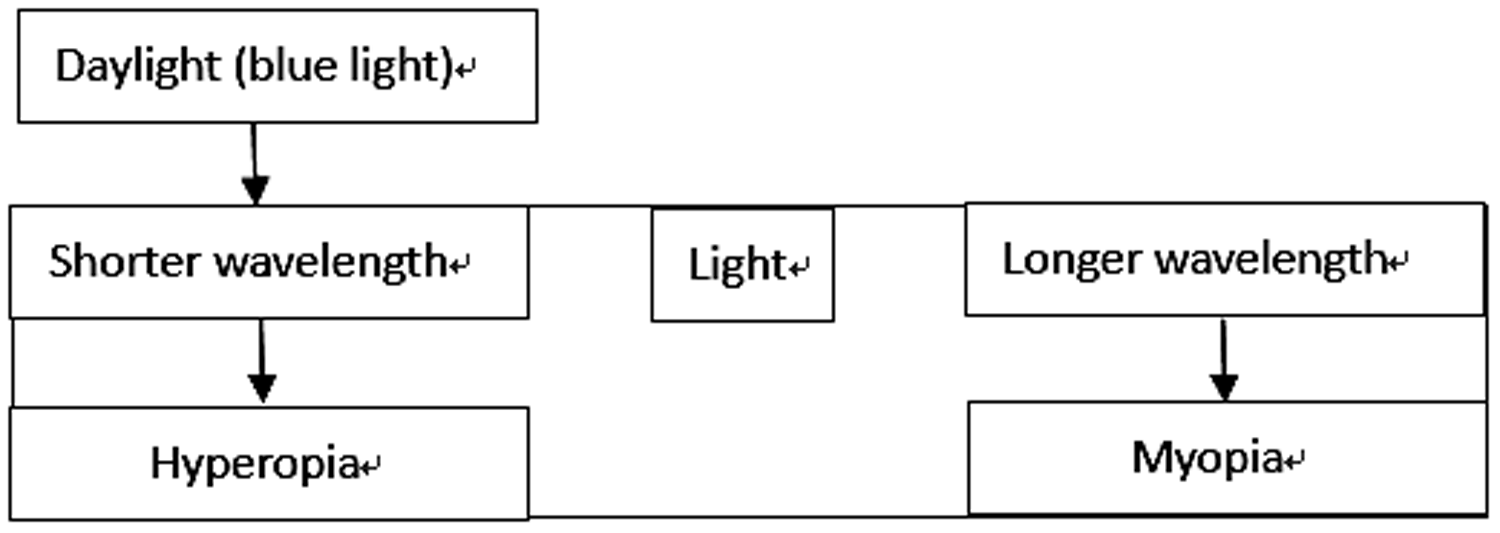
Hypothesis: Daylight composed of shorter-wavelength light impacts ocular growth.
Dopamine (DA)
DA is a neurotransmitter that has an important role in the retina, mediating eye functions such as visual signaling, ocular development, and refractive adjustment.
Over the past few decades, a considerable amount of research in vertebrates has revealed that light and endogenous circadian rhythms may affect the release of DA.45–47 Additionally, scientists believe that retinal DA concentrations indicate the release and synthesis of DA.46,48 Furthermore, pharmacological and genetic studies have provided additional clues about the importance of light or visual input in retinal DA signaling and refractive development. 37
Light affects dopamine
Several studies have previously reported that bright light has a protective effect against myopia,49–53 which had been attributed to increased levels of retinal DA and the activation of DA receptors. A 2010 study suggested that blocking D2-like receptor antagonist and spiperone has a protective effect against bright light. 52 Image contrast and light intensity, detected by photoreceptors, have been implicated in the release of DA and development of myopia. Therefore, by increasing retinal DA levels, exposure to bright light may limit myopia development, as an environmental intervention.
Typically, two steps are involved in the synthesis of DA from tyrosine, in which tyrosine hydroxylation is considered the highly-regulated and rate-limiting step. It has also been suggested that with concomitant activation of tyrosine hydroxylation, which maintains steady-state reserves of DA upon the enhancement of neuronal activity, light may stimulate the synthesis and release of DA.54,55
The above results indicate that outdoor time may affect the concentration and release of DA.
Dopamine affects myopia
After birth, the growth and refractive development of the eyes are regulated by several messenger molecules, as explained by the biochemical pathways elucidated in several studies using animal models.56–58 DA, released by amacrine and interplexiform cells, 59 plays a particularly important role in the modulation of the vertebrate visual system. 60
In a number of experiments, DA levels have been raised by either injecting DA directly into the eye or increasing DA synthesis with L-dopamine (L-DOPA).61,62 Furthermore, DA signaling has also been increased with the use of apomorphine, a nonselective DA receptor agonist, 63 and 2-amino-6,7-dihydroxy-1,2,3,4-tetrahydronaphthalene hydrobromide.49,64 These results support the hypothesis that increasing DA receptor activity or DA levels has a protective role in myopia.
Considering the findings of genetic and pharmacological studies using mouse models of myopia, a working hypothesis about homeostatic control of myopia had recently been proposed, which suggests that D1- and D2-like receptors have contradictory roles in maintaining homeostasis of the emmetropization process; activation of D1-like receptors leads to hyperopia and that of D2-like receptors leads to myopia (Figure 2). 65
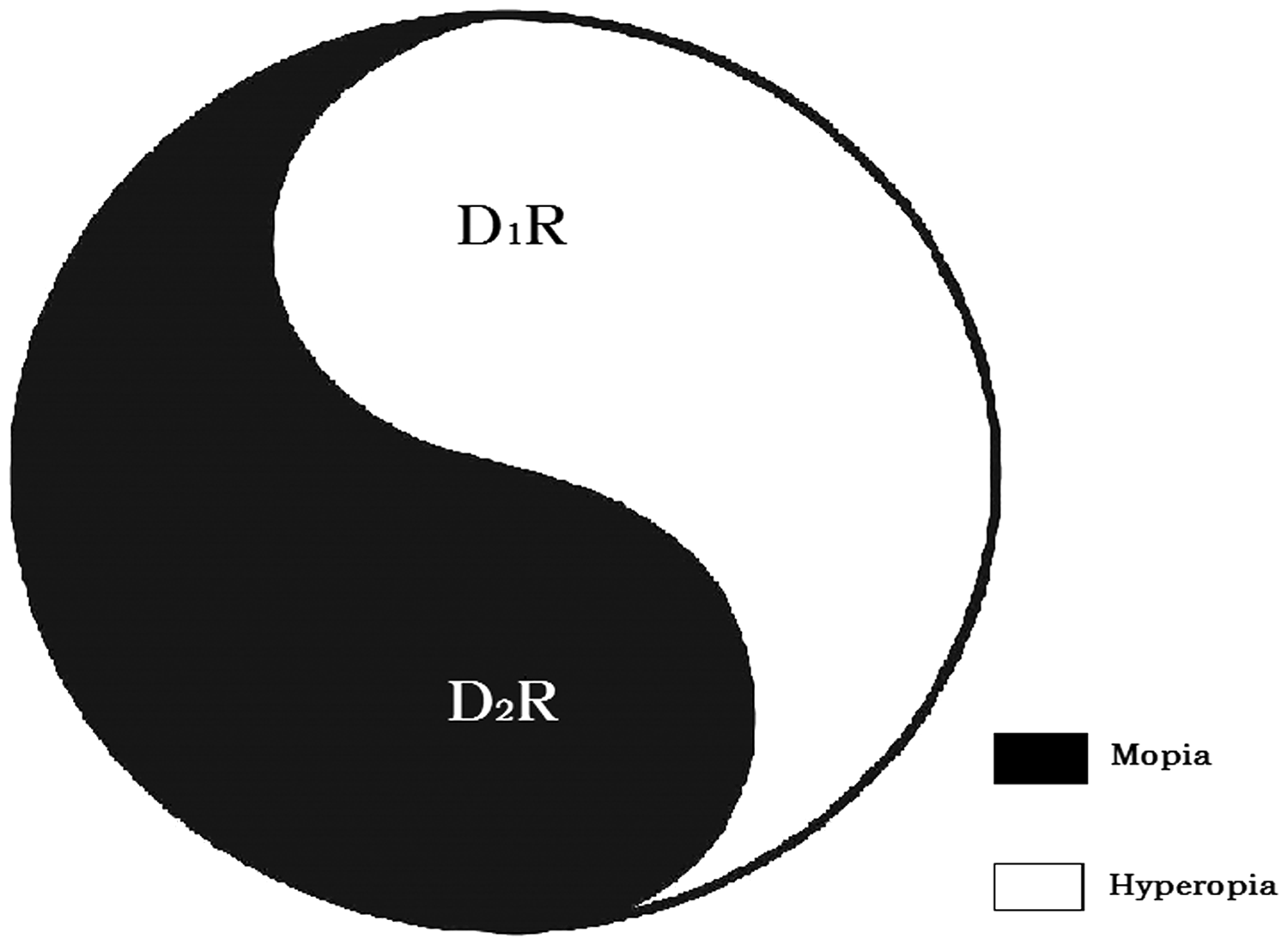
Hypothesis: Homeostatic control of myopia via the opposing effects of D1-like and D2-like receptors.
Dopamine-based strategies
DA-based strategies have been used to prevent the occurrence and to delay the progress of myopia in several studies. Reportedly, DA agonists may induce selective inhibition of form-deprivation myopia, without affecting normal visual development in mice. 63 Additionally, the influence of L-DOPA on amblyopic vision has been reported in three studies.66–69 However, some researchers disagree with those conclusions; 69 there is a need for further studies using larger sample sizes of children with myopia, to clarify the effect of L-DOPA in the prevention of myopia.
The inhibitory effect of DA on myopic eye growth has been evidenced in several works and has recently been considered as a target for treating myopia. However, in the development of myopia, several key questions regarding DA signaling need to be addressed. Further research is necessary to elucidate the exact mechanism of action and potential interactions with retinal pathways of DA.
Vitamin D
Vitamin D is considered a powerful cellular differentiation regulator with strong anticancer and antiproliferative effects. 70 Vitamin D may regulate the length and refractive degree of the eye, 71 which has a protective effect on myopia. Ciliary muscle enlargement is considered to structurally and functionally affect the eyes by increasing the risk of myopia. 72 A recent study demonstrated that the smooth muscle was found to be larger in the eyes of children with myopia. 73 Vitamin D, which is beneficial to the functioning of smooth muscle, may subsequently inhibit myopia. Exposure to solar ultraviolet B radiation may trigger vitamin D synthesis, 74 which may explain the protective effect of outdoor activities against the disorder.
It has also been suggested that higher levels of vitamin D may inhibit myopia via the following processes: regulating the growth of the sclera, adjusting the smooth ciliary muscle (necessary to achieve a clear retinal image), signaling and regulating the cell cycle,71,75–77 as well as the antiproliferative effect of vitamin D. Studies performed in British children revealed that those who spent more time outdoors appeared to have increased total vitamin D levels, although after controlling for the amount of outdoor time, blood vitamin D levels were not significantly associated with the incidence of myopia. This indicates that vitamin D may be a biomarker for the amount of time spent outdoors. Thus, there is a need for further research to separate the direct effect of vitamin D and its use an alternative to outdoor sunlight exposure.
Other potential mechanisms
According to another hypothesis, the dioptric pattern of the outdoor visual environment has been suggested to inhibit myopia. 78
A more uniform pattern of retinal defocus has been considered to be beneficial in protecting against myopia and may influence ocular growth. Additionally, in an outdoor environment, objects are typically further away with fewer dioptric variations across the visual scene, providing a more uniform pattern of retinal defocus. On the contrary, in an indoor visual environment, objects are much closer; the dioptric value is higher at the fixation point and decreases towards the periphery, which leads to higher levels of retinal defocus.
Several studies have proposed potential mechanisms associated with the protective effect of time spent outdoors. In an outdoor visual environment, the pupil constricts under high light intensity, and there is an increase in the accommodative demand for viewing distant objects, resulting in better clarity of the retinal image and an increased depth of focus.35,36,79
Conclusion
Currently, approximately 25% of the global population has myopia. 80 If the current increasing trend continues, this percentage will reach 50% (4.76 billion people) by 2050, including nearly one billion people with severe myopia. This situation amounts to a state of emergency. It is therefore crucial to find effective ways to address myopia-related complications. 65
Population-based data have demonstrated the protective effect of time spent outdoors, similar to the results of outdoor intervention programs. In this review, we have summarized four possible mechanisms involved in the protective effect against myopia of longer duration of time spent outdoors (Table 3). Further research is needed to explain these mechanisms, and DA-based strategies have yet to be used successfully in clinical settings. To prevent myopia at younger ages, measures must be implemented, such as conducting school classes outdoors, incorporating more outdoor activities into the school curriculum, and providing additional outdoor programs for children on weekends.
Main potential mechanisms involved in the protective effect against myopia of time spent outdoors.

Footnotes
Declaration of conflicting interest
The authors declare that there is no conflict of interest.
Funding
This study was supported by the Major Science and Technology Program of Changzhou Health and Family Planning Commission (ZD201511) and the Science and Technology Support Program of Changzhou (CE20175039).
