




Abstract
Objective
This meta-analysis determined the relationship between polymorphisms of the cytotoxic T-lymphocyte-associated protein 4 (CTLA4) gene and hepatitis B virus (HBV) clearance in chronic hepatitis B.
Methods
Published studies reporting associations between CTLA4 gene +49A/G polymorphisms and chronic HBV infection were reviewed. Odds ratio (OR) and 95% confidence interval (CI) were calculated to assess the risk of persistent HBV according to genotype.
Results
Six studies, involving 1076 chronic HBV patients and 1294 controls, were included. The risk of persistent HBV in patients with a +49 GG/AG genotype decreased significantly compared with the AA genotype (OR 0.65; 95% CI 0.52, 0.82). The variant G allele was negatively associated with chronic HBV infection versus the A allele (OR 0.77; 95% CI 0.68, 0.88). When stratifying by type of study control, a significantly decreased risk was associated with CTLA4+49 variant genotypes (AG and GG) in both spontaneous recovery control group and healthy control group.
Conclusions
Findings of this meta-analysis suggest that A at position +49 of the CTLA4 gene may significantly increase the risk of persistent HBV infection, whereas G at position +49 may positively influence virus clearance.
Keywords
Introduction
Hepatitis B infection remains a serious global public health problem: >350 million people are infected with the hepatitis B virus (HBV) worldwide. Approximately 5–10% of adults infected with HBV are unable to clear the virus and ultimately develop chronic HBV infection. 1 Persistence and progression of hepatitis B infection depend on several factors including host immune status, viral factors, ethnic differences and inheritance of susceptibility. Recently, polymorphisms of the cytotoxic T-lymphocyte antigen 4 (CTLA4) gene have been thought to play an important role in the persistence of HBV infection.2–4 The CTLA4 gene, expressed by T lymphocytes, is a negative regulator of T-cell responses. 5 Mice with deficient CTLA-4 develop a lymphoproliferative disorder a few days after birth; their T cells become activated and infiltrate nonlymphoid tissues. 6 In addition, in vivo blocking of CTLA-4 using an antibody enhances the immune response in murine models of infection, 7 tumour development 8 and autoimmune disease. 9 Over 100 single nucleotide polymorphisms (SNPs) have been identified in the CTLA4 gene. One of the most widely studied of these genetic variants is A/G dimorphism at position +49 in exon 1 (dbSNP: rs231775), which causes an amino acid substitution of threonine to alanine in the peptide leader sequence of the CTLA-4 protein. 10 This variant is significantly associated with many autoimmune diseases and tumours such as Graves’ disease, 11 systemic lupus erythematosus, 12 type I diabetes, 13 gastric cancer 14 and pancreatic cancer. 15 Several studies have reported on the association between chronic HBV infection and CTLA4 polymorphisms, and an A/G mutation at position +49 in exon 1 has been proposed to be associated with a decreased risk of HBV infection.2–4 Reported data are, however, controversial. Some research indicates that patients carrying CTLA4 + 49 AA genotype are more susceptible to persistent HBV infection, 2 while the others report no increased susceptibility.3,4
The present meta-analysis was conducted to determine the relationship between CTLA4 gene polymorphisms and HBV clearance in a large patient sample with chronic hepatitis B infection.
Materials and methods
Search strategy
Two independent investigators (H.X., M.Z.) carried out a search of the following: PubMed/MEDLINE® (1966 to 31 October 2012), Embase (1950 to 31 October 2012), Chinese Medical Database (1978 to 31 October 2012), Chinese National Knowledge Infrastructure and Database and China Biological Medicine Database (1977 to 31 October 2012) for all papers on CTLA4 gene polymorphisms and HBV. The search terms used were ‘hepatitis B’, ‘HBV’, ‘CTLA-4’, ‘CTLA4', ‘cytotoxic T-lymphocyte antigen 4’, ‘polymorphisms’, ‘SNP’ and ‘mutations’. The search was conducted using MeSH terms and free keywords; combinations of the key words were also used to maximize the sample size in the analysis. In addition, the reference lists of reviews and retrieved articles identified in the initial search were further searched by hand. Abstracts and unpublished reports were not collected. The language of the reviewed articles was limited to Chinese and English.
Inclusion and exclusion criteria
The following inclusion criteria were applied: (a) the evaluation of the association between CTLA4 gene polymorphisms and HBV infection; (b) a case–control or cohort study; (c) sufficient genotype data presented to calculate the odds ratio (OR) with 95% confidence intervals (CI) for risk of persistent HBV infection; (d) human studies; (e) chronic HBV infection, defined as a condition in which serum hepatitis B surface antigen was positive for ≥6 months; (f) the controls were healthy subjects or spontaneously recovered individuals. Criteria for excluding studies were: (a) any studies with overlapping data (in the case of overlapping data, the most recent publication was included); (b) any papers that were abstracts only, comments, reviews, editorials or letters; (c) studies with fewer than 50 participants.
Data extraction
Literature and eligible articles were searched by two authors (H.X., M.Z.). Each author independently extracted data about the first author’s name, year of publication, ethnicity and patient numbers, together with genotypes of cases and controls, source/type of controls and genotyping method. Any disagreement was resolved by discussion between the two authors (H.X., M.Z.) until consensus was reached.
Statistical analyses
To determine that the allele and genotype frequencies in each population were constant, the Hardy–Weinberg equilibrium model was used to assess the control groups for each study, using the goodness-of-fit test (χ2-test or Fisher’s exact test). A P-value <0.05 was considered to demonstrate significant disequilibrium.
Quantitative meta-analysis was performed using STATA® software, version 10.0 (StataCorp, College Station, TX, USA). ORs and their corresponding 95% CIs were calculated to evaluate the strength of association between the CTL4A + 49 gene polymorphism and chronic HBV infection. Sensitivity analysis was conducted to evaluate the validity and reliability of the primary meta-analysis, to ascertain the effects attributed to any individual study. Subgroup analyses were also performed, to evaluate the difference in ORs between studies with healthy controls and those with spontaneously recovered controls, and by ethnicity.
Heterogeneity was assessed for in each study using Cochrane’s Q-test and I2 measurement (I2 is defined as the proportion of total variations across studies that are due to heterogeneity rather than chance). A P-value ≤ 0.10 and an I2 value ≥50% indicated significant heterogeneity. A random effects model was used in the presence of substantial heterogeneity. The potential risk of publication bias was examined by the Egger test and a P-value ≤ 0.10 was considered to indicate the presence of a publication bias.
Results
In total, 57 potentially eligible papers were identified in the search. Of these, the following papers were excluded: 14 studies that were not case–control studies; 28 that did not contain the relevant gene polymorphisms; two that did not provide sufficient individual raw data for analysis; three that were review articles; four containing data that overlapped with other published studies. Consequently, six studies were included in the meta-analysis.3,4,16–19
Main characteristics of studies included in a meta-analysis of publications on the association between the cytotoxic T-lymphocyte antigen 4 (CTLA4) gene +49 A/G polymorphism and chronic hepatitis B virus infection.

SR, spontaneously recovered.
Figure 1 shows the risk of chronic HBV infection by different genotypes in the total analysis population. Chronic HBV infection was negatively associated with presence of the AG genotype (AG versus AA: OR 0.73; 95% CI 0.57, 0.94) (Figure 1A); no substantial heterogeneity was found. The GG genotype was also negatively associated with persistent HBV infection compared with the AA genotype (OR 0.60; 95% CI 0.47, 0.77) (Figure 1B). No statistically significant difference was found between the GG and AG genotypes (OR 0.85; 95% CI 0.70, 1.02) (Figure 1C). The AG and GG genotypes were combined and it was found that AG + GG genotype was significantly negatively associated with chronic HBV infection compared with AA genotype (OR 0.65; 95% CI 0.52, 0.82); no substantial heterogeneity was found (Figure 1D). The G allele was also significantly associated with a lower risk of chronic HBV infection, compared with the A allele (OR 0.77; 95% CI 0.68, 0.88) (Figure 2). Sensitivity analysis found that removal of any individual study did not alter the overall trend.
Meta-analysis of publications reporting associations between the cytotoxic T-lymphocyte antigen 4 (CTLA-4) gene +49 A/G polymorphism and chronic infection with hepatitis B virus (HBV). Forest plot of the risk of chronic HBV infection associated with CTLA-4 gene +49 A/G polymorphism for: (A) AG versus AA genotypes; (B) GG versus AA genotypes; (C) GG versus AG genotypes; (D) combined GG + AG versus AA genotypes. OR, odds ratio, CI, confidence interval. Meta-analysis of publications reporting the association between the cytotoxic T-lymphocyte antigen 4 (CTLA-4) gene +49 A/G polymorphism and chronic hepatitis B virus (HBV) infection. Forest plot of the risk of chronic HBV infection associated with G allele compared with A allele at position 49 of the CTLA4 gene.

No significant publication bias was found for AG versus AA, GG versus AG, and AG + GG versus AA genotypes. Significant publication bias was evident for the GG versus AA genotypes (P = 0.09). Studies were excluded one by one from the meta-analysis to observe whether the publication bias was still present. After excluding one study, 4 the publication bias was eliminated.
Association between the cytotoxic T-lymphocyte antigen 4 (CTLA4) gene +49 A/G polymorphism and risk of hepatitis B virus persistence by type of control group included in the study, in a meta-analysis of publications on the association between the CTLA4 gene +49 A/G polymorphism and chronic infection with hepatitis B virus.

OR, odds ratio; CI, confidence interval; df, degrees of freedom; SR, spontaneously recovered.
Association between cytotoxic T-lymphocyte antigen 4 (CTLA4) gene +49 A/G polymorphism and the risk of hepatitis B virus persistence by ethnicity, in a meta-analysis of publications on the association between the CTLA4 gene +49 A/G polymorphism and chronic infection with hepatitis B virus.
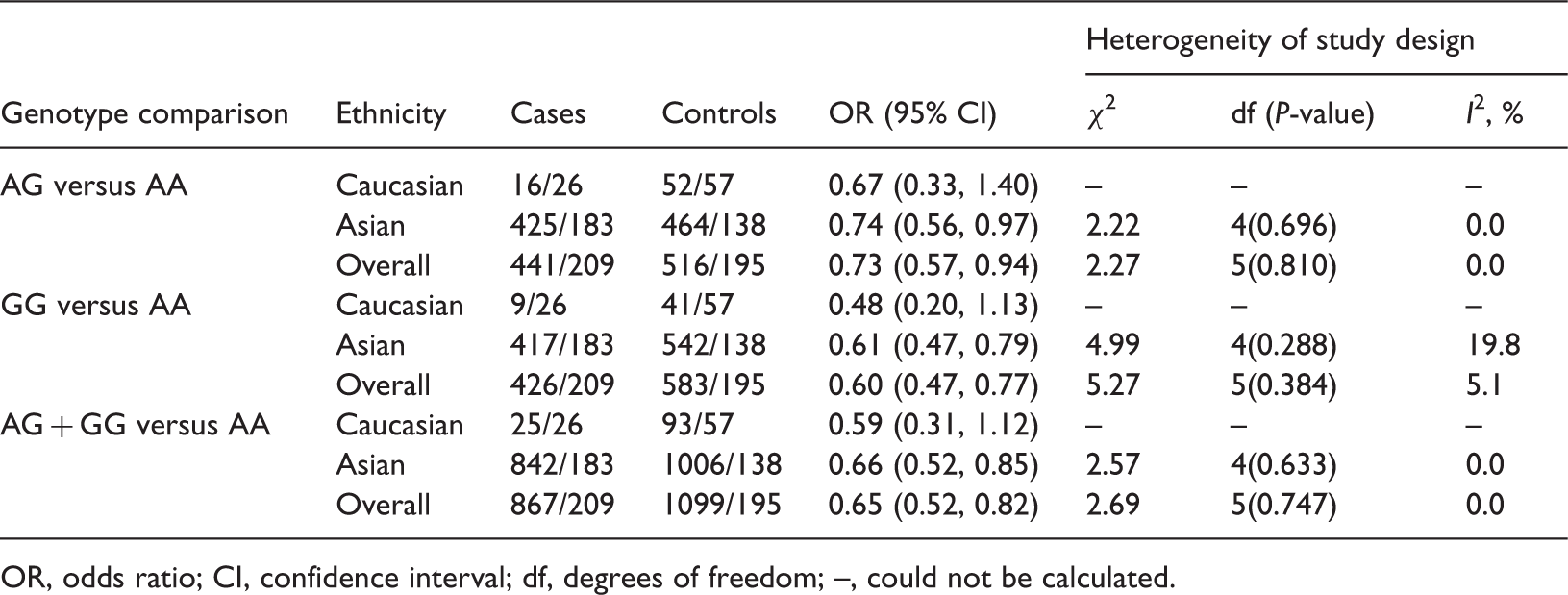
OR, odds ratio; CI, confidence interval; df, degrees of freedom; –, could not be calculated.
Discussion
CTLA4, a negative regulator of T-cell activity, is homologous to CD28 but has the opposite effect on T-cell activation. 8 There are two separate reported mechanisms of action for CTLA-4 inhibition of T-cell activation. 20 In one mechanism, CTLA-4 competes with CD28 for binding to B7 on the antigen-presenting cell (APC); the other involves direct intracellular inhibitory signals mediated by the CTLA-4 cytoplasmic tail, which occurs in the early stages of an immune response when the expression of CTLA4 and B7 is limited. 21 CTLA4 is also constitutively expressed in regulatory T cells (Treg), which have an immunosuppressive effect on T helper cells and contribute to an inadequate immune response against HBV, resulting in chronic infection. 22
A study testing the hypothesis that SNPs in the CTLA4 gene might affect the vigour of the T-cell response to HBV infection, thereby influencing viral persistence, analysed six CTLA4 SNPs in a large, matched, panel of participants with known HBV outcomes. 2 The haplotype distribution differed between those with viral persistence and those with viral clearance. Two genotypes were significantly associated with the clearance of HBV infection: CTLA4 –1722C and +49G. 2 Another study showed no significant association between the CTLA4 + 49 A/G polymorphism and the outcome of HBV infection. 3 Even in studies that agree on the association between CTLA4 + 49 A/G polymorphism and chronic HBV infection, there are differences of opinion.16–19 For example, two studies presumed that only G/G homozygotes show persistent HBV infection,16,17 while another showed that A/G heterozygosity is significantly associated with chronic HBV infection. 18 Thus, the significance of CTLA4 gene polymorphisms in chronic HBV infection remain to be determined and should be prospectively evaluated in larger studies.
The present meta-analysis provided a comprehensive assessment of the association between outcome of HBV infection and CTLA4 gene +49 polymorphism. The results indicated that both A/G heterozygosity and G/G homozygosity are significantly associated with chronic HBV infection. In subgroup analyses, CTLA4 + 49 AG/GG and GG genotypes were significantly associated with chronic HBV infection in spontaneously recovered individuals and healthy controls, respectively. This suggested that the CTLA4 + 49 G allele plays a crucial role in the body’s antiviral mechanism, and may protect healthy people from contracting HBV infection and/or enhance scavenging of virus, once infected.
Allele frequencies of the rs231775 polymorphism can vary markedly by ethnic background: the A allele is dominant in Caucasians whereas the G allele is most common in Asian populations. 23 In Caucasians, the GG genotype at position +49 occurs in 7.8–12.9% of healthy individuals while among Asian patients it is found in 39.0–48.1% of healthy individuals. 23 Thus, there may be different associations between CTLA4 + 49 A/G polymorphisms and persistent HBV infection among different ethnicities. The present meta-analysis showed that CTLA4 + 49 A/G polymorphisms were significantly associated with chronic HBV infection in Asians but not in Caucasians. As only one study in Caucasians was available, however, this subgroup analysis may not be reliable. Additional studies in Caucasian patients are needed to evaluate the association between CTLA4 + 49 polymorphisms and risk of chronic HBV infection.
The function of CTLA4 + 49 A/G polymorphism has been studied extensively. In individuals with the CTLA4 + 49 AA genotype, T-cell activation is downregulated compared with those with the CTLA4 + 49 GG genotype. 24 Levels of CTLA-4 mRNA and protein levels are significantly reduced in individuals with the CTLA4 + 49 GG genotype compared with those with CTLA4 + 49 AA genotype. 24 One study identified that the G allele may interfere with splicing of the CTLA4 gene, 25 resulting in reduced production of the soluble form of CTLA-4 and reduced inhibition of T-cell activation. Another study, 26 found that the CTLA4 + 49 GG genotype may decrease Treg function and reduce inhibition of T-cell activation. This may explain why CTLA4 + 49 A/G mutations may prevent chronic HBV infection.
In conclusion, findings of the present meta-analysis suggest that CTLA4 + 49 A/G polymorphisms may be significantly associated with the outcome of HBV infection. The AA genotype appears more susceptible to chronic HBV infection whereas the GG and AG genotypes are protective against chronic HBV infection. The association between CTLA4 + 49 polymorphism and chronic HBV infection may differ widely in different ethnic groups, however. Larger, well-designed, multicentre studies in Caucasian patients are needed to evaluate this association further.
Footnotes
Declaration of conflicting interest
The authors declare that there are no conflicts of interest.
Funding
This work was funded by the 12-5 State S&T Projects of China (grant no: 2012ZX10002007).