




Abstract
Objective
To investigate the inhibitory effect of geraniol alone, or in combination with gemcitabine, on the proliferation of BXPC-3 pancreatic cancer cells.
Methods
BXPC-3 cells were treated under different conditions: with geraniol at 10, 20, 40, 80 and 160 µmol/l each for 24 h, 48 h or 72 h; with 20 µmol/l geraniol for 24 h or 0 h before 20 µmol/l gemcitabine for 24 h; with 20 µmol/l geraniol for 24 h, 48 h and 72 h following 20 µmol/l gemcitabine for 24 h; or with 20 µmol/l gemcitabine alone as a control. Cell proliferation was assessed and changes in cell morphology were assessed by light and fluorescence microscopy. Apoptosis was detected using flow cytometry.
Results
Geraniol inhibited BXPC-3 cell proliferation in a time- and dosa-dependent manner. Geraniol alone or combined with gemcitabine induced BXPC-3 cell apoptosis. BXPC-3 inhibition rates with combined treatment were 55.24%, 50.69%, 49.83%, 41.85% and 45.27% following treatment with 20 µmol/l geraniol for 24 h or 0 h before 20 µmol/l gemcitabine for 24 h, or 20 µmol/l geraniol for 24 h, 48 h and 72 h, following 20 µmol/l gemcitabine for 24 h, respectively.
Conclusion
Geraniol inhibited the proliferation of BXPC-3 cells. Geraniol significantly increased the antiproliferative and apoptosis-inducing effects of gemcitabine on BXPC-3 cells. Maximum inhibition of BXPC-3 cells was achieved with geraniol treatment for 24 h before gemcitabine treatment.
Introduction
Gemcitabine is one of the first-line treatments for advanced pancreatic cancers.1,2 The response rate of gemcitabine is <20%, however, due to the acquired or inherent drug resistance of pancreatic cancer cells, which results in poor therapeutic outcomes.3–6
Geraniol is a natural acyclic monoterpene isolated from plants of Pelargonium, Cymbopogon spreng, Lauraceae Litsea and Rosaceae. 7 Geraniol is categorized as ‘Generally Recognized as Safe’ by the United States Food and Drug Administration for use as a food additive and insect repellent, and shows several pharmacological effects including inhibition of proliferation and growth in cancer cells and prevention of hepatotoxicity.7–10 Geraniol has also been demonstrated to enhance the inhibitory effects of 5-fluorouracil on the proliferation of colon cancer cells. 11
The present study investigated the inhibitory effect of geraniol alone, or in combination with gemcitabine, on the proliferation of BXPC-3 pancreatic cancer cells. The optimum duration of cell incubation with geraniol, when used with gemcitabine, was also investigated.
Materials and methods
Materials
Geraniol (purity >98%; 106-24-1; Sigma-Aldrich, St Louis, MO, USA) was dissolved in dimethyl sulphoxide (DMSO) at a stock concentration of 160 mmol/l, and stored at −20℃. Working concentrations were prepared by diluting the stock geraniol in RPMI 1640 culture media. Gemcitabine (A629519A; Eli Lilly and Company, Indianapolis, IN, USA) was dissolved in sterilized physiological saline at a stock concentration of 0.2 mmol/l. Fetal bovine serum (FBS) and RPMI 1640 medium were purchased from Gibco BRL, Life Technologies (Gaithersburg, MD, USA). The Cell Counting Kit-8 (CCK-8) was purchased from Beyotime Institute of Biotechnology (C0038; Haimen, Jiangsu, China) and the cell apoptosis detection kit, Annexin V-fluorescein isothiocyanate (FITC), was purchased from Keygentec Biological Development Limited (KGA108; Nanjing, China). The BXPC-3 human pancreatic cancer cell line was purchased from the American Type Culture Collection (Manassas, VA, USA).
Cell culture and detection of proliferation
The BXPC-3 cells were cultured in RPMI 1640 medium containing 10% FBS, 100 µg/ml penicillin and 100 µg/ml streptomycin at 37℃ with 5% CO2. For routine culture, cells were subcultured into new dishes when they reached 70–80% confluence (following 2–3 days of incubation), by detaching with 0.25% trypsin/ethylenediamine tetra-acetic acid (EDTA) at 37℃ and seeding into flasks at 5 × 10⁵ cells/ml. BXPC-3 cells in the logarithmic growth phase were harvested with 0.25% trypsin/EDTA at 37℃ and seeded into 96-well plates at 4 × 10³ cells/well. Cells were left to adhere for approximately 12 h at 37℃. Triplicate wells with adherent cells were treated with geraniol at 10, 20, 40, 80 and 160 µmol/l each at 37℃ for 24 h, 48 h and 72 h, respectively. Blank controls comprised wells filled with 0.1 M phosphate-buffered saline (PBS) pH 7.4. Cells treated with 0.1% DMSO at 37℃ for 24 h, 48 h and 72 h, respectively were used as negative controls. Following incubation, the treatment medium was aspirated and all groups were incubated with 0.01 ml CCK-8 for 1 h at 37℃. The inhibition of proliferation was determined by enzyme-linked immunosorbent assay (ELISA) at an absorbance of 450 nm, following the CCK-8 manufacturer’s instructions. All the experiments were repeated three times. Cell inhibition rate = [1 − (Aexperiment group − Ablank group)/(Anegative control group − Ablank group)] × 100%.
Cell morphology
The BXPC-3 cells were seeded into six-well plates at 5 × 10⁴ cells/ml in 1 ml of RPMI 1640 medium containing 10% FBS, 100 µg/ml penicillin and 100 µg/ml streptomycin. Cells were cultured overnight at 37℃, followed by incubation at 37℃ with 20 µmol/l geraniol for 24 h, 48 h and 72 h, respectively. Cells were fixed with 4% formaldehyde and the morphology was observed using phase contrast microscopy. Treated cells were also stained with 1 ml propidium iodide (100 µg/ml; incubated at 4℃ for 30 min) and 5 μlm Annexin V-FITC solution (incubated at 4℃ for 5 min); the nuclear morphology was observed under a fluorescence microscope.
Effects of geraniol and gemcitabine on BXPC-3 cell proliferation
The BXPC-3 cells in the logarithmic growth phase were harvested with 0.25% trypsin/EDTA at 37℃ and seeded into 96-well plates at 4 × 10³ cells/well. Cells were left to adhere for ∼12 h at 37℃. Cells were incubated at 37℃ under five different treatments: cells treated with 20 µmol/l geraniol for 24 h followed by 20 µmol/l gemcitabine for 24 h; cells treated with both 20 µmol/l geraniol and 20 µmol/l gemcitabine for 24 h; cells treated with 20 µmol/l gemcitabine for 24 h followed by 20 µmol/l geraniol for either 24, 48 or 72 h, respectively. Cells treated with 20 µmol/l gemcitabine for 72 h at 37℃ were used as controls. Inhibition of proliferation in BXPC-3 cells was measured using the CCK-8 method, following the manufacturer’s instructions.
Detection of apoptosis by flow cytometry
The BXPC-3 cells were cultured in RPMI 1640 medium containing 10% FBS, 100 µg/ml penicillin and 100 µg/ml streptomycin at 37℃ with 5% CO2. Cells were subcultured once they had reached 90% confluence. BXPC-3 cells in the logarithmic growth phase were harvested by incubating with trypsin/EDTA at 37℃ and seeded at 4 × 10⁵ cells/well into six-well plates. Cells were left to adhere for ∼12 h at 37℃. Adherent cells were treated at 37℃ with: 20 µmol/l geraniol for 24 h; 20 µmol/l gemcitabine for 24 h; both 20 µmol/l geraniol and 20 µmol/l gemcitabine for 24 h; or RPMI 1640 medium for 24 h as a control. For detection of apoptosis, all cells were harvested by incubating with 0.25% trypsin/EDTA at 37℃ and centrifuged at 300
Statistical analyses
Data were presented as mean ± SD. Differences between means were analysed by one-way analysis of variance (ANOVA) and Student’s t-test using the SPSS® software package, version 18.0 (SPSS Inc., Chicago, IL, USA) for Windows®. A P-value <0.05 was considered statistically significant.
Results
Cell proliferation rates were 81.35%, 64.41% and 53.28% in BXPC-3 cells incubated with 20 µmol/l geraniol for 24 h, 48 h and 72 h, respectively. Increased inhibition of proliferation was observed in all groups treated with geraniol at all concentrations for each incubation time, compared with the negative controls (0.1% DMSO) (Figure 1). Differences between the treatment groups were statistically significant (P < 0.05).
Inhibitory effects of geraniol on proliferation of BXPC-3 human pancreatic cancer cells treated with geraniol (0 [0.1% dimethyl sulphoxide], 10, 20, 40, 80 and 160 µmol/l) for 24 h, 48 h or 72 h, respectively (n = 3). Data presented as mean ± SD. *P < 0.05, one-way analysis of variance.
Analysis of BXPC-3 cell morphology by light microscopy showed that normal BXPC-3 cells exhibited adherent growth characteristics with a round morphology, clear cell outline, abundant cytoplasm and normal growth (Figure 2A). The number of adherent cells was reduced, spacing between the cells increased and cell volume decreased when cells were incubated with 20 µmol/l geraniol, and these effects increased with geraniol incubation time. Particle deposition in the cytoplasm, apoptotic cells and cell debris were also observed in cells incubated with geraniol (Figure 2B–D). BXPC-3 cells treated with 20 µmol/l geraniol for 24, 48 and 72 h, and stained with propidium iodide and Annexin V-FITC, demonstrated obvious nuclear shrinkage and chromosome condensation (Figure 2F–H).
Representative phase contrast (A–D) and fluorescence (E–H) photomicrographs showing morphologies of BXPC-3 human pancreatic cancer cells treated with geraniol (20 µmol/l) for 24, 48 and 72 h respectively: (A,E) control cells; (B,F) 20 µmol/l geraniol for 24 h; (C,G) 20 µmol/l geraniol for 48 h; (D,H) 20 µmol/l geraniol for 72 h. Flourescent cells were treated with propidium iodide and Annexin V-fluorescein isothiocyanate (FITC). Cytoplasmic particles, apoptotic cells and cell debris are shown (B–D). Nuclear shrinkage and chromosome condensation are shown (F–H). Scale bar, 25 µm. The colour version of this figure is available at: http://imr.sagepub.com.
Inhibitory effects of 20 µmol/l geraniol, in combination with 20 µmol/l gemcitabine, on proliferation of BXPC-3 human pancreatic cancer cells at 37℃ (n = 5).

Data presented as mean ± SD or % inhibition rate.
P < 0.05, compared with control, one-way analysis of variance.
Effects of 20 µmol/l geraniol, in combination with 20 µmol/l gemcitabine at 37℃, on apoptosis of BXPC-3 human pancreatic cancer cells (n = 5).
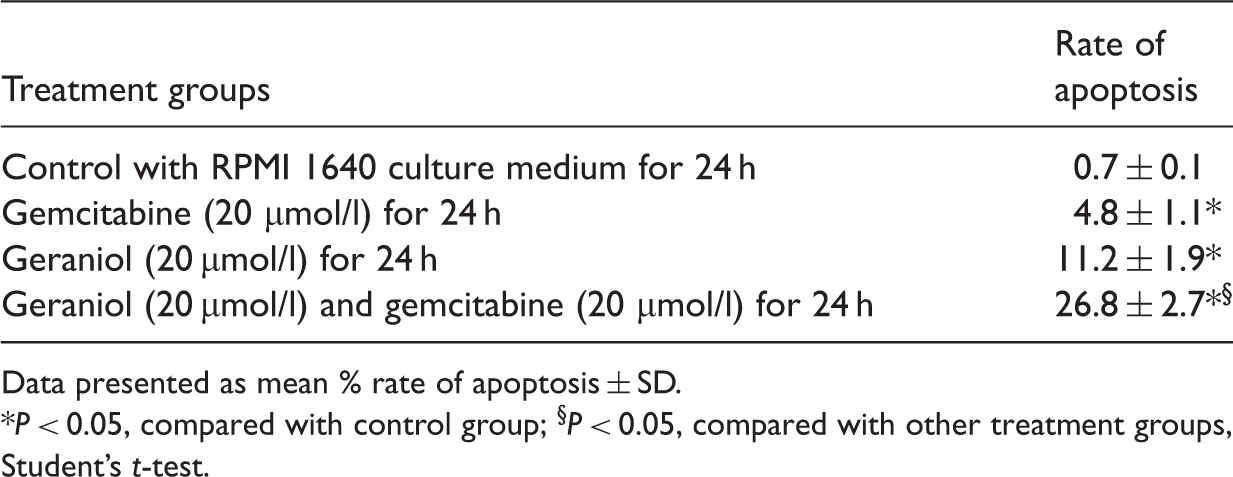
Data presented as mean % rate of apoptosis ± SD.
P < 0.05, compared with control group; §P < 0.05, compared with other treatment groups, Student’s t-test.
Discussion
Advanced pancreatic cancer is one of the most difficult malignant tumours to treat, due to resistance to conventional cytotoxic chemotherapeutic drugs and metastasis in the early stages of disease.12–15 Many pancreatic cancer patients are in advanced disease stages when diagnosed and are not fit for surgical treatment, therefore, chemotherapy (usually with gemcitabine) is the primary method of treatment.16–18 Treatment with gemcitabine alone, however, is not satisfactory in clinical applications.19,20 It has been demonstrated that combined therapy with gemcitabine increases the sensitivity of pancreatic cancer cells to gemcitabine, although combined therapy did not significantly improve survival rates in patients with pancreatic cancer and was associated with various side-effects in several clinical trials.21–23 It is necessary, therefore, to find effective methods to increase cell sensitivity to chemotherapy using gemcitabine. Fortunately, pancreatic cancer treatments using gemcitabine in combination with noncytotoxic drugs are receiving more attention.
Geraniol has been shown to inhibit prostate cancer cell proliferation, while having little effect on proliferation of normal cells and exhibiting no cytotoxicity. 24 Geraniol was shown to cause cell apoptosis of cancer cells by inducing reactive oxygen species and inhibiting phosphorylation of tyrosine kinase. 24 In the present investigation, the effects of geraniol on BXPC-3 cells, a human pancreatic carcinoma drug resistant cell line, were explored. The results demonstrated that geraniol inhibited proliferation of BXPC-3 cells in both a dose- and time-dependent manner. The obvious nuclear shrinkage and chromosome condensation observed in BXPC-3 cells treated with geraniol indicated that apoptosis was induced in these cells, suggesting that geraniol may inhibit proliferation of BXPC-3 cells by inducing cell apoptosis.
Geraniol has been shown to enhance the inhibitory effects of paclitaxel 25 and doxorubicin 26 on tumour cell proliferation. The present study showed that geraniol increased the inhibitory effects of gemcitabine on proliferation of BXPC-3 cells and induced cell apoptosis. It has been shown that the inhibitory effects of thermal therapy, in combination with gemcitabinn on pancreatic cancer cells were different at different timepoints. 27 According to previous unpublished results by the authors, the role of geraniol in immune suppression may vary depending on the treatment time, therefore, the present study investigated different treatment times on the effects of geraniol in combination with gemcitabine on pancreatic cancer cells. Five different groups were investigated in the present study: cells treated with 20 µmol/l geraniol for 24 h followed by 20 µmol/l gemcitabine for 24 h; cells treated with both 20 µmol/l geraniol and 20 µmol/l gemcitabine for 24 h; cells treated with 20 µmol/l gemcitabine for 24 h followed by 20 µmol/l geraniol for either 24, 48, or 72 h, respectively. The results demonstrated that the cell proliferation effect was most significant in the group treated with geraniol for 24 h before gemcitabine treatment for 24 h, suggesting that this treatment regimen might be an effective method to be investigated further, in clinical studies. However, the mechanism behind the enhanced antiproliferative effect of geraniol remains to be investigated.
Geraniol at a concentration of 20 µmol/l was used in the present study for the combined drug experiments, as this was shown to be the median effective concentration for inhibiting cell proliferation. To verify the results of the present study, the effects of geraniol at different concentrations in combination with gemcitabine, and the effects of geraniol/gemcitabine combinations on different human pancreatic cell lines, should be investigated.
In conclusion, the present study demonstrated that geraniol enhanced the inhibitory effects of gemcitabine on BXPC-3 human pancreatic cancer cells, possibly by inducing cell apoptosis. Combined treatment of BXPC-3 cells with geraniol for 24 h before gemcitabine showed the highest inhibitory effect. These data provide useful information for the potential clinical application of geraniol, in combination with gemcitabine, in providing a potentially more effective treatment for pancreatic cancer compared with currently available options.
Footnotes
Declaration of conflicting interest
The authors declare that there are no conflicts of interest.
Funding
This research received no specific grant from any funding agency in the public, commercial, or not-for-profit sectors.