



Abstract
Objective
To investigate whether better sexual health is associated with improvements in overall health and wellness, a more loving and intimate relationship, and a more positive outlook on life.
Methods
The Sexual Health and Overall Wellness survey used self-administered questionnaires to collect data from men and women aged 25–74 years who had had sexual intercourse at least once within the previous 12 months.
Results
Across nine countries, 3780 self-administered questionnaires were completed: 1893 from men (mean age, 44.6 years); 1887 from women (mean age, 44.2 years). The majority of men and women were satisfied with the frequency of sexual intercourse over the previous 4 weeks (59% and 66%, respectively); the majority (67% and 55%, respectively) reported that having sex was ‘very important’ or ‘absolutely essential’. For men and women, there was a strong association between satisfaction with sex and overall health, and between satisfaction with sex and an overall positive outlook on life.
Conclusion
For men and women, satisfaction with different aspects of sex was important, and was strongly associated with satisfaction with general health, relationships and other aspects of wellbeing.
Introduction
It is well known that sexual health is important and influences the overall health and emotional wellbeing of individuals. Brody and Weiss demonstrated that a firmer erection, simultaneous orgasm and increased frequency of sexual intercourse were all associated with better quality of life and improved satisfaction with sexual, partnership and mental health aspects of living. 1 Findings from the Global Better Sex Survey (GBSS) 2 and the Asia–Pacific Sexual Health and Overall Wellness survey, 3 which explored the sexual aspirations and unmet needs of both men and women worldwide, provide further evidence of the importance of the sexual experience to both men and women. Although many aspects of the sexual experience (attraction to partner, foreplay, intercourse and orgasm) were important to men and women in the GBSS, erectile function and the effect of erectile dysfunction (ED) on the sexual experience emerged as the most pressing concerns, particularly among male participants. 2 While the physical component of ED has been well documented and has been further highlighted by the GBSS, 2 the psychological effects of ED can impact on both partners.4–6 As ED also has negative impact on the sexual life of female partners (including reduced sexual activity 7 and reduced sexual satisfaction and sexual desire8,9) it is important that healthcare providers include both partners in any discussions on sexual health issues.
While a large proportion of men and women surveyed in the GBSS were not completely satisfied with their sex life and showed a desire to improve it, satisfaction with erection hardness appeared to be positively associated with satisfaction with sex, love and romance, and, interestingly, with overall health. 2 Studies suggest that satisfaction with sex appears to be positively associated with the frequency of penile–vaginal intercourse and is seen as a vital aspect of life satisfaction for women of all ages.10–12 In particular, older women have been shown to be dissatisfied with the limited variety in their sex lives. In a study by Woloski-Wruble et al. 13 of 127 older women in Israel, positive significant correlations were observed between sexual satisfaction and level of current sexual activity, and between sexual satisfaction and life satisfaction. However, since the GBSS study was conducted, there may have been a change in social norms that might have influenced the sexual habits and behaviours of individuals.
To understand further the importance of the sexual experience to both men and women, and the possible effect of sexual satisfaction on overall life satisfaction and health across Europe and the Middle East, the Sexual Health and Overall Wellness (SHOW) survey was conducted. The aim of this present survey was to test the hypothesis that better sexual health is associated with better overall health and wellness, a more loving and intimate relationship, and a more positive outlook on life in general.
Patients and methods
Study design and selection
This cross-sectional study was conducted by Harris Interactive Inc. (New York, NY, USA), which is an independent research organization. The study involved nine countries across Europe and the Middle East (Russia, Ukraine, Poland, Hungary, Czech Republic, Slovakia, Romania, Israel and Turkey) and was undertaken between 29 June 2010 and 16 August 2010. Men and women aged 25–74 years and who had had sexual intercourse at least once within the previous 12 months were eligible for inclusion.
Local authorities in the participating countries determined that independent review board approval was not required for this study. All respondents gave their verbal consent to participate in the study. They had the right to refuse/stop the interview at any point and their identity was kept strictly confidential at all times.
Data collection
In all countries except Israel and Turkey, respondents were randomly sampled from online consumer panels and completed an online self-administered questionnaire. In Israel, respondents were sampled using a door-to-door method and completed online or paper self-administered questionnaires. In Turkey, respondents were sampled using street intercepts and completed a paper self-administered questionnaire. The questionnaire was completed in the local language of the country in which the respondent was surveyed. The questionnaire was developed by Harris Interactive Inc., in close collaboration with Pfizer Inc. and in consultation with experts in the field. The questionnaire comprised closed-ended questions only, with one validated question (Erection Hardness Scale; EHS 14 ). The questionnaire was designed to evaluate: (i) overall health and wellness; (ii) importance of and satisfaction with various aspects of life, intimate relationship, sexual experience and sexual performance; (iii) general attitudes about sex; (iv) attitudes about men’s sexual health; (v) frequency of and satisfaction with sexual intercourse; (vi) attitudes and perceptions of suboptimal erection; (vii) level of interest in improving sexual experience; (viii) usage of and satisfaction with treatments for improving erectile function; (ix) physician–patient dialogue concerning erectile function. The wording of the questions was appropriately adjusted, based on gender. The questionnaires were translated into local languages by at least two independent, native speaking, professional translators. A variety of rating scales was employed during the course of the survey as follows: (i) importance scale; (ii) satisfaction scale; (iii) agreement scale; (iv) personal relevance scale.
Where relevant, respondents were placed into one of four groups based on the hardness of their or their partner’s erection during sexual intercourse, using the EHS: 14 grade 1 defined the penis as larger but not hard; grade 2 defined the penis as hard but not hard enough for penetration; grade 3 defined the penis as hard enough for penetration but not completely hard; grade 4 defined the penis as completely hard and fully rigid. Respondents who reported having ‘EHS grade 3’ (EHS 3) were referred to as having ‘suboptimal erection hardness’, while respondents reporting ‘EHS grade 4’ (EHS 4) were referred to as having ‘optimal erection hardness’. The analyses presented in this report primarily concentrate on men with EHS 3 and 4.
Statistical analyses
Data were weighted: (i) to the individual country’s standard demographic parameters (i.e. gender, age, region, education), to reduce the effects of any sampling and/or selection bias and to ensure representativeness within each given country; (ii) by the country’s population size, to reflect accurately any proportionate differences in population size between countries (small populations were down-weighted; larger populations were up-weighted).
Statistical significance was tested at the 95% confidence level using Student’s t-test on column proportions and means. A P-value <0.05 was considered statistically significant. All statistical analyses were performed using Quantum™ software, version 5.8.1 (IBM SPSS Inc., Chicago, IL, USA), where applicable.
Results
A total of 3780 self-administered questionnaires were completed across all nine participating countries; of these, 1893 were completed by men and 1887 were completed by women (Russia, 306 and 304; Ukraine, 157 and 152; Poland, 307 and 301; Hungary, 201 and 200; Czech Republic, 202 and 211; Slovakia, 152 and 149; Romania, 201 and 201; Israel, 149 and 153; Turkey, 218 and 216 men and women, respectively). The mean age of respondents was 44.6 years for men and 44.2 years for women.
Men report engaging in sexual intercourse with a partner significantly more often than women during the 4 weeks prior to taking the survey (mean of 10.3 times versus 9.3 times, respectively; P <0.05). Men with optimal erection hardness (EHS 4) reported having had sex significantly more frequently than men with suboptimal erection hardness (EHS 3) over the preceding 4 weeks (mean of 11.5 times versus 8.5 times for men with EHS 4 and EHS 3, respectively; P <0.05). In addition, men with a lower EHS grade experienced significantly lower levels of satisfaction with all aspects of the sexual experience, compared with men with EHS 4 (P <0.05). Similarly, women whose partners experienced EHS 4 had sexual intercourse significantly more frequently in the preceding 4 weeks than women whose partners experienced EHS 3 (mean of 10.8 times versus 7.0 times, respectively; P <0.05). For women with partners who experienced EHS 4, satisfaction with sex was significantly greater than in those with partners who experienced EHS 3 (P <0.05).
Although sexual intercourse appeared to become significantly less frequent with increasing age, age did not seem to have an influence on men’s satisfaction with the frequency of sexual intercourse, i.e. whether they had the right amount of sex or not; for women, the proportion satisfied with the frequency of sexual intercourse increased with age.
Overall, both men and women were satisfied with the frequency of sexual intercourse over the previous 4 weeks: 59% of men versus 66% of women reported having ‘about the right amount of sex’. However, men were significantly more likely than women to report having ‘less than the right amount of sex’ than women (36% versus 28%, respectively; P <0.05). In terms of sexual desire, significantly more men (32%) than women (22%) had sexual thoughts involving their partner one or more times per day (P <0.05).
A clear majority of men (67%) and women (55%) reported that having sex was ‘very important’ or ‘absolutely essential’ in their lives. Compared with other life priorities, although sex ranked third for men, it only ranked eighth on the list of life priorities for women. Furthermore, more than two-thirds of the women who were surveyed reported that they found family life, overall physical health, being a parent, love and romance to be ‘absolutely essential’ or ‘very important’. Among respondents aged ≥60 years, a lesser but still considerable proportion of men (58%) and women (41%) attached the same level of importance to sex. Greater levels of satisfaction with sex were strongly associated with greater levels of satisfaction with other important aspects of life (Figure 1). Men and women who reported being ‘completely satisfied’ or ‘very satisfied’ with sex were significantly more likely to be ‘completely satisfied’ or ‘very satisfied’ with their overall physical health, family life and financial wellbeing, compared with men and women who reported being ‘somewhat satisfied’ or ‘not at all satisfied’ with sex (P <0.05 for all comparisons). Association between satisfaction with sex and satisfaction with other important aspects of life, as reported by men (n = 1893) and women (n = 1887) from nine countries across Europe and the Middle East who participated in the Sexual Health and Overall Wellness survey (*P < 0.05, compared with men and women who reported being ‘somewhat satisfied’ or ‘not at all satisfied’ with sex; Student’s t-test).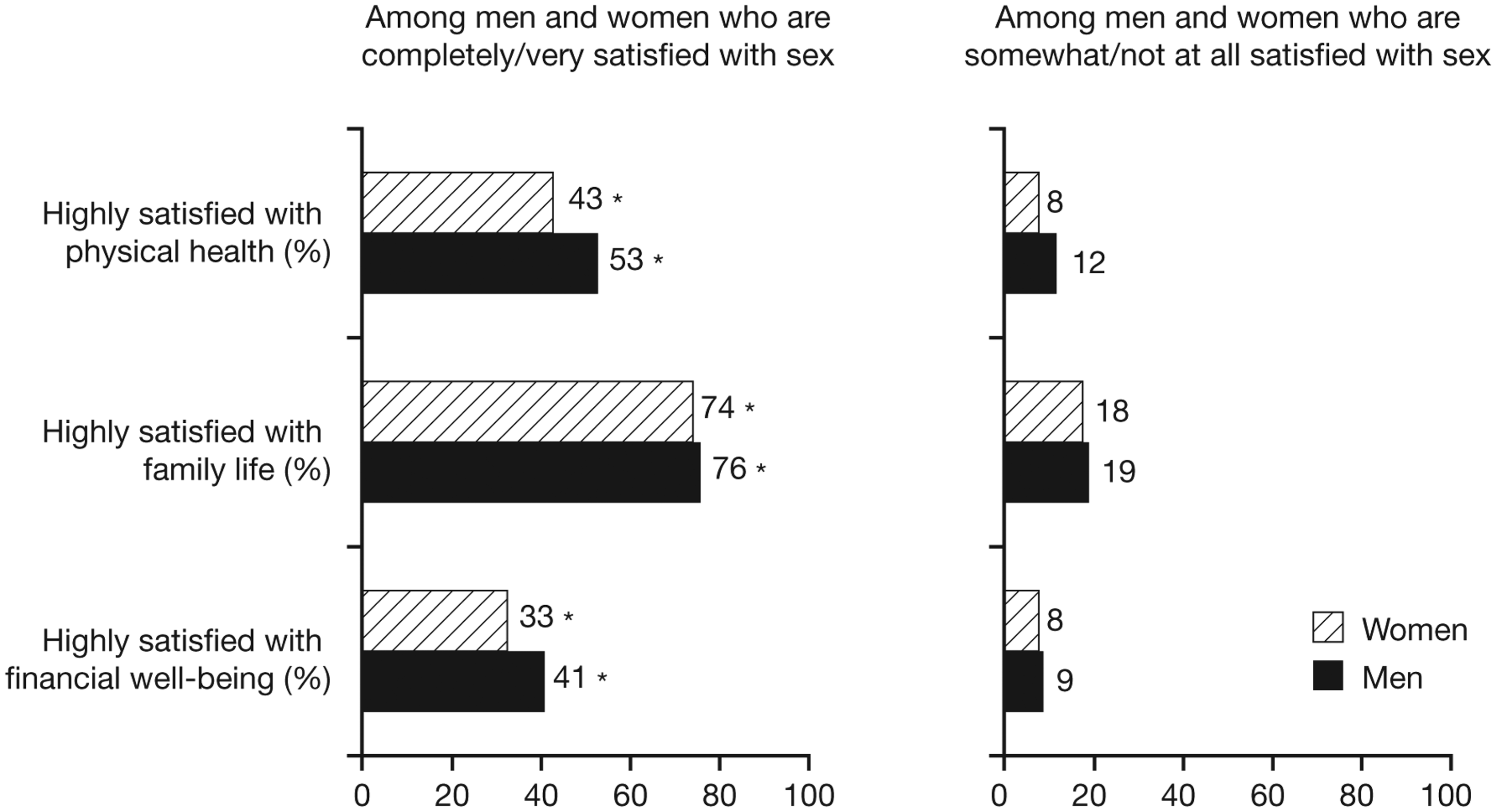
There was also a strong association between satisfaction with sex and overall outlook on life for both men and women (P <0.05 for all comparisons) (Figure 2); that is, respondents generally felt good about their lives and personal relationships, acknowledged that there was a balance in their lives, that they had opportunities to get what they wanted in life and liked to be around people. The most striking difference between men and women who were ‘completely satisfied’ or ‘very satisfied’ with sex in their lives (compared with those who were only ‘somewhat satisfied’ or ‘not at all satisfied’ with sex) was observed with regard to ‘feeling good about their relationships’. Over 50% of men and women who were at least ‘very satisfied’ with sex reported that this was ‘very true’, while no more than 14% of those who were ‘somewhat satisfied’ or ‘not at all satisfied’ with sex reported that this was similarly true for them, personally. Association between satisfaction with sex and overall outlook on life, as reported by men (n = 1893) and women (n = 1887) from nine countries across Europe and the Middle East who participated in the Sexual Health and Overall Wellness survey (*P <0.05, compared with men and women who reported being ‘somewhat satisfied’ or ‘not at all satisfied’ with sex; Student’s t-test).
Both men and women rated ‘having good sex’ as an important aspect to having a good loving or intimate relationship: 60% of men and 59% of women said that ‘having good sex’ was ‘very important’ or ‘absolutely essential’; 40% of men and 39% of women were ‘completely’ or ‘very satisfied’ with ‘having good sex’ within their current or most recent loving relationship.
Ratings for other aspects of intimate relationships revealed a difference in attitudes between men and women. Compared with men, women more frequently rated the following aspects as ‘absolutely essential’ or ‘very important’ (statistical analyses were not undertaken on these ratings): mutual respect and understanding (80% versus 68%, respectively), having an emotional connection (73% versus 62%, respectively), feeling of companionship (69% versus 60%, respectively), being physically attracted (62% versus 56%, respectively), and maintaining a sense of excitement (56% versus 51%, respectively).
In terms of other specific aspects of the sexual experience, ∼60% of men and women felt that intercourse was ‘absolutely essential’ or ‘very important’. Overall, 53% of men and 44% of women were ‘very’ or ‘completely’ satisfied with intercourse. Overall, greater satisfaction with erection hardness was associated with greater satisfaction with other specific aspects of the sexual experience.
Although 40% of men and 28% of women were ‘highly’ or ‘very highly interested’ in improving their sexual experience, less than 10% reported that either they or their partners had used a treatment in the previous 4 weeks, whether it be a herbal or complementary remedy (9% and 6% of men and women, respectively), a nutritional food supplement (9% and 4% of men and women, respectively) or a pharmaceutical agent (8% and 5% of men and women, respectively).
For both men and women, a strong association was observed between satisfaction with sex and overall health (Figure 3). Significantly more men who were ‘completely satisfied’ or ‘very satisfied’ with sex described their health as being ‘excellent’ or ‘very good’, compared with men who were ‘somewhat satisfied’ or ‘not at all satisfied’ with sex (42% versus 15%, respectively; P <0.05). Significantly more women who were ‘completely satisfied’ or ‘very satisfied’ with sex described their health as being ‘excellent’ or ‘very good’, compared with women who were ‘somewhat satisfied’ or ‘not at all satisfied’ with sex (33% versus 13%, respectively; P <0.05). In addition, significantly more respondents who reported optimal erection hardness (EHS 4) appeared to be in either ‘excellent’ or ‘very good’ health, compared with those reporting suboptimal erection hardness (EHS 3) (35% versus 17%, respectively; P <0.05). Only 20% of men who were ‘completely satisfied’ or ‘very satisfied’ with sexual intercourse reported they were ‘always’ or ‘frequently stressed’, compared with 34% of men who were ‘somewhat satisfied’ or ‘not at all satisfied’ with sexual intercourse (P <0.05). Association between satisfaction with sex and overall health, as reported by men (n = 1893) and women (n = 1887) from nine countries across Europe and the Middle East who participated in the Sexual Health and Overall Wellness survey (*P <0.05, compared with men and women who reported being ‘somewhat satisfied’ or ‘not at all satisfied’ with sex; Student’s t-test).
Significantly more men than women reported ever discussing their or their partner’s sexual health with their physician (14% versus 10%, respectively; P <0.05). In the present study, the overall proportion of men and women discussing these matters was low. For respondents who reported discussing their sexual health with their physician, most discussions were initiated by the patients themselves (73% and 74% for men and women, respectively) rather than by the physician. Among both male and female respondents, an association between EHS grade and likelihood of discussing their sexual health and/or medications with a physician was observed (Figure 4). Association between Erection Hardness Scale (EHS) grade and the likelihood of discussing sexual health and/or medication with a physician, as reported by men (n = 1893) and women (n = 1887) from nine countries across Europe and the Middle East who participated in the Sexual Health and Overall Wellness survey (*P < 0.05, compared with men and women who reported ‘ever’ having discussed sexual health and medication with their physician; Student’s t-test). Erection Hardness Scale grade 3 defined the penis as being hard enough to penetrate but not completely hard; EHS grade 4 defined the penis as being completely hard and fully rigid.
Discussion
In exploring the importance of the sexual experience in men and women, these current findings suggest that satisfaction with sex is associated with an overall positive outlook on life. In particular, it appears that satisfaction with sex is strongly associated with satisfaction with other important aspects of life such as physical health, family life and financial wellbeing.
Although the majority of men and women surveyed in the present study were satisfied with the frequency of sexual intercourse that they had had over the previous 4 weeks, a sizeable proportion of men and women indicated that they were having less than the right amount of sex (36% and 28%, respectively). These findings are similar to those reported in the GBSS. 2 Furthermore, there appears to be a direct positive association between EHS grade and frequency of sexual intercourse, with men with optimal erection hardness (EHS 4) reporting having sex significantly more frequently than men with suboptimal erection hardness (EHS 3). This suggests that improving erectile function may be an important factor in the sexual experience and an individual’s overall satisfaction in their personal life. Yet, while highly effective oral drugs for improving erection hardness have been available for many years, 15 in this study only a small proportion of men (8%) were found to be using such drugs to improve their erection, sexual experience, sexual satisfaction and overall happiness in life.
Interestingly, although as expected, sexual intercourse becomes less frequent with increasing age, the proportion of women satisfied with the frequency of sexual intercourse (or ‘having the right amount’ of sex) appears to increase with age. It has previously been reported that satisfaction with sex is a vital aspect of life satisfaction for women of all ages. 13 Thus, the greater satisfaction experienced by older women may purely reflect the lack of any age limits when it comes to the sexual needs of women; alternatively, it may also suggest that as women age they take greater satisfaction from their existing sexual encounters, even though such encounters may be less frequent in nature.
As seen in the GBSS, 2 another key finding of this present study was the importance that both men and women attribute to sex. Sex was seen to be ‘very important’ or ‘absolutely essential’ in the lives of the majority of men and women surveyed. However, compared with other life priorities, sex ranked only eighth in the list of priorities for women (compared with third for men). More than two-thirds of the women surveyed reported that they found family life, overall physical health, being a parent, love and romance to be ‘absolutely essential’ or ‘very important’, but only 55% gave the same importance rating to sex. This finding suggests that men clearly attribute more importance to sex than women, who consider many other aspects of life to be more important than sex. Similar differences in expectations are frequently encountered in couples receiving marital or sexual therapy. This present study also observed a difference in behaviour between males and females when seeking advice from their physician. During consultations, significantly more men than women reported having discussed their or their partner’s sexual health. In this present study, and in line with previous studies, very few individuals sought medical help for such disorders.16–20
The findings of this current survey also suggest that less than 10% of men have used a treatment to improve their sexual experience, whether it is a herbal or complementary remedy, a nutritional food supplement, or a pharmaceutical agent. However, caution is required when interpreting these findings: many men are often too embarrassed21,22 to speak with their local general practitioner and may use unregulated sources to obtain such agents. As a result of illicit trade, 23 the true number of medications being used may never be fully known. In this current study, only a small percentage of men surveyed used treatments to improve their sexual experience; thus, increasing patient awareness of the different treatment options is seen as an important step to improving sexual experience.
It was also interesting to note that respondents who reported optimal erection hardness (EHS 4) appeared to be in ‘excellent’ or ‘very good’ health compared with those reporting suboptimal erection hardness. This may reflect the common atherosclerotic aetiology of ED, and may serve as an indicator of the patient’s overall vascular health. 24
There were several limitations in the present study. As all of the questionnaires were self-administered, they may have been subject to a reporting bias. Respondents could not ask questions if they were unsure of anything being asked and there was the potential for misinterpretation of responses. Furthermore, the terminology used in the questionnaire may mean different things to different people in different cultures. For example, ‘a loving relationship’ may mean one thing to one person and something different to another. Finally, the impact of differences in cultural attitudes to sex on the values reported was not evaluated.
In conclusion, for both men and women questioned in this present study, satisfaction with sex appeared to be strongly associated with satisfaction with other important aspects of life, including physical health, family life and financial wellbeing. Satisfaction with sex also appeared to be associated with a positive outlook on life, while having good sex was an important aspect of a good loving/intimate relationship. The findings from this large survey, undertaken across Europe and the Middle East, further highlight the importance of all aspects of the sexual experience to both men and women, and the importance of delivering medical treatment to people who experience sexual dysfunction.
Footnotes
Declaration of conflicting interest
Drs John Dean, Arik Shechter, Arkadiy Vertkin, Petr Weiss and Onder Yaman have all received payment as consultants to Pfizer (Emerging Markets and Established Products), but wish to declare no potential conflicts of interest relating to the work described herein. Michal Hodik is an employee of Pfizer Inc. and owner of Pfizer Inc. stock. Anna Ginovker is an employee of Harris Interactive Inc.
Funding
This study was conducted by Harris Interactive Inc. and funded by Pfizer Inc.
Acknowledgements
Editorial assistance was provided by L Prevost, PAREXEL, Worthing, UK, which was funded by Pfizer Inc., NY, USA.