



Abstract
Previous research has often relied on passive observation of external phenomena when exploring technology-mediated self-transcendent experiences, overlooking co-creative, embodied interactivity. This study addresses this gap by investigating how aesthetic awe can be intentionally designed for using a novel Generative AI enabled interactive installation that augments a participant's self-reflection in real-time
We conducted a within-subjects experiment (N = 40) with four scenarios, each employing a distinct artistic design strategy. Experiences were evaluated using psychometric instruments for awe, self-immersion, and individual traits, alongside subjective impact ratings.
Findings suggested two psychological pathways to awe: a ‘Connection-Driven’ pathway, utilising realistic, narrative-led stimuli, fostered higher self-immersion and activated the Connectedness facet of awe; and a ‘Vastness-Driven’ pathway, employing abstract and unpredictable stimuli, activated the perceived Vastness and Accommodation facets of awe, despite lower self-immersion. Furthermore, individual traits were significant predictors of the experience, with Self-Transcendence, Engagement with Beauty, and Neuroticism all positively correlating with reported awe experience.
Keywords
Introduction
The convergence of visual arts and technology, aided by the recent advances in Generative AI (GenAI), has highlighted yet unexplored potential for new types of interactive experiences. The capacity of GenAI to generate controllable visual content in a near real-time manner presents significant opportunities for creating deeply personal and impactful experiences, where the viewer becomes an active co-creator. This shift in agency opens up the possibility to design not only novel interactions but also experiences that promote psychologically positive mental states.
Visual arts have long been recognised for their ability to evoke powerful emotional and aesthetic experiences that have the potential to transport the viewer from the ordinary every-day mental states to a more profound and elevated states. While these moments may be fleeting, they can have an immediate and significant effect on the viewer (Pelowski, 2015; Sherman & Morrissey, 2017). Furthermore, intentionally designing for these states is central to many well-being applications, where they serve as an aid to emotional processing and personal growth. As a result, there is a considerable amount of research in facilitating such states.
However, a key gap exists in the current research — previous empirical studies on self-transcendent experiences have often relied on participants observing a predefined external phenomenon. This includes the passive viewing of pre-recorded nature videos (Chirico et al., 2017; Piff et al., 2015) or navigating pre-existing virtual worlds in Virtual Reality (VR) (Gallagher et al., 2018; van Limpt - Broers et al., 2020; Quesnel & Riecke, 2018). Consequently, the potential of GenAI enabled systems that offer co-creative and embodied interactivity where one's own presence dynamically generates the visual content, remain largely unexplored.
The present study addresses this gap by investigating a novel method for facilitating aesthetic awe through a digital mirror-like interactive installation that augments the viewer's self-reflection. It features four distinctive scenarios, based on the strategies for designing for awe by Ke and Yoon (2020), each grounded in appraisal theory and employing a different aesthetic and artistic framework. By combining the approaches from visual arts, affordances of GenAI technology and empirical methods from psychology in human-computer interaction, the research investigates to what extent can different artistic frameworks applied via GenAI-enabled interactive installation, elicit and shape the experience of aesthetic awe.
This research contributes to the ongoing discussion on technology-mediated self-transcendent experiences, providing empirical insights in the matter. The study's findings highlight the opportunities and challenges of the synthesis of artistic approaches and emerging GenAI technology to design for novel experiences that promote psychologically positive states.
Background
Within the context of the present study, it is necessary to distinguish between Awe, Aesthetic Awe and Self-Transcendent Experiences (STEs). Awe is a complex self-transcendent emotion, with aesthetic awe being a specific subtype, arising from aesthetic encounters, such as viewing an artwork (Clewis et al., 2022). Because our experimental stimulus initiates an aesthetic experience, we use these terms interchangeably. Both are categorised as STEs—transient mental states characterized by decreased self-salience and increased feeling of connectedness. These experiences exist on a spectrum of intensity and include states such as mindfulness, flow, awe, peak and mystical experiences (Yaden et al., 2017).
The Mysteries of Awe
Awe is a complex self-transcendent emotion that is central to experiencing religion, art, and nature. Depending on the strength of the experience, it can alter one's life in a profound and permanent way (Keltner & Haidt, 2003). Awe is typically experienced when one encounters something vast and incomprehensible which transcendences an individual's current understanding of the world (Dai & Jiang, 2023; Keltner & Haidt, 2003; Monroy & Keltner, 2022; Piff et al., 2015). Thus, it is defined by two key characteristics: vastness and need for accommodation. Firstly, awe is evoked by stimuli that are immense in scale, scope or complexity (Dai & Jiang, 2023; Piff et al., 2015; Rudd et al., 2012). This vastness can be either perceptual, such as Grand Canyon or night sky with stars, or conceptual, such as authority, higher power, work of art or scientific theory (Chaudhury et al., 2021; Keltner & Haidt, 2003; Rudd et al., 2012; Yaden et al., 2017). Secondly, awe experience often requires of individuals to update their mental schemas to accommodate and incorporate the new information or perspective (Keltner & Haidt, 2003; Piff et al., 2015; Rudd et al., 2012; Yaden et al., 2017).
Although typically awe experience involves positive valance, there are cases when negative valence is experienced instead, such as with the threat-awe. Here the awe is experienced together with fear, resulting in a vast, overwhelming and threatening experience, such as when witnessing a thunderstorm or proximity of death (Chaudhury et al., 2021).
The awe experience is characterised by traits of emotional, cognitive, sensory, and social domains. Individuals experiencing awe often have reported a reduced sense of self (self-diminishment) or feeling small in the presence of something greater (Piff et al., 2015; Shiota et al., 2007; Yaden et al., 2019). Likewise, the experience often involves the feeling of being connected to something larger than oneself, such as other people, higher power, nature, or humanity as a whole (Bonner & Friedman, 2011; Nelson-Coffey et al., 2019; Stellar et al., 2017). During the experience, participants often have reported altered time perception when the time either slows down or speeds up (Keltner & Haidt, 2003; Yaden et al., 2017; Yaden et al., 2019). Similarly, the experience can halt the mental chatter and bring one fully into the present (Bonner & Friedman, 2011; Rudd et al., 2012). Moreover, awe can cause physical sensations in the body, such as goosebumps and chills (Monroy & Keltner, 2022; Quesnel & Riecke, 2018; Yaden et al., 2019). Notably, awe is commonly described as a deep and significant experience (Bonner & Friedman, 2011), that has the capacity to initiate personal transformation. As a result, experiencing awe has been linked to increased pro-social behaviours, such as generosity, ethical decision making, and helping behaviour (Guan et al., 2019; Piff et al., 2015; Rudd et al., 2012). Finally, multiple studies have identified a correlation between awe and greater happiness and contentment in life (Bethelmy & Corraliza, 2019; Chirico et al., 2016; Krause & Hayward, 2014).
Routes to Self-Transcendent Experiences
Given the psychologically positive effects of STEs, a significant body of research has focused on how they can be elicited intentionally in controlled environments. Within awe research, these efforts have largely relied on two strategies. The first involves simulating Overview effect 1 by exposing participants to views of Earth from space, either through physical installations as in Virtual Space Laboratory (Gallagher et al., 2018); a Google Earth based VR experience where participants can view different parts of Earth both from ground and orbit (Chirico et al., 2018; Quesnel & Riecke, 2018); a VR simulation of a journey into outer space (van Limpt - Broers et al., 2020); an artistic VR experience AWE (Quesnel et al., 2018; Stepanova et al., 2019), where at the climax of the experience the viewer finds oneself in outer space viewing Earth and Sun from a distance. The second scenario involves the use of nature-derived stimuli such as video recordings of awe-inspiring landscapes. For example, videos with grand vistas from mountains and scenes with ancient trees (Chirico et al., 2017), or video clips from BBC's Planet Earth series featuring scenic panoramas (Piff et al., 2015).
While these methods have proven somewhat effective for inducing awe in laboratory settings, they are largely characterised by their reliance on pre-record and non-interactive stimuli, where the participant embodies a passive observer, leaving the potential of interactive systems largely unexplored. This contrasts the broader fields of Cyberdelics 2 and technology-mediated art, where the artefacts have demonstrated a capacity to foster STEs. For example, Treehugger: Wawona by Marshmallow Laser Feast artist collective, where the viewer embodies an ancient Sequoia tree, thus shifting a perspective from a human-centric to non-human view (Smith & Warner, 2022); Isness by Glowacki et al. (2022) a scripted multiuser VR experience where participants experience oneself as luminous energetic essences with the ability to merge with one another and as a result experiencing unifying connectedness and altered states of consciousness; Hallucination Machine by Suzuki et al. (2017) which used Google's Deep Dream neural network algorithm to transform 360-degree panoramic videos to simulate visual phenomenology similar to that induced by psilocybin.
Indeed, historically, the experience of viewing an artwork more broadly has been interlinked with self-transcendence. Profound aesthetic stimuli have been considered as sources of peak experiences, which in turn are states of unselfconscious awe (Lundy et al., 2010). The notion of sublime as an intense but mixed aesthetic experience (Jacobs & McConnell, 2022), which has long been considered as a fundamental part of experiencing an artwork, can be viewed as a particular awe experience, namely the aesthetic awe (Clewis et al., 2022). The engagement with artwork and the resulting experience of sublime, can foster both self-loss and connectedness to humanity at large, whilst at the same time being overwhelming, thus mirroring the duality of awe (Clewis et al., 2022).
Therefore, a question arises, how can one deliberately and systematically design for awe experience within an artistic and interactive context? Ke & Yoon's research (2020) provides a possible answer. By using a framework of appraisal theory, the paper presents six design strategies that focus on simulating the two key characteristics of awe, namely, a perceived vastness and a resulting need for accommodation. In these scenarios the source of awe stems from perceiving the design and its association with the passage of time [1]; encountering a design which has persisted beyond one's own lifespan [2]; social implications of the design, which allows one to define its identity relative to the higher power [3]; perceiving the complex qualities of the design [4]; perceiving the unpredictable nature of the design and how it rapidly floods and overwhelms the senses [5]; and realisation that one is part of a much larger collective [6].
Susceptibility to Self-Transcendent Experiences
However, the impact of awe-inducing stimuli is unlikely to be uniform for all individuals. The very nature of STEs suggests that much depends on the set and setting, as famously postulated by the psychedelic godfather Timothy Leary, where set refers to the psychological state of the individual encompassing their expectations, beliefs, and personality traits, and setting to physical environment where the experience takes place (Kitson et al., 2020). For example, people engaged in artistic practice have reported experiencing altered states of consciousness and mystical experiences more frequently than others (Ayers et al., 1999). Likewise, those who embody character traits associated with spirituality, 3 are thought to be more inclined towards STEs (Dai & Jiang, 2023; MacDonald & Holland, 2002). In particular, the reduced self-focus and increased connectedness, which are factors in measuring awe, are also key characteristics of self-transcendence (Piff et al., 2015; Yaden et al., 2017).
The susceptibility to STEs can thus also be dependent on the personality, often conceptualised using the Big Five personality trait model. Big Five is a widely accepted and generalised measure (Giluk, 2009) that characterises individuals at a global level using five core traits — Openness to Experience, Conscientiousness, Agreeableness, Neuroticism, and Extraversion. Existing research has presented somewhat mixed conclusions about the connection between each of the individual Big Five traits and STEs, except for Openness. Multiple sources have identified a notable positive correlation between Openness to Experience and the experience of awe (Bonner & Friedman, 2011; Bride, 2016; Cotter et al., 2019; Silvia et al., 2015). However, another study concluded that there is no evidence that Openness as a trait predicts higher awe ratings, but instead there is a slight positive correlation between Neuroticism and awe (Quesnel & Riecke, 2018). Furthermore, in the development of a psychometric instrument capturing awe (AWE-S; Yaden et al., 2019), authors have identified Agreeableness, Neuroticism and especially Openness as independent predictors, whereas Neuroticism appeared to negatively correlate with the experience of awe.
The Present Study
Based on the above review, this study developed an interactive experimental stimulus for inducing awe. This stimulus was built upon a synthesis of two core elements — a narrative framework guided by four of Ke and Yoon’s (2020) design strategies, and an artistic execution that provides the sensory form and affective character for each scenario. The research sough to understand the effectiveness and difference of these individual scenarios in eliciting awe and the psychological factors that mediate and moderate the experience. Thus, the study addressed two research questions:
Furthermore, since all four conditions were based on established design strategies intended to activate the core components of awe to a similar degree, we hypothesised that they might be comparable in their overall effectiveness. However, because the conditions directly manipulated the relationship between the viewer and their self-reflection, it was further proposed that the degree of self-immersion is an important mediating factor. This led to two hypotheses (Figure 1):
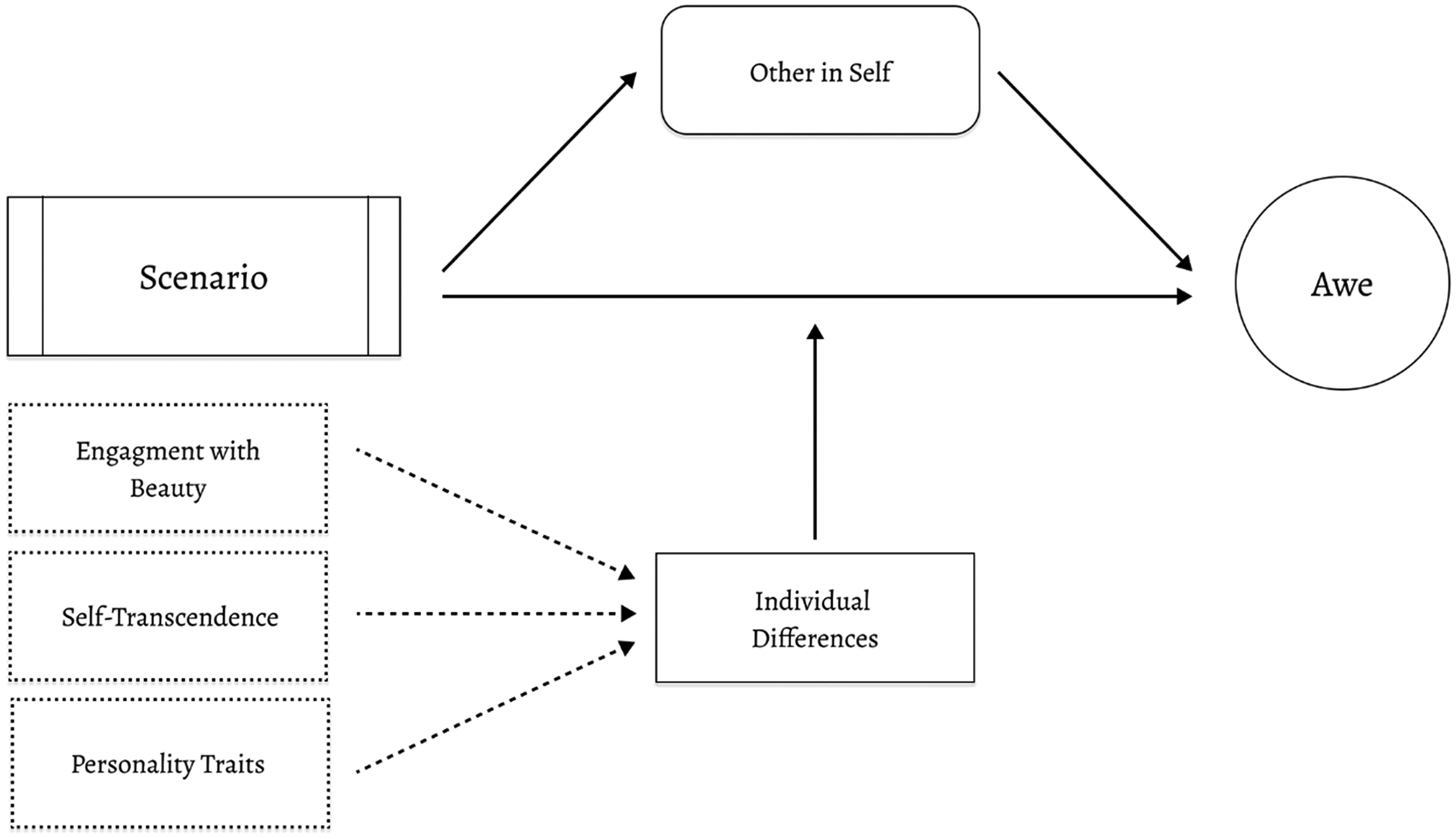
Proposed Conceptual Model of Hypothesized Relationships.
Method
The study was based on two experiments conducted in two different locations, one in Riga, Latvia and the other in Tampere, Finland. The first experiment in Riga was part of an art and science festival Laboratory of Entangled Space. Both experiments lasted for two full working days. Before the experiments, two pilot tests were carried out in Tampere University to streamline the procedure.
The study used a within-subjects experimental design with four conditions, corresponding to the four design scenarios, to assess the effects of varying GenAI based visual manipulations on participants’ physiological and self-reported responses in experiencing state of awe. The independent variable was the specific visual and conceptual augmentation of participants’ self-image carried out by real-time GenAI algorithms and distributed across the conditions, presented in a randomised order for counterbalancing. The dependent variables were the self-reported scores in the AWE-S scale and Inclusion of Other in Self scale.
Participants
A total of 40 participants were recruited across two experimental sites: Riga, Latvia (n = 20) and Tampere, Finland (n = 20). The two samples were broadly similar in their demographic composition.
The Riga sample consisted of 14 females, 5 males, and 1 participant who preferred not to specifty gender. On a 7-point Likert scale, their self-reported familiarity with arts was moderate (M = 4.10), as was their familiarity with technology (M = 3.85). The Tampere sample comprised 12 females, 6 males, and 2 non-binary individuals. This group reported slightly higher familiarity with both arts (M = 4.25) and technology (M = 4.25). The most common age group in both groups was 21–30 years (n = 16), with 31–40 year-olds forming the second most common group (n = 13). The oldest participants were between 50 and 60 years of age (n = 4).
For the first experiment in Riga, participants were recruited by creating an event on the Facebook platform, in the event description there was a link to a form where potential participants could choose a time slot. The event was then advertised by the Laboratory of Entangled Space festival. Thus, the participants were mostly people who followed the festival's Facebook page. The only restriction for participating was that participants should be at least 18 years old. For the second experiment participants were recruited from Tampere University Decision-making laboratory's (DMlab) pool by sending an invitation via email. All the participants were students in Tampere University. For both experiments there were 20 open positions, and they were filled on the first come, first serve basis. This study followed ethics guidelines set forth by the Finnish National Board on Research Integrity (TENK), including following principles of voluntary participation, informed consent, and making the privacy notice available to participants. No ethics board approval was required and participants received no compensation.
Materials
Stimulus Design
The experiments were based on a GenAI enabled screen based interactive installation that worked similar to a digital mirror, in the sense that the participant's digital reflection was transformed in real-time (see Figure 2). Here and throughout the text the term “reflection” is meant as the digital representation of the participant as captured by the camera and augmented by GenAI. The installation featured four conditions that differed in the way participant's reflection was augmented. The installation consisted of a standalone PC, TV screen, a wooden frame, webcam and a ring light. The webcam recorded the participant in front of it. Each recorded frame was then edited to remove the background using TouchDesigner software and sent as an input image to a StreamDiffusion (Kodaira et al., 2023) image generation algorithm, which used a SD 1.5 Turbo model for new content generation. Depending on the condition, each new image generation was guided by a specific prompt and the captured frame of the participant. This combination ensured consistency and visual similarity whilst also allowing us to steer visual content to fit each particular condition. The resulting synthetic image was edited once more in TouchDesigner to add a visual distortion to mimic a mirror like effect. Finally, the edited image was displayed back on the screen. The speed of this pipeline enabled generating roughly 17 frames per second, thus helping to achieve an illusion of a continuous video. The installation was interactive not only due to the fact that participants could see their own reflection being augmented, but also due to the underlying mechanics of the real-time GenAI content creation. Since each frame created by GenAI was guided by an input frame from webcam, even the smallest change in the input frames, such as the difference between participant faces, their body position, their clothing or light conditions, yielded a visually different output even when the same textual prompt was used. Thus, from a design perspective, the authors could not fully pre-design how the installation would visually “respond” to each participant in a particular condition, but instead the authors were able to establish a visual framework for each condition that set conceptual bounds on what the GenAI content could be. For example, in the Condition 4 when instructing GenAI to create a “biomimicry design”, the output would inherently be a biomimicry form, but the details of how the form would look like would always be different.
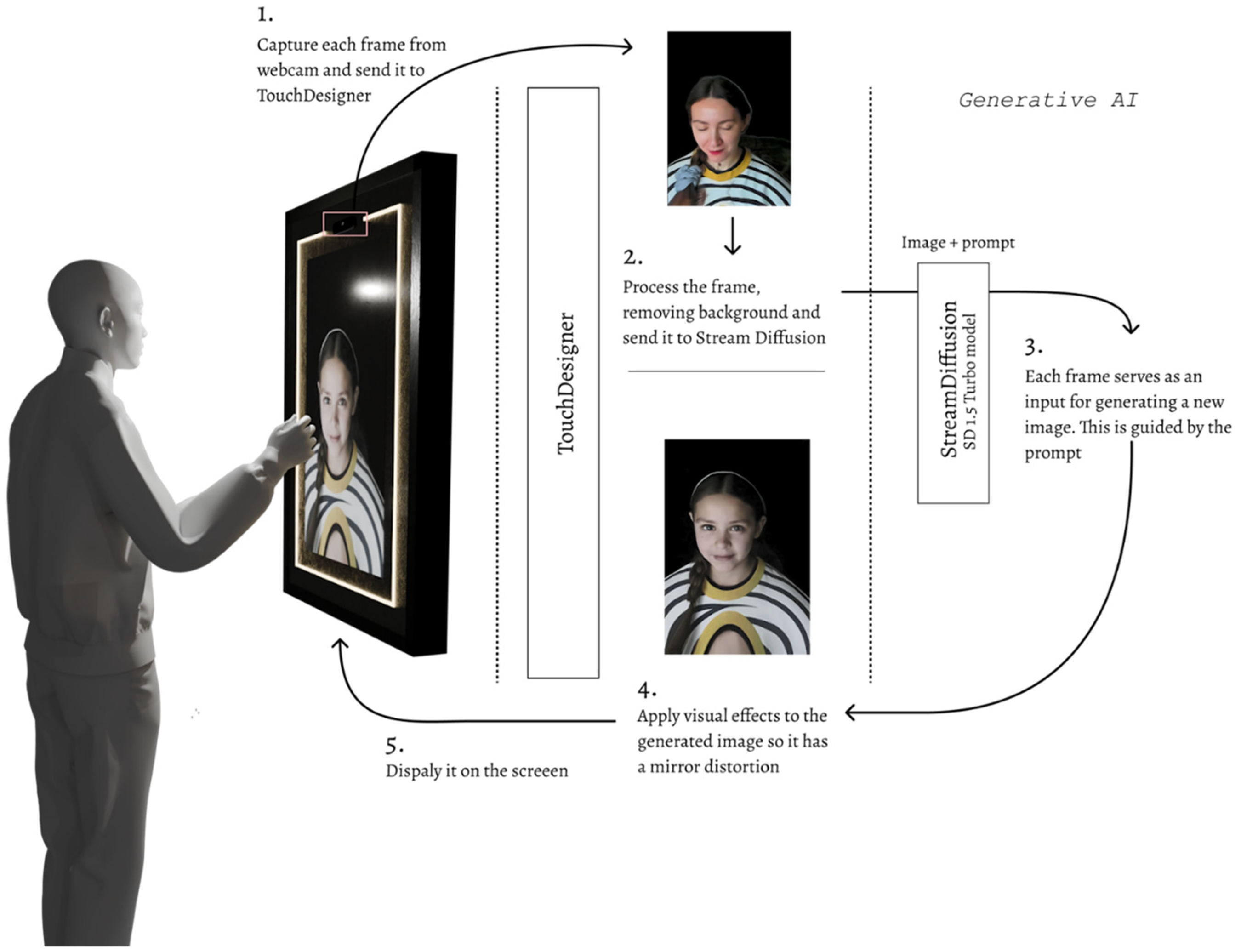
Diagram illustrating how the interactive installation operates.
The four conditions or scenarios were based on design strategies devised by Ke and Yoon (2020) and they are described as follows:
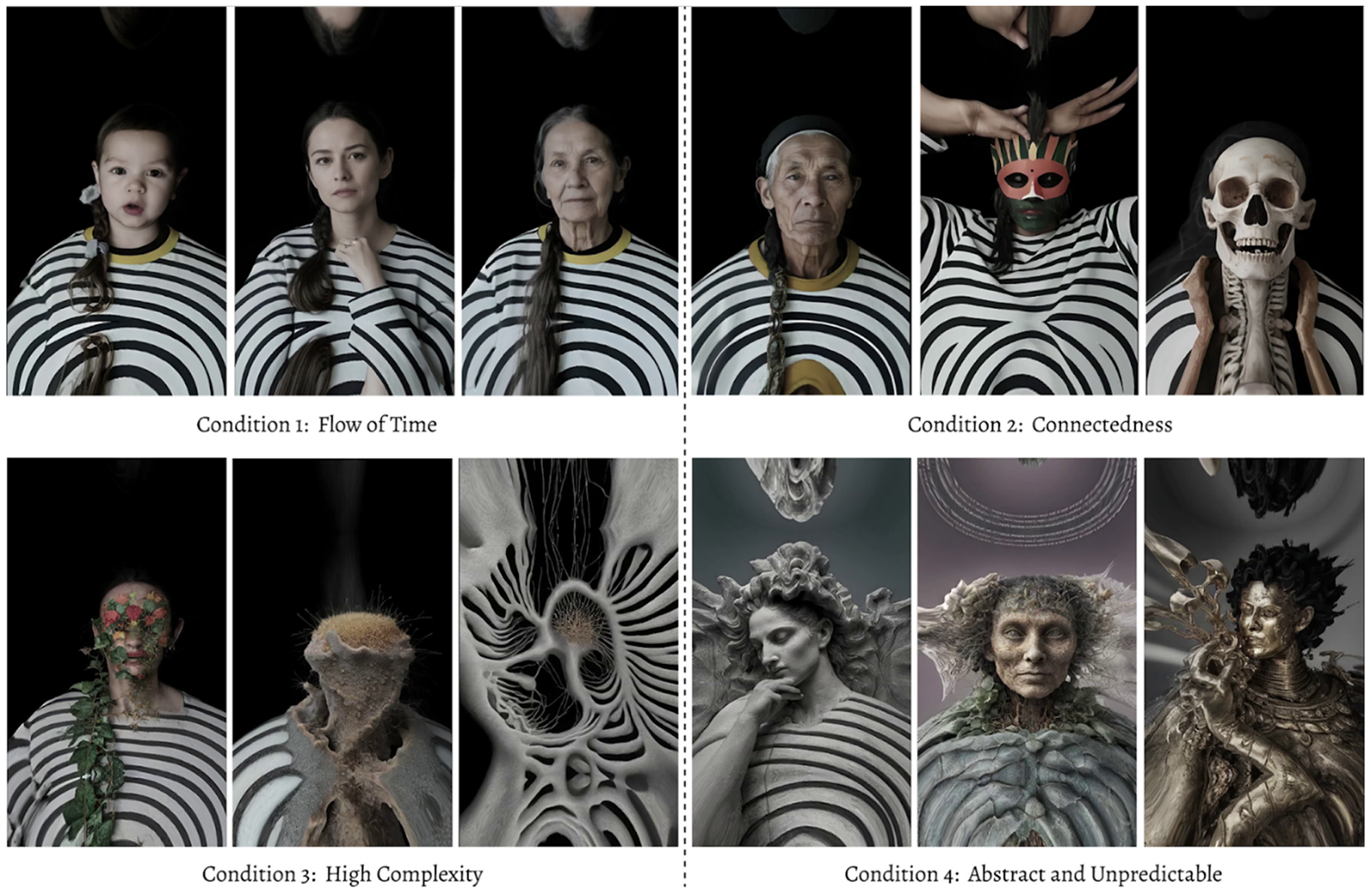
Screenshot from the four scenarios.
Physical Installations
The experiment in Riga took place in the Laboratory of Entangled Space art and science festival premises. The experiment was set up in a large empty room, that had white walls, wooden floor, and curtains blocking the entrance, with large windows on one side of the room. The second experiment was conducted in Tampere University's theatre studies rehearsal space, in a large room roughly the same size as the one in Riga, featuring white walls and wooden floor, but without the windows. In both venues, the digital mirror installation was placed in the centre of the room on a small table with a chair in front of it. The main source of light was the attached ring light. In Riga no additional lighting was used since the room had windows and in Tampere, ceiling spotlights were used to create ambient light (Figure 4).
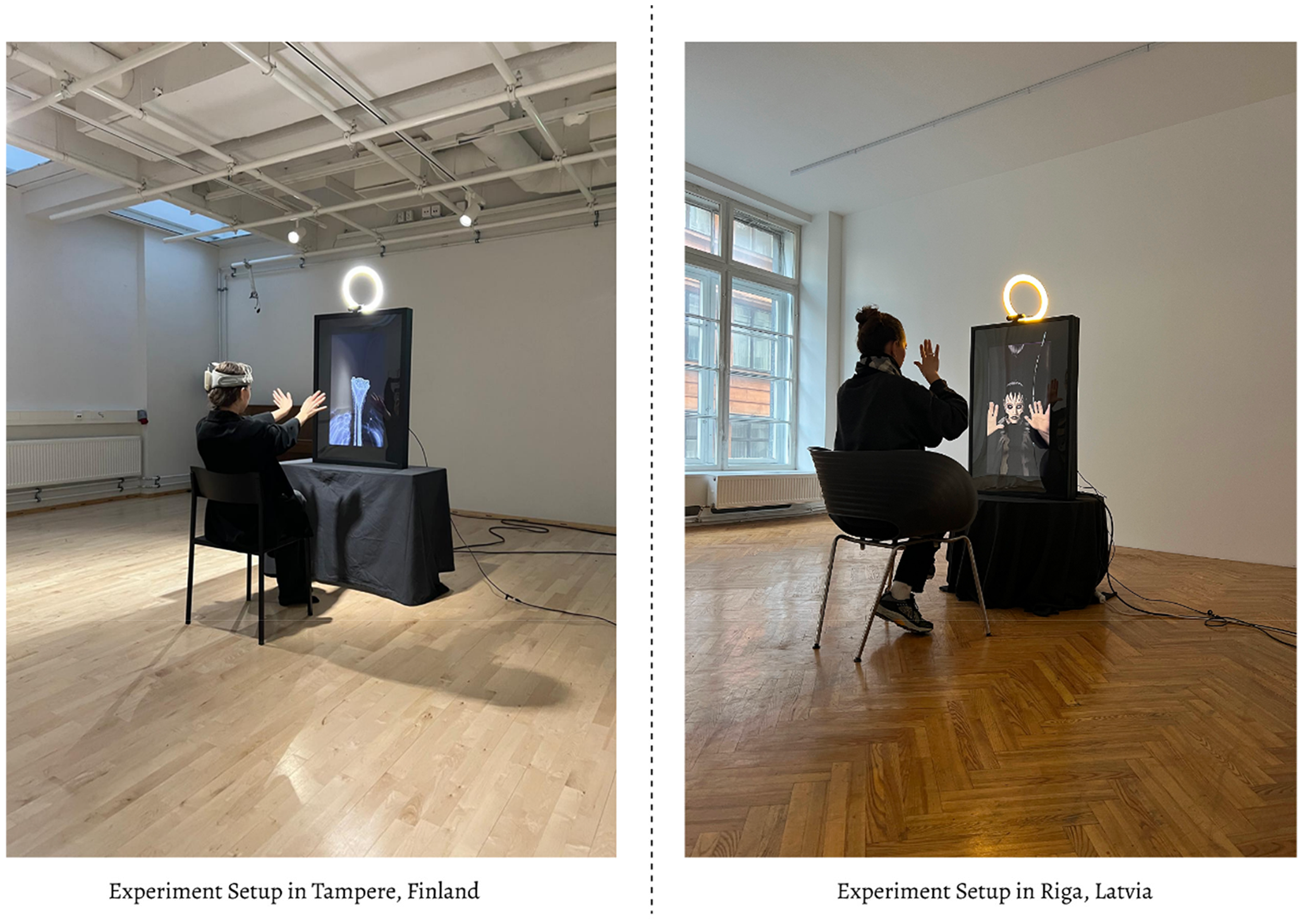
Images depicting the set up for experiment in two locations.
Materials for Measurements
Participants were first presented with a pre-test questionnaire including demographic information and individual traits. This included gender, Likert-type measurements of familiarity with art and technology and familiarity with mindfulness and meditation practices, as well as psychometric instruments in the form of Big Five personality traits, Self-Transcendence, and Engagement with Beauty scales. Additionally, following a repeated-measures design, participants completed a post-test questionnaire after each of the four conditions. These encompassed a manipulation check, self-reported degree of awe experience with the AWE-S instrument, and self-immersion as captured with the Inclusion of Other in Self instrument.
Procedure
As part of signing up for the experiment, participants were asked to provide informed consent and fill out a demographic questionnaire. Upon completion, they were assigned a unique ID that was used throughout the experiment to link the data across questionnaires while avoiding collecting any direct identifiers.
When participants arrived at the premises of the experiment, they were guided to the room where the digital mirror installation was installed. The instructor then explained the procedure, namely, that they will be presented with four different scenarios in a randomised order, where the AI will augment their reflection in the digital mirror installation and that each scenario will be different both visually and conceptually. Furthermore, they were reminded that should they at any time feel uncomfortable, they were free to abandon the experiment with no repercussions. Participants were then asked to sit down in front of the installation, and an EEG headband was attached to their heads. Before initiating the first condition, the participants were instructed on how they can physically interact with the installation by moving their body but that they should remain seated throughout. The instructor then started recording EEG data using the NIC software and initiated the first scenario based on pre-generated random seed. When the scenario commenced, the instructor left the room leaving the participant alone.
The end of the scenario was indicated by a bell sound, after which the instructor came back to the room. He then presented the manipulation check and repeated-measures questionnaires (OIS and Awe-S) regarding the scenario they just experienced. Upon completion, the instructor initiated the next scenario and left the room. When all four conditions and the corresponding surveys were completed, the instructor removed the EEG headband, conducted a short interview about the experience, and explained the purpose of the study. Each of the four scenarios lasted approximately 2 min with the session in total lasting from 15–35 min depending on how quickly participants filled out the post-test questionnaires.
Data Analysis
In terms of analysis, a combination of confirmatory and exploratory techniques was used to ensure comprehensive results and their reliable interpretation. Due to the frequent violation of the normal distribution assumption as assessed using Shapiro-Wilk, it was inadequate to conduct, for example, a repeated-measures ANOVA (H1). Instead, robust non-parametric alternatives were employed, such as Friedman's ANOVA. In the case of mediation and moderation, however, the availability of bootstrapping several thousand samples and 95% confidence intervals enabled cautious use of the Medmod module in Jamovi (H2). A similar approach was used in exploratory tests of interaction effects (RQ1), with the data first transformed to the wide format using the Jamovi module Data. This transformation allowed accounting for the within-subjects design by defining participant ID as the cluster variable in the model.
All analyses were conducted using Jamovi v2.6.44 and its Medmod, Flexplot, and Data modules. The rate of false positive findings in confirmatory analyses (i.e Error I) was controlled using the Benjamini-Hochberg False Discovery Rate (FDR).
However, when conducting EEG analysis, we found excessive noise artefacts in the data stemming both from issues with electrode connectivity and participant muscle movement. As a result, we decided to abandon EEG analysis altogether and instead focus solely on analysing survey and interview data.
Results
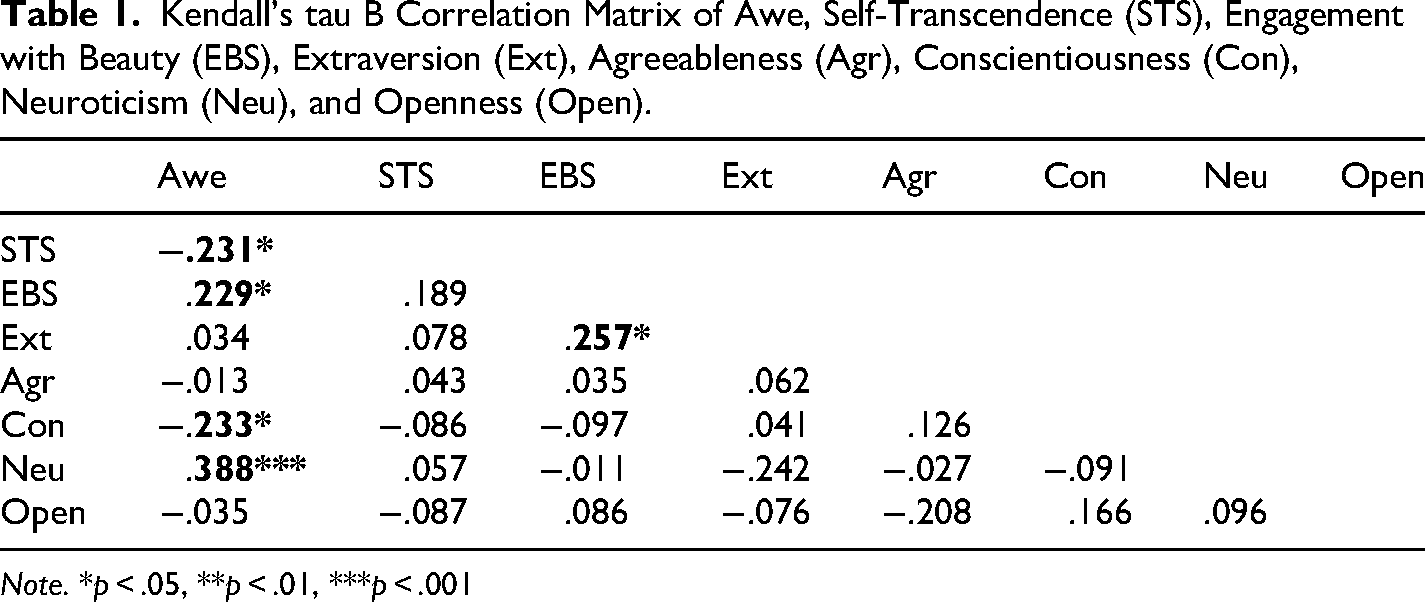
The initial exploratory correlation matrix provided an overview of study variables and their relationships as well as an opportunity to examine the possibility of multicollinearity (Table 1). There was an indication that the intensity of reported experience of awe was related to several individual differences; namely, propensity for Self-Transcendence and Engagement with Beauty, as well as Big Five personality traits of Conscientiousness and Neuroticism.
Kendall's tau B Correlation Matrix of Awe, Self-Transcendence (STS), Engagement with Beauty (EBS), Extraversion (Ext), Agreeableness (Agr), Conscientiousness (Con), Neuroticism (Neu), and Openness (Open).
Note. *p < .05, **p < .01, ***p < .001
Awe and Conditions
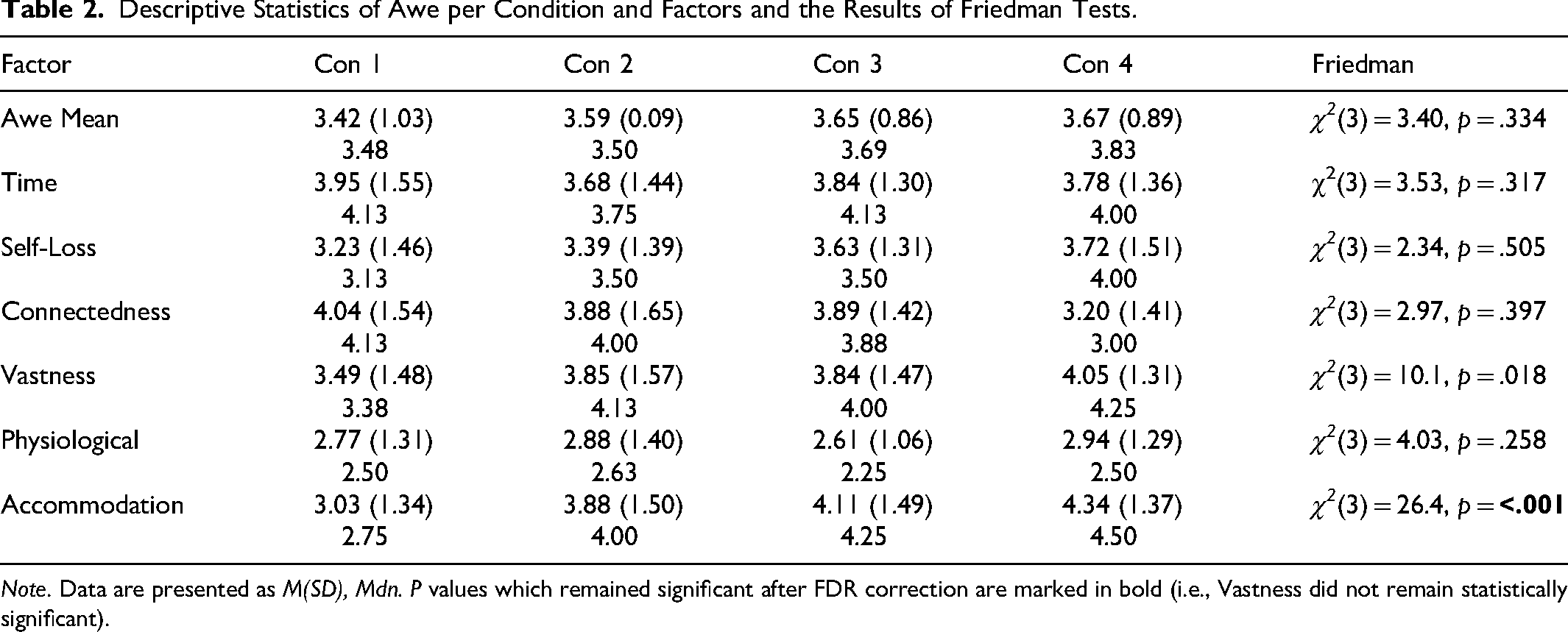
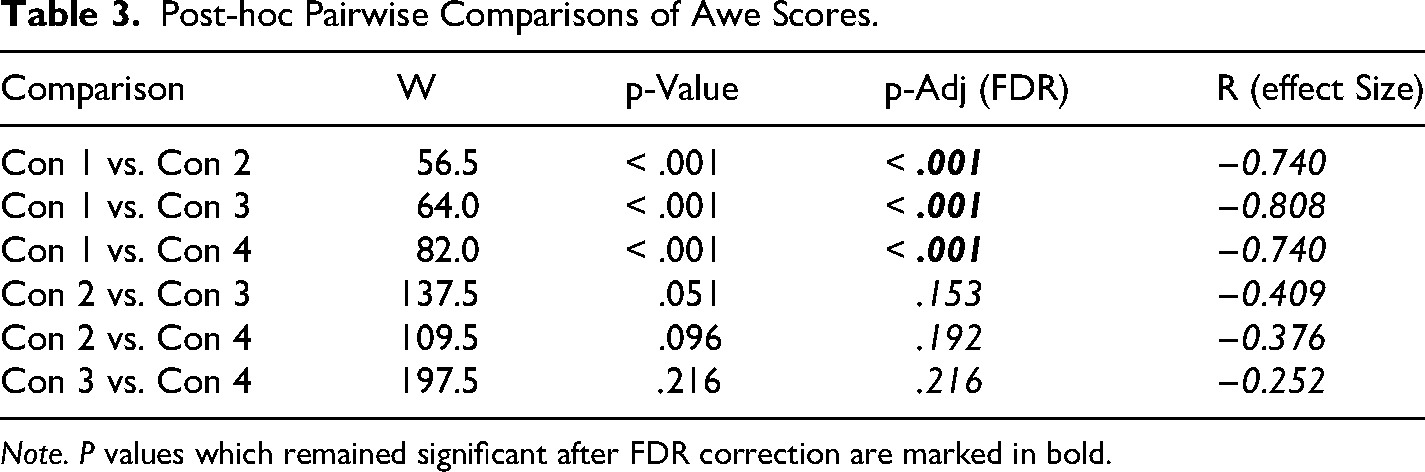
We first tested the hypothesis that all four conditions would evoke comparable experience of awe. Due to constraints of non-parametric data for conducting complex factorial tests, this hypothesis was probed through a series of Friedman's repeated measures ANOVA tests (Table 2). After correcting to control for Error 1 using the Benjamini-Hochberg False Discovery Rate (FDR) method, only the factor of Accommodation remained statistically significant. The following pairwise comparisons suggested that participants rated Accommodation significantly lower in “Flow of Time” (Condition 1) scenario than any other, with large to very large effects (Table 3).
Descriptive Statistics of Awe per Condition and Factors and the Results of Friedman Tests.
Note. Data are presented as M(SD), Mdn. P values which remained significant after FDR correction are marked in bold (i.e., Vastness did not remain statistically significant).
Post-hoc Pairwise Comparisons of Awe Scores.
Note. P values which remained significant after FDR correction are marked in bold.
Additionally, during the post-test interview, 14 out of 40 participants (35%) indicated the “Connectedness” (Condition 2) scenario as the most impactful, followed by “The Flow of Time” (Condition 1) scenario (25%), and finally “High Complexity” (Condition 3) and “Abstract and Unpredictable” scenarios (20% each). However, these marked differences were only partially supported by measures of Awe.
Mediating Effect of Self-Immersion
Next, we tested H2 regarding Other in Self (OIS), or self-immersion, as a partial mediator between scenario and resulting reported awe experience. To test whether participants’ subjective experience of self-immersion as captured through OIS mediated the effect of condition on the outcome of awe experience, six pairwise mediation models were conducted using bootstrapping (5000 samples) with 95% confidence intervals. Each model assessed the indirect effect (ab), the direct effect (c′), and the total effect (c) to determine the extent to which OIS potentially accounted for the relationship between the scenario and the resulting awe experience. Specifically, the indirect effect considers the portion of the effect realised through the mediator (a×b path) as combination of scenario-to-mediator and mediator-to-outcome paths; the direct effect only considers the remaining scenario-to-outcome effect after accounting for the indirect effect; finally, the total effect represents the overall relationship between the scenario and awe. All models used dummy-coded condition contrasts for use in Medmod module in Jamovi, and indirect effect significance thresholds were corrected for multiple comparisons using the FDR method.
In terms of path b, results consistently pointed at OIS predicting the final awe experience score (ps < .005), with coefficient ranging from 0.208 to 0.261, indicating a medium magnitude of effect. This indicated a robust positive association between the OIS, or self-immersion, and the outcome, regardless of condition. Thus, even where the mediator was not significantly different between conditions, it remained a strong predictor of the outcome.
Overall, three out of the six contrasts showed significant indirect effects, all of which involved “Abstract and Unpredictable” (Condition 4). In all three cases, path a (condition → mediator) and path b (mediator → outcome) were significant, showing that “Abstract and Unpredictable” scenario had uniquely lower mediator scores, which was in turn associated with lower awe scores. This was consistent with the finding above that the OIS was positively related to degree of awe experience. Although “Abstract and Unpredictable” scenario was associated with a higher direct outcome rating, it simultaneously reduced OIS perception, which was itself positively associated with the degree of awe experience. Furthermore, for the magnitude of effects, indirect effects could be interpreted as moderate to large. In detail:
Moderating Effects of Individual Differences
An exploratory mixed-effects model was used to examine whether individual differences moderated the effect of condition on awe experience ratings. This included the Big Five personality traits, and Self-Transcendence and Engagement with Beauty scales. The model accounted for a substantial proportion of variance in the experience of awe. The fixed effects alone, including conditions, direct effects of individual differences, and their interactions with conditions, explained 42.2% of the variance in awe experience (marginal R2), whereas the full model including other differences stemming from individual participants accounted for 31.4% additional variance (i.e., conditional R2 = .736), overall indicating a strong explanatory model for the subjective degree of awe experiences. All findings were exploratory and uncorrected for multiple comparisons and thus should be interpreted as preliminary and informative for further research, rather than confirmatory.
Out of all fixed effects, Neuroticism, Engagement with Beauty and Self-Transcendence were statistically significant (p = < .011, p = .028, and p = .022, respectively; Figure 5), with a potential trend for an interaction effect of Extraversion and condition (p = .076). This was partially further supported when analysing interaction effects between Extraversion and individual conditions; Extraversion significantly moderated the effect of “High Complexity” (Condition 3) and “Abstract and Unpredictable” (Condition 4) scenarios, such that higher Extraversion was associated with reduced awe experience in these conditions (p = .024 and p = .042). Moreover, Openness showed a positive interaction with “Connectedness” (Condition 2) scenario (p = .047), suggesting increased awe experience for more open individuals in that specific context.
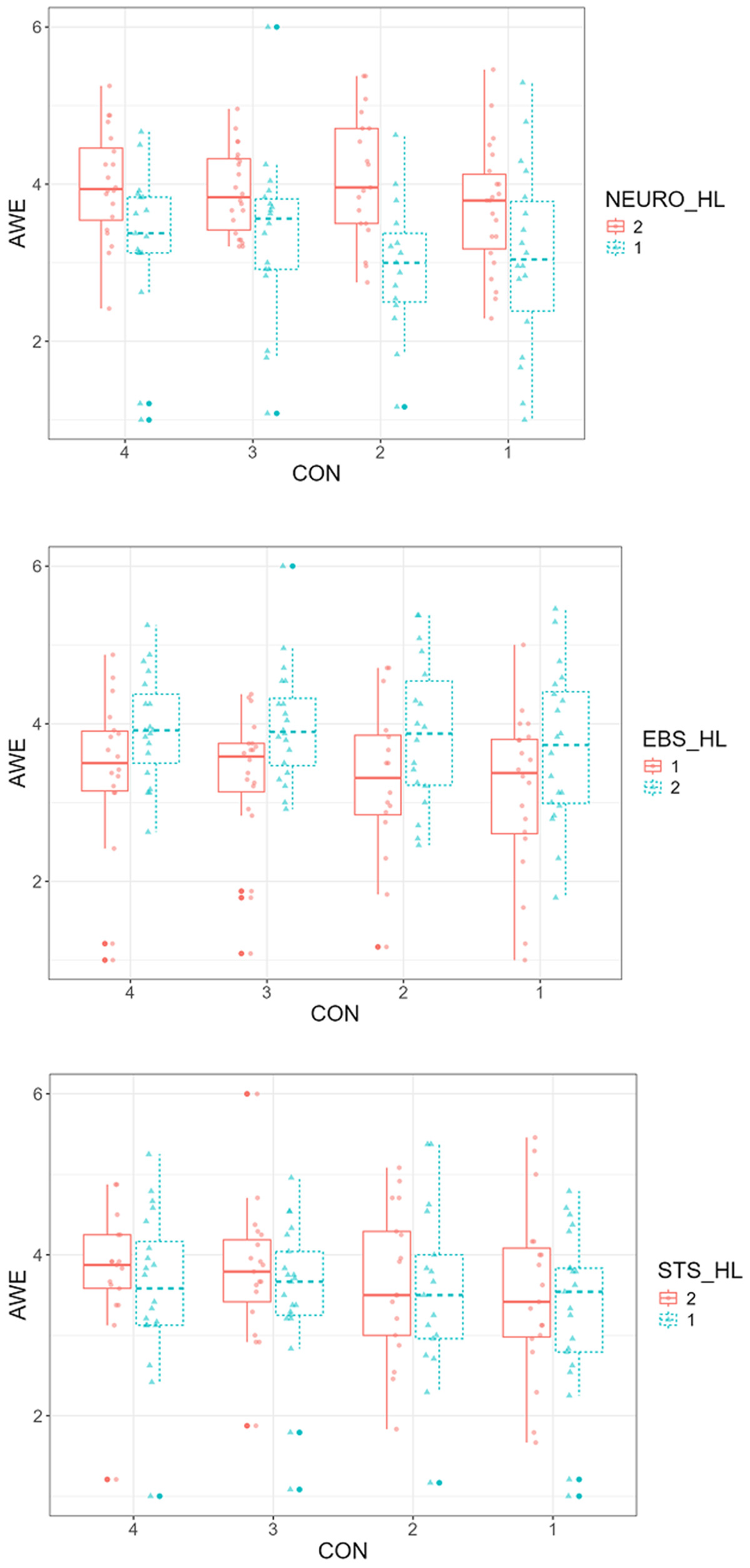
Boxplot representations of Awe scores per condition and high (2) and low (1) Neuroticism, Engagement with Beauty, and Self-transcendence.
Discussion
The study investigated whether self-transcendent experiences (STEs), specifically aesthetic awe, can be elicited through a Generative AI-enabled interactive installation that alters participant's self-reflection in real-time. Drawing on visual art's capacity to serve as a catalyst for STEs, The Looking Glass installation was developed as an experimental apparatus. It employed artistic approaches to define four distinct conditions, each designed to facilitate a unique aesthetic experience by catering to different facets of awe. These conditions ranged from a realistic, narrative-driven voyage through a persons’ life's stages as in “Flow of Time” (Condition 1) scenario and an embodiment of archetypes of mystical power as in “Connectedness” (Condition 2) scenario, to more abstract encounters with overwhelming visual complexity as in “High Complexity” (Condition 3) scenario and unpredictable, non-narrative phenomena as in “Abstract and Unpredictable” (Condition 4) scenario. This approach, utilising a personalised and interactive installation, addressed a gap in awe research which has often relied on non-interactive and static stimuli of natural phenomena.
Pathways to Aesthetic Awe
While the overall AWE-S total scores suggested a limited difference between individual scenarios (H1), AWE-S factor scores, the condition subjective impact ratings, anecdotical evidence and OIS scores revealed notable differences. As a result, we speculate that The Looking Glass facilitated aesthetic awe via at least two pathways, namely a Connection-driven Pathway and Vastness-drive Pathway. The emergence of these pathways can be attributed to the complex nature of awe and the different components that it constitutes of. For example, previous studies have shown that the experience of awe can be both positively and negatively overwhelming (Chaudhury et al., 2021), involve a sense of self-diminishment (Piff et al., 2015; Shiota et al., 2007; Yaden et al., 2019) and connectedness to others (Stellar et al., 2017). This suggests that the conditions were more successful in activating specific facets of awe rather than consistently eliciting a comprehensive awe experience.
Connection-Driven Pathway
The Connection-Driven pathway to awe was most evident in the two most realistic and narrative-driven scenarios – the Flow of Time and Connectedness, which also reflected the highest subjective impact and immersion scores. These results suggest that for a large portion of participants, a stronger sense of connection with a realistic, augmented self-reflection contributed significantly to the perceived impact of the experience. For the Flow of Time scenario, designed as a journey through one's different life stages, anecdotal evidence from interviews with participants revealed its impact was often deeply personal, with many “seeing” themselves and their close relatives in the augmented reflections. This powerful effect can be attributed to the GenAI's capacity for dynamic mirroring, creating new visual material with a considerable and always-updating similarity to the participant's own face and movements. This intense personal identification correlates directly with the scenario's higher mean scores on the AWE-S Connectedness factor.
The same principle of identification via personalised visual similarity likely underpinned the experiences in Connectedness scenario. Here, when conversing with participants they mentioned that seeing themselves embodied as archetypal and mystical figures helped establish a connection to other humans, history, or ancestors. This aligns with the scenario's high mean score for the AWE-S Connectedness factor. The capacity to visually merge one's identity with that of these other forms may not only establish empathy through a form of embodied perspective-taking but also trigger profound contemplation, as exemplified by one participant who, after this scenario, pondered whether there is life after death. This mechanism of shifting the perception mirrors similar mechanisms in the two VR works Isness and Treehugger: Wawona which are considered potent examples of Cyberdelics. In Isness the individual merges with other human beings, thus experiencing unified connectedness (Glowacki et al., 2022), whereas in Treehugger: Wawona the participant experiences reality from a non-human perspective, resulting in a self-transcendence experience (Smith & Warner, 2022).
Therefore, the self-transcendent potential of such connection-based experiences appears to lie in their capacity to prompt significant shifts in everyday perception and deepen an individual's sense of belonging within the broader human narrative. Thus, this pathway appears to tap directly into one of the core facets of the awe experience - the profound feeling of being connected to something larger than oneself, such as other people or humanity as a whole (Bonner & Friedman, 2011; Nelson-Coffey et al., 2019; Stellar et al., 2017).
Vastness-Driven Pathway
The Vastness-Driven pathway was evident in the responses of a distinct subset of participants who found the visually more abstract scenarios – High Complexity and Abstract and Unpredictable, most impactful, despite their lower levels of self-immersion. This suggests targeting the reduced self-saliency aspect of STEs via intense, abstract, and at times overwhelming visual stimuli (Keltner & Haidt, 2003; Rudd et al., 2012). Participants who preferred High Complexity scenario, designed to depict the intricate state of the natural world, highlighted that it was aesthetically pleasing and unpredictable, yet noted they still had some control over it, with some also feeling a connection to the environment and nature after the experience. The engagement with these unpredictable and complex visuals aligns with the scenario's high score on the AWE-S Accommodation factor.
Similarly, those who favoured Abstract and Unpredictable scenario, designed for an erratic and non-narrative experience, consistently emphasized its intensity, unpredictability, and visually overwhelming nature. This feedback corresponds directly with Abstract and Unpredictable scenario having the highest scores on the AWE-S Accommodation and Vastness factors, the two characteristics that are considered the defining features of an awe experience (Keltner & Haidt, 2003; Piff et al., 2015). The potent effect of these scenarios appears to stem from the combination of an overwhelming stimulus with responsive interactivity, creating a visually striking experience that differs significantly from the connection-based realism of the other pathway. Such experiences cater to different facets of awe, likely engaging individuals responsive to novelty and high sensory input. Additionally, when describing sublime, Clewis et al. (2022) focuses on a mixed valance experience of being overwhelmed yet having a positive uplift, a dynamic that is evident in the pathway's high scores on the Vastness and Accommodation factors.
Thus, the self-transcendent potential here lies not in the narrative, emotional identification or connectedness, but rather in the direct perceptual and cognitive challenge. By confronting participants with vast and overwhelming complexity and unpredictability, these scenarios trigger a need for accommodations. Characterized by powerful mixed valance encounters, they prompt the participants to expand their mental schemas to incorporate new, complex and abstract phenomena.
The Role of Self-Immersion
A detailed analysis of the level of self-immersion as a mediator for the awe experience (H2), suggested its significant role in predicting the level of awe experience. Thus, a greater sense of connection between the participant and its augmented reflection led to a higher degree of experiencing awe. It suggests the importance of the Connectedness factor of the awe experience, where the connection to “something larger than oneself” or “humanity at large” can be manifest in an augmented version of one's digital reflection (Nelson-Coffey et al., 2019; Stellar et al., 2017). This is evident in the Connection-Driven scenarios (Flow of Time and Connectedness) where the use of realistic visual stimulus has fostered high levels of self-immersion and thus predicted the resulting awe experience.
However, in the Vastness-Driven pathway, and in particular in the Abstract and Unpredictable scenario, a similar degree of awe was induced despite having a significantly lower self-immersion score. This paradox could be explained by the suppression effect where the potent awe inducing stimulus was held back by the weaker sense of self-immersion. This leads to the conclusion that the abstract and unpredictable design strategy of Abstract and Unpredictable scenario is a fundamentally powerful awe elicitor, but its full potential was not realised due to the lack of self-immersion. It is possible that while the abstract visuals successfully triggered a sense of vastness and the resulting need for accommodation, the weak identification with the on-screen digital representation hindered other key facets of awe experience, such as connectedness (Piff et al., 2015; Shiota et al., 2007).
This analysis suggests that by synthesising the overwhelming aesthetics of the Vastness-Driven Pathway with the mechanics of connectedness of Connection-Driven Pathway, it would be possible to activate multiple facets of awe simultaneously. Such an approach would likely result in significantly more potent awe experience, exceeding the impact of the individual scenarios as tested in the present study.
Individual Differences in Experiencing awe
In line with the established principle that the mindset and individual traits play a key role in mediating STEs (Kitson et al., 2020), our exploratory results reflecting a wide range and distribution of responses provide further confirmation. For example, the results have suggested that participants who scored higher on the Self-Transcendence scale experienced higher degrees of awe. This finding aligns with theoretical conceptualisations of awe itself as a self-transcendent emotion, sharing core characteristics such as reduced self-salience and an increased feeling of connectedness (Dai & Jiang, 2023; Piff et al., 2015; Yaden et al., 2017). This is further emphasised in the research that has defined self-transcendence as a pathway to awe. In particular, Dai and Jiang (2023) presented self-transcendence as a mediator between awe and inspiration whereas Jiang and Sedikides (2021) presented self-transcendence as a mediator between awe and pursuit of the authentic self.
Likewise, the results have indicated that participants who scored higher on Engagement with Beauty scale also experienced a higher degree of awe. These results reinforce the established conceptual and empirical link between experiencing beauty and eliciting awe. This aligns with theories that consider “profound aesthetic stimuli” as direct sources of peak experiences and unselfconscious awe (Lundy et al., 2010). While many studies have highlighted beautiful natural scenery as the most frequent awe trigger (Chirico et al., 2016; Yaden et al., 2019), the present study focused on awe arising from the deliberately constructed aesthetic experiences. Therefore, the finding that individuals with a greater appreciation of beauty, both in nature and arts, reported higher levels of awe is consistent with the focus and somewhat expected.
Finally, a notable link was established between Neuroticism, a Big Five personality trait, and the experience of awe. Our results suggest that participants who scored higher on Neuroticism are significantly more likely to experience higher levels of awe. This observation, while perhaps counterintuitive given Neuroticism's traditional link with negative emotionality, does resonate with some existing literature. For example, Yaden et al. (2019) found that Neuroticism emerged as a significant positive independent predictor of AWE-S scores. This is further acknowledged in research by Quesnel and Riecke (2018), where Neuroticism has been seen to have a slight positive correlation with awe experience. Several aspects of the current study's design may help explain this positive relationship. Individuals higher in Neuroticism, often characterized by heightened sensitivity to emotional stimuli and a tendency towards states like stress or anxiety, might have been more responsive to the potent aesthetic stimuli which in some scenarios was intentionally designed to be overwhelming. This aligns with research on “threat-awe,” where the experience is accompanied by feelings of fear or threat, a state that may resonate with those higher in Neuroticism (Chaudhury et al., 2021). Moreover, the visual content generated by the real-time GenAI was inherently more erratic, dynamic, and visually intense than stimuli typically employed in awe research, such as pre-recorded videos of natural scenery. It is possible that this heightened level of unpredictable and intense stimulation particularly resonated with, or was amplified by, the traits of individuals higher in Neuroticism. Such explanation seems to be further acknowledged by Yaden et al. (2019) who has demonstrated that feelings of being stressed, nervous, and importantly overwhelmed were significantly correlated with total AWE-S scores. Finally, whilst not being consistent with the findings in wider literature where Openness to Experiences has been found to positively correlate with degree of awe experience (Bonner & Friedman, 2011; Bride, 2016; Cotter et al., 2019; Silvia et al., 2015; Yaden et al., 2019), our results have suggested such a correlation with only one of the scenario – the Connectedness.
Opportunities and Challenges
This study sought to move beyond the passive, nature-derived stimuli common in the awe research and instead explore the potential of an intentionally designed, GenAI enabled interactive stimulus. Our findings affirm this potential whilst also positioning such technology in the context of modern Cyberdelics, which use technology to promote psychologically positive states. Our installation demonstrated the capacity to elicit awe-like states through at least two distinct routes. The Connection-Driven Pathway achieved this by leveraging realistic, narrative-based reflection to facilitate a deep sense of personal identification and connection to humanity. In contrast, the Vastness-driven pathway succeeded by using overwhelming and abstract visuals to create powerful perceptual and cognitive challenges, mirroring the mechanics of the sublime. The emergence of two distinctive pathways demonstrates the installation's success in activating different facets of awe, showcasing the powerful potential of synthesizing artistic approaches, GenAI technology, and established psychological principles.
However, whilst acknowledging the potential that the GenAI technology offers, there are also distinctive drawbacks and growing societal concerns surrounding this technology. For example, the reception of AI generated visual content, particularly within art and cultural spheres is often negative. The criticism frequently arises from questions about authorship (Congdon, 2025), originality and lack of lived human experience (Zylinska, 2024) which are all qualities traditionally prized within arts and culture. This can lead to viewing AI content at best as something that lacks emotional depth and at worst as something that devalues artistic labour (Read, 2024). Furthermore, the well-known practices of scraping artists’ work (Crawford, 2021) to train AI models without ruminating artists for their work, poses ethical questions about appreciating AI content, potentially further undermining the positive affective goals of the experience. Likewise, there is also a change in the broader public perception regarding the AI-generated content. The initial wave of enthusiasm and the novelty aspect of AI visuals appear to be receding (Congdon, 2025), largely due to an overwhelming influx of what is often labelled as the “AI slop” - or low quality and generic visual content created to gain mass traction on social media platforms (Hoffman, 2024; Mahdawi, 2025; Guardian staff reporter, 2025). This in turn can create aesthetic fatigue and general dislike towards AI-generated media. These negative perceptions can significantly impair the potential of using GenAI as a catalyst for STEs. As a precondition such experiences require participant openness, trust in the experience, a suspension of disbelief as well as a sense of engaging with something authentic (Kitson et al., 2020; Stepanova et al., 2019). If the medium itself is viewed with suspicion and as something that is inauthentic, it may hinder any attempts of inducing any profound personal transformation.
Limitations and Future Work
The limitations of this study primarily are connected to the ephemeral nature of STEs, the use of novel technology for designing for awe, and the inherent limitations of the employed methodology. Firstly, as noted by multiple sources, awe is notoriously challenging to elicit in a controlled experimental setting (Chirico et al., 2017, 2018; Quesnel & Riecke, 2018; Silvia et al., 2015). Although the experiments in this study were intentionally held in spaces that would resemble an exhibition venue, nonetheless these spaces were controlled environments that lack the naturalism, spontaneity, and perceived authenticity that can contribute to profound emotional experiences. As Pelowski (2015) noted, digital artworks viewed under similar conditions may be less likely to evoke the powerful and personal engagement that is essential for STEs. Furthermore, the awareness of being observed and the requirements for participants to self-monitor their sensations can further hinder the levels of immersion and the overall effect of the experience. These factors may have contributed to relatively modest overall scores of AWE-S reported in the study. While Virtual Reality (VR) has been employed in other research in order to enhance the immersion and counter the suppressing effects of the laboratory experiment environment, the current technical constraints for implementing real-time GenAI in VR required the use of screen-based installation for this study.
Moreover, the novelty inherent in both the visual material and the interactive nature of the installation presents another limitation. It is possible that once participants become familiar with the interactive mechanics and the characteristic style of the AI-generated visuals, any subsequent encounters might elicit lowered emotional responses, including awe. This is in line with previous studies that have emphasis that novelty of stimulus is an important factor for STEs (Adam & Frewen, 2024; Piff et al., 2015). It was further anecdotally acknowledged by some participants who reported that the first scenario that they experienced felt particularly impactful precisely because of how new it felt. However, having anticipated the novelty issue, the study presented the scenarios in a randomised order.
Apart from design challenges stemming from the technology, the increasing amount of ‘AI slop’ currently flooding social media could potentially influence participants’ attitudes and preconceptions towards GenAI content, consequently influencing the experience, though no participants in the present study explicitly reported such concerns. Furthermore, the inherent nature of the visual content generated by AI likewise presents some specific constraints. Generative AI models, particularly general-purpose foundational models like SD 1.5. Turbo as used in this study, operate by producing the most statistically probable visual outputs corresponding to given prompts. This mechanic intentionally favours common visual symbolism, which often results in imagery that may be perceived as cliched or aesthetically simplistic. Therefore, the visual stimuli in certain scenarios might lack nuanced artistic expression or novelty. And although it can certainly be perceived as a limitation, it was an anticipated trade-off. The nature of the experimental study requires visual content that can be broadly generalisable and comprehensible across a diverse participant pool. Thus, the tendency of AI to produce familiar representations was considered acceptable, prioritising shared understanding and generalisability over a unique and artistically distinct imagery.
Finally, future research work could build upon the design insights that have emerged from the two identified pathways - the Connection-Drive one and the Vastness-Driven one. Thus, the most promising pathway likely is the synthesis of these two approaches. The findings have suggested that the overwhelming and unpredictable aesthetics of Vastness-Driven pathways was the most potent awe elicitor, but it was suppressed by the lack of self-immersion. Therefore, a key direction for future work would be the design of a hybrid scenario that would combine the mechanics of personal connection and self-immersion from the Connection-Driven pathway with the visually intense and complex aesthetics of Vastness-Driven pathway. Investigating such hybrid designs, particularly within a more immersive medium such as VR, could lead to the development of experience capable of activating multiple facets of awe simultaneously, potentially resulting in considerably more powerful STEs.
Supplemental Material
Footnotes
Acknowledgments
This work was supported by the research infrastructure at Tampere University: NEXUS - Research Infrastructure for Interaction Between Humans, Technology, and Society. In particular, essential equipment, premises and support was provided through the Ludus laboratory inventory and staff. The study was supported by Jane and Aatos Erkko Foundation through CONVERGENCE of Humans and Machines project in Tampere University, Finland; Research Council of Finland (342144; ‘POSTEMOTION’; 337653, UNITE Flagship); and Kone Foundation (DIAL: 202008478).
Authors have no competing interests to declare.

Funding
The authors disclosed receipt of the following financial support for the research, authorship, and/or publication of this article: This work was supported by the Jane ja Aatos Erkon Säätiö, Research Council of Finland, Koneen Säätiö, (grant number 220025, 337653, 342144, 202008478).
Declaration of Conflicting Interests
The authors declared no potential conflicts of interest with respect to the research, authorship, and/or publication of this article.
Supplemental Material
Supplemental material for this article is available online.
Notes
References
Supplementary Material
Please find the following supplemental material available below.
For Open Access articles published under a Creative Commons License, all supplemental material carries the same license as the article it is associated with.
For non-Open Access articles published, all supplemental material carries a non-exclusive license, and permission requests for re-use of supplemental material or any part of supplemental material shall be sent directly to the copyright owner as specified in the copyright notice associated with the article.
