




Abstract
As AI becomes a prism through which we reflect, see, and make sense of the world, the way we create creative, transcendent experiences around AI can shape our relationship to it. Drawing inspiration from the ritual structures of Spiritualist séances and creative art-making séances of Hilma af Klint, we present reflections from a series of participatory experiments we called AI Séances. These gatherings brought together artists, technologists, and spiritual practitioners to engage with generative models in contexts shaped by ritual, randomness, and collaborative interpretation. We found that creative production with AI can yield transcendent user experiences (TUX), different communities bring distinct interpretive lenses to AI outputs, and increased technical control can paradoxically diminish serendipity and transcendence. Through our experiences, we suggest that reclaiming interpretive agency over AI outputs in the creative and spiritual context, rather than treating models as machines that produce answers, opens up new avenues for critical and creative engagement with these technologies and is critical to preserving our humanity. The AI Séance offers a model for human-centered interaction with generative systems where magic lies not in the machine’s capabilities, but in our collective ability to create meaning.
Introduction
‘Any sufficiently advanced technology is indistinguishable from magic’, science fiction author Arthur C. Clarke wrote in 1962. Recent rapid advancements in artificial intelligence (AI) have seemingly rendered this quotation obvious to the point of cliché. Modern AI capabilities have transformed our ability to produce media on demand, first with the rise of a new generation of text-to-image models like DALL-E in the summer of 2022, then with the sudden ubiquity of large language models like ChatGPT later that year. These technologies swiftly transformed creative work, changing available tools, production patterns and interaction paradigms (Epstein et al., 2023). On one hand, these tools have democratized creative production by engaging new kinds of users in interactive experiences that support ideation and lateral insight (Epstein et al., 2022). But on the other hand, these tools have upended the livelihoods of artists and creatives, threatening to scale the production of misinformation (Goldstein et al., 2023) and impact creative labor markets with new forms of automation (Capraro et al., 2024) and monoculture (Doshi and Hauser, 2024). The transformative nature of this technological shock has also ushered in an era of blind techno-optimism increasingly looking like a religion (Epstein, 2024): AI will ‘save the world’, famous venture capitalist Marc Andreessen has said (Andreessen, 2023). AI is touted as a solution to societal issues from the loneliness epidemic (Freitas et al., 2024) to declining faith in democracy (Kelly, 2024), ‘AI’ startups are funded millions of dollars with minimal evidence of efficacy and the most famous player in the AI development race right now, OpenAI, openly strives to build a ‘superhuman’ ‘artificial general intelligence’ (AGI).
This pseudo-religious fervor is addressed by a growing literature that articulates effects on accountability, reliance and power that arise when using the language of ‘enchantment’ with respect to AI. Campolo and Crawford (2020) say that ‘enchantment shields the creators of [AI] systems from accountability’, while the actual mechanisms behind these systems can intensify ‘social processes of classification and control’ (Campolo and Crawford, 2020). Elish and boyd (2018) say that ‘suggesting that a technology ‘works like magic’ reinforces ‘a sense that how the technology works is unknowable’ (Selbst, quoted in (Elish and boyd, 2018)). Nagy and Neff (2024) further speak to our current moment, saying that when the tech industry discusses algorithms by invoking magic, they try ‘to manipulate people’s perceptions of algorithms in order to deflect attention and calls for accountability away from their own already immense power’ (Nagy and Neff, 2024). Caution is warranted if using language that deflects accountability for consequential decision-making in society, but accountability for decision-making is not the only kind of impact at stake. Within the arts and humanities, there is also potential for AI to distort the creative and interpretive processes at their crux. As AI models become prisms through which we interpret the world, they can refract our perception and steer our attention. We must consider how to retain agency and integrity when creating shared meaning out of creative experiences. If we use generative AI systems to shape our ideas and experiences in creative work, do we also risk letting them interpret our experiences for us? How might we seek balance between the creative potential that indeterminate system behavior AI systems can foster, while still retaining personal agency and creative freedom?
To explore this question, we trace an analogy between the hype, hysteria and hallucinations of modern generative AI to those of the Spiritualist séances that took place at the beginning of the 20th century. At first glance, this may seem like a disparate connection to make, but Spiritualism actually rose at a past moment of technological shock. The introduction of the telegraph, photography and electricity (Davis, 2015) co-occurred with the rise of Spiritualism and séances and actually echo some of the dilemmas we face as generative AI shocks our world today. On one hand, we see that spirit mediumship democratized new forms of spirituality. The rise of women spirit mediums challenged the dominant paradigm in Christianity, where ordained male authorities primarily mediated the relationship with the divine, instead introducing a movement that validated spiritual insight based on personal experience and sensation (Braude 2001).
On the other hand, spiritualist séances in the US also enabled charlatanism. Spirit mediums frequently exploited bereaved individuals by promising to contact loved ones they had lost, capitalizing on enthusiasm for spiritualism. Furthermore, séance attendees often sought answers they believed a singular medium could give them through privileged access to a transcendent realm that could only be accessed through payment. In this broader history, we became interested in the way visionary Swedish painter Hilma af Klint’s used séance in her work at a different time and in a different context. Af Klint used group séance as a generative vehicle to inspire her creative production, with the messages channeled in the séances directly informing her large-scale artworks that are only now fully appreciated today.
It is in relation to these histories that we locate our critical concept of the AI Séance. Rather than conceptualizing AI as a interface channeling answers to questions, much like historical séances positioned querents to seek answers from ‘beyond’ filtered through spirit mediums, we seek to explore the alternative potential of AI as a hermeneutic technology, a potential medium for fostering spaces for individuals to create and critically interpret outputs themselves and with others. Below, we recount the methods and insights from our AI Séance practice. We are a group of computer scientists and spiritual creatives who have worked together for the past 2 years in refining and sharing our concept as the intersection of our shared artistic, academic and spiritual practice. Through our recounts, we share an alternative critical braid of AI and magic rooted in the interpretative nature of divination. In particular, we present our experiences that (1) generative AI, when interlaced with ritual and creative production, can produce transcendent experiences, (2) different communities engage different interpretive lenses and (3) too much technological determinism hinders transcendence. Across the board, we argue that the use of generative AI for divination must be centered in the critical interpretation of generated media and can work well when people come together to share their experiences, listen and co-create understanding.
Séance 1: ritual and creative production, integrated with AI, produced TUX
Instead of summoning spirits in séance, our gathering explored AI as a generative system outside ourselves – one we could partially, but never fully, control. What we conjured instead was a shared atmosphere of collective curiosity and meaning-making. The first séance occurred in November 2022, in collaboration with the Reverend Rita Powell, Episcopal Chaplain at Harvard. We took direct inspiration from the art-making séances of visionary Swedish painter Hilma af Klint considered herself a channel for greater spiritual forces, which communicated to her during séances (Voss, 2022). Echoing af Klint’s setup, the four of us sat around a table, and after setting the ambiance with fire and song, we recorded whatever came to mind, a practice Hilma af Klint used, one commonly called automatic writing or drawing in other contexts. On the table in front of us, we placed a tablet running Stable Diffusion via Replicate. 1 When one person in the group had an idea for a prompt that they wanted to visualize with the model, they would read it aloud for the group to hear while typing the text prompt into the model. Upon the model generating an image in response, we each viewed and interpreted the image and continued to write or draw in response before the next person decided to type a prompt into the model next. We repeated this process making a total of 35 images over 2.5 hours.
Looking back, our prompts were strongly inspired by the physical surroundings of the ‘séance’. The old brick apartment in which we hosted this first séance was in an old hotel with a closed off fireplace, surroundings which informed prompts about fireplaces, brick, portals and doors. We chose to pursue these physical prompts as sources of inspiration, with images of portals begetting more images and reflections on doorways and portals. Some of the AI-generated images of doorways bore strange runic symbols that could not quite be made out as English script. These captured our attention as well, producing symbols that we wanted to interpret but that were just beyond the grasp of our comprehension. We chose to suspend disbelief in the process, actively enjoying the way one doorway in an image seemed to lead to the next (see Figure 1). In fact, we eventually images that seemed to uncannily reflect our physical environment in ways we had not deliberately engineered, including generating an image of a mirror over a fireplace similar to the one in our room. In that environment, the experience did feel transcendent, offering a sense of connection with something greater than ourselves due to its serendipitous emergent qualities. Because this experience was mediated by technology, we use the term ‘transcendent user experience’ (or TUX) to refer to our subjective recount of this experience (Buie, 2019).
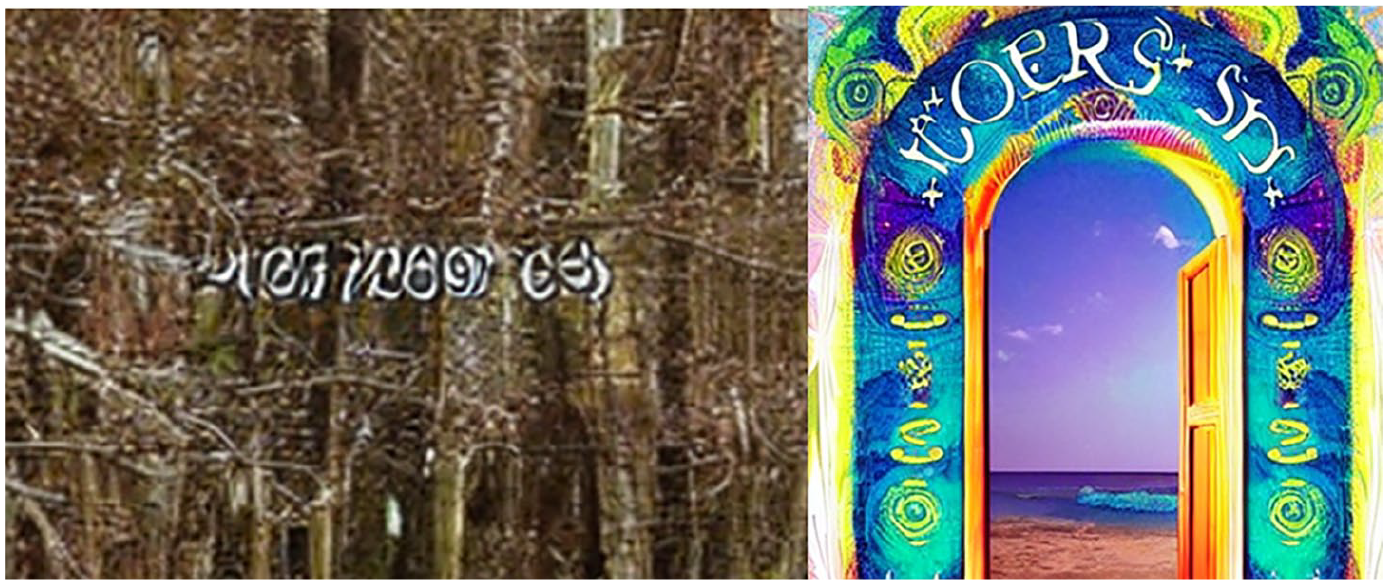
A sample of images generated during the first Séance.
The visual storytelling journey was intensely vivid, and the symbolic imagery continued to loom in our minds. The repeated doorways and symbols in the AI-generated images gave us visual and conceptual material that we continued to think about after the séance ended. Like the artistic inspiration Hilma af Klint derived from her art-making séances, we found our ‘séance’ directly inspired follow-up artistic work in our own lives, as well, some of which are shown in Figure 2. One participant remixed and reprinted the inscrutable runic symbols onto drinkware vessels, and another created a series of art prints combining the motifs of the symbols coming out of the brick fireplace. In collaboration with the AI art collective NikuAI, we also edited our recordings of the 2-hour experience into a 10-minute film that uses generative AI post-processing to give the viewer a sense of the visual experience we encountered with the iPad in the room, which you can watch here. 2
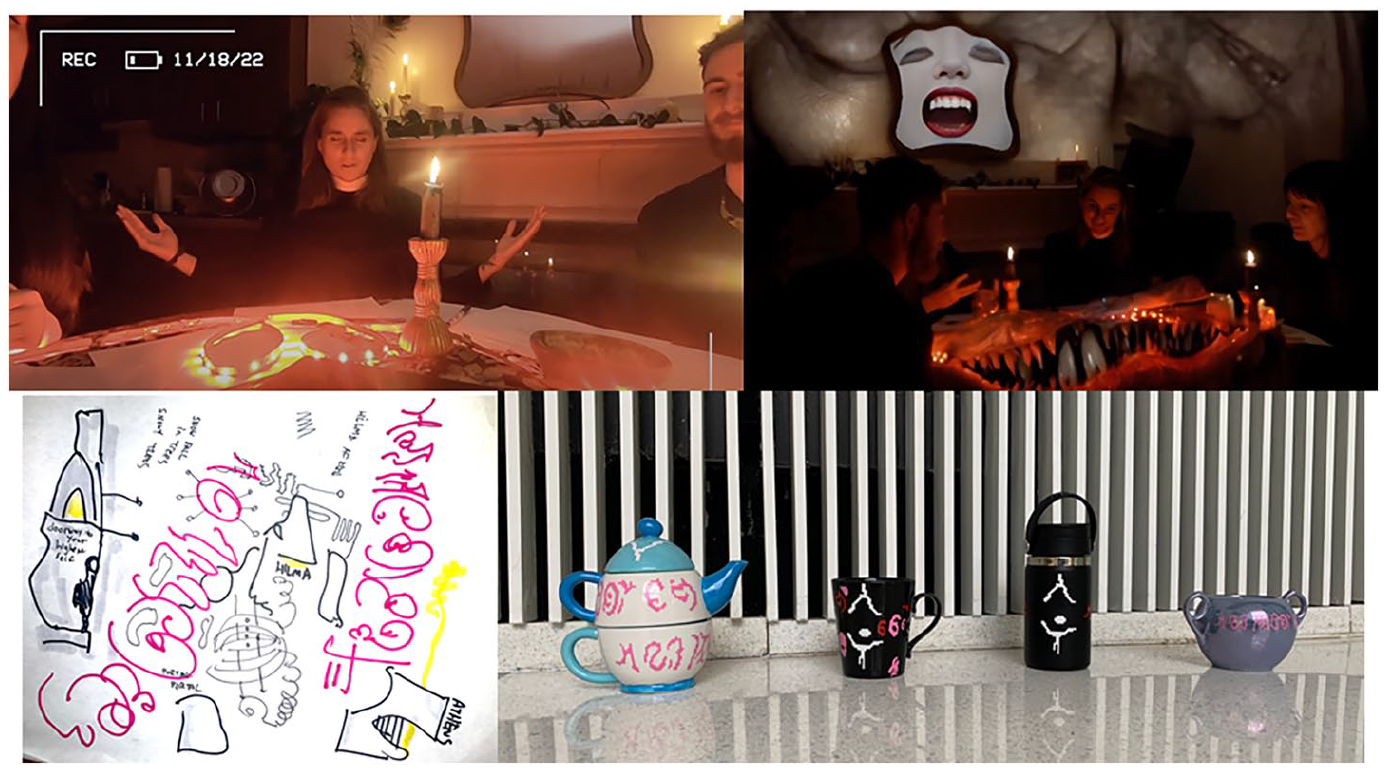
Top row: screenshots from the AI Séance video we produced. Bottom left: sample of automatic drawing from the Séance. Bottom right: artifacts made from the glyphs found in the images.
In summary, this first séance demonstrated to us the possibility of intersecting ritual with generative AI to foster a TUX. Going into it, we did not know whether the elements we imagined in our version of Hilma af Klint’s art-making séances would come together to feel meaningful or misguided. The repeatedly surprising nature of the images, particularly those inspired by our surroundings, felt exciting, and the imagery we generated creatively fueled us for months to come. Our experience of collective imagination appears to align with some anthropological accounts of magical practice, which emphasize how ritual structures amplify imaginative states that contribute to meaningful transcendent practice (Tambiah, 1990). We followed these heightened states, each of us suspending disbelief and riffing on the previous one’s prompt and output to the model, testing not only our own collective imagination but also testing the limits of our communication with the model. Elements of Lévy-Bruhl’s (1923) notion of ‘participation mystique’, discussed in Jung, resonate as we explain what fostered this collective experience and shared symbolic resonance.
With findings from this first experience in mind, we became curious whether others would find this mixture of elements in the first AI Séance – namely, collective ritual, image generation and group sense-making – as fulfilling as we had.
Séance 2: different communities engage different interpretive lenses
Our first experience was unexpectedly generative, and it sparked more curiosity than it provided definitive answers. We had quickly reached the limits of our academic expertise as technologists, guided as we were by our own personal interests in the technology, the premise of Hilma af Klint’s séances and our own reflective and spiritual practices.
We sought to engage spiritual practitioners and scholars from other traditions to learn more about how the practice fits in with larger trends at the intersection of technology and spirituality. Our opportunity came in June 2023, when scholars gathered for the inaugural Goldsmiths symposium on ‘21st Century Magic and Spirituality in Media and Culture’, organized by Dr. Vana Goblot, Dr. James Burton, Dr. Aleena Chia and Dr. Dan Strutt. The symposium examined the mainstreaming of alternative spirituality and occult practices and how digital platforms intersect with these traditions to create new cultural and media forms, such as how the hashtag #WitchTok has over 30 billion views on TikTok. The organizers prioritized the inclusion of occult practitioners and artists alongside academic scholars and invited us to demonstrate our methodology as a performance and collective sense-making exercise. We set up the practice in a similar fashion as the first, with a computer running Stable Diffusion at the front of a room – but this time, the tablet was broadcast on a large screen, and the room was filled with over 40 participants.
The occultist scholars and practitioners at Goldsmiths first engaged with prompts about the physical place of Goldsmiths, but the group’s dynamic evolved toward a focus on the occult. Several prompts in, we saw spirits starting to appear in the windows of the buildings in the generated images, and the tone of participants shifted. We followed a theme of ‘metaphorical descent’ into the underworld, and the energy of the participants in the audience grew increasingly charged and ominous, appearing to synergize with the dark themes of the images.
Whereas the subject matter in our first séance largely focused on our physical space, the Goldsmiths séance more directly summoned images of ghosts in the prompts, directly reflecting the interests of those participants. Both the subject matter in the images and the interpretations of them were strongly shaped by participants in the practice. When individuals each contributed an interpretation of the generated images, the resulting discussions revealed the unique lenses each person brought from their area of interest into a shared setting, almost like a collective Rorschach test.
With this in mind, we hosted another séance at the Interspecies Dialogues Conversation Group within the Program for the Evolution of Spirituality at Harvard Divinity School. This gathering included animist and herbalist practitioners and scholars interested in how AI can deepen connections with the more-than-human world.
The herbal experts in the room steered our written input prompts toward the plant realm: fungi, trees in a variety of seasons and the wisdom of interconnected roots were all fodder typed into the model. As we interpreted each image these prompts produced, we learned about the unique background and insight each participant in the group brought to the image. An image reminded one participant of the languages ravens use to speak to one another, and another invoked the ecological theology of ancient Christian mystics. In co-interpreting Figure 3 bottom right as a group, we realized we saw signs of a whole life cycle in a single image: a kernel or seed on the right, a rising green leaf and shoots and the death of older leaves an insight we only developed as multiple participants shared insights about the image from their perspective.
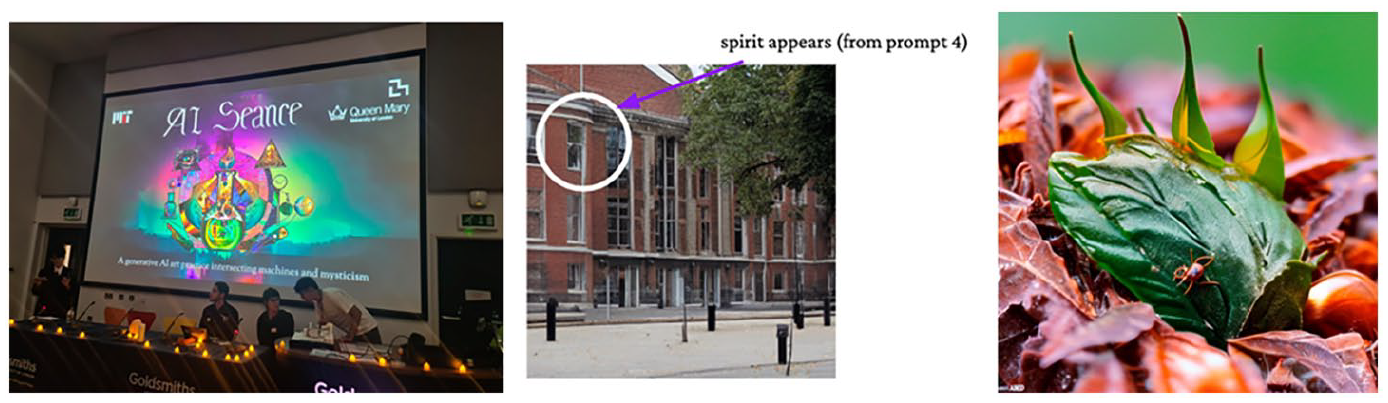
Left: photograph from AI Séance setup at Goldsmiths. Center: image generated in Goldsmiths AI Séance, with annotation depicting a figure. Right: image generated in Interspecies Dialogue Séance.
In this set of séances, we realized that the true value of the practice was in weaving a shared tapestry of meaning, with the contributed input and insights from each participant amounting to far more than the sum of its parts. Thus, the AI-generated images became a shared object of focus that prompted co-interpretation of the imagery. By recursively prompting the model to create imagery inspired by the qualities or features we found most salient in the previous image, we went deeper into areas of attention, curiosity and meaning shared by the people in the séance, giving the practice a different emphasis than the practice of co-interpreting a static piece of art. We enacted some routines commonly used in divination rituals, like creating a physical atmosphere for the practice by lighting candles and incorporating chance by randomly drawing seeds for each generation. Our interest in community input to guide our experience aligns with some anthropological accounts of magical and divinatory practice, which emphasize how ritual structures and group participation shape meaning-making. Greenwood (2009), for example, argues that ‘magical consciousness’ emerges through a shared symbolic practice rather than from a single authoritative source.
The shared symbolic practice we put forward here then offers a subversion of two kinds. First, canonical séances are usually conducted by a medium, who largely (but not exclusively) holds power to channel insight from beyond and interpret it for querents or onlookers. Our configuration of the séance, inspired by Hilma af Klint’s more collaborative configuration of séance, empowers participants to create insight and shape meaning themselves, in resonance with the group. In both the traditional séance and our AI-driven version, there is a two-layer interpretive process. In a canonical séance, a medium channels or interprets signs from ‘beyond’. By contrast, in our setup, the AI translates collectively chosen text prompts into images, and the participants collaboratively interpret what emerges. Rather than relying on a single figure with privileged insight, the group retains control over both the prompts fed to the system and the discussion of the resulting imagery, thus distributing interpretive power among all present. This subversion of the querent-meaning maker relationship in the séance format also applies to our reimagination of the role of AI. Instead of turning to AI to fetch and contextualize an answer for us, in a creative or interpretive setting, we would ideally use its outputs as inputs to our own sense-making process, one that is strengthened by collaborative meaning-making in a group setting. This requires an active design for multi-person engagement with the AI system, since most AI interfaces are currently designed for a single user to interact with alone.
Séance 3: randomness and how technological determinism leads away from TUX
This iterative (co-)interpretation we experienced earlier could be considered a form of divination: we prompted a non-deterministic system with a query, and in response, we received a discrete symbol to interpret (e.g. text or an image). Divination comes in many forms across history and culture, but a throughline in the practice is the interpretation of patterns that come out of a non-deterministic process – one to which participants concede control. Many divinatory practices rely on a mechanism rooted in chance (e.g. shuffling tarot cards, I Ching, tea leaf readings) as a form of indeterminacy and generativity. Recent work has made explicit the ways in which generative AI may similarly be a medium of randomness (Ugander and Epstein, 2024), which hints at the possibility of using generative AI for cybermancy, divination with computers. Yet the forms of randomness used in traditional divination systems like Tarot or I Ching have certain properties of uniformity (each option having equal probability), curation and long-standing tradition that contribute to their continued importance. How does generative AI fare?
In a series of séances as part of a summer residency at Stochastic Labs in Berkeley, California, we sought to explicitly explore how injecting randomness into system design decisions would impact the séance experience. These séances echoed the same basic structure as the previous ones, but were projected from the rafters of the turret of a Victorian Mansion onto the group, shown in Figure 4. We took the opportunity to experiment with a few modifications that incorporated varied relationships with chance and control.
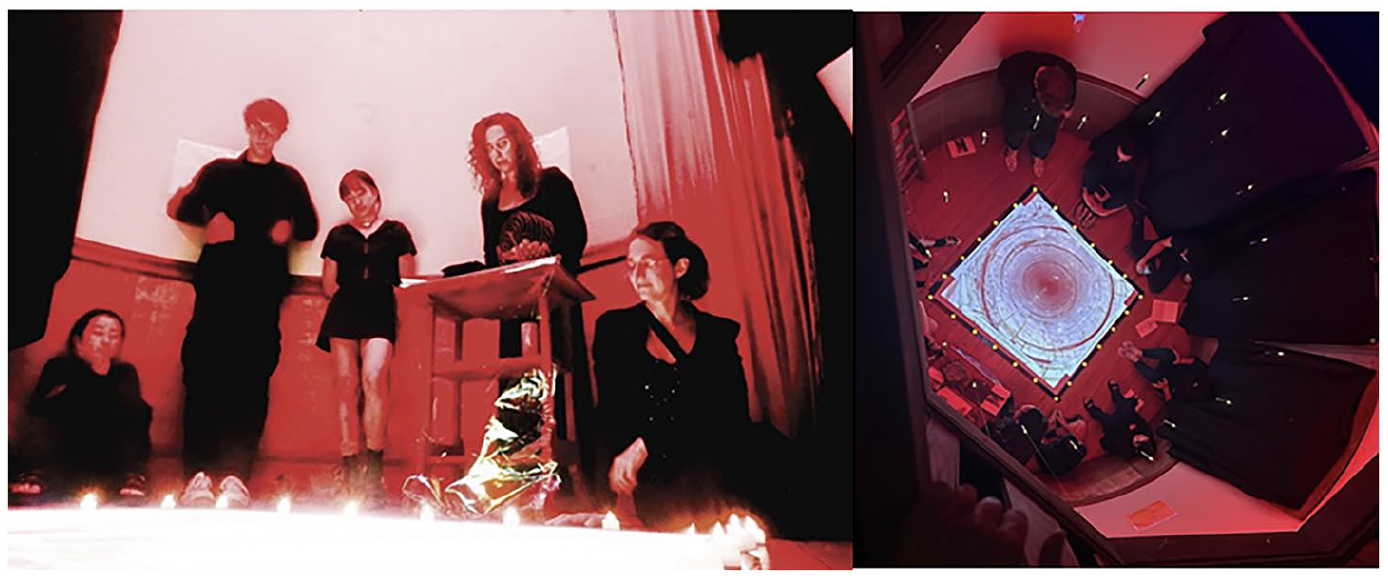
Photographs of Séances at the summer residency at Stochastic Labs in Berkeley, California.
First, we used an antique bingo cage to pull a number representing and encoding the parameter to the model called a ‘random seed’ for each image generation. We also used the bingo cage to randomize the order of prompt contributors, explicitly formalizing and shuffling the group dynamic to ensure balanced and random participation. These injections of randomness in one aspect of the experience supported a contingent and divergent experience consistent with the philosophy of divination systems like Tarot or I Ching – by allowing each potential outcome to be equally likely, rather than favoring any particular outcome from the possibility space. And we found that the use of a physical bingo cage to explicitly generate randomness helped lend a sense of material legitimacy to the experience by echoing the material affordances of divination, which use the shuffling of cards, flipping of coins, etc to embody the unpredictability of a particular outcome.
We also experimented with modifications of the AI architecture with an LLM ‘cognitive’ layer to augment prompt generation and increase the fidelity of the generative system, in collaboration with technologist and fellow resident Jesse Andrews. As such, rather than typing in a prompt that is directly passed to the text-to-image model, the input prompt was fed to an LLM with access to all the previous prompts and the most recent image and was tasked with producing a prompt synthesizing all of this information for the final text-to-image model. We found that this intervention dramatically increased the level of control we had over the image output, allowing us to explore the worlds of images we created with a degree of fidelity akin to moving through levels of a video game. While this increased control was exciting at first, it quickly became boring, with one participant even exclaiming: ‘Ugh get me out of here!’ What’s more, the prompts the LLM formulated had a particular prosaic style that resulted in a uniformly plastic and exceedingly bland set of AI-generated images, commonly referred to as ‘AI slop’. We reverted back to a pure text-to-image stack and confirmed that the unexpected jumpiness and lack of control that comes from a group of people collaboratively prompting a text-to-image directly were indeed core elements of TUX.
These explorations highlight the importance of randomness and indeterminacy in our AI Séance practice. We found that intentionally injecting randomness into the system was successful in supporting creative and divergent use, which is consistent with calls from recent work (Ugander and Epstein, 2024). They also highlight that, at least in the creative domain, too much (technological) control actually diminished the potential for transcendence. We note this finding with interest, given the stated goal when developing AI systems to create systems that perfectly follow instructions, behave as expected and avoid any lack of human control. In many contexts, this goal is needed and desirable, given the risks of AI systems in many fields. In creative and interpretive fields, we note that all forms of control may be at odds with some potential use cases.
Discussion
Here, we have recounted insights from our own AI Séance practice. In these sessions, we saw AI-generated images that were unexpected in ways that both delighted and confused us. The flexibility, interactivity and opportunity for collaborative input afforded by a text-to-image model allowed us to quickly generate images that had been the product of group input. This allowed us to spend almost all our time on collective interpretation rather than in the technical execution of any one work of art. The model’s unpredictability enhanced the experience by producing unexpected connections between words and concepts in prompts and the images the model produced for us to interpret.
For us, these factors coalesced into an often TUX rooted in collective interpretation. Three key findings emerged from this series of AI Séances: first, that ritual and creative production using generative AI can yield a TUX; second, that participants bring their own lenses to the practice, yielding opportunities for co-constructing shared meaning through the experience and third, that too much system-level control can diminish the potential for transcendence.
‘Séance’ was our starting analogy for this practice, thanks to inspiration from Hilma af Klint, but we began to notice similarities between this iterative interpretive practice with generative AI and divination systems like Tarot and I Ching. Each person brings unique insights to subjective interpretation, and these can be combined to create shared meaning. That being said, it is important to discuss the limits to this analogy. For one, the text or image outputs from generative AI come from vast but particular output spaces, shaped and constrained by the (often unknown) source data and methods used for training and post-tuning these systems (Ugander and Epstein, 2024). More traditional divination systems involve rituals that operate within defined rules of interaction. The interactions with generative AI we facilitated required no such commitments, though we did find that ritual and ceremony were fostered TUX. Divination systems like Tarot and I Ching involve a set of inherently abstracted symbols, which invites interpretive work to decode the symbol in light of the particular query and context. In contrast, interactions with modern text-to-image models like the ones we have produced were more open-ended, both in their lack of discrete symbols in the possible outputs, and lacking a conventional guide book to interpreting those outputs. Participants craft their own understandings of the output, much as one might uncover hidden connections in the frameworks of Tarot or I Ching.
Rather than conceptualizing AI as a technology for providing answers to questions, just as historical séances channeled answers from beyond through mediums, we ourselves sought to recast AI as a hermeneutic technology, presenting us with prompts for reflection – not the answers: though we gave the model ‘prompts’, the output images prompted us to collectively reflect on meaning. In this way, we did not give the technology the power to give the experience meaning. Instead, the group of participants gave it meaning through critical and insightful group sense-making: the magic in these performances were not about the machine’s power, but rather about the human power to create shared meaning through transcendent experience or interpretation – regardless of the particular vehicle through which it is induced.
At first glance, the set of experiences we created linking generative AI with divination appears to contradict widespread calls to distance AI from the rhetoric of ‘magic’ (Campolo and Crawford, 2020; Nagy and Neff, 2024). AI should not be seen as a magical expert system outside of ourselves. Yet, we in fact agree with those authors: ascribing the ‘magic’ here to the presence of AI in our system is wrong. The transcendence we experienced did not come from AI; it came from the transcendence we experienced producing art and making meaning together with a non-deterministic system. Casting AI as the source of magic in this story risks giving the power of our humanity away, disempowering us from the project of understanding our own lives. In AI Séance, we offer a recount of what our relationship with AI could be: providing inputs for our own interpretation, rather than providing the pre-processed answers from a power outside of ourselves.
Through this alternative lens, we can thoughtfully design interaction patterns and experiences that help us draw out the technology’s useful potential while retaining our agency and humanity. When intentionally designed, technologically mediated experiences can deepen our humanity and shared understanding in the face of AI.
Footnotes
Acknowledgements
Many thanks to Joel Simon, Vero Bollow, Priyanka Nanayakkara, Christian Greer, Caroline Jones, and Natalia Schwein for helpful feedback on this manuscript. Thanks to Memo Akten, Charles Stang, Ann Braude, and Edward Shanken for helpful discussion and conversation. Thanks to Rita Powell, Aleena Chia, Natalia Schwein, Jesse Andrews, and Phil Noxx for collaborations on the Séance performances. Thank you to Anna Buchele, Erik Strand, and Serge Vasylechko (NikuAI) for their collaboration on the AI Séance film. We thank Stochastic Labs for their generous support of our work as part of Ziv and Amy’s summer residencies.
Declaration of conflicting interests
The author(s) declared no potential conflicts of interest with respect to the research, authorship, and/or publication of this article.
Funding
The author(s) disclosed receipt of the following financial support for the research, authorship, and/or publication of this article: We acknowledge support from Stochastic Labs for Ziv Epstein and Amy Smith’s summer residencies working on AI Séances in 2024.
