




Abstract
According to prominent philosophical views, appreciating beauty involves psychological distancing, where one does not consider the beautiful object in light of practical interests, and beauty leads to transformative and self-transcendent affective experiences. In this study (N = 187), conducted in the naturalistic environment of a museum, we explored these ideas. Half the participants were instructed to rate the beauty of pottery objects created by a renowned artist, while the other half engaged in a control task that did not involve evaluating beauty. Based on Construal Level Theory, we used the Behavior Identification Form to explore whether aesthetic experiences encourage abstract thinking, and in turn, psychological distance. We also predicted that beauty appreciation would lead to greater transformative and self-transcendent emotions. Indeed, appreciating the beauty of artworks led participants to think in a more abstract way, especially those who practice an art hobby themselves, as well as to transformative, and self-transcendent emotions.
One of the most prominent ideas in philosophical aesthetics is that beauty involves disinterest and distance. Kant (1790/2000) argued that beauty gives rise to disinterested pleasure: when observers find an object beautiful, it pleases immediately and not because it satisfies any practical interest we may hold. Glossing the same general idea, Edward Bullough (1912) suggested that beauty has the power to transform people, by disconnecting the object or phenomenon from the practical self, and practical concerns. Beauty leads to passive contemplation, and not practical action.
While this idea has proved extremely influential since the eighteenth century, it has had its critics. Most influentially, George Dickie (1964) denied the existence of such a special state of mind, arguing that what might seem like a disinterested or distanced state of mind in aesthetic appreciation can instead be explained in terms of deploying our ordinary attentional capacities.
Alongside this, a great many philosophers, including Plato (c. 370), Schopenhauer (1969), Murdoch (1970), and Doran (2022, 2023), among others, have suggested that the affective experience of beauty involves self-transcendent and transformative elements. Iris Murdoch (1985, p. 78), for example, claims that appreciating beauty leads to a moment of “unselfing”.
In the present study, conducted in an art museum context and utilising experimental methods from social psychology, we put these two ideas to the test. More specifically, we investigated, first, whether beauty appreciation can lead to psychological distancing, indicated by abstract thinking, as predicted by the Construal Level Theory of Psychological Distance (Trope & Liberman, 2010). If so, our study would suggest that beauty appreciation has the potential to change thinking styles, by prompting people to temporarily set aside practical concerns and focus on the bigger picture. Second, we investigated whether beauty appreciation might lead to transformative and self-transcendent affective states and third, whether such affective experiences are linked to the aforementioned potential change in thinking style.
The Aesthetic Mind: Disinterestedness and Psychical Distance
According to Immanuel Kant, judgments of beauty are essentially disinterested: We have a faculty of merely aesthetic judgment, for judging of forms without concepts and for finding a satisfaction in the mere judging of them which we at the same time make into a rule for everyone without this judgment being grounded on an interest or producing one. (1790/2000, §42, 5: 300: 180, our emphasis).
Glossing a similar idea at the beginning of the twentieth century, Edward Bullough proposed the existence of a special aesthetic state of mind that is characterised by what he called “psychical distance”. Aesthetic distance, according to Bullough, is an always-present element of art experience, and lies between the person and their affective states, separating those experiencing art from their practical needs: “[…] the transformation by Distance is produced in the first instance by putting the phenomenon, so to speak, out of gear with our practical, actual self; by allowing it to stand outside the context of our personal needs and ends – in short, by looking at it ‘objectively’[…]” (Bullough, 1912, pp. 89–90).
Although the concepts of disinterestedness and psychical distance might suggest a cold, purely intellectual relationship with an object, both Kant and Bullough believed that aesthetic experience contains an affective element where the practical interest is filtered out.
While the notions of disinterestedness and psychical distance held considerable sway over the field of philosophical aesthetics (see, for example, Stolnitz, 1960), their influence has waned, particularly due to the criticisms levelled by George Dickie (1964). Dickie rejected the existence of a special aesthetic state of mind, and particularly the idea that this might involve “psychical distance,” arguing that the phenomenon being described by that latter concept is, at root, merely focusing one's full attention on an object. As such, according to Dickie, the aesthetic experience can be fully explained in terms of attention, which at a given time may, or may not involve having an aesthetic object as the full focus of one's mind.
In making the case for this idea, Dickie considers Bullough's example of the jealous man who is not able to aesthetically appreciate a performance of Othello because he keeps thinking about his own wife's potentially suspicious behavior. Bullough claims that this individual is “under-distanced” compared to the audience member who is able to aesthetically appreciate the play. Dickie argues that the two do not differ with respect to any special psychological state related to distance, such that we can truly say that the jealous husband is “under-distanced”. Rather, they simply seem to be attending to different things, and to different extents, as a result of different motivations: the audience member appreciating the play is attending fully to the play, whereas the suspicious husband is attending less fully to the play because he is also attending to his wife's behavior, motivated by his jealousy. As such, what might have first looked like a special disinterested or distanced state of mind, which we deploy when engaging with the world aesthetically, can be explained, according to Dickie, merely in terms of attending to different objects, or attending to the same object to a varying extent, as a result of different motivations and intentions.
Psychological Distance from the Perspective of Construal Level Theory
To empirically explore whether there is a special aesthetic distant state of mind, and particularly whether Bullough or Dickie is right, theories and findings from social psychology might be able to help. More specifically, the Construal Level Theory of Psychological Distance (Trope & Liberman, 2010) might suggest that there is a way of understanding the aesthetic state of mind, particularly the notions of disinterest and distance, which does not reduce to mere attention. The Construal Level Theory of Psychological Distance has established that psychological distance tends to be associated with higher levels of cognitive abstraction. Construal Level Theory examines how psychological distance shapes how events, objects, or people are mentally represented. Psychological distance comes in four distinct forms: spatial distance reflects an object's perceived physical proximity or distance from the self, temporal distance refers to closeness or remoteness in the past or future, social distance involves whether a person is perceived as being closely connected to the self or a stranger, and hypothetical distance considers whether something is more or less likely (Trope & Liberman, 2010). Importantly, as psychological distance increases in any of these domains, objects, people, and events are construed in a more abstract manner, which means that one tends to focus more on the overall picture rather than details, and on central features rather than secondary ones.
To give an example of the relationship between psychological distance and cognitive abstraction, in a seminal study by Liberman and Trope (1998), participants were asked to imagine themselves engaging in certain behaviors, such as moving into a new apartment or taking an exam, either tomorrow or next year. They were asked to describe those experiences and complete the Behavior Identification Form (BIF; Vallacher & Wegner, 1989), which is based on the idea that any action can be represented in one of two ways, namely to either focus on specific details of the action (i.e., how it is done), or to focus on its broader meaning (i.e., why it is done). Participants in the distant future group were more likely to choose more abstract action descriptions. Another study showed that when presented with two action descriptions, which differed with respect to whether they were hypothetical or actual, people were more inclined to describe the hypothetical actions by their goals, and less hypothetical actions by the concrete means of executing the actions, as measured by the BIF (Grinfeld et al., 2024). Indeed, studies have found an effect of all four types of psychological distance– temporal, spatial, social, and hypothetical–on abstract thinking (Wakslak et al., 2006; Fujita et al., 2006; Liviatan et al., 2008; Sánchez et al., 2021). If psychological distance gives rise to a more abstract mindset, then testing whether appreciation of beauty leads to greater levels of abstract thinking can help to settle whether appreciation of beauty does indeed involve a distanced state of mind, as Bullough suggests.
Abstract thinking is notoriously difficult to define and there are numerous measures of it—including perceptual measures that aim to capture focusing on global or local aspects of an image, categorisation and segmentation tasks focusing on category width, or measures based on the why-how paradigm (Burgoon et al., 2013). In this paper we focus specifically on Action Identification Theory (Vallacher & Wegner, 1987, 1989), for which the BIF is the most commonly used measure of abstraction. As noted above, it prompts participants to cognitively construe an action either by focusing on details of the action, or the broader meaning of the action. This results in more or less abstract action descriptions. As such, the BIF is a convenient way of operationalizing cognitive abstraction, and in turn psychological distance, and has become the most widely used measure to do so (Burgoon et al., 2013).
With respect to abstract thinking, aesthetics and art, several papers have begun to explore this relationship. Kim and Kim (2018) explored whether art could induce more abstract mindsets than non-art. Participants either viewed an image of a painting, or a non-artistic image of everyday objects arranged in a composition resembling that painting. To measure abstract mindset, participants were asked to rate the extent to which they considered meaning or symbolism. To measure concrete mindset, they were also asked how much they considered “monetary value” and “material/method of production”. Participants in the art condition focused significantly more on what the authors identify as the abstract aspect of aesthetic experience, that is, “meaning or symbolism”, compared to those in the non-art condition. Durkin et al. (2020) investigated whether compared to representational art, abstract art fosters psychological distance. Participants were instructed to categorise paintings as either abstract or representational and then assign them to days that were either temporally close or distant–namely, they were asked whether paintings should hang in a gallery opening tomorrow or in a year. Their results show that abstract paintings were more frequently assigned to distant locations (e.g., an art gallery in another state vs. an art gallery around the corner) than representational paintings. This implies that abstract art, in contrast to representational art, has a greater tendency to evoke a sense of psychological distance.
While most work on art and abstract thinking has focused on visual art, research suggests that artworks from other artistic domains can also give rise to more abstract mindsets. For instance, auditory cues in music associated with proximity or distance have been shown to trigger, respectively, concrete or abstract construals (Hansen & Melzner, 2014). Similarly, low frequencies in music can also increase psychological distance (Sunaga, 2018). Therefore, so far, the existing evidence supports the claim that “Distance is a factor in all Art” (Bullough, 1912, p. 90).
While this work suggests that there might be a link between aesthetic appreciation, at least of certain kinds of artworks, on the one hand, and abstract thinking and psychological distance on the other, it is limited in its ability to speak to the issues that motivate the study reported here–and specifically, whether aesthetic engagement is characterised by psychological distance. Although Durkin et al.’ (2020) findings suggest that one kind of art–abstract art–tends to lead to psychological distance (presumably by encouraging abstract thinking (Wakslak et al., 2006; Fujita et al., 2006; Liviatan et al., 2008; Sánchez et al., 2021)), they do not show that aesthetic engagement versus non-aesthetic engagement leads to psychological distance. Similarly, while Kim and Kim's work (2018) compares aesthetic objects with non-aesthetic objects, their studies use a non-standard measure of abstract thinking and psychological distance, which moreover, confounds abstraction with art-specific attributes such as symbolism. The study reported here avoids these limitations: Observers engaged with the identical set of aesthetic objects within a gallery setting but did so while either focusing on their aesthetic quality, or not. This design ensured that while the objects remained constant, the tasks elicited different mindsets. Furthermore, we opted for a standard measure of abstract thinking, namely the BIF, to make findings easier to compare to existing research.
The Affective Dimension of Aesthetic Experience
Alongside philosophical work suggesting that aesthetic appreciation involves a distanced cognitive attitude or disinterested variety of pleasure, many philosophers have thought that aesthetic appreciation–and specifically, the experience of beauty–leads to transformative and even self-transcendent affective states (e.g., Plato, c. 370; Murdoch, 1985; and Doran, 2022, 2023). Schopenhauer, for example, writes that, Whenever [beauty] presents itself to our gaze all at once, it almost always succeeds in snatching us, although only for a few moments, from subjectivity, from the thraldom of the will […] The storm of passions, the pressure of desire and fear, the miseries of willing are then at once calmed and appeased in a marvellous way. For at the moment when, torn from the will, we have given ourselves up to pure, will-less knowing, we have stepped into another world, so to speak, where everything that moves our will, and thus violently agitates us, no longer exists (1969, p.197).
Self-transcendent affective experiences include emotional states such as admiration, awe, being moved, compassion, elevation, gratitude, and wonder, and are characterised by decreased self-salience and increased feelings of connectedness (Yaden et al., 2017), and may lead people to “transcend their own desires and focus on those of another” (Stellar et al., 2017). Recent evidence suggests that people experience these emotions in response to art, with a series of studies showing that people are more likely to report having experienced awe, gratitude, and moral elevation in response to photographic art as opposed to photographs that were not intended to be art (Al-Kire et al., 2023). Self-transcendent emotions contain a cognitive element and can be categorised into two groups associated with different action tendencies: Social self-transcendent emotions motivate people to engage in prosocial behaviors, while epistemic self-transcendent emotions motivate people to engage with new information (Abatista & Cova, 2023). Despite this work, little empirical work has been done to establish whether appreciation of beauty, in particular, can lead to self-transcendent and transformative experiences (though see Doran, 2022, 2023).
The Current Study
We explored whether experiencing objects in an aesthetic manner, as opposed to a non-aesthetic manner, gives rise to a more abstract mindset and to self-transcendent and transformative affective states, and moreover, whether there is a connection between these affective states and abstract thinking. Given that beauty appreciation is the paradigm of engaging with objects aesthetically, and given the focus on beauty in the relevant philosophical literature and the relative absence of empirical studies on beauty and self-transcendent and transformative affective states, we specifically investigated whether judging the beauty of artworks may lead to a distanced abstract mindset, and self-transcendent and transformative affective states. As a second order effect, we investigated whether transformative and self-transcendent feelings induced by engagement with beautiful objects would be relevant to the state of mind of aesthetic distance.
In this study, we focused not on any particular artistic domain (such as paintings, sculptures, or photographs) nor on whether the objects under consideration were art or non-art, but specifically on beauty judgments and the effects of beauty appreciation. We therefore did not aim to focus on any specific artistic domain, but instead used the artifacts that were available at the time at a local gallery, namely ceramics objects (e.g., tea pots, bowls etc.). Studying ceramic objects furthermore meant that we were able to go beyond the stimuli used in previous investigations (such as Hansen & Melzner, 2014; Sunaga, 2018; Kim & Kim, 2018).
As a measure of abstract thinking, we used the complete version of the original BIF scale developed by Vallacher and Wegner (1989). As discussed above, the BIF is one of the most popular measures of construal level (Burgoon et al., 2013), and is also considered the most reliable (Mac Giolla et al., 2022). Although initially constructed as a trait measure, it is also commonly used as a state measure. The BIF involves descriptions of behaviors, for example, ‘making a list’, and participants are instructed to select one of two options regarding what the behavior reflects: It can be thought of as ‘being organised’ (i.e., an abstract description) or as ‘writing things down’ (i.e., a concrete description). When participants are presented with a high-distance condition–an event described as being far away in time, space, socially, or hypothetically–participants tend to choose more abstract action identifications on the BIF. In contrast, in a lower psychological distance condition, when an event is perceived as being close in space and time, as well as socially or in terms of the probability of it happening, participants are more likely to focus on the ‘here and now’ and choose more concrete action identifications, such as ‘writing things down’ in the example above.
As a measure of transformative and self-transcendent states, we used a set of items describing affective states based on the self-report surveys commonly used in museum studies (Pelowski et al., 2021, Pelowski, 2015). We also measured whether participants found the instructions easy to follow, understood what was expected of them, and found the task boring, enjoyable, or tiring. These scales were added to ensure that both groups do not differ in their engagement, as well as their levels of enjoyment and fatigue, and that an abstract mindset is an effect of beauty appreciation and not merely a result of experimental and control groups undergoing completely dissimilar affective experiences.
Individual differences in art expertise (Leder et al., 2014) and other aspects of art interest and experience (e.g., degrees in art history, art practice and hobbies, reading books about art, visiting museums, etc.) are associated with various affective and evaluative responses to art (e.g., Stevanov et al., 2019; Chatterjee et al., 2010; Kühnapfel et al., 2024). To explore whether such factors may moderate the relationship between beauty appreciation and the affective and cognitive responses under consideration, we included items adapted from earlier work (Chatterjee et al., 2010; Stevanov et al., 2019).
The experience of art and aesthetics is moderated, among other different factors, by the environment in which it is encountered. Several studies have compared aesthetic experience in museum and laboratory contexts (for an overview, see Pelowski et al., 2017). People typically give higher ratings of liking and interest when presented with artworks in a museum compared to a laboratory (e.g., Specker et al., 2017). This often coincides with the fact that museums normally exhibit original artworks, while laboratory or online studies involve various kinds of reproductions. Indeed, original artworks receive higher ratings of liking, pleasure, and interestingness than digital or paper-based artwork reproductions (Locher et al., 1999; Locher & Dolese, 2004; Brieber et al., 2015; Grüner et al., 2019). The difference extends to other artistic domains–it has also been shown that listening to live music, compared to watching a livestream, facilitates feelings of being absorbed (Swarbrick et al., 2024). It is also often noted that laboratory or online studies of aesthetic experiences may lack ecological validity (Carbon, 2020). Indeed, existing studies that have begun to examine the relationship between art and abstract thinking have yet to examine it in a museum or gallery context. For these reasons, we conducted the present study in a museum environment in a strictly controlled manner.
We hypothesised that appreciating beauty would lead participants to process information in a more abstract manner, as reflected in more frequent selection of abstract action identification descriptions on the BIF. Secondly, we predicted that appreciating beauty would lead to more positive affective states, specifically leading to higher levels of transformative and self-transcendent emotions. Thirdly, we expected that self-transcendent and transformative affect may mediate the effect of beauty appreciation on abstract thinking. Finally, we explored whether art-relevant individual difference variables (e.g., art interest and art expertise) may moderate the anticipated effects, with stronger effects for those with greater art-related experience.
Method
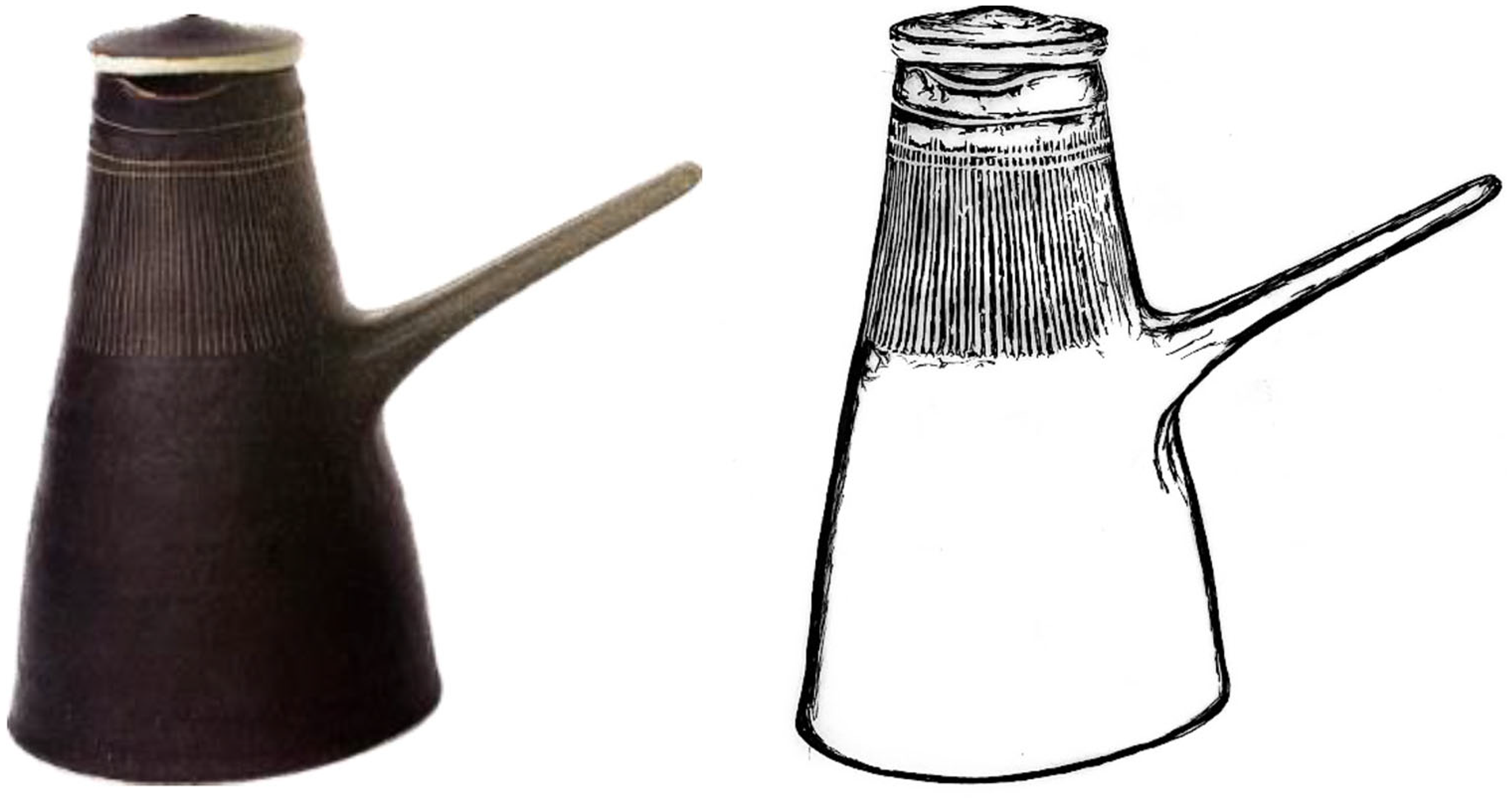
Sample stimuli for (1) Beauty Condition, and (2) No Beauty Condition.
Following the beauty manipulation, participants were led out of the gallery room where the pottery objects were displayed. In a separate area they completed the BIF, affect measures, and at the end, individual difference measures in art interest and engagement, as well as the Sensitivity to Beauty scale. They were then debriefed and compensated with £15 for participation.
Results
Importantly, however, the interaction effect was significant, F(1, 108) = 4.30, p = .04, where people with an art hobby scored higher on the BIF when judging the beauty of the clay objects (M = 14.1, SD = 3.6) compared to those merely focusing on perceptual features of those objects (M = 11.2, SD = 4.3) (See Figure 2).
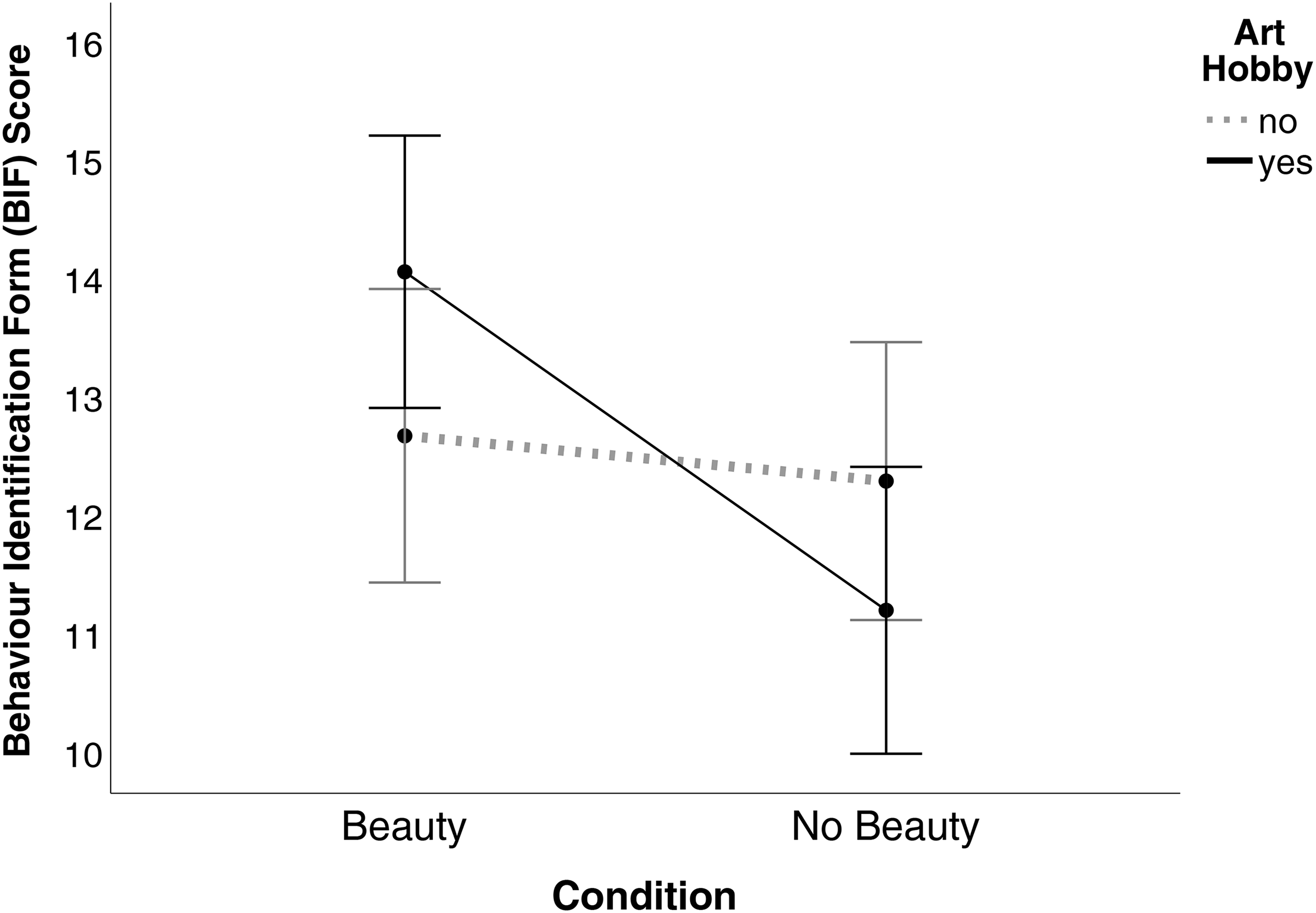
Interaction effect between Condition and Art Hobby. The analysis compared participants who judged the beauty of artworks with participants who performed perceptual matching with the artworks, as a function of whether participants had an art hobby or not. Vertical bars denote standard errors.
To better understand for whom the effect of the Condition on the BIF was different from zero, we further probed moderation with Hayes's (2022) PROCESS in R (Version 4.3), as specified by Model 1. In addition to the same interaction between Condition and Art Hobby observed in the ANOVA, b = 2.48, CI [0.12, 4.38], t = 2.07, p = .04 (see Figure 2 and Supplement Table S1), analyses showed that in the Beauty Condition, only people who reported having an art hobby chose a higher number of abstract action identification items on BIF, b = 2.86, CI [1.21, 4.51], t = 3.42, p = .001.
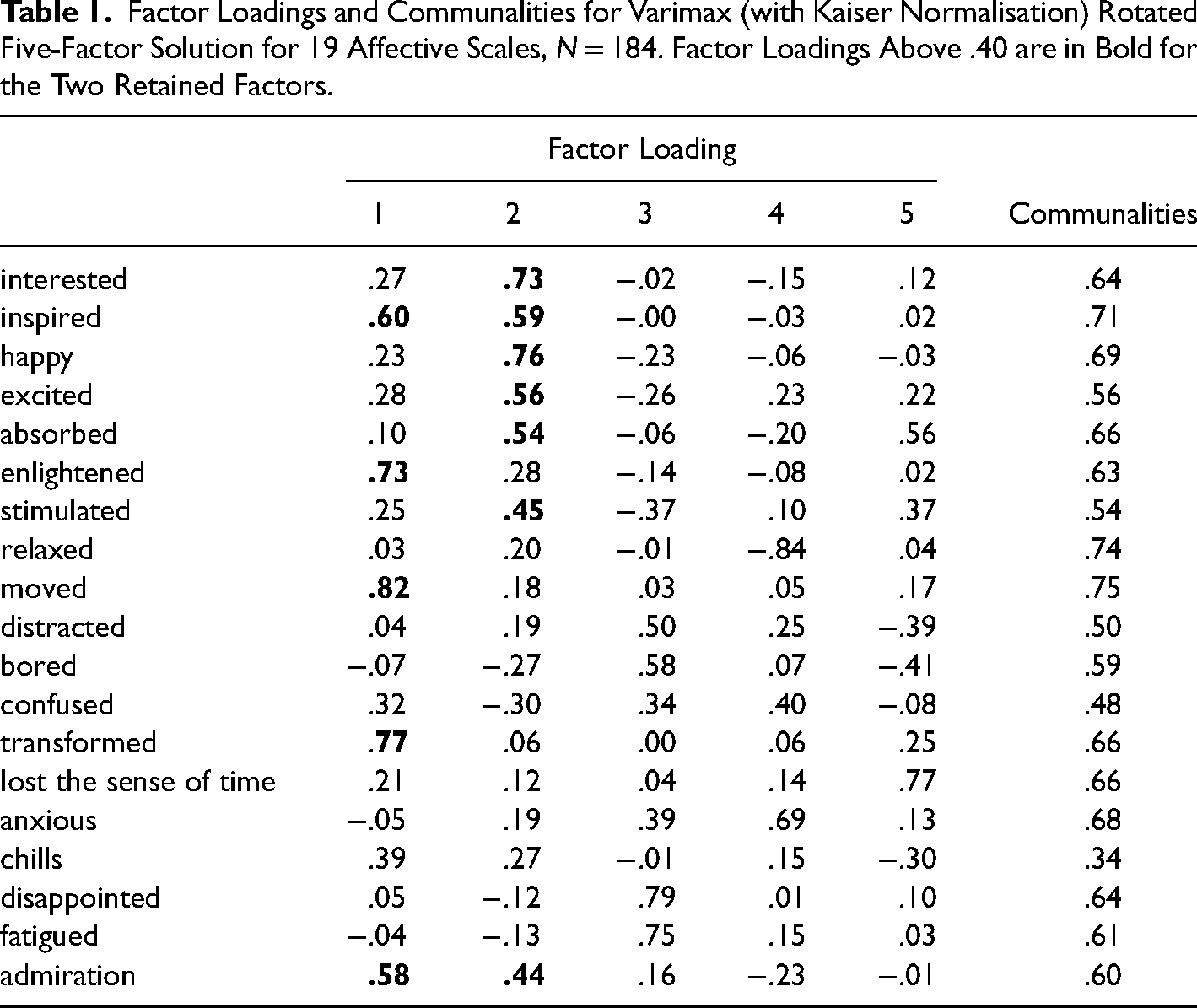
When considering the structure of the two factors, we only kept items with factor loadings above .40 (Fabrigar & Wegener, 2011) (see Table 1). The first factor involved items of how enlightened, moved and transformed participants felt after the gallery experience. This factor was theoretically meaningful (Pelowski et al., 2018, 2020; Abatista & Cova, 2023) and therefore we termed it Transformative and Self-Transcendent Feelings. The second factor comprised interested, happy, excited, absorbed, and stimulated and in line with previous findings (Schubert, 2022), we termed it Positive Affect. 2 Next, for each participant, we created a composite score on each of the factor by averaging ratings on retained items.
Factor Loadings and Communalities for Varimax (with Kaiser Normalisation) Rotated Five-Factor Solution for 19 Affective Scales, N = 184. Factor Loadings Above .40 are in Bold for the Two Retained Factors.
Now, we could proceed with testing our second-order effects: a two-way ANOVA with Condition (Beauty vs. No Beauty) and Art Hobby (yes/no) on Transformative and Self-Transcendent Feelings showed a main effect of Condition, with participants who engaged in beauty appreciation reporting more transformative and self-transcendent feelings (M = 2.9, SD = 1.1) than participants who engaged in perceptual matching of pottery objects to the drawings (M = 2.3, SD = 1.0), F(1,182) = 12.76, p < .001, with partial eta squared = .66, indicating a large-sized effect. Thus, the beauty manipulation had the intended effect on participants' affective experience. There was no main effect of Art Hobby, F(1,182) = 1.76, p = .19, suggesting that everyone enjoyed the transformative and self-transcendent benefits of beauty appreciation.
We examined various task characteristics to rule out the possibility that judging the beauty of the art objects and matching them to outline drawings differed in other, irrelevant ways. There were no differences in ease of following instructions (Beauty Condition: M = 6.7, SD = 0.6; No Beauty Condition: M = 6.6, SD = 0.7), understanding instructions (Beauty Condition: M = 6.5, SD = 0.8; No Beauty Condition: M = 6.5, SD = 0.7), the task being enjoyable (Beauty Condition: M = 5.6, SD = 1.1; No Beauty Condition: M = 5.3, SD = 1.1) or tiring (Beauty Condition: M = 1.4, SD = 0.8; No Beauty Condition: M = 1.4, SD = 0.8). Thus, both groups enjoyed their gallery experience, ruling out confounds unrelated to the experimental manipulation.
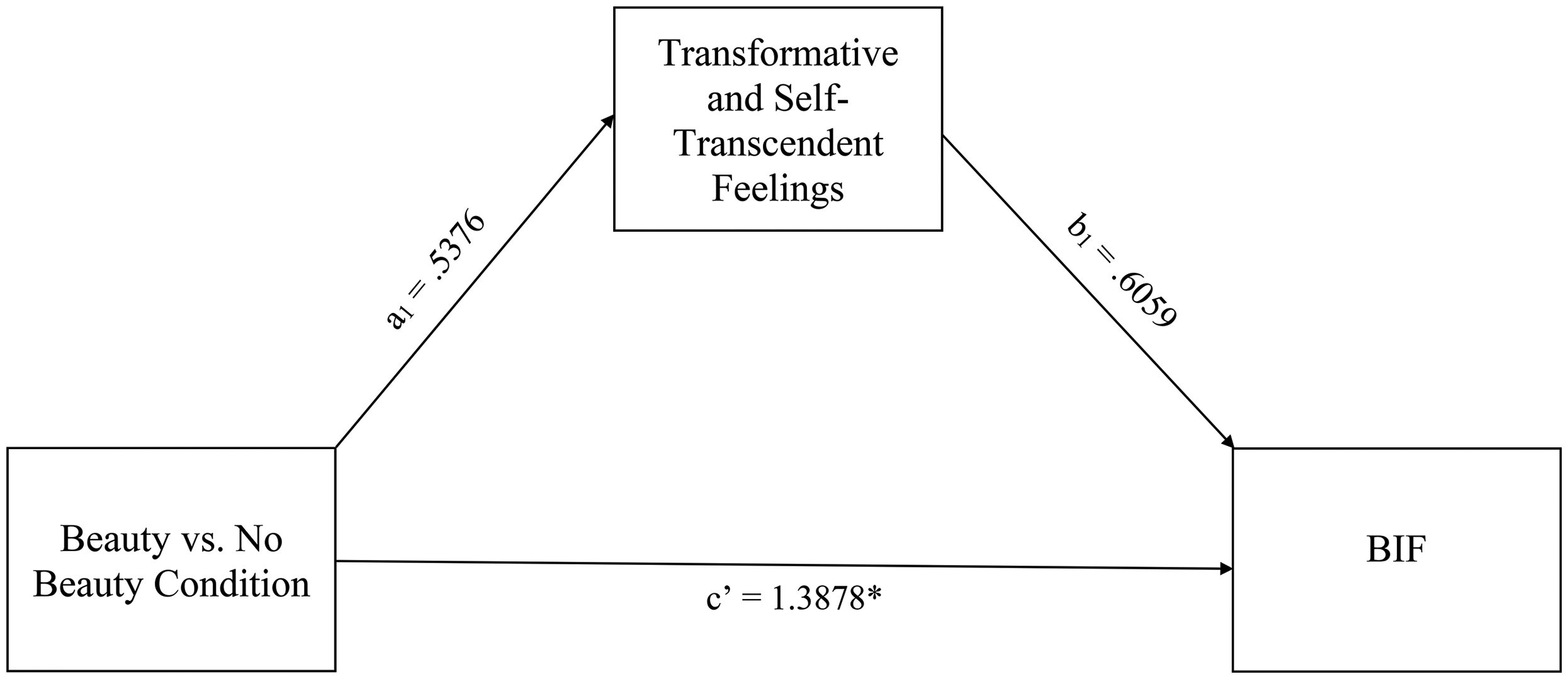
Mediation model for the presumed influence of transformative and self-transcendent feelings on abstract thinking. *denotes statistical significance < .05.
For completeness, we also explored whether relevant individual affect items, i.e., feeling enlightened, moved, transformed, and admiration
Discussion
Historically, a great many philosophers have suggested that aesthetic engagement involves a special kind of psychological state. Developing a line of thought present in Kant, for example, Bullough proposed that aesthetic appreciation gives rise to aesthetic distance, which involves a process of “putting [the aesthetic object] out of gear with our practical, actual self” (Bullough, 1912, pp. 89–90). In other words, this philosophical tradition suggested that when appreciating art, people move beyond practical constraints (concerning, for example, their needs and how they might use the object to serve these) and thereby achieve a special detached state of mind.
However, other philosophers, most notably Dickie (1964), have made influential arguments against the existence of this distinctive state of mind: according to the aesthetic state of mind's detractors, cases where it looks like we adopt a distinctively aesthetic state of mind characterised by disinterestedness and distance are simply those where we are attending fully to an aesthetic object, and this is not a distinctively aesthetic state of mind, since we routinely fully attend to non-aesthetic as well as aesthetic objects.
Given this disagreement, we drew on insights from social psychology, gained from investigations of the construct of psychological distance in the context of Construal Level Theory (Trope & Liberman, 2010), to empirically test whether the aesthetic state of mind can be understood in terms of psychological distance as conceived of the theory, and whether we could induce this state of aesthetic distance in a museum environment. The theory echoes Bullough's conception of distance and Kant's notion of aesthetic disinterest by describing a state of mind in which we transcend the here and now, and connectedly our immediate practical needs. Furthermore, it contributes the insight that this distanced state of mind involves the tendency to think in a more abstract way. Indeed, in line with this idea, some research has suggested that engaging with an image of a painting induced a more abstract mindset than engaging with non-artistic images of everyday objects (Kim & Kim, 2018).
Building on this finding, using a highly controlled method in a gallery context, the current experiment explored whether relative to a neutral control task, aesthetically engaging with art objects would increase indicators of abstract thinking. Our results showed that participants who judged the beauty of objects scored higher on the BIF, as compared to participants who completed the control task that did not require any aesthetic evaluation.
With respect to the philosophical significance of this finding, this result partially vindicates supporters of the existence of an aesthetic state of mind against their critics, and particularly Bullough, with his view that this involves distance. Engaging with the world aesthetically does indeed seem to involve a state of mind that is different to the state of mind that is involved in engaging in a practical fashion: Rather than merely involving full attentional focus, as Dickie suggests, this finding suggests that engaging aesthetically involves adopting an abstract mindset, and, given the association between abstract thinking and psychological distance, also involves psychological distance. However, this vindication is only partial, as this psychologically distanced state of mind, and the concomitant tendency to think abstractly, has been shown to arise from non-aesthetic contexts, such as when we think about unlikely events, or events that are far away from the present (Liberman & Trope, 1998; Wakslak et al., 2006; Fujita et al., 2006). As such, these results suggest that the aesthetic state of mind may not be unique insofar as it involves an abstract mindset and distance—as these can arise in non-aesthetic contexts; but that distance does at least distinguish it from the kind of mindset that tends to arise in the forms of non-aesthetic engagement that it has been typically contrasted with (other potentially characteristic features of the aesthetic state of mind are discussed below).
Our finding adds to early findings on this issue by first, using a well-validated measure of abstract thinking derived from Construal Level Theory (Liberman & Trope, 1998), (i.e., the BIF), second, by specifically targeting the aesthetic versus the practical mindset by developing a paradigm which requires participants to perform different tasks with respect to the same objects, and third, by conducting the research in a museum environment. With respect to the latter benefit, we were able to demonstrate the ecological validity of Bullough's (1912) notion of aesthetic distance, as understood in terms of Construal Level Theory, as people would typically encounter when visiting an art gallery.
Turning to the second principal aspect of our study, philosophical theorising (e.g., Plato, c. 370; Schopenhauer, 1969; Murdoch, 1970) suggested that engagement with beauty can involve pleasure, as well as transformative and self-transcending affective states, and existing empirical findings suggest that exposure to art can give rise to these feelings (e.g., Pelowski, 2015; Pelowski et al., 2021; Al-Kire et al., 2023). We therefore also examined feelings related to first, self-transcendence and transformation, and second, positive affect. In this respect, our findings bear out these philosophical claims, and extend existing findings by confirming that beauty appreciation can also lead to self-transcendent and transformative affective states (see also, Doran, 2022, 2023). While we observed the predicted effect on feelings of transcendence (e.g., moved; enlightened), importantly, we did not find differences between conditions regarding positive affect (e.g., happy; interested). In other words, while transformative and self-transcendent experiences were induced by engagement with beautiful art objects, this activity in itself did not lead to a generally happier mood than the neutral control condition. Thus, the effect on abstract thinking cannot be accounted for by general positive affect alone.
Although our study does not provide any statistical evidence for the claim that transformative and self-transcendent feelings mediate the effect of aesthetic appreciation on abstract thinking, this hypothesis remains theoretically meaningful and worth exploring in future research. One possible direction is to test this mediation model with people who report intense transformative and self-transcendent feelings. In our study, the average rating of these feelings was relatively low (M = 2.61 on a scale from 1 to 7). There also may be other potential mediators that remained untested and other causal models that potentially underlie the association between beauty appreciation and the BIF (Fiedler et al., 2018).
Additional literature is also in line with the association between aesthetic appreciation, transformative feelings, abstract thinking and distancing. In particular, an eye-tracking study by Marin and Leder (2022) suggested that the sense of pleasantness evoked by representational paintings triggered a slower and more profound processing mode compared to the observation of pleasant environmental scenes. Specifically, paintings that were deemed more aesthetically pleasing resulted in a reduced number of fixations and longer durations for each fixation. In other words, participants’ gaze lingered for longer when they were aesthetically engaged, providing support for the presumed distancing mechanism. Moreover, neuroimaging studies suggest that aesthetic appreciation can result in cognitive effects associated with abstract thinking: Aesthetic experiences have been shown to activate the default mode network, which is usually associated with self-referential thought (that is, relating external information to oneself; Vessel et al., 2012, 2013, 2019). Thus, a growing body of literature supports the hypothesis that there is a special aesthetic state of mind that it can be described in terms of psychological distancing and more abstract thought, on the one hand, and self-transcendent and self-transformative affective states, on the other.
We demonstrated the predicted main effect of a medium magnitude for the experimental manipulation of either judging the beauty of ceramic objects produced by a well-known artist, compared to focusing on perceptual features of those objects. Importantly, however, taking into account whether participants had an art hobby furthermore produced an interaction effect: Those with a propensity to regularly engage with artistic creation were most likely to reach the state of aesthetic distance. This interpretation is consistent with the evidence that having previous task-relevant experience increases abstract thinking. In particular, frequently playing video games was associated with participants viewing video game actions in more abstract terms, reflected in higher scores on the same measure we used, namely the BIF (Ewell et al., 2018).
Several methodological aspects of our experiment are noteworthy. First, pretesting had established that the two experimental conditions were of roughly equal duration. Furthermore, study participants rated how enjoyable, difficult, boring or tired they found the task they were instructed to perform. No differences were obtained between conditions, ruling out potential methodological confounds. Nevertheless, there are a number of limitations, to which we turn next.
Limitations and Future Directions
One notable constraint pertains to first, the composition of our sample, and second, the sample size. The composition was mainly Cambridge University students, which likely has an impact on the generalizability of our results. Replication studies with more diverse samples, ideally including from non-WEIRD populations (Henrich et al., 2010), are necessary to confirm our initial findings and extend our understanding of the aesthetic mind.
As a second important limitation, we chose to not conduct sample size determination calculations in advance, because of the limited duration of the artworks being exhibited. As such, we decided to collect as much data as was feasible over the month during which we had access to the gallery. Thus, the data collection concluded with the last day of the exhibition. After the study, following the latest guidance (Giner-Sorolla et al., 2024), we conducted a power determination analysis with the population effect size estimated from the most authoritative meta-analysis on the effects of psychological distance on abstraction (Soderberg et al., 2015). With a Hedge's g = .299 Using G*Power 3.1 (Faul et al., 2009), and our sample of 187 participants, and α = .05, we arrived at .53. Although this was below the recommended power of .80, Giner-Sorolla et al. (2024) acknowledge that in populations that are difficult to study, this level may not always be reached. Nevertheless, it is encouraging that our observed medium-size effect on the BIF of Cohen's d = .39 4 was in fact much larger than the one observed in the meta-analysis of direct effects of psychological distance on construal level (Soderberg et al., 2015).
As an additional consideration, one might argue that our task was not perfectly controlled, as both groups were exposed to beautiful art objects, and thus both of them could have been affected by beauty. However, if the control group also benefited from exposure to beautiful objects despite being asked to focus on the perceptual matching task only, our design potentially underestimated the true effect size, which nevertheless was of a medium-sized magnitude. A different, more controlled comparison condition might therefore show an even larger effect.
Conclusion
Philosophers reflecting the nature of aesthetic experience have put considerable thought into the question of whether it involves a unique cognitive state, and into the kinds of affective states it tends to involve. Drawing on insights and methods from contemporary social psychology, our findings suggest that engaging with artworks aesthetically may not only elicit transformative and self-transcendent emotions, but also encourage a tendency to think in a more abstract way. We observed this effect in a small art museum that is open to the public at no charge, following the typical visitor's activity of walking around and looking at specific pieces of art. Thus, the cognitive and affective benefits of art creations may be relatively accessible to many.
Supplemental Material
sj-docx-1-art-10.1177_02762374251337699 - Supplemental material for Transformed by Beauty: Aesthetic Appreciation Increases Abstract Thinking and Self-Transcendent Emotions in an Art Museum
Supplemental material, sj-docx-1-art-10.1177_02762374251337699 for Transformed by Beauty: Aesthetic Appreciation Increases Abstract Thinking and Self-Transcendent Emotions in an Art Museum by Elzė Sigutė Mikalonytė, Jasmina Stevanov, Ryan P. Doran, Katherine A. Symons and Simone Schnall in Empirical Studies of the Arts
Footnotes
Acknowledgements
The authors thank the staff at Kettle's Yard, Cambridge, in particular Susie Biller, for support in allowing us to carry out the experiment in the gallery. We thank David Gerrans for granting us permission to use his photo of a Lucie Rie artwork in  of this article. We also are grateful to Veronica Forslund and Edoardo Chidichimo for assistance with the data collection.
Author Contributions
Using the Contributor Roles Taxonomy (CRediT) categories, contributions were as follows. Conceptualization: E.S.M., J.S., R.P.D., K.A.S., S.S. Methodology: E.S.M., J. S., R.P.D., K.A.S., S.S. Validation: E.S.M., J.S. Formal Analysis: E.S.M., J.S. Investigation: E.S.M., J. S., K.A.S. Data Curation: E.S.M. Writing - Original Draft: E.S.M., J.S., S.S. Writing - Review & Editing: E.S.M., J. S., R.P.D., K.A.S., S.S. Visualization: J.S. Supervision: S.S. Project Administration: S.S. Funding Acquisition: R.P.D., S.S.
Consent to Participate
Participants gave written informed consent and were debriefed with details about the research at the end of their study session.
Consent for Publication
Not applicable.
Declaration of Conflicting Interests
The authors declared no potential conflicts of interest with respect to the research, authorship, and/or publication of this article.
Ethical Considerations
The research underwent the ethical approval process of the Department of Psychology at the University of Cambridge.
Funding
This research was funded by grant TRT-2021-10448 of the Templeton Religion Trust.
Supplemental Material
Supplemental material for this article is available online.
Notes
Author biographies
References
Supplementary Material
Please find the following supplemental material available below.
For Open Access articles published under a Creative Commons License, all supplemental material carries the same license as the article it is associated with.
For non-Open Access articles published, all supplemental material carries a non-exclusive license, and permission requests for re-use of supplemental material or any part of supplemental material shall be sent directly to the copyright owner as specified in the copyright notice associated with the article.
