




Abstract
Art-viewing is a defining component of society and culture, in part because the experience involves a wide-range and nuanced configuration of emotional and cognitive responses. Precisely because of this complexity, however, questions of the actual nature, scope, and variety of art experience remain largely unanswered: what kinds of patterns do we exhibit, how do various components go together, and can these be distilled into shared experiential outcomes? We introduce an exploratory study based on 345 individuals’ unique experiences with one of three sets of artworks. Experiences were assessed via 46 affective and cognitive items based on a recent model, with individuals reporting to what degree they felt each during their encounter. Network and latent profile analyses revealed five patterns, aligning to a Harmonious, Facile, Transformative, and two Negative outcomes. These largely supported model hypotheses, connected to specific appraisals, and could be found, although with varying probability, across individual viewers and artworks.
“The psychologist may, at best, reach the stage of analysis; he has absolutely no access to the synthesis of an aesthetic response” (Lev Vygotsky, 1974, p. 205)
Every year, billions of individuals across the globe encounter works of art (Chan & Yeoh, 2010; Tinio et al., 2015) 1 . Art can be found across cultures as an integral aspect of society (Becker, 1982). It is seen as a defining element in human evolution (Dissanayake, 2008) and perhaps as a defining feature of the human species itself (Zaidel, 2013). Whether in museums, city centers, online, or at home, art is an omnipresent feature of modern existence.
Underlying this interest is a pervasive idea of a complex, multifaceted experience. For centuries, when individuals describe in which ways they find art important, why they go to museums, or when they describe their favorite artworks, they have done so by recounting a variety of affective, cognitive, and physiological aspects (Funch, 1997; Pelowski et al., 2017c). Art, we are told, can evoke myriad emotions (Fingerhut & Prinz, 2020; Menninghaus et al., 2019; Silvia, 2009) and lead to diverse appraisals, meanings, memories, and associations (Leder & Nadal, 2014). It can evoke different responses in our behaviors and bodies (Fingerhut, 2018; Kühnapfel et al., 2023; Wolterstorff, 2003). Art might transport us to moments of awe and wonder (Fingerhut & Prinz, 2018), harmony (Funch, 1997; Shusterman, 2006), insight (Christensen et al., 2023a; Lasher et al., 1983), or even transformation (Pelowski, 2015; Pelowski & Akiba, 2011; Sherman & Morrissey, 2017). Art, of course, can also be uncomfortable, confusing, can make us angry (Chrisafis, 2011; Silvia, 2009), or simply be derivative, boring, or inert (Smith et al., 2017). These reactions—positive or negative, quotidian or profound—can differ greatly between individuals, between settings, or even between two moments for one individual within one experience itself.
Unraveling this “power” of art (Freedberg, 2013) to evoke such a range and depth of responses stands as one of the most basic and important topics for art-related research. Belletristic accounts of art's multivariate nature are a central aspect of art historical, philosophical, and critical discourses (e.g., Elkins, 2005; Freedberg, 2013; Panzarella, 1980; Shusterman, 2006). Anticipating, collecting, and comparing features is key for museum and curatorial studies (Dierking & Falk, 1992; Tröndle & Tschacher, 2012; Yalowitz & Bronnenkant, 2009), for art education (Parsons, 1987), and is especially key for psychology and empirical aesthetics.
The past two decades in particular have seen a multitude of investigations, with researchers producing insights regarding the large number of factors implied and evoked from art—including individual appraisals, aspects of meaning (Leder & Nadal, 2014; Palmer et al., 2013 for review), art-evoked emotions (Hagtvedt & Patrick, 2008; Fingerhut & Prinz, 2020; Menninghaus et al., 2019; Silvia, 2005; Specker et al., 2020), as well as how art influences the way we move our eyes and bodies (Kühnapfel et al., 2024; Rosenberg & Klein, 2015) or other physiological response (Gerger et al., 2017; Markey et al., 2019). Studies have also begun to trace some general progressions in art perception, such as from an initial impression to detailed focus (Locher et al., 2010), and identify interactions between elements, such as between some specific emotions and appraisals (Silvia, 2005). This has been coupled with emerging interest in more profound states (Csikszentmihalyi & Robinson, 1990; Fingerhut & Prinz, 2018; Schlotz et al., 2021; Silvia & Nusbaum, 2011; Vessel et al., 2012; Wanzer et al., 2020), insight and self-reflection (Pelowski, 2015; Vessel et al., 2013), and even exploration of some compelling blends in responses, such as appreciation of confusion (Muth & Carbon, 2013) or visual pleasure from negative art (Cupchik & Wroblewski-Raya, 1998; Ishizu & Zeki, 2017). These topics expand beyond the lab and gallery, offering connections from fundamental questions regarding perception or affect, to other domains such as religion and sports (Brown & Dissanayake, 2018; Funch, 1997), and raise compelling questions regarding the unique impact of art experience in addressing societal challenges (Pelowski et al., 2022) or wellbeing and health (Cuypers et al., 2012; Fancourt & Finn, 2019; Trupp et al., 2022, 2023).
At the same time, the current state of art research has yet to address an important set of questions at the base of our sustained engagement with art, namely those surrounding the multivariate, interconnected, and potentially shared or defining nature of such experiences. To date––although there have been many factors considered––research has tended to present a rather limited view of each art engagement, with each investigation targeting only a small subset of relevant elements. This is driven, primarily, by requirements for controlled, interpretable data, as well as by theoretical approaches, which tend to emphasize initial understanding, visual appraisal, basic positive or negative assessments, and/or hedonic response (Pelowski et al., 2017c). We are also limited by a lack of ecologically valid investigations of engagements with real works of art in the settings they are predominantly experienced (Pelowski et al., 2017a; Specker et al., 2023). This has left us without a systematic understanding of the complex interconnection and variety of elements relevant to art experience, limiting our conception of what can happen when we engage with art. To establish such an understanding is argued to be one of the most crucial topics in contemporary art scholarship (Cross & Ticini, 2012; Pelowski et al., 2017c; Tallis, 2008; Zentner et al., 2008). Without a framework for anticipating, investigating, and identifying the scope and nature of art experience, we cannot begin to meaningfully compare artworks, individuals, settings, and/or other contextual factors.
Even more, this deficiency touches a general question at the center of all art-related discourse—are there broad patterns within the diverse ways we respond to art? Multiple authors and studies have implied some primary, shared features to the ways we respond to art, tied to the nature of our underlying biology, neuronal structures, and psychological aspects (e.g., Dewey, 1934; Funch, 1997; Pelowski et al., 2017c for review; see also Jagodzinski, 1981). Others have objected to this view precisely due to the nuance and scope of art engagements, asserting that each individual experience may be personally unique or esoteric (e.g., see Shusterman, 2000 for review). Identifying some shared features could advance conceptual and philosophical approaches to our interactions with art, as well as provide a key foundational element for future art or cultural applications and empirical work. Yet, with the present state of research, we are left without a basic way of addressing this question or considering what might be unique or shared across our encounters with art. “Given the formability of its rich yet fleeting immediacy,” suggests one such argument (Shusterman, 2000, p. 56, see also the quote that began this paper), “how are we supposed to measure (let alone communicate) magnitudes of an experience which cannot even be properly defined or marked off for measurement?” Here we take an initial exploratory step in addressing this topic.
Multi-Participant and Multivariate Assessments: A Step Towards Unlocking Shared Art Experience?
Recently, a handful of studies have introduced new methods to move beyond single-stimulus or single-factor investigations to a more global, integrated assessment of art experience. These follow a common set of procedures, involving, broadly: (a) the compilation of several target factors, typically in the form of lists of emotions and other phenomenal states, that have been connected to interactions with art and/or aesthetic experiences; (b) the use of such a list as a self-report measure as a basis for data collection across a number of individuals and art engagements; (c) the combination and consolidation of data across cases and individual viewers via various statistical procedures. Through these procedures, researchers then highlight certain groupings or main items, which are argued to better explain the nature of and even potential patterns in responses to art.
An early example, the Geneva Emotion Music Scale (GEMS), introduced by Zentner et al. (2008; see also Scherer, 2004; Scherer & Zentner, 2001), involved a list of (initially 146) items and focused especially on emotions or other feelings evoked in experience with music. This list was then applied in a series of studies in which (N = 354) individuals were asked to note which responses they most attributed to remembered musical experiences and contrasted against emotions more often “experienced in nonmusical day-to-day contexts” (p. 498). A shortened (66-item) list was then employed on-site at a music festival, asking individuals to report those feelings that they had felt that day. A confirmatory factor analysis (CFA) supported a grouping of the items into nine “music emotion factors,” labelled by the authors, as suggesting experiences of “wonder,” “transcendence,” “nostalgia,” “peacefulness,” “power,” “joyful activation,” “tension,” or “sadness,” and which, they argued, aligned with many theorists’ suggestions for different notable types of music response, and with the authors concluding that “an accurate description of musical emotions requires a more nuanced affect vocabulary and taxonomy than is provided by current [methods]” (p. 513).
A similar, more domain-general, project, the Aesthetic Emotions Scale (AESTHEMOS), was introduced by Schindler et al. (2017) with the aim of targeting responses “that can arise when a person perceives and evaluates a stimulus for its aesthetic appeal or virtues” (p. 2), especially related to engagements with the visual arts but also to music, literature, film, etc. An initial list was compiled by the authors, incorporating 122 items, and applied in an online study asking participants “how frequently they would use [each item] to describe their emotional reactions during an aesthetic experience” (p. 18). A refined list of the 75 most-commonly noted items was next applied in an on-site data collection with individuals who had attended one of 25 different possible events, ranging between concerts, dance, readings, or museum exhibitions. Participants reported “how often” they had felt each item. Factor analyses and post-hoc theoretical adjustments suggested seven higher-order factors, argued by the authors as referring to “prototypical aesthetic emotions,” “epistemic emotions,” “animation,” “nostalgia/relaxation,” “sadness,” “amusement,” and “negative” feelings. The authors related these components to literature on aesthetic engagements and, as above, argued that “to do justice” to the complex engagement with art, “we need to assess a broad range of specific aesthetic emotions and see how they combine in individual aesthetic experiences” (p. 26). (See also, for somewhat similar methodology, lab-based assessments of largely art appraisals by Stamkou et al. (2022; Stamkou, 2022; or earlier museum work by Pekarik et al., 1999, reviewed in footnote). 2
Promise, but not yet Combination or Distillation: Outstanding Questions with Current Multivariate Approaches
These approaches constitute important advances in our assessment of art encounters, supporting both the theoretical need, and providing an empirical basis, for a multivariate consideration of art experience. However, in their actual application, they remained limited to a data reduction or scale-formulation approach. That is, studies have essentially found semantic similarity between items—suggesting how these, when provided en masse, might group together or be used similarly by participants. By further suggesting clusters of items, these approaches may reveal important salient features and even underlying patterns in art experiences. At the same time, current approaches do not yet actually explain how these aspects fit together, how we might assess the relationship between identified clusters/dimensions, or whether they could be applied to capture distinct types of art experience.
It has been noted that such cross-category or cross-emotional blending, and specific combinations, may be both common and particularly salient for describing experiences (e.g., see Keltner & Oatley, 2022; Schwarz, 2011). Questions regarding how such factors combine have been suggested as necessary next step by authors of the present multivariate reports (Schindler et al., 2017). Even more, it may be specific sequences or changes that are particularly important when describing a progressive, emerging experience (Schwarz, 2011; see also Leder, 2013; Pelowski et al., 2017c for discussion in the context of art), raising questions regarding the nature of the actual tested engagements.
Present studies have also collected data following meetings with collections of multiple, often quite diverse stimuli. Zentner et al. (2008), for example, collected reactions following visits to a large festival with multiple musical acts. Schindler et al. (2017; also, Pekarik et al., 1999) report collections following visits to entire exhibitions, museums, or other cultural events. The scope of art engagements captured in such reports is thus presumably very wide and often consists of multiple, disparate experiences (e.g., multiple varied exhibitions in a large museum over the course of one's visit). Thus, from these studies it is not possible to connect reported items to any specific experience, artwork, or even exhibition. This is specifically noted as a limitation by these studies’ authors (e.g., see Schindler et al., 2017, p. 32) and is suggested (e.g., Schwarz, 2011) as an issue particularly when using affective or phenomenal items to address experience, where these reactions should, presumably, refer to a specific moment or engagement. Such approaches also do not allow us to consider whether there is evidence for multiple ways of responding, across individual viewers, to the same works of art. These issues occur in conjunction with the present means for eliciting reports and/or scale selection that focus on frequency (“how often did you have this feeling today?” e.g., Schindler et al., 2017) as opposed to magnitude or particular item importance, or (e.g., Zentner et al., 2008) where identification is based on hypothetical engagements—“what responses do you often associate with the arts?”
Finally, questions can be asked about the included items themselves. Past studies have argued for the importance of emotions or other feeling states of the participants (e.g., ‘how they subjectively felt’ in an engagement) rather than the emotions represented or expressed in the artworks (e.g., Schindler et al., 2017, p. 2). This follows a line of research (see e.g., Keltner & Haidt, 1999; Keltner & Oatley, 2022) suggesting that especially felt responses, and certain patterns or combinations, may be key to unlocking and unraveling the ‘black box’ of human perception and cognition (see Pelowski, 2015; Silvia, 2005 for similar discussions with art). Similarly, in their final selections of items, past authors often also included appraisals, descriptions, or attributed states (e.g., Schindler et al., 2017; Stamkou et al., 2022), calling into question whether these can be meaningfully combined with reports of felt states, or whether reports may be driven by specific style or content of artworks (e.g., see Stamkou et al., 2022; Zentner et al., 2008).
On the other hand, studies may have also omitted important items. Although several authors (Schindler et al., 2017; Zentner et al., 2008) did include many previously overlooked feelings, such as epistemic, profound/self-transcending (awe, wonder), or self-conscious emotions, which are central to many belletristic and theoretical discussions of the arts, others have specifically excluded terms that the authors acknowledged might be routinely felt but were argued to be “atypical” as specifically art-elicited or to represent more “utilitarian” emotions (Schindler et al., 2017, p. 17). However, it may be such common, everyday responses—confusion, rejection, interest—that are, in conjunction with more notable “aesthetic” states, instrumental in describing experience (see Cooper & Silvia, 2009; Cowen & Keltner, 2017; Keltner & Haidt, 1999; Pelowski et al., 2017c). Similar arguments can be made for other epistemic or knowledge emotions (Fingerhut & Prinz, 2018, 2020; Stamkou et al., 2022), social/self-reflective or other “hostile"/negative emotions (anger, disgust) (Silvia, 2009; Silvia & Brown, 2007) that have tended to be overlooked. For assessments that aim to uncover a general range of differences in, or commonalities between, our experiences, these reactions may be particularly relevant. This, once again, returns to the theoretical and methodological framework underlying the selection of items and their integration. Present studies leave the field without a good guide for what factors should be assessed, why certain aspects may be important, or how to match reports to an empirical identification of patterns underlying our shared responses to art.
Present Paper
In this paper, we introduce exploratory evidence addressing many of the outstanding questions raised above. We do so through generation of items rooted in a theoretical model and use of network methods and latent profile analysis, extending beyond past study designs to better consider and compare evidence regarding multivariate, supraordinate, patterns underlying art experiences. 3
Theoretically-Guided List of Phenomenal Items and Underlying Outcomes of Art Experience
As a starting point for the present study, we compiled a list of key emotional items, which, unlike past approaches, were derived from a theoretical model of art experience. This model—the Vienna Integrated Model for Art Perception, VIMAP (Pelowski et al., 2017c; see also Pelowski & Akiba, 2011 for earlier iteration)—was created as a combination and extension of previous models of aesthetic or art processing aspects (e.g., Leder et al., 2004; Leder & Nadal, 2014; see also Pelowski et al., 2016 for comparison and review). As shown in Figure 1, the model specifies seven stages, encompassing a pre-engagement/expectations-setting state and several stages of bottom-up processing whereby individuals become aware of and integrate artwork-related visual or other sensual aspects. This is followed by stages related to the grouping, classification, and top-down integration of artwork features with individuals’ memory or past experiences and training, culminating in an initial assignment of meaning, relative understanding, and (i.e., generally positive/negative) evaluative and affective response. These preliminary stages are then further coupled with potential secondary, viewer-centered processes in which an individual may extend from, respond to, modulate, or even revisit their initial reactions to art. This model, we argue, provides a necessary theoretical framework for anticipating, hypothesizing, and empirically testing various aspects of or implications from our encounters with art (see also e.g., Kuiken & Jacobs, 2017 for theoretical and critical review).
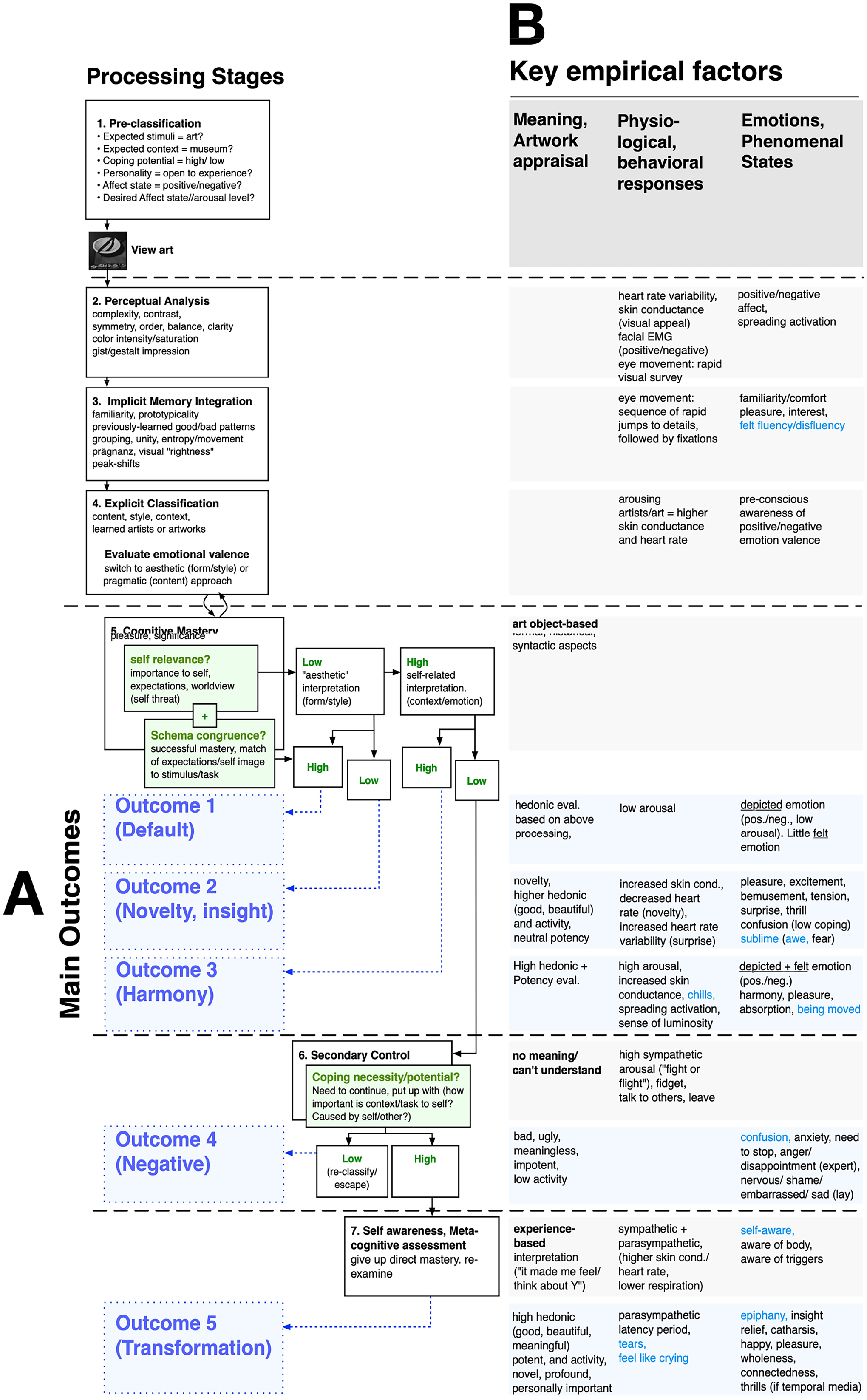
Vienna integrated model of art processing experience (VIMAP; Pelowski et al., 2017c) and posited main empirical factors.
Importantly, for the present paper, the model introduced two additional aspects: First, it integrated these stages with hypotheses for specific factors argued to arise within and be tied to each processing stage, with a particular emphasis on affective/emotional items, and other phenomenal states. These items were further presented with the accompanying argument that by assessing these in empirical study—such as via physiological monitoring or behavioral scale-based reports from participants—researchers might not only capture key aspects related to art viewing but also identify and differentiate key patterns in art experience.
Second, by connecting these phenomenal items to the processing stages argued to underlie a progressive experience, the model provides guidance for specific groupings in viewer reports. As shown in Figure 1 (blue boxes) the model proposed five such main varieties: (2) an outcome distinguished by “novelty” or interest, tied to seeing something new and also related to generally positive emotions but also epistemic (e.g., confusion, surprise/learning, but possibly wonder) response; (3) a “harmonious,” resonant outcome, with intense positive emotion (awe, absorption), and aligning to discussions of absorbing, flow-like states; (4) a generally “negative” outcome, in which individuals report difficulty, challenge (and concomitant confusion, anger, or negative feelings) and even need to leave or stop an engagement; and, alternatively, (5) a “transformative” reaction in which individuals experience similar initial challenge but move past this through reflection and adjustment with also potential positive feelings. (1) The model also included a generally neutral, “facile” result in which individuals might have a short, shallow interaction, without much notable feeling, but also that aligns to arguments (e.g., see Smith et al., 2017) for how people may often engage art. These outcomes were argued to best be thought of in terms of probability, with—given a particular individual, context, and work of art—the expected frequency of each outcome varying across conditions. At the same time, the outcomes and their characterization (e.g., the specific item patterns) were suggested to be supraordinate, operating on a level that transcends what could be considered the level of the characteristics of the individual viewer and of the respective context of viewing.
In the present study, we employed, for the first time, the full list of items specified in the VIMAP. While this study was not designed as a direct test of the model, this model and list of items provided a starting point for our assessment.
Network Modeling and Latent Profile Analysis: A Basis for Organizing, Connecting, and Identifying Shared Patterns
To statistically evaluate the compiled items, the list was paired with the use of network modeling to visualize and identify communities of interconnected items (see Christensen & Golino, 2021a; Massara et al., 2016), and thus offering many of the same data combination and reduction abilities as that of factor (FA) or principal component analyses (PCA). At the same time, this technique introduces important advantages. The construction of a network of items, with their interconnections denoted by the strength of zero-order correlations, allows for more specific information regarding the relative importance and the specific interconnection between different items, ultimately also allowing the intuitive visualization of the entire network. The use of network science to identify communities has further been shown to be equivalent or even more accurate than factors/components from more traditional methods (Christensen & Golino, 2021b; Golino & Epskamp, 2017). The approach is further deterministic, providing a data-driven means of community discovery (Christensen & Golino, 2021b).
Recently, this technique has been employed in several art or aesthetic contexts, primarily as a tool for data reduction and to discover underlying structures in multivariate reports (e.g., see, Coburn et al., 2020 and Weinberger et al., 2021 for semantic assessments with architecture; Hayn-Leichsenring et al., 2020 and Specker et al., 2021 for appraisal studies with digitally presented art images; Kühnapfel et al., 2023 and Pelowski et al., 2018 for assessments of some emotions reported following visits to specific museum artworks). Christensen et al. (2023b; see also Kenett et al., 2023) also recently applied this in a hierarchical network approach to study the structure of semantic associations between terms used in discussion of (still hypothetical) aesthetic experiences, identifying, albeit with the same limitations regarding their inter-connection as in FA, lower- and higher-order structures within experiential reports.
Going even further, an extension of the network science approach can allow for the specific consideration of potential patterns across communities and the entire network. This involves the identification of “core” items within each community (Christensen et al., 2019; Pozzi et al., 2013). By then using an iterative method to assess answering patterns across these selected core items via latent profile analysis (LPA), this allows for the identification of a finite number of answering profiles. This can provide an empirically-grounded method for identifying—across specific artworks, viewers, and contexts—the incidence, number, and potential properties of shared types of art experiences, which can nonetheless be connected back to individual cases. This approach was recently used by our team to consider individual's self-reports of personal ‘sublime’ experiences (Pelowski et al., 2019). Despite the fact that reports indeed revealed a wide variety of stimuli (e.g., nature, people, art, music) and other contextual and qualitative differences, when individuals were asked to report how these events had felt using a list of cognitive/affective phenomenal terms, this procedure identified one distinct pattern that could be fit to 92% of participants. Similarly, Cotter et al. (2018, 2019) conducted studies on recalled instances of feeling like crying with music. Once again, qualitative questions revealed a range of contexts and media. However, assessment of reported feelings using a list of 16 emotion items identified two underlying patterns. These patterns, which could be fit both back to critical and theoretical literature as well as to relatively higher probabilities of incidence for specific individuals or media (see also Cotter et al., 2024), nonetheless also suggested a connection at the level of feelings and related psychological progressions, but which had not yet been uncovered in a data-driven method.
Coupling our list of items with these network and latent profile methods––in conjunction with an empirical design for on-site data collection of specific encounters with visual art––provided a compelling, albeit exploratory, basis for considering whether we may find a similar manifestation of patterns by which we experience art. In the present study, we focused exclusively on visual art, as one of the main domains for past empirical art assessments and the main target for the VIMAP model; this allowed us to limit possible confounds when combining reports across domains, while also representing a diverse range of experiences.
Method
Participants
The study involved a final sample of 345 people (Mage = 42.3, SD = 18.3, range = 18 to 87 years; 212 female). All were convenience sampled from among paying patrons to our target museum and were further divided into three groups, based on which one of three art rooms they visited (see descriptions below): Impressionist Room (N = 108, Mage = 46.5, SD = 17.7; 61.1% female), Richter Room (N = 113, Mage = 40.7, SD = 19.3; 62.8% f), or Kiefer Room (N = 124, Mage = 40.1, SD = 17.4; 60.5% f). The sample size was based on suggestions for exploratory network and latent profile models (i.e., 300 + participants/100 + per stimuli, given our data structure and aims, see Swanson et al., 2012). The final sample was reduced from 361, with 16 individuals excluded following quality control procedures (see Results).
Participant selection was confined to only single or paired adults, omitting larger groups or individuals accompanying children (see Chang, 2006; Packer & Ballantyne, 2002; Pelowski, 2015). We also refrained from testing during large tours or at times of high crowdedness (Goulding, 2000; Pelowski et al., 2016). No participants used an audio guide or other extra-exhibit aid during the study. Participants had normal or corrected-to-normal vision and no color blindness or other visual impairments (self-reported). The study followed protocols of the ethics board of the University of Vienna.
Stimuli
The setting for the study was the Albertina Museum in Vienna (https://www.albertina.at). This is one of the most important museums of visual art in Austria, hosting, in both a permanent collection as well as temporary exhibitions, a wide range of pre-Modern, Modern, and Contemporary artworks. It is also the 55th most visited art museum in the world, with a large number of international patrons.
As stimuli, we selected three individual rooms of art, each housing distinct sets of artworks, which we treated as unified experiences throughout this study (Figure 2). Rooms were selected to represent artworks differing along two main axes of ‘valence’ (e.g., visually pleasing/affectively positive to unpleasant/negative) and ‘abstraction/conceptuality’ (mimetic/directly understandable to visually/conceptually abstract or challenging), as assessed by the research team and reviews of art-critical perspectives. Although, of course, this provided only a limited selection of artworks, these were selected because they have been argued to represent main points of division for many viewers when encountering art in museums and, in their combination, offer the potential of evoking a range of outcomes (Leder et al., 2012; Pelowski et al., 2017c).
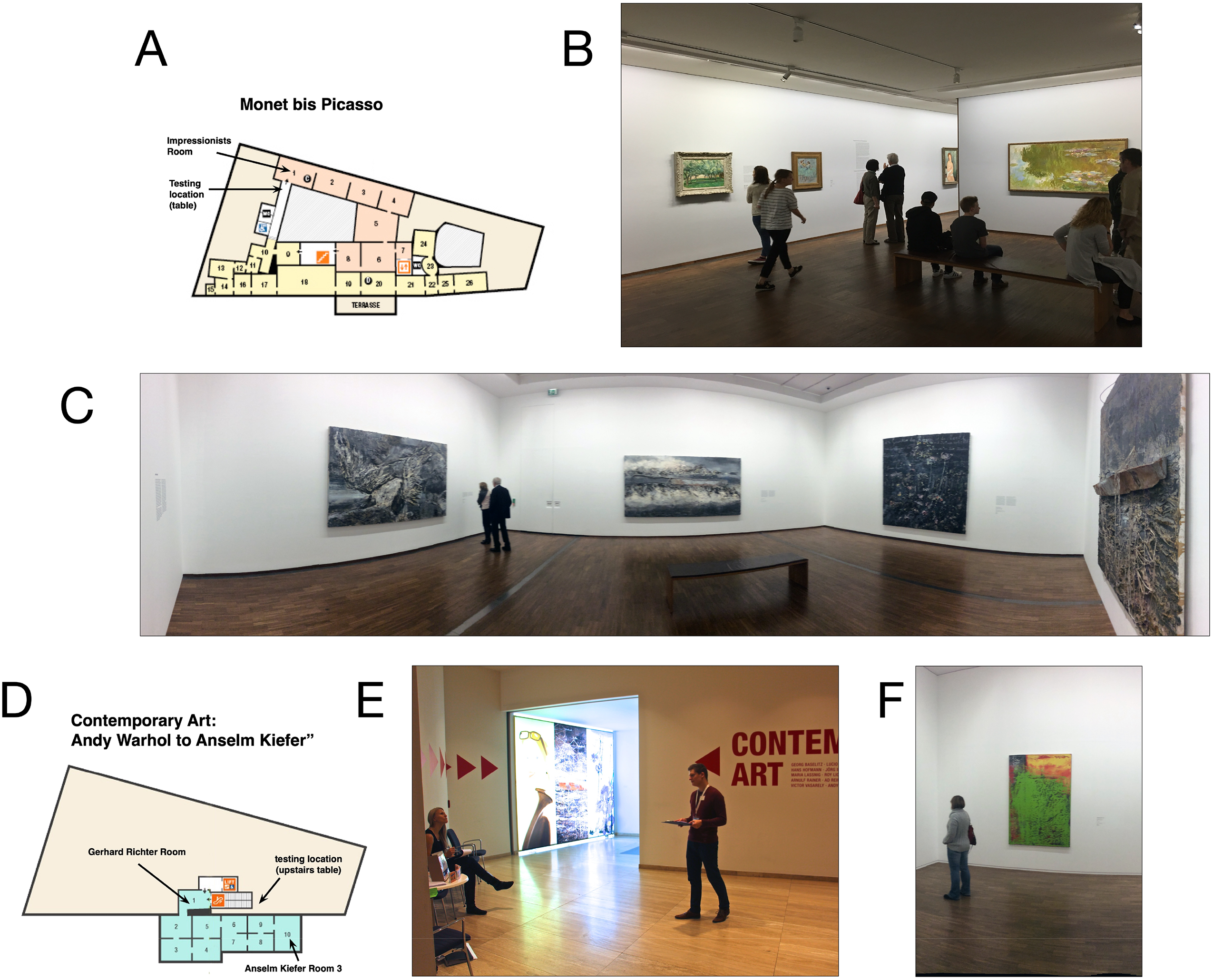
Art rooms and museum testing locations.
The selection of the specific rooms was further made to minimize, as much as possible, other conflating factors such as windows or other artworks. The rooms all contained distinct sets of art with one cohesive style and/or by one artist, with the expectation that these would lead to a generally distinct viewing experience (see Pelowski, 2015). First, we included a room of impressionist paintings. All artworks were by renowned masters (Figure 2 for examples). This set was selected because of the generally positive reception by museum audiences, with clear mimetic content. Artworks also depicted themes and used color palettes that are typically viewed as pleasant and thus were expected to perhaps elicit especially positive responses. At the same time, critical discussions also suggest that, for example in the use of mark-making or color, this art type could be seen as novel or even challenging/transformative (see Rollins, 2004) but, of course, could also lead to other responses.
Second, we included a room of abstract paintings by Gerhard Richter. This room (part of a larger, temporary exhibition, “Contemporary Art: Andy Warhol to Anselm Kiefer”) represented Richter's distinct application of mostly primary colors wiped or squeegeed across the canvas. Although the paintings themselves contained often bright colors and intriguing visual patterns, which could of course lead to a range of emotions or appreciations, previous studies have suggested that abstract works may be less enjoyed or even seen as challenging by lay audiences because they do not offer mimetic interpretation or require a more context-based, cognitive assessment (e.g., Pelowski et al., 2017b). The same aspects, for some viewers, are also argued to provide a seed for new insights or appreciation, as well as—perhaps due to their size or color fields—feelings of awe, absorption, etcetera (Hur et al., 2022; Pelowski, 2015).
Third, we included a room of four large collages/prints by Anselm Kiefer, created using somber colors (black, dark brown) and depicting mimetic yet often ambiguous and somber/disconcerting themes (bunkers, barren fields). These were again expected to evoke a range of responses (possibly especially negative or transformative/insightful), or, in general, to evoke more negative emotions, and potentially due to their rather barren, “ugly” presentations, perhaps even be seen as unrewarding. Note again, participants did not perceive more than one room of art as part of the present study, and indeed, the three rooms were not all present at the same time in the museum. All rooms were roughly the same size and, further, located near the museum entrance, minimizing potential “museum fatigue” or carried-over affect as well as potential for having seen other works of art before participating in the study (Bitgood, 2009; see Pelowski et al., 2016 for review).
Procedure
To assess encounters, we followed a previously published paradigm (Pelowski, 2015; Pelowski et al., 2018; see also Figure 2) designed to allow for the capturing, as much as possible, of a ‘natural’ art-viewing engagement. Participants were approached by a researcher in the museum foyer, near the entrance and just after their purchase of an entry ticket. The researcher(s) explained that they were conducting research on “the experiences people have with selected art,” and asked if they would be interested in participating. Those who consented were given a pre-survey (see Measures), then they were led by the researcher to the selected exhibition room (using a quasi-random assignment, as each room was tested on different days) and then instructed to enter and view the artworks. Participants were told to look in whatever manner and for whatever duration that they desired; they were timed but not observed while in the room. Once finished, participants were asked to immediately return to the researcher, who waited outside, and were then led back to the foyer where they completed a post-survey. Each participant viewed one of the three art rooms, and all analyses were conducted between-participants.
Measures
The measures used a mix of Likert-type scales and short answer questions. All participants answered the groupings of questions in the same set order, using a pen and paper form, however with ordering of individual items counterbalanced between participants. Participants could answer in either German or English, with the former version translated and backwards translated by three bilingual speakers. Where possible, we used question batteries that had been previously translated and verified for both languages.
Pre-Viewing Survey
The pre-viewing questionnaire took roughly 10 min and consisted of a series of 7-point scales (1 = “strongly disagree”, 7 = “strongly agree”, see Table S1 of Supplementary Materials for a full list) addressing viewer expectations for visiting the museum (Mastandrea et al., 2007). Additionally, we assessed participants’ mood using the short 10-item version of the Positive and Negative Affect Schedule (PANAS, Mackinnon et al., 1999).
Post-Viewing Survey
The post-viewing survey (∼25 min.) included, first, a matched version of the PANAS to assess possible mood changes, and then the following scales in the below order:
Affective/Cognitive Experience
As our main assessment, we asked individuals to report on their feelings during the art experience. This used the set of 46 items highlighted in the Pelowski et al. (2017c) model. See Table A1 of the Appendix for full list of items (as well as noted overlap with other reviewed multivariate studies). This covered a wide range of feelings, including general hedonic (joy, happy), epistemic (novelty, surprise, insight), self-aware or loss-of-self responses, as well as responses noted especially in ‘aesthetic’ contexts (moved, wonder, absorption). The list also included several items from more routine or everyday contexts (boredom, distraction, confusion, stress. etc.), other moral and social aspects noted above, and aimed to distinguish the included phenomenal terms from other, for example, formal appraisals, with the argument that all included aspects could be reported as having been ‘subjectively felt’ by a participant. All were presented as unipolar 9-point scales (“while I was inside the room, I felt (—)” with 0 = “no such feeling” and answers from 1–8 corresponded to some incidence of a feeling, as well as relative magnitude; 8 = “extremely high”), following previous museum experience studies (Pelowski, 2015; Pelowski et al., 2017b).
As a general check for the argument that experiences might often change or evolve, we also included one question assessing whether participants had detected a “change in their emotional experience throughout the art engagement”.
Artwork Appraisals
Participants were asked to rate the artworks using a battery of 10 adjectival pairs (see Figure 3 for full list) separated by 7-point bipolar scales (e.g., 1 = “very good,” 7 = “very bad”). This approach, based on the Semantic Differential instrument of Osgood et al. (1957), had been applied in several studies of engagements with art (Kühnapfel et al., 2023; Pelowski, 2015; Pelowski et al., 2022). Terms were selected for a distribution of common hedonic/evaluative ratings, artistic value, as well as scales related to “potency” (i.e., potent, sincere) or “activity” (lively, clear) factors (following Pelowski, 2015). We also included one question (7-point scale, 1 = “completely disagree”, 7 = “completely agree”) regarding whether participants “would pay to see the artwork again”.
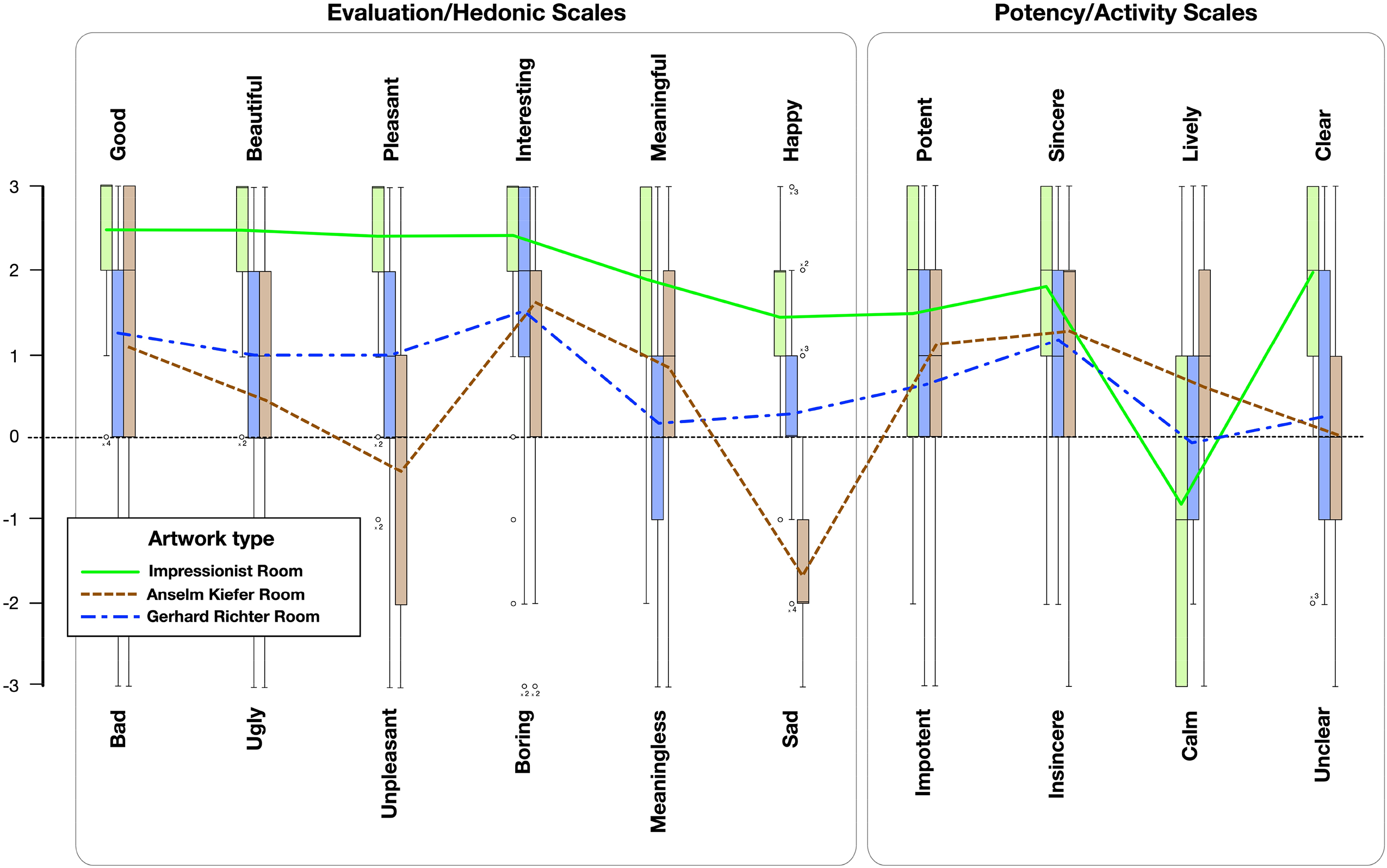
Artwork evaluations of three art-types (cross participant averages and percentiles).
Personality and Demographic Factors
Finally, we assessed demographics (age, gender, occupation, educational background), self-assessed art understanding, interest, and comfort with viewing and discussing art (based on Pelowski, 2015; Pelowski et al., 2017b), as well as formal art training, involvement in the arts (following Leder & Nadal, 2014), preference for abstract versus representational art (following Mastandrea et al., 2009), the Big Five personality inventory (German/English 10-item short version, Rammstedt & John, 2007), and Need for Affect (German translated short form, Appel et al., 2012; of original Maio & Esses, 2001 battery), which assesses tendency to seek out/avoid affective engagements.
Results
As noted above, of all participants initially recruited, 16 individuals (4.4%) were dropped due to either failure to complete all study portions, asking a partner to complete parts of surveys for them, or, in the case of two individuals, being below the age of consent. A check of answering patterns (i.e., overly monotonous answering) did not reveal issues. Thus, all others were kept for analysis. The opt-in rate for participation, out of all individuals approached in the museum, was roughly 65% (in line with past museum-based research using similar procedures, Pelowski, 2015).
Participant demographic and background information is shown in Table S1 of Supplementary Materials, including between-participant breakdowns by art room. Overall, these were generally in line with past sociological assessments of museum visitors (Hanquinet, 2013). The average age was 42.3 years, 61.4% identified as female; 70.5% had at least a university education. The overall sample tended to visit museums in the range of once every 1–2 months and to have positive scores for scales relating to assessment of their own art knowledge and interest. We also found a range of motivations for visits (Table A2), with highest agreements involving expectations to “see original art in person” but also to “have an enjoyable experience” or “to see things I have never seen before”. Participants represented a roughly 60/40% mix of German-speaking (primarily from Austria and Germany) and international tourists, covering ages from 18 to 84 years. Univariate ANOVA/Chi square tests, with Bonferroni correction (see right column, Table S1) showed no significant differences between the art room groups for education, art training/interests, motivations for visiting, as well as for personality and prior mood (PANAS).
Viewing Time and General Artwork Evaluations
Evaluations of the artworks (presented as boxplots in Figure 3) suggested several general differences, which also supported our artwork selection. The Impressionist Room was rated, on average, as the most ‘good,’ ‘beautiful,’ ‘pleasant’. The Kiefer Room was generally rated on the negative side of scales hedonic scales, as well as sad, whereas the Richter Room tended to straddle the midpoint for ratings, with also lower ratings of ‘meaningfulness’. One-way ANOVAs, with Bonferroni correction, revealed all scales to differ significantly between rooms (adjusted p = .005, .05/10). That said, when looking across participants, we found a large ratings variance, with some participants using all possible points for most scales. Similar broad differences were found for viewing time. Individuals spent, on average, 7.3 min (SD = 4.92), but ranged from 30 s to 35 min.
Affective/Cognitive Phenomenal Aspects of Art Experiences
The 46 phenomenal items, reported by participants as having been subjectively felt during their experiences, are shown as boxplots in Figure 4, ordered from highest to lowest average magnitude across all participants and art rooms. Once again, we found a wide range of responses. In general, the highest scoring items were positive feelings (‘stimulated,’ ‘absorption,’ ‘serenity,’ ‘free,’ ‘happy’) or terms notably connected to ‘aesthetic’ or art engagements (‘harmony,’ ‘wonder,’ ‘being moved,’ ‘sense of profundity’), with negative feelings tending to show lower magnitudes. Responses also suggested broad differences between art types and viewers. In line with our expectations, the Impressionism Room evoked the highest mean responses on scales related to positive affect, and the Kiefer Room tended to evoke higher negative or uncomfortable responses (‘sad,’ ‘angry,’ ‘anxiety,’ ‘emptiness,’ ‘confusion’) but also ‘novelty’ and ‘surprise.’ The Richter Room tended to have average responses somewhere between the two others. We also found self-reported evidence for changing experience across all rooms, with 73.6% of Kiefer Room visitors indicating that they had experienced a change in their feelings throughout the experience, 62.5% for the Richter Room, and still over half (55.0%) of Impressionist Room viewers. Note, we did not statistically assess for differences in specific item ratings but rather only compared at the descriptive level due to lack of specific hypotheses and the large number of items.
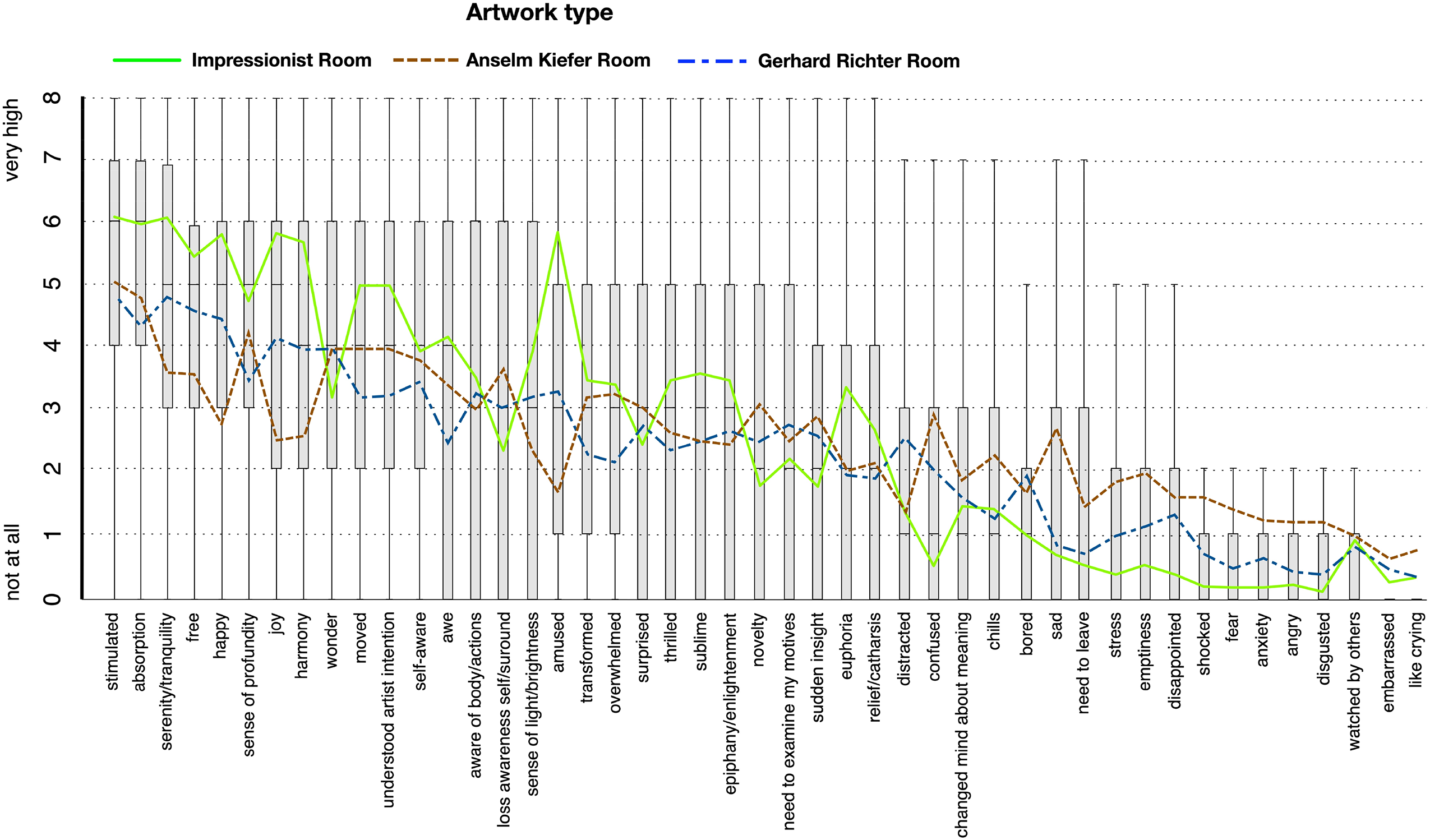
Affective and cognitive items reported as being subjectively felt during art viewing experience (between participant averages and percentiles).
Network Model of Phenomenal Factors Across Art Experiences—Analysis Method
To assess the above collection of affective and cognitive items’ potential relationships, we conducted a network modelling analysis, using the following procedure:
Network Construction
To first construct the network, we used the Triangulated Maximally Filtered Graph (‘TMFG,’ Massara et al., 2016; see Pelowski et al., 2019 for study in similar aesthetic context), including the full 46-item set of items. The TMFG algorithm constructs a network of zero-order (Pearson) correlations using a structural constraint—keeping the network planar (i.e., it could be drawn on a sphere without edges overlapping)—which limits the number of total edges in the network (3n – 6 edges, where n is the number of nodes; see Christensen, 2018 for general overview; Christensen et al., 2019 for discussion of identifying dimensional structures). The TMFG method was applied via the NetworkToolbox (Christensen, 2018) package in R (R Core Team, 2023). Because this method requires no missing data, we used full information maximum likelihood estimation to retain all participants.
Community and Core Item Identification
We then applied Bootstrap Exploratory Graph Analysis (‘bootEGA,’ Golino & Christensen, 2019; see also Golino et al., 2020; Golino & Epskamp, 2017). This applies a walktrap community detection algorithm (Pons & Latapy, 2006) to the above model to assess the number of communities or dimensions that exist in the network (Golino & Epskamp, 2017). The walktrap algorithm uses “random walks” through the model to identify the community a particular node belongs to. The random walks start at each node and then jump from one node to the next, with larger edge weights (i.e., correlations) being more probable paths of travel. Community boundaries are formed, again in a purely data-driven method, with paths occurring more often between likely community members (Golino & Epskamp, 2017; see Golino et al., 2020 for comparison of the EGA approach to traditional FA/PCA approaches). The bootEGA further applies bootstrap with replacement (Efron, 1979), conducting EGA on each bootstrapped sample, forming a sampling distribution of networks. This allows the researcher to examine the stability of a network's dimensions while providing a median, and thus more generalizable, network structure. EGA and bootEGA were applied with 100 bootstrapped samples using an adapted algorithm from the EGAnet package in R (Golino & Christensen, 2019). The walktrap algorithm was applied to detect network dimensions using the igraph (Csardi & Nepusz, 2006) package in R. Quality checks for network and community fit were applied following Kan et al. (2019).
To identify core items that were most central to each community and to the overall network—which could be then used in the following latent profile analysis—we calculated a hybrid centrality measure (Pozzi et al., 2013). This quantifies the position of each node (individual item) in the network based on its connections and relative location (“centralness”). The “hybrid” centrality measure approach is so-named because it is the rank-order combination of multiple centrality measures, maximizing centrality estimates (Pozzi et al., 2013). This approach further focused on hybrid centrality measures, as opposed to, for example, choosing the nodes with only the highest network loading within a particular community (aligning more to previous PCA or FA approaches), because we aimed specifically to represent patterns across the entire network, while also representing some items for each community. The top 30% of items within each community were selected (see Christensen et al., 2019).
Resulting Network Model, Communities, and Core Items
The final network is shown in Figure 5, with each circle, or ‘node,’ representing one cognitive/affective item and connections between nodes indicating zero-order correlations applied iteratively through the TMFG algorithm (see Note, Figure 5). Green lines indicate positive, and red lines indicate negative, correlations. The relative distance between any two nodes suggests the strength of their connection as a function of the entire network (i.e., items far apart would have a lower correlation). Across the network, we identified five item communities, denoted by the same node colors in Figure 5, and with the subsequent hybrid centrality measure suggesting 13 core items (bold black outlines in Figure 5; see also Figure 6 for full list).
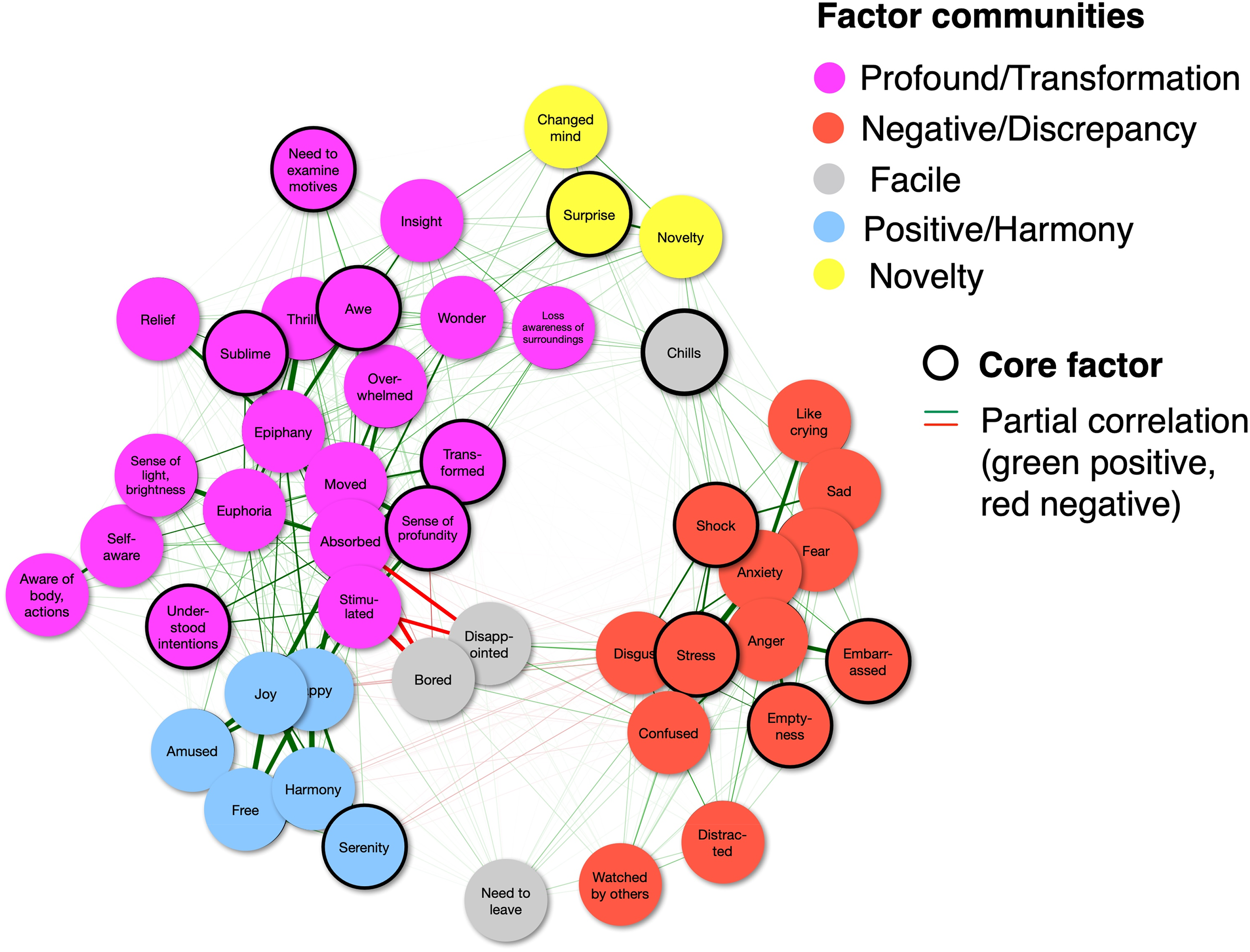
Network model of affective and cognitive reports of museum art experiences across a range of art types.
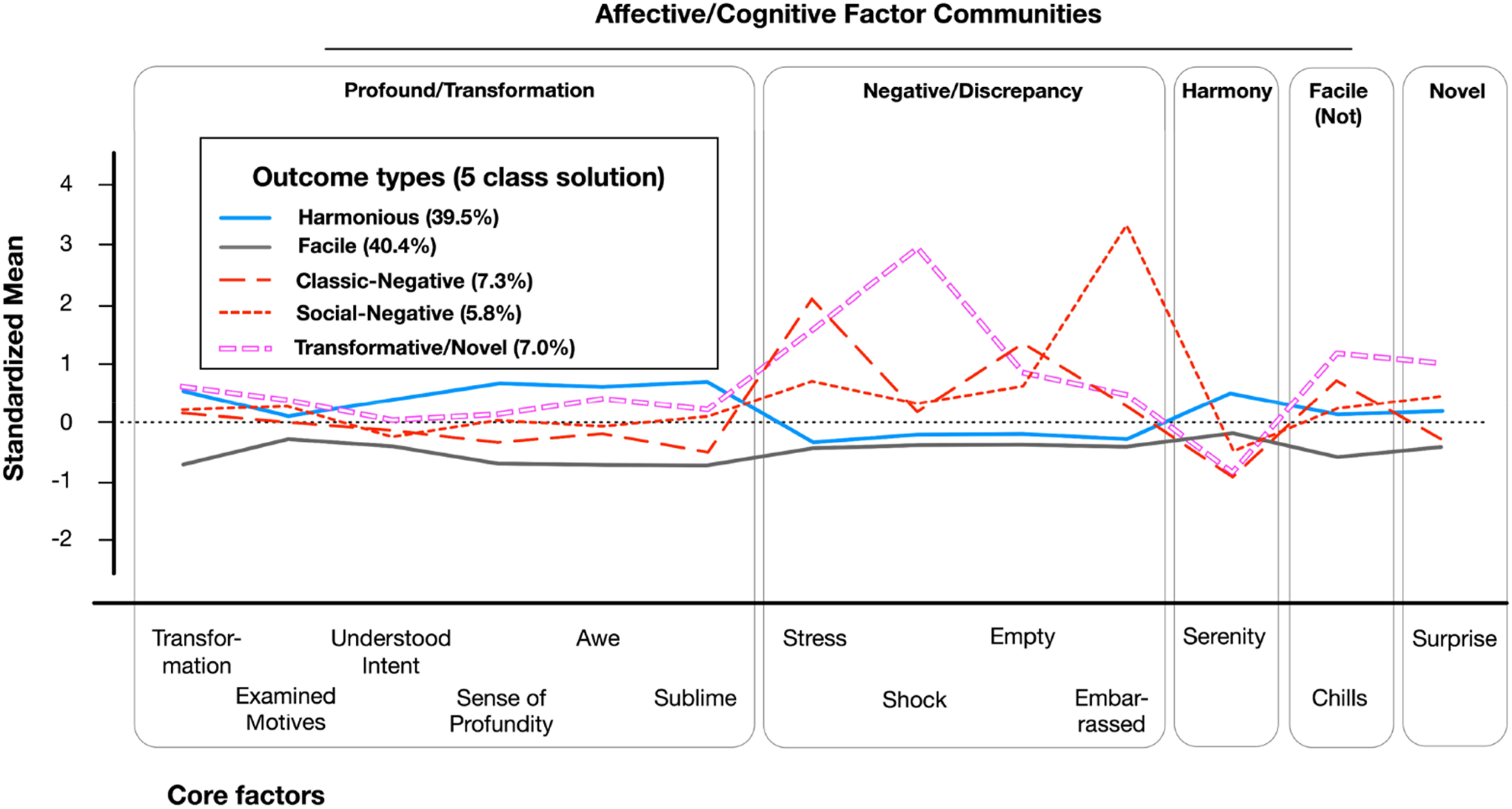
Latent profiles of art experience outcome types, based on core affective/cognitive items: five-profile solution.
The first community (1) (purple in Figure 5) contained 20 items tied to generally Transformation, self-awareness, and more generally reflecting Profound or more-or-less peak moments of experience. Its core items were feeling ‘transformation,’ having a ‘need to re-examine motives,’ ‘understanding intentions,’ as well as a ‘sense of profundity,’ ‘awe,’ and ‘sublime.’ (2). The second community (red) contained 13 items that represented largely Negative aspects, and included items argued to be related more generally to difficulty or discrepancy, with core items being ‘stress,’ ‘shock,’ ‘empty,’ and ‘embarrassed.’ (3). The third (grey) contained four items related, presumably, to generally Facile reactions—‘disappointed,’ ‘bored,’ ‘need to leave,’ with the core item, ‘chills’ (negatively loaded). (4). The fourth (blue) contained six items that represented generally positive, Harmonious responses. Its core item was ‘serenity’. (5). The final community (yellow) contained three items appearing to relate specifically to general experiences of Novelty or cognitive adjustment/insight—with the core item ‘surprise.’
Latent Profile Estimation of Art Experience Patterns
To then further assess whether viewer reports could be fit into one or multiple distinct patterns aligning to possible different types of experience, we conducted a Latent Profile Analysis (LPA) in Mplus 8 (Muthén & Muthén, 1998). This used the standardized viewer ratings (group mean = 0, SD = 1) across the 13 core items above, and tested, initially, one-, two-, three-, four- and five-profile solutions (following similar exploratory study; see e.g., Pelowski et al., 2019). Results were assessed via several statistical fit indices (Table A2, Appendix), including tests suggested to be more robust with smaller samples (Akaike’s information criterion, AIC, adjusted Bayesian information criterion, BIC, bootstrapped likelihood ratio test, see Nylund et al., 2007; Swanson et al., 2012).
All multi-profile solutions were found to be better than a one-profile solution. Generally, a five-profile solution showed the best indices’ support. Two measures (the Vuong-Lo-Mendell-Rubin Test and the Lo-Mendell-Rubin Adjusted Test) suggested that a three-profile solution could also be a viable fit. A subsequent six-profile solution also did not suggest an improved fit. Further inspection of the five-profile solution answering patterns (see also below) did not suggest the presence of “intensity classes” (i.e., two or more profiles with only differing magnitude; see Silvia et al., 2009; Swanson et al., 2012). To further compare the two possible solutions, individual participants were also assigned to each of the profiles based on the probability of most likely fit, using both a three- and a five-profile model. Assignment probabilities can be found in Supplementary Materials Table S2 (see also Table S3 for the relative assignment of the same individuals to either the three- or five-profile solutions). In both models, the profiles showed quite clear distinctions for almost all viewers (> 92% best fit probability; almost no spanning or boundary cases). Therefore, as the three-profile solution also tended to show only broad divisions into essentially relatively more positive/negative and/or neutral/facile outcomes, we used the five-profile model for the following assessment (for the interested reader, results of the three-profile solution are however provided in Figure S1 and Table S4 of Supplementary Materials).
To consider the nature of the resulting five profiles, we then looked to the answers of viewers who had been assigned to each profile across the 13 core items (using standardized scores, see Figure 6). As can be seen, the most reported profile (Profile 4, 40.4% of cases) showed the lowest magnitudes of core items (both positive and negative, with the exception of ‘serenity’) and thus suggesting a generally uneventful, unengaging (e.g., Facile following the argument of Pelowski et al., 2017c) result. This was followed by (Profile 2, 39.5%) a profile with relatively high incidence of ‘serenity,’ ‘sense of profundity,’ ‘awe,’ ‘sublime,’ as well as comparatively low levels of negative emotions and relatively high ‘understanding of artist intention,’ and thus could be interpreted to align with what Pelowski et al. (2017c) had suggested as a Positive/Harmonious outcome.
We also detected two generally ‘negative’ results. The first (Profile 1, 7.3% of reported experiences) had particularly high ‘stress’ and ‘emptiness,’ low ‘harmony,’ ‘transformation/profundity,’ and ‘novelty’ items, but also relatively high reported ‘chills,’ and thus aligning with a more-or-less ‘Classic’ Negative result (e.g., as described in the VIMAP model, Pelowski et al., 2017c). In addition, (Profile 3, 5.8% cases) we detected a similar pattern of high negative and low harmony/profound-related items, but with the notably high presence of ‘embarrassment,’ and perhaps suggesting a more Social-Negative experience (see e.g., Pelowski et al., 2014).
Finally, we found a result (Profile 5, 7%) that appeared to align with a Transformative or insightful experience as described by Pelowski et al. (2017c; see also Pelowski & Akiba, 2011). This showed relatively high ‘shock’ and ‘stress,’ however also with comparatively lower ‘emptiness’ and ‘embarrassment,’ and also with the highest ‘surprise,’ ‘transformation,’ ‘examination of motives,’ and ‘chills.’ It also had the second highest ‘awe’. Note also that, while the general labels of both the profiles and the communities of items above did show some overlap, importantly especially these latter profiles tended to show cross-community combinations, notably regarding negative aspects.
Art Experience Profiles and Outcomes, Ratings, and Mood Change
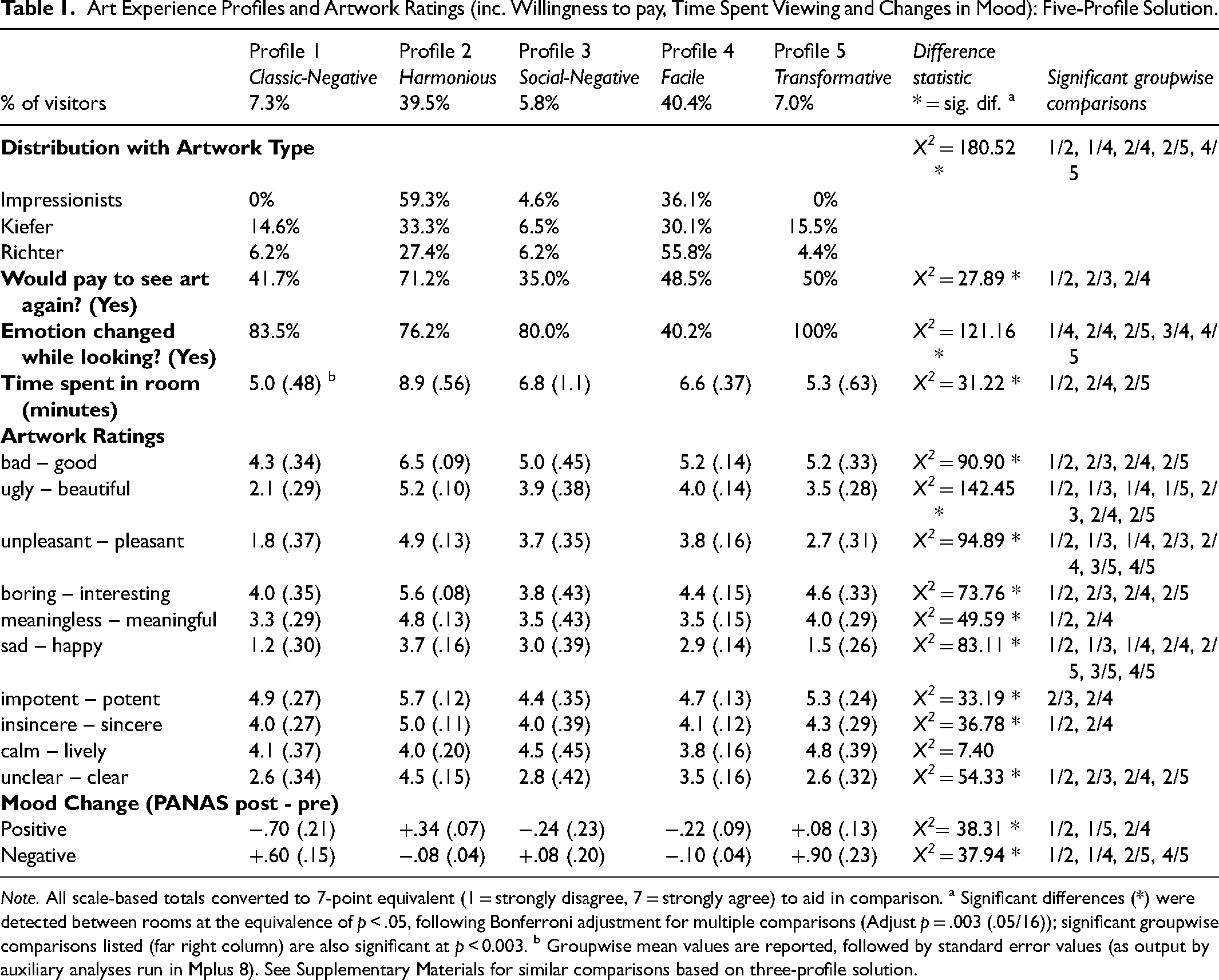
To consider how the profiles related to rating or otherwise engaging the artworks, we employed auxiliary analyses in Mplus 8 that tested the equality of means (based on the profile assignments at the individual level) across latent profiles, with results similar to analyses of variance or χ2 tests of independence but adapted to the latent profile approach. Results are shown in Figure 7 and Table 1.
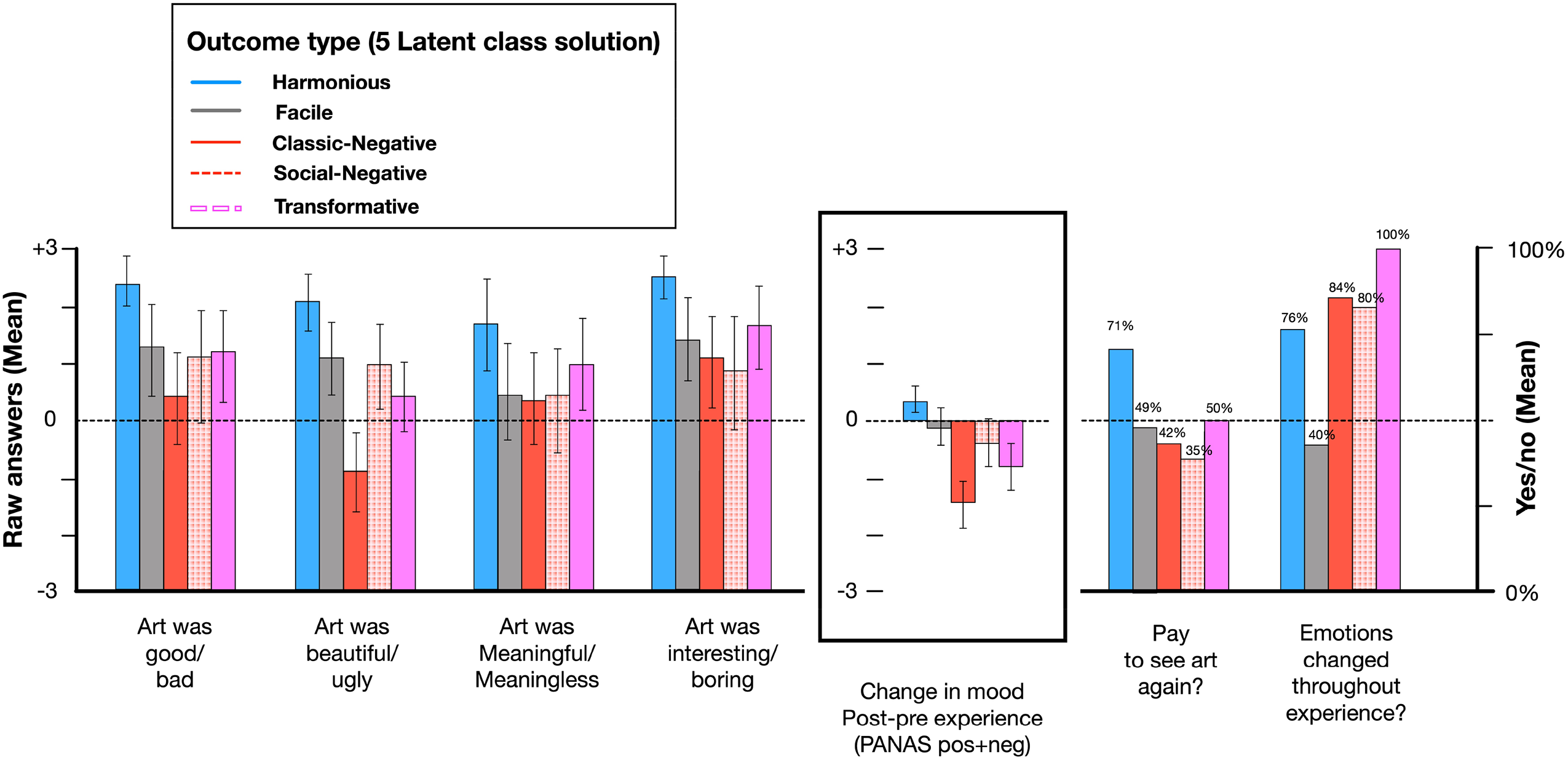
Artwork ratings, change in mood, and viewer report factors as compared across five art experience outcome types.
Art Experience Profiles and Artwork Ratings (inc. Willingness to pay, Time Spent Viewing and Changes in Mood): Five-Profile Solution.
Note. All scale-based totals converted to 7-point equivalent (1 = strongly disagree, 7 = strongly agree) to aid in comparison. a Significant differences (*) were detected between rooms at the equivalence of p < .05, following Bonferroni adjustment for multiple comparisons (Adjust p = .003 (.05/16)); significant groupwise comparisons listed (far right column) are also significant at p < 0.003. b Groupwise mean values are reported, followed by standard error values (as output by auxiliary analyses run in Mplus 8). See Supplementary Materials for similar comparisons based on three-profile solution.
Artwork Ratings, Viewing Time
For artwork ratings, results were largely in line with arguments from the VIMAP model. The Harmonious outcome (2) tended to coincide with the most positive ratings, with individuals assigned to this profile finding the art most ‘good,’ ‘beautiful,’ ‘pleasant,’ ‘meaningful,’ and ‘interesting’. The Classic-Negative outcome (1) tended to show the lowest ratings for these scales. The Facile (4) and Social-Negative outcomes (3) showed similar, comparatively higher ratings of ‘beauty’ and ‘goodness’ than the Classic-Negative case, although lower than the Harmonious. Ratings of ‘meaninglessness’ were also quite low. The Transformative outcome (5) showed ratings of ‘goodness’ and ‘beauty’ in line with the Facile and both Negative outcomes but comparatively higher ratings of ‘pleasantness’ and the second-highest ratings of ‘interestingness’ and ‘meaningfulness’. All scales, with the exception of ‘calm-lively’, differed significantly between outcomes (see Table 1).
Viewers of the Harmonious outcome were most likely (71% ‘yes’) to agree ‘that they would pay to revisit the art,’ followed by the Transformative outcome (50%), the Facile (49%), and with the two Negative outcomes notably lower (Classic-Negative, 42%; Social-Negative, 35%). Viewers also tended to spend the most time (8.7 min) when having a Harmonious outcome, followed by Social-Negative (6.7 min), the Facile (6.7 min), and then the Transformative (5.4) and Classic-Negative (5.2) outcomes.
Changes in Emotion Throughout Experience and Pre/Post Mood
Regarding the subjective reports of whether participants’ emotional experience had changed throughout the encounter, ‘Yes’ answers were given in 76% of cases for the Harmonious and in 80–84% for both the Classic- and Social-Negative varieties. Whereas 100% of viewers answered positively for the Transformative outcome, 40% of viewers in the Facile outcome reported such changes (see also Table 1). When looking to the pre/post changes in mood (via PANAS), changes for both positive and negative mood varied significantly between outcomes (Table 1). The Harmonious outcome led to the largest increase in positive mood, and a minimal reduction in negative mood. Both Negative outcomes showed a decrease in positive mood and an increase in negative. The Facile reaction led to a decrease in both, while the Transformative led to an increase in positive but also negative mood, with an especially high increase in the latter.
Outcome Types Across the Different Artworks and Viewers
Finally, as expected, we did detect different distributions in outcomes between artworks. The Impressionist Room led to the highest incidence of Harmonious experiences (59% of cases for this art type). This was followed by the Facile outcome (36%) and with only a small handful reporting Social-Negative experiences (4.4%). The Impressionist Room did not show any incidence of Transformative or Classic-Negative outcomes. On the other hand, for viewers of the Kiefer Room, about 2/3rds reported either Harmonious (33%) or Facile outcomes (30%). We also found a higher incidence of Negative (21%, combining Classic and Social types) and Transformative outcomes (15.5% cases). The viewers of the Richter Room were most likely to have Facile reactions (56%) followed by Harmonious (27%) and Negative varieties (12%, combined). At the same time, when comparing the patterns between the art types, despite varying incidence, we found rather pronounced correspondence. As can be seen in Figure 8, even the raw answers for the core items led to similar levels of magnitude and relative difference, supporting the generalizability of the outcomes across individual viewers and artworks.
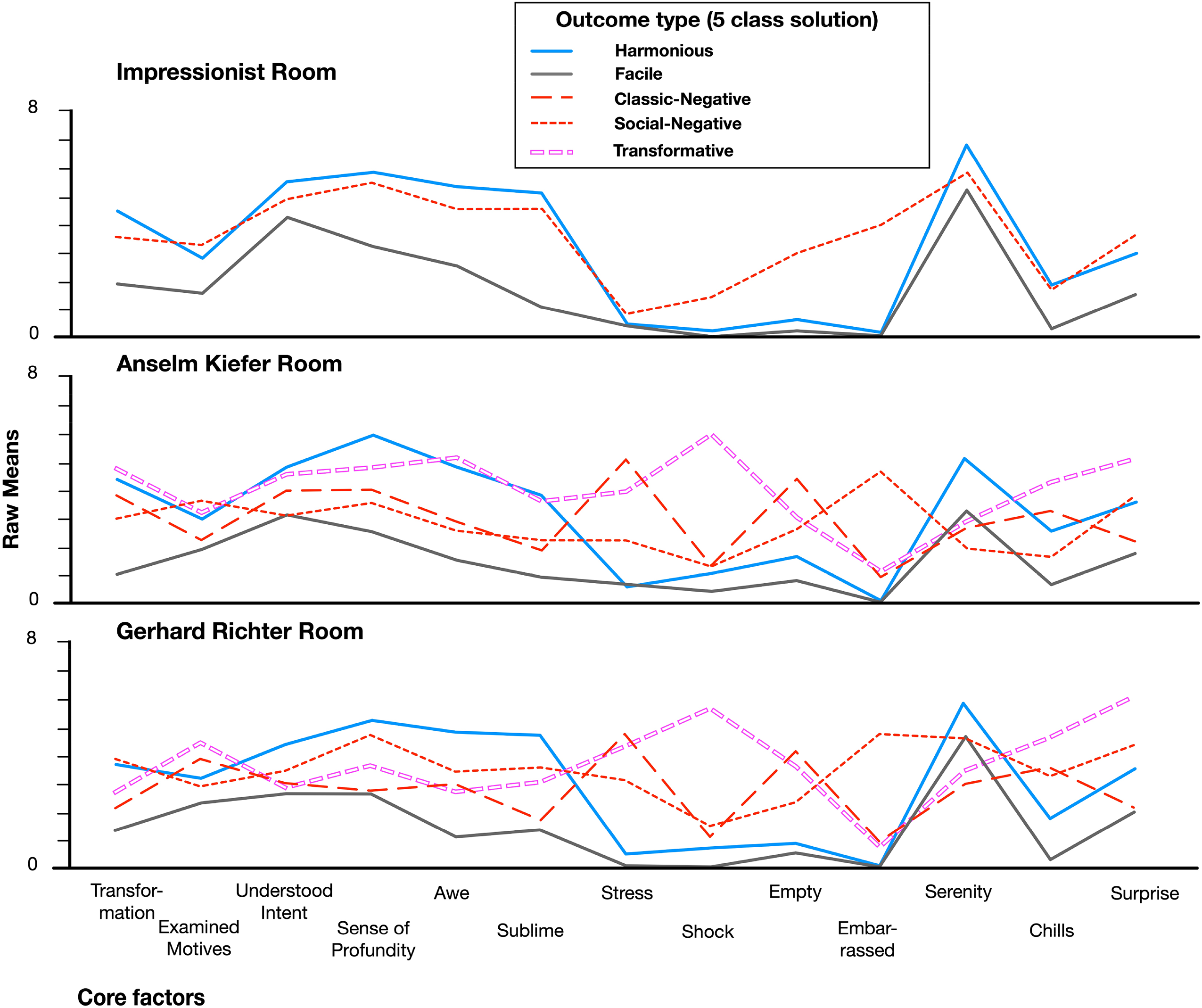
Latent profiles of art experience outcome types, compared between three art-types: based on profile-level mean answers to core affective/cognitive items.
Outcomes and viewer characteristics (Table A3), on the other hand, at the basic demographics and education level, largely did not show significant differences. Participant age, gender, level of education, self-assessed art interest, previous art study, and frequency of museum visits showed no notable relation to outcome type. Looking to expectations, participants who had Transformative outcomes did tend to agree more with the expectation of ‘learning something,’ whereas this same expectation was lower for other responses (again comparing between individuals who had seen the same art type). Personality measures (Big Five Openness, Need for Affect-Approach/-Avoidance) showed no group differences.
Discussion and Conclusion
This study presented an exploratory, proof-of-concept answer to an outstanding set of demands for a multivariate approach to assessing individuals’ experiences with visual art. We addressed this by collecting in-depth self-reports of museum visitors’ experiences, using a theoretically-guided framework and list of cognitive and affective items across several hundred viewers and three varieties of visual art. Reports were analyzed via emerging Network Modelling and Latent Profile Analysis methods, with the aim to move beyond single-factor or simple data-reduction approaches to meaningfully assess potential combinations across items, viewers, and artworks and, thus, to provide empirical support for the nature of our complex, nuanced—but also potentially more or less shared—ways of responding to art
Multivariate and Potentially Shared Aspects of Art Experience––Results of a Latent Profile Approach
Across the individual viewers, art types, and the individual response items, the results suggested a wide range of differences. At the exhibition level, we found significant differences in evaluations of hedonic enjoyment, understanding, and meaning (Figure 3), as well as relative economic interest, and even time spent viewing. Similarly, participants reported a wide range of affective/cognitive responses (Figure 4), further supporting our selection of the different art types. This range of responses, at both individual and artwork levels, followed well-established expectations (Darda & Chatterjee, 2023; Gerger et al., 2014; Marković, 2010) and reinforced longstanding arguments for the esoteric nature of viewing art.
At the same time, despite this local variance, when looking across all individuals and artworks, we did find evidence for similar dimensions and patterns. By considering the combination of 46 affective/cognitive items, compiled from a literature review and theoretical model (Pelowski et al., 2017c) and argued to provide a wide overview of potential art related responses, we detected five communities (Figure 5). These largely aligned with the theoretical model guiding this work and previous multivariate data reduction methods (e.g., Scherer & Zentner, 2001; Schindler et al., 2017; Zentner et al., 2008; see also Table A1) and supported their findings of broad semantic clusters of items in participant self-reports. See also Christensen et al. (2023b) who employed a network modelling method and similarly identified communities related to positive, negative, epistemic, and transformative items. This finding itself is interesting and generally in support of these past claims (e.g., Schindler et al., 2017) that art experiences involve a number of different factors, which tend to cohere into general, and consistent, main groupings, and represent an important multivariate basis for better understanding and addressing art experience.
Going beyond these past approaches––by selecting 13 ‘core’ items from these communities, which best described not only the communities themselves but the variance across the entire item network, and subsequently applying a Latent Profile Analysis––we revealed evidence for five distinct patterns in participant reports (Figure 6). These profiles, although found to differ in prevalence across individual viewer characteristics and artworks, were found to be highly similar across cases (Figure 8), with high (> 92%) probability of individual fit, and suggested to be rather stable, distinct, and consistent ways of describing reactions to the different art types. In turn, these results provide first, preliminary evidence for this paper's main aim of uncovering potentially supraordinate varieties of art experience. This supports past arguments (e.g., Dewey, 1934; Funch, 1997; Pelowski et al., 2017c) for such underlying progressions or commonalities when engaging art, and speaks against the claim (e.g., Shusterman, 2000 for review) that, given the wealth of factors, experiences are too broad and esoteric to be captured in empirical research. This finding was also in line with emerging research on network modelling approaches, especially with aesthetic topics, suggesting this approach to be a powerful means of teasing out specific, common, defining patterns, or affective journeys underlying complex experiences (Cotter et al., 2018, 2019, 2024; Pelowski et al., 2019).
Detected Experience Profiles and Art Experience
The nature of the detected responses further has central implications for research in empirical aesthetics. Based on the involved core items, we labelled the profiles as Harmonious, Facile, Classic- as well as Social-Negative, and Transformative. These each described distinct ways of responding, with specific items being more or less salient. The Harmonious outcome shows a generally positive, resonant, but also not self-challenging, reaction. The Facile outcome was characterized by low levels of emotion across all items, while also showing generally negative appraisals and evaluations. The Classic-Negative experience corresponded with confusion, anger, and other negative emotions; the Social-Negative showed a similar profile but with the notable addition of ‘embarrassment.’ Finally, the Transformative outcome was distinguished by high ratings of ‘shock’ and ‘stress,’ but also ‘awe,’ ‘chills,’ and ‘transformation,’ blending negative responses with those related to self-awareness and reflection. These findings suggest art's potential to lead to specific profound emotional states, to lead to reflection or self-engagement, to induce anger or discomfort, as well as to result in a largely unengaging and unrewarding experience.
Notably, the defining features of four of these five varieties—Classic-Negative, Harmonious, Facile, and Transformative—do align with the theoretical varieties proposed by the VIMAP model (Pelowski et al., 2017c), which guided our item selection and statistical approach (see also e.g., the recent findings from Christensen et al., 2023b). These profiles also align with other theoretical suggestions (e.g., see, for harmony/absorption, Funch, 2008; Panzarella, 1980; see Lasher et al., 1983; Pelowski & Akiba, 2011 for Transformation; Silvia, 2009 for Negative). Similar arguments can also be found for the embarrassed, Social-Negative outcome (see e.g., Pelowski et al., 2014). Many of the core items themselves (e.g., awe, chills, transformation, wonder) have been noted as key components in art experiences (e.g., see Fingerhut & Prinz, 2020; Pelowski et al., 2017c for review). While again our paper was not designed to be a direct test of the model, and we do not wish to claim that these results are exhaustive, these findings do suggest a matching of top-down theoretical and bottom-up data driven perspectives, providing key support both for the model hypotheses as well as the ecological validity of the results.
Even more, as also suggested in Pelowski et al. (2017c; see also Pelowski & Akiba, 2011), although the specific nature of our responses may be guided by expectations, personal reactions, and context, the present findings speak to a rather psychologically general set of possible reactions whereby we might all respond to a stimulus. Additionally, while viewers may start at the same beginning, the complex nature of reports, as well as the blending of both positive and negative items (in the case of Transformation) and the high incidence of self-reported change across all viewers (76% of all cases), speaks to the theoretical argument for an evolving interaction and the need to consider combinations across affectively or semantically similar item sets. This goes a step beyond previous findings that had employed both data reduction/factor analysis, as well as network modelling (e.g., Christensen et al., 2023b) methods, and was again suggested as a necessary extension of past multivariate work (Schindler et al., 2017; see also Keltner & Oatley, 2022; Schwarz, 2011). While again, only preliminary evidence here, these findings and method may provide a compelling basis, and set of key terms, for future research.
Other Implications for a Profiles Approach––Appraisals, Art-Impacts, Methods
Beyond this basic finding of shared patterns in and of themselves, these findings also raise several other implications, especially for how we understand and assess art. First, while we argued for keeping appraisals separate when methodologically assessing the experience, we do find that judgements (hedonic and epistemic appraisals; willingness to pay to see the art again), as well as factors such as changes in mood, were very much related to the specific variety of art engagement (Figure 7). Even more, as with the affective/cognitive patterns, each outcome suggests a nuanced blend of evaluations. For example, whereas a Harmonious experience consistently led to the most positive evaluations, Transformative outcomes showed comparatively high ratings for meaningfulness and interest, but lower appraisals of beauty; these also tended to be shorter visits and leave individuals with less positive moods, while Harmony evoked just the opposite. The Negative, but, interestingly, also Facile, outcomes tended to lead to both negative evaluations and mood impacts.
These findings, as well, broadly matched the arguments in the VIMAP (Pelowski et al., 2017c; see also Pelowski, 2015; Silvia, 2005). The blends of responses, along with the high interindividual variance detected when considering only averaged responses across viewers/artworks, also support previous evidence that relationships between art appraisals are often not linear (Hayn-Leichsenring et al., 2020; Leder et al., 2013; Sidhu et al., 2018; Trupp et al., 2023), and that, as with the experiences with art, simply relying on basic valence, understanding, or arousal may not be the most explanatory approach (Pelowski et al., 2017c). An experience-based analysis that connects outcomes to the underlying process of engaging art, would seem to provide a promising approach.
More basically, the appraisal relations found in the present paper raise implications for institutions, artists, or other stakeholders who wish to understand and provide grounds for certain responses to art. The present findings suggest that specific profiles may be connected to art that is seen as rewarding, understood, or that improves one's feelings––again, below the level of, and perhaps more critical than, the specific artwork. Engagements may also challenge viewers, sparking negative reaction, leading to worsened moods, but also potentially (in cases of Transformative outcomes) to self-reflection and learning. These connections provide compelling suggestions for emerging arguments regarding the need to better understand the varied mechanisms leading to wellbeing, health, or other societal impacts (Fancourt et al., 2021; Trupp et al., 2023). See Cotter et al. (2024) who used an LPA approach to connect generally positive and negative profiles to well-being factors in art visits.
On the other hand, the evidence for rather unrewarding, ‘facile’ responses, we think is quite important, as especially the former probably matches the way many people engage any given work of art, which does not tend to resonate (see e.g., Smith et al., 2017 for a classic finding of very short durations in average art viewing times even in major museums). This response, as well as ‘negative’ reactions that also are well-supported in the literature, supports suggestions for the need to expand our expectations for what can happen in museums or with works of art (for example, see the ICOM definition of museums, which specifically emphasizes the function of museums “offering varied experiences”; https://icom.museum/en/resources/standards-guidelines/museum-definition/). Encompassing a variety of experiences inherently means that not all experiences will have the same impact and, critically in this context, that not all experiences will lead to ‘pure emotional positivity’—nor should we probably want this to be the case. By expanding to even more nuanced, distinctive processes, we may open even more descriptive means of analysis and understanding of the varied nature of experiences.
Similarly, outcome level considerations may be key for understanding other aspects of context or anticipating impacts of specific artworks. The finding that our selected art types, although holding the potential to evoke similar patterns, showed wide variance in outcome prevalence (Table 1) suggests much fruitful ground for future research. By specifically looking for and quantifying reactions, this method may provide a new means of fitting specific art types to empirical findings. Relatedly, by assessing and comparing experience prevalence, this may open up a theoretically-driven basis for mediation or introducing changes to increase desired results (e.g., see Pelowski et al., 2014 for a preliminary approach in this direction). The lack of relation between outcome types and several other factors––education, art training, personality––found in the present paper, seems to support arguments for the generally open nature of these responses, available without specific backgrounds, given a particular work of art.
Regarding methods, this study adds to the growing collection of research advocating for emotions or other subjectively-felt states as an entry-point to capturing holistic experiences (e.g., Keltner & Oatley, 2022; Pelowski, 2015; Schwarz, 2011; Silvia, 2005). As supported here, these may serve as identifiable indicators of an individual's internal state at a particular moment, which is continuously changing, but also descriptive, as we move through an experience (Pelowski et al., 2017c). The present findings, although not directly compared here, also raise important questions regarding past multivariate approaches that have often used alternative assessments, such as having an individual report how they hypothetically expect to feel or blending reports across a large, undefined number of experiences with art.
Looking to these emotions, the theoretical implications of the specific items included in our study also raise implications. Unsurprisingly, our short list of ‘core items’ includes several terms classically associated with aesthetic experience, such as ‘awe,’ ‘sublime’, ‘chills,’ which are also noted in recent multivariate approaches and well-established from art historical, philosophical, and psychological perspectives (see Fingerhut & Prinz, 2018). At the same time, the presence of other items––‘stress,’ ‘shock,’ ‘empty,’ ‘embarrassment,’ ‘surprise,’ ‘understood intent,’ ‘examined motives’––reinforces the critical role of negative (e.g., Silvia, 2009; Silvia & Brown, 2007), reflective/(meta)cognitive, and ‘everyday’ emotions. Especially this latter category, which had again been specifically omitted in past multivariate reports (Schindler et al., 2017), was found to be a particularly descriptive, especially when contrasting different global reactions to art. This aligns with past suggestions (e.g., Cowen & Keltner, 2017; Pelowski et al., 2020; Silvia et al., 2010) that including these may be key for demarcating experience. The range of items also demonstrates the importance of a wider variety of affective and cognitive states that are not only relevant, but central, to creating multidimensional experiences.
Finally, this study adds to a growing body of literature advocating for the use of network modelling, in addition to factor and principal component analyses, as this may provide more varied methods for best describing and capturing experience. Results also provide support for the use of LPA to examine the relationship between identified communities/clusters (Cotter et al., 2024; Pelowski et al., 2021) and identify patterns in participant responses across exhibitions. Even with previous studies that have identified emotional factors of aesthetic engagement via emerging network methods (e.g., Christensen et al., 2023b), the addition of LPA to analysis procedures enables us to identify and assess these multi-dimensional, inter-factor relationships as they pertain to and occur in participant self-reports on a population level. This approach, as seen here, may be particularly powerful for assessing a class of engagements as nuanced as our meetings with the arts.
Future Directions and Caveats
While the present study provides support for the methods applied and outcomes identified, this comes with many more caveats and calls for future research. These results should be treated as a proof-of-concept and basis for setting up more expansive, focused studies to dig into many of the implications noted above. We assessed three exhibition rooms that varied in their tone and style, with the argument that this may produce a good starting point for eliciting a range of reactions to art. At the same time, this only represented a small subset of art examples, all 2D paintings. All exhibition rooms were also in the same museum and with a bias towards contemporary artists. We further did not conduct any pilot testing or post-hoc verification of the varied valence and styles (though between-exhibition comparisons provide some insights to this variance). Our sample size, although in line with minimum recommendations available at the time (Swanson et al., 2012), was also only a small subset of possible viewers. To truly provide robust evidence for the implications and applications implied in this work, it will be necessary to replicate and expand the findings started here, incorporating more, and a wider range, of participants and artworks, as well as further experimental controls (e.g., explicit verification of whether participants had not seen other exhibition rooms previously) and stimulus-selection validation procedures.
The list of affective/cognitive terms used here were primarily derived from the VIMAP model (Pelowski et al., 2017c) and its literature review. It would be beneficial to revisit and update this list. Significant work on emotions and aesthetic experience has been done in recent years, as also presented in multivariate approaches (Schindler et al., 2017; Zentner et al., 2008; see also Christensen et al., 2023b). Item inclusions and findings from such studies may provide further insights while expanding the list we used in this study. In particular, recent work has emphasized the role of embodied states (Cabbai et al., 2023; Fingerhut & Prinz, 2020; Kühnapfel et al., 2024) and social emotions (Sznycer et al., 2021), both of which would be valuable to incorporate in future investigations, especially in light of the Social-Negative outcome identified here. Some studies have also suggested potential cultural differences when it comes to attributed valence of specific feelings or how emotions might be reported (e.g., Keltner & Oatley, 2022; Masuda et al., 2008; but see also Zickfeld et al., 2019 for counter-argument); future work may consider exploring possible cultural effects further.
Although we found a rather striking correspondence, differences between the present findings and the guiding VIMAP model (Pelowski et al., 2017c) also raise interesting demands for future research. The lack of a clear Novel variety, for example, as posited in the VIMAP but not found here, may indicate that such an experience does not occur, or that we were simply unable to reveal it under these circumstances. This outcome is proposed to be thought-provoking/changing but not intensely confrontational, an outcome that may not be easily distinguished from the Facile or Transformative outcomes. It may also be that the selected exhibitions do not lend themselves to this experience type.
The identified Social-Negative outcome also raises questions. This was again very similar to the Classic-Negative profile as suggested in the VIMAP, differing only by lower ‘stress’ and much higher ‘embarrassment.’ While this may be a genuine and relevant distinction (e.g., see Pelowski et al., 2014 for discussion of a similar response pattern in a museum study), this should be carefully considered, as a few features of this profile point to it being a possible artifact. Only 20 participants were assigned to this profile, accounting for 5.8% of experiences. This proportion falls on the very low edge of recommendations for latent profile analysis (Muthén & Muthén, 2000; Weller et al., 2020). Across all participants and exhibitions, ‘embarrassed’ was also the second lowest rated affective/cognitive item, with few participants reported experiencing it at all. These features indicate that the identification of this experience type may be a byproduct of item-phrasing and/or the inclusion of these specific exhibitions. Future work that incorporates a larger, more expansive dataset may address both of these results.
Beyond expanding the present study, future work should also explore these outcomes alongside the numerous other factors of individual, context, artwork aspects, and outcomes that may help to further flesh out and define these responses. This approach is intended to assess experience below the level of ‘who,’ at a level that can accommodate both trait and state-dependent individual differences. Of course, these factors are likely to influence what kind of experience an individual has in response to a particular artwork in a particular context. Compelling questions can also be asked regarding whether similar patterns might be found for other media or modalities or settings of arts. Further, we asked participants to complete the survey measures outside of the exhibition space, after viewing the art, rather than doing so while inside the exhibition room. Such reports are suggested to be highly correlated (Merrill & Baird, 1980), but the possible distinction between responses to perceived versus recalled stimuli has rarely been investigated.
We also suggest that the current results only be considered in relation to art-museums and visual art, given the nature of the data collection. However, similar approaches could be applied to non-art museums or other cultural settings, and indeed theoretically as implied in both the present methods and the original VIMAP, we would expect to find similar patterns across a wide variety of contexts or media—nor would anything in the basic psychological processes suggested here imply anything necessary regarding these coming from ‘art’. Nature, sports, etcetera might show similar results. Exploring these factors, while expanding and building on the findings here, would of course be necessary to truly speak to the actual shared profiles of art response.
Despite these caveats, this paper does provide first evidence for potentially shared patterns whereby we may respond to art, as well as introducing new methods for teasing these apart. While the present results do not constitute a definitive model, we hope that this will serve as a foundation for new explorations and foster the understanding of the multivariate, yet interconnected, ways in which we engage with and experience the arts.
Supplemental Material
sj-docx-1-art-10.1177_02762374241292576 - Supplemental material for What Can Happen When We Look at Art?: An Exploratory Network Model and Latent Profile Analysis of Affective/Cognitive Aspects Underlying Shared, Supraordinate Responses to Museum Visual Art
Supplemental material, sj-docx-1-art-10.1177_02762374241292576 for What Can Happen When We Look at Art?: An Exploratory Network Model and Latent Profile Analysis of Affective/Cognitive Aspects Underlying Shared, Supraordinate Responses to Museum Visual Art by Stephanie Miller, Katherine N. Cotter, Joerg Fingerhut, Helmut Leder and Matthew Pelowski in Empirical Studies of the Arts
Footnotes
Acknowledgments
We would like to thank the Albertina Museum and specifically its director of Marketing and Communication, Verena Dahlitz, as well as Katharina Unger for their willingness to provide us with wonderful access and for their trust and collaboration. We would also like to thank the students and staff of the Empirical Visual Aesthetics (EVA) Lab for their help with data collection.
Declaration of Conflicting Interests
The authors declared no potential conflicts of interest with respect to the research, authorship, and/or publication of this article.
Funding
The authors disclosed receipt of the following financial support for the research, authorship, and/or publication of this article: The writing of this paper was supported by a grant to MP and JF from the EU Horizon 2020 TRANSFORMATIONS-17-2019, Societal Challenges and the Arts (870827 — ARTIS, Art and Research on Transformations of Individuals of Society).

Supplemental Material
Supplemental material for this article is available online.
Notes
Author Biographies
Appendix
Relationship Between Art Experience Profile and Participant Characteristics: Five-Profile Solution.
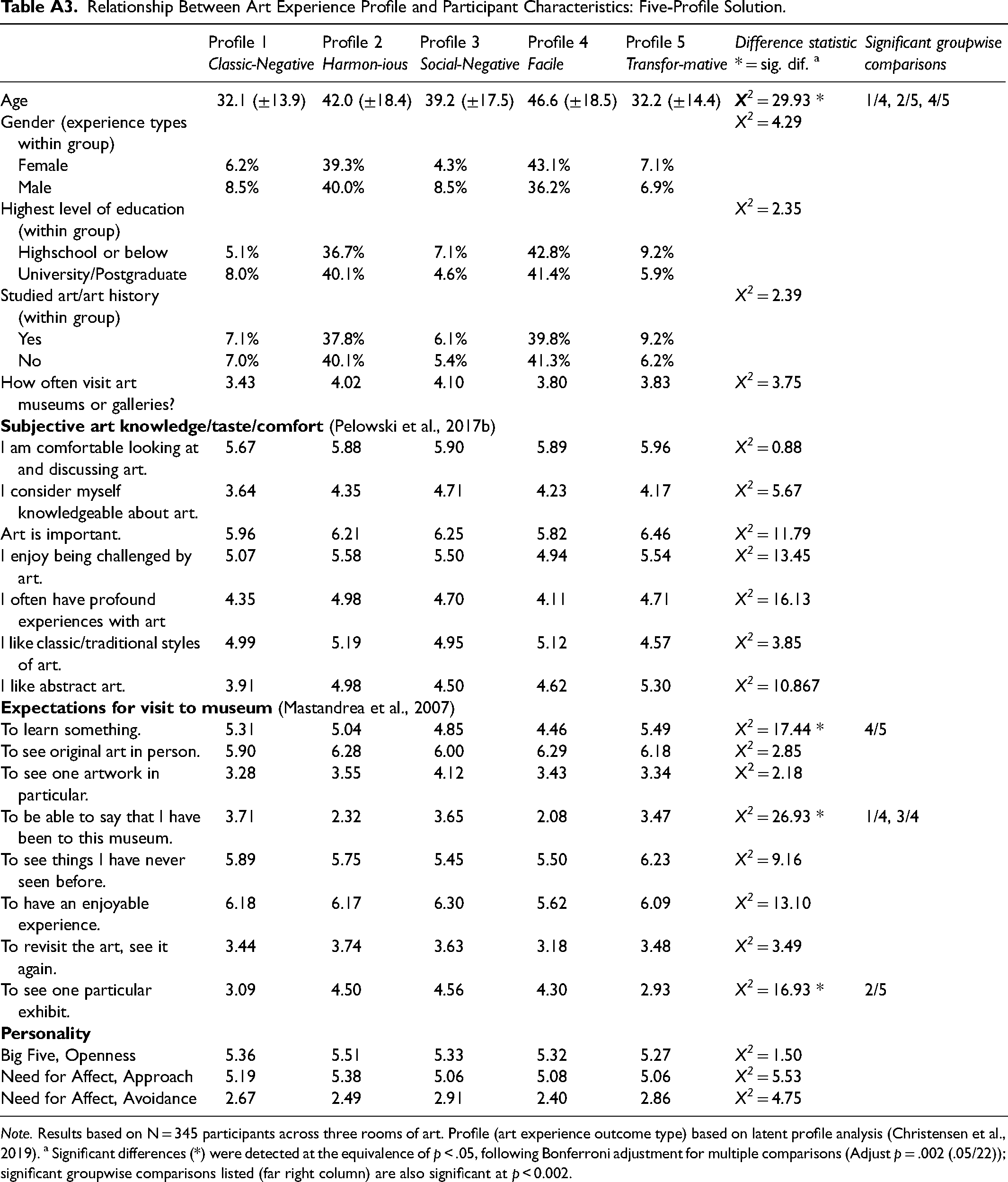
| Profile 1 | Profile 2 | Profile 3 | Profile 4 | Profile 5 | Difference statistic |
Significant groupwise comparisons | |
|---|---|---|---|---|---|---|---|
| Classic-Negative | Harmon-ious | Social-Negative | Facile | Transfor-mative | |||
| Age | 32.1 (±13.9) | 42.0 (±18.4) | 39.2 (±17.5) | 46.6 (±18.5) | 32.2 (±14.4) | 1/4, 2/5, 4/5 | |
| Gender (experience types within group) | X2 = 4.29 | ||||||
| Female | 6.2% | 39.3% | 4.3% | 43.1% | 7.1% | ||
| Male | 8.5% | 40.0% | 8.5% | 36.2% | 6.9% | ||
| Highest level of education (within group) | X2 = 2.35 | ||||||
| Highschool or below | 5.1% | 36.7% | 7.1% | 42.8% | 9.2% | ||
| University/Postgraduate | 8.0% | 40.1% | 4.6% | 41.4% | 5.9% | ||
| Studied art/art history (within group) | X2 = 2.39 | ||||||
| Yes | 7.1% | 37.8% | 6.1% | 39.8% | 9.2% | ||
| No | 7.0% | 40.1% | 5.4% | 41.3% | 6.2% | ||
| How often visit art museums or galleries? | 3.43 | 4.02 | 4.10 | 3.80 | 3.83 | X2 = 3.75 | |
| I am comfortable looking at and discussing art. | 5.67 | 5.88 | 5.90 | 5.89 | 5.96 | X2 = 0.88 | |
| I consider myself knowledgeable about art. | 3.64 | 4.35 | 4.71 | 4.23 | 4.17 | X2 = 5.67 | |
| Art is important. | 5.96 | 6.21 | 6.25 | 5.82 | 6.46 | X2 = 11.79 | |
| I enjoy being challenged by art. | 5.07 | 5.58 | 5.50 | 4.94 | 5.54 | X2 = 13.45 | |
| I often have profound experiences with art | 4.35 | 4.98 | 4.70 | 4.11 | 4.71 | X2 = 16.13 | |
| I like classic/traditional styles of art. | 4.99 | 5.19 | 4.95 | 5.12 | 4.57 | X2 = 3.85 | |
| I like abstract art. | 3.91 | 4.98 | 4.50 | 4.62 | 5.30 | X2 = 10.867 | |
| To learn something. | 5.31 | 5.04 | 4.85 | 4.46 | 5.49 | X2 = 17.44 * | 4/5 |
| To see original art in person. | 5.90 | 6.28 | 6.00 | 6.29 | 6.18 | X2 = 2.85 | |
| To see one artwork in particular. | 3.28 | 3.55 | 4.12 | 3.43 | 3.34 | X2 = 2.18 | |
| To be able to say that I have been to this museum. | 3.71 | 2.32 | 3.65 | 2.08 | 3.47 | X2 = 26.93 * | 1/4, 3/4 |
| To see things I have never seen before. | 5.89 | 5.75 | 5.45 | 5.50 | 6.23 | X2 = 9.16 | |
| To have an enjoyable experience. | 6.18 | 6.17 | 6.30 | 5.62 | 6.09 | X2 = 13.10 | |
| To revisit the art, see it again. | 3.44 | 3.74 | 3.63 | 3.18 | 3.48 | X2 = 3.49 | |
| To see one particular exhibit. | 3.09 | 4.50 | 4.56 | 4.30 | 2.93 | X2 = 16.93 * | 2/5 |
|
|
|||||||
| Big Five, Openness | 5.36 | 5.51 | 5.33 | 5.32 | 5.27 | X2 = 1.50 | |
| Need for Affect, Approach | 5.19 | 5.38 | 5.06 | 5.08 | 5.06 | X2 = 5.53 | |
| Need for Affect, Avoidance | 2.67 | 2.49 | 2.91 | 2.40 | 2.86 | X2 = 4.75 | |
Note. Results based on N = 345 participants across three rooms of art. Profile (art experience outcome type) based on latent profile analysis (Christensen et al., 2019). a Significant differences (*) were detected at the equivalence of p < .05, following Bonferroni adjustment for multiple comparisons (Adjust p = .002 (.05/22)); significant groupwise comparisons listed (far right column) are also significant at p < 0.002.
References
Supplementary Material
Please find the following supplemental material available below.
For Open Access articles published under a Creative Commons License, all supplemental material carries the same license as the article it is associated with.
For non-Open Access articles published, all supplemental material carries a non-exclusive license, and permission requests for re-use of supplemental material or any part of supplemental material shall be sent directly to the copyright owner as specified in the copyright notice associated with the article.
