




Abstract
Embodied cognition claims that how we move our body is central for experience. Exploring dimensions of bodily engagement should, therefore, also be central for engaging art. However, little attention has been paid to the actual ways viewers move in front of art and how this impacts experiences. We aim to close this gap, using a new paradigm in a gallery-like setting in which we tracked movements of participants that engaged an abstract artwork. Guided by a literature review, we relate objective movement factors and subjective body awareness to mobile viewing behavior, art experience, and expertise. We also—for the first time—define shared movement patterns employing principal component/cluster analysis and relate these to experience outcomes, noting, for example, that moving more/more dynamically related to more reported insight. As a proof-of-concept paper, we hope to support a more embodied, enactive understanding of art engagements, and provide practical guidelines for future research.
“In a certain sense it is the movement which is primary, and the sensation which is secondary, the movement of body, head and eye muscles determining the quality of what is experienced.” (John Dewey, 1896, p. 358)
Artworks, like any other stimuli that humans interact with, are not experienced in isolation. Rather, experience is strongly context-dependent, mediated by who we are, what we are doing, and how we engage our environment. In recent years, a number of studies have suggested a wide range of factors (Pelowski & Specker, 2020; Pelowski, Forster, Tinio, Scholl, & Leder, 2017 for reviews)—accompanying titles (Millis, 2001), means of presentation (Brieber, Leder, & Nadal, 2015), artwork size (Seidel & Prinz, 2018), sequencing or curation of exhibits (Reitstätter et al., 2020; Specker et al., 2020), personality (Silvia, Fayn, Nusbaum, & Beaty, 2015); ambient smells in a gallery (Cirrincione, Estes, & Carù, 2014; Spence, 2020)—all of which, in different ways, are shown to have an effect on aesthetic value, liking, interest (Brieber et al., 2015; Grüner, Specker, & Leder, 2019), viewing time (Carbon, 2017; Smith, Smith, & Tinio, 2017), memories (Brieber et al., 2015); even the emotional nature and intensity of experience (Specker, Tinio, & Van Elk, 2017).
One aspect that, while potentially central to how we experience art, has not received much empirical focus, is how we move and attend to our bodies when we engage art. When we visit a gallery or museum we actively explore, move around from one position to another, view from a distance or close up; change our viewing angle. All of which might make a difference for how we experience an artwork. Even more basically, art is not perceived by our eyes or brains alone, but our perceptions and responses are intermingled with the experience of having and using a body itself.
Aspects of bodily engagement have long been part of theories of art and aesthetic experience, such as in pragmatist (Dewey, 1934; 1980) and phenomenologist traditions (Dufrenne, 1973; Merleau-Ponty, 1962). More recently, embodied appraisal theories of emotions (Prinz, 2004) have been applied to art appreciation (Fingerhut & Prinz, 2018), as have accounts of embodied affectivity (Colombetti, 2014; Fuchs & Koch, 2014). The body also plays a central role in ecological and active vision paradigms in psychology and cognitive science (Ballard, 1991; Gibson, 1986), and is a centerpiece of an embodied-enactive understanding of the mind (Newen, De Bruin, & Gallagher, 2018; Varela, Rosch, & Thompson, 1991) that highlights how we actively generate experiences through the dynamic, bodily interaction with our environment.
Based on this embodied cognition tradition, assessing the impacts of body movements on art experience and appreciation would provide another key aspect (Fingerhut, 2018; 2021). Multiple writers in fact go so far as to explicitly argue that these movement/body-related components are constituent parts of aesthetic experiences (Bersson, 1982; Brinck, 2018; Crowther, 1993; Shusterman, 2006). However, beyond a few studies that have recorded traffic flows in museums (e.g., Kirchberg & Tröndle, 2015; Tinio & Specker, 2020; Yalowitz & Bronnenkant, 2009 for review), considered aspects such as average viewing distance (e.g., Carbon, 2020), averaged movement or density maps across exhibitions (Kirchberg & Tröndle, 2015), and studies on the concept of embodied simulation, motor processing (e.g., Freedberg & Gallese, 2007; Sbriscia-Fioretti, Berchio, Freedberg, Gallese, & Umiltà, 2013; Umiltà, Berchio, Sestito, Freedberg, & Gallese, 2012), or representations of body-formatted representations in the brain (Goldman, 2014)—what has been labeled “weak embodiment” (Gallagher, 2018)—actual movement, “strong embodiment,” is almost completely unassessed in empirical aesthetics.
This leaves open basic questions such as: how we physically engage and move when encountering art; how this movement and awareness thereof relates to how we perceive, understand, feel, and rate artworks; as well as how movement aspects interact with individual differences such as personality or expertise; are there shared patterns of movement, which might connect to our subjective art experience? On a more fundamental level, we need means whereby we can quantify and combine individual movement aspects themselves from acquired data, making sense of the complex process of moving and engaging, and addressing whether there are shared patterns of movement, which might connect to our subjective art experience.
This is the aim of the present paper. By focusing on aspects of movement, we address the role of the actual body in experiencing art. We conducted our study by using a novel infrared camera technique to continuously record participants’ body movements (in terms of walking and standing positions) while engaging an artwork in a mock-gallery, which allowed the participants to freely move in the space without being aware that movement was being recorded, and provides a precise and objective measure compared to previous video/observer-based tracking approaches. We utilized this method in combination with mobile eye tracking, which, although here employed to assess where participants are looking while moving, allows researchers to examine viewing patterns from the point of view of an individual in action, followed by self-report questionnaires regarding participants’ art experience and their art expertise. These assessments and inclusion of factors was also driven by a literature review of past, largely theoretical, discussions of potential aspects or questions involving art and the body. We connect these suggestions and factors to a range of standing and movement dynamics revealing new directions for research. Second, we employed techniques to cluster the full movement dynamics of each participant when they engage the artwork into groups, which constitute a first data-driven attempt to tease out and articulate shared ways we engage as embodied beings with an artwork and how these relate to our experience.
This study, which employs a controlled mock-gallery/artwork combination in which certain contextual and perceptual factors are simulated in a lab-oriented study design (Carbon, 2019), also provides an important example of more nuanced assessment of art-viewing conditions in more “real-world” settings (Carbon, 2019; Linden & Wagemans, 2021; Pelowski et al., 2017). It also contributes to an embodied, enactive understanding of art that aims to highlights the physical properties of art objects and settings, as well as the specific kinds of afforded bodily engagements (Fingerhut, 2018; Gallagher, 2011). All of which are emerging as demanded lines of research.
Review: Bodies, Movements, and Art—Previous Research and Suggestions
What might be central aspects to consider when assessing the body and movement when engaging art? As a frame for this paper, we have summarized previous literature in Table A1 of the Appendix. Although it should be noted that these do not often provide detailed hypotheses, or a unifying theory explaining the role of the body in art engagements, this provides an overview of past (largely theoretical and empirically underexplored) reasoning regarding main factors that may potentially show importance. We list main papers and arguments in the left column (further ordered around specific movement features that emerged in the review), alongside outstanding research questions (right column, see also corresponding labels in-text). These provide a departure point for our empirical investigation and, it is our hope, a useful review for other interested researchers in this topic. 1
How Might We Typically Move in Front of Gallery Art?
First, it is useful to briefly consider what a typical navigation through a gallery might look like. What do we tend to do upon entering a new art space? There is in fact a rather large body of research considering this topic (Table A1, part a). Stemming primarily from sociology or general museum studies, and constituting some of the earliest empirical assessments (e.g., Bailey, Bronnenkant, Kelley, & Hein, 1998; Melton, 1935; Robinson, 1928; vom Lehn, Heath, & Hindmarsh, 2002; see Bitgood, 2006 for review), these use a mix of observation or more advanced tracking methods (see Table A1, a) to capture movement patterns via heat maps of standing density, traffic flows, time spent (Bailey et al., 1998; Yalowitz & Bronnenkant, 2009), or exhibit choice/sequence (Pelowski, Liu, Palacios, & Akiba, 2014). Although these assess collective behaviors over entire visitor populations, and have not begun to consider individual experiences, they suggest a general consensus in basic engagement.
It is suggested (Bitgood, 2006; Griswold, Mangione, & McDonnell, 2013; Pelowski et al., 2017; Tinio, Smith, & Smith, 2014 for reviews) that, upon entering a gallery, and perhaps after a pause to take in the room, most visitors tend to begin walking toward and then between artworks. They often follow a wall or other anchors, visiting works of art, often in sequence (but see Carbon, 2017), stopping briefly before each; often with visitors leaving at the first doorway or exit (Bitgood & Dukes, 2006). In front of an individual artwork, as visitors approach, there is a similar consensus that they may often stop briefly from a slight distance, viewing its surface and making an assessment, deciding whether to move on to another work/leave or stay and give more attention (Smith & Smith, 2001). If they decide to stay, they may approach to a comfortable position, or find various positions, to better view and process the different elements (Griswold et al., 2013); before moving on to the next room or work. This interaction is typically argued to take a handful of seconds (with most museum data suggesting roughly 10–40s; Pelowski et al., 2017), but can also go much longer, and involve varieties of reactions or experiences.
Even within such basic patterns, there is much potential for better understanding the dynamic act of art engagement. First, it is the very nature of the above descriptions—approaching, stopping, moving, standing—that is omitted in much present empirical art research. Even more, when we specifically look into these multiple elements of embodied engagement and movement, there are a number of intriguing arguments suggesting that they may uniquely tie to specific aspects of experiences.
Viewing Orientation and Locations
This begins with the orientation and locations whereby we approach, move, and stand to view art (Table A1, part a). For example, literature suggests that most viewers tend to move right, following the right-hand wall thus approaching the right side of artworks first (Bitgood, 2006; Whyte, 1988). This could be a shared aspect of museum engagement or a statistical artifact from (i.e., right-hand-oriented) traffic flows in public spaces (Bitgood & Dukes, 2006; Parsons & Loomis, 1973). However, museum research has found that viewers may give more attention to exhibits on the right side of a room (Bitgood, 1992). Lab studies suggest that viewers may prefer art with salient objects located on the right and images with implied left-to-right movement (Wilson & Chatterjee, 2005; see also Palmer, Gardner, & Wickens, 2008). The above line of argument can also be traced in more general psychological discussions of approach-avoidance or “somatic marker” theory (Czeszumski, Albers, Walter, & König, 2021, for review), which suggests that positive events might induce right-ward steps, while negative events induce leftward movement (see more sources in Table A1).
This relates to potential research questions (right side, Table A1) and might suggest that approaching more from the right or positioning oneself to the right side may correlate to preference (e.g., Table A1, question a1-2), but also certain feelings or specific subsets of experience. On the other hand, viewers approaching from, moving toward, or standing on the left may exhibit different characteristics or even have personality/background differences (a3). 2 Unfortunately, these arguments are barely empirically explored. Existing results are also not definitive. A recent art museum study using eye tracking (Tymkiw & Foulsham, 2020), for example, suggests that viewers might look and move more from the left.
Similar to right-left orientation, moving closer to a stimulus (a4) has been connected to positive affect or higher interest (Czeszumski et al., 2021; Fernández, Kastner, Cervera-Torres, Müller, & Gerjets, 2019; Frijda, 1986; Fuchs & Koch, 2014; Lakoff & Johnson, 1980). Berlyne (1971) called this initial aspect of art engagement “receptor-adjusting response,” according to which we orient our attention to sources of stimulation (i.e., the artwork), which is then followed by “locomotor exploration,” which is movement towards the artwork for more efficient inspection. Closer approaches may influence aspects to which individuals attend (see Locher, Krupinski, Mello-Thoms, & Nodine, 2007), felt reward through reduction of uncertainty (Berlyne, 1971), or even impact specific emotions reported in an experience (e.g., Frijda, 1986). When approaching art from a distance, the speed by which we get closer may also relate to the felt importance or level of emotional arousal. As suggested in Table A1 (questions on the right), a slow approach, and perhaps spending more time distanced, may lead to more focus on overall form or emotional impact of a work or may imbue a higher sense of importance (Novitz, 2001; see also Wolterstorff, 2003). Approaching slowly, in general, may also lead to a slow reveal of information (Pelowski & Specker, 2020) and different appreciation or understanding.
Viewing Distance and Changes in Viewpoint
The average viewing distance or where we tend to mostly stand when we engage art may also be important (Table A1, b). This topic as well has been one of the key targets of previous studies, which have explored this by asking participants to either view art from pre-set distances or allowed them to find an “ideal” distance (e.g., Carbon, 2020; Clarke, Shortess, & Richter, 1984; Estrada-Gonzalez, East, Garbutt, & Spehar, 2020; Locher, Smith, & Smith, 2001). As with orientation, however, studies report a wide range of findings (see in Table A1, also question b1)—for example, suggesting distance ranges from 1 to 4.5 times the longest artwork dimension; > 1–5 + meters away—and probably tied to a mix of context, preference, and artworks (Griswold et al., 2013). Importantly, despite wide interpersonal/artwork differences, almost no studies have explored the relation between standing positions and appraisals or art experience.
Clarke et al. (1984), who looked at viewing distances with large abstract artworks, similar to those employed in the forthcoming study, and notably with a seated viewer, report that participants positioned closer (1.7 compared to 2.8 m) spent more time viewing, but did not show significant relation to preference or interestingness. Carbon (2020) asked individuals to make a series of ratings of the same art (also large abstract artworks) while changing between eight set distances, reported positive relations between standing further away and liking. Carbon (2020) showed that rated “power,” and “interestingness” varied by assigned distance for all artworks, but did not report statistical differences or patterns in which viewing distance led to higher/lower ratings.
The above lack of empirical studies thus raises questions especially involving more emotional and cognitive factors (Table A1, b2). While it seems plausible that individuals seek locations whereby an entire artwork can be seen—which was the basic point of departure for most past empirical studies—people may report less enjoyment when standing too far away for a clear image. Standing back has also been theoretically—although not empirically—argued to lead to more focus on general emotional experience (Novitz, 2001). Standing closer may lead to more felt intimacy (Pelowski et al., 2017), a sense of envelopment (Pelowski, 2015), or provide a more “internal” or “participatory” perspective (Novitz, 2001) that could also lead to different judgments or understanding.
Even more, dynamic changes in viewing position from a truly mobile viewer may be a key component to consider. As suggested above, in real gallery settings, viewers may move around to adjust perspectives and experience (e.g., Berlyne, 1971 “exploratory behavior”). Museum studies (Carbon, 2017; Tröndle, Greenwood, Kirchberg, & Tschacher, 2014) suggest that individuals may often revisit art, take meandering patterns or different vantage points (see Steier, Pierroux, & Krange, 2015 for a case report with one painting). The few studies that have allowed individuals to freely change viewing position (e.g., focusing on single aspects such as where abstract patterns transition into coherent representational images) have found large interpersonal differences (Papathomas, 2002; Pelli, 1999). Carbon (2020) reports that freedom to choose viewing distance versus viewing from assigned distances led to more liking, emotional value, power, and interestingness (Table A1, b). 3 Empirical studies that have explored changes in viewing distance have also assumed a fixed viewer in the middle of a work, omitting side movements and perspectives, leaving out key aspects that constitute art engagement (Table A1, b3).
Amount of Movement
The relative amount of movement itself may also constitute a central measure (Table A1, c). Again, the general claim of embodied cognition theories is that perception, cognition, emotions are related to movement (Newen et al., 2018; Varela et al., 1991; Wilson, 2002). It might thus be expected that relatively more movement relate to certain appraisals, understanding, or emotional experiences (Brinck, 2018; Nanay, 2015; Schino, van Klaveren, Gallegos González, & Cox, 2021; van Klaveren, Ueding, & Cox, 2019; see Table A1, c1).
Research suggests that perceptual and cognitive processes occurring while performing motor actions may relate to different activations in the brain and, thus, different phenomenal outcomes. Walking while doing cognitive tasks versus sitting is connected to increased prefrontal cortices’ activation tied to executive control and attention (Harada, Miyai, Suzuki, & Kubota, 2009; Holtzer et al., 2011). Theoretically, for art, Novitz (2001) also argues for active, “participatory” versus “passive” viewing, with the former potentially leading to deeper understanding or appreciation.
Contemporary theories of emotions (e.g., appraisal theories, Cooper & Silvia, 2009; Frijda, 2004) also argue for the role of movement. Emotions are suggested to include, as key components, expressive behaviors (facial, vocal, and postural expressions), physiological changes, and “action tendencies”/movements (Silvia, 2009, p. 48) that shape and define the emotional experience (Fingerhut & Prinz, 2018; Fuchs & Koch, 2014). A handful of art studies have shown related results. Artworks have been shown to evoke more feelings of the sublime when participants were in higher states of physical arousal versus low arousal/sitting (Eskine, Kacinik, & Prinz, 2012). Cox and van Klaveren (2022) found that reported “being moved” when viewing abstract art (while standing on a balance-board) positively correlated with postural sway in both front-back and side-side directions. Thus, moving more (e.g., c2), or in specific ways (c3), may relate to reported feelings during engagement (see also approach/avoidance above). Cox and van Klaveren (2022) also found difference in body sway patterns between painting types or different types of formal features (Pollock vs. Mondrian); large paintings, for example, may also invite or necessitate more movement to view all parts and thus relate to appreciation (Pelowski et al., 2017).
On the other hand, certain responses may tie to less movement. Beauty, insight/novelty, or other classic “aesthetic emotions” (wonder, awe) may connect to inhibited motor behavior, saving processing resources—a so-called “stopping for knowledge” argument (Sarasso, Neppi-Modona, Sacco, & Ronga, 2020). Empirical studies asking people to identify the body characteristics of wonder have also been associated with a lifted head, and transfixed—presumably static—standing (Feleky, 1914; Fingerhut & Prinz, 2018). Schino et al. (2021) also report that art-elicited delight and sadness were accompanied by subjective reports of felt activity in the head and decreased activity in the legs of participants (see Table A1, c).
Subjective Awareness of Movement and the Body
As an additional measure beyond the actual movement, it is also important to consider the subjective experience of one's body during art engagement (Table A1, d). Body awareness, sometimes referred to as proprioception or kinesthetics (Mehling et al., 2009), arguably plays a central role in the subjective experience (Berlyne, 1971; Djebbara, Brorson Fich, & Gramann, 2019) in that it heightens our awareness of what is around us, and ourselves, thereby making us aware of what we are feeling (Brinck, 2018). Thus, relatively more awareness of one's body and actions (d1) might modulate affect and attitude toward the art experience (Brinck, 2018; Jung, Ryu, Lee, Wallraven, & Chae, 2017; Schino et al., 2021). This also relates to general arguments for the importance of ecologically-valid art engagements, where in-person interactions or more body awareness may increase sense of immediacy and physical presence of the art, and the environment (Brinck, 2018; Dewey, 1980; Dufrenne, 1973; Merleau-Ponty, 1962; Shusterman, 2006). Becoming more aware of the body or actions during art experience may also act as a trigger for self-reflection, insight, or transformative experience (Pelowski, 2015; Pelowski et al., 2014). At the same time (d2), awareness of the body and moving may lead to an opposite impact. In certain contexts, such as where individuals feel rather uncomfortable or unsure with a stimulus or task, this may lead to reduced attention/cognitive resources for artworks (Pelowski et al., 2014). High awareness of body and action may also be contrary to absorbing, harmonious, wonderous experiences (Pelowski & Akiba, 2011).
Interestingly, subjective sense of the body has also been connected to body position and movement itself. Casile and Ticini (2014) suggest that, for example, stimuli close to the body (in peri-personal space) could trigger more representation of potential actions, higher degree of embodiment, or even desire for actions or movements (d3).
Combining Movement Aspects—Are There Specific, Shared Patterns for Engaging Art?
Finally, beyond the above-identified aspects, a basic question involves whether these could be combined (Table A1, e). This constitutes both a main aim and pressing issue when considering the body and movement (Linden & Wagemans, 2021), essentially asking whether—and how—we might address the global ways that people move in art spaces in front of specific works. One possibility would be to discern some shared, patterns of engagement (e1) and then explore whether these connect to specific aspects of reported art experiences (e2). However, due to both the technical and theoretical complexity, few studies have begun to address this question.
Kirchberg and Tröndle (2015) assessed visitors’ interaction with an exhibition of mostly paintings or 2D art, tracking the nature of their overall experience, their appraisals of selected artworks, physiological responses, and their movement paths and velocity (using a specially-design glove transmitting to wireless receiver). A principal component analysis with the ratings items suggested three experience types—what they called an “enthusing” experience (although primarily noted by individuals reporting having seen “familiar,” “famous,” and beautiful art), a “contemplative” (including items such as that art had alerted one's senses, been thought provoking, surprising, entertaining), and a “social experience” (driven by one item of being with “friends and family”). Following from what they argued to be a fundamental question, “are [experience] types mirrored in the mappings?” (p. 184), they combined movement/physiology maps of randomly selected twenty-two visitor-data sets from each of the three types when engaging with six artworks. However, the reported differences (such as “enthusing” visitors showing higher physiological reactions) were entirely based on the subjective choices of the authors and not data driven. Furthermore, standing positions and movement did not enter their deliberations.
Linden and Wagemans (2021) recently reported a taxonomy of 32 museum navigation behaviors, based on observation of 78 visitors in a four-room exhibition (Table A1, e). They focused primarily on eye tracking factors—such as looking at either art, other people, or the environment—but also studied overall movement throughout the museum space, by focusing on especially “changing perspective” actions whereby people moved to look from sides, stood directly in front of a painting, or approached/pulled back. The results were primarily framed as a proof of concept of the classification method itself, with discussion of interrater agreement for coding actions, with some reported average occurrence of actions across the viewer population such as equal frequencies of both standing and moving, more time centered in front of the art. More intriguing, they conducted some linear regressions between the frequency of behaviors and outcomes from the experience, considering three factors—participants’ “ease of seeing a connection” between the exhibition artworks, “extent to which the exhibition met …expectations,” and “estimation that the exhibition was more than the sum of its parts.” In the end, they did not report any connections of art experience factors to individual movements, however they suggest—much as with the range of individual factors above—that this is a necessary step toward understanding art experiences.
Present Study
In sum, the above review provides numerous aspects, but mostly unanswered questions (Table A1), regarding how we move during art engagement, as well as how this can even be assessed in empirical studies. The present study was designed as an exploratory first step to tackle these questions. Using an infrared tracking method (see Methods), we were able to locate where individuals stood and how they moved in gallery-like space in front of a single artwork. This again had two main research questions: (1) By tracking individual viewers as they entered, approached, and viewed a work of art while also assessing subjective assessments for appraisals, cognitive and emotional experience, we aimed to address many of the individual aspects noted above—where individuals stand in the gallery, as well as average standing distance on both the x- and y-axes, frequency of front-back, side-side, and total movement, as well as total distance moved. We considered how these movement aspects manifest across our sample (1a), and how they connected to the reported art experience (1b). Similarly, we considered subjective body and movement awareness via self-report surveys, connecting these also to the art experience ratings (1c) and movement data (1d). (2) Moving beyond these individual aspects, by using data-driven approaches for data consolidation, we then assessed shared movement patterns and again systematically connected these to viewers’ experience.
In addition to our main empirical goals, we also included two additional factors to help support and round out this assessment. First, we coupled this study with mobile eye tracking. This is itself an emerging line of research especially in ecologically-valid art engagements (e.g., De Winter & Wagemans, 2022; Heidenreich & Turano, 2011; Pelowski et al., 2018; Reitstätter et al., 2020; Santini et al., 2018; Walker, Bucker, Anderson, Schrei, & Theeuwes, 2017). Although, it is important to note that, due to the limitations inherent in the nature of our method and already extensive list of general factors already under exploration, we did not investigate fine-grained aspects of looking, for the present study this was a useful counterpoint for tracking movement, allowing us to assess where individuals actually looked while moving (e.g., see Linden & Wagemans, 2021 referenced above for similar usage). Mobile eye tracking has been employed in a handful of other studies combining assessments to consider, for example, viewing distance (Estrada-Gonzalez et al., 2020), movement patterns (Garbutt et al., 2020; Linden & Wagemans, 2021), or in combination with posturography while walking through art installations (Kapoula et al., 2014). However, to date mobile eye tracking has almost never been related to subjective art experience (e.g., see Trawiński et al., 2021 looking at the relationship between eye movement and personality and verbal responses to artworks). To fill this gap, we were primarily interested in whether we might similarly find general patterns for how individuals looked as this might relate to the art experience (e.g., looking relatively more at the sides, bottom, or top; Quiroga & Pedreira, 2011), whether individuals look relatively more at art or environment (Linden & Wagemans, 2021; Pelowski et al., 2018), and how such patterns relate to movement (see also Table A1, f).
Second, we considered art knowledge and interest. These aspects have also been a main topic of past context-related studies (under the general term of “art expertise”), suggesting that those with more knowledge or interest may show different looking or appraisal patterns (e.g., Nodine, Locher, & Krupinski, 1993; Pihko et al., 2011; see also Leder, Gerger, Brieber, & Schwarz, 2014 for review). As suggested by Brinck (2018), learned ways of moving may come with training or past experiences: “The viewer learns how to see and act… gradually increases the depth and complexity of aesthetic experience” (p. 204). 4 Thus, we expected that there may be similar differences when considering physical movement for different expertise levels. However, these factors as well have almost never been assessed (Carbon, 2020). Kirchberg and Tröndle (2015) included knowledge and interest in their attempt at describing main varieties of museum art engagement. They report no significant differences. Linden and Wagemans (2021)—again with an entire exhibition of artworks—comparing frequency of behaviors found no significant differences for expertise (practicing artists or degrees in art history) for any movement-related behaviors. They reported only that those more interested in art spent more time viewing from angles, but conclude, once again, that more study is required especially considering reactions to individual artworks.
Method
Participants
The study involved a final sample of 39 participants (19 female; Mage = 29.4, SD = 10.2, range = 19 to 76). This sample was derived from an initial convenience sample of 47 individuals, who represented the most we could collect during the period that we had access to the gallery room, with eight dropped due to technical issues with the eye or movement tracking measurements. Participants were split into roughly half each psychology students/Art History students from the University of [anonymized]. However, due to recent arguments that categorical (i.e., training-based) divisions can lead to misattribution of actual knowledge and interest with art (Specker, Stamkou, Pelowski, & Leder, 2022), all individuals were administered a battery for assessing art-specific knowledge and interest designed to provide a continuous variable for these constructs (see below), and we did not further consider group-wise divisions. Participants had normal/corrected-to-normal vision and received either five Euros or course credit for participation. The study followed guidelines of the ethics committee of [anonymized].
Materials
Testing Room/Gallery Setting
The testing layout is shown in Figure 1. This consisted of two rooms: an outer lab space (Room 1) where participants were fit with eye tracking glasses and filled out pre- and post- viewing surveys, and a mock-gallery space (Room 2). The latter was composed of a square room (roughly 3.5 × 3.5 m) with white walls, no windows or other doors, gallery-style overhead lighting (affording uniform coverage of the room and painting, i.e., non-spot lit), and with one abstract painting centered on the far wall opposite the entrance. The room also contained the movement tracking devices, composed of small wooden boxes placed in the corners of the far wall (see Figure 1 and below for further discussion). The gallery space could be accessed from the outer lab space by a closed door opening to a short hallway (∼3 m) which opened to the larger gallery. Upon entering the hall area (slightly offset to the right of the gallery space), the gallery room and a portion of the artwork were visible as the participant approached the room.
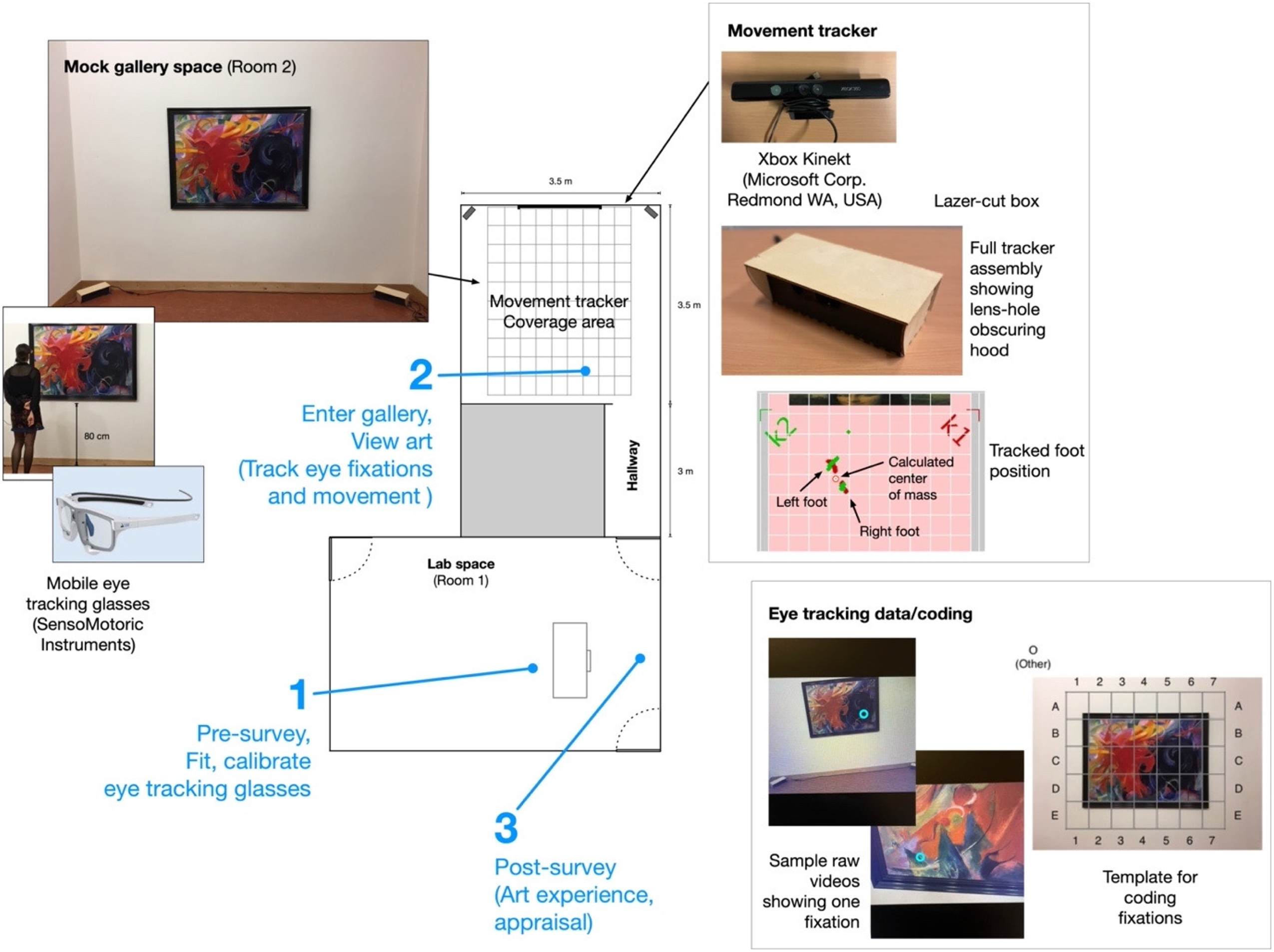
Study location and apparatus. Left-top: Mock-gallery space with single artwork (“Kämpfende Formen” (Fighting Forms), 1914; by Franz Marc (1880–1916), high quality reproduction on canvas, public domain image, Wikimedia commons). Note also the movement tracking devices in bottom corners of gallery. Left-bottom: floorplan of testing space and locations of main study stages. Right-top: bespoke movement tracking apparatus, concealment box, and example of raw location data. Right-bottom: example raw data from mobile eye tracking device, showing location circle for one fixation, as well as (right side) grid used for manual coding of fixation locations. (Note, floor and artwork grids used in coding are also provided in more detail in Figure 4).
Stimulus (Artwork)
The artwork used in the study was a high-quality reproduction of an abstract oil painting titled “Kämpfende Formen” (English: Fighting Forms, 1914; Figure 2) by the German artist Franz Marc (1880–1916) (see Klein et al., 2014 for more discussion of this artwork, and discussion of an eye-tracking study with a seated viewer in the same space). This painting is a well-respected example of the German Expressionist movement (Schleif, 2016), formally composed of a relatively darker, black-and-blue, roundish form and a lighter, reddish, angular form, which meet in the middle, with greens, purples, blues, and highlights of yellow largely around the four edges. This was chosen—in addition to its availability—due to its size (117.5 × 91.2 cm) and abstract style, with a generally uniform treatment across the canvas in terms of visual complexity, areas of color/formal saliency, and an absence of mimetic/symbolic content. Although art historians have suggested certain meanings or interpretations of the artwork, 5 the participants were not made aware of either the title or this interpretation before viewing. Nor was the artwork accompanied by labels or other information, and all participants were unfamiliar with the artwork and its provenance (assessed in the post-study survey). Although a reproduction, the painting was printed on canvas with a technique to preserve brushstrokes and other small details and, thus, was expected to reward closer looking and to be more similar to an “authentic” art experience (see Carbon, 2020 for similar approach). The painting had a black (5 cm) frame, and was hung at 80 cm from the ground, centered on the wall, with the center-point at roughly eye-height for an average adult.
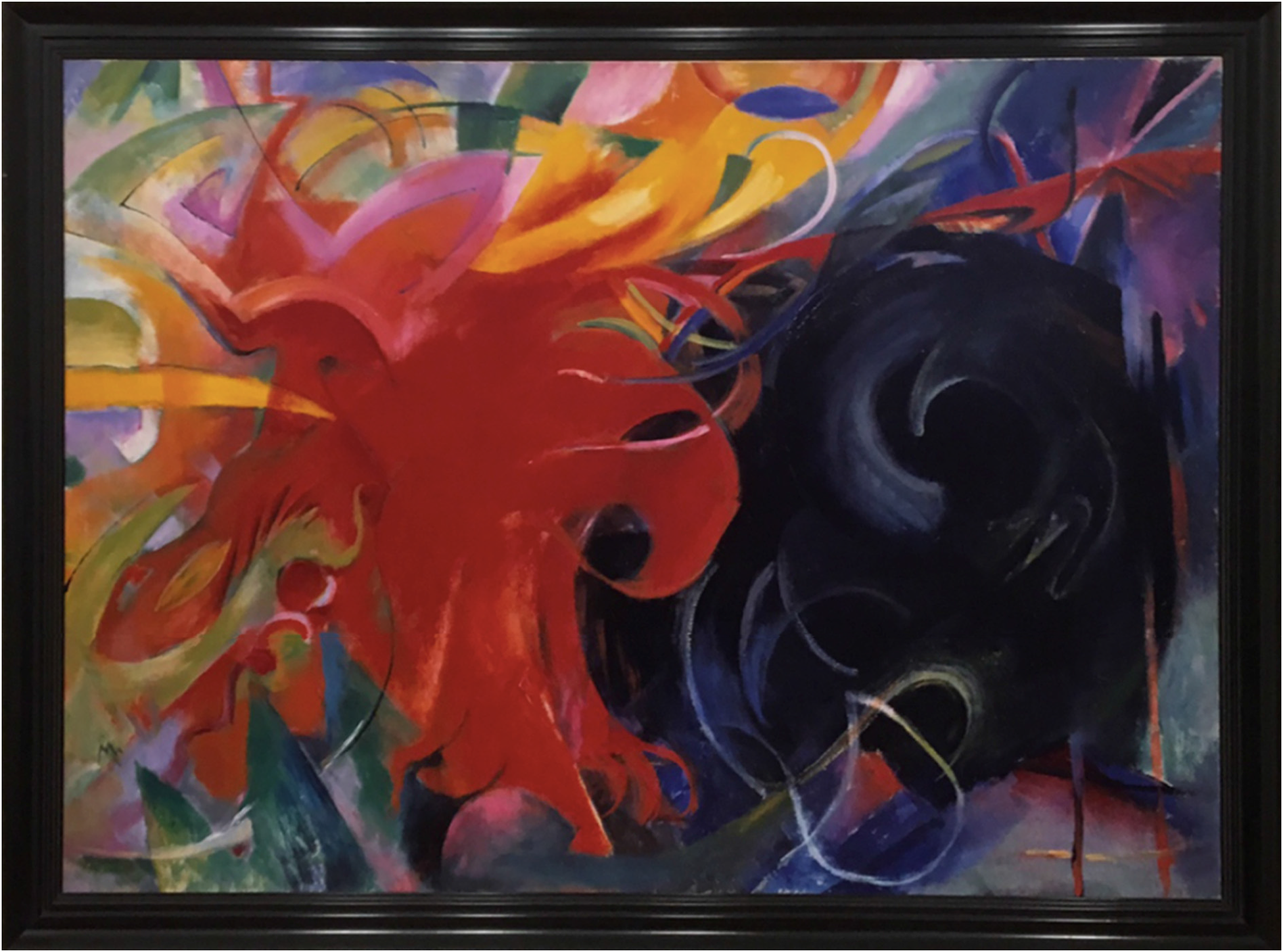
Artwork “Kämpfende Formen” (English: Fighting Forms), 1914; by Franz Marc (1880–1916), high quality reproduction on canvas, public domain image, Wikimedia commons).
Apparatus
Movement Tracking
To track movement, we employed a bespoke tracking tool—the Interactive Audience Sensor Kit (TASK, see Güldenpfennig et al., 2016 for details). This was designed by members of our team to provide a platform and software package (Processing 2.2.1 (rev 0227); see https://processing.org/) specifically tailored for unobtrusive tracking of standing, walking, or other interaction patterns in a gallery or onsite art installation (see also e.g., Helmuth et al., 2010; Sheridan & Bryan-Kinns, 2008 for similar designs of embedded sensor-based systems for tracking audience engagement in live performances, such as music or dance). The implementation made use of two calibrated infrared depth cameras contained (one each) in two Xbox Kinect units (Microsoft Corp., Redmond WA, USA). These were housed in laser-cut wood cabinets, with a hood designed to obscure awareness of the camera from a standing viewer, connected to a computer via USB cable, and accessed by the OpenKinect programming interface (https://openkinect.org/). Each unit was placed on the floor against the wall on either side of the painting, aimed at a 45° angle to the middle of the floor (Figure 1). This enabled us to monitor a 2.2 × 3m space in front of the painting and to record positions of a person's feet (not the whole person) with an accuracy of 5–20 mm depending on distance from the sensors (Samir et al., 2015), as well as with video recordings of participants’ feet via regular RGB camera also built into the Kinect. By post-processing, the center of mass between feet locations could be identified, resulting in an (+/- 3–5 cm) estimate of the viewer position within the gallery. Temporal resolution was 1 Hz.
Mobile Eye Tracking
Participants’ eye-fixations and saccades were measured using mobile eye tracking glasses (iViewETG; SensoMotoric Instruments, SMI, Teltow, Germany; Figure 1). These consist of a lightweight glasses frame with clear lenses and two cameras in a monocular set-up, connected to a small (cellular phone-sized) data-recording unit carried inside a bag worn around the waist and storing data at a rate of 60 Hz. The glasses were calibrated inside the outer lab space with a three-point calibration method using provided software (following Pelowski et al., 2018). Prior studies using the same glasses and art interaction have shown no influence on behavior or ratings compared to no-glasses conditions (Pelowski et al., 2018).
Procedure and Survey Questions
Participants were first welcomed to the outer laboratory. They were asked to fill out a consent form and given information about the forthcoming study, importantly instructing them to approach the space and look at the art as if they were in real art gallery (see Supplementary Material for full instructions). Participants were then fitted with the eye tracking glasses, the glasses were calibrated, and they were asked to enter the gallery and begin the art engagement. During their interaction, participants were not observed by researchers, nor were there other individuals within the gallery space. Although participants were aware of the eye-tracking glasses, they were not told before viewing that their movement was being tracked, and no participant guessed this fact (based on post-study interviews), with most not noticing the tracking system in the corners of the room or professing that it was probably some component (e.g., speakers, temperature monitoring) of the gallery itself. In addition, no participant expressed the realization that the artwork was a reproduction or noted any difficulty in approaching the space as if it were a “real” gallery.
Note also, although this study was conducted in a mock-gallery within a wider lab setting, our overall approach follows recent suggestions (Carbon, 2019, p. 4) that such research conditions, may provide an ideal “golden middle ground” (“Path #2” as opposed to Path #3-context-free lab-oriented and Path #1-actual gallery/museum) for balancing experimental control, while still retaining many of the key aspects of art engagement in an ecologically oriented situation—especially important given the movement measures.
Upon finishing and exiting the room, participants filled out a survey assessing the following (see Supplementary Material, Table S1 for all questions and original German wording):
Artwork Appraisals
Participants first evaluated the artwork using eleven bipolar 7-point scales (−3 = "very bad”; 3 = "very good”; 0 = "neither”). Based on the Semantic Differential technique (Osgood, Suci, & Tannenbaum, 1957), these have been used in previous art studies (Pelowski, 2015; Pelowski et al., 2018) and have been shown to provide a good overview of individual's general appreciation of a work of art. Scales were chosen to provide a distribution across, and generally highest loading on (Pelowski, 2015), the three main factors typically found with similar art ratings: “Evaluation” or “Hedonic” assessments of art quality and art enjoyment (beautiful-ugly; good-bad; interesting-boring; meaningful-meaningless), scales touching on artwork “Potency” (potent-impotent; strong-weak; serious-humorous), and “Activity” (active-passive; dynamic-static; engaging-unengaging). As noted by Carroll (1959, p. 74), especially activity factors may also indicate “the necessity” of making more/less adjustment to a stimulus while potency may be “a measurement of the amount of adjustment that is made … [or] effort which is put into a response.” Thus, these scales, sometimes themselves combined into a general “dynamism” dimension (see Kumata & Schramm, 1956; Berlyne, 1975 for discussion with art) were also expected to perhaps correlate to viewer physical or eye movement (see Pelowski et al., 2018 for a reported relation with fixation duration; to our knowledge, no relation to physical movement aspects had previously been tested). We also included a scale for “familiar-unfamiliar” as a check of subjective familiarity with the art.
Emotional/Cognitive Experience
We also used thirteen unipolar 8-point scales to assess emotional/cognitive experience (“Please think about how you felt while looking at the art”; 0 = "not at all,” 7 = "extremely”). This also followed past art studies (see Pelowski, 2015; Pelowski et al., 2018 for previous use) and included main scales thought to be particularly important in art experiences (stimulated, awe, moved), cognitive factors similarly relating to notable or positive/negative art engagements (confused, changed my mind about the art meaning, insight, novelty, felt the artist's intention). We also included scales assessing general enthusiasm, as well as emotional arousal and positive/negative emotion valence, following a circumplex model of emotion (Russell, 1980), and one question assessing body awareness (“I was aware of my body”).
Subjective Awareness of Movement
In addition, we assessed the viewers’ awareness of their interaction with the gallery space and of their own movement (7-point, 1 = "strongly disagree”; 7 = ”strongly agree”) through the following four statements: “I was aware of my movement in front of the art.”; “I was aware of my distance to the art.”; “I was aware of my physical approach to the art.”; “The gallery space influenced the way I encountered the art.” (Note, although the above body awareness question was originally formatted to use the 8-point scale above, this question was generally considered in tandem with movement-awareness questions below).
Art Interest and Knowledge
Finally, art interest and art knowledge were assessed via the Vienna Art Interest and Art Knowledge questionnaire (VAIAK; Specker et al., 2020). This consists of two parts: (1) eleven questions on art interest on a 7-point scale (1 “not at all” to 7 “completely”); and (2) a component presenting ten selected artworks and asking participants to identify the style and artist as well as to answer six multiple choice questions on iconography and art production methods to assess actual art knowledge—with resulting sum scores (from 11 to 77 points for art interest; 0 to 26 for art knowledge) providing a continuous measure of both. 6
Results
All participants in the final sample (N = 39) completed all parts of the study, with viewing times and answering patterns (lack of overly short durations; monotonous answering) suggesting a good level of seriousness and engagement.
As expected, the sample showed a wide range of scores and combinations regarding art knowledge and interest (see also scatterplot in Figure 3, bottom-left). Participants showed a mean just above the middle of the art interest scale (M = 59.0. SD = 14.06, Range = 21–77 of 11–77 possible points), and just below the middle of the art knowledge scale (M = 13.77, SD = 7.16, Range = 3–25 of 0–26 points), with a positive correlation between both (rτ = .358, p = .002). Note, due to non-normal distributions in certain variables, but to maintain consistency, we employed non-parametric methods (Kendall-tau b) for all correlational analyses throughout the paper.
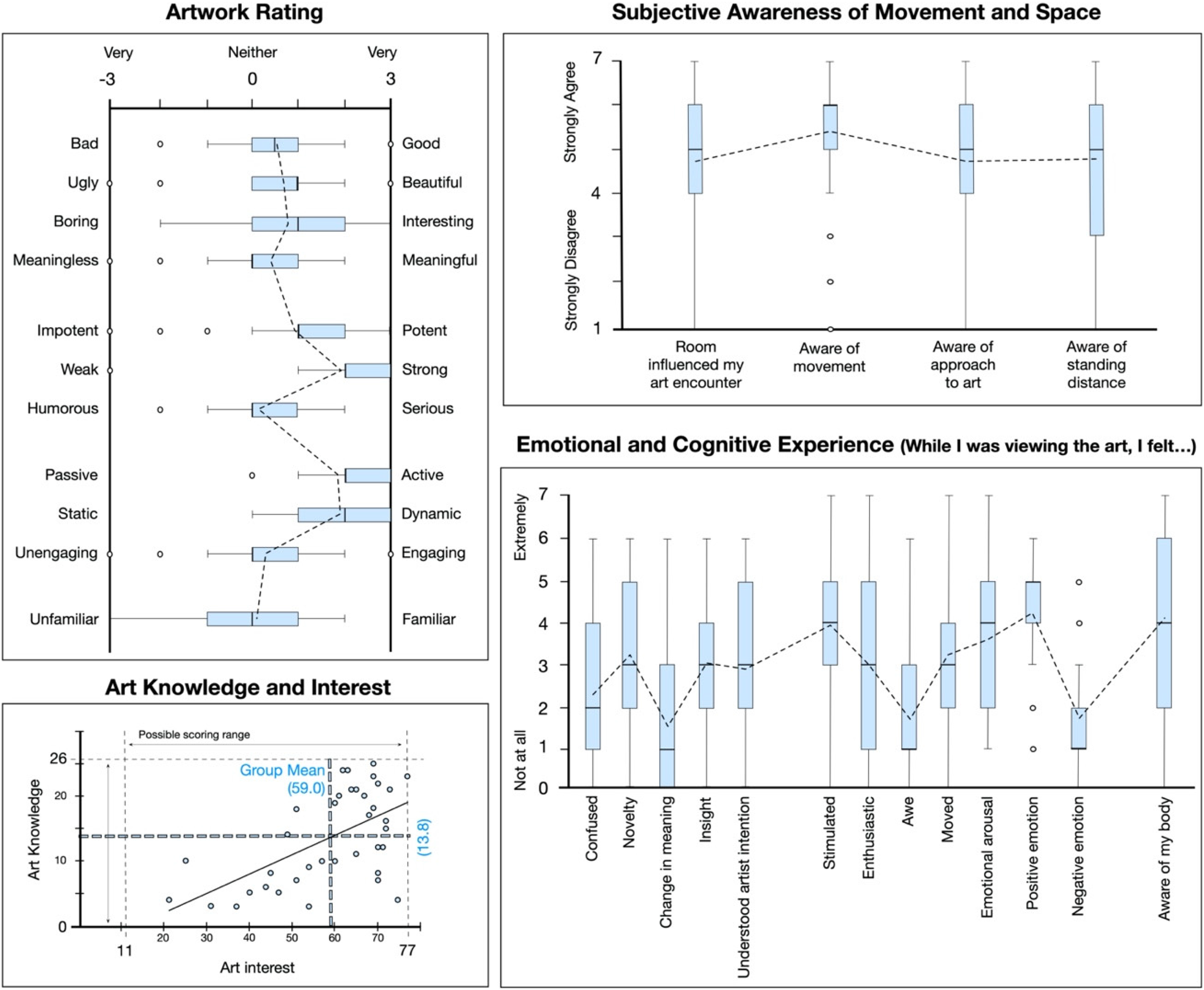
Boxplots for art rating, subjective awareness of movement and space, the emotional and cognitive experience, as well as the relationship between art knowledge and interest. Dotted lines represent the mean.
Descriptive Survey Results
Artwork Appraisals; Viewing Time
A summary of the descriptive data regarding the art appraisals is shown as boxplots in Figure 3 (top left). The mean ratings for basic hedonic factors (good, beauty, interestingness) fell on the positive side of the scales, suggesting a general appreciation of the art. Participants also showed mean ratings on the active (versus passive), dynamic, strong, and potent side of the scales with wide range in responses across the participants. Scales for meaningful-meaningless, serious-humorous, and engaging-unengaging, on the other hand, tended to have means more toward the midpoint, and showed even wider ranges. As expected, familiarity showed the lowest mean of all scales.
On average, participants spent just under three minutes engaging the artwork (M = 2.99 min, SD = 2.19), as determined by using the eye tracking videos and counting from the time at which the participant crossed the threshold of the gallery space to the moment when they turned around and walked away. This result was in-line, and even at the long end of previous museum/gallery studies (e.g., studies suggest mean/medians of 10–40ish seconds with one work of art and free viewing/movement, see Pelowski et al., 2017 for review) as well as with previous findings of mobile eye tracking studies in gallery spaces (e.g., Pelowski et al., 2018). At the same time, as indicated by the large SD, and also as often found in similar studies, we again found a rather wide range in times of between 0.95 and 10.75 min. All participants except one spent at least one minute in the room, 43.59% left within the first two minutes; 23.08% left in the first three minutes; 23.08% spent more than four minutes in the room viewing the artwork.
Emotional/Cognitive Experience
The means for reported emotion and cognitive factors (Figure 3, bottom right) tended to fall at or just below the midpoint of most scales. The highest reported aspects were stimulated, positive emotion, and, notably, aware of body/actions. Negative emotion, experienced a change in artwork meaning, and awe were the lowest reported factors.
Subjective Awareness of Movement
Participants reported that they were generally aware of their movement in front of the artwork (Figure 3, top right), and, to a lesser extent, aware of their distance from and approach to the art, and that the room/space had influenced the way they encountered the art. At the same time, once again, for almost all emotion and movement awareness scales, we also found a rather wide range of responses across viewers.
Correlations Between Appraisal/Experience Factors; Art Knowledge/Interest
Correlations between the individual appraisals, emotional/cognitive experience factors and time, discussed above, are provided for explanatory purposes in Supplementary Materials (Table S2). In general, factors had low to moderate correlations (following Cohen, 1988), with slightly positive relations between most ‘positive’ factors, and vice versa for negative (rτ = .0 to ∼.6). Viewing time positively correlated only with finding the art more interesting and dynamic. The movement/body/space awareness factors, on the other hand, did show higher, positive correlations (rτ ∼.4-.6) suggesting moderate relations. (We discuss relations between these factors and the other art/experience appraisals in the following sections below).
Art Interest/Knowledge and Appraisals/Experience
We found a negative correlation only between interest and emotional arousal as well as positive emotion (see also Figure 6). No relation was found between art knowledge and ratings/emotions.
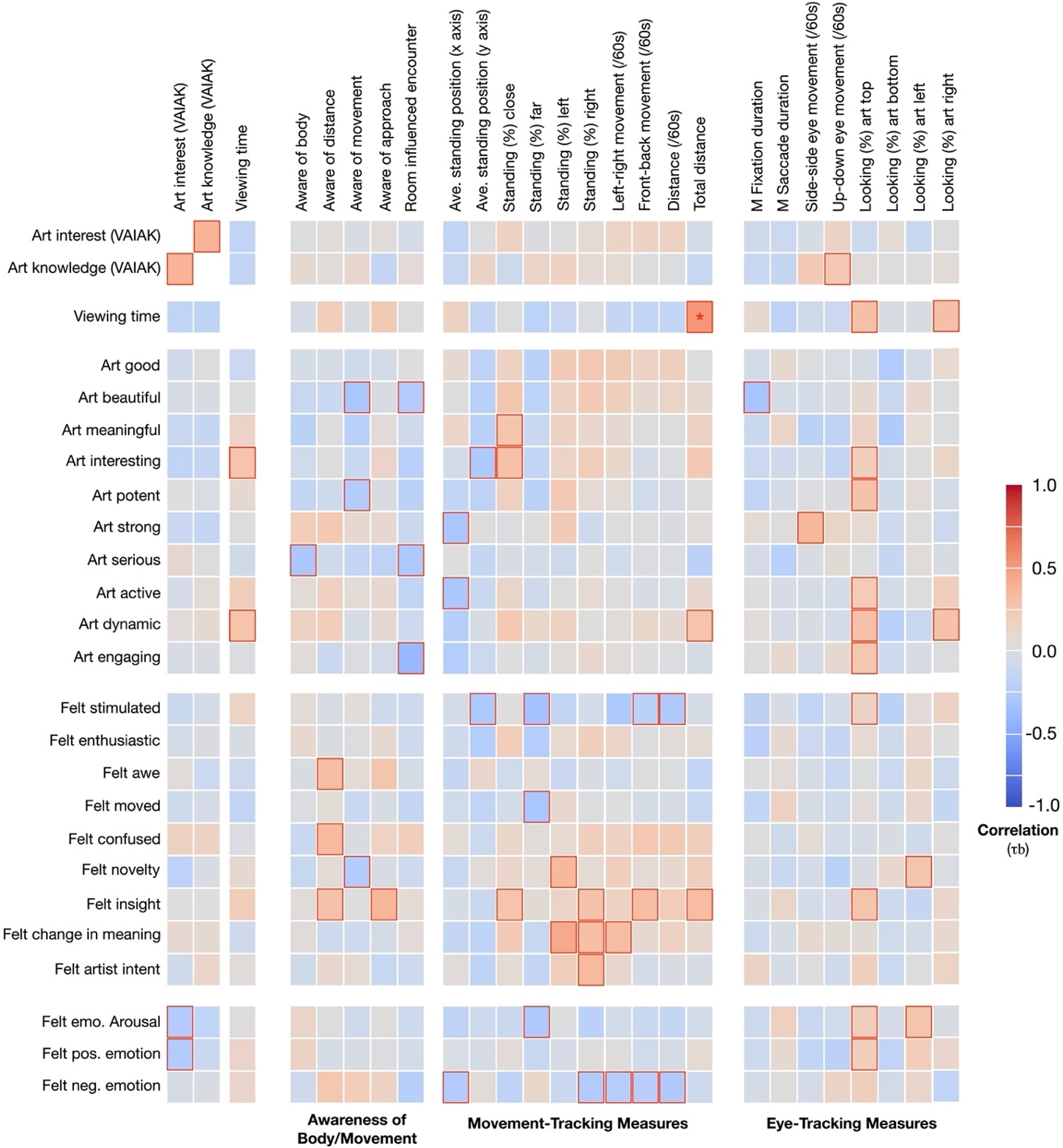
Correlation heatmap (Kendall-tau b, from N = 39 participants) of relation between subjective/objective movement and eye tracking aspects and artwork evaluations, reported feelings, viewing time, and relative level of art interest/knowledge. Red border indicates significance at p < .05, uncorrected for multiple comparisons. * indicates correlations that would retain significance following a Bonferroni correction across all parallel assessments (corrected p = .00007 (.05/650)).
Analysis of Individual Movement (and Looking) Factors (RQ 1)
Data Preprocessing
To analyze the objective movement and viewing data, both were processed and coded using a similar approach, allowing for both their individual assessments and the consideration of their interaction. The eye tracking data was processed and coded via BeGaze 3.7.40 (SensoMotoric Instruments) software. Fixations were detected using the proprietary “SMI Event Detection” algorithm as remaining samples after saccades and blinks detection (see SensoMotoric Instruments, 2017, pp. 365–366 for a more detailed description of the event detection pipeline). 7 Data was first manually inspected and blinks/artifacts or fixations with dropped tracing removed. An average of 95% of fixations per participant were retained (the highest value of missing data was 35.75% for one individual), which can be explained by a general high loss of data with mobile eye-tracking (Niehorster, Cornelissen, Holmqvist, Hooge, & Hessels, 2018). Because of the nature of a mobile eye tracking setup—with continuously shifting depth and focal planes—we did not use typical computer software-driven automatic detection of fixation locations/heatmap-generation. Thus, to identify areas of fixation/looking patterns, the painting area inside the frame was divided into a 5 × 3 grid of 15 (234 × 304 mm) cells (see Figure 1 above and Figure 4 for an example of a resulting heatmap), which has also been done in previous eye tracking studies (e.g., Jankowski, Francuz, Oleś, Chmielnicka-Kuter, & Augustynowicz, 2020). The cell size was chosen to fit the painting with a center row/column. Twenty additional cells were also added to cover the area of the frame and adjacent wall.
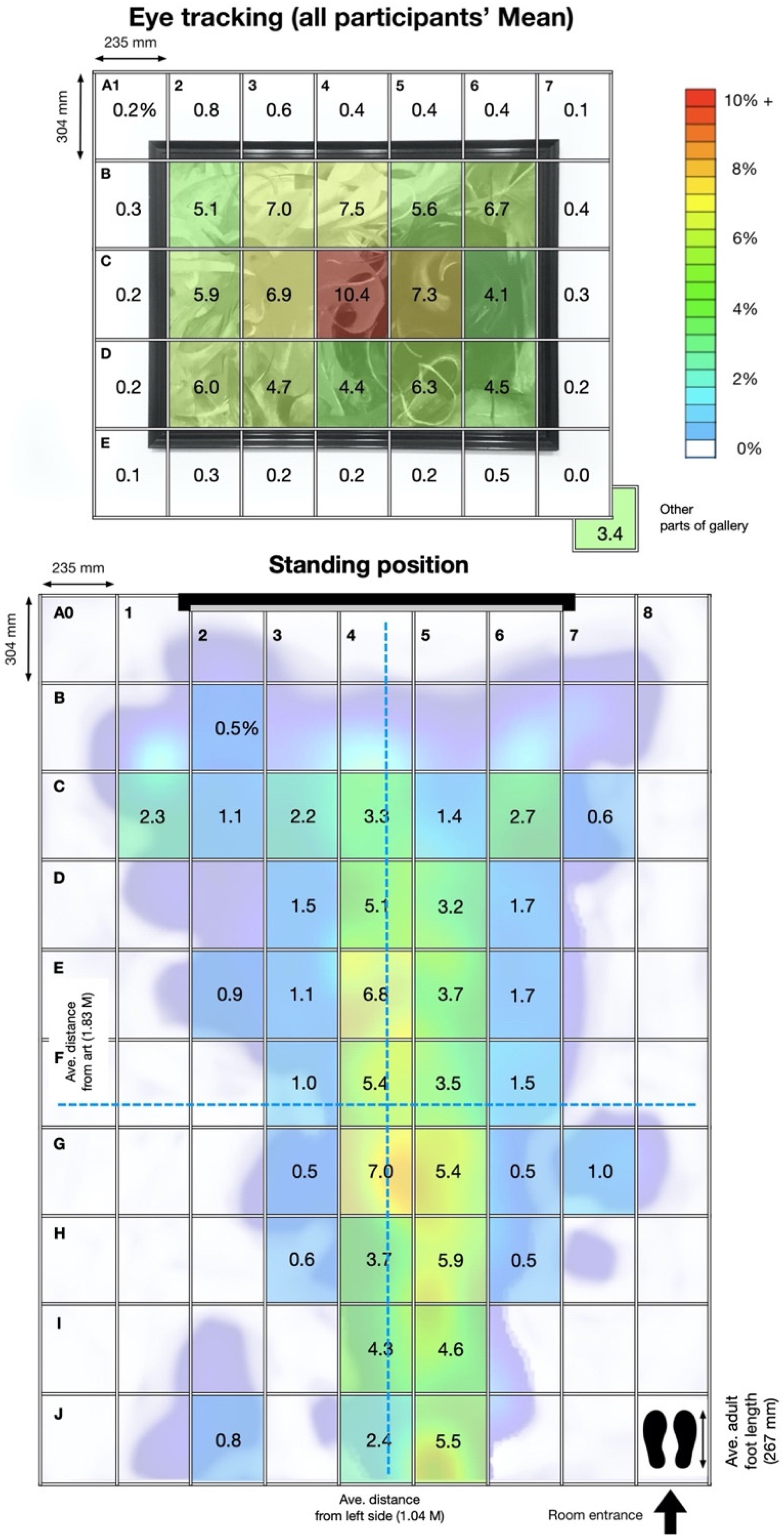
Heatmaps (N = 39 participants’ grand mean) of in-gallery standing positions (bottom) and eye fixations (top) while viewing single artwork (“Kämpfende Formen” (English: Fighting Forms), 1914; by Franz Marc (1880–1916), public domain image, Wikimedia commons). Note, cell color and number indicate % of total fixations spent standing/looking in corresponding grid cell based on manual coding of raw data. Cloud-shaped overlay on floor grid based on computer-generated heatmap from raw x-y location data. Dotted lines in floor grid indicate the average (all participant mean) viewing distance and left-right orientation.
Fixations were then manually coded by one researcher via visual inspection of the fixation in the BeGaze video to identify the corresponding grid location on the artwork. This was followed by a spot-check of roughly 5% of the fixations/participant by a co-author for quality control. All fixations, which did not fall into the artwork or frame area were coded as “other,” however, these accounted for only 3.4% of fixations across participants. As noted for general viewing time above, fixations were considered in our analyses from the moment at which the participant had crossed the threshold from the hallway, entering the gallery, to the last fixation before the participants turned to finally leave. We focused on fixations only, due to these providing the most direct assessment of where individuals looked. However, we retained both number/duration of saccades and fixations for use in some analyses.
For the movement data, the coverage area (gallery floor in front of painting) was similarly divided into a 9 wide×10 grid of cells of size equal to those used in the eye tracking coding above (234 × 304 mm, see Figure 4). Importantly, in addition to fitting the dimensions of the artwork, as described above, this cell size corresponded to the general floor area covered by an average adult (size nine shoes) when standing naturally with feet slightly apart. Corresponding cell locations were automatically coded from each raw location data point (center mass of left/right feet as described in Methods above) via a MATLAB (R2018a; The Mathworks, Inc., Natick, MA) script with subsequent visual inspection of the assignments by a researcher using a combination of the recorded RGB camera images and a generated 2D image of the positions of the feet and the center of mass and cell overlay for reference. The time frame for coding was bounded, as above, from the moment whereby the individual entered the coverage area to the moment when they turned to leave. In addition to the coding, we retained raw x-y coordinates (in mm) for use in some analyses. Positions that were not inside the grid were excluded (4.9%).
For use in cross-modal comparison, location data was also synced to the eye fixation data by assigning both x-y coordinates and grid where individuals were standing for each fixation (where individuals were looking).
Descriptive Results—Where did Participants Stand (and Look)? (RQ 1a)
As a first step, we considered how the movement factors manifested across our sample (see research question (RQ) 1a). In parallel to the various movement results, we also report the eye-tracking results, which we included as an additional measure to help support and round out the movement assessment.
Figure 4 shows a heatmap of the average standing locations (% time spent standing in each cell, out of all position recordings) and eye fixation locations (% fixations spent looking in each cell, out of all recorded fixations) across all participants. The mean standing distances on the x- and y-axis are shown by blue dotted lines across the floor grid. The standing data also includes a more detailed heatmap overlay generated from the raw x-y coordinates. Figure 5 displays the plotted trajectories of each individual viewer as they moved about the gallery space (these will be referred to as part of a pattern analysis further below).
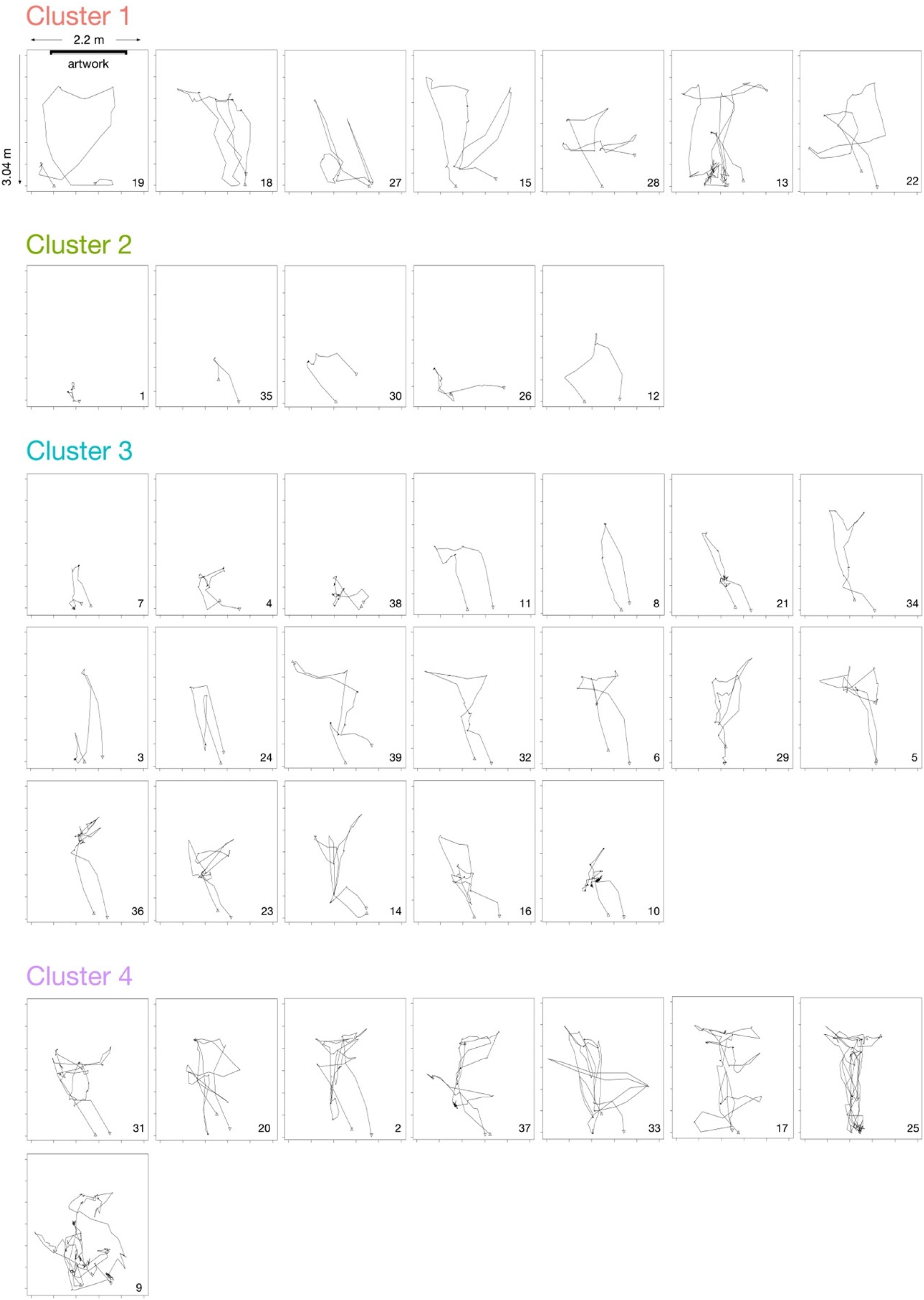
Visualization of individual movement trajectories in x-y plane by 39 participants. Cluster assignments based on outcome of the k-means cluster analysis. Numbers in bottom-right of each trajectory thumbnail are participant IDs, also corresponding to Figure 9.
Participants spent most of their time directly in front of the painting, with a mean left-right position (based on the raw x-y coordinates) of 1.04 m (SD = .15) from the left side of the tracking range (1.059 m = center). This also led to an average visual angle (based on x-y coordinates over time) of almost exactly 90 degrees (M = 91.28, SD = 9.57). Individuals stood on average 1.83 m away from the artwork with a range of 1.17 to 2.84 m (SD = .40 m).
At the same time, as made visible in the heatmap and in the plots of individual movement patterns, there were interpersonal differences in position locations and a notable amount of movement. There was a path, of about ½ meter wide, in the middle of the room, offset slightly to the right presumably due to the rightward position of the entrance, in which participants spent most time. This ran from about ½ meter away from the artwork to the back of the tracking area. The heatmap/trajectory plots also suggested that, especially as individuals stood closer, they tended to spend time at most positions across the left-right width of the work. On average, participants moved 8.39 meters (SD = 5.91; Range =1.61 to 27.50) on the y-axis, towards and away from the painting, and 5.97 m (SD = 4.06; 1.04 to 18.06) from side-to-side with a total mean movement distance of 11.42 m (SD = 7.90; 2.03 to 34.61).
Participants made an average of 526.15 eye fixations (SD = 374.67), with an average fixation duration of 216.40 ms (SD = 35.08)—in line with previously reported durations for paintings (see Jankowski et al., 2020). The mean saccade duration was 79.29 ms (SD = 2.10; mean number of saccades = 500.51, SD = 349.13). 8 As can be seen in Figure 4, participants looked most at the center of the painting, with 10.4% of all fixations in the direct center cell and 24.6% clustered in the three center cells (C3-5). Relatively more fixations were also located in the center-top (7.5%, compared to 4.4% in center-bottom) and top-right corner (6.7% compared to 5.1% in top-left corner). However, as can also be seen, individuals still tended to spend some fixations looking across the entire painting surface, with the lowest percentage of fixations was 4.1%. Altogether, these results are very similar to the eye tracking study by Klein et al. (2014) which used the same artwork. Few fixations (about 3.4% across all participants) were spent looking elsewhere (i.e., floor, room, etc.).
How Did Movement (and Looking) Relate to Art Experience? (RQ 1b)
To assess our next research question (1b), regarding how the individual movement/looking aspects and subjective reports of movement and body awareness related to the appraisals and art experience, we calculated correlations between these aspects.
For objective movements, we first calculated several aspects for each individual viewer from the general results noted in the section above, and following the literature review that began this paper. This included the mean standing distance (both x and y coordinates). In addition, to better consider the potential for people to move around the room to different viewing positions, we calculated the percent of time spent standing relatively close to the artwork (rows A-C, Figure 4, or roughly 0–1m), relatively far (rows H-J, 2.2 + m away), as well as on the right (columns 7–9) or left thirds of the tracking area (columns 1–3). Finally, we considered movement distance in front-back and side-side directions (using the Distance Formula, in cm). Because these latter aspects were highly correlated to total time spent viewing, these were standardized to relative movement frequency per 60 s. We also calculated the total distance moved (length of trajectories), 60 s for both and over the entire art encounter.
For looking aspects, we considered mean fixation duration and saccade duration, as well as the relative amount of time (sum % of total fixations) in which individuals looked at the top of the art (rows A-B, see also Figure 4), at the artwork bottom (rows D-E), at the right (columns 6–7), and at the left side (columns 1–2). In addition, we added a measure of fixation movements—cases where individuals changed one or more cells—in both the horizontal and vertical directions, again standardized to jump/60 s. The subjective factors included the four movement awareness questions discussed above, as well as body awareness.
Results are shown as a heatmap in Figure 6 with the art appraisal and experience factors, as well as viewing time and art interest/knowledge, labeled down the left side and the various subjective/objective movement and looking components listed on at the top, divided into the three aspects above (see also labels on figure bottom). Figure 7 provides a similar heatmap comparing correlations between the individual movement, looking and awareness aspects themselves. (See Supplementary Material Table S3 and S4 for correlation coefficients of all comparisons in the tables). As another means of visualizing the general standing and looking location data, we also produced a selection of heatmaps based on the correlation between the relative percentage of time spent standing or looking in each cell of the grids. These are shown in Figure 8.
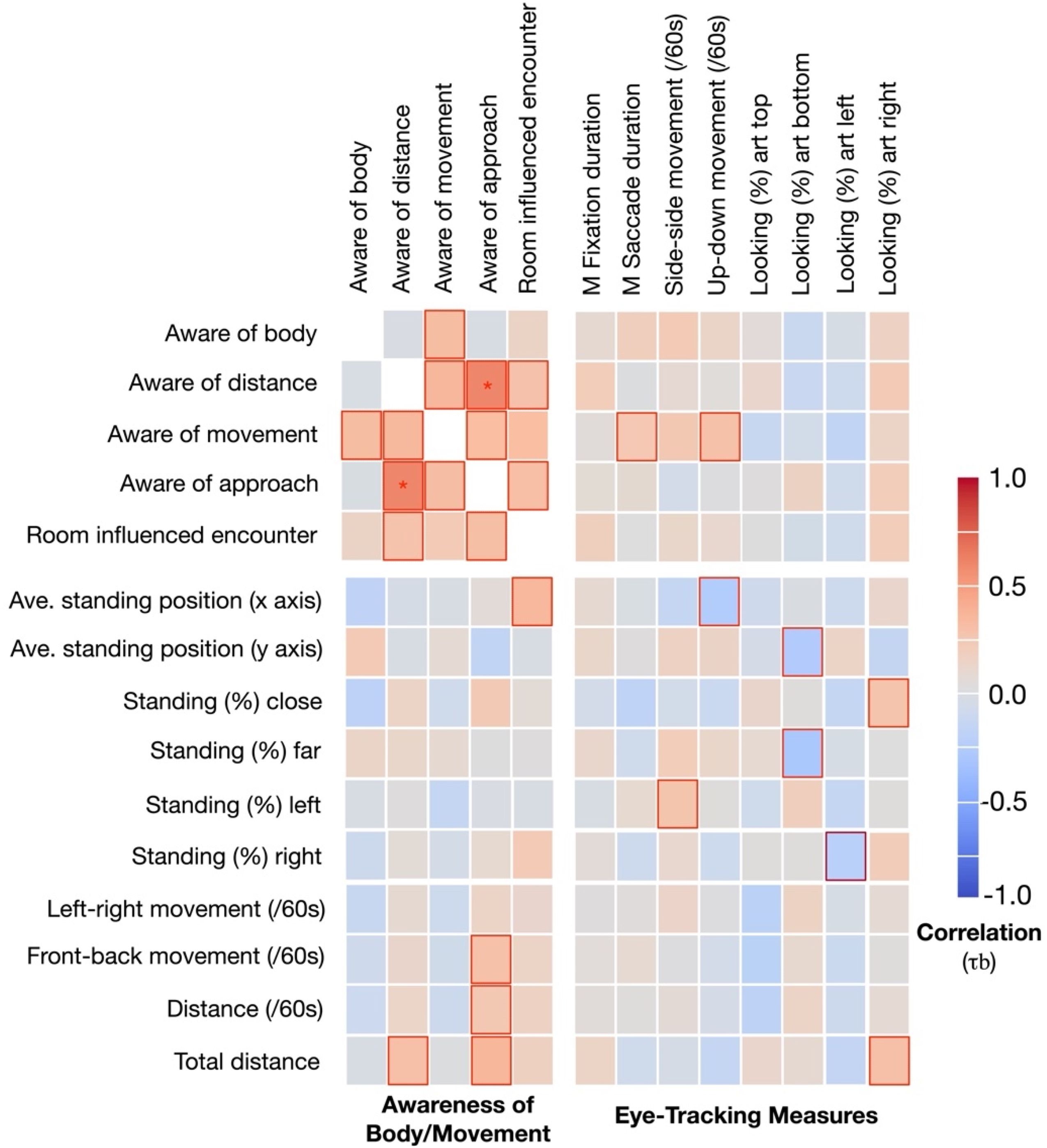
Correlation heatmap (Kendall-tau b, from N = 39 participants) of subjective and objective movement and eye tracking aspects. (Red border indicates significance at p < .05, uncorrected for multiple comparisons; * indicates correlations that would retain significance following a Bonferroni correction across all parallel assessments (corrected p = .00026 (.05/195)).
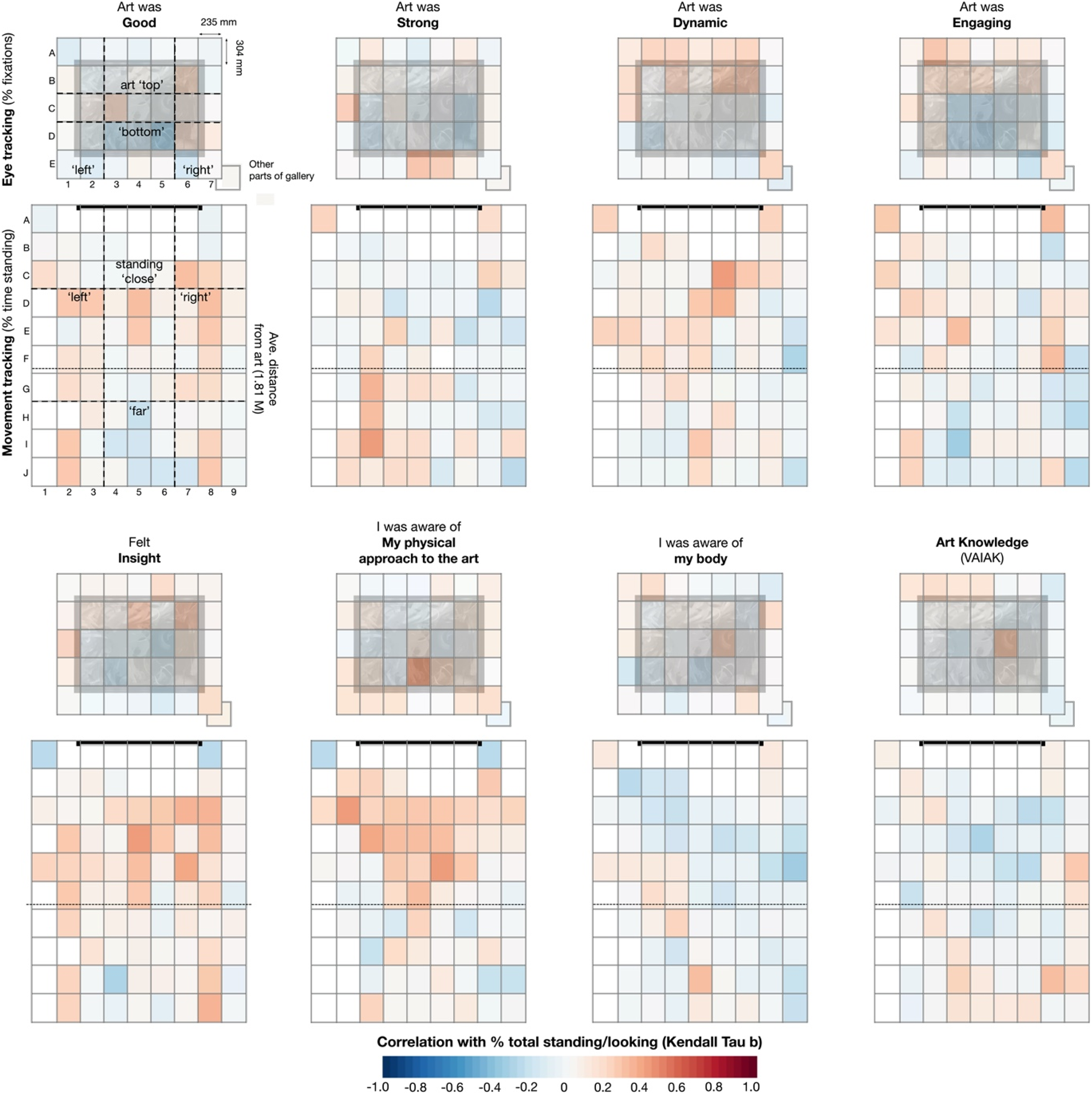
Heatmaps of looking and standing patterns in relation to specific art appraisals, reported feelings, and art knowledge. Color coding based on non-parametric Kendall-Tau b correlation score between appraisal/knowledge factor and % of total time spent looking/standing in each cell (N = 39 participants). Dotted lines in top-left image and corresponding label (“top,” “bottom,” “sides,” etc.) denote the grid areas used for assessment of standing/looking area correlations in Figures 5–6.
Note, these analyses, which include a large number of assessments and are reported without a correction for multiple comparisons, are provided as part of this paper's overall exploratory approach. Thus, although we generally used an alpha of .05 as a guide for identifying “notable” effects (also indicated by a red box for the corresponding factors in Figures 6–7), these should be considered more as indicators of possible relationships that could be tested more in the future studies. We also provide information regarding family-wise Bonferroni adjustments in the Figure 6–7 footnotes, with factors that would survive this adjustment noted by a red asterisk.
Overall, most correlations were rather small to moderate (rτ < ±.6). Regarding the distances and locations of standing in the room, we found a negative correlation between mean standing distance from the art (y-axis) and finding the art interesting (rτ = -.251), and feeling stimulated (-.261) (i.e., standing further away was related to lower reports of these factors, Figure 6). This was mirrored in the relation between standing relatively closer (in the first three grid rows) and rating the art as more interesting, (.292) meaningful, (.274) and feeling more insight (.280) (see also Figure 8 heatmap). Standing in the three rows farthest from the art again negatively correlated with feeling stimulated, (-.333) as well as to lower moved (-.306) and emotional arousal (-.280).
Spending relatively more time in the three right-most columns also positively correlated to more felt insight (rτ = .263), experiencing a change in meaning (.282), and understanding of artist intention (.317), as well as to feeling less negative emotion (-.292). Spending relatively more time in the left three columns also correlated to more reported change in meaning (. 415) and with feeling novelty (.325). Whereas, if we looked to only the mean standing distance on the x-axis, the farther this was to the right side the more people reported feeling negative emotion (-.240) and rated the art as less strong (-.266) and active, (.325) perhaps (see also Figure 8) suggesting, more than anything, that such individuals never made it very far into the room. Whereas, spending relatively at least some time moving around to the sides and near the painting related to more positive/insightful ratings.
To support this argument above, frequency of left-right (rτ = -.276), front-back (-.252), and total movement/60 s (-.291) all correlated again to less reported negative emotion. Left-right movement/60 s also positively correlated to more change in meaning (.294) and front-back movement/60 s correlated to feeling insight (.239). Total distance moved, not standardized to time, also showed a significant positive correlation with finding the art dynamic (.255) and feeling insight (.307). Overall, there was a significant relation between viewing time and total distance of movement (.511), but not to movement frequency in any direction, suggesting that viewers tended to constantly move around throughout the experience.
Looking Aspects
Among the looking aspects, more side-to-side fixation jumps/60 s correlated only to rating the art as more active (rτ = .325). Up-down eye movements/60 s, as well as mean saccade duration showed no notable relations. In regard to looking locations, looking relatively more at the top (or even above) the artwork correlated with rating the art as more interesting (.275), potent (.295), strong (.250), dynamic (.279), engaging (.259), as well as with spending more time looking (rτ = .293) and with feeling more stimulated (.277), insight (.272), emotional arousal (.274), and positive emotion (.260). Looking relatively more at the artwork bottom did not show any notable relations. Looking relatively more at the right side of the artwork positively correlated with viewing time (.266) and rating the artwork as more dynamic (.265), while looking at the left positively correlated with feeling novelty (.252) and arousal (.242). Mean fixation duration also negatively correlated to rating the artwork as beautiful (-.313). In general, it is also notable that looking aspects showed the strongest correlations to the artwork ratings, whereas, unlike the physical movement aspects, they showed minimal relations to reported experience.
How Did Subjective Movement Aspects Relate to Art Experience? (RQ 1c)
In subjective reports, awareness of how one had physically approached the art (rτ = .346) and of one's standing distance (.272) positively correlated to feeling insight. Awareness of standing distance also positively correlated to more felt confusion (.323) but also awe (.313). On the other hand, higher awareness of one's movement itself correlated with rating the art as less strong (-.280), beautiful (-.324), and with less felt novelty (-.274). A similar pattern was found for both awareness of one's body, which correlated to rating the art as less serious (more humorous) (-.320), and with feeling that the room had influenced the way one had engaged the art, which correlated to lower ratings of seriousness (-.309), beauty (-.290), and finding the art engaging (-.435).
How Did Subjective Movement Aspects Relate to (Objective) Movement (and Looking)? (RQ 1d)
Moving to the correlations between the different objective movement/looking and subjective movement aspects themselves, which was our research question 1d (Figure 7), subjectively being more aware of one's approach positively correlated with relatively more front-back movement/60 s (rτ = .300) as well as total distance travelled/60 s (.269) and total distance in the entire art engagement (.348), presumably in keeping with the relations between this awareness and generally insightful/positive ratings discussed above. Similarly, total movement distance also correlated to being aware of one's approach to the art (.270). Whereas, having a mean standing location more to the right correlated to feeling that the room influenced the encounter (.270). Few relations were found to viewing aspects, with the exception of a positive correlation between being aware of movement, mean saccade duration (.245), and frequency/60 s of up-down fixation jumps (.262).
Regarding the relative locations where individuals looked and stood, individuals who stood further away (both mean standing position on the y-axis (-.252) and standing relatively more in the three furthest-away floor grid rows (-.285)) looked less at the bottom of the artwork. Those who stood on average more on the right side of the room (mean position on x-axis) showed less up-down fixation jumps ( -.228). Spending more time on the left of the room correlated to more side-side fixation jumps (.249). On the other hand, looking relatively more to the right side of the artwork positively correlated with total movement distance (.279) and standing relatively closer to the art (rτ = .254). A pattern of negative correlations was also found between relatively standing more on the right and looking to the left side of the painting (-.245), suggesting again that individuals tended to look directly ahead.
Moving/Looking and Art Interest/Knowledge
Similar to the artwork ratings above, the objective and subjective movement/looking aspects showed few notable relations to art interest or knowledge: viewers with higher knowledge scores showed more up-down fixation jumps/60 s (rτ = .236) (Figure 6).
Combining Movement Aspects to Find Shared Patterns for Engaging Art? (RQ2)
We then moved to our second main aim, looking beyond individual moving components to capture the movement as a whole and determine whether participants organized into statistically distinct movement types that share pattern. To do this, we returned to the individual movement trajectories (Figure 5). Rather than visually grouping the different paths based on our own subjective assessment, which could lead to unintentional biases (Gonsek, Jeschke, Rönnau, & Bertrand, 2021), we based our approach on a growing body of animal movement studies which has generated promising methods and metrics to differentiate movement trajectories (Cleasby et al., 2019; for review see Joo et al., 2020).
Following this approach, we assessed a suite of seven movement metrics widely applied in such studies (see also Table 1) using the adehabitatLT (Calenge, 2015) and the trajr package (McLean & Skowron Volponi, 2018) in R 4.0.3 (R Core Team, 2018). Metrics included: the mean position on x- and y-axes, the length of each trajectory (trajectory length), the Euclidean distance between present location and a consecutive one (step length), straightness of each trajectory, euclidean distance between the present location and the starting location of the trajectory (net squared displacement; R2n), and duration. To standardize resulting metrics for further analysis, they were log-transformed, mean-centered, and divided by the variance (Jolliffe, 2014). Note, this analysis only considered body movement, as this was our main aim, and because eye movement data was non-continuous due to binning into grids.
Loading Values of Principal Component Analysis (PCA) for All Seven Components; Their Eigenvalues, Percentage (Variability %) and Cumulative Percentage (Cumulative %) Expressions.
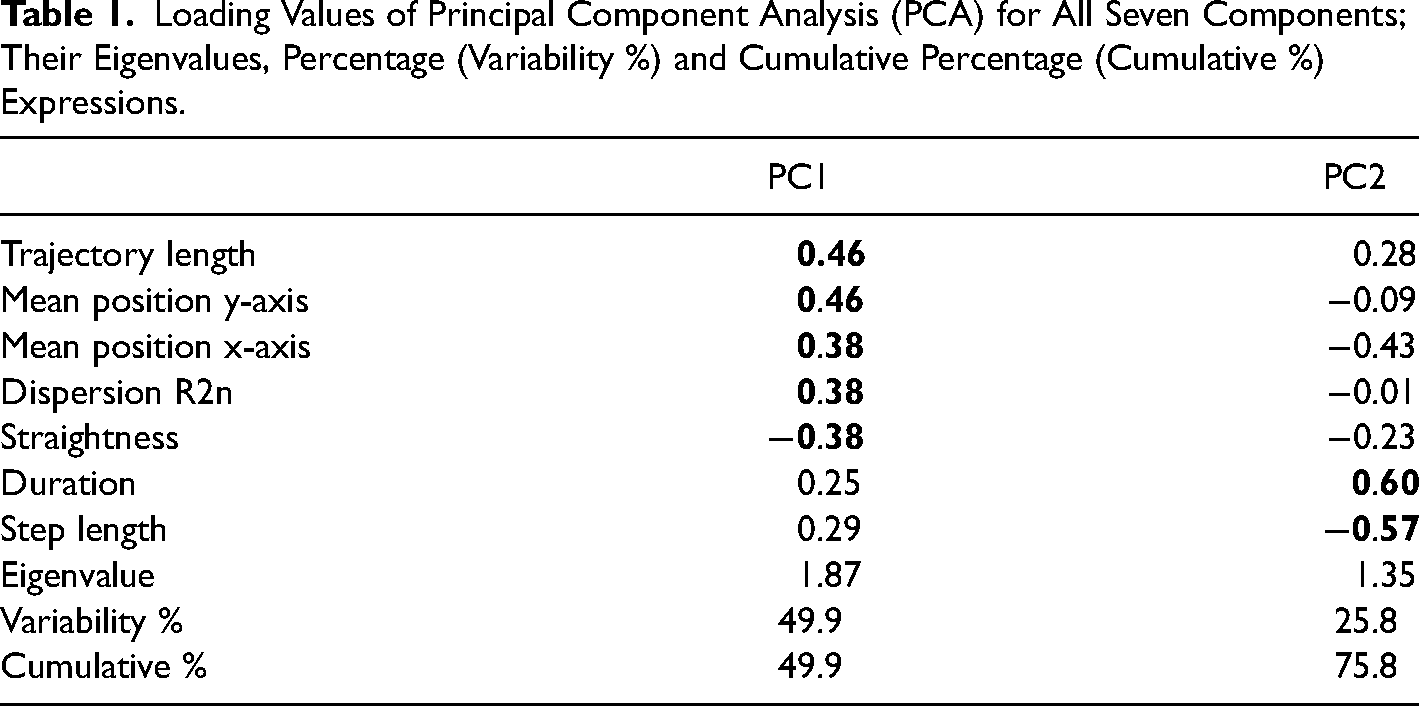
A principal components analysis (PCA) was then conducted on the above metrics using the prcomp function in the R stats library based on a correlation matrix (see Abrahms et al., 2017 for use with movement data). A Broken-Stick criterion (following Abrahms et al., 2017), a scree plot, and the Kaiser-Guttman rule, which states that components based on eigenvalues greater than one should be retained, all suggested two components (see Supplementary Material, Figure S1–2). Together, these components explained 75.18% of the variance among the movement metrics. As can be seen in Table 1, component 1 had the highest loading for trajectory length, mean x- and y-axis position, R2n, and a negative correlation with straightness—or generally suggesting relative amount of changing direction and small shifts versus long straight movements especially in left-right directions. Component 2 had highest loadings for mean movement distance, viewing time, and movement in the front-back dimension (y-axis).
Using these metrics, we then performed a k-means cluster analysis, which clusters the most similar pair of points based on similarity, using the kmeans function in R to determine if our participants fell into statistically distinct groupings (Hartigan & Wong, 1979), and followed by the Elbow method via NbClust package (Charrad, Ghazzali, Boiteau, & Niknafs, 2014) to determine an optimal number of such clusters. This suggested four groupings that best described our participants’ movements.
Identified Patterns of Movement
The movement clusters are shown in Figure 9 (bottom) along with the PCA biplot showing loadings of individual metrics used in the two principal components and the resulting clusters and corresponding individual trajectories (corresponding to individual viewers in Figures 5 and 9). Cluster 1 was characterized by high straightness, low dispersion, short duration, high step length, and mean x-axis standing position more to the right. Looking to the individual trajectories (Figure 9), participants in Cluster 1 appeared to often make a loop through the room, but as suggested by the above objective factors with a rather undeviating engagement. Cluster 2 showed similar objective factors as above, especially straightness and short duration, as well as y-axis metric (see also Figure 9) suggested that they did not step far into the room. Clusters 3 and 4 showed more movement and position adjustments, approaching art with then some side-side movement—with Cluster 4 showing the longest trajectory distance, most dispersion, and also took more time than the others.
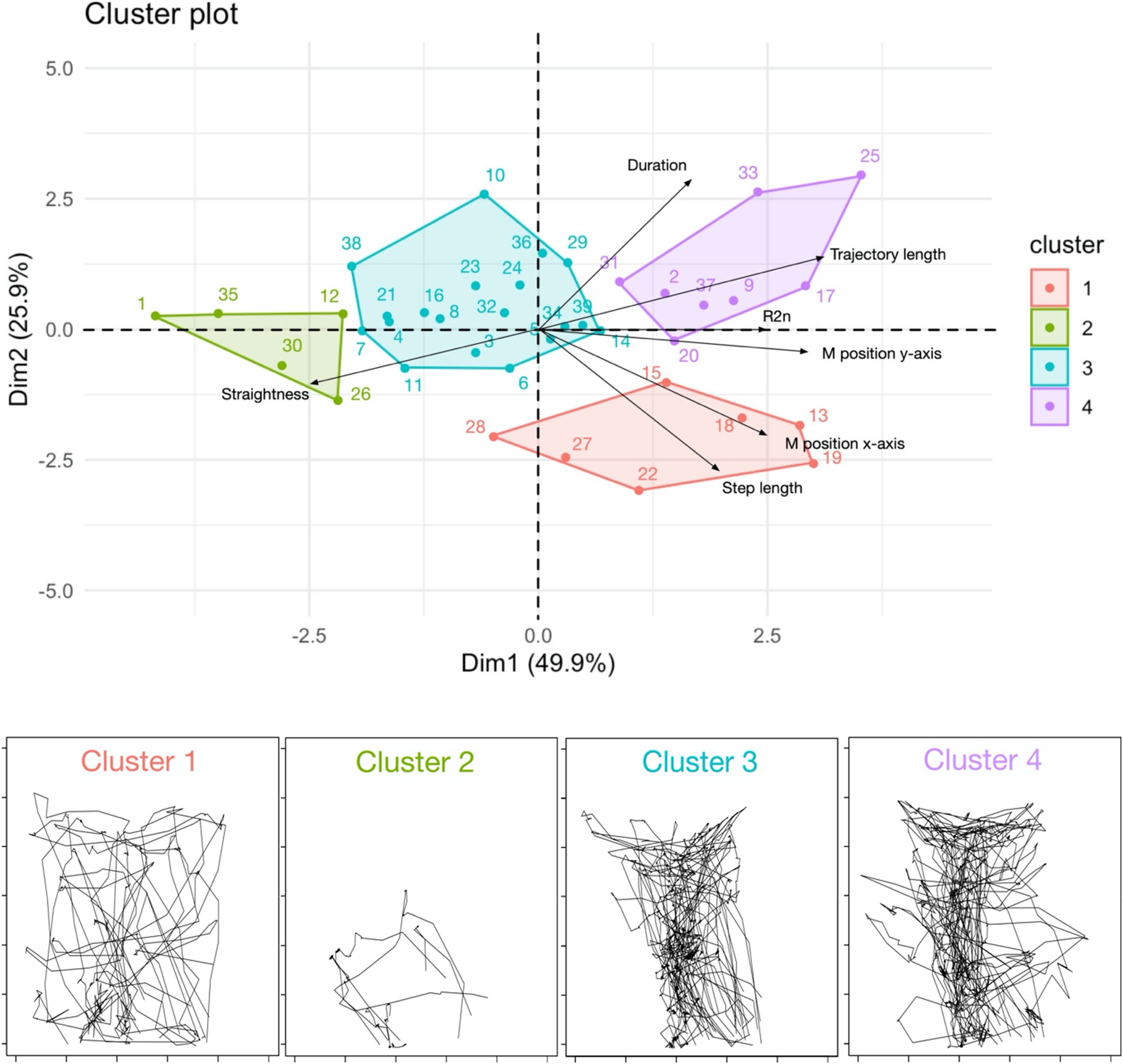
Top: overlay of PCA biplot showing loadings (assessed via factoextra R package) of individual metrics for two principal components identified for assessing global in-gallery movement patterns, and cluster plot showing the four clusters (outcome of the k-means cluster analysis) in the component 1 and 2 plane. The dots with numbers represent the 39 viewers of our sample and also corresponding to the individual trajectory thumbnails in Figure 4. Bottom: composites of all individuals’ movement trajectories assigned to each of the four clusters.
Movement Patterns and Art Experience
To consider the relation between the movement patterns and the experience of the art, we conducted non-parametric Kruskal-Wallis Tests. We found differences between patterns for awareness of the physical approach to the artwork (H(3) = 9.25, p = .026), stimulated (H(3) = 8.07, p = .045), emotional arousal (H(3) = 10.50, p = .015), positive emotion (H(3) = 8.92, p = .03), insight (H(3) = 7.91, p = .048), and with rating the art as dynamic (H(3) = 10.28, p = .016) (see Figure 10). As above, no differences were found for art knowledge or interest. Note also that none of the comparisons were significant after Bonferroni adjustments (adjusted alpha .0016 (0.05/30)), but they indicate some interesting patterns for future research.
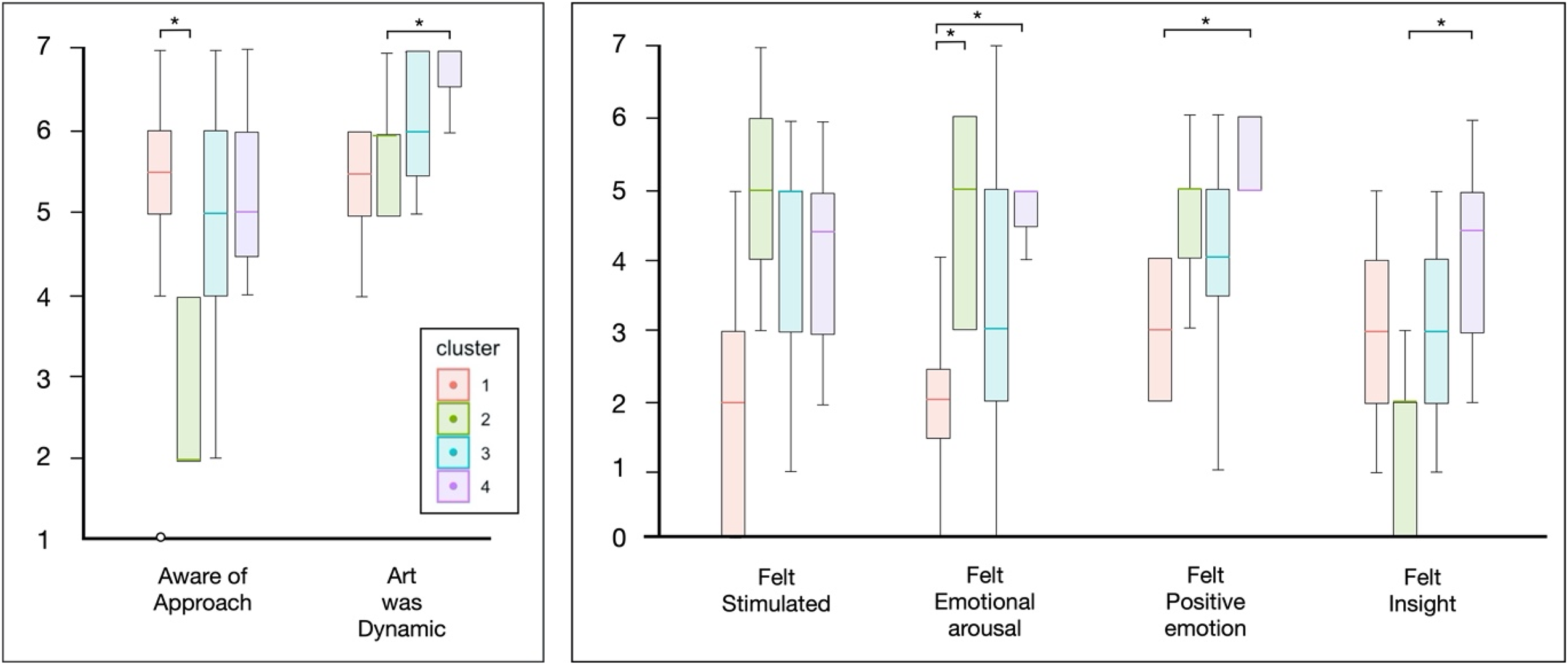
Art appraisal and art experience factors showing differences between individuals assigned to four global gallery movement clusters/groups (all factors showed significant main effect for group, non-parametric Kruskal-Wallis Tests). Error bars indicate standard error of the mean. * indicates significant differences between specific groups, Mann-Whitney U post-hoc pair-wise comparison (p < .05, Bonferroni adjusted). (awareness of the physical approach to the artwork, Group 1 vs. 2 (z = 2.849, padjusted = .026, Mdn1 = 5.5, Mdn2 = 2); rating of art as dynamic, Group 4 vs. 2 (z = -3.003, padjusted = .016, Mdn1 = 5.5, Mdn4 = 7); emotional arousal, Group 4 vs. 1 (z = -2.784 padjusted = .032, Mdn1 = 3, Mdn4 = 6), Group 2 vs. 1 (z = -2.707, padjusted = .041, Mdn1 = 3, Mdn2 = 6), felt positive emotion, Group 4 vs. 1 (z = -2.911, padjusted = .022, Mdn1 = 4, Mdn4 = 6); felt insight, Group 4 vs. 2 (z = -2.805, padjusted = .03, Mdn2 = 3, Mdn4 = 5.5). No statistically significant post-hoc differences found for feeling stimulated).
Looking to the comparisons between the individual movement patterns (see Figure 10 for information on post-hoc pairwise comparisons), we found some trends suggesting differences especially between Cluster 4 with more movement length and adjustments in position that resembles a “T”-shape and the patterns with less adjustments and movement (Cluster 2 but also 1). Cluster 4 showed the most insight, feeling of positive emotion, and rated the art as more dynamic, while especially pattern 2 showed low scores on these ratings. On the other hand, Cluster 2 had the highest reported feeling of being stimulated and emotional arousal. Cluster 1, 3, and 4 had higher awareness of how they had approached than Cluster 2.
Among other interesting trends, Cluster 1, although again with moderate insight, but a rather meandering path, had notably the lowest affective (stimulation, arousal, positive emotion) response, and rating the art as dynamic.
Discussion and Conclusion
This study presented a novel approach to capture viewers’ behavior—in terms of their body movement and viewing positions—when engaging one artwork in a gallery-like setting, coupled with viewers’ subjective awareness of their body and movement, mobile eye tracking, and ratings regarding art evaluation, emotion, and cognitive experience. This had the main aims of assessing (1) how we might record and systematically assess individual movement and looking aspects, and how these might relate to individuals’ art experience—a question that, rather surprisingly, is still in need of much empirical work. (2) We further considered whether we such aspects could be combined into shared patterns of movement that could relate to how people responded to the art. While being exploratory, with results that should be considered as trends and an overall “proof of concept,” we did find several interesting patterns, which relate to previous theoretical and experimental suggestions that began this paper and Table 1A, and which set up exciting new directions for movement and ecologically-valid art research.
First, to describe how people generally move in front of art we did find that many participants showed general patterns for engaging the art and navigating the gallery room both in line with past observations and especially foregrounding the role of positioning and movement: Participants walked up and approached the art, moving to and staying mainly within a column of half a meter wide running from the back of the room to about 1.17 m from the artwork, and resulting in movement paths that approximate a “T-shape” with more side-side movements nearer to the art (see corresponding research question in Table A1, b3). At the same time, this was also coupled with differences in individual trajectories, with both up-down and left-right changes and essentially providing systematic, individual-level evidence for past arguments regarding general navigation and adjustments in front of gallery art (Griswold et al., 2013; Pelowski et al., 2017). Total amount of distance people moved positively correlated with time. Whereas, we did not find a similar pattern with frequency of movement—suggesting a linear relation whereby individuals tended to contiguously move, at their own pace, throughout the engagement, in line with previous findings (Yoshimura et al., 2014), with a mean distance travelled of 11.4 meters; ranging from two to over 34.
During art engagement, visual attention was mainly on the artwork. We found a similar heatmap pattern like Klein et al. (2014): few fixations (3.4%) were spent looking to the floor, room, or otherwise related to navigation. This is also in line with emerging findings (e.g., Carbon, 2020 found 84.5% of visit duration spent looking at art materials), suggesting an integration of looking and movement allowing most attention to be focused on the art. Although showing relatively more focus on the painting center (see also Locher et al., 2007; Locher, Gray, & Nodine, 1996), participants also tended to look at all parts of the painting surface. This was coupled with a visual angle of nearly 90 degrees, and a correlation between right-left looking and standing positions, suggesting that individuals tended to use their movement in order to look straight ahead to visually explore the art. We for the first time in the field of empirical aesthetics assessed viewers’ subjective experience during art engagement and found that participants were generally subjectively aware of their body, as well as their viewing distance, and their physical approach to the artwork, although, as with the movement aspects, also suggesting a good deal of individual difference.
When then looking to how individuals’ movement related to appraisals and experience, we also found several interesting outcomes. We found indications that when people spent more time near to the artwork, or when their mean viewing distance was closer, they rated the art as more meaningful, interesting, and reported feeling more stimulated and insight. Participants who spent more time standing farther away had a less stimulating, moving and emotionally arousing experience, supporting arguments for closer/intimate engagements, or approaching actions relating to interest or positive ratings (see Table 1A, b2; Czeszumski et al., 2021; Fernández et al., 2019; Frijda, 1986; Fuchs & Koch, 2014; Pelowski et al., 2018).
The mean viewing distance (1.83 m/0.78 x the painting width; 1.6 x the area) tended to be closer than some previous arguments that an optimal distance would be roughly 2x a painting width (Clarke et al., 1984; Maertens, 1884; see Table 1A, b1).). However, we also found a range of distances (1.17 to 2.84 m; .5–1.2x painting width), in keeping with more recent studies showing similarly wide interpersonal difference in, say, self-chosen ‘ideal’ viewing distances (e.g., > 1 to 5 + meters, Carbon, 2020; see also Estrada-Gonzalez et al., 2020). It is also notable that, although our galley (3.5 meters deep) was slightly smaller than in some museum-focused examples (e.g., Carbon, 2020), and thus could have limited viewing distance, our viewers did not tend to stand as far away as possible, but rather moved and adjusted viewpoints.
We also found interesting relations to left-right position. Spending relatively more time standing on the right side of the artwork/room positively correlated to more felt insight, experiencing a change in meaning, and understanding of artist intention, as well as to feeling less negative emotion. At the same time, spending relatively more time on the left side also correlated to more change in meaning and felt novelty. This would suggest against some past suggestions (e.g., see Table A1, a1-3; b3), proposing a relation between standing/looking on one particular side and higher ratings. Perhaps more intriguing, these patterns suggested, once again, perhaps for the importance of movement itself. Much as standing more on the sides, regarding the dynamics of movement (see Table A1, a4), frequency of left-right, front-back, and of total movement distance/60 s all correlated to less reported negative emotion; left-right movement/60 s correlated to more change in meaning; front-back movement/60 s correlated to feeling insight. A similar positive correlation was found between total distance moved and feeling insight and finding the art dynamic, whereas such a relation was not found with only time spent viewing, suggesting again—especially as the present paper was one of the first to actually couple these above aspects to reactions at the individual level—the need and promise for more work exploring these topics.
This importance of movement was further highlighted in our second research aim. By, for the first time, applying methods from animal movement ecology, we were able to classify the 39 individual movement patterns into four distinct groups. Notably, beyond the basic ability to show shared patterns by which we might move in front of works of art, the resulting patterns also suggested especially that those showing the most, and the most focused, movement—with both a complete advance near to the artwork, as well as front-back and especially side-side adjustments—showed the most feeling of positive emotion, insight, and again rated the art as dynamic. On the other hand, a pattern with little movement, little approach to the art, and little adjustment showed especially low ratings for insight. A pattern suggesting participants had made at least one loop into the room, near the art, although without much adjustment, while showing some insight, also showed the lowest emotional arousal, positive emotion, and dynamic art ratings (see Table A1, e).
These findings suggest, again, the importance of moving and position adjustment in both emotional and cognitive art experience. The full corpus of our findings also suggests against certain arguments—such as the “stopping for knowledge” hypotheses (Sarasso et al., 2020)—that had proposed that these responses might require absence of movement. Rather, we find just the opposite (see also Cox & van Klaveren, 2022; van Klaveren et al., 2019 for similar results). The technique itself is also a promising start for future studies to move beyond even individual aspects and systematically assess trajectories and their implications for experience.
Regarding other research aspects, the subjective reports of awareness of how one had physically approached the art and of one's standing distance correlated to feeling insight and awe. Awareness of these aspects also correlated to moving relatively more per minute forward-backward and in total, as well as total distance travelled. On the other hand, awareness of movement itself, of one's body, and of the room, negatively related to appraisals of beauty, potency, seriousness, novelty, and engagement. These findings are also intriguing, suggesting, on one hand, the potential importance of subjective awareness of physical movement, especially as this might relate to more high-level navigation of a room and art. On the other hand, these latter findings, which might relate to past findings that especially becoming too aware of one's body or one's actions might lead to discomfort (e.g., Pelowski et al., 2014), as well as the fact that here too, past research has never considered body/movement awareness in gallery interactions with art, also present key potential differences and questions for future research (see Table A1, d).
Regarding the relationship between viewing behavior and art experience (see Table A1, f), we found comparatively few notable relations, especially to basic fixation durations and frequency of side-side or up-down movements. This itself matches past findings that have found, for example, no relationship between art appraisals and fixation duration in the mobile context (Heidenreich & Turano, 2011). The most pronounced pattern, on the other hand, to where individuals looked, with looking relatively more at the top of the artwork, or upwards in general, positively related to the same collection of positive terms found throughout (interesting, potent, dynamic, engaging, feeling stimulated, insight, positive emotion). This provides some support for past arguments that looking up is itself associated positively (Crawford, Margolies, Drake, & Murphy, 2006), leads to more positive evaluations (Fingerhut & Prinz, 2018), but also raises the importance of looking at these aspects in mobile, ecologically-valid contexts. The looking and moving aspects—beyond a relation between looking more at the side to which individuals spent most time standing—were not correlated (see Garbutt et al., 2020 for similar evidence).
Finally, we did not find a relation between movement aspects and either objective art knowledge or interest. Although a relation between especially expertise and movement might have been expected—whereby individual learn to move and engage in certain patterns (Brinck, 2018)—and despite our sample including individuals pursuing advanced degrees in art history, this might suggest rather that moving and resulting types of engagement could be a more basic aspect of the way we respond to art or to our environment (see also Linden & Wagemans, 2021 for similar findings).
Caveats and Avenues for Future Research
This study is, of course, not without limitations and other targets for future research. The design of our study was correlational, utilized only one specific art example, and with, again, a rather small sample. The effects found may not be generalized to other artworks and gallery settings. Especially factors such as viewing distance may, for example, depend on the artwork's size (Carbon, 2017; Clarke et al., 1984; Estrada-Gonzalez et al., 2020). Thus, subsequent research should employ more gallery rooms and artworks, varying in size, and include other art forms such as sculpture or installation art, for which mobility is key to its experience (Morris, 1966; Verstegen, 2006). Future studies should also implement more controlled conditions such as inviting participants to move in certain ways as a point of comparison, use of interventions, and focus on specific aspects. Embodiment also goes beyond physical movement. For example, changes in posture and body sway might be considered (Cox & van Klaveren, 2022; Kapoula, Adenis, Lê, Yang, & Lipede, 2011). Emotions too might more fully be considered, especially how certain movement patterns relate to specific emotional responses (Fingerhut & Prinz, 2018, 2020).
The general lack of notable patterns and relationships with the movement aspects regarding the eye tracking data could also be attributed to the rather course grid-based coding of fixations. More fine-grained continuous eye tracking data might allow to assess the relationship between looking and moving using the movement data time-synched to the eye fixation data (e.g., via Granger causality analysis one could assess whether a particular measure comes before another in time series, that is whether looking is a useful predictor of moving or vice versa). In addition, fine-grained eye tracking data would allow for statistically examination of eye-tracking (in the same manner as we did with movements) over time (for a grid-based temporal approach see Locher et al., 2007). More fine-grained eye tracking data would also be useful in order to rule out of the possibility that the relationship between art experience and fixation locations might be due to visual artwork properties alone (e.g., by using image statistics of saliency or color as moderators in the analysis). All of which would provide a meaningful contribution to arguments for advantages of mobile eye-tracking for museum studies (De Winter & Wagemans, 2022; Linden & Wagemans, 2021).
Finally, since our study design was lab-based with a mock-gallery simulating contextual art experience factors, the movement patterns and our overall technique should be further tested in real art galleries and explored for whether similar patterns do emerge with other art types and viewers, as well as either employing experience items focusing on specific outcomes, or reducing them into greater factors (e.g., by using PCA).
That said, we, for the first time, showed that we can meaningfully track participants’ movements in front of art with our new tracking device and provided a new paradigm on how to assess at the interplay between objective and subjective movement aspects and patterns as a whole, viewing behavior, as well as appraisals in a gallery-like setting. It is our hope that the theoretical considerations and novel methods might inspire other researchers and will addressed in future studies to assess the role of the body in art experience.
Supplemental Material
sj-docx-1-art-10.1177_02762374231160000 - Supplemental material for How Do We Move in Front of Art? How Does This Relate to Art Experience? Linking Movement, Eye Tracking, Emotion, and Evaluations in a Gallery-Like Setting
Supplemental material, sj-docx-1-art-10.1177_02762374231160000 for How Do We Move in Front of Art? How Does This Relate to Art Experience? Linking Movement, Eye Tracking, Emotion, and Evaluations in a Gallery-Like Setting by Corinna Kühnapfel, Joerg Fingerhut, Hanna Brinkmann, Victoria Ganster, Takumi Tanaka, Eva Specker, Jan Mikuni, Florian Güldenpfennig, Andreas Gartus, Raphael Rosenberg and Matthew Pelowski in Empirical Studies of the Arts
Footnotes
Appendix
A Summary of Key Aspects, Theory and Previous Studies Regarding the Role of Movement and the Body in Art Experience.

| Notable Theoretical and |
Hypotheses/ |
|
|---|---|---|
|
|
Mostly from sociology/museum studies (Bitgood, 2006; Pelowski et al., 2014; vom Lehn et al., 2002 for reviews); goal of general mapping of traffic flows, areas of crowding, viewing time, exhibit choice/sequence. Mix of manual (paper-pencil) and more advanced tracking methods (e.g., radio frequency-based positioning, Kirchberg & Tröndle, 2015; Lanir et al., 2017; videos, Shettel, Butcher, Cotton, Northrup, & Slough, 1968; bluetooth sensors, Yoshimura et al., 2014). - enter gallery, pause/survey room/artwork, identify objects/people/obstacles, assess/form expectations for viewing/engagement (Chang, 2006; Pelowski et al., 2014), move from work-to-work, stopping briefly in front of each - tendency to move to right upon entering, follow right-hand wall, approach right-hand side of hung artwork (Bitgood, 2006; Whyte, 1988); leftward movers also tend to not follow wall, continue across space (Bitgood, 2006; see also Pelowski et al., 2017) - leave at first doorway/open exit (Bitgood & Dukes, 2006); rare to backtrack, only cross room to approach work if stands out/highlighted (Bitgood, 2006)
- approach (along right wall or across room), stop briefly in front from a slight distance, potentially again with rightward bias (Garbutt et al., 2020) - briefly assess basic composition/schematic content, form basic ‘gist’ perception (Locher et al., 1996; Locher et al., 2007; see also Berlyne's, 1971 “orienting”) - move on to another work/leave or stay and give more attention (Smith & Smith, 2001); briefly approach to look/read label (if available), step back/forward to comfortable position and view for longer time (Griswold et al., 2013), with initial gist driving second “visual scrutiny of specific pictorial features detected initially” and “aesthetic appreciation” (Locher et al., 2007, p. 56)
- approach/avoidance (or “Somatic marker” theory, Czeszumski et al., 2021, for review; see also Frijda, 1986; Fuchs & Koch, 2014;): approach relates to positive affect (i.e., good, meaningful, desire, attention) vs. avoidance behavior (dislike, disinterest, fear). Positive events induce front-right steps, while negative events induce back-left steps (Fernández et al., 2019; see also Lakoff & Johnson, 1980 for metaphorical aspects) - moving closer may relate to interest with focus on details. Slow approach may lead to uncovering of information over time, spending more time distanced from art may lead to more focus on overall formal/emotional impact, imbue importance (Novitz, 2001; see also Gibson's, 1986, “natural vision”; Wolterstorff, 2003) |
|
|
|
Either assessed as part of general museum behavior observation (Tröndle & Tschacher, 2012), or, in few controlled studies which asked participant to view an artwork from set distances or find a ‘desired’/‘ideal’ distance. - Maertens (1884) focused on minimum distance for complete viewing, suggested distance 2x longest side (viewing angle ∼27°); Carbon (2020) reported 1.8–4.5x - Clarke et al. (1984) compared 10 (175 × 117cm) and 10 (67 × 46cm) representational artwork reproductions (different for each viewer) shown as slide projections in 5 × 5.6 m large room. Asked to choose distance where “art looks best” or “comfortable”. Increased distance with stimulus size (vis. angle ∼35° large; 25° small); nonlinear relationship. No influence from instructions. Studies with seated viewers from 1.66–2.83 m showed no distance/art size relation to preference/interestingness; viewing time longer when standing close to artwork - Locher et al. (2001) observed viewing distances with 9 representational paintings (largest = 136.5 × 143.5m) in MET New York. Range of .6–1.2m distance; vis. angle = 27–59° (M = 35). Linear relation to size - Carbon (2017), observed, from a balcony, museum visitors viewing 6 Richter paintings (0.26–3.20 sq. m) along one wall of larger exhibition and recorded closest viewing distance (using floor tiles; .5m increments). Positive relation of size/distance (1.49–2.12m, M = 1.72). No distance difference for first and repeated views - Carbon (2020) showed participants 6 abstract paintings (Pollock, Rothko; reproductions on canvas; 1–2.4 × 1–2.4 m) in ecologically-valid art gallery, in two blocks, constant order: (1) view/rate each artwork from 8 assigned distances (0.5–5.0 m, order randomized) for liking, power, interestingness, emotional value, 3D impression; feeling of “aha”; insight. (2) find preferred distance, make same ratings. Range of preferred distances (3.0–4.0 m for Pollock; 5.5–6.0 m for Rothko; 1.8–4.5x painting dimension), Rothko also showed some closer standing (.5 m). Self-chosen distance had higher ave. ratings for liking, power, interestingness, emotional value; but lower reported aha/insight. Artwork size x distance not reported (but appears not linear). Positive relation of liking and viewing distance. “With the exception of emotional value, all …variables …were impacted by assigned viewing distance”; but, actual relationship not reported - Estrada-Gonzalez et al. (2020) used mobile eye tracking to assess viewing distance of visitors freely viewing 15 paintings at Art Gallery of New South Wales. Ave. viewing distance across paintings of 1.13x longest size (1.37 m, SD = 0.195; range 0.97–1.8 m). No sig. correlation of painting size and viewing distance (relationship differed depending on painting type); Ave. 84.5% of visit duration spent looking at paintings/labels
- adjust viewing location “towards sources of stimulation or towards vantage points” from which art can be efficiently inspected (see Berlyne's, 1971, “locomotor exploration”) - move up to take in more details, step back to take in a broader view (e.g., Griswold et al., 2013); move up/back to adjust intimacy (Pelowski et al., 2017); even choose perspectives/distance to limit/change experience—stand too far away for clear image, enjoy ‘too-close’ perspective for sense of envelopment (Pelowski, 2015) - freedom to choose viewing distance vs. assigned distance leads to more positive responses (Carbon, 2020) - large interpersonal differences when participants asked to move to point where (Chuck Close) portraits transitioned from abstract pattern to coherent image (Pelli, 1999). Papathomas (2002): 4 observers (12 in follow-up) view one artwork (Patrick Hughes, Beyond the Edge; 20.2 × 24.0 cm) with 3D and painted elements designed to produce illusory depth/“move vividly as the viewer moves”. Asked visitors to move towards (from 2.5 + m) and away (from 5cm) to location where “percept switches between veridical and illusory.” Suggested “significant interobserver differences.” |
|
|
|
Current literature almost exclusively theoretical (as pertaining to art).
- Berlyne (1971)—“locomotor” (and orienting, manual) responses (especially attention to different aspects) are one of three aspects of engaging art, purported to tie to ratings/understanding/emotion - Enactive and embodied approaches to cognition (Varela et al., 1991; Wilson, 2002; see for an overview on 4E—embodied, embedded, extended, enactive—approaches to cognition: Newen et al., 2018) claim that we actively generate experience through dynamic interaction with that world, shaped by features of body and affordances for action in our environment. - planning for or doing certain actions may lead to awareness or detection of features in objects/environment—e.g., preparing for grasping facilitated detection of size; preparing for pointing facilitated detection of luminance (Wykowska, Schubö, & Hommel, 2009; see also Fuchs & Koch, 2014). - physical movement (and gesture) contributes to meaning making and interpretation, aiding with orientation and visual alignment in museums (Steier et al., 2015); e.g., upward hand movements correlated with increased positive memories (Casasanto & Dijkstra, 2010; Gramann et al., 2011). - movement may play a central role in modulating affect (Djebbara et al., 2019) - appraisal theory of emotions (e.g., Cooper & Silvia, 2009; Frijda, 2004; Lazarus, 1984; Prinz, 2004) or “embodied affectivity” (Fuchs & Koch, 2014): emotions include as determining components sensations, “expressive behavior” (facial, vocal, postural expressions), “physiological changes,” and “action tendencies” that also determine the cognitive processing and the experiences related to those emotions (Fingerhut & Prinz, 2018, 2020) - thus, specific movement aspects may guide attention, and influence the appraisal or meaning derived from art (Nanay, 2015). “Art perception is an embodied experience giving rise to distinct bodily movements in the beholder” (van Klaveren et al., 2019, p. 2; also Brinck, 2018; Cox & van Klaveren, 2022; Schino et al., 2021)
- perceptual and cognitive processes while performing action (walking, preparing for walking) may relate to different activations in brain and thus phenomenal outcomes (Gramann, Gwin, Bigdely-Shamlo, Ferris, & Makeig, 2010; Mihara, Miyai, Hatakenaka, Kubota, & Sakoda, 2008; Suzuki, Miyai, Ono, & Kubota, 2008). E.g., walking while doing cognitive tasks vs. sitting = increased prefrontal cortices activation (attention, executive control; Harada et al., 2009; Holtzer et al., 2011); mouse visual cortex double firing rate when moving - active (“participatory”) vs. passive viewing increases engagement, emotion (Novitz, 2001) - movement may be especially key for certain art types—sculpture requires circumambulation, viewing from all sides (Verstegen, 2006); large paintings invite changing positions/depth and engagement between body movement and expressive/formal aspects (Pelowski et al., 2017). Different body sway patterns (measured with balance board, Nintendo Wii) for 5 abstract paintings—move more side-side for Pollock vs. Mondrian; “people are [presumably] moving more to paintings they found more ‘moving’” (Cox & van Klaveren, 2022) - artworks rated more sublime when participants were in high physical arousal (fear-inducing video or jumping jacks) vs. low arousal/sitting (Eskine et al., 2012) - but, beauty, insight/novelty, or ‘aesthetic’ emotions (wonder, awe) may require inhibited motor behavior, saving processing resources (“Stopping for knowledge” Fingerhut & Prinz, 2018; Sarasso et al., 2020). See also Schino et al. (2021), art-elicited delight/sadness characterized by suggested increased activity in head, relative deactivations in legs (see also Brielmann & Pelli, 2017). Wonder is associated with lifted head, transfixed standing (Feleky, 1914; Fingerhut & Prinz, 2018; Seidel & Prinz, 2018) |
|
|
|
- subjective awareness and sensing one's body, positioning, and actions during movement, as well as awareness of immediacy and physical presence of the art, oneself, and the environment argued to be key aspect of enjoying and experiencing art (Dewey, 1980; Dufrenne, 1973; Merleau-Ponty, 1962) and of aesthetic experience (Bersson, 1982; Brinck, 2018; Crowther, 1993; Shusterman, 2006) - awareness of body/action may make us more aware of what we are feeling, have an affective and evaluative dimension (Brinck, 2018) - proprioception and awareness of internal bodily states (interoception) may inform about sensory information or how we are feeling, and this influences art experience (Jung et al., 2017; Schino et al., 2021; Shusterman, 2018) - becoming aware of body/actions during art engagement may lead to self-reflection, insight (Pelowski, 2015; Pelowski et al., 2014) - however, awareness of body (in certain contexts such as high social anxiety) may make people uncomfortable or lead to reduced attention/cognitive resources for artwork or willingness to deal with ambiguity/seek deeper meaning (Pelowski et al., 2014) - high awareness of body/action may also be contrary to absorbing, harmonious, wonder, “flow”-like experiences (Pelowski & Akiba, 2011) - stimuli close to body (peri-personal space) could trigger more representation of potential actions and higher degree of embodiment (Casile & Ticini, 2014) |
|
|
|
Basic question of movement discussions—can different aspects be combined into general or even shared patterns of art engagement? Only now emerging in empirical assessments using tracking of engagement aspects. Kirchberg and Tröndle (2015): Mapped aspects of movement as part of multi-year “eMOTION” program (Kunstmuseum St. Gallen, Switzerland; 552 visitors, visual art over 7 galleries, 76 artworks), with stated aim—“are [experience] types mirrored in the [movement] mappings?”
- assessed: overall experiences (self-report survey), appraisals of selected artworks, physiology (heart rate variability, skin conductance), and movement (via glove transmitting to wireless receivers and tracking movement paths/velocity at a resolution of 1 Hz) - conducted PCA on experience items suggesting three experience types—(1) “enthusing” (primarily noted by individuals reporting having seen “familiar,” “famous,” beautiful art); (2) “contemplative” (art had alerted one's senses, been thought provoking, surprising, entertaining), (3) “social experience” (driven by one item, “being with friends and family”) - considered combined movement/physiology maps of 22 randomly selected visitor-data sets from each of the three types when engaged with 6 artworks. However, although report some differences (e.g., “enthusing” visitors appeared to have higher physiological reactions), assessments entirely subjective and aggregates over all visitors, with no real consideration of individual or shared viewing positions and movement Linden and Wagemans (2021): Taxonomy of 32 “museum navigation behaviors” (TaMuNaBe), based on observation of 78 visitors to 4-room exhibition (mostly wall-hung marble/painted slabs/installations by Pieter Vermeersch at M Museum, Leuven), with aim to address need to “comprehensively… and precisely classify the behaviors displayed” in gallery settings.
- focused primarily on mobile eye tracking measures—looking at either art, others, the environment; comparing between paintings—but also studied overall movement throughout the museum space, including moving aspects such as “changing perspective” actions whereby people moved to look from sides, stood directly in front of painting, approached/pulled back. All actions coded by independent raters using pre-defined taxonomy via eye fixation data - primarily report as proof of concept—discussing interrater agreement for coding actions—or noting average occurrence of actions across the population, such as equal frequencies of standing and moving, more time centered in front of art; little incidence of looking while backing up - conducted linear regression between frequency of behaviors and three self-report factors—(1) “participants’ ease of seeing a connection” between artworks, (2) “extent to which exhibition met expectations,” (3) “participants’ estimation that the exhibition was more than the sum of its parts.” However, only report for some general walking through the gallery behaviors. No report of connections to individual movements |
|
|
|
Largely theoretical. Existing empirical studies with art consider only basic aspects of looking (i.e., attending to art vs. wall/floor; Pelowski et al., 2018 for review).
- Gibson (1986)—“ecological approach” to perception/“natural vision”—perception, and experience, “is a whole… system” (p. 205); “process of information pickup that involves the exploratory activity of looking around, getting around” (p. 147). Circular, not one-way transmission. “An observer … sees from… a path of observation” (p. 197) made up of connected “points of observation,” each related to affordances—inviting responses, perceptions, action - art viewing involves visual exploration; people progressively structure and organize visual experience via perceptual feedback from body movements made in response to artwork (Brinck, 2018). Studies have shown connections between looking/visual aspects and distinct body movements such as posture/leaning into paintings with pictorial depth (Kapoula et al., 2011; Ganczarek et al., 2015) - fixation/saccade duration may relate to movement and perception stage (orienting, focus on details, etc.); e.g., mean fixation durations for abstract artworks increases as viewing time progresses (Heidenreich & Turano, 2011) - potential associations between vertical space, magnitude, and valence (e.g., larger stimuli, looking up associated with reverence (pride and respect), positive effect, wonder (Prinz & Fingerhut, 2018); looking down associated with sadness and shame (Crawford et al., 2006) - artworks hung high, thus requiring one to look up, are better rated than artworks on the eye-level (e.g., looking up leads to rating art more positively and elicits a sense of wonder, Seidel & Prinz, 2018) - generally, longer/more fixations related to higher liking/sense of beauty with art (Mitrovic, Hegelmaier, Leder, & Pelowski, 2020) - duration of looking at artworks mediated the relationship between Openness to Experience and the frequency of use of aesthetic descriptors (Trawiński et al., 2021) |
Author Note
Corinna Kühnapfel, Department of Cognition, Emotion, and Methods in Psychology, Faculty of Psychology, University of Vienna; Joerg Fingerhut, Berlin School of Mind and Brain, Humboldt-Universität zu Berlin; Hanna Brinkmann, Department of Art History and Department for Arts, University of Vienna, and Cultural Studies, Danube University Krems; Victoria Ganster, Department of Cognition, Emotion, and Methods in Psychology, Faculty of Psychology, University of Vienna; Takumi Tanaka, University of Tokyo, Graduate School of Humanities and Sociology, Japan; Jan Mikuni, Department of Cognition, Emotion, and Methods in Psychology, Faculty of Psychology, University of Vienna, and Vienna Cognitive Science Hub, University of Vienna; Eva Specker, Department of Cognition, Emotion, and Methods in Psychology, Faculty of Psychology, University of Vienna; Florian Güldenpfennig, New Design University, Privatuniversität St. Pölten, Austria; Andreas Gartus, Department of Cognition, Emotion, and Methods in Psychology, Faculty of Psychology, University of Vienna; Raphael Rosenberg, University of Vienna, Department of Art History, University of Vienna; Matthew Pelowski, Department of Cognition, Emotion, and Methods in Psychology, Faculty of Psychology, and Vienna Cognitive Science Hub, University of Vienna.
Author contribution: Matthew Pelowski, Florian Gründelpfennig, and Hanna Brinkmann contributed to the conception and design of the study. Florian Gründelpfennig and Andreas Gartus contributed to the design and application of the technical (movement tracking) apparatus. Hanna Brinkmann, Eva Specker, Andreas Gartus, and Matthew Pelowski contributed to the data collection. Victoria Ganster, Andreas Gartus, Corinna Kühnapfel, and Florian Gründelpfennig contributed to the data preparation and preprocessing. Corinna Kühnapfel, Jan Mikuni, Victoria Ganster, and Takumi Tanaka analyzed data. Corinna Kühnapfel, Matthew Pelowski, and Joerg Fingerhut wrote the manuscript. Corinna Kühnapfel, Matthew Pelowski, Eva Specker, Joerg Fingerhut, Raphael Rosenberg, and Jan Mikuni edited and provided comments in order to finalize the manuscript. Raphael Rosenberg provided the gallery space and artwork.
Acknowledgments
We would like to thank Stefanie Sailer for help with participant recruitment and data collection, Sara Brus for her help with coding the eye tracking data, the members of the ARTIS Lab and the members of the Empirical Visual Aesthetics Lab for feedback on this project, as well as Giacomo Bignardi for the suggestion to look into animal ecology studies to analyze movement patterns.
Declaration of Conflicting Interests
The author(s) declared no potential conflicts of interest with respect to the research, authorship, and/or publication of this article.
Funding
The author(s) disclosed receipt of the following financial support for the research, authorship and/or publication of this article: The writing of this paper was supported by a grant to Matthew Pelowski from the EU Horizon 2020 TRANSFORMATIONS-17-2019, Societal Challenges and the Arts (870827—ARTIS, Art and Research on Transformations of Individuals of Society).

Supplemental Material
Supplemental material for this article is available online.
Notes
Author Biographies
References
Supplementary Material
Please find the following supplemental material available below.
For Open Access articles published under a Creative Commons License, all supplemental material carries the same license as the article it is associated with.
For non-Open Access articles published, all supplemental material carries a non-exclusive license, and permission requests for re-use of supplemental material or any part of supplemental material shall be sent directly to the copyright owner as specified in the copyright notice associated with the article.
