




Abstract
Music festivals are meant to create a unique experience for those who attend them, and this occurs through multiple phenomena. Among these phenomena are various cultural identification processes, which may be directly connected to festivalgoers’ emotions. In this scope, the main aim of this research is to understand how music festivals trigger, shape, reinforce and influence cultural identification processes and how these processes relate to the emotions felt by festivalgoers. In order to attain this aim, we present the academic state of the art in terms of models for evaluating intangible impacts and emotions in different settings. We then propose a model and a mixed-method approach for analysing such impacts on music festival experiences. This model is based on attendees’ perception of cultural impacts and music emotions during these experiences. Finally, we apply these different methodological approaches to the study of a classical music festival experience. We then draw conclusions about the relationship between festivalgoers’ emotions and identification processes. Specifically, there is a clear relationship between intense positive emotions and regional identification processes, cultural skills development and growth in music listening, where the festival experience encourages attendees to add new music to their musical preferences.
Introduction
Music events are meant to create unique experiences, which are strongly linked to personal positive and negative emotions according to Christou, Sharpley, and Farmaki (2018). Multiple other contributions have also highlighted the intangible value of the experience of cultural events. One example is the Event Experience Scale proposed by De Geus, Richards, and Toepoel (2016), who pointed to the affective experience as the backbone of cultural event experiences. There is also the Festival Social Impact Attitude Scale (FSIAS) proposed by Delamere (2001), which measures social impact based on attendees’ perceptions. From another perspective, Devine and Quinn (2019) stressed that these experiences foster a special link between attendees and the music, the community around them and the overall experience. Therefore, cultural event experience phenomena are directly connected to various cultural identification processes among attendees in music festival settings.
However, we still lack knowledge about the exact cultural identification processes that take place in relation to festivalgoers’ emotions, the impact that music festival experiences have on their cultural identity development and how music emotions affect this development. Our hypothesis is that classical music festival experiences are opportunities to feel intense emotions that can trigger or intensify specific processes related to festivalgoers’ cultural identity. In order to determine what these processes are, we present the academic state of the art in terms of models for evaluating cultural impacts in different cultural settings. We then propose a methodological approach to analyse such impacts in relation to music festival attendees’ emotions. Finally, we apply these different methodological approaches to study a specific classical music festival. Our main aims are as follows:
Identify the cultural identification processes that take place at a classical music festival. Determine the relationship between these processes and attendees’ emotions during the music festival experience.
Intangible Impact Evaluation and the Influence on Cultural Identification
Music festivals, as one specific type of cultural event, have in their essence the mission to shape the individual experience of each attendee (Ballantyne, Ballantyne, & Packer, 2014). Getz (2010) pointed this out too, finding that event planning often aims to shape the attendees’ individual and collective experiences. The uniqueness of experiences, as described by Andersson, Armbrecht, and Lundberg (2012), comes down to a set of intangible impacts that can be identified using specific models.
Interest in identifying intangible impacts began as a research niche under the umbrella of Event Studies (Getz, 1991), with the focus on understanding the social consequences of events in communities (Fredline & Faulkner, 2000; Ritchie & Lyons, 1990; Soutar & McLeod, 1993). An important contribution to the evaluation of intangible impacts was the development of the Social Impact Assessment (SIA) framework (Slootweg, Vanclay, & Van Schooten, 2001; Vanclay, 2002). Drawing mainly from an environmental perspective, these authors presented lists and definitions of possible social impacts and developed interest in SIA. Vanclay (2002), for instance, put forth a model for seven fields based on existing literature in order to analyse specific impacts in these fields. This model makes it easier to understand the possible social impacts of human activities such as cultural events.
Subsequent contributions took this further by considering different types of impacts, for example rating in terms of whether they had positive or negative consequences for participants or the community (Allen, O’Toole, Harris, & McDonnell, 2008; Bowdin, Allen, O’Toole, Harris, & McDonnell, 2011; Delamere, 2001). Further on, Pasanen, Taskinen, and Mikkonen's (2009) analysis separated the people involved in events into different groups and developed the Finish Event Evaluation Tool (FEET) for assessing impacts. The FEET centres on three main topics: (1) the profile of the participants; (2) economic impact; and (3) cultural and social impacts. This tool introduced the importance of understanding the participants’ profile in relation to their individual impacts. Thus, it was reasoned that impact type has to do not only with the participant profile and community, but also with how impacts are considered in positive and negative terms.
The complexity of evaluating the social and cultural impacts of cultural events was also palpable in the analysis by Small, Edwards, and Sheridan (2005), which looked at events using two tools: Social Impact Evaluation (SIE) (an adaptation of the SIA) and Social Impact Perception (SIP). Small et al. (2005) proposed six major steps for analysis using the SIE: (1) description; (2) profile; (3) identification; (4) project; (5) evaluation; (6) feedback. The first three steps are a way to comprehend the potentialities of the event, whereas the last two are for discussing the implementation of the analysis and how it should revert to the event itself. The fourth step of the SIE involves applying the SIP scale, which measures specific cultural impacts based on the perceptions of residents. In general, these different models (SIA, SIP and the earlier mentioned FSIAS) advanced our understanding of how to evaluate the social impacts of cultural events through three main factors: (1) participants’ perceptions; (2) information about their profiles; (3) the definition of specific impacts. These factors are essential for understanding the experience provided by cultural events and, therefore, for identifying social impacts.
Cultural Impacts
As described in several of the above-cited studies, cultural impacts were regarded as a type of social impact. However, these can be regarded as a unique set of measures and, therefore, require separate models for their evaluation, so as to understand the cultural outcome of cultural events. Cultural Impact Assessment (CIA) began with the evaluation of development processes in indigenous communities (Sagnia, 2004). However, after some initial developments in the literature, the resulting models were applicable only to the evaluation of indigenous community development (Gibson, MacDonald, & O’Faircheallaigh, 2011) or focused on cultural heritage (Rogers, 2006). Nevertheless, the development of tools for analysing indigenous communities brought some considerations that could be applied to the analysis of cultural events.
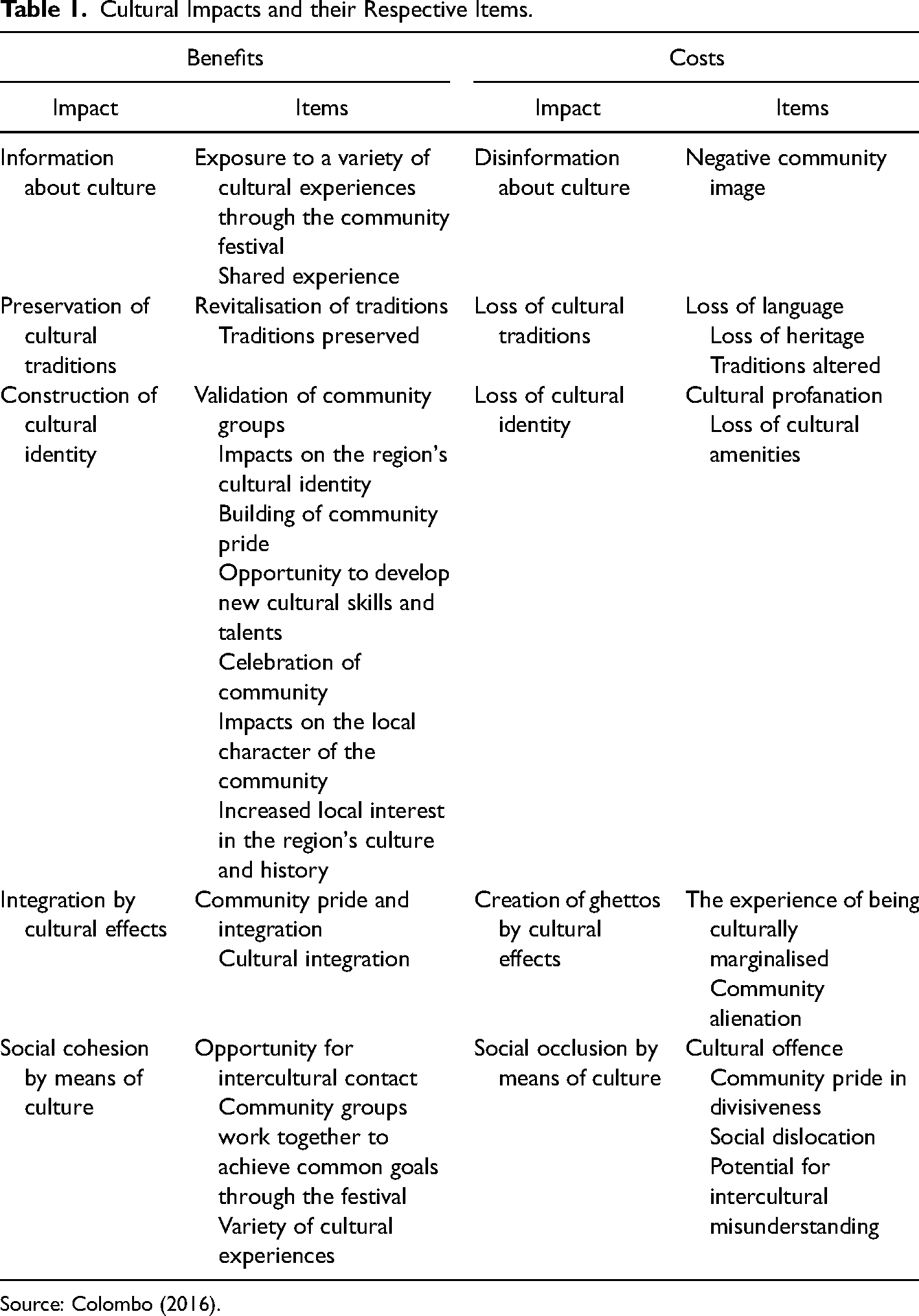
Drawing on previous contributions, Colombo (2016) proposed a model to evaluate cultural impacts in the context of cultural events. In her proposal, she based her selection of the predominant cultural impacts on the existing literature. This selection drew from several authors and considered some adaptations (Delamere, Wankel, & Hinch, 2001; Delamere, 2001; Fredline, Jago, & Deery, 2003; Getz, 1991; Small et al., 2005). From these authors, Colombo defined five impacts related to different cultural factors, focusing on their benefits and costs for the individual: (1) information or disinformation about culture; (2) preservation or loss of traditions; (3) construction or loss of cultural identity; (4) social cohesion or social exclusion; (5) social integration or the creation of ghettos. Each impact is described using four independent variables: existence, rating, intensity and intentionality. These variables were defined based on the definitions of intangible impacts given by precedent authors. Table 1 below provides descriptive information on each impact, including its benefits and costs, which have been drawn from the literature review on social and cultural impacts performed by Colombo (2016).
Cultural Impacts and their Respective Items.
Source: Colombo (2016).
This is the only model that enables us to understand the cultural outcome of cultural events through specific items. However, the scope of the model is wide and contains multiple items for evaluating a wide range of settings. Therefore, in order to perform a commensurable study, we need to make a selection. Furthermore, the model requires certain adaptation for its application to the music festival setting, which is justified in the following section.
Impact on Cultural Identity Construction
Cultural events, and music festivals in particular, have been shown to produce cultural identification. These events support collective identity or community identity building (Quinn, 2009; van der Hoeven & Hitters, 2019; Chen, Hui, Ng, & Guan, 2019), self-construction and growth (Lawendowski & Besta, 2020), identity development (Hixson, 2014) and identity expression (Boer & Fischer, 2012; Hormigos Ruiz & Oda Ángel, 2014; Kinnunen, Luonila, & Honkanen, 2019). These processes are relevant to our analysis, as they are important in the construction of people's cultural identity. Moreover, they may relate to the so-called “construction of cultural identity” impact proposed by Colombo (2016), i.e., the third impact displayed in Table 1. In fact, this impact contains an even wider list of identification processes to be analysed, namely the process of change in aesthetics provoked by the experience, new cultural skills development, personal development, the process of building community pride, the celebration of community and increased local interest in regional culture.
Theoretically, the evaluation of this impact relates strongly to the participant experience in the context of a live music event. Live music performances communicate values, as suggested by van der Hoeven and Hitters (2019), who attributed three levels of value – economic, social and cultural – to live music. The social and cultural levels contain valuable items, such as social capital, public engagement, identity, musical creativity, cultural vibrancy, and talent development. Clarke, DeNora, and Vuoskoski (2015), meanwhile, pointed to the development of empathy and cultural understanding thanks to live performances. Moreover, music, when performed live, has the power to unite individuals in a sense of common togetherness. Frith (2007) underlined the importance of live music as an essential element to break the egocentric tendencies of our individualistic society and bring together listeners. Live music's power in this regard will help us to understand festivalgoers as a community and music festivals as a type of event that fosters individuals’ cultural values, or, put another way, that helps to build cultural identity.
All in all, multiple processes related to cultural identity development in the context of live music events have proven relevant in precedent studies. Colombo's (2016) impact called “construction of cultural identity” sums up these processes. We have chosen to focus on this impact not only because there is commensurable research available, but for two other main reasons. The first, as explained above, is the suitability of studying this impact in the context of music festivals. Secondly, this research aims to identify the cultural identification processes that occur at a specific music festival, which can be accomplished by selecting this impact. Finally, it remains to be seen how emotions can be evaluated in the context of a music event and the part they play in identifying the event's cultural impact.
Emotions in the Music Festival Experience
Emotions, or affective outcome, are only one part of any experience. However, they are the most relevant part in the context of cultural events. This is shown in the paradigmatic model proposed by De Geus et al. (2016) called the Event Experience Scale (EES). This scale was developed based on an exploratory study that described experiences using four dimensions: affective engagement, cognitive engagement, physical engagement and experiencing newness. The EES allowed the authors to produce a quantitative measure of an experience that was otherwise defined in intangible concepts. When the EES was then applied (Richards, 2020), “affective engagement” (the excitement, emotional energy, intimacy, sense of adventure, values and recollections that attendees gain from an event) was found to be a key descriptive factor in event experiences. This model of analysis underlined the key role of affective engagement, i.e., the significant weight of emotions, in the construction of event experiences.
Other authors have looked at emotions related to attendee satisfaction, motivation and expectation (Morgan, 2007; Pegg & Patterson, 2010; Wood & Moss, 2015). Moreover, the affective response to cultural activities has been demonstrated as an opportunity to produce positive emotions, which in turn has an effect on well-being (Ateca-Amestoy, Gerstenblüth, Mussio, & Rossi, 2016), and as a “source of happiness” (Frey, 2008) for attendees. Given the above, we consider emotions to be an essential factor when studying experiences at live music events such as music festivals. Therefore, we need to understand how emotions are elicited by music in festival-like settings, in order to gain a complete perspective of the experience.
The unique features of music festival experiences have been analysed from different approaches. According to Packer and Ballantyne (2011), music festival experiences have four components when looked at from the attendees’ point of view. These are the music experience, the social experience, the separation experience and the festival experience (atmosphere). Based on the authors’ analysis, music is the most essential part of the music festival experience. There have been other attempts to understand the role of emotions in the context of festivals. Lee and Kyle (2013), for instance, developed the Festival Consumption Emotions (FCE) scale based on previous literature on emotions, namely studies seeking data linked to the consumer experience. This scale describes the emotions elicited during a festival experience and contains four main elements: love, joy, surprise and negative. The FCE scale has been used in multiple studies to gain insight into the emotional outcome of experiences in different settings, such as sport games (Song, Kim, & Choe, 2019) and music festivals (Rodríguez-Campo, Alén-González, Fraiz-Brea, & Louredo-Lorenzo, 2022). The latter study proved the arousal of positive emotions such as joy and love. However, no adaptations were made to the scale to accommodate the central role of music at music festivals (Packer & Ballantyne, 2011) or to entertain any other aesthetic consideration beyond the centrality of the consumption experience. We contend that affective evaluations of music festivals need to centre on music emotions.
The recognition of emotions aroused or elicited by music can be divided into three main approaches of understanding: the dimensional, the discrete and the domain-specific. The first considers that emotions should be described by a set of underlying bipolar dimensions consisting of valence (pleasantness-unpleasantness) and arousal or activation (Russell, 1980; Watson & Tellegen, 1985). The second considers the existence of basic emotions (Buck, 1988; Ekman, 1992; Izard, 1993) or a set of specific/discrete terms that may be activated through different mechanisms and processes (Izard, 1993; LeDoux, 1996; Scherer & Zentner, 2001). The third refers to the ability to express these emotions on a scale of different terms generated specifically for each domain or field of research, meaning that music requires a special set of terms to define its emotions (Zentner, Grandjean, & Scherer, 2008). For our research we decided to apply this last approach to emotion recognition, both for its applicability and demonstrated reliability over different studies and also for its strong relationship to classical music (Constantin & Drăgulin, 2019; Labbé & Grandjean, 2014; Miu & Balteş, 2012; Oberländer, Thomas, Gauer, & Völter, 2019; Zentner et al., 2008).
In yet another perspective, Woosnam, Aleshinloye, Van Winkle, and Qian (2014) developed the Emotional Solidarity Scale (ESS) to evaluate the emotional solidarity between tourists and local community residents in cultural events. In further analysis (Woosnam & Aleshinloye, 2018), their scale demonstrated the emotional bond that tourists and members of a host community may forge by participating in rural cultural events. These authors used the ESS to predict the social impact on the host community through the above mentioned FSIAS (Delamere, 2001). This attempt presented a strong relationship between the ESS terms and the items perceived in the FSIAS, which implies a strong relationship between the social impact assessment and the emotional assessment. Their work underlined the possibility and need to combine these two types of analysis through scales and the subjective perceptions of festival participants. Although their analysis was focused on the solidarity between tourists and local community members and not on the cultural value of the event, they related emotions and social impacts by combining two different models. In other words, they combined an intangible impacts assessment for a cultural event and an emotional assessment. As touched on above, a similar combination of emotional assessment and cultural impact assessment is intended in this research to study a music festival experience.
There is a lack of research on how intense emotions elicited by live music experiences may foster cultural identity construction processes among festivalgoers. In fact, it has been shown that music helps to illuminate deep emotions and that it represents, expresses and has an impact on different elements of cultural identity. However, until now there has been no attempt to analyse how live music events may arouse emotions and thus be responsible for triggering, shaping, reinforcing or influencing cultural identification processes in individuals.
Methodology
For our analysis, we drew on the Cultural Impact Perception (CIP) model proposed by Colombo (2016) and the Geneva Emotional Music Scales (GEMS) put forth by Zentner et al. (2008), as justified in the literature review above. On this basis, we designed a mixed-method approach for our study, tying together the emotional and cultural impact evaluations. With this approach, we aimed to answer three research questions:
How do music festival experiences have an impact on attendees’ cultural identity development? What cultural identification processes take place in relation to attendees’ emotions? How do music emotions affect identity development?
The first two questions required a qualitative approach focused on the cultural identity development triggered by the music festival experience in each attendee. First, however, we needed to confirm that this process indeed takes place in the context of the festival, as well as provide a detailed description of the processes that may occur due to this experience. To this end, we conducted semi-structured interviews after the festival with ten attendees, in order to gain deeper insight into the experience. We also had a sample of attendees answer a survey with questions about their cultural impact perception, in order to confirm the existence of the cultural impact on the cultural identity described by Colombo (2016). The third research question was evaluated using the same survey, but focusing on a different set of questions that allowed us to quantitatively ascertain the weight of emotions, the profile of the attendees, and the relevance of the link between these emotions and the impact on the cultural identity.
We applied both methodologies through fieldwork carried out on respondents who attended a classical music festival called Quincena Musical in August 2018 in the city of San Sebastián, Spain. This event was selected for its long tradition and ties to regional values that have connected various generations in the Basque Country, which may enable a cultural generalization.
Survey Research
During the festival, we administered the survey, which included the entire set of questions (the final survey design can be found in the supplementary material). To select the subjects, we applied a quota sampling method. For this method, the population must first be divided into subgroups, which may be offered by a previous analysis of the event or determined by analysing the society hosting the event. In the case of Quincena Musical, the subgroups were chosen and the quota then reached based on a previous analysis of the local population carried out in 2015 by a private consultancy (Ikertalde, 2015), which presented itself as a reliable source for the sampling. Before the start of the event, the respondents were told by the authors to answer the survey after each concert and to leave it in their seats/places. They were free to take as much time as they required to complete it. We collected a total of 350 surveys, of which 307 were validated for analysis.
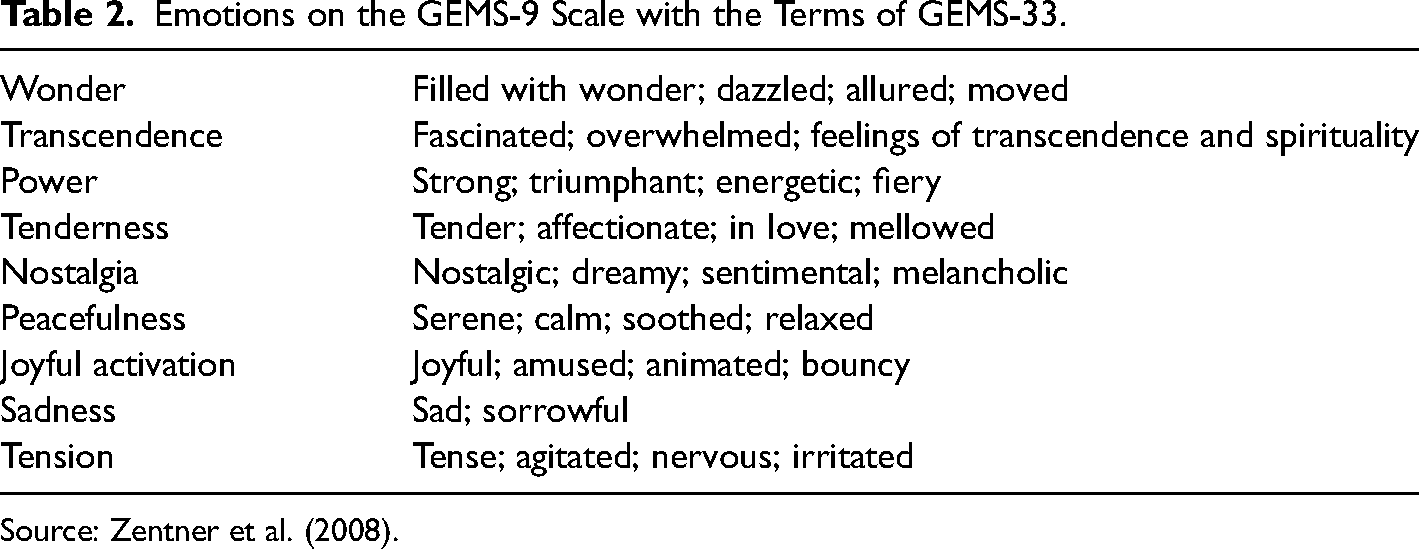
The survey was based on the variables of the two models selected from the literature review. We evaluated emotions through the GEMS-9 scale, as shown in Table 2. Each of these terms of emotion was assessed by the subjects.
Emotions on the GEMS-9 Scale with the Terms of GEMS-33.
Source: Zentner et al. (2008).
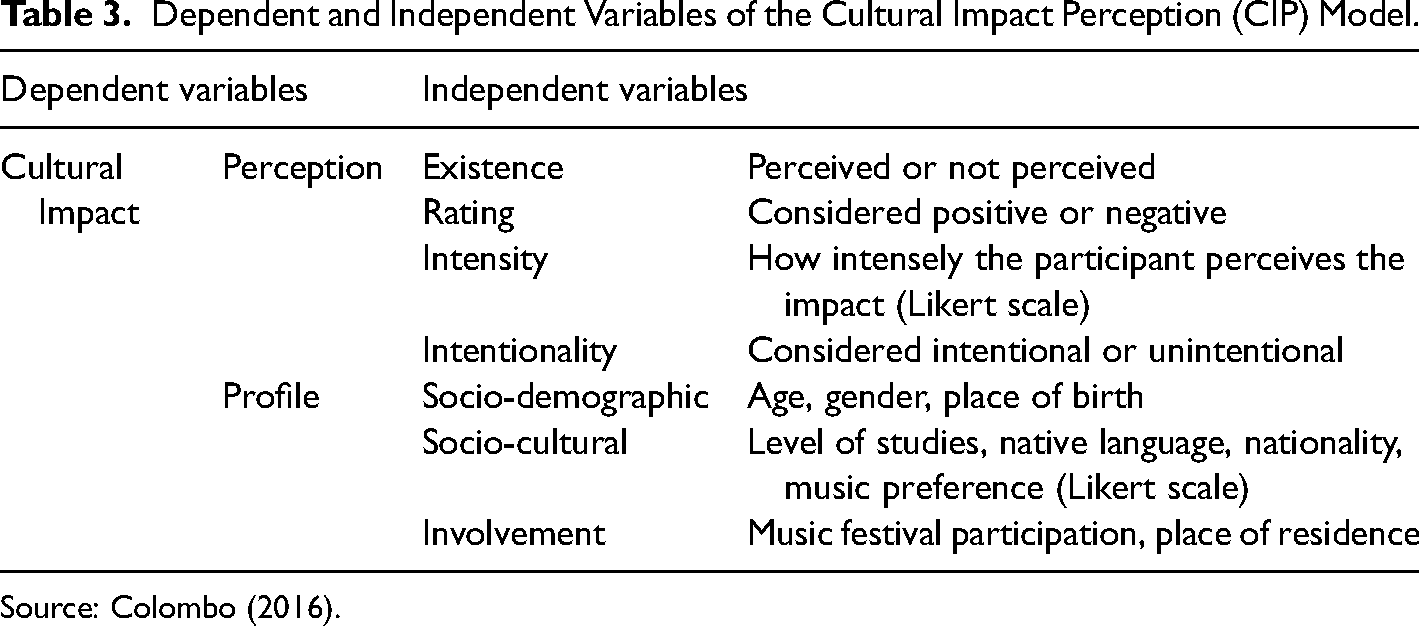
For cultural impact, we evaluated the third impact described by Colombo (2016), called “construction of cultural identity”. Our model assesses this impact by means of two dependent variables based on the subjective experience of each festival participant. These are perception and profile. The first of these two variables relies on four independent variables, to be indicated by the festival participants. These are existence, rating, intensity and intentionality. They are responsible for indicating the existence/non-existence of the perceived impact, whether the impact was considered positive or negative, the perceived intensity, and whether or not the impact was made intentionally by the organizers. Table 3 displays the complete set of variables.
Dependent and Independent Variables of the Cultural Impact Perception (CIP) Model.
Source: Colombo (2016).
By drawing on existing and proven models, we were able to combine the cultural impact assessment and emotional perception of the festivalgoers. The survey then collected socio-demographic data on the respondents, their perception of the cultural impact (existence, rating, intensity and intentionality) and the emotional outcome as measured by the GEMS scale. The intensity of the impact was evaluated through a Likert scale from 1 to 5 (1 lower rate; 5 the highest rate).
The sampling resulted in the same quotas as in the previous study by Ikertalde (2015) in terms of gender and age. Specifically, 55% were women and 45% were men, and the vast majority were older than 45 years old. The surveys were self-administered by the potential respondents. A set of instructions and an explanation of the research objectives were attached.
Post-Festival Interviews
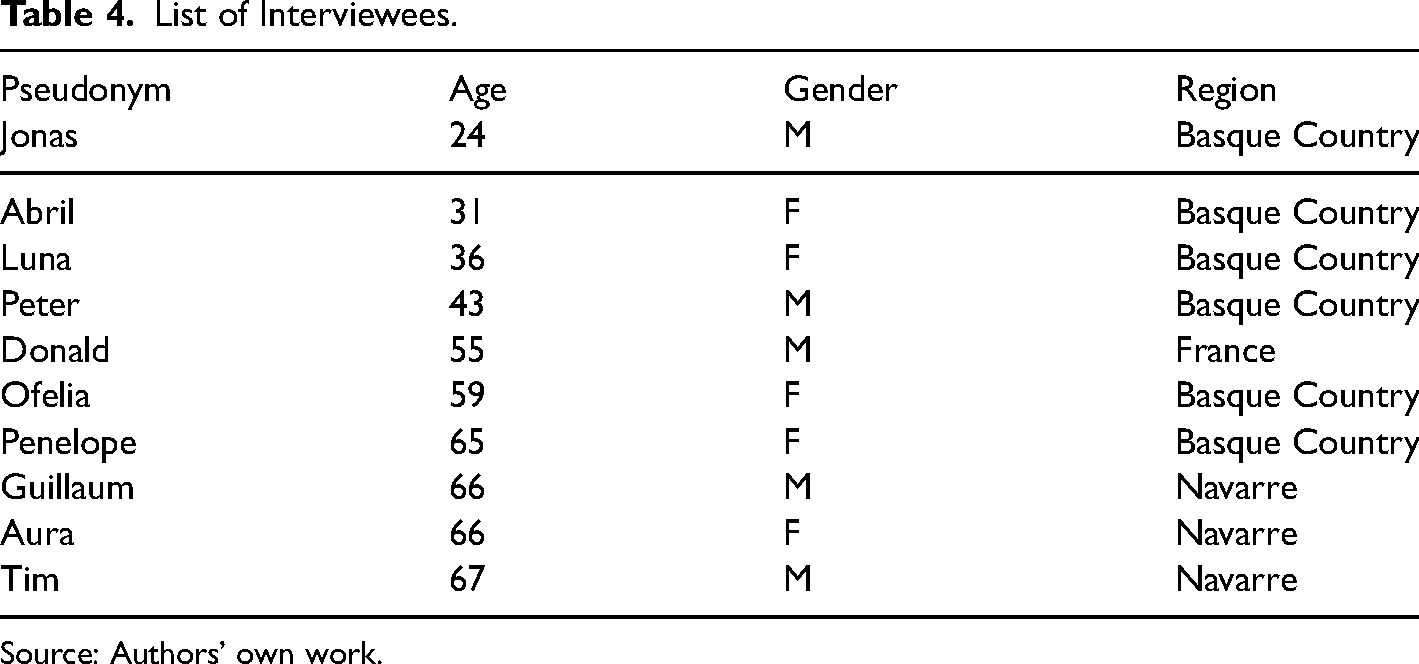
After a few days of the festival, we carried out ten interviews with Quincena Musical festivalgoers. For this, we applied the snowball technique, made two contacts after various concerts, and respected the gender and age range weightings of the city population quotas. Table 4 shows the list of interviewees with pseudonyms. These interviews were designed to gain in-depth insight into the participant experience in terms of the cultural and emotional outcome generated by participating.
List of Interviewees.
Source: Authors’ own work.
The interview questions are available in the supplementary material. They were held face to face or by telephone. The duration of each interview was between 30 min and 1 hour.
Data Analysis
The results of the surveys were processed first, and data was standardized in order to facilitate interpretation. Specifically, the data concerning the intensity of the cultural impact were correlated with the data concerning the intensity of emotions, in order to determine whether or not there is a quantitative relationship between these intensities. Secondly, we applied deductive content analysis to the post-festival interviews to identify the relevant themes related to the main topics of analysis. We used the definition of the cultural impact on the construction of cultural identity and emotions as guide categories for the content analysis. This deductive process allowed us to discern nuances in the festivalgoers’ experiences related to their emotions and cultural identity.
Results
We have structured our results into two sections based on our analysis of the data from the two methodologies employed. Firstly, we show the correlation between cultural impact intensity and emotional intensity. We then provide our interpretation of the concepts related to the festival's cultural impact on the construction of cultural identity and emotions based on data from the post-festival interviews.
Positive Correlation Between Intense Emotions and the Cultural Impact on Cultural Identity Construction
As described above, the aim of this research is to better understand the relationship between cultural identity processes and attendees’ emotions in music festival experiences. In this regard, a quantitative perspective can shed light on the link between the intensity of the cultural impact on the construction of cultural identity and the emotions felt by festivalgoers.
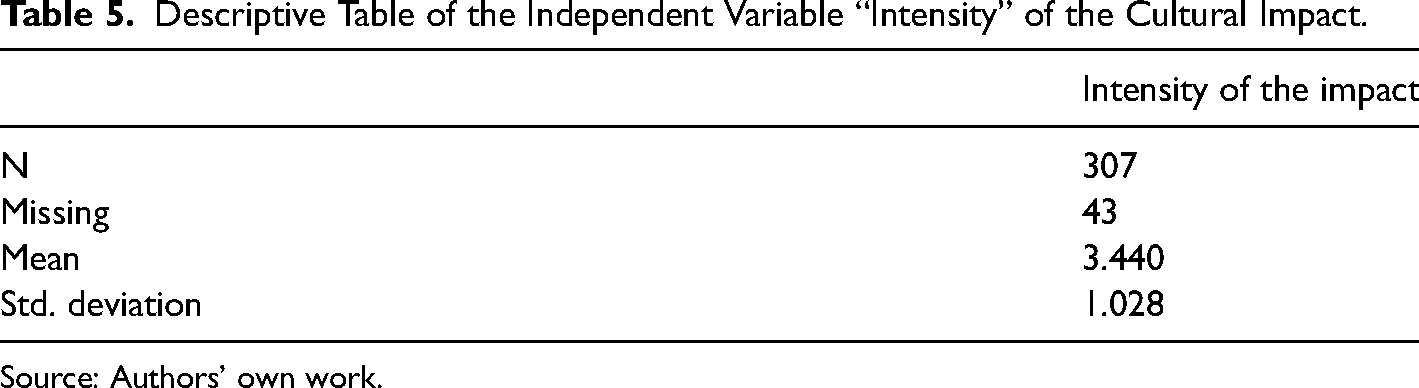
Firstly, we need to understand the intensity values of the festival's cultural impact and the festivalgoers’ emotions. As shown in Table 5, the intensity of the festival's cultural impact on cultural identification had a mean of 3.4 and a standard deviation of 1.028. Fifty-one percent (158) of the respondents rated the impact's intensity as either a 4 or a 5, and 30% (107) rated it as a 3.
Descriptive Table of the Independent Variable “Intensity” of the Cultural Impact.
Source: Authors’ own work.
Moreover, 85% of the respondents related the cultural impact's intensity to the emotions they felt in the music festival. Figure 1 represents the mean of each emotion; the most represented were joy (3.91), peacefulness (3.84), wonder (3.87) and transcendence (3.21). Whereas the less considered were sadness, tension and nostalgia.
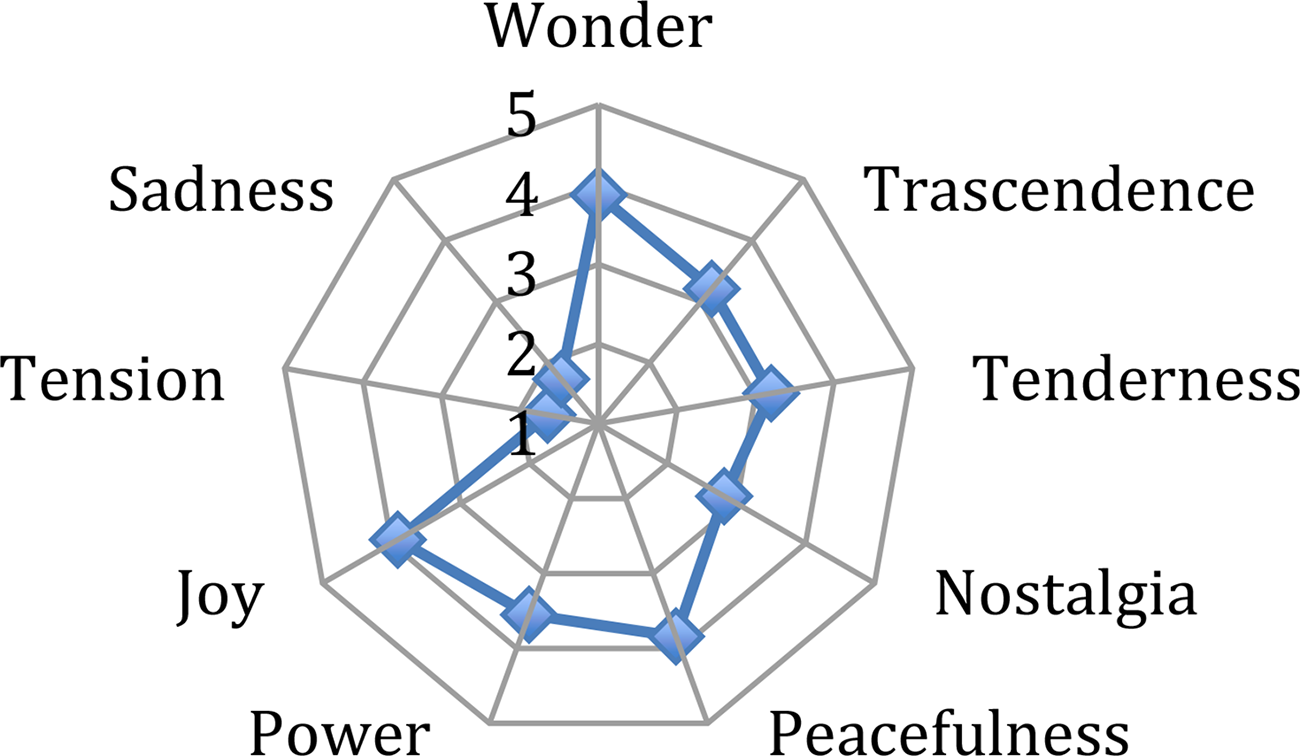
Means of the items composing the “emotions” variable. Source: Authors’ own work.
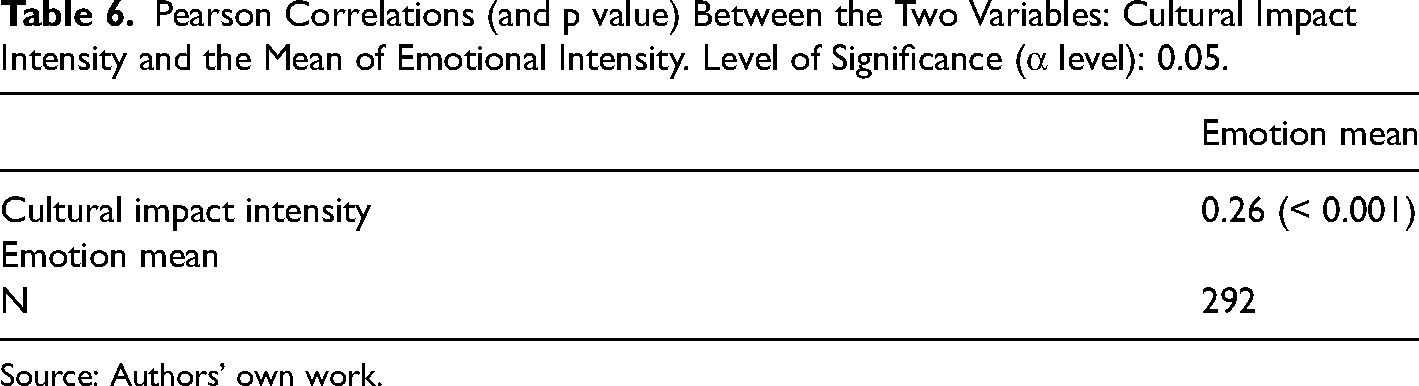
The relationship between the intensity of the cultural impact and the intensity of emotions can also be established by correlating the intensity of the cultural impact with the intensity of the emotions, which are both scaled variables. This correlation can help to explain how emotions are associated with the construction of cultural identity. Therefore, we chose to test this relationship through bivariate correlation between the variable “Intensity” of the cultural impact and the intensity mean of the emotions in the GEMS list. As displayed in Table 6, the correlation between the two independent variables (“emotion mean” and “intensity”) was positive (Pearson correlation, p value of 0.26) within a level of significance (α level) of 0.05. This result showed a weak positive correlation between the variables.
Pearson Correlations (and p value) Between the Two Variables: Cultural Impact Intensity and the Mean of Emotional Intensity. Level of Significance (α level): 0.05.
Source: Authors’ own work.
We cannot say that the weakness of the correlation may be interpreted as a direct weak relationship between those variables. We understand that these different relationships indicate a positive perceived relationship when modelling the intensity of the cultural impact depending on the intensity of emotions, but the variability of each emotion comes with a complexity that the p value cannot describe with a single correlation. Therefore, the qualitative analysis might shed light on how to better describe the relationship between emotions and the intensity of the cultural impact.
Cultural Identity Construction Processes from a Qualitative Perspective
From a qualitative perspective, the results of the content analysis of the post-festival interviews found cultural impact and emotions to be linked through three themes. These themes emerged from the codes generated in the analysis, which were identity development, identity enrichment and regional identification. At the same time, these three main cultural development-related processes were intertwined with emotional considerations. The emotional consideration of the festival experience was positive and intense, which leads us to add this positive consideration to the three main processes of identification described.
The first theme, identified as “identity development”, describes how the festival experience helped festivalgoers to develop new elements of their cultural identity. This occurred through self-development brought on by the experience at the festival, the development of cultural skills or the willingness to participate/connect within the regional community. This development was linked, for example, to culture-related development, as described by the 24-year-old psychologist, Jonas: “First, I would say that the festival helped my self knowledge, that of my own existence. It helps me to centre myself on many occasions throughout the concert and know what's going on inside me. Therefore, I think that first, it helps me to develop as a person, as a man of culture.” (J-1904, 21:40)
This cultural identity process implied emotional considerations and linked positive emotions with cultural identification. Thus, it may be interpreted as a personal achievement or as a process of cultural development through emotions.
The second theme that was categorized and related to the festival's impact on the construction of cultural identity was the process of identity enrichment that took place at the festival. This can be defined in terms of the specific cultural elements that the music festival experience contributed to the festivalgoer's identity. This enrichment came down to several factors: growth in the festivalgoer as a music listener, the addition of new music to their favourite tracks due to intense experiences and the chance to listen to new interpretations. According to April, a 31-year-old journalist, the experience helped to develop her love for music as a life experience: “Yes, in the end I think that whenever you go to a new concert, you gain something new. Every time you listen to something, you add it, more or less, to your life experience.” (A-0904, 20:19)
This development was also expressed in terms of learning that took place due to the festival experience. The interviewees referred to this learning in two ways: as something that happened or as the birth of new interests. This was described by Ofelia, a 59-year-old professor: “Because individually it makes you a more educated, more curious, more open, more sensitive person.” (O-2802, 47:45)
Penelope also mentioned education being a result of the music festival experience: “I think it also educates us that such a festival exists, it also educates us.” (P-2102, 07:42)
The birth of new learning interests was brought up by Tim, for example, who spoke of it as an experience of discovering a new world within the music: “Yes, but you always want to know more, at least I do. It wides your cultural spectrum. The world of music is vast.” (T-0903, 26:38)
The third theme related to cultural impact described by the interviewees was the regional identification that occurred thanks to the festival experience. Ofelia said: “There was also a performance by the Orfeón Donostiarra chorus, a performance of ‘The Lord's Prayer’ by Padre Donostia. The soloist was a young boy, who sang a part at the beginning that was spectacular. That song strongly connects with how we understand each other. It has a kind of melancholic and also grandiloquent quality. It's very pompous and sad as a song, but nevertheless, those of us with deep roots in Gipuzkoa like it a lot.” (O-2802, 13:00)
As before, these examples describe cultural identity processes linking cultural features to emotional responses. These processes implied emotional considerations and connected positive emotions with cultural identification, which might be interpreted, again, as a personal achievement or as a process of cultural development through emotions. As a summary of these ideas, Jonas offers a possible example of this emotional bond with a cultural feature of the festival: “I think that the emotional connection makes you like or love that piece of music more, so, independently of an author or a specific composition, I would say music in general.” (J-1904, 40:29)
Interpreting this directly, the festival experience can be understood as an opportunity for each individual to develop culturally, powered by emotions. In fact, these are only some examples of the multiple codes related to these three processes. There were more observations, descriptions and explanations defining these relevant identifications intertwined with emotional considerations. However, we would like to expand on another topic that came up in the interviews and has to do with the motivations that moved the attendees to take part in the music festival. The main motivation brought up in the interviews was music. Music was understood as a reason to attend the festival: to listen to new music pieces and performers, to enjoy an aesthetic moment with music. Penélope clearly stated this: “Without a doubt, I go because of the music.” (P-2102, 29:11)
However, the motivation was not only music in the strict sense, also key factors related to music. These included the quality of the music performed or the artistic quality of the performers. Tim expressed that the quality of the performers was a reason for his participation: “Because the calibre is high. There are high standards that you won’t find if you don’t go to big capitals.” (T-0903, 04:33)
Music was a common and central point of the interviewees’ motivations for attending the music festival. In fact, several others described motivations linked to artistic quality (Jonas, Abril, Luna, Guillaum and Tim). In our literature review, we described the centrality of music as a common denominator of music festival experiences, summarizing Packer and Ballantyne's (2011) music festival experience model. In light of this, it seems reasonable to consider music as the main direct/indirect motivation for attending Quincena Musical from the interviewees’ perspective. This is relevant for our research since we based our analysis on the importance of music emotions, which originate from the affect generated by music itself. Therefore, in the context of a classical music festival, music plays the starring role not only as a motivation for attending but also as the main elicitor of emotions. Consequently, it is correct to approach the analysis of emotions in terms of aesthetic appreciation, as we did in our model of analysis.
Conclusion, Discussion and Further Research
This research was set in motion to explore how classical music festival experiences impact attendees’ cultural identity development and how music emotions affect this development. To this end, we aimed to prove the following hypothesis: classical music festival experiences are opportunities to feel intense emotions that can trigger or intensify specific processes related to festivalgoers’ cultural identity. In order to identify these processes, we presented the academic state of the art in terms of evaluating cultural impacts in different cultural settings. We then adapted the Cultural Impact Perception (CIP) model, which helped us to identify processes related to cultural identity through survey research and in-depth interviews among attendees of the Quincena Musical classical music festival in San Sebastián, Spain. The survey results showed a positive correlation between the intensity of the cultural impact on the construction of cultural identity and the intensity of emotions. Moreover, thanks to the post-festival interviews, we found that specific cultural identity processes were intertwined with emotional considerations. In fact, it was reported by attendees that emotions intensified the cultural identification processes brought on by the music festival experience. They described feeling a sense of community, enjoying the music, bonding with regional culture, liking specific performers and feeling a sense of self-achievement in the festival. Importantly, they expressed these experiences as being intertwined with positive emotions and fostering the aforementioned cultural identification processes. Based on our quantitative and qualitative datasets, we conclude that specific music emotions play a part in intensifying a festival's cultural impact on the construction of cultural identity and, moreover, that emotional arousal reinforces and fosters cultural identification in music festival settings. Festival experiences can thus be understood as opportunities to develop specific cultural elements that arouse emotions or to feel what the festivalgoer considers culturally relevant. Both processes (cultural identification and emotional arousal) were described and may potentially occur simultaneously. In light of these findings, our main hypothesis was proved to be valid.
We confirmed that music appreciation is the main motivation for attending the Quincena Musical classical music festival. Although we cannot extrapolate this finding to all music festival types, we can generalize that music plays a key role in classical music festivals, not only in terms of motivation to attend but also aesthetic appreciation. Therefore, aesthetic emotions analysis is the correct path to understanding classical music festival experiences.
However, some limitations and nuances need to be considered in the interplay between cultural identity processes and emotions and, thus, in our analysis. From a quantitative analysis perspective, we understand that this association is neither unidirectional nor unique. The association displayed in this article is based on a theoretical approach in which cultural impact on the construction of cultural identity in music festival experiences is considered one of the most relevant impacts from those proposed in the CIP model. Therefore, further analysis is needed to understand the possible relevance of other associations in music festival settings (e.g., between other cultural impacts and emotions, between the intensity of the social experience and emotional contagion, and between emotions and the festival atmosphere). From a qualitative perspective, our analysis centred on one specific impact in order to identify specific processes related to cultural identity and emotional considerations. This focus was not a result of researcher bias. It was based on the relevance of this impact in the interviewees’ statements and its quantitative relevance in terms of the overall number of statements about it in the interviews. That being said, future research studies could focus their attention on the relevance of other cultural impacts in music festival experiences (e.g., the impact on access to information or the impact on the preservation/loss of cultural traditions). Finally, the applied model limited emotional evaluation to musical experience, and thus this conception of emotion can only be applied to classical music events. Therefore, and for further applications, these models must be adapted to the different types of cultural events studied, in order to have consequent validations. This can be done with other sets of emotions that are more general and not solely focused on the aesthetic appreciation of music.
Supplemental Material
sj-docx-1-art-10.1177_02762374231176192 - Supplemental material for Perceived Intense Emotions and Their Influence on Cultural Identification Processes: A Mixed-Method Study of a Classical Music Festival
Supplemental material, sj-docx-1-art-10.1177_02762374231176192 for Perceived Intense Emotions and Their Influence on Cultural Identification Processes: A Mixed-Method Study of a Classical Music Festival by Jordi Oliva and Alba Colombo in Empirical Studies of the Arts
Supplemental Material
sj-docx-2-art-10.1177_02762374231176192 - Supplemental material for Perceived Intense Emotions and Their Influence on Cultural Identification Processes: A Mixed-Method Study of a Classical Music Festival
Supplemental material, sj-docx-2-art-10.1177_02762374231176192 for Perceived Intense Emotions and Their Influence on Cultural Identification Processes: A Mixed-Method Study of a Classical Music Festival by Jordi Oliva and Alba Colombo in Empirical Studies of the Arts
Footnotes
Ethical Statement
This material is the authors’ own original work, which has not been previously published elsewhere. The paper reflects the authors’ own research and analysis in a truthful and complete manner.
Declaration of Conflicting Interests
The authors declared no potential conflicts of interest with respect to the research, authorship, and/or publication of this article.
Funding
The authors received no financial support for the research, authorship, and/or publication of this article.

Supplemental Material
Supplemental material for this article is available online.
Author Biographies
References
Supplementary Material
Please find the following supplemental material available below.
For Open Access articles published under a Creative Commons License, all supplemental material carries the same license as the article it is associated with.
For non-Open Access articles published, all supplemental material carries a non-exclusive license, and permission requests for re-use of supplemental material or any part of supplemental material shall be sent directly to the copyright owner as specified in the copyright notice associated with the article.
