



Abstract
Music offers a useful opportunity to consider the factors contributing to the experience of curiosity in the context of dynamically changing stimuli. Here, we tested the hypothesis that the perception of change in music triggers curiosity as to how the heard music will unfold. Participants were presented with unfamiliar musical excerpts and asked to provide continuous ratings of their subjective experience of curiosity and calm, and their perception of change, as the music unfolded. As hypothesized, we found that for all musical pieces, the perceptual experience of change Granger-caused feelings of curiosity but not feelings of calm. Our results suggest music is a powerful tool with which to examine the factors contributing to curiosity induction. Accordingly, we outline ways in which extensions to the approach taken here may be useful: both in elucidating our information-seeking drive more generally, and in elucidating the manifestation of this drive during music listening.
Curiosity Emerging From the Perception of Change in Music
William James, widely held as the father of American Psychology described curiosity as “the impulse towards better cognition” (James, 1899), while Ivan Pavlov, the Russian physiologist, described how curiosity can emerge through a “what-is-it?” reflex that causes a spontaneous focus on new things in the environment (Pavlov, 1927). Today, state curiosity is defined as the state of desiring new information (Gottlieb, Oudeyer, Lopes, & Baranes, 2013) and characterized as a special form of intrinsically-motivated information-seeking (Loewenstein, 1994; Oudeyer & Kaplan, 2007). Levels of state curiosity determine how long we choose to engage in any given activity – be it reading a book or listening to music – and can lead to exploration, learning, and better memory for the information that was initially lacking (Berlyne, 1960; Berlyne, 1966; Kidd & Hayden, 2015). While state curiosity describes an individual's state or feeling in a given moment, people with a tendency to regularly experience state curiosity in everyday life are described as being high in trait curiosity (e.g. Litman & Spielberger, 2003; Kashdan et al., 2018; Kashdan, Disabato, Goodman, & McKnight, 2020). Here, we focus on state curiosity (simply curiosity, hereafter) and ask whether moments in which listeners perceive a change in unfolding music may drive them to also feel more curious about how the heard music will continue.
Conceptualizing Curiosity as a Motivational State and Emotion
After a period of being relatively ignored as a research topic, curiosity is once more of great interest to psychologists and neuroscientists (see Kidd and Hayden, 2015 for a review). Among these groups, the importance of curiosity in knowledge acquisition and decision making (Gruber, Gelman, & Ranganath, 2014; Gruber & Raganath, 2019; Calhoun & Hayden, 2015), as well as its role in a range of positive life outcomes (Kashdan & Roberts, 2004; von Stumm, Hell, & Chamorro-Premuzic, 2011; Sakaki, Yagi & Murayama, 2018), is increasingly recognized.
Aesthetics researchers have also long emphasized the importance of curiosity – at a state and trait level – to the aesthetic response (Berlyne, 1960; Kashdan & Silvia, 2009; Schoeller, 2015). For instance, Openness to experience, which is a personality domain closely related to trait curiosity, has been shown to explain variations in aesthetic engagement when knowledge of the arts is controlled for (Fayn, MacCann, Tiliopoulos, & Silvia, 2015). Further, theoretical work and first empirical data suggest a link between curiosity (desiring information) and reward from engaging with sensory stimuli. Specifically, curiosity has been linked to the experiencing of pleasurable physiological responses referred to as aesthetic chills (Schoeller, 2015) and to the experiencing of so-called aha (insight) moments (e.g. Van de Cruys et al., 2021) that have been shown to recruit the brain's reward networks (Oh, Chesebrough, Erickson, Zhang, & Kounios, 2020).
Curiosity is often described as a motivational state, similar to hunger and pain (e.g. see Wojtowicz and Loewenstein, 2020 for an overview). Thus, when considering literature that characterizes curiosity as an emotion or emotional-motivational state (as is commonly the case in the psychology of aesthetics), it is important to acknowledge how curiosity is held to differ from other commonly studied emotions. Indeed, in the context of both experimental aesthetics and psychology more generally, curiosity is considered to belong to a group of emotions known as epistemic emotions (Chevrier, Muis, Trevors, Pekrun, & Sinatra, 2019; Vogl, Pekrun, Murayama, Loderer, & Schubert, 2019; Carruthers, 2017). Within the psychology of music, specifically, epistemic and aesthetic emotions have been pitted against so-called utilitarian emotions (Scherer & Coutinho, 2013). According to these authors, utilitarian emotions are utilitarian in that they allow individuals to adapt and adjust to unfolding events that have important consequences for survival and well-being: Aesthetic and epistemic emotions, in contrast, are not triggered by concerns for one's survival or coping potential. In the context of empirical aesthetics, some authors characterize aesthetic emotions as encompassing so-called epistemic emotions due to the latter being frequently induced during engagement with art (Schindler et al., 2017). However, in general, epistemic emotions, which include emotions such as surprise, confusion and curiosity, are considered to largely emerge from any form of cognitive incongruity that may in turn drive knowledge acquisition (Vogl et al., 2019).
The Emergence of State Curiosity
A large body of work has shown that certain features and characteristics of music may be able to also induce utilitarian emotions in a listener through mechanisms like emotional contagion (Juslin, 2016). For example, a piece of music with a slow tempo and minor mode may not only convey or express sadness, but in some situations may also cause a listener to feel sad. It is therefore important to be clear on how epistemic emotions, in contrast, are held to emerge. In contrast to the common situations in which listeners describe music as “sad” because it expresses sadness and leads them to feel melancholic, epistemic emotions are less likely to be “caught” and more likely to emerge from the listener's evaluation of the extent to which encountered information diverges from existing models of information in the environment. Indeed, with regard to the recognized triggers of felt curiosity, computational neuroscientific approaches emphasize the roles that the experience of novelty, feelings of uncertainty, and perception of change all tend to play (Gottlieb et al., 2013; Jepma, Verdonschot, Van Steenbergen, Rombouts, & Nieuwenhuis, 2012; Kang et al., 2009). In the context of music, therefore, these experiences (experience of novelty, feelings of uncertainty, and perception of change) rather than contagion of an expressed emotion are what are likely to drive curiosity during music listening.
Here, it is worth explicitly clarifying the important distinction between whether a piece of art can be said to be conveying an emotion, or to be inducing an emotion in an individual. Indeed, based on this distinction between perceived and felt emotions in music, it has been proposed that perceived and felt emotions do not always match and indeed are very often unmatched (Schubert, 2007; Schubert, 2013; Merrill, Omigie, & Wald-Fuhrmann, 2020). While people may often refer to pieces of music as being sad, happy or angry, it is noteworthy that they are unlikely to refer to a piece of music as “curious”. Indeed although certain features of music could arguably convey a persona (Cochrane, 2010) that is displaying curiosity-related behaviours (Juslin & Laukka, 2003; Eerola & Vuoskoski, 2011) and while it has even been suggested that expressions of curiosity can be contagious (Dubey, Mehta, & Lombrozo, 2021), it is outside the scope of the current article to explore any feelings of curiosity that emerge from “catching” conveyed curiosity. Here, we focus, rather, on testing the hypothesis (which emerges from information theory and computational neuroscience) that perceiving change in music may lead a listener to also feel momentary increases in curiosity about the music being heard.
Measuring State Curiosity in the Lab
There has been considerable growth in the number of studies examining curiosity in the lab (Kang et al., 2009; Gruber et al., 2014; Jepma et al., 2012; Van de Cruys et al., 2021; van Lieshout, Vandenbroucke, Müller, Cools, & de Lange, 2018; Charpentier, Bromberg-Martin, & Sharot, 2018; Kobayashi & Hsu, 2019), with the perception of novelty and change, and feelings of uncertainty all having been shown to drive feelings of curiosity. However, while perception of novelty and change, and feelings of uncertainty all tend to wax and wane in intensity over the course of temporally unfolding stimuli, most studies to date have examined curiosity using paradigms that probe discrete snapshots of experience.
In one such paradigm, in which participants are presented with a series of trivia questions and required to provide curiosity and uncertainty ratings with regard to their corresponding answers, participants showed greatest levels of curiosity when they were moderately uncertain about the outcome (e.g. Kang et al., 2009). However, in another recently used paradigm, in which participants were required to guess the number of balls in a jar, and also indicate confidence in their answer, the highest degree of curiosity was associated with greatest uncertainty (van Lieshout et al., 2018). While such discrepancy between studies may in part be due to the differences in the intrinsic value of the novel knowledge or the risk associated with seeking out this knowledge, it is clear that, to date, findings in the curiosity literature are likely highly dependent on the specific paradigms used. Critically, such discrepancies raise the concern that results from previous studies that do not take the structure of previous stimulus context into account, can say only little about how curiosity is induced in situations that unfold over time.
Thanks to decades of music cognition research that offer tried and tested methods for examining responses to music, music could be considered a still relatively untapped resource in the goal toward better understanding curiosity. Here it is proposed that, music, being a stimulus type that unfolds and constantly changes over time, offers a valuable opportunity to derive new insights into how the experience of curiosity emerges (Omigie, 2015).
A Role for Violated Expectations and Change Perception in Driving Curiosity During Music Listening?
Strong links have been found between expectancy, emotion, and reward in response to unfolding music (Krumhansl, 1997; Huron, 2006; Salimpoor, Benovoy, Larcher, Dagher, & Zatorre, 2011). Musical expectancy can defined as the tendency for listeners to make predictions as to how music will unfold and is considered to be a rich source of music induced emotion and meaning (Meyer, 1956; Huron, 2006). Critically, a large body of work had shown that listeners display implicit and explicit markers of expectation violation when they encounter surprising 1 events in music (e.g. Maess, Koelsch, Gunter, and Friederici, 2001; Pearce, Ruiz, Kapasi, Wiggins, and Bhattacharya, 2010; Omigie, Pearce, and Stewart, 2012; Omigie, Pearce, Williamson, & Stewart, 2013; Omigie et al., 2019; Bianco, Ptasczynski, & Omigie, 2020; Omigie, Lehongre, Navarro, Adam, & Samson, 2020).
Few attempts, however, had been made to use music to inform our understanding of curiosity. Thus, in a recent study (Omigie & Ricci, 2021), we explored whether high information content events (events that may be considered unexpected given the context) as characterized using a model of musical expectancy (Pearce, 2005), may be seen to drive the experience of curiosity when listening to simple melodies. Interestingly, we not only showed that high information content events predict increases in curiosity but we were also able to show that this relationship between information content and curiosity is less clear in more complex (higher entropy) music. Taken together, that study demonstrated that participants’ subjective report of their felt curiosity in response to music follows patterns that may be expected from an information theoretic perspective. However, distinctions that have been drawn between surprise (due to high information content) and perceived change speaks to the need to explore the role of perceived change alone and in its own right.
The current study thus explored the extent to which curiosity can be seen to reliably emerge from the perception of change in music. Change perception is held to trigger involuntary attention through mechanisms distinct from those underlying responses to rarity and expectancy violation (Parmentier, Elsley, Andrés, & Barceló, 2011; Ohman, 1979; Escera, Alho, Winkler, & Näätänen, 1998). Critically, accounts of information seeking emphasize that alongside unexpected or surprising events, change – which could be described as novelty on a short time scale – should lead to agents desiring information that will reduce any uncertainty they are experiencing. In music, listeners’ perception of change (Dean & Bailes, 2016) is held to integrate many different components including perceptions of change in loudness, timbre, and harmonic and rhythmic structure (Dean & Bailes, 2014; Dean & Bailes, 2016; Dean, Milne, & Bailes, 2019). Interestingly, in line with animal studies demonstrating the reinforcing nature of stimulus change (Hurwitz, 1956; Voss & Keller, 2013), perception of change in music has been associated with increase in positive emotional valence (Dean & Bailes, 2016), as well strong pleasurable responses to music, known as chills (Grewe, Nagel, Kopiez & Altenmüller, 2007; Harrison and Loui, 2014). In sum, in line with the notion that stimulus changes can lead to a “what is it” reflex and attention re-orientation in listeners, perception of change in music may be expected to temporally precede and indeed cause changes in the subjective experience of curiosity over time (Gottlieb et al., 2013). However, this possibility has not been directly investigated.
The Current Study
Here, we sought to explore the possibility that continuous ratings may provide insights into those aspects of change-triggered curiosity experiences that are available to self-report. Thus, in the current study, participants were presented with unfamiliar musical excerpts from different musical styles and rated both their subjective experience of felt curiosity (and felt calm, as a comparison task), and their perceptual experience of change when listening to the music. To quantify stimulus-specific causality across the felt curiosity, felt calm, and perceived change time-series, Granger causality, a statistical technique that allows the identification of lagged relationships between time-series (Granger, 1969) was used. We examined a range of lags in order to determine the number of seconds by which the different experiences preceded or succeeded each other, and examined causality between mismatched signals (e.g. felt curiosity ratings for one piece being modeled against perceived change ratings from another piece) as a test of the reliability of findings. Finally, the false discovery rate method (fdr) was used to correct for the large number of tests conducted since use of the traditional Bonferroni method would have been too conservative. In brief, the fdr method allowed us to identify significant comparisons while keeping a low false positive rate.
We tested the hypothesis that feelings of curiosity while listening to music can be triggered by the perceptual experience of change in the music. Specifically, it was predicted that the perception of change would reliably “Granger-cause” felt curiosity across all stimuli, since perceived change implies new information that should reliably trigger information-seeking processes. We further predicted that, in the contrast to what is seen for feelings of curiosity, any causal effect of perceived change on feelings of calm would be less reliable. Here, it was assumed that although perceived change may often be associated with decreases in feelings of calm (e.g. due to the entry of new, complex and therefore arousing sections in music) a reliable relationship would be precluded by the possibility for perceived change to also align with moments of increased feelings of calm (for instance, when a piece of music suddenly changes from being highly complex and dissonant to being perceptually more fluent).
Method
Participants
A total of 20 participants (age: M = 24.95, SD = 4.26) completed the study. Participants reported an average of a few years of formal music training (M = 2.88, SD = 3.22) in a wide range of musical instruments, and expressed preference for a wide range of musical genres. The number of participants was based on power analysis using pilot data and consideration of sample sizes used in previous studies (where sizes ranged between 16 and 21 participants: Dean & Bailes, 2010; Bailes & Dean, 2012; Dean & Bailes, 2014; Dean & Bailes, 2016). The core analyses in this study constitute Granger causality analysis on grand average data computed from continuous ratings time-series. Thus, since an average medium effect size was obtained using data collected from grand averaged time-series collected from 10 participants, a sample size of 20 was considered sufficient, both to provide power for the expected effects and to span a sample of typical listeners. The study was approved by the University Ethics Committee. After reading a detailed information sheet, all participants gave written informed consent to participate and were paid for their participation.
Stimuli
Excerpts were taken from four musical pieces found in the “Structural Analysis of Large Amounts of Musical Information (SALAMI)” database (Smith, Burgoyne, Fujinaga, De Roure, & Downie, 2011): a classical era piece “Cello concerto in D major, Adagio” composed by Luigi Boccherini in the late 1760s; a contemporary (20th century) classical music piece, “Concerto in D for strings, Rondo” composed by Igor Stravinsky in 1946; an electronic dance music (EDM) piece “Piku”, from The Chemical Brothers released in 1997 and “Dance the Devil away,” a piece released in 1991, fusing western and indigenous Australian music from the group, Outback. All stimulus excerpts were 1 minute and 50 seconds long in duration and an additional jazz track, with a duration of 40 seconds (“A Tribute to Someone” by Herbie Hancock), was used in each of three practice trials that were used to acquaint participants with the three rating tasks. In a debrief taken at the end of the study, participants expressed being largely unfamiliar with the pieces, and were unable to name either the titles of, or musicians behind, the music.
Procedure
All stimuli were presented using OpenSesame experiment software (Mathôt, Schreij, & Theeuwes, 2012). Listeners were presented with stimuli over headphones, and were allowed to adjust the volume of music playback to a comfortable listening level.
The study was divided into three parts in which participants continuously rated their experience of the same set of 4 stimuli on each of three different dimensions. The first two tasks involved rating the two felt emotions (curiosity and calm) and were counterbalanced to avoid one systematically biasing the other. The third task then required participants to provide continuous ratings of their perception of change over time for each of the pieces.
Before the tasks commenced, participants were asked to “Please continuously rate how curious you are feeling about what will happen next in the music” for the felt curiosity task; “Please continuously rate how calm you are feeling while listening to the music” for the felt calm task, and “Please continuously rate the extent to which you consider the music to be changing” for the perceived change task.
During the task, a visualization (see Figure 1) comprising a central circle, from which three chevron arrows emerged in upward and downward directions provided a scale on which participants could indicate their experience of the music (“A lot” at the top of the y axis scale to “Very little” at the bottom of the y axis scale). For each task, participants were presented with a reminder of what they were rating in that trial (“Your experience of curiosity,” “Your experience of calm,” “Your experience of curiosity”) alongside the rating scale. The word “experience” was used for all tasks as it can encompass both emotions (emotional experience) and perception (perceptual experience). The use of the word “your” in “Your experience of…” provided a simple reminder to the participants that they should be focusing on their own subjective feelings and judgments. In line with previous studies (Dean & Bailes, 2014, p. 2016), no guidance was provided regarding what aspects of change in the music they should be reporting their perception of, and this rating task was carried out last to avoid it influencing performance of the first two tasks due to demand characteristics. While not visible to participants, continuous rating data were collected on a scale of 0 to 1000. Participants were instructed to reflect on their experience continuously, and to use a mouse to move a gray circle in accordance with their experience. Participants practiced each of the three tasks using a practice trial and the order of the presentation of the pieces within each task block was randomized.
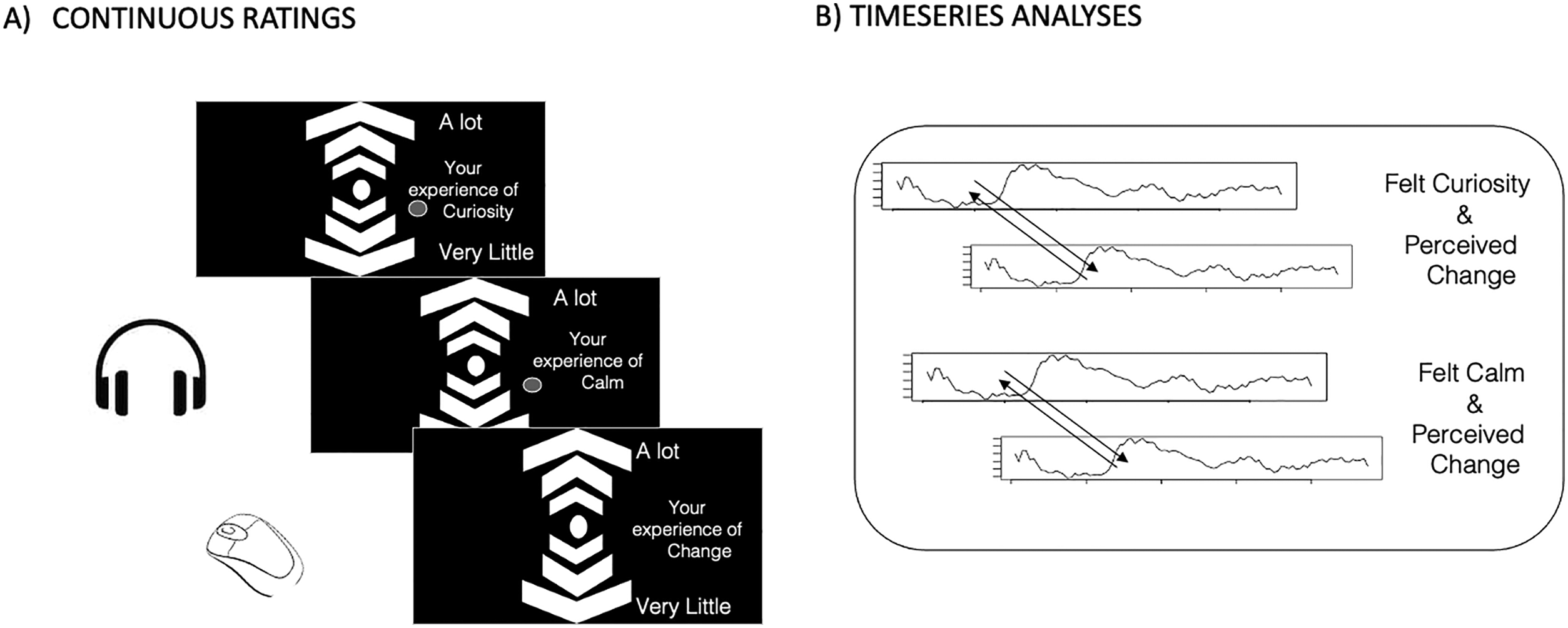
Experimental design and analysis procedure. (a) Participants rated their experience of music as it unfolded with regard to feelings of curiosity, calm and perception of change. (b) Timeseries analyses were carried out to infer causal relationships between curiosity and change (and as a comparison task, between calm and change).
Analysis
All analyses were carried out in R (R Core Team, 2021). Continuous rating data were resampled from the data acquisition rate of 20 Hz to a rate of 1 Hz, and were scaled for each individual piece, for each task, for each participant. Linear trends were removed from all time courses and the first 5 and last 5 s of the excerpt discarded to ensure that participants had settled into the task and were still performing carefully (resulting in time courses of 100 time samples).
In line with previous work (e.g. Dean & Bailes, 2014, 2016), a single time course was obtained, by averaging the continuous ratings given by all participants, for each piece of music, for each task. The grand average time-series (experience of felt curiosity, experience of felt calm and perceptual experience of change) estimated were then submitted to Granger causality (GC) analysis: a statistical technique that allows the identification of lagged relationships between time-series (Granger, 1969) and inference of whether one time series is useful in predicting another (Dean & Bailes, 2010).
A precondition of applying Granger causality to time-series is that the series do not show non-stationarity. A stationary time-series is a time-series whose statistical properties (the mean, variance and autocorrelation) are all constant over time while a non-stationary series is one whose statistical properties change over time. Non-stationary time series are extremely hard to model using available algorithms and statistical models. Thus, as most time-series showed significant non-stationarity in the data, all time-series were differenced (performed by subtracting the previous observation in a time-series from the current observation) before further analysis. New differenced time-series were renamed to begin with a d (e.g. dChange and dCuriosity) in line with previous conventions, before being subjected to the grangertest function from the lmtest package in R. A range of lags from 1 to 5 (1 to 5 s) was taken to determine the latency of any experience of felt curiosity and calm that were caused by the perceptual experience of change. To estimate whether, conversely, perceived change was Granger caused by the experience of curiosity and calm, negative lags were also estimated using the granger causal models. Afterwards, Pearson correlations were carried out between time-series at the order in which any Granger causality was found. Where no significant causal relationships were found, Pearson correlations were carried out at order 0 (i.e. with no lag).
Finally, to provide checks on the meaningfulness of significant Granger causality relationships (e.g. as in Vicary, Sperling, Von Zimmermann, Richardson, and Orgs, 2017), additional causality analysis was carried out whereby timeseries pairings were mismatched across stimuli (e.g. the change time series of one excerpt used to predict the curiosity time series of another) and only relationships that were not present using mismatched stimuli were interpreted: The justification here was that if significant Granger causality can be seen between unrelated signals, any significant causal effects observed between related signals should be interpreted cautiously, even if expected. In contrast to previous work, (e.g. Vicary et al., 2017) bidirectional causality (e.g. felt curiosity Granger-causing perceived change) was not taken as evidence of spurious causality here, since, unlike in such previous work, both directions of causality have interpretable relationships. Finally, fdr correction was used to correct for the multiple (5 lags × 2 directions × 4 pieces) tests conducted for each task separately. fdr correction was not applied to tests on mismatched timeseries, since these were seen to be largely insignificant (at an uncorrected level) and since these analyses were carried out merely as a check of the non-spuriousness of findings, rather than with any expectations of finding significant effects. A snapshot of the data and analysis can be seen on the Open Science Framework. https://osf.io/wrkq9/?view_only=a4d034c170fb442490e6eaf660702ecd.
Results
Figure 2 shows the grand-averaged perceived change and grand-averaged felt curiosity time courses (upper panel) and the results of Granger causality analyses testing the significance of causal relationships between the differenced grand-averaged felt curiosity (dCuriosity) and differenced grand-averaged perceived change (dChange) time courses (middle panel).
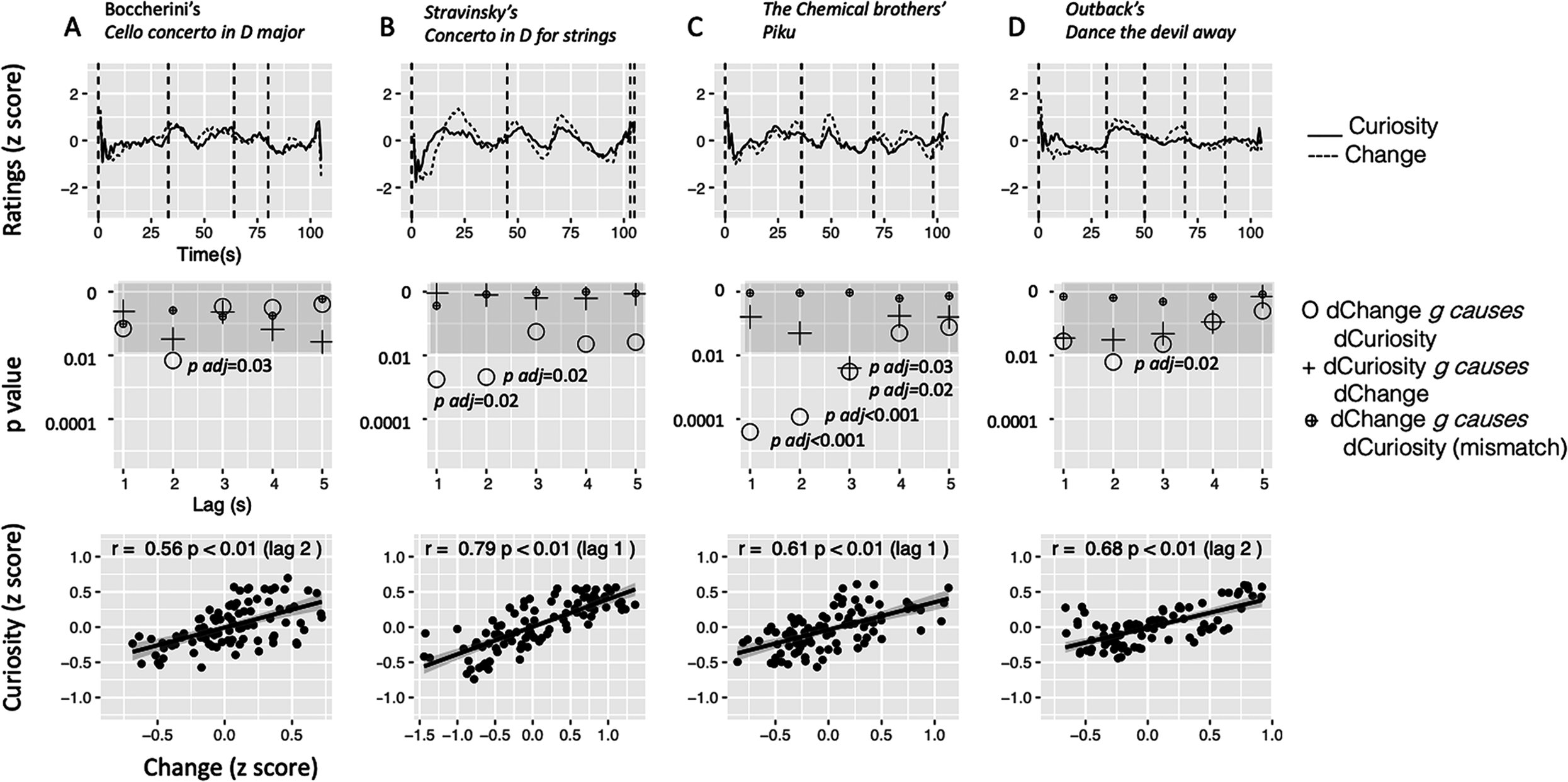
The experience of curiosity and the perception of change. The upper panel shows continuous ratings for the grand averaged differenced time series for the perception of change (dotted lines) and feelings of curiosity (solid lines) for the Boccherini / Classical music piece (a), the Stravinsky / Contemporary Classical M piece (b), the Chemical Brothers / Electronic Dance music piece (c) and the Outback / World music (d) piece. Vertical lines indicate the onset of formal units in the music. In the middle panel, for all lags from 1 to 5, large circles show the p values for perception of change “Granger-causing” curiosity, large crosses show the p values for curiosity “Granger-causing” change, and small crossed circles show the p values for perception of change “Granger-causing” curiosity for mismatched time-series. The gray shading indicates the barrier between significant and insignificant effects after fdr correction. In the lower panel, the correlation between time samples for the two time courses is shown at a representative lag (at which the Granger causality p value is smallest). p_adj = fdr-adjusted p value, where fdr is the false discovery rate.
As detailed further in Table 1 and Figure 2A, dChange Granger-caused dCuriosity for the Boccherini/Classical music (CM) piece with the strongest effect observable at the 2 s lag (F(2, 92) = 5.27, p = 0.01, adjusted p (p_adj) = 0.03) and Pearson correlation showed a positive relationship between felt curiosity and perceived change ratings (r = 0.56, p < 0.01). In contrast, dCuriosity did not Granger-cause dChange for this excerpt and, similarly, no Granger causal relationships were observed when the timeseries were mismatched (i.e. when the Stravinsky dChange time-series was used to predict the Boccherini dCuriosity time series).
Results of Granger Causality Tests Examining the Relationship Between the Experience of Curiosity and Change.
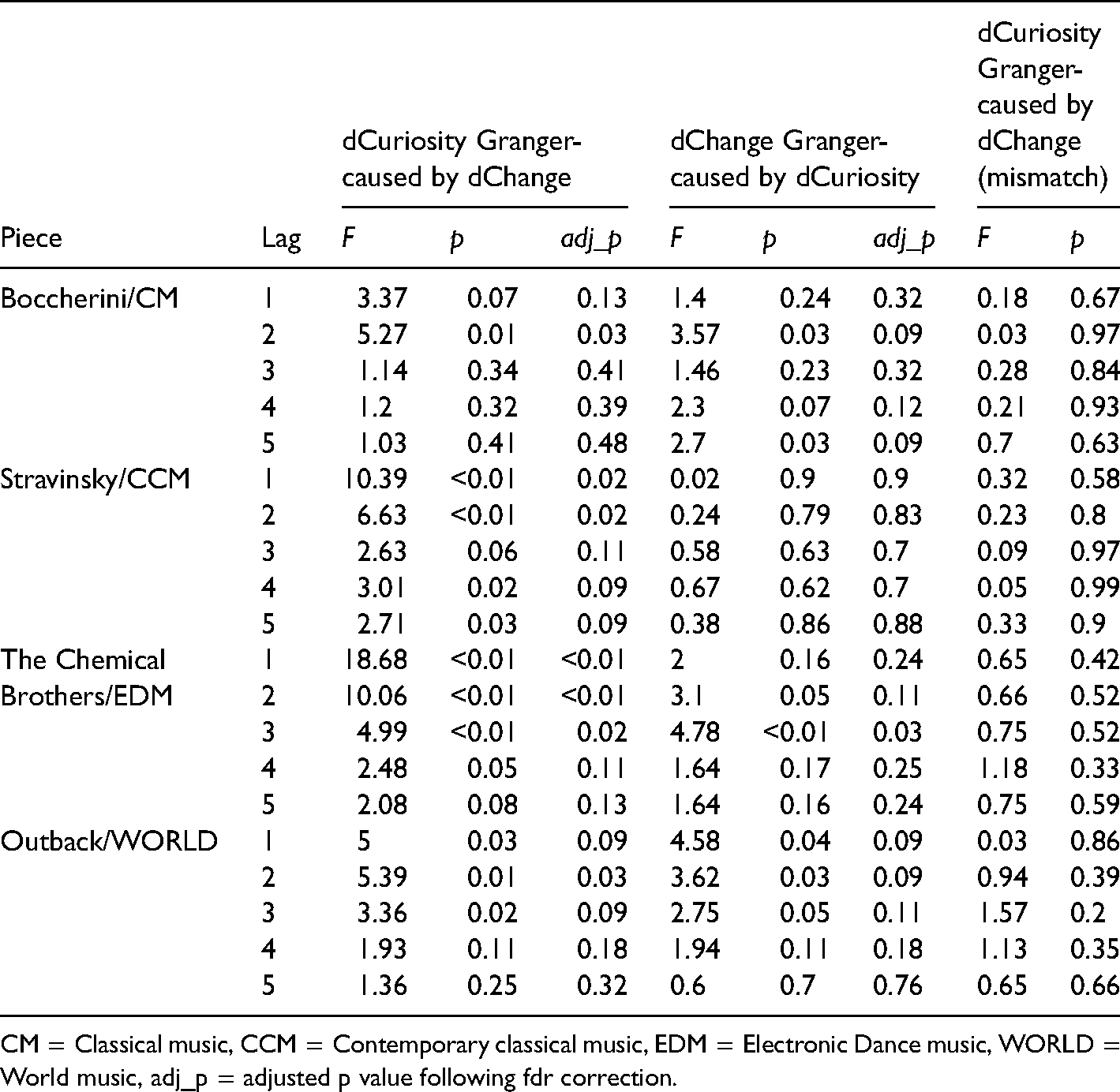
CM = Classical music, CCM = Contemporary classical music, EDM = Electronic Dance music, WORLD = World music, adj_p = adjusted p value following fdr correction.
For the Stravinsky / Contemporary Classical Music (CCM) piece seen in Figure 2b, dChange predicted dCuriosity at lag 1 (F(2,92) = 10.39, p < 0.001, adjusted p = 0.02) and lag 2 (F(2,92) = 6.63, p < 0.001, adjusted p (p_adj) = 0.02) with Pearson correlation at lag 1 (the largest effect) showing a positive relationship between curiosity and change ratings (r = 0.79, p < 0.01). Once again dCuriosity did not Granger-cause dChange for this excerpt and no Granger-causal relationships were observed when the timeseries were mismatched (i.e. when Boccherini dChange was used to predict the Stravinsky dCuriosity).
dChange Granger-caused dCuriosity for the Chemical Brothers /Electronic Dance Music (EDM) piece (as seen in Figure 2c), at a 1, 2 and 3 s lag (F(2, 92) = 4.99 to 18.68, all adjusted ps (p_adj) < 0.05), with Pearson correlation at lag 1 (the largest effect) showing a positive relationship between felt curiosity and perceived change ratings (r = 0.61, p < 0.01). However, while in line with the other excerpts, no causality was observable when the timeseries were mismatched (i.e. when Outback dChange was used to predict Chemical Brothers dCuriosity), dCuriosity was shown to significantly Granger-cause dChange at lag 3 (F(2,91) = 4.78, p < 0.01, adjusted p (p_adj) < 0.03).
Lastly, dChange Granger-caused dCuriosity for the Outback piece (as seen in Figure 2D) at a 2 s lag (F(2, 92) = 5.39, p = 0.01, adjusted p (p_adj) = 0.03), with a positive relationship between felt curiosity and perceived change ratings (r = 0.68, p < 0.01) at this lag. As with the CM and CCM pieces, dCuriosity did not Granger-cause dChange and no Granger-causal relationships were observed when the timeseries were mismatched.
Finally, Figure 3 and Table 2 show the results of Granger causality analysis testing the significance of causal relationships between feelings of calm and change perception. In contrast to analyses of the felt curiosity time courses in response to all four pieces, no Granger causality effects reached significance here.
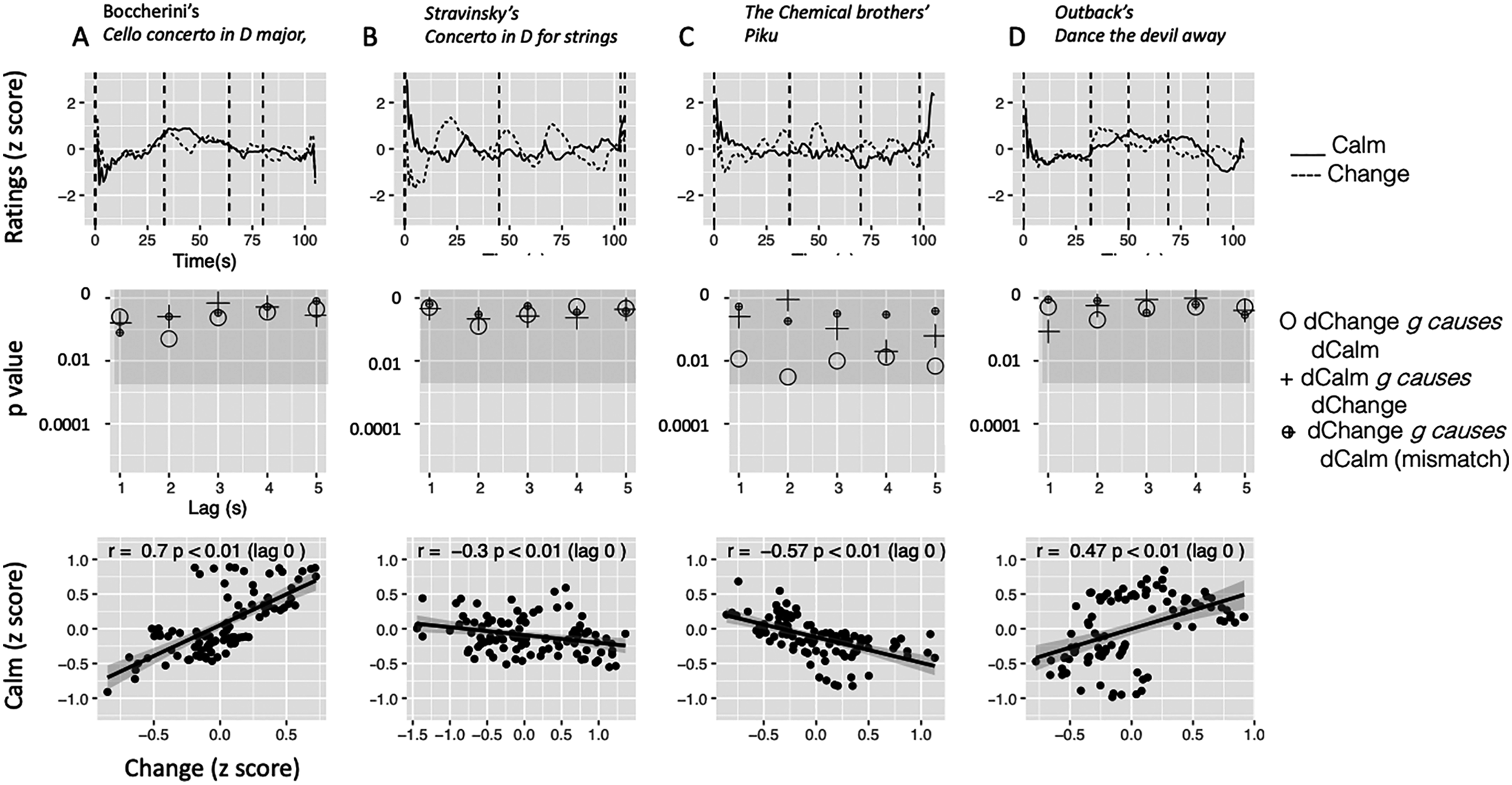
The experience of calm and the perception of change. The upper panel shows continuous ratings for the grand averaged differenced time series for the perception of change (dotted lines) and feelings of calm (solid lines) for the Boccherini / Classical music piece (a), the Stravinsky / Contemporary Classical music piece (b), the Chemical Brothers / Electronic Dance Music piece (c) and the Outback / World music (D) piece. Vertical lines indicate the onset of formal units in the music. In the middle panel, for all lags from 1 to 5, large circles show the p values for perception of change “Granger-causing” calm, large crosses show the p values for calm “Granger-causing” change, and small crossed circles show the p values for perception of change “Granger-causing” calm for mismatched time-series. The grey shading indicates the barrier between significant and insignificant effects after fdr correction. In the lower panel, correlation between time samples for the two time courses are shown at a lag 0. p_adj = fdr-adjusted p value, where fdr is the false discovery rate.
Results of Granger Causality Tests Examining the Relationship Between the Experience of Calm and Change.
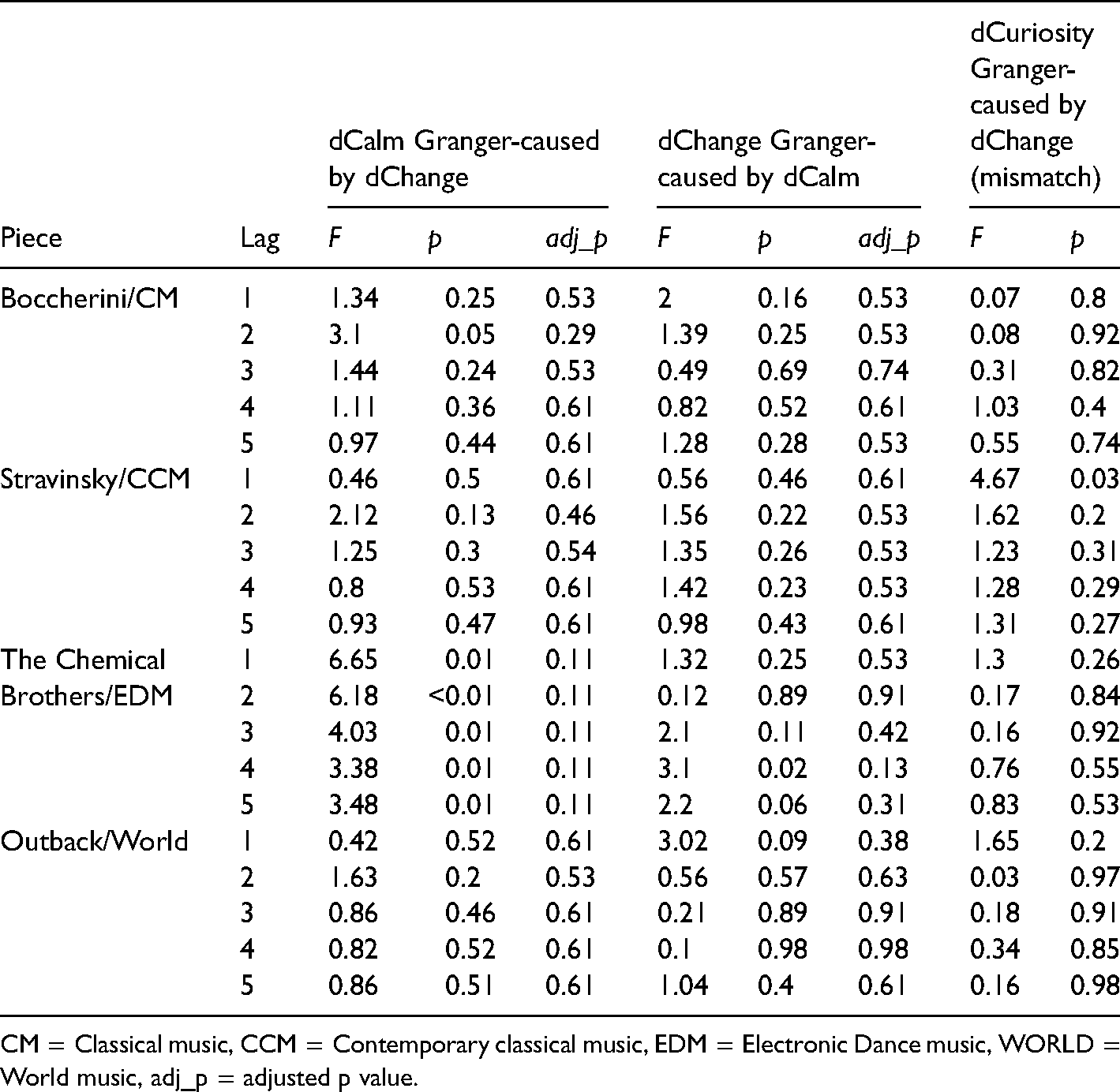
CM = Classical music, CCM = Contemporary classical music, EDM = Electronic Dance music, WORLD = World music, adj_p = adjusted p value.
Discussion
Very little work to date has examined the factors leading to dynamic changes in felt curiosity in response to temporally unfolding stimuli. Similarly, while the importance of curiosity to the aesthetic response is widely acknowledged (Berlyne, 1960; Schoeller, 2015), how curiosity emerges as a function of the structure of experienced artworks has received limited examination. Here, we used musical stimuli to examine the extent to which continuous ratings of the perception of change in music may predict changes in feelings of curiosity in response to the heard music. We showed that perception of change predicted felt curiosity in all four pieces used. In contrast, we observed that perceived change failed to Granger-cause feelings of calm in any of the same pieces.
Our findings corroborate previous work showing that a listeners’ engagement with, and interest in, a piece of music is unlikely to show a uniform distribution over the whole piece (Kaneshiro, Ruan, Baker, & Berger, 2017). Audio content recognition services like Shazam allow listeners to “query” or find out more (e.g. song name and artist) about music that is playing in their environment. Examining the relationship between the timing of listeners’ Shazam queries and the unfolding content of music, Kaneshiro et al. (2017) were able to conclude that musical moments which are particularly salient (e.g. the start of a new song, the onset of vocals, the start of the chorus) tend to drive an increase in queries. While that study examined concrete behaviors taken in a real-world scenario (and is thus different to the rating measurements taken here in the lab), we argue they reflect the same phenomenon: changes in interest in, and engagement with, music as function of perceivable structure. It has been shown that the presence of repetition (which likely negatively correlates with the presence of change) in musical streams is associated with drops in listeners’ perception of the musical stream as being salient (Taher, Rusch, & McAdams, 2016). Here we suggest that, conversely, a listener's perception of change, associated with experiencing moments as salient, leads them to experience increases in curiosity about how the music will continue to unfold.
Ultimately, that the perceived change timeseries strongly Granger-caused the felt curiosity timeseries is in line with theories suggesting that the perception of change, perhaps accompanied by an involuntary triggering of attention, can lead to an increase in the subjective experience of curiosity (Ohman, 1979; Escera et al., 1998; Gottlieb et al., 2013). Listeners’ perception of change, here, was likely associated with the kinds of musical features previously reported (e.g. changes in loudness, timbre and rhythmic structure) and it is thus interesting to speculate on how this may have influenced the different lags at which perceived change Granger-caused felt curiosity for the different pieces. Indeed, for the Chemical brothers/EDM and Stravinsky/CCM pieces, perceived change predicted felt curiosity similarly highly at lag 1 and lag 2 and here, one explanation for the short latency effect of perceived change on felt curiosity could be that changes in the structure of music in these pieces were perceived as more abrupt and salient, leading to similarly abrupt and salient increases in curiosity. Future studies that systematically manipulate the salience and speed of changing features in music would help to elaborate on how change perception contributes to felt curiosity. It could, for instance, be hypothesized that the greater the structural complexity of a genre (Daynes, 2011; Quiroga-Martinez et al., 2019; Mencke, Omigie, Wald-Fuhrmann, & Brattico, 2018), the greater the lag between perceived change and felt curiosity ratings may be expected to be. In any case, that the perceived change timeseries failed to Granger-cause feelings of calm (subjective arousal) is in line with the hypothesis that the relationship between perceived change and felt curiosity is a special one.
In addition to the differences across musical styles in the size and latency of the largely unidirectional change-curiosity Granger causality effect, the observation that at least one piece revealed felt curiosity to Granger-cause perceived change is also noteworthy. Given it is clear that the musical stimuli did not begin to exhibit salient changes (that the listeners could then perceive) because listeners were experiencing curiosity at certain points, what this finding suggests is that the experience of curiosity may reliably precede perceivable changes in the structure of music for some musical styles. Due to the dearth of studies examining changes in curiosity over time, and the lack of any studies that specifically examine the influence of change perception on felt curiosity, the extent to which some anticipatory knowledge of change may overlap with the experience of feeling curious has not previously been remarked on. In music, the experience of anticipation has been studied in the context of listeners awaiting specific pleasurable events in familiar music and, there, it has been shown to recruit the reward networks of the brain (Salimpoor et al., 2011). While it would be overly speculative to try infer the unique structural features of Electronic Dance Music that may be at play here, the current findings emphasize the possibility that listeners’ reported curiosity in the context of music listening extends beyond uncertainty caused by past events and may firmly include listeners' experiences of uncertainty with regard to events to come. Taken together, continuous ratings collected in the context of listening to unfamiliar music would seem to promise insights into those forms of anticipatory emotions that are not driven by veridical knowledge (Huron, 2006).
At this point, it is interesting to note that, while they failed to show granger causal effects, there was a significant lag 0 relationship between felt calm and perceived change for all pieces albeit in different directions. As in other cases where there is a correlation between variables but no granger causal relationships between them, we suggest a third unobserved (i.e. un-measured variable) may have been causing the observed changes in both variables. It is interesting to note that while positive relationships were observed for both the Boccherini/Classical and Outback/World piece, in contrast, negative relationships were observed for the Stravinsky/CCM and the Chemical Brothers/EDM piece. Further work is needed to understand what features of music may cause the perception of change and the experience of calm to show changes in the same or in opposite directions. However, as alluded to in our hypotheses, we speculate that a positive relationship between perception of change and feelings of calm may reflect a situation where change in music indexes introduction of events that are perceptually fluent and less arousing.
Unfortunately, and as alluded to above, although the change-uriosity associations demonstrated here are compelling in being observable across the full range of musical excerpts, the limited range of stimuli used (only one excerpt from each of the four musical styles) restricts our ability to say anything conclusive about how the examined genres differ from each other. Using a wider range of stimuli would allow the testing of specific hypotheses about how the triggers of curiosity may be influenced by the information theoretic properties of different musical styles (Mencke et al., 2018; Hansen & Pearce, 2014; Hansen, Vuust, & Pearce, 2016). For instance, varying levels of stimulus entropy or uncertainty may be expected to modulate the patterns of curiosity induced in listeners over time. Further, future studies would also benefit from having participants provide ratings for each experience across multiple hearings of the same stimuli. This would not only allow intra-rater reliability of the self-report measures to be estimated, but would also allow a test of the validity of conducting Granger causality tests at an individual level. Finally, adaptations to the paradigm could be used to address key questions that remain to be more thoroughly examined, such as the factors determining whether curiosity is experienced as a positive or negative state, and the extent to which this is based on individual differences in curiosity profiles (Loewenstein, 1994; see Kidd & Hayden, 2015 for a review; Kashdan et al., 2018).
In sum, combining continuous rating tasks with musical stimuli is shown here to be a potentially powerful approach for examining how curiosity emerges. Studies using continuous ratings have allowed psychology researchers to explain huge variability in cognitive and emotional responses to music and other artistic media over time (Coutinho & Cangelosi, 2009; McAdams, Vines, Viellard, Smith, & Reynolds, 2004; Muth, Raab, & Carbon, 2015; Toiviainen & Krumhansl, 2003; Madsen & Fredrickson, 1993; Olsen, Dean & Stevens, 2014). Here, our results show that while the use of continuous ratings is more open to demand characteristics than other implicit indices of curiosity (e.g. waiting time), its combination with the use of musical stimuli can make important contributions. We thus suggest that further research using this approach has the ability to provide continued insights into the nature of the music listening experience and the mechanisms by which art works are able to engage us.
Footnotes
Declaration of Conflicting Interests
The author(s) declared no potential conflicts of interest with respect to the research, authorship, and/or publication of this article.
Funding
The author(s) received no financial support for the research, authorship and/or publication of this article.
Author note
This research did not receive any specific grant from funding agencies in the public, commercial, or not-for-profit sectors.
