



Abstract
In folk psychology experiences of ugliness are associated with the negation of beauty and disorder, but empirical evidence is remarkably rare. Here, participants (called informed) took 102 photographs of ugly landscapes and urban scenes and reflected on their experiences. Later, participants naïve to the intentional ugliness in the photographs rated landscapes higher than informed participants. The ratings for urban scenes were similar in the two cohorts. Reflective notes revealed that emotional experiences with visual ugliness could overlap (e.g. decay), but ugliness was associated more frequently with fear and death in landscapes, and with sadness and disgust in urban scenes. The findings uncovered a complex layer of associations. Experiences triggered by perceived ugliness were contingent on a composite of socio-cultural, emotional, and evolutionary factors. Rather than being the endpoint on an aesthetic scale culminating with beauty, ugliness seems to be experienced as an independent aesthetic experience with its own processing streams.
Introduction
“If beauty is in the eye of the beholder”, can we assume that ugliness is there too?
In folk psychology, ugliness is often seen as the opposite or the negation of beauty and it is often linked to feelings of disgust and distress. Seeing beauty as the opposite of ugliness can be misleading, though. An individual can be indifferent to certain scenes or artworks, judging them irrelevant or worthless without necessarily considering them to be ugly. At other times, scenes or artworks that evoke distressing or unpleasant feelings (e.g., The Scream by Edvard Munch, Artist’s Shit by Piero Manzoni) can be highly admired and valued (Felisberti, 2020). This study examined experiences of ugliness and the assumption that ugliness is an endpoint of a somewhat linear aesthetic experience with beauty at the other extreme.
Curiously, although the experience of ugliness is discussed in Western art and philosophy, as well as in Eastern and Western music, literature, and architecture, empirical studies in psychology and neurosciences are still rare (Bayley, 2012; Eco, 2007; Rosenkranz, 2015). Such empirical studies are faced with a problem: how to understand the experience of ugliness on its own when experimental paradigms are so intricately biased towards beauty?
In art, ugliness seems to be as much a complex and multi-layered concept as beauty is, as exemplified by the photographs of Sebastião Salgado, were images of ravaged landscapes acquire an eerie and daunting beauty. The so-called “paradox of ugliness” proposes that ugliness stimulates people’s imagination while simultaneously causing cognitive disruption due to the disordered or incongruent visual properties of an object, or simply put, we can appreciate the value of something that we at first do not like and even consider distasteful. That might help explaining, for example, why some people continue to attend to unpleasant objects or scenes despite finding them ugly and repellent. On the other hand, the value of natural and man-made artefacts cannot be compared since what can be perceived (at first sight) as ugly in nature tends to remain ugly even after we have learned more about it (Budd, 2000), which is not always the case with artistic artefacts. In other words, an experience of ugliness in nature cannot be resolved by an enhanced knowledge of its ecological context, as observed with some artworks.
The experience of ugliness also has an emotional dimension. Artworks can evoke a wide range of emotions with different levels of valence and arousal (Leder et al., 2004; Marković, 2010), but most studies in empirical aesthetics focus on the pleasurable end of the aesthetic experiences, neglecting to address more complex forms of aesthetic engagement linked to ugliness (Brady, 2020). Henderson (1966) understood the inherent complexity in notions of ugliness and proposed at least four types to encompass its myriad of emotional and cognitive meanings (“sensory”, “moral”, “visceral”, “adjudicative”). For him, sensory ugliness could be a physiological response to stimuli such as a loud sound, while moral ugliness could be evoked by a heinous war scene in a film, for example. Visceral ugliness was linked to stimuli that could trigger physical repulsion or disgust (e.g., rotten food). Adjudicative ugliness was attributed to nasty stimuli, like a dissonant song or piece of critical writing. Similar notions of ugliness seem to be echoed at the psychoanalytical level, as captured by Hagman (2003) “… ugliness results from the emergence into consciousness of certain fantasies that alter the person’s aesthetic sense in such a way that the formal qualities of the experience, the shape, texture, and colour, appear to become the sources of our most disturbing and repulsive feelings”.
As many have observed, ugliness in visual art can be engaging and moving and often it is deeply entangled with beauty, but ugliness needs to be examined on its own right. There is a foggy line between “ugly, yet pleasant” (e.g., Still life by Sam Taylor-Wood, which captures in time-lapsed frames the actual decomposition of a plate of fruits), and “ugly and unpleasant” (e.g., an image of a plate with rotten fruits in our kitchen), even when the core elements depicted in the images are the same. The variety of forms in which ugliness can be interpreted and expressed suggests that aesthetic experiences associated with ugliness are likely to involve a distributed neural process which assesses the value of perceptual inputs, their context, memories, and homeostatic states, as well as the behavioural options available to the individual at any given moment (Nadal et al., 2008; Skov, 2019).
It is well known that knowledge about a given visual stimulus can affect how it is perceived (via top-down processing) and evaluated (Pelowski et al., 2017). To address the impact of prior knowledge on aesthetic judgements, this study recruited two groups of participants: one group was asked to produce ugly photographs of landscapes and urban scenes and the other group was naïve to such intentionality. The subsequent liking ratings to ugly images was used to understand the effect of prior knowledge on the individuals’ experience(s) of ugliness. Photography was chosen as the outlet for the expression of individual experiences of ugliness because inbuilt cameras are available in most mobile phones and their use was relatively well known by the targeted participants, allowing them to direct their ‘aesthetic lens’ towards ugliness and express complex experiences rather than using language alone, as noted by Barthes (1981).
This study focuses on images of spaces inhabited and/or visited by humans on a regular basis (nature of landscapes and urban scenes), but rather than using artistic images where ugliness is invariably entangled with instances of beauty, the images used here were produced by amateur photographers with the explicit intent to be linked to personal interpretations of visual ugliness. It attempts to understand the contrasting views about ugliness in man-made artefacts (context-dependent evaluations) and nature (more stable evaluations). Those environments have been chosen due to the relevance of such spaces to human wellbeing and urban planning (Cabanek et al., 2020; Wilson, 1990). In a nutshell, this study aimed at understanding the experience of ugliness in landscapes and urban scenes by:
Examining the experiences of ugliness using qualitative analysis to test the hypothesis that those experiences are as complex and multi-layered as other aesthetic experiences. Comparing liking ratings for ugly images to verify the assumption that the “paradox of ugliness” is also observed across non-artistic outputs; Examining the effect of prior knowledge (here the intentional ugliness in photographs) on liking ratings and verify if top-down processing affects such ratings.
Since pleasurable emotional experiences in natural spaces have been linked to increased wellbeing (Kaplan, 1995; Kellert, 1993), it is reasonable to assume that extended exposure to visual ugliness in daily environments are likely to impact wellbeing significantly. The findings are discussed in terms of the need to create a framework to understand ugliness as an aesthetic experience independent of that of beauty, even though deeply entangled with it.
Material and Method
Participants
There were 92 participants (75 females, 17 males) with a mean age of 29 years (SD = 9.84; range = 20-57 years), but it should be noted that eight participants did not disclose their ages. The first part of the study had 51 participants (42 females), while the second part had 41 participants (33 females), who were mostly undergraduate and postgraduate university students. They were recruited via opportunity sampling using the University recruitment system, leaflets, social media, and word of mouth. None of the participants were professional photographers and all had normal-to-corrected vision.
Due to the lack of previous empirical studies on the perception and emotional experiences of ugliness, the sample size in this study was based on the number of participants willing to contribute photographs and reflective notes and who provided their liking ratings for the images. The sample with 92 participants (two groups and four conditions) assumed a statistical power of 85% (α = 5%, two-tailed F test, repeated measures; G* Power (Faul et al., 2007), but such power analysis is a rough estimate, especially in the face of the rarity of empirical studies on the topic.
The study received a favourable view from the departmental Ethics Committee at the university and it followed the recommendations of the Helsinki Declaration 2013 and the British Psychological Society code of human research ethics. Participation was voluntary, informed consent was provided, and no cash payment or course credits were offered.
Materials
Photographs
In the first part of the study participants were asked to take photographs with the in-built cameras in their mobile phones of landscapes and urban environments they judged to be “ugly”. Each of the 51 informed participants was asked to submit one or two ugly photographs of landscapes and one or two ugly photographs of urban scenes. There was a surplus of images submitted, but the ones with animals (e.g. spiders), people and/or faces, or suspected to have been downloaded from websites (visual checks were carried out) were deleted. The final sample had 102 photographs, 49 of landscapes (i.e. natural scenes) and 53 of urban scenes. All but one participant had at least two of their photographs used in the survey.
The participants’ mood before the start of the study was monitored via their answers to mood and life orientation questionnaires, since the evaluation of pleasant or unpleasant scenes can be mood-congruent (Fiedler & Stroehm, 1986).
Life Orientation Revised Test (LOT-R)
It is a 10-item measure developed to assess individual differences in generalized optimism and pessimism (Vautier et al., 2003), revised from the original test developed by Scheier et al. (1994). There was relatively good internal consistency for the scores of the optimism and pessimism factors (Cronbach α= .73 and .77, respectively).
Short Mood and Feelings Questionnaire (SMFQ)
It is a 10-item measure adapted for adults and designed for the rapid screening of self-reported signs of depression (Angold et al., 1995). The internal consistency was good (Cronbach α= .89).
Reflective Short Essays
Participants were asked to write a short reflective essay about how they viewed ‘ugliness’ in natural and urban environments (200-300 words in length).
Procedure
Participants were informed as to the purposes of the study and had to confirm that they understood the information provided before giving their consent and starting the tasks.
They were then asked to take “ugly” photographs of landscapes and urban scenes, to reflect on the meaning of ugliness for them, and to write a short note about it. Photographs of actual humans and other living beings were not allowed due to ethical restrictions in terms of their posterior use in the survey. Otherwise participants were free to interpret ‘ugliness’ as they saw fit. To reduce possible variations in granulation and sharpness, the size of the photographs was kept in the range of 2-3 Mb (participants were asked to adjust their cameras output accordingly).
Photographs of landscapes were taken in several locations, including inside–or in the proximity–of urban areas (i.e. parks, lakes, forests in the outskirts of cities, waterways). They varied from fruits, shrubs, and plants to water bodies and the sky. There were a few exceptions to the “no living organisms” rule in the final set of images: one was a misaligned photograph of a painting at the National Gallery (“The Ugly Duchess” by Quinten Massys) and the second was a photograph of the graffiti “Well Hung Lover” by Banksy, which depicted humans (Figure 2F). Photographs of urban scenes varied from single, small artefacts to large buildings and parking spaces. A few photographs were categorised as “urban” by the participants who took them due to their core content, even though some had backgrounds with natural elements (e.g. damaged Brighton pier framed against the sea and sky; rubbish bags on a street with a tree).
The photographs submitted by the participants were used in an online survey where participants informed or naïve of the intentional ugliness in the photographs were asked to rate them using a Likert-like scale: “On a scale from 0-10, how do you like this image?”, where “0” represented “Strongly dislike it” and “10” represented “Strongly like it”.
The digital ugly photographs used in the survey were submitted via an email account created specifically for that purpose, to avoid submissions of such photographs via university emails and a code was provided to verify the submissions were from the participants. Note that the participants who contributed their photographs to the study were informed of the intentionality of ugliness in the generation of the photographs and referred to as such. The other participants were told that the photographs were taken by “amateur photographers” using their mobile phones and are referred to as naïve. The data collection for this study took place in 2011-12.
Results
Image Ratings
The missing liking ratings of participants who rated at least 95% of the images in the survey (N = 6) were replaced by the mean linear interpolation of the other ratings in the dataset. The mean ratings had normal distributions with kurtosis values between -0.19 and 0.50. The results of bootstrap samples (5000) with the confidence interval bias-corrected and accelerated and effect sizes are shown in estimation plots (Ho et al., 2019).
A 2-ugliness knowledge (informed vs. naïve) by 2-scenes (Landscape vs Urban) ANOVA showed that the ratings for Landscape and Urban images differed significantly: Urban (M = 3.70, 95% CI [3.49, 3.92]), Landscape (M = 5.08, 95% CI [4.81, 5.35]), F(1,90) = 181.52, p < .001, ɳp2 = .67. Informed participants gave lower ratings to images of landscapes than naïve ones, F(1,90) = 5.34, p = .023, but both groups rated Urban images similarly, F(1,90) = 1.16, p = .284.
The paired mean difference between Landscape and Urban ratings for informed participants was -1.18 [95% CI: -1.71, -0.676] and the Cohen’s d was -.89 (Wilcoxon test, p < .001) (Figure 1A). For naïve participants, the paired mean difference between those ratings was even higher, as there was less variance in the individual responses, -1.58 [95% CI: -1.95, -1.16]; Cohen’s d was -1.66 (Wilcoxon test, p < .001) (Figure 1B).
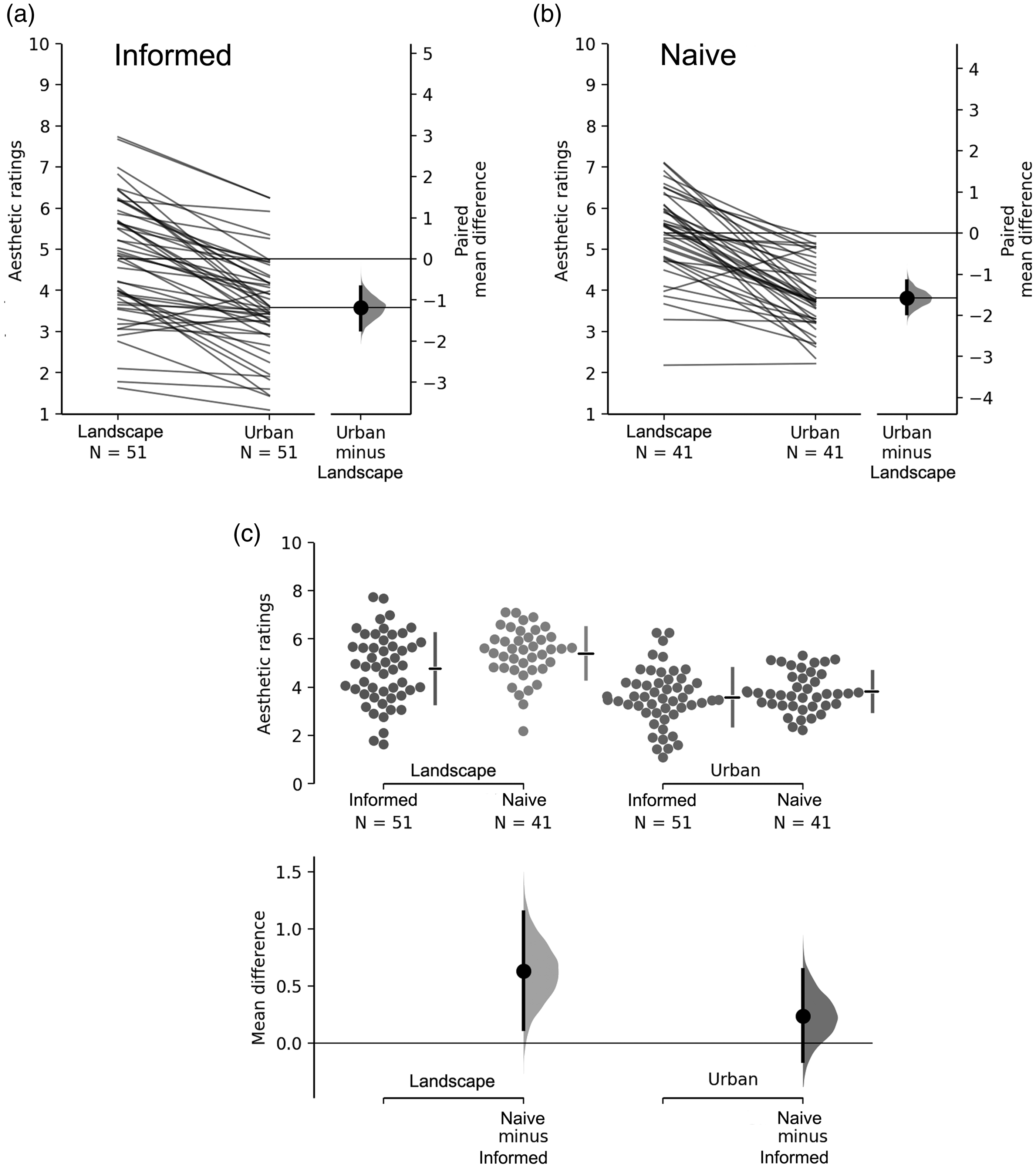
Aesthetic Ratings for Ugly Photographs of Landscape and Urban Scenes. The paired comparison of aesthetic ratings of participants informed (A) and naïve (B) of the intended ugliness is shown in the Gardner-Altman estimation plots. The unpaired comparison of aesthetic ratings is shown in the Cumming estimation plot (C). The 95% CI are indicated by the ends of the vertical bars; jitter was added to plot c to reveal the range of individual ratings.
The mean difference between the ratings of informed and naïve participants for Landscapes was 0.628 [95% CI: 0.118, 1.14] (Mann-Whitney test, p = 0.031), whereas the mean difference between the two groups for Urban scenes was negligible, 0.233 [95% CI: -0.161, 0.642] (p = 0.287) (Figure 1C).
Mood and Life Orientation (LOT-R and SMFQ)
This part of the experiment examined if the liking ratings were affected by the mood of the participants or by their overall life orientation (i.e., their level of optimism or pessimism). The two questionnaires were also used to check overall consistency; if participants were consistent, then the higher their optimism scores in LOT-R, the lower their mood and feelings scores in the SMQF. This assumption was only partially confirmed in the correlational analysis; a LOT-R optimism and SMFQ scores were not reliably correlated (r (92) = -.18, p = .094), but there was a positive and significant correlation between LOT-R pessimism scores and SMFQ (r (92) = .34, p < .001). Although the self-reports were consistent with each other, the one-tailed correlations did not reveal any significant associations between the liking ratings for the images of landscapes and urban scenes and the LOT-R and SMFQ scores (ps > .37).
Reflections on Ugliness
Fifty participants submitted their short reflective comments on ugliness in landscapes and urban environments, which were analysed with a mixed approach (qualitative visual analysis and quasi-thematic analysis). One of the participants who had contributed photographs to the study failed to submit comments.
Several participants reported that taking ugly photographs was not as easy as they had initially thought (“I can describe my experience of taking ugly pictures as both interesting and challenging”). They frequently reported the experience as more challenging for photographs of ugly things in landscapes (“Initially I found this task perplexing. The idea of seeking out unappealing images and scenes to immortalise seemed unnatural”) than ugly urban scenes (“Unlike the natural environment, the more I looked for ugliness in the city, the more I found it”).
When referring to ugliness in landscapes, the most common references were directly or indirectly related to environmental damage (“The ugliness I captured in the natural environment was of a tree that had been partially destroyed”), impenetrable shrubs, stagnated water, decay and dark and dull colours (“This time of the year the forest is wet and muddy. The colour of the leaves change to darker shades of brown. Broken branches and dried leaves are scattered all around the ground smudge into mud”, “I find the aesthetic of the dying and decaying leaves of the plants to be ‘ugly’ in a sense”) (Figure 2A and B).
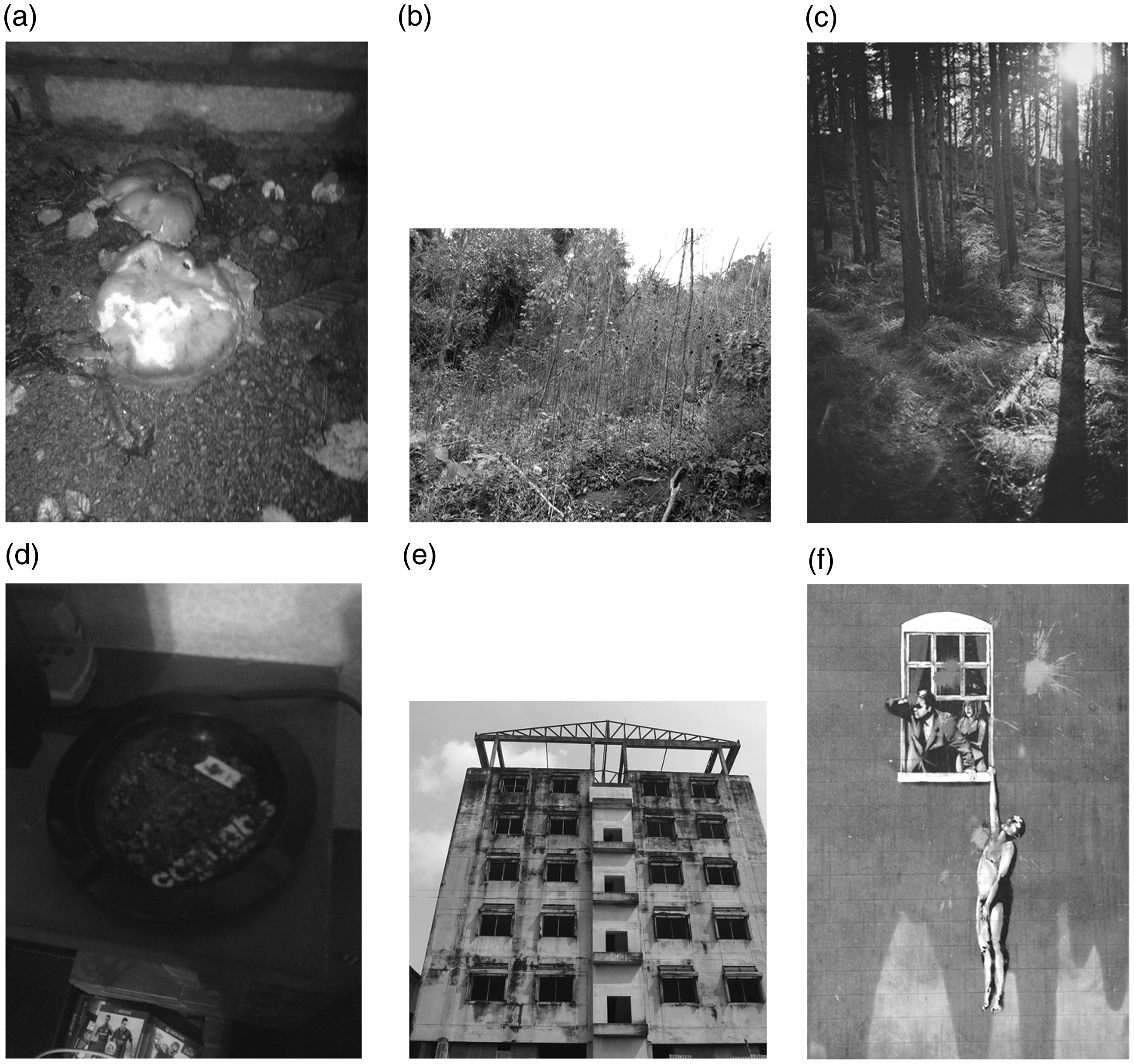
Examples of Photographs of Landscape and Urban Scenes Used in the Study. The mean ratings for each of the images given by 92 participants are in brackets: (A–C) landscapes [1.2; 4.6; 7.5], (D–F) urban scenes [1.6; 4.4; 6.9]. Note: All images were in colour; B and E were in landscape format (slightly smaller in this figure to fit in the column’s width). A red and blurred sun hallo in image C is not visible in the black and white version.
The most commonly cited elements in images of urban scenes were linked to rubbish, destruction or vandalism (“when I see an abandoned building in London sprayed with graffiti and surrounded by excessive amounts of litter”, “The broken concrete and rusted coils protruding from it gave it an almost violent look to me”), colours (“[…] run down areas might be seen as ugly due to their dull atmosphere and lack of light, which evoke negative feelings and emotions”), or a combination of those things (“[…] my meaning of ugliness was mostly related to dirt, darkness (a dark narrow pathway in the night), death (cemetery) and sickness”), as illustrated in Figure 2D and E.
Some participants linked ugliness with the meaning that could be inferred from certain images independently of their actual content (“[…] when I was taking the photo of cigarettes it occurred to me that they are also morally ugly”, Does […] a fighter jet/bomber, a tank, or a shotgun that was built to kill, or at least harm other living things be defined as ugly?”, “The photo is of a broken glass to represent addiction and dependency”). An example of image showing the complex layers of the meaning of “ugliness” is illustrated in Figure 2F, which shows a Banksy’s graffiti that had been damaged by splashes of paint thrown at it (i.e. vandalism), but also depicting a form of behaviour that could have been considered despicable by some participants.
Some participants tended to ascribe negative emotions (i.e. disgust, desolation, danger/fear, boredom) to some of their images, even when some of them were not intrinsically ugly in purely perceptual terms: “A vacant house starts to deteriorate from neglect. I don’t feel happy when I see the house”, “[…] a beautiful flower that contains rich colours and delicate petals but it also has concepts of ugliness in the form of prickly thorns on the stem which represent danger”, and “[…] an office block, the boredom of being inside all day and working at a desk with no one to talk to gives me very negative feelings”. An example of a sense of isolation in a landscape scene is illustrated in Figure 2C, which the author argued evoked feelings of “being lost” and of isolation.
It is relevant to note that although the brief for the photographic task was relatively open to interpretation, most participants focused on the environmental scenes rather than on technical aspects of photography (e.g. blurred, out of focus, pixilated, or badly cropped images). According to the reflective notes and submitted images, only two participants addressed ugliness in such way; one of them submitted a skewed photograph of the “The Ugly Duchess” painting (as cited before) and another one submitted two photographs unusually blurred.
Discussion
This study examined experiences of ugliness in visited or inhabited spaces in nature and urban environments employing photography as an empirical interface.
The first phase of the study aimed at teasing apart aesthetic ratings of informed and naïve participants to visual ugliness associated to landscapes and urban scenes and gauge the influence of prior knowledge on those preferences. Images commonly regarded as beautiful by professional photographers and art critics were not included in this study, so participants’ liking ratings had to rely on internalized aesthetic notions. The second phase examined the qualitative responses triggered by ugliness in those two environments through the notes submitted by informed participants.
The liking ratings for landscapes and urban scenes were mostly below the middle of the scale used, confirming that the average ratings for both categories of images were displaced towards the “dislike” side of the like-dislike scale. The ratings for urban scenes of informed and naïve participants were similar, but not their ratings for landscapes, which were significantly higher in naïve participants. The overall difference between the two groups was smaller than expected. The wider range of ratings by informed participants might have masked differences or similarities between the two groups. Further, participants might have treated the digital photographs as prototypical artworks simply because they had been asked to rate them, even though there was no art-related experimental framing manipulation in the survey (Wagner et al., 2014). Equally possible, although less likely, is that the unfavourable evaluations received by the first randomly presented images (from the 102 images set) might have “worn off” with the continuous exposure to the intended ugly images, gradually turning the evaluations into more favourable ones and attenuating the dislike ratings (Sluckin et al., 1980). Such findings seem to echo the Fluency Amplification Model (Albrecht & Carbon, 2014) and the Mere Exposure Effect (Zajonc, 1968) in thematic terms, but each of the images was presented only once and the experimental setup might have prevented any significant contribution of such effects.
The higher liking ratings for landscapes over urban scenes are in line with previous studies reporting a widespread adult preference for natural environments (Ibarra et al., 2017; Kaplan, 1995; van den Berg et al., 2007). A few theories, often associated to our evolutionary past, have been proposed to explain such preferences, like the Attention Restoration Theory (Kaplan, 1995) and the Biophilia Theory (Kellert, 1993), to cite just two of the better known theories. Some of them have been incorporated into different forms of mental health therapies, even though the mechanisms by which such preferences may help patients are not yet known.
Novelty, composition, and cropping can play a powerful role in how images are evaluated aesthetically (McManus et al., 2011), but most participants in this study focused on the experience of ugliness in semantic, mnemonic, and emotional terms. There were rare examples of artistic incursions linked to form and composition (e.g., a distorted framing angle, a blurred image, and a reddish artefact in one of the landscapes with trees). Given the lack of a classical education or training in photography, participants were unlikely to have rated the images purely based on concepts such as hedonic tone, expressiveness, valence, and arousal without a prompt (Nadal et al., 2006), like professional photographers might have done. Nonetheless, it is impossible to preclude the modulation of photographic conventions on aesthetic evaluations due to amateur photographers’ widespread familiarisation with basic composition, cropping, and colour adjustments (Griffin, 1987).
A subsidiary question in this phase of the study was related to the effect of mood and life orientation on the appreciation of the two sets of photographs. Previous studies suggested that low or high moods and feelings could bias perceptual responses; outcomes could be evaluated as better when individuals were in a good mood ( Huntsinger et al., 2014). Contrary to expectations, a correlational analysis revealed that neither oscillations in mood and feelings nor pessimistic or optimistic life orientation had any reliable effect on the liking ratings for the two sets of images presented.
Another phase in this study involved informed participants and their reported experience(s) of ugliness. It showed that ugliness triggered a myriad of meanings, seeping through psychoanalysis and folk psychology to semiotics and philosophy (Bayley, 2012; Brady, 2020; Eco, 2007; Hagman, 2003; Küplen, 2011; Wenzel, 1999). Their observations nested roughly into the meanings of ugliness posited by Henderson (1966): sensory, moral, visceral and adjudicative. The most common associations with ugliness in urban environments were rubbish (moral and sensory–indirectly via smell), disgust (visceral), vandalism (adjudicative and moral), and assorted forms of moral repulsion linked to unhealthy behaviours. The experiences associated with visual ugliness in landscapes focused on putrefaction and death (sensory), fear of the unknown (visceral), and environmental damage and destruction (moral and adjudicative). There was some overlap in perceived ugliness in the two environments, especially in terms of overall forms of decay. Further, (some) informed participants reported how difficult the tasks of taking ugly photographs and writing notes about their experience proved to be. They were adamant, though, that the experience changed the way they perceived their environment, and the same was true about their notions of ugliness. It is possible that the change from a state of uncertainty (“what is ugly?”) to a state of lower uncertainty (“this is ugly in this context”) led participants to experience something akin to a less distressing experience than they had initially assumed (Van de Cruys et al., 2017), but again, further studies are needed to understand that behaviour.
Theoretical accounts for preferences and avoidances of certain elements in our environment have been linked to our evolutionary past (Mayer et al., 2008; Zaidel et al., 2013), as it would have been advantageous to have negative hedonic evaluations of sensory objects and living things to avoid health hazards such as contamination, predation and other forms of danger (Tybur et al., 2013). Such links between ugliness and protective and self-defence behaviours (Menninghaus et al., 2017) also include moral transgressions and unhealthy behaviours. Although it is assumed that perceived environmental ugliness affects wellbeing, the question remains open. Disgust and distress are closely associated with bodily violations such as fresh injuries, infections and hygienic concerns (Davey, 2011). A heightened sensitivity to disgust has been linked to psychopathologies such as contamination fears, sexual dysfunctions, and hypochondriasis, to cite just a few, but ugliness by itself is not necessarily experienced only as disgust or distress. Indeed, Marzillier and Davey (2005) reported that anxiety induced by unpleasant scenes and music had a significant effect on increasing reported disgust, but increases in disgust were not linked to heightened anxiety.
Future studies are needed to extend our findings on experiences of ugliness by using other categories of images as well as different rating scales. A more elaborate set of questions is also needed to understand not only the emotional processing underlying experiences of ugliness but also its implications for wellbeing. Although a pilot study is under way (Felisberti & Mather, 2019), the isolated contribution of perceptual features to the experience of ugliness also needs to be assessed in future studies.
Most empirical studies have focused on the complexities involved in understanding beauty, relegating ugliness to obscurity. Semantically, beauty and ugliness are antonyms, which echoes the dichotomy seen in the order vs disorder focus of some early academic studies (Arnheim, 1974; Pickford, 1969), but such views fail to embrace some of the experiences with ugliness reported here and elsewhere. The layer of associations uncovered by the few studies on the topic revealed that notions of ugliness are also complex and intertwined with behaviours contingent on a composite of socio-cultural, emotional, and evolutionary factors. The experience of ugliness and beauty seem to be independent of each other, not simply opposites, since both can co-exist in artworks (see introduction), architecture (e.g. brutalism), film (e.g. horror), music and fashion (e.g. punk), as well as the environment (e.g. arid volcanic landscapes) (Brady, 2020; Cook & Furnham, 2012; Goldman & Waymer, 2014; Kieran, 1997). The experience of ugliness also seems distinct from that of beauty in evolutionary and emotional terms. Sorokowski and Kościński (2013) findings, for example, indicated that facial attractiveness varied with societies and ecological conditions, but responses to unattractive faces were less variable cross-culturally. There are differences in emotion processing too; the emotions most often associated with ugliness—pain, fear, disgust and distress—involve some neural networks distinct from those associated with beauty (Kirk et al., 2009; Luo et al., 2019; Nakamura & Kawabata, 2015).
In a nutshell, the findings in this study showed that experiential associations with visual ugliness varied with natural and urban environment, were not affected by mood, feelings or life orientation, and were only weakly modulated (if at all) by the prior knowledge of the intended ugliness in the images. The findings indicate that the experience of ugliness is not simply the endpoint of an imaginary beauty-ugliness aesthetic evaluation scale, but rather an independent experience not only entangled with the negation of beauty, but also able to coexist with it. This study is also a call for more research into this relatively neglected aesthetic experience, since its understanding may provide important information on how to avoid urban designs that reduce the restorative potential of public spaces, with likely implications for mental health and general wellbeing.
Supplemental Material
sj-zip-1-art-10.1177_02762374211001798 - Supplemental material for Experiences of Ugliness in Nature and Urban environments
Supplemental material, sj-zip-1-art-10.1177_02762374211001798 for Experiences of Ugliness in Nature and Urban environments by Fatima M. Felisberti in Empirical Studies of the Arts
Footnotes
Acknowledgment
I would like to thank the participants for their photographic contributions and reflective notes, George Mather and C Alexandro Párraga for earlier discussions on the topic, and to the R community for the useful packages for data analysis made available free of charge to us all.
Declaration of Conflicting Interests
The author(s) declared no potential conflicts of interest with respect to the research, authorship, and/or publication of this article.
Funding
The author(s) received no financial support for the research, authorship, and/or publication of this article.

Supplemental Material
Supplemental material for this article is available online.
Author Biography
References
Supplementary Material
Please find the following supplemental material available below.
For Open Access articles published under a Creative Commons License, all supplemental material carries the same license as the article it is associated with.
For non-Open Access articles published, all supplemental material carries a non-exclusive license, and permission requests for re-use of supplemental material or any part of supplemental material shall be sent directly to the copyright owner as specified in the copyright notice associated with the article.
