




Abstract
With the prevalence of photo-editing apps, young women nowadays often present ideal but unnatural beauty images in their selfies posted on social networking sites. In view of the possible impact that exposure to the enhanced selfies might have on women’s beauty image concerns, there are campaigns like #Filterdrop and #Nomakeup advocating presenting natural appearance in selfies and promoting acceptance of natural beauty. This study aims to investigate the impact of viewing enhanced (i.e. idealized) selfies, natural (i.e. unaltered, makeup-free, and enhancement-free) selfies, and a mixed set of both (i.e. idealized selfies and natural selfies appear alternately) on young women’s beauty standards and their intentions to alter their appearance. The research involved a between-subjects experiment conducted among 428 young women in the United States. The findings indicate that the more enhanced selfies young women saw, the more they believed others endorsed the cultural beauty ideals. The perceived beauty standards were associated with the young women’s personal beauty standards and their intention to take cosmetic surgery in real life.
The idealized beauty images presented by the traditional media have long been criticized for their adverse impacts on women’s body image (for a review, see Huang et al., 2021). Such a concern further increments when young women change to use social networking sites (SNSs) (Åberg et al., 2020; Perloff, 2014), because the user-generated self-images presented on SNSs are often edited to conform to those idealized beauty images in the traditional media (Li et al., 2018; Monacis et al., 2021). Updated statistics shows that 90% of young women reported using computer software or apps to edit their selfies based on the cultural beauty ideals presented traditional media (Kapidzic & Martins, 2015; Science Daily, 2021). Studies have found that exposure to enhanced selfies can reinforce young women’s body dissatisfaction, body shame, and so forth (de Lenne et al., 2020; de Valle et al., 2021; Saiphoo & Vahedi, 2019).
To counteract the negative effects of enhanced selfies, there are online campaigns like #Filterdrop and #Filterfree on SNSs encouraging women to post photos of their natural looks without using any editing, touch-up, filters, or digital enhancement (BBC, 2020; Lanquist, 2016). Experimental studies have shown that exposure to natural selfies presenting averaged or fat body shape, or face with defective skins, no makeup and so forth can reduce women’s body image concerns (Cohen et al., 2019; Kleemans et al., 2018; Stevens & Griffiths, 2020; Tiggemann & Zinoviev, 2019). However, in reality, enhanced selfies and natural selfies do not appear separately. They coexist and users are often exposed to a mixed set of them when browsing through SNSs. An investigation of the effects that such exposure might have on young women could better inform how young women process beauty images received on SNSs and get influenced in a real-world setting. The findings are expected to generate a higher level of external validity and provide a more realistic evaluation of the impacts that varying selfies on SNSs have on users’ beauty concerns.
Researchers have used the mechanisms of internalization (Tiggemann & Velissaris, 2020) or social comparison (Fasoli et al., 2023) to explain how exposure to edited selfies exerts impacts on young women’s beauty concerns. Exposure to the idealized selfies is believed to lead young women to internalize the traditionally defined beauty ideals as personal beauty appropriateness (Feltman & Szymanski, 2018; Saunders & Eaton, 2018), compare themselves with the unattainable beauty ideals (Fardouly et al., 2023; Tiggemann & Zinoviev, 2019), thereby leading to dissatisfaction with their own appearance. There is an assumption that young women endorse the ideal beauty demonstrated by edited selfies so that they are led to internalize or compare with the beauty ideals (Festinger, 1957; Thompson & Stice, 2001). Investigating the association between young women’s exposure to varying selfies and their beauty standards could affirm this assumption. In particular, enhanced selfies, in contrast to natural ones, mirror the narrowly defined beauty ideals in traditional media (Lucibello et al., 2021). Testing if exposure to natural selfies along with edited selfies can mitigate young women’s endorsement of the beauty ideals can suggest ways to offset the impacts of idealized beauty images that have been harshly criticized by feminists.
The adaptation-level theory has long been used to explain that exposure to beauty images in the media may influence young women’s beauty standards (e.g. Glauert et al., 2009; Mills et al., 2002; Winkler & Rhodes, 2005). We employ the theory in this study to investigate whether exposure to selfies on SNSs, which present idealized or natural beauty images, would be as influential in affecting beauty standards among young women. In addition, unlike the idealized beauty portrayed by remote media figures in the traditional media, the idealized beauty in enhanced selfies on SNSs is portrayed by ordinary women. Young women are likely to view selfies as personalized and reciprocal social interactions, from which they learn the beauty standards held by others (Mascheroni et al., 2015; Yau & Reich, 2019). They would then include the perceived others’ endorsement of the beauty ideal into their evaluation point and form their beauty standards as well (Chua & Chang, 2016). The dual nature of selfies that combines media images and social interaction makes it an ideal touchpoint for extending adaptation level theory in the era of new media.
We also connect the adaptation-level theory to Higgins’ (1987, 1989) self-discrepancy theory to examine the consequence of young women’s endorsement of beauty ideals. According to Higgins, people are driven to employ behaviors to resolve the discrepancy between their ideal self and their actual self. Nowadays young women may choose to edit and post their own selfies on SNSs to present a self-image of ideal beauty. Such a behavior may further enhance their dissatisfaction with their own appearance (Tiggemann et al., 2020). Young women may also be led to opt for risky cosmetic surgery to obtain an ideal appearance offline (Lu & Chia, 2022). Investigating how exposure to at least some natural selfies along the way could cultivate their acceptance of natural look and mitigate their intention to engage in risky beauty-related behaviors online can provide suggestions for campaigns or programs that aim to intervene young women’s beauty concerns and enhance young women’s self-esteem.
Given that, a between-subjects experiment (no exposure to selfies vs enhanced selfies vs a mixture of natural and enhanced selfies vs natural selfies) was conducted. Mocked-up Instagram posts in the format of vignettes were created as experimental stimuli, as Instagram is the most popular photo and video sharing platform in the United States, with adults spending an average of 30.1 minutes per day on the platform (Newberry, 2023). We focus on young women aged from 18 to 30 years old, who are more susceptible to beauty ideals and beauty standards held by their peers (Tiggemann & Lynch, 2001), as the study population. Such a design allows us to test the causal impacts of selfie exposure on young women’s beauty standards and intentions to change their appearance. The findings are also expected to shed insights into discussion on how user-generated contents on SNSs can be utilized to compliment or dismantle the power of cultural beauty ideals.
Selfies and personal beauty standards
Traditional media have long been criticized for frequently exposing young women to cultural beauty ideals that present stereotypical beauty traits, such as smooth skin texture, thin noses, small mouths with full lips, and large eyes (Conrad et al., 2009; Etcoff, 2011; Moeran, 2010). They hire people who possess these attributes to be media personas. Makeup and retouching techniques are also used to further idealize these people’s facial features or bodies. The narrowly defined beauty ideals have now spread to SNSs, which allow lay people, regardless of if their physical features match the stereotypical beauty traits, to freely portray and post their own photos and images for public exposure. SNS users, especially young women, tend to use photo-editing applications to adjust their selfies and portray idealized self-images that conform to the beauty ideals presented in the traditional media. Given that, the unrealistic attractiveness ideals have also become pervasive in SNSs via users’ selfies as evidenced in many content analyses (Lucibello et al., 2021; Tiggemann & Zaccardo, 2018).
Numerous studies have investigated the impacts that exposure to enhanced selfies has on young women’s body image concerns, such as body satisfaction, negative mood, and desire to be thin (for a review, see Rodgers et al., 2021). These literatures suggest that enhanced selfies present narrowly defined beauty ideals and legitimatize the unrealistic beauty standards for social comparison or internalization (Aniulis et al., 2022; Tiggemann et al., 2020), thereby leading to the beauty-related concerns. Social comparison over appearance and internalization of ideal beauty usually occur after individuals endorse the ideal beauty. Investigating how exposure to selfies affects young women’s endorsement of the beauty standards can clarify the conditions under which beauty images influence young women. To our knowledge, there have not been studies examining the selfies impacts on young women’s endorsement of beauty ideals. A related study has found that compared with exposure to images encouraging body appreciation, exposure to images encouraging weight loss will cause young women to have a narrower conceptualization of beauty, defining beauty with physical attractiveness rather than internal qualities (Parcell et al., 2023). It is expected that selfies exposure may also affect young women’s level of endorsement of beauty ideals as personal beauty standards.
The impacts of exposure to media beauty images on individuals’ beauty standards can be explained by the adaptation-level theory (Helson, 1947). The theory suggests that people form judgments based on a reference frame. When presented with stimuli about a particular issue, an individual combines these stimuli with their past experiences related to the issue to form a subjective evaluation point known as the adaptation level. The individual would use this adaptation level as a standard to make evaluation when he or she encounter relevant situations in the future. The theory has been applied to examine the change on individuals’ beauty standards, including the perceptions of facial attractiveness (e.g. Glauert et al., 2009; Principe & Langlois, 2012) and body ideals (e.g. Brooks et al., 2020; Winkler & Rhodes, 2005). Studies show that women’s standards of beauty will be more cater to the cultural beauty ideals when they are exposed to more idealistic beauty images (for a review, see Brooks et al., 2020). For example, Mills et al. (2002) found that compared with college women exposed to photos of large females, college women exposed to photos of thin females reported a significantly slimmer body as ideal body size.
In addition to edited selfies that represent stereotypic beauty ideals, there are natural selfies presenting users’ original looks on SNSs. In particular, recent campaigns, including #nofilter, #filterfreeselfies, #naturalselfies, and so forth, encourage users to upload natural self-images that are not beautified by editing app. These natural selfies form a contrast with enhanced selfies by presenting less attractive but more diverse appearance and challenging the narrowly defined beauty ideal (Cohen et al., 2019). Based on the adaptation level theory, it is likely that exposure to enhanced selfies may incorporate beauty ideals into individuals’ adaptation level concerning appearance. Conversely, young women exposed to natural selfies would incorporate the deviant beauty images into their adaptation level regarding appearance.
However, it is rare that people are exposed to all edited selfies or all natural selfies on SNSs. A lot of times people are exposed to a mix of enhanced and natural selfies on SNSs. The impact of this mix of selfies on young women’s adaptation level about appearance remains unexamined. Based on the same rationale of the adaptation-level theory (Helson, 1947), while exposure to idealized selfies leads to the incorporation of attractiveness ideals into individuals’ adaptation level concerning appearance, exposure to natural selfies could potentially mitigate this by introducing images deviant from attractiveness ideals. Similarly, it is likely that interspersing idealized selfies with natural selfies could adjust the adaptation level deviant from beauty ideals caused by exposure to natural selfies. Consequently, we anticipate that the endorsement of attractiveness ideals, triggered by the mixed condition, could be intermediate between those caused by the idealized alone condition and the natural alone condition. The following hypotheses were proposed accordingly:
H1(a)-(b). (a) Women exposed to enhanced selfies are more likely to endorse beauty ideals than women exposed to a mix of enhanced and natural selfie; and (b) women exposed to a mix of enhanced and natural selfies are more likely to endorse beauty ideals than women exposed to natural selfies.
Selfies, perceived others’ beauty standards, and personal beauty standards
Studies on visual adaptation predominantly examine images as stimulus and found that individuals’ evaluation points are biased by their adapted images. For instance, Principe and Langlois (2012) found that after participants get familiar with morphed faces (i.e. 60% chimp and 40% human) by exposing to such images, they showed higher explicit attractive ratings to faces morphed to some degree with chimpanzees compared with human images. In addition, social context provides important information about the social meaning of images and therefore also pose influence on the adaptation process. For instance, De La Rosa et al. (2014) found that participants’ perceptual bias regarding a hand-up action, after being adapted to one of two images (hitting vs hand-up), was reduced when exposed to a video suggesting that the hand-up photo was taken in a context where waving is most likely to occur. Social media is unique because it functions both as a content provider and as an interactive space (Chua & Chang, 2016; Yau & Reich, 2019). Given the dual nature of social media that combines media image and social context, its impacts on adaptation level development manifest in two ways. First, the content on social media acts as a stimulus that directly influences the adaptation process. Second, social media fosters an online community for interaction, where individuals observe and emulate others’ adaptations to the social environment, thereby exerting social influence to impact the adaptation process.
Specifically, the interactive nature of SNSs can impact the adaptation process through a normative influence. Social media platforms allow users to share their attitudes and behaviors through posts, which serve as valuable sources for individuals to infer what others think, feel, and do (Lee & Jang, 2010; Neubaum & Krämer, 2017), including the adaptation level as evaluation points. When SNSs posts repeatedly show that a behavior is performed by members of a group, one might assume that the behavior is widely favored by the group members (Nesi et al., 2017). As a result, people tend to learn group norms about behaviors from SNSs posts (Liu & Shi, 2019), including the norms regarding the adaptation level. When an individual perceives a behavior as normative among others, the desire to fit into the group or social pressure motivates them to adopt the same behavior (Rimal & Real, 2003, 2005). Studies consistently show that the norms that individuals infer from SNSs posts can influence their conformity to the related behaviors (Lee & Su, 2020; Mascheroni et al., 2015). This normative perception is expected to affect the adaptation level, as well.
Photo editing has been a common practice across various cultures long before digital photography emerged (e.g. Pinney, 1997; Strassler, 2010). Traditionally, editing was primarily done to improve the esthetic appeal of photographs. However, when people edit and share selfies on SNSs, their goals shift toward crafting idealized social personas, managing how others perceive them, and seeking positive feedback (Jurgenson, 2019; Lu & Chia, 2022; Titton, 2018). The dual nature of selfies that combines media beauty images and social interaction impression management makes them an indicator of posters’ adaptation of cultural beauty standards. People who endorse the beauty standards tend to post enhanced selfies to conform to the beauty ideals. In contrast, individuals who appreciate natural beauty do not feel the need to edit their selfies. They post natural selfies to promote natural appearance, advocate diverse beauty standards, and challenge the narrowly defined beauty ideals portrayed in the traditional media. This is especially likely to be true for participants of natural beauty campaigns like #nofilter and #nomakeup. They appear to have no intention to endorse the conventional beauty ideals. Therefore, exposure to more natural selfies is expected to lead a young woman to perceive less prevalence of endorsement of beauty ideals among the selfie posters.
The normative perception has long been identified to influence individuals’ beauty standards (Keery et al., 2004; Shroff & Thompson, 2006). Previous studies suggest that, compared to the beauty ideals depicted in mass media, the normative perception of evaluation standards among actual peers is more likely to influence young women’s beauty standards, as these peer standards are more relevant to their own social circles (De Casanova, 2004; Gahler et al., 2023; Romo et al., 2016; Viladrich et al., 2009). The association between perceptions of others’ beauty standards and personal beauty standards has been found to be consistent across different racial/ethnic backgrounds (Burke et al., 2021). The following hypotheses were proposed accordingly:
H2(a)-(b). (a) Women exposed to all enhanced selfies will perceive more prevalent endorsement of beauty ideals among selfie posters than women exposed to a mix of enhanced and natural selfies; and (b) women exposed to a mix of enhanced and natural selfies will perceive more prevalent endorsement of beauty ideals among selfie posters compared to women exposed to all natural selfies.
H3. Women who perceive more prevalent endorsement of beauty ideals among selfie posters are more likely to endorse the same beauty ideals.
Beauty standards and behavioral intention to change appearance
According to self-discrepancy theory (Higgins, 1987, 1989), when a person perceives that their actual self does not match their ideal self, self-discrepancy arises. This discrepancy may trigger dejection- or agitation-related emotions, motivating people to adopt behaviors aimed at eliminating the discrepancy and the associated negative feelings. In addition, self-discrepancy can also reduce self-esteem, the extent to which one prizes, values, approves, or likes oneself (Blascovich et al., 1991), as the gap between ones’ own appearance and beauty ideals can lead to negative evaluation about oneself (Ahadzadeh et al., 2017; Yu & Jung, 2018). The low self-esteem can also motivate behavior to eliminate the negative feelings and enhance self-esteem (Al Ghadeer et al., 2021; Poulimeneas et al., 2021).
Since beauty ideals are unrealistic and unattainable, when young women adopt these ideals as their beauty standards, their perception of an ideal appearance becomes even more unrealistic and unattainable. While a young woman’s actual appearance remains unchanged, the discrepancy between her actual appearance and beauty standards increases, which directly enhances her behavioral intention to change her appearance or cause low self-esteem to drive the intention of appearance change. Researchers have found that young women are motivated to engage in behaviors such as dieting (Harrison, 2001; Mason et al., 2016; Sawdon et al., 2007), exercising (Brunet et al., 2012), and seeking cosmetic surgery (Pentina et al., 2009) to reduce their appearance self-discrepancy or the low self-esteem resulted from the appearance discrepancy (Al Ghadeer et al., 2021; Poulimeneas et al., 2021).
Cosmetic surgeries can be divided into two categories: surgical procedures and non-surgical/minimally invasive procedures (WebMD, 2021). Surgical procedures involve operations such as cutting a body open and placing implants inside the body, including nose reshaping, eyelid surgery, facelift, liposuction, and breast augmentation (Sullivan, 2001). In contrast, non-surgical/minimally invasive procedures rely on the injection of chemicals or fillers into muscles or the penetration of laser light to intervene in the growth of body parts without involving surgical procedures (Devgan et al., 2019). Examples include botulinum toxin injections, laser skin resurfacing, chemical peels, and intense pulsed light (Devgan et al., 2019). Through surgical or non-surgical/minimally invasive procedures, a young woman can change the aspects of her appearance she is dissatisfied with and achieve her ideal appearance. Thus, this study focuses on the intention of undergoing overall cosmetic surgery.
Today’s young people spend much of their time online, with 99% of US adults aged 18–29 being internet users (Statista, 2023), and the average person in the United States spends 2 hours on social media per day (Wise, 2023). Their behavior to enhance appearance can extend into the online space, using photo-editing applications to remove every flaw in their self-images and create an online appearance that conforms to attractiveness ideals (Mascheroni et al., 2015). The act of posting enhanced selfies on SNSs can be viewed as a behavior to eliminate appearance self-discrepancy (Yang et al., 2021). The following hypothesis was proposed:
H4(a)-(b). Young women who endorse beauty ideals to a greater extent will report (a) a greater intention to undergo cosmetic surgery and (b) a greater intention to enhance selfies.
According to Higgins (1987), each type of self-state representation is constituted by one domain of the self (actual, ideal, or ought) and one standpoint (own vs others). Thus, in addition to the ideal self from one’s own standpoint, there is also the ideal self from others’ standpoint. As mentioned earlier, the ideal self from one’s own standpoint refers to the attributes a person ideally wishes to possess. In contrast, the ideal self from others’ standpoint refers to the attributes a person believes others wish him or her to have. People are also driven to resolve the discrepancy between their actual self and the ideal self from others’ point (Higgins, 1987). For example, when a woman perceives a greater value of thinness among others, she perceives a larger physical appearance discrepancy between her ideal and actual body shape (Kim & Rask, 2010).
A young woman is likely to project the beauty standards held by others as the ideal appearance they expect to see in her. When she perceives that selfie posters have a greater endorsement of beauty ideals, she is likely to develop a greater appearance discrepancy. This discrepancy would directly motivate the young woman to consider cosmetic surgery to achieve the desired appearance. The social pressure is particularly strong in the context of selfies (de Vaate et al., 2018; Li et al., 2018) to motivate young women receive positive feedback from others. A young woman would also edit her online selfies to create an idealized appearance in her online self-images to meet the perceived beauty standards among others. The following hypotheses were proposed:
H5(a)-(b). Young women who perceive a greater endorsement of beauty ideals among selfie posters report (a) a greater intention to undergo cosmetic surgery and (b) a greater intention to enhance selfies.
In summary, this study proposes a theoretical model to investigate the direct and indirect impact of exposure to varying selfies on young women’s endorsement of beauty ideals and behavioral intentions to change their appearance online and offline (see Figure 1).
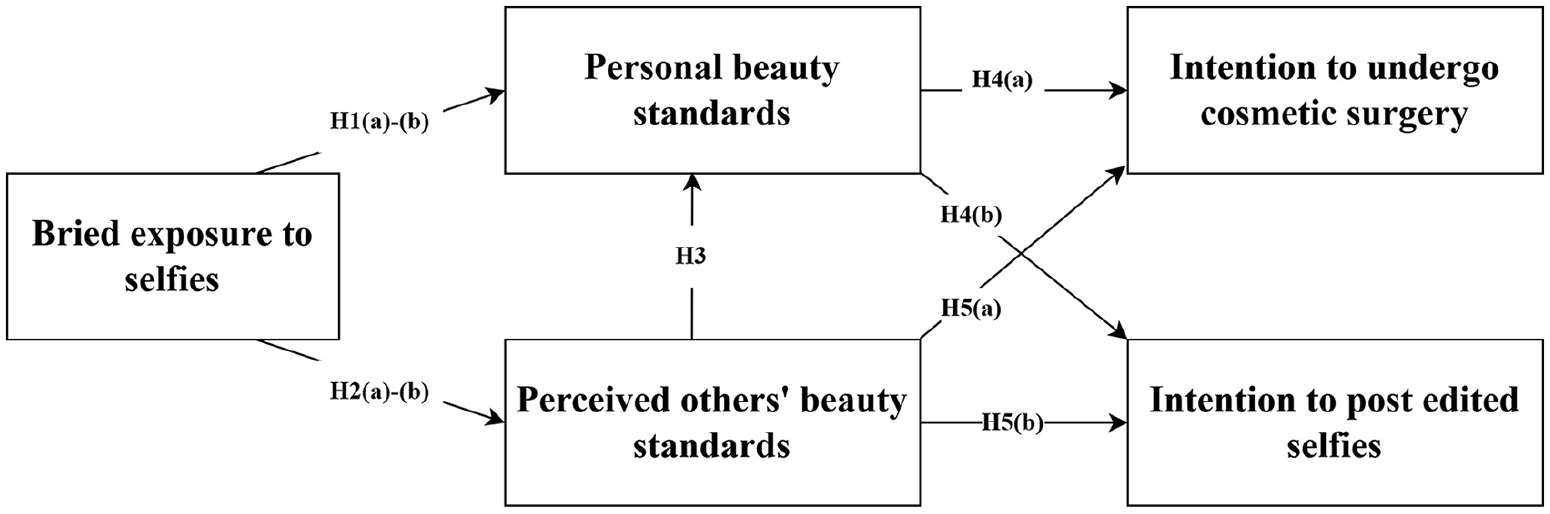
The hypothesized model.
Method
We employed a between-subjects experiment. Participants were randomly assigned to one of four groups: no exposure to selfies, exposure to enhanced selfies, exposure to a mixture of enhanced and natural selfies, and exposure to natural selfies. The experiment was conducted on Amazon’s Mechanical Turk (MTurk), which has been shown as effective for conducting online experiment (Kees et al., 2017). The survey was administered online using QuestionPro, an online survey software, to allow participants to choose a convenient time and place to provide their responses and feel more comfortable sharing honest answers (Sue & Ritter, 2012). The ethical approval was obtained before the experiment conduction.
Stimulus materials
Four sets of Instagram posts were used as experimental stimuli. Following previous studies (e.g. Becker et al., 2022; Bue & Harrison, 2020; Kleemans et al., 2018; Livingston et al., 2020), 10 Instagram posts were contained in each set. Besides images in the posts, all other information about the posts, such as the post time and location of the post, was kept consistent across the four conditions. The information about number of likes or comment was removed to avoid their influence on individuals’ perceived norms about beauty.
The first set included 10 photos unrelated to appearance. To create the appearance-irrelevant posts, 10 photos depicting only objects such as food, animals, landscapes, or flowers were collected from Instagram.
In addition, 20 natural selfies with common natural selfie hashtags, such as #nofilterselfie, and #no-makeup, were selected from Instagram pages. 1 Based on previous studies (Conrad et al., 2009; Etcoff, 2011; Moeran, 2010), the traits of beauty ideals include smooth skin texture, thin noses, small mouths with full lips, large eyes and thin jawlines. Therefore, the selected selfies were then enhanced based on these facial features using the popular Meitu Beauty Cam photo-editing application, resulting in 20 pairs of natural selfies and their enhanced versions. Pre-tests 2 were conducted to identity ten pairs of enhanced and natural selfies chosen for the experiment, with the enhanced selfies included in the enhanced selfies set and the natural selfies in the natural selfies set. In addition, a mix of natural and enhanced selfies set was created by randomly selecting five enhanced selfies and five natural selfies whose enhanced versions were not chosen.
Experimental procedure
Before starting the experiment, participants were told that the study is about evaluating Instagram images and were asked to provide consent. They first reported their Instagram usage frequency and selfie posting frequency. Then, after passing an attention check (i.e. selecting a word from a list of given words), we used the randomizer function of QuestionPro and randomly assigned participants to one of the four sets of posts. The default setting required each participant to view the previous selfie for 3 seconds before moving on to the next one. To avoid participants inferring the experimental design from the stimulus exposure, which may cause bias in study results, respondents were asked to infer the age range of the woman in the selfie when exposed to each selfie. For those who did not expose to selfies but photos of appearance-neutral contents, they were asked to rate the visual quality of the photo. After exposure to the stimuli, participants reported their responses to the variables of interest and provided demographic information. Upon completing the experiment, they were thanked and compensated with $1.
Participants
Based on G*Power analysis, a minimum sample size of 231 valid participants will be needed to achieve 90% power, with an anticipated effect size of 0.25 and a statistical significance level of 5%. Participants were recruited from MTurk workers who met the sex (female) and age (between 18 and 30) criteria. A total of 635 participants provided consent and began the survey. After an attention check, 631 participants started the experiment, with 593 completing it. In addition, participants who fail the manipulation check (n = 153), finished the survey in less than 5 minutes (n = 1) or more than 30 minutes (n = 11) were excluded. Ultimately, 428 valid responses from young women aged 18–30 were included in the analysis. Their average age was approximately 25 years old (M = 25.42, SD = 1.82). The majority identified themselves as Caucasian (79.9%, n = 342), had completed undergraduate education (74.1%, n = 317), and had an annual income between $35,000 and $99,999 (57.2%, n = 245). Averagely, they spent 10.8 (SD = 4.4) minutes completing the survey.
Measures
There are four outcome variables in the present study. Since the measures of perceived selfie posters’ endorsement of beauty ideals, personal endorsement of beauty ideals, and intention to post enhanced selfies are created based on conceptualization of the present study. We first conducted a confirmatory factor analysis to check the validity for the measures. The results (χ2 [df = 87] = 213.45, p = .00, comparative fit index (CFI) = 0.94, goodness of fit index (GFI) = 0.91, normed fit index (NFI) = 0.91, IFI = 0.84, root mean square error approximation (RMSEA) = 0.07) showed that all the standardized regression weights (SRW) of all indicators are above 0.51 and all the composite reliability (CR) are above 0.78, meeting the standards of good convergent validity (Fornell & Larcker, 1981).
Perceived selfie posters’ endorsement of beauty ideals
Respondents who were exposed to selfies were first asked to evaluate the extent to which they believed the selfie posters endorsed specific facial attractiveness features. The included facial attractiveness features were adapted from the description of mass media beauty ideals in previous studies (Conrad et al., 2009; Etcoff, 2011; Moeran, 2010). Using a 5-point scale, where 1 represented “Strongly disagree” and 5 represented “Strongly agree,” respondents were asked to indicate their agreement with the idea that the women in these selfies considered (a) smoother skin as more attractive, (b) a smaller mouth with fuller lips as more attractive, (c) smaller eyes as less attractive, (d) thinner jawlines as more attractive, and (e) a larger nose as less attractive. The five items were averaged to form a measure (Cronbach’s α = .80, M = 3.28, SD = 0.88).
Personal endorsement of beauty ideals
With the same scale, respondents were asked to answer the extent to which they themselves agree with the following sentences, including (a) an ideal look should include as smooth skin as possible; (b) a small mouth with full lips makes a woman look beautiful; (c) a woman with smaller eyes looks less attractive; (d) a thinner jawline makes a woman look better; and (e) a woman with a thinner nose tends to look more attractive. The five items were averaged to form a measure (α = .81, M = 3.16, SD = 0.87). A one-way repeated analysis of variance (ANOVA) (Wilks’ Lambda = .84, F[2, 286] = 27.78, p < .001) showed that when exposed to enhanced selfies, participants perceived selfie poster’s beauty standards is significantly higher than their personal beauty standards, while when exposed to unedited selfies, participants’ personal beauty standards are significantly higher than their perceived others’ beauty standards. When exposed to mix of enhanced and natural selfies, there is no significant difference in the two perceptions about beauty standards (Supplementary Table 1). These demonstrate that the differences between personal beauty standards and perceived others’ beauty standards is conditioned by the selfies that participants are exposed to.
Intention to have cosmetic surgery
The measure of intention to undergo cosmetic surgery was adapted from Henderson-King and Henderson-King (2005). Responses were given on a 5-point scale, where 1 represented “Strongly disagree” and 5 represented “Strongly agree.” Items included: (1) In the future, I could consider having some kind of cosmetic surgery, (2) If I could have a surgical procedure done for free, I would consider trying cosmetic surgery, (3) If I knew there would be no negative side effects or pain, I would like to try cosmetic surgery, (4) I have sometimes thought about having cosmetic surgery, and (5) I would never have any kind of plastic surgery (Reversed). These items were averaged to form a composite measure (α = .86, M = 3.01, SD = 1.11).
Intention to post enhanced selfies
Respondents’ intentions to post enhanced selfies were measured by a 100-point, 5-item estimate of the likelihood that they would use an editing app to enhance to their selfies when they need to post a selfie on social media. The five items concern the intention to (a) make skin in the selfie look smoother; (b) make mouth in the selfie smaller and with fuller lips; (c) make eyes in the selfie look bigger; (d) make jawlines in the selfie look slimmer; and (e) make nose in the selfie look smaller. The five items were averaged to form a measure (α = .92, M = 41.42, SD = 29.88).
Control variables
In addition to basic demographic information (i.e. age, education, income, race), respondents’ cosmetic surgery experience was controlled, as 18.7% of them (n = 80) indicated they had undergone cosmetic surgery before. Furthermore, respondents were asked to indicate the frequency with which they post selfies on social media using a 5-point scale, where 1 represented “less than once a month,” 2 represented “1 to 3 times a month,” 3 represented “1 to 3 times a week,” 4 represented “4 to 6 times a week,” and 5 represented “once or more per day” (M = 2.35, SD = 1.29). In addition, respondents’ Instagram usage frequency was measured using a 5-point scale, where 1 represented “Never,” and 5 represented “Almost always” (M = 4.00, SD = 1.03).
Results
Randomization check
The experimental randomization was successful. A series of ANOVA were conducted to confirm that there were no significant differences in demographic factors such as education (p = .11), income (p = .25), and age (p = .44) across conditions. A chi-square analysis was conducted to confirm that there was also no significant difference in participants’ race (p = .95) across conditions.
Manipulation check
After exposed to each selfie, respondents indicated the extent to which they believed the woman’s appearance in the selfie was enhanced (1 = not at all, 5 = heavy editing and enhancement). Their responses for the 10 photos were averaged to form a manipulation check. In the enhanced selfies condition, 30 respondents who believed the selfies they saw did not have heavy editing (score < 3) were removed. In the natural selfies condition, 40 respondents who thought the selfies they saw had heavy editing (score > 3) were removed. Based on the same criteria, 68 responses in the mixed condition with an average score lower than 3 for enhanced selfies or higher than 3 for natural selfies were deleted. In the no selfie condition, 15 respondents who reported exposure to selfies despite not being shown any were removed. A one-way ANOVA, F(2, 295) = 280.11, p < .001, revealed that respondents exposed to a set of enhanced selfies perceived the selfies as more heavily enhanced (M = 3.59, SD = 0.45) than respondents exposed to a set of natural selfies (M = 1.98, SD = 0.62, p < .001) and a mixed of enhanced and natural selfies (M = 2.71, SD = 0.41, p < .001). In addition, respondents exposed to a mixed selfies perceived the selfies as more heavily enhanced than respondents exposed to a set of natural selfies (p < .001).
Preliminary analysis
Initially, the one-way analysis of covariance (ANCOVA) was conducted to identify the direct influence of selfie exposure on participants’ behavioral intentions to change appearance. The independent variable was the photo conditions, while the dependent variable was young women’s intention to undergo cosmetic surgery or enhance their selfies. Results in Table 1 indicated that the impact of brief exposure to selfies on participants’ intention to undergo cosmetic surgery was not significant (F [3, 417] = 2.41, p = .066, η2 = .02, observed power = 0.60). Nevertheless, brief exposure to selfies significantly influenced participants’ intention to post enhanced selfies (F [3, 417] = 4.37, p = .005, η2 = .03, observed power = 0.87). Participants exposed to enhanced selfies (M = 45.90, SD = 2.01, p < .001) or a mix of enhanced and natural selfies (M = 42.47, SD = 2.51, p = 0.029) or no selfies (M = 41.49, SD = 1.90, p = 0.032) reported a greater intention to post enhanced selfies compared to those exposed to natural selfies (M = 35.26, SD = 2.17).
Mean and standard error of personal beauty standards, perceived selfie posters’ beauty standards, intention for cosmetic surgery, and intention for editing selfies across conditions.

Control for age, income, education, race, cosmetic surgery experience, the experience of posting selfies on social media, and Instagram usage. Cell means with different superscripts differ at p < .05 level according to the LSD post hoc test. Observed power is computed using alpha = 0.05.
Hypotheses testing
To assess H1 on the impact of selfies enhancement on young women’s beauty standards, an ANCOVA analysis was performed. The independent variable was the photo conditions, while the dependent variable was respondents’ endorsement of beauty ideals. The analysis only considered respondents who had been exposed to selfies. Results in Table 1 indicated that the main effect of photo conditions on the endorsement of beauty ideals among respondents was not significant (F[2, 286]= 0.47, p = .627, η2 = .00, observed power = 0.13). Consequently, H1 were not supported.
To evaluate H2(a)-(b) regarding the influence of selfies on young women’s perception of selfie posters’ endorsement of beauty ideals, another ANCOVA was carried out, using photo conditions as the independent variable and perceived endorsement of beauty ideals among selfie posters as the dependent variable. Again, only respondents who had been exposed to selfies were considered in the analysis. Results in Table 1 demonstrated that the primary effect of photo conditions was significant (F[2, 286]= 54.30, p < .001, η2 = .28 observed power = 1.00). Respondents in the natural selfies condition (M = 2.70, SD = 0.07) reported perceiving a lower endorsement of beauty ideals among selfie posters compared to those exposed to a mix of enhanced and natural selfies (M = 3.30, SD = 0.08, p < .001) and the enhanced selfies condition (M = 3.75, SD = 0.07, p < .001). Furthermore, those exposed to a mix of selfies also reported significantly lower perceived agreement among selfie posters than those exposed to enhanced selfies (p < .001). Thus, H2(a)-(b) were supported.
Finally, to simultaneously test H3, H4(a)-(b), and H5(a)-(b), the PROCESS Macro, model 6 (Hayes, 2017) was employed. Two analyses were conducted, each with the intent for cosmetic surgery and intent to post enhanced selfies entered as dependent variables. The ANCOVA revealed a linear relationship in which respondents perceived selfie posters to have a greater endorsement of beauty ideals when exposed to more enhanced selfies than natural selfies. Consequently, the selfie condition (1 = enhanced selfies set; 2 = a mix of enhanced and natural selfies set; 3 = natural selfies set) was incorporated as an exogenous variable in the model. Participants’ perceived posters’ endorsement of beauty ideals and their personal beauty ideals were included as mediators.
The summaries for the two serial mediation analyses are presented in Table 2. Results indicate that the more respondents perceive selfie posters endorsing beauty ideals, the more they adopt these ideals themselves (β = 0.19, p = .003), supporting H3. Also, young women with a higher endorsement of beauty ideals are more likely to have greater intentions to undergo cosmetic surgery offline (β = 0.18, p = .007) and edit selfies before posting online (β = 0.22, p < .001), supporting H4(a)-(b). In addition, young women who perceive others endorsing beauty ideals to a greater extent are more likely to have greater intentions to edit selfies before posting online (β = 0.14, p = .005), but not for undergoing cosmetic surgery (β = 0.02, p = .793). Thus, H5(a) was not supported by the data, while H5(b) was.
The association between brief exposure of selfies and behavioral intentions to change appearance (N = 296).

Standardized coefficients are reported.
*p < .05, **p < .01, ***p < .001.
The direct and indirect effects of selfie exposure on actions to change appearance are presented in Table 3. The association between selfie exposure and cosmetic surgery intention can be mediated via perceived selfie posters’ beauty standards and personal beauty standards (Effect = −0.02, SE = 0.01, confidence interval (CI) = [−0.041, −0.001]) and the association between selfie exposure and intention to post edited selfies can also be mediated via perceived selfie posters’ beauty standards and personal beauty standards (Effect = −0.02, SE = 0.01, CI = [−0.045, −0.005]).
The indirect association between brief exposure of selfies and behavioral intentions to change appearance.
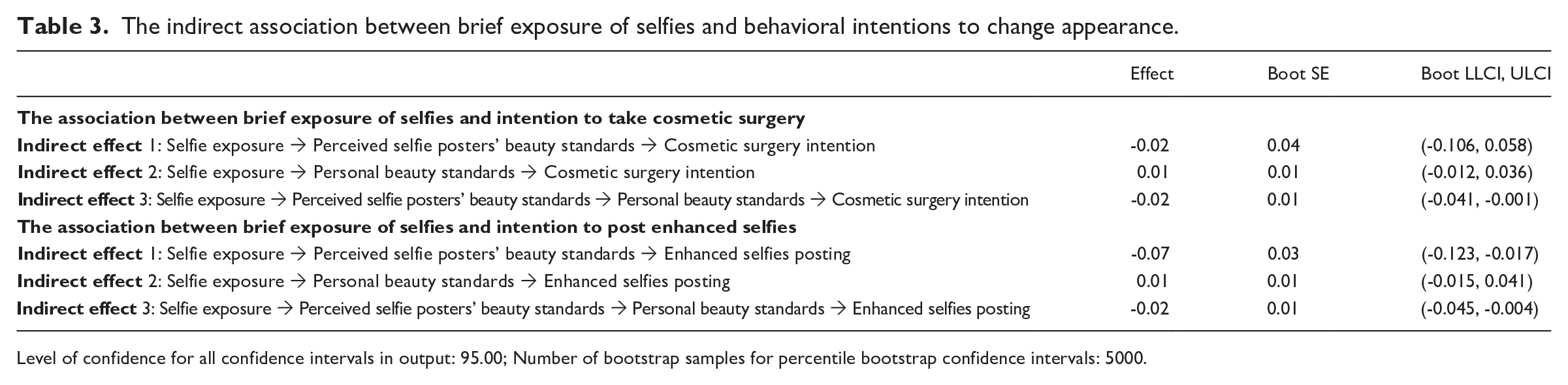
Level of confidence for all confidence intervals in output: 95.00; Number of bootstrap samples for percentile bootstrap confidence intervals: 5000.
Sensitivity analysis
To assess the stability of the study’s findings, a sensitivity analysis was conducted by further subdividing the sample into white females and non-white females, performing separate analyses with the same methodology. The results in Supplementary Table 2 demonstrated that brief exposure to selfies can impact personal beauty standards, perceived others’ beauty standards, and subsequently the intentions to change appearance among white women. However, as illustrated in Supplementary Table 3, while brief exposure to selfies can affect non-white women’s perception of others’ beauty standards, it does not influence their personal beauty standards or their intentions to alter their appearance.
Discussion
This study explores how young women’s exposure to natural and enhanced selfies pose varying influences on their intentions to modify their appearance. The results suggest that exposure to enhanced selfies, natural selfies, and a combination of both, differently affect young women’s perceptions of beauty standards held by others. These perceived beauty standards were found to be linked with young women’s beauty standards and intentions to enhance appearance, virtually through selfie editing and physically through cosmetic surgery.
We initially examined if young women’s personal beauty standards varied upon the type of selfies they were exposed. However, we found no significant differences among these conditions. One possible explanation for this null finding lies in the measures utilized in our study. In earlier studies, respondents were provided with numerous beauty images and were asked to select the most attractive one to represent their perception of ideal beauty. In contrast, this study measured respondents’ beauty standards by asking them to indicate their agreement with a provided textual description of ideal facial features. This textual description may not convey the concept of ideal facial features as intuitively as visual images.
Nevertheless, we effectively identified a process with which exposure to enhanced selfies increased young women’s endorsement of cultural beauty ideals and their intentions to alter their appearance. This process is driven by the perception that others endorse stereotypical beauty features. The findings suggest that the adaptation process in response to social media selfies is not merely a direct effect of exposure to beauty images. More importantly, social media acts as a significant socialization agent for young people, creating a context where peer presence further influences how individuals incorporate beauty images from selfies into their adaptation levels regarding beauty. This suggests that in the context of social media, individuals’ adaptation level is biased not only by the images they are exposed to but also by the social nature of these images. This is because people’s adaptation to the social environment can be revealed in their relevant posts on social media, which exert a normative influence on those who are exposed to the posts.
The adaptation level of beauty is associated with the intention to change appearance, including not only undergoing cosmetic surgery to alter one’s actual appearance but also posting enhanced selfies on social media to create an idealized online identity. Unlike real-life cosmetic surgery, which carries risks and requires significant expense, using photo-editing applications to change one’s appearance is easier and more feasible. However, the consequences of posting enhanced selfies can be far-reaching. The more frequently enhanced selfies are posted on social media, the more idealized rather than natural selfies become prevalent, causing people to feel that the beauty standards among others in general cater more to unattainable beauty ideals. This, in turn, increases their intention to change their appearance via cosmetic surgery. This suggests that the connection between selfie-related activities, including exposure to and posting of enhanced selfies, may create a continuous cycle, which could eventually lead to risk beautifying behaviors in real life.
Our finding suggests that the temporary adaptation to conventional beauty ideals serve as the link between selfie exposure and beauty-related behaviors. The adaptation process typically occurs in the short term, often during brief exposure, and serves as a subjective evaluation standard within the given context. This process differs from internalization, which involves individuals transforming long-term socio-cultural pressures to conform to beauty ideals into their personal appearance appropriateness. We found that these temporary standards of beauty were associated with beauty-related behaviors. People who reported a higher level of endorsement of the conventional beauty or perceived a higher level of endorsement of the conventional beauty among social media users, were more likely to engage in beauty-related behaviors. Potential interventions could use the adaptation level of beauty as a starting point, as short-term stimuli in the evaluation of beauty have the potential to modify subsequent beauty-related behavior. For instance, intervention programs can find ways to make or keep people’s beauty standards realistic and to adopt reasonable beauty-related behavior. This finding also suggests a future research agenda that considers the role of the adaptation process when examining beauty-related behaviors.
Furthermore, our study distinguishes one’s beauty standards from one’s perception of others’ beauty standards and we examined their influence on beauty-related behaviors separately. Two types of self-discrepancies are identified. The discrepancy between one’s ideal and actual self directly associated with the behavior to change. The discrepancy between a person’s actual self and the person’s ideal self based on others’ standpoint (ideal-other self, as Higgins indicated) was also found to relate to the person’s intention to motivate action. In addition, these two types of self-discrepancies are related such that individuals are likely to adapt the ideal-other self into their own ideal self, which again associate with their actions to change. Connecting these self-discrepancies to actions to change essentially link the self-discrepancy theory with adaptation level theory. The findings suggest that the discrepancy between one’s self-evaluation and their standards for the evaluation can lead to actions to remove the discrepancy. This can extend the influence of adaptation level theory from evaluative perception to behavioral intention, thereby providing insights into the influence of the adaptation process.
Unlike previous studies that examine edited selfies and natural selfies separately, we introduce a group that includes a mixture of both edited and natural selfies. By mirroring the actual condition users experience on SNSs, our findings provide a more realistic understanding of how exposure to different types of images influences young women’s beauty standards and related behaviors. The coexistence of selfies with different characteristics and users’ exposure to a mixed set of them highlights the complexity of beauty standards that digital media impose on young people. Future research in the domain of beauty should consider this complexity of individuals’ exposure to beauty images. The beauty-related images people encounter are not solely idealized or natural; rather, they are typically exposed to a mixture of both. Accounting for this mixed exposure can enhance the generalizability of this line of research.
There are several limitations in the present study. First, this study examined physical appearance in the context of the United States, which is a multicultural setting, but only selfies from Caucasian women were selected as experimental stimuli. We conducted a sensitivity analysis, which showed that the effects of selfies on the intention of cosmetic surgery and enhanced selfies posting were consistently significant among white women but not among non-white women. This could be because the sample size for non-white females in the experiment is small. It could also result from the fact that the beauty images chosen as experimental stimuli are white women, and white participants may have greater identification with the selfie posters and adopt the beauty ideals. The identification also explains why the effects of selfie condition on personal beauty standards is not significant in the main analysis but significant among white women sample. Future studies are encouraged to explore how participants’ different racial and ethnic backgrounds may interact with their exposure to selfies presentations of racially diverse women to affect their perceptions of beauty.
Second, the manipulation of photo editing could be improved. While enhanced selfies were successfully manipulated, as subjects seemed to recognize the edits, natural selfies were not as clear. Participants still perceived the images as somewhat enhanced. One reason may lie in the perceived attractiveness of women in the selfies. In the pilot study, we measure participants’ attractiveness and make sure that the edited version of selfies looks more attractive than the unedited version of selfies. However, we also found that many unedited versions of women have already been regarded as above-average attractive as their perceived attractiveness score being significantly larger than the mid-point 4. The perceived attractiveness may play a role to influence the perception of editing. Consequently, the number of respondents in the mixed selfie group and the unedited groups were much lower than in the other groups, even though subjects were randomly assigned to each condition. Fortunately, the manipulation was still successful, and the study’s large sample size helped counteract any bias caused by an unbalanced sample. And this was equally relevant for all the participants who exposed to selfies. Nevertheless, the perceived attractiveness may influence the proposed relationships, which involves social comparison might also be a factor. Therefore, we suggest that future studies select women as medium attractive in their experimental stimuli and measure state social comparison to include into analysis.
Third, the experimental procedure required participants to scrutinize 10 photos on social media that were not posted by their SNS friends, which may be considered unrealistic and could negatively affect the external validity of the results. Future studies could benefit from examining individuals’ reactions to selfies in their social media accounts and apply the findings into real-life intervention to see the impacts of selfies in reality.
Finally, young women’s intention to change their outward appearance is a complex behavior influenced by multiple factors. For example, individuals who experience higher levels of social comparison or internalization of beauty ideals when exposed to idealized beauty images are more likely to develop beauty-related concerns and a stronger intention to alter their appearance (e.g. Anixiadis et al., 2019; Betz et al., 2019). This suggests that participants in this study who engage more in social comparison and internalization during selfie exposure are likely to endorse beauty ideals to a greater extent and have a higher intention to alter their appearance through cosmetic surgery or photo editing. Although we did not measure these two variables, future studies should consider including them and controlling for their effects in the analysis to eliminate alternative explanations.
In addition, from a more substantive and larger institutional-level dynamics and historical patterns, ideal beauty reflects patriarchal, neoliberal, capitalist, and colonial ideologies that dictate what constitutes a “good” body (Phipps, 2014; Riley et al., 2022). The impact of natural beauty images thus highlights how the SNSs user-led body positivity movement liberates individuals from these ideologies and challenges unjust stigmas and discrimination against those deemed less worthy based solely on appearance (Zavattaro, 2021). This suggests a need for further research to explore the broader perspective of the body positivity movement and delve into the dynamics behind it at deeper social, cultural, and critical levels.
Despite these limitations and future directions, this study underscores the benefits of social media campaigns that promote natural, unedited photos, offering valuable insights into solutions for young women’s body image issues for various stakeholders. First, social media users are encouraged to post natural photos to foster an online community that values natural appearance and counters the detrimental effects of idealized beauty images. Second, educators and social workers should consider both the direct and indirect impacts of selfie exposure on young women’s body image concerns when designing intervention programs. Educating young people about the dual influences of selfies can help them understand the mechanisms behind these effects and develop strategies to cope with them. In addition, there is a need for them to launch more campaigns advocating for the sharing of natural selfies and challenging prevailing cultural beauty ideals on social media. Third, social media companies often generate content based on users’ habits, perpetuating the dominance of idealized selfies. The ethical implications of such algorithms and their influence on youth should be re-evaluated. Promoting natural selfies across social media platforms is essential to create a healthier online environment.
Supplemental Material
sj-docx-1-ctp-10.1177_20570473251334841 – Supplemental material for Real versus ideal: How selfies drive young women’s endorsement of beauty ideals to enhance cosmetic surgery intentions
Supplemental material, sj-docx-1-ctp-10.1177_20570473251334841 for Real versus ideal: How selfies drive young women’s endorsement of beauty ideals to enhance cosmetic surgery intentions by Fangcao Lu and Stella Chia in Communication and the Public
Footnotes
Content for publication
During the preparation of this work, the authors used ChatGPT 4.0 in order to proofread. After using this tool, the authors reviewed and edited the content as needed and take full responsibility for the content of the publication.
Declaration of conflicting interests
The author(s) declared no potential conflicts of interest with respect to the research, authorship, and/or publication of this article.
Funding
The author(s) disclosed receipt of the following financial support for the research, authorship, and/or publication of this article: This research project was funded by the Research Expenses Grant from the Department of Media and Communication at the City University of Hong Kong when the first author was a PhD candidate at the department.
Human participants
The research involves human participants and we have already received ethical approval for research involving human participants from the City University of Hong Kong before we conducted the study. Informed consent has been obtained before study conduction.

Supplemental material
Supplemental material for this article is available online.
Notes
Author biographies
References
Supplementary Material
Please find the following supplemental material available below.
For Open Access articles published under a Creative Commons License, all supplemental material carries the same license as the article it is associated with.
For non-Open Access articles published, all supplemental material carries a non-exclusive license, and permission requests for re-use of supplemental material or any part of supplemental material shall be sent directly to the copyright owner as specified in the copyright notice associated with the article.
