




Abstract
An exploratory study was conducted investigating the concept of beauty related to music listening—“musical beauty.” The study implemented an online qualitative questionnaire aimed to evaluate how listeners construe the concept of beauty, the pieces of music considered to be beautiful, and the intrinsic and/or extrinsic features that listeners attribute to musical pieces being considered as “most beautiful.” Analysis of long-answer responses provided by English-speaking participants (n = 32) reveals the way that listeners characterize “musical beauty” and contributes to empirical evaluation of musical aesthetic experiences. Listeners in this study construe beauty in two ways: one construal emphasizes the perceivable or recognizable intrinsic features of the piece of music, while the other emphasizes the affective or emotional extrinsic features of their listening experience.
Understanding Musical Beauty
Art in all its forms can be appraised in several ways, not all of which may include the concept of beauty. Yet, the relationship between beauty and the arts may seem inseparable to many art lovers. Empirically, “beauty” and “beautiful” are the terms most frequently associated with aesthetic experiences of art (Jacobsen et al., 2006) and music (Istók et al., 2009). The breadth of literature on the term spans several disciplines from philosophical reasoning to theoretical modeling and empirical approaches afforded by psychology and neuroscience. Still, ambiguity regarding how beauty is understood by everyday people, and its constituents remain, particularly concerning music (Brattico & Pearce, 2013).
Definition(s) of Beauty
From a Global Northern perspective, philosophical endeavors aiming to define beauty have manifested a dichotomous view of the concept seeing it as an aesthetic emotion (Armstrong & Detweiler-Bedell, 2008; Bell, 1914), and, or alternatively, an aesthetic judgment (Hume, 1777/1975; Kant, 1790/1914). From a psychological and neurobiological stance, aesthetic emotions do not differ from other emotions set in nonaesthetic contexts (Skov & Nadal, 2020). However, semantic differentiation of aesthetic emotions has become common practice in recent years (see Menninghaus et al., 2019). Presently, this article adopts the view that aesthetic emotions differ from nonaesthetic emotions insofar as they coincide with an aesthetic experience. Art critic Bell (1914) sets forth that beauty is a particular aesthetic emotion. According to Bell (1914), this emotion is provoked by “significant form,” determined by experts, that only certain works intrinsically contain. The experience of beauty, however, is subjective to each individual and is not objectively determined (Bell, 1914). Armstrong and Detweiler-Bedell (2008) also define beauty as a type of subjective, aesthetic emotion. Rather than emphasize constituents intrinsic to beautiful objects, they highlight the extrinsic constituents of beauty such as the perspective of the audience receiving the work (Armstrong & Detweiler-Bedell, 2008). They state, “beauty is felt, not discerned[…] Beauty is the exhilarating feeling that something complex, perhaps to the point of being profound, might yield to understanding.” (Armstrong & Detweiler-Bedell, 2008, p. 312).
Contrary to the idea that beauty is an aesthetic emotion, Kant (1790/1914) argues that beauty is a type of aesthetic judgment; thought or contemplation is necessary for the experience of beauty. According to Kantian theory, there is a certain universality to aesthetic beauty judgments, meaning that when an individual forms a beauty judgment about a work of art it is presumed that other audience members share this judgment (Kant, 1790/1914). Other philosophers, such as Hume (1777/1975) also explain that beauty is not a felt emotion, but a judgment that is formed. Hume's aesthetic theory posits that the aesthetic judgment of beauty is an instinctive human experience that successful art exploits by employing appropriate composition and design (Gracyk, 2016). The resulting interpretations from these philosophical thoughts may be that aesthetic judgments differ from aesthetic emotions in that judgments are perceptual labels assigned to artworks, and aesthetic emotions are the internal, affective states of an individual, but how these ideas relate to the concept of beauty and how listeners construe this concept in relation to music is empirically unknown.
Though framed as contrary views, both interpretations of beauty, as an aesthetic emotion and/or an aesthetic judgment, depend on the idea that beauty is related to intrinsic properties of a work and the receiver's interpretation of the work to varying degrees. If overextrapolated, these definitions may offer seemingly polarized views in which beauty may be considered an aesthetic judgment based on the objective validity of the intrinsic qualities of an object, separate from affective interpretation. Alternatively, if considered as a subjective aesthetic emotion separate from the objective validity of intrinsic features, beauty may be considered an idiosyncratic emotional response evading consensus. Contemporary research on the concept of musical beauty takes a less reductionist, dialectic approach. According to empirical accounts, the experience of beauty is thought to be both an aesthetic emotion and an aesthetic judgment (Omigie et al., 2021; Schindler et al., 2017). Juslin (2013) theorizes that depending on the listener and the musical context, aesthetic judgments of beauty may not always necessitate an affective response and that the two may situationally co-occur or take place independently.
Constituents of Beauty
The enigmatic nature of beauty is expanded when considering the aspects contributing to the experience. Theoretical models of visual aesthetic experiences include aesthetic appraisal and affective outcomes resulting from the mediation of sensory input from the artwork in question, as well as emotions immediately related to intrinsic and extrinsic properties of the artwork (see Pelowski et al., 2016 for an overview). Leder et al. (2004) propose that aesthetic experiences with visual art rely on cognitive processes occurring at several different stages. These include initial perception of the object's features, implicit classification of the object based on the viewer's subjective mental schema, explicit classification of the object based on the viewer's knowledge of the object's properties, and cognitive mastering and evaluation of said explicit classification (Leder et al. 2004, p. 492).
Based on these models, aesthetic experiences can be seen as gestalt experiences with both intrinsic and extrinsic constituents contributing to cognitive and/or affective appraisal outcomes. Related to music, these intrinsic features, or features contained in the piece of music can include single notes, instrument timbre, dynamics, melodies, harmonies, and rhythmic patterns (Brattico et al., 2017). Extrinsic features of aesthetic experiences, or features not contained in the object in question, can include the cognitive perception (Brattico et al., 2017), and the emotional impact or liking (Sidhu et al., 2018). However, the extent to which listeners attribute these features to constituting a piece of music as “beautiful,” and whether listeners construe beauty as a cognitive and/or affective appraisal is unknown.
Empirical Understanding of Beauty
In addition to philosophical and theoretical examination, the concept of beauty has also undergone empirical analysis. These studies have expanded our understanding of aesthetic appraisals, such as beauty, through neurological (Ishizu & Zeki, 2011; Jacobsen et al., 2006), psychophysiological (Egermann & Reuben, 2020; Omigie et al., 2021), and behavioral approaches (Breilmann & Pelli, 2017; 2019; Istók et al., 2009; Vuoskoski & Eerola, 2017).
Neurologically speaking, Jacobsen et al. (2006) posit that beauty judgments differ from other cognitive perceptual judgments such as judgments of visual symmetry. Beauty judgments activate the same brain regions as social and moral judgments, which indicates that beauty is not just a cognitive evaluation but relates to social and moral principles as well (Jacobsen et al., 2006). Another neurological study by Ishizu and Zeki (2011) examined to what extent the same brain regions were activated when experiencing beauty from different art modalities (i.e., visual art and music). Activation within the medial orbitofrontal cortex, an area that has previously been associated with the experience of pleasantness and reward (for a review, see Kringelbach, 2005), was observed during the experience of both visual and musical beauty. Building on these findings, Ishizu and Zeki (2011) proposed a neurobiological definition of beauty, emphasizing the experience of the perceiver. This neurobiological definition is reminiscent of the idea that the experience of beauty is based on an individual's interpretation of physical properties intrinsic to the artwork (visual or musical) suggested by Bell (1914) and theoretical models of aesthetic experiences (Leder et al., 2004; Pelowski et al., 2016).
More recent psychophysiological studies (Egermann & Reuben, 2020; Omigie et al., 2021) further characterize the experience of beauty with music. In their study examining the affective qualities of self-identified “beauty passages,” Omigie et al. (2021) identified three subtypes of musical beauty distinguishable by musical, affective, and physiological correlates. These three musical subtypes included: Low-Tension/Low-Energy, Low-Tension/High-Energy, and High-Tension/High-Energy passages. Similarly, Egermann and Reuben (2020) evaluated the psychophysiological responses associated with aesthetic judgments, like beauty, made under differing listening conditions. The findings suggested that aesthetic judgments may result from cognitive and/or affective processing of the music in question (Egermann & Reuben, 2020). In other words, beauty may result from a personal emotional experience of a piece of music, and/or the cognitive experience of music based on its artistic value mediated by culture and societal conventions (Egermann & Reuben, 2020).
Behavioral investigations of beauty highlight its complex and mixed-emotional or affective correlates. On this, Istók et al. (2009) found that while 66% of adult participants rated the term “beautiful” as the most positive adjective describing an aesthetic experience, the term “sad” was also observed as frequently co-occurring with the term “beauty.” Vuoskoski and Eerola (2017) similarly observed a positive correlation between experiences of beauty and sadness and found this relationship to be mediated by a sense of feeling “moved” by the music. Related to this, Brielmann and Pelli (2017) found that while pleasure and beauty are highly correlated with each other, they cannot be seen as synonymous. Over 40% of the variance observed in beauty ratings of self-selected beautiful images cannot be explained by ratings of pleasure (Brielmann & Pelli, 2019). Additional research on the complex and mixed-emotional associations observed in connection with the experience of beauty may allow for further interpretation of existing findings.
The Present Study
Based on this brief review, beauty has been philosophically conceived as both an aesthetic emotion (Armstrong & Detweiler-Bedell, 2008; Bell, 1914) and/or alternatively as an aesthetic judgment (Hume, 1777/1975; Kant, 1790/1914). According to these interpretations, beauty is presented within a subject-object framework and seen as related to the properties of the object in question and the receiver's interpretation of them. Theoretical modeling (Leder et al., 2004; Pelowski et al., 2016) expands on these views and posits that aesthetic appraisals, like beauty, rely on Gestalt properties both intrinsic and extrinsic to the work in question and may be processed in stages. Empirically, it has been suggested that beauty may relate to both social and moral principles and cognitive evaluation (Jacobsen et al., 2006) and that different types of experiences of musical beauty likely exist (Egermann & Reuben, 2020; Omigie et al., 2021). Lastly, it has been suggested that experiences of beauty may also be characterized by complex or mixed-emotional correlates (Istók et al., 2009; Vuoskoski & Eerola, 2017) and cannot be attributed to the experience of pleasure alone (Brielmann & Pelli, 2019).
However, ambiguities concerning how listeners construe the experience of musical beauty, the pieces of music considered to be beautiful by listeners, and the extent to which intrinsic musical features and/or extrinsic affective features relate to this experience still remain. The present study aimed to specifically address this gap by asking listeners how they define the abstract concept of beauty, the piece of music they consider to be “most beautiful,” and the features they believe contribute to this experience. The study followed an exploratory approach and addressed these aims through analysis of long-answer responses provided by English-speaking participants situated in the Global North as consistent with the cultural context of the theories and evidence reviewed above.
Methods
Participants
After obtaining ethical approval from the University of Sheffield's Ethics Review Procedure administered by the Department of Music (Application 033992), 32 English-speaking participants aged 19–70 (M = 29.22; ± 11.82) volunteered to take part in the online study. Participants were recruited via a public social media group for individuals interested in aesthetic philosophy and the staff and students volunteer list accessible through university services at the University of Sheffield. Sixteen participants identified as cisgender women, 13 as cisgender men, 1 as agender, 1 as bigender, and 2 preferred not to disclose their gender identity. Based on self-reported nationality, participants came from five different continents: 19 identified as European, 6 as North American, 5 as Asian, 1 as South American, and 1 as Oceanic. Based on forced-choice responses, 14 identified as nonmusicians, 15 identified as student or amateur musicians, and 3 identified as professional musicians.
Procedure
The qualitative questionnaire asked participants three free-response questions allowing for long-answer replies. Participants were first asked demographic questions regarding their age, gender identity, nationality, and self-reported level of musicianship prior to the free-response questions. To address the aims of the study participants were asked, “How do you define beauty?,” “What is the most beautiful piece of music you have experienced?,” and “Why is this the most beautiful piece of music you have experienced?.” The musical pieces participants subjectively nominated as “most beautiful” were compiled, annotated, and analyzed by the primary author in order to further characterize the type of music participants consider to be “most beautiful.”
Analysis
Free-Response Questions
The long-answer responses to the questions, “How do you define beauty?” and “Why is this the most beautiful piece of music you have experienced?” were analyzed separately using a type of thematic analysis known as template analysis (King & Brooks, 2017). The first few stages of the analysis including familiarization with data, preliminary coding, and production of the initial codebooks or templates for the two separate questions, were carried out by the first author at the onset of data analysis.
Following this, the data were independently coded by the second and third authors. The additional coders individually familiarized themselves with the data and the initial coding templates before meeting as a team with the first author to discuss and amend the coding templates. The authors met on two separate occasions before finalizing the two coding templates that were then used by all three coders to independently code the long-answer responses given to the two questions.
Once the responses were coded using the coding templates, the intercoder reliability for each free-response question was then assessed by calculating the Fleiss’ Kappa (Fleiss, 1971) for multiple coders. Lastly, the frequency for each code in the two coding templates was also calculated to determine which codes were observed to a greater or lesser extent in all responses further characterizing how participants construed beauty and the features they attributed to the experience of musical beauty.
Musical Nominations
The collection of “most beautiful” piece nominations was annotated for genre using the metadata available for each track via Apple Music (2023). Following this annotation, a multinomial logistic regression analysis was performed to evaluate the extent to which participants’ self-reported demographic background was associated with the genre of the piece nominated.
Results
Free-Response Questions
“How do you define beauty?”: Responses provided to this question broadly revealed that participants defined beauty as both an experience and an attribute. Further template analysis of the responses resulted in the development of 12 codes: (
“How do you Define Beauty?”
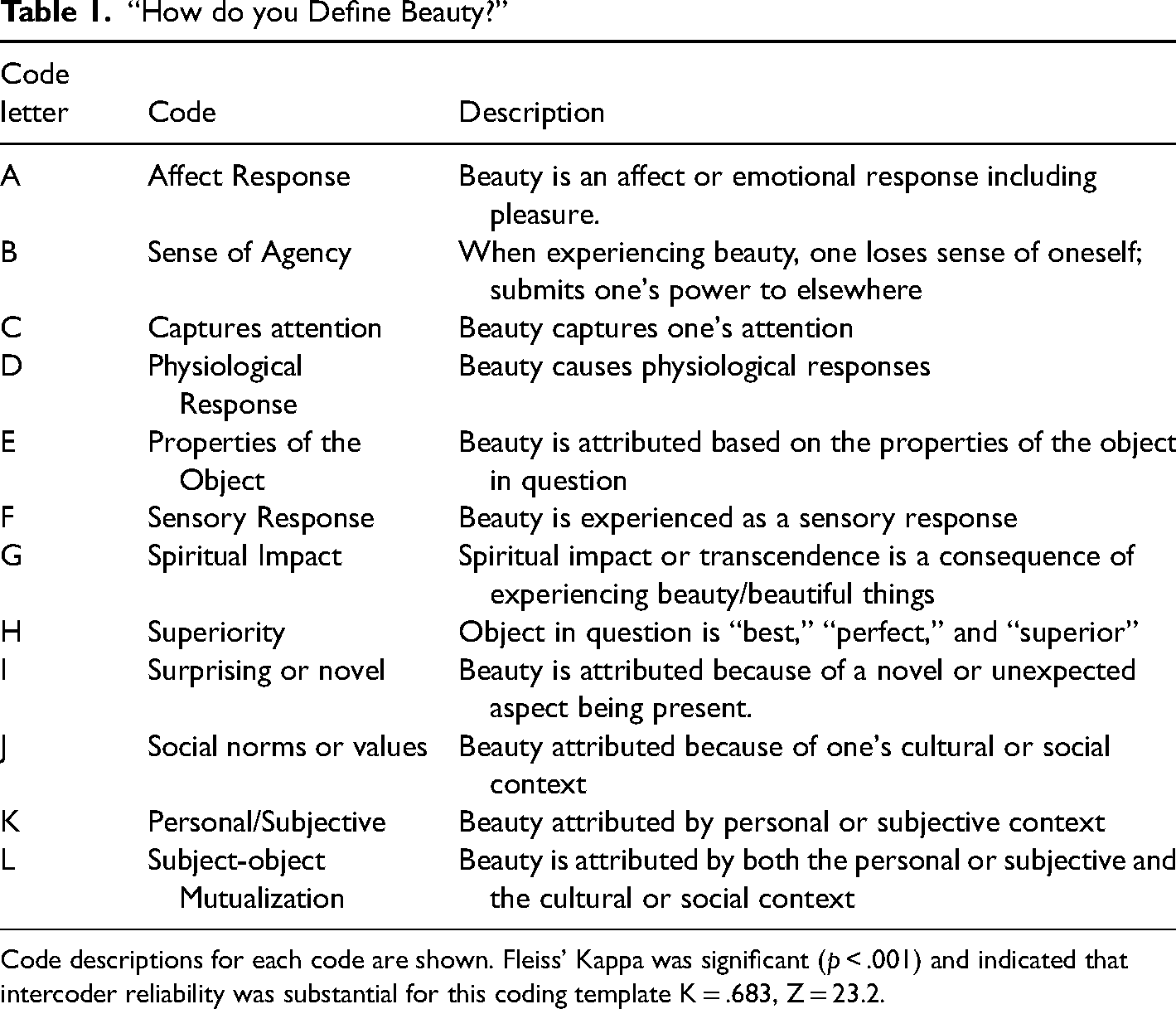
Code descriptions for each code are shown. Fleiss’ Kappa was significant (p < .001) and indicated that intercoder reliability was substantial for this coding template K = .683, Z = 23.2.
As shown in Figure 1, results from the code frequency calculation indicated that codes (
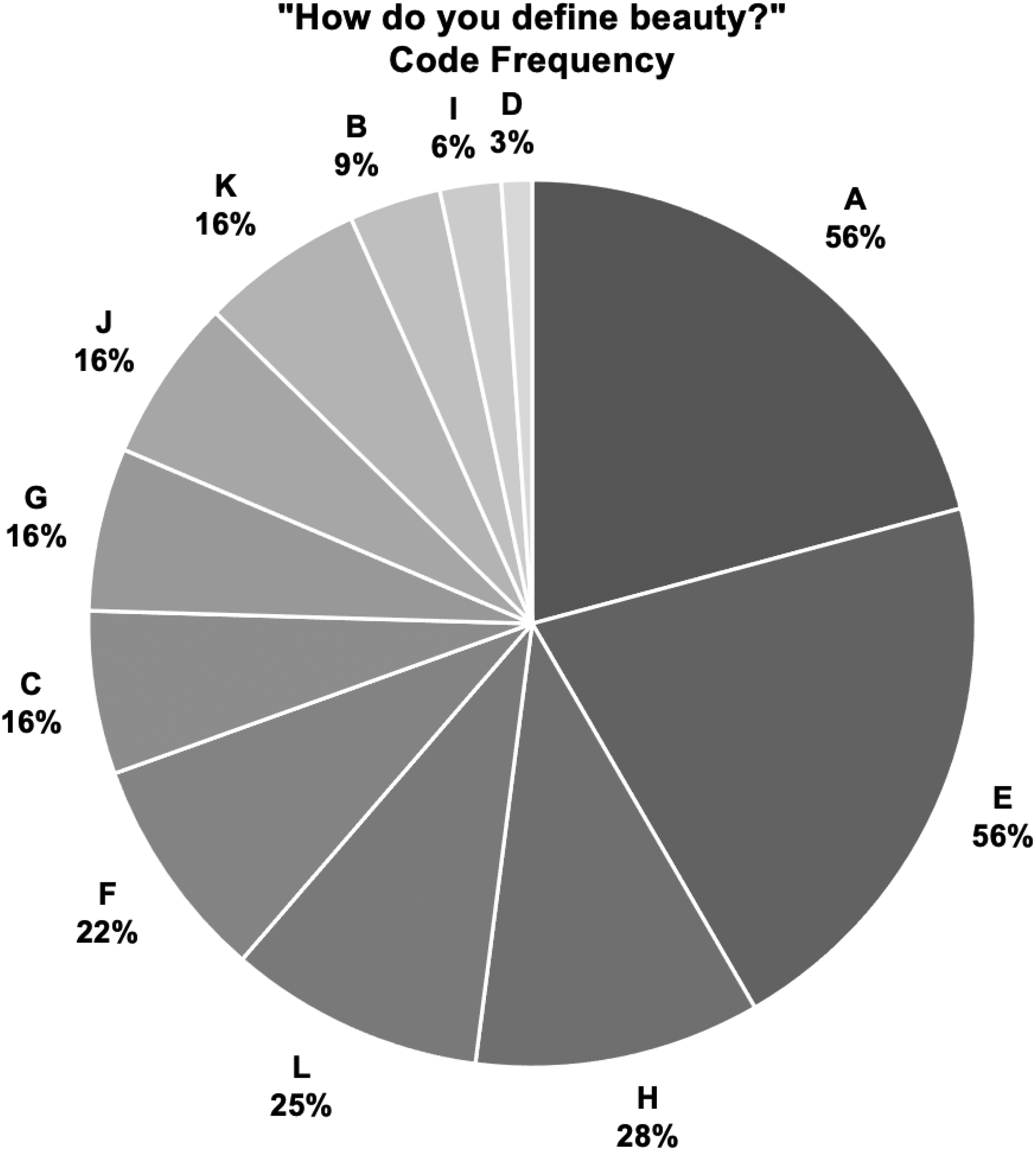
“How do you define beauty?” code frequency. Codes generated by responses defining beauty in order from highest to lowest frequency are as follows:
Codes ( “A property which makes something aesthetically pleasing. On the one hand, the experience of beauty can be largely subjective, on the other hand there are pieces of art which are widely accepted as beautiful, while the beauty standards (e.g., when it comes to humans) change over time and differ between cultures.” (P22)
“Beauty is a property that experience can instantiate. Beauty can be felt and it has an appearance that allows the subject to identify it […beauty is] determined by the object's physical characteristics, along with the subject's context (biological characteristics of the subject along with his cultural context). This appearance is particular and subjective.” (P24)
Are labeled with code (
Code ( “To me, beauty cannot be surmised in mere words. Beauty is multifaceted; it can only be conveyed through examples. Beauty is an emotion that one feels when one sees the sunset on a crisp autumn day; the smell of a forest after the first rain of summer; the taste of a fresh strawberry…” (P8).
“Why is this the most beautiful piece of music..?”: A second template analysis was conducted on the long-answer responses to a question which asked participants to justify their nomination of “most beautiful” music. Detailed descriptions for each of the 23 codes developed from this analysis can be seen in Table 2. Results from Fleiss’ Kappa for these codes were significant (p < .001) and the overall intercoder reliability was K = .629, Z = 29.5, indicating that a substantial degree of agreement was also achieved for this set of responses.
As depicted in Figure 2, the 23 codes justifying the musical nominations referenced aspects related to intrinsic features of the piece of music, as well as features relating to the listener and/or the listening experience. The codes relating to the intrinsic musical features were necessarily highly dependent on the genre of piece nominated. For instance, code (
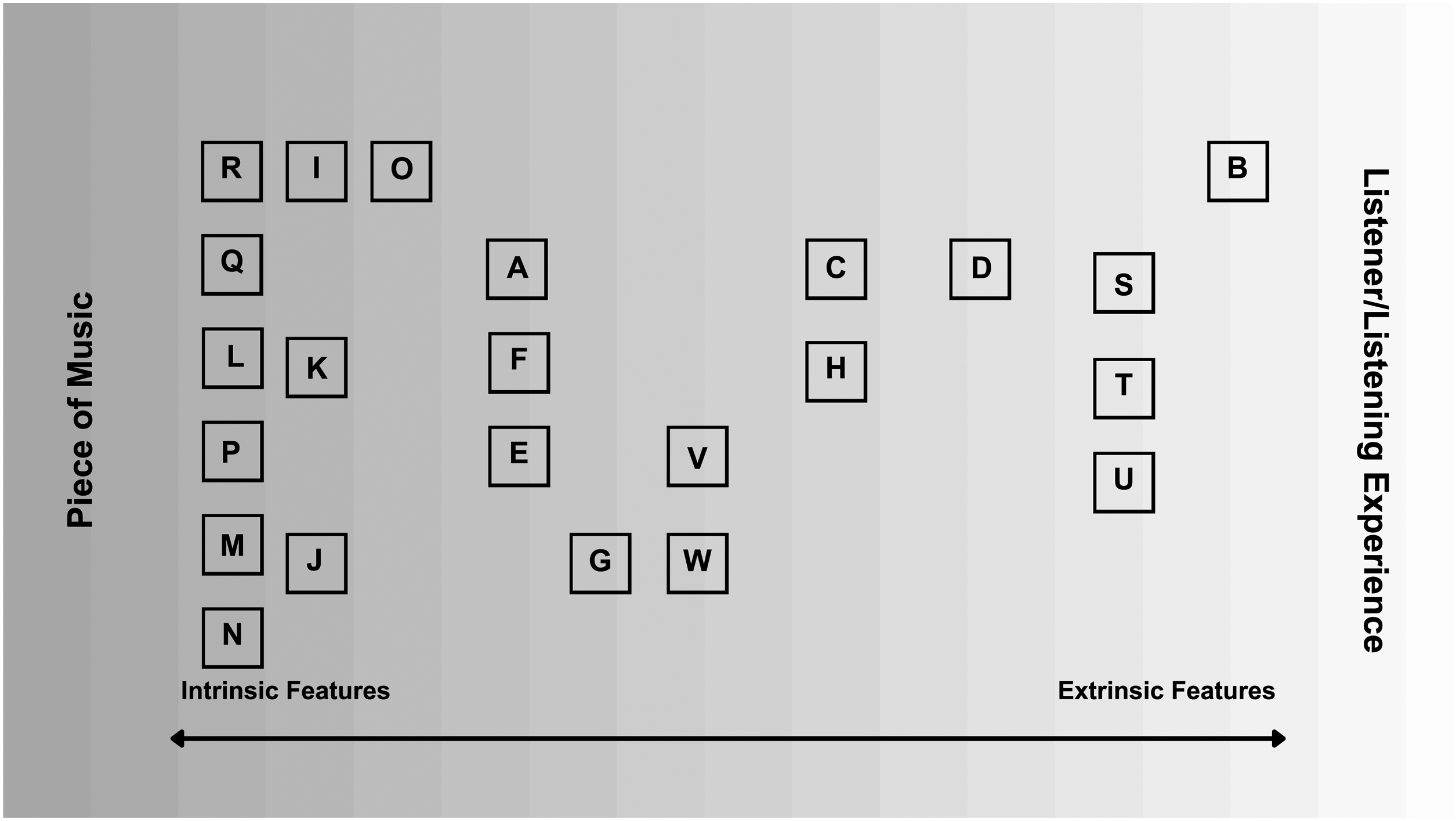
Justification codes feature reference. The 23 codes generated by responses justifying nominations as “most beautiful” referenced aspects related to intrinsic features of the piece of music itself, as well as extrinsic features relating to the listener and/or the listening experience.
“Why is This the Most Beautiful Piece of Music you Have Experienced?.”
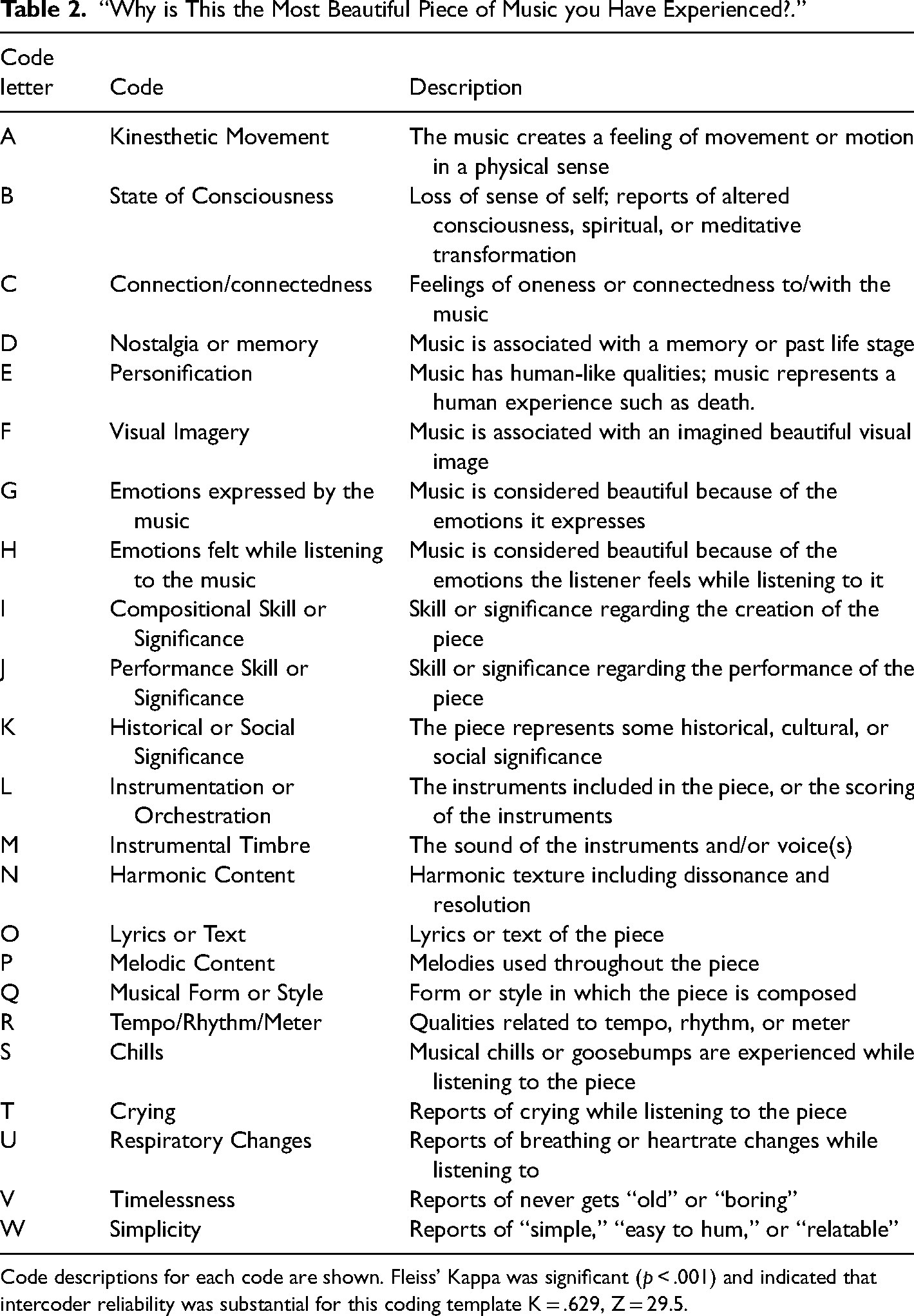
Code descriptions for each code are shown. Fleiss’ Kappa was significant (p < .001) and indicated that intercoder reliability was substantial for this coding template K = .629, Z = 29.5.
Results from the code frequency calculation, as seen in Figure 3, showed that the code most frequently observed was ( “This piece made me feel very distinct things. It made me feel sad and melancholic and made me think about death (abstractly) and my father's death in particular (not that he has died, but the fact that he will die someday). It also gave me goosebumps, and the textures of the sounds felt very heavy, made me feel a lot of emotions, as if I had come across something very important.” (P24).
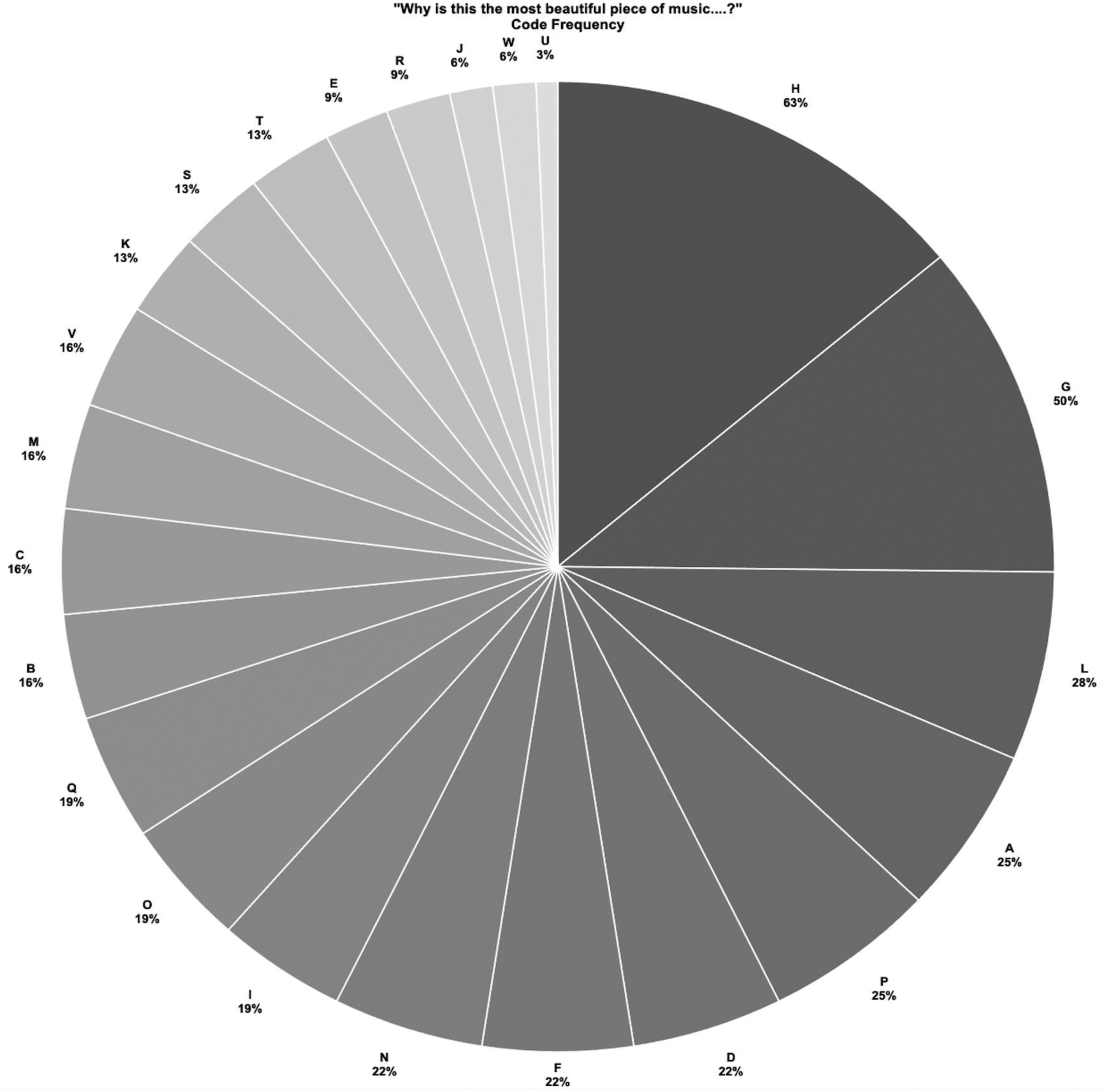
“Why is this the most beautiful piece…?” code frequency. Codes generated by responses justifying musical nominations in order from highest to lowest frequency are as follows:
The second most frequently observed code was (
The next three most frequently observed codes were (
Quotes exemplifying code (
The fifth most frequently observed code, (
Musical Nominations
Following the free-response beauty definition question, the participants were asked “What is the most beautiful piece of music you have experienced?.” These nominations then formed a collection of 38 pieces (see supplementary materials for the list of all pieces). Participants were asked to be as specific as possible and indicate particular movements from larger musical works or particular recordings of live performances if applicable. There were three instances in which nominations were not included: Tchaikovsky's Swan Lake, all musical works from a traditional Chinese music group, Guqin, and a live footwork music concert performance. These were excluded from the collection as no specific movement, piece, or tangible recording could be obtained and thus could not be analyzed. Additionally, some participants nominated more than one specific piece of music. These additional nominations were included if specific pieces were indicated and separate justification was also provided for each. AAC audio files of all 38 pieces comprising the collection were purchased through iTunes and matched for specific artists and performances when specified by participants.
To further characterize the pieces comprising the collection, the nominated pieces were categorized by primary genre according to the metadata attributed to each track by Apple Music (2023). The result of this annotation found that of the 44 possible primary genre classifications available, eight genres were represented in the collection. Figure 4 shows that of the 38 pieces comprising the collection, 20 belonged to the Classical genre, 5 belonged to the Rock genre, 3 to the Jazz genre, 2 to the Popular music genre, 4 to the New-Age genre, 2 to the Soundtrack genre, and 1 to Country and to Singer/Songwriter genres, respectively.
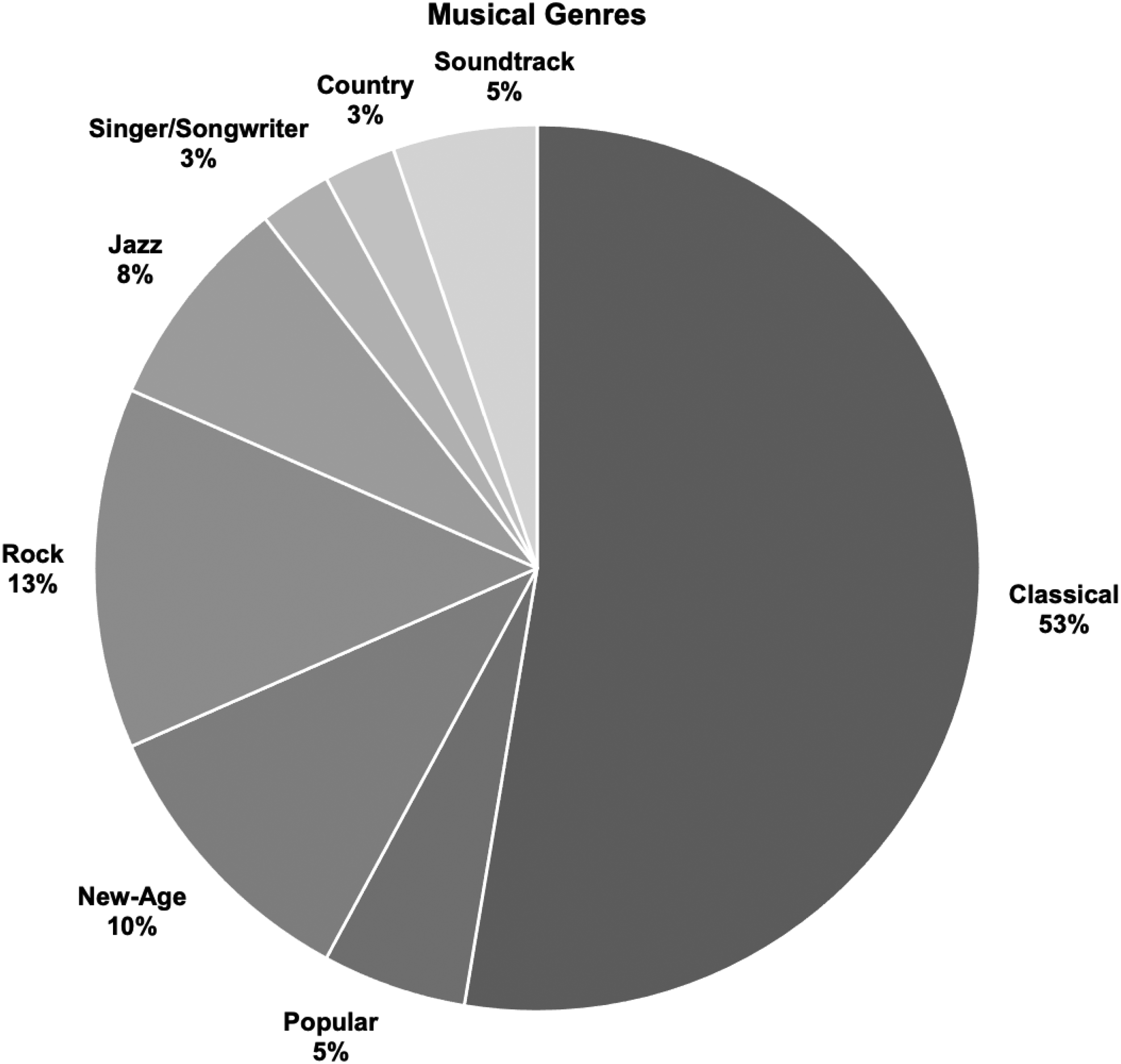
Musical nominations: genres. Musical genres represented in the collection of musical nominations included Classical (53%), Rock (13%), New-Age (10%), Jazz (8%), Popular (22%), Soundtrack (19%), Singer/Songwriter (16%), and Country (3%) genres.
A secondary multinomial logistic regression analysis was performed using SPSS Statistics (version 29.0) following the genre annotation of the collection. This analysis included participants’ self-reported demographic information concerning their age, nationality, and level of musicianship (nonmusician, student or amateur musician, or professional musician). The overall fit of the model created as a result of this analysis was nonsignificant (p = .675), indicating that there was no statistically significant relationship between participants’ age, nationality, or level of musicianship and the genre of the piece nominated as “most beautiful.”
Discussion and Limitations
Free-Response Questions
“How do you define beauty?”: Participants defined the concept of beauty generally as both an experience had and an attribute present with an object. This supports theoretical and empirical interpretations that appraisals, such as beauty, may be both a type of aesthetic emotion and an aesthetic judgment (Egermann & Reuben, 2020; Juslin, 2013; Omigie et al., 2021; Schindler et al., 2017). Of the 12 codes generated by the analysis, the top five codes observed in participants’ responses: (
“Why is this the most beautiful piece of music..?”: Analysis of participant responses resulted in the generation of 23 different codes. These codes referenced aspects related to intrinsic features of the piece of music itself and/or to the listener and the listening experience when justifying the nominated piece of music as being “most beautiful.” This observation offers empirical support to theoretical endeavors like those proposed by Leder et al. (2004) and Brattico et al. (2017), demonstrating that listeners attribute intrinsic musical features as well as features extrinsic to the piece of music related to their lives and listening experience to musical beauty. However, this observation needs further consideration as the weight of these aspects in determining if a piece is beautiful is unknown and is dependent not only on the genre of the piece in question but also the listener's evaluation.
Code frequency analysis showed that codes (
Musical Nominations
Eight musical genres were represented in the collection of 38 “most beautiful” pieces, with most of these pieces belonging to the Classical music genre. The multinomial logistic regression analysis suggested that there was no systematic relationship between participants’ age, nationality, or level of musicianship and the genre of the piece nominated. It should be noted that social desirability bias (Larson, 2019) may have influenced participants’ musical nominations, as participants were aware that this project intended to explore the concept of “musical beauty.” Cultural priming may have also played an unavoidable role in influencing participants’ musical nominations as there is a well-established bias within Western culture to associate aesthetic beauty with works of art seen as “high art” (Fisher, 2013).
Conclusion
This project explored the way listeners construe musical beauty by asking them to define the concept of beauty, nominate pieces of music considered to be “most beautiful,” and provide explanations justifying these experiences. It observed that the way musical beauty is defined and justified is variable between listeners, but that all listeners were able to identify with the term. Based on participant's responses, the term “beauty” was defined as an affective experience as well as an attribute. This supports existing views seeing beauty as both an aesthetic emotion and an aesthetic judgment (see Egermann & Reuben, 2020; Juslin, 2013; Omigie et al., 2021; Schindler et al., 2017). When justifying a piece of music as being “most beautiful” listeners referenced intrinsic features related to the piece of music itself, as well as extrinsic features related to themselves and/or their listening experience, possibly including complex emotional mechanisms. While a dichotomous view of which features (intrinsic or extrinsic) contributed to the experience of musical beauty was evident in some participant responses, others exhibited a more mutualistic or gestalt construal of these features offering further support for theoretical models integrating aesthetic experiences and their constituents (Brattico et al., 2017; Leder et al., 2004).
Taken together, the analysis of participant responses presented in this study suggests that listeners construe musical beauty in at least two ways. Following one construal, listeners emphasized the perceivable or recognizable intrinsic features of the piece of music, while following the other, listeners emphasized the affective or emotional extrinsic features of their listening experience. However, it is most likely that the two complement or inform each other rather than operate independently.
One way to interpret these findings is as evidence of a priming effect in which well-established ideals and understandings of aesthetic beauty within the Western, Global North not only influenced the type of music listeners consider to be beautiful (Fisher, 2013) but also how listeners construe the very concept of beauty. While the aims of this study were to evaluate how listeners construe the concept of beauty, the pieces of music considered to be beautiful, and the features relating to this experience, future research on the topic may benefit from evaluating the affective outcomes and the significance these experiences have in an individual's life as well as evaluating individuals’ systematic understanding of the appraisals themselves in a variety of cultures due to the way that the very notion of beauty can be regarded as culturally construed.
Supplemental Material
sj-docx-1-art-10.1177_02762374241253771 - Supplemental material for Understanding Musical Beauty
Supplemental material, sj-docx-1-art-10.1177_02762374241253771 for Understanding Musical Beauty by Abbigail Marie Fleckenstein, Jonna Katariina Vuoskoski, and Nicola Dibben in Empirical Studies of the Arts
Footnotes
Declaration of Conflicting Interests
The authors declared no potential conflicts of interest with respect to the research, authorship, and/or publication of this article.
Funding
The author(s) disclosed receipt of the following financial support for the research, authorship and/or publication of this article: This work was partially supported by the Research Council of Norway through its Centres of Excellence scheme, project number 262762.

Supplemental Material
Supplemental material for this article is available online.
Author Biographies
References
Supplementary Material
Please find the following supplemental material available below.
For Open Access articles published under a Creative Commons License, all supplemental material carries the same license as the article it is associated with.
For non-Open Access articles published, all supplemental material carries a non-exclusive license, and permission requests for re-use of supplemental material or any part of supplemental material shall be sent directly to the copyright owner as specified in the copyright notice associated with the article.
