



Abstract
Although there has been significant research on imagination's effects and capabilities, there is relatively little exploration of the content of imagination. This qualitative, exploratory study explored the content of mental imagery and imagination in 23 undergraduates. Participants described what they imagined in response to five scene prompts, such as “food court” and “office.” The imaginings’ high prevalence of colour (96%), scene-relevant objects (83%), movement (64%), and clarity (81%) suggested real-world resemblance, aligning with episodic memory's role in imagination. On the other hand, half of the imaginings were described as realistic, and some realistic traits, such as first-person perspective (35%) and three-dimensionality (30%), were relatively rare. Cartoon-like (8%) and two-dimensional (10%) imagery was less common. Because little prior research has quantified imagination content, these percentages represent initial descriptive estimates rather than comparisons to established norms.
Introduction
This paper describes a small, descriptive, qualitative, exploratory study of the contents of people's imaginations when asked to imagine scenes. Imagination is a fundamental aspect of our everyday life. When young, imagination guides pretend play and creative thinking. During adolescence, imagination guides critical thinking and future planning, allowing the individual to explore memories, future possibilities, and alternate scenarios (Pearson & Kosslyn, 2013; Zabelina & Condon, 2020). Imagination is the formation of a mental representation of something without the need for relevant external input (Abraham, 2016). Mental imagery is a subset of imagination in which the content and experience of the imagination is motor- or sensory-like. Non-imagery imagination might include imagining being married, which does not look or sound like anything in particular. Individuals with visual aphantasia or who are congenitally blind have imagination but no visual imagery.
Cumming and Eaves (2018) outline the general process by which people generate mental imagery scenes: image generation, image inspection, image translation, and image maintenance. Image generation is largely based on stored memory, typically episodic memory (Arbib, 2020; Cumming & Eaves 2018). During image inspection, the participant will scan the entire image in their mind, zooming in and out when necessary to access all the information. Image transformation entails a change of some aspect of the imagined scene, be it the entire scene or small aspects, such as a chair no longer being in the corner. The last stage of mental imagery, image maintenance, is theorized to require the participant to constantly recall the memories that the mental imagery is created from. Their research reveals many aspects of mental imagery that can be further explored, including vividness, accuracy, ease of generation, controllability, and duration.
More recent research suggests that imagination may be unified under a broad umbrella of organizational frameworks. Andrews-Hanna and Grilli (2021) argue that there are many different types of imagination, such as remembering the past, imagining the future, and creative thinking. Further, they argue that these forms of imagination can be connected to the default mode network (DMN). The DMN, typically active during rest, is crucial for imagination tasks, such as recalling memories, envisioning the future, and understanding others’ perspectives, due to its role in accessing broad knowledge (Abraham, 2016). Within this network, they further identify two systems: the mind's eye and the mind's mind. The mind's eye refers to the ability to visualize experiences, navigate environments, and mentally construct scenarios. It is thought to be responsible for fine-grained imagery, which allows for the reporting of object identification and other spatial details. The mind's mind, however, is thought to involve higher-order cognitive processes of imagination, such as perspectivetaking, self-awareness, and mentalizing (attributing mental states to oneself and others; Arioli et al., 2021).
Despite previous research on aspects of imagination, such as mental rotation and episodic future thinking, there remains limited investigation into the specific underlying patterns of mental imagery content (Abraham, 2016). When someone imagines a scene, what is that scene like? We conducted exploratory research regarding the patterns in the images people produce during imagination. How often, for example, do people's imaginings feature colour or movement? This research is important as patterns of imagination can inform process theories of imagination.
The independent variable in the study was the imagined scene prompts. There were 10 possible scenes, and each participant was asked to imagine five of them. The scene prompts were reflective of common everyday scenarios: Vacation, School, Forest, Movie, Office, Amusement Park, Baby's Room, Ocean, Food Court, and House. The dependent variables are the aspects of mental imagery as reported by the participants. These aspects were episodic recall, dimensionality, perspective, object's relation to a scene, presence of people, movement, presence of colour, presence of a scene change, object permanence, presence of a focal point, realism, clarity, and the need to zoom/navigate through the scene.
Methods
Participants
There were 23 participants recruited at a first-year cognitive science course at a large Canadian university with a Research Study Sign-Up System where students selected from a pool of studies. Participation was optional. Students had a variety of majors, but there were no engineering students in the class. All participants gave written informed consent and earned credit compensation of 1%. There were no eligibility criteria. There were 17 females, five males, and one of undetermined gender.
Procedure
After signing up, participants were then prompted to select a time to meet on a video call (Zoom) for their interview. After consenting, the interviewer informed the participants that they would be presented with five scenes and asked one at a time to describe their imagery. Participants were randomly assigned to one of two groups. Group 1 was presented with scenes 1–5, and Group 2 with scenes 6–10. The division of scenes was not intended for between-group comparison but rather to reduce the time required for each participant to complete the procedure. Participants were informed that they could describe their mental imagery in a number of ways: verbally, in the text chat box in Zoom, or by drawing on paper, which they could show and describe to the interviewer with their camera on. The participants were then asked to report openly on various aspects of their mental imagery (scene changes, sense of realism, dimensionality, and so on). After this, the experimenter asked further clarification questions about their imagery:
Did the objects within the scene appear and leave? If so, was it quick or slow? A coming and going of objects? Were there sets of colours involved? Were there any random objects of which you couldn’t see exactly what it is? Were there any objects that did not belong? Did your mental imagery make sense to the actual scene asked to describe? E.g., how integrated were the components in your scene, and were the objects related to the scene How sharp the image was: does it blur out from the side, are there any dark spots? Did any objects move in your scene? Did it move with purpose (e.g., because it was a rollercoaster) or without purpose (e.g., cup just randomly moved)? Did you have to navigate throughout your scenery to zoom in on particular areas or to see them more clearly? Was there a focal point (focused main image) to your imagined scene, and were the sizes of each object similar or coordinated to the scene? Do you need to reimagine certain features of your initial mental imagery?
For scene change data, participants were asked to reimagine their scene after the clarification questions and note if any aspect of their imagery had changed from their initial image.
Once the interview was over, participants were informed of the purpose of the study in a debriefing. The Zoom chat was then ended after answering any participant's questions. There was no time limit for interviews. The length of the interviews ranged from 17 to 55 minutes, with most interviews taking about 20 minutes.
Results
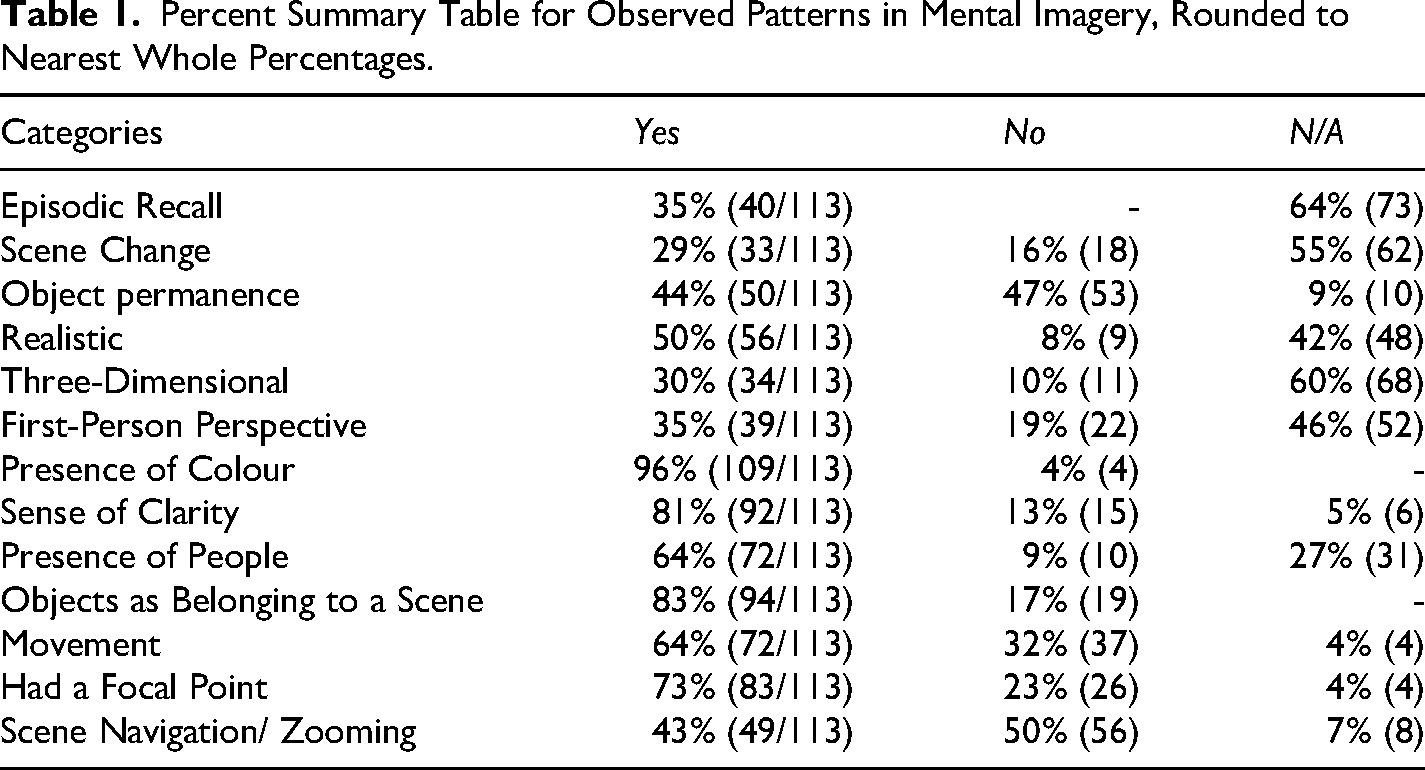
With 23 participants, each imagining 5 scenes, we collected 115 scenes in total. We excluded data from two imagery scenes because of missing information, resulting in 113 scene descriptions. We categorized responses as ‘Not Applicable (N/A)’ when participants failed to provide informative answers. We distinguished between explicit responses, such as ‘third-person point of view,’ and unclear responses, such as ‘standing across the street,’ where the point of view could not be inferred. Table 1 shows the percentages of scenes with each feature, rounded to the nearest whole percentage. We describe the results for each feature below.
Percent Summary Table for Observed Patterns in Mental Imagery, Rounded to Nearest Whole Percentages.
Episodic Recall
In this experiment, 35% (40/113) of the instances of imagination were in episodic memory recalls of scenes previously perceived, as opposed to imagination of novel content. We separated these memory recalls into two categories: episodic lived experiences and episodic media-related imagery. Episodic lived experiences could entail memories of lived experiences, such as places they had visited or things they have done (Davies & Clayton, 2024). An example of media-based imagery is constructing imagination from the setting of a form of entertainment media, such as a specific television show, movie, or video game.
During the study, participants were not explicitly asked by the researcher if their imagery was episodic; these percentages are from when participants spontaneously made mention of it naturally in their descriptions of their imagery. Participants who used episodic recall explicitly recalled episodic lived experiences 80% (32/40) of the time, while they recalled episodic media-based experiences 20% (8/40) of the time. We categorized the remaining 64% (73/113) of responses as ‘Not Applicable’ when there was no mention of episodic imagery. Because all of these reported instances of episodic recall were spontaneously produced, and not a result of a question asked, it might well be that the 35% episodic recall we report is an underestimation of the true prevalence. Future work can explore this issue more systematically.
Object Permanence and Scene Change
When individuals imagine a scene, they shift their attentional window over the image, taking into account background images and any focal points they might find (Kosslyn, 2005). We asked participants, “Did the objects within the scene appear and leave? If so, was it quick or slow? A come and go of objects?” In 44% (50/113) of the participants’ responses, objects did not disappear, while 47% (53/113) reported that objects left their scene. We categorized 9% (10/113) of responses as ‘Not Applicable’ when participants gave no answer. We also measured scene changes in participants’ imagination by asking them to reimagine the scene later and note any differences. Example changes include the appearance of people, shifts in the environment, or lighting alterations. Twenty-nine percent (33/113) of participants reported some form of scene change, 16% (18/113) reported no scene change, and we categorized 55% (62/113) as ‘Not Applicable.’
Realistic Versus Cartoon-Like
A realistic scene contains detailed, accurate imagery of the external world. Animated or cartoon-like scenes feature exaggerated characteristics, bold edges, and vibrant colours. Fifty percent (56/113) of participants reported life-like, detailed scenes, while 8% (9/113) reported cartoon-like imagery. We categorized 42% (48/113) as ‘Not Applicable’ when participants gave no answer or forgot to respond. These results suggest that realism is moderately present in imagination content.
Dimensionality
A dimension refers to a measurable attribute such as length, height, and width. Scenes can be one-dimensional (e.g., height), two-dimensional (height and width), or three dimensional (height, length, and width). We found that 30% (34/113) of scenes imagined were three-dimensional, while 10% (11/113) reported two-dimensional scenes. We categorized 60% (68/113) of the data as ‘Not Applicable’ when participants gave no relevant response. The high rate of not applicable response might reflect the fact that we did not have a specific question for dimensionality and therefore had to infer from spontaneous descriptions. The usable data suggests that mental imagery is experienced largely three dimensionally. Imagination and mental imagery often have both visual and spatial components, and some have suggested that visual imagery is two-dimensional (i.e., a 2D projection in a visual buffer) and spatial imagery is three-dimensional (Kosslyn, 1980). In this experiment, we did not attempt to measure the extent to which participants’ imagery was spatial or visual.
Point of View
Point of view in storytelling refers to the perspective from which a story is told, such as first-person (the protagonist's perspective) or third person (an outside observer's perspective). In graphics and computer gaming, the first-person point of view sees the (virtual) world through the eyes of a character, whereas in the third-person point of view, the character's whole body is visible. Thirty-five percent (39/113) of participants reported first-person perspectives, while 19% (22/113) described third-person perspectives. We categorized 46% (52/113) as ‘Not Applicable.’ Of this 46%, forty-eight percent (25/52) of participants forgot to respond to the question, and 52% (27/52) provided an ambiguous answer. An example of an ambiguous answer might be “standing in the driveway.” Due to no explicit mention of their point of view, we categorized these kinds of responses as ‘Not Applicable.’ Our findings suggest that the first-person perspective is relatively common in mental imagery. First-person imagination tends to be more emotional, and has more of a focus on sensory qualities, whereas third-person imagination is less emotional and focuses more on tasks and intentions (Davies, 2019; Libby & Eibach, 2009).
Use of Colour
The appearance of colour in imagined scenes can vary from vivid, realistic hues that mirror the external world to muted or dark tones that lack vibrancy. Participants were asked, “Were there sets of colours involved?” From this, 96% (109/113) of participants reported some aspect of colour in their scenes. This was our study's most consistent finding. Colours appropriately reflected their imagined environments. For instance, participants described resorts as vibrant and tropical, while forests appeared green and brown. Of this 96%, fourteen percent (15/109) of participants described dim or dark scenes often in movie theatres, and 8% (9/109) reported muted colour palettes. The remaining 78% (85/109) reported vibrant colours in their scenes. Four percent (4/113) reported that there was no colour in their imagined scene. Most dreams are also in colour (Schwitzgebel et al., 2006).
Clarity
Clarity refers to the vividness and sharpness of details in imagined scenes.
Participants were asked, “How sharp the image was: does it blur out from the side, were there any dark spots?” 81% (92/113) of participants reported clarity in some sense. Of this 81%, forty-eight percent (44/92) of participants reported clarity concentrated in the centre of their imagined scene, while 46% (42/92) described their entire scene as clear. Thirteen percent (15/113) reported global blurriness, and seven percent (6/92) noted a blurry centre with a clear periphery. We categorized the remaining five percent (6/113) of responses as ‘Not Applicable’ when participants gave no response to the question.
Objects and Their Relation to the Scene
The objects one puts in an imagined scene are thought to derive from their real-world interaction with objects (Bar, 2004). For example, if one has seen a living room in real life, one would know that a couch and a television typically belong in this scene. We were curious how much of our participants’ scenes contained context-appropriate objects, and to what extent there were any “random” objects (objects that do not match the scene as a whole). We asked, “Were there any objects that did not belong?” and “Did your mental imagery make sense to the actual scene asked to be described? E.g., how integrated were the components in your scene, were the objects related to the scene?” 83% (94/113) of participants stated objects belonged to their scene. 17% (19/113) reported objects that felt random or did not belong.
Movement
Dynamic scenes involve movement within the scene, while static scenes remain fixed, like still images. Participants were asked, “Did any objects move in your scene? Did it move with purpose (e.g., because it was a rollercoaster) or without purpose (e.g., the cup just randomly moved)?” Sixty-four percent (72/113) of participants reported some type of movement, whether of objects or people in their scenes, while 32% (37/113) reported no movement. We categorized 4% (4/113) of responses as ‘Not Applicable’ when participants did not respond to the question. We also examined how much movement correlated with clarity. Static scenes had slightly higher reports of adequate clarity (76%, 28/37) compared to dynamic scenes (75%, 54/72). Static scenes had slightly smaller reports of blurriness (24%, 9/37) than dynamic scenes (25%, 18/72).
All of our scene prompts were descriptions of locations (e.g., “a food court”) and not of events (such as “swing dancing.”) While more event-based prompts would likely increase the percentage of dynamic reports. It is striking that more than half of the participants had dynamic imagery, even given location prompts that suggest static scenes.
Presence of People
The presence of people in an imagined scene introduces various characters, familiar from episodic memory of a past lived event or a fabricated character that might be from a favourite television show or book. These characters interact with the scene, adding movement and detail, or are silhouettes and stills. Sixty-four percent (72/113) of participants reported the presence of people in their imagined scenes, while 9% (10/113) did not. The remaining responses (27%, 31/113) were categorized as ‘Not Applicable’ when participants failed to provide an answer.
A survey found that 78% of famous artworks featured the presence of people (Davies & McManus, 2014.) If we think of art as a kind of externalized imagination, it is interesting that we find similar proportions of the presence of people in art (78%) and internal imagery (64%).
Presence of a Focal Point
In imagery, a focal point is a specific element or feature within a given mental image where attention is often directed (Sakai & Miyashita, 1994). We asked participants, “Was there a focal point (focused main image) to your imagined scene?” 73% (83/113) of participants reported having a focused main image. 23% (26/113) reported having no focal point. We categorized the remaining four percent (4/113) of responses as ‘Not Applicable’ when participants gave no response to the question.
Navigating in a Scene
In mental imagery, scene navigation is said to be a sequential construction of different objects or viewpoints (Arbib, 2020). We were curious how often this was the case for our participants and if such movement was necessary to see objects more clearly. We asked participants, “Did you have to navigate throughout your scenery to zoom in on particular areas or to see them more clearly?” 43% (49/113) of participants reported having to navigate through their imagery. 50% (56/113) reported not having to navigate, and 7% (8/113) were categorized as not applicable when participants failed to provide an answer.
Number of Objects Recalled
In each scene, we were curious how many objects participants would report. The average of items recalled across all scenes was 2.90, while the mode was 1. Some scenes reported higher averages, amusement park (3.38), babies’ room (3.86), ocean (3.82), and movies (3.42), while others reported lower averages, such as school (1.89). All other scenes fell between 2.20 and 2.94 objects. See Figure 1. The range was also calculated for the number of items each participant recalled. The highest number of items recalled was 8, and the smallest was 2; the most common range was 4.
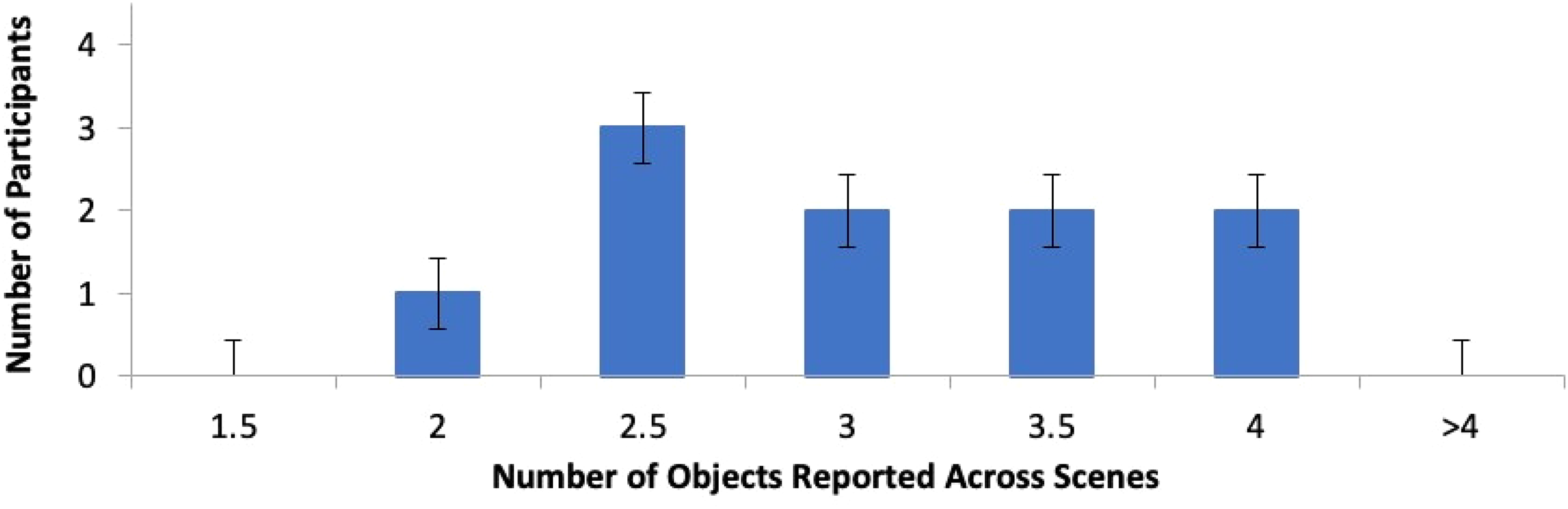
Histogram Representing the Frequency of the Number of Items Recalled Across Scenes with Standard Error Bars.
Discussion
The results reveal distinct patterns in how participants incorporated colour, movement, and clarity into their imagined scenes. Key patterns include the presence of colour (96%), objects as belonging to a scene (83%), movement (64%), and people (64%). First person perspective was commonly reported (35% first-person vs. 19% not first-person), as well as the three-dimensional imagery (30% 3D vs. 10% 2D). Participants also described their imagined scenes as realistic (50% realistic vs. 8% non-realistic), reporting some aspect of clarity in their imagery (81%) as well as having a focal point (73%). The prevalence of colour and movement in mental imagery suggests that imagination often involves vivid, dynamic representations of sensory experiences (Cumming & Eaves, 2018). The frequency of the high percentage of realistic imagery, first-person perspectives, the presence of scene-appropriate objects, and three-dimensional imagery further suggests that individuals tend to imagine scenes in ways that closely resemble real-world experiences, consistent with the role of episodic memory in mental imagery (Arbib, 2020). Interestingly, a study by Sakai and Miyashita (1994) found that an individual's focal point in imagery is largely influenced by their memory. Focal attention controls, searches, and selects for objects already in memory. It is hard to compare this finding to our episodic data, as the presence of episodic recall was not explicitly asked of participants, and therefore, there are missing values in the episodic data.
Further, an object's relevance to a scene (83%) has previously been shown to indicate that objects within a scene derive from episodic memory; we would be curious to know if this was the case with our participants as well. This is an avenue for future research.
However, while minimal, there is some variability in the data, for example, the presence of cartoon-like imagery (8%) and two-dimensional scenes (10%) highlights the potential for diversity and individual differences in mental imagery. While the main findings lean towards a real-world style pattern on imagery, these two results suggest some variance. This is further supported by the percentage of episodic reports: 35% of participants were found to have episodic recall in their imagery (80% lived experiences and 20% media-based).
Overall, these findings have important implications for understanding the cognitive processes underlying imagination. The prevalence of colour (96%), movement (64%), clarity (81%), and realism (50%), suggests that these elements might be fundamental to how individuals construct and navigate imagined scenes. This aligns with previous research suggesting that the mind's eye is responsible for fine-grained imagery, playing an important role in imagination (Andrews-Hanna & Grilli, 2021). Other patterns that would typically fall under the mind's eye, such as scene change (29%), dimensionality (30%), and object recall (M = 2.90), were not found to be as high. This could be due to how individuals were attending to their scenes and reporting information. If participants directed their attention more to aspects of colour or movement than to scene changes or dimensionality, it might have caused under-reporting.
The average number of objects recalled across all scenes was 2.90, with some scenes eliciting higher averages (e.g., baby's room: 3.86, ocean: 3.82) and others with lower averages (e.g., school: 1.89). The highest number of items recalled was 8, and the smallest was 1; the most common was 4. This variability suggests that the number of objects in individuals’ mental imagery may depend on the type of scene they are imagining. Scenes that are more familiar or emotionally charged, due to episodic memory, such as a baby's room or the ocean, might evoke richer and higher detailed imagery, leading to a larger recall of objects within the scene. The mode for objects recalled was one, further highlighting variability in imagery. While some individuals recalled multiple objects, others focused on a single focal point. This might reflect differences in vividness or imagery ability. Individuals with stronger imagery ability may have been able to construct scenes with more clarity and detail to pick out more objects.
Aside from colour (96%), objects as belonging to a scene (83%) and sense of clarity (81%), only a few of the percentages reported are overwhelming. This suggests that the results of imagination have lots of variance that a complete theory of imagination would have to be able to explain. Why might a given instance of imagination have colour or not? When do they tend to be 3D? Is it an individual difference, or is it determined by the nature of what is being imagined? These are avenues for future work.
A limitation of the study was the small sample size with only 23 participants. Future studies should increase the sample size to improve the generalizability of the findings. The high number of N/A answers was caused, in part, by a lack of standardization in question asking. Some questions were dropped, and some simply unanswered with no follow-up. Yes/No questions for dimensionality should have been added. Questions with high rates of participants forgetting to answer (Realism, Point of View, Scene Change) should have been repeated to remind participants to answer. Another limitation was that participants were not asked to report on episodic recall. This unexpected pattern emerged from the descriptions we recorded. Further, participants did not consistently report on dimensionality, scene change, and perspective; this, along with the episodic recall measures, could be correlated to the high prevalence of N/A reports. Future research should explicitly examine the relationship between the aforementioned patterns (scene change, dimensionality, perspective, clarity, realism, movement, presence of people, and colour). This is important as episodic memory is a crucial factor in the construction of imagination (Cumming & Eaves, 2018). Interestingly, Lee et al. (2021) found that humans hierarchically perceive objects; basic visual features are recognized first, then the parts, and then the object as a whole. Objects are perceived as a combination of their parts, and further, prior knowledge of one part facilitates learning of other parts in an object.
Footnotes

Ethics Approval Statement
Approved by Carleton University Research Ethics Board
Funding
The authors received no financial support for the research, authorship, and/or publication of this article.
Declaration of Conflicting Interests
The authors declared no potential conflicts of interest with respect to the research, authorship, and/or publication of this article.
Data Availability Statement
The ethics approval does not allow for availability of data.