



Abstract
Examining Facebook's role in public discourse about parapsychology is important when considering how science vs pseudoscience is widely understood. Graham's Hierarchy of Disagreement is used to assess an existing Facebook thread led by the question ‘is there any real evidence of psychic powers?’ 250 posted responses are examined for type. Critical Discourse Analysis applying scientific constructivism as a theoretical approach is used to examine most frequent types of commentary. Ad Hominem, Contradiction and Responding to Tone were the 3 most frequently recorded types. Comments evidence perceptions of educational institutions as vanguards of ‘good science’ with less consideration given to scientific rigour. Scepticism is identified as desirable when assessing research but is poorly conceptualised. Further research recommends 1) comparing parapsychology across social media platforms to assess how affordances shape debate; 2) exploring the role of scepticism and 3) examining the public's understanding of parapsychology in the context of science communication.
Keywords
Introduction
Paranormal beliefs and experiences are prominent within the public imagination. A 2022 survey of 994 people residents in the United Kingdom (UK), for example, revealed that 50% of respondents believed in ghosts (SpiritShack, 2022). Surveys consistently indicate that paranormal beliefs remain prevalent within the UK population (Castro et al., 2014/2014; Dean et al., 2022; Roe, 2023). The UK is no outlier when it comes to paranormal beliefs. A recent paper identified supernatural explanations for natural phenomena (e.g., storms, earthquakes) across 114 geographically and culturally diverse societies (Jackson et al., 2023). The associations between paranormal beliefs and cognitive function have been widely examined. A systematic review conducted by Dean et al. (2022) evidence over 30 years of research and 475 identified studies. Cognitive bias has been specifically reported as a predictor of paranormal belief (e.g., Pennycook et al., 2012; Willard & Norenzayan, 2013), thinking styles (e.g., Aarnio & Lindeman, 2005; Drinkwater et al., 2021; Williams et al., 2022/2021) and personality and individual differences (e.g., Auton et al., 2003; Chauvin & Mullet, 2021; Darolia & Chugh, 2022; Khan et al., 2025).
Less well examined are the roles and presentations of paranormal beliefs in online contexts. This is of critical importance, given how the prevailing interest is reflected on social media, with numerous ghost hunting profiles and pages (Ruickbie, 2019; Vale & Watkins, 2018). This includes the social media platform Facebook which has, in recent years, hosted a proliferation of paranormal-themed pages. Examples of UK-based paranormal pages include Paranormal UK which, as of 2nd March 2025 has 4.7k members and Paranormal Investigations UK with 11k followers (accessed by [FIRST AUTHOR] on 2nd March 2025). Current literature has primarily focused on the use of online platforms with paranormal content, including social media, as predictors of paranormal or anomalous beliefs (Brewer, 2013/2012; Stise et al., 2023; Wright et al., 2024).
The continuing interest in paranormal beliefs and experiences poses questions about how lay persons see the role of scientific research in exploring potential explanations for phenomena. There is, however, scant literature on how the public perceive research into paranormal phenomena, how it is debated publicly in the online space, and what the implications are for the ways in which social media users consume, participate, and generate content about paranormal research from an evidence-based perspective. Further research into how the public discuss such research online would potentially provide more in-depth, up-to-date, assessments of how members of the public distinguish science from non-science, how the affordances of specific platforms facilitate further discussion, and the wider implications for science communication. To do this, it is important to first introduce research to do date exploring paranormal phenomena.
Parapsychology: An Overview
Parapsychology, the research field established to take a scientific approach to examining paranormal beliefs and experiences, has been active in the UK since 1882 with the inception of the Society for Psychical Research (https://www.spr.ac.uk) set up in response to contemporary public interest in Spiritualism (i.e., seances and the reported ability in being able to communicate with the deceased). Additional research organisations include the Parapsychological Association (USA), which was formed in 1957. (https://www.parapsych.org/). Both organisations continue to be leading authorities in a field that is dedicated to the study of experiences which are in principle outside the realm of human capabilities or experiences currently understood by conventional science (Irwin & Watt, 2007, p. 1). Phenomena of interest includes psychical (psi) experiences and abilities (telepathy, clairvoyance, precognition, and psychokinesis) and evidence for post-mortem survival (e.g., ghosts, reincarnation). Proponents argue that parapsychology has the potential to broaden our worldview through developing both methodologies and theoretical frameworks for both physical and humanistic sciences, including the potential discoveries of mechanisms for phenomena not yet fully understood (Morris, 2000; Rhine & Pratt, 2010; Rock et al., 2013), while also understanding the validity of reported phenomena in the light of widespread belief (Groome & Roberts, 2024: Irwin, 1993; Lawrence, 1995).
However, parapsychology remains a controversial field due to, principally, there still being no known, or widely understood, mechanisms for phenomena explored (Ackers, 1987; Watt, 2005). Research has often relied on subjective self-reports of experiences, mostly without external validation (Kurtz, 2023). There are also accusations that parapsychology suffers from poor methodological practices (Alcock, 1981; 2023; Kennedy, 2013). In a paper outlining a meta-analysis of psi studies Cardeña (2018) argues for evidence of significant psi effects. However, Reber and Alcock (2020) issue a rebuttal, claiming that evidence of psi effects has previously been announced, then disregarded, demonstrating, they argue, no progress in the parapsychology field since its inception in the 1880s. However, theories for psi are beginning to emerge (e.g., Carr, 2015; Millar, 2015; Thompson, 2022). Yet the application of such theories is currently limited within the literature. Cardeña (2018) concedes that, despite arguing for potential statistical evidence for psi, there is currently no shared understanding for such effects. Limited theories regarding the mechanisms for phenomena present fundamental challenges for parapsychology in considering falsifiability as one of the ways of demarcating much of its work as science from non-science: if a theory is not posited, how can it be falsified or tested? (Mitra, 2020; Popper, 1963). Bunge (1984) goes further in arguing for a demarcating of science from ‘pseudoscience’ as science being, by definition, based on testability, predictive power, and compatibility with existing literature (of which, Bunge argues, parapsychology is not compatible).
Scientific Constructivism: Parapsychology in Context
Scientific constructivism presents a theoretical framework for understanding how scientific knowledge is humanly constructed rather than determined by the world (Downes, 1998). Scientific conclusions are not made in a vacuum but are arrived at by negotiating meaning through discourse and debate within communities of practice (Fosnot, 2013; Lau et al., 2003). Scientific discourse is constructed by scientists in a particular field to establish themselves in relation to other scientists, and language plays a crucial role in forming this societal reality and identity (Gunnarsson, 2014).
The demarcation argument for what distinguishes science from non-science, is complex. Merton (1973) argues that science was essentially formed by the principles of universalism, communism (as in common ownership), disinterestedness and scepticism. In the process of developing the concept of boundary work to define what constitutes science, Gieryn (1983) argues that science is not a singularity, its boundaries remain flexible, and it can change within historical and political contexts. The sets of characteristics of pseudoscience continue to be contested, with on one hand propositions that pseudoscience is something that is indicative by the degree to which unscientific practices may be taking place such as, as examples, emphasis on confirmation rather than refutation or evasion of scrutiny via peer review (French, 2021; Lilienfeld, 2005) This differs to alternative categorisations of pseudoscience, such as, for example, work based on subjectivistic knowledge or based on untestable hypotheses from the outset (Alcock, 1981). French (2021) argues that science should not be defined by a set of facts that can never be questioned, but rather by a set of processes to attempt to build on existing knowledge.
From this perspective, it could be argued that the prevailing scientific discourse has its own orthodoxies, or accepted, scientific knowledge, that demarcates areas of enquiry that exist with and within currently accepted scientific boundaries (Atmanspacher & Freiburg, 2009; Martin, 2021). Therefore, it could be argued that parapsychology is at the forefront of challenging existing demarcations (Zingrone, 2002). Several parapsychologists argue that much of the criticism of their field is based on ideological positioning rather than assessing research findings (Roe, 2017; Weiler, 2020). Furthermore, a content analysis of mainstream and non-mainstream research could not find justification for parapsychology as a pseudoscience compared to the research practices of its more mainstream counterparts (Mousseau, 2003). Nonetheless, Irwin (2007) argues that parapsychology is subject to the ‘socio-political strategies’ aimed to maintain the cultural image of science as the ‘ultimate arbiter of knowledge’ and parapsychology, with its ‘superstitious and ‘occultist’ associations for the public, is seen as an ‘affront to science’ irrespective of the research findings themselves. It is against this backdrop that parapsychology continues to struggle to be integrated into the scientific establishment.
The controversy continues online. Parapsychology is ‘criticised as a pseudoscience’ on its Wikipedia page (on 24th July 2024, sourced by [First Author])
The Role of Facebook and How to Argue
Social media has an important role to play in the continuing debate. Evidence suggests associations between the use of social media platforms as predictors of paranormal and cultivators of belief (Stise et al., 2023; Wright et al., 2024). Yet how individuals construct their arguments when discussing research into paranormal phenomena is less explored. In terms of online discourse, Boyd (2010) investigated the role of ‘networked publics’ as communities that are shaped or reconfigured by technologies who themselves reconfigure the information available. This includes the means to consume, participate in, and generate information (Taddicken & Krämer, 2021). Social media encompasses a diverse and rapidly evolving array of platforms, comprising varying functionalities including blogs, sharing of photos, commentary, and direct messaging where audiences are no longer passive recipients but are themselves the active generators of content (Hanna et al., 2011; Taddicken & Krämer, 2021). Identity on Facebook is also constructed through and by interaction, maintained by exchanging comments – a visual environment with interaction and conversation that is often fragmented. But it also allows users to utilise a range of other tools intrinsic and unique to social media platform such as emojis, likes, dislikes, sharing of links and visual material to engage in conversation or underpin or add nuance to an argument (Polletta et al., 2008; Subramanian et al., 2019). Facebook discourse, like any other discourse, is inherently constitutive of identity – how do users wish to represent themselves – people think carefully about how their profile best reflects them, and which aspects of themselves they wish to publicly represent (e.g., Boyd, 2010; Georgalou, 2017). For example, Paranormal Investigations UK describe themselves as a ‘professional paranormal investigation team’ on their Facebook page, with their own postings describing several potentially haunted locations in the UK, and types of experiences reported. They are cautious not to provide specific opinions as an administration team but still allow space for followers to comment. Paranormal investigators place a great deal of emphasis on proof of their what they argue as their own level professionalism and credibility on Facebook, which is consistent with how investigators present themselves on other media and social media platforms (e.g., Brewer, 2013/2012; Hill, 2012). This arguably is due to the dichotomy of how research into paranormal phenomena on presented and understood: on one hand as entertainment (Hill et al., 2018; Winsper et al., 2008) and on the other accusations that the field of investigation is merely pseudoscience.
Polarization on Facebook is widely examined (Bessi, et al., 2016; Del Vicario, 2016). Studies have also focused specifically on what conversational or debate tactics responders on Facebook use to challenge their opponents, including ad hominem attacks to undermine the original posters authority on a given subject (Demir, 2020; Habernal et al., 2018; Lillo-Unglaube et al., 2014; Martini, 2018) and how posters on Facebook respond to tone (Kim & Masullo Chen, 2021; West & Trester, 2013). Conversely, evidence suggests that Facebook has a way of cultivating a sense of solidarity and belonging around shared interests (Burke & Develin, 2016; Georgakopoulou, 2016). Previous literature exploring the quality of discourse on Facebook present mixed findings, from generally, poor with little evidence of deliberation (Welch, 2018) and unresolved (Cionea et al., 2017) to Facebook presenting a more egalitarian and polite level of discourse compared from other, more anonymised social media platforms including, for example, YouTube (Halpern & Gibbs, 2013). Polarised discussion about paranormal phenomena is explored (Fasce, 2022; Northcote, 2013; Weiler, 2020), yet how polarisation on research into paranormal phenomena on Facebook is less examined. YouTube discussions about parapsychology specifically suggests a polarised discussion (Murphy-Morgan et al., 2022), and further research across several social media platforms would assist with a greater understanding of how the affordances of varying platforms either facilitate or attenuate polarised discussion specifically about parapsychology and paranormal beliefs and experiences (Murphy-Morgan & Cooper, 2024).
In a 2008 essay How to Disagree, Paul Graham (https://paulgraham.com/disagree.html) responded to the natures of evolving discourses online, observing that if we are going to argue online more, rather than face-to-face, it is important to do it well, and to be able to able to be equipped to critically assess what we read and respond to. Graham (2008) also argued that being able to label and categorise types of argument (e.g., from name calling to refuting the central point etc) can also guard against ‘intellectual dishonesty’ and encourage individuals to also consider their own discourse methods to present better constructed arguments and for improved public debate (Graham, 2008). It is essentially a tool to support individuals to construct their arguments in more accomplished ways. Graham's approach has begun to be explored in the context of interactions and commentary on social media (Pascoal, 2015).
Critical Discourse Analysis: Parapsychology in the Context of Language and Power
Critical Discourse Analysis has much to offer cognitive literature in understanding the relationship between language and power. It explores the construction of conversations and the language used, in historical, cultural, social and political contexts, not looking at discourse alone as language used to create certain subject positions. It encompasses several approaches in explaining the interaction in terms of social interaction and social structures, exploring how conversation may reaffirm power imbalances in society (Fairclough, 2013; Statham, 2022; Van Dijk, 2015). It also considers prominent ideologies (Blommaert & Bulcaen, 2000; Wodak, 2002), in this instance what does and does not sit within scientific orthodoxy. From a social cognition perspective, Critical Discourse Analysis's focus on ideology and how it underpins discourse can be useful in examining how individuals understand the world (Koller, 2005/2005) and the use of language in reproducing and translating this information (Hjelm, 2021; Statham, 2022). Critical Discourse Analysis has recently been employed as a methodology to examine social media discourse in specific contexts, for example to examine how language is used online in relation to e.g., ‘fake news’ (e.g., Igwebuike & Chimuanya, 2021) and in the context of protest (Ahaotu & Oshamo, 2023). This approach has allowed for an examination of hidden power structures, ideologies or inequalities in language and communication, allowing for a constructivist approach in examining how meaning is made from the interactions.
Study Rationale
This Critical Discourse Analysis seeks to begin to address the current gap in the literature for how individuals argue for or against parapsychology, and how scientific orthodoxy is debated, via social media. To do this, this study utilises a specific social media platform (Facebook) as a way of examining how the specific affordance of this platform facilitates the conversation. The study seeks to explore how language used shapes the social power dynamics of the online discourse, particularly in the respect of what individuals understand as the difference between science and non-science. Ideologies that may underpin the discourse, and how individuals use language and strategies to support their arguments, are explored. Scientific constructivism is used as a theoretical framework to interpret how posters construct their arguments both in support of, or disagreement to, the existence of paranormal phenomena and their perspectives of parapsychology as a science.
Graham's Hierarchy of Disagreement is used as a tool to assess the frequency of types of responses to argument within this model, and how they organise their discourse online. This is a preliminary assessment to explore how Graham's Hierarchy of Disagreement could work as a tool to tease out the ways the language is ‘functioning’ to create subject positions within online social hierarchal systems encompassing discourses of ‘expertise’, ‘knowledge’ and ‘scientific/academic credibility’ (e.g., Parker, 1994). In this way, this study aims to highlight how Critical Discourse Analysis can add a level of critical enquiry in terms of analysing data qualitatively with a primary focus on how parapsychology, or research into paranormal phenomena, are contentiously discussed and subsequently polarised in public online domains.
Materials and Methods
This study was granted ethical approval by Northumbria University ethics online system [reference no: 2644]
Developed by Graham in his essay How to disagree (2008), Grahams Hierarchy of Disagreement is a model based on observations of how individuals debate and construct their arguments in the online space. It is constructed of 7 points, each of which refers to a hierarchical stage at which an argument is at its construction. This is a 7-stage disagreement hierarchy as follows: DH0: Name calling; DH1: Ad Hominem (e.g., attempts to discredit the authority of the author on a given subject); DH2: Responding to tone (i.e., responding to how something was said rather than what was said); DH3: Contradiction (e.g., simply arguing that something posited is a falsehood without evidence to underpin why this may be the case); DH4: Counterargument (e.g., contradiction with at least some reasoning); DH5: Refutation (counterargument with reasoning and evidence) and DH6: Refuting the Central Point (focusing clearly on the main point that the author is attempting to make, and counterarguing with reasoning and evidence). The Hierarchy is presented as a pyramid in Figure 1.
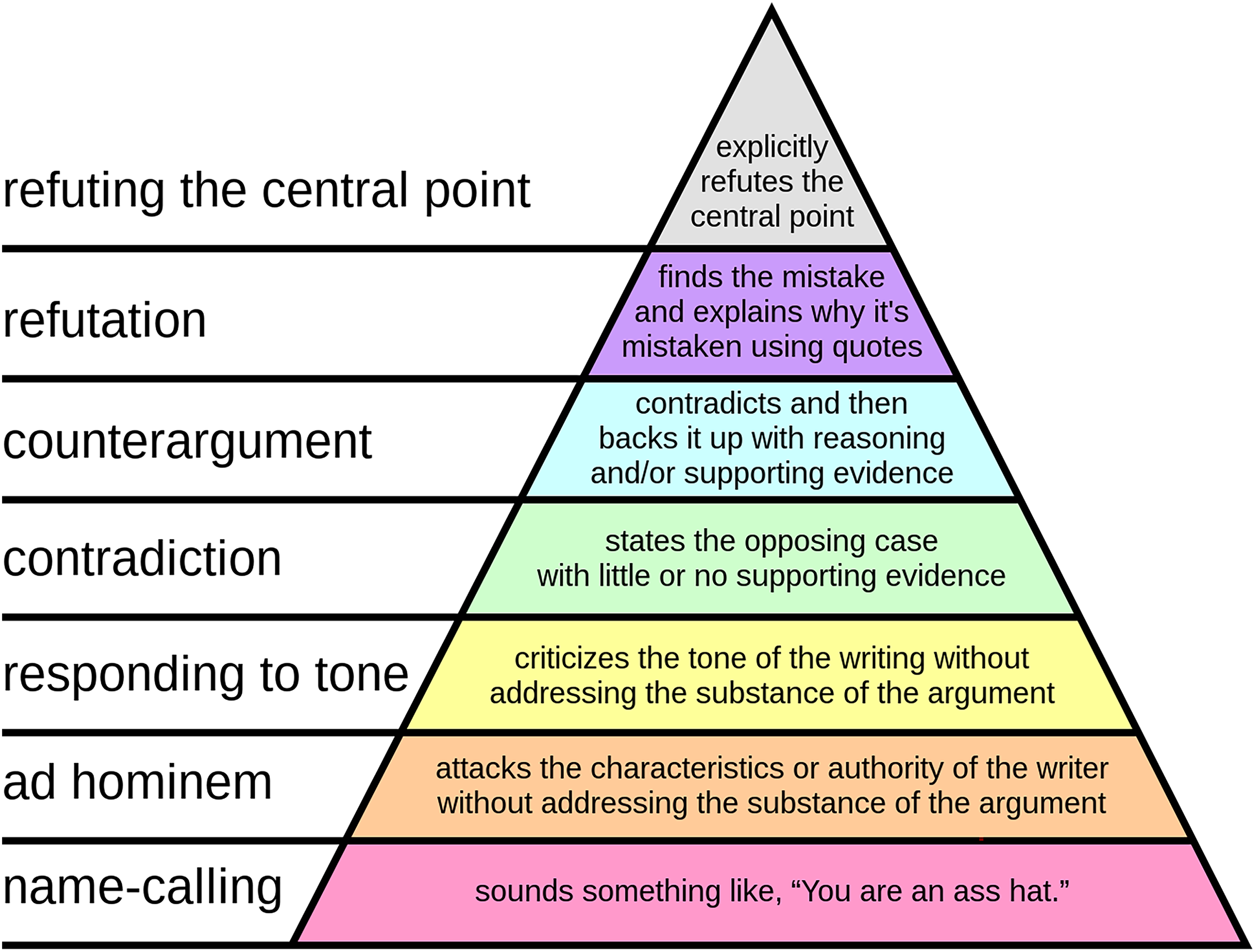
Graham's Hierarchy of Disagreement.
Procedure
Step 1: As a method for systematising coding of the data for this qualitative study, a frequency assessment of the types of comments identified all 250 comments were coded using Graham's Hierarchy of Disagreement and were categorised into which hierarchy point best reflected the point made. Some comments were categorised across more than one hierarchy. Both authors coded the data independently for consistency across the data set. Frequencies were recorded for all the hierarchies, and comments that were not applicable were removed. Applying social constructivism as a theoretical framework, the types of commentaries were used to explore how commenters used language to construct their arguments in their posts, and to what extent the notion of scientific authority was presented as an ideological position, and how language was used to demonstrate what posters viewed to be science from ‘non-science. Once each coded, authors met again to discuss their findings and to come to negotiated agreement and to discuss any remaining discrepancies in data interpretation. To aid further objectivity, a third independent researcher University of Northampton, independently checked and verified both authors coded excel data sheets, and conducted a Cohens Kappa analysis for inter-rater reliability between both raters for each of the 7 hierarchies. The rater agreements between authors demonstrated substantial to perfect levels of agreement respectively: DH0 = Name Calling (k = 1., p < .005); DH1 = Ad Hominem (k = .963., p < .001); DH2 = Responding to Tone (k = 1., p < .001); DH3 = Contradiction (k = 815., p < .001); DH4 = Counterargument (k = .954., p < .001); DH5 = Refutation (k = 929., p < .001); DH6 = Refuting the Central Point (k = 1., p < .001).
Step 2: Authors agreed pre-data collection and analysis that applied Critical Discourse Analysis would be applied to analyse all comments categorised under the 3 most frequently reported types of comments reported. All quotes from the data set are paraphrased in line with BPS Psychological Society 2021 guidelines for internet-mediated research to protect the identity and therefore anonymity of all individuals included in the online discussion.
Results
Phase 1: Frequency Analysis
The frequency analysis scores for the most recorded types of comments within Graham's Hierarchy categorisation were
The resulting frequency scores for all post categorisations are presented in Table 1.
Frequency Scores = Graham's Hierarchy of Disagreement.
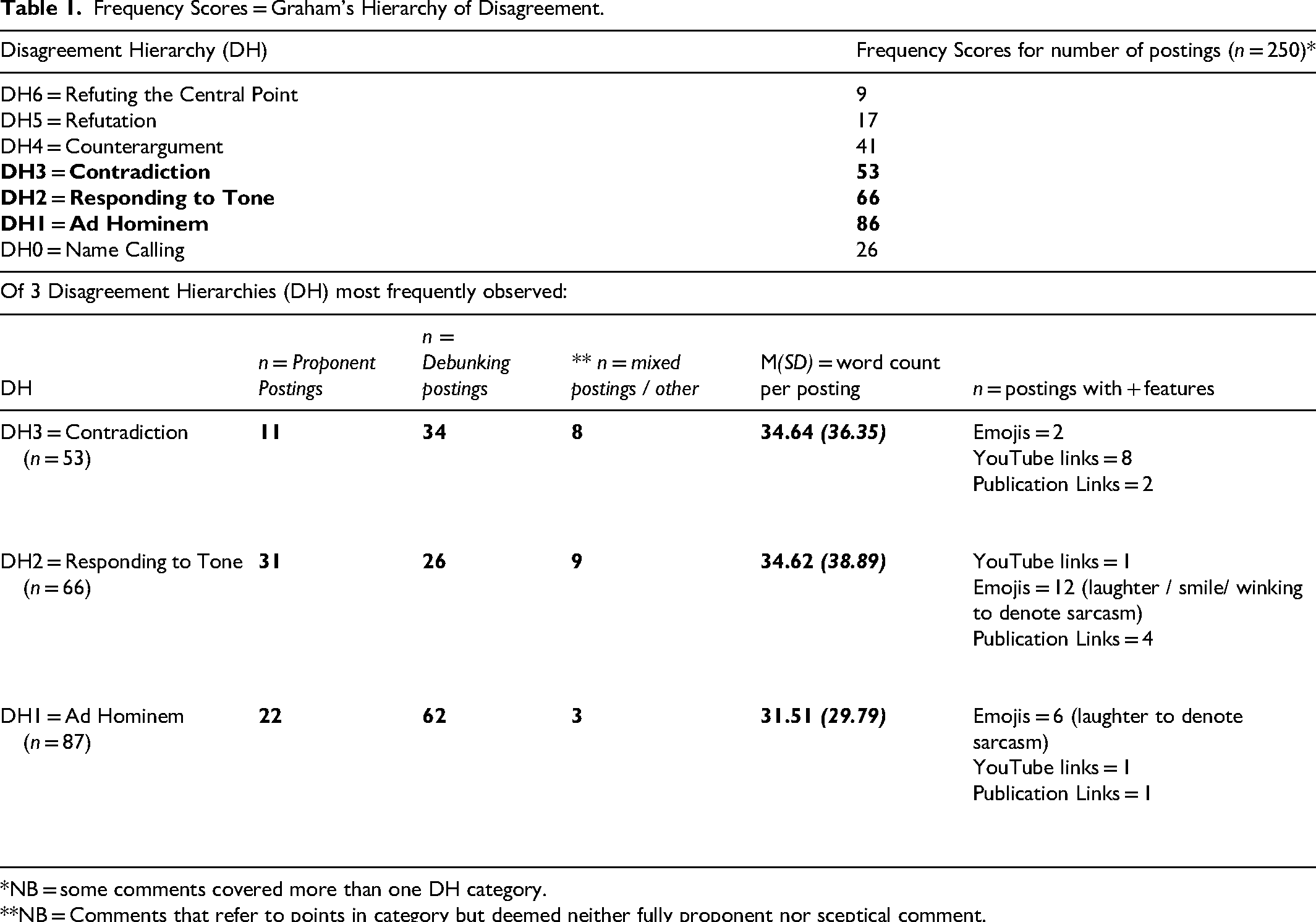
*NB = some comments covered more than one DH category.
**NB = Comments that refer to points in category but deemed neither fully proponent nor sceptical comment.
Phase 2: Critical Discourse Analysis DH 1, 2 & 3
A Critical Discourse Analysis of the 3 most frequently reported hierarchies for comments was carried out. Scientific constructivism frames this analysis, with evidence across the dataset that commenters assume an ideologically entrenched position as either proponents or debunkers of parapsychology. Most commenters assumed positions of either fighting to be ‘within the tent of accepted science’ (proponents) or trying to keep the ‘pseudoscientists out.’ (debunkers). For proponents of parapsychology, there are attempts to verify parapsychology as an accepted science by emphasising that parapsychological research use approaches that are widely accepted (e.g., methodology, protocols, data analysis etc), assuming the hallmarks of any other scientific field (e.g., psychology, neuroscience). Conversely, there appears to be assumptions made by debunkers that the ‘science community’ has an agreed consensus on what constitutes pseudoscience, that parapsychology has been categorised under the label of pseudoscience, with little understanding of how perceptions of science are constructed within historical, cultural, and political contexts. Phrases and language relate to broad themes under each of the key 3 hierarchical categories will now be explored in turn.
Role of Ad Hominem: The Pseudoscience Debate Goes on
For Ad Hominem comments, the academic rigour of parapsychology was called into question. In responses to proponents posting about parapsychology, there were specific attempts from debunking commentors to undermine the proponent's academic knowledge by attempting to discredit the calibre of their higher education, where or what they studied and debates about what constitutes ‘good’ vs ‘bad’ universities: “REAL degrees, NOT the one YOU have studied, don’t teach such supernatural nonsense.” “Some [academic] journals will publish any old crap.”
Debunking comments suggest a perceived hierarchy of prestigious universities or educational institutions as the vanguards of ‘good science’ with less consideration given by debunkers to assessing the efficacy of the processes by which research demonstrates scientific rigour (e.g., observability, replication, falsifiability). Despite one proponent's response stating that they have 2 degrees including a PhD from a UK university, the debunking responder simply states that this doesn’t count because ‘you can just fake PhDs’ if the university that you go to is ‘dubious’ and of ‘poor quality.’ From the perspective of scientific constructivism, there appears to be a sense that the perceived trappings of universities and ‘real degrees’ are a key part of the way in which science vs pseudoscience demarcation is reinforced. Proponents also appear to reinforce this demarcation, by citing how many degrees they have or how reputable journals have included some parapsychology-focused papers within their volumes (e.g., Nature, Psychology Today).
Words such as ‘woo’, and ‘bullshit’ were used by debunkers to discredit parapsychology and directed towards proponents by debunkers to try to prevent them from arguing the validity of their knowledge. This would appear to suggest that debunking commenters believe that there is an unchallenged consensus about what is considered legitimate science and what is not. From a constructivist perspective, the language used assumes that the barriers are clearly defined, and parapsychology universally discredited. Commenters continue to apply the pseudoscience argument to discredit parapsychology's scientific legitimacy, as one debunking commenter states: “[Parapsychology] is superstition, pseudoscience and medieval fantasy.”
Additionally, comments from debunkers go on to discredit, not only parapsychology per se, but also the authority and credentials of parapsychologists themselves: “Psi researchers just cite themselves and other pseudoscientists” “Somehow parapsychologists seem to want ‘special treatment’ compared to the real sciences. Anecdote is gospel!” Debunker: “Don’t you know the difference between real science and parapsychology, or should I say, pseudoscience?” Proponent response: “Why are you saying that parapsychology is a pseudoscience? Is it simply the phenomena that it studies?’ “Well, you don’t learn supernatural crap when you go get a real degree, that is certain.” “…., don't speak on behalf of other people, and if you have issue with a researcher's work, then attack his work and not him!”
Responding to Tone – “You’re Just not Listening!”
Responses to how someone responds to a previous comment rather than what was said in the response was influential in shaping the tone of the conversation. As a social media platform, interactions on Facebook do not benefit from the non-verbal communication afforded to in-person interaction, consequently the tone of a written post can be interpreted in several ways. In response to being asked why they held existing beliefs about parapsychology this debunking commenter had this to say with the following response:
Debunker: “I don’t see why I should have to justify myself and my position to you or anyone else!”
Proponent: “I am NOT having a go. [to previous respondent]. I am giving you the chance to change my mind. I’m not interested in your background; I am interested in what arguments you have [to support respondents’ position]. But anyway, never mind.”
As an affordance on Facebook, as well as other social media platforms, emojis can serve as ways to insert a level of nuance into discussions that would be reliant wholly on text. Smile and wink emojis are used in the dataset to provide a tone of sarcasm in discrediting proponent positions as in this example: “When parapsychology actually finds anything real just let us know  ”
”
Responses from proponents call attention to the use of emojis in this way with responses such as: “Is that [laughter emoji] an attempt to put humour before debate?”
This would appear to demonstrate confirmation bias in terms of how both debunkers and proponents respond to emoji use. Commenters communicate to other commenters with similar viewpoints their intention to ignore opponents’ tactics as in this proponent's example: “I am going to ignore the guy who keeps using the laughter emoji.”
The responding tone frames the conversation from the point of posters only listening to their own or similar points of view, with ‘not listening’ presenting evidence of confirmation bias, exacerbated by the limits of internet-mediated communication previously mentioned. This is illustrated by a much-repeated phrase and from both proponents and debunkers: “You just hear what you want to. You’re just not listening!”
From a constructivist perspective, the responding to tone can also indicate pre-empted or imagined attack to one's own ideological position. In this instance, this may indicate an attempt at deflection from the central point of argument to protect the perceived scientific status quo. There are also several accusations of rudeness being used as a means of attempting to silence any challenges to the science demarcation debate as this proponent complains: “Being rude is NOT being scientific – you have got to be rather close-minded to reject everything out of hand with an insult!” “I just see rudeness, personal attack, sarcasm, ridicule, deliberate attempts to divert the conversation, exaggerating, and straw man arguments as ways just to bring people down… It's the old guard against anything that might challenge the main point of view!”
Contradiction: Entrenchment, and What Makes a Sceptic?
For Contradiction, comments included several accusations of ‘money making’ as the focus of those who claim to have psychic abilities. There were also outright statements given with no invitation to respond as in this case: “There is NO evidence to support it [psychic ability]. People who claim to have these ‘powers’ are only in it for the money.” “Psychic powers are not real. They don’t exist. Magic people don’t exist. I can’t believe that grown-ups believe this stuff. Anybody claiming psychic powers is just fooling people who didn’t get a good enough education.” “The research is poor. REAL scientists know that they [parapsychologists] never found anything. REAL scientists do better things with their time.” “Real scientists don’t just produce results by shouting about what they see as proof, they let the actual results do the talking!” “Thanks, but I have researched this area [parapsychology] and have a lot more experience than YOU. Totally unconvinced, as is the REAL scientific community. Radin does a lot of woo-woo, going around promoting the paranormal while ignoring the real flaws that the REAL scientific community can see a mile off!”
However, one position that both debunkers and proponents largely agreed upon was the concept that scepticism was a healthy and important approach to take in the debate, as this commenter enthuses: “We should all be sceptics….healthy scepticism all the way!”
However, there was some considerable disagreement of what scepticism involves, let alone ‘healthy scepticism,’ with little agreement on what it means to take a sceptical approach to examining parapsychological research. There was some discussion that appeared to evidence that some commenters believe that scepticism in fact requires the enforcement of prior disbelief as this commenter suggests: ‘You are going to have to show that you understand what critical thinking and skepticism is if you are going to big up a book that takes seances and EVP [Electronic Voice Phenomena] seriously!” “Dogmatic scepticism and letting personal beliefs cloud their judgement – that is what's ruining things online. But then these people try to say they are using scepticism. It's demeaning.” “Belief in disbelief is not scepticism. It's pseudo-skepticism.”
There is, however, little discussion about what constitutes scepticism beyond the realms of reinforcement of currently held disbelief of accusations from proponents that debunkers are conflating disbelief with ‘real’ scepticism. This appears to suggest that this, whilst there is broad agreement that scepticism is a key component of critical thinking, there is little consensus between proponents and debunkers as to what constitutes a sceptical approach.
Discussion
The study set out to consider the implications for how the public understand and discuss information about parapsychology, classification of disagreement, and implications for public discourse about scientific information. To do this we explored public perspectives of parapsychology on Facebook, utilising Graham's Hierarchy of Disagreement as a tool for assessing the types of discourse commentary most frequently used. Taking a scientific constructivist perspective, a Critical Discourse Analysis approach was utilised to examine how the conversation reflected prevailing perceptions of parapsychology, how the affordances of Facebook helped or hindered the conversation, and what the discourse revealed about how the public viewed concepts or science vs pseudoscience more broadly.
The original question: “I know this is a strange question, but I will go ahead and ask it: is there any evidence of psychic powers? Has any research come close to suggesting that it is humanly possible?” arguably assumes that to ask questions about scientifically unorthodox subjects is outside of societal norms. Through the lens of scientific constructivism, it could be argued that this question set the tone of conversation from the outset; that being that the owner of the profile on who this conversational thread unfolded already presents the question by positioning parapsychological research (i.e., psi) as unusual and outside the scientific mainstream.
Frequency scores using Graham's Hierarchy of Disagreement revealed ‘ad hominem’ was the most frequently used argument approach when it came to challenging an opposing view. This corroborates previous literature regarding how ad hominem attacks have been used to undermine an online opponent on a given subject (Demir, 2020; Habernal et al., 2018; Lillo-Unglaube et al., 2014; Martini, 2018). Less well understood are how such comments are used to suggest a perceived hierarchy of prestige, including prestigious universities or educational institutions as the vanguards of ‘good science’ at the expense of assessing the efficacy of the processes by which research demonstrates scientific rigour (e.g., observability, replication, falsifiability). ‘Responding to tone’ was also frequently reported as a debate tactic, and this supported previous research findings (Kim & Masullo Chen, 2020; West & Trester, 2013). Additionally, emojis were used to provide nuance to postings, most notably when it came to sarcasm, which also agrees with previous social media studies (Subramanian et al., 2019). The frequent accusations that fellow commenters with opposing views were ‘just not listening’ is consistent with previous literature evidencing polarisation on Facebook (Bessi, et al., 2016; Del Vicario, 2016). Colloquial and expletive language was used to disregard parapsychology as pseudoscience, with considerable evidence of confirmation bias and polarising positions in terms of reaffirming existing ideological positions for both debunkers and proponents. This is consistent with previous literature dealing with perceptions of parapsychology on social media (Calderbank, 2023; Murphy-Morgan & Cooper, 2024; Murphy-Morgan et al., 2022).
‘Contradiction’ was the third most frequently reported approach, with commenters making a statement without providing evidence to support their claims. This would appear to corroborate previous studies that suggest a poor quality of discourse on Facebook (e.g., Welch, 2018). Links were used widely to contradict a previous commenter's position, and currently the use of links as counterargument on social media appears to be sparsely examined. The use of links to YouTube videos and publications to counter a previous comment could shed further light on how the affordances of Facebook as a platform help or hinder a conversation: to what extent is the sharing of a link either providing information or simply shutting the conversation down? (e.g., Polletta et al., 2008). Previous literature exploring the quality of discourse on Facebook present mixed findings, from generally, poor with little evidence of deliberation to Facebook presenting a more egalitarian and polite level of discourse compared from other, more anonymised social media platforms such at YouTube (Halpern & Gibbs, 2013). We did not find a great deal of civility on this Facebook thread, contrary to much of the literature (e.g., Burke & Develin, 2016). Whilst there was a consensus between debunkers and proponents that scepticism was a healthy approach to scientific debate, there was little agreement on whether a sceptical position either meant reaffirming ones existing disbeliefs or taking an objective, dispassionate approach to assessing information at hand before arriving at a considered position. People were misrepresenting their own beliefs as facts rather than considering them as opinions which needed substantiating with evidence. To counter what some proponents argued was an ideological positioning of parapsychology as pseudoscience, they mobilised behind accusations of ‘pseudo-skepticism’ when it came to challenging those with opposing views. Pseudoscepticism uses the tactics of discussing someone's work in an unscientific way including, as examples, both ad hominem attacks and vitriolic tone (Cabbolet, 2025). Proponents’ references to pseudoscepticism, and how it differs from scepticism remains unexplored in the current data set. Greater knowledge of the etymology of scepticism, and what taking a sceptical approach involves, or does not involve, may help to provide a more informed consensus on what constitutes scientific debate.
Regarding study limitations, in terms of the use of Graham's Hierarchy as a tool for assessing disagreement, and as the data were extracted from an existing Facebook thread, the authors have no knowledge of how the hierarchical points on the tool would have been conceptualised by the commenters themselves. The data analysis was also challenging in that many of the comments encompassed more than one of the hierarchical categories (e.g., a comment illustrating both ‘responding to tone’ and ‘contradiction’). Both authors also recognise their own subjective values in terms of the data analysis, and the epistemological limitations of their own socio-political contexts, and how this may inform how they have shaped their interpretation of the discourse.
Authors acknowledge that this is one data set from one social media platform. Use of a single data set as the focus for deeper investigation is consistent with the critical discourse methodology, which allows for a deeper investigation into the language used and its relationship with, in this instance, how science vs pseudoscience is demarcated. This paper is intended to be first stage exploratory study to examine how dominant narratives about parapsychology and scientific orthodoxy might be further examined or challenged. The decision was made from the outset to focus on a contextualised understanding of language used, and a deep vs broad application. Further research is recommended to build on the findings to examine if ‘ad hominem,’ ‘responding to tone’ and ‘contradiction’ can be applied as a focus to further investigate the discourse across online discourse more widely. The authors also acknowledge that the data was collected from a personal Facebook thread begun by a researcher working in a similar field. Therefore, it could be suggested that, whilst there were a wide variety of views, it is difficult to know to what extent the results and shape of the discourse could be replicated across other Facebook personal profiles (e.g., someone not working in academic research). It could be suggested that most commenters, given the profession of the original posters, may well be individuals with an interest in science and science communication, and how representative these comments are within the wider public realm may be up for debate. It is also important to acknowledge the limitations of Facebook as a platform in terms of demographic reach. For example, a decline in Facebook use in 18–34-year-olds (Hong & Oh, 2020). This also has implications for the generalisability of findings of this study, and to what extent attitudes may differ on an alternative social media platform.
This paper focuses on existing Facebook commentaries bringing ecological validity to the study, in that the posting was from a real-world context. However, demographic information about commenters was unavailable. Further research is recommended to involve participants recruited to a study utilising Graham's Hierarchy to assess for potential associations with demographic variables such age, gender, ethnicity, and highest level of education as examples. Further research with study participants recruited to the study from the outset could further contribute to the understanding power dynamics within language used and socio-cultural influences. This study arguably contributes to the current cognitive and individual differences literature focused on paranormal beliefs and experiences, in that it offers an initial exploration of the types of language used, and the debating strategies employed, in online discourse about attitudes towards research into paranormal phenomena. Further research to examine, for example, the association between either thinking style or personality traits, and types of debating strategy used, could also provide further insight into the how individuals construct their arguments specifically in online contexts.
The debate appears to provide further evidence of the pseudoscience demarcation boundary. The fierce and polarised debate in evidence across this data set suggests that parapsychology continues to be at the forefront of challenging existing demarcations (Zingrone, 2002). This is further complicated by the ever-evolving networked publics on social media (Boyd, 2010), and how communities organise to communicate their views online. From a science communication point of view, the public are no longer passive consumers of information, but also the curators of it (Taddicken & Krämer, 2021). This makes providing tools which will support greater efficacy of informed and constructive debated increasingly challenging. Further research is recommended to compare how the debate regarding parapsychology is formulated across several social media platforms to assess how differing platform affordances allow or hinder constructive debate. Assessing this in the context of demographics, personality and individual differences would also allow for a deeper understanding of the impact of additional influences that might be brought to bear on how individuals formulate their attitudes toward research into paranormal phenomena and how their views are communicated. Further exploration of the role of scepticism, and how it is conceptualised, is recommended as a way of exploring how Facebook and social media users examine the information they receive or share about parapsychology. Further research is recommended to also examine the public's understanding of the historical, political, and contemporary contexts of science, including the exploration of parapsychology, in context. Public fascination with paranormal phenomena remains as prevalent and therefore research in the area continues to be of public interest. This paper attempts to address gaps in the literature in terms of deepening insights into how parapsychology is discussed online, and how the affordances of a specific social media platform facilitate the conversation.
Footnotes
Author Note
Murphy-Morgan, C & Smith. L. A (2023, August 3-6) Assessing Public Perspectives of Parapsychology through Facebook: A Discourse Analysis Utilizing Graham's Hierarchy of Disagreement. (Conference presentation abstract) 65th Annual Convention of the Parapsychological Association, Oslo, Norway. Published in The Journal of Parapsychology, 87, 76–78.  .
.
Acknowledgements
The first author would like to thank The Alex Tanous Foundation for Scientific Research for their support with this research. Both authors would like to thank Dr Matthew Hopkins, University of Northampton, for assisting with independent verification of both data analysis and inter-rater reliability agreement.
Ethical Approval
This study was granted ethical approval by Northumbria University Ethics Committee (Ref. 2644).
Funding
The authors disclosed receipt of the following financial support for the research, authorship, and/or publication of this article: This work was supported by the Alex Tanous Foundation for Scientific Research, (Scholarship Programme).
Declaration of Conflicting Interests
The authors declared no potential conflicts of interest with respect to the research, authorship, and/or publication of this article.
