



Abstract
This narrative inquiry aimed to investigate whether the deliberate use of positive imagined interactions (IIs) could contribute to the enhancement of cross-cutting political conflict, and also tested the seventh theorem of II conflict linkage theory. Undergraduate student participants were assigned to one of three conditions: positive II, negative II, or control in a three-phase procedure. Participants engaged in an II and then reflected on their IIs through open-ended questions before having real cross-cutting conversations on a political topic of their choice with trained confederates. Participants then completed a questionnaire assessing the constructiveness or destructiveness of their interaction. Thematic analysis revealed that 40 out of the 45 total participants engaged in positive and constructive conflict with their conversation partners. Positive IIs facilitated perspective-taking, while negative IIs allowed individuals to mentally defend their beliefs. Although the results neither confirmed nor refuted Theorem 7 of II conflict linkage theory, they did provide support for Theorem 3, which suggests that negative intrusive IIs can manifest even when individuals attempt to have positive IIs.
Divisions among Americans on basic political concepts reached record highs during Barack Obama's presidency and these divisions grew wider throughout Donald Trump's years as President (Pew Research Center, 2017). Unfavorable opinions of opposing parties have also grown through the years (Pew Research Center, 2017). Americans are becoming increasingly polarized while also feeling more and more angst toward members of opposing political groups. In fact, 95% of Americans believe that “people on opposite sides of an issue demonize each other so severely that they make finding common ground impossible” (Q, 2016, p. 9). Sunstein (2018) refers to such “visceral, automatic dislike of people of the opposing political party” as “partyism” and claims that it “now exceeds racism” (p.10)
Such extreme disdain is not limited to one's acquaintances or strangers from across the political aisle. The rhetoric of the 2016 and 2020 Presidential Elections strained and even ended familial, romantic, and friendly relationships throughout the US. A Reuters poll found that 39% of respondents argued with family members or friends over politics (Whitesides, 2017). Additionally, 16% of respondents stopped talking to a family member or friend completely and 13% ended a relationship with a family member or friend due to the 2016 Election (Whitesides, 2017). A cooperative balance regarding cross-cutting political issues is proving difficult for Americans to achieve in the post-2016 election era.
Americans are also confining themselves into echo chambers, both online and in the real world, that reaffirm their political beliefs and protect them from those who disagree. Echo chambers, according to Schmitt-Beck and Lup (2013), are spaces where “citizens receive only confirmation of previously held views” (p. 529). Most people, for example, surround themselves with friends who hold similar political views (Pew, 2014). Liberals’ and conservatives’ differences, explains Pew (2014), span beyond politics and even affect where people choose to live and who they want to marry into their families. Echo chambers are especially dangerous because they are capable of guiding people to believe falsehoods, beliefs that are difficult, or even impossible, to correct (Sunstein, 2018). These all-time high levels of political tension, partizanship, and interpersonal conflict are tearing families and friendships apart, leading people to isolate themselves in echo chambers of their own political views.
Americans are also conflict-avoidant, particularly regarding politics (Mutz, 2006), but why? Ulbig and Funk (1999) suggest that people have a general “distaste for disagreement” and that for many people, disagreement “creates a negative psychological tension” (p. 267). Americans usually do not want to risk hurting their reputations or losing friends, so many avoid engaging in conflict, controversy, and the risk of offending others all together (Morey et al., 2012).
Citizens’ inability to engage in effective civil discourse is problematic for a variety of reasons. Sunstein (2018) explains that “unplanned, unanticipated encounters are central to democracy itself” (p. 6) because such encounters often involve topics and viewpoints that people avoid. Those types of conversations though “are important to ensure against fragmentation, polarization, and extremism, which are predictable outcomes of any situation in which like-minded people speak only with themselves” (Sunstein, 2018, p. 7). Mutz (2006) recommends that being part of a diverse political network is important because it fosters an understanding of multiple perspectives, encourages political tolerance, and promotes a greater awareness of one's own rationales and viewpoints.
Even though cross-cutting political discourse is extremely beneficial, people avoid such conversations in an attempt to escape conflict. Deutsch (1994b) considers that conflict may have such a bad reputation because of its relation to war and social disorder. What many fail to realize though, is that engaging in conflict does not have to be a negative or painful experience. Competitive and dissatisfying conflict, according to Deutsch (1973), is the type of conflict that should be avoided. Alternatively, Deutsch (1994b) explains that constructive conflict “is the root of personal and social change” and that it is a “medium through which problems can be aired and solutions arrived at” (p. 13).
New processes and techniques for enhancing constructive political conflict are needed now more than ever. Conversations about politics have always been tricky to navigate, but such exchanges are even more precarious in the post-2016 election era. As of October 2017, “the gap between the political values of Democrats and Republicans [was] now larger than at any point in Pew Research Center surveys dating back to 1994” (Pew Research Center, 2017, p. 2). It is common for people to avoid political conversations, especially when the person they are talking to holds different political beliefs. When cross-cutting political conversations do occur, they often evolve into aggressive confrontation or divisive debate. New techniques for managing conflict would be beneficial for average, day-to-day interactions and especially useful for cross-cutting political conversations.
Imagined interactions (IIs) may prove to be an excellent tool for preparing for cross-cutting conversations. IIs are the conversations that individuals envision in their minds. One way to think about IIs is as a mental script for what one anticipates a conversation will sound like. The present study suggests IIs can be used strategically to help one become a better communicator and, more specifically, a better cross-cutting political conflict manager.
It is significant because it fills several gaps in the imagined interaction (II) literature. Ideally, this study can lead to the development of self-talk strategies and methods of strategic IIs that can help people to have more constructive cross-cutting conversations about politics. In fact, this study found that cross-cutting political conflict with strangers is generally constructive, regardless of induced state, and that positive and negative IIs tend to serve different functions for cross-cutting political II.
Literature Review
Imagined interactions have been studied in great detail over the past three decades. According to Honeycutt (2003b), IIs are “a type of daydreaming in which individuals think about conversations in their minds” and attempt to “simulate real-life conversations with others” (p. xi). The theoretical foundations of II theory are rooted in symbolic interactionism and phenomenology, which date as far back as the 1930s (Honeycutt, 2003b).
IIs are a form of intrapersonal communication, the most basic form of communication from which all other types of human communication evolve (Honeycutt, 2010). Honeycutt (2010) explains that “IIs operate as a mechanism to operationalize the study of intrapersonal communication as it works to shape communication interpersonally” (p. 13). IIs can be understood as intrapersonal communication (communication with oneself) about interpersonal communication (communication between two people). IIs are a phenomenon that all individuals encounter on a daily basis, whether they realize it or not. People may have imaginary conversations before they enter an argument with a loved one, when they plan out how to phrase a question for their teacher or boss, or when they envision yelling at the person who cut them off in traffic.
IIs have been studied in relation to a variety of different functions, attributes, and concepts. Previous studies have examined the most common functions of IIs (Honeycutt et al., 2015) and the specific attributes that explain the interpersonal nature of IIs (Honeycutt et al., 1990). Gotcher and Honeycutt (1989) analyzed the real-life effects of IIs on forensic competition participants and Zagacki et al. (1992) explored the role of mental imagery and emotions in IIs. IIs have also been studied in relation to prejudice reduction (Crisp & Turner, 2009) and communication apprehension (Honeycutt et al., 2009). This small sampling of II literature illustrates the wide variety of research that has been conducted under this theoretical framework. None of the existing literature, however, combined IIs theory with cross-cutting political discourse.
Attributes of Imagined Interactions
There are eight attributes used to describe IIs: frequency, proactivity, retroactivity, variety, discrepancy, self-dominance, valence, and specificity (Honeycutt, 2003b). These attributes are relevant because they provide a means for measuring intrapersonal communication in the form of IIs (Honeycutt, 2003b).
Frequency
This attribute describes how often or how regularly IIs occur (Honeycutt, 2003b). Those who engage in more frequent IIs tend to have higher conversational interpretation skills; they are better at paraphrasing others’ words and recognizing irony and sarcasm (Honeycutt, 2010).
Proactivity and Retroactivity
The second and third attributes, proactivity and retroactivity, point out whether an II occurs before or after an actual interaction. Proactive IIs take place before actual interactions while retroactive IIs occur after (Honeycutt, 2003b). Honeycutt (2010) states that proactivity is the only II attribute that is directly related to a function of IIs. Individuals often use proactive IIs to rehearse what they may say in response to imagined statements from others (Honeycutt, 2010). Alternatively, retroactive IIs occur after an actual interaction takes place, often as an attempt to review the actual interaction (Honeycutt, 2003b). Linked IIs occur when an actual interaction is followed by a retroactive II, which is immediately followed by a proactive II and then another actual interaction and so on (Honeycutt, 2003b).
Variety
The fourth attribute, variety, explains how diverse an individual's IIs are in terms of topics and interaction partners (Honeycutt, 2010). IIs can center around a wide variety of topics such as conflict, home life, school, work, extracurricular activities, and dating and may involve various conversation partners like friends, family members, and significant others (Honeycutt, 2010).
Discrepancy
Honeycutt (2010) states that the fifth attribute, discrepancy, describes the differences between IIs and actual interactions. Sometimes, an actual interaction turns out to be very similar to the II that preceded it while other times, the actual interaction is completely different from the II.
Self-Dominance
Self-dominant IIs are those in which the person imagining the interaction does most of the talking (Honeycutt, 2010). Typically, the self speaks more in an II and the other plays the primary role of listener (Honeycutt, 2003b).
Valence
Honeycutt (2010) describes the next attribute, valence, as “the amount and diversity of emotions that are experienced while envisioning conversation” (p. 5). Valence is measured by how pleasant or unpleasant an II is perceived to be (Honeycutt, 2003b).
Specificity
The final attribute, specificity, refers to how detailed and distinct the images within one's IIs are (Honeycutt, 2010). Those who report highly specific IIs tend to have greater levels of communication competence and conversational sensitivity (Honeycutt, 2010).
Functions of Imagined Interactions
IIs generally serve at least one of the following six functions: relationship maintenance, conflict linkage, rehearsal, self-understanding, catharsis, and compensation (Honeycutt, 2003b). These functions help researchers to understand the purpose of individuals’ IIs.
Relationship Maintenance
The relationship maintenance function explains how IIs influence interpersonal communication (Honeycutt, 2010). The majority of IIs focus on significant others while a small percentage involve strangers and acquaintances (Honeycutt, 2003b). According to Honeycutt (2003b), the relational maintenance function allows IIs to create relationships and even help to shape them as they develop.
Conflict Linkage
The conflict linkage function of IIs “explains how individuals relive prior arguments as well as prepare for new conflict episodes” (Honeycutt, 2010, p. 6). Conflict linkage is the function most relevant to this study on cross-cutting political conflict and will be discussed in greater detail below.
Rehearsal
The third function, rehearsal, involves planning and practicing what one might say during an actual interaction (Honeycutt, 2010). Rehearsal allows individuals to try out various alternatives in an attempt to select the best possible statement or statements for whatever interaction they may be preparing for (Honeycutt, 2010).
Self-Understanding
The function through which one gains a deeper understanding of themselves by reflecting on their beliefs and attitudes is known as self-understanding (Honeycutt, 2010). IIs, for example, have even been used in therapy as an opportunity for patients to gain greater self-clarification (Honeycutt, 2003b).
Catharsis
The catharsis function of IIs, according to Honeycutt (2010), explains how they can be used to alleviate tension and curtail uncertainty about another person's actions. This function provides individuals with an opportunity to unburden themselves and reduce anxiety (Honeycutt, 2003b).
Compensation
The last function, compensation, refers to IIs’ ability to make up for actual interactions that are lacking (Honeycutt, 2010). IIs offer people an opportunity to “say” things they missed an opportunity to say or cannot say at all. For example, when a person is cut off in traffic, they very rarely get out of their car, approach the person who wronged them, and then proceed to yell at them. Instead, one may envision this process of telling the other person off to compensate for their inability to actually do so.
Imagined Interaction Conflict Linkage Theory
Conflict is one of the most prevalent subjects of IIs. In their study of mental imagery and emotion in IIs, Zagacki et al. (1992) found that conflict was one of the most common topics of their participants’ IIs. The study also found that conflict was typically correlated to less satisfying IIs (Zagacki et al., 1992). This low satisfaction indicates that rather than using IIs to mentally process conflict to reach a more satisfying experience, some people use IIs to either review or rehearse the negative aspects of conflict (Zagacki et al., 1992). Other studies have examined the physiological effects of IIs. Honeycutt (2010) argues IIs can actually influence one's blood pressure and heart rate. He asserts, “the fact that there is physiological arousal in imaginary conversations as well as actual encounters points to the power of the human mind in affecting emotion and arousal either when alone or when actually talking” (Honeycutt, 2010, p. 61).
In their study examining the recurring nature of conflictual IIs, Allen and Berkos (2010) found 41%, nearly half, of their participants’ IIs were conflictual. Additionally, the majority (63%) of II partners were significant others, friends, or bosses rather than family members, coworkers, roommates, strangers, or potential partners (Allen & Berkos, 2010). Out of the three types of conflicts (behavioral, normative, and personal), Allen and Berkos (2010) found that most conflicts were either normative or personal, dealing “with the interpersonal norms, values, and attitudes that permeate thinking about interpersonal relationships and the judgments partners make about the relationship and one another” (p. 39). The study also found evidence that IIs are used in both productive and unproductive manners to manage conflict, and that recurring conflicts make up a significant portion of individuals’ routine IIs (Allen & Berkos, 2010). These recurring conflicts are what make II conflict linkage theory so unique.
Conflict linkage refers to the ways in which one dwells upon arguments and fights and explains “why conflict is enduring, maintained, may be constructive or destructive, and can erupt anytime in interpersonal relationships” (Honeycutt, 2003a, p. 3). According to Allen and Berkos (2010), “recurrent conflicts constitute a significant portion of the IIs that individuals engage in on a routine basis” and are “deep-rooted in intrapersonal and relational issues,” (p. 39).
Conflict linkage describes the process through which recurring conflicts are nourished by retroactive and proactive IIs that are linked together in a continuous loop (Honeycutt, 2003b). Conflicts do not necessarily end if interrupted by physical separation. Instead, during a period of physical separation, individuals may use retro- and proactive IIs to keep conflict alive, or linked, in their minds, allowing the conflict to pick right back up once the physical separation has ended (Honeycutt, 2003b). So, imagine that Piper and Oscar are having an argument one weekday morning, but by the time Oscar must leave for work, the two have not successfully resolved their conflict. As their days go on, physically apart, Oscar replays the morning's conflict in his mind, imagining what he wished that he had said differently. Knowing that the conflict will continue when Oscar gets home from work, Piper imagines what she might say to him and considers how he might respond. Even though Piper and Oscar were physically separated, the conflict lived on in each of their minds through linked retroactive and proactive IIs.
Axioms and Theorems of II Conflict Linkage Theory
There are three axioms and nine theorems that make up conflict linkage theory and explain the ways in which individuals productively or unproductively manage their daily conflicts (Honeycutt, 2010). All of the axioms and theorems will but discussed below. Theorem 7 will be discussed in greater detail as it is most relevant to the present study.
Axioms 1, 2, and 3. These axioms present logical explanations of how interpersonal relationships are created and defined. According to Axiom 1, interpersonal relationships continue to exist through IIs, a form of intrapersonal communication, outside of actual interactions (Honeycutt, 2003a). Axiom 2 explains that thinking about and dwelling upon a relationship partner allows an individual to maintain and develop that interpersonal relationship (Honeycutt, 2003a). The final axiom states, “A major theme of interpersonal relationships is conflict management (e.g., cooperation-competition). Managing conflict begins at the interpersonal level of communication in terms of IIs” (Honeycutt, 2003a, p. 8).
Theorem 1. The first theorem of II conflict linkage theory claims that retroactive and proactive IIs keep conflict alive (Honeycutt, 2003a). During a retroactive II, one may revisit a conflict and reformulate their points and counterpoints to prepare for a future interaction (Honeycutt, 2003a). Honeycutt (2003a) explains that through this process, unresolved conflict episodes are linked together.
Theorem 2. According to Theorem 2, an individual's mood dictates whether their IIs will be positive or negative (Honeycutt, 2003a). When a person is in a good mood, their IIs will be more positive. If a person is in a bad mood then, their IIs will be negative. This theorem portrays the vital role of emotion in the development of IIs (Honeycutt, 2003a).
Theorem 3. The third theorem states that intrusive negative IIs often invade when a person purposely attempts to create a positive II (Honeycutt, 2003a). For example, if Piper was purposely engaged in a positive II about resolving a conflict with Oscar, negative IIs might naturally creep into her imagination, even if she tried to keep them out.
Theorem 4. Honeycutt's (2003a) fourth theorem states, “suppressed rage is a result of the lack of opportunity or inability to articulate arguments with the target of conflict” (p. 14). In other words, when a conflict goes unspoken or unsettled, animosity builds within. IIs may actually intensify such rage as individuals ruminate upon conflict (Honeycutt, 2003a).
Theorem 5. Theorem 5 explains that contextual cues such as music, substances abuse, television shows, or movies, may help to facilitate thoughts about conflict (Honeycutt, 2003a). For example, some people associate conflicts with particular songs, so when they hear those songs, they are led to recall that past argument.
Theorem 6. According to the sixth theorem of II conflict linkage theory, “Recurring conflict is a function of brain neurotransmitter activity in which neurons are stimulated” (Honeycutt, 2003a, p. 18). Some research suggests that biological factors play a role in the development of communication traits such as conflict and verbal aggression (Honeycutt, 2003a).
Theorem 7. The seventh theorem states, “In order to enhance constructive conflict, individuals need to imagine positive interactions and outcomes” (Honeycutt, 2003a, p. 6). At its surface, this theorem seems to make sense. Theorem 7 aligns with ubiquitous beliefs and guidelines that assert a positive mindset can help one live a happier, healthier, or better life. Honeycutt (2003b) rationalizes Theorem 7 by citing studies completed by Infante (1995) and Infante and Rancer (1996). Infante (1995) sought to help students develop strategies they could use to control verbal aggression, but none of these strategies specifically involved IIs and instead focused on enhancing communication skills more broadly. While these studies prove that individuals can be taught conflict management strategies, they do not confirm that IIs, specifically, can be taught as a conflict management tool.
There have been other attempts to validate Theorem 7. Honeycutt (2003b) cites a forensic coaching study (Gotcher & Honeycutt, 1989) in an attempt to do so. With that study, Gotcher and Honeycutt (1989) implied forensic coaches could teach their debaters to use IIs as a rehearsal mechanism in order to relieve stress and anxiety. This study is relevant because it shows that IIs can be used as a practical tool for rehearsal and stress relief, but it has nothing to do with conflict management and thus may not be sufficient for justifying the seventh theorem of conflict linkage theory.
Theorem 8. The purpose of Theorem 8 is to explain how conflict linkage is capable of distorting reality (Honeycutt, 2003a). Honeycutt (2003a) argued that when a person keeps a conflict active in their mind, they often imagine a conversation that will differ from the conversation that will actually take place. For example, Oscar may anticipate that he will stay calm during an argument and that Piper will bring up irrelevant, previous arguments to prove her point. In reality, if Oscar becomes loud and heated and Piper maintains focus on the argument at hand, then the actual conflict is discrepant from the II, thus indicating that Oscar's II is distorted reality.
Theorem 9. According to the ninth and final theorem, IIs are sometimes used as an “escape from societal norms” (Honeycutt, 2003a, p. 21). So, if Oscar gets into an argument with his boss at work, there are societal expectations that he will remain calm and, depending on the culture of the organization, subservient. To compensate for how he is expected to behave, Oscar may later imagine an interaction in which he behaves more boldly.
Imagined Interactions in Political Contexts
Few other studies have examined IIs in political contexts. Madison et al. (2014) examined partisan voting in relation to the functions of IIs. They found that individuals who voted for Republicans and Democrats had less self-understanding and rehearsal IIs than individuals who preferred Independents (Madison et al., 2014) This suggests, explained Madison et al. (2014), “that voting along party lines may be a heuristic, or ‘mindless’ behavior” (p. 105).
Warner and Villamil (2017) tested “the depolarizing potential of intrapersonal communication through imagined intergroup political contact” (p. 447). According to Warner and Villamil (2017), partisans often avoid thoughts that are incongruent with their political attitudes, but “IIs in which people are prompted to engage in a hypothetical interaction with a member of the outgroup can override the natural inclination of partisans to avoid ruminating about the outgroup” (p. 450). Their results showed that IIs with the political intergroup can actually improve attitudes about the political outgroup (Warner & Villamil, 2017). Warner and Villamil (2017) Explain that this finding held true regardless of primed valence; positive IIs were more effective, but even negatives primes were capable of decreasing negative affect. The researchers “suspect that imagining a negative interaction allowed people to work through feelings of frustration and anxiety and therefore experience the catharsis function of IIs” (Warner & Villamil, 2017, p. 461). Ultimately, Warner and Villamil (2017) claim, these findings illustrate “the power of intrapersonal communication and provide a promising strategy to reduce affective political polarization moving forward” (p. 462). If IIs can positively impact the way one things about those who hold opposite political beliefs, then it may certainly be possible that IIs can positively affect cross-cutting political conflict.
Only one II study has examined political talk specifically. Lambertz (2011), studied people's IIs about politics with their family members in an attempt to discover how people from different types of families (pluralistic, consensual, protective, and laissez faire) use IIs for political talk differently. The results showed “that IIs helped participants relieve tension and anxiety about political conversations” (Lambertz, 2011, p. iii). Lambertz (2011) coded her participants’ IIs into the following categories: exchange of ideas, gossip/complaining conversations, information seeking, recapping the days’ events or forecasting a voting behavior, persuasion, conflict, decision-making, joking around, and other. Only 6% of proactive IIs and 8.3% of retroactive IIs focused on conflict. The top functions of participants’ political IIs were catharsis, self-understanding, and rehearsal (Lambertz, 2011). The present study is an important first step toward developing a body of research on IIs and political discussion.
Interpersonal Conflict
Conflict is a wide and varied concept with many definitions and descriptions. There are also many different types of conflict such as intrapersonal, intragroup, intranational, intergroup, and international conflict (Deutsch, 1973). The present study focuses on interpersonal conflict, or conflict between two individuals. Deutsch (1973), a prominent conflict researcher, defines conflict as a circumstance that “exists whenever incompatible activities occur” (p. 10). Such incompatibilities may prevent, obstruct, interfere with, injure, or make the opposing individual or party less effective (Deutsch, 1973). This definition takes a very broad approach to conflict, not limiting it by N relationships or other factors, making it ideal for this study that involves strangers engaging in conflict.
There are many variables that can affect the course of conflict (Deutsch, 1973). Some of these variables include the attributes of the individuals involved, any existing prior relationships, and the nature of the problem that has led to the conflict, the social environment where the conflict takes places, any audiences interested in the conflict. The strategies and tactics used by those involved in a conflict as well as the conflict's potential consequences also impact conflict's course. Deutsch (1973) explains that “the actions taken during the course of conflict and the consequences of conflict rarely leave the participants unchanged” (p. 7).
Conflict also serves a variety of functions. Deutsch (1973) contends that conflict has an abundance of positive functions as well as personal and social value. Deutsch (1973) outlines the following positive functions of conflict: It prevents stagnation, it stimulates interest and curiosity, it is the medium through which problems can be aired and solutions arrived at, it is the root of personal and social change. Conflict is often part of the process of testing and assessing oneself and, as such, may be highly enjoyable as one experiences the pleasure of the full and active use of one's capacities. In addition, conflict demarcates groups from one another and thus helps establish group and personal identities; external conflict often fosters cohesiveness. (p. 8-9)
Conflict clearly serves many positive functions; therefore, it is pertinent that individuals learn to manage conflict effectively and engage in it constructively.
Constructive vs. Destructive Conflict
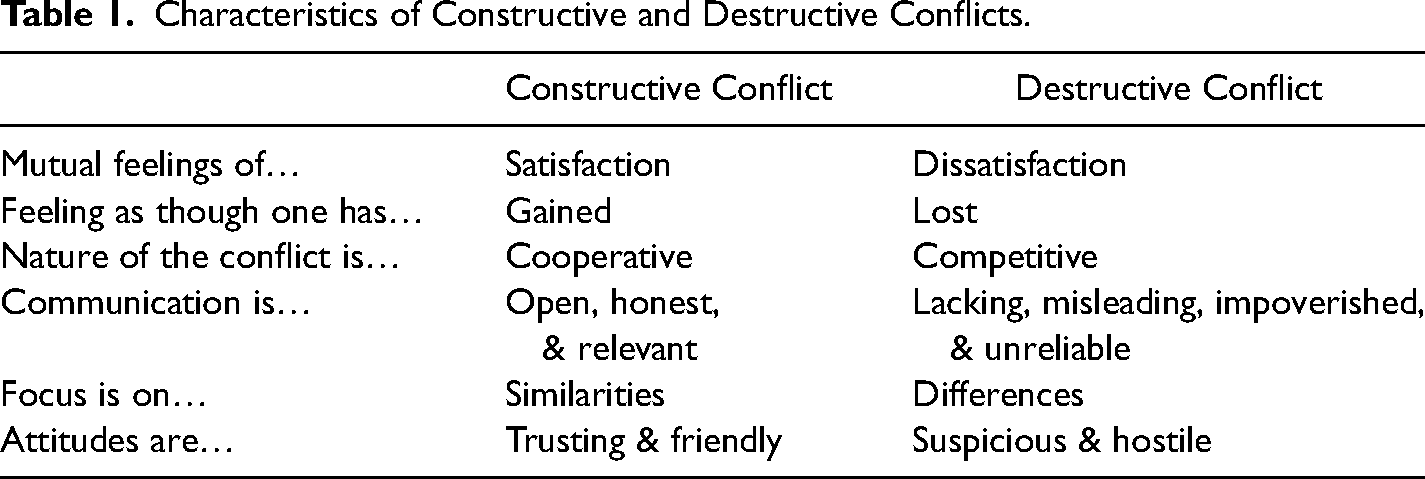
Conflicts can, generally, be categorized into one of two types: constructive or destructive. Constructive conflicts have productive results that leave participants feeling satisfied and as though they have gained something through the conflict (Deutsch, 1973). Such conflicts are cooperative, seek to fulfill the needs and goals of all involved, and involve “open and honest communication of relevant information” (Deutsch, 1973, p. 29). Those engaged in a constructive conflict tend to evoke a trusting and friendly attitude while focusing on similarities rather than differences (Deutsch, 1973). Those engaged typically recognize the legitimacy of the other's interests and opinions (Deutsch, 1973). Furthermore, constructive conflicts may be characterized by mutual enhancement and a lack of defensiveness (Deutsch, 1973).
Destructive conflicts leave participants feeling dissatisfied with the results of the conflict and may cause those involved to feel as though they have lost (Deutsch, 1973). These conflicts are competitive, leading to a win-lose mentality. Communication in a destructive conflict is typically unreliable, impoverished, misleading, or lacking (Deutsch, 1973). In a destructive conflict, participants tend to take a suspicious and hostile attitude including abnormal and outrageous actions that emphasize differences between the two parties, rather than similarities (Deutsch, 1973). Destructive arguments may use threats, deception, and power strategies (Deutsch, 1973). Additionally, destructive conflicts often intensify and are “characterized by a tendency to expand and escalate” (Deutsch, 1973, p. 351).
Overall, according to Deutsch (1994a), constructive conflict resolution resembles an effective and cooperative problem-solving process whereas destructive conflict resolution is like a competitive interaction. The underlying purpose of this study was to determine whether IIs can be used as a practical tool to help people achieve constructive, rather than destructive, cross-cutting political conflicts. To aid in that mission, the most relevant of Deutsch's (1973) characteristics of constructive and destructive conflict have been summarized in the Table 1.
Characteristics of Constructive and Destructive Conflicts.
Conflict Avoidance
Conflict avoidance is a significant aspect of interpersonal communication and plays a pivotal role in shaping individuals’ engagement in political activities. Ulbig and Funk (1999) highlighted that people differ in their inclination to avoid interpersonal conflict. Some individuals actively seek to differentiate themselves from others by expressing dissenting opinions, while high self-monitors adapt their behavior to social situations. The “spiral of silence” theory, as explained by Noelle-Neumann and Petersen (2004), provides insights into the reasons behind conflict avoidance. This theory posits that people fear isolation and, as a result, monitor which behaviors receive public approval. Consequently, individuals tend to refrain from publicly expressing their views when they anticipate backlash, ridicule, or social isolation (Noelle-Neumann & Petersen, 2004).
Ulbig and Funk's (1999) research demonstrated a significant relationship between conflict avoidance and political participation, encompassing activities like political protest, campaign support, and political discussions. Those who exhibit higher levels of conflict avoidance are less likely to engage in such political activities. Furthermore, their study identified low income and lower education as strong predictors of interpersonal conflict avoidance, suggesting that individuals less equipped for democratic participation may be deterred by the potential for social conflict (Ulbig & Funk, 1999). Consequently, reform efforts aimed at enhancing political participation should consider how the social context may either stifle or intensify the inherent conflict in politics.
In addition to structural reforms, there is a need for education and training to foster constructive political discourse among citizens, helping them overcome conflict avoidance tendencies. Such initiatives can enable individuals to navigate political conversations effectively and promote active political engagement.
Conflict Management
Various scholars have developed models and approaches for conflict management over the years. For instance, Blake and Mouton's (1964) managerial grid outlined five approaches to conflict management based on individuals’ concerns for people versus concerns for production. These approaches include avoiding, accommodating, compromising, competing, and collaborating. Similarly, Thomas (1976) categorized conflict management approaches based on assertiveness versus cooperation. Rahim (1992) presented a model with five conflict management styles, considering concern for oneself versus concern for others: integrating, obliging, dominating, avoiding, and compromising.
Deutsch (1994b) emphasized several essential skills for effective conflict management, including the cultivation of cooperative and problem-solving relationships, open-mindedness to creative solutions, and the ability to adopt an outside perspective. Deutsch noted that a lack of these skills contributes to destructive conflicts on various levels, from national to individual.
Furthermore, Deutsch (1994a) provided a list of suggestions to enhance conflict management, including finding common ground, active listening, honest communication, and taking the perspective of others. Notably, one recommendation is to understand one's own typical responses in different conflict situations and work on controlling dysfunctional tendencies (Deutsch, 1994a).
Imagined Interactions (IIs) as a Conflict Management Skill
While the above-mentioned conflict management skills do not directly identify IIs as a conflict management tool, there is a potential link between IIs and effective conflict management. IIs involve imagining conversations with others, which inherently requires taking an other-oriented perspective, albeit to varying extents depending on the individual. Being able to thoughtfully and accurately anticipate what one's conversation partner might say can contribute to constructive conflict management (Korsgaard et al., 2004).
Beebe et al. (2016) defined other-orientation as being aware of the thoughts, needs, experiences, emotions, and goals of communication partners while maintaining one's own integrity. Imagining a conversation partner's responses necessitates a degree of other-orientation. This perspective-taking can positively impact conflict resolution (Korsgaard et al., 2004). Additionally, Deutsch (1994a) emphasized the importance of considering the other's perspective during conflicts.
Imagined interactions can facilitate the process of taking an other-oriented perspective during conflicts, potentially improving the outcomes of such interactions. By practicing IIs, individuals can develop better skills for understanding and empathizing with their conversation partners, which aligns with the goals of constructive conflict management.
Cross-Cutting Political Conflict
Cross-cutting political conflict refers to interpersonal conflict surrounding political topics between individuals with opposing viewpoints. Political conversations, as defined by Kim et al. (1999), encompass various forms of political talk, discussion, or argument conducted voluntarily by free citizens without specific agendas. These conversations are a crucial element of deliberative democracy, which relies on the exchange of political ideas and opinions (Kim et al., 1999).
However, many political discussions occur among individuals with similar political views, which limits exposure to differing opinions (Mutz, 2006). Mutz highlighted the benefits of cross-cutting political discourse, including a deeper understanding of one's own views, an improved grasp of opposing viewpoints, and increased tolerance. Nevertheless, such discussions can strain relationships, leading to a need for clear norms and guidelines for handling political differences respectfully (Mutz, 2006).
Conover and Searing (2005) found that private settings are the primary context for political discussions, and people often avoid these conversations due to a lack of information or skill. Additionally, individuals may avoid political discussions to prevent negative judgments, maintain social harmony, and adhere to social norms (Conover & Searing, 2005).
In a culture where cross-cutting political conflict is often avoided, efforts to promote constructive discourse are essential. Mutz (2006) suggested that people would benefit from having more “weak ties” in their social networks and emphasized the need for instruction and norms on how to handle political differences respectfully. Encouraging respectful political discourse in informal settings and facilitating exposure to diverse political opinions can contribute to a healthier democratic discourse.
Conflict avoidance and conflict management are critical aspects of interpersonal communication and political engagement. Understanding the factors contributing to conflict avoidance, promoting conflict management skills, and fostering constructive political discourse can all contribute to healthier political interactions and more active participation in democratic processes. Efforts to bridge the gap between individuals with differing political viewpoints can enhance the quality of political discourse and strengthen democracy.
In light of the extant research and the polarization in the US political scene today, two research questions were explored through the course of this study.
Method
After receiving IRB approval from a prominent southern US university, open-ended survey questions built the foundation of this narrative inquiry. According to Gilstein (2013), a narrative inquiry is a type of qualitative methodology that “seeks to understand the ways in which people create meaning in their lives through the construction of narratives” (para. 1). Narrative inquiries use data such as letters, journals, conversations, interviews, and photographs to develop an understanding of certain life experiences (Gilstein, 2013). This particular narrative inquiry allowed the researchers to gather information from the participants through a form of self-storytelling. A thematic analysis of the respondents’ narratives allowed for identification of major themes that appeared in the data. A thematic analysis, according to Clarke and Braun (2013), “is essentially a method for identifying and analyzing patterns in qualitative data” (p. 121). Thematic analysis is beneficial because it works well with a wide variety of research questions, can be used to analyze many different types of data, is successful with both large and small data sets, and can be used to develop either data- or theory-driven analyses (Clarke & Braun, 2013).
Researchers used a self-reflexive approach in the present study, in the form of first-person discussion and reflection. Self-reflexivity has been described as “one of the most celebrated practices of qualitative research” and is “considered to be honesty and authenticity with one's self, one's research, and one's audience” (Tracy, 2010). In qualitative research, the researcher is part of the social phenomena being studied and thus plays an active role in the research process (Tracy, 2010). According to Gergen and Gergen (1991), critical reflection, examination, and exploration throughout the research process allow qualitative researchers to use reflexivity to move outward and to expand understanding.
Pilot Study
The design of this study was original in many aspects, so a pilot study was necessary to assess the success of the procedures. After obtaining Institutional Review Board approval, a pilot study with 15 participants was conducted. The pre-interaction prompts successfully induced constructive IIs for the majority of the positive group and destructive IIs for most of the negative group. Additionally, the flow of participants from phase to phase and all other logistics worked favorably. The data collected during the pilot study was later incorporated into the final dataset.
Participants
The sample consisted of 48 participants enrolled in undergraduate communication courses at a prominent university in the southern United States. Three participants’ data were removed from the sample, leaving 45 total in the final dataset. One participant was an outlier because of their age, the second did not engage in an II, and the third made jokes throughout their responses thus making their data unreliable. Students received course credit in exchange for participation. Those who did not wish to participate in the study were assigned an alternative task of equal value and demand.
The majority of participants were 20 and 21 years old, but ages ranged from 19 to 27 years old. Participants were 57.8% female and 42.2% male. The majority of participants, 73.3%, were Caucasian, 22.2% were African American, and 4.4% were Hispanic. As for political affiliation, 37.8% of participants identified as Democrats, 31.1% were Republicans, 26.7% indicated that they were Independents, and 4.4% either did not know or did not indicate their political affiliation.
The demographic breakdown of each group was relatively reflective of the whole body of participants. The positive II group was 70.6% female and 29.4% male and 66.7% Caucasian and 33.3% African American. The positive II group was 40.0% Democrat, 26.7% Republican, 20.0% Independent, and 13.3% unknown. The negative II group was 53.3% male and 46.7% female with 66.7% Caucasians, 26.7% African Americans, and 6.7% Hispanics. This group was 53.3% Democrat, 26.7% Republican, and 20.0% Independent. Lastly, the control group was 53.3% female and 46.7% male and was made up of 86.7% Caucasians, 6.7% African Americans, and 6.7% Hispanics. The political affiliation of the control group differed from the other groups with 40.0% identifying as Republican, 40.0% identifying as Independents, and only 20% indicating that they were Democrats.
Procedure
Upon arrival at the research site, participants were required to read and sign a consent form. Then, based on Harwood et al.'s (2011) design, participants were randomly assigned to one of three groups: positive II, negative II, or control.
Participants were assigned to these groups when they were randomly given an adhesive badge with a participant identification number including two digits and one letter (for example, 01-P, 02-N, 03-C, etc.). The numerical digits were significant to each participant so that their pre-interaction and post-interaction questionnaires could be matched for analysis. The letter indicated which group they were randomly assigned to (“P” for the positive II group, “N” for negative II group, and “C” for control group.) The meaning of the letters was kept secret from the participants.
Several participants at a time were directed to a computer lab where they would begin the three-phase procedure: pre-interaction, interaction, and post-interaction. The pre-interaction phase included a detailed questionnaire that assessed demographic information and prompted the participant to engage in an II. The interaction phase involved an actual conversation with another person. During the post-interaction phase, participants responded to a second questionnaire about their actual interaction.
Phase 1: Pre-interaction. The first questions verified the participants’ identification number and assessed basic demographic information including age, gender, ethnicity, and political affiliation. The questionnaire then asked participants to select which one of the following topics they were most passionate and opinionated about: abortion, gun control, Donald Trump, immigration, or climate change. Participants were also verbally asked to briefly explain their stance on their selected topic. Most of the political topics were selected from Everett's (2013) 12-item Social and Economic Conservatism Scale (SECS) because they are extremely prominent issues in the US today and often elicit polarizing opinions.
Next, the participants were prompted to engage in an II on their selected topics. The prompts were based on Deutsch's (1973) characteristics of constructive and destructive conflict which can be broken down into six main dimensions: satisfaction versus dissatisfaction, gained versus lost, cooperative versus competitive, open and honest communication versus lacking, misleading, and poor communication; a focus on similarities versus differences; and trusting and friendly attitudes versus suspicious and hostile attitudes. The positive II group's prompt guided participants toward a constructive II with a stranger who disagrees with them. The negative II group's prompt guided participants toward a destructive II with a stranger who disagrees with them (see Appendix C). The control group, like in Harwood et al.'s (2011) study, was prompted to imagine that they were in an outdoor scene (see Appendix D).
After reading their prompts, the participants were asked to take as much time as needed to imagine either their interaction or outdoor scene. Then, they were asked a series of follow-up questions. Open-ended questions were asked to give participants the opportunity to elaborate on their thoughts and experiences in their own words. Such elaboration, according to Husnu and Crisp (2010), helps to reinforce the effects of imagined contact with another person. Many of the questions were adapted from Honeycutt's (2010) Survey of Imagined Interactions (SII) as well as previous II studies (Bryan, 2010; Harwood et al., 2011). Additionally, several of the questions assessed whether the conversation was constructive or destructive. These questions were based on the six dimensions of constructive versus destructive conflict mentioned above.
Phase 2: Interaction. After completing their pre-interaction questionnaires, the participants were escorted to either a classroom or office to engage in an actual, one-on-one conversation about their chosen topic with a trained confederate. Eleven communication graduate students, who were completely blind to the design and purpose of this research, assisted with the study. Each confederate was thoroughly trained by the researchers and given a guide that contained all necessary information. The confederate training guide contained a detailed outline of the procedure and the confederates’ role in the study, instructions on how to behave like a convincing confederate, and an extensive review of arguments both for and against each of the five political topics.
The confederates were instructed to wait inside of a pre-assigned classroom or office. Immediately before the interaction, the confederates were told which topic they would be discussing with the participant, and what stance they should take on it, based on the participants’ responses to the Phase 1 questionnaire. The participants were then invited into the classroom or office and both confederates and participants were instructed to discuss the selected topic for 10 min. The participants then returned to the computer lab after the 10-min timer went off, while the confederates were instructed to stay in the room. I would then set the timer and leave the room.
As the interaction began, the confederates pretended that they did not know their conversation partner's stance on the selected issue. The confederates were instructed to disagree with the participants and mirror their disposition during the interaction. For example, if the participant stayed calm, cool, and collected, then the confederate would do the same. If the participant began to angrily raise his or her voice, the confederate imitated their anger and aggression.
Phase 3: Post-interaction. After their interactions, the participants returned to the computer lab where they completed the post-interaction questionnaire programed in to Google Forms. This questionnaire, like the pre-interaction questionnaire, asked open-ended questions that were adapted from previous studies and encouraged the participants to elaborate on their experiences. The nature of these questions, as with the pre-interaction questionnaire, guided participants to evaluate the constructiveness or destructiveness of their conversations.
After completing the post-interaction questionnaire, all participants were debriefed. They were informed that their conversation partner was a trained confederate who was instructed to disagree with them. They were also told that the views that the confederate expressed during their conversation may not actually reflect their personal views.
Analysis
Responses to both the pre-interaction and post-interaction questionnaires, collected through Google Forms, were exported as Microsoft Excel documents for analysis. Of the 48 total participants, data from 45 participants were analyzed. Researchers then conducted a thematic analysis to analyze the pre-interaction questionnaire and the post-interaction questionnaire. Clarke and Braun's (2013) six phases of thematic analysis were used to analyze the data collected through this study. The six phases include the following: (1) immersion and familiarization, (2) creation of condensed categories, (3) search for themes, (4) review themes, (5) define and name themes, (6) write up results (Clarke & Braun, 2013).
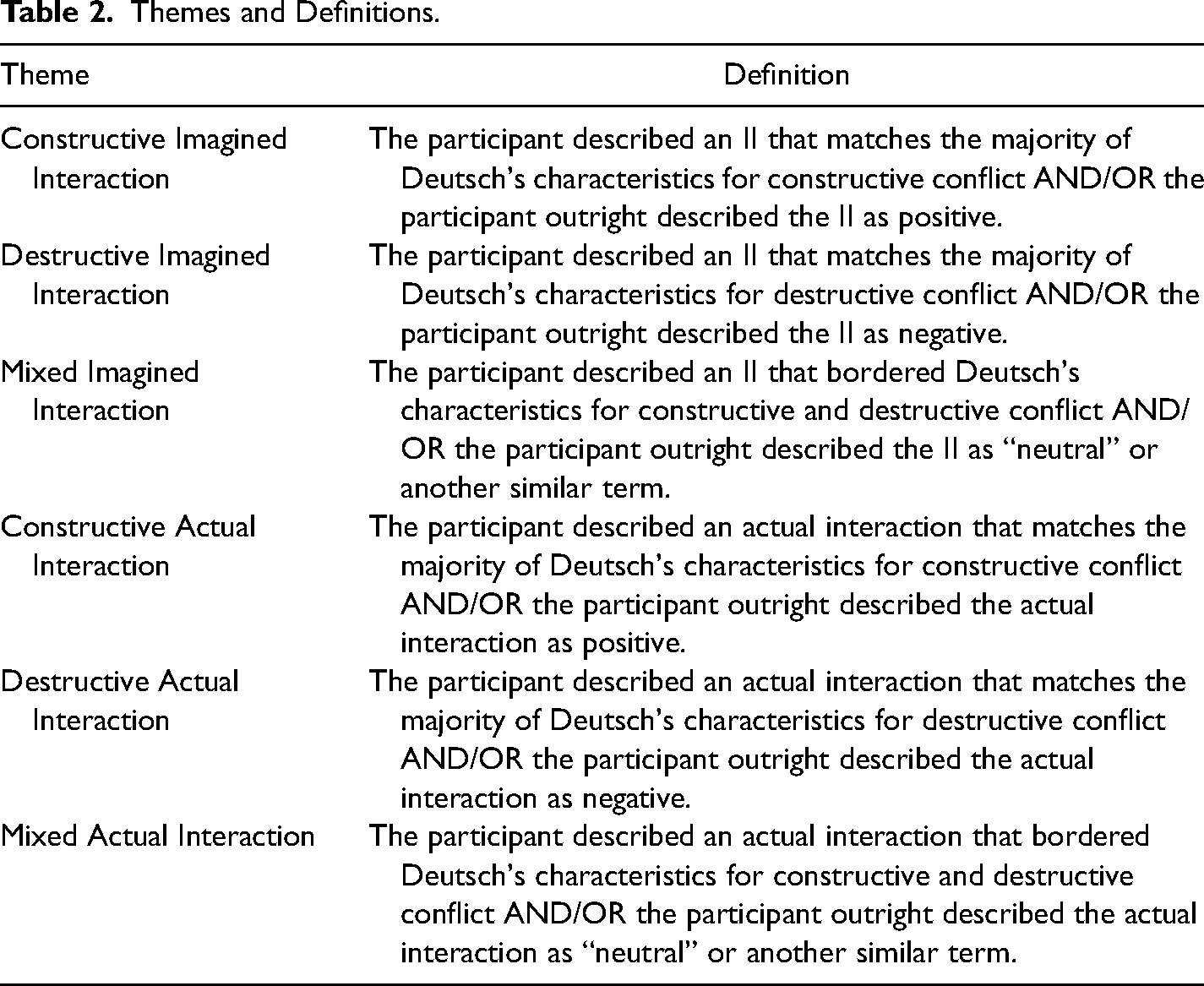
Each pre-interaction and post-interaction journal entry was read several times and notes on observations were taken. The data was then organized into condensed categories that were most relevant to the research questions (Clarke & Braun, 2013) including the following: constructive IIs, destructive IIs, mixed IIs, constructive actual interactions, destructive actual interactions, and mixed actual interactions. Other interesting and relevant patterns were also explored and reviewed according to the themes (Clarke & Braun, 2013) by comparing the categories detected among the positive II, negative II, and control group. Each theme was then isolated by identifying their essence and developing an impactful, concise, and informative name for each (Clarke & Braun, 2013). The names and definitions of each theme can be found in Table 2.
Themes and Definitions.
Results and Discussion
The open-ended nature of the pre-interaction and post-interaction questionnaires allowed the participants to elaborate on their thoughts and experiences in their own words. The participants’ elaboration generated an extremely rich body of data which contained several pertinent themes. The first section seeks to answer the research questions by breaking down the results of each of the three groups (positive II, negative II, and control). These results present the constructive, destructive, or mixed nature of each participant's imagined and actual interactions. Following the breakdown of each group, the first section presents a discussion of these groups collectively and answers the research questions set forth by this study. The remainder of this analysis explores additional themes that emerged from the data. These themes include gained perspective, defense of one's values, IIs opposite of induced state, and the white, male “other.” These themes have interesting implications for II theory, conflict management, and other areas of communication research.
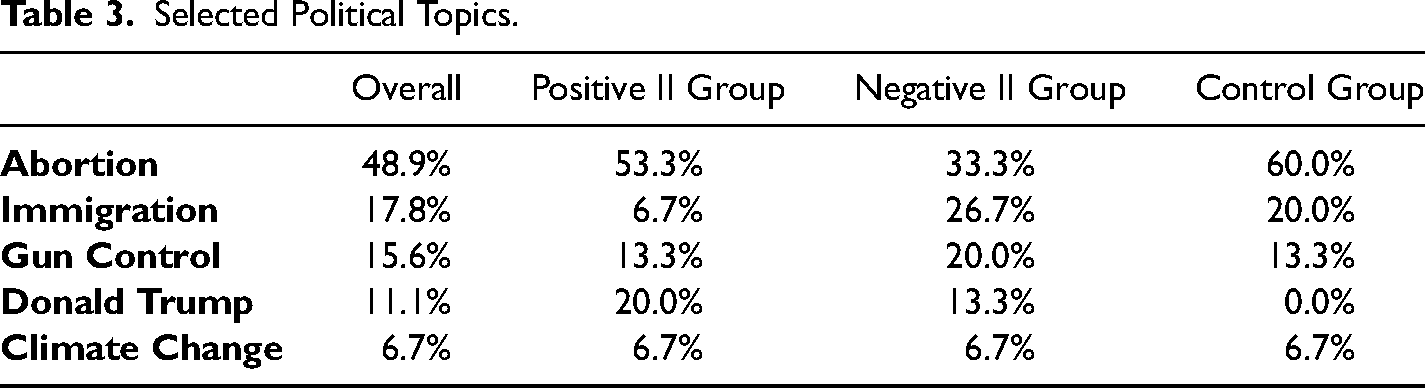
Table 3 displays the percentages of participants who selected each of the five political topics. Overall, when asked to select the political topic that they were most opinionated and passionate about nearly half of all participants selected abortion. The next most popular topic was immigration followed by gun control, Donald Trump, and then climate change. Notably, abortion was the most-selected topic of each group. Table 3 shows an overview of all participants as well as a breakdown per group.
Selected Political Topics.
Constructive vs. Destructive Conflict
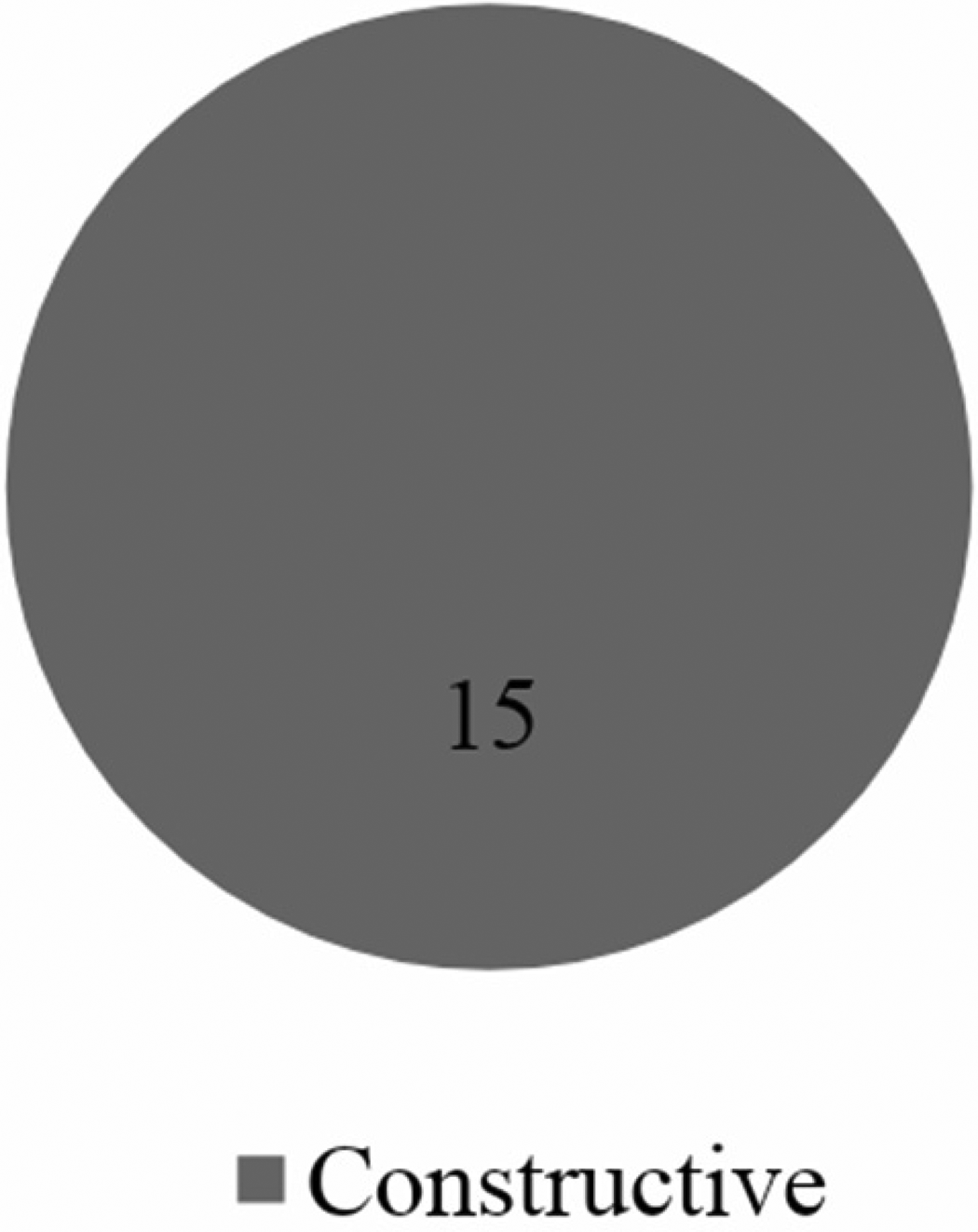
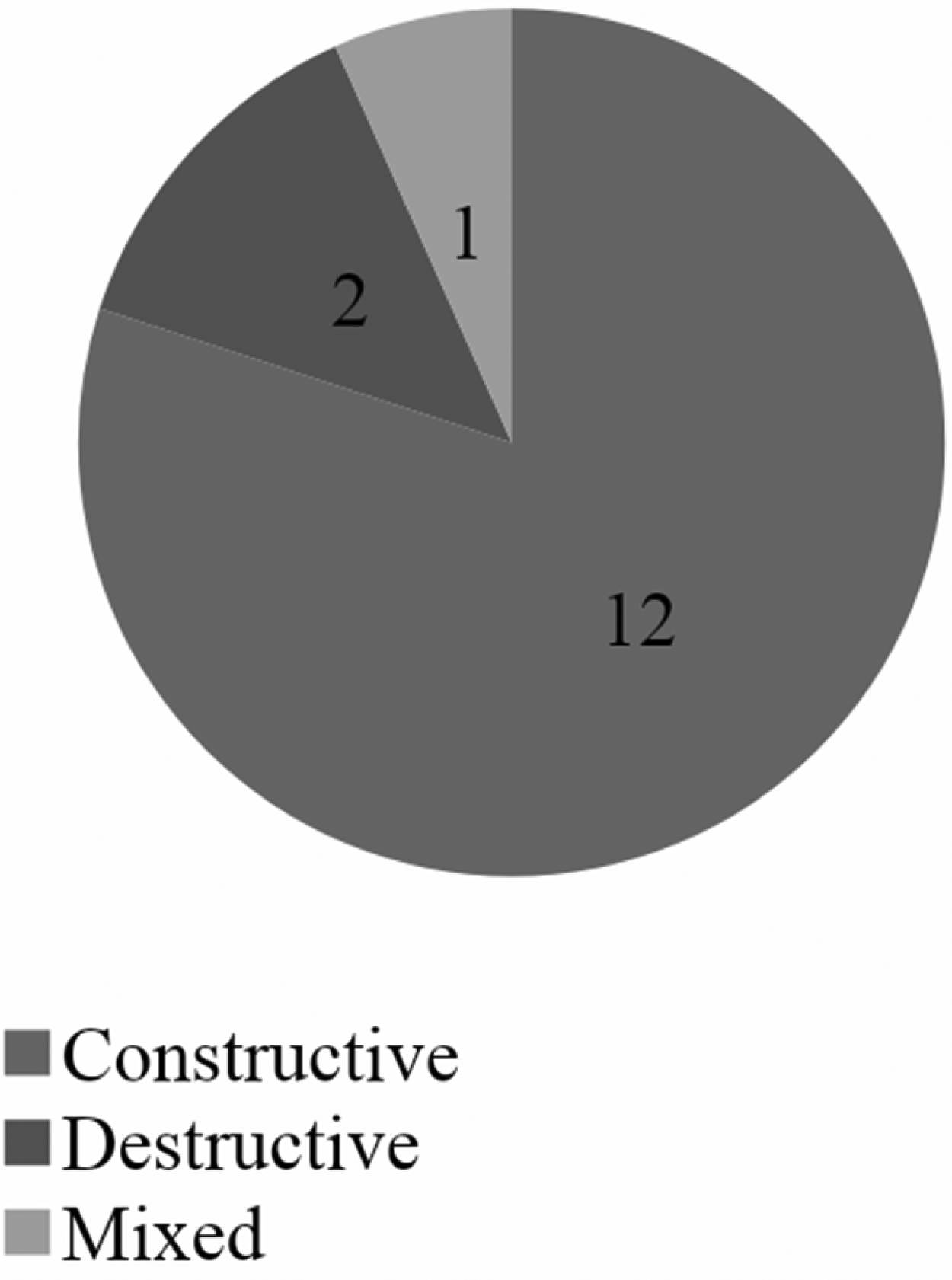
Figure 1 displays the positive II group's IIs classified as constructive, destructive, or mixed. Though these participants were induced to have a positive, constructive II during Phase 1 of the study, not all of their IIs were constructive. Twelve of the participants actually engaged in a constructive II, two participants had a destructive II, and one participant had a mixed II. Figure 2 shows the positive II group's actual interactions. Notably, all 15 participants in this group had constructive actual interactions.
Positive II Group's Imagined Interactions.
Positive II Group's Actual Interaction.
Figure 3 displays the constructive, destructive, or mixed nature of the negative II group's IIs. Though these participants were induced to have a negative II, there was some variation. Twelve participants from this group had destructive IIs, two had mixed IIs, and one had a constructive II. Nearly all of these participants’ actual interactions though, were constructive. As depicted in Figure 4, thirteen had constructive actual interactions, one participant had a destructive actual interaction, and one had a mixed actual interaction.
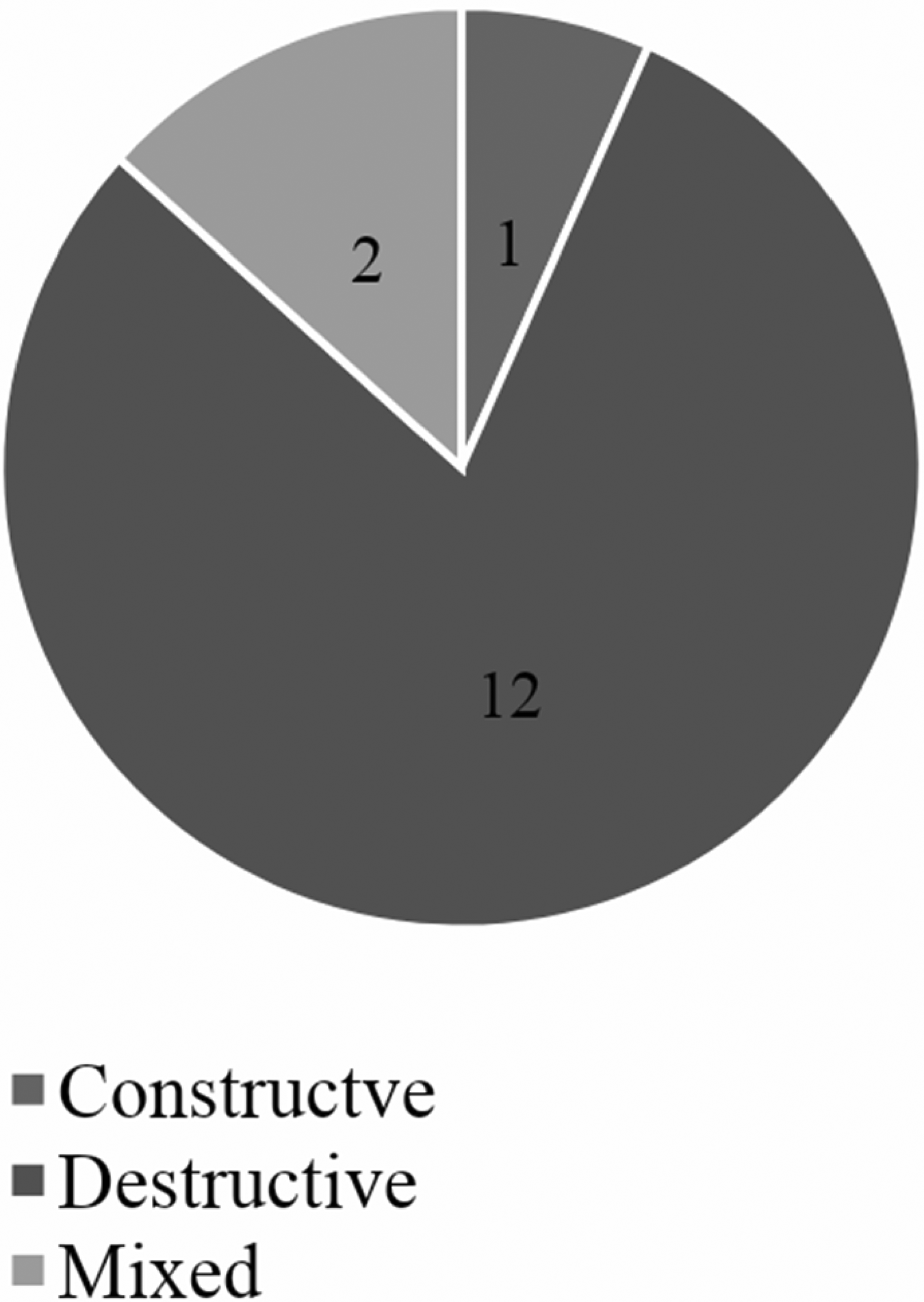
Negative II Group's Imagined Interactions.
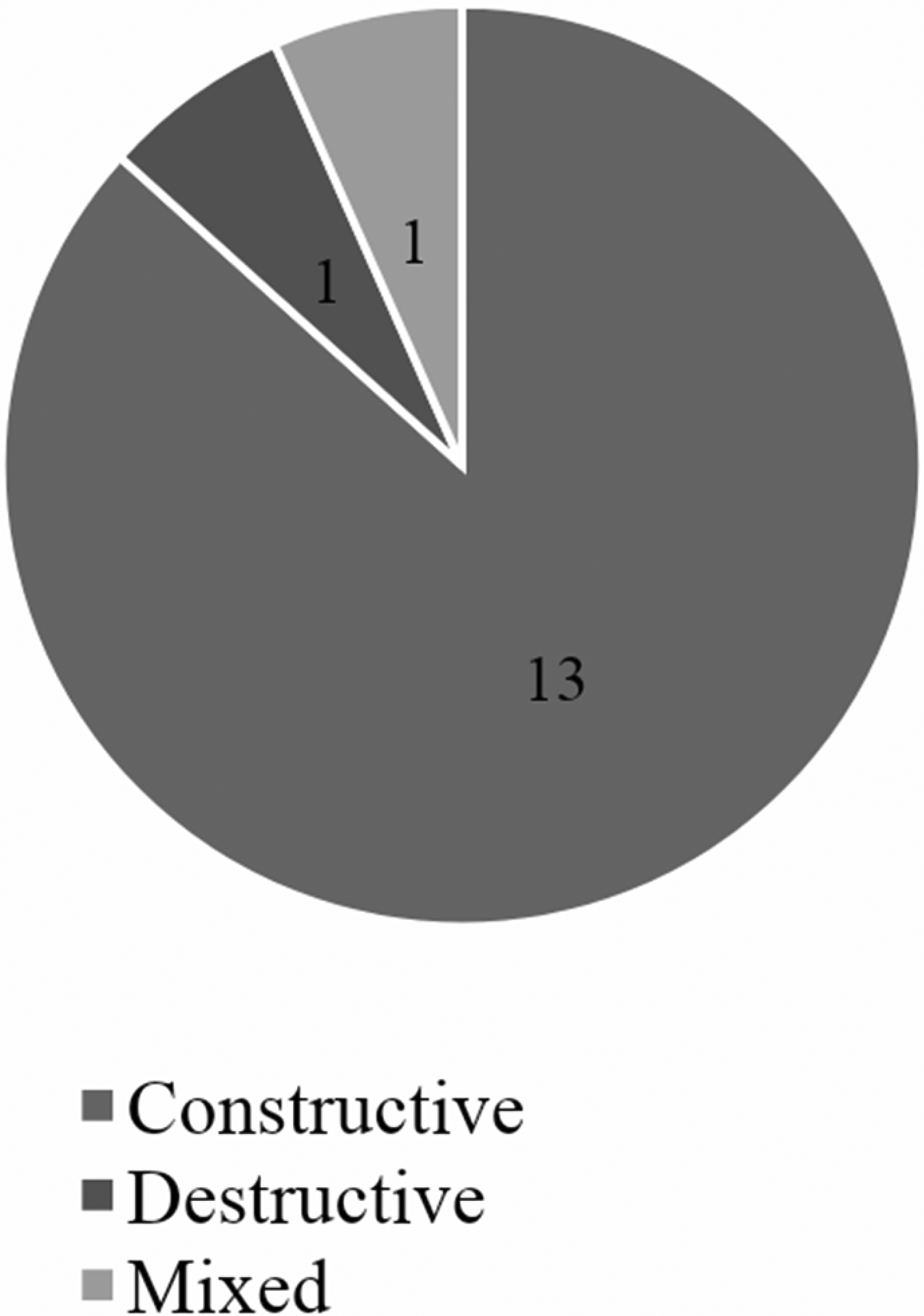
Negative II Group's Actual Interactions.
Figure 5 characterizes the control group's actual interactions as either constructive, destructive, or mixed. The control group did not participate in an II and instead imagined an outdoor scene. The majority, 12, of these participants had constructive actual interactions. Two control group members had destructive actual interactions, and one participant had a mixed actual interaction.
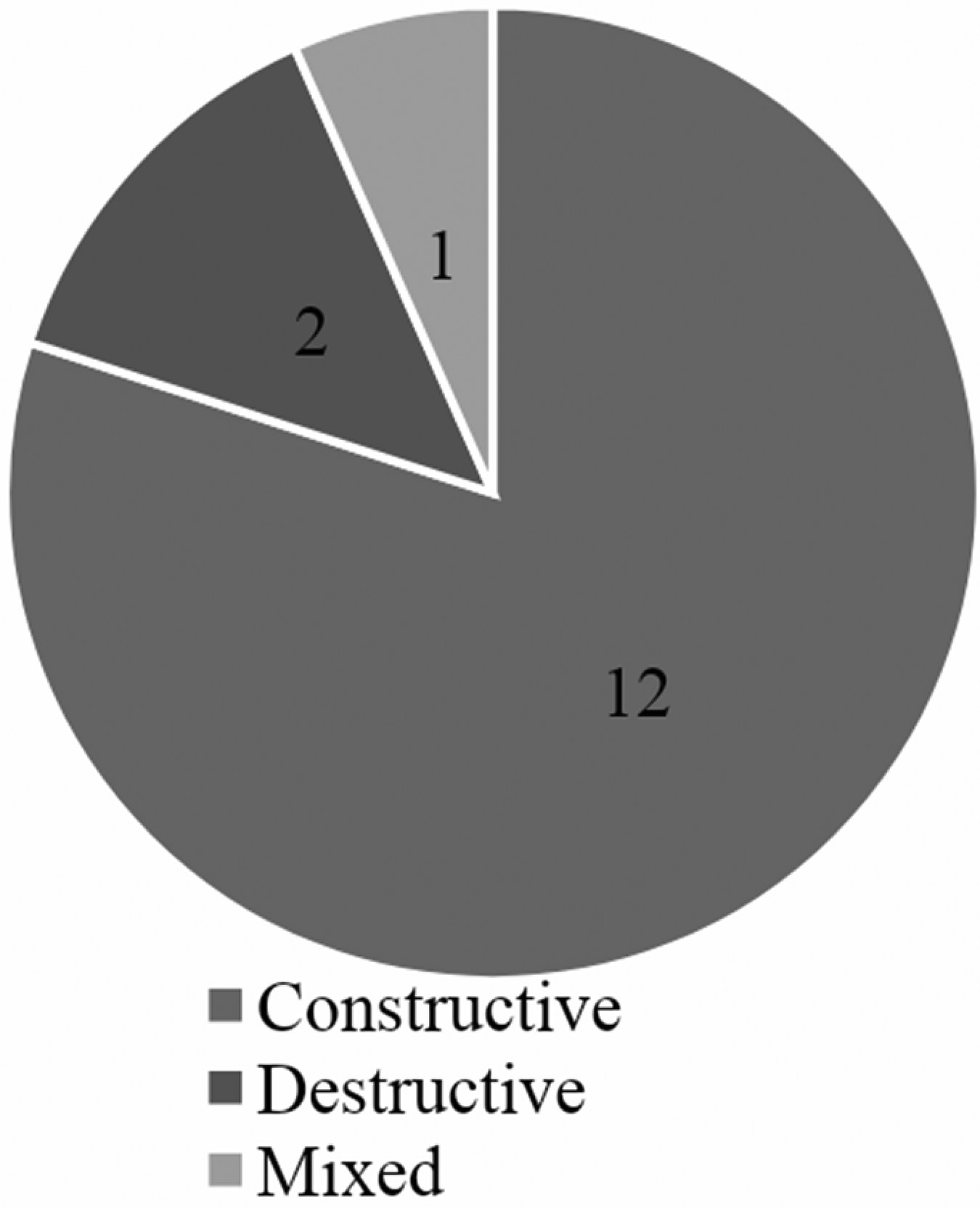
Control Group's Actual Interactions.
Discussion
This study hoped to find a new, simple process for enhancing constructive political conflict. Could America's cross-cutting political dialogue problem be solved with something as simple as a positive mindset? The results of this study indicate that the answer is still unclear. All participants who were induced to imagine a positive, constructive interaction had positive and constructive actual conflicts. The interesting thing here though is that nearly everyone who participated, whether induced to have a positive or negative II, ultimately engaged in a constructive actual conflict. Had the same not also been true for the control group, this study could conclude that any II, positive or negative, may lead to more constructive cross-cutting political conversations but, even the majority of the control group had positive interactions as well.
So, what does this mean? In simplest terms, one could conclude that engaging in cross-cutting political dialogue with strangers is actually not as bad as Americans make it out to be. The key word here is “strangers” because as previously mentioned, politics has had adverse effects on familial, romantic, and friendly relationships (Whitesides, 2017). This study suggests that cross-cutting conversations with strangers, rather than friends or families, have the tendency to be very positive and constructive. How then, is this information beneficial to those struggling with cross-cutting dialogue with their families, friends, and partners? Perhaps engaging in cross-cutting political dialogue with strangers is the first step. Doing so sheds light on why the “other side” thinks and feels the way they do. Many of this study's respondents, for example, expressed that they felt enlightened by their conversation partner who held opposing views. Engaging in cross-cutting conversations with strangers then may function as great practice for those hoping to work up to such conversations with their loved ones.
Gained Perspective
Many participants expressed a feeling of gained perspective or insight. These participants made comments such as, “I gained a little more perspective into why they think the way they think” (31-P), “I gained because I was able to understand a different side of the issue” (37-P), and “I had gained quite a bit [of] information about their viewpoint” (08-N). After her II, one participant from the positive II group explained: My partner and I felt very satisfied because we allowed each other to see one another's point of view. It was like learning about a new religion or a new sport. I may play my own sport or have my own religion, but it was nice to know more about what someone else is a part of just for added knowledge. (28-P)
Eleven of the 15 participants induced to have a positive II expressed that through their II, they were able to see a new perspective, gain insight, or learn something new. Only two of the 15 participants induced to have a negative II expressed similar thoughts. It appears then, that engaging in a positive II is more likely to help with perspective-taking.
Ten of the 11 positive II group members who expressed a sense of gained perspective during their II expressed similar sentiments after their actual interactions as well. Though negative IIs did not lead to perspective-taking during the II, seven members of the negative II group expressed a sense of gained perspective after their actual interaction. Four control group members also indicated that they gained insight or learned something new from their actual interaction. So, those who participated in an II, regardless of their induced state, were more likely to express sentiments of perspective-taking after their actual interactions than the control group.
Though positive IIs do not directly lead to constructive conflict, they do certainly appear to be related to perspective-taking and thus, the practice of taking an other-orientation. As previously mentioned, other-orientation is defined as being “aware of the thoughts, needs, experiences, personality, emotions, motives, desires, culture, and goals of your communication partners while still maintaining your own integrity” (Beebe et al., 2016, p. 398). Both Deutsch (1994a) and Korsgaard et al. (2004) agree that taking an other-orientation positively impacts conflict resolution. Actively imagining a positive interaction gives people the opportunity to take an other-orientation, which may lead to constructive actual conflict. This perspective-taking function of IIs then may be the key to enhancing cross-cutting political conflict.
Defense of One's Values
Several participants expressed that they felt satisfaction or joy from being able to defend their beliefs and viewpoints. A participant from the negative II group, for example, wrote: “I felt that I had gained personally in the fact of standing up for my beliefs” (11-N). Other participants expressed that they enjoyed “being able to communicate and share my own personal opinions” (03-C) and “felt as if I had gained in the sense that I’ve spoken up about something which I feel very passionately about” (13-P).
Over half, eight participants, of the negative II group expressed some sort of satisfaction with defending their values and beliefs during either their imagined or actual interaction. Only two participants from the positive II group and one from the control group expressed similar experiences. One can conclude then, that individuals primed to engage in a negative II are more likely to find satisfaction in defending their values. Negative IIs may be priming individuals to more vehemently guard their views, perhaps through the self-understanding function of IIs. Defending one's views is not necessarily a bad thing; most participants who expressed these sentiments did not do so maliciously. Instead, I deduce that negative cross-cutting political IIs encourage a deeper understanding of one's beliefs, which Mutz (2006) explains is a benefit of cross-cutting discourse.
IIs Opposite of Induced State
Eight participants, over half of the group, induced to have a positive II indicated that even though they were instructed to imagine a positive interaction, their mind wandered towards thoughts of a negative conversation. One participant induced to have a positive II, for example, explained that “It was easier to imagine a hostile conversation because that's what can be readily found on the internet” (13-P). Another member of the positive II group explained why her mind wandered towards thoughts of a negative conversation as follows: “today there is a lot less conversation and a lot more arguing. People want to state their beliefs and then throw yours down” (40-P). A third participant from the positive II group wrote: “Yes my mind immediately thought of a negative conversation because it is depicted that communicating in that fashion is the only way to discuss opposing views” (46-P).
This finding partially supports Theorem 3 of II conflict linkage theory which states, “when an individual attempts to purposely create positive IIs (i.e., as therapy for a poor marriage), negative intrusive IIs will frequently occur, in many cases with effects that undermine the therapy or positive intent” (Honeycutt, 2003b, p. 76). Over half of the participants in this study experienced negative intrusive IIs when purposely attempting to create positive IIs. Honeycutt (2003b) contends that negative IIs are “recalled more readily and have higher informational value” which may explain why intrusive negative IIs occur. The negative intrusive thoughts though did not undermine the positive intent of the IIs because all of the participants induced to have a positive II ultimately had a positive actual interaction.
Alternatively, only three of the participants induced to have a negative II indicated that their thoughts wandered toward a positive conversation. Instead, several members of the negative II group expressed how easy it was to automatically imagine a negative conversation with someone they disagreed with politically. One participant induced to have a negative II expressed that “My mind went to negative thoughts immediately” (02-N). Another wrote, “Negative conversations are also way easier to imagine since I see them more often due to their explosive nature” (05-N).
The White, Male “Other”
When asked to describe what their II partner looked like, over half, eight members, of the positive II group did not mention race. Two African American females imagined African American girls, a Caucasian female imagined a “white male,” and an African American female described a “white male.” In the negative II group though, over half, eight, participants did mention race and all eight mentions were “white.” These mentions came from Caucasians, African-Americans, and a Hispanic participant. Of those eight mentions, six participants specified white males. So, a decent portion of the participants, when asked to imagine a negative political conversation, envisioned a white male.
While these numbers do not necessarily indicate extreme differences in how people imagine race in their IIs, the results are interesting. The fact that nearly half of the participants in the negative II group imagined a “white male” may have stimulating implications for those who study co-cultural theory or other similar theories. Future studies should consider the role of race in IIs.
Limitations
There are several limitations to this study that must be noted. First, there was no way to control for the participants having additional IIs on their own in between their imagined and actual interactions. In the event that a participant was, for example, induced to have a positive II but then they had a negative II on their way to their actual interaction, their data would be skewed. Further, this study could not answer its first research question with the data collected so future studies should continue to investigate whether positive IIs can lead to constructive actual conflicts. Additionally, the participants were all very close in age, so the results may not extend to other age groups.
Several limitations are directly related to the use of confederates in this study. The fact that 11 confederates were used is also a limitation. In an ideal situation, far fewer confederates would be used to maintain consistency and enhance reliability; that was not practical for this Master's thesis though. The confederate training sought to combat this issue by providing each confederate with thorough, identical information. Additionally, the confederates varied a bit in age. While most confederates were very close in age to the participants, others were a bit older. Speaking with an older confederate may have led some participants to perceive that their conversation partner was an authority figure, thus causing them to behave differently than they normally would.
There were also environmental limitations. Ideally, all actual interactions would have taken place in a classroom rather than having some take place in an office. Like speaking with an older confederate, being in an office may have led to false perceptions of authority. Lastly, nearly all members of the control group imagined peaceful and enjoyable outdoor scenes. Having the control group imagine an outdoor scene may have inadvertently put the control group members in a positive mindset, which may have, in turn, had positive effects on their actual interactions.
Suggestions for Future Research
Future research should delve deeper into the ways in which IIs foster other-orientation. This exploration could benefit from the incorporation of video recording to capture participants’ real interactions, enabling the retrieval of comprehensive verbal and nonverbal data for valuable insights. These findings also hold intriguing implications for conflict management studies, warranting future investigations, potentially with a quantitative approach.
Additionally, forthcoming studies could involve assessing the confederates’ perceptions of their actual interactions, facilitating a comparison with their conversation partners. To enhance the study's robustness, it would be valuable to replicate it with fewer confederates, employ an alternative prompt for the control group, and include participants of varying ages. Given that the qualitative approach employed in this study couldn't fully address the first research question, there's a compelling need for further examination of the impact of positive IIs on constructive conflict using quantitative methods.
One particularly intriguing avenue for follow-up research could involve recreating the methodology but having participants engage in their actual interactions through online chat applications. This adjustment might yield markedly different results, as participants may feel more emboldened to engage in destructive conflicts when shielded by a screen. As one participant from the negative II group noted, imagining a conversation on Facebook, a platform notorious for divisive political discourse, led to a less cooperative outcome compared to an in-person scenario. Thus, a shift to online interactions could potentially lead to more reports of destructive conflicts among participants.
Footnotes
Declaration of Conflicting Interests
The authors declared no potential conflicts of interest with respect to the research, authorship, and/or publication of this article.
Funding
The authors received no financial support for the research, authorship, and/or publication of this article.
