



Abstract
Human beings have relished the idea of possessing supernatural/superhuman powers for millennia. However, do some people desire such powers more than others based on specific individual differences and characteristics? We examined how individual differences in imaginative involvement (fantasy proneness, absorption) and magical beliefs (superstitiousness and religiousness) uniquely related to desire for 12 supernatural powers (final N = 143); participants also rated the supernaturalness of each power and how much they believed humans possess/will possess each power. These individual differences, as predicted, consistently correlated with the desire for supernatural powers and the belief that humans may possess these powers in the future. After controlling for sci-fi and fantasy narrative consumption, only absorption and superstitiousness (chance subscale) uniquely related to desire for supernatural powers; and only absorption uniquely predicted the belief that humans do/would possess these powers. Ultimately, there are important individual differences in desire and perception of supernatural powers.
Keywords
For millennia human beings have relished the possibility of possessing supernatural/superhuman powers. By supernatural, we mean abilities that violate natural laws or present a break in reality as put forward by Newtonian physics (Cohen et al., 2011; Solomon et al., 2010; Webster & Saucier, 2011; Webster et al., 2023). Boyer (2001) claimed that most cultures incorporate supernatural entities or powers, whether that be Gods who can shoot lightning or sons of master craftsman who create wings from feathers and beeswax to fly. Indeed, whether in writings or visual art, fantasies of flight are very common in both Western (e.g., US, Europe) and non-Western (e.g., China, Africa, Native America) traditions (Solomon et al., 2010). But supernatural abilities extend beyond flying, to include things like psi/precognition, mindreading, teleportation, or psychokinesis. The development of such supernatural beliefs does not seem inherently tied to cultural systems, though; such beliefs may develop independently of culture influence because of shared, fundamental experiential experiences (Hufford, 1995).
Today, people voraciously consume media that contain characters imbued with supernatural abilities, particularly fantasy narratives, whether that be via books, games (online, video, tabletop), movies/TV, or artwork. However, we contend that there are important individual differences in this voraciousness. Specifically, the current study examined how individual differences in imaginative involvement (fantasy proneness and absorption) and magical beliefs (superstitiousness and religiousness) uniquely related to desire for 12 supernatural powers. Participants also reported how much they believed that humans possess or will possess said powers and how much they believed that said powers are, in fact, supernatural.
The Psychology of Fantasy and Supernatural Powers
If it is actually impossible for humans to fly or walk through walls, at least based upon our understanding of Western science, why create media or daydream about possessing such powers? Webster and colleagues (Webster & Saucier, 2011; Webster et al., 2023) have theorized on the psychology of fantasy and its role in human thought and behavior. Fantasy is a specific type of imaginative involvement that contains three elements: first, a willing suspension of disbelief (e.g., visualizing oneself with a supernatural ability) for a short amount of time which, importantly, does not indicate a psychological break from established social reality, but rather a form of playful engagement with imagination; second, in the moment, this break is “taken seriously, neither laughed at or explained away” (Tolkien, 1983, p. 114); and, third, that this break in reality—like other emotion-focused coping strategies—offers some ameliorative benefit (Webster & Saucier, 2011; Webster et al., 2023).
For example, in applying terror management theory (TMT), Cohen et al. (2011; see also Koole et al., 2013; Solomon et al., 2010) demonstrated an existential need for fantasy. TMT states that humans are uniquely aware of their impending deaths and must manage this “terror” via adaptive psychological mechanisms (for a review, see Pyszczynski et al., 2015). These mechanisms generally defy death either symbolically (lasting testaments to one's life on Earth, such as monuments or symphonies) or literally (ways in which our physical body defies or transcends death, usually typified by the existence of afterlives). Supernatural abilities, such as flying, may help us transcend our bodily limitations and help buffer death anxiety, that is, serve as a terror management mechanism (Cohen et al., 2011; Solomon et al., 2010).
Cohen et al. (2011) empirically demonstrated that after mortality salience (i.e., thinking about one's death, a common manipulation in TMT research), participants reported greater desire to fly—but not greater desire for mindreading or walking through matter. Moreover, those who engaged in a guided flight fantasy (vs. a “grounded” condition) exhibited decreased death-thought accessibility and less defensive reactions (e.g., less support for charismatic, aggressive leaders) following mortality salience. Further, flying fantasies increased feelings of freedom from bodily limits, which appeared to explain the decreased terror management responses.
Our current study more comprehensively examined individual differences in people's desire for and perception of different supernatural powers. As Cohen et al. (2011) recognized, flying is not the only supernatural ability, as they also examined desire for mindreading and walking through matter in one of their four experiments. They argued that mindreading and walking through walls did not convey the same feelings from bodily limits and death transcendence. However, we reason that there are other supernatural abilities that directly help people stave off death, whether that be enhanced healing abilities (e.g., Wolverine from X-Men) or even unnaturally long lives (e.g., the Elves in Lord of the Rings). Indirectly, time travel or precognitive abilities may also provide enhanced protection against death by being able to change harmful events in past/future or presage harm, respectively (Koole et al., 2013).
Ultimately, in our current study participants rated their desire for 12 supernatural powers (see Table 1). Perhaps those powers that help transcend our bodily limits may be rated as more desirable; thus, as part of our analysis strategy, we conducted an exploratory factor analysis on the 12 desire ratings to assess whether they would hold together into one grouping or whether there are subgroups. Accordingly, for each superpower, participants also rated how supernatural each power is—that is, how much each power “defies the natural laws of the universe and our natural human physical abilities” (i.e., supernaturalness). We would expect that participants would find some powers to be more supernatural than others; and, as supernaturalness increases, desire for that power would also increase. Lastly, participants also rated how much they believed humans have possessed/currently possess or will possess in the future each superpower. We also conducted exploratory factor analyses on these two DVs.
Descriptive Statistics for the 12 Supernatural Powers.
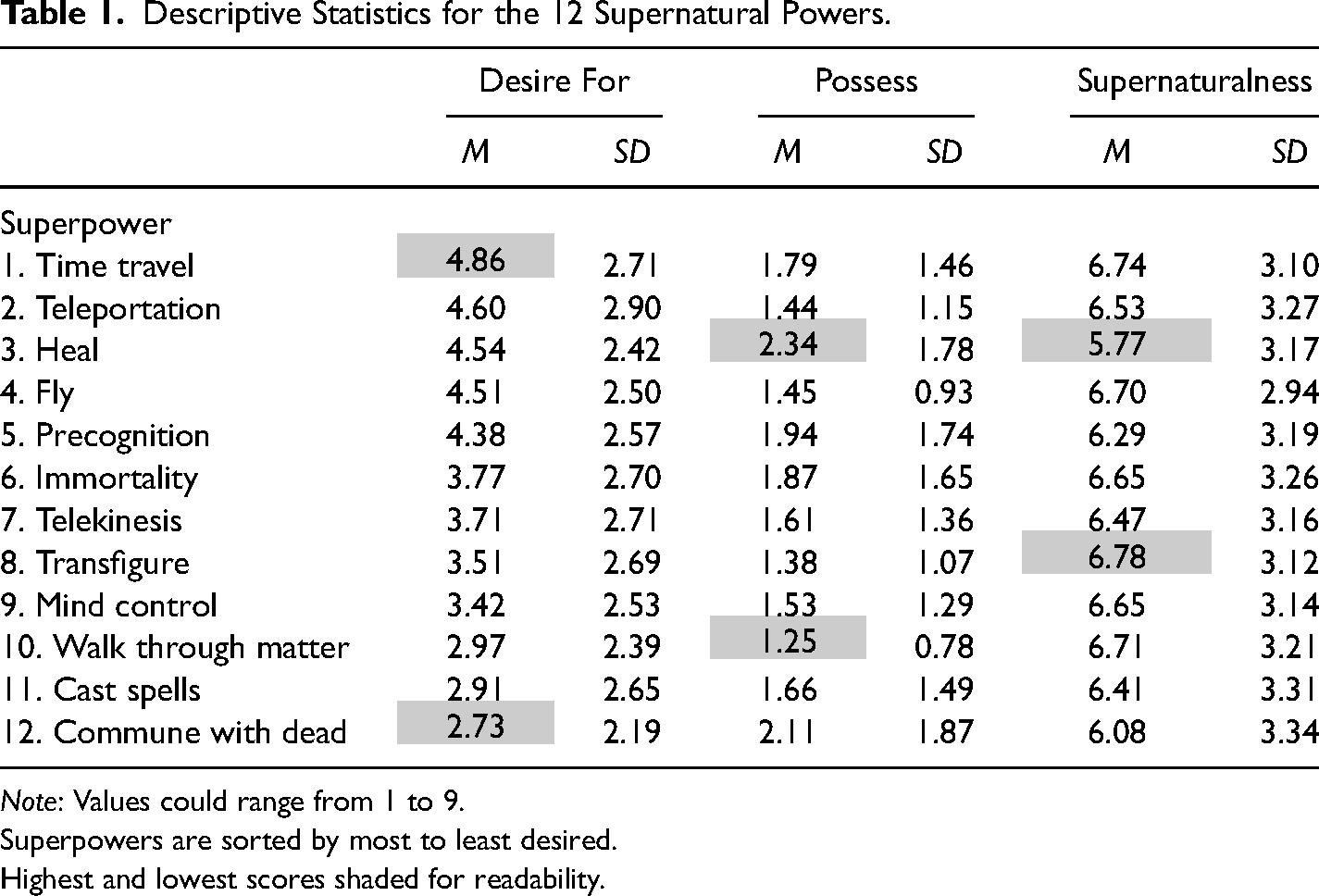
Note: Values could range from 1 to 9.
Superpowers are sorted by most to least desired.
Highest and lowest scores shaded for readability.
Cohen et al.'s (2011) experiments, while theoretically compelling, also did not examine potential individual differences. Webster and Saucier (2011; see also Webster et al., 2023) reasoned that not all people are as fascinated with fantasy and supernatural abilities—that is, there are important individual differences in how people experience imaginative involvement.
Individual Differences in Imaginative Involvement
Webster and Saucier (2011) examined how two key individual differences—fantasy proneness and absorption—predicted cognitive (image vividness) and emotional (engagement and positive affect) responses while completing guided fantasy and non-fantasy visualization tasks (Cohen et al., 2011). Fantasy proneness, originally conceptualized by Wilson and Barber (1983), can be described as “an extensive and deep involvement in fantasy” (Rhue & Lynn, 1987, p. 121), including frequent/intense fantasizing and daydreaming, a history of childhood make believe, and extrasensory experiences (see Merckelbach et al., 2022, for a recent meta-analysis). Tellegen and Atkinson (1974) initially defined absorption as “a disposition for having episodes of ‘total’ attention that fully engage one's representational (i.e., perceptual, enactive, imaginative, and ideational) resources” (p. 268); Roche and McConkey (1990) likewise describe absorption as “a characteristic of the individual that involves openness to emotional and cognitive alterations across a variety of situations” (p. 92). Psychometrically, absorption is measured by six highly intercorrelated second-order factors: responsiveness to engaging stimuli, synesthesia, enhanced cognition, dissociative involvement, vivid reminiscence, and enhanced awareness (Tellegen & Atkinson, 1974).
Webster and Saucier (2011) found that fantasy proneness—specifically, the fantasy intensity subscale—best predicted image vividness; absorption best predicted greater engagement during the visualization task, which was partially mediated by increased positive mood. These relationships held regardless of whether participants had a picture as a visualization aid and whether the visualization task included a fantastical component—that is, having participants visualize themselves flying (vs. being “grounded”) in the guided narrative. Interestingly, people scoring higher fantasy proneness or absorption reported much stronger feelings of “flying” in the grounded condition (and these feelings were also moderately related to engagement); this suggests that they invoked supernatural ability even without instruction to do so, which may explain why the relationships between fantasy intensity/absorption and responses to the visualization task were not stronger in the flying fantasy condition.
Further, other research has shown that absorption and fantasy proneness both related to greater likelihood of having spiritual or out-of-body experiences, in which there is a subjective separation of self from the body (Gow et al., 2004; Lifshitz et al., 2019; Luhrmann et al., 2021; Parra, 2009). Such experiences may engender a sense of self-transcendence, awe, or wonder and influence humans’ tendencies to think about ideas about a soul, an afterlife, and potentially abilities such as flying.
Given their strong association to imaginative involvement, we reasoned that both absorption and fantasy proneness would positively correlate with desire for supernatural powers. The other dimensions of fantasy proneness—childhood make believe and extra-sensory perceptions—might even come into play more when specifically asking participants about superpowers. Childhood make-believe often includes actively pretending to have superpowers (e.g., putting on your parent's bathrobe and pretending to do magic with a wand); and, extrasensory perception could also be perceived akin to a superpower, too. However, perhaps absorption would better predict desire for supernatural powers. Following Webster and Saucier's (2011) results, perhaps people higher in fantasy proneness can better picture themselves using these superpowers, but people higher in absorption have a stronger emotional pull to them.
We also reasoned that fantasy proneness and absorption would relate to perceptions that humans have or will possess these 12 superpowers. Previous research has established that both fantasy proneness (e.g., Dasse et al., 2015; Irwin, 1990) and absorption (e.g., Glicksohn & Barret, 2003; Nadon & Kihlstrom, 1987) correlated with belief in paranormal beliefs/experiences, including psychokinesis and precognition—two superhuman abilities we included among our 12 powers. If people who report greater fantasy proneness or absorption believe more in these “superhuman” abilities, we assume that they would also believe that humans have or will possess other superhuman abilities.
Individual Differences in Magical Beliefs
Subbotsky (2010) differentiated magical beliefs and magical thinking: “In contrast to magical thinking, which confines magical characters and events to the domain of imagination, magical beliefs imply that the magical characters or events exist in the physical world” (p. 7). Superstition is more likely a type of magical belief, as superstitious people more likely believe superstition is a real force in the world. Imaginative involvement is more akin to magical thinking (e.g., daydreaming about flying), although individuals who have greater imaginative involvement may also more greatly endorse magical beliefs (e.g., such as believing that wishing upon a star will indeed make dreams come true). Thus, we expected modest correlations between fantasy proneness/absorption and superstitiousness.
Ultimately, superstitiousness may be perceived as a quasi-superpower in and of itself. Indeed, Subbotsky (2010) would likely argue that superstitions and supernatural powers are both examples of magical beliefs; and, “Since notions of physical space, time, causality, and object permanence are interdependent, violation of any of these tacitly implies violation of all the others” (p. 5). If carrying a good luck charm actually changes their lives for the better, people may feel like they are tapping into a mysterious power that is beyond the natural laws of the universe and humans’ natural physical abilities as put forward by Newtonian physics. Such individuals would relish thinking about possessing other superpowers, even if they may not quite believe they could possess such powers (vs. the power of superstition, which they believe may actually “work” in everyday life). Nonetheless, belief in superstition is also part of Tobacyk's (2004) paranormal belief scale, which includes subscales about psi/precognition and psychokinesis; thus, we assume those who more strongly believe in superstition will also more readily believe that humans have/will possess other superhuman abilities.
Individuals who are more spiritual in nature and not strongly tied to organized religion tend to more strongly endorse paranormal beliefs (Baker et al., 2016; Baker & Draper, 2010). Indeed, religiously dogmatic people may feel that supernatural powers are only for supernatural entities to possess; human beings possessing such powers may be seen as unseemly, going against the natural order of the universe as dictated by their faith. Dragojlovic and Einsiedel (2013) did find that people who believe in God more greatly opposed genetic manipulation or the creation of new organisms because it interfered with the natural order and divine creation. Thus, more religious people may in fact find supernatural powers as less desirable. Nonetheless, McClenon's (1997) ritual healing theory highlights how people who have had vivid, moving religious or spiritual experiences often go to become spiritual healers themselves, using supernatural powers to reportedly heal people who could not be helped by modern, Western medicine. However, such healers may not have specifically desired such powers a priori but fulfilled a calling to be instruments of a higher power; or, they would argue that their powers are being channeled through a higher power.
In sum, the current study's primary aim was to examine the effects of individual differences in imaginative involvement (fantasy proneness and absorption) and magical beliefs (superstitiousness and religiousness) on desiring and perceiving 12 supernatural powers. We conducted exploratory factor analyses to assess whether the 12 superpowers would hold together as a single group or whether there would be subgroups. Then, we tested our main hypotheses: H1: Fantasy proneness, absorption, and superstitiousness would be positively related to desire for supernatural powers and perceptions of whether humans possess/will possess these powers.
H2: Religious belief would be negatively related to desire for supernatural powers.
We did not make any a priori predictions about how each individual difference would correlate with perceived supernaturalness. After examining the bivariate correlations, we conducted hierarchical regression analyses to assess how each of the four individual differences uniquely explained variance in each of the three DVs. Importantly, we measured and controlled for general consumption of both fantasy and sci-fi media, which we reasoned would be associated with both the individual difference measures and desire for supernatural powers.
Method
Participants and Procedure
Kansas State University's IRB approved all procedures and measures. The final sample of 143 (61 men, 81 women, 1 did not report 1 ; Mage = 19.20; 76% White) Midwestern university undergraduates completed the measures below, via pencil-and-paper, in classrooms for research credit. We eliminated 34 participants for missing data (> 5%). The working dataset on OSF contains all scale items: https://osf.io/shjq2/?view_only = df1885fd763a4d5f9b4d3e58b6ac056a.
We collected as much data as we could given the limits of our general psychology pool. The smallest effect size that we can detect with 80% power is r = 0.23 (https://sample-size.net/correlation-sample-size/), which is just above the threshold for a moderate effect size according to Cohen. Thus, if there are any meaningful (small-to-moderate or above) effects, we should be able to detect them with our sample size.
Materials
Participants responded to all self-report items on 1 = “Strongly Disagree” to 9 = “Strongly Agree” scales. Responses to items were averaged together to create mean composite scores when applicable. Participants completed the materials in the order presented below.
Results
We conducted all analyses using SPSS v28. All datasets and syntax are available at https://osf.io/shjq2/?view_only = df1885fd763a4d5f9b4d3e58b6ac056a.
Supernatural Power Ratings
The supernaturalness scores were all well above the middle point, with most mean scores falling in between 6 and 7, indicating that participants strongly perceived these powers as being, in fact, supernatural. The ability scores were all toward the lower end of the scale, with most in between 1 and 2, indicating that participants did not strongly believe that we do/will possess said powers. 3
Overall, the EFA results suggest that the ratings for each DV hold together well; thus, we aggregated ratings across all 12 supernatural powers, that is, creating one desire mean score (α = .95), one supernaturalness mean score (α = .97), and one ability-to-possess superpower score (α = .91). The internal consistency of each aggregated score was excellent, which is unsurprising given the EFA results.
Bivariate Correlations
First, desire for supernatural powers was positively and moderately correlated with perceived supernaturalness and ability scores (see Table 2). That is, as participants more greatly desired supernatural powers, the more they believed these powers were in fact supernatural and the more they believed that humans do/would possess these powers. Perceived supernaturalness and ability scores were not significantly correlated. These intercorrelations indicate these three DVs should be treated as independent outcomes.
Descriptive Statistics and Bivariate Correlations Between All Variables of Interest.
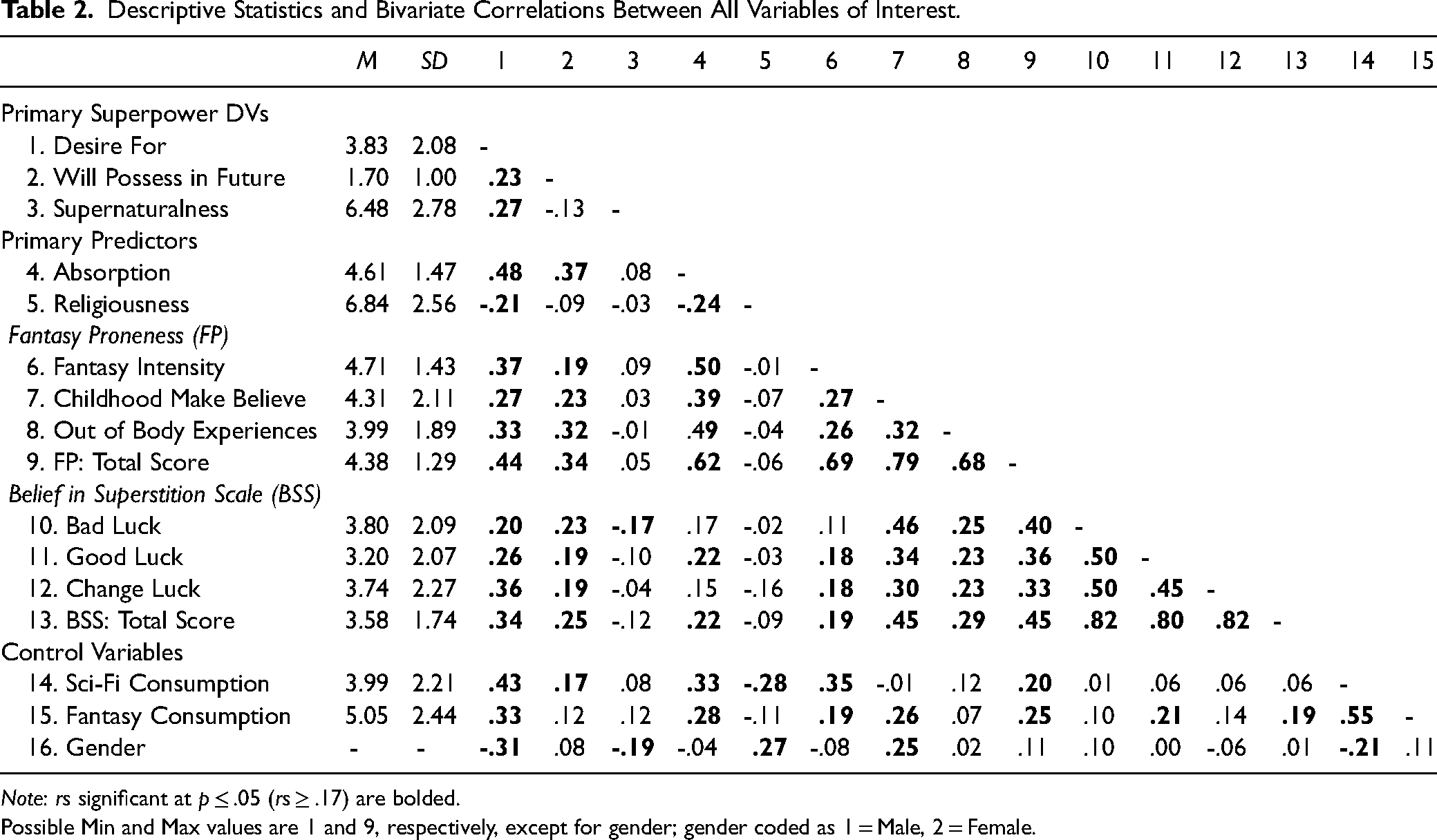
Note: rs significant at p ≤ .05 (rs ≥ .17) are bolded.
Possible Min and Max values are 1 and 9, respectively, except for gender; gender coded as 1 = Male, 2 = Female.
Second, as predicted, all four primary predictors modestly to strongly correlated with desire for supernatural powers. Absorption, fantasy proneness, and BSS scales all positively correlated with desire for supernatural powers; that is, as participants reported greater absorption, fantasy proneness, or superstitiousness, they reported greater desire for supernatural powers. Religiousness correlated negatively with desire, so more religious participants reported less desire for supernatural powers. Also, fantasy and sci-fi consumption correlated with desire for superpowers; as participants reported greater consumption of sci-fi or fantasy narratives, they reported greater desire. Lastly, men reported greater desire for superpowers.
Third, almost all the predictors correlated with perceived ability scores, except religiousness. Absorption, fantasy proneness, and BSS scales all positively correlated with ability scores; that is, as participants reported greater absorption, fantasy proneness, or superstitiousness, they more strongly believed that humans do/would possess these powers. Also, sci-fi consumption positively correlated with ability scores; as participants reported greater consumption of sci-fi narratives, they more strongly believed (albeit modestly) that humans do/would possess these powers.
Lastly, only two variables correlated with perceived supernaturalness: BSS: Bad Luck (negatively) and gender, although these correlations were quite small. That is, both participants who reported greater belief in bad luck and women reported slightly lower perceived supernaturalness.
Multiple Regressions
We then conducted three hierarchical multiple regression analyses assessing how the individual difference predictors (if they correlated with the DV) uniquely explained variation in each of three DVs after controlling for gender, consumption of sci-fi media, and consumption of fantasy media (if correlated with the DV). For all multiple regressions, we assessed problems with outliers using Cook's D and multicollinearity using VIF/tolerance values 4 . These values did not indicate any outliers or multicollinearity.
Regression Results Predicting Desire for Supernatural Powers.
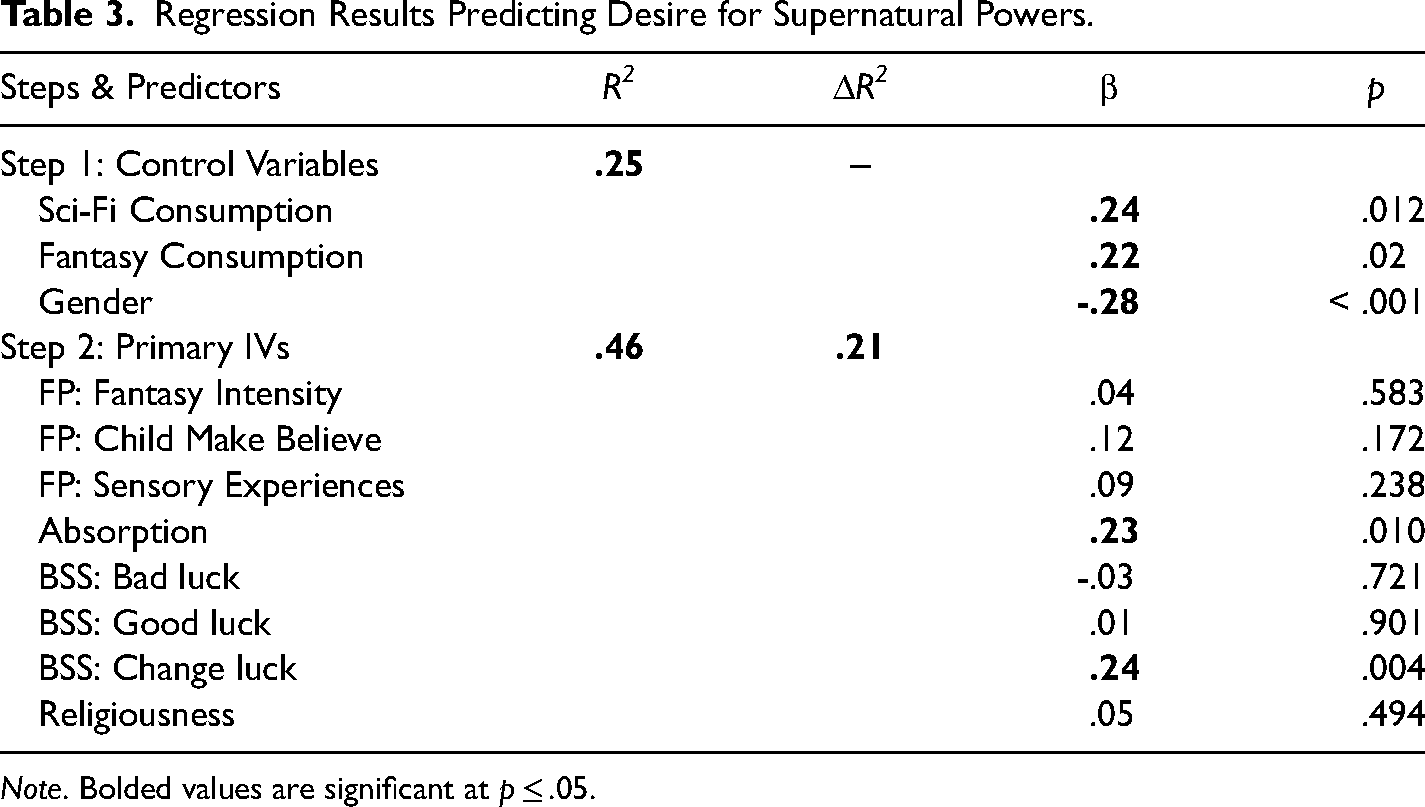
Note. Bolded values are significant at p ≤ .05.
Regression Results Predicting Belief that Humans Will Possess Superpowers in Future.
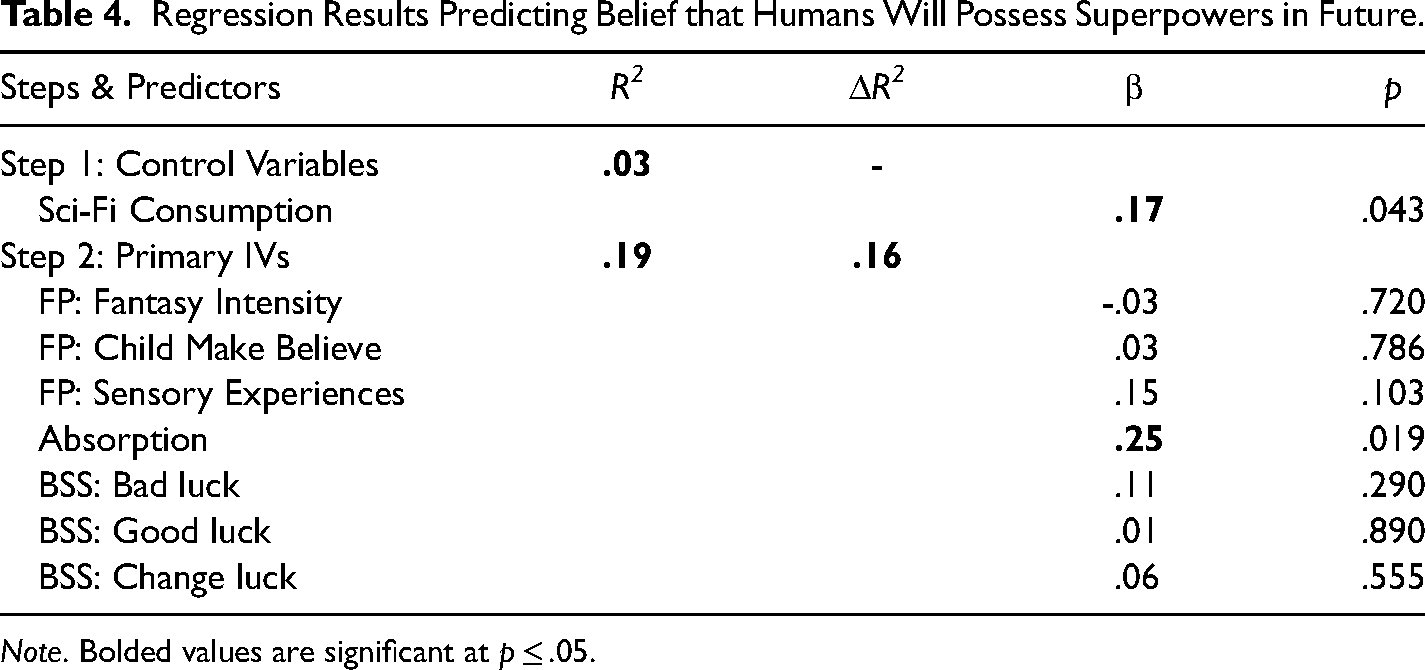
Note. Bolded values are significant at p ≤ .05.
Discussion
In sum, our current study examined the effects of individual differences in imaginative involvement (fantasy proneness, absorption) and magical beliefs (superstitiousness and religiousness) on desiring and perceiving 12 supernatural powers after controlling for consumption of both fantasy/sci-fi media. Much research has examined individual differences in beliefs about supernatural abilities, especially psi and psychokinesis, via paranormal belief scales; but, we could not find any research examining individual differences in desire to have such superpowers. The current study is advantageous in measuring desire for a larger set of supernatural powers and in concurrently assessing the predictive utility of two major types of individual differences: imaginative involvement and magical beliefs.
First, desire for supernatural powers was moderately and positively correlated with both perceived supernaturalness and perceived ability to possess each superpower. As people desired superhuman powers more, they perceived such powers to be more supernatural and more in reach of humans possessing them. Second, as we predicted, absorption, fantasy proneness, and superstitiousness positively correlated with desire for superpowers, while religiousness negatively correlated. Multivariate analyses then showed that only absorption and superstitiousness (change luck subscale only) uniquely explained variability in desire scores. That is, participants who reported greater absorption and belief that luck can be changed more greatly desired supernatural powers.
When considering the effects of absorption and fantasy proneness (which were highly intercorrelated themselves) on desire for supernatural powers, we did propose that absorption may better predict desire given that individuals with higher absorption may feel a stronger emotional pull to having superpowers, while those higher in fantasy proneness could better picture themselves with such powers (c.f. Webster & Saucier, 2011). The pull of supernatural powers seems strong, as absorption was also the only individual difference to uniquely explain variability in perceptions of how much humans possess/will possess the superpowers; people who reported greater absorption more greatly believed that humans possess or will possess supernatural powers.
Perhaps fantasy proneness did not “win” out over absorption because imaginative involvement is not always a positive experience for those higher in fantasy proneness. There is substantial research showing that fantasy proneness is related to dissociative experiences and schiztopy (e.g., unwanted hallucinations, perceptual aberrations, paranoia; Merckelbach et al., 2022) as well as chronic negative affect (depression, anxiety). Meanwhile, absorption seems more consistently related to greater positive emotional experiences and imaginative involvement (Crawford, 1982; Snodgrass & Lynn, 1989; Webster & Saucier, 2011; Wild et al., 1995) and not as consistently or weakly linked to psychopathology (e.g., Gick et al., 1997; Lilienfeld, 1997; McClure & Lilienfeld, 2002). As Roche and McConkey (1990) summarize, “absorption involves a desire and readiness for affective engagement”; we could perhaps qualify that sentence by saying “primarily positive affective engagement” (p. 96). In short, people higher in absorption (vs. fantasy proneness) may have more “fun” playing with fantasy and supernatural powers.
Regardless, future studies should incorporate both older (e.g., transliminality; Lange et al., 2000) and recently-developed measures assessing individual differences in imaginative involvement (Naylor & Simonds, 2015; Weibel et al., 2018; Zabelina & Condon, 2020), which were published after our current study's data collection period. We noticed that both Naylor and Simonds (“Negative Fantasy” and “Positive Fantasy” 5 ) and Zabelina and Condon's (“Emotional Valence”) final measures included subscales assessing emotional valence of participants’ fantasies/daydreams. We reason that absorption in particular would more strongly related to positive fantasy and, hence, desire for supernatural powers.
We argued that superstitiousness may also relate to desire for supernatural powers, as superstitions themselves (e.g., carrying a rabbit's foot to facilitate beneficial outcomes) are quasi-supernatural, that is, violate the laws of nature. Superstitiousness individuals may thus desire “true” superpowers, superpowers that would work more consistently than superstitions. But we did not make any predictions about which subscales would best predict desire. Indeed, all superstitiousness subscales (belief in bad luck, belief in good luck, belief that luck can be changed) positively correlated with desire for superpowers, but only the change luck subscale uniquely explained variability in desire. Perhaps possessing supernatural powers may be more attractive for those who think they can change their luck because they could use such powers to help change their future. Belief in bad luck or good luck alone does not necessarily mean you can change your luck; even if you had superpowers, you could not necessarily stop bad luck or facilitate good luck, if such luck is unpredictable—up to the fate and random chance. Indeed, Fluke et al. (2014) found that the good luck and bad luck subscales more consistently correlated with external (powerful others and chance) locus of control.
Religiousness was the only variable to negatively correlate with desire for supernatural powers; however, religiousness scores did not uniquely explain variation in desire. Nonetheless, it is important to highlight that a more comprehensive study of religiosity and desiring/perceiving superpowers is warranted given the multidimensionality of the religiosity construct. We used a belief-based measure, but we should also measure people's identity (e.g., asking how religious people are or how strongly they identify with a specific religious affiliation), behavior (e.g., church attendance or prayer frequency), and motivational orientation (e.g., extrinsic, intrinsic, or quest). Traditional religious dogmas often confine anything magical to the domain of God, particularly in Christianity (which is the predominant religious affiliation at our study site); perhaps those with a quest, spiritual, or mystical orientation (regardless of affiliation), which focus more on openness and personal experience with divine, such dogma is less important and belief in supernatural abilities in humans might be more welcome/acceptable (Arrowood et al., 2022; Zagano, 2013). Alternatively, though, even strongly Christian individuals may still believe in supernatural healing (e.g., the power of prayer); however, such individuals may profess that they do not actively desire such powers or that such powers are not actually within themselves but channeled through themselves from God.
There was a general lack of correlations between the individual differences and our third DV, perceived supernaturalness. People's ratings of supernaturalness were generally not related to their individual differences in absorption, fantasy proneness, superstitiousness, and religiousness. Only the bad luck subscale was related to perceived supernaturalness. Perhaps this DV assessed participants’ more objective evaluation of the supernaturalness of each power – rather than their more obviously subjective perceptions of the powers – which did indeed vary (i.e., supernaturalness scores’ SDs were > 3.00; see Table 1) but did not depend on these individual differences.
In any case, future research should examine how absorption or superstitiousness may moderate terror management responses. Cohen et al. (2011) found that mortality salience (i.e., death reminders) increased desire to fly and that flying fantasies help abate defensive reactions after mortality salience. Perhaps these effects would be stronger for those who more greatly desire supernatural powers, in this case, those higher in absorption or superstitiousness. Engagement in fantasy and simulating supernatural abilities may serve as stronger terror management mechanisms for these individuals. Such research could also examine whether freedom from bodily limits helps mediate any relationship between these individual differences and desire for superpowers; that is, people higher in absorption or superstitiousness may more greatly desire superpowers because superpowers help them transcend their humanly physical limitations.
Moreover, future research should more closely examine other supernatural abilities than flying fantasies in future terror management research. The top five most desired superpowers did include flying, but also included time travel, healing, teleportation, and precognition. As previously discussed, these superpowers may directly (e.g., healing abilities) or indirectly (e.g., precognition) help overcome natural bodily limits and transcend death. Of course, there are other supernatural abilities that the current study did not include that future studies should, such as super strength, super speed, invisibility, or manipulation of elements like wind, fire, earth, and air (as in The Last Airbender series).
We further acknowledge that our sample was predominantly White. Future research needs to examine how race or other marginalized/minoritized identities (e.g., LGBTQ, persons with disabilities) may moderate desire for or perception of supernatural abilities. Those with minoritized identities face consistent oppression/injustice and may engage in fantasy narratives that employ superhuman abilities to feel less trapped or powerless (Fawaz, 2016; Nama, 2011). From a TMT perspective, feeling like one is contributing to society in meaningfully symbolic ways is one way we try to cope with the terror of death awareness; if individuals feel like they can’t contribute meaningfully—especially when society is actively trying to oppress them—existential anxiety will plausibly follow.
We also note consumption of sci-fi and fantasy media are likely important controls to include in future studies, as both types were associated with magical thinking (mainly absorption and fantasy proneness) and uniquely predicted desire for supernatural powers. Gender also uniquely related to desire for superpowers, with men desiring them more. Gender did not consistently relate to imaginative involvement (except childhood make-believe) or magical beliefs (except religiousness). Perhaps this gender difference can be better explained by adherence to traditional gender roles about masculinity, strength, and power (c.f. Ingalls, 2012). That is, there is a sociocultural expectation for men to be more physically adept, and wielding superpowers would be one way to fulfill that expectation.
It is crucial to identify three more limitations. First, the current sample was limited to undergraduates, so it would be beneficial to replicate and extend these findings with more diverse samples from online data collection platforms (Buhrmester et al., 2011). Second, prospective/longitudinal research can better establish cause-and-effect relationships between magical thinking and desire for supernatural powers. It would be particularly interesting to assess how consumption of fantasy/sci-fi media changes these relationships. For example, if over the course of a year people higher in absorption read more fantasy/sci-fi narratives, would this increase desire for supernatural powers?
Finally, there has been vigorous debate about whether research has established evidence of supernatural powers, especially psi/precognition (e.g., Cardeña, 2018; Rabeyron, 2020; Reber & Alcock, 2020). The current research does not aim to establish or negate evidence of whether humans can possess superpowers; our study neither precludes these powers from existing or feeling real for the people who experience them nor do we wish to diminish the importance of such beliefs for people who benefit from holding them.
Conclusion
The current study examined how individual differences in imaginative involvement (fantasy proneness, absorption) and magical beliefs (superstitiousness and religiousness) related to desire for and perception of 12 supernatural powers. As predicted, these individual differences correlated with the desire for these supernatural powers and the belief that humans may possess these powers in the future. Overall, participants were particularly attracted to time travel, teleportation, healing, and flying powers. Importantly, our examination of unique prediction revealed that individuals who reported greater immersion in sensory/mystical experiences (i.e., higher absorption) and greater belief that one's luck can be changed more greatly desired these superpowers; and, those higher in absorption also were more likely to believe that humans possess or will possess such powers. Perceptions of each power's supernaturalness did not meaningfully differ based upon these four individual differences. Ultimately, our current study demonstrates that individual differences in imaginative involvement and magical beliefs do relate to how much individuals desire and how they perceive supernatural powers.
Footnotes
Declaration of Conflicting Interests
The author(s) declared no potential conflicts of interest with respect to the research, authorship, and/or publication of this article.
Funding
The author(s) received no financial support for the research, authorship, and/or publication of this article.
