



Abstract
Imagination allows us to imagine a wide variety of scenarios, but some mental simulations may have a particular feeling of (re)experiencing or (re)living; they feel ‘real’. Yet little is known about perceived realness. We adapted imagination paradigms to examine realness for a range of imaginings and associations with personality traits. In Study 1, participants (n = 71) simulated two types of realistic episodic future event imaginings, manipulated to differ in plausibility, using the social sphere paradigm. In Study 2 and 3, psychology students (n = 181) and acting students (n = 41) imagined events from a first-person, third-person, and fictional person perspective. Feelings of realness were closely related to, and often predicted by, ease of the imagining and one's absorption into the imagining, with a differential supportive role of vividness and emotion, providing partial evidence for the fluency theory of reality monitoring. Trait absorption and fantasy proneness were both associated with greater felt realness of imaginings, but the more fictional the imagining, the more fantasy proneness supported feelings of realness.
Introduction
Imagination is a marvellous ability: we can imagine what we might have for lunch later, how the job interview next week might go, what it might be like being a celebrity, or what life in Medieval times might have been like. In other words, we are able to imagine ourselves in incredibly diverse settings, ranging from different places, times, and contexts to being a different person. However, not all these imaginings may be as rich and involved as the other, and not everyone is able to imagine these various settings as well as others. There are several options to assess how ‘good’ someone's imagination is, such as measuring how much detail someone is able to imagine, and with how much vividness – this would capture the range from aphantasia to hyperphantasia (Zeman et al., 2020), and this is measured by for example the Vividness of Visual Imagery Questionnaire (VVIQ; Marks, 1973). However, there is more to imagination than details and visual imagery; really feeling or experiencing an imagining is what it makes come to life. Endel Tulving famously introduced and used the concept of autonoetic consciousness, or the feeling of (re-)experiencing, to distinguish between semantic memory and episodic memory (Tulving, 1985). Here, we will define the feeling of ‘realness’ of a mentally simulated event in the same vein: as the feeling of (re)living or (re)experiencing. The present project examines when an imagining feels experienced or feels ‘real’, and what factors may predict this occurring.
One way to examine what is special about imaginings that feel real is by asking how imaginings that do not feel real and that do feel real differ in one's mind. The original theories of such reality monitoring suggested that the number of details in the imagining might be a distinguishing feature between real (i.e., remembered) and non-real (i.e., imagined) mental simulations, whereby non-real simulations have fewer perceptual details than real simulations (Johnson et al., 1979; Johnson & Raye, 1981). While real, remembered events are indeed generally associated with greater sensory and perceptual detail than imagined future events (e.g., Addis et al., 2008; D’Argembeau & Van der Linden, 2004), later instantiations of reality monitoring theories suggest that at its core reality monitoring might rely on the fluency or familiarity of imagining (Bernstein et al., 2012; Tversky & Kahneman, 1973). In line with this idea, repeated emotional (though not neutral) future imaginings increase in plausibility with repetitions, associated with concurrent increases in event detail, ease of imagining, and arousal (Szpunar & Schacter, 2013). Repetition also contributes to false memories, that is, imaginings that are mistaken for real memories (Loftus & Pickrell, 1995). Indeed, it is in false memory research that reality monitoring research has predominantly been applied, such as studies involving the Deese/Roediger–McDermott (DRM) paradigm (Gallo, 2010), and less is known about reality monitoring as to how it distinguishes between realistic and more ‘fantastical’ imaginings, that is, something that could never be true (unlike false memories), such as imagining life in the Medieval period.
Episodic imagination research (i.e., examining the imagination of events, rather than a focus on visual imagery) so far has tended to either focus on realistic imagining, such as the simulation of future events (van Mulukom et al., 2013) or counterfactual but possible events (De Brigard & Parikh, 2019), whereas fiction research focuses on ‘fantastical’ imagining such as identifying with fictional characters (Broom et al., 2021; Liebers & Schramm, 2019) – these are rarely combined at the same time (see for an exception, Szpunar et al., 2007). In the current research, we aimed to explore some of these gaps and investigate what affects the feeling of realness of both realistic and fictional imaginings and have adapted previous imagination paradigms to help us achieve this.
A second aspect of this project is investigating imagination traits. So far, we have discussed the characteristics of imaginings and how variations may contribute to differences in feelings of realness of the imaginings, but how about variations in the characteristics of the imaginers? One group of people who routinely imagine both realistic and fantastical personas and worlds, and indeed are lauded when they do so skilfully (i.e., to the extent that the fictional or fantastical seems real), are actors (Noice & Noice, 2006). Importantly, actors also experience higher levels of blurring of the boundaries between real and imagined (Panero, 2019). As such, we will compare actors against other participants -psychology students- in this project. Moreover, we looked to actors to see if there are certain traits that may be associated with both imaginative processes and reality monitoring processes (even if in an undermining fashion). Importantly, actors score higher on as absorption and fantasy proneness (Panero, 2019; Panero et al., 2016; Thomson et al., 2009), traits that have been associated with both imagination and boundary blurring or dissociation. Therefore, we also investigated these traits in more detail in the present project.
Trait absorption is generally measured by the Tellegen Absorption Scale (Tellegen & Atkinson, 1974) and comprises the ability to focus one's attention and immerse oneself fully into in sensory or imaginative experiences (see Lifshitz et al., 2019 for a detailed discussion and an historical overview). While this involves sensory experiences in addition to imaginative experiences, many of the items on the Tellegen absorption scale assess the internalised associations and elaborations of such experiences, and overall, the internal domain of fantasy and mental imagery is emphasised. For example, items include “Thoughts and images come to me without the slightest effort on my part” and “Some of my most vivid memories are called up by scents and smells”. Importantly, trait absorption seems to frequently capture “a proclivity for experiencing the unreal as more real” (Lifshitz et al., 2019, p. 8), as for example demonstrated in a virtual reality study where participants with high levels of absorption experience the scenarios as more real than participants with lower levels of absorption (Sas & O’Hare, 2003).
Another trait which is common in actors is fantasy-proneness, an intense involvement with fantasy and imagination, to the point of blurring reality boundaries. It is often measured by the Creative Experiences Questionnaire (CEQ; Merckelbach et al., 2001), which contains items like “I am never bored because I start fantasising when things get boring.” and “As a child, I had my own make-believe friend or animal.”. Fantasy proneness is typically highly correlated with absorption (e.g., Platt et al., 1998, r = .77, p < .001; Rhue & Lynn, 1989, r = .71, p < .001; see also Webster & Saucier, 2011) and appears to tap into similar (e.g., motivational) components of imaginative involvement (Webster & Saucier, 2011). However, some have argued that these traits may differ in that absorption involves multiple specific cognitive mechanisms (e.g., immersion, focus, and attention), whereas fantasy proneness might be more of a preference or personal tendency for fantasy immersion (Merckelbach et al., 2022) and a personal history of intense engagement in imaginative activities (Roche & McConkey, 1990). Others have argued are that the Tellegen Absorption Scale is broader in scope, places more emphasis on emotional engagement, and is more positively phrased than the CEQ (Webster & Saucier, 2011). Here, we decided that since these are two of the boundary blurring personality traits of actors that support imagination directly (whereas dissociation does not, for example; Panero, 2019; Panero et al., 2016), we would keep both. This way, we would furthermore be able to further contribute to the teasing apart of these two related traits.
In summary, in the present research, we aim to bring the various strands of imagination research together, combining paradigms and ratings, to assess how the feeling of realness of imaginings is affected by (i) the characteristics of imaginings, (iii) imagination traits, specifically absorption and fantasy proneness, and (iii) regular practice with immersing oneself in imaginings, specifically acting. We hypothesised that feelings of realness will present themselves as feeling of immersed (re)living and/or (re)experiencing, with fluency and coherency, of a mentally simulated event, in line with Bernstein et al. (2012) and Tversky and Kahneman (1973). We investigate this for a range of imaginings, from imagining plausible and implausible realistic scenarios, to imagining hypothetical situations as oneself, as a third but familiar person, and to imagining fantastical situations as a fictional person. In Study 1, we aimed to examine the feeling of realness of two types of future event imaginings, which are realistic but have been manipulated to differ in their plausibility, and the effect of absorption and fantasy proneness traits on feelings of realness and other imagining characteristics. In Study 2, we adapted an acting imagination paradigm with a third-person and fictional person component to be more like future event imagination studies. Here we further examined how the feeling of realness of imaginings might differ by the types of imaginings and their characteristics, as well as the traits absorption and fantasy proneness. In Study 3, we recruited a sample of acting students, who completed the same set-up as Study 2. This allowed us to further investigate potential differences between actors and other populations.
Study 1
Introduction
In this study, we examined feelings of realness of, and absorption in, future event imaginings for the first time. By using the social sphere imagination paradigm (van Mulukom et al., 2016), we were able to have participants imagine two types of realistic events, which differ in plausibility and detail ratings, and which we therefore hypothesised would differ in feelings of realness, too. This paradigm has participants imagine within-sphere events, which are events with memory details (persons, locations, and objects) that all come from the same social sphere, or across-sphere events, which has memory details from across three different social spheres (a person from your family, a location from work, and an object from sports). This results in imaginings that therefore differ in plausibility but also detail and coherency (van Mulukom et al., 2016). In addition to the future event imagination task, participants completed a survey which assessed their trait absorption and fantasy proneness. We hypothesised that greater levels of trait absorption and fantasy proneness in particular would be associated with higher ratings for imagining characteristics in the more difficult across-sphere condition particularly, as well as with the difference score between the condition; i.e., that those higher on trait absorption and fantasy proneness would have smaller differences in ratings between the within-sphere and across-sphere events, due to their imaginative ability. This study was done with non-acting university students.
Methods and Materials
Participants
Seventy-two participants were recruited via the internal university system and were awarded with university credit in return for participation in the study; these were predominantly psychology students. Of these participants, 61 were female (84.7%) and 11 were male (15.3%). Their age ranged from 18–50 years of age, with a mean of 21.8 years (SD = 5.6). The participants were recruited over the course of three iterations of this study (nS1 = 34, nS2 = 20, nS3 = 18), but are collapsed into one for the present research, given the overlap in variables. Where some variables are missing in one of the iterations, this will be noted.
Procedure
Participants completed three sessions in this study; in the pre-experiment session, participants would complete an online survey with imagination trait scales (detailed in the Methodology section) at home, in first experimental session, memory details would be retrieved, and one week later, in the second experimental session, participants would imagine future events with the memory details. This study followed the social sphere paradigm (van Mulukom et al., 2016).
In the first experimental session, participants came to the lab and were asked to retrieve 96 ‘memory details’ (i.e., persons, locations, and objects) the participants had encountered within the past five years; see Supplementary Materials SM.1 for full instructions. The participants were furthermore asked that these memory details should come from three different social spheres that they have, so that they recalled 32 persons, locations, and objects from each social sphere.
In the second session, participants completed a future event imagination task; see Figure 1 (and SM.2 for full instructions). In this task, memory details from the prior session were randomly combined to form new person-location-object sets (each set was presented as a single stimulus). For half of those, the combined details were retrieved, by the researcher, from a single social sphere – this was the within-sphere condition, and for the other half, one memory detail was taken from each of the three social spheres and combined – this was the across-sphere condition. The participants were shown 4 blocks of 18 stimuli each (apart from the 20 participants in the second iteration of this study, who only completed 16 stimuli per block, due to a technical error). Within each block, within-sphere and across-sphere stimuli were mixed, so as to avoid participants get into a rut. Each imagining screen (10 s) was followed by the rating screens (3 s each), always in the same order, followed by a fixation cross (2 s) for a small break in between imaginings.
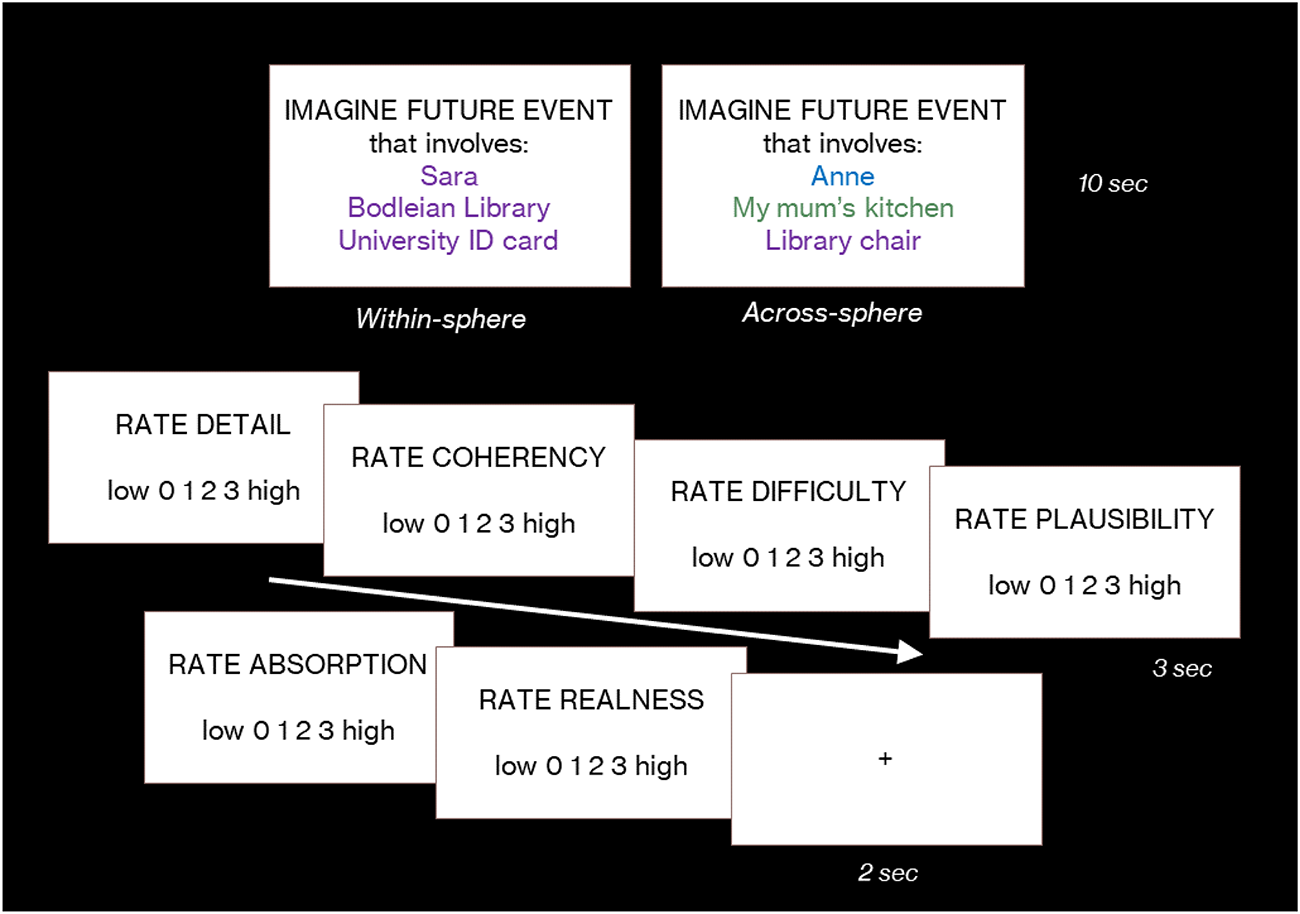
Overview of the imagination task in study 1.
Measures
Trait Measures
Absorption (trait). We measured absorption with the 34-item Tellegen Absorption Scale (Tellegen & Atkinson, 1974), but had rather than the original No/Yes (0/1) scoring, had participants answer on a scale from “Never” (1), “At least once” (2), “Occasionally” (3), “Often” (4), to “Very often” (5)(Jamieson, 2005). Example items are: “If I stare at a picture and then look away from it, I can sometimes “see” an image of the picture almost as if I were still looking at it” and “If I wish I can imagine that my body is so heavy that I could not move it if I wanted to”. The reliability of this scale was excellent (α = .93). The ratings on the items were averaged to one average score.
Fantasy proneness. We measured fantasy proneness with the Creative Experiences Questionnaire (Merckelbach et al., 2001). Example items are: “As a child, I had my own make-believe friend or animal.”, “Many of my fantasies are often just as lively as a good movie.”, and “When I think of something cold, I actually get cold.”. Participants answered “No” (0) or “Yes” (1) for 25 statements; these scores had good reliability (α = .73) and were added up to a single sum score.
Scenario Ratings
Participants were asked to press a space bar as soon as they had an event in mind (this would not change the screen, which would stay up for the full 10 s) and were asked rate their imaginings for five aspects: detail, coherency, difficulty, plausibility, absorption, and realness. Detail: How much detail the participant imagined, from no detail (0) to a highly detailed event (3). Coherency: How coherent the imagined event was. From a fragmented imagined event where the details did not really come together (0) to an event with details that were integrated (3). Difficulty: How difficult it was to imagine the event. From it was really easy to imagine the event (0) to it was really hard to imagine the event (3). Plausibility: How plausible the imagined event was. From the event was implausible (0) to the event was plausible (3). Absorption: How absorbed the participants were in the imagining, whether they lost track of time, and felt immersed in the imagining. From not absorbed at all (0) to completely absorbed (3). Realness: How real the imagining felt, and whether it felt more like an imaginary event (0) to whether it felt as real as a memory (3).
Results
Imagining Characteristics
First we examined the characteristics of the imagining across the two conditions; see Figure 2 & Table SM3.1. The experimental manipulation was successful: all characteristics differed significantly between the two conditions, with the across-sphere condition less detailed, coherent, plausible, absorbed, and real, and more difficultly and slowly imagined (correlations in the Supplementary Materials, SM.3). Because it is unclear what reaction time represents exactly, we will disregard this for further analyses and focus on the exactly defined ratings instead.
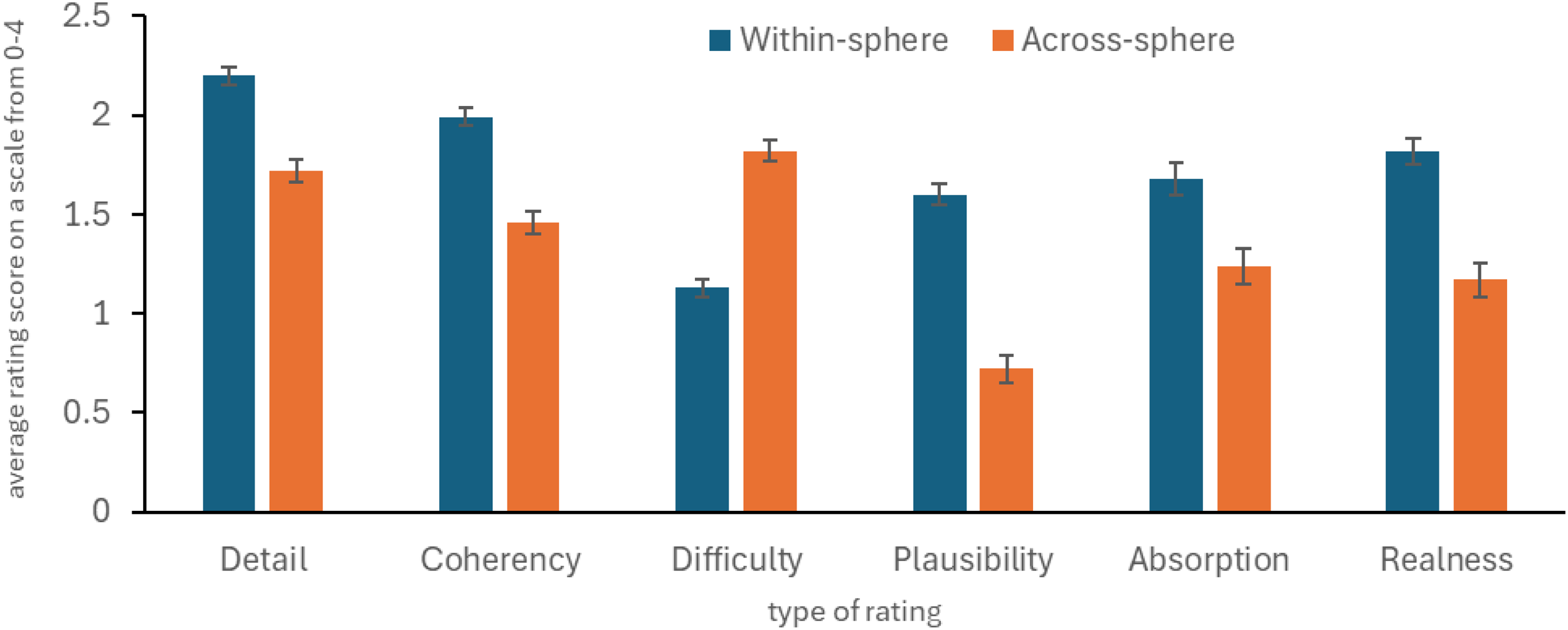
Averages of imagining characteristics for the within-sphere and across-sphere conditions with SE error bars; the two conditions significantly differ from each other for every rating.
Next we examined what predicted realness of the imaginings in both conditions with a linear multiple regression, see Figure 3. Because there were several significant correlations between the imagining ratings, we also ran a ridged regression, which takes into account multicollinearity by using ridge traces with a range of “lambda” values. The optimal value of “lambda” is its smallest value that results in stable coefficients, see Supplementary Materials SM.4. Because the values of the regression coefficients were very similar, we will continue with the linear multiple regression here. A feeling of realness of imaginings in the within-sphere condition was positively predicted by absorption into the imagining and coherency and plausibility of the imagining, as well as negatively by detail of the imagining. The feeling of realness of imaginings in the across-sphere condition was only significantly and positively predicted by absorption into the imagining. To test whether (ratings of) plausibility did not take up an excessive amount of variance by virtue of being partially synonymous with feelings realness, we also ran these regressions without plausibility, but the effects were the same, excluding any effects of plausibility of course (see SM.5).
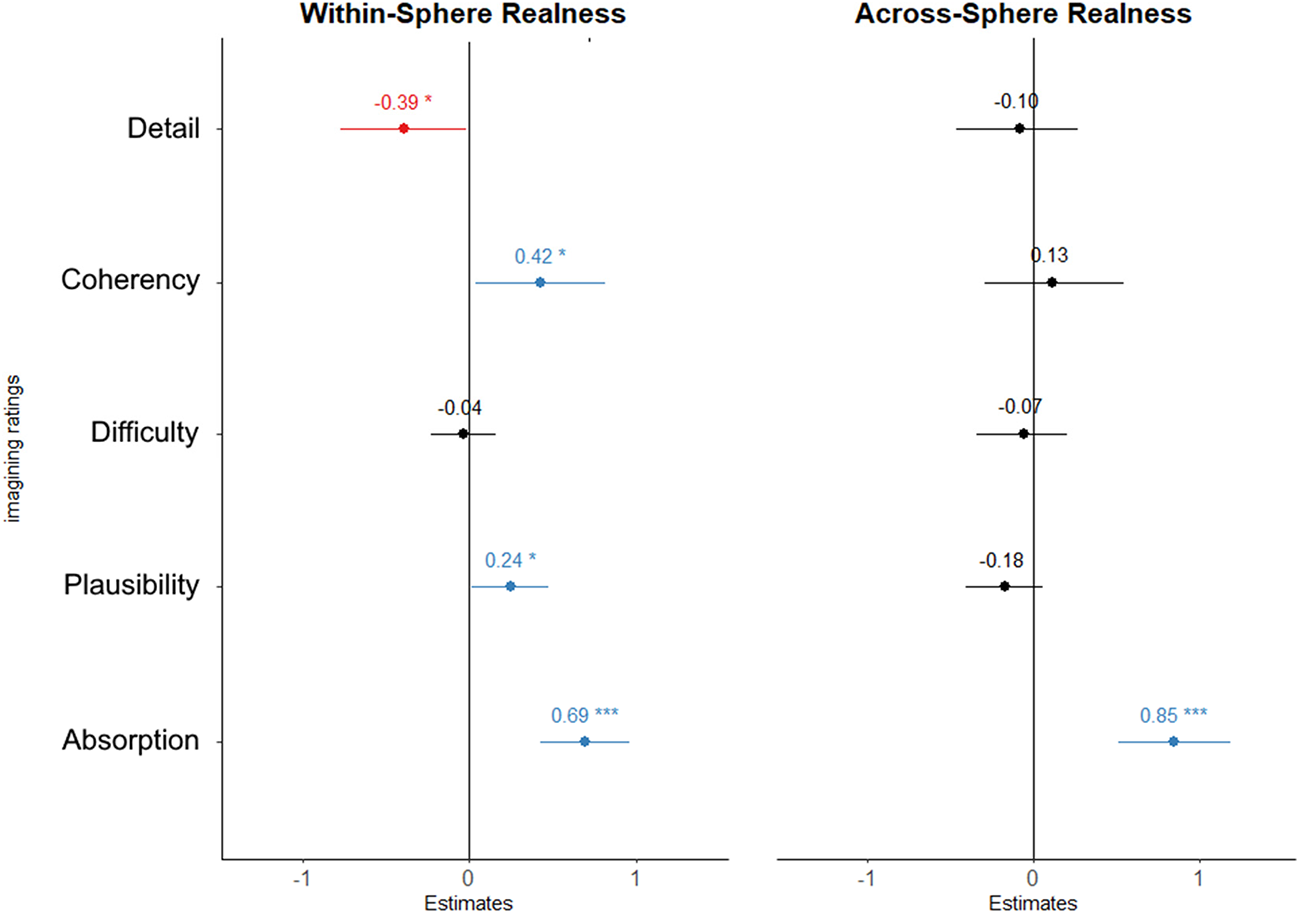
Two regression plots predicting the average feeling of realness of within-sphere (left) and across-sphere (right) imaginings by the other imagining characteristics; standardised beta coefficients with 95% confidence intervals are shown (*p < .01, **p < .001).
To investigate these differences across conditions statistically, a hierarchical linear regression analysis was conducted which examined whether condition (within/across-sphere) moderated the relationship between imagination dimensions (Detail, Coherence, Difficulty, Plausibility, Absorption) and realness ratings. The full interaction model accounted for a significant and substantial proportion of variance in realness ratings, R² = .79, F(11, 64) = 21.99, p < .001, adjusted R² = .75. Absorption into the imagining emerged as the only significant main effect, showing a strong positive association with realness ratings across conditions (β = 0.81, 95% CI [0.53, 1.10], p < .001). Other main effects were not significant: Detail: β = −0.09, 95% CI [−0.38, 0.20], p = .55; Coherence: β = 0.12, 95% CI [−0.22, 0.45], p = .483; Difficulty: β = −0.08, 95% CI [−0.35, 0.18], p = .53; Plausibility: β = −0.20, 95% CI [−0.42, 0.03], p = .08.
The analysis also revealed a significant Condition × Plausibility interaction (β = 0.45, 95% CI [0.09, 0.80], p = .014), indicating that the association between plausibility and realness ratings was more positive in within-sphere imaginings compared to across-sphere imaginings. No other interactions reached statistical significance: Condition × Detail: β = −0.27, 95% CI [−0.76, 0.22], p = .28; Condition × Coherence: β = 0.27, 95% CI [−0.26, 0.81], p = .31; Condition × Difficulty: β = 0.05, 95% CI [−0.31, 0.40], p = .79; Condition × Absorption: β = −0.26, 95% CI [−0.64, 0.12], p = .18. A likelihood ratio test comparing the full interaction model against a main-effects-only model showed no significant improvement in model fit, ΔR² = .04, F(5, 64) = 1.81, p = .12.
Imagination Traits
For our investigation of the role of imagination traits on future event imagination, we examined the correlations between the various imagining ratings and two traits, absorption and fantasy proneness (which furthermore were significantly and positively correlated with each other, r(64) = .60 [0.41, 0.73], p < .001); see Table 1 (and SM.6 for distribution graphs). As expected, the two traits are significantly and positively correlated with feelings of realness ratings, regardless of the condition. Further, fantasy proneness is significantly correlated with across-sphere imagining characteristics only (with the exception of realness of within-sphere events, such that a greater fantasy proneness trait is associated with greater realness of within-sphere imaginings). Trait absorption on the other hand is significantly correlated with within-sphere coherency, absorption, and realness, as well as lower across-sphere difficulty and greater across-sphere absorption and realness.
Correlations Between Ratings of the Within-Sphere Imaginings (Within) and Across-Sphere Imaginings (Across), the Difference Between Within-Sphere and Across-Sphere Ratings (Difference), and the Traits Absorption and Fantasy Proneness.
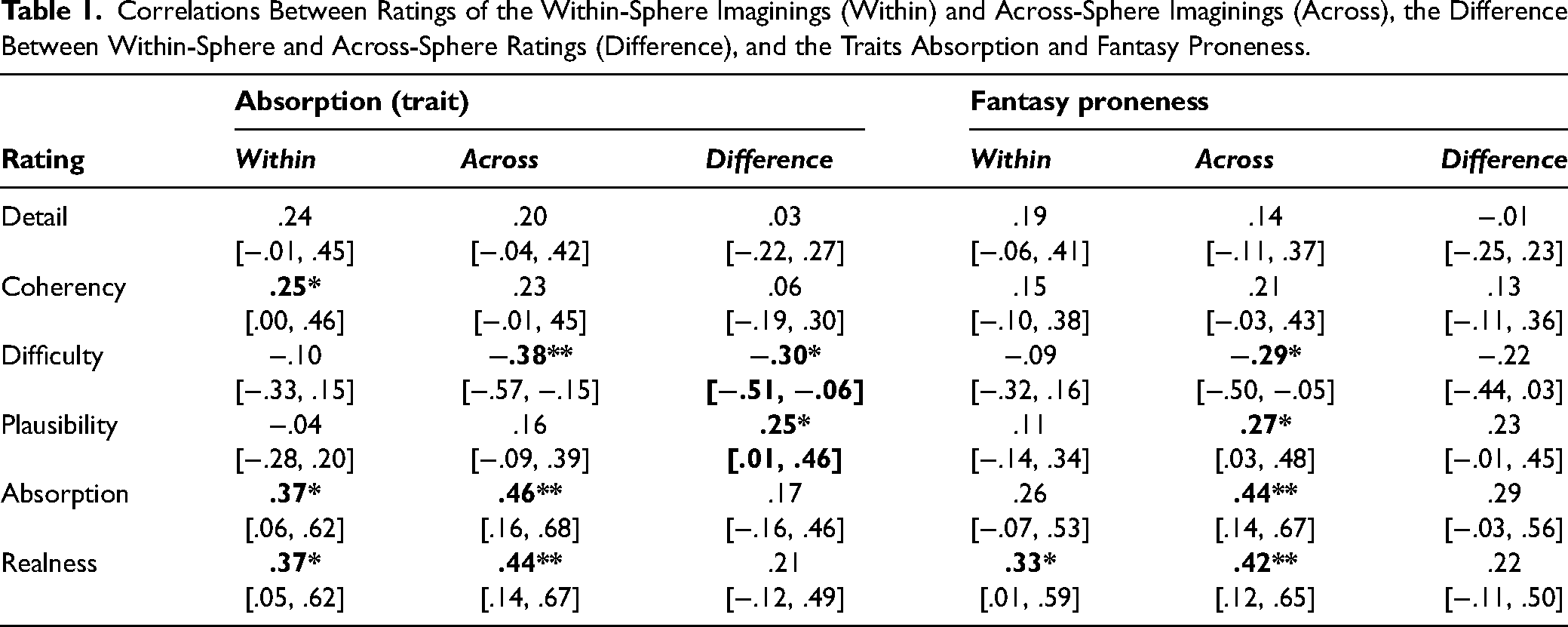
Next, we examined the association between imagination traits and differences between conditions. We predicted that differences in imagining characteristics would be correlated with both trait absorption and fantasy proneness, to the extent that these traits would help participants imagine across-sphere events to a better extent. However, keeping in mind that participants always had a greater average rating for within-sphere than across-sphere events (reversed for the difficulty rating), and given that the traits were often significantly correlated with the across-sphere correlations, we found that the higher someone scores on trait absorption, the smaller the difference in plausibility and ease of imagining between across-sphere events are as compared to within-sphere events. In other words, across-sphere imaginings approximated within-sphere imaginings more closely for plausibility and ease of imagining (the reverse of difficulty) in people with higher levels of trait absorption than those with lower levels of trait absorption. There was no such effect for fantasy proneness.
Discussion
In this study we set out to examine the feeling of realness of imagined future events with different rates of plausibility. We found, as expected, that events with greater plausibility – those with persons, locations, and objects from the same social sphere – were rated as being of greater realness than those with lower plausibility – events containing persons, locations, and objects from three different social spheres. The interaction of condition by plausibility demonstrated a medium-sized effect, reflecting that plausibility predicts feelings of realness in within-sphere imaginings but not across-sphere imaginings, while the other imagining characteristics affected feelings of realness in the same way, regardless of condition.
When predicting feelings of realness by the imagining characteristics, we found that it was most strongly predicted by absorption (in both types of future events) and coherency (though only in within-sphere events), putting forward evidence for the fluency reality monitoring theory (Bernstein et al., 2012), though also suggesting that more attention should be paid to absorption into the imagining; a rating hitherto lacking in the episodic simulation literature.
We found that imagination traits like absorption and fantasy proneness are particularly associated with across-sphere event characteristics, as opposed to within-sphere events, which are a more regular form of future event imagination, and therefore likely do not ‘profit’ of greater skills for fantastical imagination. Indeed, fantasy proneness predicted across-sphere event characteristics only; with the exception of feelings of realness, which were associated with both greater trait absorption and greater fantasy proneness across both conditions.
Study 2
Introduction
There are very few episodic imagination studies which include tasks where one has to imagine fictional events or that involve non-fictional individuals, such as imagining events involving former President Bill Clinton (Szpunar et al., 2007) or that measure aspects of fictional imaginings. Experimental tasks for fictional imagination do exist: Brown and colleagues (2019) developed a paradigm which involved imagining answering questions as either oneself (first-person), a well-known close ‘other’ (third-person) or Romeo or Juliet (fictional person). However, this paradigm lacks the detailed assessment of imagination (e.g., imagination ratings) that the episodic imagination literature utilises. Therefore, to develop a behavioural measure of imagination, we combined methods from episodic imagination research (van Mulukom et al., 2016) with methods from the neuroscience of acting research (Brown et al., 2019).
We looked also to the psychology of fiction literature to create additional measures of engagement with, or absorption or transportation into, the imaginings overall. Story world absorption (Kuijpers et al., 2014) directly examines this process, further split up into the components attention, emotional engagement, feelings of transportation, and mental imagery. We used this items from this scale and also adapted a pictorial measure of identity fusion (Swann Jr et al., 2009), which examines the merging of one's personal and social identity, to measure the process of becoming one with the imagined character.
We hypothesised that feelings of realness, and other imagining characteristics, including story world absorption and character fusion, would be highest in the first-person condition, then the third-person condition, and finally the fictional person condition, given that we all routinely imagine hypothetical events for ourselves, but less frequently so for other individuals, and rarely for fictional persons.
We further hypothesised that perceptive detail and vividness would correlate with the feeling of realness of the imagining but that, in line with a fluency hypothesis of reality monitoring and acting research findings, that ease of imagining and absorption into the imagining would predict realness of the imagining. We had no hypotheses about emotion of the imagining, except that it would likely correlate with feelings of realness, reflecting that emotional involvement like it has happened to oneself.
In terms of traits we hypothesised that realness of imaginings of especially fictional imaginings would be affected by both fantasy proneness and trait absorption, given that these dispositions are associated with a blurring of the boundary between real and imagined (Panero, 2019), and that could be one way in which fictional imaginings can still come to feel real.
Methods and Materials
Participants
Participants were recruited via Coventry University's research credit system and received research credits for participation in our study (which on average took about 60 min). Participation was anonymous, through participant numbers specific to the University's research credit system. Ethics approval was obtained from the University's ethics committee.
One hundred and eighty-one participants took part in the experiment (148 female, 32 male, and 2 non-binary participants; age range 18–39 years, M = 20.1, SD = 2.5 years old). Most participants grew up in the United Kingdom (n = 118, 64.8%), Portugal (n = 16, 8.8%), or Poland (n = 8, 4.4%), while all other listed countries had fewer than 5 participants each. Participants were all university psychology students.
Of these participants, 152 (83.5%) reported to have no formal training in theatre or film and 51 (28.0%) reported to have amateur performance experience in theatre or film (these options were not mutually exclusive). Most participants indicated that they had seen the play or film of Romeo and Juliet (n = 67, 36.7%) or had read the play (n = 25, 13.7%), with three participants (1.6%) indicating they had acted in the play themselves. The other participants indicated that they would say they knew about the narrative and characters (n = 42, 23.1%), or heard about it and broadly knew about it (n = 43, 23.6%), with just two participants saying they had never heard of it (1.1%).
Procedure
Participants read an information sheet and completed an online consent form prior to taking part, then completed the imagination task, and finished their session with filling out a short survey.
The imagination task was adapted from a combination of studies; we merged previous research on the neuroscience of acting (Brown et al., 2019) with event imagination (van Mulukom et al., 2016). In short, participants imagined possible scenarios as themselves, as their best friend, and as a fictional person (Romeo or Juliet). Participants rated each of the imagined scenarios as well as the overall condition on a number of different characteristics. See Figure 4 for an overview of the imagination task (including blocks and ratings), and Supplementary Materials SM.7 and SM.8 for the full task (instructions and all stimuli).
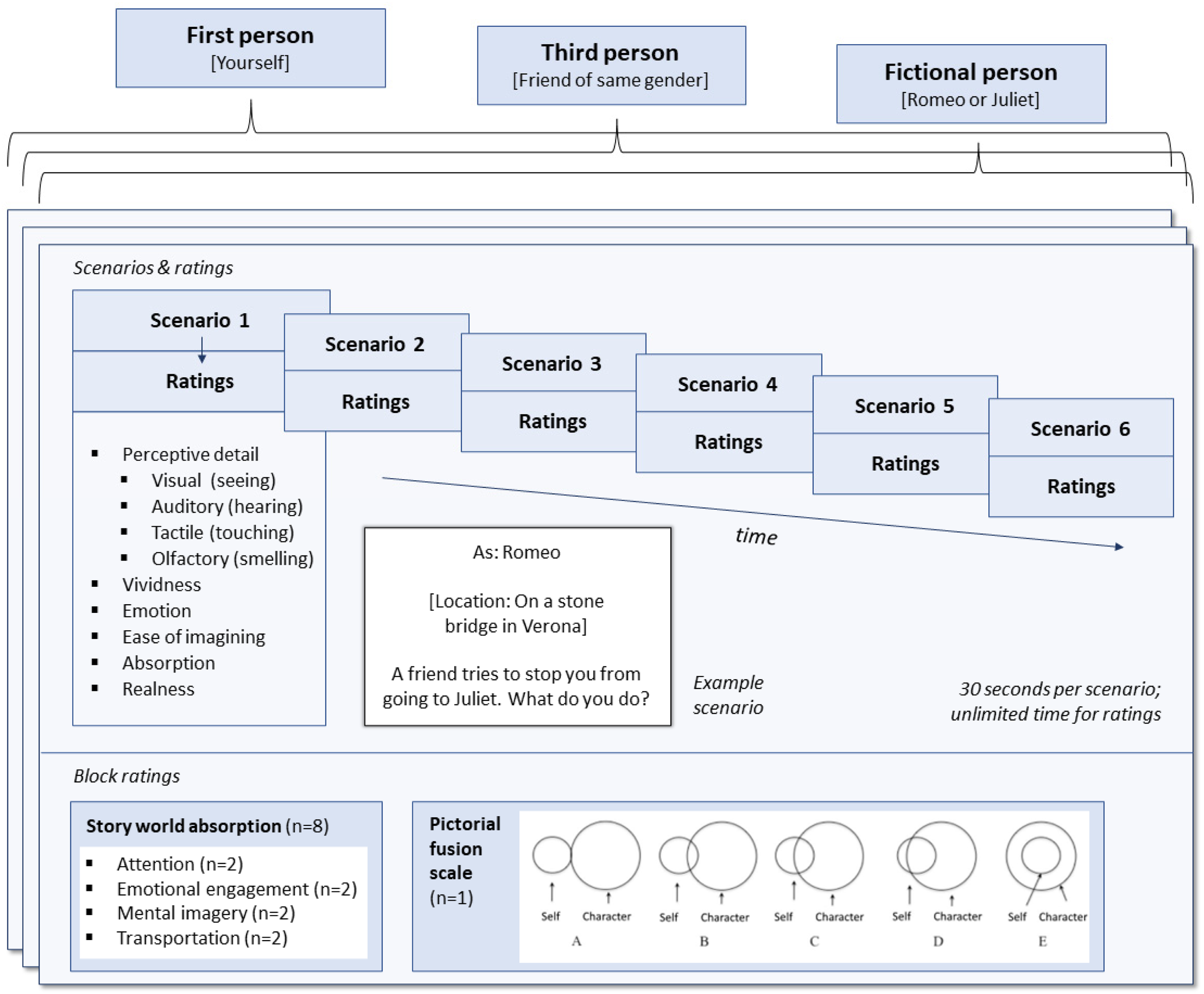
Overview of three blocks of the imagination task (imagining scenarios as oneself (1P), a friend of the same gender (3P), and Romeo or Juliet (FP)), each block of which has six imagination scenarios with ratings as well as post-block ratings.
Participants were presented with three blocks of six scenarios, which were always presented in the same order: first-person condition block of scenarios (imagining being yourself in scenarios), third-person condition block (imagining being your best friend in scenarios), and the fictional person block (imagining being Romeo or Juliet in scenarios). Participants were given 30 s to image each scenario, after which the screen automatically proceeded. Participants had unlimited time for other aspects of the task (e.g., rating). Participants were asked to rate each scenario for nine different aspects; after they had completed a block (i.e., six scenarios), they were asked to rate the block as a whole through three additional sets of ratings (see Measures below). Finally two versions were created for each of the conditions of the imagination task, so that in another longitudinal study we ran (van Mulukom, 2024), one version could be used pre-[event] and one post-[event].
In order to keep the conditions as equal as possible and to not to add an extra dimension of difficulty to the imagination task, participants were asked to write down their own gender so that the third-person condition and fictional person condition could be matched with their gender (Romeo or Juliet). As this is a binary choice, non-binary participants were asked to pick the gender they would like to imagine acting as during the task. Participants were asked to write down the name of their best or close friend of the same gender (which was automatically checked to be the same as their own indicated gender), which was then transferred into the scenario texts in the imagination task stimuli during the experiment.
Measures
Survey
Absorption (trait). As in Study 1, we measured trait absorption with the 34-item Tellegen Absorption Scale (Tellegen & Atkinson, 1974), with the same response options. The reliability of this scale was excellent (α = .95).
Fantasy proneness. As in Study 1, we measured fantasy proneness with the Creative Experiences Questionnaire (Merckelbach et al., 2001), and again summed “Yes” (1) answers. The reliability of this scale was good (α = .81).
Scenario Ratings
Imagining ratings. Participants were asked to rate their imaginings for six aspects: Perceptive detail, vividness, emotion, ease of imagining, absorption, and realness. Perceptive detail was split into four: visual, auditory, tactile, and olfactory detail. Visual detail & perception: How much detail the participants were able to see, and, how present visual perception was in their imagining; Auditory detail & perception. How much detail the participants were able to hear, and, how present auditory perception was in their imagining; Tactile detail & perception: How much detail the participants were able to feel, and, how present tactile perception was in their imagining; Olfactory detail & perception: How much detail the participants were able to taste, and, how present olfactory perception was in their imagining. These scores were combined into a single score for perceptive detail (Cronbach α's for the various conditions > .827). Participants were asked to rate their imaginings for an additional five aspects: Vividness: How vivid the imagining was, and whether it was clear, bright, and detailed. Emotion: Whether the imagining was emotional, and how much emotion/feeling was experienced. Ease of imagining: How easy it was to imagine the scenario, and how fluent it was and whether it flowed? Absorption: How absorbed the participants were in the imagining, whether they lost track of time, and felt immersed in the imagining. Realness: How real the imagining felt, and whether it felt more like a memory of an event (very real), or more like an imagined fantasy (not at all real). All imagining ratings were done on a scale from 0–4: “Not at all” (0), “Somewhat” (1), “Moderate” (2), “Considerable” (3), and “Very much” (4).
Block Ratings
Story world absorption. We selected eight items from the Story World Absorption scale (Kuijpers et al., 2014) to measure the participants attention (α's > .60), feeling of transportation (α's > .78), emotional engagement (α's > .76), and mental imagery (α's > .77) of the imagined scenarios (two items per subscale; see SM.9 for an overview of the items). Reliability for the overall scale was good across all three blocks (Cronbach's α's > .86). Participants chose from the following response options: “Strongly disagree” (−2), “Disagree” (−1), “Neither agree nor disagree” (0), “Agree” (1), and “Strongly agree” (2).
Character fusion. We adapted the pictorial identity fusion task (Swann Jr et al., 2009) to measure how much participants were able to immerse themselves into their character and become ‘one’ with them. Participants were presented with five different pictorial options of two circles (one circle denoting oneself, and another, bigger circle denoting the character) gradually merging to become one (see Figure 4). Thus, the scores possible for this measurement ranged from 1 (“A”) to 5 (“E”).
Results
Imagining Characteristics
First we examined the scores on each of the three conditions, see Figure 5 and Table SM10.1. Participants were consistently better at imagining scenarios in the first-person condition, compared to the third-person condition, which in turn was better than the fictional person condition. More specifically, Bonferroni-corrected post-hoc comparisons indicated that vividness of imagining, ease of imagining, absorption in imagining, and realness of imagining differed between each of the three conditions (p-values < .001). Emotionality of imagining was greater in 1P than in 3P (p = .001) and FP (p < .001), and emotionality was also greater in 3P than in FP (p < .001). Story world absorption and character fusion also differed significantly between each of the three conditions (p-values < .001; see SM.10 for the story world absorption subscales individually).
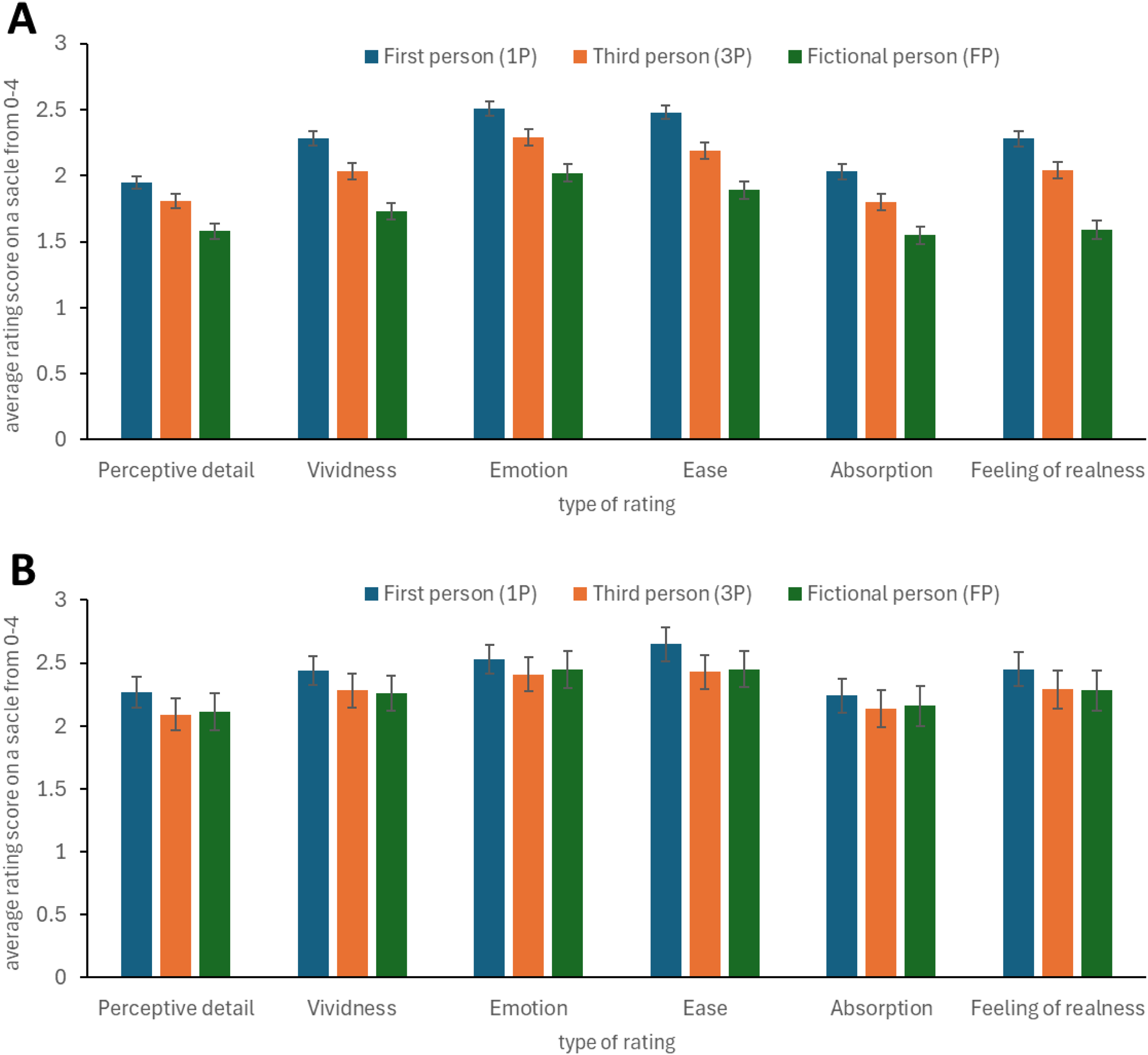
Averages of imagining characteristics for the three acting conditions with SE error bars in (A) study 2 and (B) study 3; there was a significant main effect of condition for every rating of psychology students in Study 2 (A) but for none of the ratings of acting students in Study 3 (B).
Next we investigated which imaging characteristics could predict the feeling of realness of the imagining. Because we hypothesised that this could differ according to the imagining condition, we ran three separate regressions, see Figure 6 and Table SM10.4. However, since the imagining ratings were all quite highly related to each other, we also ran a ridged regression, which takes multicollinearity into account (see Study 1). The beta coefficients of the ridged regression have been added to Table SM10.4 (note that these do not have p-values).
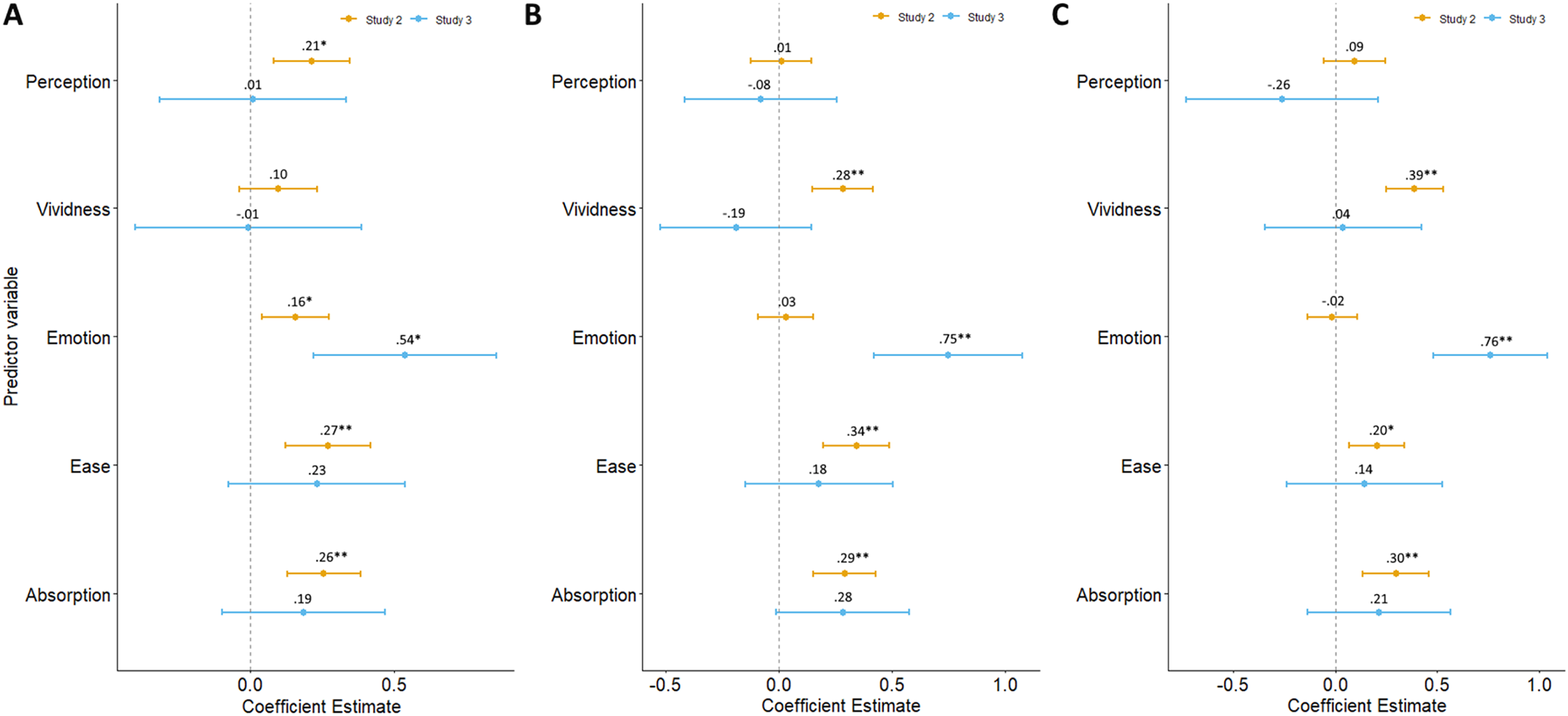
Three regression plots predicting the average feeling of realness by imagining characteristics for (A) the first person condition, (B) the third person condition, and (C) the fictional person condition, for both Study 2 (psychology students) and Study 3 (acting students); regression coefficients with 95% confidence intervals are shown (*p < .01, **p < .001).
To assess these differences statistically, we conducted a hierarchical linear regression analysis to examine whether condition (1P, 3P, FP) moderated the relationships between imagining characteristics (Perception, Vividness, Emotion, Ease, Absorption) and feelings of realness ratings. The full interaction model explained a statistically significant and substantial proportion of variance in realness ratings (R² = .84, F(17, 517) = 155.90, p < .001, adjusted R² = .83). The model revealed significant positive main effects for Perception (β = 0.25, 95% CI [0.09, 0.41], p = .002), Emotion (β = 0.17, 95% CI [0.04, 0.30], p = .009), Ease (β = 0.29, 95% CI [0.13, 0.44], p < .001), and Absorption (β = 0.26, 95% CI [0.13, 0.39], p < .001), whereas Vividness showed a non-significant association with feelings of realness (β = 0.11, 95% CI [−0.04, 0.26], p = .16).
In terms of interactions, significant interaction effects were observed for Condition × Vividness: Condition [FP] × Vividness: β = 0.32, 95% CI [0.11, 0.54], p = .003, though Condition [3P] × Vividness was non-significant: β = 0.19, 95% CI [−0.02, 0.40], p = .08. A significant interaction was also found for Condition [FP] × Emotion: β = −0.19, 95% CI [−0.37, −0.01], p = .04, while Condition [3P] × Emotion was non-significant: β = −0.14, 95% CI [−0.32, 0.04], p = .13. For Perception, a significant interaction was found for Condition [3P] × Perception: β = −0.24, 95% CI [−0.46, −0.02], p = .03, while Condition [FP] × Perception was non-significant: β = −0.14, 95% CI [−0.38, 0.09], p = .24. Other interaction effects were non-significant: Condition × Ease (3P: β = 0.07; FP: β = −0.06): both ps > .51; Condition × Absorption (3P: β = 0.03; FP: β = 0.06): both ps > .59. A likelihood ratio test comparing the full interaction model to the main-effects-only model showed that adding interaction terms marginally improved model fit (F(10, 517) = 1.813, p = .056). The effect size for this improvement was small (Cohen's f² = .035). This suggests that while the inclusion of interaction terms does provide some additional explanatory power, the improvement in model fit is modest and just at the threshold of statistical significance.
Imagination Traits
We investigated how imagination traits might influence the imaginings in the three conditions. First, we examined the distribution of absorption and fantasy proneness in the sample, see SM.11. Again, trait absorption and fantasy proneness were significantly and positive correlated with each other, r(144) = .73 [0.65, 0.80], p < .001. Then, we assessed correlations between the imagining characteristics and the imagination traits, and all correlations were positive and significant, see SM.12. This suggests that the imagination traits both significantly contribute to the imaginings and their characteristics.
Next, we investigated how imagination traits may be correlated with differences between the conditions; see Table 2. We hypothesised that differences between the fictional condition and the first-person and third-person condition in particular would be correlated with absorption and fantasy proneness, as this is the more difficult condition, involving imagining fantastical scenarios rather than more realistic ones. This hypothesis was only partially borne out: Fantasy proneness was correlated with a smaller negative difference in imagining characteristics between the fictional and first-person condition (except for perceptive detail), as well as attention to the imagining, and between the fictional and third-person condition for overall story world absorption (and separately, attention and emotional engagement), whereas absorption predicted this for perceptive detail and feelings of realness between the fictional and first-person condition, and feelings of realness between the third-person and first-person condition, but there were no other correlations.
Correlations Between the Traits and Differences in Ratings Between the Conditions (1P = First person, 3P = Third person, FP = Fictional person) for Psychology Students in Study 2.
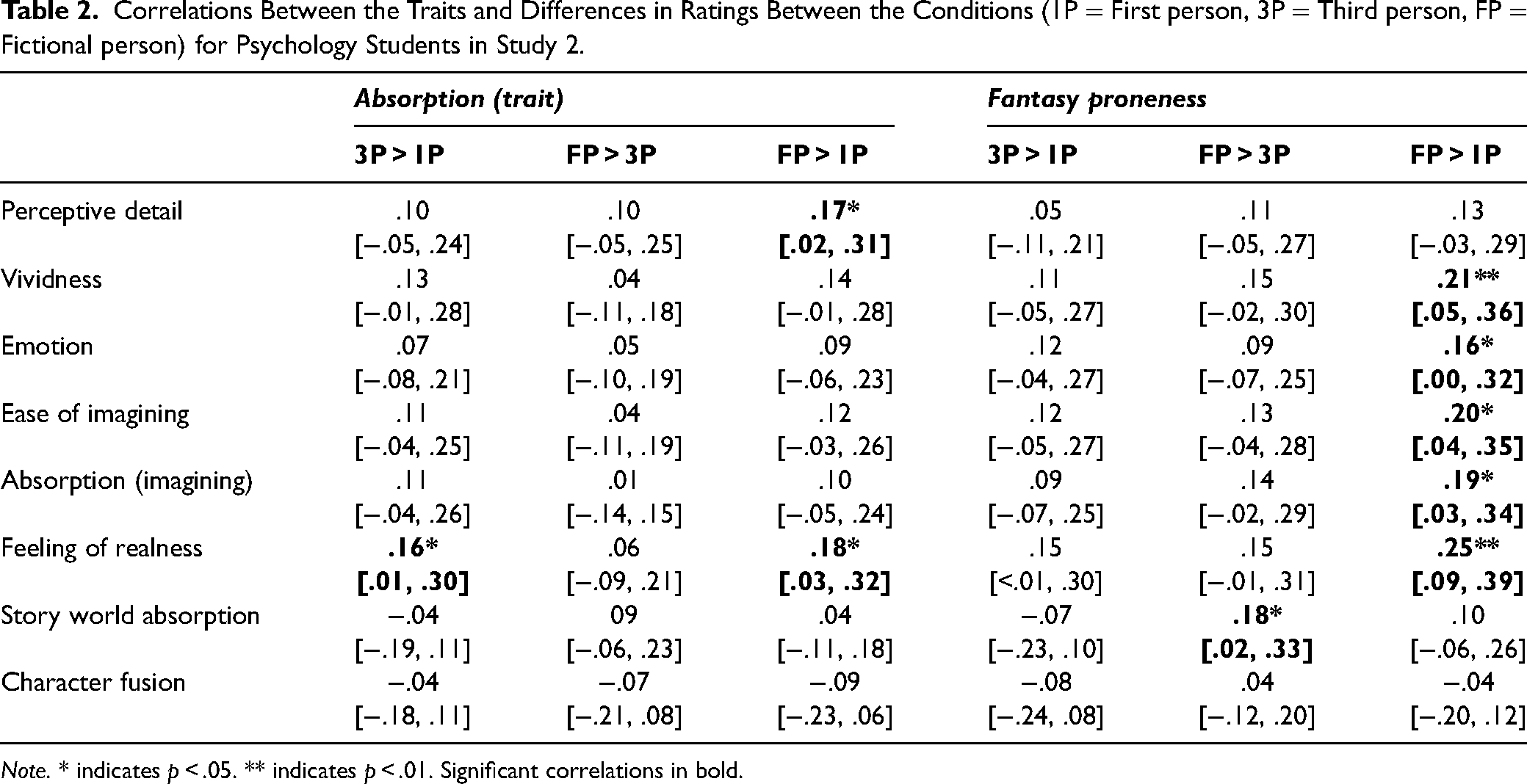
Note. * indicates p < .05. ** indicates p < .01. Significant correlations in bold.
Discussion
The imagination task was an adapted version of a procedure used for neuroscience research of acting (Brown et al., 2019), and involved three conditions: imagining scenarios as oneself (first-person), a close or best friend (third-person) and as Romeo or Juliet (fictional person). Participants rated the individual scenarios as well as each condition block (of six scenarios). All of the characteristics and ratings (both individual scenario and overall block ratings) were greatest for the first-person condition, followed by the third-person condition and then the fictional person condition, indicating participants were best able to imagine scenarios in the first-person condition, then third-person condition, and then fictional person condition.
We found that feelings of realness were predicted by imagining characteristics ease of imagining, absorption into imagining, emotion, and perceptual detail when imagining scenarios from a first, third, and fictional person perspectives. In this, ease of imagining and absorption showed consistent relationships with feelings of realness regardless of perspective, but (i) the relationship between vividness and feelings of realness was stronger in fictional person imaginings compared to first person imaginings, with no significant difference between first person and third person imaginings, (ii) the relationship between emotion and realness was significantly diminished in the fictional person imaginings as compared to the first person imagining, with no significant difference between first person and third person imaginings, and (iii) the relationship between feelings of realness and perception was stronger in third person than in first person, with no significant difference between fictional person and first person imaginings.
The additional roles of vividness and emotive were unexpected to be predictive of the fictional imaginings’ realness given newer reality monitoring theories focused on imagining fluency, but make sense as contributing factors: Recalled memories can feel more real when they are more vivid and have more detail than dull recalled memories (Rubin et al., 2003b), where its vagueness may contribute to uncertainty regarding its source (imagination or memory) and therefore realness.
Through correlational analyses, we found that imagination traits were significantly and positively correlated with each of the imagining characteristics. Because the traits were significantly associated with the ratings across the board, this suggests that both trait absorption and fantasy proneness contribute to imagining acting out different scenarios, whether as oneself, someone else, or a fictional character.
Finally, we examined the associations of imagination traits with differences in imagining characteristics between the conditions. By comparing the third-person imagining to first person imagining, we keep realistic imagining constant, but add the perspective of being someone else; by comparing fictional imagining to the third-person account, we keep imagining from a third-person perspective constant, but add the imagining necessary for fantastical scenarios; and finally, by comparing the fictional account to the first-person account, we combine third-person and fantastical imagining mechanisms.
Unexpectedly, we found that trait absorption was not typically associated with differences between the conditions in this study, with the exception of feelings of realness differences between the first-person and the third-person condition and the first-person and fictional person condition. While this strengthens the support for the proposal that trait absorption underlies feelings of realness of non-personal, non-realistic imaginings, it was surprising that trait absorption was not also associated with other differences between the three conditions. One possible explanation is that the variability in the characteristics was too low: On average, the imagining characteristics for the third-person and fictional person condition were relatively low in this study. This is not unexpected, given that our task is relatively unusual, especially when it comes to the fictional person condition: We do not often imagine how we would act in scenarios as Romeo or Juliet, set in a completely different time, location, and setting. We did however find correlations between fantasy proneness and differences in imagining characteristics between the first-person and fictional person condition. These two conditions differed the most from each other, with the fictional condition having the added task of imagining someone else's perspective as well as a fictional setting, which might be why we are able to see otherwise possibly subtle effects here (as opposed to differences with the third person perspective).
Study 3
Introduction
In this study, we repeated the set-up of Study 2, but recruited acting students to complete the task and survey. We hypothesised that the acting students would score higher on absorption and fantasy proneness, and would be better in particular in the fictional person condition; a type of imagining that non-actors do not routinely do (as opposed to our own event imagination and imagining what life like might be like for others).
Methods and Materials
Participants
Participants were recruited through personal and colleagues’ contacts, relevant social media (Facebook groups and subreddits for acting students), and the DramaHE UK mailing list. Forty-one participants (24 female, 16 male, 1 other/nonbinary; age range 18–57, M = 25.5, SD = 9.8 years) took part. These participants had predominantly grown up in the United Kingdom (n = 14, 34.1%), South Africa (n = 8, 19.5%), the United States (n = 7, 17.1%), and Australia (n = 5, 12.2%). All other participants grew up in either Germany, Greece, India, Romania, Spain, Turkey, and Zambia. Of those, 31 (75.6%) indicated they had amateur performance experience in theatre or film, 21 (51.2%) that they had directed or produced one or many amateur theatre or film productions, 19 (46.3%) that they had professional performance experience in theatre or film, 11 (26.8%) that they had won an award or prize for acting in theatre or film, 12 (29.3%) that they had directed or produced or many professional theatre or film productions, and 8 (19.5%) that their performance work has been recognised in national or international publications (these options were not mutually exclusive). In terms of their knowledge about Romeo and Juliet, three participants indicated to have heard of it but only broadly know it (7.3%), seven said they would say they know about the narrative and characters more or less (17.1%), 11 have read the play (26.8%), 15 had seen the play or film (36.6%), and 5 had acted in the play themselves (12.2%).
Procedure
The procedure was identical to that of Study 2.
Measures
The measures were identical to that of Study 2.
Results
Imagining Characteristics
As in Study 2, first we examined the imagining characteristics between the three conditions, see Figure 5 and Table SM13.1 (see SM.13 also for the story world absorption subscales individually). Interestingly, for the acting students of the current sample, the three conditions did not differ on their scenario or block ratings, with the exception of character fusion, which was greater in the 1P condition than the 3P condition (p < .001) and FP condition (p < .001), while 3P and FP not differ significantly from each other (p = .40). Differences in ease of imagining, apparently greater in the 1P condition than in the 3P (p = .003) and in the FP condition (p = .03), with no difference between 3P and FP, did not reach the Bonferroni-corrected threshold of p = .004. This is in contrast to the results of the psychology students of Study 2, who had statistically significant differences in scores for every scenario and block rating of the imagination task between the three conditions (1P, 3P, FP).
We also compared performance on the imagination task between the Study 2 and Study 3 participants (see SM.14) and found that the Study 3 participants scored higher on every rating for the fictional person condition. Acting students also scored higher on perceptive detail, absorption, overall story world absorption as well as subscales attention and transportation, and character fusion for the third-person condition, but with the Bonferroni-correction for multiple comparisons, this was no longer significant at p = .004.
Next, we ran multiple linear regressions and ridged regressions to predict feelings of realness of imaginings in each condition by the other imagining ratings, see Figure 6 and Table S13.4. We also conducted a hierarchical multiple regression analysis to examine the relationship between feelings of realness and imagining characteristics (perception, vividness, emotion, ease, and absorption) together with the moderating role of condition (first-person, third-person, and fictional person). The overall model explained a significant proportion of variance in feelings of realness, R2 = .77, F(17, 103) = 19.98, p < .001. However, of the imagining characteristics, only emotion demonstrated a statistically significant positive association with feelings of realness (β = 0.54, 95% CI [0.23, 0.84], p < .001) for the acting students. The analysis further revealed no significant interaction effects, and the change in R2 when adding the interaction terms was not significant, F(10, 103) = 0.38, p = .95, Cohen's f2 = .04, suggesting that overall, the relationships between the imagining characteristics and feelings of realness did not significantly differ across perspective conditions.
Imagination Traits
We examined the distribution of the imagination traits in this sample and found it to be normally distributed, see SM.15. Interestingly however, trait absorption and fantasy proneness were not significantly correlated with each other: r(36) = .31 [−0.02, 0.57], p = .06. Next, we compared the traits of participants of this study, Study 3 (acting students), with those of Study 2 (psychology students), and found that, as hypothesised, acting students scored significantly higher than psychology students on both absorption (Mpsy = 2.51, SDpsy = 0.62, Mact = 2.51, SDact = 0.62, t(215) = −2.15, p = .02) and fantasy proneness (Mpsy = 12.47, SDpsy = 5.06, Mact = 14.41, SDact = 4.82, t(185) = −2.15, p = .02); see Figure 7 for the distributions of these trait scores in each of the samples.
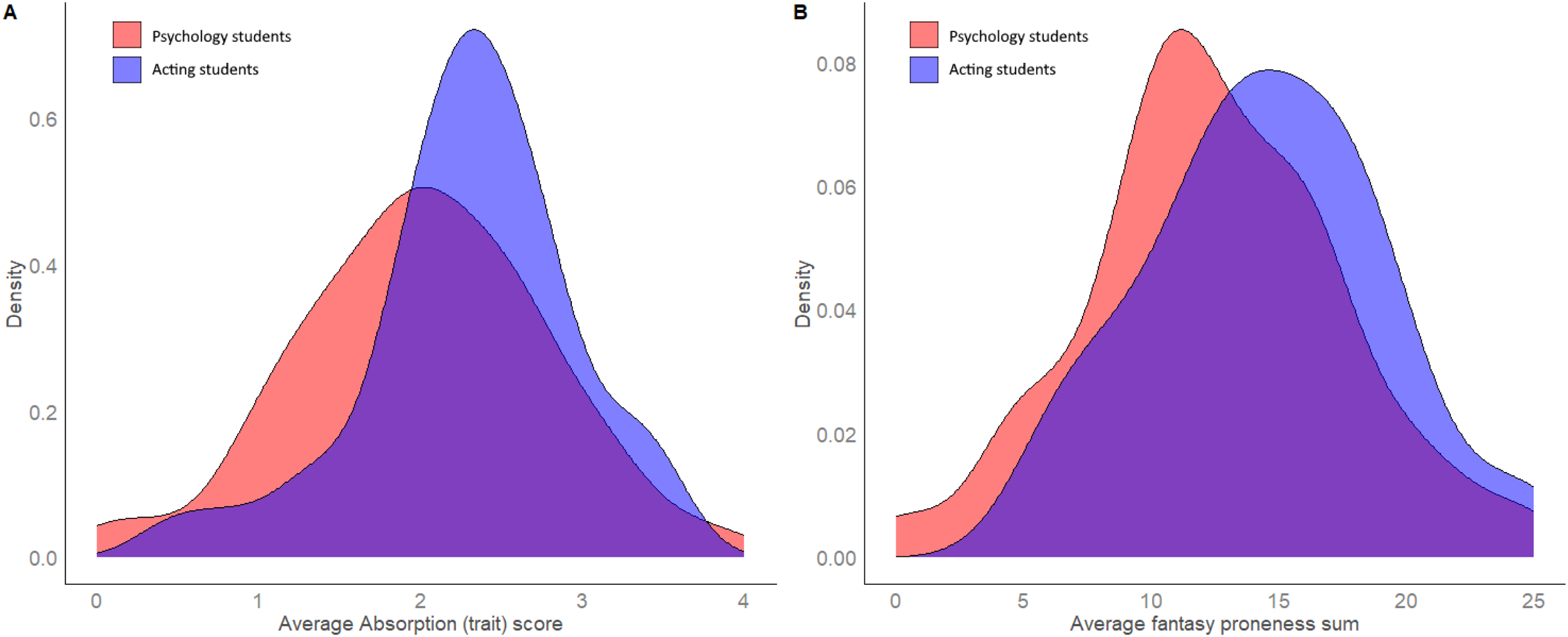
Density plots of average absorption trait score (A) and fantasy proneness (B) for participants from Study 2 (psychology students) and participants from Study 3 (acting students).
We examined correlations between the imagining characteristics and imagination traits, and this time did not find all correlations to be positive and significant, see SM.16. Instead, trait absorption was most correlated with first-person and third-person imagining characteristics, whereas fantasy proneness was correlated mainly with character fusion in the third-person and fictional person condition. In addition, feelings of realness of the first-person condition were significantly and positively correlated trait absorption, feelings of realness of, as well as absorption into, the third-person condition with both trait absorption and fantasy proneness, and finally feelings of realness of the fictional person condition with fantasy proneness.
Next, we examined correlations of the traits with the differences between the conditions. Probably partially due to there being little differences between the conditions for this group, there were very few significant correlations between the traits and differences in ratings between conditions, except between fantasy proneness and the difference in character fusion between the first-person and third-person condition, r = .38 [.08, .62], p = .02, and the difference between the first-person condition and fictional person condition, r = .33 [.02, .58], p = .04; see Supplementary Materials SM.17.
Finally, we combined the data of Study 2 and Study 3 and ran multilevel models examining the effect of the traits on the differences in imagining characteristics between the conditions; see SM.18. Multilevel modelling is a more robust way to examine this than correlations as previously done, but also requires a larger sample, so could not be done for Study 2 and Study 3 separately. A linear mixed model was fit to investigate the effects of condition (1P, 3P, and FP) and the traits on the imagining characteristics, thus accounting for the nested structure of the data: Every imagining is done by (i.e., nested within) an imaginer who has certain levels of traits (absorption, fantasy proneness). This model included random intercepts and random slopes for condition at the participant level and was fit using maximum likelihood estimation (using the lmer package in R); see SM.18 for the tables with the results of these models.
For the participants of Study 2 and Study 3 combined, the main effects were as previously reported (see SM.15), and effects of trait absorption and fantasy proneness on the various imaginings are discussed too. Here, we will focus on predicting feelings of realness (see SM18.6). For both multilevel regressions, results indicated a significant main effect of condition, with both the 3P condition and FP condition showing significantly lower perceived realness compared to the 1P condition. In addition, trait absorption was a significant predictor of perceived realness (b = 0.44, SE = 0.08, t(192.21) = 5.39, p < .001), and the interaction between condition and trait absorption was significant for the FP condition (b = 0.29, SE = 0.09, t(182.91) = 3.07, p = .003), but not for the 3P condition (b = 0.14, SE = 0.08, t(196.08) = 1.74, p = .084). Fantasy proneness was also a significant predictor of perceived realness (b = 0.06, SE = 0.01, t(203.14) = 5.14, p < .001), and the interaction between condition and fantasy proneness was significant for both the 3P condition (b = 0.02, SE = 0.01, t(193.59) = 2.09, p = .038) and FP condition (b = 0.06, SE = 0.01, t(189.83) = 4.37, p < .001).
Discussion
In contrast to Study 2, in Study 3 almost none of the imagining characteristics differed between the three conditions, except for character fusion (ease of imagining did not meet the Bonferroni-corrected threshold). It was the first-person condition that differed from the other two, with the third-person condition and the fictional person condition not differing significantly from each other. An explanation for this is that it is straightforward to identify with oneself even one imagines oneself in a hypothetical situation, but identifying as others is more complicated. Still, it is somewhat surprising the other imagining ratings of the first-person condition did not also differ from those in the other conditions, given that first-person imagining is such a routine activity (Klinger & Cox, 1987). One explanation is that the overall task – imagine acting out a scenario – was simply easier to do for the acting students, regardless of which persona one was asked to imagine to be. Moreover, it may be that the acting students took the whole imagination task as an acting task - including for the first person condition, meaning that their first person ratings are not reflective of their everday imagination, but rather of their acting imagination ability.
We again examined what predicts feelings of realness of the imaginings in the three conditions. In contrast to Study 2, it was found that only emotionality of imagining was a consistent predictor of feelings of realness, with some assisting roles for absorption and ease of imagining (in Study 2, emotion only played a role in the first-person condition). We suggest that this may be explained by the fact that when actors feel emotionally engaged with an imagining, it is then that they really become absorbed and are fluently transported into the imagining (Konijn, 2000). The fact that absorption and ease of imagining play supportive roles in creating imaginings with higher realness ratings speaks to this, but because the imagining characteristics were so highly intercorrelated, we cannot further examine this possibility.
There were fewer correlations between the imagination traits and imaging characteristics in this study than in Study 2, possibly due to the smaller sample size. Trait absorption was particularly predictive of imagining characteristics in the first-person and third-person condition, with fantasy proneness being associated with greater character fusion in the third-person and fictional person condition. Feelings of realness of the imaginings (and differences of realness as compared to the first person perspective) were associated with both absorption (1P, 3P) and fantasy proneness (3P, FP), however. In line with the Study 2 findings, feelings of realness during a fictional imagining are specifically predicted by fantasy proneness rather than trait absorption.
There were also very few correlations between trait absorption and fantasy proneness and differences between the three conditions. This is likely due to the lower differences in imagining characteristics between the three conditions for the acting students (only character fusion was significantly different); reducing the variability with which the traits can correlate considerably. It is a limitation of this study that ultimately it is not completely clear whether some Study 2 effects are lacking in Study 3 because of its smaller sample size or because it is a qualitatively different sample. For future research, it would be important to have an even bigger sample of acting students to complete the study.
Acting students were better at particularly the fictional person condition than psychology students as expected. There may be two reasons for this: one, acting students’ training, practice, and/or expertise are influencing characteristics of imaginings in the fictional person condition, or two, acting students’ higher levels of fantasy traits - absorption and fantasy proneness - support the imaginative processes. Here we suggest both reasons likely contributed: Imagining oneself in as a fictional person is not something we routinely do, whereas imagining scenarios we might ourselves come to be in –even if not very likely– as well as imagining what life is like for others, especially those close and familiar to us, is a much more well-practiced, everyday experience for all of us. Therefore, it stands to reason that the samples differ in the fictional person condition especially. Secondly, through multilevel models combining both samples, it was found that while both trait absorption and fantasy proneness affected the imaginings significantly, fantasy proneness had a stronger effect on the characteristics of imaginings in the fictional person condition as compared to the first-person condition. This suggests that fictional imagination is supported by fantasy proneness especially, rather than trait absorption.
General Discussion
The present research set out to investigate what factors contribute to the feeling of realness -the sense of realness or feeling of reliving or re-experiencing of mentally simulated events- during different types of imagined scenarios, ranging from plausible future events to entirely fantastical situations. By combining different imagination paradigms and ratings, we examined how characteristics of the imagined scenarios themselves (e.g., detail, coherence, plausibility), individual traits of the imaginer (i.e., absorption, fantasy proneness), and fantastical or fictional imagination practice (i.e., studying acting) impact feelings of realness. Our goal was to bring together various strands of imagination research to provide a more comprehensive understanding of what makes an imagining feel lifelike and immersive.
In Study 1, we used an existing future event imagination design –the social sphere paradigm, which examines imaginings of events with memory details recombined within social spheres and across social spheres (van Mulukom et al., 2016)–, and added two new imagining ratings: feelings of realness and absorption into the imagining. We also measured two traits of the participants which we hypothesised to influence feelings of realness of the imaginings, especially for less plausible imaginings: trait absorption (Tellegen & Atkinson, 1974) and fantasy proneness (Merckelbach et al., 2001). We found that within-sphere events were perceived as significantly more real than across-sphere events. When predicting these feelings of realness in plausible future events by imagining characteristics, the strongest predictor was absorption into the imagining, but also plausibility of the imagining, and feelings of realness of less plausible imagined future events were predicted only by absorption into the imagining. Trait absorption and fantasy proneness predicted feelings of realness of both plausible and less plausible future events (i.e., within-sphere and across-sphere events respectively), suggesting that feelings of realness of simulated events are indeed affected by these traits, regardless of their plausibility. However, fantasy proneness only predicted characteristics of less plausible future events.
In Study 2 and Study 3, we adapted a new imagination paradigm from research on acting (Brown et al., 2019). In this set-up, participants imagined events at certain locations as in Study 1, but now from different perspectives: from a first-person perspective (as oneself), third-person perspective (as one's best friend of the same gender), and fictional person perspective (as Romeo or Juliet, depending on one's gender). As expected, feelings of realness differed between the three conditions, with the greatest feelings of realness for the first person perspective, then third person, then the fictional perspective, but this did not hold up in the acting sample (though there was a possible marginal trend, which with a larger sample might be borne out).
In Study 2, with the psychology students sample, feelings of realness of first person imaginings -akin to future event simulation- were predicted by ease of imagining, absorption, perceptive detail, and emotion. This is not dissimilar to findings of Rubin et al. (2003b), who found that memories (as elicited by an adapted Galton-Crovitz word-cuing technique) that had a greater sense of reliving had greater visual and auditory imagery, emotionality, and coherence. Something which has not been considered in depth here and that could be investigated in future studies, is the effect of spatial scene construction on feelings of realness. Previous research has shown that both intensity of the memory as well as the spatial content (i.e., setting layout, event layout, personal position, field/observer perspective) predict the extent of reliving of the memory (Rubin et al., 2019).
Previous reality monitoring research has found that older adults were more likely to misremember imagined events as real when they had vivid sensory details (Johnson et al., 1988). Similarly, recent neuroscientific research has found that the more vividly participants imagined a visual stimulus, the more likely they were to believe it was real, even when nothing was actually presented (Dijkstra & Fleming, 2023), similar to a study which included blindfolding participants, and where greater visual imagery was associated with greater reliving (Rubin et al., 2003a). Here, we found that vividness or perceptive detail contributed to feelings of realness too, though absorption and ease of imagining (immersion and fluency of imagining) were typically the stronger predictors. Importantly, in the present research we examined feelings of realness, not accuracy or reliving. Nonetheless, reality monitoring theories should consider the influence of fluency and the feeling of (re)experiencing, as factors contributing to whether something is judged as a true memory or not. These feelings may still affect the accuracy of the source attribution and therefore the rate of false memories – especially for people scoring high on absorption and fantasy proneness.
Interestingly, in Study 3, with the acting students sample, feelings of realness in these conditions were predicted by emotion only. Given that these effects cannot just be explained by differences in absorption and fantasy proneness (correlations between these traits and emotion were equivalent with the other imagining characteristics in Study 2), this suggests a qualitative difference in imagination experience for the two groups (psychology students and acting students). An important distinction may be made here between involvement with inner worlds (emotional and other mental states) and alternative worlds (imaginary and fictional worlds), which are increased in actors (Goldstein & Winner, 2009). The embodied aspect of imagination is underresearched from a psychological perspective (though see McCaw, 2020), and factors like interoceptive and exteroceptive awareness have only recently received more attention and have been demonstrated to be influential on the actors’ imagination (van Mulukom, 2024).
The idea of a qualitative difference in imagination between the samples of Study 2 and Study 3 is further supported by the fact that for the acting students, ratings across the three conditions often did not differ significantly (with the exception of character fusion), which suggests that the acting students may have approached each of the conditions as an acting task, rather than the first person condition as a task to imagine oneself in hypothetical situations, like future event simulation set-ups. A qualitative difference -i.e., how the task is approached and completed- may furthermore explain why, when comparing the imagining ratings between the two samples, it is mainly the fictional person condition that the acting students scored higher on than the psychology students. Similarly, it is currently still unclear whether episodic simulation and fantastical imagination are qualitatively different, or are placed on a continuum, where the same processes take place, but differ in degree of “realness”. Interaction analyses in the present paper suggest that associations with perceived realness can differ according to whether it concerns a realistic or fantastical imagination task.
There are several explanations for why acting students scored significantly higher than the psychology students on the fictional person condition but not the other conditions: It may simply be that the acting students had more experience with, and knowledge of, the play Romeo and Juliet. However, we conducted analyses to control for the participants’ knowledge of the play, and found that differences between the Study 2 and Study 3 samples remained significant. An alternative explanation is that imagining being a fictional person is the most unusual task: While we all regularly imagine ourselves in different times and places (e.g., future event simulation Szpunar, 2010) or imagine what it would be like to be someone else (i.e., Theory of Mind Saxe, 2013), we do not consistently image what it is like to be a fictional person. This happens to some extent in typical engagement with fiction (e.g., watching a film, van Mulukom & Clasen, 2025), but this is a somewhat more passive form of imagining than what was asked of the participants here: They had to imagine, practically from scratch, how they, as the character Romeo or Juliet, would respond to a variety of scenarios in a variety of settings.
This research also underscores that that varied imagination paradigms may be required to fully understand the spectrum of imagination. Previous future event simulation studies with similar paradigms have struggled with low ratings for similarity to previous events (e.g., van Mulukom et al., 2013), suggesting that different types of imagining processes may be involved. The social sphere paradigm (van Mulukom et al., 2016) may aid with having participants imagine more life-like simulations, as within-sphere events have significantly higher plausibility ratings than other future event imagination paradigms (McLelland et al., 2015). Moreover, the adaptation of Brown et al. (2019) allowed us to neatly compare regular future event imagination with Theory of Mind imagination and fantastical imagination, which combines the episodic simulation literature with that of fiction research, and for which we welcome more research. We also investigated imagination traits in relation to future event imagination in healthy participants, which is rarely done (it is generally daydreaming styles that are related to personality traits, e.g., Blouin-Hudon & Zelenski, 2016), and which could provide important additional insights.
The difficulty of separating trait absorption and fantasy proneness has been mentioned before (e.g., Webster & Saucier, 2011), and we do not have a clear solution here. However, a clear finding was that across studies, fantasy proneness was more strongly associated with imaginings in the more fictional conditions than in the personal conditions. Trait absorption as a more general cognitive mechanism may not be used preferably in one imagination process over the other, while fantasy proneness might. This is an interesting distinction which we believe warrants further investigation in studies with a similar broad range of imagination conditions as was used here.
Absorption has been negatively correlated with accuracy of autobiographical memories (Platt et al., 1998), though interestingly, fantasy proneness does not seem to affect reality monitoring (Aleman & de Haan, 2004), suggesting fantasy prone people are not at a greater risk of confusing fantasy with reality. That finding is compatible with what we have found in the present research: Absorption is closely related to feelings of realness across the board, whereas fantasy proneness appears particularly important for the (multiple aspects of) imagination of more fictional scenarios. This follows in the sense that trait absorption is not about imagery as such, but about attention and focus (Tellegen & Atkinson, 1974) – in this way it may directly affect the fluency of the imagining, and hence associated reality monitoring (Bernstein et al., 2012). As for fantasy proneness; on the one hand, being able to engage lucidly with one's fantasy may in fact support reality monitoring through increased metacognitive awareness (Loo & Cheng, 2022), though fantasy proneness might on the other hand also be associated with more dissociative experiences and less effective attentional control (Rauschenberger & Lynn, 2003). This suggests that fantasy proneness tends to measure an engagement with fantasy, but lacks a measurement of cognitive, affective, and attentional control.
Importantly, actors score higher on both trait absorption and fantasy proneness than other populations (Panero et al., 2016; Thomson et al., 2009), meaning that these traits may interact to create imaginative processes with potential boundary blurring effects: A deep focus and immersion into the imagination allows for a deeply felt experience, whilst experience with entertaining fantastical ideas further supports the fictional simulation. Actors also score higher on empathy than a comparable sample from the general population (the empathy quotient but not systemising quotient; Baron-Cohen & Wheelwright, 2004), as well as higher on extraversion, openness to experience, and agreeableness in terms of personality (Nettle, 2006). There are close links between imagination and Theory of Mind (Buckner & Carroll, 2007; van Mulukom, 2020), but the association between Theory of Mind and absorption or fantasy proneness appears underresearched. There is, however, research demonstrating that acting training can increase one's empathy and theory of mind, in both children and adolescents (Goldstein & Winner, 2012). Social competencies might be improved because acting activates and trains social cognition (McDonald et al., 2020).
There may be issues with simulating other people too though: For one, simulating others can change the self (Meyer et al., 2019). Through a series of eight studies, Meyer et al. found that simulating others can change self-knowledge, to the extent that the self becomes more like the simulated other. This has been found to be the case in actors as well, where the character that actors take on affect the personality of the actors (Hannah et al., 1994; Nemiro, 1997; Panero, 2019); however, this may be particularly the case for actors who do method acting, whereby they connect emotionally with the character (Dieckman, 1991). Based on the present research, we would suggest that emotion may here be a contributing factor to how real the imagining becomes, as we saw in Study 3. Once the imagining starts to feel quite real, it is more straightforward to see how that would influence one's own, real, self-concept.
One acknowledgement we need to make is the limitations inherent in self-report studies, it may be the case that we have not fully captured true individual differences in the perceived realness of imagination. Specifically, responses may reflect varying thresholds for interpreting and reporting imaginative experiences rather than genuine differences in perceived realness. This concern is particularly salient for our actor participants, who are accustomed to evaluating their imaginative capabilities. An issue is that it is hard to incorporate objective measures of imagination alongside self-report questionnaires, but qualitative approaches could contribute deeper insights into how different populations understand and articulate their imaginative processes. Nonetheless, research from flashbulb memories suggests that belief in perceived accuracy –which for flashbulb memories means that individuals have a strong feeling of realness for the memory, even though it is in fact often inaccurate and therefore imagined– can be predicted reliably (Talarico & Rubin, 2003), suggesting that there are some reliable, common processes as well – though when comparing to memories, we need to make sure to not confound event recollection and event belief (Scoboria et al., 2014).
In conclusion, this research has explored factors contributing to the feeling of realness in imagined scenarios, ranging from plausible to fantastical, examining how scenario characteristics, individual traits like absorption and fantasy proneness, and acting experience influence this sense of realness. Three studies were conducted using different imagination paradigms, including future event simulation and imagining from various perspectives (first-person, third-person, and fictional). The studies found that absorption into the imagining, ease of imagining, vividness, and emotion all contribute to feelings of realness, with trait absorption affecting imagining fluency and fantasy proneness being particularly important for fictional scenarios. The research also highlights differences in imagination between psychology and acting students, with emotional engagement emerging as a key predictor of realness of imaginings by acting students, particularly for fictional characters, potentially following their experience in embodying roles. Future research on reality monitoring may consider how the feeling of (re)experiencing, influenced by factors like absorption, ease of imagining, and emotional engagement, contributes to source attribution, and how this differs between people based on their imagination traits.
Footnotes
Acknowledgements
We thank Steve Brown for generously sharing the stimuli of the “neuroscience of Romeo and Juliet” study, which we adapted for Study 2 and Study 3.
Data Availability Statement
The data that support the findings of this study are available from the corresponding author upon reasonable request.
Declaration of Conflicting Interests
The author declared no potential conflicts of interest with respect to the research, authorship, and/or publication of this article.
Funding
The author(s) disclosed receipt of the following financial support for the research, authorship, and/or publication of this article: The author received a £10k grant of the Coventry University Early Career Researcher Pump-Prime Funding Scheme (2017-2018) which supported Study 1.
Ethical Approval and Informed Consent Statements
Ethical approval was received for all projects prior to data collection, and all participants gave informed consent.
