




Abstract
Fantasy proneness has recently been related to creative thinking. To try and explain this link, we examined whether the relation was mediated by Openness to Experience (openness) because fantasy proneness and openness involve an imaginative thinking style. Study 1 assessed fantasy proneness (Creative Experiences Questionnaire), openness, and creative (divergent) thinking in 87 undergraduates (77% women, mean age 21 years). Study 2 replicated the method with museum visitors of similar age (58% women, mean age 23 years). Our hypotheses received partial support: although fantasy proneness did not directly predict creativity in either study, bivariate correlations in both studies revealed that fantasy proneness positively predicted openness, and openness positively predicted creativity. In addition, openness mediated the relation between fantasy proneness and creativity, but only in Study 2. These findings reveal potentially useful relations between fantasy proneness, openness, and creativity, and show that findings from student populations are not necessarily generalizable.
Creativity is central to the ability to solve problems and innovate, and is a critical skill to support individual, societal, and economic advancement (Batey & Furnham, 2006). Creativity is often considered a two-dimensional construct, requiring both an original idea, and one that innovates, or serves a purpose by conferring some real-world benefit in the context in which it is developed (Amabile, 1982; Hoff, 2013). There is much debate about whether creativity is domain specific or domain general (Baer, 2012; Plucker, 1998; Woolley et al., 2020). Domain specific advocates argue that creative ability is unique to specific areas or domains of cognition, such as writing poetry or creating sculptures. Proponents of the domain-general view of creativity emphasise the generative aspects of human cognition that enable us to respond flexibly and adaptively to new experiences, situations, or environments (Ward et al., 1999). Such cognitive processes may include associative thinking, retrieval of information from memory, and analogical reasoning. In the current study, we took a domain-general view of creativity, exploring the relation between creative thinking and a “fantasy proneness” cognitive style. Specifically, we considered whether fantasy proneness may support creative thinking through its associations with Openness to Experience (hereafter referred to as openness), the personality trait that is most strongly related to creativity. Our rationale for these aims is described below.
The construct of fantasy proneness was first described by Wilson and Barber (1982; see also Lynn & Rhue, 1986; Merckelbach et al., 2001) in relation to a small group of highly hypnotizable women, who shared a profound and life-long involvement in fantasy, which they experienced as vivid, rewarding, and interwoven in their everyday lives. In comparison to women with less hypnotic ability, the fantasy-prone women spent more time fantasising and daydreaming, had more vivid autobiographical memories, and were more likely to have had out-of-body, paranormal, or intense religious experiences. Despite their unusual experiences, the fantasy prone women were “as well adjusted” as the average person (Wilson & Barber, 1982, p. 112). Although much research has been concerned with potential relations between fantasy proneness and psychopathy (see e.g., Merckelbach et al., 2021), Wilson and Barber (1982) argued that the vivid mental imagery and capacity for absorption reported by fantasy-prone individuals might support adaptive functioning, including the ability to think creatively. They cited the example of Nikola Tesla, an engineer and inventor best known for contributing to the modern Alternative Current electricity supply system, as a fantasy-prone individual who used his vivid imagination in the production of his inventions.
Fantasy Proneness and Creativity
Theoretically, there are many reasons why fantastical thinking and creativity could be related. Silverman (2016) argued that processes involved in fantastical thinking, such as projecting unusual, novel, or symbolic actions onto objects, have much in common with creative thinking, such as generating new ideas and alternatives to reality. He also proposed that fantasy proneness may predispose one to a generally more playful attitude, which may support elements of creative thinking such as generating atypical or novel ideas. Furthermore, being fantasy prone and being creative both involve a level of thinking that is representational or separate from reality. One such form of thinking is known as counterfactual thinking, that is, generating ideas that are ‘counter to the facts’ (reality) (Magid et al., 2015).
To examine the relations between fantasy proneness and creativity, Lynn and Rhue (1986) asked adults to complete Wilson and Barber’s (1982, as cited in Lynn & Rhue, 1986) Inventory of Childhood Memories and Imagination (ICIM). This is a 52-item self-report instrument that includes statements describing involvement with fantasy (e.g., ‘As an adult, I still enjoy fairytales’), vivid imagination, and unusual perceptual and sensory experiences in childhood and adulthood. Higher scores indicate more diverse experiences involving fantasy. Lynn and Rhue (1986) found that high fantasisers (i.e., those with ICIM scores in the top 4%) were more creative than medium or low fantasisers (i.e., low fantasisers had ICIM scores in the lowest 4%). However, Lynn and Rhue’s measure of creativity was unusual in that they did not ask participants to produce creative ideas themselves but to rate their liking for simple versus complex line drawings. Two other studies (Hill & Clark, 1998; Lack et al., 2003) reported significant moderate correlations (r = .49 and r = .36 respectively) between fantasy proneness (assessed by the ICIM) and creativity, although the measures of creativity were not ideal because they relied on self-report rather than producing creative ideas.
Another study that examined the relation between fantasy proneness and creativity was conducted by Bacon et al. (2013). They used the CEQ (Merckelbach et al., 2001), a 25 item, yes/no measure assessing fantasy engagement in both childhood and adulthood. Creative experiences is a one-dimensional construct (Merckelbach et al., 2001) and is related to the ICIM (Merckelbach et al., 2022). The CEQ includes items describing: the developmental antecedents of fantasy proneness, e.g., ‘As a child, I sometimes had the feeling that I was someone else (e.g., a princess, an orphan, etc)’; intense elaboration of and profound involvement in fantasy and daydreaming, e.g., ‘I spend more than half the day (daytime) fantasizing or daydreaming’; and the concomitants and consequences of fantasizing including psychic abilities and out-of-body experiences, e.g., ‘When I think of something cold, I actually get cold’. Bacon et al. (2013) found a significant correlation (r = .55) between the CEQ and a specific form of creative thinking called counterfactual thinking (this requires participants to produce alternatives to reality in the form of ideas about what might have been). There also seems to be a link between fantasy proneness and creativity in childhood (Bunce & Woolley, 2021).
More recent evidence on the relation between fantasy proneness, as measured by the CEQ, and creativity comes from a study of creative lying (Boskovic et al., 2021). In that study, university students were categorized as high, medium, or low fantasisers using the CEQ. Next they had to produce two 200-word narratives of events, one genuine and one fabricated, which were subsequently rated by legal psychology experts for veracity. While there were no discernible differences between accounts of genuine events produced by high, medium, or low fantasisers, students who were high fantasisers produced less plausible fabricated stories than medium or low fantasisers, as judged by experts. These findings suggest that fantasisers were more creative in their lying, and that this was detectable by the experts.
Although the body of evidence concerning the relation between fantasy proneness and creativity discussed so far is correlational, other studies provide evidence to suggest that higher levels of fantasy proneness may support creative thinking, rather than the other way around. Retrospective accounts of authors of creative fiction often describe childhoods characterized by more fantastical ways of acting and thinking, such as inventing imaginary companions, compared to a sample of high school students (Taylor et al., 2002). Although it is arguable that creative fiction writers may be liable to memory distortions that result in recalling more fantastical childhoods, research does not support this possibility (Horselenberg et al., 2004). Root-Bernstein and Root-Bernstein (2006) found that adults with exceptional creative ability, as indicated by receiving a MacAuthur Fellowship for creative excellence, were more likely to have invented fantastical worlds, or ‘paracosms’ in childhood. In further support of a directional relation between fantasy proneness and creativity, longitudinal studies have demonstrated a link between early fantasy proneness and later creativity. Russ et al. (1999) measured fantasy elements in children’s pretend play when children were in first- and second-grade (6–8 years). Four years later, children completed a divergent thinking task. The results showed that, independent of IQ, the amount of fantasy in children’s pretend play predicted their subsequent creative thinking. Similarly, Wallace and Russ (2015) found that girls in fourth grade, who engaged in more imaginative pretend play, produced more creative alternate uses for common objects at a 4-year follow up.
Fantasy Proneness, Openness to Experience, and Creativity
The research presented thus far provides good evidence of a relation between fantasy proneness and creativity, and raises the possibility that a predisposition to fantastical thinking supports creativity. Nonetheless, fantasy proneness does not always lead to creative thinking but may instead be associated with rumination on negative experiences leading to depression (Rauschenberger & Lynn, 1995). Therefore, it is important to understand the circumstances in which fantasy proneness is most likely to support creativity. It is also important to address the question of what mechanism may be affecting the relation between fantasy proneness and creativity in order to understand the nature and development of creativity and how to support creative thinking (Woolley et al., 2020).
We propose that fantasy proneness results in more creative thinking because it may be linked to the personality factor Openness to Experience (Oleynick et al., 2017). This personality trait is one factor of the ‘big five’ in the Five Factor Model of Personality (McCrae & Costa, 1997) and is the trait that has most consistently been related to creativity. This trait includes Aesthetics (artistic interests), Feelings (emotionality), Actions (adventurousness), Ideas (intellectual curiosity), Fantasy (imagination), and Values (psychological liberalism). While it contains an element of fantasy, it is substantially broader, with research showing that all facets of openness are significantly positively correlated with creativity (McCrae, 1987). Thus, it may be that fantasy proneness is most likely to support creativity when it is integrated with the other motivational and cognitive characteristics that are associated with the openness personality factor. In terms of processes involved in creative metacognition (Kaufman & Beghetto, 2013; Puente-Díaz et al., 2022), fantasy-proneness should contribute to idea generation by enabling individuals to produce many varied and unusual ideas. However, it may interfere with idea evaluation and selection of a relevant and effective solution to a specific problem. Therefore, the utility of fantasy-proneness for creativity may depend on its coexistence with intellectual curiosity and values to enable effective idea evaluation in relation to the multifaceted (e.g., physical, social, temporal) demands of the problem.
Evidence for a positive relation between openness and creativity is large and robust (see Batey & Furnham, 2006, for a review): in a second-order meta-analysis, Da Costa et al. (2015) found a correlation of r = .22 between openness and creativity. The relation is often stronger when creative performance is self-rated, for example, a meta-analysis by Karwowski and Lebuda (2016) found a correlation of r = .47 between openness and self-rated creativity. Research has also found a biological basis for the association between openness and creativity, for example, Li et al. (2015) found that openness mediates an association between trait creativity and an increase in the volume of grey matter in the right posterior medial temporal gyrus.
In contrast, research on the relation between fantasy proneness and openness is surprisingly sparse and has only found modest/weak correlations. For example, Sánchez-Bernardos and colleagues found a modest association of r = .11 between fantasy proneness and openness in 14- to 18-year-olds (Sánchez-Bernardos & Avia, 2004). They also found moderate associations between openness and two separate aspects of fantasy proneness (one measuring intense imagery and daydreaming, r = .25, and the other measuring the childhood antecedents of fantasy, r = .37) in university students (Sánchez-Bernardos et al., 2015). Similarly, Thibodeau et al. (2018), in a study of the relation between fantasy proneness and religiosity in university students, found a relation (r = .25) between fantasy proneness and openness. Taken together, these findings suggest that there may be a link between fantasy proneness and openness.
In summary, the current study examined the relations between fantasy proneness, openness, and creativity, testing the potential mediating impact of openness as a mechanism through which fantasy proneness leads to creativity. Our aim was to determine whether this personality trait helps to explain why fantasy proneness is related to creativity (see Figure 1). The hypotheses were: 1) fantasy proneness has a direct positive relation to creativity; 2) openness has a direct positive relation to creativity; 3) fantasy proneness has a direct positive relation to openness; and, 4) fantasy proneness has an indirect positive effect on creativity through openness. If these hypotheses are supported, the data would support the proposal that fantasy proneness can be an adaptive individual difference that has important relations to the personality trait openness and creativity.
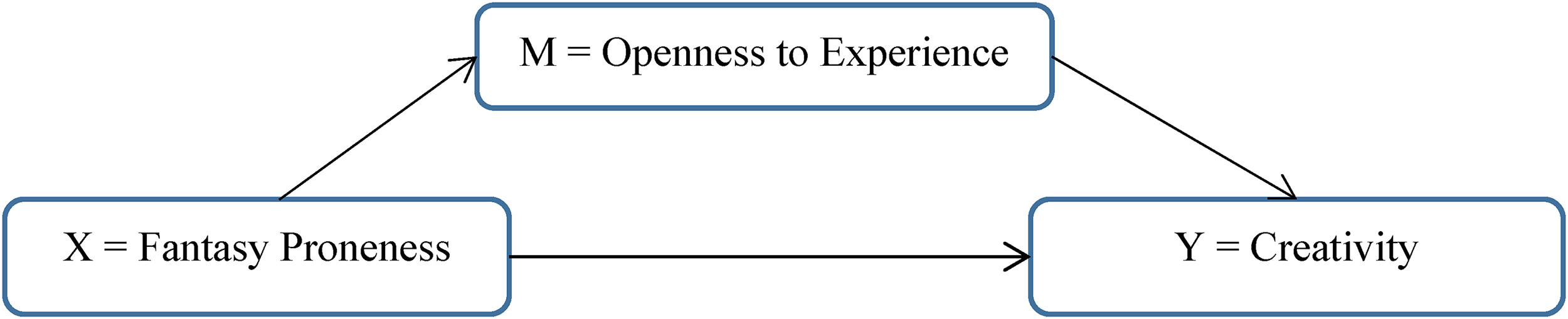
Hypothesized Relation Among Fantasy Proneness and Creativity Mediated by Openness to Experience.
In study 1, we tested these hypotheses with university students who completed the CEQ (Merckelbach et al., 2001) as a measure of fantasy proneness, and an openness to experience measure based on Goldberg et al.’s (2006) inventory. To measure creativity, we employed two divergent thinking tasks: the first was an instances task (generate alternate instances of things that make a noise) (Wallach & Kogan, 1965) and the other was an alternate uses task (generate alternate uses for a cup) (Guilford, 1971). Although divergent thinking tests have been criticized for providing a narrow measure of creative thinking, they were used in the current studies to enable findings to be compared with other research (Plucker & Runco, 1998; Zeng et al., 2011). Undergraduates from two courses, psychology and creative writing, were recruited in order to compare potential effects of studying a creative arts subject versus a science subject. However, we found no differences between each subject in the relations between our key variables, thus we did not consider the effect of subject further. In Study 2, we repeated the method with an age-matched sample of science museum visitors to test the generalizability of the findings, given that a substantial amount of creativity research involves undergraduate participants.
Study 1
Method
Participants
The participants were 87 undergraduates studying at one university in the UK. The average age was 20.84 years (SD = 1.92 years, range 19–31 years). In total there were 67 women (77%), 19 (22%) men, and one participant (1%) who preferred not to answer. The majority of participants identified as White British (81, 93%). Two (2%) identified as Black, 2 (2%) as Asian-British, and 2 (2%) preferred not to answer. Sixty-one (70%) were studying Psychology and 26 were studying Creative Writing (30%).
Materials and Scoring
Fantasy Proneness
This was measured using the CEQ, a 25-item questionnaire developed by Merckelbach et al. (2001). Participants responded yes or no to each item, and the number of yes responses were summed to provide a fantasy proneness score for each participant. Example items included ‘As a child I thought that the dolls, teddy bears, and stuffed animals that I played with were living creatures’ and ‘I often have the feeling that I can predict things are bound to happen in the future’ (Cronbach’s alpha = .75).
Creativity
Participants completed two creativity tests of divergent thinking. The first test was based on Wallach and Kogan’s (1965) Instances test and required participants to ‘list as many different things that you can think of that make a noise’. The second test was an alternate uses test based on Guilford (1971). In the current study participants generated alternate uses for a plastic cup: ‘A plastic cup could be used in different ways, for example, you could use it as a hat, or pretend that it is a toy car. Please list as many uses of a plastic cup as possible.’
Creativity scores were calculated for the instances and alternate uses tasks using the method validated by Runco et al. (1987). This is a combined measure of both fluency and originality, calculated as follows: A weight was assigned to each response to indicate how rare it was in the sample. For example, if an idea was produced by 13 out of 110 participants, it would receive a weight of 1-(13/110) = 0.88. If an idea was produced by only 1 participant, the weight would be 1-(1/110) = 99. The weights for each item were then summed for each participant to produce a creativity score.
We also developed a method to score the real-world applicability of the alternate uses for the cup. This was to consider the ‘Innovation’ dimension of creativity that is often overlooked in studies that focus simply on the number of ideas produced and not their real-world relevance. To assess innovation, each response was coded on a 2-point scale, with 1 being impossible and 2 being possible. Example impossible responses included using it as a rocket, mobile phone, fairy lights, or as a tree. Example possible responses included using it as a pen holder, for drawing on, as a plant pot, or as a bug catcher. Reponses that were described as something that you could pretend to do with the cup, e.g. pretend to use it as a rocket, were scored as possible. A second rater scored 25% of the responses and interrater agreement for innovation scores was substantial, Cohen’s Kappa = 0.68, p < .001. Innovation was calculated by multiplying the weighted fluency score with the innovation score for each item, then summing the items.
Openness to Experience
A set of 12 statements was taken from Goldberg et al.’s (2006) inventory for openness to experience to assess this big five dimension of personality, based on NEO-PI-R Domains (Costa & McCrae, 1992, as cited by Goldberg et al., 2006). Participants responded to the statements by rating how accurately each one described their own behaviour on a scale of 1 to 5, where 1 = a very inaccurate description of yourself and 5 = a very accurate description of yourself. Example items were ‘Enjoy hearing new ideas’ and ‘Have a vivid imagination’ (Cronbach’s alpha = .80).
Procedure
Ethical approval was granted by the first author’s institution. Students were invited to take part in the study after lectures through the online questionnaire platform Qualtrics. Questions were presented in a fixed order, starting with the creativity tests, followed by the CEQ, and lastly the openness inventory. Demographic questions were asked at the end. It took approximately 15 min to complete.
Results
Preliminary analyses indicated that there were no significant effects of age, gender, ethnicity, or degree program on any of the variables of interest (fantasy proneness, openness, instances originality, alternate uses originality, or alternate uses innovation). Therefore, data were collapsed across these variables in the main analyses.
We used mediation analysis to test the hypotheses that: 1) fantasy proneness has a direct positive relation to creativity; 2) openness has a direct positive relation to creativity; 3) fantasy proneness has a direct positive relation to openness; and, 4) fantasy proneness has an indirect effect on creativity through openness (Figure 1). The outcome variables were: 1) instances originality; 2) alternate uses originality; and, 3) alternate uses innovation. In all three analyses, fantasy proneness was the predictor variable and openness was the mediator variable. Fantasy proneness and openness accounted for 31% of the variance in instances originality scores (adj R2 = .10), 23% of the variance in alternate uses originality scores (adj R2 = .05), and 27% of the variance in alternate uses innovation scores (adj R2 = .08). Table 1 contains descriptive statistics for all variables and the correlation coefficients between fantasy proneness, openness, and each of the outcome variables.
Correlations among Fantasy Proneness, Openness to Experience, and the Three Creativity Scores (Study 1).
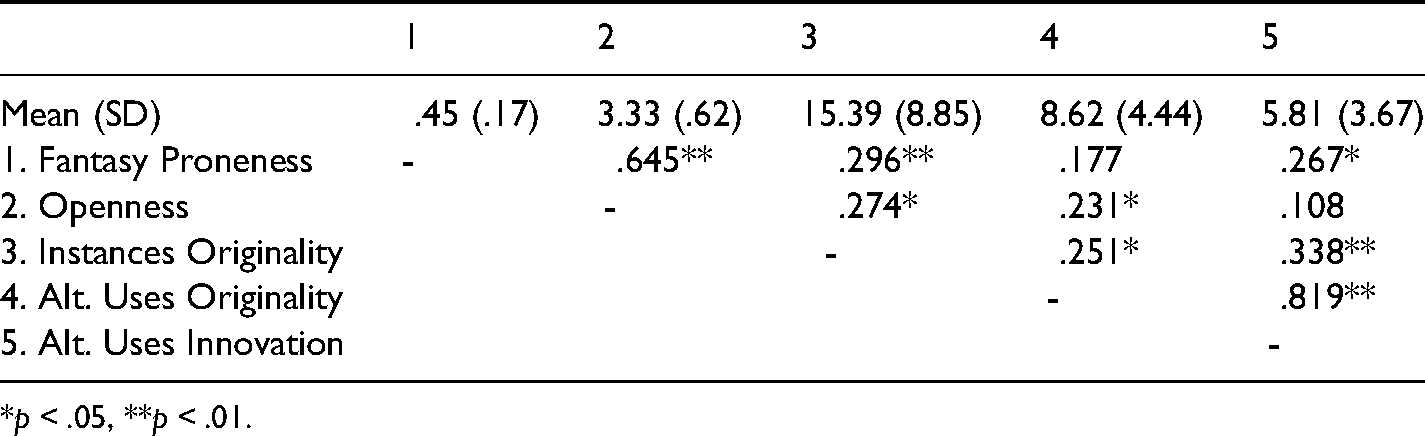
*p < .05, **p < .01.
A simple mediation analysis using ordinary least squares path analysis with 10,000 bias corrected bootstrap samples was conducted for each of the three creativity scores using PROCESS Model 4 (Hayes, 2013) in SPSSv25. As recommended by Aiken and West (1991), mean-centered scores were used for fantasy proneness and openness. The direct and indirect effects of the predictor variables on each of the three creativity scores are shown in Table 2. As shown in Table 2, fantasy proneness did not have a significant direct effect on instances originality or alternate uses originality, but it did have a significant direct effect on alternate uses innovation. Thus hypothesis 1 was supported in only one of the three models, specifically the model predicting the extent to which task solutions were innovative. Openness did not have a significant direct effect on creativity in any of the three models. Thus, hypothesis 2 was not supported. In support of hypothesis 3, fantasy proneness had a significant direct effect on openness, which was identical in all three models, B = 2.32 (SE = .30), LLCI = 1.72, ULCI = 2.92, p < .001. However, the indirect effect of fantasy proneness on creativity through openness was not significant in any of the three models, therefore, hypothesis 4 was not supported. Thus, in contrast to our hypotheses, fantasy proneness largely did not predict creativity, either directly or indirectly through openness in this sample of undergraduates.
Predictors of Instances Originality, Alternate Uses Originality, and Alternate Uses Innovation Scores of Creativity (Study 1).
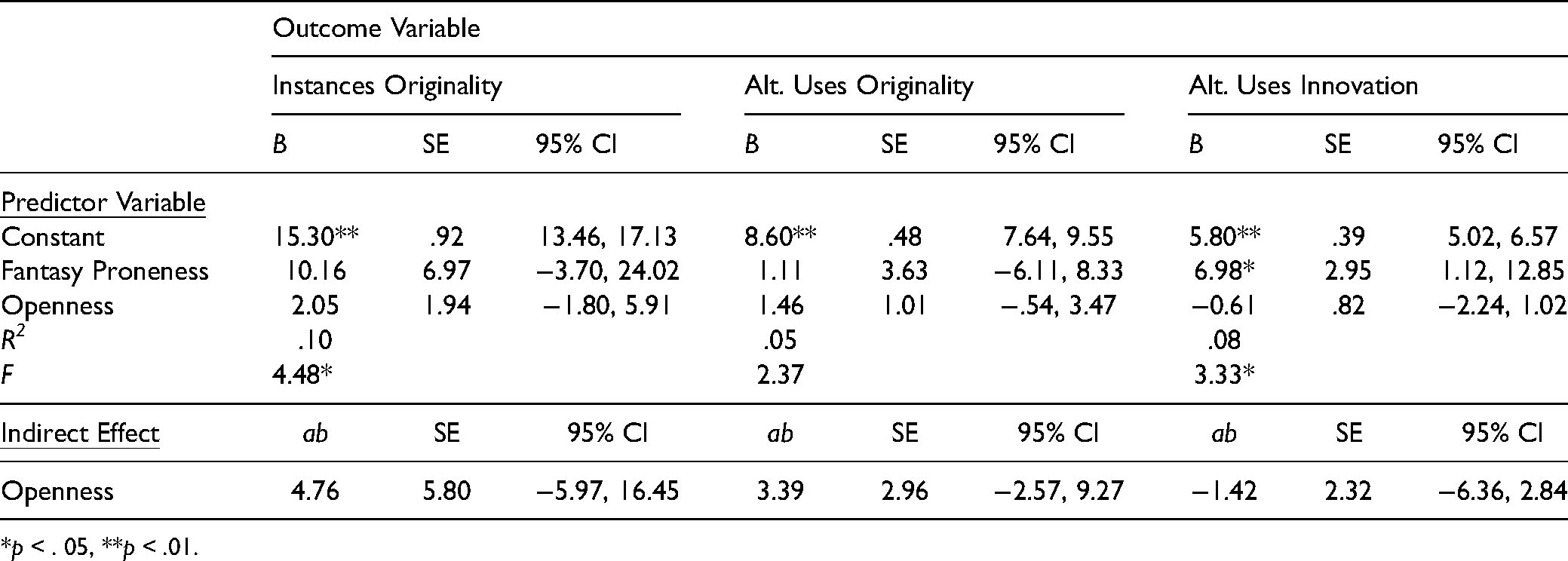
*p < . 05, **p < .01.
Discussion
Surprisingly, in our sample of undergraduates, the mediation analysis largely did not support our hypotheses. First, we did not find a direct relation between fantasy proneness and creativity when creativity was assessed in relation to the ability to generate multiple ideas in divergent thinking tasks, specifically, generating alternate instances of things that make a noise and alternate uses for a cup. It is unclear why our study should fail to find a link, given previous evidence. Fantasy proneness was, however, significant related to innovation when generating alternate uses for a cup: students who were more fantasy-prone generated more innovative (possible) than inappropriate (impossible) uses. At first, this finding may be the opposite of what one might expect. Yet, interesting research with children has found that children who are more fantasy prone (have a higher fantasy orientation) are better at distinguishing between fantasy and reality than children who are less fantasy prone (Sharon & Woolley, 2004). This is thought to be because fantasisers spend more time than non-fantasisers negotiating the boundary between fantasy and real-life when beginning and ending a fantastical episode. Therefore, more fantasy prone children may develop more knowledge about the possibilities and limits of the imagination (Sharon & Woolley, 2004). People with a higher level of fantasy proneness may, as a result, be more cognisant of the realistic/innovative or fantastical/inappropriate nature of their creative output and ultimately be more cognisant of the appropriateness of a response.
Our hypothesis that fantasy proneness would be positively related to the personality trait openness, which is related to interest in the arts and enjoying unconventional and liberal ideas, was also supported by the bivariate correlations and mediation analysis. These data contribute to an emerging literature examining the relation between fantasy proneness and openness. Although prior studies (Sánchez-Bernardos & Avia, 2004; Sánchez-Bernardos et al., 2015; Thibodeau et al., 2018) have found significant associations between fantasy proneness and openness, the strength of the association in this sample was stronger (r = .65) than associations found in previous studies (r = .11 to r = .25). Therefore, future work is needed to determine factors that contribute to the strength of this relation and the ways in which fantasy proneness may support the development of openness.
Finally, our hypothesis that openness would be positively related to creativity was not supported by the mediation analysis, despite modest raw correlations between openness and instances originality and openness and alternate uses originality. In the mediation analysis, we found no direct effect of openness on creativity when fantasy proneness was taken into account. The lack of a relation in the mediation analysis contradicts a body of research showing that openness is the personality trait that is most consistently related to creativity (Batey & Furnham, 2006; Da Costa et al., 2015). Relatedly, the lack of a direct relation between openness and creativity may explain why we also found no support for the hypothesis that there would be an indirect effect or mediating role of openness on the relation between fantasy proneness and creativity. It is not clear why this was the case given conceptual and empirical support for hypothesizing such links. Perhaps the timing of data collection for the students (after a lecture) meant that their cognitive resources were low and they were not able to produce as many creative responses as might otherwise have been possible (De Right & Jorgensen, 2015). Alternatively, perhaps the lack of diversity in the sample meant that there was insufficient variability to detect individual differences. With these limitations in mind, we replicated the research in Study 2 with an age-matched, but more diverse sample, by recruiting participants from a public space in a museum. We also assumed that these participants’ cognitive resources would not be fatigued, which was potentially the case in the student sample in Study 1.
Study 2
In Study 2 we further tested the potential mediating effect of openness to experience on the relation between fantasy proneness and creativity in participants who were not fatigued from a lecture, and who were more diverse/representative of the population. We chose a museum setting (Science Museum, London, UK) because this provided a real-world setting outside of university from which to recruit participants, and because it afforded a practical and quiet space for participants to complete the task. Four hundred and sixty-seven museum visitors completed the survey, but only data from a subsample of 166 visitors representing the same age range as the students in Study 1 were analyzed in Study 2.
Method
Participants
Participants were 166 museum visitors aged between 19 and 31 years (M = 23.14 years, SD = 3.08). There were 98 women (58%) and 68 men (42%). The majority listed their nationality as either British (49%) or American (12%), but 28 other nationalities were represented. In terms of ethnicity, 74% identified as white, 8% identified as multi-ethnic, 8% as Asian or Asian-British, 5% as Black, and 4% as ‘in another way’. Participants represented a range of occupations, including teacher, nurse, pharmacist, musician, artist, and engineer. Approximately half (48%) were university students, which is representative of the general population (Kershaw, 2019), and they were studying a diverse range of subjects.
Materials
The materials and scoring procedures were identical to Study 1. Cronbach’s alpha was .78 for openness to experience and .83 for fantasy proneness. Interrater agreement for coding the innovation scores was substantial (Cohen’s Kappa = 0.73, p < .001).
Procedure
Participants were all visitors at the ‘Who am I?’ gallery in the Science Museum, London, UK, which has a dedicated space for visiting researchers to demonstrate ‘live’ science to visitors. Visitors in the gallery were informed about the research by research assistants and invited to take part. Only participants who gave informed consent completed the questionnaire. The only limits on who could take part were that they had a level of English that enabled them to understand the information sheet and produce answers in written English. Participants completed the questionnaire online using the computers provided. Questions were presented in a fixed order as described in Study 1. It took approximately 15 min to complete.
Results
We repeated the same set of analyses as in Study 1. Preliminary analyses indicated that neither age, gender, nor ethnicity were significantly related to any of the creativity scores, therefore, these variables were not included in the main analyses. We repeated the mediation analysis from Study 1 to test the same hypotheses. Fantasy proneness and openness accounted for 24% of the variance in instances originality (adj R2 = .06), 23% of the variance in alternate uses originality (adj R2 = .05), and 22% of the variance in alternate uses innovation (adj R2 = .05). (This was generally slightly less than in Study 1–31%, 23%, and 27% respectively). Table 3 contains descriptive statistics for all variables and the correlation coefficients between fantasy proneness, openness, and each of the outcome variables.
Correlations among Fantasy Proneness, Openness to Experience, and the Three Creativity Scores (Study 2).
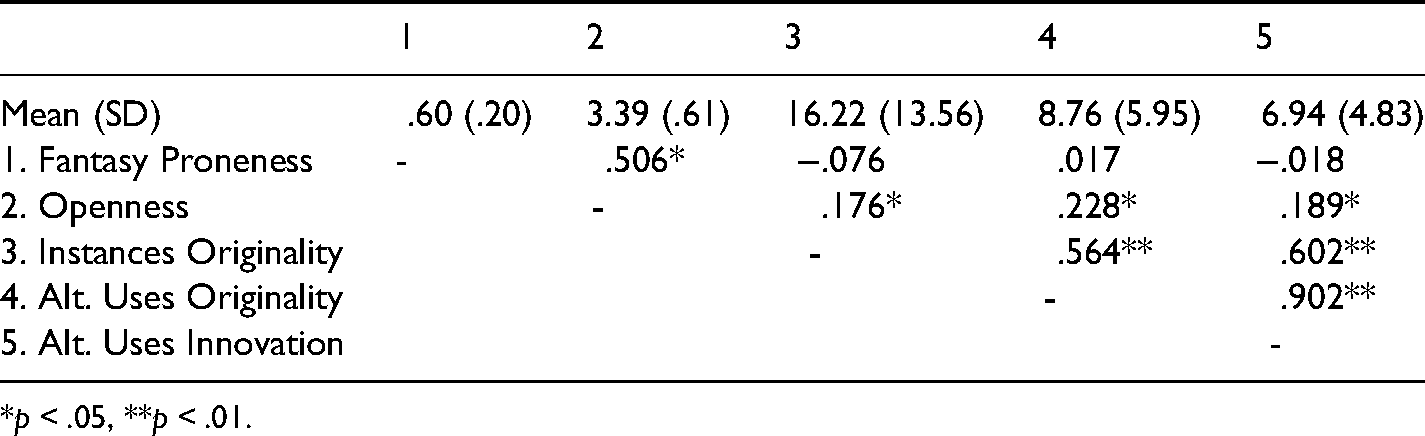
*p < .05, **p < .01.
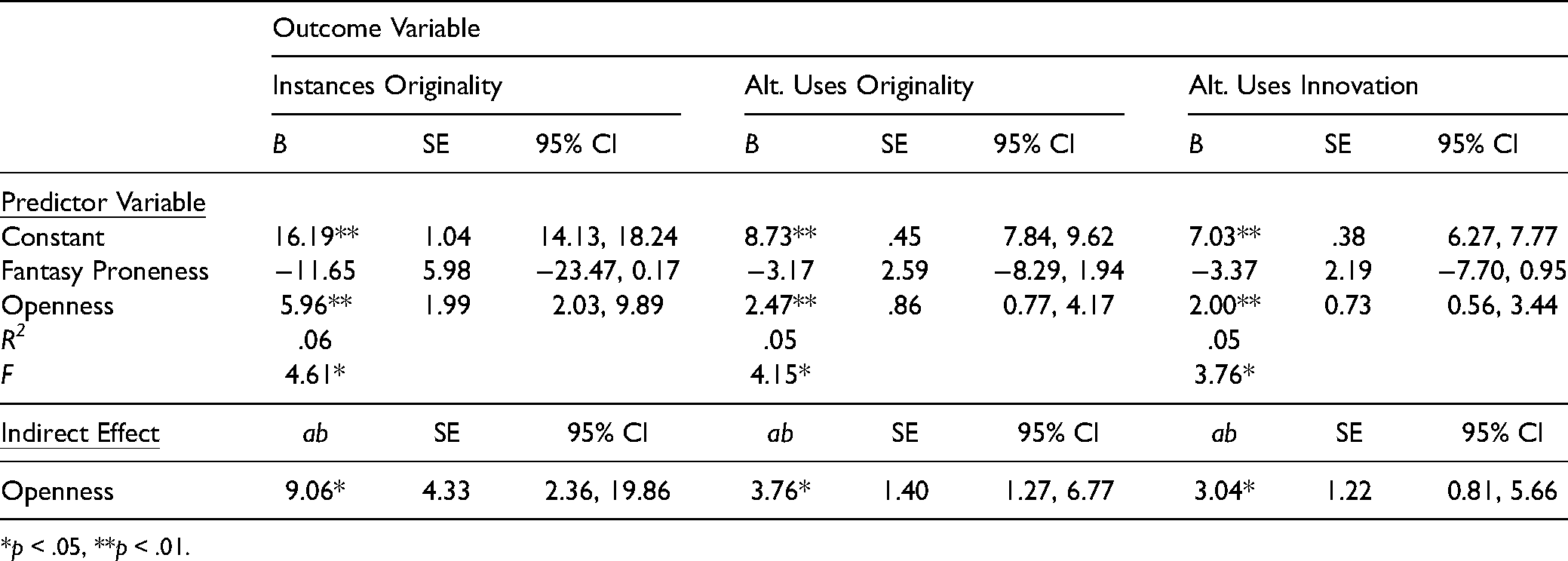
The direct and indirect effects of the predictor variables on each of the three creativity scores are shown in Table 4. As this table shows, fantasy proneness did not have a significant direct effect on instances originality, alternate uses originality, or alternate uses innovation, therefore, hypothesis 1 was not supported. However, the remaining hypotheses were supported in all three models: openness had a significant direct effect on creativity (hypothesis 2); fantasy proneness had a significant direct effect on openness, B = 1.52 (SE = .21), LLCI = 1.11, ULCI = 1.93, p < .001 (hypothesis 3); and fantasy proneness had a significant indirect effect on creativity through openness (hypothesis 4).
Predictors of Instances Originality, Alternate Uses Originality, and Alternate Uses Innovation Scores of Creativity (Study 2).
*p < .05, **p < .01.
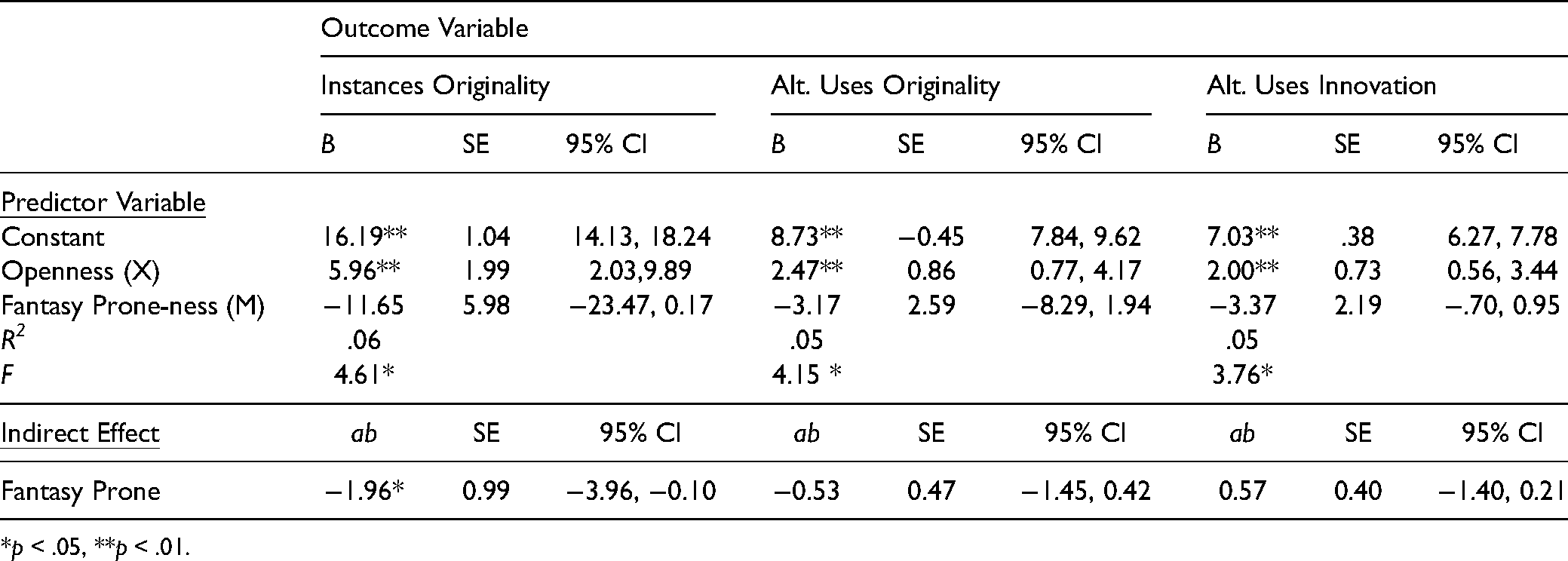
To further probe the direction of the indirect effect and establish whether fantasy proneness supports openness or whether openness supports the development of fantasy proneness, we conducted a set of mediation analyses with the same three outcome variables, but with openness as the predictor variable and fantasy proneness as the mediator. The results (see Table 5) lent further support to our hypothesis that fantasy proneness supports openness rather than openness supporting the development of fantasy proneness because in two out of the three models the indirect effect of openness on creativity through fantasy proneness was not significant. However, in one model (originality in the instances task) the indirect effect of openness on creativity through fantasy proneness was significant.
Predictors of Instances Originality, Alt. Uses Originality, and Alt. Uses Innovation with Openness as the Predictor (X) and Fantasy Proneness as the Mediator (M) (Study 2).
*p < .05, **p < .01.
Discussion
In contrast to Study 1, the data in Study 2 provided more robust support for our hypotheses. Fantasy proneness was directly related to openness, which, in turn, was directly related to all three assessments of creativity, namely higher originality scores on the instances and alternate uses tasks, and higher innovation scores on the alternate uses task. Furthermore, the direct link between fantasy proneness and creativity, although not significant itself, was fully mediated by openness. This suggests that fantasy proneness was indirectly associated with creativity because it positively predicted the personality trait openness, which was strongly correlated with creativity. However, the finding that openness predicted creativity indirectly through fantasy proneness in one case (originality in the instances task) in the reverse mediation analysis, suggests that there may be certain types of creativity that are differentially affected by fantasy proneness and openness. Nonetheless, the findings from this sample of participants supports the theoretical rationale for finding meaningful relations between fantasy proneness, openness, and creativity, and further research should explore the limits and vulnerabilities of these relations.
There are at least two potential explanations for the differences in findings between the two studies in terms of participant differences. In Study 1, the participants were students completing the task after a lecture when their cognitive resources may have been depleted, which could have negatively affected their creativity. In contrast, Study 2 participants took part during a leisure trip to a museum and may have had more energy to devote to the tasks. Second, in Study 2, the sample was more diverse and representative of the general population in that age range.
General Discussion
Although fantastical thinking is often thought of as a quality of early childhood thinking that is left behind in adulthood, the ability to engage in fantasy supports many adult pursuits. Fantasy is a central component of many leisure activities, ranging from intense engagement with favourite TV shows, movie series, or video games, to doll collecting, to participating in historic re-enactments or amateur theatre productions. These activities require a sustained commitment of time as well as cognitive and emotional resources, and provide a sense of community and shared meaning for many participants (Dill-Shackelford & Vinney, 2020; Dreschke, 2019; Ignacio & Cupchik, 2021). Nonetheless, fantasy proneness, or the tendency to become deeply involved in fantasy (Wilson & Barber, 1982) and its potential relations with everyday cognitive functioning have rarely been studied. Rather than being viewed as a maladaptive trait that has relations with psychopathy, Wilson and Barber argued that fantasy proneness may be adaptive because of its potential links with cognitive processes such as creativity. Others have proposed that fantasy proneness may be associated with creativity because they both involve imagining how things could be different rather than how they actually are. The current studies examined these issues by exploring the potential mediating impact of openness on the relation between fantasy proneness and creativity.
Results from both studies support the claim that the personality trait openness has relations to fantasy proneness and creativity. Specifically, in both studies, bivariate correlations revealed that fantasy proneness was moderately to strongly associated with openness, and, across the two studies, openness was positively associated with each of the three measures of creativity. In addition, Study 2 provided evidence of an indirect effect of fantasy proneness on each of the three measures of creativity through openness.
The finding that fantasy proneness is indirectly related to creative thinking supports Wilson and Barber’s (1982) argument concerning the adaptive aspects of fantasy proneness, as well as more recent efforts to identify the positive effects of imaginative involvement in adulthood (e.g., Naylor & Simonds, 2015; Plante et al., 2017). According to Naylor and Simonds (2015, p. 113), imaginative involvement, or “the tendency to mentally suspend reality through the broadening and narrowing of consciousness” encompasses the related constructs of fantasy proneness, absorption, and daydreaming. They argue that recent efforts to identify the role of imaginative involvement in typical development and cognitive functioning have been hampered by the use of measurement scales developed for clinical research in which questions about imaginative experiences in adulthood refer primarily to intrusive and negatively valenced fantasies. Although the fantasy proneness instrument used in the present studies, the CEQ, was specifically designed to minimize “invasive” questions, it retains questions related to paranormal experiences as well as questions describing negative physical responses, such as nausea, to imagined experiences (Merckelbach et al., 2001). This suggests that a fruitful direction for future research might be to examine the relations among imaginative involvement, as measured with their more positively valenced Imaginative Involvement Questionnaire, (IIQ), openness, and creativity.
Although the results of the current study are a promising step toward understanding the role of fantasy proneness in creativity, the results of the two studies were not entirely consistent with each other. Consideration of the differences between the samples used in the studies and the patterns of associations among fantasy proneness, openness, and creativity observed across the two studies suggest an additional direction for future research. In Study 1, with a sample comprising university students studying psychology and creative writing, the correlation between fantasy proneness and openness was especially strong, and both fantasy proneness and openness were related to two of the three measures of creativity. However, neither fantasy proneness nor openness emerged as independent predictors of originality, although fantasy proneness did predict innovation ratings of solutions to the alternate uses for a cup task. In contrast, in Study 2, with a broader sample of young adults recruited from a science museum, the correlation between fantasy proneness and openness was smaller (although still larger than has been found in previous studies), and openness was positively related to all three measures of creativity. In contrast, fantasy proneness was not directly related to any of them. It is possible that greater the differentiation between fantasy proneness and openness in Study 2 reflected greater variability in the aspects of fantasy proneness and openness represented in the more diverse sample of Study 2, and that this allowed for effective measurement of relations among fantasy proneness, openness, and creativity.
This possibility is raised by recent work indicating that both fantasy proneness and openness are multifaceted dimensions of personality; therefore, the specific facets of each construct present in a sample may influence the extent to which the two constructs are interrelated, as well as the extent to which either is associated with creativity. Openness is commonly measured as two correlated but separate sub-traits: ‘openness,’ which comprises the facets of fantasy, feelings, and aesthetics, and ‘intellect,’ which comprises the facets of ‘ideas’ and ‘values’ (De Young et al., 2007; Kaufman et al., 2016). The two sub-traits are both associated with creativity, but one study found that they are associated with different fields of creativity: Kaufman et al. (2016) found that ‘openness’ predicted creative achievement in the visual arts, music, and creative writing, whereas ‘intellect’ predicted creative achievement in science and inventions (Kaufman et al., 2016). The separate facets of openness are also differentially related to the two factors of Fantasy Proneness identified by Sánchez-Bernardos et al. (2015). Factor 1, which measures vivid imagery, frequent daydreaming, and use of fantasy as an escape is more highly associated with the fantasy facet, whereas Factor 2, which measures childhood experiences with fantasy and unusual experiences, is more strongly associated with aesthetics and feelings. This analysis suggests that future studies of relations among fantasy proneness, openness, and creativity should involve sufficiently large and diverse samples to determine whether the relations are moderated by domain, for example, art vs. social science. They should also use measures of fantasy proneness and openness that permit examination of differential relations between the two factors of fantasy proneness, the two sub-traits of openness, and domain general measures of creativity. Finally, rather than give participants separate tests of these constructs, it would be fruitful to create a way in which all key constructs can be tested by embedding them in a meaningful task to create a more ecologically valid test. This could involve a variation of the Consensual Assessment Technique (Amabile, 1982) in which participants respond to one or more problem prompts (e.g., ‘design a living space for a family coping with the effects of climate change in the year 2100’) and a panel of raters evaluate the responses on creativity, the perceived personality of the creator, and the amount of fantastical thinking involved in producing the response.
Conclusion
As we enter the third decade of the 21st century, the need for creative thinkers who can envision and execute solutions to the world’s problems, including climate change, pandemics, natural disaster, and widespread social unrest, is clear. In this context, it is especially important to understand factors that contribute to individual differences in creativity, including personality factors. The current studies contribute to this understanding by documenting the mediational role of openness in the relation between fantasy proneness and creativity. Although previous studies have examined relations between each component of our hypothesized model, to our knowledge, these are the first studies to examine the nature of relations between all the three components. Future research should examine which facets of fantasy proneness and openness to experience are most closely related to creativity and identify social and educational experiences that are effective in promoting the development in creativity in individuals with these characteristics.
Footnotes
Declaration of Conflicting Interests
The author(s) declared no potential conflicts of interest with respect to the research, authorship, and/or publication of this article.
Funding
The author(s) received no financial support for the research, authorship, and/or publication of this article.
