



Abstract
Internal dialogue, the verbal intrapersonal communication among our inner voices, characterizes and influences creative thinking. Open questions remain, however, about how individual differences in internal dialogical activity relate to creative thinking. A survey study (N = 325) was therefore conducted to explore the correlations between individual differences in internal dialogical activity, creative potential, and creative achievement. The results showed that internal dialogical activity correlated positively with creative achievement, which can be explained by a disposition to dialogically engage with thoughts, opinions, and ideas. Internal dialogical activity also correlated positively with originality during divergent thinking, which can be explained by a disposition to experience many types of internal dialogues. Supportive internal dialogical activity positively correlated with the production of many diverse responses. No correlations were found with convergent thinking. Herewith, the present study contributes novel insight into the relationship between internal dialogical activity, creative potential, and achievement.
Internal Dialogue, Creative Potential, and Creative Achievement
Creativity, the conception of ideas, solutions, or products that are novel yet appropriate (Runco & Jaeger, 2012), can be adaptive when there is uncertainty about whether and how a satisfactory problem solution can be developed, such as in situations that are complex, novel, ill-defined, and otherwise uncertain (Beghetto, 2021). When no ready-made solution can be selected from one's existing problem solution repertoire (Reiter-Palmon, 2017), creativity can help escape from a current suboptimal situation in favor of an improved future one (Sawyer, 2011). Indeed, whether it is solving problems related to our everyday functioning (Puccio, 2017), or thinking about how to address the world's most pressing challenges, such as ending world poverty (Si et al., 2021), creative thinking often has a role to play (Kaufman & Beghetto, 2009). Furthermore, creative skills are essential in a broad range of professional domains, including art, design, and invention (Carson et al., 2005). One major contributing factor to creativity is the manner in which people engage in a dialogue with others (Paulus & Nijstad, 2003), materials (Schön, 1992), and machines (Frich et al., 2019), to advance their creative process. The contemporary discourse on creativity, however, tends to omit one critical form of dialogue: The internal dialogue that goes on between a person's inner voices.
Internal dialogue can be conceptualized as the intrapersonal communication between a person's inner voices (Hermans, 1996, 2003). These inner voices can represent different aspects of the self and of imagined real or fictional others – and can be viewed as the verbal manifestation or component of imagined interactions (Honeycutt, 2010; 2020). The types of internal dialogues people tend to engage in, influence how they think and act in the world (Oleś, 2009; Oleś & Puchalska-Wasyl, 2010). Supportive internal dialogues, for example, emphasize positive aspects of the self or imagined others, coloring the way a person makes sense of, and acts within, their environment more positively. Early theoretical (Fernyhough, 2016; Glăveanu, 2017) and qualitative research (Hellerstein, 2009) suggest that internal dialogues can also play a role in creative thinking. The scarcely available quantitative evidence, however, suggests no relationship between internal dialogues and creative potential (de Rooij, 2022b). These preliminary findings, however, might be a consequence of a narrow conceptualization of internal dialogical activity. Exploratory quantitative research can therefore help to further untangle the relationship between internal dialogue and creativity.
The present study explores how individual differences in internal dialogical activity correlate with creative potential and creative achievement. In what follows, the rationale that underpins the alleged relationship between internal dialogue and creative potential and achievement will be unpacked in more detail, after which the method and result of a correlational study will be presented. The paper ends with a discussion of these results, study limitations, and new directions for future research that can help to further understand the relationship of internal dialogue with creative thinking.
Internal Dialogue
The Dialogical Self Theory postulates that inner experience is partly characterized by the representation of different voices of the self, and those of real and fictional others (Hermans, 1996, 2003). Internal dialogue is the intrapersonal communication between these different inner voices. These inner voices can represent different aspects of the self or those of (fictional) others. Internal dialogue can be experienced by the production of verbal mental imagery in the absence of any overt and audible vocalization (Honeycutt, 2020; Oleś & Puchalska-Wasyl, 2010). For example, by posing questions and receiving answers, having disagreements and reaching agreements, and expressing doubts between the voices experienced within (Puchalska-Wasyl & Oleś, 2013). Hermans and Hermans-Konopka (2010) suggest that knowledge deficit, ambiguity, complexity, and other causes of uncertainty activate internal dialogues. These internal dialogues serve to regulate cognition (e.g., changing perspective to solve a problem), emotion (e.g., ruminative dialogues that maintain negative emotion), and motivation (e.g., supportive dialogues to maintain engagement) either adaptively or maladaptively (Oleś & Puchalska-Wasyl, 2010; Puchalska-Wasyl & Zarzycka, 2021). Internal dialogues can therefore be seen as a form of simulated action that emerges from the different ways in which inner voices interact and respond to situations that elicit uncertainty. The character of the inner voices in dialogue, and the types of exchange that these voices have, characterize how people make sense of, and act within, their inner and outer environment (Oleś & Puchalska-Wasyl, 2010).
Although internal dialogues are often studied independently (Oleś & Puchalska-Wasyl, 2010), internal dialogues can be seen as the verbal manifestation, or the verbal component, of the broader and richer construct of imagined interactions. Imagined interactions are “a type of daydreaming, social cognition, and mental imagery in which people experience cognitive representations of conversation with accompanying verbal and nonverbal features” (Honeycutt, 2020, p. 387). Imagined interactions can be multimodal. Where, for example, verbal mental imagery enables the intrapersonal communication between a person's different inner voices, and visual mental imagery enables experiencing the scene in which the verbal dialogue takes place (Honeycutt, 2003, 2010, 2020). As such, internal dialogues can manifest as the verbal component of imagined interactions. Not all imagined interactions, however, involve visual mental imagery (Dawes et al., 2022). That is, when people engage in inner speaking in dialogical form without the involvement of other types of mental imagery, internal dialogue can also be seen as a verbal manifestation of imagined interactions (Honeycutt, 2020).
Internal dialogue can also be conceptualized as one of the phenomenological qualities of inner speaking (Alderson-Day et al., 2018; McCarthy-Jones & Fernyhough, 2011). Inner speech is commonly defined as the production and experience of verbal language without any overt and audible vocalization (Alderson-Day & Fernyhough, 2015; Fernyhough, 2016; Langland-Hassan, 2021). While people tend to experience inner speaking in dialogical form, with some reports stating that over 75% of inner speaking has a dialogical quality, inner speaking can also manifest purely in monological form (Alderson-Day et al., 2018; McCarthy-Jones & Fernyhough, 2011). For example, when an inner voice merely narrates, rather than engages in a back-and-forth with other inner voices. In other words, inner speech is necessary for internal dialogues, but not all inner speech is dialogical.
The Vygotskian view is that the capacity for having internal dialogues develops from a process of internalization (Vygotsky, 1934/1987). People engage with children through verbal dialogue to understand and regulate their cognitions, emotions, and motivations. Children then learn to simulate dialogue and apply its functions to themselves through private speaking, which later becomes fully internalized as inner speaking (Alderson-Day & Fernyhough, 2015). Internal dialogues, therefore, tend to manifest as intrapersonal communication of the self with imagined real and fictional others, and as the simulation of social relationships (Honeycutt, 2020; Oleś & Puchalska-Wasyl, 2010). For example, we might use our imagination to carry on social interactions when the original interlocutor is not present anymore to resolve an unfinished discussion. Outside the constraints imposed by social interactions with other people, however, internal dialogues can also be applied solely to the self (Hermans, 1996; Puchalska-Wasyl et al., 2008). For example, as a way to confront and resolve different conflicting positions within the self, such as when ‘good me’ thinks I should do X, but ‘bad me’ thinks I should do Y.
Individual differences in internal dialogical activity derive from the presence, character, and dominance of different kinds of inner voices, and the frequency and type of intrapersonal communication that tends to occur between these inner voices (Hermans, 1996, 2003; Hermans & Hermans-Konopka, 2010; Oleś, 2009; Puchalska-Wasyl et al., 2008; Puchalska-Wasyl & Zarzycka, 2021). Oleś (2009) suggest that the following types of internal dialogical activity commonly occur within the general population: 1) spontaneous dialogue (a disposition for spontaneous dialogical engagement with thoughts, opinions and ideas); 2) identity dialogues (dialogues aimed at understanding and shaping one's identity, values and priorities in life); 3) supportive dialogues (dialogues used to upregulate and downregulate positive and negative thoughts); 4) ruminative dialogues (repeating negative thoughts or memories in dialogical form); 5) confronting dialogues (playing out multiple conflicts between different aspects of the self, such as between the aforementioned ‘good me’ and ‘bad me’); 6) social simulation (conducting by imagination past or future conversations with others, including discussions, quarrels, or exchanges of ideas); and 7) change of perspective (using dialogue as a way to shift one's point of view to understand challenging situations or searching for solutions, including taking a promising or conflicted perspective of someone else, or of a less dominant aspect of the self).
Creative Potential and Creative Achievement
To conceive a creative idea, solution, or product, one typically engages in a creative process (Lubart, 2001). Although the details of creative processes differ between people (Obenzinger, 2015), projects (de Rooij et al., 2021), and domains (Glăveanu et al., 2013), most suggest that creativity requires undertaking activities to understand the problem at hand, generate ideas, and effectively evaluate and select ideas (Lubart, 2001; Mumford & McIntosh, 2017). Some models also suggest that selected ideas must undergo an iterative process where steps are taken toward implementation, and an idea, solution, or product is revised based on what is learned (Garud et al., 2013; Mumford & McIntosh, 2017). The assumption here is that exposition to the complexities of the real world will help reduce uncertainty about whether a novel idea can truly be developed into something appropriate (Jalonen, 2012). Due to the extensiveness and variability of creative processes, however, it is challenging to develop standardized tests that effectively capture creative ability.
To capture individual differences in creative ability in experimental and survey studies researchers therefore commonly resort to measures of creative achievement and to psychometric tests of creative potential. Creative achievement refers to “… the sum of creative products generated by an individual in the course of his or her lifetime” in domains that are historically associated with creativity (e.g., art, design, invention) (Carson et al., 2005, p. 37). The critical assumption here is that the magnitude of creative achievement stems from a complex of intrapersonal differences, such as divergent and convergent thinking ability, but also, e.g., intelligence, imagination, openness, intrinsic motivation; and interpersonal differences, ranging from access to resources and opportunities to work with experts, to whether societal and cultural norms are conducive to personal development in creative domains (Carson et al., 2005). In other words, some factors that are implicitly measured by creative achievements relate directly to creative ability, whereas other factors relate to enabling circumstances for creative activities and disseminating creative products. Creative achievement, therefore, provides broad insight into individual differences relevant to real-world creativity.
Testing creative potential, which typically encompasses administering divergent and convergent thinking tests, provides more precise insight into cognitive processes that can contribute to creativity. Divergent thinking, the production of variation, is assumed to increase the chance that sufficiently varied and novel material is generated during a creative process such that an original yet useful idea, solution, or product can be developed (Erwin et al., 2022). Divergent thinking is often tested with Guilford’s (1967) alternative uses task (AUT), where people are asked to generate as many creative and original uses of an object (e.g., a pencil) within a short time. Convergent thinking is a search process whereby an optimal solution is generated by integrating remotely associated information, and by selecting the most optimal answer (Cropley, 2006; Smith et al., 2013). Mednick’s (1962) Remote Associates Test (RAT), where participants are presented with multiple word triads for which another word needs to be retrieved from memory that connects all three presented words (e.g., item: “fish/ mine/ digger”, answer: “gold”), is often administered to test convergent thinking (Wu et al., 2020). Still, tests of creative potential show weak predictive validity for real-world creative ability (e.g., Harris et al., 2019; Jauk et al., 2014; Liu et al., 2019; Said-Metwaly et al., 2022). This limited predictive validity can be attributed to the observation that creativity requires more than divergent and convergent thinking alone (Runco & Acar, 2012) and that their efficacy may be domain-dependent (Baer, 2022).
Internal Dialogue, Creative Potential, and Creative Achievement
Early theoretical and qualitative research suggests that there may be a relationship between individual differences in internal dialogical activity and creative achievement. Internal dialogues (Hermans & Hermans-Konopka, 2010) and creativity (Beghetto, 2021) can both result from encountering uncertainty. Glăveanu (2010, p. 87) argues that creativity is connected to previous knowledge by “… a dialogical relationship with the ‘old’ or the ‘already-there’. Any innovative idea or object never comes out ex-nihilo …”. Hellerstein’s (2009) interview studies suggest that the internal dialogue may be one such dialogue that is involved in creative thinking. Their research suggests that creative professionals routinely rely on internal dialogues with different aspects of the self, with real and fictional others, and through social simulation to progress their creative process. If we assume that creative achievement requires frequent engagement in the creative process, and engagement in the creative process commonly involves internal dialogues, then we can conjecture that creative achievement positively correlates with internal dialogical activity.
There might be more to this alleged relationship between internal dialogical activity and creative achievement. Creative achievement typically correlates with intrapersonal factors that support exploring varied positions and perspectives (Glăveanu, 2021), such as divergent thinking and openness to experience (Carson et al., 2005). Internal dialogical activity, when characterized by a the intrapersonal communication by, and of, an increasing number of different inner voices (Oleś, 2009), could also be a source of variation that underlies creative achievement. This aligns with Fernyhough’s (2016) theoretical assertion, who suggests that internal dialogue can facilitate creativity because it enables a way of thinking where “… perspectives from experience and memory can come together in varied, troublesome and regenerative ways” (Fernyhough, 2016, p. 157). The variation introduced by the intrapersonal communication of, and between, an increasing number of inner voices might be a previously understudied way in which creativity is achieved. Taken together, we argue that these conjectures suggests the following hypothesis: Internal dialogical activity positively correlates with creative achievement (H1).
With regard to creative potential, we argue that the above rationale could also apply. Previous research suggests that interpersonal differences that broadly relate to variation in thinking positively correlate with performance on tests of creative potential. These include verbal fluency (Silvia et al., 2013), flexible attention (Palmiero et al., 2022) and exploration states (de Rooij et al., 2018) for divergent thinking, and associative fluency (Benedek & Neubauer, 2013) and remote association (Mednick, 1962) for convergent thinking. Speculatively, internal dialogical activity could be yet another, currently understudied, source of variation that underlies creative potential. The findings by de Rooij (2022b), however, appear to go against this conjecture. Their results suggest no correlation between a disposition for engaging in dialogical inner speaking with performance on the AUT nor on the compound remote associates task. The dialogicality measure in the used revised varieties of inner speech questionnaire is, however, not designed to capture the variability of internal dialogical activity (Alderson-Day et al., 2018), but is rather more akin to Oleś's (2009) spontaneous dialogue. To explore this further, we propose to test the following working hypothesis: Internal dialogical activity positively correlates with measures of creative potential (H2).
Individual differences in specific types of internal dialogical activity might relate to creative potential and achievement in both adaptive or maladaptive ways. As mentioned, the mere inner dialogical engagement with thoughts, opinions, and ideas might be commonly relied on by creative professionals (Hellerstein, 2009), but does not correlate with measures of creative potential (de Rooij, 2022b). Supportive and ruminative dialogues might be one way in which people tend to talk themselves up or down (Oleś, 2009), and could therefore augment or diminish the correlates of intrinsic motivation and positive affect (e.g., Hardy, 2006) with creative achievement (de Rooij, 2022a; Hellerstein, 2009; Rogelberg et al., 2013) and creative potential (Daugherty, 1993). However, these relationships appear to be unstable in correlational studies (Daugherty, 1993; de Rooij, 2022b), and appear to be highly sensitive to situational factors (de Rooij, 2022a; Hardy, 2006). Furthermore, creative professionals incidentally simulate social dialogues with protagonists (Foxwell et al., 2020), clients (de Rooij et al., 2021), family and friends, peers, critics, and audiences (Hellerstein, 2009) to generate the information they can use to advance their creative process. Whether social simulation structurally relates to creative achievement, however, is an open scientific question. Finally, little is known about whether individual differences in other common types of internal dialogical activity, such as identity dialogues, confronting dialogues and the use of dialogue to shift perspectives relate to creativity. The literature, therefore, leaves us with many open questions about the relationships between specific types of internal dialogical activity, creative potential, and creative achievement. To explore these potential correlation further, we propose to answer the following research question: How do individual differences in engaging in different types of internal dialogical activity correlate with measures of creative potential and creative achievement? (RQ1).
Method 1
Participants
Three hundred thirty-six people initially participated in the study. Data from eleven participants were removed because they did not complete the study. The data from the remaining 325 participants (Mage = 21.12, SDage = 3.23, 239 self-identified females, 82 males, 4 non-binary or third gender) was therefore used in the analyses. The participants were recruited from the human subjects pool of the Tilburg School of Humanities and Digital Sciences, Tilburg University. All participants were students enrolled in one of the higher education programs at this institute (5 master, 156 pre-master, 164 bachelor students). The sample was predominantly Dutch (n = 233), with 92 participants representing 41 other nationalities. Their mastery of the English language was at least advanced (C1) (Cambridge English test), or comparable, as per the entry requirements of the Tilburg School of Humanities and Digital Sciences. Eleven participants were native English speakers. The participants received course credit in exchange for their time spent. The study was approved by the Research Ethics and Data Management Committee of the Tilburg School of Humanities and Digital Sciences.
Procedure
Participants were recruited at the Sona page of the human subjects pool of the Tilburg School of Humanities and Digital Sciences where the study was advertised. There, prospective participants could voluntarily sign up to participate in the study. After doing so they received a link to a Qualtrics page. They were asked to find a quiet place where they could do the study and only use a laptop or desktop computer rather than, for instance, their smartphone. They were fully informed about the purpose of, and activities during, the study. After confirming informed consent they participated in the study. The participants were first asked to fill in socio-demographic information and the IDAS. Then, they did the two AUTs, the remote associates task, and filled in the Creative Achievement Questionnaire (CAQ). After finishing the latter, the participants were thanked for their time and received course credit.
Measures
Internal Dialogical Activity
Oleś's (2009) Internal Dialogical Activity Scale (IDAS) was administered to assess individual differences in 1) overall internal dialogical activity, and 2) the frequency of seven types of internal dialogues that commonly persist within the general population. The IDAS consists of 46 items plus one dummy item that are rated on a 5-point Likert scale (1 = I definitely do not agree, 5 = I definitely agree). One item was recoded to match the polarity of the other items. The mean of the 46 items was calculated to capture individual differences in the frequency of overall internal dialogical activity. Cronbach's alpha suggested good internal consistency, α = .93. The same items were used to capture Oleś's (2009) seven types of internal dialogical activity. The internal consistency of the items that capture spontaneous dialogue (6 items), α = .75, identity dialogue (6 items), α = .80, ruminative dialogue (9 items), α = .77, confronting dialogue (5 items), α = .78, and simulation of social situations (7 items), α = .72, was acceptable. The internal consistency of the items used to assess supportive dialogue (7 items), α = .69, and change of perspective (6 items), α = .56, was not acceptable. No further efforts were made to control the reliability or dimensionality of these constructs to maintain consistency with previous work, and because the found consistency similar in previous work, e.g., α = .73 and α = .71 in Puchalska-Wasyl and Zarzycka (2020, p. 421).
Creative Achievement
Carson et al.'s (2005) CAQ was administered to capture the real-life achievements of the participants in domains that are historically associated with creativity. For each of the domains (see also below), the participants were asked to select which creative achievements apply to them. The magnitude of the achievements determines the number of points scored on the scale. For example, in the visual arts domain “I have taken lessons in this area” scores one point, “I have had a showing of my work in a gallery”, scores four points, and “My work has been critiqued in national publications” scores seven points. See Carson et al. (2005) for further details. Creative achievement in the present study was most strongly represented by people with achievements in visual arts (M = 1.01, SD = 2.08), music (M = 1.12, SD = 2.42), dance (M = 1.09, SD = 2.38), creative writing (M = 1.04, SD = 2.08), and humor (M = 1.20, SD = 1.30); and to a lesser extent by achievements in invention (M = .75, SD = 1.69), science (M = .39, SD = .98), theater (M = .76, SD = 2.09), culinary arts (M = .77, SD = 1.17), and architecture (M = .10, SD = .42). Creative achievements in domains other than specified in the CAQ were also reported (M = .51, SD = 1.54), which included cosplay costume and fashion design, for example. See also Figure 1. The overall creative achievement was calculated by taking the sum of the scores assigned in all the domains assessed with the CAQ.
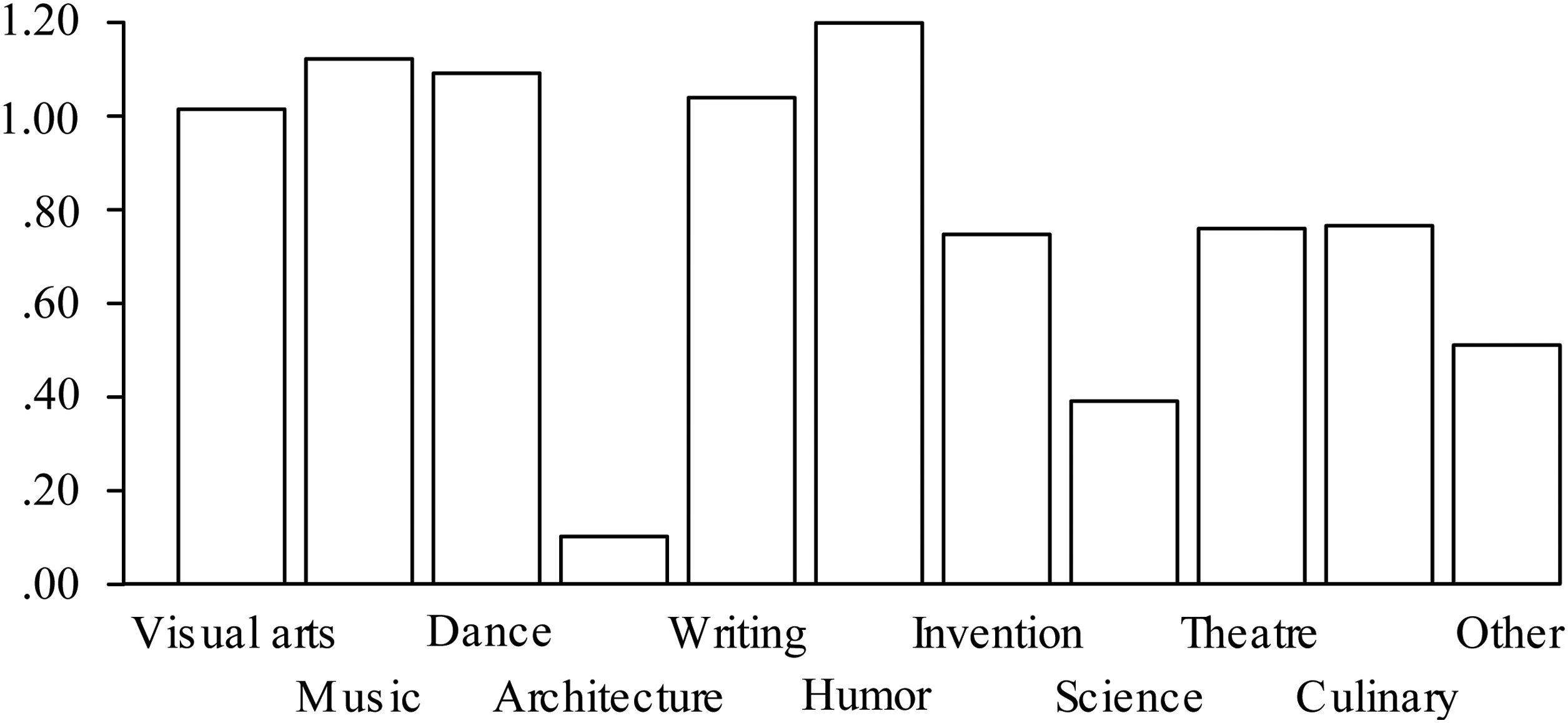
Mean creative achievement scores for the subdomains of the Carson et al. (2005) Creative Achievement Questionnaire.
Creative Potential
Guilford’s (1967) Alternative Uses Test (AUT) was administered twice to assess divergent thinking ability. Participants were asked to come up with as many creative and original uses as they could for a pencil and for a sock. As such, the “be creative” instructions were used which increases the construct validity of the AUT as a measure of creative potential (Forthmann et al., 2016; Nusbaum et al., 2014). Each task took exactly 2 min. Divergent thinking was quantified by counting the number of uses (fluency), the number of category switches (flexibility), and the number of responses that were entirely unique when compared to all responses in the sample (originality), i.e., the number of uses generated by a participant that no one else in the sample came up with (Guilford, 1967).
When quantifying the participants’ responses, the term uses was broadly defined as anything one could do with an object. This included uses that were more specific to the given object (e.g., using a pencil to sketch a bicycle) and uses that could apply broadly to many objects (e.g., selling a pencil to make some money). Responses that were clearly “non-uses” or otherwise did not fit the task instructions were not included when determining the fluency, flexibility, and originality scores. The object uses conveyed in the responses, rather than their exact formulation, determined how the responses were included. For example, the responses “using a pencil to make holes in the soil to plant seeds” and “a hole-punching tool for seed planting” would be considered equivalent.
Significant and positive Kendall's tau-b correlations between the responses to the two items were found for fluency, r = .473, p < .001, flexibility, r = .454, p < .001, and originality, r = .249, p < .001. This suggested that aggregation (sum) was justified. The resulting aggregated fluency, flexibility, and originality scores were used in the analyses.
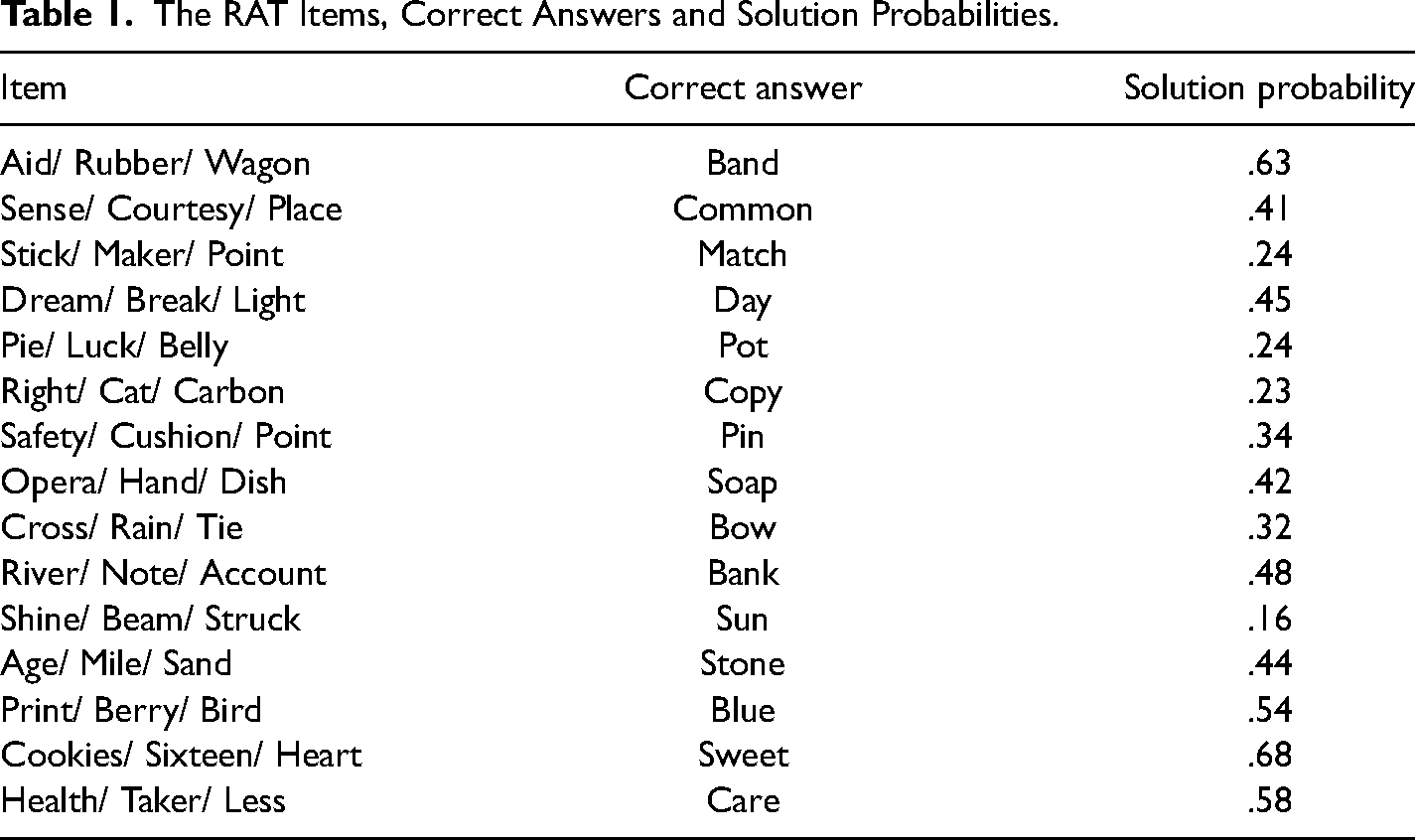
Mednick’s (1962) RAT is another commonly used test of creative potential. This test captures the ability to converge upon a single correct solution based on multiple informational units (Smith et al., 2013). This is done by presenting participants with a list of word triads for which a word needs to be found that connects all three items (e.g., a compound word, or a functional relationship). What sets the RAT apart from most other convergent thinking tests (e.g., Raven's progressive matrices) is that the word triads in the RAT are semantically distant, and thus require relatively far-spreading activation in semantic memory (i.e., remote associations) to generate a solution (Mednick, 1962). This, in turn, is assumed to test the type of convergent thinking that underlies creative ability. In the present study, participants were presented with a list of 15 such items. They were asked to try to answer all items. No time limit was imposed. The number of correctly solved items was counted and used in further analyses. The RAT items, correct answers, and solution probabilities are presented in Table 1.
The RAT Items, Correct Answers and Solution Probabilities.
Socio-Demographics
The participants were also asked to self-report their age, gender, education level, nationality, and whether English was their native language or not. Because the sample does not properly represent the general population, these characteristics provide basic insight into what population any results might generalize to. The results are presented in the “Participants” section.
Data Analysis
The statistical analyses were conducted using R version 4.2.1 (R Core Team, 2022). To provide insight into the general characteristics of the dataset the descriptive statistics and correlations were calculated using the R package Psych version 2.2.5 (Revelle, 2022). The count data did not meet assumptions of normality and linearity. Therefore, the non-parametric Kendall's tau-b correlations were reported. See Table 2.
Descriptive Statistics and Correlations.
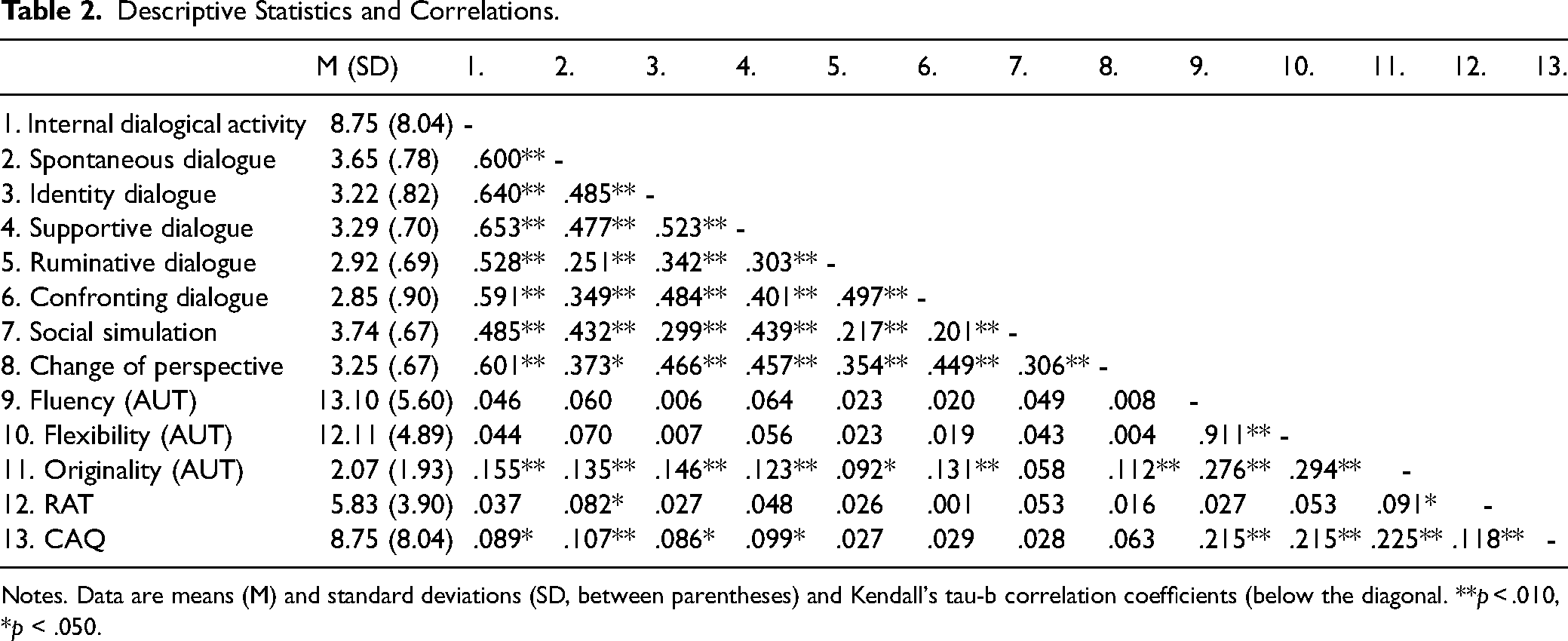
Notes. Data are means (M) and standard deviations (SD, between parentheses) and Kendall's tau-b correlation coefficients (below the diagonal. **p < .010, *p < .050.
The hypothesis tests and the exploration of the research question were conducted by computing a series of regression models using generalized additive modeling (GAM) as implemented in the R package GAMLSS version 5.4–3 (Rigby & Stasinopoulos, 2005). GAM provides a flexible framework for computing regression models that suit the count data type. The regression models were computed with internal dialogical activity as the predictor and, individually, fluency, flexibility, and originality from the AUT, the number or correct RAT scores, and the total CAQ score as the target variables. Another set of regression models was computed with the types of internal dialogical activity spontaneous dialogue, identity dialogue, supportive dialogue, ruminative dialogue, confronting dialogue, social simulation, and shift in perspective as the predictors; and fluency, flexibility, and originality derived from the AUT responses, the number of correct RAT scores, and the total CAQ score as the target variables.
Although it is typical to compute Poisson regressions for count data, there was also a good chance that the data were overdispersed due to many zero measurements, which breaches the assumptions underlying Poisson regression (e.g., Silvia et al., 2012). Each regression model was therefore initially computed with a Poisson, negative binomial type 1, negative binomial type 2, zero-inflated Poisson, and zero-inflated negative binomial type 1 distribution (Rigby & Stasinopoulos, 2005). These alternative distributions are more robust to zero inflation and overdispersion. ANOVA was used to test which of the distributions minimized the Akaike information criterion the most (an indicator of model fit) (Burnham & Anderson, 2004). The results for the models with the best model fit were reported. See Table 3 and Table 4 for the results and further model fit information.
Results of the Regression Analyses on the Relationship Between Overall Internal Dialogical Activity on Creative Potential and Creative Achievement.
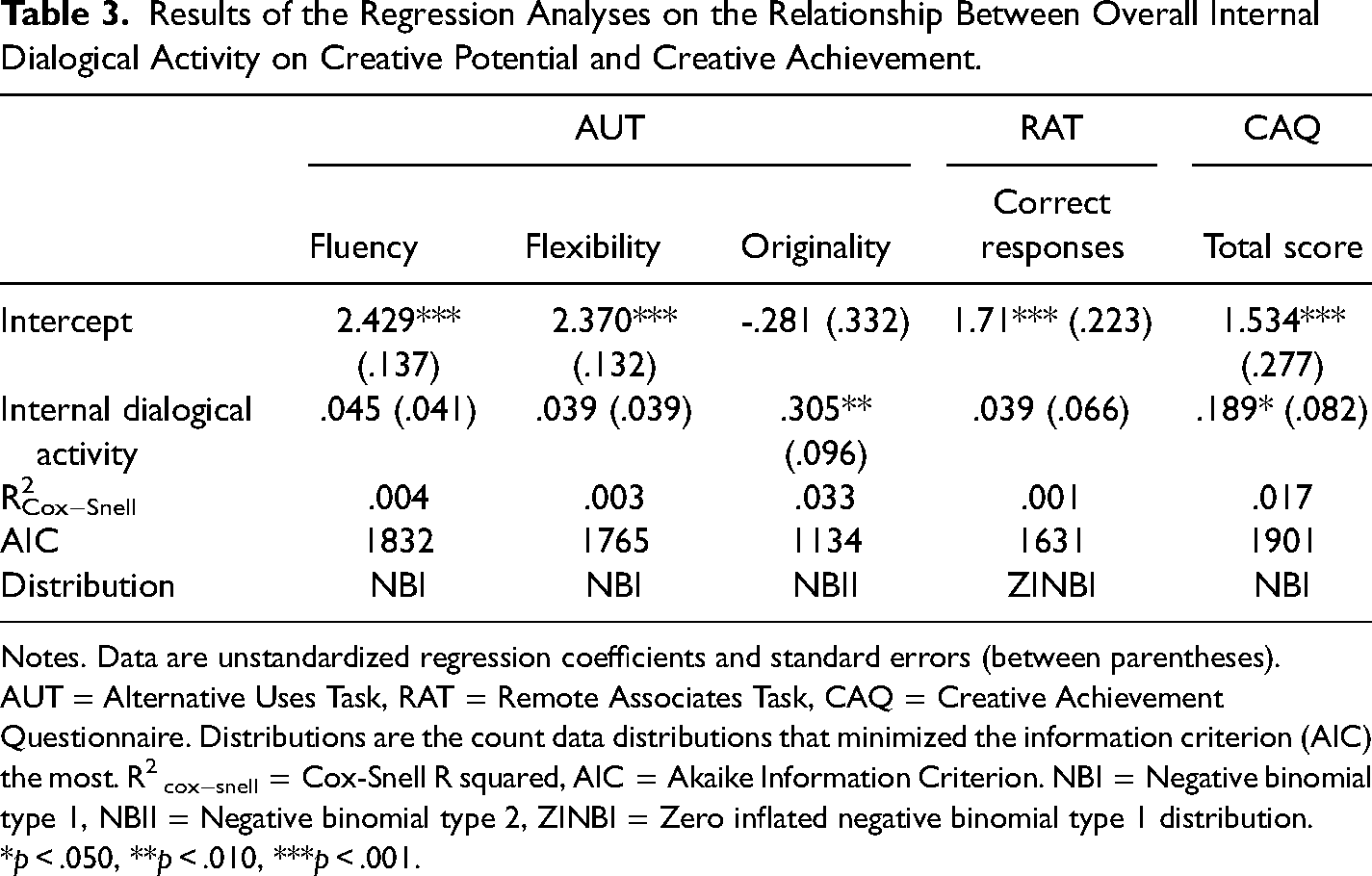
Notes. Data are unstandardized regression coefficients and standard errors (between parentheses). AUT = Alternative Uses Task, RAT = Remote Associates Task, CAQ = Creative Achievement Questionnaire. Distributions are the count data distributions that minimized the information criterion (AIC) the most. R2 cox−snell = Cox-Snell R squared, AIC = Akaike Information Criterion. NBI = Negative binomial type 1, NBII = Negative binomial type 2, ZINBI = Zero inflated negative binomial type 1 distribution. *p < .050, **p < .010, ***p < .001.
Results of the Regression Analyses on the Relationship Between the Types of Internal Dialogical Activity on Creative Potential and Creative Achievement.
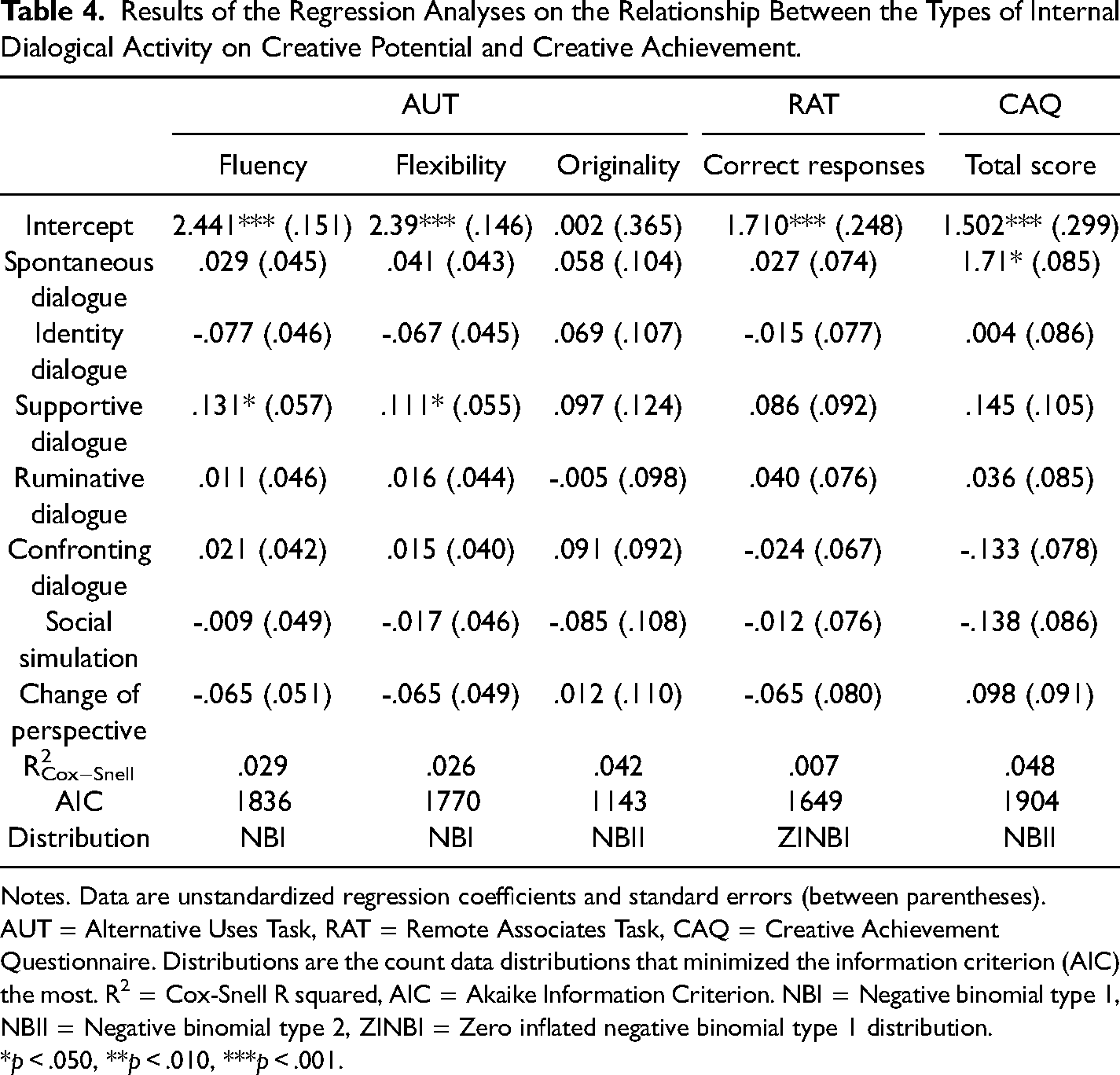
Notes. Data are unstandardized regression coefficients and standard errors (between parentheses). AUT = Alternative Uses Task, RAT = Remote Associates Task, CAQ = Creative Achievement Questionnaire. Distributions are the count data distributions that minimized the information criterion (AIC) the most. R2 = Cox-Snell R squared, AIC = Akaike Information Criterion. NBI = Negative binomial type 1, NBII = Negative binomial type 2, ZINBI = Zero inflated negative binomial type 1 distribution. *p < .050, **p < .010, ***p < .001.
Results
To provide insight into the general characteristics of the dataset the descriptive statistics and correlations were calculated. The results are presented in Table 2.
The results of the regression analyses showed a significant and positive correlation of internal dialogical activity with the number of original responses during the AUT2, b = .305, p < .001, and with the total score on the CAQ, b = .189, p = .022. No significant correlations were found of internal dialogical activity with fluency, b = .045, p = .267, or flexibility, b = .039, p = .316, during the AUT, nor with the number of correct responses during the remote associates task, b = .039, p = .558. See Table 3 for further details.
The results showed furthermore significant and positive correlations of supportive internal dialogical activity with fluency, b = .131, p = .023, and flexibility, b = .111, p = .044, during the AUT; and the results showed a significant positive correlation of spontaneous internal dialogical activity with the total score on the CAQ, b = .171, p = .044. No significant correlations of a tendency to engage in identity dialogue, ruminative dialogue, confronting dialogue, nor the use of internal dialogues for simulating social situations or changing one's perspective, were found with the measures of creative potential and creative achievement. See Table 4 for further details.
Discussion
The present study was conducted to explore how individual differences in internal dialogical activity correlate with creative potential and creative achievement.
Internal dialogical activity positively correlated with real-world creative achievement (H1). This relationship may be best explained by the observation that engaging in creative activities might also come with more frequent dialogical engagement with thoughts, opinions, and ideas. That is, the regression analyses suggested that, of the specific types of dialogical activity, only spontaneous dialogical activity positively correlated with creative achievement. Moreover, the tau correlations suggested that only a few types of internal dialogues weakly but positively correlated with creative achievement, and with spontaneous dialogue correlating more strongly than overall dialogical activity (Table 2). As such, the conjecture that internal dialogical activity might be a source of variation in thought that underlies creative achievement is likely inaccurate. Rather, this finding aligns with previous qualitative research suggesting that internal dialogues with different aspects of the self is more of a modus operandi through which people engage in creative work (Hellerstein, 2009). The present study, therefore, contributes quantitative evidence suggesting that individual differences in internal dialogical activity positively relate to real-world creative achievement.
The positive correlation between internal dialogical activity and the generation of original responses during the AUT, however, might point to a different underlying relationship (H2). That is, the regression analysis suggested that none of the more specific types of internal dialogical activity significantly correlated with originality, whereas the tau correlation coefficients suggested a positive correlation with nearly all types of internal dialogues (Table 2). This aligns with the conjecture that the increased variability in inner voices that characterizes increases in overall internal dialogical activity explains why there is a positive relationship with creative potential. This relationship, however, is limited to the production of originality during divergent thinking. As such, the present study contributes quantitative evidence suggesting that – and how – individual differences in internal dialogical activity positively relate to creative potential.
The found relationship between individual differences in supportive dialogical activity and fluency and flexibility connects well to studies that show positive correlations between divergent thinking ability and positive self-evaluation (de Rooij et al., 2015, 2017), upregulation and maintenance of positive affect (Bledow et al., 2013; de Rooij & Jones, 2015), and overall positive mood states (Baas et al., 2008; Davis, 2009). This positive relationship between divergent thinking ability and positive affect is often attributed to a relationship between positive affect and enhanced cognitive flexibility (de Dreu et al., 2008). Speculatively, supportive internal dialogues may be yet another way in which people can support the relationship between positive affect and divergent thinking. This provides novel insight into how individual differences in specific types of dialogical activity relate to creative potential and creative achievement (RQ1).
Still, it is striking that few of the more specific types of internal dialogues significantly correlated with the measures of creative potential and creative achievement. Possibly, people might rely on, and utilize, specific types of internal dialogues in idiosyncratic ways (Hellerstein, 2009). For example, ruminative internal dialogues may well be adaptive when used to critically think through the quality of an idea but could stimy the generation of ideas when interrupting the free-flowing nature of divergent thinking (de Rooij & Jones, 2013). In addition, creatives also report finding ways to reduce any negative effects of maladaptive internal dialogues (Hellerstein, 2009). Such as two of the creative professionals in Hellerstein (2009), who disclosed “ … how they tried to keep certain voices out of their minds because they feared these voices would have a devastating impact on their art making” (Hellerstein, 2009, p. 266). It could therefore be that the diverse roles that the types of internal dialogues can play, and the diverse ways in which people manage the influence of their internal dialogues on creative thought, complicate a search for frequently occurring correlational relationships in the population of specific types of internal dialogues with measures of creative potential and creative achievement.
There are, of course, also several limitations that need to be taken into account when interpreting the results. Due to the exploratory nature of the study, the results need to be interpreted as preliminary and seen merely as a guide to further explore how internal dialogues and creativity relate to each other. Also, while the IDAS is designed to measure individual differences in (types of) internal dialogical activity, some constructs may in fact serve as a proxy for measuring broader underlying dispositions. Some studies, for example, show a correlation of neuroticism with ruminative and with confronting dialogues (Oleś & Puchalska-Wasyl, 2010; Puchalska-Wasyl et al., 2008). As a consequence, we cannot rule out that we indirectly measure the effects of neuroticism on creative potential and achievement by using these IDAS constructs as a proxy. Hence, these results are reported in correlational rather than causal terms. Care must be taken when drawing conclusions about null findings regarding specific types of internal dialogical activity. It is plausible that creative thinking itself is characterized by its own specific types of internal dialogues, such as dialogues between “I as maker” and “I as evaluator” (Glăveanu, 2017). The IDAS is not designed to capture such internal dialogues. Perhaps a creativity-specific taxonomy of internal dialogues is needed to advance knowledge in that area.
The manner in which originality was scored for the AUT also comes with several limitations. Notably, scoring originality based on uniqueness does not fully capture a person's ability to generate original responses (Silvia et al., 2008). For example, it could be the case that some participants generated many reasonably original ideas, but no unique ideas. The latter is not captured by the measurement used in the present study. Furthermore, it is well known that the used measure of originality is confounded by fluency (Hocevar, 1979; Plucker et al., 2011). Note that in the present study, however, additional analyses 2 showed that the positive correlation between internal dialogical activity and originality remained significant after controlling for fluency.
To further explore how individual differences in different types of internal dialogical activity relate to creative potential and creative achievement, future work can benefit from developing a novel creativity-specific taxonomy of internal dialogues. Glăveanu (2017) proposes that, during the creative process, a dialogue unfolds between inner voices that represent “I as maker” and “I as evaluator”. Making and generating, and evaluating form critical activities in the creative process (Lubart, 2001). Extending this reasoning, the creative process also consists of activities related to understanding the problem (Reiter-Palmon, 2017), idea selection, and steps toward implementation (Mumford & McIntosh, 2017). It may well be that inner voices representing “I as a problem owner” or “I as a developer” also play a critical role in the relationship between internal dialogical activity and creativity. Developing a creativity-specific taxonomy and measurement instrument of internal dialogical activity can therefore benefit future research on the relationship between internal dialogues and creative thinking.
The limitations imposed by correlational studies also need to be overcome to advance research on internal dialogues and creativity. One critical challenge is that merely instructing people to conduct an internal dialogue likely draws on different neural mechanisms than spontaneously occurring internal dialogues (Hurlburt et al., 2016). The relationships between internal dialogical activity and creativity is especially sensitive to uncertainty as both emerge as a consequence of uncertainty (Beghetto, 2021; Hermans & Hermans-Konopka, 2010). Manipulating uncertainty could therefore enable studying the relationship between internal dialogues and creativity experimentally in novel ways. Establishing causality subsequently opens the door to developing ways to control and harness one's internal dialogical activity in adaptive ways (Kross, 2021).
Furthermore, because internal dialogues can form part of the richer construct of imagined interactions (Honeycutt, 2020), which can involve other types of mental imagery than verbal mental imagery alone (Honeycutt, 2003, 2010), studying internal dialogues independently of other aspects of the interactions people imagine as part of their creative thinking process (Foxwell et al., 2020; Hellerstein, 2009), might introduce uncertainty about the causes that underlie any relationships between internal dialogues and creative thought (de Rooij, 2022a, 2022b). For example, not taking into account the type of visual scene in which an imagined verbal dialogue takes place could change its effects on creative thinking. This could be similar to how the environment in which overt dialogues with others take place, shapes the meaning of, and responses to, a dialogue (e.g., Malinin, 2016, 2019). Future work could therefore benefit from taking the broader construct of imagined interactions, rather than internal dialogues, as a starting point for understanding the role of this understudied aspect of human imagination in creative thinking.
In conclusion, the presented study contributes novel insight into how internal dialogical activity relates to performance on measurements of creative potential and creative achievement. The findings suggest that engaging in internal dialogical activity positively relates to creative achievement, which can be explained by a general disposition to dialogically engage with thoughts, opinions, and ideas, and to the production of originality during divergent thinking, which can be explained by the variation introduced by a disposition to experiences many inner voices in dialogue. Furthermore, the study contributes evidence suggesting that the production of many and diverse responses during divergent thinking relates to a disposition for supportive internal dialogical activity.
Footnotes
Declaration of Conflicting Interests
The author declared no potential conflicts of interest with respect to the research, authorship, and/or publication of this article.
Funding
The author received no financial support for the research, authorship, and/or publication of this article
