



Abstract
Inner speaking, the covert talking that goes on inside a person's mind, can shape creative thought. How the phenomenological properties and quality of inner speaking correlate with a person's creative potential, however, is an open scientific problem. To explore this, participants (n = 267) filled in the revised Varieties of Inner Speech Questionnaire and the revised Launay Slade Hallucination Scale (auditory subscale), and performed three tests of creative potential: one divergent (Alternative Uses Test) and two convergent thinking tests (Compound Remote Associates Test, short Hagen Matrices Test). The results showed that a tendency to engage in condensed and evaluative/ critical inner speaking negatively correlated with convergent thinking ability; and the results pointed toward a potential negative correlation of auditory hallucination proneness with divergent and convergent thinking ability. No evidence was found for a correlation of the dialogicality, imagining of others’ voices, or positive/regulatory aspect of the participants day-to-day inner speech, with creative potential. Herewith, the presented study contributes novel insight into the relationship between the varieties of inner speech and creative potential.
Creativity, the conception of original yet useful ideas (Runco & Jaeger, 2012), is central to human adaptation (Gabora & Kaufman, 2010). It is critical to the development of medical innovations that help us live longer and healthier (Offit, 2021), to solving the world's most pressing problems such as climate change (Gardiner, 2020), and enables artists and musicians to create awe-inspiring experiences (Patterson, 2013). Inner speaking, the covert talking that goes on inside a person's own mind, might serve as a mental facility – as a component of imagination – that can augment or diminish creative thinking (Fernyhough, 2016; Glaveanu, 2017). Interestingly, the phenomenological properties and quality of inner speaking vary substantially across people (Alderson-Day et al., 2018). People vary in the degree to which their inner speaking tends to be dialogical, condensed, and involves the imagined voices of others, is used in a positive and regulatory or evaluative and critical manner (Alderson-Day et al., 2018; McCarthy-Jones & Fernyhough, 2011), and whether its source is perceived to be in a person's inner or outer environment (Johns et al., 2014; Morrison et al., 2000). Few studies to date, however, have explored the correlates of such individual differences in the inner speaking that people experience, with their potential for creativity (Fernyhough, 2016, pp. 108–109).
To help address this lacuna, the present study explores the correlates between these varieties of inner speech and creative potential. In what follows, a rationale for a relationship between individual differences in the phenomenological properties and quality of people's inner speaking and their creative potential is developed, before reporting on the method and results of a quantitative study (n = 267). The paper then discusses the results and limitations of the study, and proposes future research with the intention to help advance our understanding of how the varieties of inner speaking might augment or diminish creative ability.
Varieties of Inner Speech
Inner speaking can be defined as the activity of producing and experiencing verbal language without any audible vocalization (Alderson-Day & Fernyhough, 2015; Hurlburt et al., 2013; Langland-Hassan, 2021). Other neologisms that have been used to refer to this component of human imagination include internal monologue and dialogue, inner voice, subvocalization, covert self-talk, and verbal auditory imagery (Alderson-Day & Fernyhough, 2015; Hurlburt et al., 2013; Morin, 2005). The emergence of inner speaking can be attributed to a process of internalization of external experiences throughout childhood (Vygotsky, 1934/1987). During early childhood the first steps toward the internalization of language production and function are taken when children start to overtly mimic the manner in which others interact with them though language, and they learn to apply this to themselves (Diaz et al., 2014). For example, when children talk aloud to themselves to guide their own play. This talking aloud to oneself is referred to as private speech. In subsequent development, language production and function can become fully internalized and used in a manner that does not require overt speech (Alderson-Day & Fernyhough, 2015). Rather, it is produced covertly and “heard” only by a person's “inner ear” (Smith et al., 2014). This production and experience of verbal language without any audible vocalization is referred to as inner speaking.
The phenomenological properties and quality of inner speaking partly emerge from the internalization of overt verbal interactions with others (Alderson-Day & Fernyhough, 2015; Hurlburt et al., 2013). In line with this, people vary in the degree to which their inner speaking is dialogical, i.e., to which inner speaking is characterized by a back-and-forth exchange of I-positions (Alderson-Day et al., 2018; Hermans & Olés, 2013). For example, people might rely on dialogical inner speaking to take different perspectives on a problem when attempting to solve it, such as “I think that”, “I doubt whether” (Puchalska-Wasyl & Olés, 2013). Relatedly, people vary in the degree to which their inner speaking involves the experience of other voices than their own (Alderson-Day et al., 2018; Honeycutt, 2020). Experiencing other's voices can give a different character to the conversations that go on in a person's mind, which can, e.g., alter the impact such internal conversations have on behavior. Such as when one participant in Hellerstein (2009) confesses to avoid imagining an internal dialogue with their father, stating “My dad … his criticism would be much more devastating …” (Hellerstein, 2009, p. 266). However, the phenomenological properties and quality of inner speaking are also shaped by a transformation of inner language production and function (Hurlburt et al., 2013). Possibly, this transformation emerges from the further development of inner speaking outside the constraints imposed by a need for effective social interaction and adherence to social norms that characterize overt language production and function. One such transformation is that inner speaking can become condensed, i.e. it can become linguistically less rich compared to when speaking aloud to others (Fernyhough, 2004; McCarthy-Jones & Fernyhough, 2011). For example, one could speak innerly in abbreviated sentences without a loss of meaning (Alderson-Day et al., 2018), which assumingly would be less likely to function well when conversing overtly with others.
The function of language in the regulation of others’ behavior, motivation and emotion can also become internalized, transformed, and applied to the self (Clowes, 2007; Perrone-Bertolotti et al., 2014). Inner speaking can have an evaluative/ critical quality that drives such self-regulation (Alderson-Day et al., 2018; Salas et al., 2018). Evaluative inner speaking tends to be negative and critical in character (Alderson-Day et al., 2014, 2018). For example, when people talk themselves down with evaluations such as “I’m bad at this”. Typically, such inner speaking adds negatively valenced information into one's appraisal process, “coloring” the perception of events in one's (inner) environment more negatively (e.g., Hirsch et al., 2015; Stokes & Hirsch, 2010). In line with this, a disposition to engage in evaluative/ critical inner speaking correlates positively with measures of anxiety and depression, and correlates negatively with self-esteem (Alderson-Day et al., 2014, 2018; McCarthy-Jones & Fernyhough, 2011). Alternatively, people might also rely on inner speaking to up-regulate their motivation and emotion through a positive/ regulatory quality of inner speaking (Alderson-Day et al., 2018). Such positive inner speaking, e.g., with statements such as “I’m good at this”, could add positively valenced information into one's ongoing appraisal processes. This could facilitate upregulating motivation and positive emotion, and coping with negative situations (Park et al., 2020). Despite this, however, a disposition to engage in positive/ regulatory inner speaking and related kinds do not to correlate with measures of self-esteem, depression, or anxiety (Alderson-Day et al., 2018; Brinthaupt et al., 2009).
Another well-documented phenomenological property of inner speaking is that its perceived source can be attributed to the internal of external environment Alderson-Day & Fernyhough, 2015). In the case of the latter, this is referred to as an auditory hallucination (Langdon et al., 2009). Auditory hallucination is a symptom of psychosis (Allen et al., 2007), and commonly experienced by people living with schizophrenia (Kühn & Gallinat, 2012). However, it is also prevalent in the general population (Johns et al., 2014). The inner speech model of auditory hallucination postulates that auditory hallucination is caused by impaired self-monitoring (Frith, 1992; Jones & Fernyhough, 2007), i.e. “… the ability to identify and distinguish sensations caused by one's own actions from those that arise from external influences” (Allen et al., 2007, p. 409). Impaired source monitoring increases the chance that inner speaking is misattributed to an external source (Jones & Fernyhough, 2007; Wilkinson & Fernyhough, 2017). As a consequence, individual differences range from experiencing no auditory hallucination, to infrequent hallucinatory experiences that typically happen under specific conditions (e.g., when people are sleep deprived), to more frequent and longer lasting auditory hallucinations (Johns et al., 2014). However, other causes might also cause auditory hallucination experiences, including extreme alertness to threat, trauma, and intrusions from memory (Alderson-Day & Fernyhough, 2015; Johns et al., 2014).
Creative Potential
Creativity can be defined as the conception of ideas, problem solutions, and products that are original but also useful (Diedrich et al., 2015; Runco & Jaeger, 2012). Creativity can be adaptive when confronted with an ill-defined, complex, or novel situation that requires action (Ford, 1996; Mumford & Gustafson, 2007). Although the details of the activities in a creative process vary by person (Runco, 2019) and profession (Glaveanu et al., 2013), there are also regularities (Lubart, 2001; Plucker & Beghetto, 2004). To arrive at a creative outcome people tend to engage in activities to construct a problem, gather information, and generate ideas, and evaluate and select one or more ideas that are iteratively developed and revised based on what is learned by taking steps toward practical implementation (Isaksen et al., 2010; Mumford & McIntosh, 2017). When studying creativity in the laboratory, psychometric tests that are designed to assess creative potential are often used (Cropley, 2000; Runco & Acar, 2012). Assessing creative potential provides insight into abilities that could underlie performance in real-life creative endeavors, but provide no certainty about whether they indeed consistently predict creativity in the real-world (Barbot et al., 2019; Runco & Acar, 2012). Creative potential can be assessed by testing divergent and convergent thinking ability (Cropley, 1996; Reiter-Palmon et al., 2019; Runco & Acar, 2012).
Divergent thinking, the production of variation (Guilford, 1950, 1967), can be used as an indicator for an ability to generate original responses (Runco & Acar, 2012). Divergent thinking ability is often measured with Guilford's alternative uses task (AUT) (Guilford, 1967), during which people are asked to generate creative uses of a common object, and the Torrance Test of Creative Thinking test battery (Torrance, 1972). Divergent thinking can be seen as an exploration of a semantic space where responses become increasingly remotely associated over time with the initial stimulus or thought that initiated it (Beaty & Silvia, 2012; Hass, 2017a, 2017b). It contributes most prominently to the generative activities that form part of problem construction (Reiter-Palmon, 2017), information search (Harms et al., 2020), and idea generation (Runco, 2010; Vincent et al., 2002); but less so to later stages in the creative process, such as idea evaluation and taking steps toward implementation (Vincent et al., 2002). Despite the fact that divergent thinking contributes to a limited number of activities during a creative process (Runco & Acar, 2012; Vincent et al., 2002), several correlational studies report moderate to strong correlations between measures of divergent thinking and real-world creative achievement (e.g., Carson et al., 2005; Jauk et al., 2014), and weak to moderate correlations for longitudinal studies (e.g., Plucker, 1999; Runco et al., 2010; Sternberg & Lubart, 1996).
Convergent thinking, thought oriented toward deriving a single correct solution, is also critical to creative thinking (Cropley, 2006; Wu et al., 2020). Convergent thinking “… makes it possible to explore, evaluate or criticize variability and identify its effective aspects.” (Cropley, 2006). It can be seen as a search process in which a single correct solution is retrieved that satisfies multiple constraints (Smith et al., 2013). Solutions can arise by spontaneous insight, where the search process occurs subconsciously and the solution enters awareness unexpectedly accompanied by an AHA! Moment, and by analysis, where a solution is developed gradually by iteratively generating candidate solutions and evaluating these to guide the next search, until a solution is found that best addresses all constraints (Kounios & Beeman, 2015). Convergent thinking tests come in many forms, with some drawing strongly on associative abilities (e.g., (compound) remote associates test) (Bowden & Jung-Beeman, 2003; Mednick, 1962), and others drawing more broadly on reasoning and fluid intelligence (e.g., Raven's Progressive Matrices, Hagen Matrices Test) (Heydasch et al., 2013, 2020). Convergent thinking supports the creative process at various stages (Cropley, 2006; Lubart, 2001): From selecting and synthesizing critical elements from previously gathered information to develop a mental model of a problem at hand (Reiter-Palmon, 2017), to developing and revising an idea based on what is learned by taking steps toward practical implementation (Cropley, 2006; Mumford et al., 2002). The strength of the correlations between performance on tests of convergent thinking and measures of real-world creativity vary from very weak to moderate (e.g., Agnoli et al., 2016; Armstrong, 2012; Harris et al., 2019; Liu et al., 2019). See Cropley (2000) and Ochse and Van Lill (1990) for reviews.
Varieties of Inner Speech and Creative Potential
Individual differences in the phenomenological properties and quality of inner speaking could underpin different mental facilities or relate to other dispositions that can augment or diminish divergent and convergent thinking ability. The varieties of inner speech might therefore correlate with creative potential in varying ways. Among these are the dialogicality, condensedness, and presence of other people's voices that characterize a person's inner speaking; its utility for self-regulation through evaluative/ critical and positive/ regulatory inner speaking; and auditory hallucination proneness.
The general role of dialogicality in creative thinking is well-established. Creative thought is commonly framed as a dialogue between the self and materials, such as in Schön’s (1992) seminal work on design as a reflective conversation with materials, or with other people, emphasizing the often collaborative (Paulus & Nijstad, 2019) and sociocultural nature of creative processes (Glaveanu et al., 2020). The role of internalized dialogues with the self during creative thought, however, is less well understood. It has been suggested that dialogical inner speaking supports changing and taking different perspectives on a problem, which in turn could benefit creative thinking (Fernyhough, 2016, pp. 108–109; Glaveanu, 2017). Relatedly, an aptitude for generating diverse and distant associations, which assumingly could also result from generating different perspectives, can benefit performance on divergent (e.g., Benedek, Könen, et al., 2012) and convergent thinking tests (e.g., Marko et al., 2019). This also aligns with qualitative evidence from studies on creative professionals, who routinely engage in an internal dialogue “… with different aspects of themselves” throughout their creative process (Hellerstein, 2009, p. 303). It can therefore be hypothesized that the dialogicality of a person's inner speaking positively correlates with divergent (H1a) and convergent thinking ability (H1b).
Although inner speaking can also be condensed compared to overt speaking to others, and can involve the voices of others, few studies, if any, provide evidence toward a direct relationship between these phenomenological properties of inner speaking and creative potential (cf. Hellerstein, 2009). To learn more about the relationship between these phenomenological properties of inner speaking and creative potential the present study explores the following research questions: How does the condensedness of inner speaking correlate with divergent and convergent thinking ability? (RQ1) How does a tendency to imagine other voices correlate with divergent and convergent thinking ability? (RQ2)
The self-regulatory functions of inner speaking might also relate to creative potential. Daugherty’s (1993) observational studies of preschoolers during the Torrance Test of Thinking Creatively in Action and Movement (TCAM) (Torrance, 1975), which tests divergent thinking ability (Reisman et al., 1981), suggested that evaluative and critical private speaking (e.g. “I’m bad at this”) negatively influenced the number, originality, and imaginativeness of the children's responses. Inversely, positive private speaking (e.g., “I can do this”) had a positive effect on these indices divergent thinking. Relatedly, positive and negative self-evaluations positively and negatively influence the generation of original responses during divergent thinking (de Rooij et al., 2015, 2017). Regarding the potential correlates between self-regulatory inner speaking and convergent thinking, few studies, if any, provide direct evidence. Experimental findings do suggest that self-evaluation negatively influences performance on a convergent thinking test when self-efficacy is low (Sanna & Pusecker, 1994). Given the correlations between the closely related constructs self-esteem and evaluative/ critical inner speaking, this could point to a negative correlation between evaluative/ critical inner speaking and convergent thinking ability. It can therefore be hypothesized that a tendency to engage in evaluative/ critical inner speaking negatively correlates with divergent thinking ability (H2a), and, more speculatively, with convergent thinking ability (H2b); and that a tendency to engage in positive/ regulatory inner speaking positively correlates with divergent thinking ability (H3). In addition, the following is explored: How does positive/ regulatory inner speaking correlate with convergent thinking ability? (RQ3)
Finally, a proneness to experience auditory hallucinations is a phenomenological property of inner speaking that could relate to creative potential in yet another manner. (Auditory) Hallucination proneness correlates positively with a tendency to have fantasy experiences (Crowe et al., 2011; Merckelbach et al., 2021; Merckelbach & van de Ven, 2001). Fantasy proneness, in turn, positively correlates with self-reported creative ability (Lack et al., 2003; Lynn & Rhue, 1986). Complementarily, emerging evidence also suggests a relationship between hallucination proneness and disinhibition (de Leede-Smith et al., 2020). Eysenck (1995), for example, suggested that increased disinhibition is a common characteristic of creative people and there is some empirical evidence to support this (e.g., Radel et al., 2015). Studies on creative potential, however, often suggest that divergent thinking ability correlates positively with performance on inhibition tests (e.g., the color-word Stroop test) (e.g., Benedek et al., 2014; Benedek, Franz, et al., 2012; Edl et al., 2014), and tend to provide no evidence for a correlation between inhibition with performance on convergent thinking tasks (e.g., Benedek et al., 2014; Lerner, 1975; Marko et al., 2019). Given this mixed evidence, the following research question will be explored: How does auditory hallucination proneness correlate with divergent and convergent thinking ability (RQ4)?
Method
To explore the relationship between the varieties of inner speech and creative potential the following study was conducted. 1
Demographics and English Language Proficiency
Demographic information was collected to provide insight into the general characteristics of the sample. Participants were asked to report their age, gender, country of origin, and whether English is their native language or not. Because all students were enrolled at a Dutch higher education program, we can assume they had at least an advanced (C1) or proficient (C2) command of the English language (Cambridge English test), or comparable levels, which forms part of the entry requirements of the educational programs of Tilburg University, in which the participants were enrolled (Tilburg University, 2021). English language proficiency and mother tongue are relevant sample characteristics because the study information, questionnaires, and tasks are presented in English to a predominantly Dutch and largely non-native English speaking sample. See the Participants subsection for the results.
Procedure
The study was advertised on the SONA page of the Department of Communication and Cognition, Tilburg University. There participants could sign up voluntarily. The advertisement also stated that participants should use a desktop, laptop or tablet pc, but not their phone; and to find a quit place where they could work uninterrupted for approximately 30 min. After signing up, the participants received a link to a Qualtrics webpage on which the study was conducted. Participants were presented with information about the purpose, tests, and measurements used in the study and a consent form. After signing informed consent they were asked to report demographic information (see above) and fill in the VISQ-R and LSHS-R (see below). Thereafter, they completed the alternative uses test, compound remote associates test (CRAT), and shortened Hagen matrices test (see below). Each task was preceded by instructions and examples, and participants were encouraged to take a break between the tasks if they felt they needed it. After finishing these tests of creative potential they were thanked for their participation and received their course credit. The study took approximately 30 min.
Participants
Two hundred sixty-seven people participated in the study (Mage = 21.48, SDage = 3.85). The participants were students of the Communication and Information Sciences higher education program of Tilburg University. One hundred sixty-eight participants self-identified as female, 92 as male, and 7 as non-binary or other gender. One hundred fifty-seven were enrolled at the bachelor, 106 at the pre-master, and 4 at the master level. One hundred seventy participants were Dutch, the others were from 47 other countries. For 252 participants, English was not their mother tongue, for 15 it was. The participants were recruited from the human subjects pool of the Department of Communication and Cognition of Tilburg University and received course credit for their participation. The study was approved by the Research Ethics and Data Management Committee of the Tilburg School of Humanities and Digital Sciences of Tilburg University.
Varieties of Inner Speech Questionnaire – Revised
The Varieties of Inner Speech Questionnaire – Revised (VISQ-R) was administered to assess individual differences in the phenomenological properties and quality that characterize the participants’ day-to-day inner speaking (Alderson-Day et al., 2018; McCarthy-Jones & Fernyhough, 2011). Participants rated the 26 items of the VISQ-R on a 7-point Likert scale (1 = Never, 7 = All the time). This included the following subscales: Dialogicality, i.e. inner speaking characterized by a back-and-forth conversation (5 items), condensation, i.e. inner speaking that is shortened compared to overt speaking to others while retaining its meaning (5 items), other voices, i.e. imagining other's voices rather than one's own voice when inner speaking (5 items), evaluative/ critical, i.e. critical and often negative evaluation of behavior by means of inner speaking (7 items), and positive/ regulatory, i.e. inner speaking that is positive and constructive (4 items). Previous research suggests that these subscales have good internal consistency, α > .80, with the exception of the positive/ regulatory subscale, α = .60 (Alderson-Day et al., 2018, p. 53).
Launay Slade Hallucination Scale – Revised (Auditory Subscale)
Auditory hallucination proneness was assessed with five items from the revised Launay Slade Hallucination Scale (LSHS-R) (Morrison et al., 2000). The LSHS-R consists of 16 items that aim to capture general, visual, and auditory hallucination proneness. The participants rated five items of the auditory subscale on a four-point Likert scale (1 = Never, 4 = Almost always). The LSHS-R is commonly used to assess hallucination proneness in non-clinical populations (e.g., Moseley et al., 2020), and its auditory subscale has previously been used to study inner speaking (e.g., Alderson-Day et al., 2014; Fernyhough et al., 2019). Previous work shows that the items for the auditory subscale have questionable to acceptable internal consistency, e.g. α = .69 (Alderson-Day et al., 2014) and .73 (McCarthy-Jones & Fernyhough, 2011).
Tests of Creative Potential
To test the participants’ creative potential the AUT, CRAT, and the short form of the Hagen matrices test were administered.
Alternative Uses Task
Guilford (1967) AUT is an often used indicator of creative potential (Reiter-Palmon et al., 2019). Participants are asked to generate creative uses of a common household object. The underlying assumption is that creative thinking can result from the same associative process that underlies performance on the AUT, where performance depends on associations increasingly shifting away from the source to overcome semantically close associations (Acar & Runco, 2019; Hass, 2017a, 2017b). The present study used the “be creative” instructions, which intend to focus participants to generate creative responses rather than on many responses (Nusbaum et al., 2014). This is assumed to improve the AUT's efficacy of a measure of creative potential. Participants were asked: “Please come up with as many original and creative uses for a BOX as you can”. Following recommendations by Silvia and Benedek (2021), further instructions explained what creativity meant within the context of the task. The task took 3 min.
Performance on the AUT was assessed using the SemDis software (Beaty & Johnson, 2021). SemDis calculates the semantic distance between the source object (i.e. a box) and each response by the participant. SemDis’ output correlates moderately to strongly with human creativity ratings of AUT responses (Beaty & Johnson, 2021). Prior to calculating the scores, non-uses were removed (e.g., when a participant writes “not sure what to think of next”) and spelling and grammar errors were corrected. The scores were calculated using the GLOVE semantic space and multiplicative aggregation. These settings have resulted in the strong correlations with subjective human ratings of creativity, also with “box” as the common object, amongst others, for the AUT (Beaty & Johnson, 2021). The means for the SemDis scores were calculated for each participant and used in further analyses.
Compound Remote Associates Test
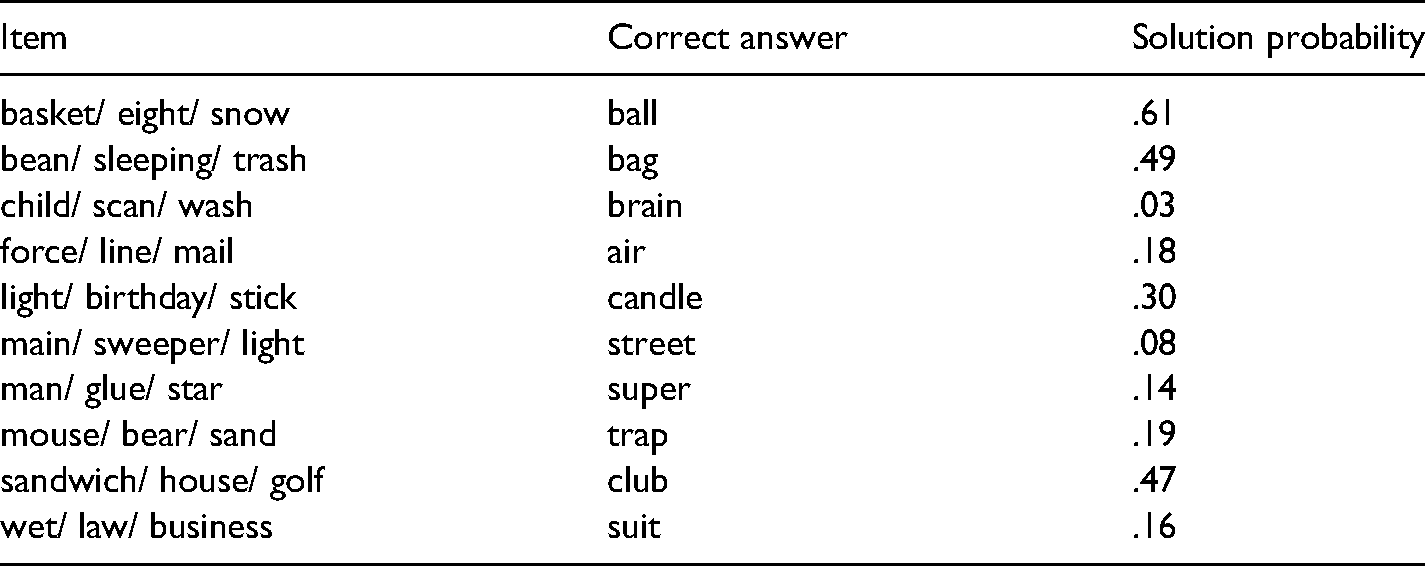
The CRAT is also commonly used to test creative potential (Bowden & Jung-Beeman, 2003). During the CRAT participants are asked to think up the one single correct word that can be used to create compound words from three presented words. For example, participants can be presented with the item “Man/ Fox/ Rabbit”. The correct response would then be “Hole”. Finding such a single correct solution requires making semantically distant (remote) associations (Mednick, 1962). The underlying assumption is that the ability to integrate semantically distant sources of information and ideas into a single correct and coherent response, can benefit creative thinking (Cropley, 2006). The CRAT commonly assumed to test convergent thinking, but it has also been suggested that performance on the CRAT requires both divergent thinking, e.g., an increasingly remote exploration of a search space, and convergent thinking, i.e. deriving a single correct answer that satisfies multiple constraints (Wu et al., 2020). Relatedly, others use the CRAT as an insight problem solving test to assess the role of AHA! Moments in creative thinking (e.g., Kounios & Beeman, 2015, pp. 66–67). For the present study, 10 items of average difficulty were selected from Bowden and Jung-Beeman (2003). Participants received 30 s to type in a response to each sequentially presented item. CRAT performance was assessed by counting the number of correct responses for each participant. See Table 1 for the presented items, correct answers, and the solution probabilities obtained in the present study.
Solution Probabilities Compound Remote Associates Test Items in the Present Study.
Hagen Matrices Test – Short
The short form of the Hagen matrices test (HMT-S) was also administered (Heydasch, 2014; Heydasch et al., 2013, 2020). Here, participants are presented with jigsaw puzzles and are asked to select the puzzle piece that completes the puzzle from eight given options. The short form consists of six pre-selected puzzles of increasing difficulty. A maximum of two minutes could be spent to answer a single item. Prior to starting the test, participants receive instructions and tried to answer two example items. The HMT-S Performance scores were assessed by counting the number of correct responses. Increasingly difficult HMT-S items requires an increasing aptitude for induction, reasoning, and fluid intelligence (Heydasch et al., 2013, 2020), as conceptualized in the Cattell-Horn-Carroll model of intelligence (Schneider & McGrew, 2012). Although a verbal rather than a visual test could also be an obvious choice given the topic of inner speech, resource constraints did not permit using the lengthier verbal alternatives. That said, an aptitude for these cognitive abilities has been argued to be modality independent (e.g., predicting performance on verbal, spatial, and numeric cognitive ability tests) (Cattell, 1987), and likely involves inner speaking regardless (cf. Munroe, 2021). The short form is an economic version of the full Hagen Matrices Test and can be used for non-clinical purposes (Heydasch et al., 2013, 2020). In the creativity research literature, matrix tests such as the HMT-S are commonly used in two ways. Firstly, matrix tests have been used as convergent thinking tests (e.g., Webb et al., 2017), because they require people to satisfy multiple constraints to think up a single correct answer (Smith et al., 2013). In addition, matrix tests similar to the HMT-S, such as Raven's progessive matrices, are known predictors of creative achievement (Harris et al., 2019). Thus, we can assume that the HMT-S can be conceived of as a measure of creative potential. Secondly, the HMT-S is designed as an economic measure of intelligence. Indeed, similar tests have been used solely, or as part of a larger test battery, to study how much of the variance of AUT (Nusbaum et al., 2014) and CRAT (Lee et al., 2014; Lee & Therriault, 2013) performance outcomes is predicted by (fluid) intelligence. Thus, we can assume that the HMT-S is also useful as a way to control for the influence of induction, reasoning, and fluid intelligence on AUT and CRAT performance.
Data Analysis
The data were analyzed with R version 4.1.0 (R Core Team, 2021). Cronbach alphas were calculated for the assessed subscales of the VISQ-R and LSHS-R to gain insight into their internal consistency. On the basis thereof a decision was made about whether the items for these subscales could be aggregated and used in further analyses. To provide insight into the general characteristics of the dataset descriptive statistics and correlations were calculated using Psych version 2.1.9 (Revelle, 2021). Prior to this the data were inspected for correct execution of the tests of creative potential. CRAT responses with zero entries or zero correct were not used in the analyses (n = 10). It is often assumed that people should be able to solve CRAT items of moderate difficulty correctly (Bowden & Jung-Beeman, 2003), and therefore entering zero correct entries was taken to reflect insufficient engagement with, or understanding of, the task. AUT scores for participants that entered no uses for a box could not be calculated (n = 9) and could therefore also not be used in the analyses. HMT-S responses with zero (correct) entries (n = 10) were also not used in the analyses. It was assumed that these data points signaled a lack of engagement with, or understanding of, the task. For example, scoring zero correct on the HTM-S indicates an IQ of < 85 (Heydasch et al., 2013, 2020), which is unlikely to enable people to fulfill the requirements needed to start a higher education program (Hegelund et al., 2018), but which they nonetheless did (see Participants subsection). To explore the research question a regression analysis using the structural equation modeling framework was calculated with Lavaan version 0.6–9 (Rosseel, 2012). Case-wise (full information) maximum likelihood estimation was used to maximize the number of cases that could be included in the analysis due to the missing data points. The structural equation modeling framework was used to conduct the regression analysis because it allows flexible modeling of the covariances of both predictor and target variables (Rosseel, 2012), such as a possible correlation of HTM-S with scores on the AUT (cf. Nusbaum et al., 2014) and CRAT (cf. Lee et al., 2014; Lee & Therriault, 2013) performance. The measured varieties of inner speech were included as the predictor variables with the scores on the AUT, the compound remote associates task, and the short form of the Hagen matrices test as the target variables. Therewith, the statistical model included three regressions, one for each target variable. No extreme values were detected with Tukey's fences (k = 3.0). Visual inspection of the plotted standardized residuals versus the standardized predicted values for the regressions that formed part of the statistical model, suggested no heteroskedasticity. However, visual inspection of the histograms and Shapiro-Wilk tests suggested that the data distribution of dialogical, condensed, and other voices properties of the participants inner speaking, auditory hallucination proneness, and the scores on the CRAT and HMT-S deviated from normality (all p < .050). To help reduce the chance that these deviations from normality caused type I and type II errors the bootstrapping method was applied (1000 draws). Earlier tests of the statistical model with only covariations based on significant correlations (Table 2) yielded unacceptable model fit (comparable fit index < .95) (Hu & Bentler, 1999). Ultimately, all varieties of inner speaking were covaried, and all tests of creative potential were covaried (yielding a comparative fit index of 1.00). The results of this last model are reported in the results section.
Descriptive Statistics and Correlations.
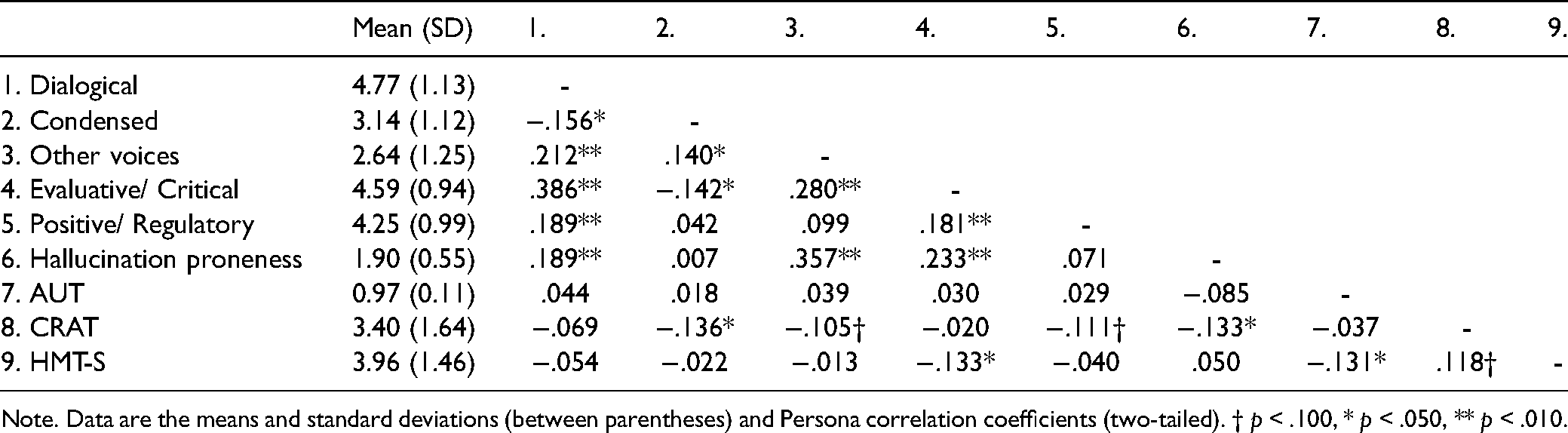
Note. Data are the means and standard deviations (between parentheses) and Persona correlation coefficients (two-tailed). † p < .100, * p < .050, ** p < .010.
Results
To provide insight into the internal consistency of the assessed VISQ-R and LSHS-R subscales Cronbach alphas were calculated. The results suggested good internal consistency for dialogical, α = .814, condensation, α = .841, other people, α = .864, and evaluative/critical, α = .780, inner speaking, and questionable internal consistency between the items used to measure positive/ regulatory inner speaking, α = .608, and auditory hallucination proneness, α = .645. Deleting items from these subscales did not yield α > .700. Given that previous work showed similar internal consistency for the positive/ regulatory subscale of the VISQ-R (Alderson-Day et al., 2014) and the auditory subscale of the LSHS-R (Alderson-Day et al., 2014), no further steps were taken to increase the internal consistency of these subscales. The mean for each subscale was therefore calculated and used in further analysis.
Descriptive statistics and correlations were calculated to provide insight into the general characteristics of the dataset. These are presented in Table 2. The results of the regression analysis are presented in Figure 1 and Table 3.
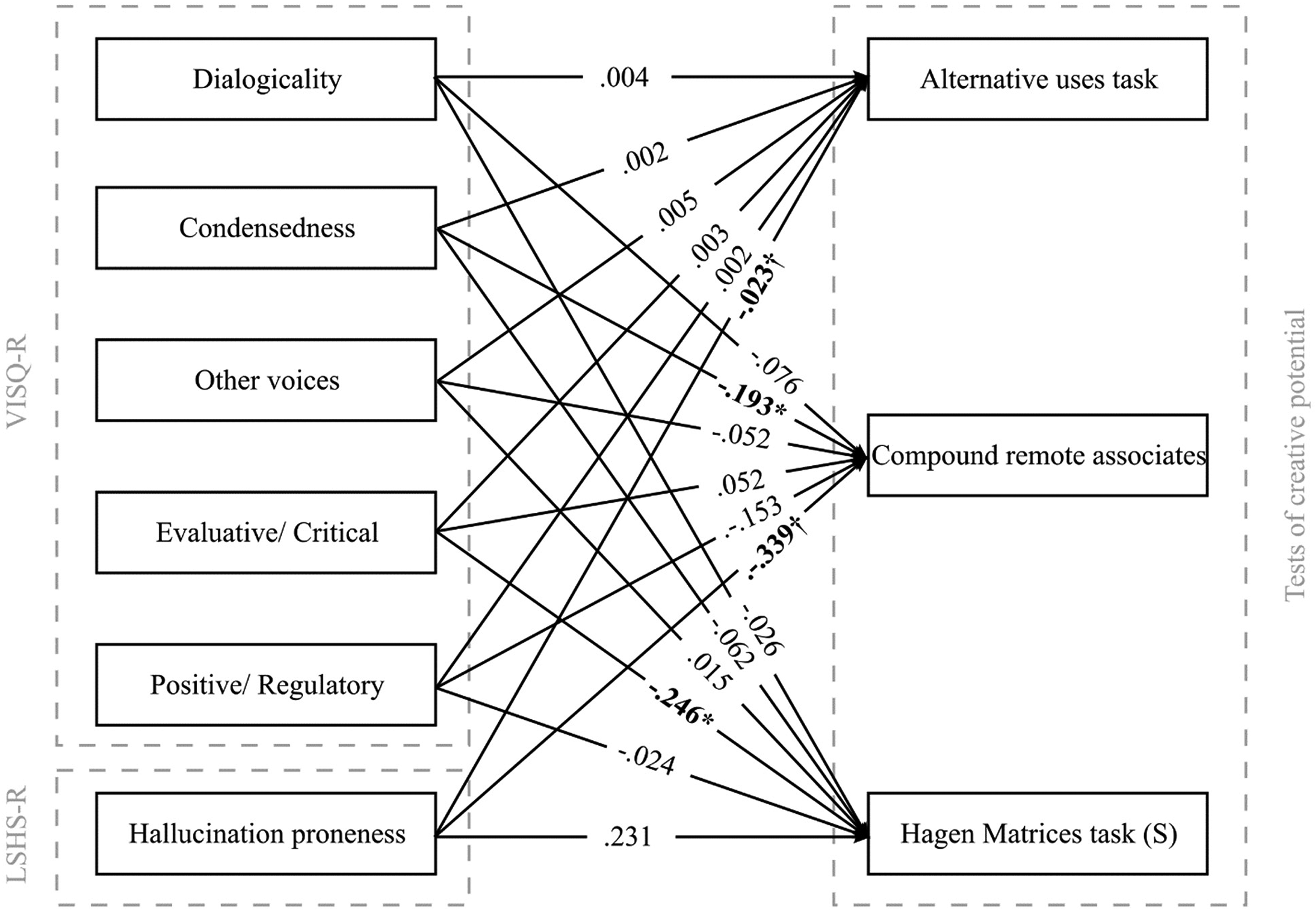
Visual representation of the test results of the relationships between the varieties of inner speaking and performance on the administered tests of creative potential. † p < .100, * p < .050.
Results of the Structural Equation Model.
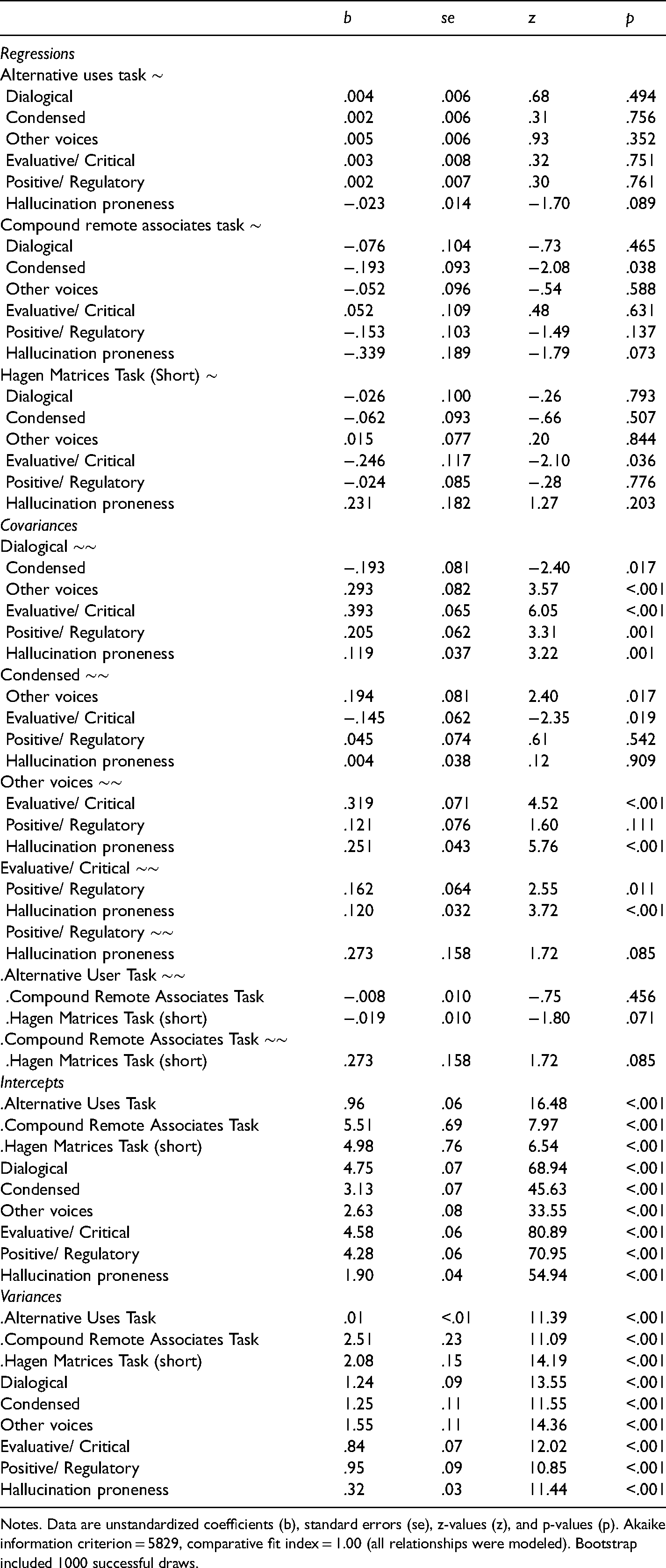
Notes. Data are unstandardized coefficients (b), standard errors (se), z-values (z), and p-values (p). Akaike information criterion = 5829, comparative fit index = 1.00 (all relationships were modeled). Bootstrap included 1000 successful draws.
Regarding inner speech’ phenomenological properties dialogicality, condensedness, and other voices. The results showed no significant correlation between dialogicality and performance on the AUT, b = −.004, p = .494, CRAT, b = −.076, p = .465, or HMT-S, b = −.026, p = .793. Interestingly, the results did show a significant negative correlation between condensedness and performance on the CRAT, b = −.193, p = .034. However, condensedness did not significantly correlate with performance on the AUT, b = .002, p = .756, and HMT-S, b = −.062, p = .507. Regarding other's voices, the results showed no significant correlations with performance on the AUT, b = .005, p = .352, CRAT, b = −.052, p = .588, or HMT-S, b = .015, p = .844. These findings therefore suggest no evidence for the conjecture that the dialogicality of inner speech positively correlates with divergent (H1a) and convergent thinking ability (H1b); nor for a relationship between a tendency to imagine others’ voices and creative potential (RQ2). However, the findings do provide preliminary evidence for a relationship between the condensedness of inner speaking and some unique aspect of creative potential that is needed to perform well on the CRAT, but not on the AUT and HMT-S (RQ1).
Regarding self-regulatory inner speaking, the results showed no significant correlations between evaluative/ critical inner speaking and performance on the AUT, b = .003, p = .751, or CRAT, b = .052, p = .631. The results, however, did show a significant negative correlation between evaluative/ critical inner speaking and performance on the HMT-S, b = −.246, p = .036. Furthermore, no significant correlations were found between positive/ regulatory inner speaking and performance on the AUT, b = .002, p = .761, CRAT, b = −.153, p = .137, or HMT-S, b = −.024, p = .776. Herewith, these findings suggest no evidence for a relationship evaluative/ critical or positive/ regulatory inner speaking with divergent thinking (H2a, H3), and no evidence for a relationship between positive/ regulatory inner speaking and convergent thinking (RQ3). However, the results partially confirm the conjecture that a tendency to engage in evaluative/ critical inner speaking negatively correlates with convergent thinking ability (H2b).
Finally, regarding the correlation between auditory hallucination proneness and creative potential. The results showed negative correlations between auditory hallucination proneness and performance on the AUT, b = −.023, p = .089, CRAT, b = −.339, p = .073, and the HMT-S, b = .231, p = .203. Despite the fact that these correlations were not significant at the p < .050 level, they were relatively strong, and in the case of the AUT and CRAT yielded p < . 100. These findings may therefore point toward a need to further explore this potentially negative relationship of auditory hallucination proneness with divergent and convergent thinking ability (RQ4).
Discussion
The present study was conducted to explore the correlates between individual differences in the phenomenological properties and quality of people day-to-day inner speaking with their creative potential.
Previous theoretical work suggested that the degree of dialogicality that characterizes a person's inner speaking might underpin a mental facility that can be used to take different perspectives on a problem, which could benefit a person's creative thinking process (Fernyhough, 2016, pp. 108–109; Glaveanu, 2017). The results of the present study, however, contribute no evidence for a correlation of dialogicality with divergent (H1a) or convergent thinking ability (H1b). This might raise questions about the relevance of internal dialogue in creative thought. However, given that qualitative research suggests that creative professionals routinely rely on internal dialogues as part of their creative process (Hellerstein, 2009), it would be premature to do this on the basis of the present study's results. Hermans’ Dialogical Self Theory postulates that an internal dialogue can take on many forms and functions that do, or do not, involve such a perspectival exchange with the self (e.g., Hermans, 1996; Hermans & Gieser, 2011; Hermans & Hermans-Konopka, 2010; Puchalska-Wasyl et al., 2008), which might be a nuance that is not captured with the VISQ-R (Alderson-Day et al., 2018). Taking into account the different kinds and functions of internal dialogue that are postulated by the Dialogical Self Theory (Hermans, 1996; Hermans & Hermans-Konopka, 2010), which includes its specific use in changing and taking different perspectives (Puchalska-Wasyl et al., 2008), could provide alternative insights into the relationship between the dialogicality of a person's inner speaking and their creative potential.
Individual differences in the condensedness of inner speaking and the tendency to imagine other voices, with creative potential, were also explored. Although the results of the study did not contribute evidence in support of a relationship between imagining others’ voices during inner speech and creative potential (RQ2), the results did suggest that people whose inner speaking tends to be more condensed compared to their overt speech with others, also did worse on the CRAT (RQ1). This finding can be taken as preliminary evidence for a negative relationship between the condensedness of inner speaking and some unique aspect of creative potential that is needed to perform well on the CRAT, but not on the AUT and HMT-S. This might relate to Marsh et al. (2021), whose experimental studies suggest that exposing participants to changing tones or speech sounds, which allegedly interferes with inner speech production, diminishes performance on the CRAT. One explanation is that inner speech is needed to form a verbal gestalt of a solution, which is needed for evaluation and which helps to guide further memory search. Possibly, this verbal gestalt might lack some of the richness needed to effectively guide memory search when inner speaking is condensed, diminishing CRAT performance in a similar way.
Interestingly, individual differences in the self-regulatory qualities of inner speaking were expected to varyingly correlate with divergent and convergent thinking ability. However, the results showed that a tendency to engage in positive/ regulatory (H3) and evaluative/ critical (H2a) inner speaking did not correlate with divergent thinking ability in the present study; and showed no evidence for a relationship between positive/ regulatory inner speaking and convergent thinking (RQ3). However, the findings did indicate that people whose inner speaking tends to be increasingly evaluative/ critical, also did worse on the HMT-S. This partially confirms hypothesis H2b. Possibly, a disposition for evaluative/ critical inner speaking is part of a larger complex of individual differences that also involves lowered self-esteem (Alderson-Day et al., 2018; Brinthaupt et al., 2009). Speculatively, evaluative/ critical inner speaking could reflect a tendency to add negative information about the self (cf. Hirsch et al., 2015; Stokes & Hirsch, 2010), which in turn might negative influence convergent thinking ability specifically for people already who experience low on self-esteem (cf. Sanna & Pusecker, 1994).
Furthermore, the results point toward a potentially negative correlation of auditory hallucination proneness with divergent and convergent thinking ability (RQ4). Possibly, these findings can be explained by the relationship between hallucination proneness and (dis)inhibition (de Leede-Smith et al., 2020). This finding aligns with previous work that suggests that inhibition positively correlates with divergent thinking ability (Benedek et al., 2014; Benedek, Franz, et al., 2012; Edl et al., 2014). However, the finding that auditory hallucination proneness also negatively correlates with convergent thinking does not align with such previous work, which overall suggests no evidence for a correlation between inhibition and convergent thinking (Benedek et al., 2014; Lerner, 1975; Marko et al., 2019). Possibly, this is due to a nuance between inhibition and disinhibition that is not always clear in the literature. Inhibition as tested with the color word Stroop test, e.g., does not correlate (negatively) with measures of behavioral disinhibition (Heflin et al., 2011). In any case, these findings need to be investigated further before drawing any conclusions, not least because they did not reach significance (p < .100 for AUT and CRAT).
The presented study also has its limitations. Firstly, individual differences may reflect the existence of specific mental facilities that can relied upon during a creative task, such as an aptitude for taking diverse perspectives by dialogical inner speaking. However, when measuring individual differences we have no certainty about whether these mental facilities were actually activated and relied upon during the tests of creative potential. Secondly, some varieties of inner speech might be symptomatic of another disposition, such as evaluative/ critical inner speaking, which is more frequent in people with heightened trait anxiety (Alderson-Day et al., 2018). Measurements of some varieties of inner speech may therefore have served as an unintended proxy for measuring another disposition, e.g., trait anxiety measured with evaluative/ critical inner speech as a proxy (cf. Hirsch et al., 2015; Stokes & Hirsch, 2010). Hence, the present article discussed the results in terms of correlation rather than causation. Thirdly, no controls for possible sources of distractions, mental states (e.g., mood, tiredness, intoxication), and other factors that could have influenced performance on the tests of creative potential were administered. Rather, participants completed the study at a time and place, and in a state, of their choosing, which introduces uncertainty about the validity of these performance measures. Fourthly, some of the (null) findings can also depend to the limited ecological validity of divergent and convergent thinking tests (cf. Cropley, 2000; Zeng et al., 2011). Creativity ‘in the wild’ is often shaped by how people deal with factors such as uncertainty and risk (Dewett, 2004; Valtulina & de Rooij, 2019). Individual differences in evaluative/ critical and positive/ regulatory inner speaking, for example, may play a very different role when there is uncertainty and risk at play that can have real-world consequences, than in tests of creative potential (cf. Hellerstein, 2009). Despite their limitations, however, tests of creative potential are useful because of their historical and frequent contemporary use (Reiter-Palmon et al., 2019). This serves comparison of the results of the present study with previous related research.
Due to the largely exploratory nature of the study the results should not be taken as definitive, but rather as indicative – and as an incentive to conduct further research.
One direction for future work could be to directly advance the findings obtained in the presented study. This requires ensuring that the different properties of inner speaking are activated during the tests of creative potential to test for causal effects rather than correlations, ideally through experimental research. The novel finding of a negative correlation between the condensedness of inner speaking and performance on the CRAT, for example, requires such a second look. This to establish whether it is indeed the case that the properties and quality of the verbal gestalt that people synthesize to evaluate CRAT solutions, and guide subsequent memory search, is hampered by condensed inner speaking (cf. Marsh et al., 2021). Moreover, the results point toward future research to explain the potentially negative correlation of auditory hallucination proneness with divergent and convergent thinking ability (de Leede-Smith et al., 2020). One starting point could be to look into the nuances in the measurements of inhibition and disinhibition to help explain these correlations further (e.g., Heflin et al., 2011).
The hypotheses that were not confirmed, such as about the relationship between dialogical inner speaking and creative potential, also require further testing. The notion of uncertainty might be critical here. Uncertainty is increasingly seen as critical for taking creative action and guiding the execution of the creative process (De Clercq & Belausteguigoitia, 2019; Valtulina & de Rooij, 2019). Hermans & Hermans-Konopka (2010) suggest that uncertainty experienced from complexity, ambiguity, knowledge deficit, and unpredictability can activate dialogical inner speaking. Uncertainty is therefore of methodological interest, because manipulating it during a creative task might be a naturalistic way to activate dialogical inner speaking (cf. Hurlburt et al., 2016). Uncertainty is also of theoretical interest. Hermans & Hermans-Konopka (2010) suggest that dialogical inner speaking serves uncertainty reduction by facilitating divergence, e.g., by introducing more I-positions, or convergence, e.g., by facilitating pruning the number of I-positions or accepting one I-position as central. One could therefore conjecture that uncertainty connects dialogical inner speaking to creative thinking by facilitating divergent and convergent thinking.
Another direction for future work could be developed by using tasks that test actual creativity rather than creative potential. Several factors that shape creativity ‘in the wild’, for example, require effective self-regulation (Beeftink et al., 2012), which might be facilitated by inner speaking (Brinthaupt et al., 2009). Positive/ regulatory inner speaking may help to cope with creative processes that require substantial risk taking (cf. Dewett, 2004; Kornilova & Kornilov, 2010), and to maintain the motivation needed to progress the creative process when confronted with uncertainty about whether a successful solution can be developed (cf. De Clercq & Belausteguigoitia, 2019). Progress can also be made by studying the utility of different phenomenological properties and quality of inner speaking in specific stages of the creative process. Internal dialogue, for example, might particularly benefit the early stages of the creative process activities are undertaken to understand the problem at hand, by enabling dialogical inner speakers to travers diverse perspectives (Fernyhough, 2016, pp. 108–109; Glaveanu, 2017), similar to how diverse perspectives in groups can benefit this stage of the creative process (Toader & Kessler, 2018).
To conclude, the findings suggest that individual differences in the phenomenological properties and quality of people's day-to-day inner speaking relates to creative potential in varying ways. That is, a disposition for inner speaking that tends more condensed or critical/ evaluative relates to diminished convergent thinking performance; and auditory hallucination proneness may relate to diminished divergent thinking and convergent thinking performance. Furthermore, the study contributes no evidence for a relationship between the dialogical, other voices, and positive/ regulatory properties of a person's day-to-day inner speaking with creative potential. Herewith, the present study contributes novel insight into the relationships between the varieties of inner speech and peoples creative potential, and embodies an early step toward a research program that aims to understand how inner speaking might affect, be relied upon during, and forms part of, the creative process.
Footnotes
Declaration of Conflicting Interests
The author(s) declared no potential conflicts of interest with respect to the research, authorship, and/or publication of this article.
Funding
The author(s) received no financial support for the research, authorship and/or publication of this article.
