




Abstract
Not all federal employees experience the presence of political appointees in their agencies in the same way. Drawing on a 2022 survey of 1,306 federal bureaucrats in the United States, we show that personality traits—especially Neuroticism—condition how formal politicization translates into perceived political influence. Ordered logistic regression models reveal that, when formal politicization increases, more Neurotic employees are significantly more likely than their less Neurotic peers to say appointees wield “a great deal” of influence. Conscientiousness displays a weaker and somewhat more ambiguous moderating effect, while Openness, Extraversion, and Agreeableness are unrelated to perception. These findings suggest identical institutional structures can generate sharply heterogeneous psychological responses across individuals and that practitioners might do well to consider management strategies anticipating such variation in an effort to preserve morale and retention in the face of intensifying politicization.
Keywords
Recent scholarship in public administration and political science emphasizes the tension between politicization of the bureaucracy—broadly defined as executive attempts to assert political control over administrative processes—and bureaucratic autonomy or expertise (e.g., Heclo, 1977; Hollibaugh, 2015; Hollibaugh & Rothenberg, 2024; Lewis, 2008; Moe, 1985; Wood & Lewis, 2017). While significant attention has focused on institutional design, appointment strategies, and agency-level outcomes (e.g., performance, turnover), far fewer—if any—studies have explored the interaction between politicization and the individual differences among career officials. This is a potentially curious omission, as public employees do not all react uniformly to the insertion of political appointees into their agencies; they may sense or interpret political influence in different ways based on their own cognitive frameworks (and/or other intrinsic attributes), even when formal structures or appointment strategies are identical (or nearly so).
Against this backdrop, theoretical perspectives from psychology and organizational behavior can provide new insights. In particular, the “Big Five” personality traits (Openness [to Experience], Conscientiousness, Extraversion, Agreeableness, and Neuroticism) have proven influential in predicting various aspects of employee behavior—ranging from leadership emergence to burnout—in both the private and public sector contexts (Cooper et al., 2013; Judge, Erez et al., 2002). Nevertheless, these traits remain underexamined in the study of administrative and bureaucratic politics, despite the intuitively appealing links between politicization and how individuals perform in the workplace and/or react to changes thereto.
As such, this paper asks the following question: To what extent do federal bureaucrats’ personality traits influence their perceptions of administrative politicization? In response, we argue that personality traits—particularly the Big Five trait of Neuroticism—can modify employees’ perceptions of administrative politicization, with those high in Neuroticism more sensitive to changes in formal politicization. 1 Using a 2022 survey of federal bureaucrats in the United States, we find support for this contention; at all levels of formal politicization, those higher in Neuroticism perceive more administrative politicization than those who are more emotionally stable, which is consistent with previous research suggesting Neurotics are prone to focusing on potential negative outcomes when in uncertain situations (DeYoung & Gray, 2009; Gray & McNaughton, 2003; Ramey et al., 2017), as well as heightened threat perception. 2 We also find similar—albeit weaker and somewhat more ambiguous—results for Conscientiousness, with more conscientious respondents more sensitive to formal politicization.
By integrating insights from personality psychology into the study of administrative politics, this research helps explain why agencies with similar levels of formal politicization might have very different internal climates, as the difference may lie in who works in them. Although the empirical focus here is on the United States federal service, the implications resonate beyond a single country, as many modern democracies grapple with balancing political control and bureaucratic autonomy (e.g., Hustedt & Salomonsen, 2014), and the findings here suggest this balance may be experienced differently by different individuals (which is a finding that plausibly transcends institutional and/or cultural differences). Indeed, in highlighting this human factor, the study contributes knowledge relevant to public sectors in other democratic states where politicization of the bureaucracy is a distinct possibility. 3
The Politicization of Bureaucratic Agencies
Scholars of public administration and bureaucratic politics have long documented the evolution of political control over administrative institutions. For example, studies of the Nixon and Reagan presidencies highlighted their strategic deployment of appointments and reorganization to augment executive control over the bureaucracy (Heclo, 1977; Moe, 1985; Nathan, 1983; Weko, 1995), though politicization efforts varied across agencies (Ban & Ingraham, 1990; Ingraham et al., 1995). This heterogeneity prompted subsequent research examining the conditions conducive to political intervention and implications for agency operations and policymaking in the United States (Hollibaugh & Rothenberg, 2024; Lewis, 2005, 2008; Light, 1995; Lowande, 2019; Resh, 2015; Richardson, 2019; Wood & Lewis, 2017), though the concept has also been subject to much study in other countries (Cooper, 2021; Hustedt & Salomonsen, 2014; Niklasson & Jezierska, 2024). Importantly, as Hustedt and Salomonsen (2014) and Limbocker et al. (2022) note, “politicization” can refer to several different concepts in practice. For example, in their analysis of state bureaucracies in Western European countries, Hustedt and Salomonsen (2014) argue politicization encompasses three distinct but interconnected mechanisms—formal, administrative, and functional politicization—and Limbocker et al. (2022) find evidence for similar mechanisms in the United States.
In this context, formal politicization refers to structural mechanisms enabling the president or other elected principals to place appointees in positions of authority or to reorganize agencies for political leverage (Hustedt & Salomonsen, 2014; Limbocker et al., 2022; Moe, 1985). Administrative politicization refers to the actual influence political actors exert over day-to-day decisions within agencies (Eichbaum & Shaw, 2008; Wood & Lewis, 2017). And functional politicization describes how career civil servants adapt their behavior and career choices in response to the political environment, sometimes creating internal labor markets resembling political appointment patterns (Hood & Lodge, 2006; Hustedt & Salomonsen, 2014). In this paper, however, we focus on how personality traits affect the relationship between formal and administrative politicization and leave the study of any effects on functional politicization for future research.
Importantly, high levels of formal politicization do not always translate to high levels of administrative politicization; sometimes appointees hold formal authority yet rarely intervene, or careerists have enough autonomy to mitigate or mute political pressures (Lewis, 2008). Regardless, the negative effects of politicization can be concerning, as high levels (of all types) can lead to increased employee turnover, resulting in the loss of valuable institutional knowledge and expertise (Doherty et al., 2019). Politicization can reduce agency effectiveness by disrupting normal operations and potentially subordinating technical expertise to political goals (e.g., Wood & Lewis, 2017). And workplace cultures can suffer as well, with the creation of ingroups and outgroups, reduced employee morale, and tension between careerists and appointees (Richardson, 2019).
Personality in Bureaucratic Settings
Turning now to a discussion of the individual differences between bureaucrats, early organizational theorists speculated about a distinct “bureaucratic personality,” which is a rigid, rule-bound type of official shaped by hierarchical structures (Merton, 1940; Thompson, 1975). While such descriptions contain a grain of truth (though might risk being characterized as caricatures), more contemporary evidence shows that public employees exhibit a broad range of personality traits, much like employees in other sectors, and systematic differences between the Big Five trait profiles of public sector and private sector employees appear modest (Cooper, 2020). This suggests it might be inaccurate to speak of a single “bureaucratic personality,” as bureaucracies are staffed by individuals with diverse dispositions, each of which can shape behavior in different ways.
Perhaps the most dominant way of analyzing such individual differences and dispositions in recent years has been the Big Five framework (or the Five Factor Model of personality). Public administration scholars are no exception to this trend, and have increasingly turned to it in order to better understand individual differences between bureaucrats (Aarøe et al., 2021; Cooper, 2020; Cooper et al., 2013). 4 The Big Five traits—Openness (to Experience), Conscientiousness, Extraversion, Agreeableness, and Neuroticism—represent broad, stable dimensions that capture much of the variance in human personality, have robust psychometric underpinnings (McCrae & Costa, 2005), and are highly relevant to real world outcomes. For example, in private sector studies, these traits predict job satisfaction, leadership emergence, turnover, and more (Judge et al., 1999; Seibert & Kraimer, 2001).
Adopting this framework, public administration scholars have begun to link these traits to important attitudes and behaviors in public sector settings (Nørgaard, 2018). For example, the Big Five have begun to appear in work on performance, administrative burdens, tolerance for rule changes (Aarøe et al., 2021), and ambition for promotion within agencies (Hassell et al., 2026) among other topics, appear to influence prosocial motivations like public service motivation (Jang, 2012; van Witteloostuijn et al., 2017), and have also been shown to affect elite behavior more broadly (Ramey et al., 2017). By bringing personality into focus, this emerging literature seeks to enrich our collective understanding of why bureaucrats differ in their work behaviors, stress responses, interpretations of political events in the workplace, and more.
These considerations are particularly important given the immense levels of discretion possessed by individual bureaucrats. Classic street level bureaucracy theory highlights that many public officials (like social workers, police officers, teachers, and other frontline agents) operate with substantial autonomy in how they interpret and implement policy (Lipsky, 1980; Nørgaard, 2018). In practice, this means individual administrators often act as de facto policymakers, in that they make judgment calls about, for example, who receives services, how strictly to enforce rules, or how much effort to invest in assisting a client. This is consistent with Lipsky's (1980) observation that street-level officials cope with complex demands by developing personal routines or categorizations of clients; in other words, who they are (their attitudes, biases, and styles of interaction) directly influences how they carry out their jobs. Indeed, if personality varies from one administrator to the next, such variation could translate into markedly different decisions and behaviors in these discretionary settings.
Indeed, empirical research supports the notion that individual differences among bureaucrats have real consequences for policy implementation. For instance, studies show that frontline bureaucrats’ personal perceptions and interpretations of policies substantially influence their compliance with rules and their behavior towards clients (Nørgaard, 2018). More generally, Brehm and Gates (1997) famously demonstrated that some public servants “work” diligently while others “shirk,” partly as a function of their own motivations and dispositions; later research showed the importance of other motivations such as Public Service Motivation (Perry, 2000; Perry & Wise, 1990; Schuster et al., 2022) in explaining behavior.
While those studies focus on the effects of attitudes, perceptions, and other motivations, it stands to reason that underlying personality traits help shape those very attitudes; for example, other research has shown that personality traits are important antecedents of Public Service Motivation (van Witteloostuijn et al., 2017). In terms of the specific effects of the Big Five traits, a highly Conscientious official, for example, might be predisposed to strict rule following and thoroughness, whereas a more Open official might be inclined to adapt rules in a more flexible way to help a citizen in need. 5 These personality-driven tendencies might result in one citizen receiving a warning in lieu of a citation from one officer, while another citizen in a similar situation might get formally penalized by a different officer, not because the policy changed, but because the personality of the bureaucrat did. Therefore, understanding the personality traits of bureaucrats is critical to understanding the forces that shape their perceptions and motivations and, ultimately, their behavior.
Theoretical Framework and Hypotheses
While the broader claim here is that the personality traits of public administrators are important because they have profound influences on the cognitive processing and behavior of individual administrators, the specific central claim of this paper is that the Big Five personality traits can systematically shape employees’ perceptions of how formal politicization maps onto administrative politicization. However, we expect that each trait—where relevant—likely affects dynamics in different ways, and for different reasons, which we elaborate upon below.
Openness
Openness, which encompasses creativity, intellectual curiosity, and receptiveness to new ideas, likely has complex effects in public sector contexts. On the one hand, this trait is linked to innovation and reformist attitudes (for example, an open-minded administrator may be more likely to embrace new policies, support organizational change, and think outside the box when problem-solving), as such individuals are more prone to seeking out new information and are more engaged in intellectual pursuits (DeYoung, 2015; Ramey et al., 2017).
On the other hand, highly Open individuals may become frustrated by the constraints of bureaucratic rules and red tape. Interestingly, one large study found that public sector employees who score lower on Openness report higher job satisfaction, whereas very Open individuals tend to be less satisfied in bureaucratic jobs (Cooper, 2020). This inverse relationship may reflect that those who are imaginative and novelty-seeking may feel stifled by the more procedurally rigid and hierarchical nature of public organizations. Open individuals are also generally more tolerant of ambiguity and more receptive to diverse perspectives; such characteristics align with more progressive or reformist political attitudes (Gerber et al., 2011). In a politicized agency environment, such individuals might chafe against top-down partisan pressures or value-based restrictions that limit expert-driven innovation. In sum, Openness equips bureaucrats to be agents of change and adaptiveness—bringing fresh ideas and flexibility—but a misalignment between Openness and rigid (and/or partisan) institutional structures may result in disenchantment or conflict with the status quo.
In any event, in the present context of politicized public agencies, the intellectual curiosity undergirding Openness might lead to a heightened awareness of subtle power imbalances and deviations from established norms (or at least a greater desire to seek out information about them). Thus, more Open employees should be more likely to notice variation in formal agency politicization, leading to Hypothesis 1: Hypothesis 1: Individuals with higher levels of Openness should be more sensitive to changes in the formal politicization of their agency environments.
Conscientiousness
Reflecting traits like dutifulness, orderliness, and self-discipline, Conscientiousness is arguably the trait most stereotypically associated with the “ideal” civil servant. Conscientious individuals place strong emphases on adhering to rules, procedures, and ethical standards (McCrae & Costa, 2005; McCrae & John, 1992), and they therefore tend to excel in formal organizational environments. In both public and private sectors, higher Conscientiousness robustly predicts job performance and satisfaction (Cooper, 2020).
The dutifulness of Conscientious individuals can be highly beneficial for maintaining institutional integrity and consistency. At the same time, high Conscientiousness often correlates with a preference for order and stability, and even with more conservative or traditionalist attitudes in the political realm (Gerber et al., 2011). Consequently, very conscientious bureaucrats might be less comfortable with sudden changes or innovations that disrupt established routines. Additionally, given their desire to uphold organizational integrity, they may more readily detect political maneuvering that undermines established protocols. If such politicization is linked to potential inefficiencies or ethical breaches, Conscientious employees may be more likely to be vigilant in noticing and reporting these issues and therefore should be more sensitive to variation in formal agency politicization. Hypothesis 2: Individuals with higher levels of Conscientiousness should be more sensitive to changes in the formal politicization of their agency environments.
Extraversion
Extraversion, characterized by sociability, assertiveness, and a focus on rewards (McCrae & Costa, 2005; McCrae & John, 1992), shapes how bureaucrats interact with colleagues, stakeholders, and the public. Extraverted officials often excel at navigating interpersonal dynamics (Akert & Panter, 1988; Pollet et al., 2011) and are generally gregarious and energetic, which can be assets in roles that involve public outreach, teamwork, or interdepartmental coordination. Studies find that Extraverts in government tend to experience higher job satisfaction (Cooper, 2020), likely due to their propensity to build supportive social networks and seek out leadership opportunities. There is also evidence of self-selection effects; for example, more extraverted individuals (especially those who are highly educated or starting families) are disproportionately drawn to public sector employment (Maczulskij, 2017), perhaps attracted by the collaborative, service-oriented nature of many government jobs. Within agencies, extraverts may emerge as informal leaders (Judge, Ilies et al., 2002) and may be more comfortable navigating office politics through their natural networking skills and charisma. However, extraverts might struggle more with aspects of bureaucratic work that are isolating or routine; some research notes that extraverted personalities are less likely to thrive in monotonous environments where rules-driven tasks are repeated day in and day out (Nørgaard, 2018).
In politicized settings, an extravert's assertiveness might lead them to speak out or push back where more introverted peers stay quiet, though this likely depends on other factors like organizational culture; alternatively, they may adapt well to shifting political landscapes, given their networking abilities. In any event, these dynamics suggest Extraversion might influence reactions to politicization more than the ability to perceive it in the first place. We therefore make no theoretical predictions about the role of this trait.
Agreeableness
Agreeableness, which involves cooperativeness and trust (McCrae & Costa, 2005; McCrae & John, 1992), aligns closely with the normative ideals of public service. Highly agreeable bureaucrats are predisposed to be helpful team players who seek harmony in the workplace. Research on Public Service Motivation finds that Agreeableness is a significant predictor of the compassion dimension of PSM (van Witteloostuijn et al., 2017), suggesting agreeable individuals may be motivated by a desire to help others and serve the public interest. In practice, an agreeable administrator may excel at collaborative policymaking, conflict resolution, and maintaining positive relationships with citizens and political principals. However, extreme Agreeableness can have drawbacks, as agreeable personalities might avoid necessary confrontation, find it difficult to enforce unpopular rules, or resist whistleblowing even when ethical violations occur, all simply to preserve collegial relationships.
In the present context, agreeable officials might be conflicted; on one hand, their trust in others could make them less cynical about political directives, but on the other hand their ethical inclinations could be strained by orders that undermine fairness or harm clients. However, this suggests Agreeableness might be more likely to affect how politicization is interpreted—whether as a collaborative challenge or as a force that may destabilize workplace harmony—as opposed to whether it is detected in the first place. As such, its precise impact on detecting changes in politicization remains unclear, and we therefore make no specific hypothesis.
Neuroticism
Finally, Neuroticism is associated with emotional instability, anxiety, and reactivity (McCrae & Costa, 2005; McCrae & John, 1992), which can undermine neurotics’ job satisfaction and commitment (Nørgaard, 2018). In bureaucratic roles, a certain level of emotional stability is often considered a prerequisite for coping with routine pressures and political turbulence (Nørgaard, 2018), putting Neurotics at a disadvantage when politicization is high. Research suggests that less Neurotic employees tend to handle workplace stress better and report higher job satisfaction, whereas those higher in Neuroticism are less satisfied and more easily overwhelmed (Cooper, 2020; Nørgaard, 2018).
Additionally, Neurotic individuals tend to focus on potential negative outcomes (Bolger & Schilling, 1991; DeYoung & Gray, 2009; Gray & McNaughton, 2003; Ramey et al., 2017), and this may lead them to be more attuned to signs of politicization threatening workplace stability; as such, they may therefore respond more strongly to variation in formal agency politicization. Such a dynamic would be consistent with a recent study of faculty members working at public universities in India; in that study, those who scored higher on Neuroticism were more inclined to see their work environment as politicized or rife with favoritism (Aggarwal et al., 2022). In the present context, the same dynamics might suggest more Neurotic individuals are more sensitive to the presence of formal politicization and may also be more likely to interpret potentially ambiguous administrative actions as politically motivated threats. As such, the final hypothesis is therefore derived: Hypothesis 3: Individuals with higher levels of Neuroticism should be more sensitive to changes in the formal politicization of their agency environments.
Overall, the theory posits that among the Big Five, Openness, Conscientiousness, and Neuroticism offer the clearest mechanisms for detecting or amplifying perceived political interference. The remainder of this paper examines whether, in an environment with variable formal politicization across agencies, employees’ personality traits correspond with systematic differences in how they perceive administrative politicization.
Data and Methods
Individual-level data are drawn from the Survey on the State of the U.S. Public Service, which was conducted between August 10 and December 8, 2022. Potential respondents were identified using a roster of U.S. federal employees compiled by Hollibaugh et al. (2020), with survey invitations sent to their work email addresses.6,7
Measuring Administrative Politicization
We operationalize the measure of administrative politicization using survey respondents’ responses to the question, “In general, how much influence do you think Political Appointees have over policy decisions in your department or agency?” Responses to this question were measured as a five-category ordered response, which ranges from “None” to “A Great Deal,” which were subsequently coded on a 0–4 scale, with 0 representing “None” and 4 representing “A Great Deal.” All of the NA/DK responses were dropped.
Additionally, following Limbocker et al. (2022), we also operationalize the measure of administrative politicization using the difference between responses to the aforementioned Appointee Influence question as well as a Senior Civil Servant Influence question, which asks, “In general, how much influence do you think Senior Civil Servants have over policy decisions in your department or agency?” Responses to the Senior Civil Servant question are on the same scale as the Appointee Influence question, and the responses to the Senior Civil Servant Influence question were subtracted from the Appointee Influence question after NA/DK responses were dropped. This resulted in an ordered variable ranging from −4 (no appointee influence and a great deal of senior civil servant influence) to 4 (no senior civil servant influence and a great deal of appointee influence). However, this dependent variable is constructed by taking the difference of two other ordinal variables, and such operations may run into measurement issues. As such, we simply take the sign of this variable and use it as the dependent variable in the Difference Between Appointee and Senior Civil Servants models; this variable is scored as −1 if the respondent said senior civil servants had more influence than political appointees, 1 if they said the opposite, and 0 if they said the two groups had equal influence. 8
Distributions of these variables are presented in Figure 1. As the left pane shows, the majority of respondents felt appointees had at least some influence, with the modal response being they had a good bit of influence (and the second most common response being they had a great deal of influence). The right pane provides additional context and indicates the modal response is the perception that appointees and senior civil servants have equal levels of influence within agencies, though more respondents felt appointees had more influence than senior civil servants than vice versa.
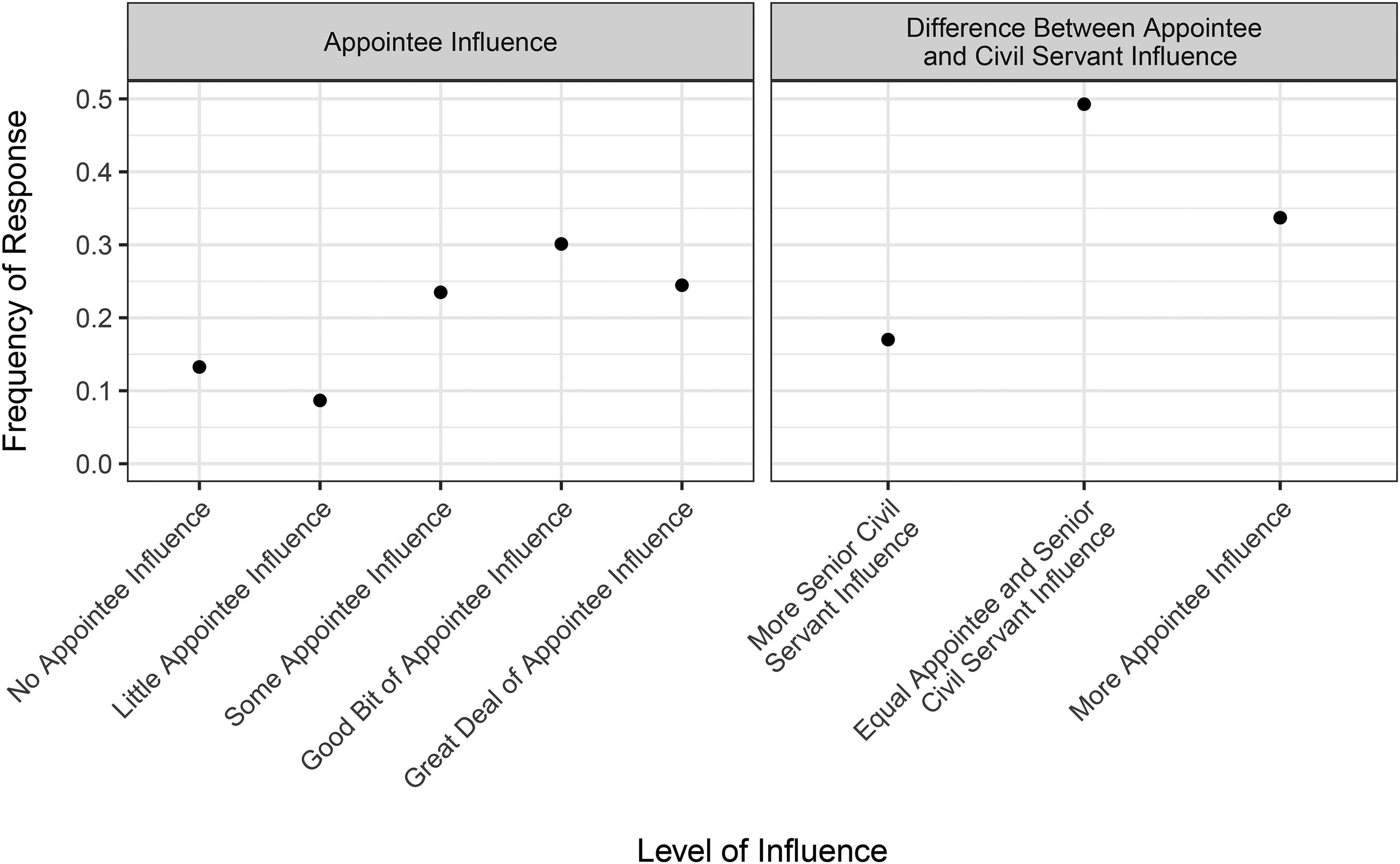
Distributions of perceived appointee influence.
Measuring Bureaucratic Politicization
In this paper, formal politicization is measured in two ways. The first, PoliticizationSES, is defined as

The second, PoliticizationSup, is defined as

Measuring Personality Traits
To measure their placements on each of the five Big Five personality traits, respondents were asked to complete the Mini-IPIP survey (Donnellan et al., 2006), which is a 20-item version of the International Personality Item Pool's Five-Factor Model measure (Goldberg, 1999; Goldberg et al., 2006). Each of the five traits are measured using four prompts, and respondents were asked to indicate their agreement with each using five-point Likert scales. 11 For each trait, the additive sum of the four relevant questions is taken as the measure of the overall trait, and the measures are normalized to have mean zero and standard deviation one. 12
Controls
Additional variables included age, gender, education, General Schedule grade, membership in the Senior Executive Service, tenure, salary range, and political party identification (Democrat, Republican, or neither). Public Service Motivation (PSM) was measured via Kim's (2011) scale, and agency-level controls for structural independence (Selin, 2015) were also added.
Estimation Strategy and Results
As both dependent variables are ordinal in nature, we use ordered logistic regression models. Table 1 presents the results with Appointee Influence as the dependent variable, and Table 2 presents the results when the Difference Between Appointee Influence and Civil Servant Influence is used. While the ordered nature of the dependent variables complicates interpretation of the coefficients, a cursory glance at the signs and significance suggests strong and consistent support for Hypothesis 3, weak (at best) support for Hypothesis 1, and conflicting support for Hypothesis 2. Perhaps most obvious are the results for Neuroticism, where the interactions between it and the measures of Politicization are positive and significant in all models. This result, consistent with Hypothesis 3, suggests more Neurotic employees’ perceptions of administrative politicization are more responsive to changes in formal politicization. We also note the positive and significant result in Model 5 for the interaction between Openness and Politicization is consistent with Hypothesis 1, as more Open respondents’ perceptions of administrative politicization seem to be more responsive to changes in formal politicization. However, this expected result only appears in one of the sixteen models presented in the main text, so we do not view it as determinative in any respect. Additionally, we find conflicting support for Hypothesis 2, as the interactions between Conscientiousness and Politicization are negative and significant in Model 5 (contrary to expectations) and positive and significant in Models 10 and 11 (in line with expectations). Therefore, given the exceptionally weak support for Hypothesis 1 and the ambiguous and conflicting evidence for Hypothesis 2, we focus on the consistently strong support for Hypothesis 3 for the rest of this section.
Ordered Logistic Models of Perceptions of Administrative Politicization (SES Measure of Politicization).
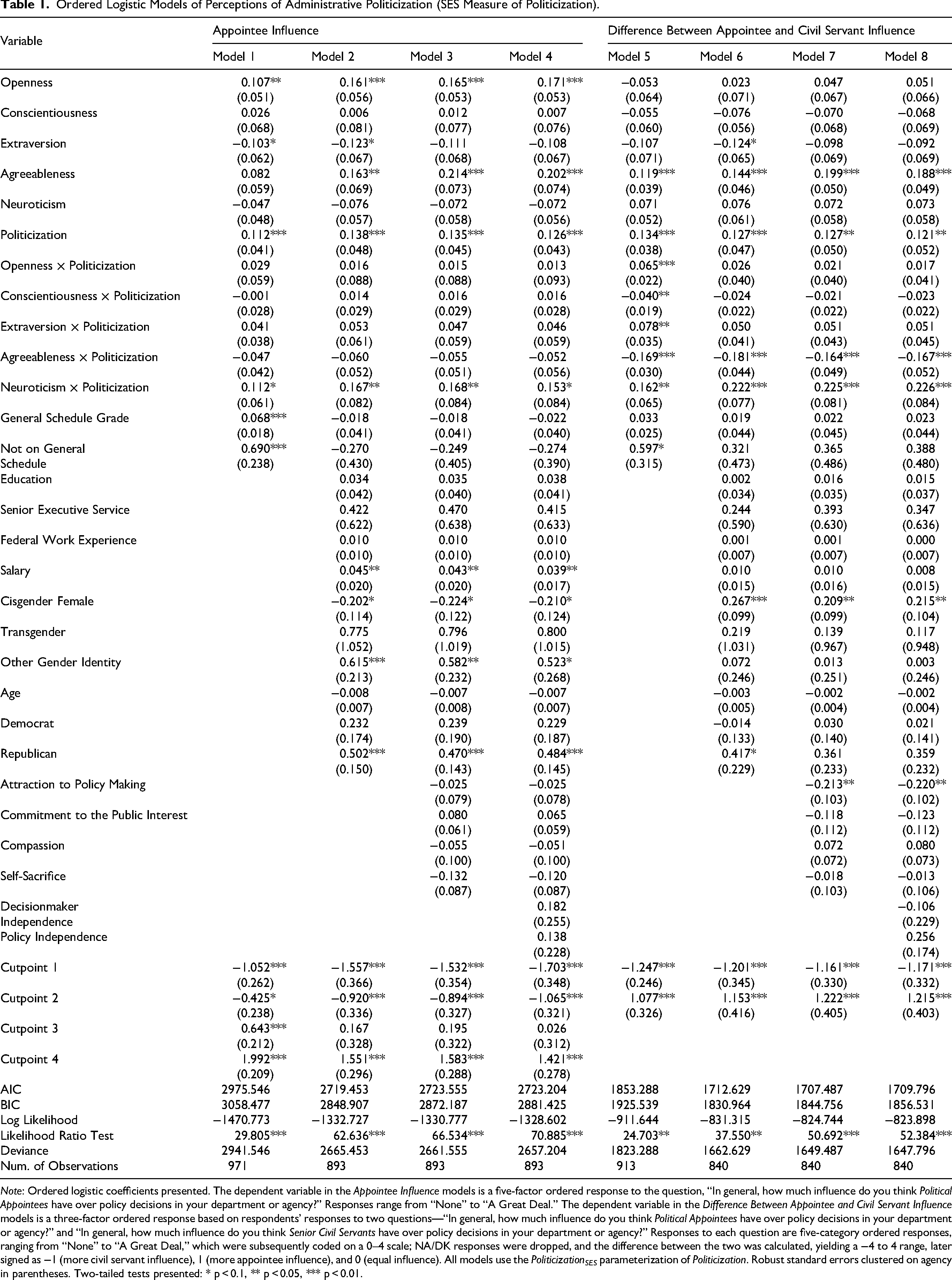
Note: Ordered logistic coefficients presented. The dependent variable in the Appointee Influence models is a five-factor ordered response to the question, “In general, how much influence do you think Political Appointees have over policy decisions in your department or agency?” Responses range from “None” to “A Great Deal.” The dependent variable in the Difference Between Appointee and Civil Servant Influence models is a three-factor ordered response based on respondents’ responses to two questions—“In general, how much influence do you think Political Appointees have over policy decisions in your department or agency?” and “In general, how much influence do you think Senior Civil Servants have over policy decisions in your department or agency?” Responses to each question are five-category ordered responses, ranging from “None” to “A Great Deal,” which were subsequently coded on a 0–4 scale; NA/DK responses were dropped, and the difference between the two was calculated, yielding a −4 to 4 range, later signed as −1 (more civil servant influence), 1 (more appointee influence), and 0 (equal influence). All models use the PoliticizationSES parameterization of Politicization. Robust standard errors clustered on agency in parentheses. Two-tailed tests presented: * p < 0.1, ** p < 0.05, *** p < 0.01.
Ordered Logistic Models of Perceptions of Administrative Politicization (Supervisor Measure of Politicization).
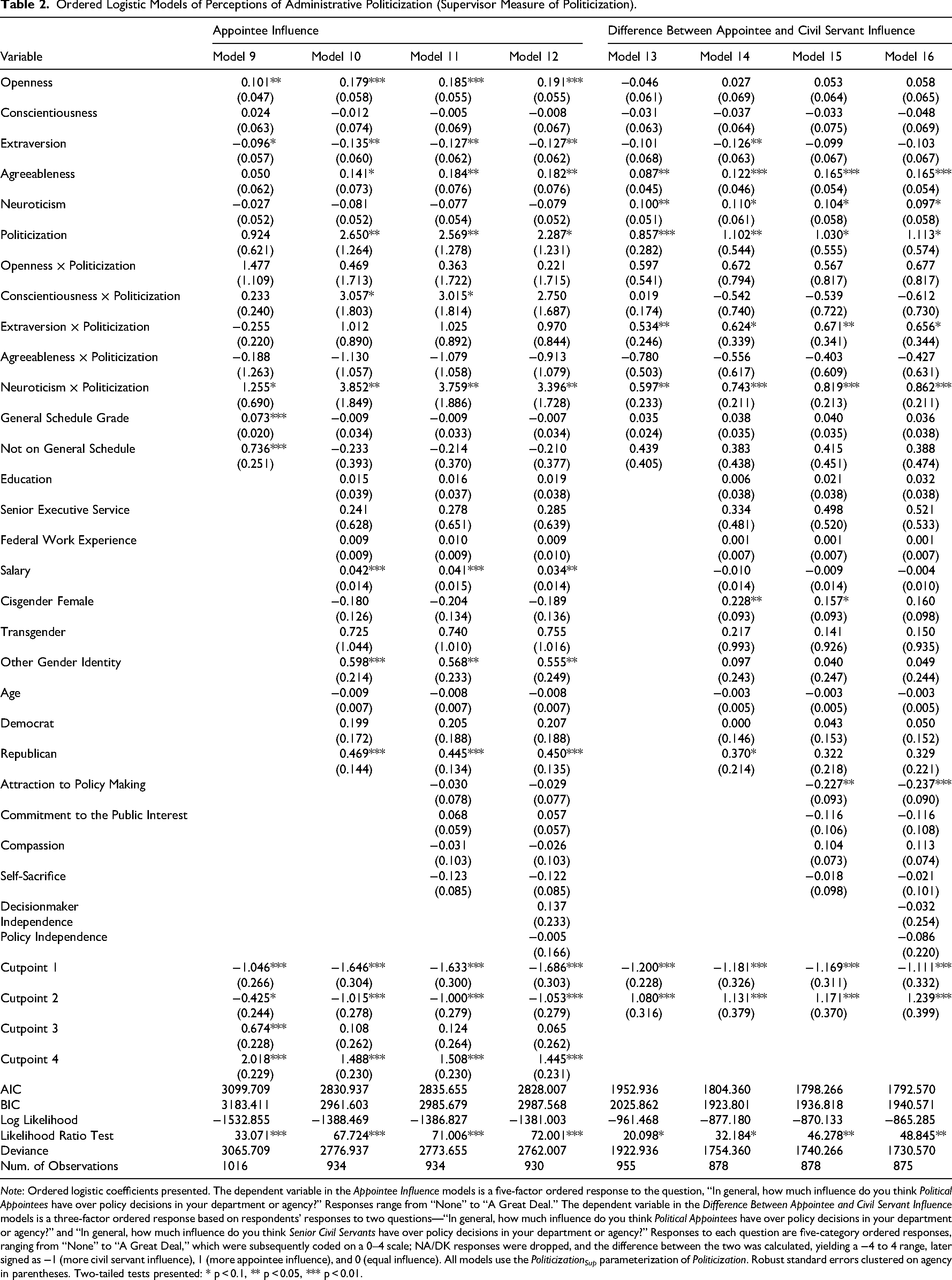
Note: Ordered logistic coefficients presented. The dependent variable in the Appointee Influence models is a five-factor ordered response to the question, “In general, how much influence do you think Political Appointees have over policy decisions in your department or agency?” Responses range from “None” to “A Great Deal.” The dependent variable in the Difference Between Appointee and Civil Servant Influence models is a three-factor ordered response based on respondents’ responses to two questions—“In general, how much influence do you think Political Appointees have over policy decisions in your department or agency?” and “In general, how much influence do you think Senior Civil Servants have over policy decisions in your department or agency?” Responses to each question are five-category ordered responses, ranging from “None” to “A Great Deal,” which were subsequently coded on a 0–4 scale; NA/DK responses were dropped, and the difference between the two was calculated, yielding a −4 to 4 range, later signed as −1 (more civil servant influence), 1 (more appointee influence), and 0 (equal influence). All models use the PoliticizationSup parameterization of Politicization. Robust standard errors clustered on agency in parentheses. Two-tailed tests presented: * p < 0.1, ** p < 0.05, *** p < 0.01.
We present key results in Figures 2 and 3. Figure 2 uses the coefficient estimates from Model 2 (Table 1) and Model 10 (Table 2) and presents the predicted probabilities of providing the different responses to the level of influence political appointees have in one's agency, varying both Neuroticism and Politicization. Specifically, simulated differences (King et al., 2000) in probabilities are presented between those with levels of Neuroticism one standard deviation above the mean and one standard deviation below the mean, with Politicization allowed to vary between zero and the 90th percentile value. 13 The lines indicate the point estimates of the differences in response probabilities, and the shaded areas represent the 90% (darker shades) and 95% (lighter shades) confidence intervals. We also include faint vertical dashed lines (reflecting the mean values of Politicization in the relevant sample and horizontal dashed lines at zero (reflecting no difference in probabilities between those with higher versus lower levels of Neuroticism). Figure 3 uses the coefficient estimates from Models 6 and 14 and presents analogous results for the difference in probabilities of responses to the constructed Difference Between Appointee and Senior Civil Servant Influence dependent variable.
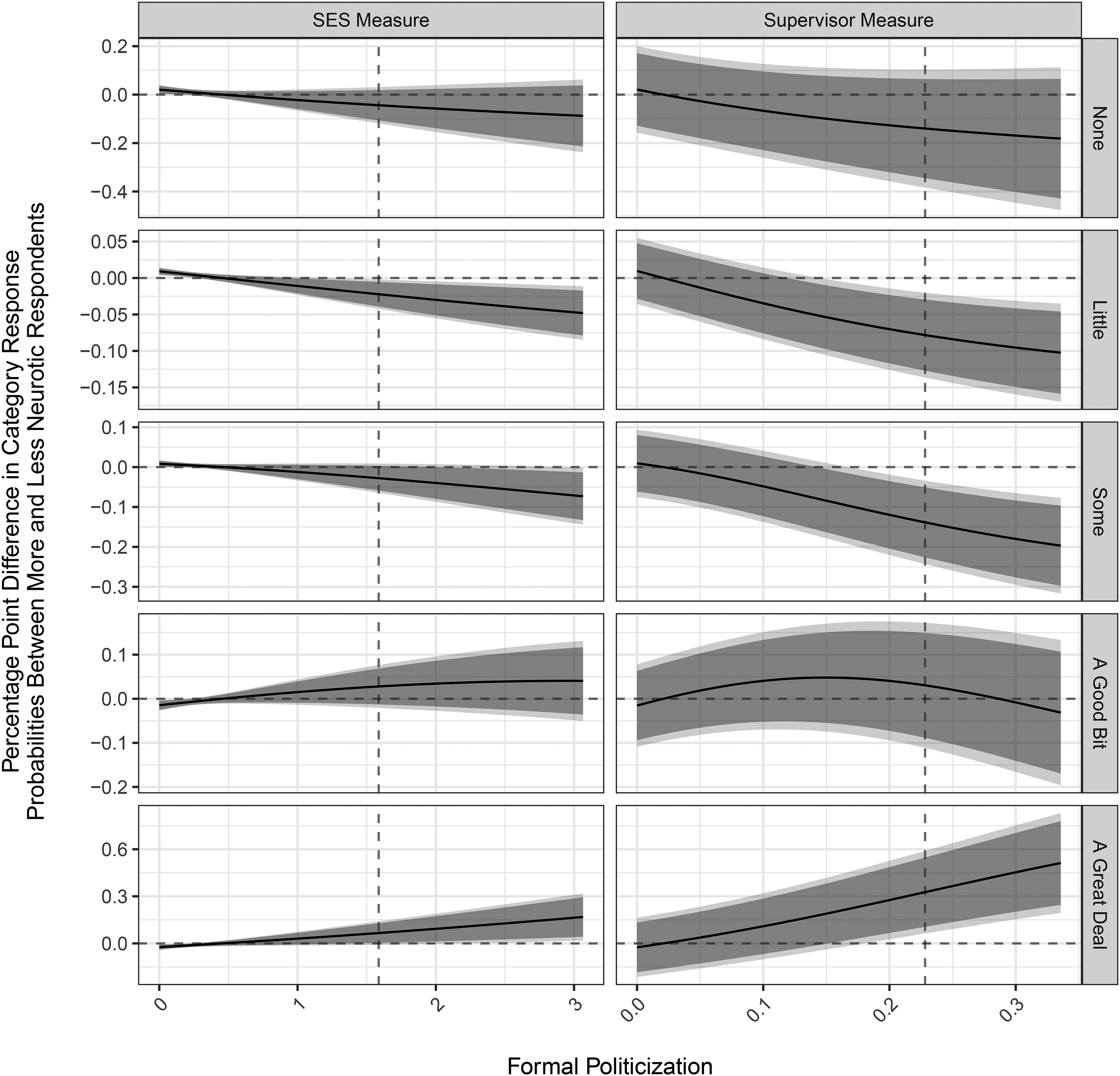
Effects of Neuroticism and Formal Politicization on Perceptions of Appointee Influence.
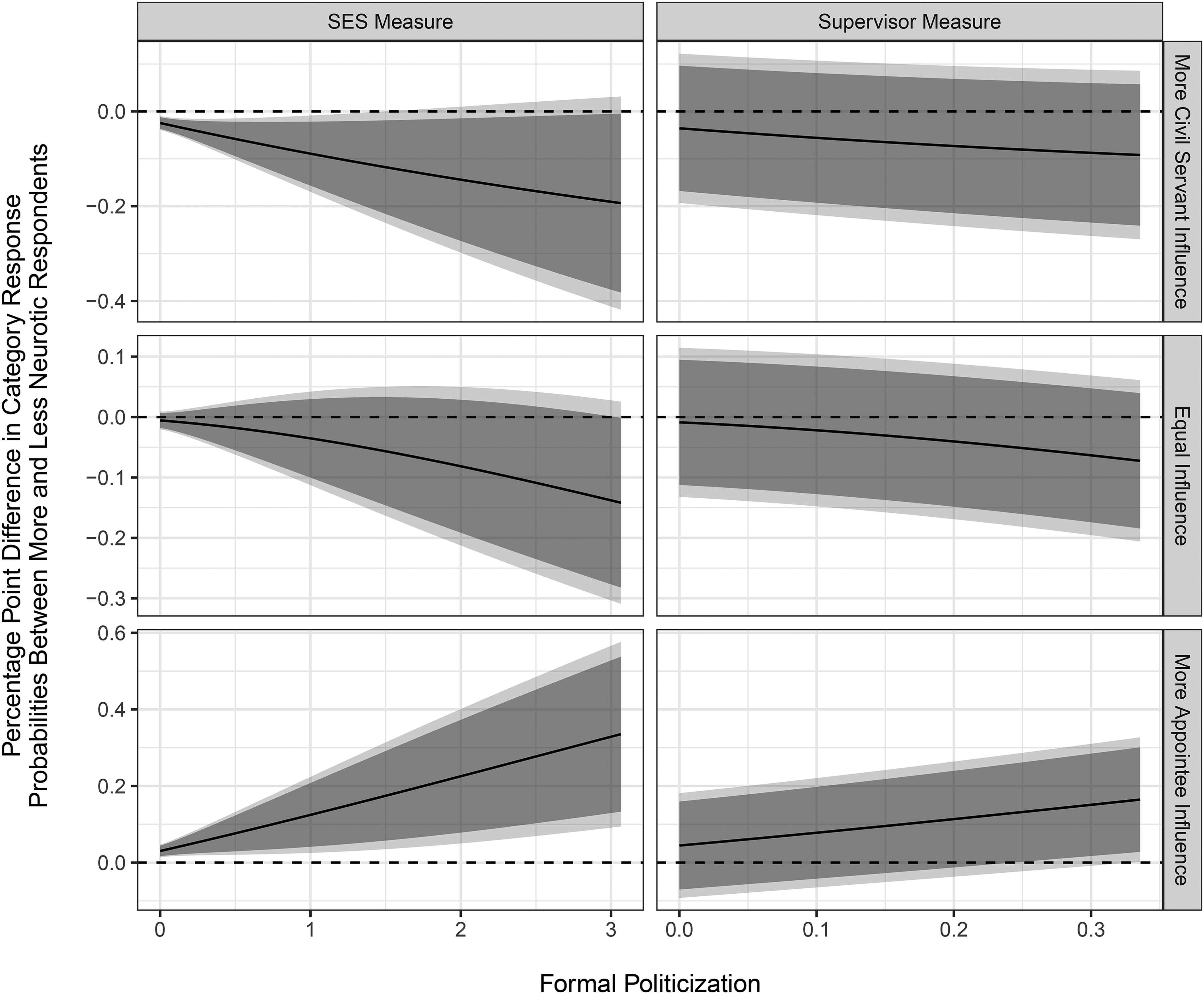
Effects of Neuroticism and Formal Politicization on Perceptions of Appointee and Senior Civil Servant Influence.
As can be seen in both Figures, for each measure of Politicization, there are significant and substantively important differences between those higher in Neuroticism and those lower in the trait. Focusing first on Figure 2, as Politicization increases those with higher levels of Neuroticism are less likely to say political appointees have “Little” or “Some” influence within their agencies and more likely to say they have “A Great Deal” of influence. Effects are substantively significant, with the strongest effects being that more Neurotic respondents are about five to ten percentage points less likely to say appointees have “Little” influence, eight to twenty percentage points less likely to say they only have “Some” influence, and about twelve to fifty percentage points more likely to say they have “A Great Deal” of influence, with the results stronger in magnitude when the supervisor measure of Politicization is used.
Figure 3 presents analogous results for the Difference Between Appointee and Civil Servant Influence models, and the results largely align with those from Figure 2. For example, at the highest levels of Politicization presented in the graph, more Neurotic respondents are between sixteen and thirty-three percentage points more likely to say political appointees have more influence than senior civil servants, with negligible differences between respondents at the lowest levels of Politicization. Additionally, when the SES measure of Politicization is used, more Neurotic respondents were about twenty percentage points less likely to say senior civil servants had more influence when levels of formal politicization were at the high end of the chart. Collectively, the results in Figures 2 and 3 suggest Neuroticism is associated with statistically and substantively significant differences in how respondents connect changes in formal politicization to their own perceptions of administrative politicization, with more Neurotic respondents more sensitive to changes in the former.
Some of the results for the control variables also exhibit interesting patterns, the most interesting of which are arguably those for Republican and the Attraction to Policymaking dimension of Public Service Motivation. In all models where Appointee Influence is the dependent variable, and in a few with the other dependent variable, Republican respondents are more likely to say appointees have higher levels of influence. Notably, the survey was fielded during the middle of the Biden administration, so it seems likely outparty respondents were more sensitive to any formal politicization that might have been occurring. Additionally, those with higher values on Attraction to Policymaking were less likely to say appointees had high levels of influence, but only when the Difference Between Appointee Influence and Senior Civil Servant Influence was used as the dependent variable. This suggests such respondents are more likely to say senior civil servants had higher levels of influence, which could be explained by several factors, including motivated reasoning (in that they respond as such because they want senior civil servants to have more influence), unrepresentative positions (in that those with higher levels of Attraction to Policymaking are more likely to find themselves in positions where senior civil servants have more influence), or something else entirely. Regardless, future research should examine these dynamics further.
Overall, consistent with expectations, we show Neuroticism is strongly connected to the extent to which federal employees’ perceptions of administrative politicization are grounded in variations in formal politicization. Employees ranking higher on this trait generally perceive more administrative politicization at all levels of formal politicization relative to employees ranking lower on this trait. We also find no strongly consistent effects for Openness or Conscientiousness, contrary to expectations. 14
Discussion
The findings in this paper illustrate that politicization is not experienced or perceived uniformly by public servants even under similar institutional arrangements. Rather than suggesting that formal politicization necessarily produces different levels of political control across agencies, the results indicate that employees differ systematically in how they interpret and react to the same structural conditions. In this sense, the study highlights a psychological pathway through which identical organizational designs might potentially generate divergent internal climates, without necessarily requiring that political appointees behave differently across those settings.
To that effect, this study contributes to the growing scholarship on micro-level factors in bureaucratic politics by theorizing and testing how different personality traits—in this case, Neuroticism—might shape perceptions of political influence. The results highlight the value of integrating personality psychology into research on political control; traditional accounts of politicization emphasize institutional design, the extent of appointee layering, and leadership style (which itself might be a function of personality), whereas the present findings suggest how those structures are perceived depends at least in part on employees’ dispositional tendencies. Specifically, employees higher in Neuroticism seem to be more sensitive to increases in formal agency politicization, perhaps because they are more likely to see the introduction or presence of numerous appointees as more invasive or threatening, which then leads them to perceive elevated levels of administrative politicization. This dynamic suggests perceptions of politicization—like other workplace stressors—are at least partly shaped by personality. Future work might explore whether these differing perceptions lead to distinct outcomes (such as variations in turnover intentions, morale, policy compliance, or something else). If more Neurotic employees are more likely to see politicization and feel threatened, they may exit agencies at higher rates—or become less engaged with policy initiatives.
Nevertheless, a key limitation is the survey's low response rate, as the survey was conducted without any official government partnership or endorsement. This lack of broader participation may reflect institutional barriers, widespread “survey fatigue,” or wariness about discussing potentially sensitive political topics. In turn, the sample's representativeness may be affected in ways difficult to correct post hoc. 15 Consequently, any claims to generalizability are necessarily restrained. Nonetheless, these data offer an important initial test of a model of bureaucratic politicization incorporating personality traits. Future projects aiming to replicate or expand on this approach might want to seek official endorsement or external partnerships to boost response rates, collect panel data to track how changes in agency leadership or political contexts shift employees’ perceptions, and/or explore complementary qualitative methods (e.g., interviews) to understand how employees with different personalities notice, understand, or even rationalize the presence of political appointees.
Conclusion
Politicization is not merely a structural fact of the administrative state in the United States and other countries around the globe; rather, it is a lived work experience filtered through one's personality traits. As discussed here, employees high in Neuroticism consistently perceive greater political influence under identical formal arrangements, while the other Big Five personality traits (with the possible exception of Conscientiousness) show little to no effect. Recognizing these tendencies matters for both scholarship and practice. For researchers, the results indicate caution against treating “politicization” as a simple function of appointee counts, as the actual effects of such numbers are filtered through administrators’ perceptions; future researchers would be well-served by incorporating such contexts into studies of politicization. For practitioners, the findings might underscore the potential importance of anticipatory management. Agencies might be able to mitigate morale losses (or other negative outcomes) by understanding personality distributions, communicating changes clearly, and pairing potentially vulnerable staff with stabilizing supports. In short, blending the insights of personality psychology with the perennial question of political control of the administrative state yields a more nuanced, actionable picture of life inside politicized bureaucracies.
The broader approach here could also be applied to the study of other deep-seated aspects of individuals that guide perceptions and behavior within public sector organizations. One example is the religiosity or religious values of public administrators, as these have been shown to affect their discretionary decisions and how they implement policy (Golan-Nadir, 2024). This also suggests further implications of our findings for street-level bureaucracy theory, as it suggests additional dispositional sources of frontline behavioral variation often overlooked by standard models. Indeed, scholarship on street-level bureaucracy has documented how street-level officials use discretion and coping mechanisms to shape policy implementation on the ground, often acting as de facto policymakers amid resource constraints. Early accounts and later studies (Lipsky, 1980; Maynard-Moody & Musheno, 2003; Prottas, 1978) attribute this on-the-ground heterogeneity in implementation mainly to institutional pressures, ambiguous rules, or professional socialization. Brehm and Gates (1997), for example, conclude that a bureaucrat's own preferences have the greatest effect on behavior, potentially outweighing (or at least mitigating) formal incentives. Our evidence that Big Five personality traits (especially Neuroticism) condition perceptions of politicization extends these insights to the realm of individual dispositions, as the results show that two employees facing the same level of formal politicization can perceive (and, presumably, respond to) it differently because of who they are. This suggests that street-level discretion, policy interpretation, and coping are driven not only by where one works (context) but also who the worker is (personality). Thus, our findings suggest street-level bureaucracy theory, coupled with an analysis of stable dispositional traits, might be able to offer a more comprehensive understanding of why similarly-situated bureaucrats exercise discretion in varied ways; such an approach, while left for future work, would link the microlevel psychology of frontline workers with macrolevel patterns of administrative behavior.
That all said, it is striking that, aside from Neuroticism's robust impact, none of the other Big Five traits consistently influenced perceptions of politicization. This null finding suggests that many stable dispositional differences (e.g., being more Agreeable, Open, or Extraverted) do not, by themselves, make a federal employee substantially more or less sensitive to the influence of political appointees in their agencies. One possible explanation is that these traits manifest in responses to politicization in ways not captured by the perception measure (for instance, influencing how employees cope with politicization rather than whether they detect it). Another explanation is that the other Big Five traits simply are not triggered by the types of environmental cues provided by formal politicization, whereas Neuroticism—characterized in part by anxiety and threat sensitivity—directly heightens one's alertness to political interference. Prior research on personality in public service has similarly found that not all traits are equally relevant across all outcomes; 16 our results echo that pattern, underscoring the unique role of Neuroticism. We emphasize that this pattern is potentially theoretically meaningful, and future scholars of public administration might focus on anxiety-prone dispositions when studying perceptions of organizational threat, while recognizing that the other traits may require different research designs (and/or outcome variables) to reveal their influence on actual behavior (if it exists at all).
Additionally, while this study's conclusions are drawn from survey data analyzed using quantitative methods, future research could employ in-depth interviews or case studies of federal employees to illuminate the mechanisms behind these patterns. Conversations with career officials (with a focus on ensuring a sample with sufficient variance on the Neuroticism trait) could potentially reveal how they interpret leadership's actions. Such qualitative insights would richly complement our statistical findings, helping to flesh out the causal story behind personality-driven differences in perceptions of administrative politicization.
On balance, these findings align with broader psychological theories linking anxiety and threat perception (Bolger & Schilling, 1991; Gray & McNaughton, 2003) and open a path for more thorough investigations into the interplay between structural political control and the cognitive-emotional orientations of bureaucrats, as well as the relationship between such orientations and individual behavior. For scholars and practitioners of public administration, the implications are clear—reforms or interventions increasing the density of political appointees may be differentially experienced by employees, depending not only on organizational culture or partisan orientation but also on enduring personal dispositions. Indeed, individuals with higher levels of Neuroticism may feel overwhelmed and threatened in response, potentially leading to increased stress, lower morale, and higher turnover (among other behavioral effects), while others may remain more resilient. Recognizing this heterogeneity has the potential to enrich our collective understanding of how formal politicization maps onto administrative (and, potentially, functional) politicization and ultimately influences performance, workforce stability, and the quality of policy implementation.
Supplemental Material
sj-pdf-1-arp-10.1177_02750740261444334 - Supplemental material for Personality Traits and Agency Politicization: Neuroticism and Perceived Political Control in United States Federal Agencies
Supplemental material, sj-pdf-1-arp-10.1177_02750740261444334 for Personality Traits and Agency Politicization: Neuroticism and Perceived Political Control in United States Federal Agencies by Gary E. Hollibaugh, Jr. and Matthew R. Miles in The American Review of Public Administration
Footnotes
Acknowledgements
Author names are listed in alphabetical order of last name. We thank the reviewers, Mallory Compton, Pablo Fernandez-Vasquez, George Krause, Markus Tepe, and audience members at the 2023 Annual Meetings of the American, European, and Midwest Political Science Associations and the International Society for Political Psychology, as well as the 2024 and 2025 Annual Meetings of the Public Management Research Association for valuable feedback on previous drafts. Hollibaugh acknowledges support from the Momentum Fund at the University of Pittsburgh and the Expense Support Grant Program at the Institute for Humane Studies (Grant no. IHS016929). Amanda Zaner provided excellent research assistance. All errors remain our own.
Funding
The authors disclosed receipt of the following financial support for the research, authorship, and/or publication of this article: This work was supported by the Institute for Humane Studies (grant number IHS016929).
Declaration of Conflicting Interests
The authors declared no potential conflicts of interest with respect to the research, authorship, and/or publication of this article.
Data Availability Statement
Replication data and code are available at the Harvard Dataverse at https://doi.org/10.7910/DVN/1XFZ5V.
Supplemental Material
Supplemental material for this paper is available online.

Supplemental material
Supplemental material for this article is available online.
Notes
Author Biographies
References
Supplementary Material
Please find the following supplemental material available below.
For Open Access articles published under a Creative Commons License, all supplemental material carries the same license as the article it is associated with.
For non-Open Access articles published, all supplemental material carries a non-exclusive license, and permission requests for re-use of supplemental material or any part of supplemental material shall be sent directly to the copyright owner as specified in the copyright notice associated with the article.
