




Abstract
Active citizens who take initiative are generally regarded as desirable. However, the precise reasons why citizens’ initiatives are considered valuable and what their value consists of remain unclear, vague, and often unanswered. In this study, we used Q methodology to explore how civil servants, local politicians, and societal actors in a Dutch municipality view the public value of citizens’ initiatives. The analysis reveals four distinct views of the value of citizens’ initiatives: a view that values intangible results, a view that values a hands-on mentality, a view that values acting out of a sense of purpose, and a view that values citizens organizing and acting out of their own interests. Theoretically, we distinguish between material, immaterial, and process-oriented interpretations of values, and empirically this distinction shows that across the four value views, the process-oriented values are the most disagreed upon. Finally, we find common ground between the value views that we label “selfish collectivism.” This is the view that appreciates citizens’ initiatives for solving problems for the sake of the community, not for their altruism, but because they are self-serving. The strong differences in value views suggest that there is a risk that subsequent policy language and instruments based on these views could lead to conflict between the actors involved.
Expectations of Citizens’ Initiatives
Citizens are asked to participate in a wide range of policy processes (Healey, 2015; Uitermark, 2015; Verhoeven & Tonkens, 2013; van de Wijdeven, 2012) and self-organizing citizens’ initiatives are counted on to produce public services in a wide variety of domains. Citizens’ initiatives or community-based initiatives also contribute to public life and generally have positive effects on society (Hurenkamp et al., 2006, p. 10 & p. 20; Boonstra & Boelens, 2011, p. 117; Healey, 2015, p. 116).
Citizens’ initiatives are viewed by local governments as promising vehicles to deliver solutions to a broad range of public problems. These initiatives are often expected to reduce costs for implementing policy programs, sometimes because they are “believed to empower and educate citizens and reduce the reliance of individuals and social organizations on state bureaucracies” (Bakker et al., 2012., p. 396, see also Edwards, 2009 about civil society expectations). Local governments want to include citizens in both policy-making and its implementation, or at times, want citizens to take care of themselves as self-sufficient and self-organizing beings (Hurenkamp & Tonkens, 2011, p. 27). Active citizenship is approached by governments to provide a solution to different kinds of societal puzzles. These range from providing libraries, playgrounds, and kindergartens, to correcting a deficiency of social cohesion, consumerism and asocial behavior, social exclusion, or to bridging the increasing gap between government and society (Tonkens, 2006, p. 5; Uitermark, 2015, p. 2311).
The “promise” of citizens’ initiatives is sometimes labeled public value (Bryson et al., 2013, p. 25; Brandsen et al., 2017, p. 682; Duijn & Popering-Verkerk, 2018). However, what this value entails is often fuzzy (e.g., van de Wijdeven, 2012). Examples of describing these values are varied:
citizens produce “publically valued goods and services in non-state and non-market ways” (Healey, 2015, p. 116), citizens’ initiatives contribute to various societal values (Mattijssen et al., 2015, p. 85), citizens’ engagement is necessary for better results and because of moral necessity (Hurenkamp and Tonkens, 2011, p. 27), or citizens’ initiatives have a favorable effect on the local community (Hurenkamp et al., 2006, p. 57).
The specific ideas about the public value that citizens’ initiatives produce are oftentimes vague while the expectations by local governments are high. We expect differences because initiators or participants themselves may have other views on why citizens’ initiatives are more valuable than those of policy-makers or politicians (van Straalen et al., 2017). If this expectation is true and there is indeed a mismatch in what is perceived as the value of a citizen initiative, such ambiguity can help in understanding why the interaction between governments and citizen initiatives is often problematic. Governments may expect too much of citizens’ initiatives, even demanding too much of them, resulting in disappointment by both initiators and governments. Or governments may create a suboptimal institutional context in terms of rules, enabling conditions and policy instruments which are not in agreement with the motives and ambitions of the initiative itself (Streeck & Schmitter, 1985, p. 122). Some overlap or the complementarity between perceptions and ideas of public value by citizen initiatives is likely to be important for successful coproduction. Therefore, we propose to investigate the following question: To what extent do ideas of the public value(s) of citizens’ initiatives differ between local politicians, civil servants and societal actors?
With this study, we analyze whether there is such a difference and, if so, what that possible difference could look like. In doing so, we provide some clarifications within the public value debate (Alford & Hughes, 2008; Hartley et al., 2017; Prebble, 2018). Responding to Stoker's (2006) argument that public value has a highly contextual character, this research creates a specific contextual setting to determine what is valued by the public: the value of citizens’ initiatives within a local context. In other words, our research adds to the understanding of the question of what “a public values” instead of what “the public values” (Benington, 2009, p. 233; Hartley et al., 2017, p. 672). If there is a perception gap between the initiators of citizens’ initiatives and local governments of what public values are, unraveling this gap may help to revisit the current ‘ways of working’ between these two. Consequently, clarifying the current working relationship, including the usual incentives to support (Blok et al., 2022) and the institutional arrangements between citizens’ initiatives and local governments, may promote productive interaction.
Theoretical Literature: Public Value and Categorizing Outcomes
Two types of literature are discussed: the literature that helps to understand the value that citizens’ initiatives could lead to and the literature that helps to further distinguish different kinds of valuable outcomes. We start with the former by providing three lenses that provide a perspective on why citizens’ initiatives could be valuable.
Public value is a broadly coined concept that is also used to capture some of the trends surrounding self-organization (e.g., Mattijssen et al., 2015, who speak of “creating value with the public”; Duijn & Popering-Verkerk, 2018). Public value is primarily known through Moore's book Creating Public Value (1995). But public value is a complicated concept for at least two reasons. The first reason is that Moore's book “has the term ‘public value’ in its title, but the book is really more about quality public management and presents no stable concept of public value” (Jørgensen & Bozeman, 2007, p. 357). Therefore, the absence of a sound definition of public value, while the concept is massively used 1 , is a profound problem (ibid., but see also Alford & O’Flynn, 2009; Bozeman, 2002; Overeem & Tholen, 2011). For example, the concept is used to make a point about innovation in the public sector, but, although fulfilling an important part of the authors’ arguments, “what the value actually is” is often taken for granted (e.g., Hartley, 2005). Rhodes and Wanna state (2007, pp. 408 & 419): “Moore is unclear whether he offers a new theoretical framework, a concept, a heuristic device, or an operational tool of management.” The second reason is summarized by Stoker (2006, p. 50): “The concept of public value does appear to have a decidedly context-dependent character” which makes it difficult to use to define valuable outcomes in general (see also Alford & O’Flynn, 2009, p. 176). Anything can be valuable given “the right” context.
The public value paradigm, framework or theory offers, so far, little if any help in defining what makes citizens’ initiatives valuable. The premise on which the public value discourse is based—value—could be of use. As Alford and O’Flynn (2009, p. 175) note about value: “that property of a thing because of which it is esteemed, desirable or useful; worth, merit or importance.” Similar definitions arise from Meynhardt (2009, p. 197).
In sum, someone must find value in something that citizens’ initiatives produce. The question remains: who is to do the valuing? Alford and Hughes (2008) argue that public value is valuable to whoever consumes it. Self-organizing citizens often produce valued goods or services that they use themselves as well. In that sense, from the public value perspective, citizens’ initiatives are valuable because they do something that initiators or participants themselves see as desirable (and because they use it themselves). Moreover, as argued in the introduction, public authorities value citizens because they produce desirable goods and services. There are multiple actors who may be suited to do the valuing (see also Hartley et al., 2017, p. 674).
The second lens is about how value is created. Self-organized citizens’ initiatives are a form of collective action: (Bakker et al., 2012; Blok et al., 2020). When citizens successfully organize and produce “something,” they overcome the collective action problem (Ostrom et al., 1994). Succeeding in collective action can be seen as valuable because it signals the ability to cooperate. Thus, citizens’ initiatives are seen as valuable because they are a form of collective action or because they show evidence that its problems, as described by Olson (1965), can be overcome.
The third and final lens is value expressed by concepts such as civil society, social cohesion, and social capital. These concepts are prominent cornerstones in Putnam's work (2001, p. 22): bonding social capital, as he labels it, is “good for undergirding specific reciprocity and mobilizing solidarity.” In line with this, bonding social capital is associated with trust and citizen participation, a combination that enables the production of socially desirable outcomes (ibid., p. 288). Social capital, Putnam states in the end of Bowling Alone, makes us smarter, healthier, safer, richer, and better able to govern a just and stable democracy, (ibid., p. 290). Social capital “is presumably what produces a dense civil society” (Fukuyama, 2000, p. 7; see also Walzer, 1991). Civil society encompasses all social relations between citizens (Bryant, 1993) and has a dense network of civil association (Foley & Edwards, 1996, p. 38). As such, it is also seen as necessary for fruitful and spontaneous self-organization (Bryant, 1993, p. 399) and a healthy public sphere (Diamond, 1994; Edwards, 2009). Castells (2008, p. 76) argues that civil society is the place where various views are expressed and that a good relationship between the state and civil society is the cornerstone of democracy (see also Keane & Merkel, 2019). Self-organizing citizens’ initiatives are valuable because they can be seen as an expression of “the civil society.” Within this civil society, citizens deliberate about common affairs and act and organize independently of the state.
However, making distinctions between these last two lenses might lead to some confusion. Citizens’ initiatives are manifestations of cooperative behavior (lens two) and, therefore, naturally connected to concepts such as social cohesion and civil society (lens three). As such, we feel it is necessary to elaborate more on these distinctions. Following Edwards (2009) position on this matter, distinctions should be made between civil society or collective action as a means to get somewhere on the one hand and as a vision of “the good society” on the other. In this research, we view civil society (that one wants to create) and social capital (which is something one possesses) as valuable ends.
These ends could be achieved through collective action by citizen's initiatives, but this is not necessarily the case. Civil society can also be created by healthy states, well-functioning markets, and non-associated citizens. Simultaneously, a vivid associational life full of initiatives is hardly sufficient in itself to make a society civil (Edwards, 2009, pp. 44–48).
Next, for the second type of literature, we identified three fruitful starting points to better understand the public value(s) of citizens’ initiatives: first, distinguishing between internal and external; second, conceptualizing different levels of outcomes; and third, defining public value in terms of material, non-material, and process outcomes.
Igalla and colleagues (2019) make the distinction between internal and external outcomes. External outcomes are observable outside the initiative; they are the produced goods. They state that citizens’ initiatives “provide and maintain an alternative form of traditional governmental public services, facilities, and/or goods themselves, such as water distribution, education and training, and residential care” (ibid., p. 7). In terms of external outcomes, the authors find that, according to the literature, most initiatives contribute to social improvements of the community, economic improvements of the community, physical improvements of the community, and environmental improvements. In terms of internal outcomes, they refer to organizational aspects that the initiatives realize for the initiative itself, such as durability, legitimacy, and organizational outcomes (ibid., p. 10).
Another distinction in outcomes is made by van de Wijdeven (2012, p. 257). He differentiates between the outcomes in terms of the questions of “what does it yield,” “what does it bring about” and “what does it bring forth”? Van de Wijdeven answers these questions sequentially: the first with “the clean park,” then, with “sociality and self-confidence,” and finally, with “citizenship.” His distinction is primarily aimed at how the impact of outcomes is experienced by those who are involved.
Van der Torre et al. (2019) studied public value for “The Association of Netherlands Municipalities.” As a starting point, they used three categories of values (ibid., p. 5) that are also useful for this research: material values (of which lower taxes or higher employment opportunities are examples); immaterial values (of which happiness or a sense of community are examples); and process values (of which co-creating a space for citizens, making decisions transparently, or anchoring in democratic processes are examples).
Ultimately public value, social capital, and collective action are well-connecting concepts (Benington, 2009). The public value of citizens’ initiatives is related to its external goods, also to its internal goods, and to the process of how citizens’ initiatives do things. Our framework captures these distinctions by the previous authors in combination with the three lenses on valuable outcomes that we have just discussed. In this way, we can distinguish between these values:
Next, we discuss the ground for expecting differences in the perspectives of public value between different actors surrounding citizens’ initiatives.
The Tensive Relationship Between the Government and Initiatives
In many countries collectives of citizens who engage with public problems are becoming increasingly important (Baum, 2001; Bailey, 2012; Healey, 2015; Henriksen et al., 2018). There are multiple reasons why governments are partial to citizens’ initiatives. Firstly, most ideas refer to “the right behavior” of citizens (Boonstra & Boelens, 2011, p. 101). For example, citizens should be self-reliant because it is good for them and good for society (Tonkens, 2006, p. 9; van Dam et al., 2015, pp. 165 & 175). Arguments often start with stating that citizens rely too much on the government and, furthermore, that they behave like consumers (Kleistra, 2019; van Rooij et al., 2019, p. 429). The Dutch government stated in 2013 that “the goal is to activate as many citizens as possible to take on local activities” (Ministry of the Interior and Kingdom Relations, 2013). Secondly, active citizenship is necessary for a well-functioning democracy associated with natural communal activities and self-organization and is therefore a crucial building block for civil society (Eriksson, 2012, p. 687). Within the Dutch context of this research, the government has set up multiple efforts to increase the number of citizens participating in society or to support, facilitate, and even entice citizens to participate and organize themselves (Ministry of the Interior and Kingdom Relations, 2018; van Dam et al., 2015, p. 164).
Both of these views held by the government illustrate that there are high expectations about citizens’ initiatives. These high expectations by political parties and civil servants have also been found in previous studies (Den Ouden et al., 2019; de Haan et al., 2018, p. 313; who, for the record, also found some lower expectations of civil servants). In addition, social funds and housing corporations have laid their eye on citizens’ initiatives (Denters et al., 2013). To illustrate the point of having unreasonably high expectations, we quote Edwards (2009, p. 16) about associations in the civil society, which we believe also applies to citizens’ initiatives: “There is equal danger in expecting too much from associational life, as if it were a ‘magic bullet’ for resolving the intractable social, economic and political problems (…). It seems, [they] are expected to organize social services, govern local communities, solve the unemployment problem, save the environment, and still have time left over for rebuilding the moral life of nations.”
In conclusion, governments have high expectations about citizens’ initiatives and the public value they create. But these expectations may be too high, and, moreover, we seriously doubt that all expectations are shared by those involved in citizens’ initiatives. This mismatch of expectations may consequently result in wrong or suboptimal policies and inappropriate instruments aimed at inviting or supporting citizens’ initiatives. As such, we find it crucial to understand more precisely what the perspectives of all the actors are and how they differ.
Research Design
We used Q methodology (Brown, 1993; McKeown & Thomas, 1988; Stephenson, 1953; Watts & Stenner, 2005), which has quantitative features, such as factor analysis to order and to couple certain qualitative points of view. “Fundamentally, Q methodology provides a foundation for the systematic study of subjectivity” (Brown, 1993, p. 93). The purpose of this study is to discover how different actors, or different ‘publics’ if you will (Benington, 2009), view the public value(s) of citizens’ initiatives. In a sense we are exploring the “contests, debates and arguments between and among different [actors] about what constitutes public value” (Hartley et al., 2017, p. 674). And because values “express subjectivity” (Meynhardt, 2009, p. 199), a systematic study of subjectivity fits the purpose because the participants in this study decide what they think is valuable about citizens’ initiatives (Watts & Stenner, 2005, p. 69).
To successfully execute the Q study, the following procedure was applied: (1) making a
The Q Sample: Public Value Statements
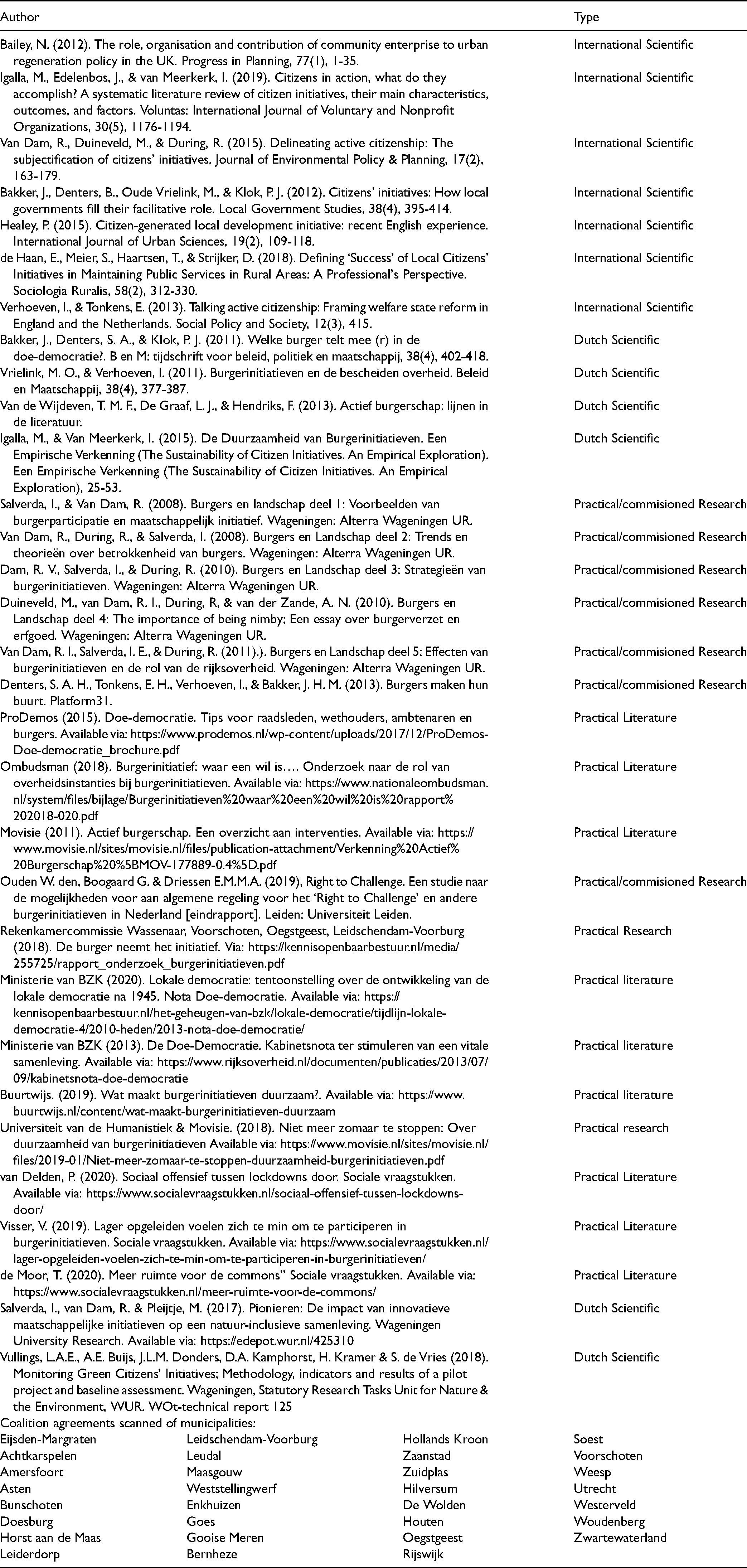
The primary concern of constructing the Q sample is making it generally representative (Watts and Stenner, 2005, p. 75). Collecting the samples can be done either in an unstructured or in a structured way. And as structured samples are drawn based on theoretical arguments (McKeown & Thomas, 2013, p. 23), or, more specifically, the theoretical framework, we chose to do the latter. A total of 179 statements was reduced to 36 statements (12 for each value). First, we categorized the statements on face value, which led to roughly 25 categories of statements for each type of value. Next we further compressed the statements by finding overlaps between the categories until a total of 12 statements for each type of value remained. One of the authors scraped the Dutch ‘Coalition Agreements’ by city councils of 2018 on citizens’ initiatives (and similar labels). This led to an inventory of 31 municipalities profiling themselves with high ambitions for citizens’ initiatives (all but one explicitly and actively wanted to support citizens’ initiatives). None of the municipalities explicitly mentioned citizens’ initiatives before the merger. In the new coalition agreement, the municipality is quite vocal about citizens’ initiatives. Examples are that they “really want to give space,” that they see “citizens’ initiatives as leading in how the municipality deals with its community” and that they want to “stimulate, encourage and facilitate” citizens’ initiatives. The inventory of coalition agreements was then used to check whether the 36 statement also represented these coalition agreements. Finally, we discussed the statements with a panel of eight experts ranging from science and practice, to local and national government. We created a Q sample from the following sources (see appendix 1 for an overview):
Dutch commissioned research from practice: for example, a ministry commissioned a series of five research projects on citizens’ initiatives and another ministry commissioned a research report on the possibilities for the Right to Challenge; Dutch scientific research that is often used by researchers or practitioners; International scientific research that is often used by researchers or practitioners; Other semi-public research or pieces about citizens’ initiatives, such as documents by Courts of Audits [Rekenkamercommissie], the Ombudsman, or the Dutch information center for democracy, “ProDemos.”
It was already remarkable how most of the documents were aimed at stimulating citizens’ initiatives or describing indicators that increase the success of citizens’ initiatives without explaining what it is that is valuable or successful in terms of citizens’ initiatives.
3
Many of the documents also have a rather instrumental vision of citizens’ initiatives. For example, Movisie (2011) presents an overview of interventions to stimulate active citizenship, and a committee of a local Court of Audit stresses the need for citizens’ initiators to work with other actors to realize their goals (instead of working well together internally, i.e., collective action).
The P set: Selecting Participants
The selection of actors who will do the “valuing” has partly been theoretically presorted (McKeown & Thomas, 2013, p. 31) because we expect various social actors to have different views. Therefore, we included local politicians, civil servants, and societal actors, including initiators. Together with the municipality, we selected a diverse set of participants within these groups, for example, local politicians from different political parties and civil servants ranging from the city manager to street-level bureaucrats. As for citizens, we included initiators and non-initiators and they were all active and societally-involved respondents (from schools, the library or the ‘village council’) who could be approached via the municipality. With this step in the Q methodology, we tried to refrain from including only enthusiasts (Fiorina 1999, p. 402).
With this P set, we figuratively “created well-informed publics”—again, not the public—to express ideas about the public value of citizens’ initiatives (Benington, 2009, p. 232; Meynhardt, 2009, p. 206).
The Q Sort and Interview: Ordering Statements and Expressing Ideas
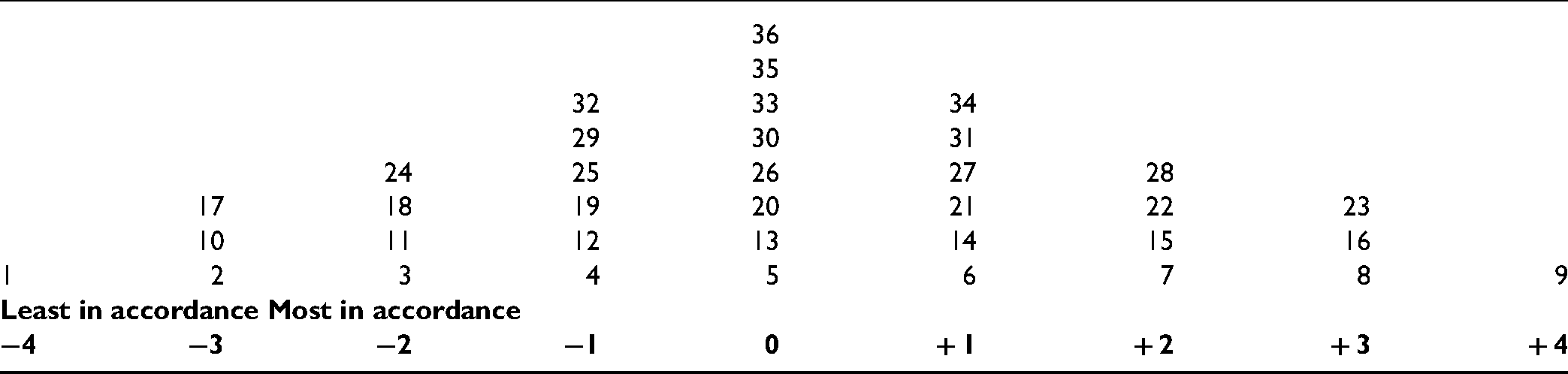
Our sample of 22 respondents ranked the 36 statements according to a forced-choice format (appendix 2). The statements were ranked on a normal distribution from – 4 to + 4, which is appropriate for Q samples smaller than N = 40 (McKeown & Thomas, 2013, p. 29). Respondents ranked the statements from ‘least in accordance’ to “most in accordance.” This range indicates that a score (or position on the format) is always to some extent in accordance.
Due to the covid pandemic, the interviews took place in the summer of 2021 via MS Teams and Miro (an online whiteboard) and the statements were posted on digital post-its. The Q interviews typically lasted 50 −70 min. A few questions were asked before the sort: e.g., “what is your background?” and “how do you define citizens’ initiatives?” And a few after the sort: “why did you put these statements at the extremes?”, “did you miss specific statements?”; “do you think citizens’ initiatives can do the majority of public tasks better than governments?”; “do you think citizens’ initiatives should always be financially supported?”; and “what are the downsides with and problems for citizens’ initiatives?” The answers to these questions and the additional explanations to the rankings were written down by the researchers, leading to 22 research notes of approximately 1,000 words a piece.
Analysis and Results
We analyzed the Q sorts with KADE (Banasick, 2019), an open-source application for the analysis of Q study data. First, the correlations of all respondents were calculated, resulting in a .22 correlation between all the sorts, indicating that the respondents were a rather heterogenous group. Second, the Principal Components Analysis led to 8 factors of which 7 had an Eigenvalue higher than 1. We reviewed the analysis and noticed that, with 5 factors or higher, only single respondents represented those factors. Therefore, we continued with 4 factors having an explained variance of 57% (the "composites" of these 4 factors are in appendix 3). Third, factors were rotated using Varimax.
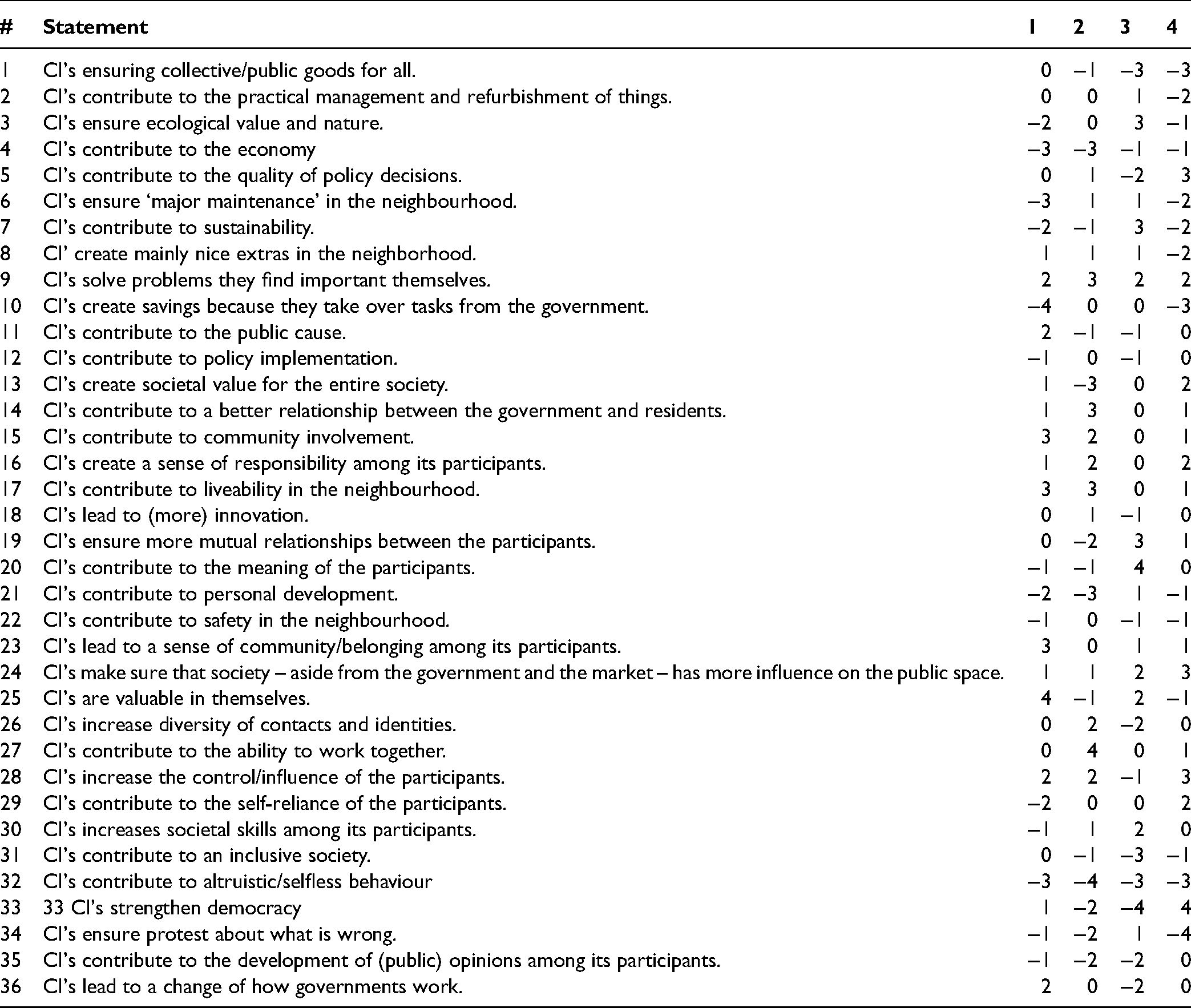
Table 1 shows the various respondents (categorized by types) and how they “loaded” on the factors. Respondents can load negatively (–1 to 0) or positively (0 to + 1) on the factors. Next, we interpreted each of the factors based on the characterizing statements, i.e., those statements with a score of ± 3, 4 or the distinguishing statements (these are “significantly” different for one factor compared to the others), and the explanations of the respondents.
Correlation Coefficient Between Respondents and Factors.
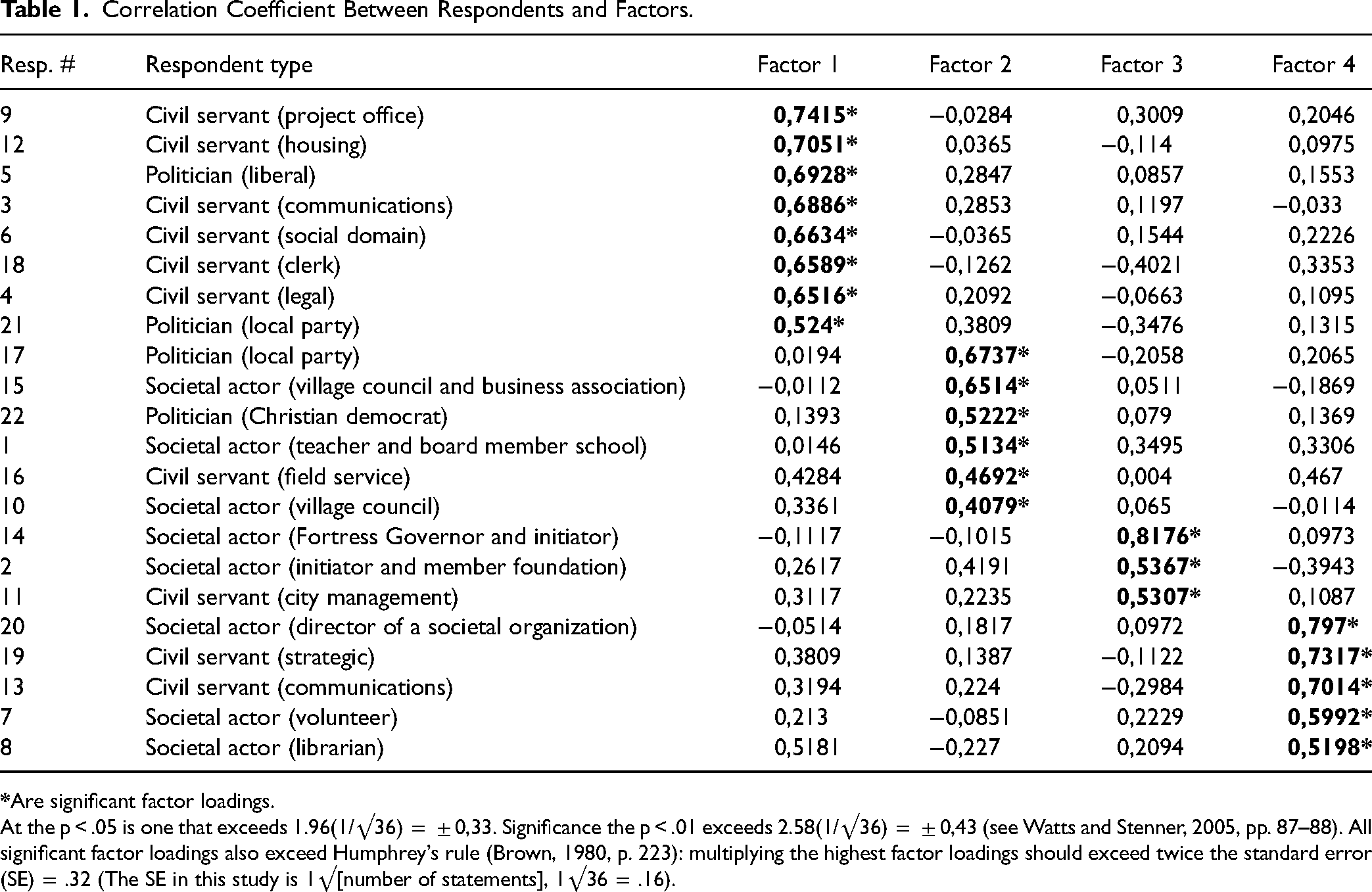
At the p < .05 is one that exceeds 1.96(1/√36) = ± 0,33. Significance the p < .01 exceeds 2.58(1/√36) = ± 0,43 (see Watts and Stenner, 2005, pp. 87–88). All significant factor loadings also exceed Humphrey's rule (Brown, 1980, p. 223): multiplying the highest factor loadings should exceed twice the standard error (SE) = .32 (The SE in this study is 1√[number of statements], 1√36 = .16).
Factor 1: Idealistic Immaterialists
Factor 1 has 8 significant loadings: 6 civil servants and 2 local politicians. Factor 1 opines that citizens’ initiatives are intrinsically valuable. That citizens’ initiatives contribute to the involvement in the community, liveability, and solidarity/community spirit are expressions of that intrinsic value. Respondents who associate strongly with this factor value citizens’ initiatives because they are viewed as a form of reassurance that people are still willing to do something for their community and the public cause.
Factor 1 is also rather idealistic in the sense that it values the immaterial rather than the material. All the statements that the participants did not agree with are material values; furthermore, their idealism is visible in the statement quotes. Citizens’ initiatives should—in principle—not be valued for the savings they might realize or as replacements for the government's role in major maintenance projects. In other words, the real value of citizens’ initiatives is not as instruments to realize output. Another respondent also highlights how “feeling involved” is what matters for citizens’ initiatives, and anything else is secondary (Table 2).
Statements with Highest/Lowest Scores for Factor 1.
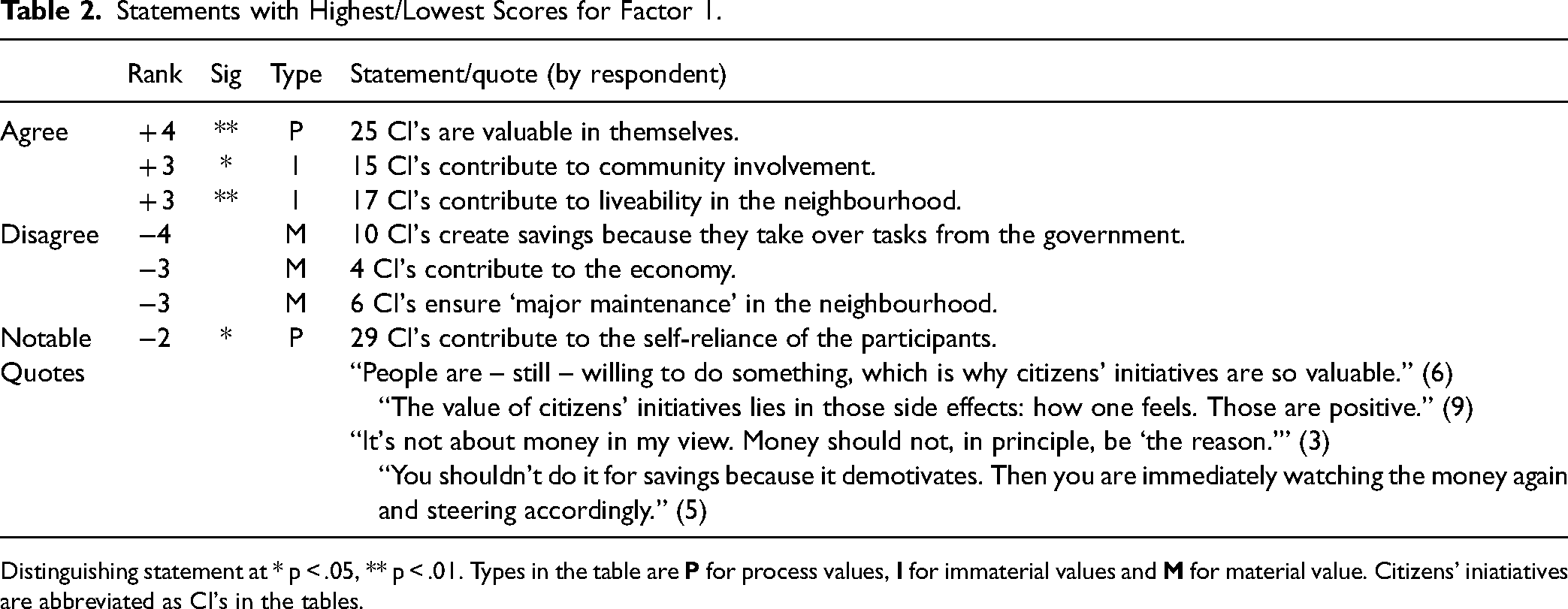
Distinguishing statement at * p < .05, ** p < .01. Types in the table are
Factor 2: Pragmatic Partners
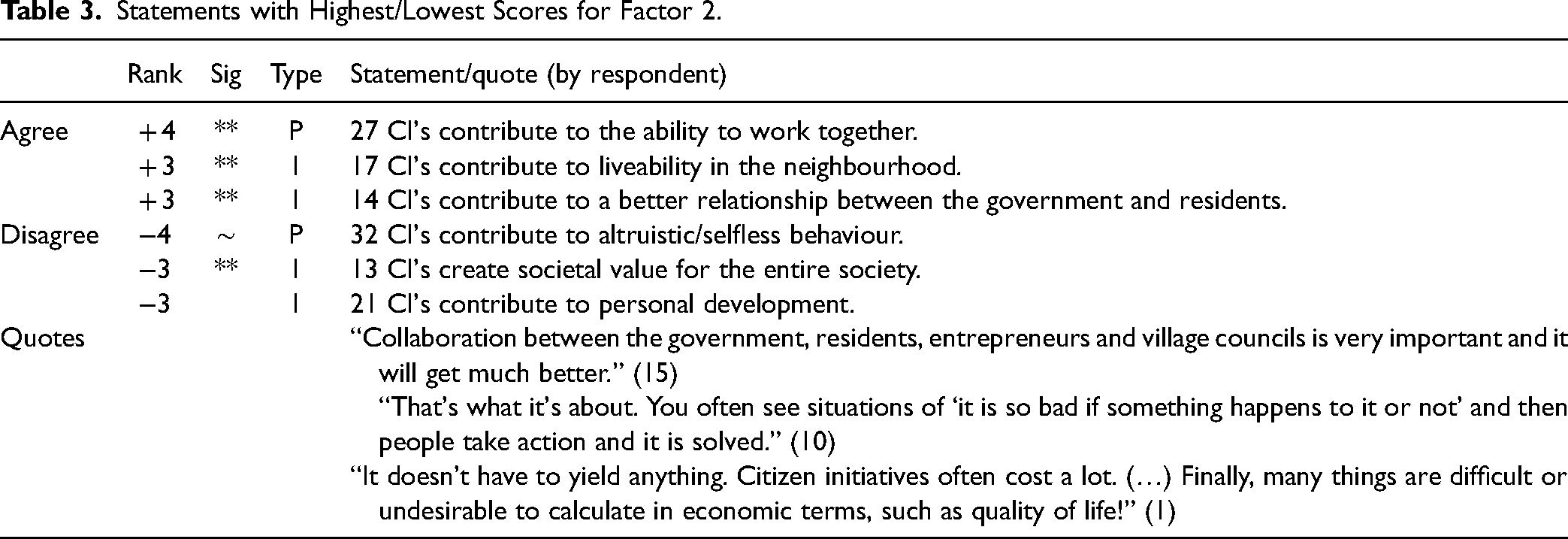
Factor 2 has 6 significant loadings: 3 societal actors, 2 local politicians, and 1 civil servant. This factor is called pragmatic because it conveys a certain kind of hands-on-mentality. Not the kind that leads to all sorts of material output, but the kind that leads to liveability and a better relationship between the municipality and the community. The statement ‘CI's solve problems that they themselves find important’ also ranked + 3 on this factor.
The combination of taking action when necessary as initiators is central to this factor and also central for nurturing collaboration/partnership between the municipality and the community. The interaction is necessary to get acquainted and to strengthen cooperation/partnership between governments and initiators. In addition to Table 3, other quotes illustrate this position: ‘The relationship really improves by talking to each other. (…) And it is good to listen to initiatives because then you notice what is happening locally.’ (16)
Statements with Highest/Lowest Scores for Factor 2.
Factor 3: Personal Purpose
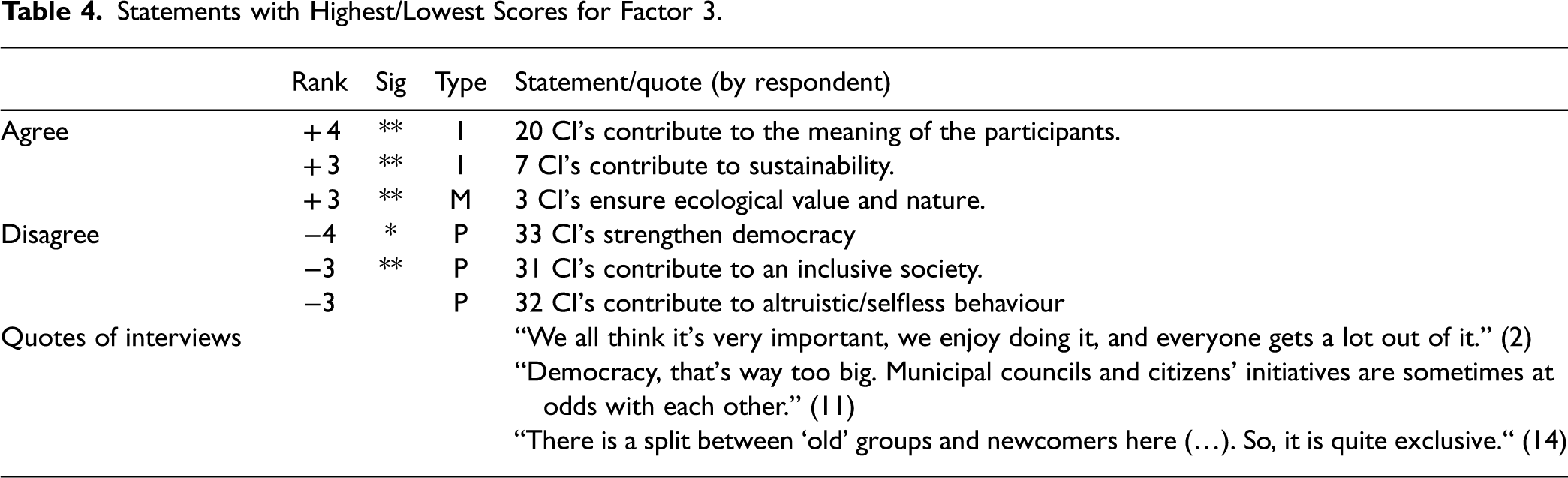
Factor 3 has 3 significant loadings: 2 societal actors and 1 civil servant. This third perspective is characterized by a mix of immaterial and material values. Factor 3 encompasses elements of both meaning and fun because taking initiative provides both. Furthermore, they find meaning in engaging with important subjects such as ecology and sustainability.
But factor 3 is also quite unique by disagreeing strongly with three process-type values. Citizens’ initiatives do not contribute to democracy, inclusivity, or altruistic behaviour. Respondent 11 summarized this view: “When people are involved in citizens’ initiatives, it really contributes to their sense of purpose. That is not selfless. They do it because they find it important themselves or because they want to achieve something. Or because it's fun. And that's fine. But that's not altruism and it doesn’t have to be.“ (11)
Statements with Highest/Lowest Scores for Factor 3.
Factor 4: Democratic Developers
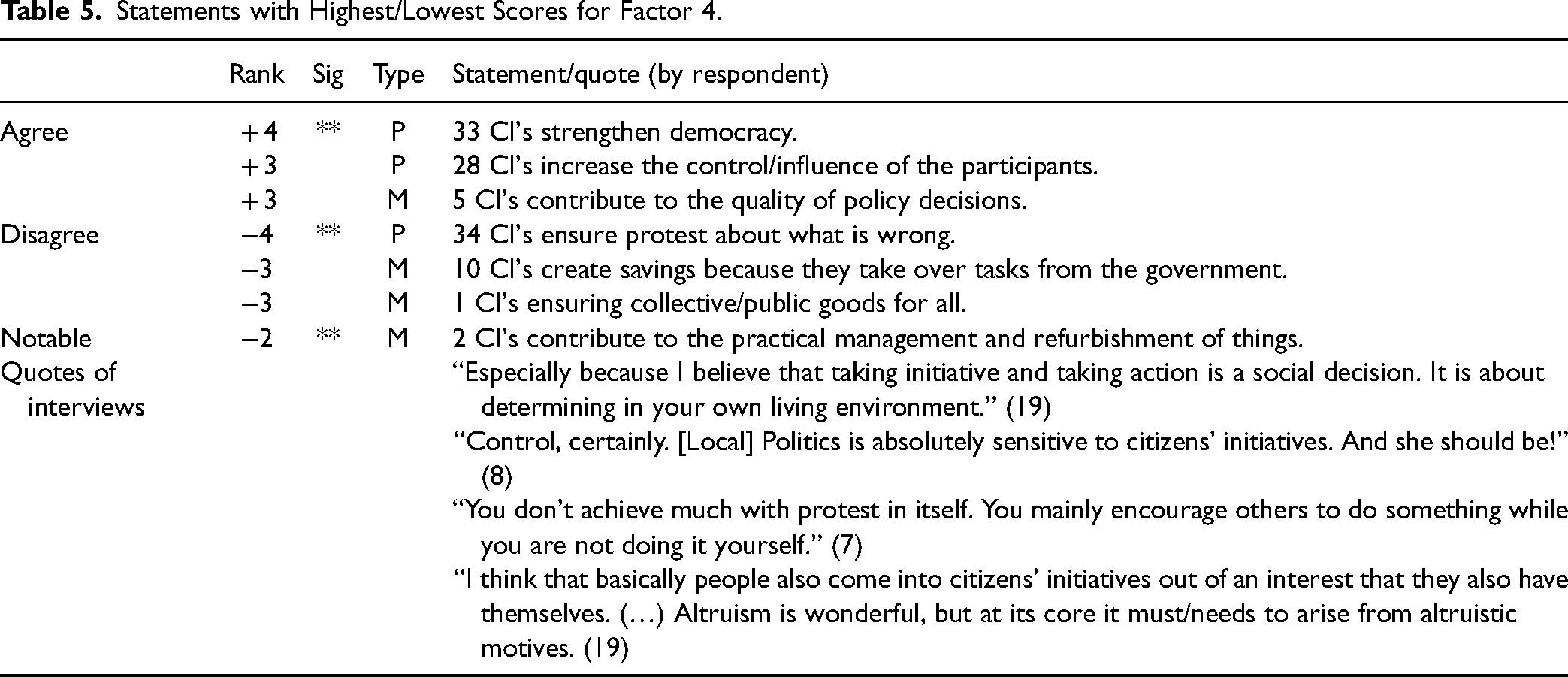
Factor 4 has 5 significant loadings: 3 societal actors and 2 civil servants. This final factor sees citizens’ initiatives as boosters for democracy. But there's a catch: citizens’ initiatives are not democratic per se, but they strengthen democracy by advocating for and acting on their interest. In that sense, they increase the democratic influence of participants and increase the quality of policy decisions. It is expected, but nevertheless, legitimate, that citizens’ initiatives act—perhaps egoistically—out of their own interest. No person can be truly altruistic and, moreover, democracy needs the articulation of interests and action of collectives. It is valuable and important that citizens’ initiatives take responsibility and ‘solve the problems that they themselves find important.’
Factor 4 also values citizens’ initiatives because they are viewed as self-determined and constructive. Protest is seen both as “being against something” or as encouraging others to do something rather than taking action oneself. Citizens’ initiatives should also—just as the idealistic immaterialists believe—not be viewed too instrumentally. They are not to be seen as producers of public goods, a savings opportunity, or as replacements for the municipal field service (Table 5).
Statements with Highest/Lowest Scores for Factor 4.
Similarities and differences
In the introduction, we argued that it is extremely important that a specific agreement or complementarity between the perceptions and ideas of public value as produced by citizen initiatives is to result in successful coproduction. To understand this (lack of) overlap and complementarity, we make a few comparisons.
In table 6, the correlations between factors are presented (1 is high, 0 is low). The correlations show that especially the factor of personal purpose seems to have the most disagreements with the other factors. There also seems to be a considerable correlation between the idealistic immaterialists and the democratic developers, indicating that a consensus about the value of citizens’ initiatives could be reached easier between these two factors. For example, both factors show disagreement on the statements that citizens’ initiatives contribute to sustainability or ensure “major maintenance” in the neighborhood. Both factors also show relatively strong agreement with statements that citizens’ initiatives solve problems they themselves find important or that they increase control of and influence over the participants.
Correlation Coefficient Between Respondents and Factors.

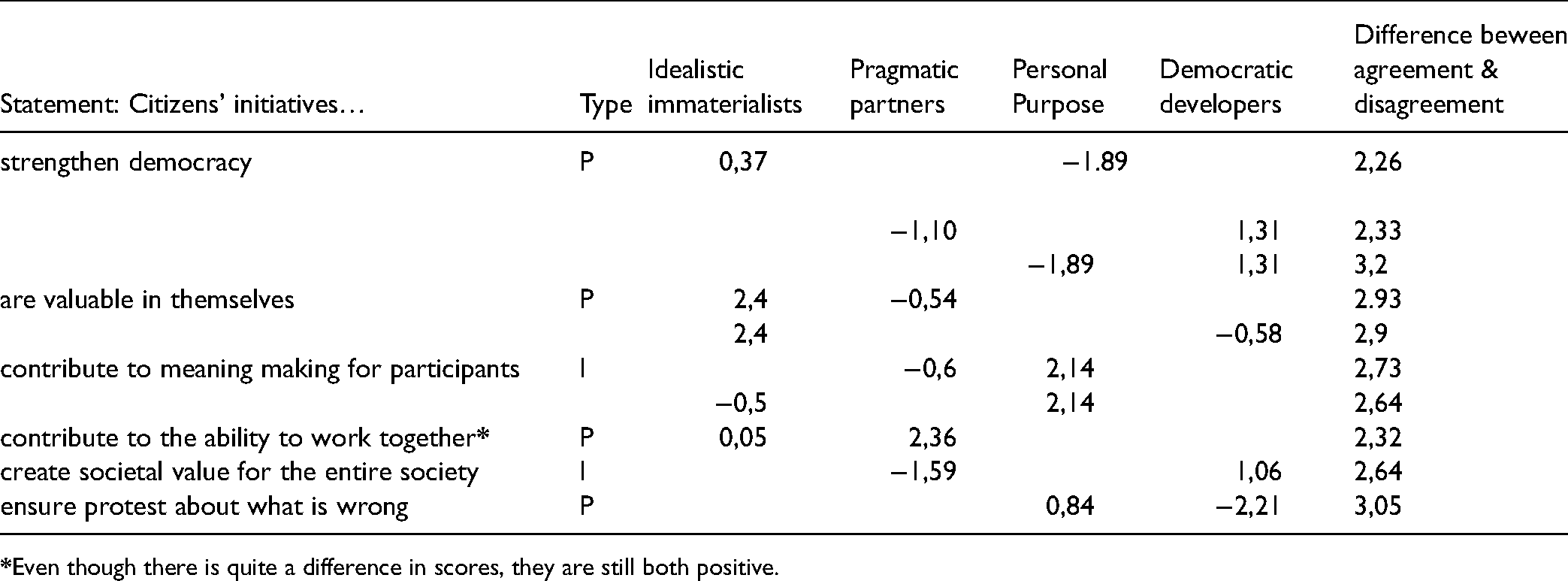
There are three statements about citizens’ initiatives that lead to the most disagreements (in appendix 4 we discover some more differences):
They strengthen democracy They are valuable in themselves They contribute to meaning-making for participants
These disagreements are salient because political or governmental discourse on citizens’ initiatives is often related to democracy (see van Dam et al., 2015).
In general, this Q study shows that the conflicting statements are generally process statements, and the most agreeable statements are generally material and immaterial statements. It seems that the material value of citizens’ initiatives—within this study context—are the least disputed. 4 In the end, all views combine multiple types with what they agree or disagree on. The idealistic immaterialists, however, strongly agree on immaterial statements (that's no surprise), and this factor also relates quite well to the second lens (citizens’ initiatives as expressions of the civil society and “what does it bring forth?” question). The personal purpose type, on the other hand, strongly disagrees with the process-type statements.
The statement “citizens’ initiatives solve problems they themselves find important” was the most agreed upon with scores of +2 and +3 by all factors. And the statement “Citizens’ initiatives contribute to altruistic/selfless behaviour” was disagreed upon by all factors with scores of either −3 or −4. Two other statements that the factors generally agree on is that citizens’ initiatives do not necessarily create safety nor innovation. But generally, this “selfish collectivism” (self-selection of problems and non-altruïsm) is common ground across all the value views.
Finally, while it is not at the heart of Q studies to compare the respondents (rather, it is about their views), we were still interested to—albeit prudently—compare the social actors. Figure 1 shows how our actors, on average, relate to the four value views. Societal actors share the view of “personal purpose” the most and “idealistic immaterialists” the least. Civil servants mostly share the view of “idealistic immaterialists” and least share the view of “personal purpose.” Local politicians share the view of “pragmatic partners” the most and of “personal purpose” the least. This comparison is a first glimpse, and again such a comparison is not at the heart of Q studies, so this result should be considered cautiously.
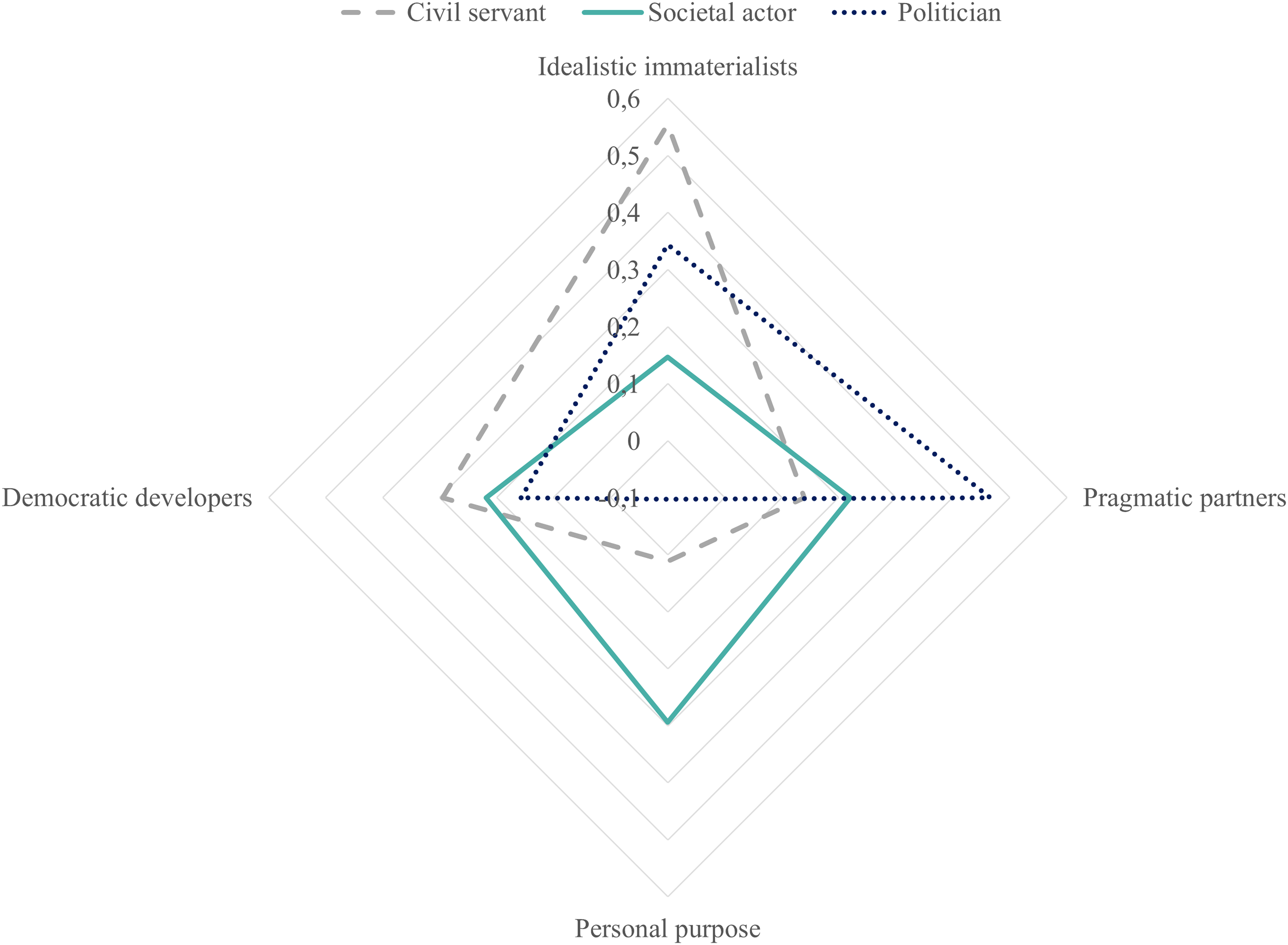
Average correlations of actors and value views.
Our results show that there are some shared aspects across the views, for example, selfish collectivism, that could be common ground for fruitful coproduction. At the same time, as Figure 1 illustrates, there are not only differences between views, but also meaningful disagreements between views and, likely, between social actors. To illustrate this point imagine a city council that shares a vision and sets budgets in line with the pragmatic partners, and civil servants who (having some discretionary room) write/employ policy language and act in line with the immaterial idealists. While the initiators and participants themselves need support to meet their needs in line with personal purpose. Such a scenario would lead to strain, frustration, and would reduce motivation.
Conclusion and Discussion
In the introduction and theoretical sections, we problematized the possible misalignment of values between governments and citizens’ initiatives. The vast majority of information that we analyzed to help us collect statements for the Q interviews, more or less took the value of citizens’ initiatives for granted. The majority of the research or reports was concerned with increasing the conditions for the success of citizens’ initiatives. It was all about pushing the buttons or changing the levers in order to “systematically increase outcomes” regardless of what the outcomes are (MacIntyre, 2011, p. 90). But exactly what the value of citizen's initiatives is, was often taken for granted, unspecified, and/or accepted as the one thing that they “just create.” The value perspective was not questioned. Citizens’ initiatives are approached as “initiatives-as-they-happen-to-be” and facilitated, upgraded, and governed. But if the values are examined more closely, there's a whole world behind them, and our research was able to show that this world contains a plurality of values.
By studying different types of social actors within a medium-sized Dutch municipality using Q methodology, we found four different views connected to the values of citizens’ initiatives. These four views all have different configurations of how they define what is valuable about citizens’ initiatives. But there are also similarities. All four views value citizens’ initiatives because of their self-determination. Various actors value citizens taking action and doing something instead of waiting for officials to step in. This relates to other findings (Edelenbos et al., 2018, p. 61) where it is concluded that citizens’ initiatives take action because of some trigger. Another interesting similarity among the views is that citizens’ initiatives are not necessarily valuable because they “contribute to selfless behavior.” This view subscribes to the idea that it is logical and acceptable that citizens’ initiatives are (partly) driven by individual or group interests. We labelled the common ground between value views “selfish collectivism.”
One of the theoretical lenses that helped us to examine our research question was about distinguishing types of values. We found that process-type statements created the most disagreements. Statements expressing the idea that citizens’ initiatives are valuable in themselves or strengthen democracy were especially prone to grave disagreements. In contrast, the material values are, relatively, the least prone to disagreements (because most disagreed with these statements).
As for how the different actors viewed the value of citizens’ initiatives, we did a more in-depth study towards how the different views of the values concerning citizens’ initiatives take shape. We did, however, also take a look at how the various types of actors/respondents connect to the four views. While this type of study is not definitive in claiming that these differences are significant—these findings should be interpreted cautiously—it does suggest that there may be meaningful differences between actors in value views about citizens’ initiatives that may hinder fruitful collaboration. This is especially the case when it comes to creating the right “invited space” or funding schemes for citizens’ initiatives.
Next, we set out a few implications based on our study and findings. Given that governments are fond of citizens’ initiatives (Boonstra & Boelens, 2011; Bakker et al., 2012; Brandsen et al., 2017; Hurenkamp & Tonkens, 2011) and that they likely have specific value views about citizens’ initiatives or specific goals (such as strengthening democracy), tensions could definitely arise. As citizens’ initiatives may be shaped by the perceived expectations and goals of governments (van Dam et al., 2015, p. 174), they could be subjected, controlled, and governed in a way that does not align with their value views about themselves. “This governmental control of organizations can be achieved through at least four mechanisms: (…) [such as] the use of symbolic policy language” (Brandsen et al., 2017, p. 684). We have already demonstrated how a mismatch between a council's language, policy language, and needs of initiators can exist. And there is still the risk that citizens’ initiatives can be seen as magic bullets (Edwards, 2009). We therefore argue that it is crucial to first discover the relevant value patterns within a certain context before creating various arrangements.
In this study, we set a specific context (a medium sized Dutch municipality) in which we let various respondents express their value-views of citizens’ initiatives. This approach which fits exceptionally well the studying of public value(s) (Meynhardt, 2009, p. 199), even in municipalities with different characteristics. We started with the argument that what people value about citizens’ initiatives is often somewhat fuzzy, unclear, or that it is just “a heap of good things.” We believe that with this study, we made the discourse about the value of citizens’ initiatives clearer and more comprehensible and that we have discovered distinctive value patterns. Q methodology is indeed, as suggested by Hartley and colleagues (2017), suited to trace and map values. Our final contribution is to show that it indeed matters to explore the value views of citizens’ initiatives and be specific about them. As “public value can only exist in a coproduction between government, citizens, associations, entrepreneurs and firms” (Brandsen et al., 2017, p. 682) it seems wise in these interdependent coproductions to understand each other's value views before action is taken.
This study has limitations and we discuss the most important ones. First, this study is mainly about citizens’ initiatives with some government involvement. There are citizens’ initiatives that operate almost completely independently of governments (although they must abide by the law). These initiatives are naturally less affected by high or specific expectations from governments. Second, we did not quantitively examine significant differences in views between groups. In order to further inquire the possible tensions and problems we described, such a study would be very helpful. Third, studying values is a difficult exercise. With our distinctions between type of goods and type of values, we made the exercise somewhat less difficult. But these distinctions are not perfect. We acknowledge that some statements could have fitted in other types of value-views, depending on how they are interpretated. Another weakness is that Q study does well when the statements are unambiguous and when not open to too many different interpretations from participants. We tried to design such statements, but straightforward statements can also flatten a complex discourse, such as the one about values. Nevertheless, there is little, or even no room, for conditional viewpoints about a statement because it needs to be ranked. Working with these statements also leaves less room for the sedimentation in values: the potential future spinoff in values or the changes in values over time. Finally, as the Q methodology is not yet mainstream (but becoming more en vogue), some would also criticize this method; for example, there is the criticism that any sample of statements is prone to selection bias by the researchers. From a Q-point-of-view, we argue that it is not so much about “the total meaning” of the Q sample, but how meaning is given by respondents to “the Q sample”; that is the heart of the method (Brown, 1993, p. 101).
Of course, there are multiple promising options for further research. First, it would be useful to do this Q study in other municipalities, regions, or provinces to see how meaning is given to the value of citizens’ initiatives elsewhere. It is also promising to zoom in on various actor groups: What kind of value views characterize different groups such as civil servants or local politicians, and which value differences exist within these groups? In this study we more a less treated these actor groups as homogeneous, not acknowledging nor inquiring about the differences within these groups. Finally, a more quantitative approach—perhaps based on the statements or the four views in this study or future studies – to explore the various value views of citizens’ initiatives of a representative sample of the whole population would be insightful. Such an approach would greatly increase our knowledge about how various actors perceive the value of self-organization and about the possible problems and tensions set out in this piece.
Footnotes
Appendices
Appendix 1: Used literature and checked coalition agreements for the concourse
| Author | Type | ||
|---|---|---|---|
| Bailey, N. (2012). The role, organisation and contribution of community enterprise to urban regeneration policy in the UK. Progress in Planning, 77(1), 1-35. | International Scientific | ||
| Igalla, M., Edelenbos, J., & van Meerkerk, I. (2019). Citizens in action, what do they accomplish? A systematic literature review of citizen initiatives, their main characteristics, outcomes, and factors. Voluntas: International Journal of Voluntary and Nonprofit Organizations, 30(5), 1176-1194. | International Scientific | ||
| Van Dam, R., Duineveld, M., & During, R. (2015). Delineating active citizenship: The subjectification of citizens’ initiatives. Journal of Environmental Policy & Planning, 17(2), 163-179. | International Scientific | ||
| Bakker, J., Denters, B., Oude Vrielink, M., & Klok, P. J. (2012). Citizens’ initiatives: How local governments fill their facilitative role. Local Government Studies, 38(4), 395-414. | International Scientific | ||
| Healey, P. (2015). Citizen-generated local development initiative: recent English experience. International Journal of Urban Sciences, 19(2), 109-118. | International Scientific | ||
| de Haan, E., Meier, S., Haartsen, T., & Strijker, D. (2018). Defining ‘Success’ of Local Citizens’ Initiatives in Maintaining Public Services in Rural Areas: A Professional's Perspective. Sociologia Ruralis, 58(2), 312-330. | International Scientific | ||
| Verhoeven, I., & Tonkens, E. (2013). Talking active citizenship: Framing welfare state reform in England and the Netherlands. Social Policy and Society, 12(3), 415. | International Scientific | ||
| Bakker, J., Denters, S. A., & Klok, P. J. (2011). Welke burger telt mee (r) in de doe-democratie?. B en M: tijdschrift voor beleid, politiek en maatschappij, 38(4), 402-418. | Dutch Scientific | ||
| Vrielink, M. O., & Verhoeven, I. (2011). Burgerinitiatieven en de bescheiden overheid. Beleid en Maatschappij, 38(4), 377-387. | Dutch Scientific | ||
| Van de Wijdeven, T. M. F., De Graaf, L. J., & Hendriks, F. (2013). Actief burgerschap: lijnen in de literatuur. | Dutch Scientific | ||
| Igalla, M., & Van Meerkerk, I. (2015). De Duurzaamheid van Burgerinitiatieven. Een Empirische Verkenning (The Sustainability of Citizen Initiatives. An Empirical Exploration). Een Empirische Verkenning (The Sustainability of Citizen Initiatives. An Empirical Exploration), 25-53. | Dutch Scientific | ||
| Salverda, I., & Van Dam, R. (2008). Burgers en landschap deel 1: Voorbeelden van burgerparticipatie en maatschappelijk initiatief. Wageningen: Alterra Wageningen UR. | Practical/commisioned Research | ||
| Van Dam, R., During, R., & Salverda, I. (2008). Burgers en Landschap deel 2: Trends en theorieën over betrokkenheid van burgers. Wageningen: Alterra Wageningen UR. | Practical/commisioned Research | ||
| Dam, R. V., Salverda, I., & During, R. (2010). Burgers en Landschap deel 3: Strategieën van burgerinitiatieven. Wageningen: Alterra Wageningen UR. | Practical/commisioned Research | ||
| Duineveld, M., van Dam, R. I., During, R, & van der Zande, A. N. (2010). Burgers en Landschap deel 4: The importance of being nimby; Een essay over burgerverzet en erfgoed. Wageningen: Alterra Wageningen UR. | Practical/commisioned Research | ||
| Van Dam, R. I., Salverda, I. E., & During, R. (2011).). Burgers en Landschap deel 5: Effecten van burgerinitiatieven en de rol van de rijksoverheid. Wageningen: Alterra Wageningen UR. | Practical/commisioned Research | ||
| Denters, S. A. H., Tonkens, E. H., Verhoeven, I., & Bakker, J. H. M. (2013). Burgers maken hun buurt. Platform31. | Practical/commisioned Research | ||
| ProDemos (2015). Doe-democratie. Tips voor raadsleden, wethouders, ambtenaren en burgers. Available via: https://www.prodemos.nl/wp-content/uploads/2017/12/ProDemos-Doe-democratie_brochure.pdf | Practical Literature | ||
| Ombudsman (2018). Burgerinitiatief: waar een wil is…. Onderzoek naar de rol van overheidsinstanties bij burgerinitiatieven. Available via: https://www.nationaleombudsman.nl/system/files/bijlage/Burgerinitiatieven%20waar%20een%20wil%20is%20rapport%202018-020.pdf | Practical Literature | ||
| Movisie (2011). Actief burgerschap. Een overzicht aan interventies. Available via: https://www.movisie.nl/sites/movisie.nl/files/publication-attachment/Verkenning%20Actief%20Burgerschap%20%5BMOV-177889-0.4%5D.pdf | Practical Literature | ||
| Ouden W. den, Boogaard G. & Driessen E.M.M.A. (2019), Right to Challenge. Een studie naar de mogelijkheden voor aan algemene regeling voor het ‘Right to Challenge’ en andere burgerinitiatieven in Nederland [eindrapport]. Leiden: Universiteit Leiden. | Practical/commisioned Research | ||
| Rekenkamercommissie Wassenaar, Voorschoten, Oegstgeest, Leidschendam-Voorburg (2018). De burger neemt het initiatief. Via: https://kennisopenbaarbestuur.nl/media/255725/rapport_onderzoek_burgerinitiatieven.pdf | Practical Research | ||
| Ministerie van BZK (2020). Lokale democratie: tentoonstelling over de ontwikkeling van de lokale democratie na 1945. Nota Doe-democratie. Available via: https://kennisopenbaarbestuur.nl/het-geheugen-van-bzk/lokale-democratie/tijdlijn-lokale-democratie-4/2010-heden/2013-nota-doe-democratie/ | Practical literature | ||
| Ministerie van BZK (2013). De Doe-Democratie. Kabinetsnota ter stimuleren van een vitale samenleving. Available via: https://www.rijksoverheid.nl/documenten/publicaties/2013/07/09/kabinetsnota-doe-democratie | Practical literature | ||
| Buurtwijs. (2019). Wat maakt burgerinitiatieven duurzaam?. Available via: https://www.buurtwijs.nl/content/wat-maakt-burgerinitiatieven-duurzaam | Practical literature | ||
| Universiteit van de Humanistiek & Movisie. (2018). Niet meer zomaar te stoppen: Over duurzaamheid van burgerinitiatieven Available via: https://www.movisie.nl/sites/movisie.nl/files/2019-01/Niet-meer-zomaar-te-stoppen-duurzaamheid-burgerinitiatieven.pdf | Practical research | ||
| van Delden, P. (2020). Sociaal offensief tussen lockdowns door. Sociale vraagstukken. Available via: https://www.socialevraagstukken.nl/sociaal-offensief-tussen-lockdowns-door/ | Practical Literature | ||
| Visser, V. (2019). Lager opgeleiden voelen zich te min om te participeren in burgerinitiatieven. Sociale vraagstukken. Available via: https://www.socialevraagstukken.nl/lager-opgeleiden-voelen-zich-te-min-om-te-participeren-in-burgerinitiatieven/ | Practical Literature | ||
| de Moor, T. (2020). Meer ruimte voor de commons'’ Sociale vraagstukken. Available via: https://www.socialevraagstukken.nl/meer-ruimte-voor-de-commons/ | Practical Literature | ||
| Salverda, I., van Dam, R. & Pleijtje, M. (2017). Pionieren: De impact van innovatieve maatschappelijke initiatieven op een natuur-inclusieve samenleving. Wageningen University Research. Available via: https://edepot.wur.nl/425310 | Dutch Scientific | ||
| Vullings, L.A.E., A.E. Buijs, J.L.M. Donders, D.A. Kamphorst, H. Kramer & S. de Vries (2018). Monitoring Green Citizens’ Initiatives; Methodology, indicators and results of a pilot project and baseline assessment. Wageningen, Statutory Research Tasks Unit for Nature & the Environment, WUR. WOt-technical report 125 | Dutch Scientific | ||
| Coalition agreements scanned of municipalities: | |||
| Eijsden-Margraten | Leidschendam-Voorburg | Hollands Kroon | Soest |
| Achtkarspelen | Leudal | Zaanstad | Voorschoten |
| Amersfoort | Maasgouw | Zuidplas | Weesp |
| Asten | Weststellingwerf | Hilversum | Utrecht |
| Bunschoten | Enkhuizen | De Wolden | Westerveld |
| Doesburg | Goes | Houten | Woudenberg |
| Horst aan de Maas | Gooise Meren | Oegstgeest | Zwartewaterland |
| Leiderdorp | Bernheze | Rijswijk | |
Appendix 2: Q sort format
| 36 | ||||||||
| 35 | ||||||||
| 32 | 33 | 34 | ||||||
| 29 | 30 | 31 | ||||||
| 24 | 25 | 26 | 27 | 28 | ||||
| 17 | 18 | 19 | 20 | 21 | 22 | 23 | ||
| 10 | 11 | 12 | 13 | 14 | 15 | 16 | ||
| 1 | 2 | 3 | 4 | 5 | 6 | 7 | 8 | 9 |
|
|
||||||||
|
|
|
|
|
|
|
|
|
|
Appendix 3: Composites: views,statements and positions
|
|
|
|
|
|
|
|---|---|---|---|---|---|
| 1 | CI's ensuring collective/public goods for all. | 0 | −1 | −3 | −3 |
| 2 | CI's contribute to the practical management and refurbishment of things. | 0 | 0 | 1 | −2 |
| 3 | CI's ensure ecological value and nature. | −2 | 0 | 3 | −1 |
| 4 | CI's contribute to the economy | −3 | −3 | −1 | −1 |
| 5 | CI's contribute to the quality of policy decisions. | 0 | 1 | −2 | 3 |
| 6 | CI's ensure ‘major maintenance’ in the neighbourhood. | −3 | 1 | 1 | −2 |
| 7 | CI's contribute to sustainability. | −2 | −1 | 3 | −2 |
| 8 | CI’ create mainly nice extras in the neighborhood. | 1 | 1 | 1 | −2 |
| 9 | CI's solve problems they find important themselves. | 2 | 3 | 2 | 2 |
| 10 | CI's create savings because they take over tasks from the government. | −4 | 0 | 0 | −3 |
| 11 | CI's contribute to the public cause. | 2 | −1 | −1 | 0 |
| 12 | CI's contribute to policy implementation. | −1 | 0 | −1 | 0 |
| 13 | CI's create societal value for the entire society. | 1 | −3 | 0 | 2 |
| 14 | CI's contribute to a better relationship between the government and residents. | 1 | 3 | 0 | 1 |
| 15 | CI's contribute to community involvement. | 3 | 2 | 0 | 1 |
| 16 | CI's create a sense of responsibility among its participants. | 1 | 2 | 0 | 2 |
| 17 | CI's contribute to liveability in the neighbourhood. | 3 | 3 | 0 | 1 |
| 18 | CI's lead to (more) innovation. | 0 | 1 | −1 | 0 |
| 19 | CI's ensure more mutual relationships between the participants. | 0 | −2 | 3 | 1 |
| 20 | CI's contribute to the meaning of the participants. | −1 | −1 | 4 | 0 |
| 21 | CI's contribute to personal development. | −2 | −3 | 1 | −1 |
| 22 | CI's contribute to safety in the neighbourhood. | −1 | 0 | −1 | −1 |
| 23 | CI's lead to a sense of community/belonging among its participants. | 3 | 0 | 1 | 1 |
| 24 | CI's make sure that society – aside from the government and the market – has more influence on the public space. | 1 | 1 | 2 | 3 |
| 25 | CI's are valuable in themselves. | 4 | −1 | 2 | −1 |
| 26 | CI's increase diversity of contacts and identities. | 0 | 2 | −2 | 0 |
| 27 | CI's contribute to the ability to work together. | 0 | 4 | 0 | 1 |
| 28 | CI's increase the control/influence of the participants. | 2 | 2 | −1 | 3 |
| 29 | CI's contribute to the self-reliance of the participants. | −2 | 0 | 0 | 2 |
| 30 | CI's increases societal skills among its participants. | −1 | 1 | 2 | 0 |
| 31 | CI's contribute to an inclusive society. | 0 | −1 | −3 | −1 |
| 32 | CI's contribute to altruistic/selfless behaviour | −3 | −4 | −3 | −3 |
| 33 | 33 CI's strengthen democracy | 1 | −2 | −4 | 4 |
| 34 | CI's ensure protest about what is wrong. | −1 | −2 | 1 | −4 |
| 35 | CI's contribute to the development of (public) opinions among its participants. | −1 | −2 | −2 | 0 |
| 36 | CI's lead to a change of how governments work. | 2 | 0 | −2 | 0 |
Appendix 4: Differences in most disagreed statements across factors
| Statement: Citizens’ initiatives… | Type | Idealistic immaterialists | Pragmatic partners | Personal Purpose | Democratic developers | Difference beween agreement & disagreement |
|---|---|---|---|---|---|---|
| strengthen democracy | P | 0,37 |
−1.89 | 2,26 | ||
| −1,10 | 1,31 | 2,33 | ||||
| −1,89 | 1,31 | 3,2 | ||||
| are valuable in themselves | P | 2,4 | −0,54 | 2.93 | ||
| 2,4 | −0,58 | 2,9 | ||||
| contribute to meaning making for participants | I | −0,6 | 2,14 | 2,73 | ||
| −0,5 | 2,14 | 2,64 | ||||
| contribute to the ability to work together |
P | 0,05 | 2,36 | 2,32 | ||
| create societal value for the entire society | I | −1,59 | 1,06 | 2,64 | ||
| ensure protest about what is wrong | P | 0,84 | −2,21 | 3,05 |
Acknowledgments
The authors thank the anonymous reviewers for their constructive comments on the submitted manuscript.
Declaration of Conflicting Interests
The author(s) declared no potential conflicts of interest with respect to the research, authorship, and/or publication of this article.
Funding
The author(s) received no financial support for the research, authorship, and/or publication of this article.
