



Abstract
This article takes the perspective of the street-level bureaucrat (SLB) as policy entrepreneur, asking when SLBs are more or less likely to engage in actions aimed at policy change. Drawing on an interdisciplinary approach that connects the public management and policy implementation literatures, this article explores the gap between intentions and behavior in street-level policy entrepreneurship. It investigates two individual and organizational variables (coupling self-efficacy and organizational climate for innovation) that mediate and moderate the relationships between attitudes toward policy entrepreneurship, intentions to engage in policy entrepreneurship, and actual entrepreneurial behavior among SLBs. We demonstrate how strengthening the individual and organizational variables discussed can help organizations improve their bottom-up policy making.
Keywords
Introduction
Street-level bureaucrats (SLBs)—the government employees who have direct contact with members of the public in areas such as education, social services, health care, and policing—often feel alienated from the policies they are expected to implement (Tummers et al., 2009). This sense of being psychologically disconnected from one’s work responsibilities has a range of negative consequences for both organizations and employees. At the organizational level, it can reduce the effectiveness of implemented polices or lead to divergence between organizational policies and those implemented on the ground. At the personal level, it can lead to stress, burnout, or decisions to leave the organization (Gofen, 2013; Tummers et al., 2009; Tummers et al., 2012). Drawing on Hirschman’s (1970) famous model, the literature so far has emphasized two choices open to an alienated SLB: “exit” and “loyalty.” Yet Hirschman’s model offers a third possibility, one that thus far has been less-examined in street level literature: the possibility of “voice,” whereby dissatisfied SLBs may work to change policies with which they feel uncomfortable (Hupe & Buffat, 2014).
In this article, we take a step toward understanding policy entrepreneurship among general SLBs by investigating their intentions and behavior with respect to “voicing” their policy ideas and being active in policy formation. As such, our research adds to the extant literature on SLBs’ discretion (Lipsky, 1980) alienation (Tummers et al., 2009) and divergence (Gofen, 2013). It also turns the spotlight away from the dysfunctional aspects of street-level bureaucracy alienation most addressed in the literature (Van Parys & Struyven, 2018), and toward the question of how policy alienation among SLBs can lead to functional behavior.
Although some prominent scholars have studied street-level policy entrepreneurship (Arnold, 2015; Cohen, 2021; Frisch-Aviram et al., 2018; Golan-Nadir, 2021; Lavee & Cohen, 2019; Petchey et al., 2008), they have largely analyzed specific successful case studies of heroic SLBs. We take a broader approach and focus on intentions and behaviors to engage in street-level policy entrepreneurship among ordinary SLBs. To accomplish this goal, we use an interdisciplinary framework to construct and test a model to analyze the street-level policy entrepreneurship process. Our focus is on the gap between intentions to engage in street-level policy entrepreneurship and actually doing so. We adopt this approach because it is a well-known fact that while intentions inevitably precede behavior, behavior does not inevitably follow intentions.
We develop a scale that can be used to examine how different factors influence this gap, including the organizational context (specifically, the organizational climate for innovation) and psychological factors (specifically, perceived personal efficacy). Our main research questions are: Is there a gap among SLBs between their intentions of engaging in street-level entrepreneurship and their actual behavior? What mechanisms widen this gap and what mechanisms bridge or narrow this gap?
Our interdisciplinary approach draws on the theory of planned behavior from social psychology (Ajzen, 1991; for a comparison with the theory of planned action, see Madden et al., 1992), public administration scholarship on street-level bureaucracy (Lipsky, 1980), and public policy research on policy entrepreneurship (Mintrom, 2000; Mintrom & Norman, 2009; Zahariadis, 2008). The intersection of these fields of study has gained importance over recent decades in the wake of public management reforms such as New Public Management (Hood, 1991), which demands more proactive bureaucratic action (Osborne et al., 2013; Pollitt & Bouckaert, 2000), and new institutional governance settings that call for innovation in public policy implementation (Osborne & Brown, 2011).
Our theoretical contribution is threefold. First, our model advances the public administration literature by increasing our understanding of SLBs’ coping strategies (Tummers et al., 2015). In particular, we investigate the strategy of “voice,” which emphasizes not only SLBs using their discretion during policy implementation to cope with work pressure, but also the possibility of their active involvement during policy formation for leading a policy change. This active involvement was found to have a positive relationship with work engagement and a negative relationship to the intent to leave (van Loon et al., 2018). Second, we enrich the public policy literature by taking a first step in modeling street-level, bottom-up policy making. Third, from the public management point of view, our model shows that managers can enhance policy entrepreneurship intentions and behavior among SLBs and minimize their alienation by stimulating both personal and organizational moderators (van Engen et al., 2016).
We also make methodological and practical contributions. Methodologically, we provide a validated and psychometrically sound measurement scale for street-level policy entrepreneurship. We hope this scale can be used to improve cross-sector and cross-national comparisons (Grimmelikhuijsen & Knies, 2017). From a practical public administration point of view, seeking to understand the gap between intentions to engage in policy entrepreneurship and doing so and its predictors implies that public organizations and managers should encourage feedback on policies from the street level (Zacka, 2017, p. 234). This approach also highlights the individual’s sense of capability and the importance of the organization’s commitment to innovation in promoting public service (Cropley, 2016).
The article proceeds as follows. The next section reviews the literature and presents the expected relationships between the variables. The third section describes the research design, scale development and validation, and the measures used. In the fourth section, we detail our preliminary findings on the relationship between the variables using data gathered from a sample of 229 SLBs in Israel. We conclude by discussing the insights gleaned from the findings for policy entrepreneurship and street-level bureaucracy scholarship.
Predicting the Gap Between Intentions and Policy Entrepreneurship Behavior Among SLBs: Model and Hypotheses
Bottom-Up Policy Making
SLBs are the frontline workers of the new public management (Brodkin, 1997, 2011; Evans, 2016; Hupe et al., 2016; Lipsky, 1980; Maynard-Moody & Musheno, 2000; Riccucci, 2005; Thomann, 2015). It is they who engage with the public (as teachers, health professionals, law enforcement offers, social workers, and so on). Traditionally, these professionals are expected to implement policies dictated from above (Brodkin, 2011; Lipsky, 1980; Tummers et al., 2012). But the public policy literature is beginning to recognize the importance of allowing for the development of policies from the bottom up, as a response to some of the normative challenges of policy making (Benton et al., 2017; Carnegie & Kiger, 2009; Gal & Weiss-Gal, 2013; Granruth et al., 2018; Zacka, 2017).
First, from a democratic perspective, bottom-up policy making transforms vague, abstract democratic concepts into practical, everyday practices based on citizens’ actual perceptions and needs, promoting a livelier democracy and improving citizen-state relations (Dahlberg & Holmberg, 2014). Second, as Lipsky (1980) and Majone and Wildavsky (1977) have long pointed out, SLBs are policy formatters when they interact with clients in providing services and enforcing the law. Their discretionary power can challenge the state’s normative and moral ideas, as framed in the state’s policies (Brodkin, 1997; Hill & Hupe, 2009; Pressman & Wildavsky, 1984; Tummers & Bekkers, 2014). Allowing policy making from the bottom up promotes open discussion regarding the morality of these policies (Zacka, 2017). Third, bottom-up policy making flips the well-known notion of the policy cycle (Wegrich & Jann, 2006), so that policies are developed through consideration of how the state should interact with its citizens. This new perspective may offer insights into why some policies are not implemented as they should be and minimize the gap between policy making and actual policy implementation (Pressman & Wildavsky, 1984). Finally, the involvement of professional, skilled, knowledgeable street-level workers in the policy-making process may yield better policies. These street-level workers interact with citizens on a daily basis and are better advocates for making the policies match people’s needs (Arnold, 2015; Gal & Weiss-Gal, 2013; Lavee & Cohen, 2019).
SLBs as Policy Entrepreneurs
As described above, SLBs are commonly understood in the literature as implementers of policy dictated to them from above (Brodkin, 2011; Lipsky, 1980; Tummers et al., 2012). However, SLBs may find themselves unable to wholeheartedly endorse these policies for a variety of reasons, including ethical and moral considerations, reasons related to their professional identity, and/or rational decision-making (Gofen, 2013). They may therefore find themselves in the difficult situation of having to take actions that are at odds with their sense of self (Hupe & Buffat, 2014; Lipsky, 1980; Zacka, 2017).
The idea of voice as a response to difficult situations in the workplace derives from Hirschman’s (1970) pioneering work Exit, Voice, and Loyalty. To this model, Farrell (1983) later added a fourth dimension, neglect. Applying the expanded model to bureaucracy, Zacka (2017, pp. 233–236) described the four options as follows: (a) Exit, or quitting the job. (b) Loyalty, or remaining in the organization. This response can take two forms: tenacity, where employees remain in the organization but refuse to compromise their own principles or internal identity in the face of organizational demands; or self-deception, where employees persuade themselves that the conflict they first sensed between external demands and their self-understanding is not as pronounced as it first seemed. (c) Neglect, defined as cynicism or detachment. (d) Voice, or speaking up. This response entails providing feedback to superiors about problematic policies and seeking to play a role in shaping policy formation. 1 We focus on the last of these options: the will to use one’s voice to cope with implementation failures. This willingness arises as a result of analyzing problems and seeking opportunities for solving them (Brockmann, 2017) using policy entrepreneurship (Arnold, 2015; Durose, 2011; Frisch-Aviram et al., 2018; Petchey et al., 2008).
The term policy entrepreneurship was coined by Kingdon (1984), in his influential work Agendas, Alternatives, and Public Policies. According to Kingdon, successful policy making occurs when three streams of the policy process—policy, problem, and politics—come together. When such an event occurs, solutions to policy problems can be suggested and may be implemented when the political conditions are ripe, Kingdon defined policy entrepreneurs as individuals or small groups who generate potential solutions to social problems, and are positioned to help bring these solutions to fruition as policy when the political window of opportunity opens. Similar to their counterparts in private entrepreneurship, a defining characteristic of policy entrepreneurs is their willingness to invest their resources—time, energy, reputation, connections, and sometimes money—in the hope of a future return (Mintrom, 1997, 2000; Mintrom & Norman, 2009; Zahariadis, 2008).
While Kingdon’s (1984) ideas quickly gave rise to a substantial literature, Arnold (2015) argued that the policy entrepreneurship scholarship has a street-level blind spot, failing to recognize the phenomenon of SLBs who act as policy entrepreneurs. Typically, most studies regard policy entrepreneurs as high-level government officials or other actors with access to political or social elites. At the same time, early work on policy entrepreneurship among SLBs was concerned with their heroic deeds in struggling against the system (Arnold, 2015; Durose, 2011; Frisch-Aviram et al., 2018; Petchey et al., 2008). Our study joins and extends this emerging stream of research on street-level policy entrepreneurship while avoiding such heroic framing. Instead, we present an exploratory model of policy entrepreneurship intentions and behaviors among ordinary street-level workers.
The Gap Between Intentions and Policy Entrepreneurship Behavior: A Lesson From the Theory of Planned Behavior
We use the theory of planned behavior—widely used in the private entrepreneurship literature (Bird, 1988; Krueger & Carsrud, 1993)—the basic framework for this research. According to this well-known theory, the strength of an intention is an immediate antecedent of behavior (Ajzen, 1991). Intention here is defined as a person’s plan to engage in a behavior, encompassing both direction (to do X vs. not to do X) and intensity (the time and effort one is prepared to invest in doing X), while behavior is defined as the actual steps taken (Ajzen, 1991; Sheeran, 2002). While intentions are a necessary antecedent of behavior, the reverse is not true: behavior does not necessarily follow intentions. Moreover, the strength of an intention is not necessarily a barometer of whether or not one will follow through from intention to action. Studies in health behavior (Rhodes & de Bruijn, 2013), commercial behavior (Carrigan & Attalla, 2001), and entrepreneurial behavior (Fayolle & Liñán, 2014) have established that intentions are only the preliminary stage of successful goal attainment. Both personal factors (e.g., insufficient skills and capabilities) and environmental factors (e.g., lack of support from others) may cause a gap between intentions and actual behavior (Ajzen, 2011; Fayolle & Liñán, 2014; Gollwitzer & Sheeran, 2006). Sheeran (2002) found that this gap is larger for intentions requiring complex interacting actions—an unsurprising finding, given that complex acts demand more emotional and practical capabilities than simple acts.
Policy entrepreneurship is such a complex act, with many interacting parts and both emotional and practical facets (Cohen, 2016). Practically, policy entrepreneurship requires an investment of time and effort, and the deployment of skills and competencies the individual may not normally use. Emotionally, it requires a great deal of courage. As Kingdon (1984) noted, policy entrepreneurs must be “willing to invest their resources—time, energy, reputation, money—to promote a position for anticipated future gain in the form of material, purposive or solidary benefits” (p. 179). In other words, policy entrepreneurs must stake substantial existing assets—including intangible assets such as their reputations—on hopes of an uncertain future benefit. Thus, we assume that to whatever extent SLBs develop intentions to act as policy entrepreneurs, their actual engagement in policy entrepreneurship behavior will be less likely. We call this the gap between street-level policy entrepreneurship intentions and behavior.
Attitudes Toward Policy Entrepreneurship
Just as under the theory of planned behavior, intentions are an antecedent of behavior, intentions themselves have antecedents. The most important of these is the attitude toward the behavior (Ajzen, 1991). In keeping with the three main factors that cause SLBs to fail to implement the policy as stated—ethical or moral considerations, professional identity, and rational decision-making (Gofen, 2013)—toward policy entrepreneurship among SLBs may have ethical, professional, and rational roots. Thus, SLBs may be moved by concerns about the morality of an existing policy (Maynard-Moody & Musheno, 2003), by a sense of professional obligation (Hupe & Hill, 2007), or by rational considerations including self-interests such as a desire to demonstrate their capabilities or earn recognition (Mintrom & Norman, 2009). For any of these reasons (or some combination thereof), SLBs may have strong positive attitudes toward policy entrepreneurship, meaning a positive assessment of the value of engaging in policy entrepreneurship.
However, policy entrepreneurship inherently entails uncertainty. While some difficult and challenging tasks involve a clearly defined set of actions (e.g., eating healthily requires choosing the right foods), entrepreneurs must balance a range of interests and concerns, identify and track the three streams of the policy process (policy, problem, and politics), and be prepared to leverage the window of opportunity when it opens (Kingdon, 1984; Mintrom, 2000). Positive attitudes alone do not provide all of the psychological and practical tools needed to help people through the associated risks and uncertainty. Therefore, while positive attitudes toward policy entrepreneurship may translate into greater intentions to engage in entrepreneurial behavior, they may not translate into an increase in actual behavior, resulting in the negative outcome of widening the gap between intentions and behavior.
We can conclude that positive attitudes toward policy entrepreneurship deepen the gap between intentions and behaviors (see Figure 1).
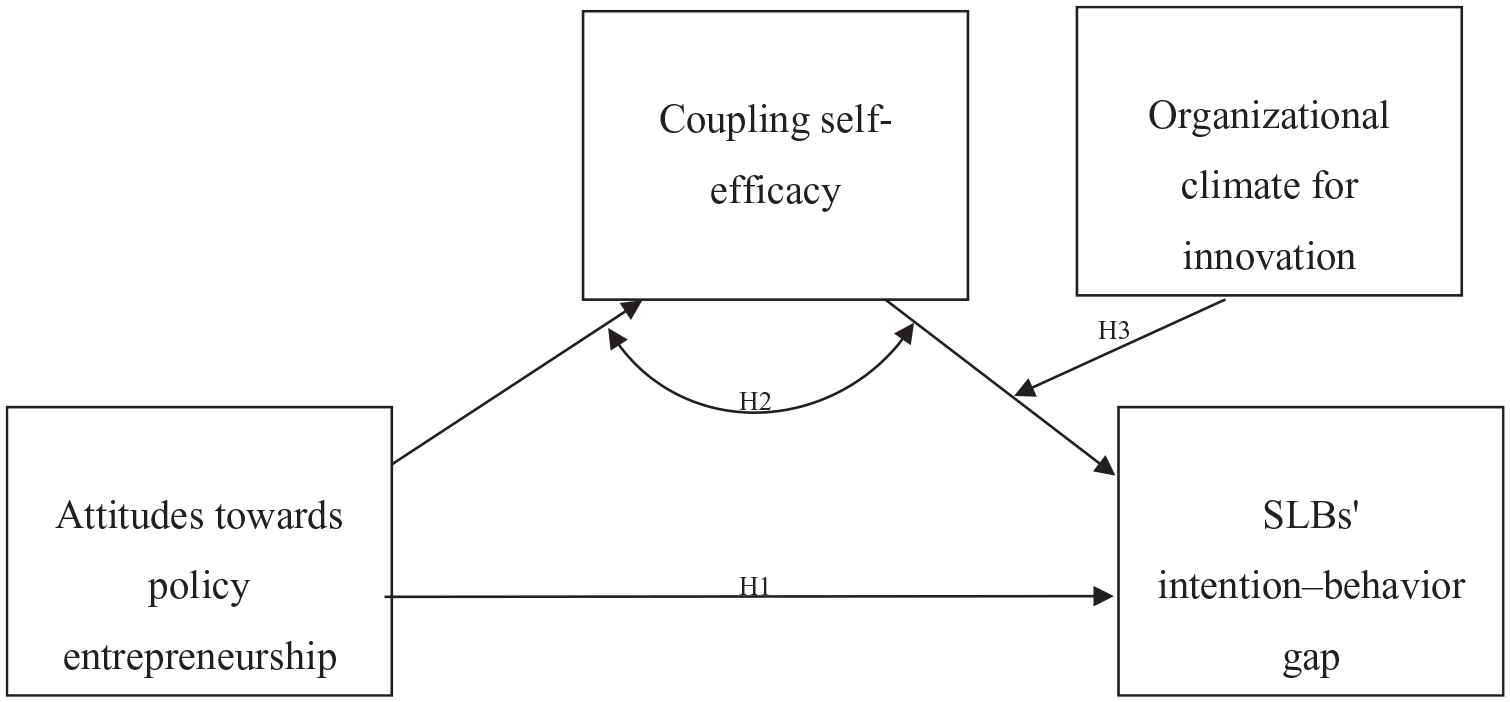
The research model.
Moderating Factors: Self-Efficacy and the Organizational Climate for Innovation
Under Kingdon’s (1984) multiple streams approach, policy entrepreneurs “are responsible not only for prompting important people to pay attention, but also for coupling solutions to problems and for coupling both problems and solutions to politics” (p. 21). This coupling of the various streams prepares the ground for action when the window of opportunity opens. Zahariadis (2008) emphasized that “the likelihood of coupling success increases under four conditions: entrepreneurial effectiveness, framing, venue-shopping, and policy modes. The first refers to individual attributes, the other two to strategies, and the last to institutional context” (p. 520). Based on this claim, we identify two critical components that moderate the relationship between policy entrepreneurship intentions and policy entrepreneurship behavior: the skills of the entrepreneur and the nature of the institutional setting in which the entrepreneur works. In doing so, we follow van Engen et al.’s (2016) call to focus on individual and organizational factors to better understand SLBs’ response to policy formation.
The mediating role of coupling self-efficacy
Self-efficacy is defined as people’s perceptions or inner beliefs about their chances of using their skills to succeed in a given task or achieve a chosen outcome (Bandura, 1997). Self-efficacy is a key factor in determining human agency, because individuals with a high level of self-efficacy with respect to a certain task are more likely to pursue that task and persist in trying to accomplish it (Bandura, 1997). 2
Following Kingdon’s notion of “coupling” the different streams of the policy process, we define coupling self-efficacy as the perceptions of a SLB that she or he has the skills and abilities needed to realize policy entrepreneurship goals. A strong sense of self-efficacy should stimulate the motivation to succeed in the policy entrepreneurship task, because people are not motivated to try things that they feel they cannot accomplish (Boyd & Vozikis, 1994). Thus, we assume that the greater the SLBs’ coupling self-efficacy (i.e., the greater their sense that they have the personal attributes needed to succeed in policy entrepreneurship tasks), the less they will regard the outcome as uncertain, and the more likely they will translate their intentions into action. In such cases, the gap between their intentions and their behavior should be narrower (see Figure 1). Formally, we hypothesize the following:
The moderating role of organizational climate for innovation
An organizational climate for innovation is one where creativity and change are encouraged (Isaksen & Ekvall, 2010). When employees feel that the organization promotes innovative and creative behavior, they are likely to respond accordingly (DiLiello & Houghton, 2006). SLBs work within institutions, are affected by them, and, in turn, influence them (Hupe & Buffat, 2014, p. 560). In an innovative environment, policy entrepreneurs are free to use their skills to pursue their chosen objectives (Borins, 2001; Lavee & Cohen, 2019). However, in the face of institutional constraints, even the most skillful entrepreneurs may fail. We posit the following:
Method
Sample and Procedure
The data were collected in June 2018 using questionnaires distributed to 302 nurses and teachers in the northern part of Israel. The participants were asked to fill out a paper questionnaire providing information about their intentions and behaviors toward policy entrepreneurship. Respondents’ privacy and anonymity was ensured. Overall, we collected 229 questionnaires, a response rate of 76%.
The demographic distribution of the respondents is as follows: 73.4% were women, and 26.6% were men. On average, the participants were 37.4 years old (SD: 8.7). With regard to education, 42.9% had a bachelor’s degree, 40.2% reported having a master’s degree, and 15% reported having a professional undergraduate diploma (accepted in Israel for nursing and teaching). Regarding ethnicity, 66.8% of the respondents were Jewish, 21.1% were Arab Muslims, 6.7% were Arab Christians, and 3.6% were Druze. This distribution is very similar to the ethnic distribution among Israeli workers. In general, the sample closely approximates the overall Israeli working population according to the Israel Central Bureau of Statistics in age, education, gender, and ethnicity in these specific occupations.
We also asked respondents about their organization’s size and sector, and whether they managed other employees at work. With respect to organizational size, 38.8% reported working in small organizations (up to 50 workers), 12% in small-to-medium size organizations (51–100 workers), 7.8% in medium-to-large size organizations (101–200 workers), and 41.5% in large organizations (201 workers or more). With regard to sector, 64.3% said they worked for the public sector, 25.8% for the private sector, and 9.9% for the third sector. On average, they had worked for 11.84 years (SD = 8.56). Fewer than half (46.8%) reported that they managed others at work, while the remainder said they did not manage other employees.
Measures and Scale Development
The variables in this study are based on perceptions, making a survey the preferred method (George & Pandey, 2017). In the absence of existing scales for all of the research variables, we constructed a new questionnaire. We built the questionnaire gradually based on the steps outlined in scale development guides (Clark & Watson, 1995; DeVellis, 2016). We first developed initial content specifications based on a comprehensive review of the policy entrepreneurship literature and previous scales (particularly the Entrepreneurial Intention Questionnaire [EIQ] first developed by Liñán & Chen, 2009), along with 17 in-depth interviews with SLBs (environmental inspectors in local municipalities) who had demonstrated different levels of policy entrepreneurship. These semi-structured interviews were designed to clarify the motivations, attitudes, and behaviors that characterize policy entrepreneurs. This stage resulted in 40 items that we used for a pilot test. On the basis of this pilot, redundant and unclear items were removed, bringing the number of items to 32.
Special attention was paid to the possibility of common method bias, which can affect the outcomes of surveys where all of the data come from the same source. Following Podsakoff et al. (2012), we reduced the risk of common method bias by using clear language, labeling all response options, referring where possible to the current situation rather than past situations, using different columns for the variables, and putting the dependent variable on a separate sheet. Podsakoff et al. (2012) also noted the importance of adjusting the survey to respondents’ capabilities. Therefore, we drew our sample from currently working respondents with enough expertise to answer the survey questions. Finally, to enhance respondents’ motivation, we explained the study’s aims and scope to them.
We first describe our measures and then our tests of the scale’s validity and reliability.
Dependent variable
Our dependent variable, the gap between policy entrepreneurship intentions and behavior, is based on the relationship between measures of policy entrepreneurship intentions and policy entrepreneurship behavior. Because it is impossible to measure future behavior, research typically relies on measures of past behavior and current intentions to gauge the relationship between them (Liñán & Chen, 2009).
Policy entrepreneurship behavior is a measure of whether and how the respondent previously engaged in specific policy entrepreneurship activities. Following Ajzen (2011), we used the literature review and interviews described above to create an eight-item index of specific policy entrepreneurship activities and tasks, from the most rudimentary (e.g., drawing attention to a specific problem) to more proactive (e.g., using the media or creating a network to lead a policy change). Items were framed using the wording “In the past, I have . . .” (Ajzen, 1991; Gollwitzer, 1999). Respondents were asked to what degree they had engaged in each action on a Likert-type scale from 1 (do not agree) to 7 (strongly agree). The responses were averaged to create an overall policy entrepreneurship behavior score for each respondent. See Table 1 for the full list of items.
EFA With Oblique Rotating Factor Loadings.
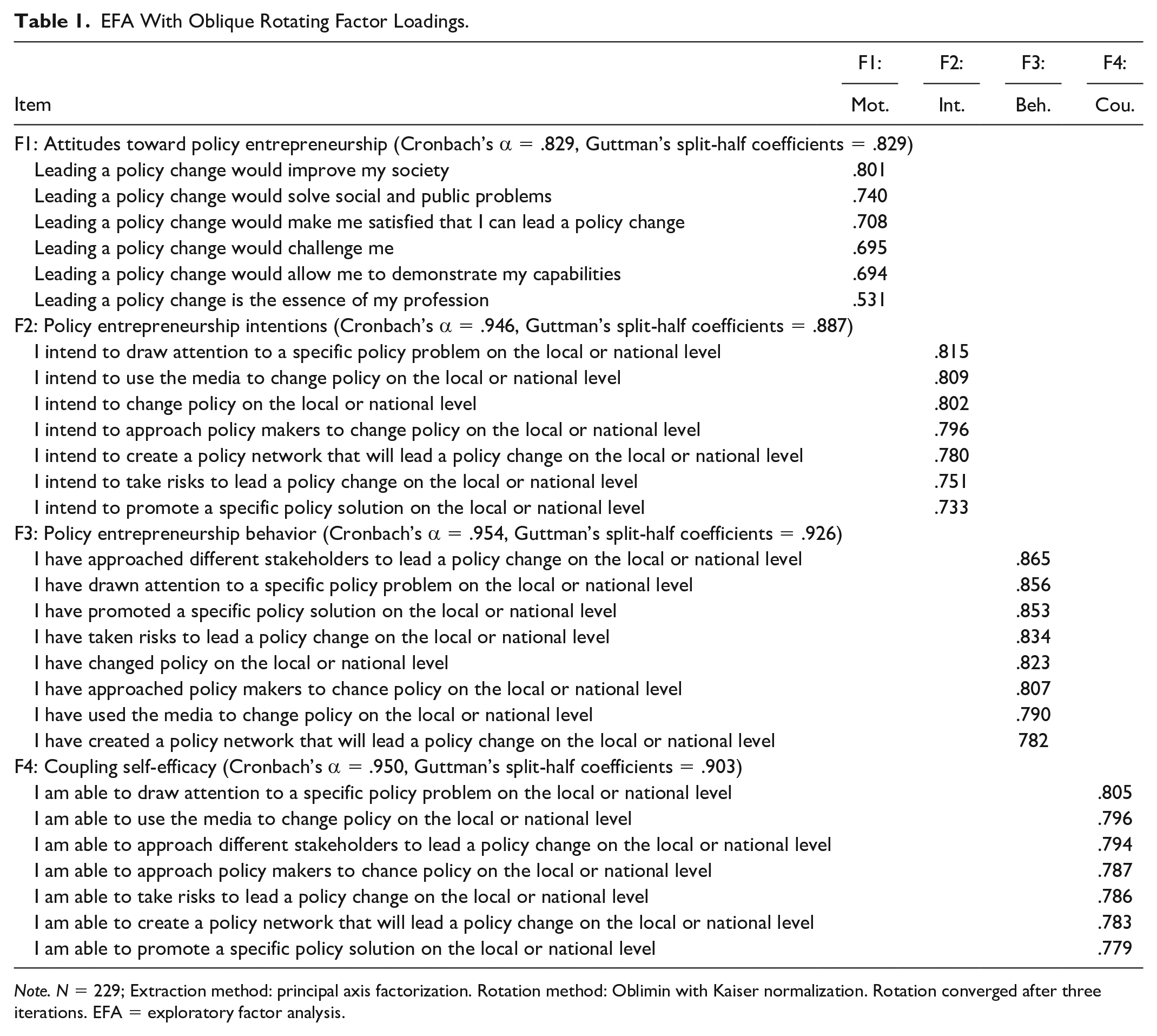
Note. N = 229; Extraction method: principal axis factorization. Rotation method: Oblimin with Kaiser normalization. Rotation converged after three iterations. EFA = exploratory factor analysis.
Policy entrepreneurship intentions were captured by an eight-item list of activities and tasks similar to that used for policy entrepreneurship behavior, following Ajzen’s (1991) recommendation that the predictor (intentions) and criterion (behavior) should be measured at the same level of specificity. We used the framing “I intend to . . . ” that Armitage and Conner (2001) argued was the most accurate way of capturing intentions (p. 483). Finally, following Thompson’s (2009) point that having entrepreneurial intentions is not a binary yes-or-no question but rather a continuum, respondents were asked to indicate their intentions to engage in these activities and tasks on a Likert-type scale from 1 (weak intentions) to 7 (strong intentions). The responses were averaged to create an overall entrepreneurship intentions score for each respondent. The full list of items is shown in Table 1. 3
The gap between policy entrepreneurship intentions and behavior
Following the methodology typically used in intention–behavior research (Carrington et al., 2014; Sheeran, 2002), we calculated the gap between intentions and behaviors by subtracting each respondent’s total score on the policy entrepreneurship behavior scale from his or her total score on the intentions scale.
Independent variable
The independent variable in this study, attitudes toward policy entrepreneurship, was assessed by a seven-item index developed based on our interviews and literature review. The items were framed using the phrase “Leading a policy change will” and were designed to capture beliefs about the value of policy entrepreneurship at different levels, including the social (e.g., “Leading a policy change would improve my society”), the personal (e.g., “Leading a policy change would allow me to demonstrate my capabilities”), and the professional (“Leading a policy change is the essence of my profession”). Following Krueger and Carsrud (1993), respondents were asked their agreement with each statement on a Likert-type scale from 1 (do not agree) to 7 (strongly agree). The six items were averaged to create an overall attitude score for each respondent. The items are shown in Table 1. 4
Mediating and Moderating Variables
Coupling self-efficacy, the mediator in this study, captured the extent to which respondents feel confident that they have the skills and abilities needed to bring together the different streams of the policy process (policy, problem, and politics) to lead to a policy change. Following Zhao et al. (2005), we developed an eight-item scale assessing self-efficacy with regard to the specific policy entrepreneurship tasks delineated in the intentions and behavior scales, as described above (see Table 1). 5 Respondents were asked to rank their confidence (“I am able to . . .”) on a Likert-type scale from 1 (no confidence) to 7 (complete confidence). For each respondent, we averaged the seven items to create an overall coupling self-efficacy score.
Organizational climate for innovation, the moderator in this study, was assessed through a single item: “The organization for which I work supports my innovative ideas.” Responses were given on a Likert-type scale from 1 (do not agree) to 7 (strongly agree).
Control variables
To ensure sufficient internal validity, we collected data on a number of microlevel and macrolevel control variables that have been shown to be related either to street-level bureaucracy or to entrepreneurial behavior. These include age (which affects risk-taking and entrepreneurship; for example, Minola et al., 2016); gender (women are less likely to become entrepreneurs; for example, Díaz-García & Jiménez-Moreno, 2010); ethnicity (Einstein & Glick, 2017); education (Liñán and Chen, 2009); and the size and sector of the organization, which are considered important in the public administration literature.
Statistical Analysis
We tested all of the hypotheses with the IBM SPSS Statistics 23.0 software package. To test validity and reliability, we used exploratory factor analysis (EFA). To test the correlations (H1), we used the Pearson’s coefficient correlation. To test the mediation (H2) and mediation-moderation effects (H3), we used Models 1 and 14, respectively, of the PROCESS Macro (version 3.0), a computational tool for path analysis-based analyses (Hayes, 2015).
Findings
We first report our findings with respect to the scale’s validity and reliability. We then report on our tests of the hypotheses.
Developing and Testing the Dependent Variable
Following Chandler and Lyon (2001, p. 103), we report the essential psychometrics for scale building: validity, the “evidence that the measurement is actually measuring the intended construct,” and reliability, the “consistency and stability of a score from a measurement scale.” Given that we expected some of the factors to be correlated, we tested their validity using exploratory factor analysis (EFA) with oblique rotation (Field, 2013). In our sample, the Kaiser–Meyer–Olkin test for the adequacy of the sample was quite high (.930), and Bartlett’s sphericity test was highly significant (p < .001). These tests confirm that the data are suitable for factor analysis. Three items had factor cross-loadings above .3 (one each from policy entrepreneurship intentions, coupling self-efficacy, and attitudes toward policy entrepreneurship). Therefore, following Field (2013), we omitted them from the scales. However, the remaining items yielded four factors that were clearly distinct from each other. Table 1 presents the results for the EFA with the oblique rotated factor loadings. As the table indicates, all items loaded only on the expected factor. Thus, we named them in accordance with their original nominal definitions: attitudes toward policy entrepreneurship, policy entrepreneurship intentions, coupling self-efficacy, and policy entrepreneurship behaviors.
We also tested for internal validity, convergent construct validity, and discriminant validity. Internal validity refers to whether theoretically related constructs are correlated. In our study, we expected all of the constructs to be correlated. Convergent construct validity assesses the extent to which constructs that are predicted to be related are indeed related. Finally, discriminant construct validity assesses the extent to which unrelated constructs are unrelated (DeVellis, 2016). For convergent construct validity, our assumptions, based on De Bruin et al. (2007), that education and gender were correlated with coupling self-efficacy were confirmed (b =.237, p < .005; b = .340, p < .005, respectively). For discriminant validity, our assumptions, based on Liñán and Chen (2009), that age was not correlated with the policy entrepreneurship intentions and behavior constructs were also confirmed (b = −.003, p = n.s.). Table 2 presents these correlations and the descriptive statistics of the constructs.
Descriptive Statistics, Correlations, and Construct Convergent and Discriminant Validity.
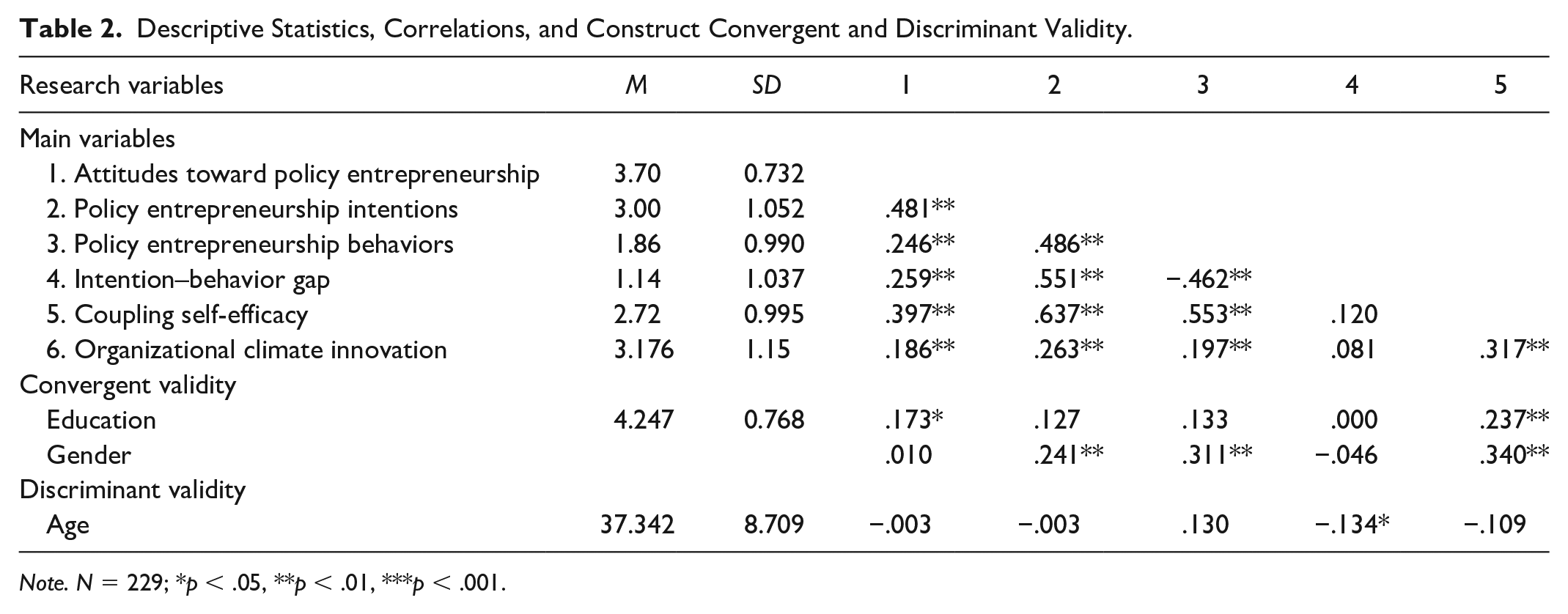
Note. N = 229; *p < .05, **p < .01, ***p < .001.
For our reliability tests, we examined the scales’ internal consistency using Cronbach’s alpha and Guttman’s split-half coefficients. The usual threshold is .7 for newly developed measures (Liñán & Chen, 2009). In our constructs, the values range from .829 to .946 (see Table 2).
These initial results suggest that our theoretically developed scales fulfill the requirements for reliability and validity. Therefore, we used these scales to calculate the gap between each participant’s intentions to engage in policy entrepreneurship and actual behavior and to examine the hypotheses, as reported next.
Tests of the Hypotheses
Relationship between attitudes toward policy entrepreneurship and the intention–behavior gap (H1)
A Pearson’s coefficient test revealed a significant positive correlation between attitudes toward policy entrepreneurship and the gap between policy entrepreneurship intentions and behavior (r = .259, p < .001) (see Table 2). The stronger the positive attitudes toward policy entrepreneurship, the wider the gap, confirming H1.
Mediating effect of coupling self-efficacy (H2)
Using Hayes’ (2015) PROCESS (Model 4) macro for SPSS, we tested the indirect effect of attitudes toward policy entrepreneurship on the gap between policy entrepreneurship intentions and behavior through coupling self-efficacy. As Table 3 indicates, we found a negative indirect effect of attitudes toward policy entrepreneurship on this gap through coupling self-efficacy, b = −.406, 95% lower limit of the confidence interval (LLCI) = 0.655, 95% upper limit of the confidence interval (ULCI) = 0.917. The overall indirect model accounted for approximately 39.2% of the variance in this gap (R2 = .392, F = 72.739, p < .001). Thus, H2 is confirmed: the relationship between attitudes toward policy entrepreneurship and the gap between policy entrepreneurship intentions and behavior is mediated by coupling self-efficacy. The stronger a person’s positive attitudes toward policy entrepreneurship, the greater that individual’s coupling self-efficacy, and in turn, the smaller the gap between entrepreneurship intentions and behavior.
Mediation Analysis (PROCESS Model 4) of the Indirect Effect of Coupling Self-Efficacy on the Relationship Between Attitudes Toward Policy Entrepreneurship and the Intention–Behavior Gap (H2).
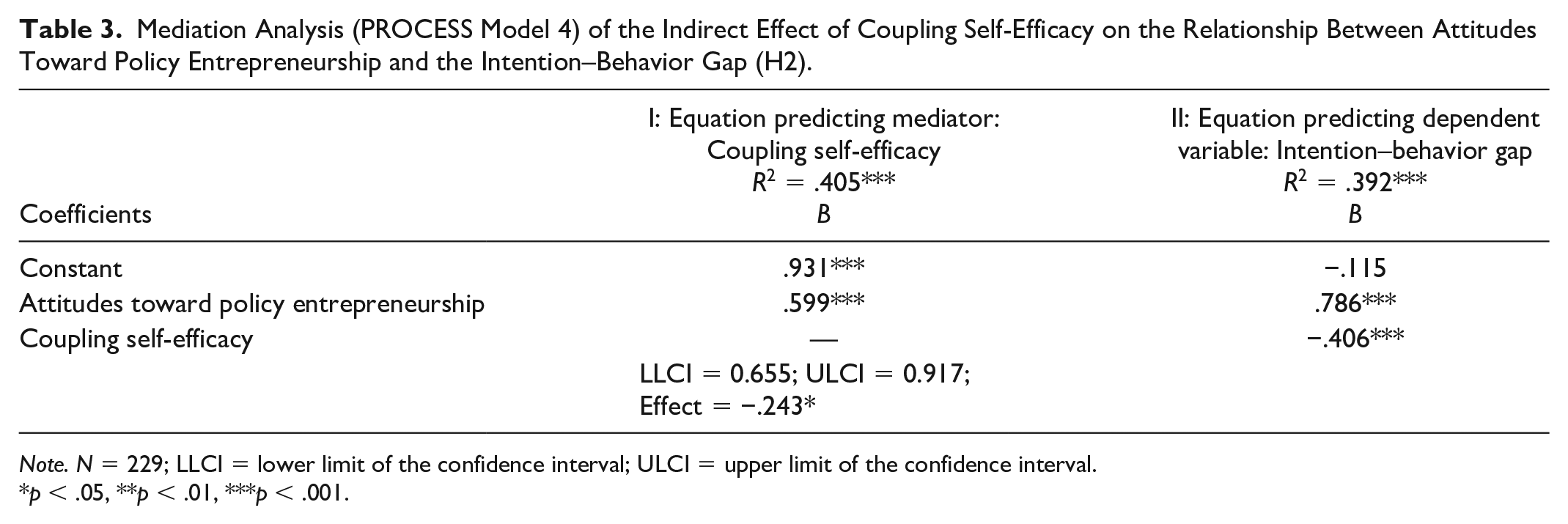
Note. N = 229; LLCI = lower limit of the confidence interval; ULCI = upper limit of the confidence interval.
p < .05, **p < .01, ***p < .001.
The full model: Mediated-moderation effect (H3)
H3 posited the moderating effect of an organizational climate for innovation on the relationship between coupling self-efficacy and the gap between policy entrepreneurship intentions and behavior, such that the stronger the organizational climate for innovation, the greater the effect of coupling self-efficacy on transforming intentions into behavior (i.e., reducing the intention–behavior gap). To test the full mediated-moderated model, we employed Hayes’ PROCESS Model 14 (Hayes, 2015; Table 4). In this model, the full interaction was significant (b = −.115, p < .05; 95% LLCI = −0.126, 95% ULCI = −0.015), indicating that the strength of the negative effect of coupling self-efficacy on the intention–behavior gap depends significantly on the values of organizational climate for innovation. Overall, a significant conditional indirect effect was found for different levels of organizational climate for innovation. In a weak organizational climate for innovation, the effect of coupling self-efficacy on the intention–behavior gap was significant, negative, and weak (b = .159, p < .05; 95% LLCI = −0.247, 95% ULCI = −0.060). In a medium organizational climate for innovation, this effect was significant, negative, and moderate (b = −.228, p < .05; 95% LLCI = −0.310, 95% ULCI = −0.147) and in a strong organizational climate for innovation, the effect was significant, negative, and stronger (b = −.296, p < .05; 95% LLCI = −0.405, 95% ULCI = −0.192). The overall mediated-moderated model accounted for approximately 41.0% of the variance in the intention–behavior gap (R2 = .410, F = 38.315, p < .001). Thus, H3 was confirmed.
Conditional Full Model (Mediation-Moderation PROCESS Model 14) (Hayes, 2015) Examining (a) the Mediation Effect of Coupling Self-Efficacy on the Relationship Between Attitudes Toward Policy Entrepreneurship and the Intention–Behavior Gap and (b) the Moderation Effect of Organizational Climate for Innovation on the Relationship Between Coupling Self-Efficacy and the Intention–Behavior Gap (H3).
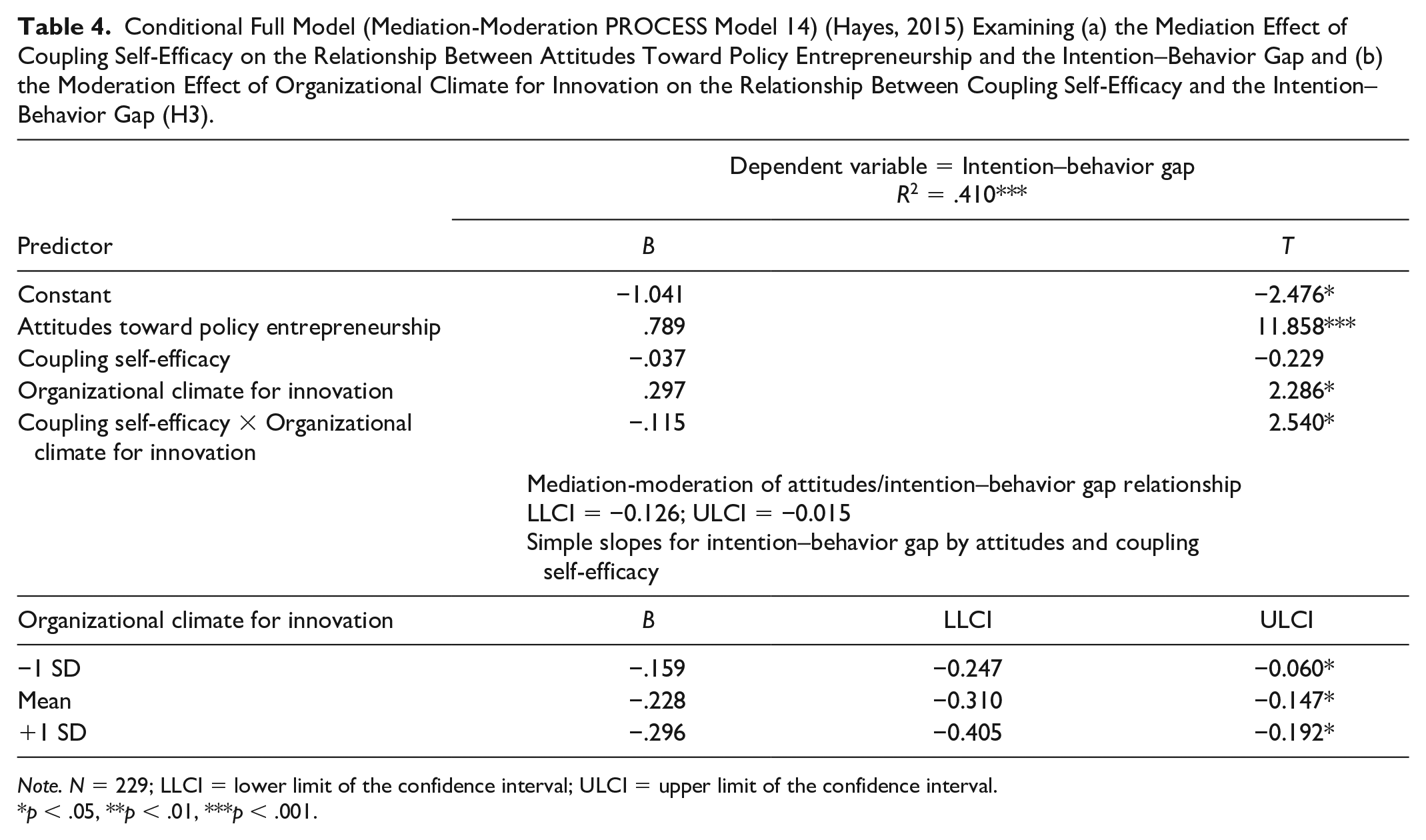
Note. N = 229; LLCI = lower limit of the confidence interval; ULCI = upper limit of the confidence interval.
p < .05, **p < .01, ***p < .001.
Figure 2 plots the conditional effects (simple slopes) of coupling self-efficacy on the intention–behavior gap for values of the organizational climate for innovation. As shown in Figure 2, the stronger the organizational climate for innovation, the stronger the link between coupling self-efficacy and a narrowing of the intention–behavior gap. We will return to these results in our discussion.
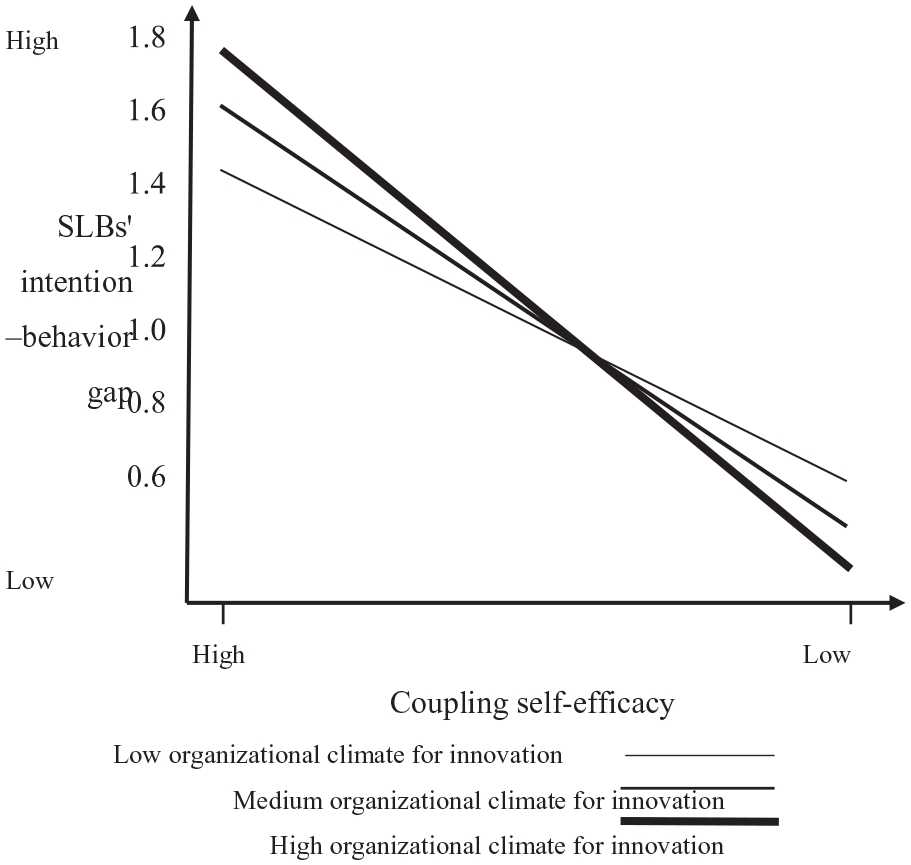
A moderating effect of organizational climate for innovation on the relationship between coupling self-efficacy and policy entrepreneurship intention–behavior gap.
Discussion
This article offers a first glance into the perceptions of SLBs about policy making by measuring their attitudes toward street-level policy entrepreneurship, street-level policy entrepreneurship intentions, and actual street-level policy entrepreneurship behavior. This perspective has major implications for the political role of SLBs (Poulsen & Koch, 2018). Most notably, it opens the possibility of viewing SLBs who feel alienated from the policies they must implement not only as victims of a difficult situation (Lipsky, 1980), but also as players who can respond to this alienation by using their “voice” (Hirschman, 1970) to take an active role in policy formation.
This perspective of voice is different than the more common understanding in the public administration literature about SLBs using discretion during policy implementation (for an exception, see Brockmann, 2017). Be it “guerrilla government” (O’Leary, 2010), “workarounds” (Campbell, 2012), or “whistle-blowing” (Lavena, 2016), these strategies are employed by SLBs, who, when dissatisfied with the actions of public organizations, programs, or people, may actively deviate from norms or rules (O’Leary, 2010). However, while these rule-breaking SLBs usually do not go public with their concerns, and bend the rules on a one-on-one basis, the entrepreneurial activities of the SLBs described in this article are explicit in their desire to influence and change policy. Scholars investigating SLBs such as nurses, teachers, and social workers have recently called for the expansion of their role in policy making from the formulation stage up through implementation, evaluation, and reform (Gal & Weiss-Gal, 2013). SLBs are asked to evaluate and give feedback on the successes and failures of the policies they implement. By doing so, they help bridge the gap between policy implementation and policy reformation.
Policy entrepreneurship is a difficult role that demands courage and persistence. It makes SLBs liable for engaging in a practice that deviates from agency policy. To investigate why SLBs would do so, we point to the role of personal qualities (self-efficacy) and aspects of the organizational environment (climate for innovation) as crucial in helping transform intentions into successful implementation.
Our findings add to the literature in several ways. First and foremost, we add to our understanding of policy entrepreneurship among ordinary SLBs, as opposed to high-level government officials or other, private individuals with access to political or social elites. In particular, we investigate the relationship between the attitudes of these ordinary workers toward bottom-up policy making, their intentions to play a role in the policy process, and their actual behavior. Our findings relate to the scholarship on New Public Management (Hood, 1991) that calls for new types of public employees, those who are entrepreneurial and innovative, who can address the rapidly changing needs of citizens, public goods, and policy (Osborne, 1993) by moving around rules or developing new productive and ethical ways of doing things. Recent research underscores the importance of bureaucrats in policy making, and specifically their role in providing feedback on existing policies. Their insights help detect problems and propose possible solutions for the design of new policies (Workman, 2015). It is thus important to understand how SLBs perceive this demand to be active from the bottom up.
Second, we enrich the literature on policy alienation in the SLB role, much of which has dealt with the need to balance conflicting moral considerations when implementing the policy in individual cases. We indicate how this moral difficulty can find an outlet in policy entrepreneurship (Gofen, 2013; Tummers et al., 2009).
Third, case studies on street-level policy entrepreneurship (Arnold, 2015; Durose, 2011; Frisch-Aviram et al., 2018; Petchey et al., 2008) have found a positive relationship between attitudes toward policy entrepreneurship and the gap between intentions and behavior. More positive attitudes lead to a larger gap. People might have strong intentions but their actual behavior does not change because some key ingredient is missing (Ajzen, 1991). Our findings add to our understanding of the mechanisms behind this phenomenon.
We proposed and found that the gap between policy entrepreneurship intentions and behavior can be narrowed by two factors: coupling self-efficacy on the individual level and organizational support for innovation on the organizational level. Our finding that coupling self-efficacy mediates the relationship between attitudes and the intention–behavior gap points to the importance of self-efficacy in behavioral change. The moderating role of organizational climate for innovation suggests that even SLBs who see themselves as having a high level of coupling self-efficacy will feel frustrated and constrained if they work in an organizational environment that does not support innovation. Indeed, previous case studies have demonstrated similar findings (Frisch-Aviram et al., 2018). In this environment, SLBs are less likely to decide to invest in policy entrepreneurship (Schmitt et al., 2016). Conversely, a sound organizational climate for innovation can help reduce the uncertainty and insecurity associated with policy entrepreneurship, enabling capable SLBs to put their entrepreneurial intentions into practice.
Research in the leadership of SLBs has shown that their work conditions and discretion make it difficult for them to exercise leadership (Brodkin, 2011; Maynard-Moody & Musheno, 2003; Riccucci, 2005). Our findings demonstrate that managers of SLBs who are interested in promoting innovation and entrepreneurship should focus on both the individual and organizational levels, including individual-level interventions for improving self-efficacy (Margolis & McCabe, 2006) and improvements to the organizational climate for innovation (Cropley, 2016; Glisson, 2015; Ren & Zhang, 2015).
Finally, this study makes a methodological contribution, in that we develop a new scale to measure policy entrepreneurship—a concept that until now has been studied mainly through qualitative research. We followed a strict protocol of scale building to ensure the scale’s reliability and validity.
Limitations
Our contributions notwithstanding, we acknowledge the limitations of our study. First, given the cross-sectional design of our study, we cannot draw conclusions about the direction of causality in our mediation and moderation relationships. Future research using an experimental design, perhaps utilizing psychological insights to construct interventions addressing the gap between policy entrepreneurship intentions and behavior, could help draw such conclusions. Second, our sample includes nurses and teachers in Israel. Future research should study cross-national similarities and differences in the gap between policy entrepreneurship intentions and behavior. In addition, more research is needed to understand this gap among other SLBs, as well as the role of the personal and organizational moderators.
Conclusions and Ways Forward
Our findings suggest several avenues for future research. First, we draw our data from a single source. Future research could use multisource analysis to assess the perceptions examined here. Second, this study looked at street-level policy entrepreneurship from the individual perspective. Future research could take an organizational perspective, asking, for example, under what conditions organizations encourage (or, alternatively, undermine) street-level policy entrepreneurship. Given recent calls in the management literature for increased street-level innovation (Kach et al., 2015; Smith et al., 2005), it is important to know how public bodies understand and relate to this concept. Other studies could also take a cultural perspective, exploring how cultural factors act as barriers or promoters to those seeking to engage in street-level policy entrepreneurship (Cohen, 2018). Third, future research can use the model developed here to deepen our understanding of how the gap between policy entrepreneurship intentions and behavior affects other psychological variables, such as work engagement and public service motivation. Finally, from a normative point of view, future research could investigate the benefits and losses of street-level policy entrepreneurship intentions and behavior.
Footnotes
Declaration of Conflicting Interests
The author(s) declared no potential conflicts of interest with respect to the research, authorship, and/or publication of this article.
Funding
The author(s) disclosed receipt of the following financial support for the research, authorship, and/or publication of this article: This work was supported by Israel Science Foundation: [grant number 431/17].
