




Abstract
To understand why and how marketing educators can best use generative artificial intelligence (AI), such as ChatGPT, this article integrates a literature survey, interviews with both marketing educators and managers, and surveys of both marketing educators and students. In leveraging these inputs, the authors argue that generative AI can significantly shape and improve the future of marketing education. Specifically, by including ChatGPT in their lessons, marketing educators can both materially enhance learning experiences and better prepare students for future jobs with marketing firms that rely on ChatGPT in practice. Noting that ChatGPT has downsides, this research identifies several steps educators should take to minimize the risks. Finally, the authors propose an agenda for continued research into how marketing educators can and should use ChatGPT, with the explicit recognition that ChatGPT is evolving rapidly, so that, the research agenda will need to adapt as well.
. . . AI breakthroughs are already changing the way we work and it’s crucial students get the new skills they need to build a fulfilling career. University staff also need support as they look at how AI can be used to enhance their teaching.
For marketing and marketers, a particularly significant disruptor in recent years has been the seemingly relentless onslaught of new technology and applications, especially those enabled by artificial intelligence (AI) (Grewal et al., 2018). These new technologies provide marketing educators with a new set of topics and domains to cover in their classes. Noting marketing educators’ efforts to wrestle with the implications of AI, we undertake a targeted investigation of generative AI, a specific form of AI that has emerged recently and is likely to exert meaningful impacts. Generative AI underlies ChatGPT (where GPT stands for “generative pretrained transformer”), a large language model (LLM) that is trained on a large, diverse data set that autonomously learns from data and then produces seemingly intelligent responses to written prompts (van Dis et al., 2023).
According to observers, it is, “quite simply, the best artificial intelligence chatbot ever released to the general public” (Hirsh-Pasek & Blinkoff, 2023). In less than a year, ChatGPT acquired more than 100 million users (Ruby, 2023); in contrast, it took Twitter about 5 years to attract a similar number of users. Such popularity stems from ChatGPT’s capabilities: With instantaneous speed, it can generate marketing copy, respond to questions, write essays, summarize articles, translate texts, evaluate codes, and more (Elbanna & Armstrong, 2023). The speed of its response, together with its ability to provide a wide range of written responses and outputs, are key to ChatGPT’s appeal. For example, we asked ChatGPT to define “backwards market research” (see Andreasen, 1985; we did not provide this reference to ChatGPT) and describe its effectiveness. Nearly immediately, ChatGPT produced the following summary:
1
Backwards market research, also known as reverse market research, refers to a method where a company or individual begins their research process by identifying a specific problem, challenge, or opportunity, and then works backwards to gather information and insights that can help address or exploit that particular issue. In traditional market research, the process often starts with a broad exploration of the market, industry trends, customer preferences, and other relevant factors, leading to the identification of potential problems or opportunities. In contrast, backwards market research focuses on narrowing down the scope from the outset and tailoring the research efforts to directly address the predefined issue.
This (acceptable) answer is especially impressive if we contrast it with the outcomes when we enter the same prompt into the Google search engine, which primarily produces weblinks, but not a concise response that is (fairly) correct and—most important—ready to be on-shared.
Yet, its appeal may be countered by some concerns; ChatGPT is far from perfect. Among its other flaws, ChatGPT can make (substantial) errors and exhibit bias. First, ChatGPT errors, also referred to as “hallucinations” (Athaluri et al., 2023), remain an issue. Athaluri et al. (2023) asked ChatGPT to identify 50 research topics suitable for further examination, then write up a suitable research protocol for each of them, with references. On close examination, about 15% of the references turned out to be incorrect (Athaluri et al., 2023). Second, ChatGPT may exhibit bias. In tests by Rutinowski et al. (2023), involving questionnaires about political biases, ChatGPT responded in ways that were (significantly) more consistent with progressive views.
To ensure clarity, we explicitly note that ChatGPT differs from generative AI. Generative AI refers to the technology underlying ChatGPT; ChatGPT is generative AI coupled with a specific, broad-based data set. Other generative AI, trained on different data sets (or different LLMs), address different, often very specific, applications. Some other popular generative AI applications include (a) DALL-E-2, which creates unique, high-quality images by autonomously learning from textual descriptions; (b) Google’s Bard, the generative AI developed in a competitive response to ChatGPT, which launched recently and is improving rapidly; and (c) perplexity.ai, another ChatGPT competitor that claims to provide more informative answers, including references (Nelson, 2023). Other generative AI applications also are specific to the education domain. For example, Khan Academy’s Khanmigo relies on the service provider’s proprietary data set to offer one-on-one tutoring to high school students (Dorsey, 2023). GrammarlyGO leverages another specific data set to support writing tasks (Lucariello, 2023), and Chegg plans to launch CheggMate, a generative AI associated with a Chegg-curated data set, to provide exam assistance.
Relative to these examples though, ChatGPT’s distinctive appeal stems from its broad-based applicability across a wide variety of (marketing) domains. As a result, it is widely used by marketers in practice. Bal et al. (2015) argue that students must become familiar with the technologies used by marketing firms; building on this point, we propose that it is important that marketing educators give students exposure to and practice with ChatGPT. Even if other generative AI may be relevant to marketing educators, for the purposes of the current research, we focus specifically on ChatGPT.
To address how ChatGPT can be used in marketing education, we specify its use in student-facing roles (with the acknowledgment that it also might apply in non–student-facing educator roles, such as to increase educators’ productivity or help them write student recommendations). Regarding ChatGPT in student-facing roles, marketing educators offer some mixed views. On the one hand, some educators sound alarms of a ChatGPT crisis, as when Scott (2023) states: I thought we could create personalized discussion questions, meaningful and engaged essay assignments, and quizzes that were sufficiently individualized to course materials that they would be AI-proof. Turns out, I was incorrect. Particularly with the arrival of [ChatGPT], there is very little I can assign to my undergraduates that [ChatGPT] . . . can’t at least take a stab at. Students may have to fill in a few details and remember to delete or add some phrases, but they can avoid most of the thinking—and save a lot of time . . . [ChatGPT] can write essays, compare and contrast options, answer multiple-choice questions, ace standardized tests, and it is growing in its capacity to analyze data—even a lot of data—that is fed to it. It can write code and make arguments. It tends to make things up, including citations and sources, but it’s right a lot of the time.
Terwiesch (2023) describes the case of a Wharton professor who assigned a final exam of a typical MBA course to ChatGPT and determined that the answers would earn a passing grade, somewhere between a B and B–. In response, some universities have moved to ban 2 or restrict the use of ChatGPT, including a top French university (Sciences Po; Reuters, 2023) and both Oxford University and Cambridge University in the United Kingdom (Wood, 2023).
On the other hand, some (other) marketing educators are bullish on ChatGPT, for two main reasons. First, ChatGPT can improve the learning experience (Baidoo-Anu & Ansah, 2023; Clark, 2023; Elbanna & Armstrong, 2023; Puranam et al., 2023; Zhai, 2022). By way of a stylized (and parallel) example, in the past, trigonometry students needed extensive sine tables to determine sine and cosine values; today, they simply use their calculators or Excel. Similarly, to build critical thinking skills, students might be challenged to review content produced by ChatGPT to find logical fallacies, inaccuracies, or sections in which the point could be made better, which should enhance their own reasoning skills (Hirsh-Pasek & Blinkoff, 2023). Alternatively, ChatGPT could be used as a sparring partner, suggesting alternatives to marketing strategies and marketing tactics proposed by students (Clark, 2023). Finally, ChatGPT can take the role of an assistant and help with a variety of activities, such as improving student writing (Baidoo-Anu & Ansah, 2023; Elbanna & Armstrong, 2023; Zhai, 2022).
Second, though some firms (e.g., Apple) express misgivings about ChatGPT (Esposito, 2023), many marketing firms already use it in sophisticated, strategic ways (Brand et al., 2023; Sinha et al., 2023), especially in their marketing and sales functions (e.g., Uta, 2023; Wiggers, 2023). Thus, graduating from business school relatively skilled in using ChatGPT is important, if students are to be competitive on the job market (Peres et al., 2023). According to one report, “When assessing candidates to hire, 90% of U.S. business leaders say having ChatGPT experience is a plus for jobseekers” (Smith, 2023). A recent editorial, referring more generally to generative AI, called for marketing educators and administrators to: ask ourselves how we can incorporate GenAI into how we train students to effectively use the tools in solving real-world marketing problems . . . business education should prepare today’s students for the jobs they will have upon graduation, which includes being well-versed in how to use the latest technologies on the market . . . [and] should view GenAI no differently: as a technology that will be available on the market and that our students should be trained to use. (Peres et al., 2023, p. 272)
Both these points suggest that marketing educators should embrace ChatGPT, use it in classes, and ensure that students are skilled in using ChatGPT by the time they graduate. Yet, there remains a need for caution and care, so that, we examine the competing perspectives closely.
Specifically, to determine how marketing educators can think about ChatGPT, we conducted an extensive literature review (considering both academic literature and the popular press), surveyed students and marketing educators, and interviewed marketing educators and senior managers. On the basis of these diverse inputs, we propose some ideas for how marketing educators should think about ChatGPT; specific conditions in which marketing educators should, or should not, use ChatGPT; and how they can optimally leverage it if they choose to use ChatGPT. Even as we issue these recommendations though, we acknowledge that the situation is evolving, such that, ChatGPT continues to improve, and many alternatives are emerging. Accordingly, we also propose a research agenda, with key questions that researchers should examine in the years ahead.
Literature Review
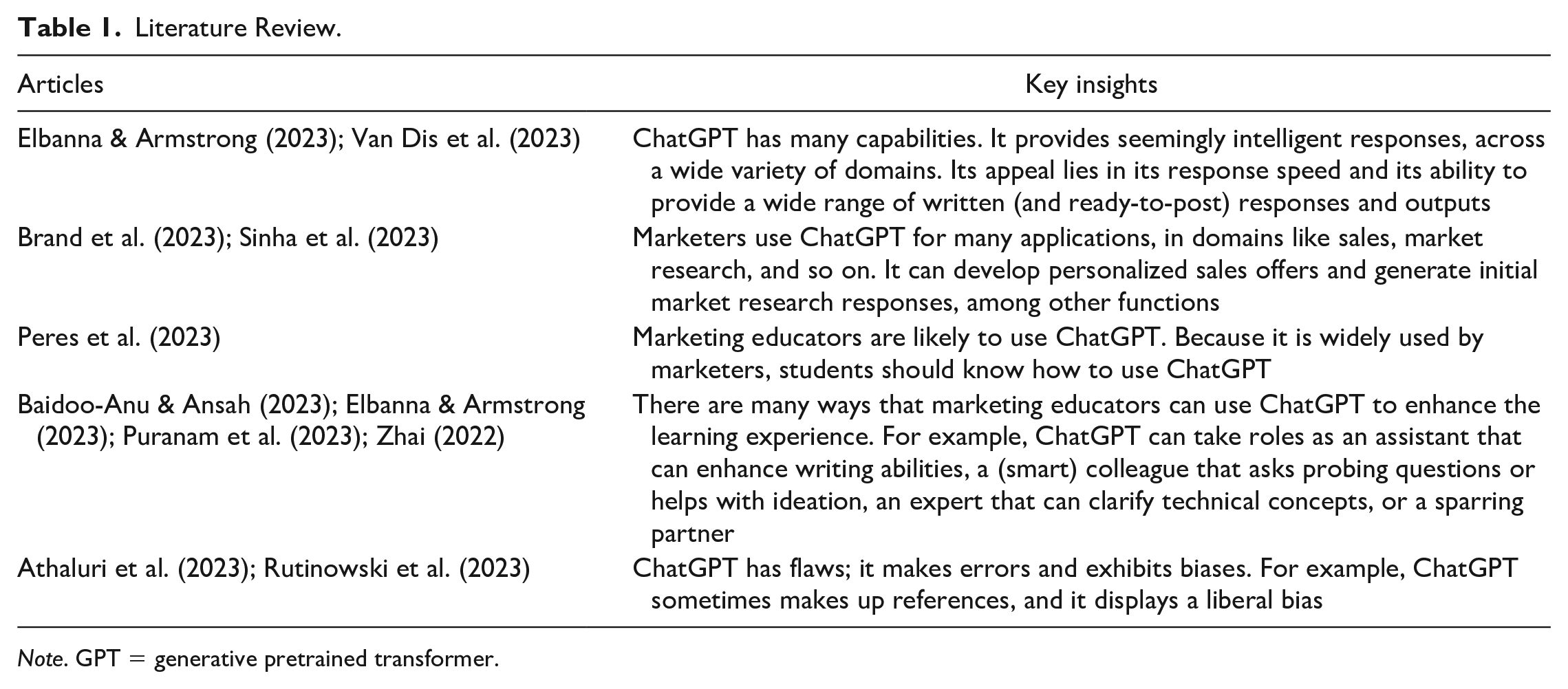
Because ChatGPT is a relatively recent technology, there is little academic research pertaining to it, and especially its application to marketing education. Baidoo-Anu and Ansah (2023), Elbanna and Armstrong (2023), and Zhai (2022) all propose that ChatGPT can enhance student learning experiences, such as by taking roles as an assistant that can improve writing abilities, a (smart) colleague that can ask probing questions or help with ideation, or an expert that can clarify technical concepts (Elbanna & Armstrong, 2023). Clark (2023) details the use of ChatGPT for ideation, in which role it rapidly suggested possible marketing strategies that the class debated. Table 1 lists such benefits of ChatGPT, as outlined in academic literature.
Literature Review.
Note. GPT = generative pretrained transformer.
But Table 1 also contains evidence of the issues with ChatGPT, including its errors, biases, and potential for plagiarism (van Dis et al., 2023). As van Dis et al. (2023, p. 224) note, “we asked ChatGPT to summarize a systematic review that two of us authored . . . ChatGPT fabricated a convincing response that contained several factual errors, misrepresentations and wrong data.” They also found that it indicated that 46 studies were reviewed, when the paper reviewed 69 studies. It also overemphasized the role of cognitive behavioral theory. Such potential for errors is well-known, such that, (substantial) human oversight is required if students or professors plan to use its output. In addition, ChatGPT has exhibited biases (Biddle, 2022; Knight, 2023)—a serious concern, in that such biases may nudge students in less desired directions, without their conscious awareness. For example, answers offered by ChatGPT may encourage students to develop ideas consistent with the promoted points of view. Finally, ChatGPT raises plagiarism questions (van Dis et al., 2023). That is, ChatGPT may generate a response that includes substantial portions of text from a source, without citing that source properly. To the extent that the response appears in academic work, students may find themselves accused and accountable for this form of plagiarism, even if it was unintentional, indirect, or inadvertent.
Exploratory Discussions
To gain further insights, we conducted three exploratory discussions, seeking to understand the perspectives of (a) marketing educators, (b) practicing marketers (whose views have implications for how marketing educators should view ChatGPT), and (c) firms that compete with ChatGPT, and offer ChatGPT alternatives. These discussions took place through teleconferencing; reflecting their exploratory purpose, we did not create any interview guides but instead allowed the experienced respondents to respond as they wished. As we detail subsequently, we leveraged the insights provided in these exploratory discussions to create formal surveys, and systematically collect information from both students and marketing educators.
College Professor Who Uses ChatGPT in Marketing Classes
Clark (2023) describes an actual in-class use of ChatGPT; we reached out to this professor for deeper insights. Clark’s undergraduate students had to develop a relatively new product concept, and they used ChatGPT to ideate in relation to the target segment, positioning, and various elements of the marketing mix. A key observation was the speed with which ChatGPT ideated, such that, its “strengths are centered around quantity of information and speed” (Clark, 2023), which facilitates brainstorming processes. The professor conceded that even if the ChatGPT responses were not optimal, they provided a good starting point. If the professor were to repeat the exercise in future semesters, he indicated he would propose more advance work prior to class, devoted to analyzing ChatGPT’s responses, as well as how to write good ChatGPT prompts. This insight resonates with the increasing importance of “prompt engineering” capabilities cited in some recent studies (Barrett, 2023; Wallbank, 2023).
CEO of a Technology Start-Up
Prior to initiating this study, this CEO indicated to one of the authors that she was a strong proponent of ChatGPT. Thus, we sought her insights into how her technology start-up uses ChatGPT. She noted ChatGPT’s substantial use by both the marketing and technology departments. Her marketing department used ChatGPT to craft social media content in an efficient way, though to make the content truly striking, human input remained essential. She could not quantify the exact efficiencies due to ChatGPT but claimed substantial time savings.
Her technology department used ChatGPT primarily to check coding. In this case, the CEO was able to quantify the time savings, which were substantial. She had initially planned to set up three software teams, each of which would work on different projects. With the increased productivity attained through ChatGPT, the CEO felt comfortable using just two software teams.
Finally, the CEO was working to find ways for ChatGPT to help her sales teams; this effort remained a work-in-process. But she anticipated that ChatGPT would help her sales team, in multiple ways (e.g., Sinha et al., 2023).
Notwithstanding these benefits, the CEO cited concerns about privacy, admitting that she was unsure if everything uploaded onto ChatGPT would remain private. Her technology teams therefore upload only a subsection of code onto ChatGPT, not the firm’s full code library. This important point has not been examined or discussed in prior academic literature but represents a critical consideration (Thorbecke, 2023).
Account Executive at a Technology Company Competing With ChatGPT
ChatGPT offers various capabilities, including proofreading and copyediting. The tech company for which this account executive works for provides proofreading and copyediting services; it counts many universities among its customers. It has created a generative AI, using a custom data set and algorithms. This generative AI promises fewer errors than ChatGPT, due to its use of the custom data set and algorithms. It also promises enhanced privacy, because what gets uploaded into this generative AI will not be available for anyone else to access. The latter point is critical, in that this generative AI is designed to connect with companies’ proprietary databases. It, however, remains an open question whether users will prefer a generative AI solution that offers more privacy but that is less broad in its applicability.
Survey of Students
Method
One of the authors works for a university in the southeastern United States. Prior to introducing ChatGPT-related assignments in an undergraduate marketing class, he sought to understand how students viewed ChatGPT. Thus, in the first half of 2023, he administered a paper-and-pencil survey to 131 students (median age = 21 years; 38.9% self-identified as female). First, the survey asked whether the respondent had ever used ChatGPT (1 = not used at all, 5 = used a lot) and how knowledgeable was the respondent about ChatGPT (1 = not know anything at all, 5 = know a lot) (self-report). Second, respondents briefly described a possible academic use for ChatGPT (open-ended responses, one to two sentences) and indicated if they believed this use was consistent with university policies (1 = yes, 2 = not sure, 3 = no). Third, we asked participants to provide an example of a non-academic use of ChatGPT (open-ended responses, one to two sentences). Fourth, the survey included items asking about students’ opinion about ChatGPT (1 = very negative, 7 = very positive). Finally, we gathered demographic information (age, gender).
Results
Most respondents had not used ChatGPT; the scores indicated their relative unfamiliarity with the tool, M = 2.37, significantly below the scale midpoint; SD = 1.74; t(130) = −4.11, p < .01, d = −.36. Nor were the students very knowledgeable about ChatGPT, M = 2.22, significantly below the scale midpoint; SD = 1.18; t(130) = −7.56, p < .01, d = −.66. Yet even with these consistent indications of a general lack of familiarity, these data reveal some nuanced insights. In general, while respondents had not used ChatGPT (54.2% of respondents chose a score of 1), a significant proportion (26.7%) chose a score of 5, indicating substantial use of ChatGPT. The distribution thus appears as somewhat bimodal, in that this student population, as a whole, has not used ChatGPT much, but a fair number of them have used ChatGPT substantially.
The student-provided examples of what they considered academic uses of ChatGPT also varied. For example, they predicted relying on ChatGPT for initial academic research, solving basic problems, summarizing extant work, writing papers from scratch (possibly first drafts), rewriting papers, debugging code, performing translations, and checking grammar. Notably, 41.4% of respondents were not sure if such uses complied with their university’s ethics policies, and a further 24.4% of respondents were confident that certain uses did not comply (e.g., using ChatGPT to rewrite an essay). These insights suggest that students consider ChatGPT potentially useful for their academic work, but they are not sure if their university would allow such uses. Among the nonacademic uses of ChatGPT, students listed (a) developing meal plans, (b) selecting healthier food options, (c) writing an initial draft of a social media post, or (d) writing a product description to be posted online. Again, it appears that students regard ChatGPT as useful. Finally, despite their relative unfamiliarity with ChatGPT, the students expressed positive views of ChatGPT, M = 4.58, significantly above the scale midpoint; SD = 1.28; t(107) = 4.75, p < .01, d = .46.
In summary, students remain unfamiliar with ChatGPT but have developed positive views of it. A few had used ChatGPT, perhaps minimally, for academic and nonacademic uses. Considering just academic uses though, students express concerns about whether relying on ChatGPT might expose them to the risk of sanctions from their university.
Survey of Marketing Educators
As noted, one of the authors works for a university in the southeastern United States. In the first half of 2023, that university’s center for teaching excellence asked him to offer a university-wide workshop on ChatGPT, speaking to professors and graduate students who taught classes about some ways to think about ChatGPT and use it in their classes. In preparation, he administered a pre-workshop, exploratory survey, with the assistance of the university’s center for teaching excellence.
Method
The survey was administered on Qualtrics; it was deliberately short. In particular, we did not request demographic information, though all the respondents (N = 47) were engaged in teaching roles. Instead, the survey addressed (a) the extent to which respondents were knowledgeable about ChatGPT (1 = not at all knowledgeable, 5 = extremely knowledgeable), (b) their assessments of ChatGPT (1 = very negative, 7 = very positive), (c) whether ChatGPT should be banned in classroom settings (1 = definitely should NOT be banned, 7 = definitely should be banned), and (d) whether perceptions of ChatGPT and related policies seemed likely to change in the next year or so (1 = ChatGPT will be banned in classroom settings, 7 = ChatGPT will actively be used in classroom settings). In addition, the survey included space—at the end—for any open-ended responses the participants wanted to add.
Results
Among these respondents, we again find that they did not feel very knowledgeable about ChatGPT, M = 2.43, significantly below the scale midpoint; SD = .83; t(46) = −13.04, p < .01, d = −1.90. Nevertheless, they expressed a positive opinion of it, M = 4.47, significantly above the scale midpoint; SD = 1.19; t(46) = 2.68, p < .05, d = .39. Accordingly, these marketing educators generally did not call for ChatGPT to be banned, M = 3.28, significantly below the scale midpoint; SD = 1.46; t(46) = −3.41, p < .05, d = −.49, and also predicted that policies would evolve to allow the use of ChatGPT in classroom settings, M = 4.67, significantly above the scale midpoint; SD = 1.43; t(45) = 3.19, p < .05, d = .47. They explained their views in insightful ways too, as the following verbatim comments reveal: ChatGPT 4 is significantly more advanced than previous versions and I assume that the trend will continue. Resisting these advances seems futile. Thus, it seems important for us to identify legitimate uses for AI technology, teach students how to use it effectively, and help students to critique AI output (and become more critical consumers of information, in general). It is here to stay. Banning ChatGPT will not achieve anything; therefore, we must learn how to use it in the classroom. I think ignoring AI and its existence will only allow for students to utilize it in a non-modulated form. Additionally, it is detracting from their education as we in higher education are meant to expose them to emerging technologies and methodologies.
Still, some skepticism was evident, in line with popular press accounts of ChatGPT, such as in the comment: Since the focus here at [university] is on students using ChatGPT to cheat, I do not feel that faculty will use it in their classes. Like with some other helpful tools for learning, ChatGPT policies will probably focus on not allowing to use it and get reported if they do.
In summary, marketing educators are not very familiar with ChatGPT. Nevertheless, they hold a positive view of it and expect its expanded use in the classroom. However, we find little clarity in their descriptions of the exact ways ChatGPT might be used.
Follow-Up Survey of Marketing Educators
Noting that these marketing educators were not very knowledgeable about ChatGPT, we ran a follow-up survey to elicit responses from a specific segment of marketing educators indicating their relative knowledge about ChatGPT.
Method
In a follow-up survey, run a few days after the initial survey, we reached out to 19 marketing educators (median age = 39 years; 63.2% self-identified as female) across the United States who taught classes, such as digital marketing, marketing analytics, research methods, consumer behavior, or core marketing. We recruited this convenience sample by emailing the Qualtrics survey to colleagues in other schools who were teaching marketing classes using ChatGPT (to varying degrees).
Respondents indicated their opinion about ChatGPT (1 = very negative, 7 = very positive), whether ChatGPT should be banned in classroom settings (1 = definitely should NOT be banned, 7 = definitely should be banned), and whether they predicted rapid changes to related policies (1 = ChatGPT will be banned in classroom settings, 7 = ChatGPT will actively be used in classroom settings). Again, we offered space for open-ended responses and asked respondents to list up to three academic and three nonacademic uses of ChatGPT.
Results
This sample is too small for any meaningful quantitative analysis, but the mean values are consistent with the prior surveys. Respondents had a positive opinion of ChatGPT (M = 4.58, notionally above the scale midpoint; SD = 1.47), did not call for ChatGPT to be banned (M = 2.21, notionally below the scale midpoint; SD = 1.62) and anticipated that policies would change to allow the use of ChatGPT in classroom settings (M = 4.21, notionally above the scale midpoint; SD = 2.02).
In the open-ended responses, these marketing educators identified widespread applications of ChatGPT in marketing practice, including drafting social media or blog posts, crafting product descriptions, creating first drafts of sales or customer service messages, brainstorming (Eapen et al., 2023; Shimek, 2023), and crafting early business plans. They also suggested ChatGPT’s usefulness for classroom assignments, such as for initial drafts of reports, collecting background information on a topic, editing a written paper, brainstorming, and creating draft marketing materials.
In turn, these classroom assignments appear to have clear links with professional uses of ChatGPT. The respondents indicated their belief that in-classroom uses of ChatGPT would provide students with greater exposure to ChatGPT and its capabilities, and those capabilities in turn would translate into improved prospects in job markets.
How ChatGPT Might Be Used by Marketing Educators in the Classroom
Marketing and marketing education already have been substantially affected by digital disruptions (Crittenden & Peterson, 2019; Schlegelmilch, 2020), and such disruptions appear likely to continue, such that marketing educators must embrace the influence of digital technologies, and generative AI in particular, in the classroom. According to a recent survey, members of the educational community anticipate that ChatGPT will substantially change learning in business schools (McCormack, 2023). With this prediction, we consider: How should marketing educators think about and plan to use ChatGPT? Specifically, how can they best trade off the benefits of using ChatGPT with its risks and downsides? Based on our literature review, interviews, and survey results, we offer some recommendations for marketing educators.
Extracting Benefits From ChatGPT
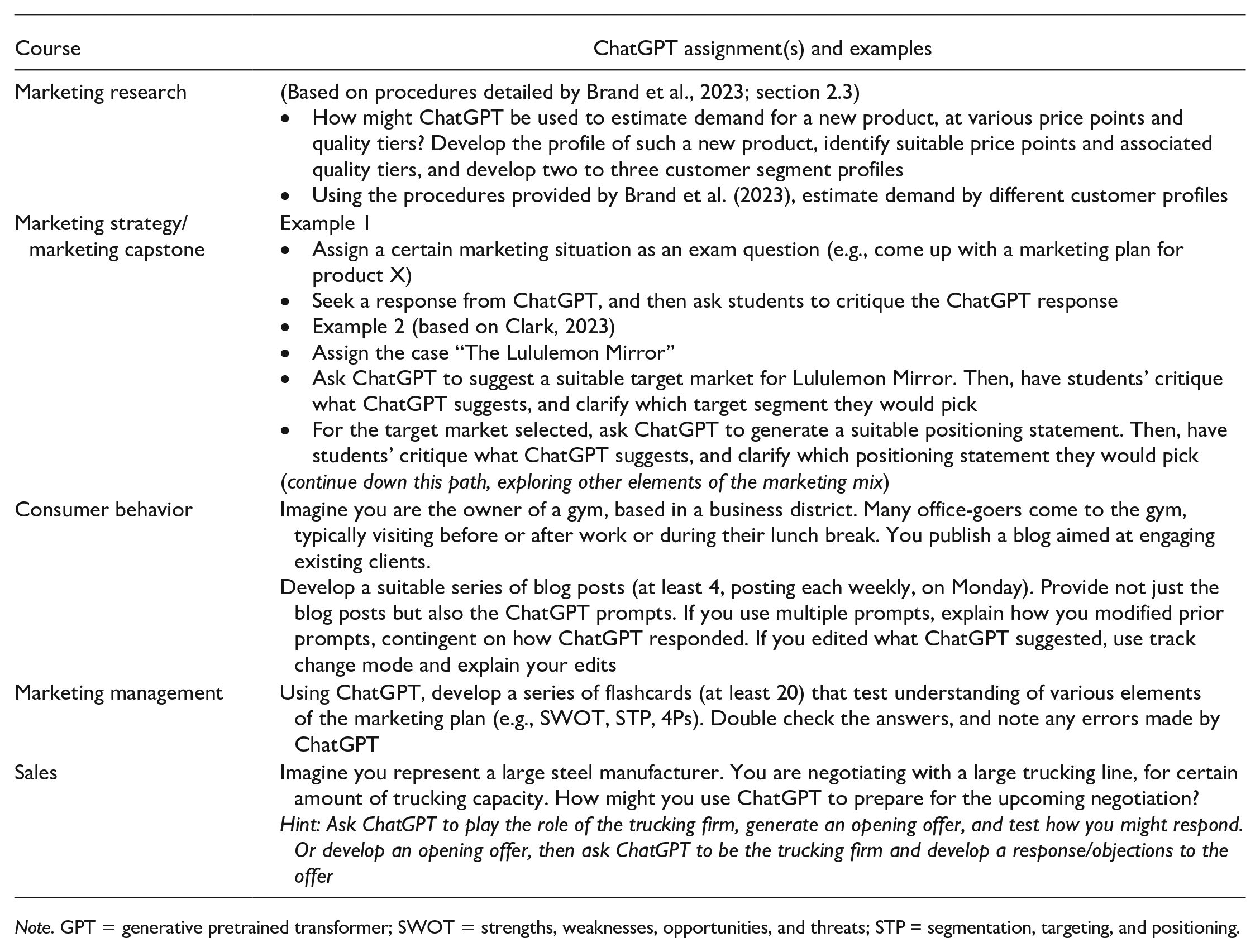
Firms increasingly use ChatGPT for their marketing, advertising, and sales tasks, so that, it is beneficial for marketing students to be conversant in ChatGPT and familiar with the kind of tasks they can execute in their work life using ChatGPT. Marketing educators might consider creating assignments that mimic how actual marketers use ChatGPT—not unlike how marketing curricula already train students on marketing-specific software, like Mulesoft, Hubspot, Python, Tableau, and Qualtrics. In the appendix, we list (by course) some ChatGPT assignments that map onto how marketers currently use it. Such assignments might be developed further, to reflect employer feedback and actual uses, such as those by Microsoft and Slack (Smith, 2023).
Furthermore, ChatGPT can enhance the learning experience. Both London Business School and Yale University, for example, assert that ChatGPT can be valuable for helping students with assignments, generating suggestions, and providing feedback, as summarized in dedicated websites (London Business School ChatGPT Basics, https://teaching.london.edu/london-business-school-chatgpt-basics/; https://poorvucenter.yale.edu/AIguidance). Educators already know the importance of engaging students (Bal et al., 2015), and ChatGPT offers great promise in this effort too. To enhance engagement and the learning experience effectively, educators should exploit the opportunities that ChatGPT can grant students, in that they can spend less time on cognitively easy but time-consuming “busywork” and devote more time to cognitively demanding or creative tasks. For example, if the assignment is to write a business plan, ChatGPT might produce a skeleton draft (Ahmad, 2023), which students can use and critique critically, then define and specify their own optimal plan after conducting a complex SWOT (strengths, weaknesses, opportunities, and threats) analysis or careful assessment of which consumer segments to target. Here, the analogy with a calculator again is pertinent: Rather than spending hours calculating numbers by hand, students can use a calculator (or Excel), then devote their time and cognitive resources to interpreting the meaning of the numbers provided by Excel. Like a calculator, ChatGPT can be a useful tool. Yet to use these tools effectively, students also must receive advanced instruction, such as in how to validate the key facts conveyed in the report or confirm that all necessary citations appear appropriately in the text.
In addition, ChatGPT can provide counterarguments, or alternate ideas to help students develop their own arguments more effectively (Atlas, 2023; Puranam et al., 2023). In our personal experience working with undergraduate students who have chosen to specialize in sales and entrepreneurship, we often engage with them as participants in various competitions, such as to pitch new ideas or ventures. Recently, some of them tasked ChatGPT with coming up with various objections, which gave the students meaningful practice in testing the various responses they could offer to address such objections. Such uses parallel Clark’s (2023) description of a marketing class, in which students created marketing plans, and then ChatGPT created an alternate plan, allowing the class to debate the pros and cons of each.
Finally, ChatGPT is a constantly available study partner (Atlas, 2023). It can quickly create relevant flashcards and other study tools to help students learn the 4Ps or the key components of the elaboration likelihood method or regulatory focus theory. Because ChatGPT can produce outlines of concepts in diverse ways, students with different learning styles might gain a better grasp on complex concepts. Considering the potential for ChatGPT to provide incorrect information though, students must find ways to protect against that risk.
We also offer some caveats. 3 Notably, we focus on ChatGPT, in accordance with its widespread buzz; marketing educators similarly might assume that they should prioritize ChatGPT, jump right into its introduction and assignments for using it. But in practice, it might be more beneficial for marketing educators to start with an introduction to AI and generative AI, then outline the various generative AIs in use. After this broader introduction, they might more effectively introduce ChatGPT as a specific form of generative AI. We offer this recommendation for two main reasons. First, it is not clear which generative AI ultimately will dominate; ChatGPT may be the most popular version today, but the future remains uncertain. Providing a broad overview of generative AI (and AI more broadly) helps students understand the underlying technology and arguably should leave them more open to considering the potential of other forms of generative AI that may prove superior over time. Second, even if ChatGPT remains the dominant generative AI, other formats offer superior functionality in certain domains (e.g., DALL-E-2 likely is superior for producing images). If students can toggle across various generative AI, depending on their unique needs, they will be better prepared to perform across a variety of diverse, dynamic job tasks in their future employment. Accordingly, we explicitly acknowledge that our general findings—related to how marketing educators can consider use of ChatGPT—extend to other generative AI as well.
We also note room for a more philosophical discussion of the actual role of marketing education. Some marketing educators prefer to teach technical software as part of a marketing class, whereas others assume they will learn it outside of those classes (e.g., learn technical software in a foundational class). The case of SPSS offers a clear example: About 44% of marketing research classes formally teach SPSS (Reavey et al., 2021), revealing an obvious split in teaching philosophies. Similar considerations likely apply to ChatGPT. Learning about the uses of generative AI (broadly), and ChatGPT specifically, can extend across disciplines (e.g., Frackiewicz, 2023). A pedagogical question thus surfaces: Should marketing educators take the lead in teaching ChatGPT, or should ChatGPT be taught as a foundational class?
Limiting the Downsides of ChatGPT
Clearly, ChatGPT makes errors. Thus, any user must take the responsibility for checking every bit of information that ChatGPT provides. In essence, ChatGPT cannot be treated like a trusted advisor; instead, it is more like “an omniscient, eager-to-please intern who sometimes lies to you” (Bowman, 2022). Making students aware of this point, and then convincing them to check the information that ChatGPT provides, remains a challenge for marketing educators.
Also, as we noted, ChatGPT can be biased in various ways. Cost (2023) finds that “more negative stereotypes were applied to countries with predominantly residents of color,” and Harris (2023) reports that the CEO of the company that maintains ChatGPT has admitted that “ChatGPT has shortcomings around bias.” Such bias is difficult to police; again, the onus is on the user to be vigilant. It is possible that ChatGPT may improve over time, but the timing and character of these improvements remain open questions.
The significant risks of plagiarism associated with ChatGPT are especially troublesome in academic settings (Nolan, 2023). A student given an assignment might be tempted to ask ChatGPT for the answer. As Terwiesch (2023) has documented, ChatGPT-produced responses might earn a good grade on their own. Although marketing educators can, and already do, caution students about and impose sanctions if they find evidence of plagiarism, in practice, plagiarism is quite difficult to detect, much less prove. If a student accused of relying on ChatGPT and not producing original work decides “to dig their heels in and deny the use of AI, it can be difficult to prove” (Nolan, 2023). Existing plagiarism and other fraud detection systems are not advanced enough to conclude decisively when something has been written by a human versus ChatGPT.
Might students get around such accuracy and plagiarism concerns merely by disclosing their use of ChatGPT? This thorny and evolving ethical question depends on who is evaluating their uses. Although individual evaluators may choose to impose their own standards, the American Psychological Association (APA) has provided some initial guidance (McAdoo, 2023). Its style guide calls for (a) disclosing the use of ChatGPT in the methods sections, (b) providing full details of the prompt used, and the full text of the response generated, in an appendix, and (3) suitably citing ChatGPT. Furthermore, APA standards hold authors responsible for any factual errors or plagiarism created by ChatGPT, with the specific caution that “it may be better to read those original sources to learn from that research and paraphrase or quote from those articles, as applicable, than to use the model’s interpretation of them” (McAdoo, 2023).
Alternatively, educators might design “ChatGPT-proof” assignments. Dobson (2023) asks, as “ChatGPT continues to grow in terms of both its capabilities and usage—including in education and academia—is it high time for universities to revert to the time-tested oral exam?” Oral exams might be ChatGPT-proof, but they are not very scalable. An in-class multiple choice exam might be ChatGPT-proof and scalable, but it is less applicable to upper-level classes. Thus, no easy answers emerge in terms of how to create ideal, effective, ChatGPT-proof assignments.
Finally, ChatGPT is associated with privacy concerns. To the extent that any proprietary data or analyses conducted by students in the process of working on assignments are uploaded to ChatGPT, unauthorized others may be able to access it, to the detriment of those who licensed the content to specific educators or educational institutions. This risk may restrict the extent to which ChatGPT may be used.
Some of the emerging alternatives to ChatGPT address a few of these concerns. For example, Grammarly’s GrammarlyGO makes fewer errors than ChatGPT and raises fewer privacy concerns, but it does not offer broad applicability. Considering our focus on just ChatGPT (for the purposes of this article), we do not discuss these alternatives further. Finally, an obvious caveat is that, like any new technology, ChatGPT will improve over time. Some of the points we raise may become obsolete or irrelevant soon. Still, recent versions of ChatGPT have been criticized as less intelligent than prior versions (Abid, 2023), so the trajectory of ChatGPT may not be as upward-sloping as some might expect.
Developing a Research Agenda
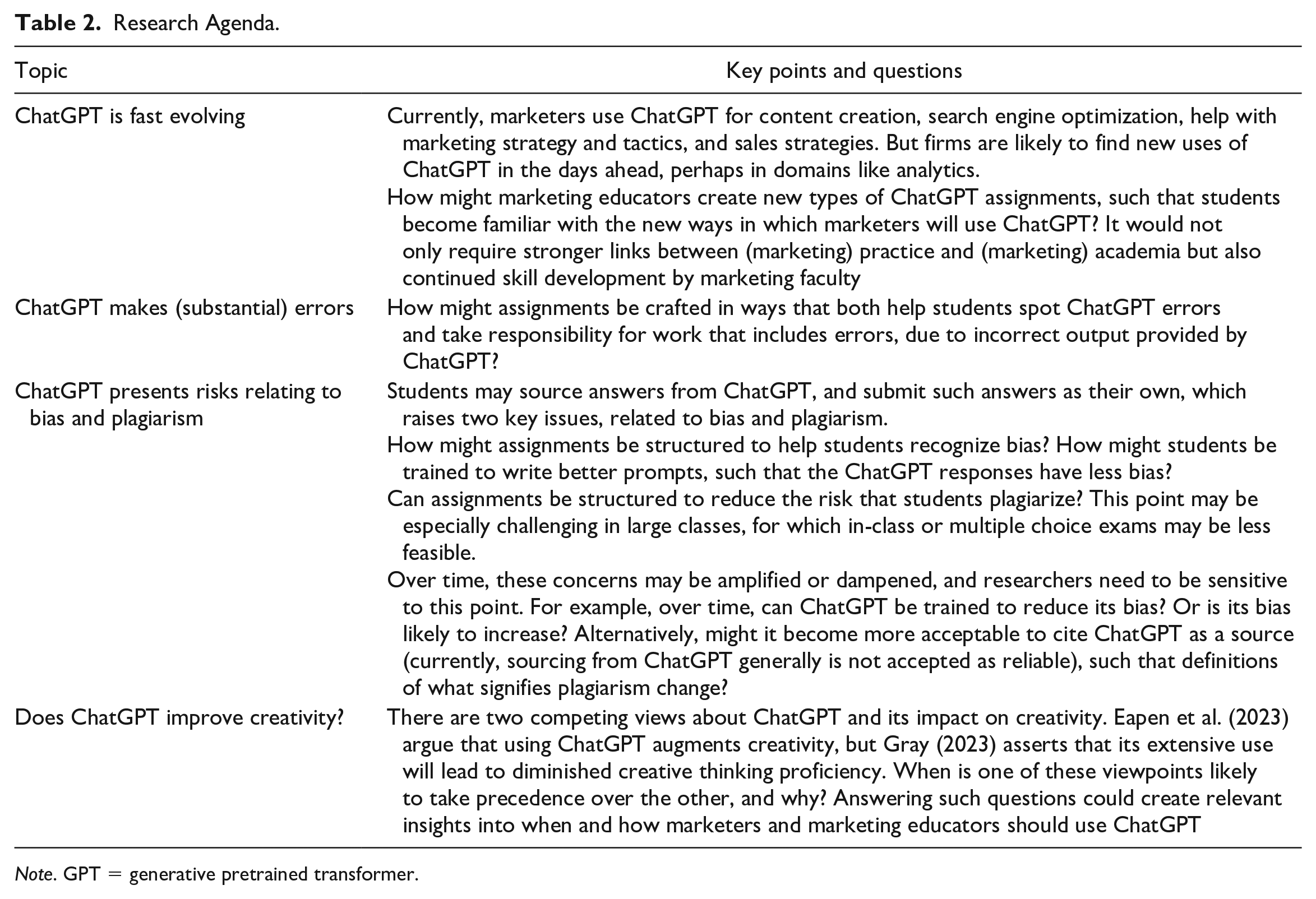
ChatGPT is a recent, fast evolving innovation, subject to ongoing questions about how marketing and sales firms can best use it, as well as how it might affect learning experiences in the classroom. Such questions, and their ultimate answers, can inform marketing educators regarding how to use ChatGPT suitably. Accordingly, we propose an agenda for continued research (Table 2). Considering its newness, the diverse uses of ChatGPT in marketing practice are remarkable, including the creation of suitable (ready-to-post) content, search engine optimization, and marketing plan development, as well as generating client emails and messages and helping with sales tactics in sales departments. But firms are likely to find new, expanded, and creative uses of ChatGPT, which will determine the types of ChatGPT-related content marketing educators need to teach. Thus, marketing educators and marketing practice should actively coordinate, to ensure the educational content is up-to-date and that students enter the workforce with relevant skills.
Research Agenda.
Note. GPT = generative pretrained transformer.
Regarding inaccurate and biased information, we call for users to exercise caution and verify content. Such considerations also should inform how marketing educators actually use ChatGPT in classrooms. We need further research that identifies effective ways to motivate students to expend the time and effort needed to verify information provided by ChatGPT. Similarly, marketing educators need insights into how to protect against student plagiarism that results from their use of ChatGPT. In-class or verbal exams can reduce the opportunities for students to use ChatGPT to cheat during exams, but they are not always appropriate or effective. How might tests be structured to allow students to use ChatGPT during exams but still provide a suitable measure of their knowledge?
Finally, Eapen et al. (2023) argue that using ChatGPT may augment creativity and “produce and identify novel ideas—and improve the quality of raw ideas. Specifically, companies can use generative AI to promote divergent thinking, challenge expertise bias, assist in idea evaluation, support idea refinement, and facilitate collaboration among users.” In contrast, Gray (2023) believes that “using ChatGPT extensively might also result in users becoming less proficient in creative thinking . . . by relying on the tool for creative tasks, users might inadvertently stifle their own creativity.” Resolving these contrasting viewpoints requires research into when one viewpoint is likely to dominate over the other. Such insights also could help marketing educators structure their pedagogical uses of ChatGPT more effectively.
Footnotes
Appendix
| Course | ChatGPT assignment(s) and examples |
|---|---|
| Marketing research | (Based on procedures detailed by Brand et al., 2023; section 2.3) • How might ChatGPT be used to estimate demand for a new product, at various price points and quality tiers? Develop the profile of such a new product, identify suitable price points and associated quality tiers, and develop two to three customer segment profiles • Using the procedures provided by Brand et al. (2023), estimate demand by different customer profiles |
| Marketing strategy/marketing capstone | Example 1 • Assign a certain marketing situation as an exam question (e.g., come up with a marketing plan for product X) • Seek a response from ChatGPT, and then ask students to critique the ChatGPT response • Example 2 (based on Clark, 2023) • Assign the case “The Lululemon Mirror” • Ask ChatGPT to suggest a suitable target market for Lululemon Mirror. Then, have students’ critique what ChatGPT suggests, and clarify which target segment they would pick • For the target market selected, ask ChatGPT to generate a suitable positioning statement. Then, have students’ critique what ChatGPT suggests, and clarify which positioning statement they would pick (continue down this path, exploring other elements of the marketing mix) |
| Consumer behavior | Imagine you are the owner of a gym, based in a business district. Many office-goers come to the gym, typically visiting before or after work or during their lunch break. You publish a blog aimed at engaging existing clients. Develop a suitable series of blog posts (at least 4, posting each weekly, on Monday). Provide not just the blog posts but also the ChatGPT prompts. If you use multiple prompts, explain how you modified prior prompts, contingent on how ChatGPT responded. If you edited what ChatGPT suggested, use track change mode and explain your edits |
| Marketing management | Using ChatGPT, develop a series of flashcards (at least 20) that test understanding of various elements of the marketing plan (e.g., SWOT, STP, 4Ps). Double check the answers, and note any errors made by ChatGPT |
| Sales | Imagine you represent a large steel manufacturer. You are negotiating with a large trucking line, for certain amount of trucking capacity. How might you use ChatGPT to prepare for the upcoming negotiation? Hint: Ask ChatGPT to play the role of the trucking firm, generate an opening offer, and test how you might respond. Or develop an opening offer, then ask ChatGPT to be the trucking firm and develop a response/objections to the offer |
Note. GPT = generative pretrained transformer; SWOT = strengths, weaknesses, opportunities, and threats; STP = segmentation, targeting, and positioning.
Declaration of Conflicting Interests
The author(s) declared no potential conflicts of interest with respect to the research, authorship, and/or publication of this article.
Funding
The author(s) received no financial support for the research, authorship, and/or publication of this article.
