




Abstract
In this article, we examine the linkage between students’ game-playing motivations and a wide variety of gamification elements within higher marketing education. Using an interpretive and convergent mixed-methods design, we discover four clusters of students that vary in terms of their game-motivational bases and views on gamification elements. Social completionists want to study together with others and enjoy the social aspects of gamification. Highly motivated completionists could be described as ambitious students who enjoy social learning but are also internally motivated and willing to accept most gamification elements. Independent completionists want to immerse themselves in learning but prefer the individual and noncompetitive elements of gamification. Pure completionists are the “let’s get it done” group, who want to focus on completing their studies and are likely to be critical toward any gamification. We propose that higher education should take into account the differences in students’ game-playing motivations and fine-tune their gamification efforts to engage and motivate different kinds of students. Finally, we provide suggestions to marketing educators on how to consider the various motivational bases of the participants in gamified experiences.
Keywords
“It’s quite funny that even though I’m usually rather competitive, I still don’t think that the best way to learn is to compete against each other.” (F, 23)
Gamification is a growing trend in education (Dicheva et al., 2015; Hung, 2017; Zimmerling et al., 2019) and marketing educators are increasingly employing games (such as Kahoot, Markstrat, or SimBrand) and gamified elements (such as badges and leaderboards) in their classes (Dikcius et al., 2021; Humphrey et al., 2021; Robson, 2019). Therefore, there is an emerging need to understand this connection more deeply.
This linkage can be observed in the very definition of gamification, according to which gamification can be regarded as the application of game design elements in a nongame context with the intention to utilize the motivational factors of games (e.g., Deterding et al., 2011; Robson et al., 2014). Much of the research on gamification motivations is grounded on Deci and Ryan’s (2000) self-determination theory, which has identified a so-called internalization continuum in which the quality of motivation may move from extrinsic motivations (e.g., materialistic gains, appearance, wealth) to intrinsic motivations (e.g., personal health, growth, and wellness; Rigby, 2015). In consequence, extrinsic and intrinsic motivations are largely examined in relation to gamified education (e.g., Alsawaier, 2018; Hung, 2017; Papp, 2017; Ramirez & Squire, 2015; Zimmerling et al., 2019). To elaborate, proponents of gamified education argue that gamification elevates students’ extrinsic and intrinsic motivation to learn (Alsawaier, 2018). Several empirical studies of gamification in higher education have shown that gamification affects students’ engagement in learning processes, thereby enhancing their learning experience (Ashley, 2019; Chapman & Rich, 2018; Cheong et al., 2014; de Sousa Borges et al., 2014; Dikcius et al., 2021; Kyewski & Krämer, 2018; Looyestyn et al., 2017). However, others deem gamification to be an exploitative and oversimplified approach that increases competition and tends to rely only on extrinsic motivation (Hamari et al., 2014; Hung, 2017).
There are many possibilities to employ different kinds of gamification elements in classroom work, yet much of the earlier research deals with the most typical gamification elements and/or just a few of them at a time. For example, Kyewski and Krämer (2018), as well as Humphrey et al. (2021), focused on badges, Cheng et al. (2018) on open digital badges, Robson (2019) on a point system, and Mekler et al. (2013) on points, levels, and leaderboards. Similarly, the extant body of knowledge on the variety of game-playing motivations is massive (e.g., Bartle, 1996; Vahlo et al., 2017; Yee, 2006), including multiple dimensions such as immersion and sociality (e.g., Kahn et al., 2015; Yee et al., 2012), which can also be regarded as central to different learners. Still, although the current knowledge shows that learners approach their learning in different ways (Coertjens et al., 2016; Parpala et al., 2010), the differences between students’ game-playing motivations have not been in the focus of the earlier studies regarding gamified marketing education (Kyewski & Krämer, 2018; Looyestyn et al., 2017).
To address these gaps, we link the research on various game-playing motivations (e.g., Bartle, 1996; Kahn et al., 2015; Vahlo et al., 2017; Yee, 2006; Yee et al., 2012) to a wide spectrum of gamification elements (e.g., Hunicke et al., 2004; Werbach & Hunter, 2012; Zichermann & Cunningham, 2011) in higher education. In particular, in this interpretive and convergent mixed-methods study, we aim to examine the differences in marketing students’ game-playing motivations and explore their views on different gamification elements within higher marketing education. In this way, we aim not only to show the connections to different gamification elements and students’ motivational bases via a quantitative approach but also to produce a deeper understanding of students’ views by analyzing qualitative data. More specifically, our research questions are the following:
By using mixed-methods design with both quantitative and qualitative data, we propose ideas to enhance higher education courses in a manner that accounts for students’ differences in their game-playing motivations and thereby fosters their engagement in learning activities.
Game-Playing and Gamification Motivations
Research has yielded multisided knowledge on the motivational bases of game-playing, as the field of game studies has for decades delved into the question of why people play games. Most often, this question is approached by creating game-player types based on gamers’ different motivations, which highlights the interconnectedness of the discussions of gamer typologies and game-playing motivations. Indeed, according to a review by Hamari and Tuunanen (2014), roughly 40% of the studies on game-player types have employed game-playing motivations as the main descriptors of player groups.
In this regard, Bartle’s (1996) taxonomy describing the players of multiplayer online games is often mentioned as a seminal work in categorizing types of gamers. In Bartle’s (1996) taxonomy, (a) for achievers, the key motivation of playing is to master the game; (b) explorers wish the game-world to surprise them; (c) socializers play for the sake of interacting with other players; and finally (d) killers just want to show their superiority over other humans. However, Bartle’s (1996) taxonomy has received a lot of criticism for its lack of empirical testing and other issues. In response, Nick Yee, another pioneering researcher in game-playing motivations, carried out a quantitative survey among 3,000 players of Massively-Multiplayer Online Role-Playing Games (MMORPGs). According to his (Yee, 2006) results, Achievement, Affiliation, and Immersion are key motivations to play games. After these seminal studies, the topic has received notable attention and various versions have been developed. To illustrate, Kahn et al. (2015) identified six player motivational dimensions, namely, socializer, completionist, competitor, escapist, story-driven, and smarty-pants, thereby adding to Yee’s (2006) categorization with motivations to control and complete the game, enjoy its story, and achieve a feeling of becoming smarter through gaming.
Much of the research on gamification motivations is grounded on Deci and Ryan’s (2000) self-determination theory, in which competence (being able to achieve goals and feel successful), autonomy (feeling free to choose own behaviors), and relatedness (being connected to other people) are regarded as basic human needs and their fulfillment is tied to life satisfaction and well-being. When it comes to gamification, feelings of competence or mastery may appear when users are solving an optimal level of challenge, which sometimes involves a flow experience (Rigby, 2015). In education, feelings of competence can be supported, for example, through the use of pre-and-post quizzes, experience points, badges, or rapid feedback (Hew et al., 2016). Autonomy, in contrast, may be enhanced by providing individual paths such as optional topics or other means of giving freedom of choice to the students as well as making students be responsible for their own actions (Alsawaier, 2018; Hew et al., 2016). Finally, in gamified education, relatedness may be increased by social status or social engagement and supported by virtual characters, group work, discussions, and items representing status such as badges or leaderboards (Alsawaier, 2018; Rigby, 2015).
Intrinsic and extrinsic motivations in gamification may be regarded as stemming from self-determination theory. Striving to fulfill the three basic human needs involves acting from intrinsic motivation, whereas extrinsic motivation means pursuing an activity based on its instrumental value (e.g., materialistic gains, appearance, wealth; Deci & Ryan, 2000; Rigby, 2015). However, instead of being distinct motivations, these motivations form a so-called internalization continuum (Deci & Ryan, 2000) in which the move from extrinsic motivations toward more intrinsic ones may be pushed by creating gamification elements that facilitate deeper internalization (Rigby, 2015). In a related manner, according to Xi and Hamari (2019), badges, challenges, goals, and leaderboards may increase users’ sense of achievement, and features such as avatars, storytelling, and role-play can lure users who like to immerse themselves in the gamified experience. In contrast, opportunities for collaboration may invite those motivated by sociality. In this way, extrinsic motivation should not automatically be understood as “bad” or suboptimal to intrinsic motivation because, in the continuum, the quality of motivation simply implies the original reason for pursuing a certain activity (Rigby, 2015).
When reviewing the research on gamification motivations in an educational context, most of the research has focused on how students get motivated by concrete gamification elements such as points, badges, and leaderboards, a few at a time (de Sousa Borges et al., 2014; Dicheva et al., 2015; Mekler et al., 2013). Moreover, students are usually treated as one single group and differences between students’ game-playing motivations are not taken into account (Kyewski & Krämer, 2018; Looyestyn et al., 2017). An exception to this is Cheong et al. (2014), who analyzed game elements according to both the reason for playing games and the types of games played. Similarly, Vahlo et al. (2017) point out that present-day games include mechanisms that can trigger various game-playing motivations and combine different genres, which applies to using gamified elements in education as well. However, further research on game-playing motivations is needed to understand how different gamification elements may be applied in various contexts outside the typical domain of games (Hamari & Tuunanen, 2014), such as in education. To address this gap, the current research explores the connections between different game-playing motivations and a wide variety of gamification elements in education.
Gamification Elements in Higher Education
It is not surprising that most of the gamification frameworks are based on game design. The pioneering framework for game design is MDA (mechanics, dynamics, and aesthetics), where mechanics are the components of the game that set its rules and progression, dynamics are the player’s interactions with those mechanics, and aesthetics are the desirable emotional responses evoked in the player when she interacts with the game system, such as having fun, feeling anxious, or being surprised (Hunicke et al., 2004; Zichermann & Cunningham, 2011). This framework was developed further by Robson et al. (2015), who presented the MDE framework (mechanics, dynamics, and emotions), in which emotions replace aesthetics to better capture the user engagement outcomes. The strength of MDE is that it highlights the importance of different emotional experiences (Mullins & Sabherwal, 2020).
Although there is no commonly agreed classification of game design elements (Dicheva et al., 2015), there are several complementary, overlapping, and even contradictory categorizations (e.g., Deterding et al., 2011; Hunicke et al., 2004; Werbach & Hunter, 2012), resulting in inconsistent and fluid terminology (Robson et al., 2015). For our study, we use the term gamification elements to emphasize that these game design elements are not specific to games and are used in nongame contexts (Deterding et al., 2011; Dicheva et al., 2015). We acknowledge the level of abstraction in different elements and follow the suggestion by Dicheva et al. (2015) to categorize gamification elements into principles and components, where components are more concrete elements and result from principles. Table 1 presents typical gamification elements with their exemplary application in education.
Application of Typical Gamification Elements in Education.
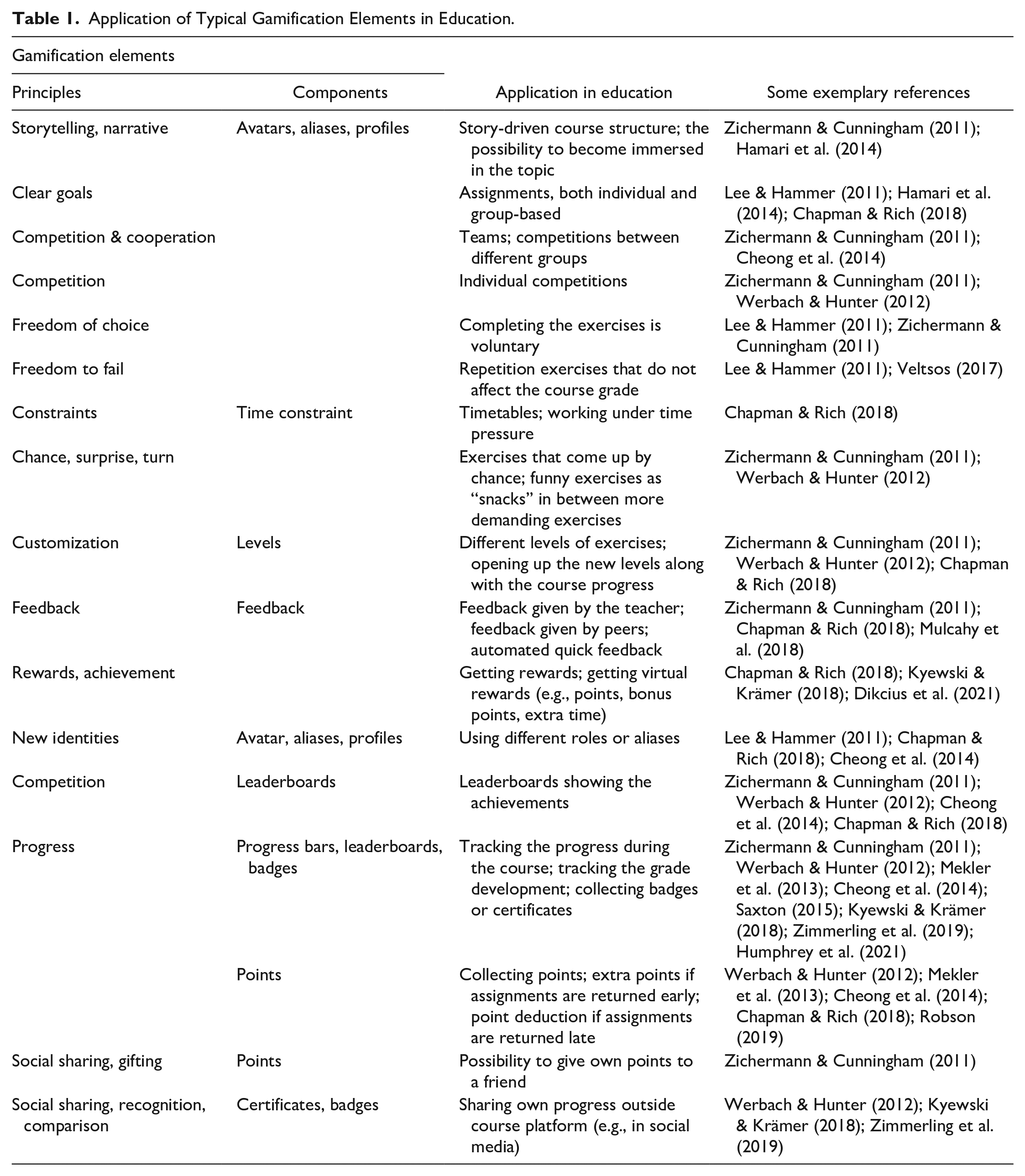
The most typical gamification elements include concrete, visible components such as points, badges, and leaderboards, levels for progression, and avatars for self-representation (e.g., Lee & Hammer, 2011; Mekler et al., 2013; Werbach & Hunter, 2012; Zichermann & Cunningham, 2011) that result from gamification principles (Deterding et al., 2011; Dicheva et al., 2015) or mechanics and dynamics (Hunicke et al., 2004; Robson et al., 2015; Zichermann & Cunningham, 2011). Furthermore, these gamification principles include higher-level elements such as storytelling, goals, challenges, cooperation, competition, progress, customization, feedback, freedom of choice, freedom to fail, gifting, social sharing, and rewards (Werbach & Hunter, 2012; Zichermann & Cunningham, 2011). In line with this, in educational gamification, different teaching and learning activities along with assessment methods are ways to achieve the intended learning outcomes. To illustrate, the challenges may include individual or group-based learning projects and feedback may consist of teacher or peer feedback or self-reflection. Indeed, Mulcahy et al. (2018) found that feedback influences knowledge creation, whereas challenges and awarding points foster enjoyment and knowledge in the gamification experience.
Earlier research has tapped into analyzing the most motivating gamification elements in education (e.g., Cheong et al., 2014; Looyestyn et al., 2017). Cheong et al. (2014) investigated students’ perceptions of several gamification elements and concluded that all the elements that were presented to the respondents were highly rated. Chapman and Rich (2018) examined how specific gamification elements affected the students’ perceived motivation in learning. They found that the four most motivating elements were points for assignments, deadline bonuses and penalties, deadline flexibility, and current grade indicator. Finally, Kyewski and Krämer (2018) examined the impact of badges on students’ motivation and performance, discovering that badges had less impact on motivation and performance than is commonly assumed, and students’ intrinsic motivation decreased over time. Indeed, prior research highlights that gamification elements may even harm intrinsic motivation, and thus gamification should be carefully considered before implementation (Ramirez & Squire, 2015).
Surprisingly few studies have explicitly focused on higher marketing education. Among these few, Saxton (2015) added badging to a marketing simulation to increase student motivation to achieve the simulation’s goals, Ashley (2019) used gamification in an information literacy class and found that it motivated students to engage in class activities, and Robson (2019) used gamification, namely, a point system, to engage marketing students in a personal branding exercise during the class. Humphrey et al. (2021) found that the systematic use of ready-made digital badges contributed in several ways to marketing students’ job search and career preparation. Finally, Dikcius et al. (2021) found that expected rewards affected perceived enjoyment of the course positively, whereas unexpected rewards had a negative effect on satisfaction and perceived usefulness of the course.
Successful planning of gamification in education involves understanding the students, determining what they need to do, and using appropriate gamification elements to motivate them to act (Cheong et al., 2014; Werbach & Hunter, 2012). Constructively aligned teaching (Biggs & Tang, 2015), including the intended learning outcomes, such as knowledge and skills; teaching and learning activities, such as assignments and exercises; and aligned assessment, preferably both formative and summative, provides a fine starting point for gamification. Indeed, several gamification elements such as clear goals, collaboration, or feedback are fundamental to all education but must be adapted to fit the gamification paradigm. Still, in many cases, teachers and educators use ready-made learning management systems (LMSs) such as Moodle or Canvas, and are in that way restricted by the gamification tools available to them.
In conclusion, very little is known about how different motivational bases are linked to students’ views of gamification. In the following section, we explain our methodological choices for accomplishing this.
Method
Mixed-Methods Design and Paradigm
This study uses mixed-methods research, aiming to achieve both breadth and depth of understanding by incorporating both qualitative and quantitative approaches (Teddlie & Tashakkori, 2009). In particular, we lean on convergent mixed-methods design, employing both types of data with the intent to merge the results (Harrison et al., 2020). Similar to the integrated interpretive mixed-methods research by Bahl and Milne (2006), we combine qualitative discussions and quantitative cluster solutions in our analysis to generate an understanding of reality from the perspective of those experiencing it. Thus, by relying on the interpretive paradigm, we base our research on individuals’ subjective and shared understandings (Eriksson & Kovalainen, 2016) on the gamified education and aim to seek pragmatic tools (Bahl & Milne, 2006) for educators by analyzing students’ views on gamification in education. In sum, the current interpretive and convergent mixed-methods research consists of two data sets (a qualitative and a quantitative), which are combined in three main phases of analysis.
Sampling of Participants
To gain an understanding of higher education marketing students’ views on their game-playing motivations and gamified education, we recruited students participating in several marketing classes at a Finnish research university. First, qualitative data collection was carried out through group discussion on the Moodle platform (a web-based LMS); for that, we selected an online marketing course (Accounting for Marketing) for bachelor’s-level marketing majors. Participation in the research was not a compulsory part of the coursework, but participating students were rewarded with extra points in their course evaluations. All but one of the 32 students were willing to participate (N = 31); their ages varied between 23 and 29, and 21 were female.
Second, the quantitative data set was collected using an online survey. For the quantitative analyses, we aimed at a larger and more varied sample to obtain statistical significance and therefore recruited respondents in several higher education marketing courses. We approached students via the teachers of four bachelor’s-level (B) and one master’s-level (M) marketing course: Basics of Marketing and Sales (B), Marketing Research (B), Quantitative Research Methods (M), Bank Course (B), and Digital Marketing Analytics (B). Students were not given any incentives for answering but could participate in a lottery. In total, we had 361 respondents, of whom 66% were bachelor’s students; 18% were marketing majors, while the others had marketing as a minor or were taking a few marketing courses. The background of the participants was a good match with the typical sociodemographic variation among Finnish marketing students, as 55% (n = 198) of the respondents were females and 72% (n = 259) were between 20 and 25 years old.
Data Collection
We used two measurement scales in data collection. These measurement scales were (a) game-playing motivations in education, and (b) gamification elements in education, in which the critical constructs were measured using multi-item instruments. The scale on game-playing motivations in education (30, Scale 1–7) was adapted from previously used items on game-playing motivations in general by Yee (2006), Yee et al. (2012), and Kahn et al. (2015). An identical scale was previously used and tested by Luomala et al. (2017) and was found to be locally fit for purpose. However, in this study, the measurement scale was adapted such that the students kept the learning context in mind while responding to the questions. The items measured students’ responses on six game-playing motivation dimensions: sociality, achievement, completionism, escapism, self-development, and story-drivenness. The scale on gamification elements (27, Scale 1–7) measures students’ responses on how motivating they perceive the different gamification elements in their higher education studies to be. The list of gamification elements was adapted and elaborated from Zichermann and Cunningham (2011), Werbach and Hunter (2012), Cheong et al. (2014), Dicheva et al. (2015), and Chapman and Rich (2018). When selecting the gamification elements to study, we aimed at variety, including both gamification principles and gamification components (see Table 1). In the quantitative data collection, we also asked students to provide background information, including age, gender, university, major, and approaches to learning using a multi-item instrument (Parpala et al., 2010).
When it comes to qualitative data collection, the students first responded to the questionnaire and then participated in the discussion on the platform. In this way, the questionnaire was used as a technique to direct and evoke multisided discussion (Eriksson & Kovalainen, 2016) and not as data per se. When the students entered the discussion platform, they were shown the measurement scale again and were asked to think back on their responses. Regarding the scale of game-playing motivations in learning, the different motivations (i.e., sociality, achievement, completionism, escapism, self-development, and story-drivenness) that the items intended to measure were now also highlighted. In particular, students were advised to tell in their own words how they see the individual items and different motivations and discuss which of them they regard as being particularly motivating in education and which not. They were also asked to think about what type of a learner (e.g., competitive or social) they considered themselves to be. In this way, the measurement scale acted as an elicitation technique commonly used to help study participants to remember and express their views on study topics (Moisander & Valtonen, 2006). The discussion yielded 49 responses, including the original replies to the teachers’ questions and discussions between students.
Integrated Analysis of Data Sets
As the key point of the convergent mixed-methods design is to integrate the data analysis (Harrison et al., 2020), we explain the analytical procedures by combining the analysis phases of both data sets. To begin with, the analysis of the qualitative data followed procedures of interpretive content analysis (Eriksson & Kovalainen, 2016), that is, an alternating emphasis on theory- and data-driven analyses. The first phase was a theory-driven analysis consisting of coding the data according to the dimensions of game-playing motivations (Kahn et al., 2015; Yee, 2006; Yee et al., 2012), and therefore the initial coding scheme consisted of the same themes as were employed in the quantitative survey. Although the coding was originally aligned with the theoretical dimensions, the interpretive content analysis gave more depth to those categories as old categories were merged and new subcategories were added when they appeared in the data during the coding. At the end of the first round of coding, completionism had five subcategories (e.g., “feeling of control,” “self-development”), sociality six (e.g., “helping others,” “teamwork as a working-life skill”), competitiveness six (e.g., “competing against oneself,” “gamified learning as a motivator”), escapism two, and story-drivenness had no subcategories. To highlight the transparency of our coding, the complete coding scheme is shown in Figure A1 in the appendix. The second author carried out the initial coding, but as the coding scheme was elaborated, both authors screened the data and discussed the conformity of the coding (i.e., whether such interpretations can be made based on data, see Eriksson & Kovalainen, 2016).
Regarding the quantitative data set, we followed the analytical procedures employed in prior research on the topic (Luomala et al., 2017; Vahlo et al., 2017) and began with a factor analysis of items on game-playing motivations to produce a cluster solution. A principal components analysis with Varimax rotation was conducted using SPSS 26 software. The data fulfilled the basic preconditions for conducting factor analysis (Kaiser–Meyer–Olkin [KMO] = .858, Bartlett’s test, approx. χ2 = 5,123.169, df = 435, sig. = .000). The common eigenvalue cutoff point of 1.0 was used to initially determine the appropriate number of factors. The initial eigenvalue suggested seven factors, where four factors included three or more items loading at least .65. We then run a confirmatory factor analysis using the 15 items loading into these four factors. The four-factor solution explains 70.3% of the total variance. The first factor (four items, α = .905) was interpreted to reflect socializing, the second (five items, α = .831) was interpreted to reflect completion, the third (three items, α = .878) was interpreted to reflect competitiveness, and the fourth (three items, α = .677) was interpreted to reflect immersion in learning. See Table 2 for factor loadings and statistics.
Factor Loadings and Statistics.
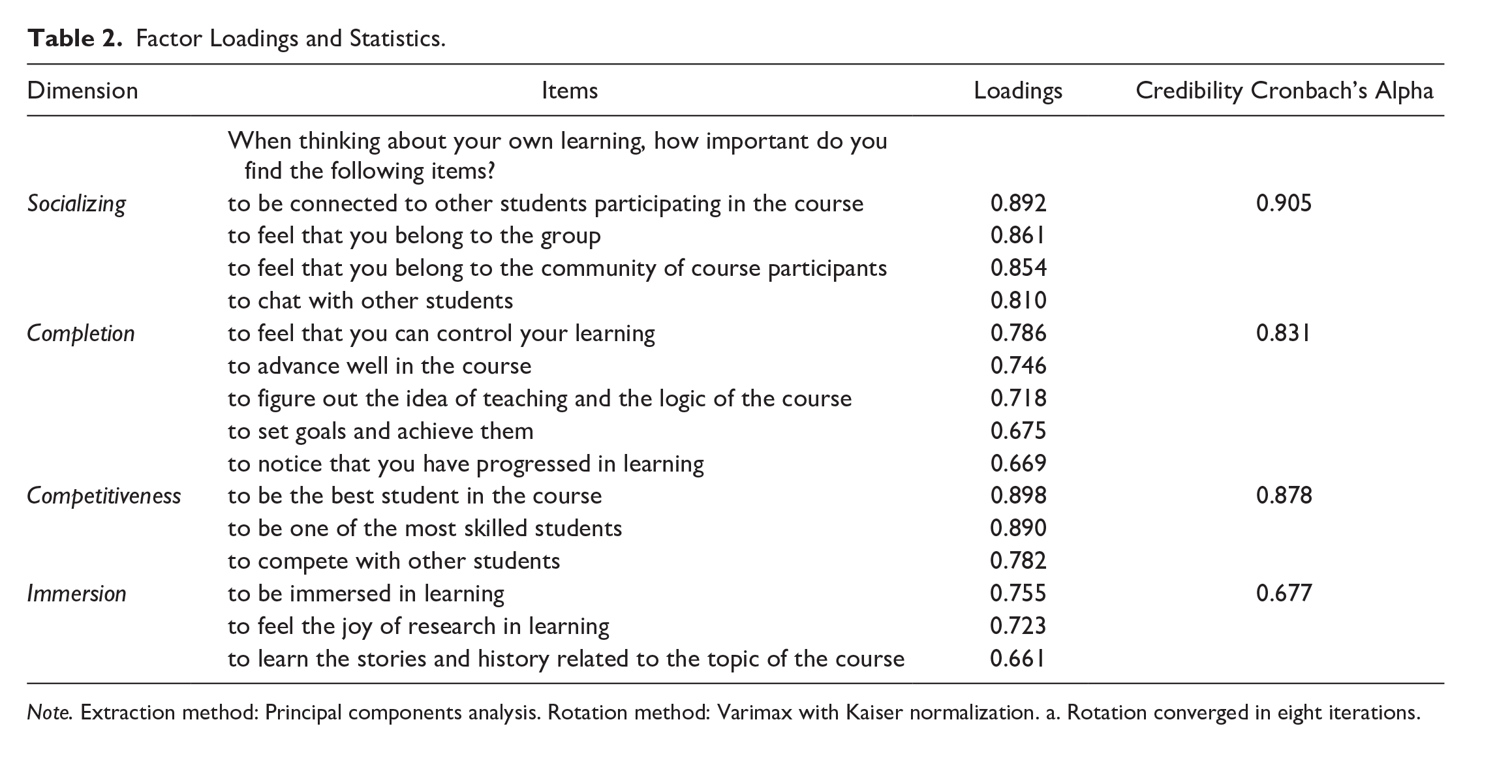
Note. Extraction method: Principal components analysis. Rotation method: Varimax with Kaiser normalization. a. Rotation converged in eight iterations.
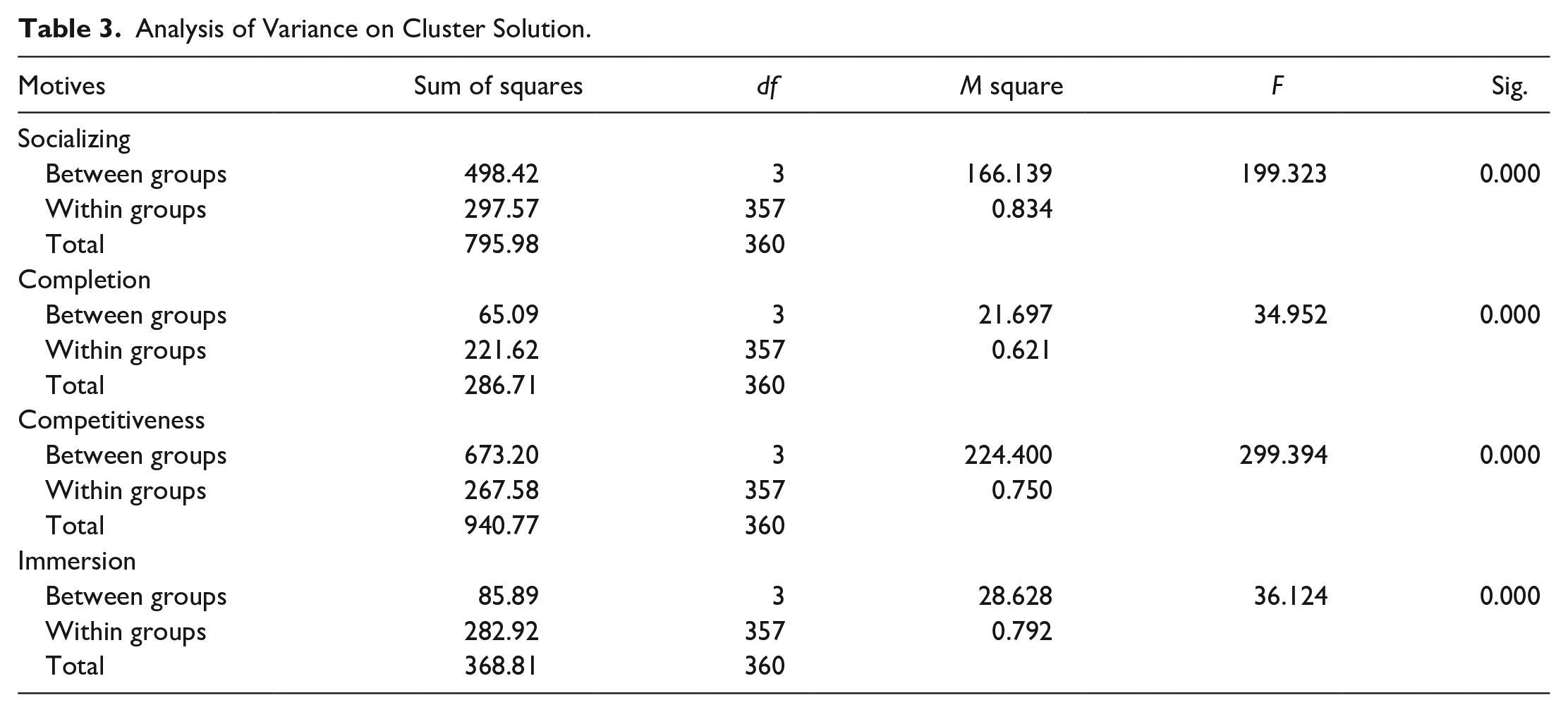
Next, a cluster analysis was used to detect groups of students in such a way that students in the same cluster are more similar to each other than they are to students in other clusters. The four factors (socializing, completion, competitiveness, and immersion) were used as an input for cluster analysis to ensure equal treatment of underlying motivations (Janssens et al., 2008). Initially, hierarchical cluster analysis with between-groups linkages was conducted using three-, four-, and five-cluster solutions, where a four-cluster solution seemed most appropriate for showing clear differences between clusters. Following the hierarchical cluster analysis, a K-means cluster analysis was conducted, experimenting again with three-, four-, and five-cluster solutions. Similar to Bahl and Milne’s (2006) interpretive mixed-methods design, we compared different solutions with the first phase of qualitative analysis and the four-cluster solution was chosen based on its interpretability, best ability to explain differences between clusters (Janssens et al., 2008; Kettenring, 2006), and concordance with previous work (e.g., Luomala et al., 2017). Analysis of variance (ANOVA; Table 3) was used to confirm the significant differences between clusters: socializing (F = 199.323, df = 3.357, sig = .000), completion (F = 34.952, df = 3.357, sig = .000), competitiveness (F = 299.394, df = 3.357, sig = .000), and immersion (F = 36.124, df = 3.357, sig. = .000).
Analysis of Variance on Cluster Solution.
In each cluster, the factor Completion received the highest scores, although its level varies between clusters. Indeed, completion seemed to be a motivation that characterizes all respondents, presumably because the data were collected in relation to higher education. Thus, the clusters are named accordingly (see Table 4; for a more thorough discussion, see the “Results” section). The clusters do not differ significantly in terms of gender or degree, but there are differences in age groups.
Cluster Solution and Characteristics.
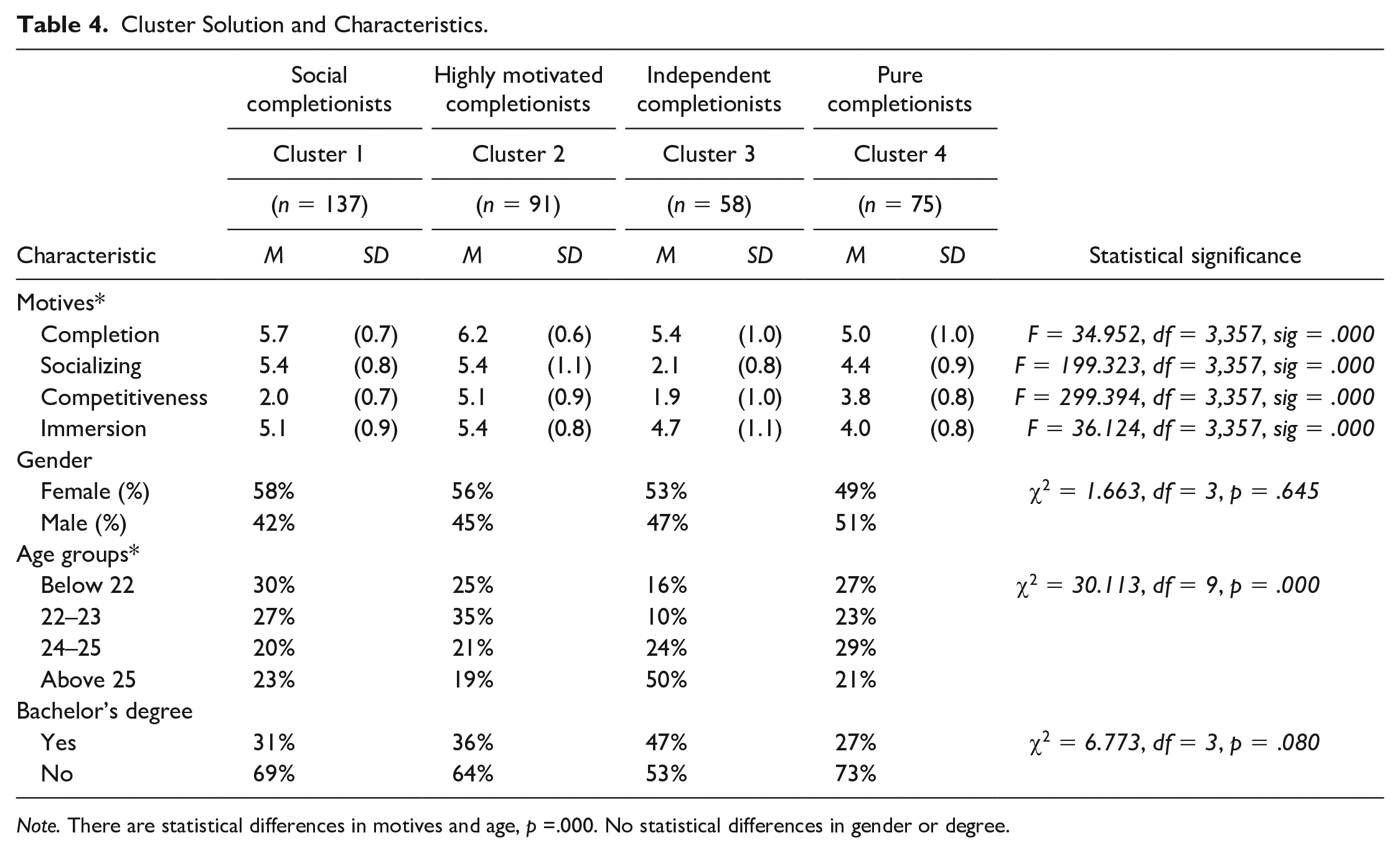
Note. There are statistical differences in motives and age, p =.000. No statistical differences in gender or degree.
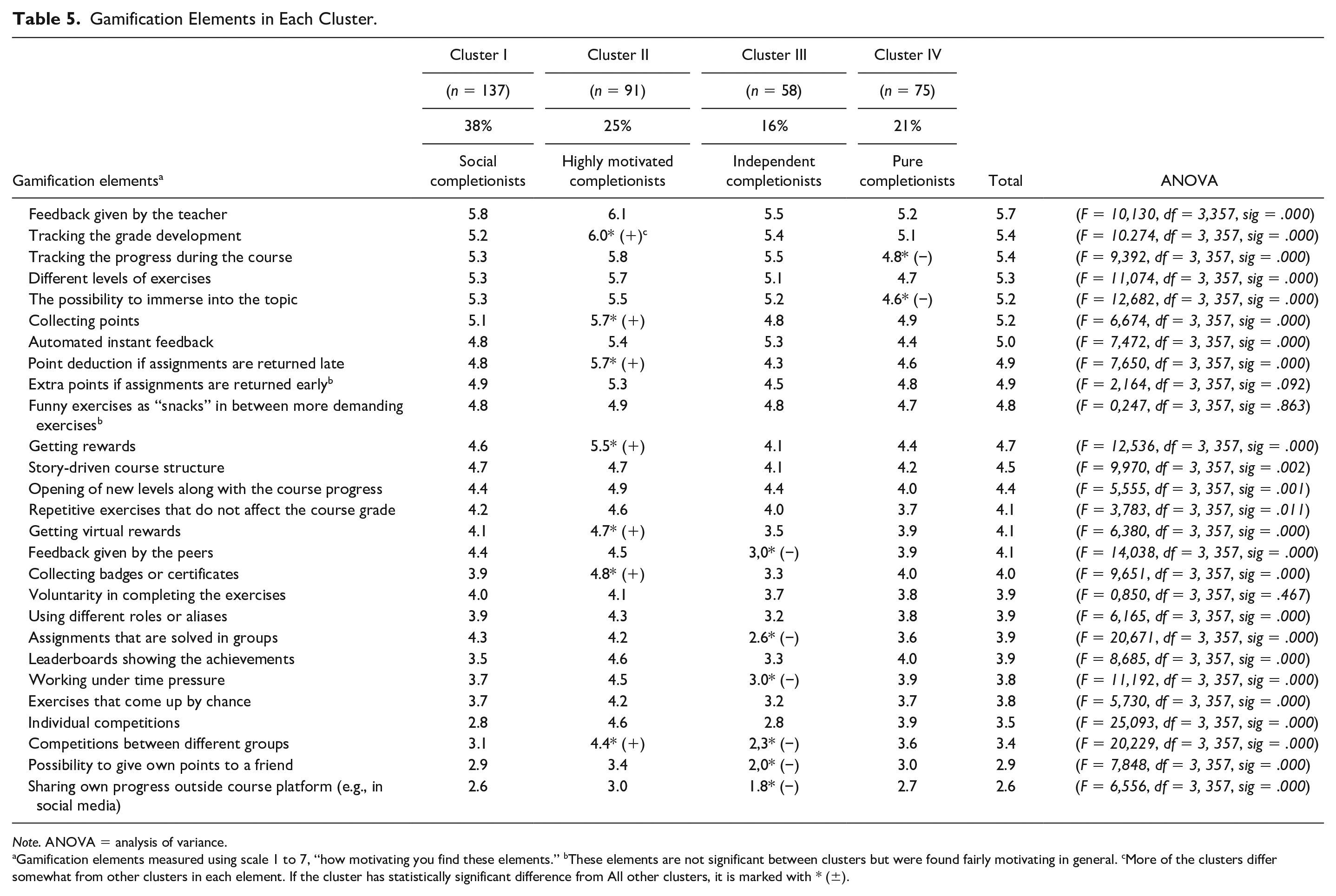
When it comes to the analysis of gamification elements, we asked the students how motivating they found the 27 gamification elements on a scale of 1 to 7. In general, the most motivating gamification element was “feedback from the teacher” (M = 5.7) and the least motivating gamification element was “sharing your progress outside the course platform” (M = 2.7). We then used ANOVA to analyze how these elements differ between clusters. Table 5 presents the mean values for each gamification element in total and for each cluster, as well as the statistical significance of the differences. Only two gamification elements (“extra points if assignments are returned early” and “fun exercises as snacks between more demanding exercises”) were not different across clusters. Moreover, we have highlighted those clusters that differ from all other clusters, either positively or negatively, based on the gamification element.
Gamification Elements in Each Cluster.
Note. ANOVA = analysis of variance.
Gamification elements measured using scale 1 to 7, “how motivating you find these elements.” bThese elements are not significant between clusters but were found fairly motivating in general. cMore of the clusters differ somewhat from other clusters in each element. If the cluster has statistically significant difference from All other clusters, it is marked with * (±).
After conducting the analyses of quantitative data, we carried out the second phase of qualitative analysis. In this phase, the content analysis proceeded to interpretation in which the focus is on finding relationships between concepts (Eriksson & Kovalainen, 2016); therefore, attention was paid to forming a typology of different kinds of students based on their preferences on game-playing motivations in relation to gamification elements in education. Although this phase of analysis followed the results of quantitative analyses, the subcategories of each game-playing motivation that were created in the first phase of qualitative analysis allowed us to understand the differences in students’ reasoning, feelings, and ideas to obtain greater depth for the measurement items. To illustrate, in regard to competitiveness the subcategories referring to its individual nature (e.g., “competing against oneself”) could be clearly related to independent completionists, whereas subcategories like “competing together” yielded a greater understanding about why highly motivated completionists scored highest in competitiveness. In Figure A1 in the appendix, presenting the coding scheme, we highlight in different colors which subcategories were the most clearly attached to which cluster. Although it should be noted that connections are not always that clear-cut, the illustration aims to show visually how, in line with the objective of convergent and interpretive mixed-methods research, the qualitative and quantitative approaches were merged in the analysis and research results (Harrison et al., 2020). Therefore, the qualitative data were not only used to validate the quantitative analysis but also enabled us to gain a better understanding of the underlying phenomenon from the student perspective.
Results
In the following, we report our results by combining quantitative and qualitative analyses to highlight four identified clusters that differ in their motivations and views on gamification elements in marketing education. Our results show that social completionists represent students who are socially motivated, highly motivated completionists scored very high on all game-playing motivations, and independent completionists had a low motivation to engage in socializing. Finally, pure completionists just want to complete their course with marginal effort.
Social Completionists
The first cluster of students is called social completionists as, besides their eagerness in completing (M = 5.7, SD = 0.7) their studies, they scored particularly high on the socializing (M = 5.4, SD = 0.8) motivation. These students are keen to work with others and understand how social learning can be helpful. They see that sociality helps both the student who is in the teaching role and the one being helped out to learn more deeply, as the next quote illustrates: The best way to learn often happens in social situations, like when you ask for help from your classmate. Then your classmate also learns as (s)he is structuring the thing for him/herself, goes through it in her/his mind, and then teaches the other one. The feeling of belonging to the group is important on these occasions, so that you dare to ask others and comment based on your own views, and not try just to please others, or not have to think about whether your answer is “smart” enough. (F, 26)
Therefore, the use of gamification elements that can trigger positive group cohesion seems to work especially well for this group of students and gamification element achievements solved in groups had the highest mean of all clusters (M = 4.34), statistically significant compared with independent completionists and pure completionists: “Kahoot and other quizzes are good in my opinion, and help us to learn. At the same time we can feel a sense of belongingness and laugh at funny responses” (F, 26). Indeed, having a relaxed, open, and helpful atmosphere—and even a feeling of solidarity—was regarded as an essential element for social learning, and students stated, “Belonging to the community is especially important to me, and I want to help people around me” (M, 26).
In this cluster, the factor of competitiveness scored low (M = 2.0, SD = 0.7), differing significantly from highly motivated completionists and pure completionists. Also, this group is not motivated by most of the reward-based gamification elements, such as competition, time pressure, points, or leaderboards. The qualitative data strengthen this conclusion; competitiveness should not break down the relaxed, supportive atmosphere in the groups: I agree that playful competition can enhance learning and bring some joy in studies . . . Still, it’s important that the atmosphere stays good, so that learning is pleasant, and competing against others isn’t in the main role. (F, 22)
According to the analysis, a suitable manner of using competitiveness-focused gamification is to approach it in a way that integrates the social and positive aspects of group work, such as assignments solved in groups, helping others to level up, competing as groups, or using pseudonyms or avatars when competing. The following two quotes illustrate these: “The communal side of games is emphasized more when working together in assignments, and students could help each other to reach the next level, and the grade isn’t based on comparisons to others” (M, 24) and “When we don’t appear under our own names, I think this gives me the opportunity to share my own thoughts more freely, but in no way do I feel the need to play any special role” (M, 25).
Highly Motivated Completionists
The second cluster comprises those students that might be described as well-performing and ambitious students. Although the completion (M = 6.2, SD = 0.6) motivation was the highest, they scored very high on all game-playing motivations and are therefore called highly motivated completionists. This cluster scored equally high on the factors of socializing (M = 5.4, SD = 1.1) and immersion (M = 5.4, SD = 0.8); the interpretation is that this cluster consists of students who get motivation from social learning but are also self-directed and internally motivated to learn. The following excerpt from our qualitative data highlights this connection: “I feel that both sociality and self-development motivate me. It’s great to develop oneself and learn together with others” (M, 25).
The qualitative data further show how these students are motivated to learn, enjoy challenges, want to succeed in their studies, and are willing to construct a personal learning path: “What I find particularly motivating in teaching and learning is when I succeed in challenging tasks and in general the feeling that I’m developing and learning something new and important” (F, 23).
As this cluster scored the highest in the factor of immersion in relation to the other groups (M = 5.4 vs. M = 4.0–5.1), it shows the possibilities of integrating the kind of gamification that enables students to immerse themselves in learning and even spark so-called flow, as illustrated by one of our students: “Immersing myself in learning and achieving a certain state of flow motivates me to make progress in my studies and also arouses interest in deepening my skills” (F, 26).
This cluster also scored highest in competitiveness (M = 5.1, SD = 0.9), with a statistically significant difference to all other clusters. In this group, competitiveness is attached to sociality—for instance, competing in teams is a way to bump up learning motivation—as described in the following excerpt: My competitive spirit awakens if I find that I’m not performing as well as others. Then I can put in more effort in the future—especially in group work, if I see that others are doing more work to achieve the common goal. (M, 25)
As the quote illustrates, for these students working in teams or smaller groups may be motivating as such, as it boosts their motivation to not be inferior to others. However, introducing gamification, such as by organizing competitions between teams, fosters the competitiveness–sociality connection even more. The following quotation highlights this: I find myself to be a pretty social learner. I’m a team player and I like to learn together. I like to notice that I learn myself but I also enjoy seeing others learn. I also have some competitive spirit. I might not always admit it. I’m still happy and I feel I have succeeded if the team is successful. Am I joyful that my team has succeeded or that we’ve beat the other teams? Probably both. (M, 25)
These highly motivated students find several reward-based gamification elements more motivating than all the other clusters: tracking grade development (M = 6.01 vs. M = 5.43 in total), getting rewards (M = 5.55 vs. M = 4.71 in total), collecting points (M = 5.68 vs. M = 5.18 in total), point deduction if assignments are returned late (M = 5.71 vs. M = 4.92 in total), collecting badges or certificates (M = 4.79 vs. M = 4.05 in total), and getting virtual awards (M = 4.67 vs. M = 4.10 in total), all statistically significant.
To illustrate, this cluster found working under time pressure more motivating than the other groups (M = 4.53 vs. M = 3.84). This was also evident in the qualitative answers where students saw the value of learning how to act in stressful situations in relation to their future work life, and how gamified education can be helpful in that learning experience: The competitive situation may teach you to work under pressure. I believe it’s useful because stressful situations can happen and you should then be able to work effectively. Different people react to stressful situations differently, so it would be important to be aware of your own ways of working under pressure. (F, 26)
Independent Completionists
The third cluster is characterized by their low motivation to engage in socializing (M = 2.1, SD = 0.8), being statistically significantly lower than in all the other clusters. As they had the highest scores for the completion motivation (M = 5.4, SD = 1.0), they could be described as independent completionists, who have low motivation to work in groups. Indeed, when we look at the gamification elements, this cluster scores significantly lowest in several elements that include a social aspect: assignments solved in groups (M = 2.57 vs. M = 3.87 in total), feedback given by peers (M = 3.00 vs. M = 4.09 in total), possibility to give points to a friend (M = 1.97 vs. M = 2.88 in total), and sharing their own process outside the course platform (e.g., social media; M = 1.83 vs. M = 2.61 in total). These students especially do not want to work together if their own grade depends on it, as illustrated in the following quotes: “I don’t want my grade to be dependent on other students’ goals” (F, 23) and “In the end, learning is an individual task, even if you are supported by your peers or supervisor, and therefore comparisons feel unnecessary, because in the end, the most important thing is to develop yourself, not how you rank in relation to others” (M, 24).
In addition to the feeling of controlling their own learning, they also want to know that they have learned something new and meaningful. This creates a feeling of immersion. Indeed, their second-highest motivation was immersion (M = 4.7, SD = 1.1), which can be seen in the following quote: Noticing that I have developed and reached my goals (the feeling of completion and control) brings feelings of success, and in that way increases motivation. I think that this is the feeling that creates “immersion,” and learning feels fun. (F, 29)
This cluster reacted unfavorably toward competition, scoring the lowest on the factor of competitiveness motivation (M = 1.9, SD = 1.0) when compared with other clusters. Accordingly, they do not react favorably to tying gamification elements to competitiveness. Competitions between different groups scored significantly lower than in other clusters (M = 2.28 vs. M = 3.41 in total) and individual competitions scored significantly lower than two other clusters (M = 2.84 vs. M = 3.51 in total). Similarly, their reactions on the item “Working under time pressure” were lower than all other clusters (M = 3.03 vs. M = 3.84 in total). This is also evident in one of our qualitative quotes: “I’m not motivated by competitiveness because I feel that I study for myself. Competing against my classmates just astonishes me. I don’t have the need to be the best in class, because comprehensive learning and linkages to working life are important to me” (F, 30) and “Competitiveness doesn’t motivate me, because I always do as well as I possibly can, and if I don’t succeed after all, then competition just brings me down” (M, 26). As these students are intrinsically motivated to learn, losing in competitions may discourage them.
Pure Completionists
Pure completionists differ from other clusters mainly in two ways. First, although students in this cluster scored rather high in completion (M = 5.0, SD = 1.0), they still ranked lowest in comparison with other clusters. Second, while the score for the factor of immersion was at an average level (M = 4.0, SD = 0.8) in this cluster, it was nonetheless the lowest among all the clusters. In socializing (M = 4.4, SD = 0.9) and competitiveness (M = 3.8, SD = 0.8), they scored in the middle compared with other clusters. This cluster could be described as a “let’s get it done” group of students, who just want to complete their degree with marginal effort.
When looking into gamification elements, in general, the pure completionists find them less motivating than other groups. The gamification elements that are significantly different from all other groups are tracking progress during the course (M = 4.79 vs. M = 5.37) and the possibility to be immersed in the topic (M = 4.56 vs. M = 5.19). Although these scores are pretty high compared with all gamification elements, this cluster still ranks the lowest. This cluster scores the lowest in several gamification elements and finds them significantly less motivating than at least two other groups. These elements include automated instant feedback, feedback given by the teacher, different levels of exercises, repetitive exercises that do not affect the course grade, fun exercises as “snacks,” tracking grade development, and unlocking new levels as the course progresses.
It seems that pure completionists might find gamification useless or even nonsensical. For example, “Sometimes I find myself frustrated in university studies when the topic under discussion isn’t necessarily challenging or difficult to understand per se, but the chosen method (e.g., difficult group work) makes the whole course frustrating” (F, 23). These students are very critical and sometimes even argue against using any kind of gamified element, as “the traditional way” is the best way to learn, as our qualitative data show: “I think the gamification of education sometimes goes overboard. You don’t always need the games—digitalization enables us to have quizzes or other exceptional ways to get students motivated and activated in classes” (F, 23).
There seems to be an urge to know why certain teaching methods are used and how those methods help their learning, as one of our students says, “For me, it’s important that I understand why a certain thing is included in the class, and how it enhances my learning” (F, 25). Thus, it seems that gamified teaching at its best might motivate students in this cluster to become wrapped up in studying.
Discussion and Educational Implications
The study highlights that student groups may comprise different kinds of students whose views on gamification differ. According to our results, these are social completionists, highly motivated completionists, independent completionists, and pure completionists. Along the lines with approaches to learning, where students with different approaches—deep, surface, or organized—may share the same classroom (Parpala et al., 2010) and may use different approaches in different courses (Coertjens et al., 2016), it can be assumed that the students in marketing classrooms consist of a mix of different kinds of students, presumably some from every cluster. Moreover, they may shift from one cluster to another in different situations (such as when studying a different topic or attending different courses). Thus, the teachers cannot assume that one recipe fits all, but need to understand how students may be engaged and motivated differently by different gamified learning activities.
So, in practice, while teachers plan their gamified learning activities, they need to consider students’ differences in their game-playing motivations. So, for example, when planning a competitive element for the course, the teachers should think about how different students may react to it. They may alternate different gamification elements during the course, and in this way, they can enhance the engagement and motivation of different students.
Next, we give more precise suggestions for higher education teachers based on our findings. Table 6 summarizes these educational implications.
Educational Implications for the Practice of Teaching.
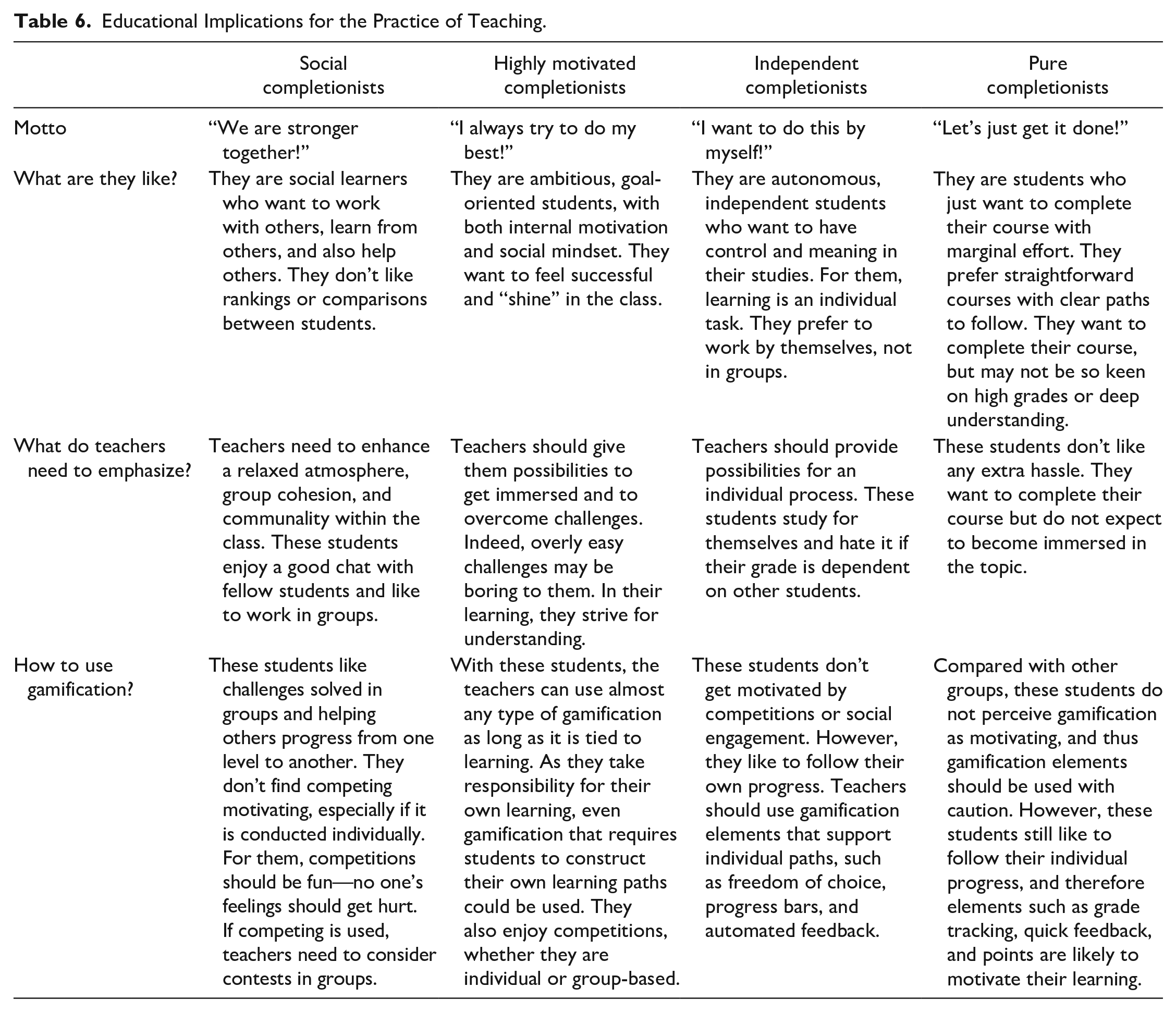
First, social completionists are social learners who want to work with other students. They value solving assignments in groups, storytelling, and peer feedback. Educators need to enhance communality, a relaxed atmosphere, and group cohesion (e.g., using group work assignments). Educators should avoid unnecessary and individual competition and it seems that competitive elements work best in groups, voluntary exercises, or when using avatars or group names. The atmosphere in the classroom must not be broken and no one’s feelings may be hurt.
Highly motivated completionists are ambitious students with both internal motivation and a social mindset. Educators should give them challenging assignments, enhance their possibilities to dive into the topics, and let them find the best way to overcome challenges. In many ways, they are ideal higher education students, as they are hardworking and internally driven. This group of students is obviously the most accepting of all sorts of gamification elements in their classes. Indeed, educators can choose almost any type of gamification for highly motivated students, as they get motivated by individual and group-based competitions, tracking grade development, collecting points and badges, or leaderboards showing their achievements in team competition or individual progress. Although earlier literature warns against using extrinsic gamification elements for intrinsically motivated students (e.g., Hamari et al., 2014), our results show that these highly motivated students seem to also get a greater motivational boost from some of those elements than the other clusters. However, educators need to avoid shallow, repetitive, or reward-based gamification that relies only on extrinsic motivation as highly motivated completionists might find these useless and boring, which may affect their motivation.
When educators have independent completionists in their class, they should understand that these are individually driven students who want to have control over their studies. These students want to learn effectively and constructively. Educators should choose gamification elements that enhance students’ individual learning process, for example, by offering choices between exercises or individual learning paths. Progress bars or leveling up based on earlier assignments suit these students well, whereas competition and social engagement are not motivating for these students. If games or other competitive gamification elements are used, these students need to know how those elements enhance their own learning.
Pure completionists are students who want to complete their courses with marginal effort, without wasting time on any “fun and games.” The students typically focus mainly on getting the course done, and thus educators should make it clear how the class is assessed and completed. In general, gamification elements should be used judiciously, if at all. However, as these students like to follow their individual progress, elements such as points and tracking the grade development can be useful to them.
Our study confirms the earlier findings that gamification elements can be controversial and even reduce motivation and thus need to be implemented with caution (Chapman & Rich, 2018; Rigby, 2015). We argue that part of that controversy may be because students are often studied as a homogeneous mass rather than as groups of individuals with different motivational grounds for gamification. If the teachers better understand what kinds of students they have in their class, they can better fine-tune the gamification to engage and motivate each student. For example, competitiveness emerged in varied ways in different clusters. Thus, its usage should be considered thoroughly and the ways in which gamification elements are applied in different classes should be varied. Furthermore, as Rigby (2015) suggests, extrinsic motivations should not be seen implicitly as “bad,” as they may represent the reasons for why one is pursuing one’s goals; therefore, our findings also highlight that gamification elements that trigger extrinsic motivations may work for some students, actually luring them to progress forward in the internalization continuum according to social-determination theory (Deci & Ryan, 2000).
Moreover, educators and program managers should consider gamification in course planning. Different courses may use different kinds and amounts of gamification, from not-at-all to fully gamified online courses depending on the learning objectives, student population, and faculty preferences. Especially when communicating about courses beforehand (e.g., in the course descriptions or faculty websites), the types of gamification activities should be described beforehand so that the students know what to expect. This may be particularly relevant when marketing open university courses to the general public, as different kinds of gamification activities may appeal to a variety of interested participants.
Conclusion
In this interpretive and convergent mixed-methods research, we examined the connection between game-playing motivations and gamification elements in higher marketing education. Our first research question was, “What types of clusters of students with differing motivational bases can be found?” To answer this question, our findings highlight four clusters of students based on their game-motivational reactions to gamified education. The clusters are labeled so that they highlight key motivations in comparison with other clusters: (a) social completionists, (b) highly motivated completionists, (c) independent completionists, and (d) pure completionists. The factor of completion was highly emphasized in our data, and thus all the clusters are named accordingly. Otherwise, our findings on the emergence of game-playing motivations in education resemble previous research on game-playing motivations in general as our four factors were labeled completion, socializing, competitiveness, and immersion (e.g., Hamari & Tuunanen, 2014; Kahn et al., 2015; Luomala et al., 2017; Yee, 2006). However, although we employed a scale of items that included the dimension of storytelling, it did not appear to be that evident in students’ minds and did not load as its own factor. This is somewhat surprising as stories such as real-life examples or cases are regularly used in marketing education (Jaskari, 2013; Klebba & Hamilton, 2007).
Our second research question was, “How do these different types of students differ in their views on gamification elements in education?” To answer this, we have highlighted how the different clusters get motivated by a wide variety of different gamification elements. For example, where independent completionists may get motivated by working mostly alone, avoiding group work, social completionists prefer gamification elements that emphasize cooperation, peer support, and social engagement. Furthermore, pure completionists may find most gamification elements demotivating and frustrating, whereas highly motivated completionists accept all kinds of gamification efforts. Thus, even in gamification, no single recipe fits all, but student differences need to be considered when fine-tuning teaching and developing education.
Our study contributes to the extant research on gamification in education by highlighting how mixed-methods research on game-playing motivations enables more fine-tuned analysis on ways to use gamification elements. As prior research has focused on students’ intrinsic or extrinsic motivations, the current research highlights different motivations and delves into their multisided variations in different students. In this respect, our research also suggests further studies on students’ changing motivations. To illustrate, students can be motivated by different gamification elements at different times; in a similar vein, they are capable of changing their approach to learning depending on the situation (Parpala et al., 2010). This study contributes to marketing education literature by bridging the gap between the literature on gamification in education and marketing education.
This study is not without limitations. First, although the mixed-methods study design yields insights that cannot be obtained solely through quantitative and qualitative data, new investigations are needed. Thereby, we suggest further studies on diversity in different cultures and cultural locations. For example, students in more individualistic cultures or other cultural locations may be more competitive in nature than in the current European context and more collectivist cultures may value more social engagement. Second, the present study concerns marketing, which has implications on what types of traits and ambitions our sample shares (Jaskari et al., 2018). As students vary across disciplines (Parpala et al., 2010)—for example, finance students may be more competitive than marketing students—more research is needed across various academic disciplines. Third, we rely on a self-administered survey tool to explore how motivating different gamification elements are. As we have seen, students who are pure completionists reacted more negatively to gamification elements than the other clusters. Whether gamification engages them, motivates them, or makes them strive for higher marks is to be discovered using other tools. Fourth, the adapted measurement scale yielded a four-factor solution compared with the six-factor solution suggested by previous studies. Thus, further studies should look deeper into the contextualization of the measurement scale to an educational context. Furthermore, future studies are called for regarding each of the game-motivational factors and their relation to developing practical teaching cases as well as exploring students’ experiences of their learning outcomes.
Footnotes
Appendix
Declaration of Conflicting Interests
The author(s) declared no potential conflicts of interest with respect to the research, authorship, and/or publication of this article.
Funding
The author(s) disclosed receipt of the following financial support for the research, authorship, and/or publication of this article: The authors have received financial support from The Foundation of Economic Education.
