




Abstract
This research interprets the destabilization in U.S. higher education using Layton's theory of marketing systems to detail disruptions to academia's system settings. It highlights three impacted areas: governance, sentiment, and transformation. The authors examine the interplay between societal, technological, competitive, and political power shifts as major disruptors reshaping higher education. It critically examines these shifts by intertwining history with the demands of today's evolving landscape, emphasizing the need for transformative change. Layton's theory is utilized in this study to provide stakeholders a starting point to make informed, situationally aware strategic decisions during the choice and value-added phases of the framework based on Layton's Marketing Systems Theory.
Keywords
The Impacts of Change: Shifting System Settings
Due to new market entrants and technological advancements, various industries have undergone significant disruptions in the last two decades, including entertainment, music, transportation, and hospitality. These disruptive forces now also impact the American higher education system. As other industries and business sectors have undergone significant upheavals, this research assesses the impacts of increased consumer choice and challenges that have surfaced for traditional notions of higher education. This manuscript leverages Layton's Marketing Systems Theory (2019) to begin a conversation surrounding the future of higher education in the aftermath of multiple destabilizing stimuli.
While academic leaders do not directly influence system settings, their choices (in response to system setting changes) influence outcomes and system infrastructure, which can impact the environment from which system settings arise (Layton 2019). This manuscript aims to apply marketing systems research to analyze the U.S. higher education system's settings and the disruptions it faces. After a brief summary of Layton's Marketing Systems within the context of U.S. higher education and its marketing system settings, a discussion of three pillars of power shifts affecting the higher education marketing system follows. The manuscript also includes a summarizing figure and areas for future research. This research contributes to the existing literature by embedding the conversation of systemic change into the first phase of Layton's model, offering a reference that academic leadership can use to apply the latter half of the model to future decision-making, action, and change.
Layton's Theory of Marketing Systems
A catalyst often begins the exchange process between two or more individuals or institutions within a system (Layton 2019). A catalyst may result from an abrupt power shift, technological innovation, or a societal value change. Once the catalyst occurs, opportunities or threats associated with it are identified, and self-interest, tempered by mutuality and morality, increases the likelihood of more contemporary offerings and valuable exchanges, ultimately altering the marketing system itself (Layton 2019). Layton (2017) further conceptualized the marketing system as a core of marketing, where the outcome of the exchange is a sale or transaction, and the result of a marketing system is assortment. The success of an exchange can be defined in terms of the benefits it brings, and the effectiveness of a marketing system is determined by the degree to which the assortments produced by the system contribute to the improvement in the quality of life of the community that is being considered (Layton 2017).
The American Industrial Revolution was the “technological shock” that catalyzed the transformation of higher education into the industry recognized today (Goldin and Katz 1999). In response, the turn of the twentieth century saw the founding of “almost all of today's noteworthy U.S. universities” and specialization that fostered the application of science to industry (Goldin and Katz 1999, p. 38) to support the need for “the manufacture of steel, rubber, chemicals, sugar, drugs, nonferrous metals, petroleum, and goods directly involved in the use or production of electricity (Golden and Katz 1999, p. 39). Today, the higher education industry faces another technological, economic, and cultural revolution. As depicted in Figure 1, changes in system settings have called into question the value of the exchange between society and U.S. higher education. This questioning at the macro level has resulted in power shifts between politicians/faculty, industry certificates/4-year degrees, students/professors, and athletes/conferences. The result is a modified assortment of educational offerings in which traditional institutions and degrees are losing perceived and actual value. Just as higher education was revolutionized at the turn of the twentieth century, it must once again evolve and recalibrate the components of self-interest, mutuality, and morality in program offerings to better fit current system settings. This evolution will allow academia to remain viable participants in the marketing system; resistance or refusal to evolve will result in declining relevance and influence as customers find greater value from other offerings (Layton 2011).
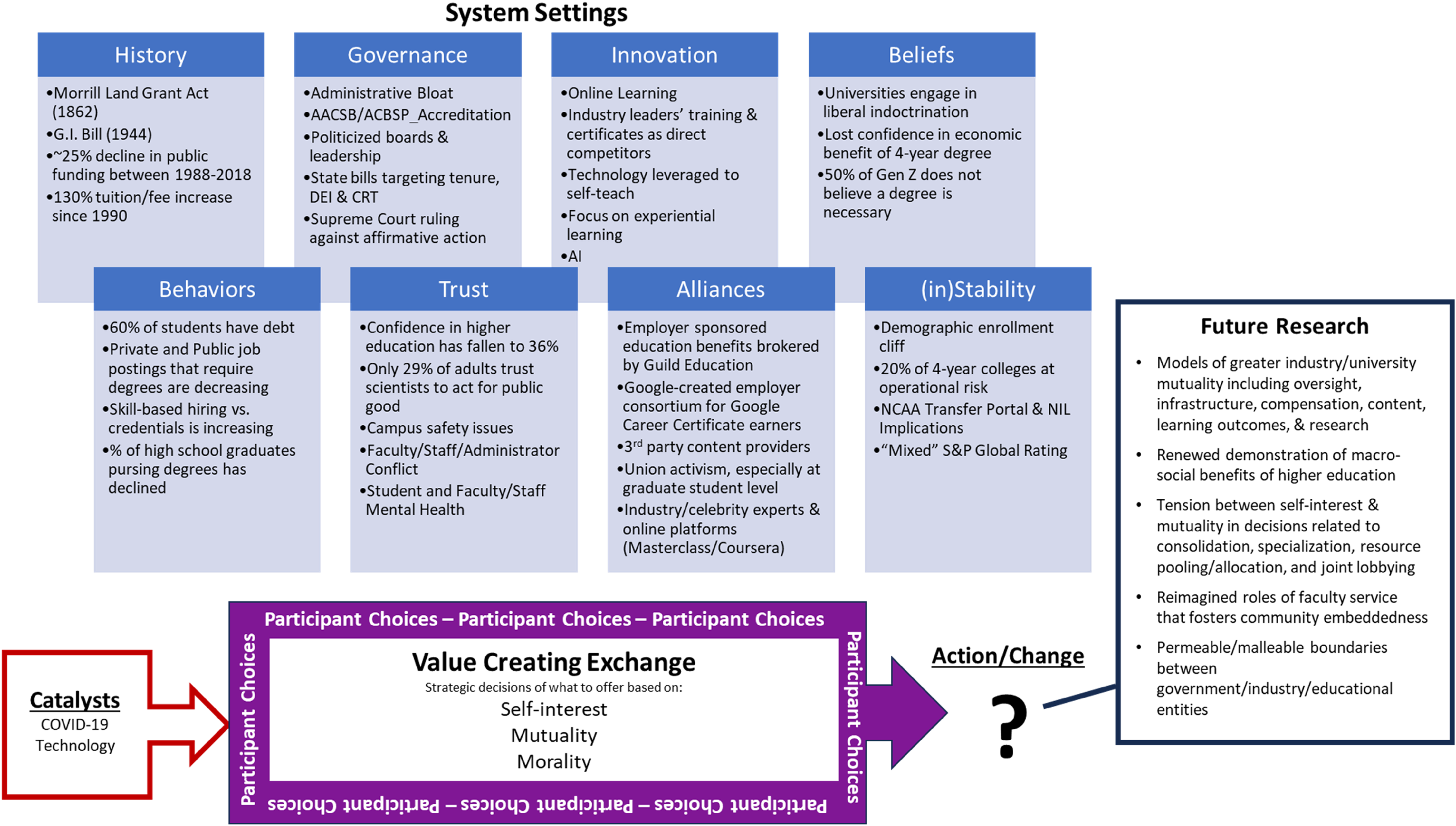
Application of Layton's Model to the U.S. Higher Education System.
U.S. Higher Education System Settings: Governance and Political Influences
Scandals like the highly publicized ‘Varsity Blues’ (NPR 2023), combined with partisan politics (Pew Research Center 2019), have certain states signaling they “no longer trust college leaders to run their own affairs” (Diep 2022), thus putting significant downward pressure on confidence in colleges and universities while wielding outsized influence. As an example of this increased political influence, despite a faculty no-confidence vote and student protests, former Nebraska Senator (R) Ben Sasse became president of the University of Florida, the nation's #5 ranked public university, in February 2023. Many public flagship university board members and administrators achieve their positions through a political appointment process that favors the party in control at the time of appointment (O’Leary et al. 2020). Due to declines in education appropriations, the share of operating revenue contributed to university budgets by students and their families has more than doubled in the past 40 years. In 1980, the average student share was 20.9%, but had increased to 42.2% by 2022 (excluding federal stimulus funding) (SHEF Report 2022). Despite state allocations now making up a significantly smaller portion of overall operating budgets (Marcus 2019), there has not been a proportional decrease in state influence over operational decisions. The past two years have seen eight states pass or introduce legislation seeking to dismantle tenure (Lieb 2023). Also, 24 states have introduced or approved bills targeting DEI initiatives and expenditures (Bryant and Appleby 2023). Meanwhile, in an attempt to navigate political risk and mitigate running afoul of state politicians, many universities have hired for newly created administrative positions that function to ensure compliance with various laws and regulations, such as those related to financial aid, accreditation, student safety, and diversity, equity, and inclusion (Greene and Paul 2021).
Additionally, Supreme Court rulings (s) No. 20-199 & No. 21-707 were decided six to three (6/3) in favor of the conservative non-profit Students for Fair Admissions, Inc., with only the court's liberal justices dissenting. The decision effectively ends affirmative action and race-conscious admissions practices at Harvard University and the University of North Carolina Chapel Hill. Ultimately, the ruling primarily affects a small number of highly selective institutions nationwide. However, several states quickly called for the cessation of similar programs at state institutions. Most notably, Missouri Attorney General Andrew Bailey (R) called for the end of race-conscious decisions in admissions, scholarships, and employment in the University of Missouri System within hours of the Supreme Court decision.
The Role of Accreditation in the U.S. Higher Education's System Settings
Accreditation historically pertains to an institution's general assessment and quality assurance (Eaton 2015) for operational and academic purposes. Business schools bearing the Association of Advanced Collegiate Schools of Business (AACSB) designation send signals of quality, academic excellence, and legitimacy (Faria and Mixon 2022) to would-be students. Maintenance of AACSB accreditation requires adherence to a comprehensive list of programmatic and faculty performance standards emphasizing research productivity (Veretennik and Okulova 2022). As such, faculty efforts and incentive structures heavily lean toward research activities in the leading institutions bearing the quality marker of this accreditation. This causes a disconnect between marketing efforts that highlight more student-centric objectives versus the reality of the allocation of energy and resources by faculty that often diminish or, at best, deprioritize the importance of pedagogical emphasis and student outcomes. While being a great researcher certainly does not preclude one from also being a great teacher, meta-analyses have shown no correlation between faculty research and effective teaching at the individual level (Prince, Felder, and Brent 2007). Regardless, there is still value in the research-teaching nexus, especially when undergraduate students are involved in research activity as part of experiential learning practices (Prince, Felder, and Brent 2007).
However, even with a clear benefit to students, the emphasis on research is still problematic given that the American public's distrust in scientists’ contribution to the collective best interest has increased by double digits (from 12% in 2020 to 27% in 2023) and 34% of the population believes the impact of science on society has been equally negative as positive (Kennedy and Tyson 2023). It stands to reason that the same American public does not see the value in continuing to pay inflated tuition prices to fund scientific research in which they have little confidence. Yet research is also heavily weighted in global university rankings that had, until very recently, been highly prioritized by administrators (Sloan 2023). This skewed emphasis on research over teaching can have negative implications for students since it generally has little to no relationship to the classroom experience or student learning at the undergraduate level (Prince, Felder, and Brent 2007). Faculty are also negatively impacted as they are caught between paying “customers” in the classroom who expect teaching to be the top priority while being evaluated based on research productivity by administrators. Heavy workloads required by the ‘do more with less’ culture created by the budget cuts have negatively impacted faculty mental health, affecting student interactions, teaching quality, and physical health (Beames et al. 2023). The current structure creates a tension between resource allocation and student success. Considering the looming threat of a decline in prospective students due to a shrinking population (Hussar and Bailey 2020), it is crucial to prioritize student outcomes and retention.
Macromarketing & the Upheaval of U.S. Higher Education
One macromarketing effect of a successful marketing system is an assortment that improves the quality of the community served by that system (Layton 2011). Americans report that they have lost confidence in the economic benefit, question the payoff, and are concerned about affordability and access to higher education (Brink 2022). Recent studies show that Gen Z is increasingly less enthused about college, with 50% stating that they do not believe a college degree is necessary (Burt 2022). With the national birth rate at half of what it was in the 1960s (Stobbe 2021), there are not enough young workers to fill the vacancies of Baby Boomers. The resultant downward pressure on labor force growth could disrupt the historically counter-cyclical nature of the economy and demand for education, as unemployment rates are predicted to stay low despite upward pressure on wages and stagnant GDP (Molnar 2018). While there is a growing need for skilled workers in various trades (Binkley 2023), many Americans state that colleges and universities are “failing to prepare graduates for work” (Lederman 2022).
System Disruptions: Competition & Technology
Given that Google is the most significant player in digital marketing, students need access to in-depth training on their products. To “remove college degrees as a barrier to entry,” Google launched its Career Certificates as an alternative option designed for high-paying careers (Katz 2021). By providing access at a drastically lower price point, Google has made education more affordable and accessible for a broader socio-economic reach (Katz 2021). With the average time for completion ranging from three to six months, students can obtain this Google-certified credential for only $234 (Katz 2021). Massive open online courses (MOOCs) entered the market in 2008, and by 2012, it was predicted that they would upend higher education. A decade later, they have had minimal impact due to most MOOCs being considered a generally “lousy product” with “dropout rates of over 90%” (MAUT n.d.). Unlike most MOOCs, which are created and administered by academic faculty, branded certificate content is developed by tech-forward industry leaders who specialize in creating user-friendly products based on their access to troves of user and usage data. They have the financial resources, technology, and talent necessary to produce high-quality content optimized for online delivery.
Beyond widespread industry use of their products, which creates built-in demand for the most up-to-date supporting educational materials, Google's offering has more disruptive potential because they leveraged that product usage to generate demand for those who earn their branded certificate. To ensure access to good jobs as advertised, Google created an employer consortium of 150 industry-leading companies who agreed to accept their certificates in lieu of a traditional degree. Well-regarded employers joined the Google consortium, including Nasdaq, SAP, Adobe, AT&T, Dell, Deloitte, Accenture, and Ford. The job market has shown a preference for candidates holding these certificates regarding job placement and salary (Syrdal and Watson 2022; Staton, 2022).
Google partners with universities as a curriculum provider to fill the knowledge gap between many professors’ experience and the latest industry practices. This shifts typical classroom responsibilities away from professors to external, for-profit entities. In their marketing materials to participating institutions, they encourage faculty to become “wraparound support” to a core curriculum they were not involved in creating or delivering (Grow with Google 2023). Google is not alone in the supplemental support (or replacement) of traditional education. Companies like GreenFig offer a similar model and partner with large, well-known institutions (e.g., the University of Oregon) (GreenFig.com 2023).
In 2021, as a response to the skyrocketing costs of attending college and the increased demand for labor in the aftermath of the COVID-19 pandemic, employer-sponsored education benefits became one of the most popular and marketed perks for employee recruitment and retention (Pearson 2021). Many participating companies ran press campaigns announcing their commitment to employee development through debt-free degree attainment. A closer read of these press releases stated that employees could choose from programs offered by approximately 40 schools (Team Target 2023). The company responsible for brokering these employee education benefits is Guild Education, a for-profit, venture-backed company founded in 2015 (CNBC 2022). Unlike Google's Career Certificates, Guild Education does not develop or market its own courses. Instead, they connect employers, education partners, and adult learners through a vetted marketplace of certificate and degree programs (Kim 2023). Guild applies market dynamics to their academic partners by requiring programs to align with market needs and produce student outcomes that provide working adult learners with the necessary skills. Since employers are paying for their employees to be enrolled in the program, “if a school underperforms on outcomes or raises prices above quality, the employer stops buying from them” (Kim 2023). This demand for outcomes aligns with Levine and Van Pelt's (2021) description of the necessary shift in higher education's focus from “fixed-time” to “fixed-outcomes.” This argument highlights that rather than focus on ‘four-year degrees’ consisting of a set number of credit hours, more attention should be given to the demonstrable skills developed than the time spent in development.
When Target announced its partnership with Guild Education, 340,000 employees were eligible for participation (Team Target 2023). Since Walmart's partnership with them, more than 89,000 employees have enrolled through Guild Education's student portal (Calonia and Hahn 2023). Between only two of the participating employers, that's nearly 500,000 students being filtered through Guild Education and funneled into the small number of institutions that have become Guild Education partners. Examples of employers partnered with Guild Education include Disney, Discover, Lowes, Waste Management, and Chipotle. In other words, millions of working adult learners are being directed toward a subset of programs brokered and vetted by Guild Education and away from every other institution of higher education. Regardless of their high quality, flexibility, or focus on student outcomes, unless programs are affiliated with Guild Education, they will not have access to adult learners taking advantage of employer-sponsored education benefits.
Given that the average enrollment across all private and public bachelor's degree-granting institutions is only 4,393 (Welding 2023), and less than 1% of four-year degree-granting institutions are Guild Education partners (Bouchrika 2022), the tens of millions of credit hours being managed and directed by Guild Education makes them a significant power player. As the pool of traditional students shrinks, partnering with Guild Education allows access to a vast and growing group of employer-sponsored adult learners, making them a disruptive force. TIME Magazine named them to their TIME100 Most Influential Companies of 2022 as one of only 20 Innovators (Reilly 2022), and CNBC ranked them as #5 on their 2022 Disruptor 50 list, up from #49 in 2021 (CNBC.com 2022).
Industry leaders who shape marketing practices, platforms, and profitability have also created their own curricula and branded certifications to provide users with the skills and demonstrated proficiency needed to optimize their tools. Bloomberg, Salesforce, Meta, HubSpot, LinkedIn, and Tableau are some branded SAAS (software as a service) companies that provide branded certificates for free or minimal costs (Laverie, Hass, and Mitchell 2022). The certification process includes the most up-to-date, platform-specific learning materials designed by the platform itself. This effectively grants direct access to their industry-leading tools, and removing educational intermediaries keeps costs low, ensures a high level of accuracy, and removes the lag time between platform changes and curriculum updates. Certification from the brand itself carries with it the automatic recognition of that brand and its influence within the marketplace.
Many companies now recognize the value of diverse experiences and skills and no longer require degrees for potential hires (Hufford 2022). U.S. job postings that require a bachelor's degree decreased 5% (from 46% to 41%) from pre-pandemic levels in 2019 (Hufford 2022). Industry-leading companies like Google, IBM, Bank of America, Delta Airlines, and Tesla have publicly stated a reduction in educational requirements as they focus more on skills and experience than educational credentials (Hufford 2022; Mearian 2022). Maryland and Pennsylvania have similarly removed degree requirements for many state jobs (Hufford 2022). Skills-based hiring, rather than academic qualification, is up 63% since 2021, and 81% of organizations report using or exploring the implementation of a skills-based framework for recruiting and hiring (Mearian 2022). And, while outside the scope of this paper, artificial intelligence systems offer an additional option for task delegation and job automation. These statistics actively demonstrate how American society has changed the value of higher education and the perceptions and demands of education credentials.
Within the education sector, some authors go as far as to refer to technology implementation in education as a paradigm shift, citing the growing importance of educators becoming not only deliverers of knowledge but also information co-creators and mentors (Haleem et al. 2022). The pandemic also perpetuated a new teaching climate wherein many students found or perceived themselves as primarily responsible for leveraging technology to self-teach (Conrad et al. 2022; Dorie, Loranger, and Hurst 2021). With greater access to foundational knowledge, educators face the challenge of emphasizing the practical application of information. Integrating experiential activities like simulations helps ensure lessons remain relevant and impactful for student learning (Laverie, Hass, and Mitchell 2022). While the shift toward experiential teaching methods is positive, it disrupts traditional content delivery.
Consequently, the textbook industry and supporting resources like lecture slides and test banks may fall short in terms of currency and comprehensive course materials (Laverie, Hass, and Mitchell 2022). As a result, educators must turn to modern tools such as Stukent Simternships, Quizlet, and ChatGPT to remain current and engage students. Although circumstances surrounding COVID-19 were beyond educators’ control, the abrupt switch to fully online learning disrupted face-to-face instruction and forced many students to largely self-teach. The experience exacerbated beliefs that the traditional classroom learning model widely used by much of higher education has become obsolete. This has increased the responsibility of faculty and institutions to provide additional value for students, especially given the price premium.
Conclusion
The pressure felt by the system setting changes outlined here places a heavy onus on the academy to make better, more strategically informed participant choices. Layton's model intentionally shows the system setting arrow as unidirectional. Our only option is to change our offering and tailor our value to stimulate the outcomes and infrastructure that will ultimately circle back as evolutionary feedback to change future system settings. Refusal to adapt will not stop other system participants from wielding more significant influence or maximizing the downstream variables, such as emerging complex social mechanisms, immediate outcomes, and infrastructure formation.
The suggested implementation of simulations and the adoption of modern technology create a potential divide in instructors’ capabilities, as those unfamiliar with these technologies may feel uncertain about their application to course content, implementation methods, assisting students with their usage, and managing academic misconduct. We must critically examine long-standing market system structures and propose innovative models that optimize self-interest, mutuality, and morality, likely making traditional institutions more permeable and malleable. Rather than operate as competitors or vendors/buyers, a new higher education system could involve professors spending a portion of their time in Google's labs working on both research and curriculum development for certificate programs, with Google sharing a portion of the labor cost in exchange. This permeability between traditional educational institutions and industry leaders could bridge the knowledge gap between professors and industry while decreasing university overhead and providing a place for market-testing research. Future research should examine the role of service, University models, and community benefits in the changing education landscape (see Figure 1).
To say that the gravity of this situation is paramount would be an understatement; applying Layton's model to the macrostructure of higher education provides stakeholders with a roadmap to make better, more strategic decisions in the participant's choice phase of the model. Academia must evolve to better fit the system as it exists today, not as it existed at the turn of the twentieth century when the current system was created. As the familiar aphorism goes, the first step to recovery is admittance of a problem. This commentary highlights the problems that need to be addressed before the value of the traditional higher education system is further diminished.
Footnotes
Associate Editor
Ben Wooliscroft
Declaration of Conflicting Interests
The authors declared no potential conflicts of interest with respect to the research, authorship, and/or publication of this article.
Funding
The authors received no financial support for the research, authorship, and/or publication of this article.
