



Abstract
Objective
This study aims to assess the educational needs and professional competencies of community pharmacists in Qatar to inform the development of relevant continuing professional development (CPD) programs.
Methods
A mixed-methods cross-sectional exploratory study targeting community pharmacists was conducted using a questionnaire and an event diary. Descriptive and inferential analyses were utilized to analyze the data using the Statistical Package for Social Sciences (SPSS®) version 21 software. For the event diary, thematic content analysis was used for data analysis.
Results
Drug information skills and pharmaceutical care process were the most identified topics for inclusion in CPD programs. None of the pharmacists thought that they were competent in core areas of pharmacy practice. Community pharmacists who filled an event diary highlighted the need for development in areas such as communication skills and medication safety.
Conclusion
The identified needs shall help in developing a CPD program that addresses what community pharmacists perceive as educational and professional training needs.
In Qatar, as in other countries worldwide, easy access to community pharmacists provides an opportunity to ensure the achievement of optimal patient care outcomes. Community pharmacists in Qatar are 100% expatriates, originating from Middle Eastern and Asian educational and clinical practice backgrounds, where community pharmacy practice remains undeveloped. 1 The majority of community pharmacies in Qatar are privately owned, although there are some local and international chain stores (e.g., Boots). 2 While some cognitive services are performed in addition to the traditional dispensing activities in community pharmacies, the majority of advancements and expansion of professional roles in pharmacy occur in the hospital setting. Hospital pharmacists, traditionally, tend to enjoy a higher level of practice compared to community pharmacists. 2 Pharmaceutical care services, including the level of evidence-based knowledge and practices provided by the community pharmacists in Qatar, have reported to fall short of what could be considered optimal.1,3–8 For example, simulated-client approach study conducted in Qatar found that about 62% to 70% of community pharmacists did not counsel patients about the dispensed medications, and none of them had assessed the medical history of patients. 1 The study also reported that at least one medication labeling parameter was missing in one third of their interactions. It should not come as a surprise, therefore, that the community pharmacy practice had been perceived negatively by the public in Qatar in a study conducted by El Hajj et al. in 2011. 9 Also, a more recent study showed poor knowledge and attitude among community pharmacists regarding appropriate antibiotic use, an important health awareness topic. 10 Such findings highlight the need for upscaling and improving the practice in the community pharmacy setting in Qatar. This need had also been articulated in Qatar National Health Strategy 2018–2022 (QNHS 2018–2022) and Qatar National Vision 2030 (QNV 2030) which aims at improving primary health-care services, including community pharmacy practice.2,11,12
The Continuing Professional Development Program of the College of Pharmacy (CPD-CPH) at Qatar University aims at supporting the lifelong learning of all pharmacists in Qatar. The CPD-CPH Program achieves this, in part, through the provision of educational programs tailored to address the competency needs of local pharmacy professionals. It develops its annual calendar of activities based on regular needs assessments, and maps these activities with the National Association of Pharmacy Regulatory Authorities (NAPRA) Model Standards of Practice (MSOP). 13 The NAPRA MSOP defines the minimum practice competencies and standards that should be met by practicing pharmacists and against which regulatory authorities shall measure pharmacists’ performance. 13 The program was first launched in 2008, based on an evidence-based strategic plan tailored to the needs of the local pharmacists in Qatar. These needs were initially identified through a needs assessment study conducted in April 2008, prior to launching the CPD-CPH program. 14 Based on the identified educational needs, the CPD-CPH program was launched, and since then underwent major development milestones.15,16 The CPD-CPH program became accredited by Qatar Council for Healthcare Practitioners of the Supreme Council of Health and the Accreditation Council for Pharmacy Education (ACPE) in the United States in May 2013 and January 2014, respectively. 16 Since then, all pharmacists in Qatar are required to complete minimal annual CPD credits to maintain or renew their pharmacist practicing license. 17 The Qatar Council for Healthcare Practitioners of the Ministry of Public Health is the official accrediting and licensing body of all health-care practitioners in Qatar.
One of the most important requirements in a successful continuing professional development program is the relevance of its contents to the needs of its target group of learners. Educational programs that do not conduct needs assessment and analysis may focus on issues that are less important to trainees, or perhaps needs that do not even exist. 18 Needs analyses have been used in the health-care field to identify gaps, develop health-care systems, and improve clinical practice. For example, an Australian study highlighted the need for pharmacists to extend their health care role in medication management and advice toward health advocacy. 19 Other studies targeted more focused roles of pharmacists such as that performed to assess the educational needs of pharmacists in applying pharmacogenomics into clinical practice. 20 Another study assessed the competency of pharmacists to provide pharmaceutical services for HIV-positive patients and their needs to perform this role. 21
In Qatar, only one pharmacists’ needs assessment study has been conducted to date. 14 This study had a general scope (i.e., included hospital and community pharmacists), as it was conducted at baseline, prior to CPD-CPH program implementation. Also, it was not based on the NAPRA MSOP and did not include a triangulation method. Since then, several years have passed, during which the CPD-CPH program had underwent several progress milestones (i.e., accreditations). The next milestone is to design CPH-CPD activities that are tailored to certain pharmacy subspecialty areas, one of those is community pharmacy. To achieve this, a well-structured community pharmacists’ group-specific needs analysis was needed to develop a training program that contributes in raising the professional competency of pharmacists to meet international standards. To date, no study investigating the training needs specific to community pharmacists and their professional competencies had been conducted in Qatar. It is worth mentioning that the level of practice in community pharmacy in Qatar mirrors that in other neighboring Gulf countries and needs for improvement could thus be similar. 1 The objective of this study was to assess the educational needs and self-assessed competency levels of community pharmacists in Qatar in order to develop CPD activities that are tailored to their needs.
Methods
Design
This study was cross-sectional descriptive study. A mixed-methods approach was utilized by using (a) a self-administered survey and (b) an event diary. Ethical approval to conduct the study was granted by Qatar University’s Institutional Review Board (ethics approval number QU-IRB 312-E/14). All participants provided written informed consent to participate in the study.
Study Population and Sampling
The study population comprised of all community pharmacists in the state of Qatar. Pharmacists who worked in settings other than community pharmacies were excluded from this study. Using a sample of convenience strategy, invitations to participate in the study were e-mailed to eligible participants in a sampling frame that included the contact addresses of all community pharmacists that were recorded in a register at the College of Pharmacy at Qatar University (495 community pharmacists). Reminders and follow-up emails were sent throughout the recruitment phase which extended for 3 months. In addition, a purposive sample of five community pharmacists participated in filling an event diary. These pharmacists were approached during one of the CPD-CPH activities conducted every month.
Tool Development and Validation
The two main tools used in this study for data collection were a questionnaire and a self-assessment daily event diary. The tools were administered in the English language (the language spoken by all participants).
The survey questionnaire was developed based on the NAPRA MSOP13. The survey captured basic demographics of the participants, followed by 35 items distributed over four main predetermined domains based on the NAPRA MSOP: (a) preferences and requirements of pharmacy-related topics in future CPD-CPH cycles, (b) self-assessment of competency levels on core pharmacy areas, (c) professional satisfaction, and (d) additional comments to describe further professional needs. The examined core educational needs and competency areas were (a) drug information skills, (b) pharmaceutical care process, (c) health promotion skills, (d) dispensing over-the-counter medication skills, (e) pharmacy management skills, (f) professional pharmacy and ethics, and (g) communication and counseling skills. The draft survey tool was examined for face and content validation by a panel of three experts in survey instrument development and pharmacy practice research. The final questionnaire draft was further piloted on five respondents from the target population (who were later excluded from the analysis) to determine its comprehensiveness, clarity, and burden in respect to duration of completion. The questionnaire required approximately 15–20 minutes to complete. A mixed format of open and close-ended responses across 3-point Likert-type scale was utilized.
A self-assessment daily event diary was also used in this study. This method follows the Critical Incident Technique (CIT) strategy. 22 Unlike conventional questionnaires, CIT allows capturing data freely and totally from the perspective of the respondent under a certain research question, without preconception or preguidance of what the respondent should focus on. 23 During this technique, respondents freely identify which events are relevant from their perspective and reflect on these incidents completely in their own words. This method had been employed in our research as a method of triangulation to assure that all educational needs have been captured to assure the validity of our findings. The diary was designed such that significant incidents the pharmacist had with patients in any given day were recorded along with their date and time. Pharmacists were asked to record how they thought they performed, how could they have done better, and what were their needs based on the interactions to include in future CPD-CPH programs. An explanatory page was attached to the questionnaire and the event diary to explain the purpose of the study and to assure the participants of the confidentiality of the information to be provided. Thematic content analysis approach was used to assess the captured event diary findings.
Data Analysis
Descriptive and inferential analyses were performed for the data generated from the survey using Statistical Package for the Social Sciences (SPSS®) version 21 software. Frequencies and percentages were used to present categorical data. The responses of participants were stratified according to their baseline characteristics (gender, qualifications, experience duration, country of graduation) using two-tailed chi-square tests. A p value ≤.05 was considered statistically significant. For the event diary, thematic content analysis was used to analyze the data generated.
Results
Questionnaire Survey
Of 495 community pharmacists, 99 community pharmacists responded to the survey (around 20% of all community pharmacists in Qatar). Of this sample, 56% were male, around 80% worked in a community chain pharmacy, and most of them practiced pharmacy for at least 4 years. The majority of the participants obtained their undergraduate pharmacy degree from India (39.1%), Egypt (30.3%), and the Philippines (19.2%). Besides their bachelor degree, 8.1% of the pharmacists had master’s degree, 4% had PharmD, and 1% had a PhD (Table 1).
Demographics of Participants in the Survey (n = 99).
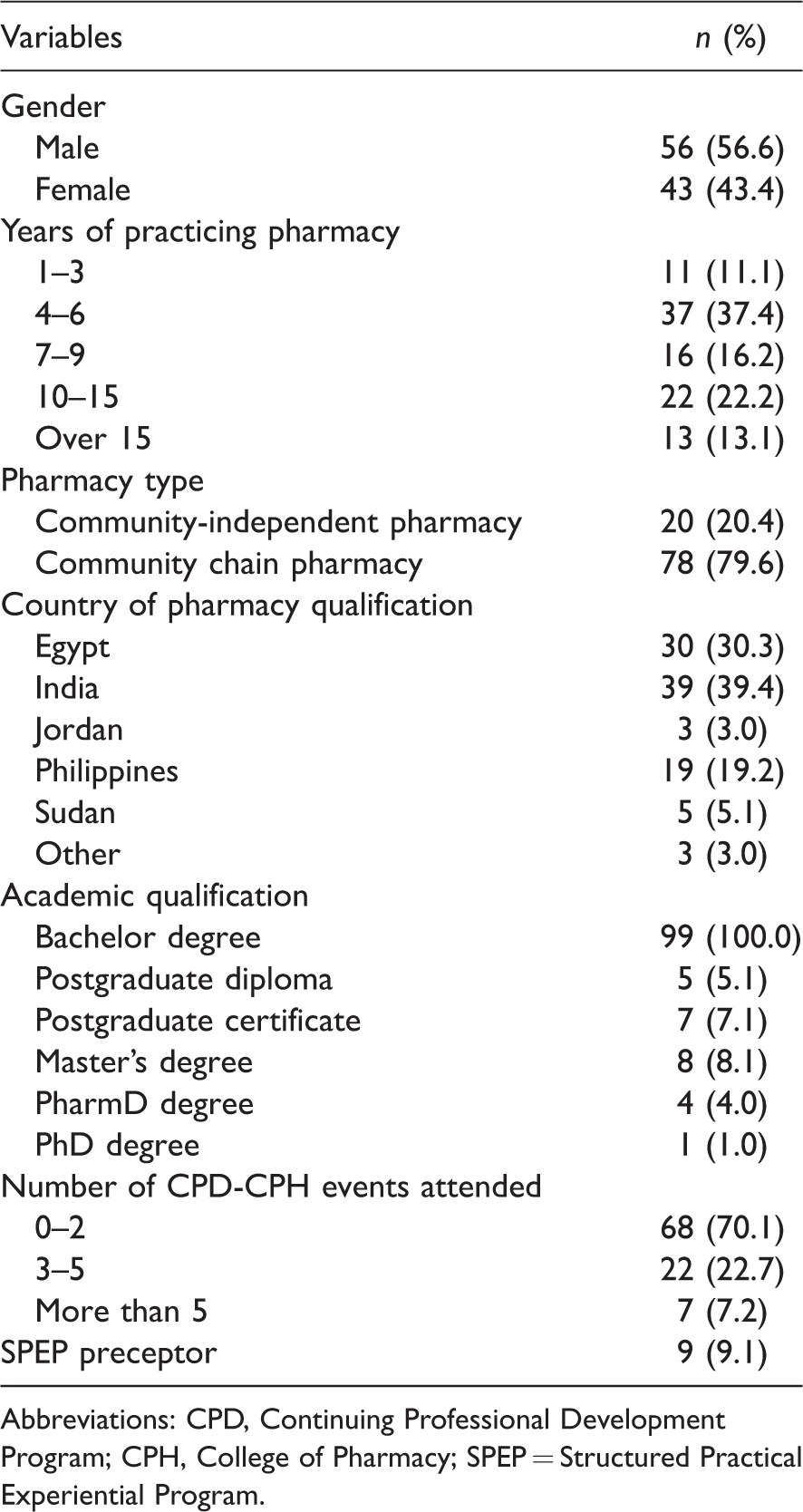
Abbreviations: CPD, Continuing Professional Development Program; CPH, College of Pharmacy; SPEP = Structured Practical Experiential Program.
The majority of the participants indicated that all of the educational and professional development needs listed were required. Drug information skills was the most reported need (84.8%), followed by pharmaceutical care process (83.7%), health promotion skills (79.2%), dispensing over-the-counter medication skills (77.9%), pharmacy management skills (76.3%), professional pharmacy and ethics (74.5%), and communication and counseling skills (74.2%; Table 2). Cross-tabulating demographics with needs revealed that gender, community pharmacy type, and years of practicing pharmacy did not influence the self-assessed needs of the pharmacists (p ≥ .05).
CPD-CPH Needs of Community Pharmacists (n = 99).
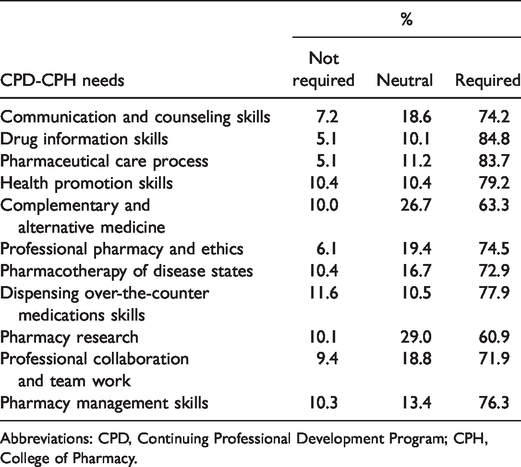
Abbreviations: CPD, Continuing Professional Development Program; CPH, College of Pharmacy.
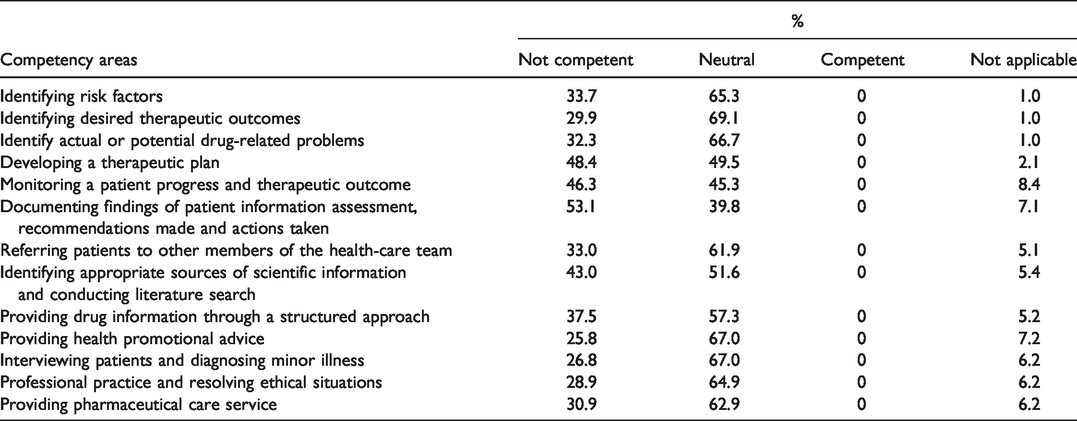
Pharmacists were asked to self-assess their competency level in major pharmacy activities. Notably, in a 3-point scale, none of the respondents thought they were competent in any of the core areas of pharmacy practice. In addition, greater than half of the participants could not decide if they were competent or not in most of the areas and were neutral about them (Table 3).
Self-Assessment of Competency Level by Community Pharmacists (n = 99).
Nearly half (48.5%) of the community pharmacists thought they were reasonably satisfied with their professional competency level and 27.3% thought they were fully satisfied, although none of them felt they were competent in any of the core pharmacy areas. Only a small proportion of the respondents thought that they were not satisfied (2%) or were extremely dissatisfied (3%) with their professional competency (Figure 1).
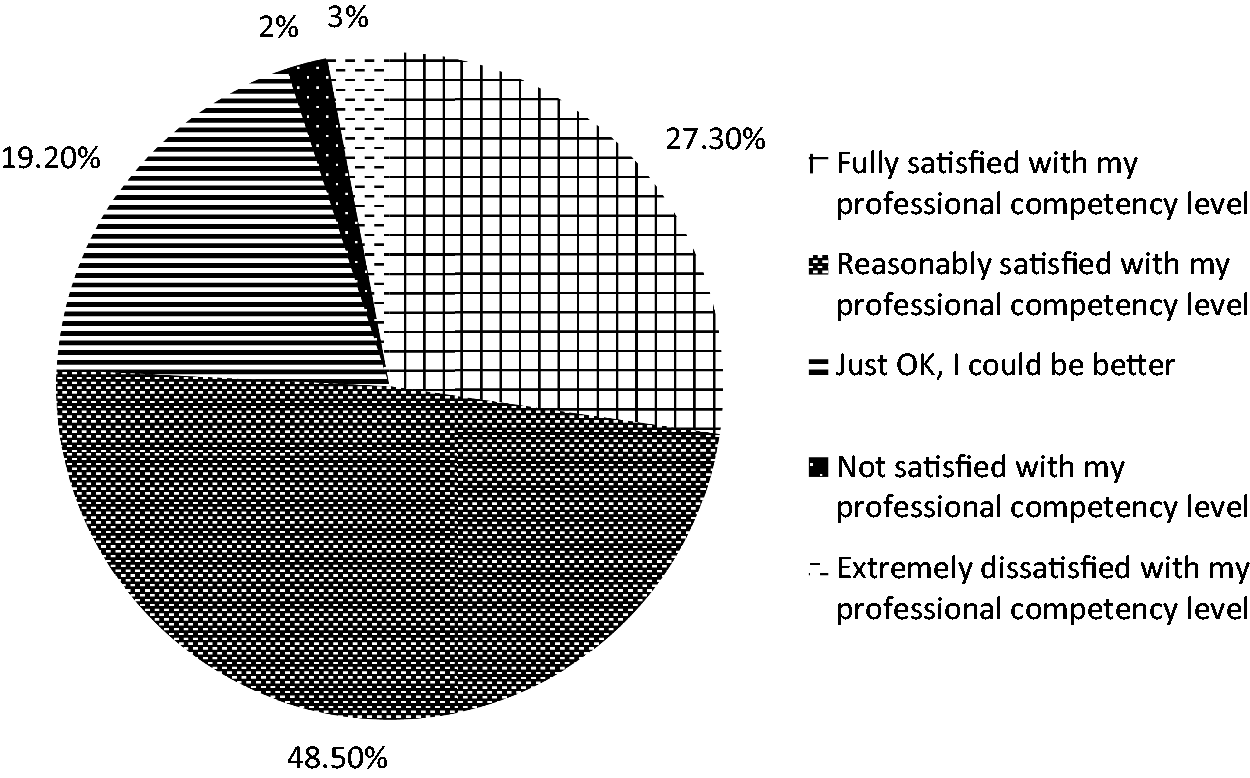
Satisfaction With Professional Competencies (n = 99).
Event Diary
Community pharmacists who participated in writing an event diary identified key educational needs. Among those highlighted were medication safety in pregnancy and lactation, communication skills, patient data collection, medication abuse and misuse, systematic literature search, sports pharmacy, reproductive disorders, interpretation of laboratory data, and diagnosis of minor illnesses.
Pharmacists used their diaries to reflect on specific incidents and subsequently identified practice areas needing improvement. One participant expressed difficulty in diagnosing and treating minor illnesses after interacting with a patient and wrote: “I was not sure with the diagnosis because stomach pain and black color vomiting may indicate several health issues …” This showed that the pharmacist could not differentiate between minor illness that could be managed by ambulatory pharmacy, and the signs and symptoms that are out of community pharmacy scope of practice. Another pharmacist shared an interaction with a patient and pointed out her need for good communication skills: “I found it hard to cool down the patient who left angry.” Moreover, one of the pharmacists was approached by a pregnant woman asking for medicine for her cough; the pharmacist noted: “We need to know more about safe medications during pregnancy.”
Discussion
To the best of our knowledge, this study is the first Qatar community pharmacists-specific needs assessment that (a) utilized a mixed methods approach and (b) was based on the NAPRA MSOP. A previous educational needs assessment of Qatar pharmacists has been conducted, but had a general scope (i.e., included hospital pharmacists), and was not based on NAPRA MSOP and did not employ a triangulation technique. 14 Our findings suggested that educational needs of Qatar’s community pharmacists’ include drug information skills, pharmaceutical care process skills, and communication skills mirror; similar findings to those reported in studies conducted elsewhere within the region. For example, in the United Arab Emirates, pharmacists identified disease management as a priority need in CPD programs and community pharmacists in Egypt identified therapeutics, followed by topics related to clinical assessment skills.24,25 Furthermore, Flemish pharmacists have rated pharmaceutical care-related topics as the most needed. 26
Most of the community pharmacists in Qatar are from the Indian subcontinent, Egypt, and Philippines—countries associated with traditional and nonclinically oriented undergraduate pharmacy curricula. 27 These are graduates of differing and heterogeneous educational systems, with diverse attitudes and perceptions about their roles and the expected professional standard of performance. Consequently, a national CPD program based on international standards and tailored to the community pharmacists’ needs and practice gaps is essential to achieve a homogenous advanced practice in Qatar. Indeed, anecdotal evidence suggests that community pharmacists in this region are disadvantaged with respect to opportunities for professional development compared to their peers who work in governmental hospitals and primary health-care clinics.
The provision of CPD programs tailored to the needs of pharmacists in the community and based on a set of competency standards should reflect on high quality of care delivered to the population. Considering that many community pharmacists are also involved, as preceptors, in training undergraduate pharmacy students in Qatar, the value of such programs cannot be overstated. 28 Such a program will not only reflect on the national level, but will extend to the international level, since most of the community pharmacists working in Qatar are expatriates. Continuing education of pharmacists contributes in building confidence to provide cognitive services, an influencing factor to their participation in the delivery of medication therapy management services. 29 Hence, enabling interventions such as CPD programs are important to build this confidence and competence. In Jordan, most community pharmacists reported that they were fully aware about the meaning of pharmaceutical care; however, the unavailability of pharmaceutical care training was the main barrier for its implementation. 30 Moreover, having excellent mentorship during well-structured experiential training programs was shown to be a direct predictor of confidence. 28 Mentors who were patient advocates produced graduates who were patient-centered and who exhibited greater sense of responsibility, accountability, and clinical reasoning skills. 28
The participants in our study expressed the needs for topics spanning many competency areas. These needs had been translated in the public’s perception toward community pharmacists. A study reported that the public in Qatar do not adequately understand the role of community pharmacists in treatment, monitoring and health screening. 9 Another study showed that community pharmacists in Qatar were minimally involved in counseling their patrons on the choice and the use of home diagnostic tests. 31 Elsewhere, consumers were not satisfied with the provision of nondrug services, especially health promotion counseling, which is important when delivering pharmaceutical care services. 32
This study also showed that none of the respondents thought they were competent in any of the core areas of pharmacy practice (e.g., personal skills, monitoring the patient’s progress and therapy outcomes, assessing and providing drug information, developing a therapeutic care plan). Interestingly, almost half of the respondents also indicated that they were reasonably satisfied with their professional competency level and over 27% thought they were fully satisfied. This appeared contradictory with the finding that none thought they were professionally competent. One could only infer from these results that the majority of pharmacists seem to accept their current level of competence, albeit poor. This, too, raises concerns in regard to the competency standard that requires a pharmacist to perform pharmacy in a professional manner. Accepting to practice at a mediocre level defies the principles of professionalism, namely, patient-centeredness, beneficence, and nonmaleficence.
The findings of this work need to be interpreted considering several important limitations. First, due to logistical and organizational issues, our sampling frame was based on the internal records of the College of Pharmacy at Qatar University. This could mean that our sample was incomplete and underrepresents the community pharmacists in the country. Second, our study achieved a low response rate (20%). Since the database used did not include complete baseline demographic data about the registered community pharmacists, we could not determine whether or not the nonresponders had different demographic characteristics from the responders. These limitations may affect the generalizability of the study findings. More importantly, they call for national efforts to establish a national comprehensive pharmacists-specific database that will facilitate future research and professional development activities.
The use of an event diary provided a triangulation strategy to assess the needs. Pharmacists who participated in documenting incidents in an event diary identified key areas in which they required improvement. Although these findings could translate into an overall poor professional competency levels, they are nevertheless valuable in designing a CPD program that is relevant to the real needs of the target pharmacy population.
Conclusion
The professional and practice needs identified by community pharmacists in Qatar included drug information skills, communication skills, pharmaceutical care skills, systematic literature search, sports pharmacy, medication safety in pregnancy and lactation, interpretation of laboratory data, and diagnosis of minor illnesses. The current findings suggest the need to balance between CPD developers and professional bodies identified competency standards and pharmacists’ self-identified needs when developing plans for CPD programs. The findings have implications for future CPD programs in Qatar which should be tailored toward the identified needs of the community pharmacists, in addition to predetermined professional competency standards.
Footnotes
Author Contributions
N. K. conceived the original research idea. N. K. and A. A. initially designed the study and developed its protocol, contributed in data collection and administration of questionnaire, statistical analysis of the data, manuscript writing, and editing. H. F. and F. S. have both contributed and actively participated in the design and conduct of the study, data collection and administration of questionnaire, statistical analysis of the data, and manuscript writing. All authors have read and approved the final version of the manuscript.
Declaration of Conflicting Interests
The author(s) declared no potential conflicts of interest with respect to the research, authorship, and/or publication of this article.
Funding
The author(s) disclosed receipt of the following financial support for the research, authorship, and/or publication of this article: This publication was made possible by an Undergraduate Student Grant—QUST-CPH-SPR-13/14–12—from Qatar University. The funding organization was not involved in any part of the research. The statements made herein are solely the responsibility of the authors.
