




Abstract
Bystanders’ responses play an important role in cyberaggression incidents among youth. This study examines factors differentiating cyberbystander roles as defenders or outsiders. Individual factors (gender, age, self-efficacy, and digital skills), social factors (parent, teacher, and peer mediation), contextual factors (victim’s age relative to the bystander, perceived victim’s emotional (upset) response, and bystander-victim relationship quality), and types of incident modalities are explored. Data from 736 Czech adolescents (M age = 14.4 years, SD age = 1.69, 51.9% boys) who acted as defenders or outsiders in cyberaggression incidents in the preceding year were analyzed using hierarchical binary logistic regression. Being a defender versus an outsider was significantly associated with younger age, active peer mediation, good relationship with the victim, higher perceived victim’s emotional (upset) response, and no video modality. The study underscores the multifaceted nature of online bystander behavior, offering insights for prevention and intervention targeting specific factors to promote defending behavior in adolescent cyberaggression.
Introduction
Cyberaggression has become a widespread phenomenon among adolescents in recent years (Runions et al., 2016). Cyberaggression can be defined as “intentional harm delivered by the use of electronic means to a person or a group of people, irrespective of their age, who perceive(s) such acts as offensive, derogatory, harmful or unwanted” (Grigg, 2010, p. 152). The rise of digital communication platforms and social media has facilitated perpetrators’ engagement in harmful behavior, consequently amplifying the visibility of such incidents (Craig et al., 2020). While prevention and intervention efforts often focus on the role of the perpetrators and victims (e.g., Ang, 2015), it is crucial to recognize the pivotal role of bystanders (González-Calatayud & Prendes Espinosa, 2021). In particular, understanding the behavior of cyberbystanders - those who witness online harmful or potentially harmful behavior toward others - can provide insights into how to prevent and address cyberaggression more effectively. Research has identified various bystander roles in cyberbullying (Lambe & Craig, 2020; Salmivalli et al., 1996). Among these, defenders (i.e., active bystanders who defend the victims in the cyberaggression situation) and outsiders (i.e., passive bystanders who neither take part in cyberaggression nor help the victims or assist the perpetrators) have garnered significant interest in research (Polanco-Levicán & Salvo-Garrido, 2021). Recognizing the impact of bystanders on cyberaggresion dynamics, prior studies (Pouwels et al., 2019) emphasized the necessity of examining the factors associated with deciding whether to assist or refrain from involvement in cyberaggression incidents.
This study investigates how demographics and individual factors (cyberbystanders’ gender, age, self-efficacy, and digital skills); social factors (parent, teacher, and peer mediation); and contextual factors (the victim’s age relative to the bystander, bystander’s perceived victim’s emotional (upset) response, bystander’s-victim relationship quality), and the modalities of the incident, relate to adolescent’s decisions to assume the role of a defender as opposed to an outsider. These factors are crucial for understanding cyberaggression and bystander behavior dynamics and can help tailor interventions more effectively.
Cyberbystander Behavior: Defenders versus Outsiders
We will be drawing from studies focusing on cyberaggression as well as cyberbullying as they both contribute to the understanding of the cyberaggression dynamic. Cyberbullying is defined similarly to cyberaggression, but in addition, it includes the criteria of repetition and power imbalance (Perren et al., 2010; Smith et al., 2008). Cyberagression can thus be seen as a broader concept that covers cyberbullying. We will be applying the term cyberbullying when this has been put forward by the reported research.
A cyberbystander may witness cyberaggression through social media, text messages, chat rooms, or other digital technologies and platforms. They do not have direct involvement as a victim or perpetrator (Shen et al., 2022). Importantly, their response, or lack thereof, can significantly impact the severity of the situation, either escalating or de-escalating it (Jeyagobi et al., 2022; Polanco-Levicán & Salvo-Garrido, 2021). Studies in the Czech Republic, Spain, and Israel revealed that cyberbystanders are primary participants in cyberbullying, outnumbering victims or defenders by at least two-fold (González-Calatayud & Prendes Espinosa, 2021; Machackova et al., 2018; Olenik-Shemesh et al., 2017), further substantiating their importance in cyberaggression.
Prior research identified several possible ways that bystanders reacted to aggression. Salmivalli et al. (1996) distinguished four bystander roles in offline bullying: “outsiders,” who ignore or do not take action despite being aware of the situation; “reinforcers,” who provide positive feedback to the bully by laughing or shouting encouragement; “assistants,” who join in on the bullying despite not initiating it; and “defenders,” who actively support the victim by comforting them, giving advice, or attempting to intervene on their behalf.
While all four bystander roles are essential to study, outsiders and defenders are particularly noteworthy. By actively supporting the victim, defenders can stop the harm and send the message that such behavior is not acceptable (e.g., Bussey et al., 2020). Conversely, outsiders’ inaction can perpetuate harm to the victim. By ignoring cyberaggression, outsiders may inadvertently communicate to the perpetrator that their behavior is acceptable or that the victim is unworthy of help (Shultz et al., 2014). Therefore, understanding the factors that result in defend or outsider behaviors can help improve prevention and intervention programs and reduce harmful outcomes of cybervictimization.
Factors that Play a Role in Cyberbystander Behavior
Although bystanders play a pivotal role in addressing cyberaggression, there is still limited understanding of the factors associated with their responses. Prior studies identified various individual factors (such as empathy level, moral disengagement, and gender; Domínguez-Hernández et al., 2018; Jeyagobi et al., 2022) that relate to cyberbystander behavior, yet research on the social and contextual factors involving the victims and modalities used in cyberaggression towards defending behavior are limited (Domínguez-Hernández et al., 2018). Moreover, as technology and online platforms advance, individual factors influencing cyberbystander behavior may evolve (Wong-Lo & Bullock, 2014). This necessitates ongoing research to stay up to date with the current trends and challenges in the digital world.
Inspired by ecological approaches to human development that recognize the different levels (or systems) of influences that affect children generally as well as in their online behavior or bullying situations specifically (e.g., Bronfenbrenner & Morris, 2006; Smahel et al., 2020; Swearer & Espelage, 2010), our study incorporates individual, social, and contextual factors as predictors (Jeyagobi et al., 2022; Van Cleemput et al., 2014). We conceptualize individual factors as those that encompass personal characteristics and traits that shape responses to online aggression. Social factors come into play as the wider social system of a child (i.e., a bystander) can significantly shape bystander behavior (Lambe et al., 2019). Lastly, by contextual factors, we refer to the broader environment in interaction with the individual in which cyberaggression incidents occur. This multifaceted approach aims to identify the predominant predictors of bystander-defending behavior, enhancing understanding and depth in comprehending the phenomenon. The following subsections provide a more detailed argumentation and description of the examined factors.
Individual Factors
Gender and Age Differences
Research indicates that there are gender differences in adolescents’ responses to cyberaggression. Females are more inclined to offer support to victims (Herry et al., 2021; Herry & Mulvey, 2022). Males tend to be passive or ignore cyberbullying episodes (Machackova et al., 2018; Wang & Kim, 2021). These distinctions may stem from varied emotional attributions towards cyberaggression such that adolescent girls evaluated perpetrators’ behavior more negatively (attributing more shame and guilt) than boys (Shohoudi Mojdehi et al., 2019). Such differences align with internalized gender role norms. Female bystanders are more likely to engage in prosocial behaviors, like defending victims, because gender norms put higher expectations on them to act empathically and show sensitivity towards others’ distress than males (Panumaporn et al., 2020). Therefore, in this study, girls were expected to engage more in defending during cyberaggression than boys.
Regarding age differences, prior studies suggested that younger adolescents intervene more frequently than older ones (Allison & Bussey, 2017; Herry et al., 2021). Younger children view cyberbullying as less acceptable (Mulvey et al., 2016) and tend to attribute higher shame and guilt to cyberbullying behavior compared to older adolescents (Shohoudi Mojdehi et al., 2019). This decline in expected intervention and a growing tolerance of cyberaggression may be linked to a heightened significance placed on peer groups and their pursuit of autonomy (Van Cleemput et al., 2014). Besides, exposure to frequent aggressive behavior may desensitize young people to the harmful effects of aggression as they mature (Estévez et al., 2019). However, findings on this topic are inconsistent, with some studies reporting no significant age differences, while others found older adolescents to be more active bystanders (Erreygers et al., 2016; Machackova et al., 2018; Olenik-Shemesh et al., 2017). Given this evidence, we hypothesized that younger adolescents would be more likely to engage in defending behavior compared to their older counterparts. This is based on the presumption that younger adolescents have stronger emotional responses to aggression or bullying and are less influenced by peer dynamics that discourage intervention.
Self-Efficacy and Digital Skills
Both online and offline bystander behavior studies highlighted the importance of individual psychological factors (e.g., Lambe et al., 2019; Meter & Card, 2015; Van Cleemput et al., 2014). One particular aspect for bystanders in cyberaggression is an individual’s self-efficacy. This signifies the individual’s belief in their ability to successfully accomplish a task or a goal (Bandura, 1986) and, in this context, the ability to defend cyberaggression victims. According to Bandura’s (1986) social cognitive theory, a positive relationship exists between self-efficacy and the motivation to act, leading to increased behavioral engagement. Similarly, the Bystander Intervention Model (Latané & Darley, 1970) outlines a decision-making process wherein bystanders might refrain from intervening in cyberaggression if they doubt their ability to help or lack the necessary skills, leading to hesitance. In cyberaggression scenarios, for example, bystanders might avoid intervening if they doubt the effectiveness of their assistance or lack the skills needed to address the situation (Karasavva & Mikami, 2024). Prior studies on cyberbystander intervention found that adolescents’ higher self-efficacy predicted increased defending behavior (Clark & Bussey, 2020; Leung, 2021). However, some studies found no difference in self-efficacy levels between defenders and outsiders (Olenik-Shemesh et al., 2017). They suggested that the social environment and peer interaction might be more influential than self-perceptions and the beliefs in their ability to intervene. Yet, in line with social cognitive theory (Clark & Bussey, 2020), we expect that higher self-efficacy, in general, leads to greater motivation and proactive involvement in helping others, making individuals more likely to act as defenders.
In addition to self-efficacy, individual skills, particularly digital skills, have a strong potential to play a key role in cyberbystander intervention. Digital skills encompass the ability to navigate, evaluate, and create online content (van Deursen et al., 2014). Prior research (DeSmet et al., 2016; Jeyagobi et al., 2022) highlighted social, empathic, and coping skills as having positive associations with defending behavior. However, the role of individual digital skills has often been overlooked. Effective intervention, such as reporting harmful content or providing technical advice (e.g., on blocking), requires specific digital knowledge (Jashari et al., 2022). Enhanced digital skills could also be helpful in recognizing the incident as an aggressive act that requires action (Sonck & de Haan, 2014). Conversely, lacking these skills could hamper efficient victim protection. Therefore, we assume that adolescents with higher levels of digital skills are better equipped to defend against cyberaggression and defend victims effectively. Thus, we expect they will be more likely to defend the victim rather than stay passive.
Social Factors
Prior research suggests that the social environment significantly impacts bystander-defending behavior (Hayes & Turner, 2022; Li et al., 2024). As social learning is a complex process influenced by various socialization agents and practices (Grusec & Hastings, 2015), it becomes essential to examine the roles played by different socialization agents. This study focuses on parents, peers, and teachers as the primary socializing agents in adolescence. Specifically, we examine the effect of their active mediation practices, i.e., - the interactions they have with children to explain and discuss media content and guide their media usage (Shin & Lwin, 2017). This can involve encouraging children to approach media material critically or offering additional information to enhance their understanding (Ren & Zhu, 2022). These practices can impact adolescents’ responses to cyberaggression. For instance, it has been found that adolescents who discuss cyberbullying experiences with their parents (an active parental mediation practice) are more inclined to defend the victim than those who do not (Levy & Sela-Shayovitz, 2020). Peers are important, as adolescents often talk to friends about their online experiences and seek their advice regarding online issues (Shin & Lwin, 2017). Teachers’ active mediation practices provide opportunities for students to develop social and emotional skills to recognize and defend bullying behavior (Feng et al., 2022). Therefore, all three socialization agents could potentially provide adolescents with resources to defend the victims more effectively and, thus, more likely. However, some evidence shows that mediation efforts by diverse socialization agents could lead to different outcomes and that not all mitigate the negative impact of media on children (Chen & Shi, 2019; Fikkers et al., 2017). Exploring active mediation by all three social agents is thus important to determine which one(s) are linked to bystanders’ reactions.
Contextual Factors
Victim-Related Contexts
The bystander’s reactions might also depend on many contextual factors, i.e., the specific circumstances of the incident. In our study, we focus on contexts in interaction with or relation to the victim, i.e., the victim’s relative age to the bystander, the bystander’s quality of relationship with the victim, and the bystander’s perception of the victim’s emotional (upset) response.
Victim’s Relative Age
The victim’s age is significantly associated with adolescents’ bystander-defending behavior (Moche & Västfjäll, 2021; Rogers et al., 2011). Studies on perceived social support have indicated that younger victims tend to receive more support from teachers, parents, and adults compared to older ones (Huang & Chui, 2024). This is often because younger victims are perceived as more vulnerable due to their inexperience and inability to handle aggression. Consequently, bystanders may feel a heightened sense of duty to intervene when they witness aggression directed at younger individuals, who are seen as less capable of defending themselves (Singstad et al., 2021). Additionally, Blomqvist et al. (2020) suggested that younger students are more likely to confide in adults about their bullying experiences, potentially increasing their chances of receiving support.
However, the victim’s relative age (i.e., whether the victim is younger, the same age, or older than the bystander) can further shape the bystander’s response. While many studies have focused on the simple age of the victim, fewer have explored the relative age dynamic. A qualitative study has shown that bystanders are more likely to intervene when the victim is younger than themselves, as older bystanders (in comparison to younger victims) are hierarchically higher in social groups and may feel a stronger sense of responsibility to protect those who are relatively more vulnerable (e.g., Price et al., 2014). This focus on relative age allows us to better understand the motivations behind bystander behavior, as it highlights how power dynamics and perceived vulnerability can shift based on the victim’s age in relation to the bystander. We hypothesized that bystanders are more likely to defend victims younger than themselves.
Bystander’s Quality of Relationship with the Victim
Research in offline and online bullying highlights the substantial role of bystander-victim relationship quality in defending behavior (Lambe et al., 2019; Machackova et al., 2018). Research shows that bystanders’ closeness to victims (e.g., friendships or sibling bonds) positively correlates with increased defense and support for victims (Bastiaensens et al., 2014; Bellmore et al., 2012; DeSmet et al., 2014). Several reasons have been theorized, such as emotional connection, loyalty to the victim, and low moral disengagement that motivates bystanders to act and protect them (Mainwaring et al., 2023). Conversely, bystanders lacking personal connections or harboring negative relationships with victims are less likely to intervene (Chen et al., 2016). Thus, we proposed that a good quality of relationship between bystanders and the victim would motivate bystanders to defend and support the victim.
Bystander’s Perception of the Victim’s Emotional (Upset) Response
Research on offline and online bullying often suggests that understanding victims’ emotional state can also impact bystanders’ defending behavior (empathy-defending relation) (Lambe et al., 2019; Nickerson et al., 2015). For instance, if bystanders perceive the victim is highly distressed, visibly upset, or in immediate need of help, they are more likely to intervene and provide support (Liu et al., 2019). Such perception triggers empathy and a desire to alleviate suffering. Conversely, if bystanders perceive the victim as unaffected or capable of handling the situation, they may be less motivated to intervene. For instance, Pronk et al. (2016) found that awareness of victims’ distress in hypothetical offline bullying scenarios was positively related to their intended defense. Hence, we propose perceiving heightened upset emotions in victims motivates bystanders to defend them.
Modality Used in Cyberaggression
Different modalities, such as video, text, and audio, can significantly impact bystander-defending behavior in a cyberaggression scenario by (non)eliciting empathy (e.g., Price et al., 2014; Sokol et al., 2015). The forms of modality differ in the richness of the cues they transfer, which can affect how individuals perceive the severity and immediacy of the cyberaggression situation, as well as their emotional and empathetic responses (Menesini et al., 2011; Pyżalski et al., 2022). In a video modality, where visual and auditory cues are present, bystanders may witness the aggressive act and the victim’s emotional distress more vividly, potentially increasing their urgency to intervene. Text-based modalities, on the other hand, may lack the emotional impact conveyed by nonverbal cues, making it easier for bystanders to detach themselves from the situation and be less motivated to intervene. Similarly, audio modalities can convey emotional tone but lack visual cues, potentially leading to mixed effects on bystander behavior. Hence, different modalities could elicit varying responses from a bystander (Slonje et al., 2013). Cyberbullying studies reveal that different communication methods affect victims’ emotional well-being differently. For example, video cyber incidents tend to distress victims more than text-based ones, resulting in a greater negative emotional impact (Macaulay et al., 2022; Smith et al., 2008). Bystanders who are exposed to these different modalities might empathize more strongly with victims who are harassed by content perceived as more severe or emotionally distressing (regardless of whether the victim’s immediate reaction is visible within the content). However, the research on the specific role of modality in bystander-defending behavior is currently quite limited. As a result, further research on the role of modality is warranted. Therefore, in the present study, we do not have a specific hypothesis regarding modality; rather, our approach is exploratory in nature.
Current Study
The study examines the factors associated with defending behavior during cyberaggression. Firstly, it hypothesizes that demographic factors, such as being a girl or younger, will be positively associated with defending behavior. Further, individual factors such as higher self-efficacy and digital skills are anticipated to be positively related to defending. Secondly, social factors, namely active mediation by parents, peers, and teachers, are expected to be associated with an increased likelihood of defending behavior. Thirdly, it proposes that contextual factors in relation to the victim, such as younger victims’ relative age, good relationships with the victim, and perceived higher victims’ emotional (upset) responses will increase the likelihood of helping. The study also explores the role of modalities in cyberaggression attacks but lacks specific predictions due to limited prior research. Refer to Figure 1 for the proposed model. Proposed research model.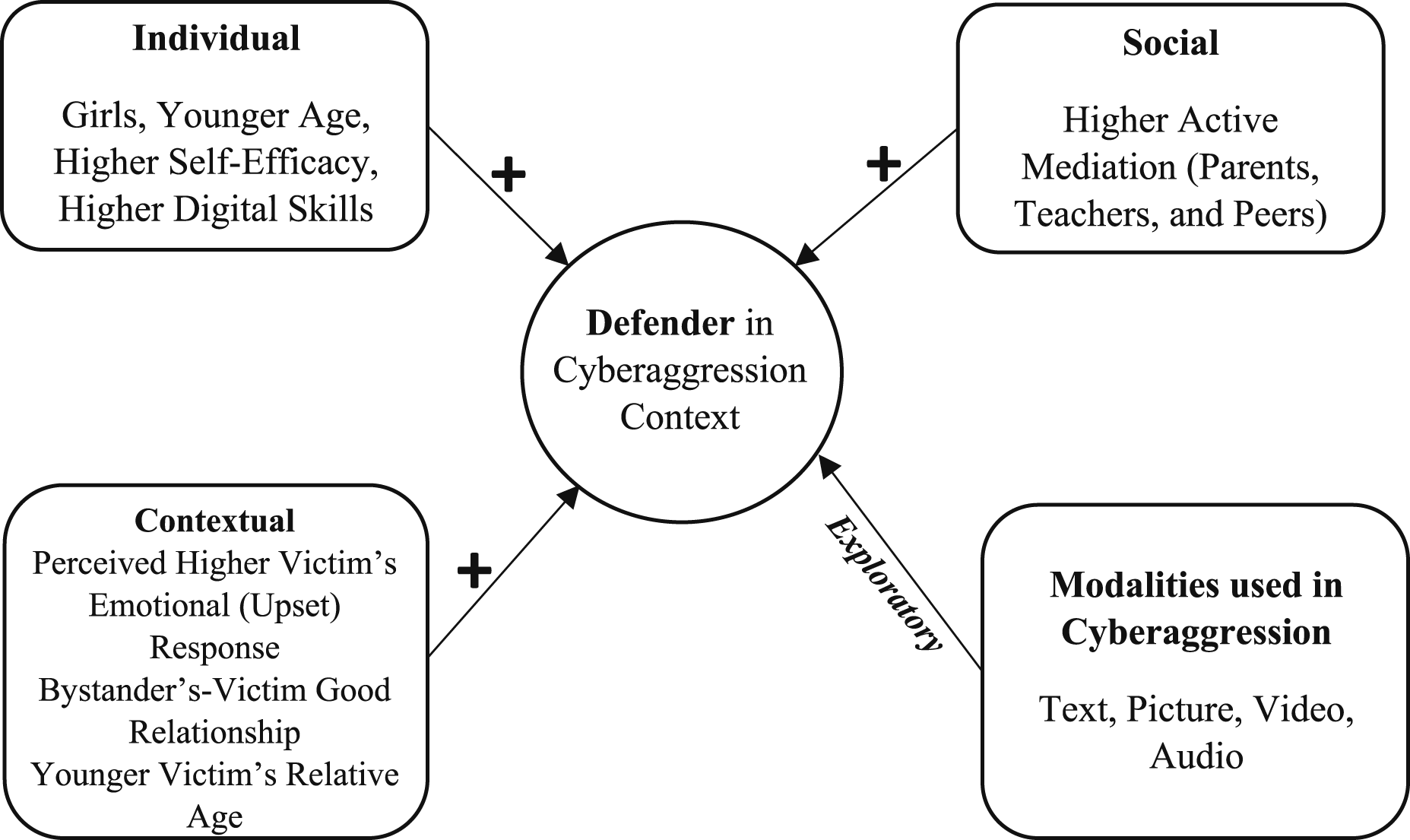
Methods
Participants and Procedure
This study utilizes Czech survey data from the EU Kids Online IV project, focusing on the online experiences of European children and adolescents. The Czech Republic EU Kids survey collected data from 2825 participants aged 9–18 in the Czech language. To alleviate the survey length for younger participants, the cyberbystander module of questions was only asked to participants in grade six and onward (circa 11+ year-olds) (78.9% of the whole sample, n = 2228). Out of these, 39.7% (n = 884) reported witnessing a cyberaggression incident in the past 12 months. We considered data from participants who identified as either defenders or outsiders (excluding those who helped the offender (n = 32) and those who did not respond to the question about their reactions (e.g., “prefer not to answer” or “I don’t know,” n = 116). Thus, the final sample comprised 736 adolescents aged 11–17 (M age = 14.4 years, SD age = 1.69, 51.9% boys).
Sampling and data collection in Czechia involved 89 primary and secondary schools using proportional stratified random clustered sampling between October 2017 and February 2018. Data were gathered via CAWI (Computer Assisted Web Interviewing). Participants were recruited via classes and schools, with the consent of school representatives, parents, and participants. The sampling procedure involved a random selection of schools from the Registry of the Czech Ministry of Education, stratified proportionally according to population in all eight regions (see European Commission & Eurostat, 2020), type of school (elementary, vocational, and grammar school), and further divided into small and large schools. The response rates on the level of school cooperation were 41.7% from the school where contact was established. The University’s Research Ethics Committee approved the project. Detailed information about the methods can be found in the EUKO IV technical report (Zlámal et al., 2020).
Measures
The Cyberbystander Experiences
The cyberbystander topical module was created by the EU Kids Online project (Zlámal et al., 2020). It was based on definitions and measurements of cybervictimization established in previous EU Kids Online studies (Livingstone et al., 2011). To ensure comprehensibility, the included items underwent cognitive interviews with 28 Czech children in the 11–17 age range. In the questionnaire, the cyberbystander module followed a set of questions about experiences with (cyber)aggression. Cyberaggression was introduced as follows: “Sometimes children or teenagers say or do hurtful or nasty things to someone, and this can often be quite a few times on different days over a period of time, for example. This can include teasing someone in a way this person does not like, hitting, kicking, pushing someone around, or leaving someone out of things. When people are hurtful or nasty to someone in this way, it can happen face to face (in person), by mobile phones (texts, calls, video clips), or on the internet (e-mail, instant messaging, social networking, chatrooms).” After questions about victimization and perpetration experiences, the cyberbystander module was introduced: “Sometimes, you can WITNESS SOMEBODY ELSE being treated in a hurtful or nasty way ON THE INTERNET. This might, for example, happen on social networking sites, in online discussions, or on media-sharing platforms such as YouTube. In the PAST YEAR, have you witnessed somebody else being treated in such a way?” Only those who answered “Yes” were further asked about their experiences the last time they witnessed such an event and were included in this study.
Defending Behavior
We asked, “It is possible to react in various ways to what happened. Select the option which best describes what you did.” Those who answered, “I tried to help the victim (e.g., comforted them, gave advice, attempted to intervene, etc.),” were categorized as defenders. Those who selected “I did nothing” were classified as outsiders. These options were mutually exclusive.
Perceived Victim’s Emotional (Upset) Response
We asked, “How upset do you think the person to whom this happened was?” with responses from (1) Not upset to (4) Very upset (M = 2.50, SD = 0.89).
Bystander-Victim Relationship Quality
We asked a single-choice question, “How is your relationship with the person to whom this happened?” with categorical options Good (33.3%), Neutral (21.6%), Bad (3.9%), None (41.2%). Dummy variables were used in the analysis, with “good” as a reference category.
Victim’s Relative Age
We asked a single-choice question, “How old was this person?” with categorical options: About my age (42.4%), Younger than me (11.1%), A teenager older than me (20.7%), An adult (12.9%), I don’t know (12.9%). Dummy variables were used in the analysis, with “About my age” as a reference category.
Modality Used in Cyberaggression
We asked a multiple-choice question, “When the person was treated in this way online or via a mobile device, what kind of content was used to bother the person?” with options: Written text (85.1%), Picture(s) or photo(s) (30.8%), Video (18.5%), Audio (7.1%).
Individual Characteristics
Participants’ Gender
Gender was assessed through a single-item question with response options: “a boy” (51.9%), “a girl” (48.1%), “I do not know” (0%), or “prefer not to say” (0%).
Age
Participants denoted their birth month and year. The variable was recounted to reflect age in years (M = 14.44, SD = 1.69).
General Self-Efficacy
We used five (out of 10) items from Schwarzer and Jerusalem (1995; e.g., “It’s easy for me to stick to my aims and achieve my goals”) rated on a four-point scale (1 = Not true, 4 = Very true). The Cronbach alpha for the scale is .84, demonstrating good internal consistency. The final score was computed by averaging the items (M = 2.63, SD = 0.64).
Digital Skills
The scale included 11 items rated on a five-point scale (1 = Not at all true, 5 = Very true; e.g., “I know how to save a photo that I find online”). Ten items were adapted from Helsper et al. (2015; the original scale consisted of 35 items), and one additional item was added by EU Kids Online. The scale has a good internal consistency (Cronbach alpha = .82). The final score was computed by averaging the items (M = 4.29, SD = 0.54).
Social Factors
Active Mediation
Active parental mediation, teacher mediation, and peer mediation were assessed with three items each. The items were scored on a five-point scale (1 = Never, 5 = Very often). The wording was the same for each mediation agent (e.g., “Encourages me to explore and learn things on the internet,” “Suggested ways to use the internet safely,” “Helped me in the past when something has bothered me on the internet”). The Cronbach alphas for the subscales were sufficient (parental mediation: .69, teacher mediation: 66, peer mediation: .75). Final scores for each subscale were computed by averaging the items (parents M = 2.36, SD = 0.93, teachers M = 2.30, SD = 0.85, peers M = 2.21, SD = 0.95).
Analytical Approach
First, we examined the missing data patterns in the final sample (n = 736). The relative frequencies of missing data in predictors used in regression ranged from 0% to 12.8%. Most participants (61.4%) had no missing values (M missings_count = 1.08, SD = 1.78, Mo = 0, Me = 0). The Little MCAR test provided a significant result (χ2 (512) = 657.47, p < .001), indicating that data were not missing completely at random (MCAR). The normed version of χ2 was low (χ2/df = 1.28) (used to adjust the sensitivity to sample size; Bollen, 1989), indicating that the data were likely missing at random (MAR). Accordingly, we applied the Expectation-Maximization (EM) (Dong & Peng, 2013) method to fill in the missing data for the main analysis.
To address the potential cluster effects (for both school and class) on the cyberbystander behavior, we calculated the intraclass correlation coefficient (ICC), which resulted in a value of 0.001. Since this value is below the threshold of 0.05, it indicates no significant cluster effect in our study. To test our hypotheses, we utilize hierarchical logistic regression (Wong & Mason, 1985). This analysis aimed to determine the likelihood of adolescents supporting victims (referred to as “defenders,” coded as 1) as opposed to taking no action (“outsiders,” coded as 0). In each step of the analysis, we incrementally introduced different sets of variables to see how each block (or level of variables) added to the explained variance in bystanders’ behavior. In the model, we consequentially added (a) demographics (gender, age), (b) individual characteristics (digital skills, self-efficacy), (c) social factors (active mediation by parents, peers, and teachers) (d) contextual variables (bystanders’ relationship with victim, bystanders’ perception of emotional (upset) response, victims relative age), and (e) modality used (written, picture, video, audio). The last step of the regression (including all predictors) is used to determine whether the proposed hypotheses were supported or not. We conducted the analyses using SPSS version 29.
Results
Out of the analyzed sample, 53% of the participants reported helping the victims (i.e., defenders), while 47% indicated that they had not taken any action (i.e., outsiders) during the previous year’s cyberaggression incident they witnessed.
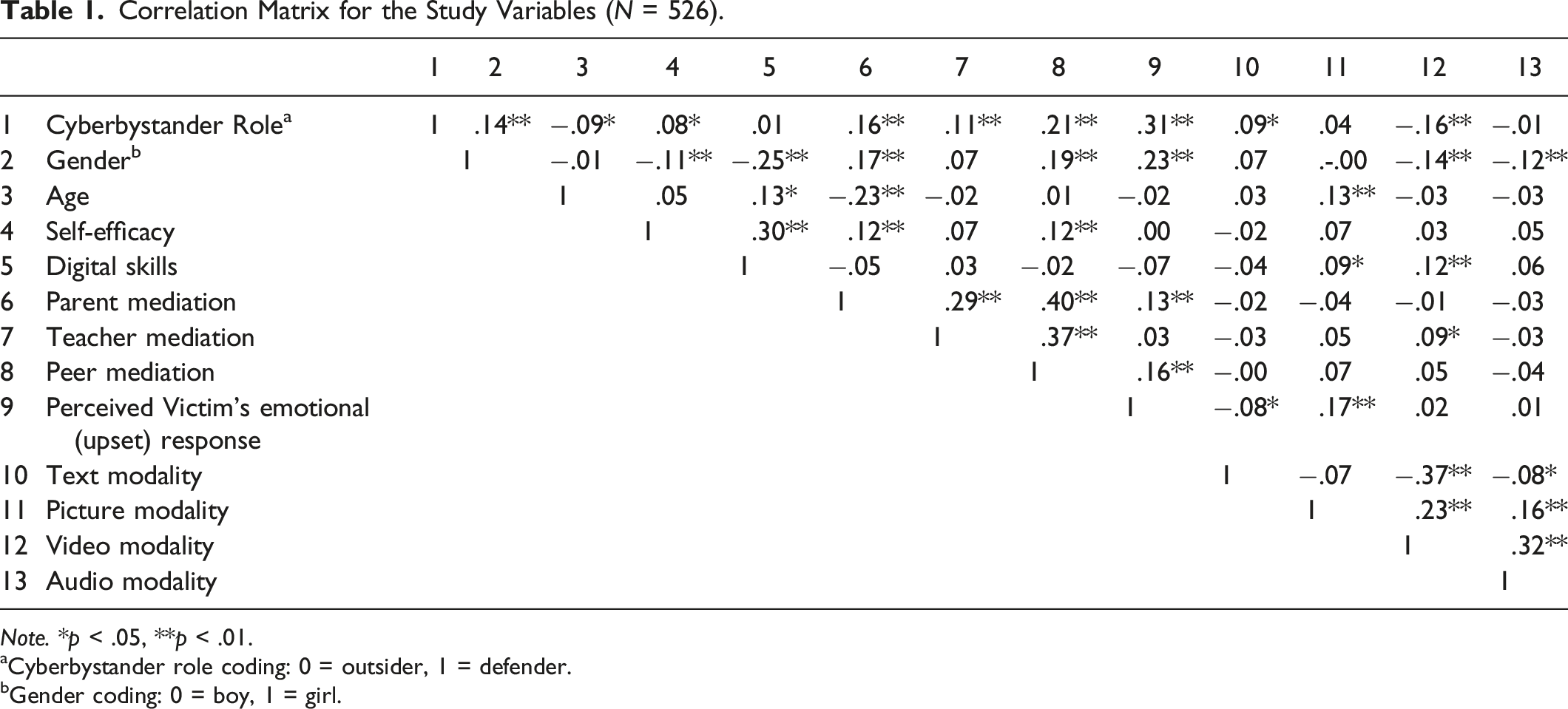
Correlation Matrix for the Study Variables (N = 526).
Note. *p < .05, **p < .01.
aCyberbystander role coding: 0 = outsider, 1 = defender.
bGender coding: 0 = boy, 1 = girl.
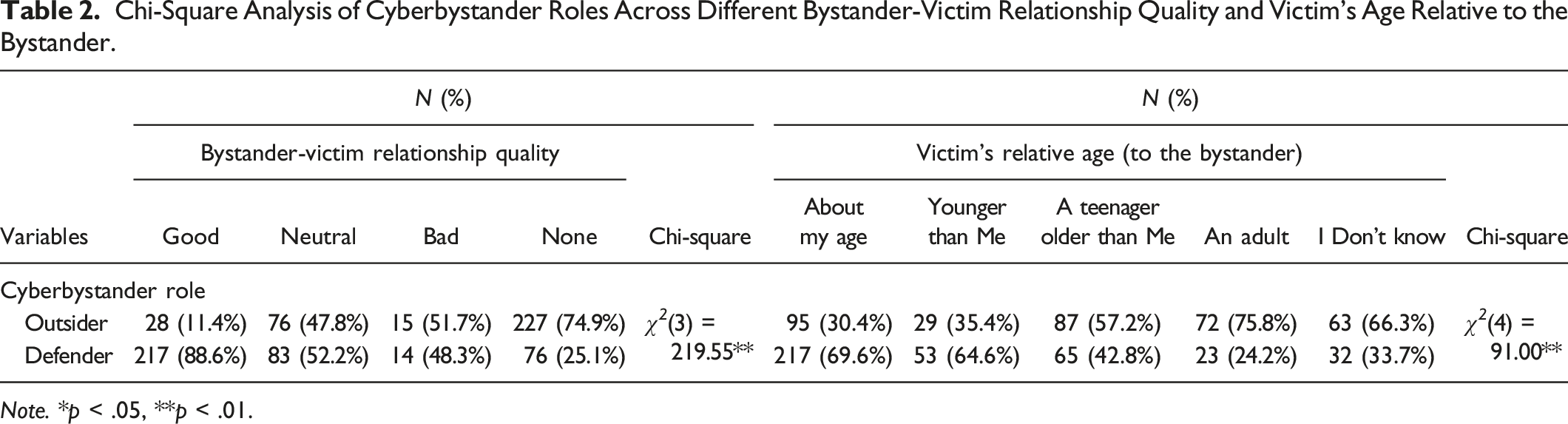
Chi-Square Analysis of Cyberbystander Roles Across Different Bystander-Victim Relationship Quality and Victim’s Age Relative to the Bystander.
Note. *p < .05, **p < .01.
Hierarchical Logistic Regression Predicting Cyberbystander Behavior
Our analysis met the assumptions for logistic regression, including independent observations and VIF values below 5, indicating no multicollinearity. No significant outliers were detected using Cook’s Distance (D) value (D < 1). Furthermore, the Box-Tidwell procedure confirmed that all continuous independent variables exhibited a linear relationship with the logit of the dependent variable.
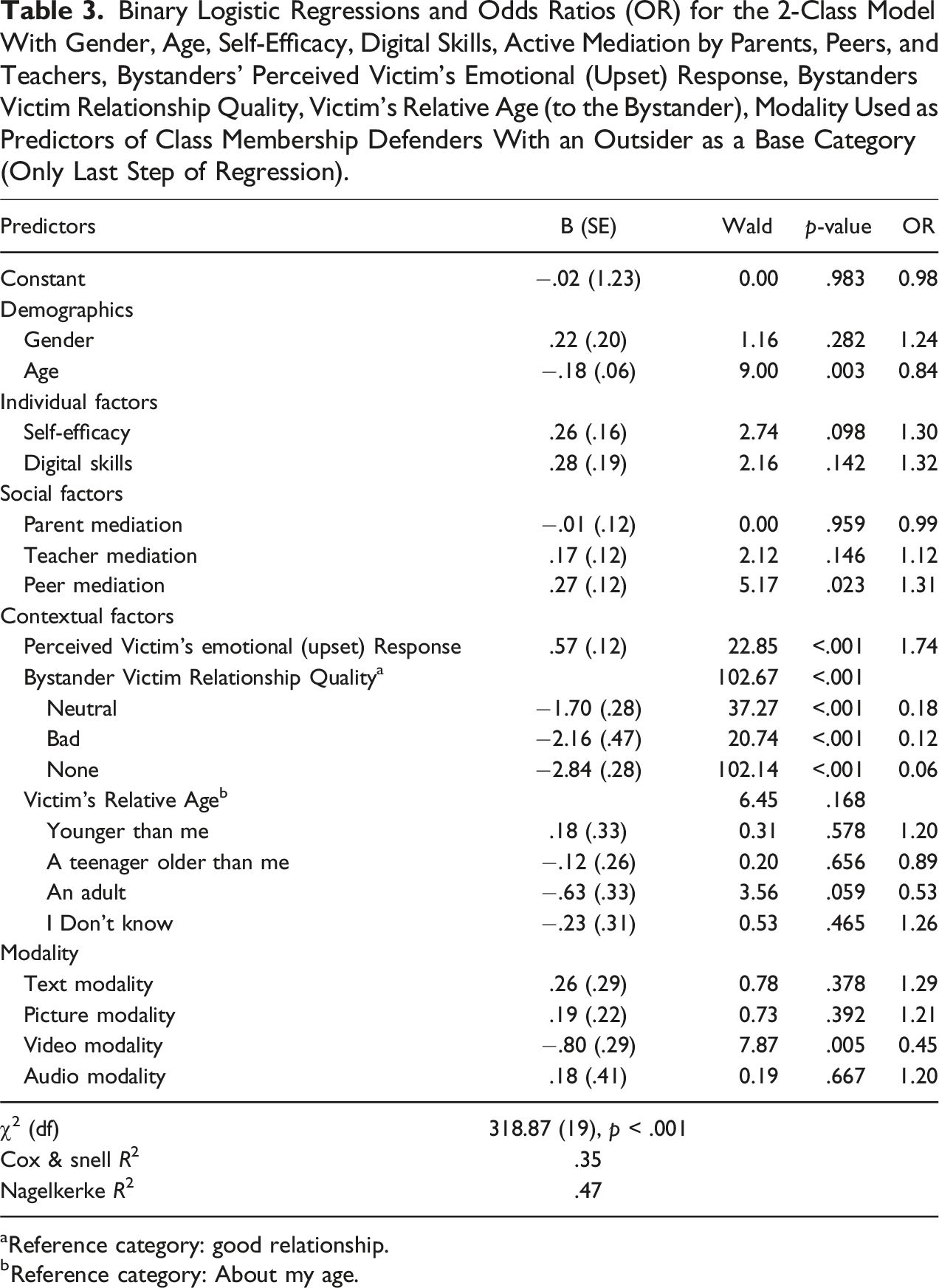
As noted above, we run hierarchical regression in five steps. The addition of all blocks significantly improved the model (see Table S1 in Supplement for coefficients in each step). In the first step, the inclusion of demographics (gender, age) explained 3.7% of the variance (based on Nagelkerke R2; χ2(2) = 20.94, p < .001), the second step (individual characteristics: digital skills, self-efficacy; χ2(4) = 29.51, p < .001) added 1.5% of the variance, the third step (social factors: active mediation by parents, peers, and teachers; χ2(7) = 54.69, p < .001) added 4.4%, the fourth step (contextual factors: bystanders’ relationship quality with the victim, bystanders’ perception of emotional (upset) response, victims relative age; χ2(15) = 306.71, p < .001) added 35.9%, and finally, the last step (modality: text, picture, video, audio; χ2(19) = 318.87, p < .001) added 1.5%. Altogether, the variables thus explained 47% of the variance of the dependent variable.
Binary Logistic Regressions and Odds Ratios (OR) for the 2-Class Model With Gender, Age, Self-Efficacy, Digital Skills, Active Mediation by Parents, Peers, and Teachers, Bystanders’ Perceived Victim’s Emotional (Upset) Response, Bystanders Victim Relationship Quality, Victim’s Relative Age (to the Bystander), Modality Used as Predictors of Class Membership Defenders With an Outsider as a Base Category (Only Last Step of Regression).
aReference category: good relationship.
bReference category: About my age.
Discussion
Understanding adolescent bystanders’ helping behavior in cyberaggression is vital for safer online environments. This study delves into the individual, social, and contextual factors that may relate to defender or outsider behavior among adolescents, shedding light on their potential role in addressing cyberaggression incidents.
Individual Factors
In line with prior research on online and offline bullying (Lambe et al., 2019; Machackova et al., 2018), we hypothesized that adolescent girls would be more likely to defend the victim. Bivariate correlation indeed showed this relationship. This suggests that there is a tendency for girls to demonstrate slightly higher levels of defending behavior compared to boys. However, the effect of gender was not statistically significant in the multivariate model, thus not supporting our hypothesis. This implies that other factors (in particular, the relationship to the victim and the perceived victim’s upset response, see below) are more decisive when it comes to adolescents’ decision to defend a victim of cyberaggression. The lack of significant gender effects in our study could also explain why some previous research (Barlińska et al., 2018; Erreygers et al., 2016) did not find strong gender-related differences in defending behavior. Our results imply that gender may not be as central a factor as previously thought, and the decision to defend may be shaped by a broader array of contextual factors, such as bystanders’ relationship quality with victims and the perceived victim’s emotional (upset) response. Consequently, intervention programs aimed at encouraging defending behavior in cyberaggression contexts may not need to be tailored differently for boys and girls, as the underlying motivators for defending actions seem to transcend gender differences.
Previous research has shown inconsistent results regarding age differences in cyberbullying/aggression bystander behavior (Polanco-Levicán & Salvo-Garrido, 2021). Some studies found no significant differences, while others reported that younger adolescents are more likely to act as cyberbystanders, and still others found older adolescents to be more active bystanders (Erreygers et al., 2016; Machackova et al., 2018; Olenik-Shemesh et al., 2017). Our study found that younger adolescents are more likely to act as defenders than older adolescents in cyberaggression situations. The differences observed in cyberbystander behavior across studies may stem from the varying age ranges examined. For instance, studies like Quirk and Campbell (2015), which analyzed adolescents aged 12–18, found that younger adolescents are more inclined to act as defenders than outsiders, consistent with our findings in the 11–17 year age range. This pattern suggests that adolescents may become more passive bystanders as they age. Van Cleemput et al. (2014) explained that this passivity could be attributed to older adolescents’ increased social inhibition and heightened sensitivity to peer group dynamics, which often discourage overt helping behaviors due to concerns over social acceptance and a desire for autonomy. Schultze-Krumbholz et al. (2018) propose that this shift may also be related to a desensitization effect that occurs with age, where older adolescents become less sensitive to the plight of victims and thus less inclined to take action. This suggests that younger adolescents are more likely to act as defenders due to their less developed social concerns and a more straightforward sense of justice and empathy, which diminishes as they age and social dynamics become more complex. These findings underscore the importance of considering age-related factors when examining adolescents’ responses to cyberbullying, as the inclination to defend victims may decrease as they progress through adolescence, influenced by both social and psychological developments.
Our hypothesis regarding self-efficacy was not supported. Although self-efficacy was related to cyberbystander behavior in the bivariate analysis and was significant in the initial step of the multivariate analysis focusing on individual factors, it lost significance in the final model when social and contextual factors were included. This suggests that while self-efficacy may play some role, other factors may be more central in shaping defending behavior. Future studies could examine whether social and contextual factors mediate or moderate the relationship between self-efficacy and defending behavior. Interestingly, contrary to previous research linking adolescents’ netiquette and online communication skills and reduced cyberbullying activities (Park et al., 2014), adolescents’ digital skills were not associated with bystander behavior either. Our study thus shows the limited potential of adolescents’ efficacy or skills to contribute to the mitigation of cyberaggression. However, it has to be noted that the measurement of digital skills in this study primarily concentrated on the technical facets and overlooked the assessment of social digital skills or “netiquette.” Our study indicates that although having proficient skills may facilitate effective online navigation, it does not necessarily determine an individual’s willingness to intervene in cyberaggression incidents. Similarly, having high general self-efficacy does not seem to be associated with defending behavior in cyberaggression contexts. One possible explanation for both findings may thus be that intervening in cyberaggression requires a more specific facet of self-efficacy/skills that our study did not assess. Research suggests that domain-specific self-efficacy, such as internet-related or defending-specific self-efficacy, may be more relevant in determining intervention behavior (Bussey et al., 2020; Hu et al., 2023). Future studies should consider differentiating between general and specific forms of self-efficacy to better understand their respective roles in cyberbystander behavior.
Social Factors
The results highlighted the role of active mediation in cyberbystander behavior, which differed across socializing agents. Bivariate analysis showed a positive relationship between mediation by parents, teachers, peers, and cyberbystander behavior. However, in the multivariate model, only peer mediation was significantly positively linked to cyberbystander behavior, whereas parent and teacher mediation had no effect. These differences may be due to the varying contents and topics of active mediation provided by each socializing agent (Shin & Lwin, 2017). Online aggression might be easier to discuss with peers than with adults (i.e., parents or teachers). We assume peers can relate to adolescents’ online experiences better than parents or teachers; they are more familiar with the online environment and thus can provide more relevant knowledge about expected online behavior norms. As a consequence, peer advice in this particular area might be perceived as more trustful than that of adults, which might be the reason for its significant effect. This interpretation warrants future studies on the mediation content from diverse agents and how relevant adolescents perceive it. These differences among socializing agents emphasize the complexity of social dynamics that are associated with responses to cyberaggression.
Contextual Factors
In our study, the contextual factors, particularly bystanders’ relationship quality with victims and perceived victims’ emotional (upset) response, played a crucial role. These variables added most to the explained variance (35.9%) of defending behavior, highlighting that specifics of a concrete cyberaggression incident play a dominant role in bystanders’ decisions to act or stay passive. Our study provides insight into several selected factors but overall, we suggest that future research should further explore these factors as they seem important for prevention and intervention efforts.
Adolescents with a good relationship with the victims (in comparison to neutral, bad, or no relationship) tend to be defenders rather than outsiders. Research often suggests that adolescents strongly emphasize their interpersonal relationships, seeking peer connection and support (La Greca & Harrison, 2005). When close and positive relationships exist with the victim, adolescents feel emotional connections and empathy, which motivates them to protect and support their friends and peers who are targeted by cyberaggression. The intervention efforts should thus place specific stress on empathizing with the victims – not only with the ones the bystander is familiar with but also the ones with more distant or no relationships.
Contrary to our hypothesis, the age difference between the victim and the bystander was not significantly associated with bystanders’ behavior in cyberaggression incidents. We initially hypothesized that younger victims would receive more assistance from bystanders due to their perceived vulnerability based on age. To test this, we compared bystanders’ reactions to victims who were younger, the same age, or older than them but found no significant differences in their behavior. Interestingly, the bivariate analysis suggests a significant variation in bystander roles depending on the victim’s relative age, such that bystanders were more likely to act as defenders when the victim was younger or of the same age as the bystander. Several factors might explain this pattern. For instance, bystanders may perceive younger victims or those of similar age as more vulnerable and in need of protection, prompting a more proactive response. In contrast, when the victim is older or perceived as more capable, bystanders might feel less compelled to intervene. Social identity and group dynamics also play a crucial role; bystanders often feel a stronger sense of empathy and kinship toward individuals who are similar in age, which can enhance their motivation to act (Casey et al., 2017; Scholte & van Aken, 2006). Another possible explanation and suggestion for future researchers is to take into account the age of the bully, a factor not examined in the current study. It is possible that older victims may be bullied by peers of similar age, that is, by the bully older than the bystander. In this case, the bully can have a higher perceived social status, and the bystander may be less likely to intervene.
However, the multivariate analysis did not reveal a significant relationship between relative age and bystander behavior. These findings suggest that the association between relative age and bystander behavior is likely intertwined with other complex factors. For instance, bystanders’ perceptions of a victim’s vulnerability might be more strongly associated with social norms within their peer group than with relative age alone. This indicates that the dynamics of bystander behavior in cyberaggression incidents are shaped by a broader social context and the specific interactions within social groups. Besides, it can also be perceived that age-related cues are often less salient or noticeable in online environments (Groenestein et al., 2018), which can diminish the impact of age on bystander behavior. Unlike face-to-face interactions, where physical appearance, voice, and body language can indicate someone’s age, online interactions often lack these direct indicators. As a result, age is less likely to be a defining characteristic in how individuals are perceived and treated in cyber contexts. Future research should delve deeper into these interactions to understand better the factors influencing bystander behavior in cyberaggression contexts, extending beyond age differences.
Finally, in exploring the impact of communication modalities on bystander intervention in cyberaggression, video modality revealed unexpected results. We assume richer modalities, such as video, would better convey the severity of the cyberaggression, increasing the likelihood of bystanders defending the victim. Contrary to this expectation, adolescents were less inclined to defend victims when the cyberaggression involved videos. There are several possible explanations for this counterintuitive finding. Videos, being highly engaging and capable of reaching a wider audience compared to text or audio (Sundar et al., 2021), may lead to a diffusion of responsibility (Latané & Darley, 1970) among a larger number of bystanders, causing individuals to feel less personally accountable. Additionally, the heightened realism and immediacy of video content might induce greater emotional overwhelm or distress, which could lead to disengagement rather than intervention. Additionally, the multi-modal affordances of video can potentially amplify negative (e.g., ridicule or victim blaming) tones more than other modalities due to the combination of visual and auditory elements (Meyrowitz, 2008), making the situation feel more intense and daunting. Consequently, this increased intensity might heighten the perceived social risks of intervening, leading bystanders to be more cautious and hesitant. Thus, while videos might intensify the perception of an incident’s severity, this amplification can also trigger stronger emotional and social responses that reduce the likelihood of defending behavior. However, it is also possible that the effect of modality is not uniform. While our findings suggest that overall, bystanders tend to help less in incidents with video modality, the effect can be different or even opposite in specific instances. For example, if the victim is a close friend, highlighting the effect of the attack via richer modality may overcome the potential effects listed above and elicit empathy; or if it happens on a platform that is not widely public, the diffusion of responsibility might not be an issue. Future researchers can consider this dynamic in further exploring the complexities of video-based cyberaggression. Further, it is to be acknowledged that our measures may be somewhat limited in capturing the full complexity of the character of the attack. Future research should delve into video-based cyberaggression dynamics to explore factors like virality, audience reach, framing, and realism to understand better how these elements relate to bystander actions.
No significant differences were observed among defenders and outsiders for other modalities, implying that video content is uniquely related to bystander behavior in cyberaggression scenarios.
Limitations and Future Work
While this study effectively examined the multifaceted factors associated with defenders’ behavior in cyberaggression scenarios, certain limitations warrant consideration. Social desirability bias in participants’ responses might skew self-reported behaviors. The research focused on individual, social, and contextual factors, overlooking cultural impacts and prior experiences. Enlarging the study to encompass varied cultures aids in comprehension across societal contexts. Cross-sectional data employed in the study cannot establish causal relationships concerning the factors influencing cyberbystander behavior during cyberaggression. Future studies should employ longitudinal or experimental methods to establish causation and understand the temporal associations. Additionally, the study employs a categorical approach rather than a continuous approach to define defenders and outsiders (Demaray et al., 2021). While this method offers clarity in distinguishing between different participant roles, it falls short in capturing the potential fluidity and situational variability of adolescents’ behavior in cyberaggression incidents. Future researchers should explore methods that account for these dynamic aspects to understand better the complexities of adolescents’ responses in such contexts. Further, the study was solely concentrated on the direct effects of these factors, omitting their interplay. Subsequent research could investigate these interactions for a more nuanced analysis.
Conclusion
This study sheds light on crucial insights into the dynamics of cyberbystander decisions, highlighting key predictors of defending behavior in online contexts. Among the individual factors examined—age, gender, self-efficacy, and digital skills—only age emerged as a significant predictor for defenders, highlighting its role in encouraging proactive responses to cyberaggression. In contrast, gender, self-efficacy, and digital skills did not show a strong relationship with bystander behavior. Peer mediation was found to be a significant factor associated with defending behavior, underlining the importance of peer support in encouraging adolescents to defend. In contrast, parental and teacher mediation appeared to have a less pronounced effect, highlighting the need to recognize and address communication barriers between adolescents and adults regarding cyberaggression issues. Contextual factors emerged as the crucial variables, with factors such as perceived victims’ emotional responses and positive bystander-victim relationships linked to a higher likelihood of helping behavior. These findings suggest the significance of emotional understanding and strong interpersonal connections in fostering supportive interventions. Additionally, video-specific forms of cyberaggression presented unique challenges, highlighting the need for targeted approaches that consider the medium of aggression. Overall, this study emphasizes the importance of tailored interventions that integrate peer involvement, emotional connections, and media-specific sensitization to create a safer online environment for adolescents. Addressing these factors may be crucial in effectively combating cyberaggression and empowering young individuals to act as responsible cyberbystanders.
Supplemental Material
Supplemental Material - Defender or Outsider? Understanding Individual, Social, and Contextual Factors in Cyberbystander Behavior in Cyberaggression
Supplemental Material for Defender or Outsider? Understanding Individual, Social, and Contextual Factors in Cyberbystander Behavior in Cyberaggression by Shanu Shukla, Hana Machackova, Lenka Dedkova, and Anke Görzig in The Journal of Early Adolescence.
Footnotes
Declaration of Conflicting Interests
The author(s) declared no potential conflicts of interest with respect to the research, authorship, and/or publication of this article.
Funding
The author(s) disclosed receipt of the following financial support for the research, authorship, and/or publication of this article: This study is supported by The study is from the project “Research of Excellence on Digital Technologies and Wellbeing CZ.02.01.01/00/22_008/0004583” which is co-financed by the European Union. Funded by the European Union (Project 101109073 — MULTIPLE). Views and opinions expressed are however those of the author(s) only and do not necessarily reflect those of the European Union or the European Research Executive Agency. Neither the European Union nor the granting authority can be held responsible for them.

Supplemental Material
Supplemental material for this article is available online.
Author Biographies
References
Supplementary Material
Please find the following supplemental material available below.
For Open Access articles published under a Creative Commons License, all supplemental material carries the same license as the article it is associated with.
For non-Open Access articles published, all supplemental material carries a non-exclusive license, and permission requests for re-use of supplemental material or any part of supplemental material shall be sent directly to the copyright owner as specified in the copyright notice associated with the article.
