




Abstract
During early adolescence, the influence of friends becomes more pronounced. This study models the effect of friends’ academic ambitions on adolescents’ ambitions while controlling for friends’ academic achievement and disentangling social influence from friendship selection using random coefficient multilevel stochastic actor-oriented models (SAOM) on a longitudinal sample of 19 school classes (N = 407) in grades six through eight. The findings indicate that adolescents adjust their academic ambitions to align with their friends’ ambitions and their achievement to match their friends’ achievement. However, their ambitions are unaffected by their friends’ achievement, and vice versa. These results highlight friends’ influence while demonstrating that complex social influence across these outcomes is not evident despite the interdependence of academic ambitions and achievement within individuals. Moreover, the mechanisms of social influence vary across subjects. In Hungarian literature, friends’ high ambitions and achievement drive similarity, whereas in mathematics, the opposite pattern underscores the domain-specific nature of ambitions.
Keywords
Introduction
The period of early adolescence represents a crucial phase in the development of self-concept and academic motivation. Between the ages of 10 and 12, conceptions of ability and future ambitions or goals become more coherent, and their impact on students’ motivation and academic performance becomes more apparent (Dweck, 2002; Helwig, 2001). Consequently, academic aspirations are of great importance at this stage of life, as they play a major role in determining effort, diligence, and academic performance, and have a lasting impact on career opportunities later in life (Chowdry et al., 2011; Gutman & Akerman, 2008; Haller et al., 1968).
During early adolescence, friendships become increasingly important compared to earlier stages of life, and friends can influence a variety of behaviors and attitudes (Berndt, 1992; Berndt & Savin-Williams, 1993; Brechwald & Prinstein, 2011). Early adolescents often modify their academic aspirations, motivation, and behavior to align with the academic standards, norms, and values of their peers (Coleman, 1988; Shin & Ryan, 2014; Wang et al., 2018; Wigfield & Eccles, 2020).
In addition to the direct transmission of academic values, motivations, and ambitions, the academic achievements of peers can also shape students’ aspirations. The academic achievements of peers, particularly close friends, serve as a benchmark for social comparison, leading to adjustments in one’s own ambitions or academic performance (Cook et al., 2007; Molloy et al., 2011; Shin & Ryan, 2014). Consequently, it is essential to also consider the role of friends’ academic achievement when examining the effect of friends on academic ambitions.
Furthermore, assessing the effect of social influence on academic ambitions is difficult because it may be concealed by concurrent social selection processes (Steglich et al., 2010), as friendship ties may be selected along certain individual characteristics (Brown & Larson, 2009; McPherson et al., 2001) that are closely related to academic ambitions. Thus, similar academic ambitions may be both a cause and an effect of friendship ties.
In this paper, we employ multilevel stochastic actor-oriented models (SAOM) to disentangle the influence of friends on the academic ambitions of Hungarian early adolescents from friendship selection based on academic aspirations, while accounting for the role of academic achievement in both processes. Our study contributes to existing research on the influence of friends on school-related attitudes, behaviors, aspirations, or expectations (e.g., Kretschmer & Roth, 2021; Lorenz et al., 2020; Shin & Ryan, 2014) by integrating the co-evolution of academic ambitions, friendship ties, and academic achievement into a single model.
In contrast to previous studies that have focused on the distant educational expectations of older students (Kretschmer & Roth, 2021; Lorenz et al., 2020), our research focuses on early adolescents’ ambitions regarding proximate academic outcomes before they are sorted into differentiated tracks. We argue that early adolescents have more agency regarding their next assessment than the highest level of education, and thus are likely to be influenced by their peers in this regard.
Background
The Formation of Academic Ambitions
The current study examines social influence on the development of academic ambitions in two school subjects. In this context, academic ambitions are examined within the framework of aspirations, which are defined as a combination of desires, preferences, choices, and calculations (Appadurai, 2004) that represent the minimum level of achievement that individuals consider satisfactory (Castellani et al., 2010). These aspirations differ from mere desires in that students are aware that effort is required to achieve them (Flechtner, 2017). Consequently, aspirations can influence students’ academic performance by enhancing their motivation (Abu-Hilal, 2000; Trebbels, 2015). However, the development of academic aspirations and achievement are interrelated and can be mutually reinforcing. Encouraging high aspirations among disadvantaged students can reduce educational inequality, but only if they are accompanied by resources to help them achieve their goals (Flechtner, 2017; St. Clair et al., 2013).
Relevant others can affect the development of several concepts that contribute to aspirations, such as desires, preferences, choices, and calculations (Appadurai, 2004). Peers, particularly friends, become influential socializing agents during early adolescence (Berndt & Savin-Williams, 1993). Friends can influence perceptions of academic challenges and the ability to cope with them, as well as the valuation of academic success and specific academic outcomes (Archer et al., 2010; Gale & Parker, 2015; Wigfield et al., 2009).
Adjustment to Friends’ Academic Ambitions
In addition to parents, peers can also play a role in the development of children’s various behaviors and attitudes (Bandura, 1977). From early adolescence, children become more susceptible to the opinions and judgments of their peers compared to earlier stages of life (Laursen & Veenstra, 2021; Lieberman, 2015), particularly to the influence of their friends (Berndt, 1992; Berndt & Savin-Williams, 1993; Brown & Larson, 2009).
Friends have been shown to influence academic motivation in early adolescents (Altermatt & Pomerantz, 2003; Molloy et al., 2011; Ryan, 2001). In addition, they can set standards for students regarding the importance of academic success, school-related norms, beliefs, prosocial behaviors, and the amount of effort put into schoolwork (Eccles & Wigfield, 2020; Hamm et al., 2011; Reindl, 2020; Shin & Ryan, 2014; Wentzel et al., 2004; Wigfield & Eccles, 2020). This is important because attitudes toward school and learning can influence students’ expectations and ambitions for themselves (Wigfield & Eccles, 2020).
Some studies have emphasized domain-specific differences, suggesting that social influence on academic ambitions should be examined as a domain-specific construct. Chow and colleagues (2018) argue that academic norms and values can be transmitted more effectively in academic subjects, such as language and mathematics, which are more intrinsic, than in nonacademic subjects, such as art or physical education. In contrast, Fortuin and colleagues (2016) found that peer socialization effects were only observed for native and foreign languages, but not for mathematics.
Interrelations of Academic Achievement and Academic Ambitions
Academic ambitions and achievement are mutually reinforcing within individuals (Gutman & Akerman, 2008; Zhang et al., 2011), based on perceptions of their abilities and beliefs about success (Eccles & Wigfield, 2020). These perceptions are constantly updated not only through comparisons made within individuals but also with others who are relevant to them (Barron & Hulleman, 2015; Mussweiler, 2009; Zell & Strickhouser, 2020), and friends can be particularly important in this regard (Berndt, 1992; Berndt & Savin-Williams, 1993). Social comparison can occur with respect to academic ambitions and academic achievement, and potentially across these two domains of outcomes.
Firstly, social comparison may lead adolescents to align their academic performance with that of their friends. This is because friends can motivate each other, provide instrumental help as well as emotional and motivational support for learning, or serve as role models for one another (Cook et al., 2007; Huguet et al., 2009; Lomi et al., 2011; Wentzel et al., 2018). Second, there may also be a complex social influence on ambitions and achievement, as students may adjust their ambitions based on comparisons with their friends’ academic performance. However, the direction of such a complex influence that goes beyond the social influence of friends’ ambitions on academic ambitions is not self-explanatory.
The negative contrast of being surrounded by high achievers can negatively affect self-evaluation and might lead to a downward adjustment of one’s ambitions (Marsh, 1991; Rosenqvist, 2018), though it is important to note that friends may not play a role in this process beyond the effects of classmates’ achievement (Jansen et al., 2022). Additionally, the positive and negative consequences of peers’ academic achievement may also coexist (Seaton et al., 2008).
Third, the interplay between achievement and ambitions suggests that friendship selection based on similar academic achievement may also result in similar ambitions. Fourth, it is possible that unobserved confounders affect both academic ambitions and friendship formation, such as socioeconomic background.
Similarity in terms of easily observable academic attributes tends to be more important in friendship selection than more intrinsic academic attributes (van Duijn et al., 2003; Wang et al., 2018). Academic achievement is often accompanied by observable behaviors related to schoolwork, such as class participation or (the lack of) homework completion (Green et al., 2012). In addition, students are often required to give oral reports in front of their peers, who can hear feedback on their performance and see their peers’ test scores, and high achievers are publicly recognized for their exceptional performance.
Academic achievement, as an observable attribute, may be indicative of characteristics that are not easily observable but are important in choosing friends (Lomi et al., 2011; Torlò & Lomi, 2017). Previous studies have demonstrated that students tend to form friendships with those who have similarly high or low academic achievement (Flashman, 2012; Gremmen et al., 2017; Lomi et al., 2011; Rambaran et al., 2017; Smirnov & Thurner, 2017; Torlò & Lomi, 2017) and may terminate friendships with friends whose academic achievement differs from their own, rather than aligning their academic achievement with that of their friends (Flashman, 2012; Smirnov & Thurner, 2017). However, there is also empirical evidence for the absence of friendship selection effects based on academic achievement in academically focused school subjects (Fortuin et al., 2016).
The Present Study
Friends can directly shape academic motivation and set academic standards for students (e.g., Altermatt & Pomerantz, 2003; Hamm et al., 2011; Molloy et al., 2011; Reindl, 2020; Shin & Ryan, 2014). Therefore, we hypothesize that early adolescents adjust their academic ambitions to match the ambitions of their friends
Adjustment Hypothesis Early adolescents adjust their academic ambitions to the academic ambitions of their school friends.
The effect of friends on academic achievement is a well-established phenomenon (e.g., Cook et al., 2007; Lomi et al., 2011), as is the reinforcing relationship between academic achievement and ambitions (Gutman & Akerman, 2008; Zhang et al., 2011). Consequently, in the present study, we also consider the social influence of friends on academic achievement and the effect of friends’ academic achievement on ambitions, given the potential association between social influence on academic achievement and ambitions.
Salient attributes may play a role in friendship selection (de Klepper et al., 2010; van Duijn et al., 2003; Wang et al., 2018). By definition, friendship selection precedes the influence of friends who may or may not later influence each other. We argue that when students are not yet close to each other and deciding whether to become friends, academic achievement is an easily observable attribute and thus may play a role in friendship selection (e.g., Flashman, 2012; Gremmen et al., 2017; Lomi et al., 2011; Rambaran et al., 2017; Smirnov & Thurner, 2017; Torlò & Lomi, 2017), whereas academic ambition is more intrinsic and less salient until a closer relationship is developed, and does not contribute to friendship selection when similarity in academic achievement is also taken into account
Selection Hypothesis similarity in academic achievement affects the formation and maintenance of friendship ties.
Data, Measures, and Methods
Data
The analysis is based on data collected as part of the Competition and Negative Ties research project conducted by the ‘Lendület’ Research Center for Educational and Network Studies (RECENS) at the Hungarian Academy of Sciences (HAS) (e.g., Kisfalusi et al., 2019).
The study employed a smaller subsample of the original dataset. The specific steps involved in this process are outlined in Appendix A. Additional tables and statistical models include data for students in the 19 included school classes (N = 407), although not all students answered all questions at each measurement.
Measures
Dependent Variables
Descriptive Statistics on the Friendship Network and the Changes in Friendship Ties, Academic Ambitions, and Achievement.
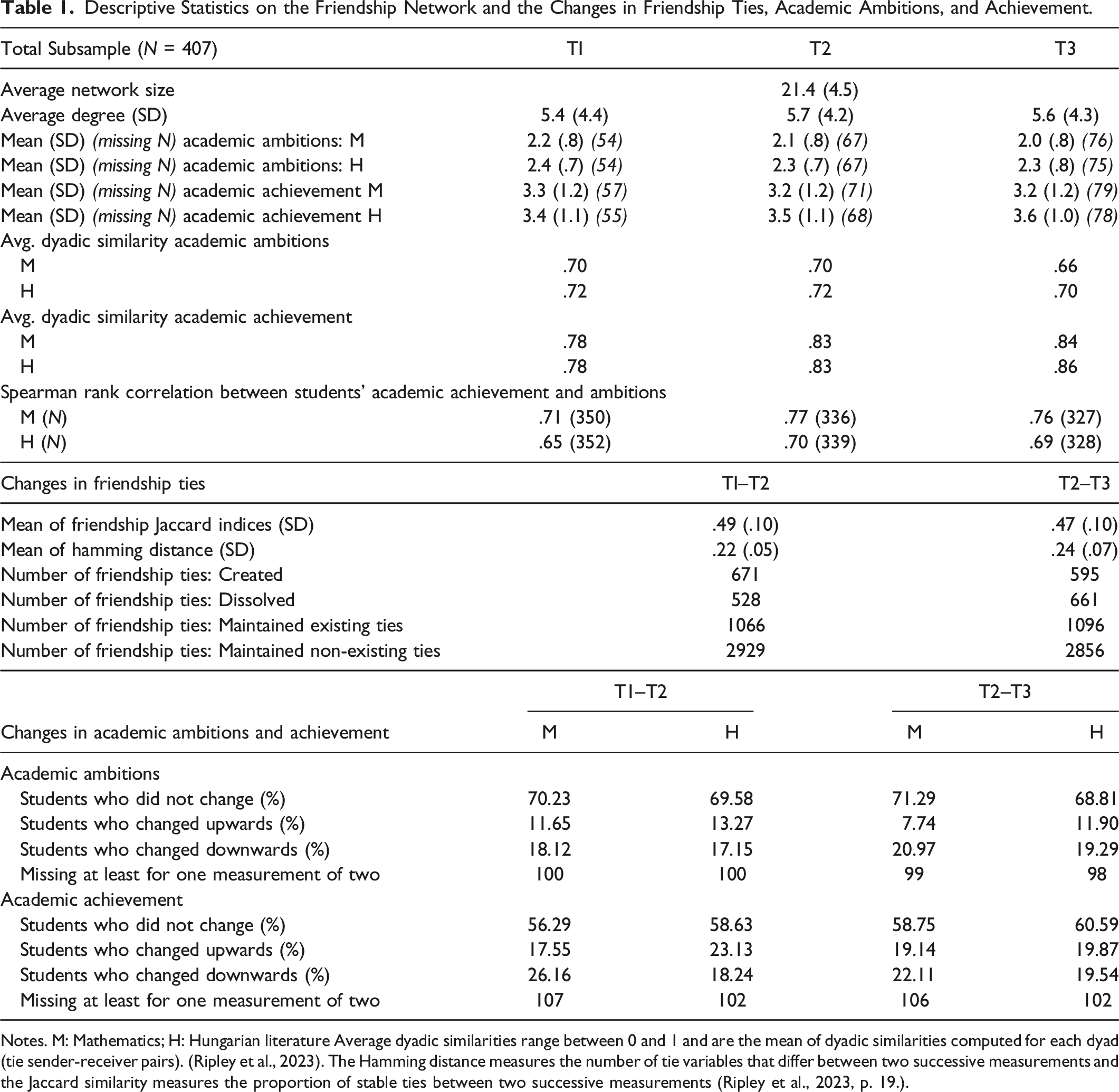
Notes. M: Mathematics; H: Hungarian literature Average dyadic similarities range between 0 and 1 and are the mean of dyadic similarities computed for each dyad (tie sender-receiver pairs). (Ripley et al., 2023). The Hamming distance measures the number of tie variables that differ between two successive measurements and the Jaccard similarity measures the proportion of stable ties between two successive measurements (Ripley et al., 2023, p. 19.).
Academic Ambitions
Under the assumption that academic motivation varies by subject (Green et al., 2007), academic ambitions were measured separately for mathematics and Hungarian literature. Students were asked the following question to assess their ambitions: ‘What grade would you be satisfied with in Hungarian literature/mathematics?’ Students could answer on a scale from 1 to 5, according to the Hungarian grading system. Since the percentage of students who chose 1 or 2 was very low in both subjects (ranging from 1.67 to 3.33% over the measurements), these answers were merged with 3, resulting in three ordered categories: 1: ‘Insufficient, sufficient, or satisfactory’; 2: ‘Good’; 3: ‘Excellent’.
Academic Achievement
Academic achievement in mathematics and Hungarian literature was based on self-reported mid-year grades using a 5-point scale (1: ‘Insufficient’, 5: ‘Excellent’) which are typically received at the end of January or early February. This assessment was made prior to measuring ambitions in the questionnaire (spring).
Friendship
Friendship was represented by an adjacency matrix with binary values. Students could rate their classmates on a scale of 1–5. Those marked with the highest value (5, labelled as ‘a good friend of mine’) were coded as friends (1 = ‘friends’, 0 = ‘not friends’). Ties were either unilateral or reciprocal.
Independent Variables
Some measures are included in the models for either the academic ambitions or the academic achievement dependent variable. In the models of the academic ambitions of the students, the academic achievement of the students and their friends is controlled for beyond modelling the adjustment to friends’ ambitions, while in the models of the academic achievement of the students, the academic ambitions of the students and their friends are controlled for beyond modelling the adjustment to friends’ achievement. This is noted in the detailed specification of the models in Appendix B
Academic achievement (only for the academic ambitions dependent variable). Measured as described in the section on dependent variables.
Individuals engage in comparisons with their past achievements within and across domains, which influence their evaluation of future options (Wan et al., 2021). Consequently, the models include early adolescents’ academic achievement in Hungarian literature/mathematics in comparison to their performance in the other domain, as well as their academic achievement in the same domain
Cross-domain comparison (only for the academic ambitions dependent variable). Individuals frequently compare their performance in different domains and tend to prioritize and value those in which they excel (Möller et al., 2016). Therefore, a dichotomous variable was included to measure whether students’ achievement was higher in one school subject compared to the other (1 for ‘Yes’, 0 for ‘No’). This means that for Hungarian literature ambitions, a cross-domain comparison with mathematics achievement was included and vice versa
Academic ambitions (only for the academic achievement dependent variable). Measured as previously described in the section on dependent variables. This effect should be interpreted as a mere statistical association between the two measures.
Given the well-documented influence of parents on students’ academic performance, motivation, beliefs about their abilities, and aspirations (Bandura et al., 2001; Sewell & Hauser, 1993), students’ perceptions of their parents’ satisfaction with their overall academic performance were included as a control variable in the models with the academic ambitions dependent variable (Bandura et al., 2001; Sewell & Hauser, 1993). Parental background may also influence students’ goals and ambitions (Boudon, 1974; Breen & Goldthorpe, 1997) as well as their academic achievement (see Sirin, 2005 for a review). Therefore, a covariate for parents’ educational background was included.
Gender is an important attribute for the creation and maintenance of friendship ties and the development of academic ambitions. Adolescent friendships are often highly gender-segregated (e.g., Kretschmer et al., 2018). Additionally, there may be gender differences in ambitions related to various school subjects (Belinszki et al., 2020). Therefore, gender was included as a control variable for adjusting one’s ambitions, achievement, and friendship selection.
In Hungary, ethnicity, family socioeconomic status, and student ability are often interrelated due to the disadvantaged family background of Roma studentson average (Kertesi & Kézdi, 2012). In addition, Roma students tend to receive lower grades (Kisfalusi et al., 2021) and have lower expectations for themselves compared to their non-Roma peers as a result of the internalization of labeling mechanisms (Szalai, 2008). Therefore, self-reported ethnic identity was included as a control variable to account for its potential impact on early adolescents’ academic ambitions and achievement.
However, models with ethnic identity and gender did not converge for the behavior dependent variables when the academic ambitions and academic achievement behavior dependent variables were considered in the same model, so these attributes are only included in the friendship selection part of the models. Models for only one behaviour dependent variable (ambitions) converged with ethnic identity and gender and these results are available from the first author upon request.
Descriptive Statistics of the Predictor Variables.
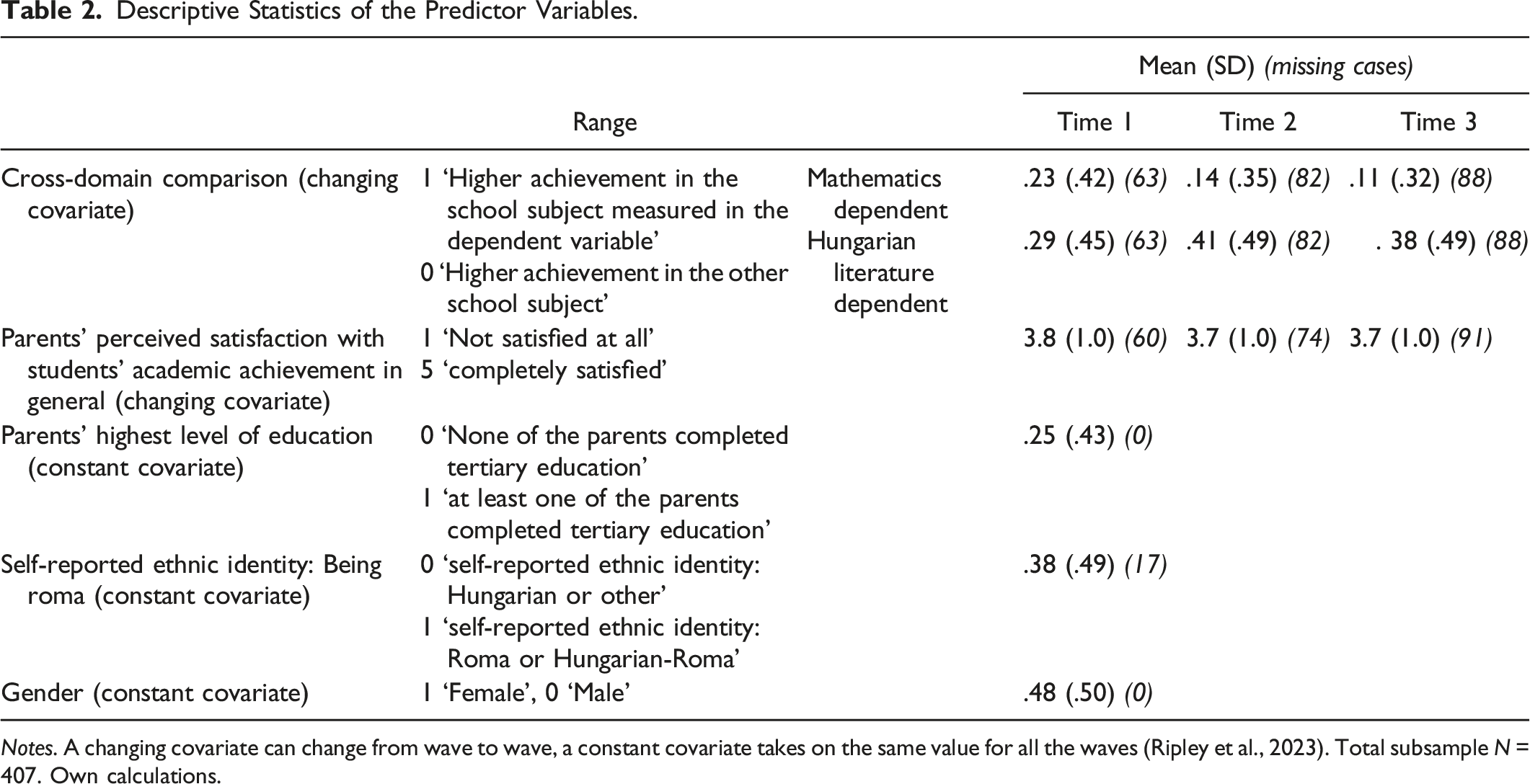
Notes. A changing covariate can change from wave to wave, a constant covariate takes on the same value for all the waves (Ripley et al., 2023). Total subsample N = 407. Own calculations.
Analytical Strategy
The present study employed Stochastic Actor-Oriented Models (SAOM) to analyze the coevolution of friendship ties, academic ambitions, and academic achievement. Stochastic Actor-Oriented Model can disentangle effects of social selection and influence (Steglich et al., 2010) by estimating the interdependent effect of network processes and individual attributes on the evolution of network (in this case, friendship) and individual ‘behavior’ dependent variables (used in a broad sense, in this case, academic ambitions and achievement). We identify selection and influence effects by modelling the decisions students make in light of the changes in their network (Ripley et al., 2023). Students can create, maintain, or terminate friendship ties, and adjust or keep their ambitions and achievement in light of the changes in their network in the school class.
We applied Stochastic Actor-Oriented Models with multiple groups (in this case, school classes) with parameters that vary across groups and parameters that are assumed to be non-varying across groups using Bayesian estimation implemented in sienaBayes (Kaplan & Depaoli, 2013; Koskinen & Snijders, 2023; Ripley et al., 2023). In this approach, the joint probability of the parameters and the data are modeled “as a function of the conditional density of the data given the parameters, and the prior distribution of the parameters” (Kaplan & Depaoli, 2013, p. 410.).
All groups have the same number of time points and identical model specifications. We allow some network parameters to vary randomly across groups. Usually, structural effects for network dynamics are assumed to vary across networks. Other parameters, especially those related to the hypotheses that are expected to hold universally across classrooms, are considered as non-varying through the estimation process (Koskinen & Snijders, 2023). To account for the groups’ own network structure, structural effects on network dynamics were assumed to be random.
Furthermore, fixed effects that resulted in non-converging models were also tested as random effects. These included egoX effects for friendship dynamics and gender and ethnicity effects for behavior dynamics, as well as similarity effects on friendship dynamics for gender and ethnicity. Except for gender and ethnicity similarity effects, varying parameters did not improve convergence for these parameters, so they were removed from the final models. Achieving adequate convergence statistics can be problematic for certain parameters when considering multiple behavior dependent variables together in a single model. This may be due to insufficient changes in the behavior dependent variables or a strong association between the behavior dependent variables (McMillan et al., 2018), which may also extend to how certain covariates affect the behavior dependent variables.
Four independent sequences of the same model configuration were all run with 3000 main iterations, and convergence was assessed using the rstan package (Stan Development Team, 2020) based on monitoring the
Model Specification
Stochastic Actor-Oriented Models allow for the inclusion and parallel handling of multiple behavioral dependent variables and networks (Steglich et al., 2010). We model the co-evolution of friendship ties, academic ambitions, and academic achievement in the same model. Our approach ensures that while we model social influence on ambitions we control for social influence on academic achievement allowing for a clearer interpretation of how friends’ ambitions specifically affect individuals’ academic ambitions. The primary objective of the study is to isolate the influence of friends on academic ambitions. Our analytical approach does not aim to model and test a causal chain, where students assimilate their academic achievement to that of their friends and subsequently adjust their ambitions.
The model results express the probabilities of changes in friendship ties, academic ambitions, and academic achievement between two observations and can be interpreted as log odds ratios in logistic regression models. The influence of friends on the two behavior dependent variables (ambitions and achievement) is modeled by the tendency of assimilating one’s academic ambitions or achievement towards the friends’ same outcome (average similarity effect).
Beyond the average similarity effect for the two behavior dependent variables there are slight differences in the included effects. For the academic ambitions dependent variable, the effect of academic achievement and friends’ average academic achievement on individuals’ tendency to increase, maintain, or decrease their academic ambitions is included. Similarly, for the academic achievement dependent variable, the effect of academic ambitions and friends’ average academic ambitions is included. Further individual-level covariates are also included to model the development of ambitions and achievement (Appendix B).
Regarding friendship dynamics, we included similarity effects for both academic ambitions and academic achievement that can show whether early adolescents’ similarity in their academic ambitions or achievement contributes to the creation and maintenance of friendship ties. Similarity in gender, ethnicity, and parents’ highest level of education were included as possibly confounding effects for friends’ similarity in academic ambitions or achievement.
Alter effects (modeling whether those with higher ambitions or achievement are more likely to be nominated as friends) were included as control variables. Unfortunately, we were unable to achieve model convergence by including ego effects related to the same covariates. This was not solved by allowing time variation, random variation of ego effects, or by excluding from the data nodes with high out-degree centrality relative to their network size (nominating more than half or two-thirds of students in the class) from the data. Consequently, the selection hypothesis had to be evaluated with the constraint that ego effects were not controlled for. We modeled some of the structural effects representing general tendencies for creating and maintaining friendship ties independently from individual characteristics. For instance, this includes reciprocity or indegree popularity, indicating a tendency to send reciprocal friendship nominations and friendship nominations towards popular others, respectively. All the effects are listed in Appendix B.
Results
Descriptive Results
Table 1 shows that most students did not change their ambitions between two assessments. High ambitions in Hungarian literature and low and high ambitions in mathematics were particularly persistent. Nevertheless, a significant proportion of students still adjusted their ambitions. Friends appeared to be similar in terms of their academic ambitions and achievement, as suggested by average dyadic similarities. Furthermore, there was a strong positive association between academic achievement and academic ambitions.
Random Coefficient Multilevel Siena Model Results for Social Influence
Random Coefficient Multilevel Siena Model Results Part 1 (Social Influence on Academic Ambitions).
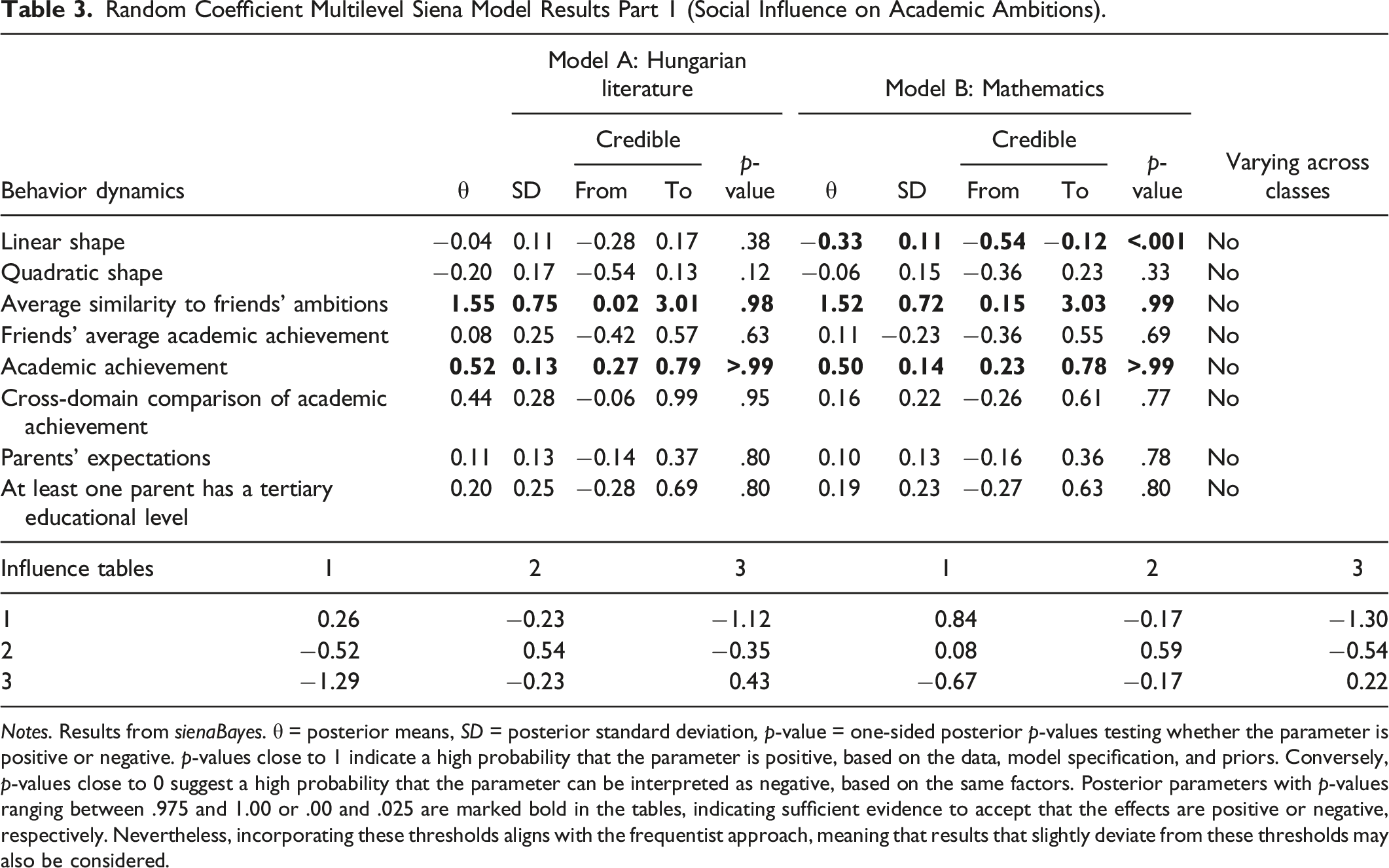
Notes. Results from sienaBayes. θ = posterior means, SD = posterior standard deviation, p-value = one-sided posterior p-values testing whether the parameter is positive or negative. p-values close to 1 indicate a high probability that the parameter is positive, based on the data, model specification, and priors. Conversely, p-values close to 0 suggest a high probability that the parameter can be interpreted as negative, based on the same factors. Posterior parameters with p-values ranging between .975 and 1.00 or .00 and .025 are marked bold in the tables, indicating sufficient evidence to accept that the effects are positive or negative, respectively. Nevertheless, incorporating these thresholds aligns with the frequentist approach, meaning that results that slightly deviate from these thresholds may also be considered.
The results support the Adjustment Hypothesis for both Hungarian literature and mathematics academic ambitions as early adolescents adjusted their ambitions to the ambitions of their friends. The coefficients of the average similarity effects in Table 3 are positive (θ Hungarian = 1.55, SD Hungarian = 0.75, p Hungarian = .98, θ Mathematics = 1.52, SD Mathematics = 0.72, p Mathematics = .99) while simultaneously accounting for social influence on academic achievement (θ Hungarian = 3.31, SDHungarian = 0.75, p Hungarian >.99, θ Mathematics = 2.35, SDMathematics = 0.73, p Mathematics >.99). The average similarity effects for academic ambitions and achievement can be as attributed to social influence because the models account for the contribution of friendship selection to the similar ambitions and achievement of friends.
Random Coefficient Multilevel Siena Model Results Part 2 (Social Influence on Academic Achievement).
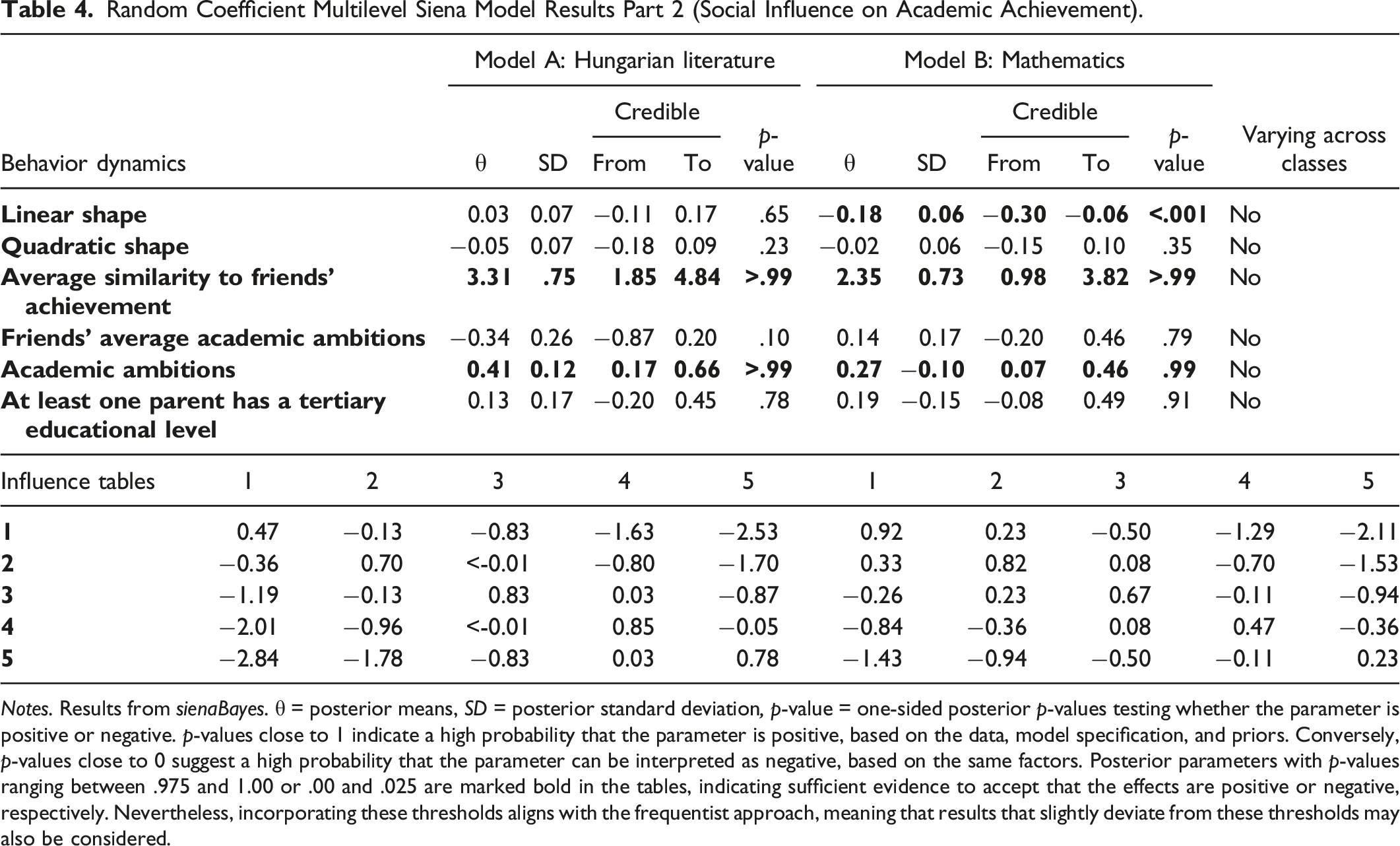
Notes. Results from sienaBayes. θ = posterior means, SD = posterior standard deviation, p-value = one-sided posterior p-values testing whether the parameter is positive or negative. p-values close to 1 indicate a high probability that the parameter is positive, based on the data, model specification, and priors. Conversely, p-values close to 0 suggest a high probability that the parameter can be interpreted as negative, based on the same factors. Posterior parameters with p-values ranging between .975 and 1.00 or .00 and .025 are marked bold in the tables, indicating sufficient evidence to accept that the effects are positive or negative, respectively. Nevertheless, incorporating these thresholds aligns with the frequentist approach, meaning that results that slightly deviate from these thresholds may also be considered.
For Hungarian literature ambitions, the tendency towards similarity was more associated with the influence of friends with moderately high (4) or high (5) ambitions than with that of friends with low ambitions (3 or below). Meanwhile, in mathematics, the tendency to become like one’s friends was more strongly associated with having friends who had either low (3 or below) or moderately high (4) ambitions, rather than friends with high ambitions (5). This is above and beyond the different linear trends in ambitions in mathematics and Hungarian literature. Thus, their friends’ low ambitions in mathematics may also trap students in low ambitions in mathematics. Similarly, friends’ good (4) or excellent (5) grades in Hungarian literature were attractive to adjust to, but less so in mathematics, while heaving friends with low mathematics performance seemed to gravitate students toward lower performance.
Concerning the general tendency to adjust ambitions, students tended to lower their mathematics ambitions (θ = −0.33, SD = 0.11, p < .001) but not their Hungarian literature ambitions (θ = −0.04, SD = 0.11, p = .38) as shown by the linear shape effects.
Random Coefficient Multilevel Siena Model Results for Social Selection
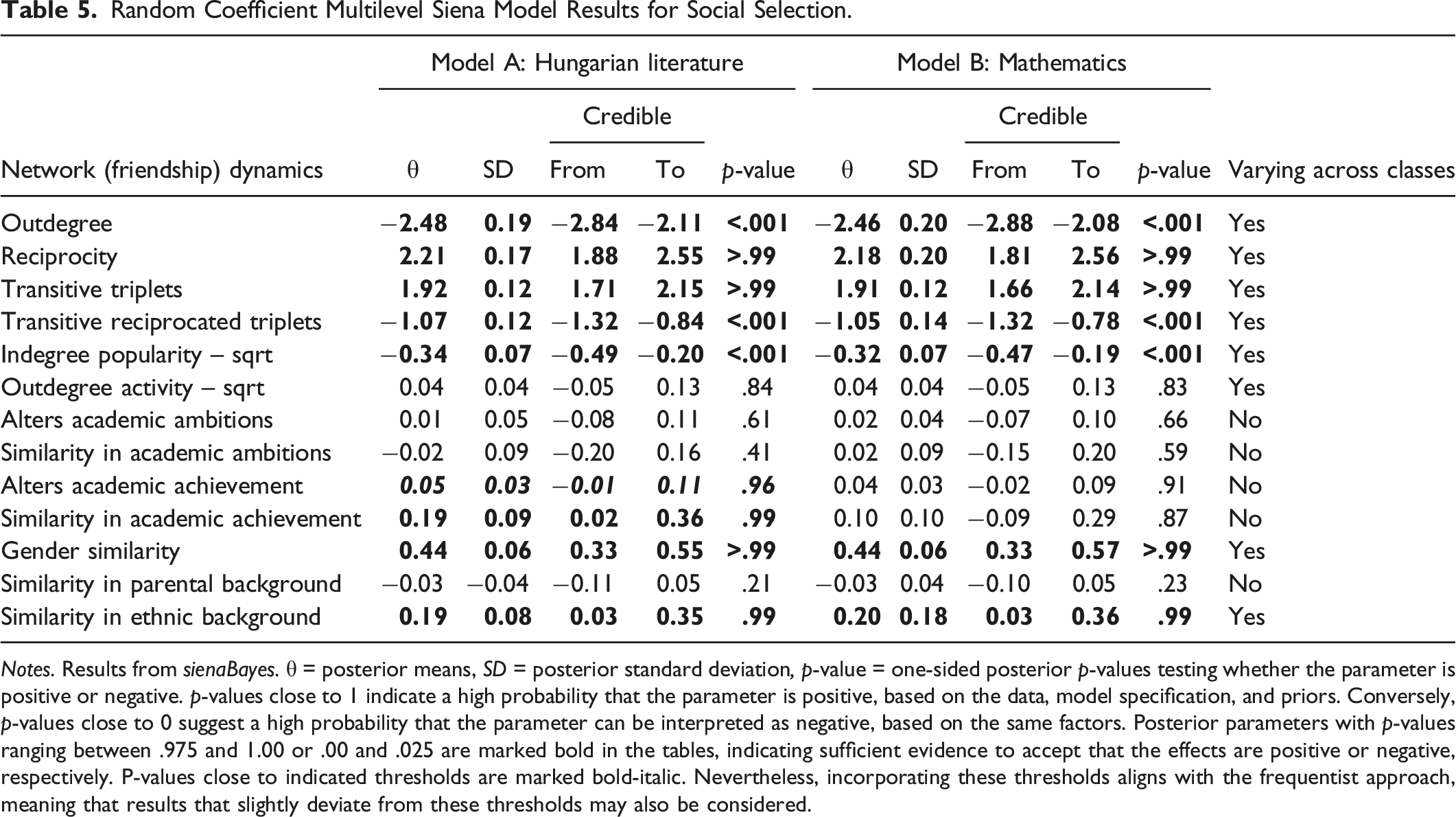
Random Coefficient Multilevel Siena Model Results for Social Selection.
Notes. Results from sienaBayes. θ = posterior means, SD = posterior standard deviation, p-value = one-sided posterior p-values testing whether the parameter is positive or negative. p-values close to 1 indicate a high probability that the parameter is positive, based on the data, model specification, and priors. Conversely, p-values close to 0 suggest a high probability that the parameter can be interpreted as negative, based on the same factors. Posterior parameters with p-values ranging between .975 and 1.00 or .00 and .025 are marked bold in the tables, indicating sufficient evidence to accept that the effects are positive or negative, respectively. P-values close to indicated thresholds are marked bold-italic. Nevertheless, incorporating these thresholds aligns with the frequentist approach, meaning that results that slightly deviate from these thresholds may also be considered.
Regarding the tendency to form and maintain friendship ties in relation to academic achievement, the results differ for the two school subjects. Our Selection Hypothesis is supported only for Hungarian literature and not for mathematics, as similarity in academic achievement only affected friendship selection with regard to Hungarian literature (θHungarian = 0.19, SDHungarian = 0.01, pHungarian = .99, θMathematics = 0.10, SDMathematics = 0.10, p Mathematics = .87). The students seemed to be more likely to become and/or stay friends with other students who were similar to them with respect to their academic achievement in Hungarian literature while also accounting for similarity in academic ambitions, same gender, same ethnicity, similar parental background, or structural effects. Nevertheless, it is important to treat social selection results based on academic achievement with caution due to the exclusion of ego effects.
Students with high ambitions were no more likely to receive friendship nominations than those with lower ambitions, in either of the subjects.
Discussion and Conclusions
In this study, we used longitudinal multilevel social network analysis to distinguish social influence on academic ambitions from social selection as well as social influence and selection processes in relation to academic achievement. Our approach and results underscore the importance of studying social network mechanisms in relation to academic ambitions and academic achievement together.
We found strong evidence for the social influence of friends on each of these outcomes. Our results indicate that the academic ambitions of friends influence individuals’ academic ambitions, and the academic achievement of friends have a significant impact on individuals’ academic achievement. Our study was able to disentangle simple social influence effects within these domains of outcomes from complex social influence effects across the two domains. While we found evidence for social influence within the domains, we did not find evidence for complex social influence from friends’ achievement to individuals’ ambitions or from friends’ ambitions to individuals’ achievement, controlling for cross-domain within-individual effects.
The analysis also revealed subtle differences in the operation of social influence processes for the two school subjects. In Hungarian literature, friends’ high ambitions seemed to be more attractive than their low ambitions. In mathematics, however, the low ambitions of friends seemed to contribute to the trapping of students with low ambitions. These different patterns of social influence across academic disciplines may be due to the distinct positioning of mathematics relative to other subjects. Unlike reading and writing, math achievement is often correlated with perceived innate ability (Gunderson et al., 2017) and tends to be more closely associated with individual interest (Jansen et al., 2016). In addition, math anxiety often leads to avoidance and reduced competence (Ashcraft, 2002). Friends who reinforce math inadequacy beliefs may consequently discourage each other from pursuing the subject.
While our results are robust with regard to the operation of social influence effects with respect to the two school subjects, we found differences in the extent to which selection mechanisms based on academic achievement take place. While similarity in academic achievement in Hungarian literature contributed to friendship selection as hypothesized, similarity in academic achievement in mathematics did not affect friendship selection, contradicting our initial hypothesis. This finding is partially consistent with prior research indicating that academic achievement signals other relevant characteristics to peers, which in turn shapes friendship ties (Lomi et al., 2011; Torlò & Lomi, 2017).
Family background influences reading attitudes and performance (Rogiers et al., 2020), and students who enjoy reading typically achieve higher reading comprehension (Cheema, 2018; Kush et al., 2005). Students can engage socially through shared book experiences (Wigfield, 1997), and similar reading attitudes and performance may also indicate socioeconomic similarities that facilitate friendships. However, it is essential to exercise caution when interpreting the results of social selection, given the exclusion of ego effects.
The generalizability of the results may be limited by the initial sampling procedure, which resulted in an overrepresentation of less advantaged schools in the sample. Future studies replicating the research in different contexts and using alternative data sources could potentially address this limitation. Despite these limitations, our study makes a substantial contribution to understanding the impact of social influence on educational outcomes. It is the first comprehensive analysis to disentangle the effects of social influence from selection on academic ambitions, taking into account social influence on academic achievement and social selection based on academic achievement. Our findings clearly show that friends’ academic ambitions can be meaningful for the development of students’ ambitions beyond the influence of friends’ academic achievement on students’ academic achievement. The results also underscore the domain-specific nature of academic motivation (Green et al., 2007; Jansen et al., 2016) and highlight the domain-specificity of friendship selection and influence mechanisms related to academic values (Chow et al., 2018), warranting domain-specific investigations.
Footnotes
Acknowledgements

Declaration of Conflicting Interests
The author(s) declared the following potential conflicts of interest with respect to the research, authorship, and/or publication of this article: The first author of the study has a close working relationship with the editors of the Special Issue. The fourth author of this study is an editor of the Special Issue but has not overseen the review process of the present study.
Funding
The author(s) disclosed receipt of the following financial support for the research, authorship, and/or publication of this article: Eszter Vit and Károly Takács gratefully acknowledge the funding from the European Research Council (ERC) under the European Union’s Horizon 2020 Research and Innovation programme (grant agreement No 648693, PI: Károly Takács). Federico Bianchi acknowledges funding from the Italian Ministry of University and Research under the PRIN 2017 program (“14ALL - One for all, all for one. Reputational mechanisms for aggression, revenge, and forgiveness in intergroup relationships”, 20178TRM3F_002), National Research, Development and Innovation Office (ITM NKFIH), Hungary (FK 137765) and the Cariplo Foundation (“SOCIABLE - The Brescia nexus: SOCIal infrastructure and cognitive ABiLitiEs in an ageing population”). The original computations were enabled by resources provided by the Swedish National Infrastructure for Computing (SNIC) at Linköping University, partially funded by the Swedish Research Council through grant agreement no. 2018-05973.
Steps for Selecting the Subsample for the Analysis.
Time 1
Time 2
Time 3
Data collection wave
Wave 4
Wave 5
Wave 6
School grade
6th
7th
8th
Academic year (spring semesters)
2014/2015
2015/2016
2016/2017
Nschools
34
26
25
Nclasses
53
39
37
Nstudents
1054
743
663
Mean age (SD)
12.7 (0.8)
13.6 (0.7)
14.6 (0.7)
School classes present in all three waves
37
Nr of classes with a participation rate of more than 75% in any of the successive waves and with a change in composition of less than 20% between any of the waves
21
Subsample in the present analysis: At least one change for each period (T1-T2 and T2-T3) in both school subjects
19 (N = 407 students)
Age of students in the subsample
Age12Time1 = 48.44%, Age13Time1 = 40.79%, Age14Time1 = 5.38%, AgeolderTime1 = 5.39%
Cmparison of academic ambitions and achievement in the two school subjects in classes that participated in all three waves by whether students’ class was included in the AnalysisWilcoxon rank sum test (p-value)
Academic ambitions: Hungarian literature
W = 67346 (.03)
(N = 705)W = 51016 (.05)
(N = 617)W = 46499 (.08)
(N = 592)
Academic ambitions: Mathematics
W = 64830 (.28)
(N = 705)W = 51450 (.08)
(N = 621)W = 44361 (.56)
(N = 592)
Academic achievement: Hungarian literature
W = 64324 (.30)
(N = 701)W = 47751 (.80)
(N = 620)41922 (.60)
(N = 590)
Academic achievement: Mathematics
W = 67076 (.03)
(N = 702)W = 48119 (.82)
(N = 617)W = 46215 (.10)
(N = 590)
Model Specification.
Notes. Ripley et al. (2023).
Effect name (RSiena effect name)
Modelling the Tendency of…
Friendship dynamics
Structural effects
Outdegree (density)
Creating and maintaining friendship ties
Reciprocity (recip)
Reciprocating friendship ties
Transitive triplets (gwespFF)
Creating and maintaining friendship ties with friends of friends
Indegree popularity – sqrt (inPopsqrt)
Creating and maintaining friendship ties with those actors who have more incoming ties
Outdegree activity – sqrt (outPopsqrt)
Those actors with more outgoing ties creating and maintaining friendship ties
Alters academic ambitions (altX)
Creating and maintaining friendship ties with those who have higher academic ambitions
Similarity in academic ambitions (simX)
Creating and maintaining friendship ties with those with similar academic ambitions measured by the centered similarity scores between an actor and those whom that actor is tied to
Alter’s academic achievement (altX)
Creating and maintaining friendship ties with those who have higher academic achievement
Similarity in academic achievement (simX)
Creating and maintaining friendship ties with those with similar academic achievement measured by the centered similarity scores between an actor and those whom that actor is tied to
Similarity in parental background (simX)
Creating and maintaining friendship ties with those with similar parental background measured by the centered similarity scores between an actor and the actors that actor is tied to
Gender similarity (simX)
Creating and maintaining friendship ties based on gender similarity measured by the centered similarity scores between an actor and the actors that actor is tied to
Ethnic similarity (simX)
Creating and maintaining friendship ties based on ethnic similarity measured by the centered similarity scores between an actor and the actors that actor is tied to
Similarity in parental educational background (simX)
Creating and maintaining friendship ties based on similarity in parental educational background measured by the centered similarity scores between an actor and the actors that actor is tied to
Behavior dynamics
Linear (linear)
Educational ambitions/achievement changing (increasing or decreasing) over time
Quadratic shape
The effect of academic ambitions/achievement on itself
Average similarity (avSim)
Students’ assimilating their academic ambitions/academic achievement to their friends’ average academic ambitions/academic achievement measured by the centered average similarity scores between an actor and the actors that actor is tied to
Alters (friendship) average academic achievement (for academic ambitions)/academic ambitions (for academic achievement) (avXAlt)
Cross-behavior influence: The tendency of adolescents to change their ambitions/achievement in response to friends’ academic achievement/ambitions
Ego’s academic achievement (effFrom)
Students’ academic achievement adapting (increasing or decreasing) their academic ambitions
Ego’s academic ambitions (for academic achievement) (effFrom)
Students’ academic ambitions adapting (increasing or decreasing) their academic achievement
Cross-domain comparison (for academic ambitions) (effFrom)
Students’ academic achievement compared to the other school subject (higher or not) adapting (increasing or decreasing) their academic ambitions
Parents’ expectations (for academic ambitions) (effFrom)
Adapting (increasing or decreasing) their academic ambitions in response to their parents’ higher expectations
Having at least one parent with a tertiary educational level (effFrom)
Students with at least one parent who has a tertiary education level adapting (increasing or decreasing) their academic aspirations