



Abstract
The aim of this study was to explore the experiences and perceived impact of the COVID-19 lockdowns among early adolescents in the northwest of England, as well as explore the self-care and coping strategies that helped the young people continue to thrive. Fourteen adolescents, 9 boys and 5 girls, were recruited from four secondary schools in North West England. Remote online interviews were conducted. Inductive reflexive thematic analysis was used to analyse the interview data and four themes were identified: (1) change: ‘life feels weird’; (2) embracing lockdown; (3) feelings of loss; and (4) stress, worry and challenge. Processes identified will be able to help inform policy and practice for supporting adolescents in the future, including the promotion of positive coping strategies and the provision of resources for young people, schools and families.
The COVID-19 pandemic is sweeping the world, with many lives lost (World Health Organization, 2021). Across the UK, both local and national restrictions are enforced to help prevent the spread of COVID-19. For example, not mixing with other households, not allowing other households into your home and children not attending school unless they are vulnerable or children of keyworkers (Gov.UK, 2021). These precautions aim to reduce the spread of infection (British Medical Association, 2020). However, the isolation of lockdown inevitably had a negative impact on some people’s mental health (Usher et al., 2020). Indeed, Reger et al. (2020) described the COVID-19 pandemic as a ‘perfect storm’ for inducing emotional distress. Pandemics are associated with uncertainty, ambiguity and loss of control, as well as worries about one’s own and others’ health, lifestyle disruptions, social isolation and loneliness – all of which are known risk factors for heightened mental health difficulties and poorer wellbeing (Shanahan et al., 2020). Specifically, the COVID-19 pandemic, including both the disease itself and the associated prevention measures, presents particular challenges to adolescents (Dvorsky et al., 2020). Factors such as school closures, social distancing requirements, cancelled plans and loss of face-to-face relationships can all be especially difficult for young people to manage (Branquinho et al., 2020), particularly at a time when they are already at a heightened vulnerability for mental health difficulties.
Some evidence already exists for the negative effects of the COVID-19 pandemic and associated lockdown on the mental health and wellbeing of young people. However, the potential positive elements of lockdown, and the effective coping strategies that have been used have so far, have been somewhat overlooked. Furthermore, most research has investigated the impact on adults or older adolescents (16–19 years, e.g. Demkowicz et al., 2020; Pascual-sanchez et al., 2020); less evidence exists regarding the effects on younger adolescents. This is particularly important given that they are at a critical stage in their development (Kim-Cohen et al., 2003). Thus, there is a clear need for further research within this population.
This study aims to explore early adolescents’ (11–14 years old) experiences during lockdown and on their return to formal schooling, focusing on both the perceived positive and negative impacts. The study also aims to explore the self-care and coping strategies adopted by early adolescents to support their mental health and wellbeing, both during lockdown and on their return to formal schooling (September–December 2020). The resilience processes identified in young people’s environments will provide insights into the most beneficial factors that can be promoted, in order to support adolescents in the future. These insights may help to inform policy and practice when supporting adolescents post-pandemic, and during any future similar events.
Risk in Early Adolescence
Early adolescence (age = 11–14 years) is not only a key period of development, but is also associated with the onset of symptoms of mental health conditions. Fifty percent of lifetime cases of mental health conditions have their first onset by age 14 years (Kim-Cohen et al., 2003), and rates of emotion disorders (i.e. depression and anxiety) in adolescents have been increasing in recent years (3.9% in 2004 to 5.8% in 2017; Vizard et al., 2018). Thus, when combining rates of previous emotional difficulties with the potential detrimental effects of the COVID-19 pandemic, the impact on adolescents’ mental health and wellbeing is a cause for concern. Early evidence is already indicating that adolescents’ mental health has suffered, with a study conducted in China highlighting the higher rates of anxiety and depression in adolescents aged 12–18 following the pandemic (Zhou et al., 2020). There is also evidence to suggest that, relative to adults, adolescents are at an increased likelihood of experiencing mental health problems such as depression and anxiety, and heightened stress, including post-traumatic stress, as a result of COVID-19 (Liang et al., 2020; Pascual-sanchez et al., 2020; Raccanello et al., 2020).
One potential key area of challenge for adolescents is the repeated school closures (March–July 2020 and January–March 2021 to date), which may have resulted in reduced face-to-face contact with peers. Early adolescence is a time when young people typically grow in independence and begin to prioritise relationships with peers over family members (The Lancet Child & Adolescent Health, 2020). Peer relationships are also associated with positive wellbeing and adjustment during adolescence (Žukauskiene, 2014); they serve as an important source of both social support and influence, helping to shape young people’s behaviour, identity and attitudes (Telzer et al., 2018). As such, adolescents’ normative developmental experiences are likely to have been disrupted during this time. As adolescents are also more likely to seek mental health support from friends than family or formal services (Radez et al., 2020), it is unclear who they will feel able to turn to should they experience any difficulties, potentially compounding the problem. While the long-term effects of lockdown are unknown, evidence from previous pandemics indicates that loneliness during quarantines is associated with long-term depression and anxiety in adolescents (Sprang & Silman, 2013).
In addition, school closures may have meant that adolescents have missed out on a host of valuable opportunities and resources that extend far beyond their social development. For instance, adolescents were required to continue their schooling in the home environment, with reduced support and instructional time from teachers. UNESCO (2020) has highlighted the interruption to learning as a key adverse consequence of the pandemic, with lockdown exacerbating existing disparities and health inequalities within the education system.
Resilience in Early Adolescence
While there are undoubtedly potential negative social, educational and mental health impacts of the COVID-19 pandemic and associated lockdown on adolescents, a sole focus on risk will miss the young people who evade difficulties and continue to thrive, despite adversity. In other words, those adolescents who display resilience (Wright et al., 2013). Just as we need to understand which young people are at increased risk of mental health conditions during this pandemic, it is equally important to understand which adolescents do well, and why (Dvorsky et al., 2020). An understanding of the resilience processes that some adolescents use to cope can advance our understanding of how young people respond to crises, and can help inform the services and resources offered (Dvorsky et al., 2020).
Resilience is considered to be a dynamic process that all young people are capable of demonstrating if the appropriate mechanisms are in place (Luthar & Cicchetti, 2000; Masten, 2001). While the literature has historically focused on resilience as a personality trait that some children can possess, recent research in the field has demonstrated a shift in focus from the individual, to the individual’s interactions with their environment and specifically the factors in their environment that facilitate wellbeing under stress (Ungar, 2011b, 2012). Thus, in keeping with Bronfenbrenner’s ecological systems theory (Bronfenbrenner, 1977), resilience work is moving away from the study of vulnerable young people, to a focus on the socio-ecological factors that operate at multiple levels across domains to promote positive wellbeing, emphasising the value of community and familial factors (Landau, 2010). Furthermore, it is thought that these levels interact with and impact one another (Masten, 2007). Ungar (2011a) further developed this by suggesting that resilience could be understood as a child’s ability to access the resources, known as ‘protective factors’ they need from the community, in order to establish and maintain their wellbeing in the face of risk or adversity.
However, there is also some research to suggest that certain characteristics relating to an optimistic outlook and curiosity are important for promoting resilience during the COVID-19 pandemic (Xie et al., 2020). For instance, the aforementioned Chinese study reported that adolescents with higher levels of optimism for the COVID-19 pandemic had lower levels of anxiety and depression symptoms (Zhou et al., 2020). The TELL study, a qualitative research project with older adolescents aged 16–19 years in the UK, also found that some young people attempted to adopt a positive outlook in order to care for their wellbeing during the pandemic (Demkowicz et al., 2020). Among participants in the TELL study, it was common for this attempt at a positive mindset to be an intentional coping strategy for promoting good mental health. Notably, many adolescents actively engaged in self-care and implemented adaptive coping strategies in an attempt to look after their mental health. These included engaging in enjoyable activities, creating a routine, participating in hobbies, exercising regularly and keeping in touch with friends. A Portuguese study of adolescents and young adults (aged 16–24) found similar themes regarding intentional coping strategies (Branquinho et al., 2020).
Contrary to some reports, adolescents have reported benefits of lockdown. They viewed it as an opportunity for growth and development, to learn new skills and welcomed the additional free time they had to relax (Branquinho et al., 2020; Demkowicz et al., 2020). Others were grateful for the opportunity to avoid the normal pressures of daily life, particularly the social pressures to fit in at school (Demkowicz et al., 2020). It is possible that for some young people, for instance, those who experience peer victimisation at school or who have difficulties with social anxiety, that lockdown may even have been preferable (Dvorsky et al., 2020). Thus, for some adolescents, the real concern comes when they return to full-time schooling. It is currently unclear how they will respond; there is a paucity of research in this area. However, the additional disruption that lockdown brings, combined with the perceived negative consequences of returning to school, may well result in heightened levels of emotional distress for these young people.
The Current Study
While evidence exists for the negative effects of the COVID-19 pandemic and associated lockdown on the mental health and wellbeing of young people, the potential positive elements of lockdown, and the effective coping strategies that have been used have so far, still need to be explored. Furthermore, most research has investigated the impact on adults or older adolescents (16–19 years, e.g. Demkowicz et al., 2020; Pascual-sanchez et al., 2020); less focus has been given to the effects on younger adolescents. Finally, the evidence base has mostly involved quantitative research. While this is valuable in terms of identifying the scale of the disruption the pandemic has caused, it does not allow for subjective, individual experiences, or acknowledge the heterogeneity in the early adolescent population (Dvorsky et al., 2020). Indeed, the voice of young people is a valuable resource both during and after the COVID-19 pandemic (Branquinho et al., 2020). Young people can contribute important knowledge relating to their problems and needs (Ozer & Piatt, 2017) and so this study intends to explore their experiences during lockdown and on their return to formal schooling, focusing on both the perceived positive and negative impacts. The study also aims to explore the self-care and coping strategies adopted by adolescents to support their mental health and wellbeing. In turn, the resilience processes identified in young people’s environments will provide insights into the most beneficial factors in different socio-ecological domains (e.g. school, community and family) that can be promoted, in order to support adolescents in the future. These insights may help to inform policy and practice when supporting adolescents post-pandemic, and during any future similar events. In line with the aforementioned aims, research questions are as follows: 1. What are early adolescents’ experiences of lockdown and return to formal schooling during the COVID-19 pandemic? 2. What resilience processes did early adolescents describe across socio-ecological domains that promoted good mental health and wellbeing during the COVID-19 pandemic? 3. What self-care and coping strategies do early adolescents describe using during the COVID-19 pandemic to support their mental health and wellbeing?
Methods
Design
The current study utilised qualitative interview data collected as part of the Adolescents’ Lockdown-Induced Coping Experiences (ALICE) study. The ALICE study was conducted in the North West of England with five secondary schools between September and December 2020, when all pupils were in school. Pupils in years 7–9 (aged = 11–14 years) participated. Schools sent information sheets to the parents/carers of all pupils in these year groups, along with a link to an online survey, consisting of a suite of measures exploring young people’s mental health and wellbeing during the COVID-19 pandemic, and their experiences of lockdown. 294 young people participated in the survey. At the end of the survey, young people were asked to provide their parents’ contact details if they would like to opt-in to a follow-up one-to-one qualitative interview. The parents of these young people were then contacted, and their opt-in consent sought. The ALICE study received ethical approval from the institutional Research Ethics Committee (Ref: 20/NSP/037).
Participants and Recruitment
All schools in the ALICE study were secondary schools. Two were coeducational and two were single sex (one boys’ and one girls’). The single sex schools were both academically selective, and the girls’ school was fee paying. Sixty-five (22%) young people consented to be contacted for a qualitative interview. The parents/carers of all potential participants were sent an email containing an information sheet and a parent consent form. In total 17 parents expressed interest in the interview and 14 (82%) consented for their child to take part. In total, pupils from four schools took part in the interviews, with 57% of the young people attending the first school, and the remaining students attending the four others.
The mean age for participants was 12 years (range = 11–13 years) with nine boys (64%) taking part and five girls (36%). Forty-three percent of the interviewees were from Black, Asian and Minority Ethnic (BAME) groups, and the remainders were White/British.
Data Collection
Data were collected using semi-structured one-to-one interviews (see Supplementary files). A bespoke semi-structured schedule was developed for the study, and was designed to act as a guide to ensure specific topics were addressed, whilst also allowing for unanticipated responses (Galletta, 2013). Interviews lasted on average 26 minutes (16.5–41.3 minutes’ range). Broad topics covered in the interview schedule included wellbeing during the pandemic, coping strategies and resilience processes that promoted wellbeing in various domains of adolescents’ socio-ecological environments, such as relationships with family and friends, home life, experiences of and feelings towards lockdown and COVID-19 and changes to schooling, for example, ‘I’d really like to hear about the things that you think have helped with your wellbeing during lockdown. What do you think these might be?’. Prompts and probes were utilised where necessary to encourage participants to elaborate on their answers, clarify unclear responses and ensure resilience processes across multiple socio-ecological levels were captured (e.g. social, community and home factors).
Due to on-going COVID-19 restrictions, the interviews took place online via Microsoft Teams and fully informed opt-in assent was taken prior to the interview beginning. To account for ethical concerns when interviewing young people, care was taken to minimise power imbalances and to ensure participation was voluntary and fully informed. For example, prior to starting the audio recording, the researcher introduced themselves to the young people and engaged in light conversation to build rapport (Arksey & Kinght, 1999; Cohen et al., 2007; Eder & Fingerson, 2003). They also explained the study in detail, reiterated that the study was voluntary and that they could stop at any time and offered an opportunity to ask questions. The young people were asked to think of a pseudonym for anonymity purposes. Young people were offered the option to choose their own pseudonym to increase feelings of control and ownership of their data (Allen & Wiles, 2016).
Analytic Strategy
The audio recordings were transcribed verbatim using the Otter programme (www.otter.ai) and were reviewed and validated by the researchers. Analysis took place in NVivo 11 (https://www.qsrinternational.com/nvivo/). Braun and Clarke’s (2006, 2019) reflexive thematic analysis was used to analyse the data. We adopted an inductive approach, focusing on what was personally meaningful to participants. An iterative coding process was utilised, which enabled the continual revision of themes until the final classifications of major themes were agreed by the team, ensuring trustworthiness and rigour. This approach aligned with our focus on developing rich experiential themes that could capture latent features of the data (rather than purely semantic) and thus offer nuanced insights into participants’ subjective experiences.
Transcripts were analysed by four authors (EA, PS, JC, AH). Braun and Clarke’s six stage guide (2006) was used (Figure 1).EA began analysis first, familiarising themselves with the dataset and generating initial codes. After approximately 25% of the transcripts had been coded, these codes were explored to develop an initial set of themes. The remaining three authors analysed the final 75% of the transcripts, reviewing the themes and developing further codes as appropriate. Once all data had been analysed, authors engaged in reflexive discussion to explore the decisions made and examine where further consideration may be valuable; the thematic structure was then revisited and developed in line with this discussion. The approach taken was informed by quality and rigour principles and guidance, particularly those recommended by Yardley (2000) of sensitivity to the research context, commitment and rigour, transparency and coherence and impact and importance. Trustworthiness criteria outlined by Nowell et al. (2017) were also adhered to throughout all stages of the analysis, such as following an iterative process, engaging in peer debriefing and researcher triangulation throughout and ensuring a team consensus on themes.
Findings
Overview of themes and subthemes.
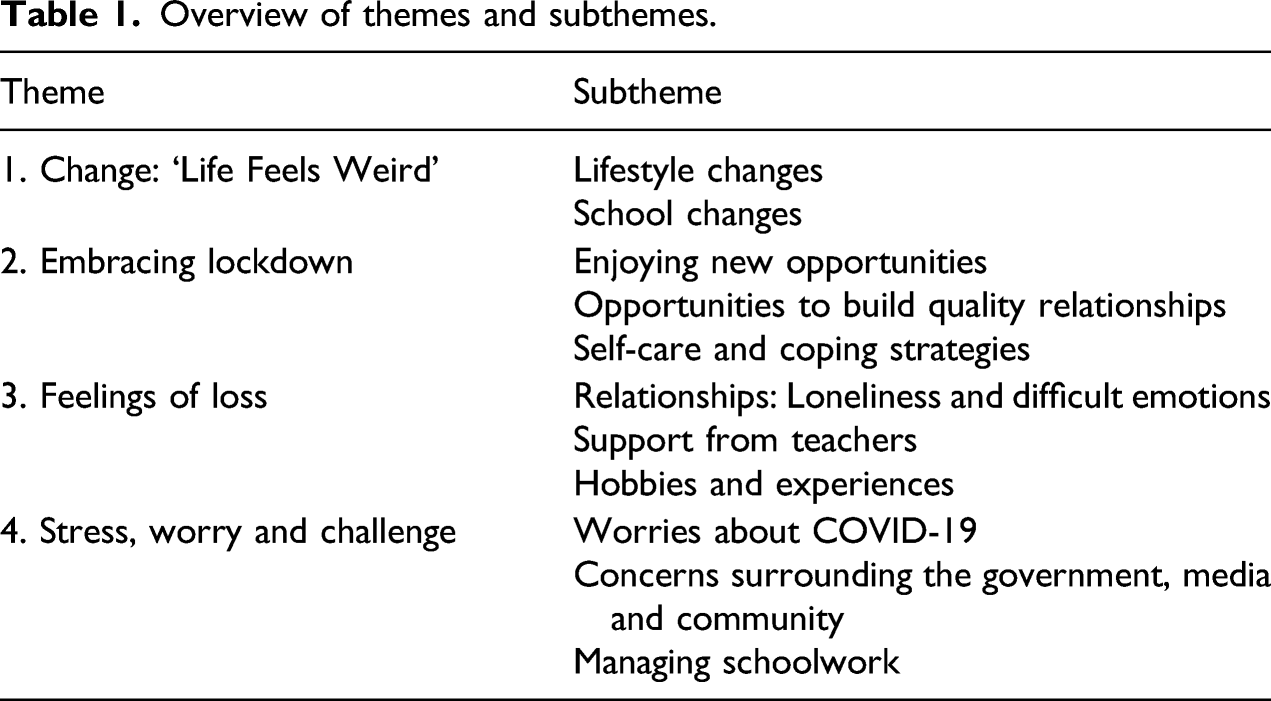
Change: ‘Life Feels Weird’
Several young people used the word ‘weird’ to describe how their life had changed during the COVID-19 pandemic. The most frequently identified changes were associated with either their lifestyle or schooling.
Lifestyle changes
In terms of lifestyle changes, when asked what had changed since lockdown, young people often identified factors relating to their daily routine, for instance: ‘I was awake around about the same time, but instead of having to get up, I either read a book or just watched my pad and just had breakfast’ (Peter). Indeed, several participants noted the opportunity to have a ‘lie in’, stay in their pyjamas and have a more relaxed morning with a ‘better’ breakfast. Conversely, some young people said that their daily life had ‘mostly stayed the same’ (Bruce). One participant recognised that this was due to their parents being key workers: ‘well my dad was still at work, so it kind of felt that was normal’, although recognised that there were still elements of their daily routine that had changed: ‘we had a system, so he would come home, and he put his work clothes in the wash, and he’d go to shower, so that’s new. We do that every time we come in now… so... we know we’re safe’ (Isabel).
However, for some participants, lockdown presented what they perceived as negative changes to certain health routines. For example, two participants noted that their ‘sleeping pattern was very bad’ (Elsa), another commented on their increased food intake: ‘everyone in my family were just eating and eating’ (Mr Miyagi). Others mentioned the lack of exercise: ‘normally you’d do martial arts, you’d do football, you’d do swimming. So as well as school you’d be doing all of those things… And then all of a sudden all of that was off’ (Jeff).
Some participants described that having to stay in the house during lockdown meant they lost some independence, which they found hard: ‘[I was] quite upset that I wasn’t able to like see people and go out and stuff. It was quite frustrating because I just wanted to go out but I couldn't’ (Sofee). Often, the frustration was focused on not being able to go out with their friends: ‘we were locked inside of our houses. And I really like, with my friends sometimes, when I’m allowed some alone time or something, or like I’m allowed to go out with my friend, which I find… that quite nice and nice to get a break’ (Jeff).
One notable change in young people’s lives was their relationships with friends and family. For some, they felt lockdown had caused them to drift from their friends: ‘I definitely played a lot less with [my friends]. I don't know why it was I just wasn't really enthusiastic enough to play with them. They didn't really play with each other as well’ (Olaf). Whilst some still enjoyed talking to their friends online, most felt that they were drifting from them and found using technology to keep in touch ‘really weird, almost unnatural’ (Bruce).
School changes
With regards to school changes, participants tended to focus on their experiences of working from home, and discussed how school was different when they returned in September 2020. Most talked about home schooling, specifically how the timings of their day shifted, and they often finished all of their work early: ‘We could do it any time that we wanted, so that was absolutely amazing. The work was actually kind of fun to do on like your laptop and all that instead of like a loud, noisy classroom’ (Elsa); ‘because I finished at 11 I didn't really need the breaks, so that was fine and then I just got the rest of the day off’ (Olaf). However, for some participants, they felt that they had lost their sense of routine, and almost all participants preferred ‘the getting up and going to school routine’ (Peter). Without the routine of school, some found it difficult to work independently and motivate themselves to do their schoolwork, explaining: ‘it was quite tough… it would be a struggle to get me to start doing it’ (Trevor).
On returning to school, most participants commented on the extra restrictions that were in place: ‘It’s a bit weird because you have to wear like masks in the corridors and stuff. And you stay in the same classroom all day. You don't really get to walk around as much in school and stuff’ (McEye). Several young people described how school had ‘changed quite a lot’ and felt ‘strange’ (McEye, Alfred) with the new restrictions, highlighting requirements such as having to sit in specific seating plans, wear masks, be in the same classroom all day, have less breaks, be in bubbles and sanitise all of the equipment. However, all young people recognised that these changes were implemented to keep them safe: ‘[before] we wouldn't have to worry about Coronavirus but now we need to be extra careful’ (Isabel).
Embracing Lockdown
All young people described the positives of lockdown, and most made a conscious effort to engage in self-care and make the most of the situation.
Enjoying new opportunities
All participants identified some positives of lockdown when asked about their experiences. Some said they enjoyed having more free time, and welcomed this opportunity to have ‘more time to relax’ (Sofee) and ‘rest a bit more and… get away from the stress of school’ (Bruce). The majority of participants also commented that they enjoyed using the extra time to engage in existing hobbies such as playing games online or with siblings, watching television and baking: ‘a positive is like, I get to stay home and that and like I get to catch up on my favourite TV shows and I just get to do loads of fun stuff’ (Elsa). Others also described using lockdown as an opportunity to ‘find new hobbies’ (McEye) or learn a skill: ‘I’ve got a lot more like practical abilities like I can cook, I can cook pasta after it and yeah I can do a lot more’ (Gerald); ‘we got table tennis… and then we got badminton, volleyball, archery, foot tennis, football…’ (Jeff).
Opportunities to build quality relationships.
The majority of young people talked about the perceived impact of lockdown on their relationships, with many enjoying the opportunity to spend more time with their family and strengthen their relationships: I’ve got, like, to spend more time with like, my family… Because usually we just like, would say bye in the morning, then when we come back, we’d just go on our phones and stuff, and not really speak to each other but we’ve had, like, more time together and stuff so that’s good… me and my sister are a bit like closer and stuff because we have more time together to like do things (Sofee).
When asked about the positives of lockdown, one participant answered: ‘family bonding definitely. [Mum’s] my friend now’ (Jeff); although a couple of participants highlighted there was an adjustment period: ‘there’s a context of us all trying to learn how to do something in a completely different way and not rub each other up the wrong way… [but] I think as a family… I think I’ve got a bit better relationship with them’ (Alfred). However, lockdown did encourage a couple of young people to take stock of their lives and appreciate their friendships: ‘I guess I’ve come to see how lucky I am to have all these friends’ (Peter).
Self-care and coping
Participants described actively engaging in self-care strategies in an attempt to care for their wellbeing or cheer themselves up. This included activities such as art, playing games, watching television and reaching out to friends. A common strategy was finding activities that would just ‘pass the time’ such as using social media, in order to prevent boredom. Some young people also recognised the strategies that would not be beneficial for their wellbeing: If I did feel frustrated, I think I’d just probably forget schoolwork for that day because I could catch it up on another day. I’d probably just listen to music or something, just to try and cheer me up or like read a book because I know that just watching TV would just not help that much (Olaf).
Several participants emphasised the importance of trying to have a positive mind set in order to care for their wellbeing. Two participants felt that setting goals helped their wellbeing, while others thought that keeping a positive attitude or hopeful outlook was beneficial: ‘you shouldn't worry about it too much because it’ll just make you panic even more about it, and just like, try to stay focused and stuff’ (Sofee). Some participants seemed to find accepting the situation and acknowledging that they had no control over it was a useful strategy, although it could be difficult: ‘it was hard to try and, you know, stay positive about it. But I guess there was nothing else we could do’ (Isabel).
Conversely, participants also found that some things boosted their wellbeing or made them ‘happier’, although they did not engage in them specifically for this purpose. This included talking to their friends, being outside, spending time with their pets, baking, playing games, watching their favourite television show and playing on video game consoles: ‘what’s helped me is, spending time with everyone… calling my friends, and being on the phone and stuff and still being able to talk to them’ (McEye); ‘go out on a walk or on like a run or something, that made me feel better, or like stroke my dog and stuff’ (Sofee).
However, not all participants’ found it easy to cope, and the coping strategies they implemented were not necessarily adaptive. One participant commented that they had felt that ‘it’s been harder to like, cope… it’s been harder to cope with, just cope with school, like coping with your behaviour’ due to the fact that ‘loads of things have changed’, and explained that they would ‘eat’ in an attempt to make themselves feel better (Mr Miyagi).
Feelings of Loss
Most young people expressed some sense of loss as a result of the COVID-19 pandemic, although they experienced this in several different ways.
Relationships: loneliness and managing difficult emotions
The majority of participants expressed sadness or annoyance at being apart from their friends when they were working from home, and found this difficult: ‘I couldn't get out and I couldn't go and see my friends, so that was quite hard and I guess it made me kind of upset’ (Isabel). Conversely, some recognised that lockdown had both positive and negative aspects regarding relationships, which made them feel mixed emotions: ‘happy with my family. But sad when I miss my friends. So kind of a mixed range of emotions I would say’ (McEye). However, for others, there was a broader range of emotions present: A mix really. Sometimes I’m gonna be upset with myself and say, I’m trying to interact with my friends online. But say like I’m doing a hand gesture and they can’t see, it annoys me a little bit, so annoyance and upset. But also I have happiness because I can finally see my family for more than five minutes before I’ve got to go to bed (Jeff).
Even since returning to school, safety measures such as ‘bubbles’ meant that they still did not see their friends: It’s a bit sad, because … I can’t see them [my friends] because we’re in year group bubbles, because I don’t just have friends in year nine I have friends higher up in school, and now I can’t really see them apart from if I see them like waiting for the buses or anything… it’s not the same as chatting to them for like an hour (Alfred).
Some participants also missed other family members during lockdown: ‘I really did miss my Nana a bit. When she was finally able to come round, it was just really nice. I couldn't see my cousin’s either… not being able to see them was the negative’ (Olaf). One participant described how talking to family members over video ‘felt weird’ as ‘they weren’t that used to the technology’ (Bruce) which was a barrier to keeping in touch with wider family.
Support from teachers
All participants commented on the loss of support from their teachers when working from home, stating this as the main reason for preferring to be in school: ‘I didn't really like it because I’d rather be at school. Because I’d be able to ask the teacher and all that... And, when you’re online you’re not able to… do that. I kind of like being in school more’ (Elsa). For some, this was particularly challenging for certain subjects: So you just message [the teachers] saying I didn't really understand that bit and they would get back to me, but I found that bit really hard, because with some types of work like Spanish, I felt it was better with help from the teachers, because it’s languages and you need to hear it, so it makes sense (Isabel).
However, a small proportion of participants commented how doing their schoolwork from home had actually given them more independence, which they enjoyed: ‘I actually find it a lot easier… I did all the work. I was sat in a comfortable place. I have the TV right in front of me. Most teachers say that like music makes you distracted or something, but I find that it really helps me… I found it quite nice just to be able to do it when I want or how I want without the teachers and every other student around me’ (Olaf). Others commented that it was motivating themselves to do the work without having ‘a teacher to tell me ready what to do’ (Trevor) that was the tricky element, while some felt the main difficulty was not being able to get immediate feedback on their work: You could send them an email during the lesson but… it would take them a while to get, to respond to like, it was very strange because some of the teachers in school, they have inboxes with thousands of emails in and it’s, it takes a while, you have to, you might have to send a couple of emails before it gets through (Alfred).
However, even on returning to school, some participants noted that the new restrictions meant they still could not always get support or immediate feedback from their teacher: The teachers have to stay in a box so they can’t go out of the box to help you. So if you sit at the back of the classroom, you have to, you’d have to ask for help, and you couldn't go to them. You just have to ask questions in front of the whole class, and they have to like zoom in on the board, and they can’t mark our books so the books have to isolate for 72 hours (Isabel).
Loss of hobbies and experiences
Some young people described how hobbies they previously enjoyed has ‘just gone’ (Alfred), both in school, such as lunchtime clubs, choir and band, and outside of school, such as Scouts and Guides, netball and football. Some described this as ‘annoying’ because they could not see their friends at these clubs (Elsa), while others felt sad: ‘I used to go to Guides every single Wednesday and in lockdown, we would just have a zoom call and then it was the summer holidays and it’s just not been the same really… it does make me feel upset’ (Isabel).
Some participants also described a loss of broader experiences as a result of the pandemic, such as not being able to have a birthday party or go on holiday: ‘[I was] annoyed because going on holidays is the best bit of the year and we missed it’ (Trevor). For the young people who had transitioned to secondary school over the summer holidays, missing their last days of primary school was particularly upsetting: ‘I just felt sometimes I just really want to do [the leavers’ disco]. Because… it’ll be like a nice ending. And you remember those bits where you’re leaving, but now you don’t have much to like remember, all them happy experiences’ (McEye). They went on to explain that they felt they had lost out on being able to do activities together with their primary school class during the last weeks of term: ‘because we had to social distance, we couldn’t do as much as we really wanted to… we all wanted to be together but we couldn’t’.
Furthermore, for these participants, they also had not been required to do their primary school Standard Assessment Tests (SATs) which they were upset about due to the work they had put into preparing for them: You’ve done all your mocks, you’ve worked really hard and then you don’t get to do like the final assessment to see where you’re actually at. So I would say it’s a bad thing… It’s just like your mocks were pointless, basically because you don’t actually get to do your SATs. So it made me feel quite upset (McEye).
Stress, Worry and Challenge
Participants described certain elements of the COVID-19 pandemic that they found difficult, or that made them feel stressed or worried. They described experiencing a range of emotions, including anger, frustration, nervousness, sadness, boredom and confusion.
Worries about COVID-19
Participants expressed varying degrees of worry in relation to the COVID-19 virus. Some were not too concerned: ‘I’m not that worried about it because I know all the people in my family are gonna be safe’ (Peter), while others were very worried about a family member catching it: ‘I’m worried that someone in my family is gonna get really sick and then end up… having to go to hospital for a while or, the worst thing happening which I don't want to say because I think I might cry’ (Jeff). Indeed, the main concern for almost all young people was as family member or friend catching the virus: ‘the only time I would be bothered, [is] if someone I know tested positive’ (Olaf). However, the majority acknowledged that while it was on their mind, they were not necessarily scared of it: ‘I don't think that I go [a] day without thinking about it in some way or another, but I’m not biting my fingernails about it’ (Alfred).
For some participants, the concern was more around how long restrictions were going to last for: ‘it’s not a worry thing but I think about, is there gonna be a vaccine or are we gonna like have this for the entire...’ (Gerald), and they were longing for a sense of normality: ‘it does make me feel upset because I guess I just want to go back to normal like without COVID and all that. So it’s just a bit upsetting to be honest’ (Isabel).
Feeling safe was a key concern for a large proportion of the participants. For some, feeling of safety was the reason they were not worried about the virus: ‘I wasn't scared because I knew if me and my family just stayed safe then we’d be fine’ (Bruce). Most recognised the need to ‘be extra careful’ and welcomed the additional safety measures implemented at school: ‘they’ve also put hand sanitiser stations in our classrooms so they are quite good the changes’ (Isabel). However, some participants expressed concern that they ‘don’t particularly feel like fully safe’ at school because social distancing measures were not always adhered to: ‘although we’ve got masks on, we still like squash together, and going up and down the stairs, between... between breaks, lunch and periods, it gets very chaotic. People often get pushed down the stairs and stuff’ (Olaf).
Concerns surrounding the government, media and community
Some participants expressed some frustration with the government and their handling of the pandemic; they felt annoyed that they had not implemented restrictions ‘like other countries had done’ (Alfred): ‘I was feeling quite angry… I feel like the government could have handled it better, so they could have said wear masks earlier… I would get quite annoyed at things’ (Isabel). They also expressed confusion at the guidelines, with one participant stating, ‘[the Government] weren't very calm with the situation, and they were giving different measures every week. Like, no pattern, it felt just a bit random’ (Bruce).
Generally, participants understood the need for the lockdown restrictions, and sometimes thought they should be stricter. However, they did also recognise the potential negative outcomes of the lockdown measures: I think it’s good that obviously, we went into a lockdown to stop the rise of cases. But it’s, I think it’s bad for our mental health because obviously we don't get to interact with lots of people and you’re just stuck in your house. But we need to take it seriously because it’s killing people so if the number of cases do rise quite a lot, I think we should go into lockdown (McEye).
Most participants stated that they watched the news, often when their parents were watching it on the television. However, a couple of participants avoided it because they felt it would make them ‘overly stressed about stuff’ (Jeff). Indeed, some felt that the media made them feel scared: ‘sometimes when I see stuff on the news, reporting… how many deaths there’s been, I get a bit worried’ (McEye). Conversely, some felt that social media contributed to their worries: ‘I’ve got tik tok and lots of people are just like, “Oh my gosh, like, what are we gonna do?”… some of it was quite upsetting to see, and I think that can really make people sad’ (Isabel).
As noted above, most young people’s concerns surrounding COVID-19 were focused on others becoming ill from the virus and recognised that the restrictions were there to ‘protect other people’ (Elsa). However, several young people also expressed concern for other people in different ways. For example, one was concerned for their grandmother as their grandfather was placed in a care home and ‘she took that like really hard’ (Olaf), and another felt sad during the Black Lives Matter protests in 2020: ‘during like, the Black Lives Matter protest, that was really upsetting because I guess lots of people were affected by it and how it changed people like mentally’ (Isabel). However, young people also often felt frustration with others in their community, generally when they were not following the guidelines ‘I thought they were kind of stupid… you should have stayed inside because now you’re having the risk of spreading the virus’ (Peter). One participant expressed how this made them feel confused: ‘there is blatantly arrows there and in the shops, they’ve got like “please wear masks”, “follow the arrows” and stuff and yet people just ignore them. So just confused really as to why they just don't want to follow them’ (Olaf).
Managing schoolwork.
A major challenge for most young people was managing their schoolwork from home, and most said that they would prefer to be in school. For some, it was keeping up with the amount of work set that was difficult, and they found it hard to focus when there were other distractions around, with no teachers to keep them on task: It was a bit like stressful with the work and stuff because we had quite a lot of work to do, and it was like quite hard to keep like concentrated and stuff when I’m at home because I could easily just go on my phone or like go to my dog or stuff (Sofee).
Technology was also mentioned by several participants as a particular challenge: At the start, it was really hard because I didn't really know how like Google Classroom was working so I was working on my mum’s old Kindle, because that’s the only thing that would be working, and I couldn't take photos on it so I had to say to my teachers, I’ve done it on paper. And then I started using my tablet, which, that was a lot better. So it was hard to try and, you know, stay positive about it (Isabel).
Furthermore, confidence in their schoolwork was an issue noted by several participants, due to a lack of feedback: ‘so I would submit some work and some teachers would get back straight away, and some of them would leave it until quite a while. I guess that had knocked my confidence a bit because I didn't know if I was doing it right or wrong. So that was quite hard’ (Isabel). However, others commented that keeping up with their work during lockdown made them feel more confident, as they were more prepared than their classmates: It made me feel good like 'cause… I know I’m gonna be ahead… say we do a test for like, for what they sent us in lockdown, [classmates] wouldn’t be as prepared as I am so I’d be getting better marks than them so that was mainly what helped me through (Jeff).
Some participants also commented on the challenges presented when they were sent home from school due to someone in their bubble testing positive for COVID-19: I found a little bit awkward 'cause we’d just got, we just got in for two weeks, so we’d got used to the work and we’d settled in and then on the last Friday in the morning, we were immediately sent home, so I was like ‘oh no’ I was like ‘what was happening’ and then the teachers told us that we’d have to go home, so that was hard because you’ve like, you’ve got ready for school and then you’ve just got to go immediately home (Jeff).
This was particularly difficult for the participants who had started at a new school, as they were still adjusting to their new classmates: Some people have forgot each other’s names and stuff. Everyone’s been like really confused about what we’re meant to do but like loads of people, are just like, 'what’s your name, what’s your name?' because we only had like a brief time in school. We only had like four weeks to start off and then we were isolating for two weeks. And now we’re back. Yeah, so it’s been like a bit in out in out (McEye).
However, participants did note that not all elements of working from home were negative. Some found it easier to concentrate: ‘it was actually quite a lot easier because we, we were allowed to fidget… to have music on in the background. Yeah, it was just generally easier’ (Gerald), and work at their own pace: ‘my class… just messes around, and they took the teacher’s time away, so that’s why we didn't get much of the work done. So when I came home, I just got the work done really quickly, so I just found it really easy’ (Olaf).
Discussion
This study set out to explore the experiences of early adolescents (aged = 11–13 years) during the COVID-19 pandemic, the resilience processes across various socio-ecological domains, and the self-care and coping strategies adopted to support their mental health and wellbeing. As the adolescents were plunged into lockdown, many viewed the initial period positively as they had more free time and could participate in other hobbies such as cooking, art, playing games and watching television. However, over time they began to miss time with their peers, within and out of the school environment. As it became evident that young people were to be taught without the previous input and support from their teachers, some became more frustrated. Others also expressed anger about the government guidelines not being clear and towards people who did not follow the social distancing rules. The findings from this study revealed that key issues for adolescents were focused around missing their peers and face-to-face support from their teachers.
Factors and resilience processes in the school domain were heavily emphasised by adolescents. Regarding school closures, the experiences of adolescents working independently at home varied, with some reporting finding it a struggle to complete tasks without structure. However, for others it became a swift morning routine, with some finishing their work as early as 11 o’clock. Notably, the adolescents who spoke about having a routine, either directly or indirectly, seemed to manage better than those who did not. This is consistent with contemporaneous studies into the impact of the pandemic on adolescents’ wellbeing (e.g. Demkowicz et al., 2020), and evidence regarding the importance of routines for supporting positive wellbeing and good mental health (e.g. Piscitello et al., 2019). Of particular note is that almost all participants commented on the difficulties of not having face-to-face contact with their teachers, highlighting just how valuable this support is to them. Whilst many acknowledged that their teachers were still contactable via email and were doing their best to help, it appears that this was not an adequate replacement for daily face-to-face contact. This should not be understated, and emphasises how important it is to enable young people to have regular access to their teachers throughout the pandemic and as we emerge from it.
From a social perspective, as adolescents transition from primary to secondary school, they would usually be forming new peer relations and be exploring their new school environment (Jindal-Snape et al., 2020). However, young people within the study reported returning to school in September 2020 with many restrictions in place, such as only mixing with their bubble (usually their class) and having the same fixed place for lunch and break every day. Not being able to interact with their peers as normal was difficult for some adolescents, who reported a greater desire for autonomy and independence. Indeed, our participants emphasised their need to meet their friends away home and out of the classroom at school. This finding is consistent with previous evidence that suggests increased autonomy and interaction with peers is of great importance during this period of development (Van Ryzin et al., 2009), further supporting that this is a key issue for this age group during the pandemic. At the time of writing, the current narrative in the UK appears to focus on young people ‘catching up’ academically, including the possibility of additional lessons during the weekends and summer holidays (e.g. Department for Education, 2021). However, the findings from this study suggest that, moving forward, it will be equally (if not more) vital to ensure that young people have opportunities to ‘catch up’ on time spent with their peers, building relationships and forming their identity outside of the family home.
Results from this study are consistent with the challenges already identified for adolescents during lockdown in other domains of their life, with reported impacts on their mental and physical health, including increased feelings of frustration, a sense of loss, disturbed sleeping patterns, unhealthier eating habits and lack of physical activity. Going forward, it may be useful for the policies and procedures implemented to aim to help support young people with caring for their mental and physical health, perhaps through school-based interventions or the provision of online resources. While some of these resources already exist (e.g. YoungMinds and the Anna Freud Centre), perhaps more needs to be done to ensure they reach the young people who need them. At a more ‘macro’ level, in the community domain, participants in this study voiced frustrations with the UK Government. This is corroborated by previous literature such as the TELL study, where older adolescents also emphasised frustrations with the way the pandemic had been handled (Demkowicz et al., 2020). Our study therefore builds upon this, highlighting that these issues are consistent across ages. To reduce this frustration, consulting with young people and ensuring their voices are heard when developing policies for preventing the transmission of COVID-19, and eventually, the road map for emerging out of lockdowns and returning to ‘normality’, is invaluable. Research by Kim and colleagues (2020) supports this. They interviewed teachers within the UK, and found that they felt uncertainty and worry for the most vulnerable children, such as those with mental health difficulties. They wanted more joined-up thinking from the UK Government on how to support them effectively, along with clarity from policymakers to enable future planning.
Adolescents reported feeling sad, frustrated and angry as a result of lockdown, and worry about their loved ones. In terms of wider community processes, they seemed informed about the virus and the guidance around it, but the news did cause more worry and fear for some. Initial research examining global media framing of COVID-19 showed an emphasis on fear messages and scaremongering, as well as a drive towards constantly releasing breaking news on the pandemic (Ogbodo et al., 2020) and so it is perhaps unsurprising that the news has increased anxiety amongst this age group. While the implications of this are not yet known, there is potential that this prolonged exposure to worry may manifest itself as increased rates anxiety or other emotional difficulties in this population in the long-term (Loades et al., 2020). It is important to highlight that adolescents did appear to be very aware of what was going on around them, often expressing frustration regarding their situation of being stuck at home away from their friends and school, and others not following the rules.
However, alongside the difficulties expressed by some young people, our findings offer insight into the adaptation and resilience occurring among early adolescents at this time. The majority engaged in self-care and valued looking after their wellbeing, and many were able to identify the adaptive coping strategies they could implement to mitigate any aspects of lockdown they found particularly challenging. Participants adopted various strategies, including both active help-seeking strategies (e.g. seeking support from their friends), and cognitive coping strategies (e.g. finding the positives of lockdown). This is perhaps unsurprising as these sorts of coping strategies are the ones most frequently used by adolescents (Cicognani, 2011; Gelhaar et al., 2007).
Furthermore, all participants also highlighted the benefits of lockdown. The main positive for the young people appeared to be the extra time they were now spending with their parents and siblings. At times, this seemed to be quite influential on how positive they were about their time in lockdown. As parents who may have worried about the negative effects on their children being at home and away from school and their friends for so long, they may find comfort knowing that more time with them created feelings of happiness and connectivity. This is vital given that current research indicates that parents are currently unaware of the impact of the pandemic on their children (Horesh & Brown, 2020).
Many young people welcomed the opportunity to have more free time with less demands placed on them, and to explore new hobbies and develop new skills. This highlights the extent of the pressure and stress that is placed on our young people, with high-stakes examinations and complex social pressures. Their engagement in personal development (e.g. learning to cook) and evaluation of their lives in lockdown reflects positive youth development, positioning adolescents as agents of their own development and growth (Larson, 2006). It has previously been argued that education systems are frequently at odds with this need for self-determination in adolescence, with little scope for young people to exercise autonomy (Eccles et al., 1993). Thus, the COVID-19 pandemic may represent an opportunity to reflect on the structure of our education system and the demands placed on our adolescents, and the extent to which we act as facilitators in their self-exploration. Such reflection should include active discussion with adolescents about what can be learnt and acted on to carry forward the positives of lockdown.
Implications
The findings noted above highlight the various resilience processes that can be promoted across multiple socio-ecological domains to support adolescents’ wellbeing and to help them cope, should a similar situation present itself in the future. In the school domain, teachers could ensure they make an effort to reach out to students and interact with them, even if it is via an online platform (e.g. Zoom). It also appears important that teachers mark work in a timely manner, as remote students may need more feedback when this is not able to be delivered in person. Given the substantial workload already placed on teachers, it will be vital that senior leaders of schools and Government-level policies support teachers in doing this effectively.
In terms of the family domain, parents (or other relatives) may want to focus their efforts on encouraging adolescents to interact with their peers frequently, using appropriate technology if necessary. In particular, it may be valuable to encourage them to use online platforms to stay in touch with groups of peers, given the importance of peer groups for adolescent development. Furthermore, the findings suggest that implementing a structured family routine may be beneficial to adolescents’ wellbeing, and parents could also support adolescents in developing a daily schedule so that they feel a sense of control and structure, while also accomplishing all of their daily school assignments on time. In addition, since many extracurricular activities tend to be cancelled during a pandemic, family members may want to encourage adolescents to still engage in a daily exercise plan (e.g. playing in the park, going jogging and playing sport), both to get outdoors and also to promote good physical health. This could be in the form of informal play or engaging in pre-existing hobbies, but it could also present as an opportunity for adolescents to learn a new skill.
Another implication to be considered by family, as well as schools and the wider media, is to ensure adolescents have good and regular access to appropriate news sources, to prevent fear due to a lack of awareness, as well as anxiety related to adult news content. Finally, at a Government level, it will also be important to consult with young people on education, health and social care policies, to ensure their voices are heard and their needs are met.
Limitations
There were multiple limitations to this study. First, a small sample (n = 14) of adolescents were interviewed from across four schools, with two schools only having one participant in this study. Whilst more young people volunteered, ethical requirements to obtain parental consent limited the number of young people who were able to participate. In an effort to increase validity, future research should aim to include the same number of participants from each school. Second, the use of remote interviews has limitations; for instance, some participants may feel uncomfortable discussing sensitive issues with a researcher over a video call (Deakin & Wakefield, 2014; Seitz, 2016). Trained interviewers were used to avoid and/or navigate such situations. To enhance trustworthiness of the data (Braun & Clarke, 2006; Yardley, 2000), each of the interviews was transcribed and checked by two individuals and four trained qualitative researchers coded the transcripts. Third, the transferability of the findings is somewhat constrained given the relatively small convenience sample. However, participants were from different schools, ethnicities and genders which increases the heterogeneity of the sample interviewed. Finally, since participants in this study self-selected after they had participated in an online survey, it is possible that the survey had an effect on which young people volunteered. It is also likely that the young people who volunteered to participate, and were subsequently supported by their parents to do so, were those who had a positive lockdown experience, and so it is possible that different themes may have been identified in a broader sample (e.g. the ‘embracing lockdown’ theme may have been less likely).
Conclusions
This study expands upon the current literature by providing a more in-depth perspective on the experiences of younger adolescents during lockdown. However, the long-term effects of lockdown are unknown, and it is important that further research continues, to identify potential negative impacts and ways to overcome them. Even more pressing is the need to educate schools and families on how to best communicate with adolescents about the possible effects of lockdown on their wellbeing. Finally, this study highlights the importance of providing information and resources for young people and those who support them, aimed at improving the impact of lockdown on adolescents’ health and behaviour; for example, strategies to target psychosocial health (e.g. feelings of loss or fear), including an educational component for teachers and families. However, before this can be achieved, more research is needed on both parents and teachers’ experiences of COVID-19 in England, including how data collated on young people’s mental health has informed the strategies and evidence that has been most effective within home and school settings.
Supplemental Material
sj-pdf-1-jea-10.1177_02724316211052088 – Supplemental Material for Adolescents’ Lockdown-Induced Coping Experiences (ALICE) Study: A Qualitative Exploration of Early Adolescents’ Experiences of Lockdown and Reintegration
Supplemental Material, sj-pdf-1-jea-10.1177_02724316211052088 for Adolescents’ Lockdown-Induced Coping Experiences (ALICE) Study: A Qualitative Exploration of Early Adolescents’ Experiences of Lockdown and Reintegration by Emma Ashworth, Anna Hunt, Jennifer Chopra, Catrin Eames, David W. Putwain, Kathryn Duffy, Joanna Kirkby, Shane McLoughlin and Pooja Saini in The Journal of Early Adolescence
Footnotes
Acknowledgements
The authors would like to thank all of the pupils and schools who participated in the study.
Declaration of conflicting interests
The author(s) declared no potential conflicts of interest with respect to the research, authorship, and/or publication of this article.
Funding
The author(s) received no financial support for the research, authorship, and/or publication of this article.
Supplemental Material
Supplemental material for this article is available online.
References
Supplementary Material
Please find the following supplemental material available below.
For Open Access articles published under a Creative Commons License, all supplemental material carries the same license as the article it is associated with.
For non-Open Access articles published, all supplemental material carries a non-exclusive license, and permission requests for re-use of supplemental material or any part of supplemental material shall be sent directly to the copyright owner as specified in the copyright notice associated with the article.
