




Abstract
This review aimed at identifying specific features of PYD interventions with a PA component that appear most promising at reducing bullying behaviors among pre- and early adolescents. We reviewed articles that included PYD interventions with a PA component among pre- and early adolescents aged 8–14 years from five databases and found seven studies representing 3892 participants. Studies collectively showed that PYD-PA interventions can promote an interactive and supportive relationship between participants and staff and foster adolescents’ psychosocial development. The review’s limitations include the variation of PA components and geographical contexts of interventions leading to a difficulty in synthesizing the results. PA-based PYD interventions provide a promising approach that can foster youth’s psychosocial development such as the use of an interactive approach and the use of several PYD components (e.g., empathy and caring ). This approach, consequently, may lower bullying behaviors. Given the nature of this review, further evaluation is warranted.
Bullying Behavior and Risk-Reduction Interventions
Bullying is a subtype aggression that can be viewed as a conduct-disordered behavioral pattern, and generally an antisocial behavior (Olweus, 1994). This behavior is characterized by an intention to repetitively do harm and which is perceived as a power imbalance, involves those who bully others (bullies), those who are bullied (victims), and those who observe, reinforce, assist, or defend the bully (bystanders; Olweus & Limber, 2010). Bullying includes different types such as physical aggression (e.g., hitting, pushing, or kicking), verbal harassment (e.g., name calling, spreading rumors, or threatening) and relational aggression (e.g., socially isolating or spreading false rumors about the targeted individual; Gladden et al., 2014). Victimization includes being physically abused by bullies (e.g., being physically hurt or threatened by another), verbally abused (e.g., being teased, laughed at, or called names), and relationally affected (e.g., being left out of things deliberately; Bond et al., 2007). Bystander behavior often play a role in bullying incidents where bystanders either reinforce and encourage the bully, join the bully, defend the victim by comforting them or telling the teacher, or ignore the bullying incident (Jenkins & Nickerson, 2017). Despite efforts to reduce bullying, 28% of students in grades 6 to 12 experience bullying (Espelage & Colbert, 2016), 30% of elementary, middle, and high school students bully others (Bradshaw et al., 2007), and 70% report witnessing bullying in their schools (Bradshaw et al., 2007). Moreover, students in elementary school report being bullied more (27%) than students in middle (25%) and high schools (19%) (Rivara & LeMenestrel, 2016).
Bullying behaviors have been linked to adverse health and behavioral consequences (Moore et al., 2017; Schoeler et al., 2018). For instance, adolescent bullies are at increased risk for low academic achievement, poor school adjustment, substance use problems, and later life violent and criminal behaviors (Moore et al., 2017; Schoeler et al., 2018). Bullying victims experience adverse mental health, physical, psychosomatic problems such as depression, suicide, stomach aches, and sleeping problems (Moore et al., 2017; Schoeler et al., 2018). Likewise, bystanders report psychological and behavioral problems such as anxiety, interpersonal sensitivity, and fear of being further victimized (Rivers et al., 2009). Moreover, bullies and bystanders are both at greater risk of substance use, suggesting being on either side of the bullying equation is maladaptive (Rivers et al., 2009).
While some anti-bullying interventions have been effective in reducing bullying risk factors, some interventions that employ a risk-reduction approach have been less effective (Smith et al., 2004). Risk-reduction approaches entail a prevention science perspective that is based on the idea that risk and protective factors can predict the likelihood of undesired behavioral health outcomes. As such, this approach focuses on eliminating risk factors and enhancing protective factors in individuals (Hawkins et al., 2002). A criticism of these interventions is their primary focus on reducing risk factors that contribute to this behavior (Melendez-Torres et al., 2016) rather than fostering capacities (Reid et al., 2004).
Positive Youth Development Interventions
In contrast to risk-reduction approaches, positive youth development (PYD) interventions are grounded in the philosophy that every individual is capable of positive change (Catalano et al., 2004). PYD is a broad, cross-disciplinary construct, and a comprehensive approach to intervention that emphasizes youths’ strengths and assets in their social environments (Snyder & Flay, 2012). PYD, as a multidisciplinary field, overlaps with prosocial education approaches such as social and emotional learning and social-emotional and character development (Snyder & Flay, 2012). As such, the term PYD represents this overlap and informs these approaches (Snyder & Flay, 2012). PYD programming seeks to enhance adolescents’ abilities to cope with bullying by strengthening their interpersonal (e.g., relationship building, empathy, and assertiveness) and intrapersonal (e.g., resilience and self-worth) skills (Snyder & Flay, 2012). Such interventions can decrease bullying behavior frequency, suggesting that promoting adolescents’ social-emotional skills can reduce bullying (Payton et al., 2008).
Several literature reviews have examined anti-bullying interventions through a PYD lens and have shown a reduction in all three bullying behaviors, primarily among adolescents. A meta-analysis conducted by Durlak et al. (2010) on after-school interventions among elementary, middle, and high school students that focus on enhancing personal and social skills of children and adolescents, showed a reduction in problem behaviors (e.g., aggression, delinquency, and rebelliousness) and an increase in positive social behavior (e.g., positive interactions with others) and self-perceptions among all age groups. Similarly, a systematic review conducted by Lee et al. (2015) on school-based anti-bullying interventions showed that programs that targeted emotional control among primary and secondary school students had a significantly larger effect size on victimization outcomes (e.g., being physically, verbally, or relationally abused) than those that did not. It also showed that studies involving secondary school students showed larger effect size on victimization than studies involving primary school students (Lee et al., 2015). In one meta-analysis that examined anti-bullying programs on bystander behavior from kindergarten through grade 12 showed that treatment effects were greater for older, adolescent-age students which suggested that bystander behavior may not influence younger students in a short period of time as it is a developmental process (Polanin et al., 2012). Conversely, a meta-analysis conducted by Melendez-Torres et al. (2016) on anti-bullying and violence interventions that promote PYD assets (e.g., emotional and behavioral control and self-efficacy) showed that long term results were not statistically significant; potentially due to the low number of primary studies included in the meta-analysis, the diversity of the programs, and the differences in age groups.
Youth engagement in structured physical activities (PA) that are organized, voluntary, supervised, and that focus on promoting life, leadership, and conflict resolution skills have also been found to reduce aggression and antisocial behavior among adolescents (Fraser-Thomas et al., 2005). Additionally, adolescents are less likely to engage in problem behaviors when PA interventions couple skill-building activities with opportunities to interact with non-deviant peers and positive adult role models (Mahoney et al., 2005). However, bullying behaviors can go unnoticed when PA are unstructured or improperly supervised (Espelage & Swearer, 2003; Garner & Hinton, 2010). This lack of supervision is evident when teachers and/or parents are not adequately trained to supervise activities where bullying might go unnoticed. Also, competitive and performance-oriented PA interventions have been linked to antisocial behavior and decreases in morality development and reasoning as adolescents grow into adulthood (Fraser-Thomas et al., 2005). Thus, there is a need to couple PA interventions with an approach that fosters prosocial assets over antisocial and aggressive behavior.
Coupling PYD with Physical Activity Interventions
Interventions that couple PYD philosophy and PA have been found to foster positive self-perceptions and improve adolescents’ social outcomes, mental well-being, psychological assets, and physical health. For instance, in 12 secondary schools in Hong Kong, a PYD intervention that included a PA component was found to improve mental well-being, self-efficacy, and resilience among adolescents, as well as physical fitness and physical activity levels (Ho et al., 2017). Similarly, a formative evaluation of a PA-based PYD program among pre- and early adolescents showed that this approach can foster positive self-perceptions and enhance social skills for participants (Riciputi et al., 2018). While neither of these interventions directly targeted bullying behaviors, we hypothesize that interventions that couple PYD with PA (PYD-PA) have the potential to positively impact bullying behaviors (bullying, victimization, and bystander) among pre- and young adolescents given their influence on positive behavioral, mental, and physical health changes. However, to our knowledge, there are no available reviews that assess PYD-PA anti-bullying interventions. Also, there has been mixed evidence on the effectiveness of anti-bullying interventions that solely employ a PYD approach.
Goals of this Critical Review
This study sought to critically review studies evaluating the effectiveness of PYD interventions that include a PA component on bullying behaviors among pre- and young adolescents. Study findings can inform prevention science research that targets bullying through the development of youth assets. The current review expands upon the previous literature reviews by including the PA component in the search and examining bullying behaviors as an outcome.
Study Eligibility Criteria
Types of Studies
Included studies investigated PYD-PA interventions that target bullying behavior among pre- and early adolescents. Studies of interventions that included the term PYD, a PYD-related concept (e.g., social and emotional learning, and character development), and/or utilized any PYD component (e.g., self-concept, decision-making skills, self-improvement, and empathy) were included. Included studies of interventions having components addressing physical activity (e.g., programming educational lessons on PA promotion and opportunities for participants to engage in interactive PA lessons) were included. As well, studies were included if they were peer-reviewed, quantitative, and were quasi-experimental and/or experimental design. English language manuscripts published in peer-reviewed journals up until June 26th, 2019, were included.
Types of Participants
Studies including participants aged 8–14 years were identified and examined. This age range was selected as it marks the transition from pre-adolescence into adolescence (Zimmer-Gembeck & Skinner, 2011), a developmental timeframe when there is increased likelihood of bullying (Rivara & LeMenestrel, 2016). We included studies that had a mean age between 8 and 14 years old, even if they included individuals outside the 8–14-year-old range.
Types of Outcomes
This study examined outcomes pertaining to bullying, victimization, and bystander involvement. Also, since bullying is a subtype of aggressive and antisocial behaviors (Olweus, 1994), we included studies addressing these two outcomes. Studies exploring other aggressive behaviors such as neighborhood or gang violence were excluded as these are defined and constructed differently than bullying behaviors. While violent behavior includes doing harm to other individuals, bullying behavior has a repetitive pattern of doing harm to others.
Information Sources
We searched five electronic databases (i.e., PsycINFO; EBSCO Platform, PubMed, CINAHL; EBSCO Platform, Cochrane Library, and ERIC; and EBSCO Platform), references of included studies, and references of related reviews that examined anti-bullying interventions using a PYD approach for original articles published between 1937 and 2019. Additional information on study information (e.g., sample size and descriptive data), eligibility criteria, and adjusting for confounding factors was requested from four study authors, three of whom provided information.
Search Strategy
Primary search terms included free-text, database-specific Index or Medical Subject Headings (MeSH) terms related to population (e.g., adolescent, youth, and teen), AND intervention (e.g., positive action, positive youth development, socio-emotional, character development, afterschool, school-based, out of school time, social and emotional learning, social and emotional character development, and positive psychology), AND context (e.g., physical activity, exercise, and sport), AND primary outcomes (bullying, victimization, and bystander). The search was built in PubMed and translated to the other databases by updating controlled terms (MeSH equivalent) and field tags. All free-text terms were consistent across all databases. See Figure 1 for the search using PubMed as an example. Search terms used in the PubMed search.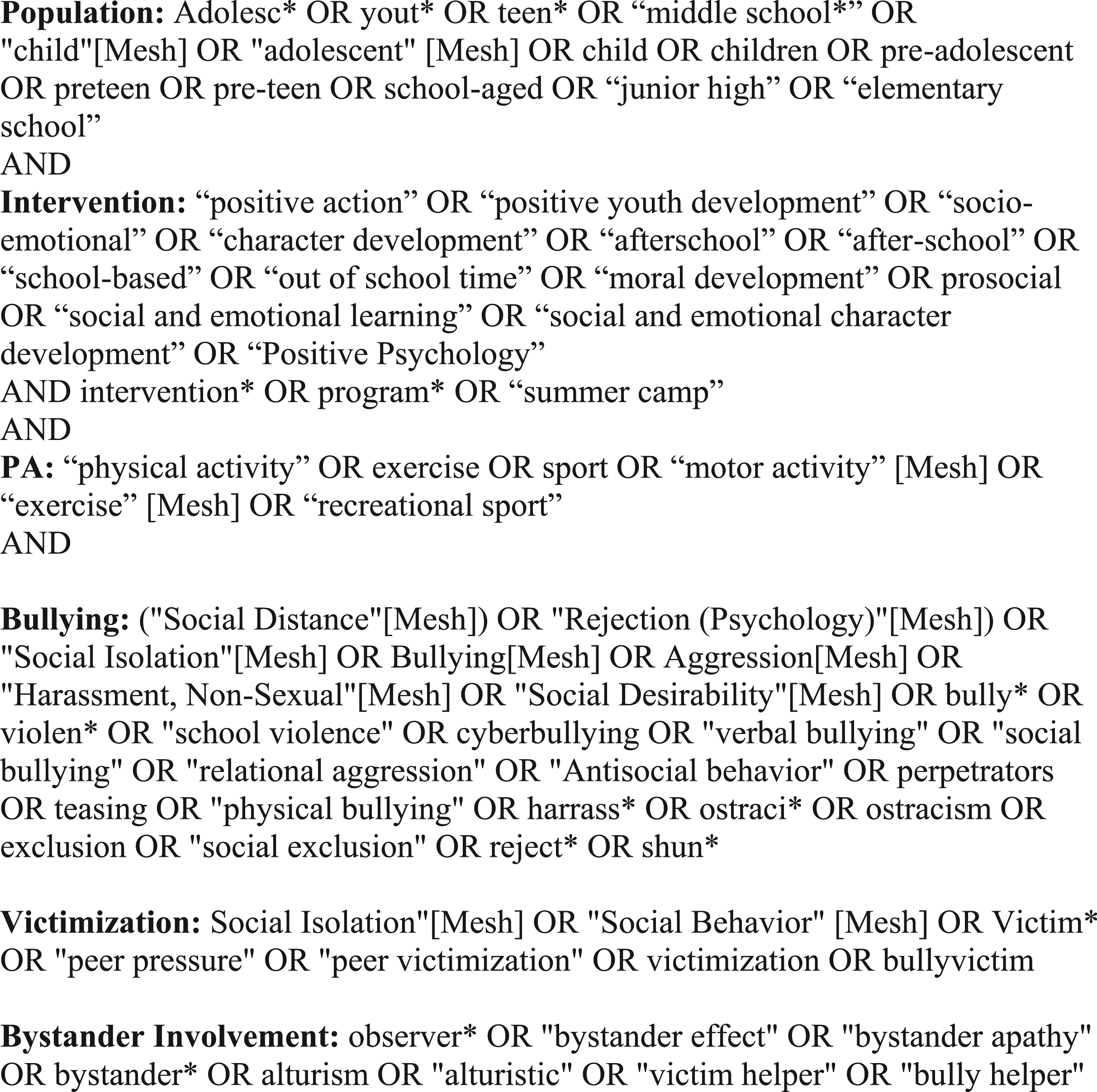
Study Selection
The Preferred Reporting Items for Systematic reviews and Meta-Analyses (PRISMA) flow diagram (PRISMA; Moher et al., 2009) was used to map the search process. The search and screening process are depicted in Figure 2. Two reviewers (author #1, Research Assistant [RA]) independently screened article titles and abstracts, and one reviewer (author #1) searched reference lists. Author #1 and the RA independently read and screened the full-text article if the title and abstract suggested eligibility or provided insufficient information to determine inclusion. When disagreements about inclusion occurred, author #2 was brought into discussion. 480 articles were retrieved. After removing duplicates, 379 article titles and abstracts were reviewed. Seven met the inclusion criteria and were eligible for the qualitative synthesis (see Figure 2). All seven provided results regarding bullying, one regarding victimization, and two regarding bystander behavior. PRISMA flow diagram of research outcome and study selection (Moher et al., 2009).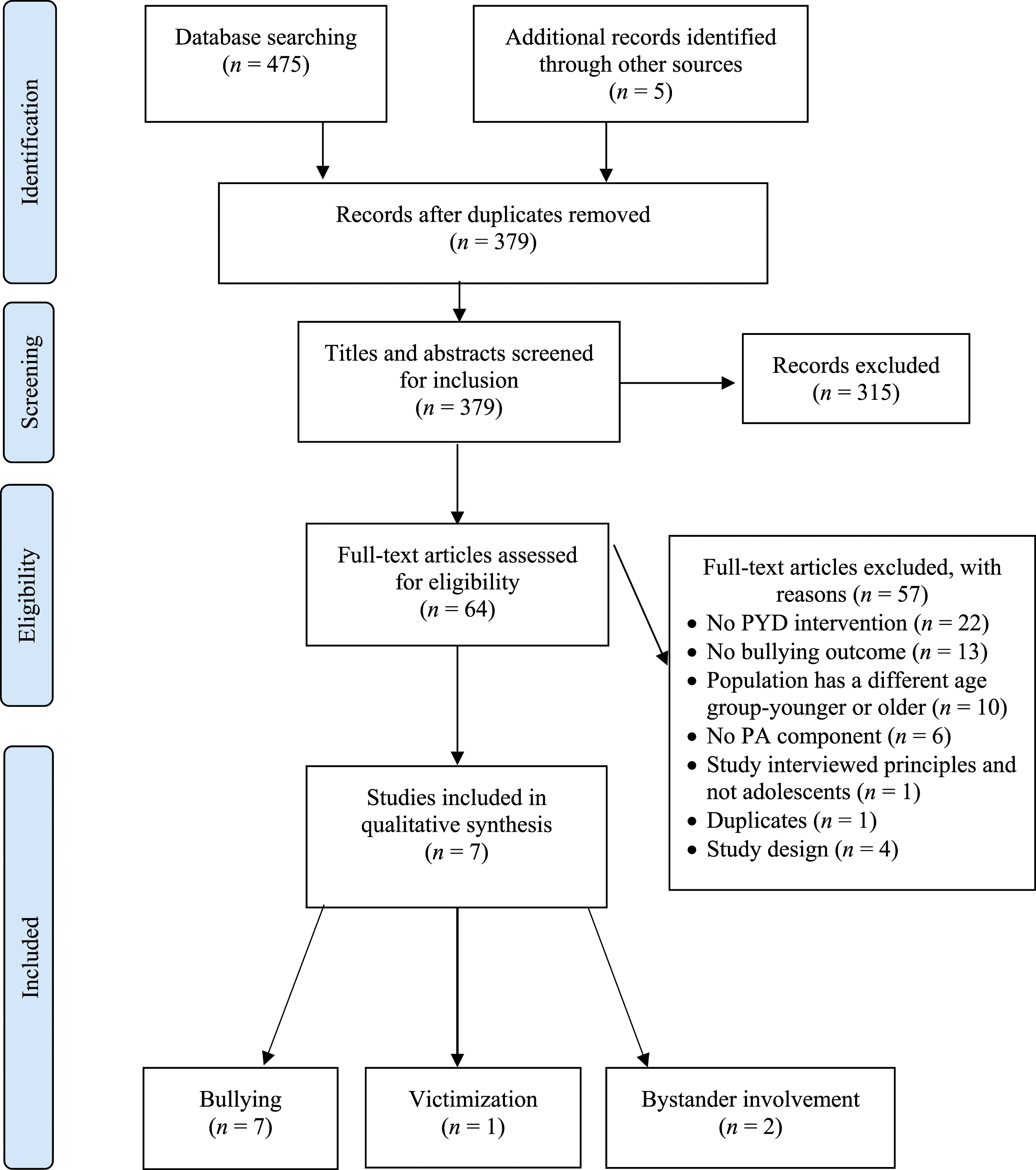
Data Collection
Summary of Individual Studies, sample Characteristics, and results.
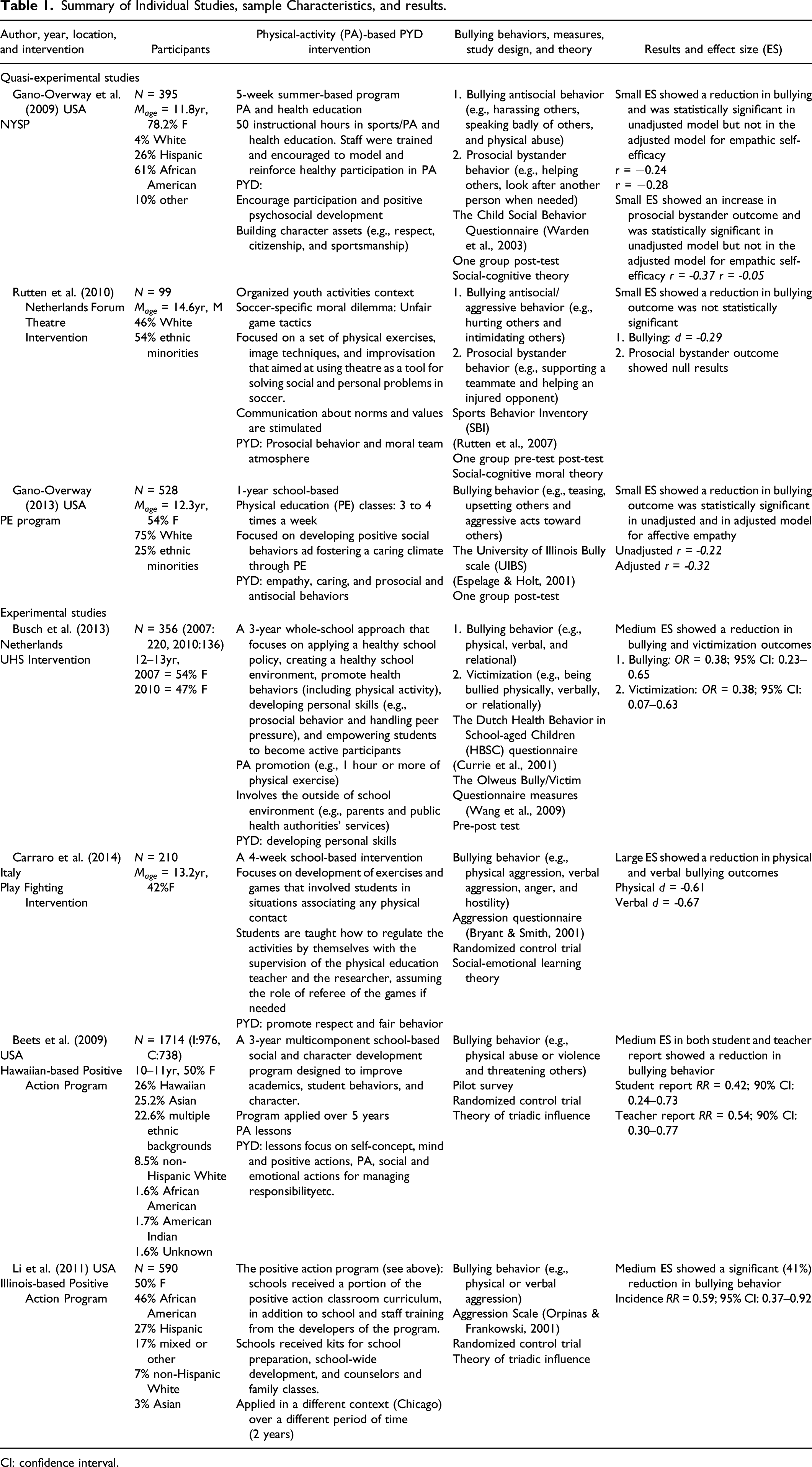
CI: confidence interval.
Summary Measures of Individual Studies
Summary measures were extracted from each study (e.g., Odds Ratios [OR], Pearson correlation coefficients [r], standardized mean difference [SMD or Cohen’s d], etc). The variation in the magnitude and direction of effect sizes were assessed qualitatively using Rosenthal’s and Cohen’s qualitative criteria. As such, Odds Ratios were evaluated as small (OR ≤ |1.5|), medium (OR ≤ |2.5|), large (OR ≤ |4|), and very large (OR ≤ |10|). As well, Pearson correlation coefficient effect size was evaluated as small (r ≤ |.10|), medium (r ≤ |.30|), large (r ≤ |.50|), and very large (r ≤ |.70|), and SMD was evaluated as small (d ≤ |.20|), medium (d ≤ |.50|), large (d ≤ |.80|), and very large (d ≤ |1.30|; Cohen, 1992; Rosenthal, 1996). Given the small number of studies retrieved, no meta-analysis was performed.
Results
Study Characteristics
The review included three quasi-experimental (two post-tests and one pre-post-test) and four experimental studies. Sample size ranged from 99 to 528 in quasi-experimental trials, and 210 to 1714 in experimental studies. All seven studies addressed bullying as an outcome, one assessed victimization and two assessed prosocial bystander involvement. All outcomes were measured by means of self-reported questionnaires. Examples on how bullying behaviors were operationalized in each study are presented in Table 1.
Participants Characteristics
3892 pre- and early adolescents participated in the included studies: 1022 in the quasi-experimental design studies, and 2870 in the experimental design studies. 46% of the participants were female, and among studies that reported ethnicity distribution, approximately 28% of participants across five studies were Caucasian or White, 26% Hispanic across two studies, 53% African American across two studies, and other 25% ethnic minorities across five studies.
Description of the Interventions
Intervention Contexts, PYD Constructs, and PYD-PA Approach
For quasi-experimental design studies, the main programs were a free 5-week summer-based National Youth Sport Program (NYSP; Gano-Overway et al., 2009), a school-based Physical Education (PE) program (Gano-Overway, 2013), and an organized youth sports forum theatre intervention (Rutten et al., 2010). The NYSP sought to build positive assets through physical activity lessons that included a minimum of 50 instructional hours in sports/physical activity (e.g., basketball) and health education (e.g., awareness on substance use). For example, staff were trained and encouraged to model and reinforce healthy participation in physical activity while they actively highlighted when youth demonstrated respect, compassion, and integrity through sports. They were also encouraged to develop a caring relationship with the youth (Gano-Overway et al., 2009). The PE-based intervention focused on developing positive social behaviors (e.g., prosocial behavior and social competence) and fostering a caring climate through PE (Gano-Overway, 2013). The forum theatre intervention focused on a set of physical exercises, image techniques, and improvisation that aimed at using theatre as a tool for solving social and personal problems in organized youth soccer context (e.g., unfair game tactics and violating prosocial norms) where communication about norms and values within sports is stimulated, a cognitive moral conflict that can only be resolved through high levels of moral reasoning is provoked, and a positive moral atmosphere and moral cognitive growth are influenced, in an environment that is based on communication and mutual respect. The intervention focused on promoting moral reasoning and fair play attitude among athletes (Rutten et al., 2010).
The experimental design studies included the Utrecht Health School (UHS) program, a school-based program (Busch et al., 2013); the Play Fighting program, a 4-week school-based PE program (Carraro et al., 2014); the Positive Action program, a 5-year school-based program delivered in Hawaii (Beets et al., 2009); and the Positive Action program, a 2-year school-based trial program delivered in Chicago, Illinois (Li et al., 2011). The Utrecht Health School (UHS) intervention sought to promote personal skills (e.g., prosocial behavior and handling peer pressure), empower students to become active participants and make healthier choices, promote healthy behaviors (e.g., 1 hour or more of physical exercise per day, healthy nutrition awareness and substance use reduction), encourage refraining from compulsive behaviors (e.g., internet use and gaming), and focus on health promotion of knowledge and skills. The play fighting intervention focused on promoting social and emotional skills such as respect and fair behavior in physical activity, where youth are allowed to play roughly against each other but in a structured and supervised setting which would allow control over physical aggression by teaching the youth to respect their opponent and the rules of the specific game in physical activity. Positive Action program sought to promote social and character development through lessons that focused on body positive actions (e.g., physical activity), self-concept, emotional regulation, getting along with others, as well as encouraging honesty and self-improvement, through a structured curriculum (Beets et al., 2009; Li et al., 2011). All seven interventions ranged from 5 weeks to 3 years. A full description of each intervention is summarized in Table 1.
Intervention Delivery Format
Different contexts and methods for delivering the combined PYD and physical activity components were found among the seven studies: The NYSP study provided 50 instructional hours on physical activity and health education, and exposed youth to character development through both curriculum lessons and physical activity exercises and games. For example, after a lesson on respect, youth would play sports and staff would highlight when youth demonstrated examples of showing respect for others (Gano-Overway et al., 2009). The forum theatre intervention involved professional actors giving a performance at the soccer clubs on soccer-specific moral dilemmas and propose challenging solutions in front of an audience (parents and coaches). A facilitator would then explain the scene and invite the audience to discuss the suggested solutions (Rutten et al., 2010). The PE study was delivered through PE teachers, and no further information about delivery was provided in the article (Gano-Overway, 2013). The Utrecht Health School (UHS) program (Busch et al., 2013) provided several teaching modules where students were active participants in activities focused on health promotion, and peer education where older students taught younger students about health-related topics (e.g., physical activity) which stimulated critical thinking and decision-making among youth. Further, teachers and parents were trained to build better communication and encourage youth’s competencies to make healthier choices. The play fighting program (Carraro et al., 2014) was delivered during PE lessons through a progression of games and exercises that placed students in situations where there is physical contact and opposition. The PE teachers took the role of the referee, allowing a direct teaching method and giving precise instructions to students; this allowed the students to regulate the activities by themselves, which provided a context for promoting social and emotional skills (Carraro et al., 2014). The Positive Action program provided 140 15–20-minute lessons for each grade level that were implemented throughout the academic year. Activities used an interactive approach involving staff, teachers, and parents, were delivered by the teachers in structured discussions and activities (e.g., games and role-playing) on lessons that promote social and emotional learning (e.g., respect, empathy, moral development and decision-making) and physical activity (Beets et al., 2009; Li et al., 2011).
Intervention Outcomes
Quasi-Experimental Design: Bullying Behavior (k = 3)
Evaluations of PYD constructs (caring, empathy and prosocial behavior) used in the interventions revealed a reduction in bullying behavior across all three quasi-experimental studies. For instance, the NYSP demonstrated that positive developmental assets such as caring and empathy reduced adolescents’ antisocial behavior (e.g., harassing others and speaking badly of another) via its effect on promoting empathic self-efficacy (r = −0.24). The forum theatre program (Rutten et al., 2010) showed that a positive moral atmosphere in organized youth sports contributed to reduced levels of antisocial behavior (e.g., encouraging physical abuse or bullying during matches) among young athletes (d = −0.29). The physical education program demonstrated that caring and cognitive empathy (i.e., positive developmental assets) were associated with a decrease in youth’s antisocial behavior like bullying (r = −0.32; Gano-Overway, 2013). Overall, small effect sizes were found among the three studies for bullying behavior (Table 1).
Experimental Design: Bullying Behavior (k = 4)
Evaluations of PYD constructs (respect, fair play, prosocial behavior, self-concept, and caring) used in the interventions revealed a reduction in bullying behavior across all four experimental design studies. For instance, UHS’s findings suggested that learning and adapting a health promotion perspective towards healthy eating and PA fostered personal asset development, which consequently reduced bullying behavior and showed a medium effect size (OR = 0.38; 95% CI: 0.23–0.65; Busch et al., 2013). The Play Fighting program demonstrated that students who learn to control aggressive behaviors and who manage their physical strength in contact games and exercises were less likely to report bullying behavior and showed a large effect size for physical bullying (d = −0.61) and verbal bullying (d = −0.67; Carraro et al., 2014). The Hawaiian-based Positive Actions program found that students who received the intervention reported significantly lower levels of bullying behavior (rate ratio = 0.42; 90% CI = 0.24, 0.73) when compared to the control group (Beets et al., 2009). Similarly, the Illinois-based Positive Action program also demonstrated a significant (41%) reduction (incidence rate ratio = 0.59; 95% CI: 0.37–0.92) in bullying behavior; thus, focusing on multiple aspects of character and social development situated within the positive action program (Table 1) aided in reducing bullying behavior (Li et al., 2011). Both Positive Action programs reported medium effect sizes (Table 1).
Victimization outcome (k = 1) Victimization was measured and assessed in only one experimental design study, the Utrecht Health School (UHS) program (Busch et al., 2013). Findings revealed that, compared to the control group, the intervention group demonstrated a higher baseline level measure of victimization which decreased after program implementation (OR = .38 [95% CI = .07, .63]), reporting a medium effect size (Table 1).
Bystander involvement outcome (k = 2) Prosocial bystander involvement was measured and assessed in two quasi-experimental design studies, NYSP (Gano-Overway et al., 2009) and the Forum Theatre program (Rutten et al., 2010). For the NYSP study, perceived caring climate positively predicted prosocial behavior (r = .37), reporting a small to medium effect size. Perceived caring climate was found to positively impact bystander involvement through its influence on empathic self-efficacy. Results suggest that a PYD youth intervention offered within a physical activity context can foster prosocial behavior through empathic self-efficacy. The Forum Theatre intervention measured and assessed off-field prosocial behavior and found no differences between the pre-and the post-test (see Table 1).
Discussion
The purpose of this study was to critically review studies evaluating the effectiveness of PYD interventions that include a PA component on bullying, victimization, and bystander involvement among pre- and young adolescents. Only two studies evaluated the impact of PYD-PA approach program on victimization and only one study on prosocial bystander behavior, so more research is needed on these outcomes to determine intervention effectiveness. Overall, findings from this review suggest that such interventions can be promising in reducing bullying behaviors, and describe the components included in such interventions. The most promising features of the seven reviewed articles include targeting a variety of PYD constructs and integrating them within caring and empathetic relationships that create supportive environments involving role models. As well, utilizing an interactive approach where teachers, coaches, and/or parents are involved in the delivery of the intervention components showed a promising feature of these interventions. Finally, combining PYD and PA components in the interventions showed a promising approach to reduce bullying behavior as PA was used to foster PYD constructs and decrease bullying behavior.
Interventions targeted a variety of PYD constructs but tended to focus on strengthening and developing caring relationships, suggesting an agreement among researchers and practitioners who design these interventions in the importance of positive social interactions for reducing bullying behaviors in adolescents (Gano-Overway et al., 2009). For instance, the NYSP (Gano-Overway et al., 2009) focused on developing caring and empathic environment, in order to influence adolescents’ sense of self-efficacy and help adolescents control their emotions (Payton et al., 2000). Teachers, coaches, and/or parents may play a role in creating these supporting environments and influencing adolescents’ ability to regulate their emotions and be more empathetic by modeling and reinforcing positive behaviors (Gano-Overway et al., 2009). Indeed, empathy scholars have found that children whose parents model and reinforce caring behavior are able to manage their emotions better (Mussen & Eisenberg, 2001), which has been found to help adolescents develop emotional competence and regulation (Lockwood et al., 2014; Payton et al., 2000). The latter is associated with a high level of empathetic responsiveness that is associated with less bullying and more active helping of victimized peers (Gini et al., 2007; Jolliffe & Farrington, 2006).
Most programs included in our review used an interactive approach where teachers or coaches were involved in the delivery of its components. For instance, the Positive Action program integrated a teacher–student communication opportunity and allowed for exchange of ideas in a nonthreatening environment (Beets et al., 2009; Li et al., 2011). Similarly, the NYSP’s staff were encouraged to develop a caring relationship with the campers and reinforce character development through demonstrating and discussing respect and compassion (Gano-Overway et al., 2009). In organized youth sports such as soccer, coaches play an important role in modeling behavior to their players and having behavioral expectations from their players that will make them more aware of the coach’s disapproval of any antisocial behavior and would contribute to higher levels of moral reasoning (Pizarro, 2000; Rutten et al., 2007). These findings draw attention on the important role that teachers or coaches may play in influencing intervention effectiveness. Indeed, research has found that the involvement of such role models in youth programming can influence youth engagement and motivation by establishing a supportive and caring program climate (Riciputi, 2016). This interactive relationship contributes to youth engagement in the program and provides them with emotional support which is important in such programs to build character assets and prosocial behaviors that are based on principles such as respect, fairness, and responsibility (McDonough et al., 2013; Riciputi, 2016). Relationships with older mentors such as a teacher or a coach contribute to an improved youths’ behavioral, intellectual, and emotional functioning, and are associated with reduced problem behavior such as bullying or violence, increased physical activity levels, and increased psychological functioning (DuBois & Silverthorn, 2005; Riciputi, 2016). Some interventions also included parents as part of their curriculum. For instance, the UHS program involved parents in shaping the goals of the program in creating healthy behaviors by using an interactive learning technique that focus on building better communication which helps in increasing students’ competencies which empower them to make better decisions (Busch et al., 2013). Indeed, several aspects of parenting such as discipline, warmth, monitoring, and modeling of healthy behavior have been linked to positive youth developmental outcomes. Parents who are engaged in promoting youth healthy behaviors positively influence the social competence and engagement of their child, which in turn affect their child’s development (Youngblade et al., 2007).
This review showed that combining PYD with PA is a promising approach to reduce bullying behavior among adolescents. This evidence supports findings that providing adolescents with opportunities to engage in PA can enhance adolescents’ psychosocial development, increase their awareness of prosocial values, foster social competence, and decrease engagement in problem behaviors such as bullying (Mahoney et al., 2005). For instance, one study showed that using PA as a way to discuss prosocial values and moral dilemmas can stimulate moral cognitive growth and contribute to the development of a moral climate within a PA context (Kavussanu et al., 2006). It is interesting to note that correlation studies conducted in the adolescent population have found that moral climate is associated with reduced antisocial behavior and increased prosocial behavior (Kavussanu et al., 2006).
Limitations
This study included several limitations. First, PA was included differently in each program and in some cases, it was only included in an educational lesson which affected our evaluation of the PA component among studies. All studies used self-report for their outcome measures; given that outcomes were negative behaviors, social desirability may have affected the validity of the measures, consequently potentially resulting in measurement error, thus caution should be taken when drawing conclusions based on these results. Lastly, because the retrieved interventions varied from one context to another (USA vs Italy and Netherlands), there is a variation in the population homogeneity, as well as in the policy and educational systems from one country to another, making the implementation and evaluation of such interventions different, and non-generalizable.
Conclusion
The purpose of this critical literature review was to examine the effectiveness of combined PYD-PA interventions on bullying, victimization, and bystander behaviors among pre- and young adolescents. Interventions that utilize a PYD approach (e.g., caring, empathy, respect, compassion, moral reasoning, and self-concept) within a PA context have the potential to foster youth’s psychosocial development, which may consequently reduce problem behaviors. Further, an interactive and supportive approach between the participants and the intervention’s staff can be helpful in promoting personal skills which, in turn, may reduce bullying behavior. This critical literature review provides a promising starting point for a combined PYD-PA approach to address bullying among adolescents and further evaluation is warranted.
Footnotes
Declaration of Conflicting Interests
The author(s) declared no potential conflicts of interest with respect to the research, authorship, and/or publication of this article.
Funding
The author(s) received no financial support for the research, authorship, and/or publication of this article.
