




Abstract
Although Bowlby proposed that adolescence is a major developmental period to transfer their attachment figures from parents to other people, no comprehensive longitudinal study on attachment transfer from early to late adolescence exists. This study employed 215 early to late adolescents between ages 11 and 18 years (
Keywords
At one end of the developmental spectrum, decades of research have focused on the importance of parents as primary attachment figures in early childhood. At the other end, there is an accumulating body of evidence that guides our understanding of the nature and function of attachment relationships with romantic partners during late adolescence and adulthood. However, there exists a knowledge gap in attachment during the early and middle adolescence period, in which very little is known about the transfer of attachment figures from parents to peers, such as friends and romantic partners. To understand the detailed processes underlying adolescents’ transfer of attachment figures from early to late adolescence, this study employed a six-wave (with a 4-month interval) longitudinal study involving four cohorts of adolescents (5th, 7th, 9th, and 11th graders).
Defining and Assessing Attachment Figures in Adolescence
Bowlby (1969/1982) defined children’s attachment as “a strong disposition to seek proximity to and contact with a specific figure and to do so in certain situations, notably when frightened, tired, or ill” (p. 371). That is, attachment is closely related to emergency situations in which children are at risk of their life. Bowlby (1980) further proposed that to increase the chance of survival, children display attachment behaviors toward a “differentiated and preferred individual” (p. 39). Adolescence is the period in which people typically begin to rely less on their parents as primary attachment figures. Instead, there is a growing preference for friends and subsequently romantic partners as new attachment figures, as children develop cognitively, physically, and physiologically (Ainsworth, 1989). The growing importance of nonparental attachment figures from the onset of adolescence is also underscored by Bowlby (1929/1982): During adolescence a child’s attachment to his parents changes. Other adults may come to assume an importance equal to or greater than that of parents . . . At one extreme are adolescents who cut themselves off from parents; at the other are those who remain intensely attached and are unable or unwilling to direct their attachment behavior to others. (p. 207)
To estimate adolescents’ transfer of attachment figures, this study employed the Important People Interview (IPI; Rosenthal & Kobak, 2010) that was developed based on Bowlby’s and Ainsworth’s conceptualizations. Specifically, the IPI includes nine items, of which three items assess adolescents’ preferences for attachment bond, while the other items tap onto support seeking and affiliation. Rosenthal and Kobak (2010) proposed that the attachment bond category is distinguished from the other categories based on emergency versus nonemergency situations (Waters & Cummings, 2000). A high level of attachment behavior activation is elicited in emergency situations including the loss of the availability of an attachment figure (whom an adolescent would miss), events involving danger (whom the adolescent would contact in a threat to his or her life), and situations that prompt a feeling of closeness (whom the adolescent feels closest to; Rosenthal & Kobak, 2010). On the other hand, nonemergency situations are contexts involving ordinary daily challenges and positive social engagement which are defined as social support and affiliation in the IPI.
The reliability and validity of the IPI have been demonstrated. Using an exploratory factor analysis, Rosenthal and Kobak (2010) psychometrically demonstrated that three of the nine IPI items tap onto attachment bond behavioral systems, while the other items tap onto support seeking and affiliation. This factor structure was replicated in a study by Umemura, Lacinová, Kraus, Horská, and Pivodová (2018), which utilized a confirmatory factor analysis to analyze the first-wave data reported in this study. Regarding the validity of the IPI, adolescents’ perception of parental acceptance was associated with a higher preference for parents and a lower preference for friends in adolescents’ attachment bond (Rosenthal & Kobak, 2010). In addition, a higher preference for friends and a lower preference for father were linked to externalizing and internalizing behavior problems (Rosenthal & Kobak, 2010; Umemura, Lacinová, Kraus, et al., 2018), which results were consistent with a hypothesis that a premature transfer from parents to peers is a risk factor for adolescents’ adjustment (Kobak, Rosenthal, Zajac, & Madsen, 2007). Hence, the IPI is both theoretically and psychometrically appropriate for assessing attachment transfer and was, therefore, used to examine the process of attachment transfer in the present study.
(RQ1) Is Adolescents’ Transfer of Attachment Figures From Parents to Peers Likely to Be Irreversible?
Recent longitudinal findings with a young adult sample suggest that a backward transfer of primary attachment figures from peers to parents is unlikely among young adults (Umemura, Lacinová, Kotrčová, & Fraley, 2018; Umemura, Lacinová, Macek, & Kunnen, 2017). Specifically, as romantic relationships progress, young adults’ preference for romantic partners increases, with a corresponding decrease in preference for friends. However, preferences for parents remained unchanged. In addition, when romantic relationships end, young adults increased their preference for friends but not for parents. These findings suggest that there is some fluidity in the transfer of primary attachment figures between friends and romantic partner in early adulthood, but such transfer is unlikely to occur between parents and peers.
All the above-mentioned findings concern young adults but not adolescents. Adolescence is postulated as an important developmental phase in which individuals experience the transfer of attachment figures from parents to peers (Kobak et al., 2007). However, a two-wave longitudinal study conducted by Friedlmeier and Granqvist (2006) with middle and late adolescents (aged 14-18 years,
(RQ2) In Some, But Not All, Adolescents, Do Their Transfer From Parents to Romantic Partners Indirectly Go Through Friends?
“Some, but not all [emphasis added], friendships have an attachment component, and some, but not all, constitute enduring affectional bonds” (Ainsworth, 1989, p. 714). As Ainsworth (1989) believed, several cross-sectional studies have found that attachment preferences for friends are temporarily high during adolescence (Nickerson & Nagle, 2005; Rowe & Carnelley, 2005; Seibert & Kerns, 2009; Viejo, Monks, Sánchez-Rosa, & Ortega-Ruiz, 2019). This finding leads us to hypothesize that some, but not all, adolescents transfer between parents and romantic partners as attachment figures occurs first through a transfer to friends. The better understanding of roles of friends as attachment figures is important, as the question has been raised since Ainsworth (1989).
Past longitudinal research, however, has not examined whether some, but not all, adolescents transfer their attachment figures from parents through friends to romantic partners. This is because longitudinal studies that have focused on adolescents’ transfer did not distinguish between friends and romantic partners but combined them as peers (Friedlmeier & Granqvist, 2006; Mayseless, 2004). One longitudinal study with young adults focused only on changes in preference for a romantic partner, but not on changes in preference for friends or parents (Fagundes & Schindler, 2012). Hence, whether the transfer between parents and romantic partners indirectly go through friends has not been well explored longitudinally.
(RQ3) How Long Does It Take for Romantic Partners to Become the Primary Attachment Figures?
The amount of time taken for romantic partners to become the primary attachment figures might differ based on the operationalization of attachment. To assess the transfer of attachment figures, past studies have tended to use the WHOTO scale (Fraley & Davis, 1997; Hazan & Zeifman, 1994) that measures the following three subcategories with two items each: safe haven (“Who is the person you want to be with when you are feeling upset or down”; “Who is the person you would count on for advice?”), proximity seeking (“Who is the person you most like to spend time with?”; “Who is the person you don’t like to be away from?”), and secure base (“Who is the person you would want to tell first if you achieved something good?”; “Who you always count on?”). Several cross-sectional studies using the WHOTO scale have revealed that it takes approximately 2 years for individuals to fully complete their transfer of attachment to romantic partners (Fraley & Davis, 1997; Hazan & Zeifman, 1994). However, using the same WHOTO scale, a longitudinal study by Fagundes and Schindler (2012) found that young adults were likely to nominate their romantic partners as the primary attachment figure in the safe haven and proximity seeking subcategories only after about 4 months into the relationship. On the other hand, for the secure base subcategory, it took 2 years for the romantic partners to be the primary attachment figure. These findings suggest that the amount of time that takes for young people to consider their romantic partner to be the primary attachment figure may be different depending on aspects of attachment. Using the IPI scale (Rosenthal & Kobak, 2010), this study is the first to longitudinally estimate the time it takes for the romantic partners to become the primary attachment figure, based on Bowlby’s conceptualization of attachment behavioral systems.
The Present Study
The primary aim of this study is to understand the detailed processes of attachment transfer from early to late adolescence. To that end, we employed a six-wave multicohort design involving early, middle, and late adolescents from 5th grade (11- and 12-year-olds at Wave 1), 7th grade (13- and 14-year-olds), 9th grade (15- and 16-year-olds), and 11th grade (17- and 18-year-olds). Each cohort was followed up longitudinally for 2 years. This sequential design covers the whole developmental phase in adolescence, enabling us to map a trajectory of attachment transfer from early to late adolescence. Notably, longitudinal data are crucial in understanding the process of “transfer” between primary attachment figures, as cross-sectional data would not enable us to chart the transfer over time.
We conducted data collection every 4 months (six waves in total) because this small time lag between waves would enable us to capture the exact timing of transfer. A previous longitudinal study found that the transfer of romantic partner as the primary attachment figure seems to take only 4 months in young adults for some attachment functions (Fagundes & Schindler, 2012), which suggests that a similar timing of transfer might be found in adolescents.
Hypotheses
Regarding the role of adolescents’ developmental stages in the transfer of attachment figures, if the transfer between parents and romantic partners indirectly go through friends, one can expect that adolescents would chronologically experience a transition from parents to friends and then another transition from friends to romantic partners. Therefore, we also hypothesized that some early adolescents experience the first transfer from parents to friends, and as they transition to middle and then late adolescence, they experience the second transfer from friends to romantic partners.
Regarding the role of adolescents’ developmental stages, late adolescents are physically and emotionally more ready to develop romantic relationships compared to earlier adolescents (e.g., Meeus, Branje, van der Valk, & de Wied, 2007; see Collins, Welsh, & Furman, 2009, for review). Therefore, we hypothesize that later adolescents’ transfer to romantic partners is faster compared to earlier adolescents’ transfer.
Method
Participants
We recruited 215 Czech adolescents. The mean age of the adolescents was 14.02 years (SD = 2.05, age range: 11-18 years at Wave 1), and 54% of the sample were females. The sample comprised four cohorts, with 45 fifth graders (11- to 12-year-olds), 72 seventh graders (13- to 14-year-olds), 59 ninth graders (15- to 16-year-olds), and 39 eleventh graders (17- to 18-year-olds). We visited three secondary schools where we explained our research project to parents and then recruited adolescents and their parents who agreed to participate in our research (see Umemura, Lacinová, Kraus, et al., 2018, for more detailed information about our recruitment procedure). The ethical research committee of Institute for Reserch of Children, Youth, and Family at Masaryk University approved the project entitled “the development of adolescent relationships: Using an attachment theory perspective, a dynamic systems approach, and a time-series method,” and informed consent was obtained from the adolescents and their parents.
Participants were mostly from middle- or upper-middle-income families. Specifically, the average score of parents’ perception of household income (it is not enough to cover all expenses = 1; it is high and we do not really worry about spending = 4) was 2.80 (SD = 0.61). The average score of parents’ perception of their family socioeconomic status (SES) relative to other families in their society (very poor = 1; very rich = 10) was 5.91 (SD = 1.29). Mothers’ and fathers’ average education levels were 4.14 (SD = 1.06) and 4.09 (SD = 1.09), respectively (an elementary school education = 1; a master’s degree or higher = 5). Regarding adolescents’ living arrangements with their parents, 18.4% of them lived without their biological father, 1.0% lived without both biological parents, and the rest lived with both parents.
Procedure
Over 2 years from October 2016 to June 2018, data were collected every 4 months in six waves. To assess adolescents’ attachment transfer, they completed the IPI (Rosenthal & Kobak, 2010) in their classroom. Adolescents, their parents, and their teachers also reported adolescents’ psychological and behavioral adjustment, which data are not used in the present study. The data are available upon request from the corresponding author.
Missing data analyses
The missing data rate was low (1%-7% across six waves). However, Little’s (1988) missing completely at random test was χ2/df = 2,427.18/1,977 = 1.23, p < .001. We also found differences between adolescents who continued to participate in our project and those who dropped out, in terms of their attachment preferences, SESs of their families, and their living arrangement with parents (see Supplemental Material). To handle the missing values, we implemented full information maximum likelihood (FIML; Enders, 2010).
Measures
Attachment figures
The IPI (Rosenthal & Kobak, 2010) consists of three distinct factors (attachment bond, support seeking, and affiliation), each measured with three items. This study only used the three items of the attachment bond factor, which involves Bowlby’s (1969/1982) conceptualization of attachment behavior systems. These items are (a) “To whom do you feel closest?”; (b) “Imagine that you must fly across the country by yourself and stay by yourself for 2 weeks. Who would you miss the most?”; and (c) “Imagine you are walking by yourself. While crossing the street, you are suddenly hit by a car. The next thing you know, you are waking up in a hospital emergency room. Who do you call first?” Participants were asked to rank attachment figures in four rows, with the primary attachment figure(s) on the top row, the next most significant attachment figure(s) in the second row, and so on. We used a paper-and-pencil format (the original IPI was conducted online) and allowed the participants to assign the same rank to multiple attachment figures (see Umemura, Lacinová, Kraus, et al., 2018 for the detailed information of our instruction).
Rosenthal and Kobak (2010) demonstrated the reliability of the IPI factors using an exploratory factor analysis. Umemura, Lacinová, Kraus, et al. (2018) supported the reliability of the attachment bond factor using confirmatory factor analyses. For the purpose of this study, we used only the factor of the attachment bond system in our analyses. Cronbach’s alphas ranged between .70 and .98. Two nonattachment factors, affiliation and social support, were measured only for the purpose of reliability analysis (not for future use; Umemura, Lacinová, Kraus, et al., 2018).
Romantic relationship status
In every wave, we asked adolescents to report whether they were currently dating with someone and, if so, whether their romantic partner was the same as the one reported in the previous wave.
Analyses
To better understand the holistic processes of attachment transfer, this study used two analytic approaches: person- and variable-oriented analyses. The former estimates changes in primary attachment figure(s), and the latter estimates an increase in the ranking of one attachment figure with a corresponding decrease in the ranking of another attachment figure. Previous studies have only used either one of the two approaches (e.g., Friedlmeier & Granqvist, 2006; Mayseless, 2004 employed the former approach, while Fagundes & Schindler, 2012; Umemura et al., 2018 employed the latter approach). This study extends the literature by incorporating both approaches in a single study.
Person-oriented analyses allowed us to identify the primary attachment figures and their transfer over time. Each item for the attachment bond factor was converted to binary data; that is, whether parent, friend, and/or romantic partner was nominated as the primary attachment figure(s) or not (1 or 0, respectively). We began with a series of cross-sectional latent class analyses (LCAs), which enabled us to identify the primary attachment figure in each of the six waves. Subsequently, we conducted a latent transition analysis (LTA) with data from six waves altogether. LTAs enabled us to examine patterns of adolescents’ transfer of primary attachment figures. Therefore, using the LTA, we examined RQ1 (the irreversible-trend hypothesis) by testing whether the transfer of primary attachment figures from parents to peers is more likely to occur compared to the transfer from peers to parents. The LTA also enabled us to examine RQ2 (the transfer-through-friends hypothesis) by testing whether the transfer of primary attachment figures from parents to friends is more likely to occur compared to the transfer of primary attachment figures from parents to romantic partner, and whether the transfer of primary attachment figures from friends to romantic partners is more likely to occur compared to the transfer from parents to romantic partners. To examine RQ3 (the 2-year vs. 4-month hypothesis), we explored how long it took for each adolescent who started a new romantic relationship during our 2-year longitudinal study to nominate their partner as the primary attachment figure.
As opposed to the person-oriented analyses, which focused on the dichotomous level of attachment preferences (primary attachment figures vs. not), variable-oriented analyses focused on the continuous level of attachment rankings. Particularly, for each item of the attachment bond factor, attachment figure(s) who was nominated as the primary attachment figure(s) was assigned 4 points, the secondary figure(s) was assigned 3 points, the tertiary figure(s) was assigned 2 points, the quaternary figure(s) was assigned 1 point, and no nomination was 0 point, as following the procedure of the original study (Rosenthal & Kobak, 2010). For example, when an adolescent nominated his or her mother as the primary attachment figure for the first item, the tertiary figure for the second item, and the secondary figure for the third item, the scores for his or her mother were 4, 2, and 3 points, respectively. Subsequently, to develop a continuous composite score, the points for the three items were averaged.
We employed multilevel modeling (MLM), which enabled us to estimate temporal changes in the continuous level of attachment preferences for parents, friends, and romantic partners. As presented in the following MLM equations, Wave (i.e., all six waves in this study) and Romantic status (0 = not having a romantic partner; 1 = having a romantic partner) were used as the Level 1 within-person predictors. As the Level 2 between-person predictors, we included adolescents’ cohort (1 = 5th grade; 2 = 7th grade; 3 = 9th grade; 4 = 11th grade). The MLM equations were as follows:
Level 1:
Level 2:
The MLM allowed us to examine RQ1 (the irreversible-trend hypothesis) by exploring whether the preference for parents is decreasing over time and whether the preference for peers is increasing over time. The MLM also allowed us to examine RQ2 (the transfer-through-friends hypothesis) by testing whether earlier-cohort adolescents increase their preference for friends compared to later-cohort adolescents, and whether later-cohort adolescents increase their preference for romantic partners compared to earlier-cohort adolescents. For the following LCA, LTA, and MLM analyses, we employed the Mplus statistical software (version 7.11, Muthén & Muthén, 1998-2019).
Results
Person-Oriented Analyses
Cross-sectional LCAs
We estimated a series of cross-sectional LCAs. To determine the number of latent classes that best fit our data, we used the Bayesian information criterion (BIC) and our subjective evaluation of models based on theoretical knowledge. The evaluation of 1- to 6-class models revealed that 3-class models had the smallest BICs consistently across six waves (see Supplemental Table 1), suggesting that 3-class models best fit our data. In addition, we subjectively evaluated that three classes, with each class representing different primary attachment figures (parents, friends, or romantic partners), seem to offer the most reasonable solutions. Hence, we decided to use the 3-class models across six waves to conduct the subsequent LTAs.
To examine whether these three classes are the same across six waves, we examined the measurement invariance of probabilities that adolescents nominate parents, friends, and romantic partners as primary attachment figures across six waves (see Figure 1). The BIC of the model in which all the probabilities were constrained to be equivalent (BIC = 7,480.71) was smaller than the BIC of the unconstrained model (BIC = 8,036.43). These results indicated that the classes have equivalent characteristics across six waves. Specifically, adolescents who were categorized in the “Parent Class” had the highest likelihood of choosing a parent as the primary attachment figure and very low likelihood of choosing a friend and romantic partner. Similarly, adolescents in the “Partner Class” were most likely to choose their romantic partner as the primary attachment figure and least likely to choose parents and friends. Finally, adolescents in the “Friend Class” were most likely to choose friends as the primary attachment figures. However, the probability that adolescents in the Friend Class chose friends (from 39% to 70%) was not as exclusive as the probabilities that the adolescents in the Parent Class or Partner Class choose parents (from 88% to 93%) or romantic partner (from 78% to 98%), respectively. These results suggested that friends are not as exclusively preferred primary attachment figures as parents or romantic partners.
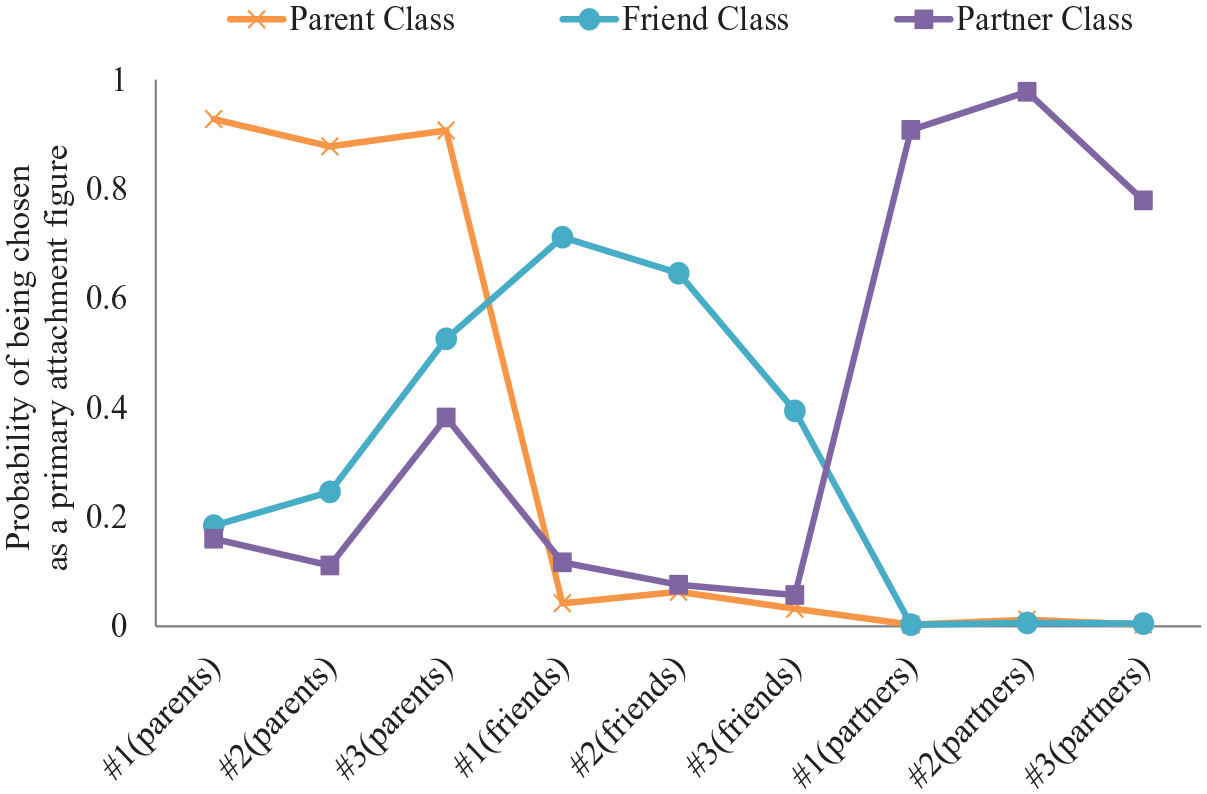
The class probability of being chosen as a primary attachment figure.
Longitudinal LTAs
We examined whether the proportion of adolescents transitioning from one class to another between Wave k and Wave k + 1 would be similar across six waves. Again, the BIC of the model in which the proportion of class transition between consecutive waves was restricted (BIC = 7,382.37) was smaller compared to the BIC of the unrestricted model (BIC = 7,480.71). These results indicated that the transition of the classes from one wave to another is also similar.
Table 1 presents the proportion of adolescents’ transition between classes from k to k + 1 wave (i.e., 4 months apart). To show a comprehensive picture of transition from Wave 1 to Wave 6 (i.e., 20 months apart), Table 1 also presents the number of adolescents between classes, which was estimated based on the above constrained LTA.
The Probability of Primary Attachment Status Transitions During 4-Month Intervals (Left), and the Number of Primary Attachment Status Transitions During 20-Month Intervals (Right).
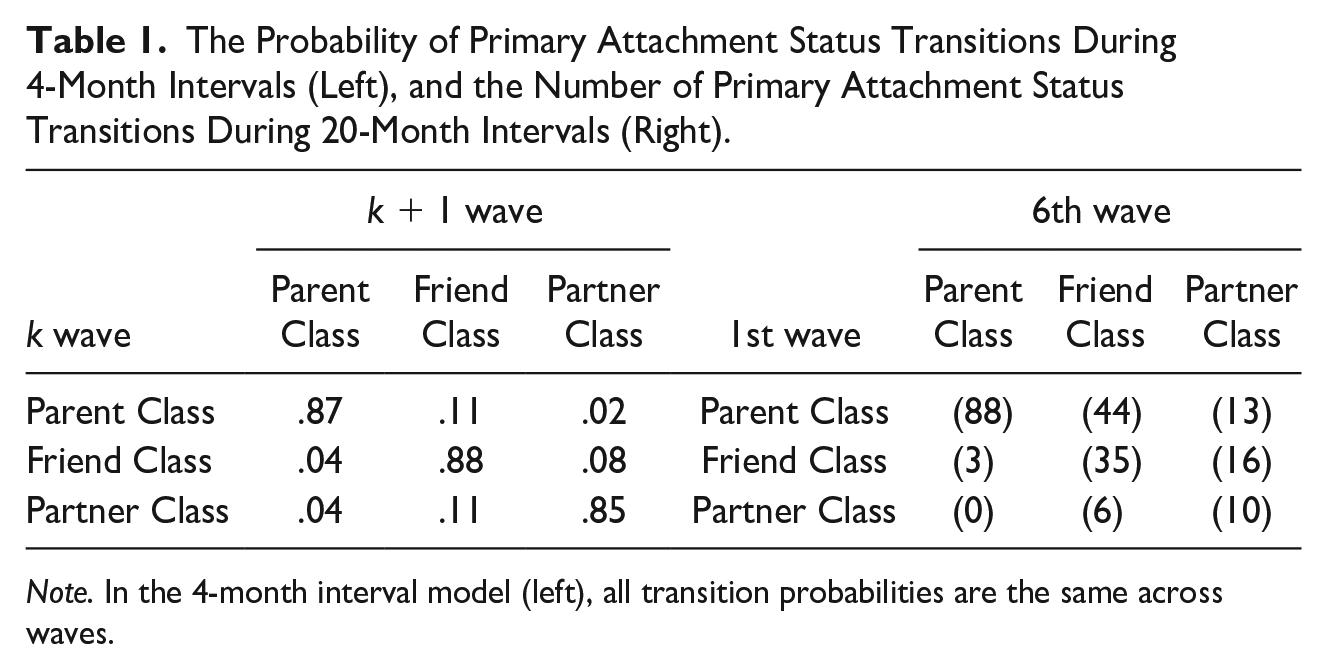
Note. In the 4-month interval model (left), all transition probabilities are the same across waves.
The irreversible-trend hypothesis
The results supported the irreversible-trend hypothesis. Regarding the probability of adolescents between k wave and k + 1 wave, the adolescents who preferred their friends were more likely to move their preference toward their romantic partner (8%) rather than toward their parents (4%). The adolescents who preferred their romantic partner transferred their preference toward friends (11%) rather than toward their parents (4%). Moreover, regarding the number of adolescents between Wave 1 and Wave 6, 57 adolescents who preferred parents in Wave 1 transferred their preference toward their peers in Wave 6, whereas only 3 adolescents who preferred peers in Wave 1 transferred their preference toward parents in Wave 6 (McNemar’s test 1 = 46.82, p < .001).
In Figure 2, the number of adolescents who were assigned to classes is presented separately across four different cohorts. This study is the first examining the irreversible-trend hypothesis in early adolescents. The percentage of adolescents who were assigned to Parent Class constantly decreased from Age 11 years (91% of the Cohort 1 adolescents at Wave 1) to Age 19 years (15% of the Cohort 4 adolescents at Wave 6), while the percentage of adolescents who were assigned to either Friend Class or Partner Class increased. Statistically speaking, McNemar’s tests were conducted for the four cohorts separately. In the 20-month interval, adolescents in all four cohorts experienced the transfer from parents at Wave 1 to peers in Wave 6 rather than the transfer from peers to parents: McNemar’s test = 9.09, p = .003 (Cohort 1); McNemar’s test = 15.04, p < .001 (Cohort 2); McNemar’s test = 14.06, p < .001 (Cohort 3); McNemar’s test = 4.00, p = .045 (Cohort 4). These results indicated no cohort differences in the irreversible-trend hypothesis.
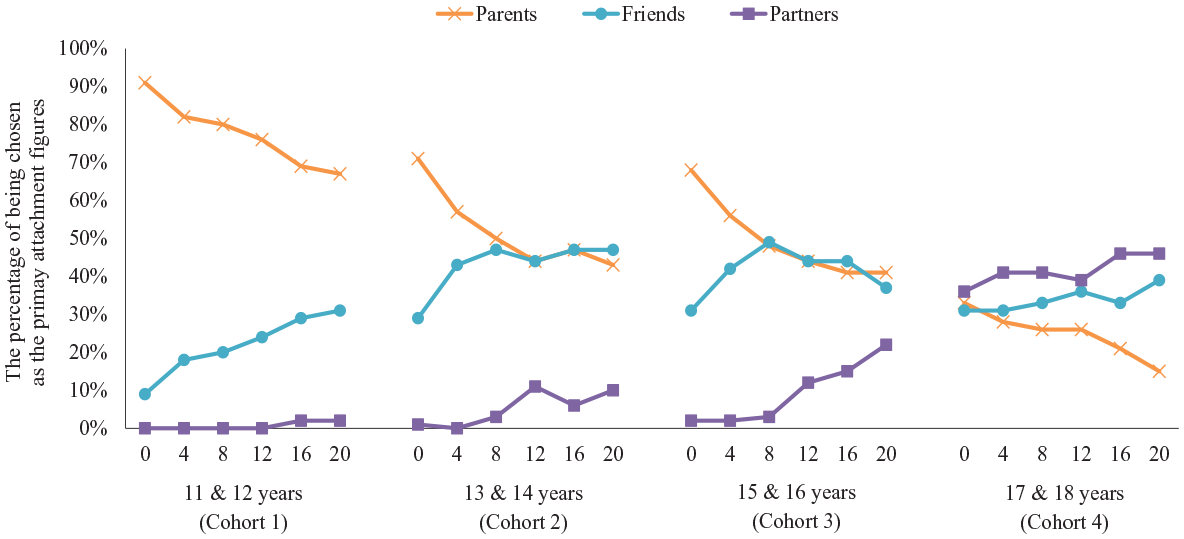
Changes in percentages of being chosen as the primary attachment figures across four cohorts.
The transfer-through-friends hypothesis
This hypothesis seemed partially supported because we found a higher rate of transfer from parents to friends than directly from parents to romantic partners, while we did not find a significantly different rate of transfer from friends to romantic partners than directly from parents to romantic partners. Specifically, more adolescents transferred their primary attachment figures from parents to friends (11%), compared to adolescents who directly transferred from their parents to their romantic partner (2%). In the 20-month interval, 44 adolescents transferred their primary attachment figures from parents at Wave 1 to friends at Wave 6, whereas 13 adolescents directly transferred from their parents at Wave 1 to their romantic partner at Wave 6 (exact binomial test p < .001; 95% confidence interval [CI] = [.64, .87]). However, the transfer from friends to romantic partners was not significantly larger than the transfer from parents to romantic partners. In the 20-month interval, the number of adolescents who transferred from friends at Wave 1 to romantic partners at Wave 6 (n = 16) was not significantly different from the number of adolescents who directly transferred from parents at Wave 1 to romantic partners at Wave 6 (n = 13; exact binomial test p = .711; 95% CI = [.36, .74]).
Regarding developmental differences, we also hypothesized that early adolescents are more likely to transfer from parents to friends than from parents to romantic partners. In the 20-month interval, 10 adolescents in Cohort 1 transferred their primary attachment figure from parents at Wave 1 to friends at Wave 6, whereas 1 adolescent in Cohort 1 transferred from their parents at Wave 1 to their romantic partner at Wave 6 (exact binomial test p = .012; 95% CI = [.59, 1.00]). In Cohort 2, 20 adolescents transferred their primary attachment figure from parents to friends, whereas 2 adolescents did from parents to romantic partner (binomial test p < .001; 95% CI = [.71, .99]). In Cohort 3, 11 adolescents transferred from parents to friends and 5 adolescents did from parents to romantic partners (exact binomial test p = .210; 95% CI = [.41, .89]). In Cohort 4, three adolescents transferred from parents to friends and five adolescents did from parents to romantic partners (exact binomial test p = .727; 95% CI = [.09, .76]).
As another hypothesis of developmental differences, we also expected that late adolescents would be more likely to transfer from friends to romantic partners than from parents to romantic partners, whereas early adolescents are not. However, we did not find any statistical differences in all cohorts.
In sum, the earlier cohorts had significantly larger transfers from parents to friends than from parents to romantic partners, although the later cohorts had no significantly larger transfers from friends to romantic partners than from parents to romantic partners. Hence, these results only partially supported the transfer-through-friends hypothesis.
The 2-year versus 4-month hypothesis
We looked at how long it took for each adolescent who started a new romantic relationship during our 2-year longitudinal study to nominate their partner as the primary attachment figure. In our longitudinal study, 67 adolescents were in a romantic relationship, of which 51 of them started a new romantic relationship after this project had begun. Table 2 presents the first-time ranking of romantic partner for these 51 adolescents (the ranking was simply created by the median score of the three attachment bond items). Of these 51 adolescents who just started a romantic relationship, 34 adolescents (67%) had already nominated their romantic partner as their primary attachment figure at the wave right after the romantic relationship had begun (exact binomial test p = .024, 95% CI = [52, 79]). For example, the first row case at the upper left of Table 2 indicates that this adolescent started a new romantic relationship between Wave 4 and Wave 5. This adolescent nominated the romantic partner as the primary attachment figure at Wave 5. This result provides stronger support for the “4-month hypothesis,” rather than for the “2-year hypothesis.”
First-Time Ranking of Romantic Partner in Adolescents Who Started a New Romantic Relationship After the Data Collection Had Begun.
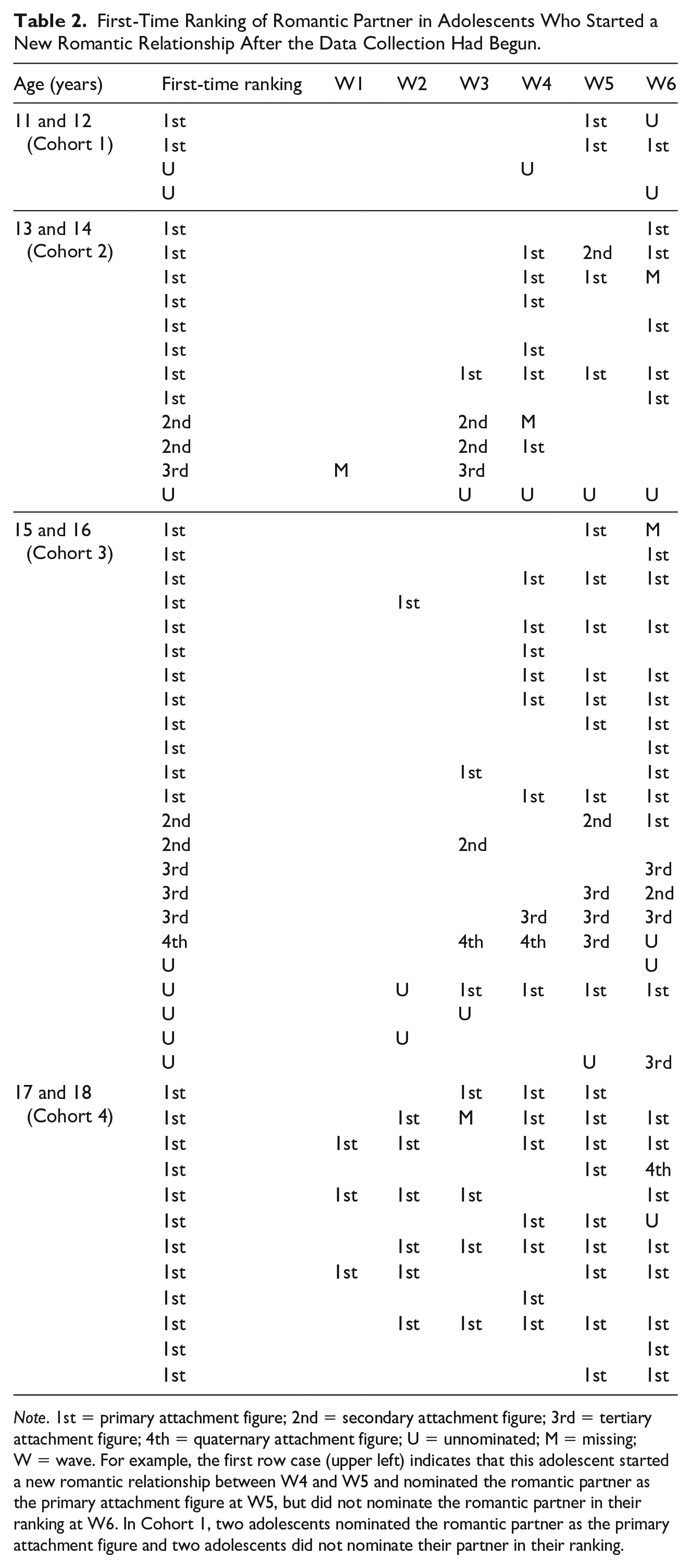
Note. 1st = primary attachment figure; 2nd = secondary attachment figure; 3rd = tertiary attachment figure; 4th = quaternary attachment figure; U = unnominated; M = missing; W = wave. For example, the first row case (upper left) indicates that this adolescent started a new romantic relationship between W4 and W5 and nominated the romantic partner as the primary attachment figure at W5, but did not nominate the romantic partner in their ranking at W6. In Cohort 1, two adolescents nominated the romantic partner as the primary attachment figure and two adolescents did not nominate their partner in their ranking.
Notably, all the adolescents in the latest cohort nominated their romantic partner as the primary attachment figure within the first 4 months of their romantic relationship. On the other hand, 33% of the adolescents in the other cohorts did not nominate their romantic partner as the primary attachment figure (Fisher’s exact test p = .004). This result supported one of our hypotheses regarding the developmental stage of the adolescents, in which later adolescents’ transfer to romantic partners tends to be faster compared to earlier adolescents.
Variable-Oriented Analyses
Descriptive statistics
The means (SDs) and bivariate correlations of attachment preferences are presented in Table 3. As indicated by the mean scores, attachment preferences for parents sequentially decreased across waves, while attachment preferences for romantic partners sequentially increased. However, the means of attachment preferences for friends did not show a consistent pattern of changes. Regarding the correlation analyses, within each wave, attachment preferences for parents were negatively associated with attachment preferences for friends and with attachment preferences for romantic partners. Notably, associations between attachment preferences for friends and attachment preferences for romantic partners were nonsignificant across all the waves.
Correlation Coefficients for Attachment Preferences.
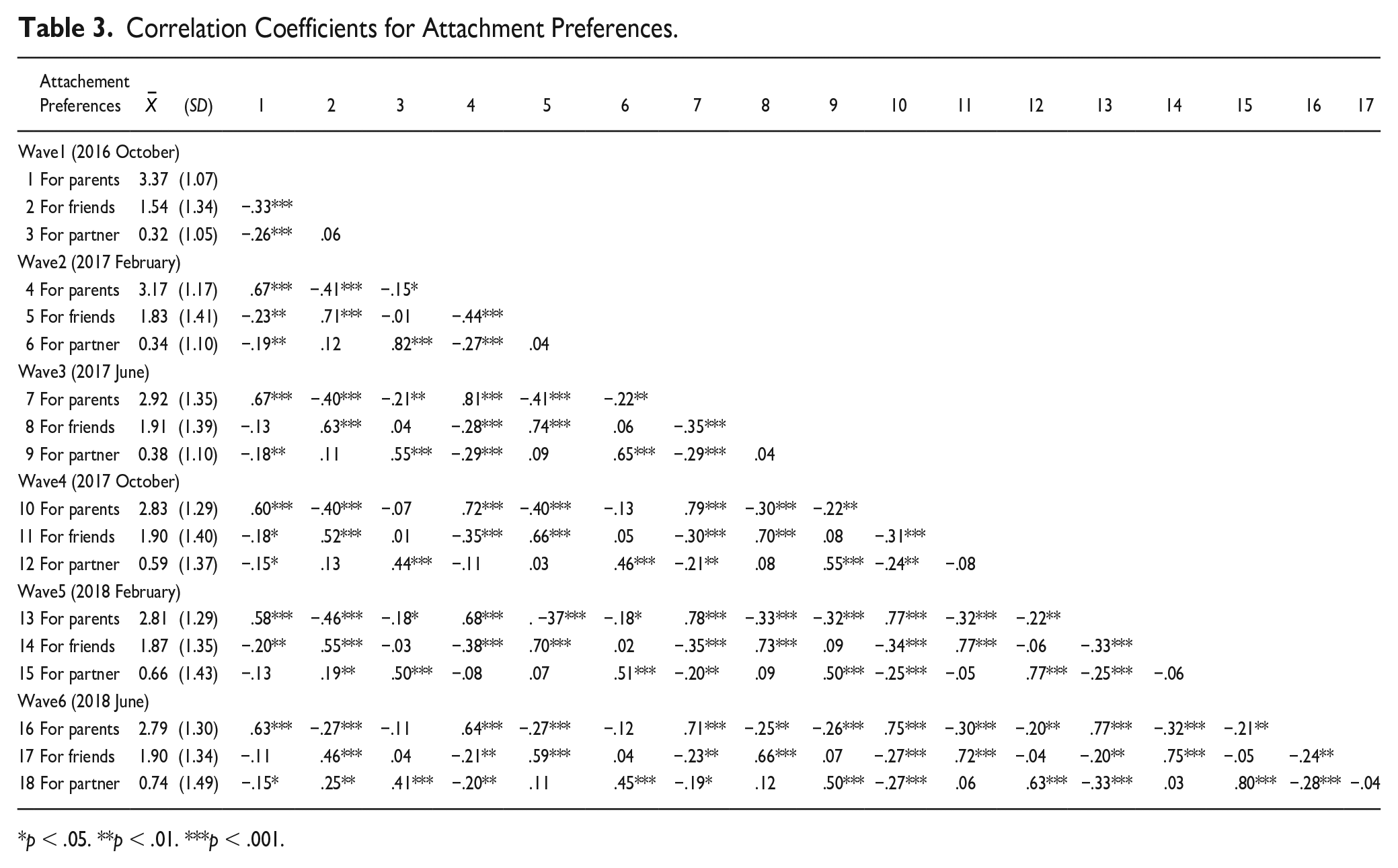
p < .05. **p < .01. ***p < .001.
MLM
The results of the MLM analyses of attachment preferences for parents and friends are presented in Table 4. We did not conduct an MLM analysis of the attachment preference for romantic partners because its distribution largely violated the assumption of normality. This violation could be because romantic partners are likely to be nominated as the primary attachment figures (not subsidiary attachment figures), as found in the above analysis to test the 2-year versus 4-month hypothesis.
Multilevel Models for Attachment Preferences.
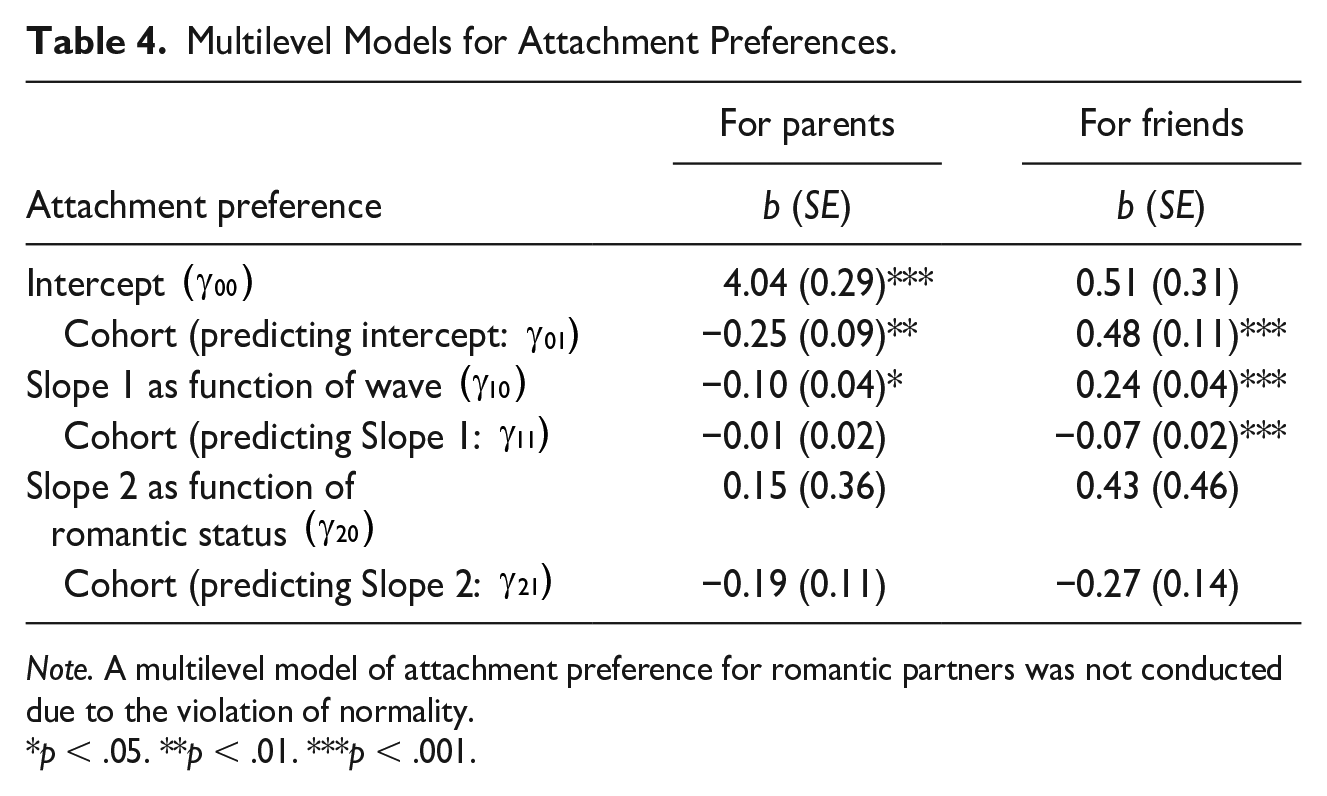
Note. A multilevel model of attachment preference for romantic partners was not conducted due to the violation of normality.
p < .05. **p < .01. ***p < .001.
The irreversible-trend hypothesis
Adolescents’ preference for parents at the intercept of the model (Wave 1; the parameter
The transfer-through-friends hypothesis
We further found that younger adolescents are more likely to increase their preference for friends, compared to older adolescents. Specifically, regarding the preference for friends, the within-person increases of wave varied between persons as a function of the cohort (the parameter
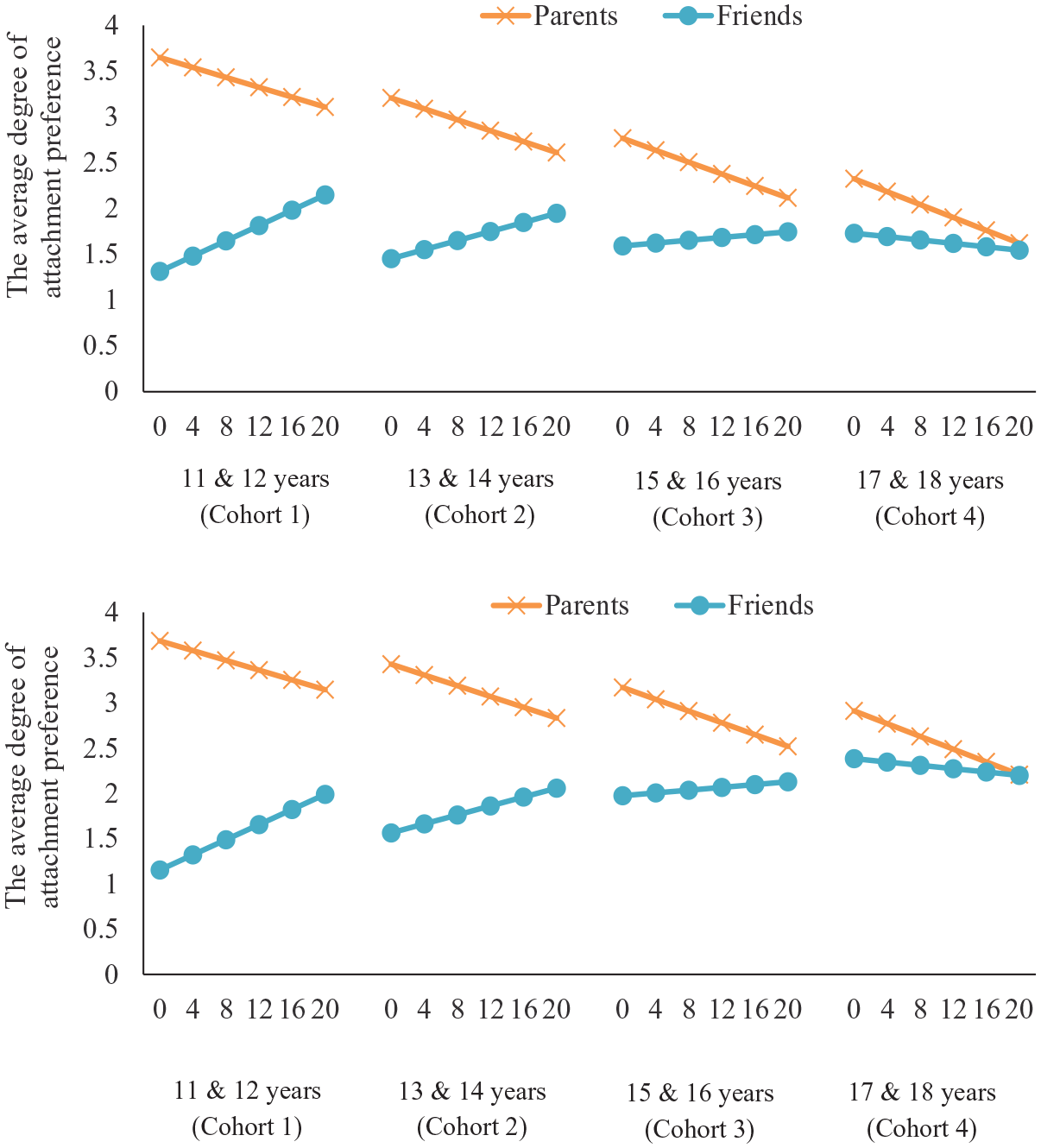
Changes in attachment preferences for parents and friends among adolescents who were in a romantic relationship (top) and among adolescents who were not in a romantic relationship (bottom).
Discussion
To prospectively examine the transfer of attachment figures from early to late adolescence, this study employed a six-wave 2-year longitudinal design with four cohorts (5th, 7th, 9th, and 11th graders). This study was the first longitudinal assessment of the IPI (Rosenthal & Kobak, 2010), developed based on Bowlby’s conceptualization of the attachment behavioral system. Data obtained in this study were analyzed using the person- and variable-oriented approaches. A person-oriented approach focused on the shift of primary attachment figures, and a variable-oriented approach focused on changes in attachment rankings. These methodological advantages provided us with a better understanding of adolescents’ transfer of attachment figures.
The Irreversible-Trend Hypothesis
We found that the primary attachment transfer from parents to peers was likely to be irreversible. More adolescents transferred their primary attachment figures from parents to peers (friends and romantic partners) than from peers to parents. When comparing the transfer within a 20-month interval, 57 adolescents transferred from parents to peers, whereas only 3 adolescents transferred from peers to parents. Moreover, our results consistently found this one-way transfer from parents to peers throughout adolescence. Specifically, adolescents who preferred parents constantly decreased from the early adolescence (91% of the Cohort 1 adolescents at Wave 1) to the late adolescence (15% of the Cohort 4 adolescents at Wave 6), while adolescents who preferred peers increased from the early adolescence (9% of the Cohort 1 adolescents at Wave 1) to the late adolescence (85% of the Cohort 4 adolescents at Wave 6). Similar findings were demonstrated in our variable-oriented analyses. That is, adolescents’ preference for parents decreased within persons (i.e., across a person’s waves) and between persons (i.e., across different cohorts), while adolescents’ preference for friends increased both within and between persons.
Consistent with our findings in adolescence, a previous study found that young adults who break up with their romantic partner increase their preference for friends rather than for their parents (Umemura et al., 2017). All these findings suggest that once adolescents and young adults become attached to their peers as their attachment figures, they are unlikely to experience backward transfer of attachment figures from peers to parents. Taken together, we believe that the transfer from parents to peers seems likely to be irreversible throughout adolescence and even probably through young adulthood.
In our data, however, there were three adolescents who transferred back from peers in the 1st wave to parents in the 6th wave (two adolescents in Cohort 2 and one adolescent in Cohort 4). Interestingly, their back transfer was stable (e.g., friends were the primary attachment figures during the first three waves, while parents were the primary attachment figures during the latter three waves). This result suggests that a small percentage of adolescents do transfer back from peers to parents in a stable manner, although it seems rare.
The Transfer-Through-Friends Hypothesis
We found differences in developmental characteristics for the transfer-through-friends hypothesis. Specifically, person-oriented analyses revealed that only the earlier-cohort adolescents had significantly larger transfers from parents to friends than from parents to romantic partners. The same was not observed for the later-cohort adolescents. Furthermore, variable-oriented analyses demonstrated that earlier-cohort adolescents had a greater increase in their preference for friends, compared to later-cohort adolescents. Interestingly, the latest-cohort adolescents even showed a slight decrease in their preference for friends, regardless of whether they had a romantic partner (see Figure 3). All these results supported the former part of our transfer-through-friends hypothesis regarding adolescents’ developmental stage; that is, earlier adolescents are likely to experience the transfer from parents to friends.
However, our results did not support the latter part of the hypothesis: That is, later adolescents tend to experience the transfer of attachment figures from friends to romantic partners. One possibility is that, no matter how strongly later-cohort adolescents used to prefer their parents or friends as attachment figures, they would soon prefer their romantic partner once they enter into a romantic relationship. In fact, our variable-oriented analysis for the romantic partner preference was not examined due to the violation of normality probably because romantic partners are likely to be nominated as the primary attachment figure (not subsidiary attachment figures). This will be explicated further in the next section.
Nonetheless, friends did not seem to function as the exclusive attachment figures in the way parents or romantic partners did. In our LCAs, adolescents who were assigned to the Friend Class did not nominate friends as the primary attachment figure as exclusively as adolescents in the Parent Class did for their parents or as adolescents in the Partner Class did for their romantic partners. Adolescents in the Friend Class, on average, also showed moderate levels of preference for parents in some items. In addition, our variable-oriented analyses showed that, unlike parents for many earlier adolescents, friends were not exclusively preferred (or solely important) attachment figures (Figure 3). These results were consistent with that reported in the study by Hazan and Zeifman (1994), which revealed that friends did not become “full-blown” primary attachment figures (i.e., adolescents did not nominate friends in all the subcategories of the WHOTO scale, which was employed in that study). In sum, for some, but not all, adolescents, their transfer of attachment preferences between parents and romantic partners indirectly go through friends, but the preference for friends is not as exclusive as the ones adolescents had for parents earlier on, or for romantic partners later on.
The 2-Year Versus 4-Month Hypothesis
Using the IPI scale that was developed based on Bowlby’s conceptualization of attachment behavioral systems (Rosenthal & Kobak, 2010), we prospectively found that it takes 4 months or fewer for many adolescents to nominate their romantic partner to be the primary attachment figure. This finding does not align with the results reported in previous cross-sectional studies (Fraley & Davis, 1997; Hazan & Zeifman, 1994), which found that 2 years was the length of time needed for a romantic partner to become the primary attachment figure based on the WHOTO scale. However, a longitudinal study involving young adults (Fagundes & Schindler, 2012) that had also used the WHOTO scale prospectively found that it took only approximately 4 months for a romantic partner to receive a nomination for the primary attachment figure in the safe haven and proximity seeking subcategories, although it took over 2 years for a romantic partner to receive a nomination in the secure base subcategory. Taken together, longitudinal evidence suggests that, except the secure base subcategory of the WHOTO scale, romantic partners can become the primary attachment figure for both adolescents and young adults within 4 months.
We also hypothesized that earlier adolescents take longer to nominate their romantic partners to be the primary attachment figures compared to later adolescents. We found that all adolescents in the latest cohort nominated their romantic partner within the first 4 months of their romantic relationship, whereas a significant number of adolescents in the earlier cohorts did not. This finding suggests that by the end of adolescence (e.g., the age of 17-19 years in our study), individuals may be ready to transfer their attachment to romantic partners. Previous studies have suggested that having a romantic partner in late adolescence helps adolescents with emotional and interpersonal competencies, whereas having a partner in early adolescence is a risk factor for emotional and interpersonal problems (e.g., Collins et al., 2009; Meeus et al., 2007 for review). These findings from previous studies are consistent with our prospective evidence pertaining to the readiness of romantic partners as the primary attachment figures in the late adolescence.
Limitations
This study used the relatively small sample (N = 215). However, this sample size could still uncover a medium level of effect size (e.g., ρ = .30). The decision to employ a smaller sample was balanced against the priority to collect longitudinal data in shorter intervals over 6 waves, to more adequately capture the detailed process of adolescents’ attachment transfer. In addition, 5% of the recruited families (12 families) did not consent to participate in our research project, and up to 7% of the families who had initially agreed on their participation to our project missed a subsequent wave. Our missing data analyses revealed that our participants were from higher SES and more stable family environments, compared to those who were missing at some point. For the comprehensive understanding of attachment transfer, future research needs to focus on adolescents who are from unstable and at-risk families.
Conclusion and Future Studies
This study provided prospective evidence for the transfer of adolescents’ attachment figures from early to late adolescence by employing the IPI (Rosenthal & Kobak, 2010). Our results revealed that once adolescents have transferred their primary attachment figures from parents to peers, they were unlikely to experience a transfer back from peers to parents. This pattern of irreversibility seems to remain the same from early to late adolescence. However, we also found a developmental difference in attachment transfer. That is, the transfer of attachment from parents to friends is more likely to be prevalent in early adolescence rather than in late adolescence, although we did not find evidence for a transfer from friends to romantic partners in late adolescence. In addition, friends were not as exclusive attachment figures as parents or romantic partners were. Hence, we concluded that our results provided only partial support for the transfer-through-friends hypothesis. For many adolescents, particularly for late adolescents, it took 4 months or less until their romantic partner became the primary attachment figure. This finding was consistent with the one from another longitudinal study (Fagundes & Schindler, 2012), underscoring the utility in conducting longitudinal studies to accurately estimate the time needed for romantic partners to become primary attachment figures.
Regarding individual differences in adolescents’ attachment, our longitudinal findings suggested that some adolescents transfer directly from parents to romantic partner, while others do indirectly through friends. In addition, the timing of transfer is different; some adolescents transfer early, while others do later. In adolescence and young adulthood, these individual differences of attachment transfer may be as important as individual differences of attachment quality (e.g., secure vs. insecure relationships), which have been considered almost exclusively in the literature on adolescents’ attachment. Therefore, future studies need to systematically examine these two components of individual differences: attachment transfer and attachment quality.
Supplemental Material
sj-pdf-1-jea-10.1177_0272431620978531 – Supplemental material for Transfer of Early to Late Adolescents’ Attachment Figures in a Multicohort Six-Wave Study: Person- and Variable-Oriented Approaches
Supplemental material, sj-pdf-1-jea-10.1177_0272431620978531 for Transfer of Early to Late Adolescents’ Attachment Figures in a Multicohort Six-Wave Study: Person- and Variable-Oriented Approaches by Tomotaka Umemura, Lenka Lacinová, Dana Juhová, Lenka Pivodová and Hoi Shan Cheung in The Journal of Early Adolescence
Footnotes
Declaration of Conflicting Interests
The author(s) declared no potential conflicts of interest with respect to the research, authorship, and/or publication of this article.
Funding
The author(s) disclosed receipt of the following financial support for the research, authorship, and/or publication of this article: This research was supported by a grant from the Czech Science Foundation: GA16-03059S. The first author (T. Umemura) is supported by the HIRAKU-Global Program, which is funded by MEXT’s “Strategic Professional Development Program for Young Researchers”.

Supplemental Material
Supplemental material for this article is available online.
Notes
Author Biographies
References
Supplementary Material
Please find the following supplemental material available below.
For Open Access articles published under a Creative Commons License, all supplemental material carries the same license as the article it is associated with.
For non-Open Access articles published, all supplemental material carries a non-exclusive license, and permission requests for re-use of supplemental material or any part of supplemental material shall be sent directly to the copyright owner as specified in the copyright notice associated with the article.
