




Abstract
Although it has been proposed that the COVID-19 pandemic has increased the risk of parental burnout and child maltreatment in families, parent-reported empirical evidence is scarce. Furthermore, it is unknown whether different profiles of maltreatment can be identified among parents based on physical violence, emotional violence, and neglect, and how these profiles differ based on family-related background variables. We adopted a person-oriented approach and examined maltreatment profiles of Finnish parents and their association with parental burnout and different background variables. The participants were 967 Finnish parents (88% mothers) who filled in a questionnaire during the COVID-19 lockdown in the Spring of 2020. The data were analyzed using k-means cluster analysis, one-way analysis of variance (ANOVA), chi-square test, Kruskal–Wallis test, and multinominal regression. We found four different profiles: no maltreatment (67.4%), emotional maltreatment (21.3%), neglectful maltreatment (7.3%), and diverse maltreatment (3.9%). Parental burnout was associated with all maltreatment profiles. Furthermore, parents’ low education level as well as children's young age and the high number of boys in the family were associated with maltreatment profiles. More than one third of the parents used some form of maltreatment during the COVID lockdown, emotional maltreatment being the most common profile. From a prevention point of view, it is important to identify those parents who are at risk for burnout and offer early educational and practical support particularly for families with young children.
Child Maltreatment Profiles of Finnish Parents and Their Associations With Parental Burnout During COVID-19-Lockdown
Due to the COVID-19-pandemic and isolation of families during lockdowns, the concern about child maltreatment blossomed (Huang et al., 2023). It is known that the COVID-19-pandemic increased child maltreatment (Wong et al., 2021) and the risk factors for child maltreatment (Baron et al., 2020; Lawson et al., 2020), while at the same time, the notifications of child maltreatment decreased (Baron et al., 2020). This is alarming because when schools and other child-related institutions were closed, it was more difficult to detect and prevent maltreatment. Furthermore, it is known that the COVID-19 pandemic increased the prevalence of parental burnout (van Bakel et al., 2022) as the stress factors for parents reached a new level (Griffith, 2020). Since parental burnout, in turn, has been shown to be a significant risk for child maltreatment (Mikolajczak, Brianda, et al., 2018; Mikolajczak et al., 2019; Roskam & Mikolajczak, 2020), it is essential to study maltreatment in this context.
Most of the maltreatment research during the COVID-19 pandemic has concentrated on children's experiences and symptoms, and only a few studies examined parents. Furthermore, to the best of our knowledge, it is unknown whether there were different profiles of parents who use different types of maltreatment. From a prevention point of view, identifying different groups of maltreating parents—and understanding what differentiates them—would help generate targeted interventions for families to reduce maltreatment during times of social crisis (Debowska et al., 2017; Norman et al., 2012). Consequently, in the present study, we adopted a person-oriented approach and examined different maltreatment profiles of parents during the COVID-19 lockdown. Furthermore, we assessed how parental burnout and different family-related background variables are associated with these profiles.
Child Maltreatment
Even though most of the Finnish children live in a safe environment with their basic rights fulfilled, approximately one-fourth of the children are maltreated (Leppäkoski et al., 2021; Söderholm & Kivitie-Kallio, 2012). Comprehensive definition of maltreatment is complicated, because it often happens privately, and it has a strong stigmatization (Manly, 2005). Furthermore, children can be maltreated by many people, like family members, caregivers, friends, foreigners, other children, medical staff, or other people with responsibility for the children (World Health Organization [WHO], 2006). WHO has created a general definition of child maltreatment, which includes all physical, emotional, or sexual violence, neglect, or any other act that happens in a relationship, that does or might harm a child's health, survival, development, or self-worth (WHO, 1999). In the present study, we examined child maltreatment as parent-conducted physical and emotional violence and neglect.
Physical violence in families is often a way to punish children (WHO, 2006). Physical violence includes every act that does or might cause physical harm to a child (WHO, 1999), like shaking, hitting, kicking, biting, choking, burning, or threatening with weapons (Krug et al., 2002; WHO, 2006). Also, incidents where the responsible adult does not prevent physical harm from happening to the child even though one has an opportunity for it are included in physical violence (WHO, 1999). Estimates of the prevalence of physical violence vary to a great extent (Krug et al., 2002). According to a global meta-analysis, approximately 22.6% of people have experienced physical violence in their childhood (Stoltenborgh et al., 2015). Studies all around the world have, however, reported even higher estimates of physical violence (Krug et al., 2002). In Finland, discipline violence (e.g., violence that the parent conducts as a result of the child not obeying the parent) has decreased remarkably from 1988 to 2008 (Fagerlund et al., 2014) and it has been illegal since 1984 (Act on Child Custody and Right of Access (1983/361). However, a recent Finnish study reported that even 14.3% of 4-year-old children have experienced physical violence in the past 12 months (Leppäkoski et al., 2021).
Emotional violence means that one fails to provide a safe environment for a child's development and attachment style (WHO, 1999). Also, any acts that do or might cause problems for a child's physical, psychological, spiritual, moral, or social development are included in emotional violence (WHO, 1999, 2006). Emotional violence can include, for example, limiting a child's freedom, minimizing, denigrating, blaming, threatening, scaring, discriminating, and mocking the child (WHO, 1999). These single acts are included in emotional violence only if they can be controlled by the maltreated person (WHO, 1999). A global meta-analysis reported that 36.3% of the people had experienced emotional violence in their childhood (Stoltenborgh et al., 2015). In Finland, emotional violence has been decreasing remarkably from the year 1988 to 2013 but an up-to-date study reported that 28% of the children had experienced rebuking or nagging before the age of 14 (Fagerlund et al., 2014).
Neglect can be one single act or set of acts where one cannot fulfill the basic needs of a child like health, education, emotional development, nutrition, and safe environment (WHO, 2006). In previous research neglect has been divided into physical neglect (e.g., one does not take care of a child's basic needs), emotional neglect (e.g., one does not comfort the child), and educational neglect (e.g., one does not help a child with his/her homework) (Aunola et al., 2021; Mikolajczak et al., 2019). In the present study, neglect was assessed as one form of child maltreatment and it was not divided into dimensions. A global meta-analysis reported that 16.3% of people had experienced physical and 18.4% emotional neglect in their childhood (Stoltenborgh et al., 2015).
The different forms of maltreatment rarely appear alone, but instead, they make combinations (Warmingham et al., 2019). A Canadian study reported that 90% of adolescents in social services had experienced more than one form of violence (physical, emotional, sexual violence, neglect, and being exposed to domestic violence) (McGee et al., 1995). Another Canadian study reported that half of the children, who had experienced physical violence, had experienced other forms of violence as well (Larrivée et al., 2007). They also reported that the children who experienced more than one form of violence experienced it more often than children who had experienced only physical violence (Larrivée et al., 2007). Similarly, a Finnish study showed that 25.4% of 4-year-old children had experienced both physical and psychological violence in the past 12 months (Leppäkoski et al., 2021).
Although it has been shown that maltreatment is often experienced in different combinations, most of the previous studies have assessed maltreatment using a variable-oriented approach (e.g., Stoltenborgh et al., 2015). This approach assumes that participants form a homogenic population in terms of the examined variables (Meyer & Morin, 2016; Sorkkila & Aunola, 2021). Person-oriented approach, in turn, assumes that the population is heterogenic (Sorkkila & Aunola, 2021) and forms smaller sub-populations based on differences in the variables assessed (Meyer & Morin, 2016). In the few previous person-oriented studies that have been conducted with children as participants, the most common profile emerging has been characterized by children experiencing physical and emotional violence (Debowska et al., 2017) or physical and emotional violence with neglect (Kim et al., 2017).
In the previous studies, the information about maltreatment has been gathered from children themselves or from adults retrospectively (e.g., neglect by their own parents in their childhood; Debowska et al., 2017). Very few studies have asked parents themselves about their own maltreating behavior toward their children. In the present study, we aimed to examine parent-reported child maltreatment at a very specific time, that is, during a COVID-19 lockdown. During this time, families were isolated to their homes and the risk of child maltreatment worldwide increased significantly (Griffith, 2020; WHO, 2020). Our first aim was to investigate what kinds of maltreatment profiles can be identified among Finnish parents based on physical and emotional violence and neglect during the COVID-19 lockdown. Furthermore, we wanted to assess how common these profiles were.
Parental Burnout
Research on parental burnout has blossomed worldwide during the last few years (for a review, see Mikolajczak et al., 2023). Parental burnout consists of emotional exhaustion (i.e., chronic fatigue that does not go away by resting), contrast in previous parental self (i.e., parent does not feel himself/herself as a good parent as he/she used to be), being fed up as a parent (i.e., parent does not enjoy the time he/she spends with his/her children anymore), and emotional distancing from children (i.e., parent only takes care of the essential aspects of parenting but he/she does not show affection toward his/her children) (Roskam et al., 2018). Although these four dimensions load on separate factors, they correlate with each other strongly (r = .84–.95; Aunola et al., 2020) and therefore have been often examined as one, overall burnout (e.g., Mikolajczak et al., 2019; Sorkkila & Aunola, 2021). Although parental burnout is moderately related to job burnout and depression, they have been shown to be separate constructs: whereas job burnout takes place in a work context, parental burnout takes place in a parent–child context (Mikolajczak et al., 2019). Depression, in turn, is all-pervasive (Mikolajczak et al., 2019).
Parental burnout develops in a situation where parental demands constantly override parental resources (Mikolajczak & Roskam, 2018). According to the Balance between Risks and Resources Theory (BR2-theory), parental demands are stress-inducing factors (e.g., countless parental chores), and parental resources are stress-reducing factors (e.g., self-compassion or positive co-parenting; Mikolajczak & Roskam, 2018). Although parental demands and resources can vary between individuals, some commonalities have been discovered. For example, recent studies in Finland have shown that parent's gender, age, employment status, financial situation, and child's special needs were associated with parental burnout (Sorkkila & Aunola, 2020). During the COVID-19 crisis, some changes were discovered in the background variables explaining parental burnout. For example, parents were also more burned out if they had small children with whom they spent a lot of time (Sorkkila & Aunola, 2021), which makes sense, since during lockdowns the regular support networks (e.g., grandparents, childcare) were unavailable. However, it has been repeatedly shown that sociodemographical factors (e.g., parents’ age and educational status, the number of children) explain relatively little of variance in parental burnout and personality-related factors (e.g., pessimism, perfectionism, and resilience) explain more (e.g., Le Vigouroux et al., 2017; Mikolajczak, Brianda, et al., 2018; Mikolajczak, Raes, et al., 2018; Sorkkila & Aunola, 2020, 2021).
Parental burnout can have serious consequences to parents themselves, to the spousal relationship, and to the children living in the family (Mikolajczak, Brianda, et al., 2018; Roskam et al., 2017). For example, parental burnout has been shown to be related to parent's escape and self-harming thoughts, addiction behavior, and sleeping problems, as well as to the number of conflicts in the spousal relationship (Mikolajczak, Brianda, et al., 2018). Parental burnout has also been shown to be a significant risk factor for violence and neglect toward children (Mikolajczak, Brianda, et al., 2018; Mikolajczak et al., 2019; Roskam & Mikolajczak, 2020). However, few studies have examined the relationship between parental burnout and child maltreatment during a COVID-19 lockdown, although it has been shown that during the crisis the prevalence of parental burnout has increased significantly across the world (van Baken et al., 2022). Our second aim, thus, was to examine how maltreatment profiles of parents are associated with parental burnout.
The Background Variables Related to Child Maltreatment
Previous studies have reported several parent-related background variables that are associated with child maltreatment (Dixon et al., 2007; Krug et al., 2002; Sidebotham & Heron, 2006; Straus et al., 1998). For example, it has been shown that young parents tend to maltreat their children more than older parents (Murphy et al., 2018; Sidebotham & Golding, 2001; Sidebotham & Heron, 2006; Straus et al., 1998) and people with lower education tend to maltreat their children more than people with higher education (Dubowitz et al., 2011; Paavilainen et al., 2001; Sidebotham & Heron, 2006). Regarding gender, the findings have been more mixed. Although several studies have shown that mothers use more discipline violence than fathers (Fagerlund et al., 2014; Straus et al., 1998), some have found that fathers use more physical violence than mothers (Dixon et al., 2007). A recent Finnish study showed, in turn, that adolescents with highly educated mothers had experienced more maltreatment than adolescents with highly educated fathers or lowly educated parents (Fagerlund et al., 2014), suggesting that the background variables of interest may interact. Furthermore, it has been found that burned-out mothers use more severe violence against their children than burned-out fathers, whereas burned-out fathers tend to neglect their children more than burned-out mothers (Roskam & Mikolajczak, 2020).
There is less information about the child-related background variables. However, some studies have reported that boys have a greater risk for physical violence than girls (Krug et al., 2002; Larrivée et al., 2007; Leppäkoski et al., 2021; WHO, 2006) and girls experience different forms of neglect more than boys (Krug et al., 2002; Larrivée et al., 2007). Also, younger children seem to have a greater risk for maltreatment than older children (Krug et al., 2002; WHO, 2006), and the amount of discipline violence decreases as the children grow older (Straus et al., 1998). Moreover, having many children in the family seems to increase the risk of child maltreatment (Dubowitz et al., 2011; Paavilainen et al., 2001), which may result from higher parental demands.
The present study examined various background variables that have been shown to correlate with child maltreatment in multiple previous studies (e.g., Dixon et al., 2007; Krug et al., 2002; Sidebotham & Heron, 2006; Straus et al., 1998). However, parent- and child-related backgrounds have been rarely examined together, and previous results have been somewhat conflicting (e.g., Dixon et al., 2007; Fagerlund et al., 2014). Our third aim was, thus, to examine how maltreatment profiles differ from each other based on the relevant background variables, which were parents’ gender, parents’ age, parents’ education, children's age, children's gender, and the number of children in the family.
Present Study
The present study aimed to examine what kind of maltreatment profiles can be identified among Finnish parents based on physical violence, emotional violence, and neglect and how common they are. We examined the profiles during the COVID-19 lockdown, since it has been proposed that this time is particularly risky for child maltreatment (Griffith, 2020). Furthermore, we aimed to examine how the profiles differ based on parental burnout symptoms and relevant background variables. The specific research questions were as follows:
What kind of maltreatment profiles can be identified based on physical and emotional violence and neglect among Finnish parents during the COVID-19 lockdown? How common are these profiles? Do these profiles differ based on (a) parental burnout and (b) relevant background variables (parents’ sex, parents’ age, parents’ education, children's age, children's sex, and the number of children)?
Method
Participants
The participants were 967 parents (88% mothers), who were selected for this study from 1,105 parents who answered the questionnaire. The excluded participants had missing values or did not have children living at home. The missing data analysis showed that the selected parents did not differ from the excluded parents based on parents’ sex or the number of children in age categories under 1, 1–4, and 19 or older. However, the selected parents had fewer children living at home (1.54 vs. 2.32, p < .001) and more children in age categories 5–9 (0.74 vs. 0.54, p < .05), 10–14 (0.56 vs. 0.28, p < .001) and 15–18 (0.24 vs. 0.11, p < .001).
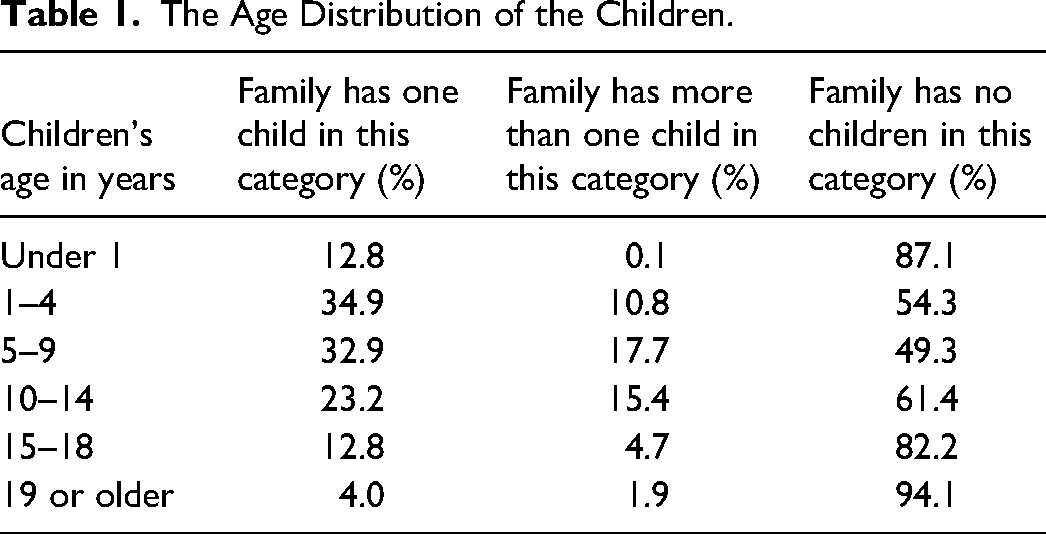
Mothers’ age varied between 20 and 59 (M = 38; SD = 6.5) and fathers’ age between 26 and 60 (M = 41; SD = 7.5). Out of the parents, 49% had a University degree, 26% had a University of Applied Sciences degree, and 22% had gone to vocational school, which represents relatively well the Finnish population (44% University degree; Official statistic of Finland, 2021a). Parents had approximately two children (M = 2.3, SD = 1.4; range 1–12), which is somewhat higher than in the population (1.84 children; Official statistics of Finland, 2021b). A total of 75% of the parents were living in a nuclear family, 10% in a single-parent family, 10% in a blended family, and 5% represented other family forms, which is relatively similar to the Finnish population (Official statistic of Finland, 2021b). Out of the families, 43% had one girl and 28% more than one girl. Furthermore, 46% of the families had one boy and 32% more than one boy. The age distribution of the children is shown in Table 1. A total of 97% of parents reported being isolated to their homes due to COVID-19 restrictions.
The Age Distribution of the Children.
Procedure
The data were collected from April 22 to May 13, 2020, when Finland was locked down and in a state of emergency because of COVID-19 pandemic. The approval for this study was permitted by the ethics committee of the University of Jyväskylä. Before answering the questionnaire, informed consent was obtained from the participants about the meaning and value of the research as well as their voluntary participation, anonymity, and the possibility to withdraw from the study at any point. They also had to have at least one child living at home. The data were gathered via an internet Webropol survey which was advertised on the University's website and on different sites of social media. The answers were transmitted to the IBM SPSS Statistical program (Version 24).
Measures
Child maltreatment
Child maltreatment was measured with Parental Violence and Neglect questionnaire (Mikolajczak, Brianda, et al., 2018; Mikolajczak, Raes, et al., 2018) which was translated into Finnish (Aunola et al., 2021). The measure consists of six items, out of which one measures physical violence (I spank or slap my child(ren).), two emotional violence (e.g., I tell my child(ren) that I will abandon my child(ren) if s/he does not behave well.), and three neglect (e.g., I am not taking care of my child(ren) even when I know I should (i.e., meals, hygiene, etc.).). All the items were rated on an 8-point Likert scale (0 = never; 7 = several times a day). The Cronbach alpha reliability for the emotional violence scale was weak (α = .576) and for the neglect scale moderate (α = .711).
Parental burnout
Parental burnout was measured using the Finnish version of the Parental Burnout Assessment (PBA; Roskam et al., 2018), which has been validated in Finland (Aunola et al., 2020). The measure consists of 23 items which measure exhaustion in parental role (nine items, e.g., I feel completely run down by my role as a parent), experienced negative change in parental role (six items, e.g., I don’t think I’m the good father/mother that I used to be to my children), feeling of being fed up as a parent (five items, e.g., I can’t stand my role as father/mother anymore), and emotional distancing from own children (three items, e.g., I do what I’m supposed to do for my children but nothing more). All the items were rated on a 7-point Likert scale (0 = never; 6 = every day). The Cronbach alpha reliabilities for the subscales were either good or moderate (α = .950, .930, .905, .747), and for overall burnout very good (α = .972).
Background variables
Parents were asked about their gender (are you a mother/a father), age, and educational level (1 = no vocational education, 2 = vocational school degree, 3 = vocational institution degree; 4 = lower technical college degree, 5 = higher technical college degree, 6 = lower University degree, and 7 = higher University degree). They were also asked about their children's gender (how many daughters/sons do you have), children's age (number of children in different age categories: under 1, 1–4, 5–9, 10–14, 15–18, 19, or older) and the number of children living at their home.
Analysis Strategy
Analyses were conducted using the IBM SPSS Statistical program (Version 26). First, the aim was to identify different maltreatment profiles based on parent-reported physical violence, emotional violence, and neglect. To be able to form a meaningful cluster solution, the following steps were made. First, the variables were standardized so that different standard deviations would not affect the forming of the clusters. Second, k-means cluster analysis was carried out by using MacQueen's clustering method. In this process, the cases are assigned to the closest cluster and the new centroids are then calculated for the affected clusters (Morissette & Chartier, 2013). This process is run multiple times until the iteration process is stabilized by using the earlier centroids as the new initial centers (Meyers et al., 2013). Third, the iteration process was carried out from two to six profiles to form the final cluster solution.
After ending up with the final cluster solution, the differences in criteria variables between the four maltreatment profiles were assessed using a one-way analysis of variance (ANOVA). The pairwise comparisons were made by using Dunnett's T3 corrections. Because of the skewness of the maltreatment variables, the results were further verified with the Kruskal–Wallis test.
Second, the parents who used four different styles of maltreatment were compared to one another on the basis of their self-reported parental burnout by using Kruskal–Wallis test and one-way ANOVA. After that, the differences in background variables between the four different profiles were assessed by one-way ANOVA, chi-square test, and Kruskal–Wallis test. The pairwise comparisons were made by using Dunnett's T3 or Bonferroni corrections. Finally, to evaluate the statistical significance constancy when controlling other significant variables, the multinominal regression was carried out with variables that were related to different maltreatment profiles in the earlier analysis phase.
The effect sizes were assessed with partial eta squared and Cramer's V. The limit values for partial eta squared were evaluated using Cohen's (1988) criteria: weak (0.01 ≤ ηp2 < 0.06), moderate (0.06 ≤ ηp2 < 0.14), and large (0.14 < ηp2). The limit values for Cramer's V were weak (ϕc ≤ 0.2), moderate (0.2 < ϕc ≤ 0.6), and large (ϕc > 0.6) (SPSS, 2021).
Results
The Maltreatment Profiles
By comparing statistical significance, contextual coherency, and sample sizes in different cluster solutions, the four-cluster solution was considered to best describe the Finnish parents’ maltreatment profiles. The identified four profiles differed from one another based on the different forms of violence (p < .001), were contextually coherent (i.e., had profiles in which parents were diversely maltreating and non-maltreating which is in line with previous research e.g., Debowska et al., 2017; Warmingham et al., 2019), and had at least 12% of the parents belonging to the smallest group when excluding the non-maltreating parents from comparison. This approach was applied because of the skewness of the maltreatment variables. The profile solution is presented in Figure 1.
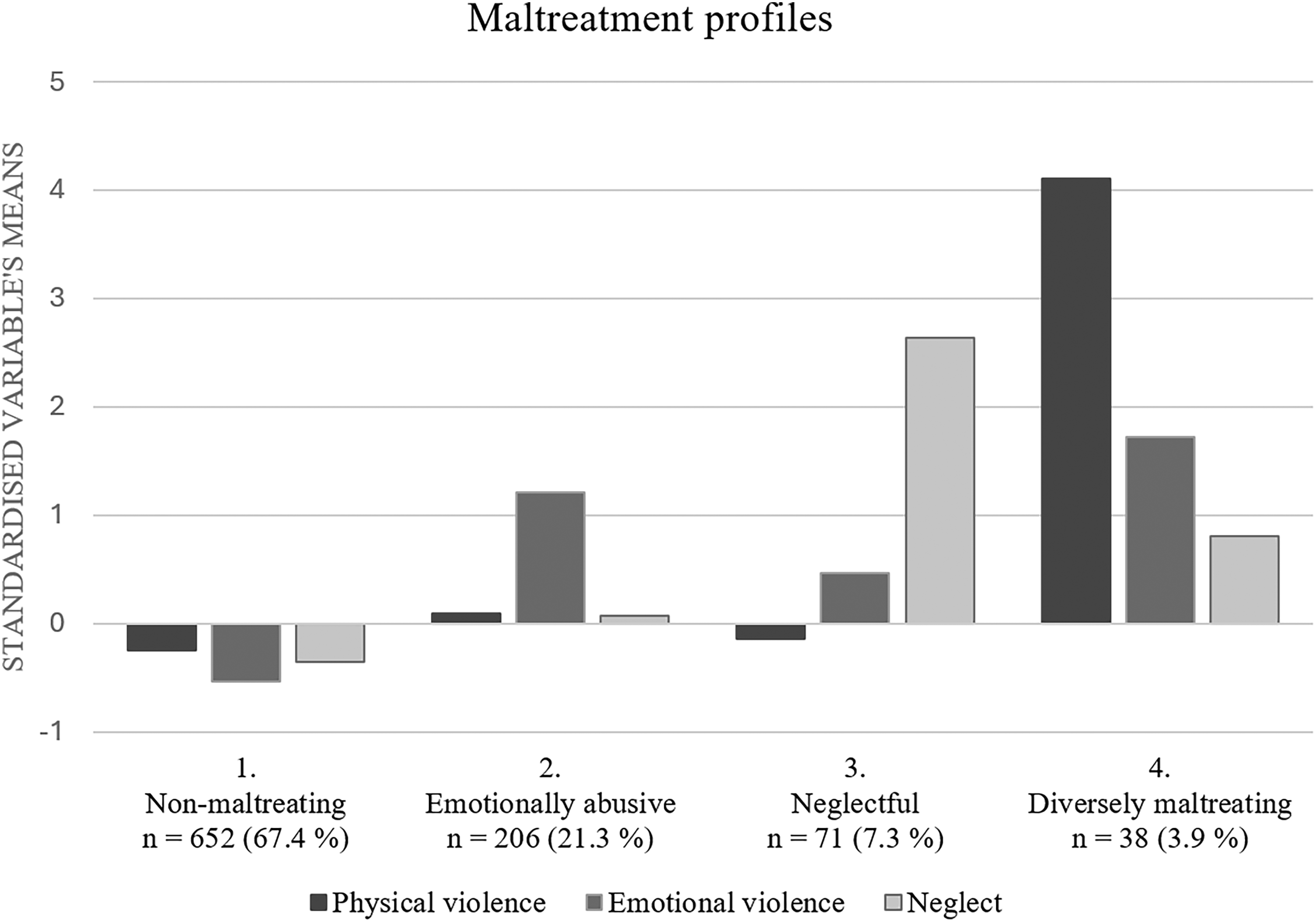
The maltreatment profiles with standardized variables (k-means cluster analysis).
The largest profile (n = 652, 67.4%) was characterized by a low level of both physical and emotional violence and neglect. The profile was named non-maltreating parents. The second largest profile (n = 206, 21.3%) was characterized by a low level of physical violence and neglect but a relatively high level of emotional violence. This profile was named emotionally abusive parents. The third largest profile (n = 71, 7.3%) was characterized by a high level of neglect, a moderate level of emotional violence, and a low level of physical violence. The third profile was named neglectful parents. The smallest profile (n = 38, 3.9%) was characterized by a high level of both physical and emotional violence and a moderate level of neglect. This smallest profile was named diversely maltreating parents.
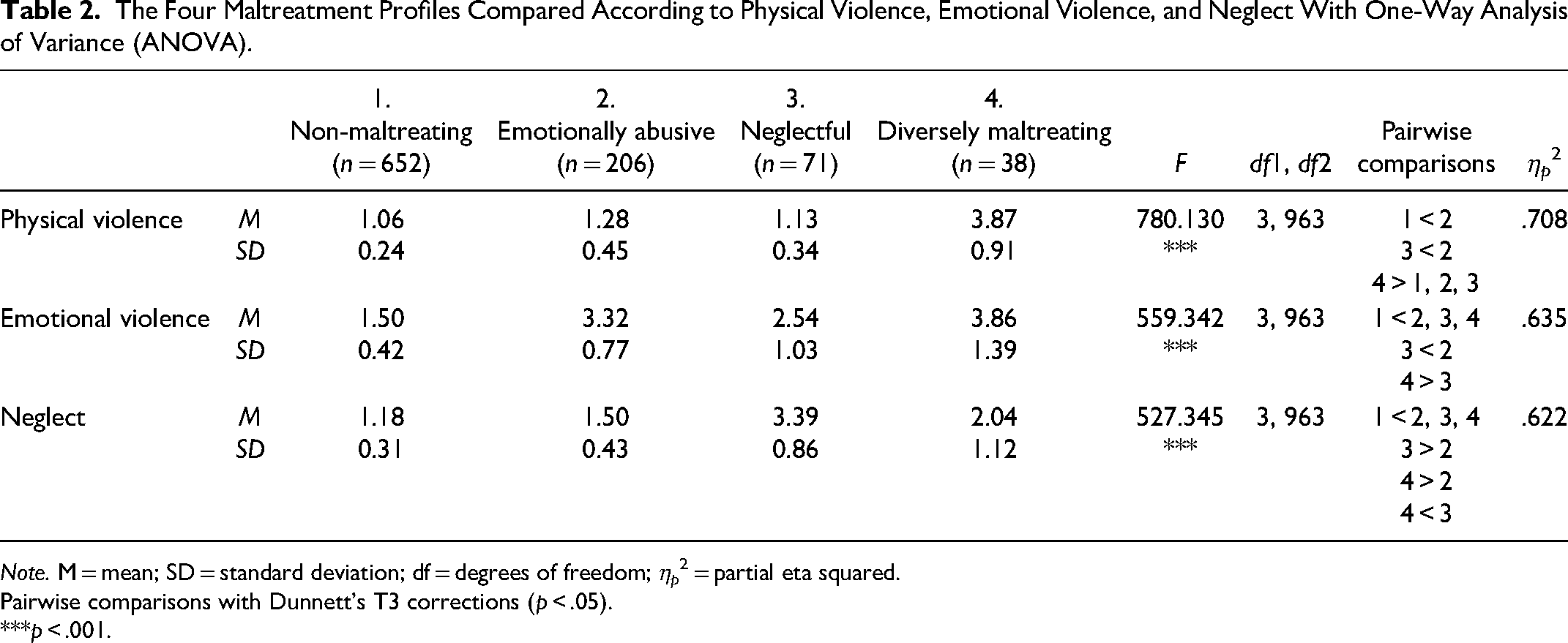
The means (M) and standard deviations (SD) for the maltreatment variables are shown in Table 2. According to the one-way ANOVA, the maltreatment profiles differed from one another with both physical (F(3, 963) = 780.130, p < .001) and emotional violence (F(3, 963) = 559.342, p < .001) and neglect (F(3, 963) = 527.345, p < .001). According to Cohen's (1988) criteria, the effect sizes were large (see Table 2). More specifically, pairwise comparison showed that non-maltreating parents reported lower levels of emotional violence and neglect than the other parents (p < .001). Also, non-maltreating parents reported lower levels of physical violence than emotionally abusive (p < .001) or diversely maltreating (p < .01) parents.
The Four Maltreatment Profiles Compared According to Physical Violence, Emotional Violence, and Neglect With One-Way Analysis of Variance (ANOVA).
Note. M = mean; SD = standard deviation; df = degrees of freedom; ηp2 = partial eta squared.
Pairwise comparisons with Dunnett's T3 corrections (p < .05).
p < .001.
The profile of emotionally abusive parents reported higher levels of emotional violence than non-maltreating (p < .001) or neglectful (p < .001) parents. Furthermore, they used a higher level of neglect than non-maltreating (p < .001) parents but a lower level of neglect than neglectful (p < .001) or diversely maltreating (p < .01) parents. The emotionally abusive parents also reported a lower amount of physical violence than diversely maltreating parents (p < .01) but a higher amount of physical violence than non-maltreating (p < .001) and neglectful (p < .01) parents.
Additionally, the neglectful parents showed higher levels of neglect than any other parents (p < .001). Moreover, the neglectful parents used emotional violence second lowest of all the other profiles as non-maltreating (p < .001) parents used it less frequently and the other profiles (p < .001) more frequently. The neglectful parents also used the lowest amount of physical violence compared to emotionally abusive (p < .01) or diversely maltreating (p < .001) parents.
Parents who are diversely maltreating used more physical violence than any other profile of parents (p < .001). In addition, they also use more frequently emotional violence than non-maltreating (p < .001) or neglectful (p < .001) parents and more neglect than non-maltreating (p < .001) and emotionally abusive (p < .01) parents.
The results were further validated with Kruskal–Wallis test, which demonstrated identical findings with one exception: when tested with the Kruskal–Wallis emotionally abusive parents did not statistically significantly (H(3) = 45,569, p < .315) differ in the amount of neglect compared to diversely maltreating parents.
Parental Burnout and Background Variables
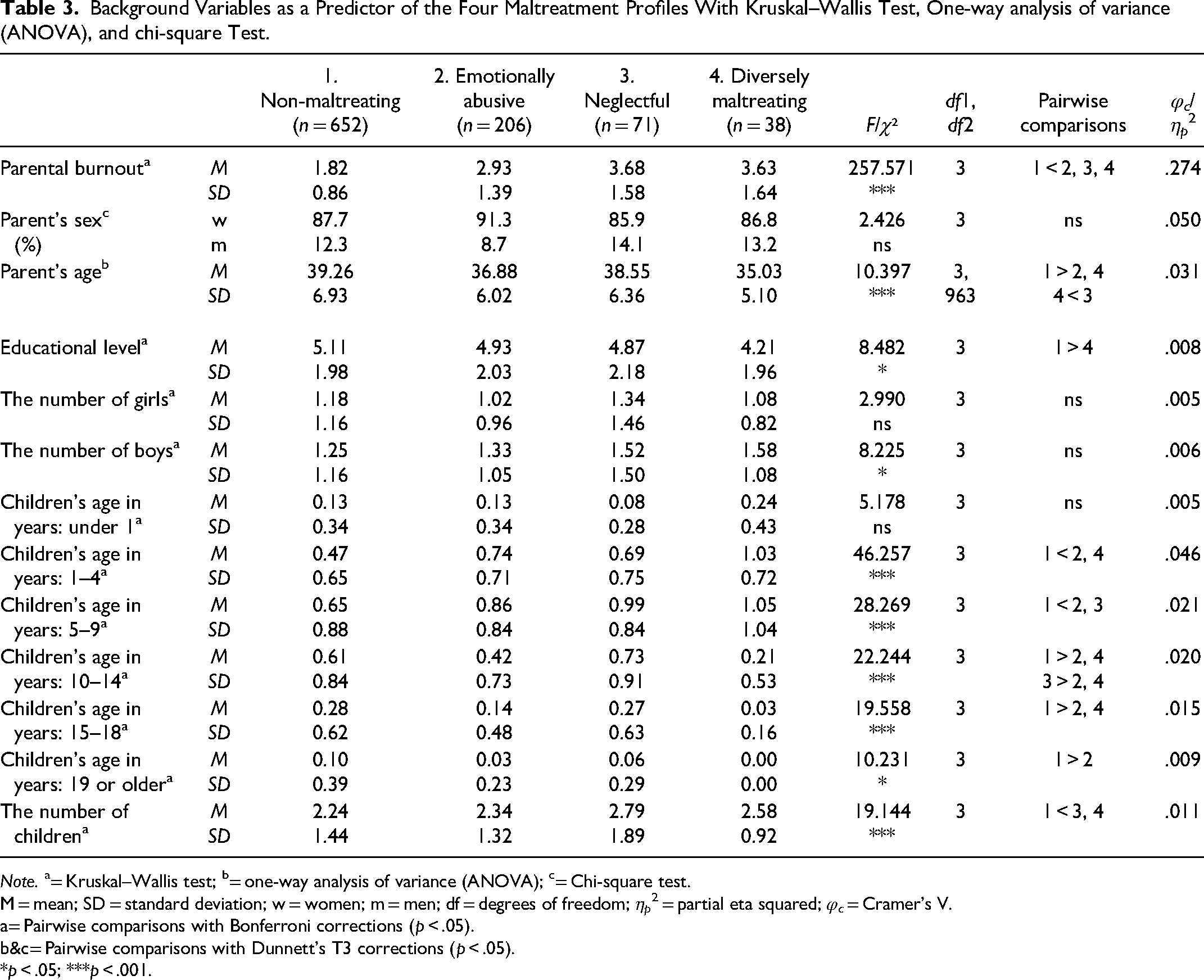
Next, differences between maltreatment profiles in parental burnout were tested. The results concerning the differences in parental burnout are shown in Table 3. The results of the Kruskal–Wallis test demonstrated statistically significant differences (H(3) = 257.571, p < .001): parents with non-maltreating profile showed a lower level of parental burnout than any other group. The differences in parental burnout were also assessed via ANOVA. The results were similar to the Kruskal–Wallis test with one addition: neglectful parents were more burned out than emotionally abusive parents (p < .01).
Background Variables as a Predictor of the Four Maltreatment Profiles With Kruskal–Wallis Test, One-way analysis of variance (ANOVA), and chi-square Test.
Note. a= Kruskal–Wallis test; b= one-way analysis of variance (ANOVA); c= Chi-square test.
M = mean; SD = standard deviation; w = women; m = men; df = degrees of freedom; ηp2 = partial eta squared; φc = Cramer's V.
= Pairwise comparisons with Bonferroni corrections (p < .05).
= Pairwise comparisons with Dunnett's T3 corrections (p < .05).
*p < .05; ***p < .001.
The results concerning differences in background variables are shown in Table 3. The results demonstrated that maltreatment profiles differed statistically significantly in nine out of the 12 tested variables. These statistically significant variables were parent's age, education level, the number of boys in the family, children's age, and the number of children in the family.
Finally, to examine the unique associations between maltreatment profiles and their statistically significant associates, multinominal logistic regression was carried out where maltreatment profiles were predicted by parental burnout and those background variables that were identified to be statistically significantly associated with the profiles. In the analyses, Non-maltreatment profile was used as a reference group. The results are shown in Table 4. Because the number of children correlated strongly with the number of boys in the family (r = .713, p < .01), only the number of boys was included in the analysis. The results for maltreatment profiles were that, after controlling parent's age, education level, the number of boys in the family, children's age, and the number of children in family, compared to non-maltreating parents, emotionally abusive and neglectful parents showed a higher likelihood of parental burnout. Also, after controlling the background variables, compared to non-maltreating parents, emotionally abusive and neglectful parents showed a higher likelihood of having children in age categories 5–9. Furthermore, after controlling the background variables, compared to non-maltreating parents, diversely maltreating parents had a higher likelihood for parental burnout and had a higher number of boys in the family as well as fewer children in age groups 10–14 and lower educational level.
Multinominal Logistic Regression of Predictors on Maltreatment Profiles (Non-Maltreating Group as Reference Group).
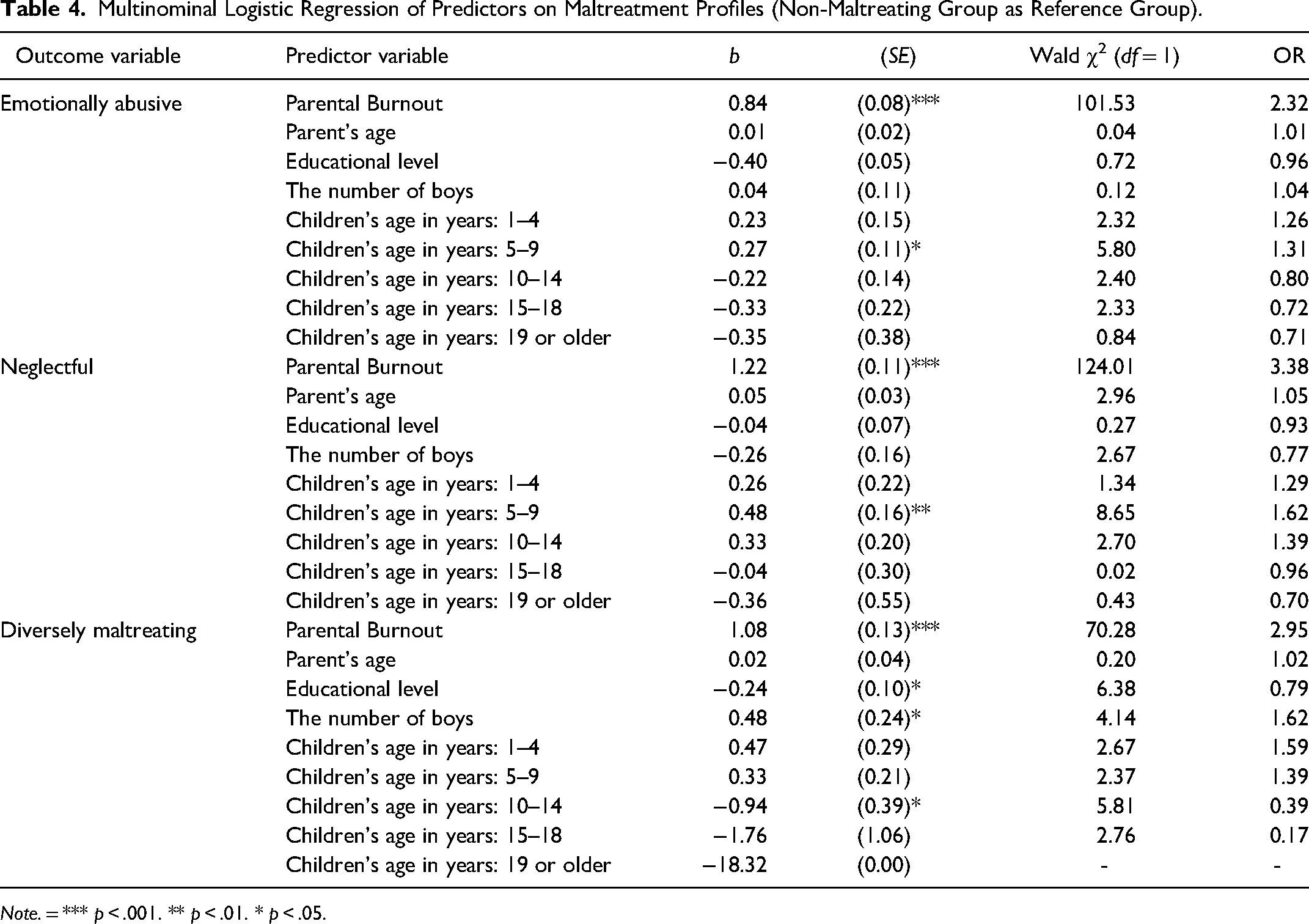
Note. = *** p < .001. ** p < .01. * p < .05.
Discussion
The aim of this study was to examine what kind of maltreatment profiles—based on physical and emotional violence and neglect—can be identified among Finnish parents during the COVID-19 lockdown and how common these profiles are. Moreover, we aimed to examine how these profiles differ based on parental burnout and relevant background variables (parents’ age, gender, and education as well as children's age, gender, and the number of children) and assess their unique associations when controlling other significant variables.
The results showed that there were four distinct maltreatment profiles of parents. The largest profile was the non-maltreating (67.4%), the second largest the emotionally abusive (21.3%), the third largest the neglectful (7.3%), and the smallest the diversely maltreating (3.9%) profile. The non-maltreating profile was characterized by a low level of all types of maltreatment. To the contrary, the diversely maltreating profile was characterized by a high level of physical and emotional violence and a moderate level of neglect. The emotionally abusive profile was characterized by a high level of emotional violence which was used as frequently as in the diversely maltreating profile. In opposition, the neglectful profile was characterized by a high level of neglect which was used more frequently than in the diversely maltreating profile. Also, the neglectful profile was characterized by as low level of physical violence as the non-maltreating profile.
Although the majority of the parents in our study were not maltreating their children, more than one third were using some kind of maltreatment. This amount is higher than the earlier estimates of maltreatment in Finland (Leppäkoski et al., 2021; Söderholm & Kivitie-Kallio, 2012), which may be explained by the specific time of data gathering, which was during the COVID-19 lockdown. This is alarming since it is known that maltreatment can have serious and long-lasting effects on a child's health, survival, development, or self-worth (WHO, 1999) and confirms the earlier arguments about the increased risk of child maltreatment during the COVID-19 crisis (Griffith, 2020). Parents were mostly emotionally abusive—characterized by, for example, blaming, threatening, or mocking the child—which has been shown to be the most common form of maltreatment also in previous studies (Fagerlund et al., 2014; Stoltenborgh et al., 2015). Since physical abuse is criminalized in Finland (Act on Child Custody and Right of Access (1983/361), emotional abuse may be seen as a more way accepted way to control and discipline the child. However, it is known that emotional abuse alone may have serious consequences. For example, a meta-analysis showed that emotionally abused children had a three-fold higher risk of developing a depressive disorder than non-abused children (Norman et al., 2012). Consequently, it would be important to educate parents early on using more constructive ways to respond to challenging situations with the child, particularly during crises.
The fact that we found a diversely maltreating profile is in line with previous studies (see e.g., Larrivée et al., 2007; McGee et al., 1995; Warmingham et al., 2019) which suggest that different types of maltreatment rarely occur alone, but instead, physical and emotional violence usually occur on top of neglect (Kim et al., 2017). However, in contrast to the previous studies (Kim et al., 2017; Warmingham et al., 2019), in our study diversely maltreating profile was the smallest one of the found four profiles. This suggests that among Finnish parents during the COVID-19 pandemic, different forms of maltreatment may also occur independently. Indeed, we discovered a group of neglectful parents who were not emotionally or physically abusive, and emotionally abusive group, who were not neglectful or physically abusive. These profiles may also have different antecedents and consequences. For example, physical violence in families is often inflicted because of punishment (WHO, 2006) and its goal is to get control of the child's behavior (Larrivée et al., 2007). The reasons for neglect, on the other hand, might not be to get control, but instead reflect the exhaustion of the parent (Mikolajczak, Brianda, et al., 2018; Mikolajczak, Raes, et al., 2018), which can explain why neglectful parents do not use physical violence toward their children.
The results showed that non-maltreating parents were less burned out than any other profile's parents. This association remained even when controlling for other variables, which shows that parental burnout is a serious risk factor for all types of maltreatment. This finding is in line with previous studies, which have consistently shown that burned-out parents are more likely to maltreat their children than parents who are not burned out (Mikolajczak, Brianda, et al., 2018; Mikolajczak et al., 2019; Roskam & Mikolajczak, 2020). It is not surprising that burned-out parents, who are chronically exhausted, fed up with parenting, and emotionally distanced from their children, are likely to maltreat them. Since the COVID-19 pandemic has increased severe parental burnout worldwide (van Bakel et al., 2022), particularly its influence on child maltreatment should be acknowledged and reacted upon.
The result showed that emotionally abusive and neglectful parents were more likely to have more 5–9-year-old children than non-maltreating parents. This result is not surprising as young children set more demands on parents, and, consequently, may be more risk to experience these kinds of maltreatment (Krug et al., 2002). Furthermore, having more boys in the family, having less 10–14-year-old children in the family, and having a lower parental educational level were associated with a higher likelihood for diverse maltreatment. These findings are in line with the previous studies showing that boys may experience more physical abuse than girls (Krug et al., 2002; Larrivée et al., 2007; Leppäkoski et al., 2021; WHO, 2006), and the amount of physical abuse decreases as children become older (Straus et al., 1998). This may be explained by boys—particularly at younger age—being more physically aggressive themselves than girls, and thus, physical punishment may be used as a method of controlling their behavior (Larrivée et al., 2007; Lytton and Romney 1991). Traditional gender beliefs may also play a role, as boys are often seen as more “tolerant” to physical punishment than girls and girls as more vulnerable than boys (for a review, see Lytton & Romney, 1991). Less educated parents, in turn, may have less recourses and information about how to respond to a child's challenging behavior, and they may, thus, be more prone to use diverse maltreatment, including physical abuse (Dubowitz et al., 2011). These findings highlight the importance of early parenting education to all kinds of families, which could include, for example, information about child development and methods of confronting the child in challenging situations.
The Strengths and Limitations of the Study
To the best of our knowledge, this study was among the first to examine child maltreatment with a person-oriented approach by using parents’ perspectives. The fact that we found four different maltreatment profiles addresses the importance of developing different kinds of interventions to protect children from the consequences of maltreatment. The study was conducted at a very unusual time, COVID-19 lockdown, which gives important information for political decision-makers in acknowledging families’ well-being in the post-COVID-19 phase and in preparing for future crises.
Nevertheless, the study had several limitations. First, this study was cross-sectional which means that the directionality of maltreatment and parental burnout cannot be assessed (i.e., it is not known if parental burnout influenced maltreatment, or maltreatment influenced parental burnout). In the future studies, it would be interesting to examine both the directionality and development of parental burnout and child maltreatment throughout time, particularly through a social crisis. Second, because of the skewness of the maltreatment variables (i.e., majority of the parents did not maltreat their child), the maltreating profiles were relatively small. Also, the average frequency of maltreating was “once in a month” even though the profiles were named in a certain way (e.g., neglectful, diversely maltreating). Third, the participants were not asked about the severity of their maltreatment. In the future studies, it would be beneficial to assess maltreatment's severity as well as frequency. Fourth, the measure for emotional violence had a weak Cronbach's alpha, which means that the consistency and operability of this measure were not as good as they should have been. Fifth, because the data were collected online, the sample did not represent all Finnish parents. Instead, the participating parents could have been selective in some ways (e.g., they could have been particularly fed up with the COVID-19 pandemic), although the sample seemed to represent the Finnish families quite well in terms of family type and education (Official Statistics Finland, 2021a, 2021b). Furthermore, mothers were over-represented in the present study, and the answers thus mainly represent mothers’ points of view. Sixth, the results only represent people in one cultural context, that is Finland. It is possible that parents from other countries and cultures maltreat their children differently, which should be addressed in future studies. Finally, we want to highlight that maltreatment is a sensitive subject that can cause guilt and shame for parents. This may generate false answers, modified answers, or reluctance to answer at all. Instead of using only self-reports, future studies should address this topic with a multi-informant style (i.e., collect data from parents and children). Ethically, may be beneficial to study maltreatment in an intervention context, where support could be offered directly to those who are in need.
Conclusion
This study offered novel information about parent-reported maltreatment profiles and their relationship with parental burnout during a COVID-19 lockdown. We discovered four separate profiles of maltreatment, indicating that there are parents who use mainly emotional maltreatment or mainly neglect, but also parents who use diverse maltreatment (i.e., many types are simultaneous). More than one third of the parents used some form of maltreatment, which is alarming, and needs to be acknowledged by decision-makers. Parental burnout was a serious risk factor for all types of maltreatment. Family-related health and social services should, thus, recognize and intervene with parental burnout already in its early stages to prevent child maltreatment. Furthermore, during lockdowns family services should be kept open—or at least remotely available—for particularly those families, who are at risk for child maltreatment. For example, the present study showed that less educated parents with young children were particularly at risk for using diverse maltreatment, which makes support services in these kinds of families particularly urgent at times of social crises.
Footnotes
Acknowledgments
This study is part of the IIPB – International Investigation of Parental Burnout – consortium as well as EduRESCUE – the Resilient Schools and Education System project.
Author Note
The article is based on the Master's Thesis of Jenna Kytölä's and Riikka Kosonen, which has been supervised by Matilda Sorkkila and Kaisa Aunola and statistically assisted by Joona Muotka.
Declaration of Conflicting Interests
The authors declared no potential conflicts of interest with respect to the research, authorship, and/or publication of this article.
Funding
The authors disclosed receipt of the following financial support for the research, authorship, and/or publication of this article: This work was supported by the Strategic Research Council (SRC) established within the Academy of Finland (Grant number 345196).
