



Abstract
Accumulating evidence shows that most chronic neurological diseases have a link with sleep disturbances, and that patients with chronically poor sleep undergo an accelerated cognitive decline. Indeed, a single-night of sleep deprivation may increase metabolic waste levels in cerebrospinal fluid. However, it remains unknown how chronic sleep disturbances in isolation from an underlying neurological disease may affect the glymphatic system. Clearance of brain interstitial waste by the glymphatic system occurs primarily during sleep, driven by multiple oscillators including arterial pulsatility, and vasomotion. Herein, we induced sleep fragmentation in young wildtype mice and assessed the effects on glymphatic activity and cognitive functions. Chronic sleep fragmentation reduced glymphatic function and impaired cognitive functions in healthy mice. A mechanistic analysis showed that the chronic sleep fragmentation suppressed slow vasomotion, without altering cardiac-driven pulsations. Taken together, results of this study document that chronic sleep fragmentation suppresses brain metabolite clearance and impairs cognition, even in the absence of disease.
Deng et al. found that chronic sleep fragmentation of 30 days significantly suppressed glymphatic influx, which was mirrored by cognitive decline. In vivo two-photon imaging in the awake state revealed that slow vasomotion rather than cardiac driven pulsations was suppressed in chronic sleep fragmented mice. Therefore, vascular dysfunction induced by sleep disturbance might impair brain metabolic waste clearance and increase the risk of developing dementia.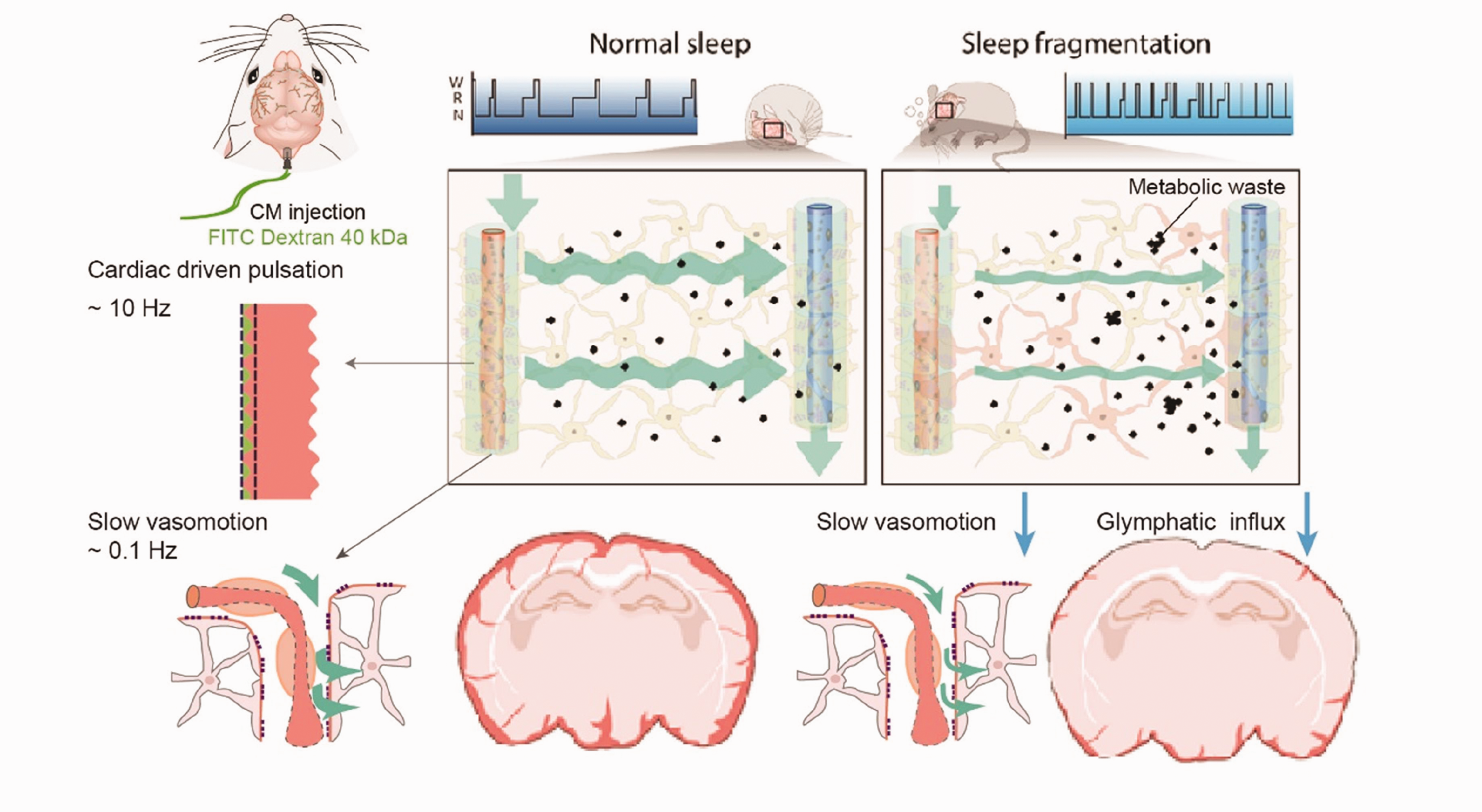
Get full access to this article
View all access options for this article.
References
Supplementary Material
Please find the following supplemental material available below.
For Open Access articles published under a Creative Commons License, all supplemental material carries the same license as the article it is associated with.
For non-Open Access articles published, all supplemental material carries a non-exclusive license, and permission requests for re-use of supplemental material or any part of supplemental material shall be sent directly to the copyright owner as specified in the copyright notice associated with the article.
