




Abstract
The reporting of crime to the police is crucial for an efficient functioning of the criminal justice system. It is widely argued that victims’ decision to contact the police is based on considerations of the anticipated costs and benefits of crime reporting. Scholars have previously suggested that victims’ attitudes towards the police may influence their perceptions of the costs and benefits associated with crime reporting. However, victims’ trust in the police as a multidimensional construct has not been empirically tested as a predictor of victims’ crime reporting to the police. This study uses Crime Survey for England and Wales data from 2017/2018 to 2019/2020 to explore the relationship between victims’ trust in police effectiveness and violent crime reporting behaviour. Furthermore, this study examines the influence of victim and situational characteristics on decisions to report victimisation to the police. Our analysis reveals that victims’ trust in police effectiveness does not predict their decision to disclose violent crime victimisation to the police. However, victims’ sex and age significantly influence reporting decisions. Moreover, our findings reveal that situational factors, specifically the presence of a weapon and injury to the victim, are important predictors of violent crime reporting.
Introduction
Violent crime has detrimental affects on victims as well as harmful social and economic effects on the whole community, including inciting fear of victimisation and distrust in criminal justice institutions. Violence against the person covers a broad range of offences, varying from low psychological, emotional or physical harm to the most serious crimes, such as knife crime or homicide. Less serious violence, such as stalking and harassment, constitutes about a third of police-recorded violent crime (Office for National Statistics (ONS), 2023). Estimates from the Crime Survey for England and Wales (CSEW) show that over 1 in 10 adult respondents experienced some form of harassment during the 12 months prior to the date of the interview (ONS, 2023). In addition, an increase in serious violence incidents has been observed in the last decade in England and Wales. Between 2014 and 2019, there was a 41% increase in monthly hospital admissions for assaults with a sharp object (Home Office, 2021), and it has been reported that police-recorded knife crime increased by 84% between 2014 and 2020 (Home Office, 2022). Consequently, there are growing efforts by the government to reduce violent crime and to better understand the prevalence, nature and distribution of those crimes in the United Kingdom. An integral part of the government violent crime reduction plan is the Serious Violence Duty for England and Wales that aims to implement a multi-agency approach to understand and prevent serious violence (Home Office, 2022). However, in order to understand violent crime prevalence and to be able to carry out the commitments of the Serious Violence Duty to understand the causes and consequences of violent crime, the reasons for the under-reporting of violent crime need to be explored and addressed. Previous research has found that more than 44% of violent crimes are not reported to the police each year (Buil-Gil et al., 2021; Hart and Rennison, 2003), and the proportion of crimes reported to the police has been in decline since the 2010s (Brunton-Smith et al., 2024; Xie et al., 2024).
Crime reporting shapes police recorded crime statistics, and in turn, the incidents of crime reported to the police do not necessarily reflect the true rates of crime. The dark figure of crime and its implications for crime prevention are not only recognised by academics but also by practitioners and policymakers. The Beating Crime Plan for England and Wales highlights ‘increasing reports’ as one of the top priorities for crime reduction and argues that ‘increased reporting reflects greater victim confidence and better identification of offending by the police and other agencies’ (Home Office, 2021: section 3.3). Indeed, police officers rely on victims reporting crime to be able to efficiently carry out their duties. The reporting of violent crime to the police is particularly important as failure to report may undermine police efforts to respond to and prevent crime (Skogan, 1976). The under-reporting of crime may also lead to misallocation of resources as specific dark figures of crime are not addressed accordingly. Keeping the implications of the victims’ reporting decision in mind, it is important to understand the factors that motivate victims’ decision making, in order to find solutions that could improve cooperation with the police. Using data from the CSEW, this study aims to explore whether and how victims’ trust in police affects victims’ decisions to report violent crime to police authorities. Although the new policies in England and Wales mostly aim to tackle serious violence, this paper will focus on the high-volume violent crime types measured in the CSEW. Our study explores whether trust in police effectiveness (i.e. the confidence that the public has in the ability of the police to perform their duties competently and efficiently) affects victims’ crime reporting to the police.
Literature review
Rational choice perspective of crime reporting
It is widely argued that as with other behaviours, a decision to report victimisation to the police is the result of rational decision-making processes involving considerations of the anticipated costs and benefits of reporting the crime (Asiama and Zhong, 2022; Bowles et al., 2009; Felson et al., 2002; Skogan, 1984; Xie and Baumer, 2019). From this perspective, victims who associate crime reporting with greater advantages than harms are more likely to report the crime to the police than those who anticipate greater costs than benefits. Some of the main benefits of reporting for victims include receiving immediate and future protection from victimisation, treatment and retribution (Bowles et al., 2009). However, there are also possible costs associated with reporting violent crimes, for instance, a perceived risk of revictimisation, fear of retaliation, compromised privacy, admission of vulnerability, feelings of shame and disapproval of peers (Bowles et al., 2009). Furthermore, victims may be discouraged from reporting the crime to avoid being blamed, stigmatised and not taken seriously by the authorities. Victims may need to trust that they will not experience revictimisation by police officers and be ultimately disappointed in the handling of their case. In other words, victims need to believe that they will be treated fairly and that their case will be dealt with competently. Victims’ decision to report crime is in turn, affected by previous experiences with the criminal justice system (Xie et al., 2006). This suggests that victims’ perceptions of the police may influence their decision to report crimes. Trust in the criminal justice institutions, and particularly the police as the first point of contact following a crime, may be integral for the victim’s decision to report crime experiences.
However, some argue that crime reporting decisions are not entirely rational as victims may not be able to assess the costs and benefits of reporting their victimisation when coping with a crisis situation (Gottfredson and Gottfredson, 1988). Victims’ rational assessment of the costs and benefits associated with crime reporting may be distorted by the emotional state derived from the experience of victimisation, including emotions such as fear, anger, guilt, stress or shame (Greenberg and Ruback, 1992). In addition, victims may rely on their social networks for support following the incident, and they will often follow the advice given by peers and role models, which may influence their decision to disclose the crime to the police (Greenberg and Ruback, 1992; Ruback et al., 1984). Overall, victims’ decision making can be affected not only by the anticipated costs and benefits of crime reporting, but also by their emotional state, support networks and previous experiences. Due to these factors, victims’ costs and benefits assessment may be distorted and the reporting decision may instead be driven by a form of bounded rationality.
Perceptions of the police and crime reporting
Perceptions of police are multidimensional in nature and can contain many different aspects associated with police work and behaviour (Bottoms and Tankebe, 2012; Jackson et al., 2013). However, the independent importance of these different elements is often overlooked in research (Kääriäinen, 2008). Jackson and Bradford (2010) addressed this issue, which led to a conclusion that various perceptions of the police are not homogeneous and this should be reflected in empirical research. This study is interested in the unobservable construct of trust in the police. Trust can be defined as a belief that the person in a specific role will satisfy socially defined expectations of that role (Hawdon, 2008). In the context of policing, an individual expects police officers to be capable of carrying out their duties and to act with right intentions towards all people in the community (Hardin, 2006). This relates to both Tyler’s (1990) procedural justice and outcome-based trust models (Hawdon et al., 2003). Sun et al. (2014) empirically tested trust in the police in Taiwan, recognising that there are two underlying dimensions – procedurally based trust and outcome-based trust, however, they combine both into a single-factor model. Jackson and Bradford (2010), however, use three subscales to operationalise trust in the police in England, which include perceptions of police effectiveness, fairness and community engagement. This suggests that judgements of police capability and fairness may affect victims’ willingness to risk the costs of reporting in exchange for perceived benefits that the police could provide (Jackson and Gau, 2015).
Limited research efforts have been directed towards examining how victims’ cost-benefit considerations of crime reporting are influenced by their attitudes towards the police. Boateng’s (2018) study addressed this gap and argued that victims’ perceptions of the police influence their rational decision to report a crime in Ghana. The findings suggest that victims’ satisfaction and confidence in policing have a positive impact on crime reporting (Boateng, 2018). However, this study failed to consider the multifaceted nature of perceptions of police constructs, and the findings cannot be generalisable to an industrialised country as perceptions of the police vary in different political, social and economic contexts (Tyler, 2007). This brings to consider another gap in research. There are limited studies that explore attitudes towards the police as predictors of crime reporting in England and Wales. Analysing British Crime Survey (currently CSEW) data, both Skogan (1994) and MacDonald’s (2001) findings indicated that victims who hold more positive attitudes towards the police are more willing to report their victimisation. More recently, Tarling and Morris (2010) built on these two studies for their research, however, perceptions of police were not considered in their analysis of crime reporting trends.
While there are few empirical studies that explore the impact of victims’ trust in the police (as a multidimensional construct) on their rational choice to report crime, some studies do consider trust in the police as a predictor of cooperation with the police in a wider context. For instance, adhering to social control theory, Bradford and Jackson’s (2016) findings indicate that trust in the police is positively associated with cooperation with police forces in London neighbourhoods. Furthermore, some studies view the antecedents of trust, procedural justice and effectiveness, as predictors of crime reporting. Regarding the perceived effectiveness of the police, empirical studies show inconsistent results. Studies in the United States mostly find no influence of perceptions of police effectiveness on cooperation (Fagan and Tyler, 2004; Sunshine and Tyler, 2003). Similar findings are also observed by Murphy et al. (2008) in Australia.
However, as perceptions of the police vary in different environments, it is possible that police effectiveness has a greater influence on crime reporting in other countries. For instance, Tankebe (2009) found that perceptions of police effectiveness affect cooperation with the police in Ghana, and Reisig et al. (2012) found that both perceived police legitimacy and effectiveness influence public cooperation with the police in Slovenia. More recently, Lee et al. (2023) discovered that police performance is positively associated with violent crime reporting in Caribbean countries. Goudriaan et al. (2004) also observed similar findings across a set of industrialised countries. However, in a later study, Goudriaan et al. (2006) found that confidence in police effectiveness does not influence crime reporting in the Netherlands. Bennett and Wiegand (1994) and Kochel et al. (2013) found that effectiveness does not significantly affect reporting decisions in developing countries when the seriousness of the crime is taken into account.
The findings regarding perceptions of procedural justice are more stable and indicate a positive relationship between perceptions of fairness and cooperation with the police (Graham et al., 2019; Kochel et al., 2013; Lee et al., 2023; Murphy and Barkworth, 2014; Murphy et al., 2008; Sunshine and Tyler, 2003; Tyler, 1990).
Victim and situational factors associated with violent crime reporting
Although victims may use rational assessments to reach a decision to report, the importance of the considered costs and benefits often depend on individual and situational characteristics (Baumer, 2002; Bennett and Wiegand, 1994; Tarling and Morris, 2010; Torrente et al., 2017). For instance, empirical studies consistently show that serious offences are more likely to be reported (Bennett and Wiegand, 1994; Goudriaan et al., 2004; Skogan, 1994). In serious cases, even if the victim distrusts the police, the associated benefits of reporting may be more important than negative perceptions of police effectiveness or fairness (Kochel et al., 2013). The presence of an injury, involvement of a weapon, multiple offenders, and completed as opposed to attempted incidents have been shown to be significant predictors of crime reporting in previous research and across different countries and sociocultural contexts (Baumer, 2002; Gottfredson and Hindelang, 1979; Goudriaan et al., 2004; Skogan, 1994; Zhang et al., 2007).
In addition to severity measures, other situational characteristics, such as the victim-offender relationship, are important to consider. Reporting someone known to the victim can secure protection from further victimisation. However, it would likely have a direct impact on the relationship and may lead to severe repercussions to the victim. However, reporting an unknown offender is also risky as it is less likely to lead to an arrest. As such, the empirical findings are inconsistent, with some studies finding that reporting is more likely when the offender is known to the victim (Asiama and Zhong, 2022; Goudriaan et al., 2004; Goudriaan and Nieuwbeerta, 2007); and others observing that stranger violence is more likely to be reported (Boateng and Lee, 2014; Gartner and Macmillan, 1995; Skogan, 1994; Tarling and Morris, 2010). Yet other studies find no effect of victim–offender social relationship on crime reporting (Baumer, 2002; Felson et al., 1999).
Moreover, the significance of the costs and benefits of reporting in each case vary according to the victim’s characteristics. Individuals with limited access to support or resources may be more inclined to contact the police. In which case, the need for assistance assumes more importance than negative perceptions of the police. Specifically, it has been found that women, older and Black victims are more likely to report violence to the police (Baumer, 2002; Baumer and Lauritsen, 2010; Bosick et al., 2012; Felson et al., 1999, 2002; Slocum et al., 2010; Watkins, 2005; Xie and Lauritsen, 2012). Findings regarding the level of education are inconsistent: some studies argue that those with higher educational attainment are more likely to report violent crimes (Goudriaan et al., 2006; Skogan, 1994), while others find the opposite effect (Baumer, 2002; Baumer and Lauritsen, 2010). Black’s (1976) theory of law proposes that culture, as one of the domains of social life, affects citizens’ decision to invoke the legal system. From this perspective, education can be used as an indicator of culture, which posits that educated people are more likely to mobilise the law (Black, 1976), and therefore, report crime to the police. Finally, prior victimisation experience seems to be associated with lower likelihood of reporting violent crimes (Zhang et al., 2007), which could be a reflection of victims’ perceptions of police incompetence (Conaway and Lohr, 1994). Overall, the considerations of the costs and benefits associated with violent crime reporting are affected by victim and situational characteristics.
The current study
To address the gaps in knowledge of previous research, the primary objective of this study is to examine the influence of victims’ trust in the police on their rational decision to report violent crime. Past research has not tested whether victims’ cost-benefit analysis is influenced by their trust in the police as a multidimensional construct. Moreover, little research exploring the rational choice model of violent crime reporting has been conducted in recent years in England and Wales.
This study explores the following hypotheses:
H1. The incidents in which the victim has a higher level of trust in the police are more likely to be reported.
H2. The incidents that are perceived as more serious are more likely to be reported, that is, if the incident resulted in an injury, a weapon was present, involved multiple offenders, completed as opposed to attempted and the offender was a stranger.
H3. The incidents which involve victims who are female, older, minority ethnic, with higher educational attainment and no prior experience of violent victimisation are more likely to be reported.
Nonetheless, as will be explained in the following sections, in this study, we could only derive a reliable multidimensional measure of trust in police effectiveness, as opposed to perceptions of procedural justice, from the CSEW. As such, we will only be able to partly test H1 and explore whether trust in police effectiveness affects violent crime reporting.
Data and methods
Data
CSEW data from three rounds covering the period between 2017/2018 and 2019/2020 is used for this study (ONS, 2021a, 2021b, 2022). The CSEW is an annual cross-sectional survey that aims to establish victimisation rates in the general population (ONS, 2021c). However, this survey also addresses other topics, such as perceptions of the police, and is, therefore, widely used in various criminological research. The CSEW dataset consists of ‘victim forms’ and ‘non-victim forms’. Non-victim forms collect information about respondents’ demographic characteristics and attitudes towards the police, while victim forms record data about each crime incident reported by each respondent.
In this study, the non-victim form is first used to obtain a reliable construct of trust in the police using confirmatory factor analysis (CFA) from the full dataset of respondents. Then, non-victim form data, including latent factor scores of perceptions about the police, is merged to the victim form data using the unique identifier of each respondent. Victim forms contain information about specific crime incidents. As each case on the victim form refers to an individual incident, the unit of analysis in this study is crime incidents.
For the purpose of this analysis, violent crime includes all crimes classified within the category ‘All BCS violence’ of the survey, which includes serious wounding, other wounding, common assault, attempted assault, serious wounding with sexual motive, other wounding with sexual motive, robbery and attempted robbery. Rape, attempted rape, indecent assault as well as snatch theft are excluded from this category. Snatch theft is excluded because, unlike robbery, it does not involve threats or violence to the victim (ONS, 2017). Following ONS (2023) guidelines, rape, attempted rape and indecent assault are excluded due to the low prevalence rates recorded in the survey, which are deemed unreliable for statistical purposes. While the exclusion of sexual offences from the overall violence measure has been criticised due to its impact on the ‘gendered data gap’ (Cooper and Obolenskaya, 2021), research has noted that factors determining the reporting of sexual violence may largely differ from those influencing other types of crimes, including factors such as ‘rape myth acceptance’ and anticipated probability of incarceration (Heath et al., 2013; Lizotte, 1985). Addressing the under-reporting of sexual violence may thus require specific strategies.
There are several methodological issues caused by the design of this survey that should be addressed. First, the number of victim forms per respondent is capped at six, which may hinder true victimisation rates. However, Hales and Stratford (1997) found that capping is unlikely to have a significant impact because very few victims experience multiple crimes that do not correspond to the ‘Series’ category. This brings to consider another issue. Respondents that experience multiple similar incidents that are likely to be caused by the same offender complete only one form. This is problematic as the characteristics of the most recent incident may cover the circumstances of previous incidents. In addition, repeat victimisation creates ‘event-dependency’, meaning that the reporting choice of one incident may affect the reporting decision of subsequent incidents (MacDonald, 2001). Therefore, as these factors affect reporting, MacDonald (2001) argues that models should control for both event dependency and series of victimisations. Furthermore, incidents are clustered within victims. In our data, 2,129 incidents are nested within 1,919 victims (on average 1.11 incidents per victim). In order to mitigate the impact of each of these issues on our findings, our analysis controls for repeat victimisation and series of events. Moreover, as data from three different survey rounds are used, the rounds of the interview are also controlled for, to account for variation associated with rounds and reporting trends overtime.
Measures
Dependent variable
The dependent variable is a dichotomous measure that indicates if the victim reported the incident to the police (1 = Yes; 0 = No). As this study assumes victims’ rational decision, only the incidents in which the victims self-reported are considered.
Operationalising trust in the police
Trust is subjective and, therefore, is not directly measurable. However, previous work indicates that perceptions of police fairness and effectiveness are two significant threads of trust in the police (Jackson and Bradford, 2010). The CSEW questionnaire includes five items that have been previously used to measure trust in policing (details in Figure 1). All variables were measured on 5-point Likert-type scales which are reverse coded so that higher values relate to more positive attitudes (Robinson, 2018).
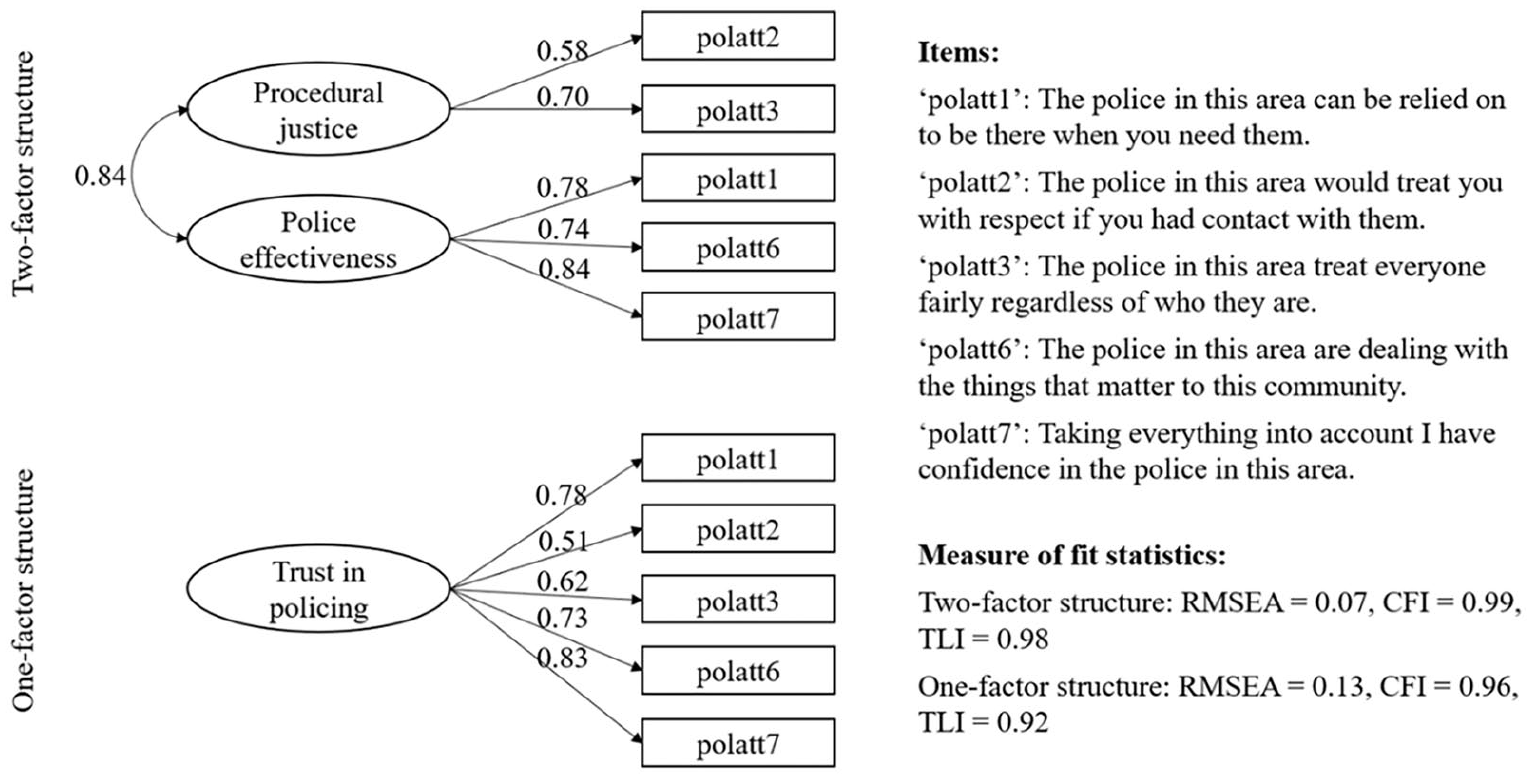
CFA path diagrams.
CFA is used to operationalise our measures of trust. Maximum likelihood estimation is applied to deal with missing values (in line with similar research, for example, Bradford et al., 2017; Gau, 2014; Hough et al., 2013). Figure 1 displays path diagrams of CFA models representing one- and two-factor structures of trust in the police, and displays standardised factor loadings for each item. In accordance with the literature, a two-factor model structure is hypothesised and tested. The first latent construct reflects trust in police procedural justice. This latent construct consists of two items (Cronbach’s alpha = 0.72). The second factor consists of three items that reflect trust in police effectiveness. This subscale produced a high Cronbach’s alpha value of 0.84, which indicates that these items are associated with the same latent construct (Robinson, 2018).
Measure of fit statistics of the one- and two-factor models are assessed. A good fit for the data is typically assumed when the Root Mean Square Error of Approximation (RMSEA) is smaller than 0.08, and the Comparative Fit and Tucker–Lewis indexes (CFI and TLI, respectively) are greater than 0.95 (Hu and Bentler, 1999). Results indicate that the two-factor model fits the data well (RMSEA = 0.07, CFI = 0.99, TLI = 0.98), and these items do not load onto a single latent construct (RMSEA = 0.13, CFI = 0.96, TLI = 0.92). This analysis confirmed that there are two underlying components of trust in the police. However, it is suggested that each scale needs to consist of at least three items (Marsh et al., 1998; Robinson, 2018). Therefore, while procedural justice contributes to the explanation of trust in the police, it will not be considered in the analysis given that it is not currently supported by enough items in the CSEW to satisfy scale requirements and due to its high correlation with our construct of trust in police effectiveness (r = 0.84 in this particular model). All scores derived from CFA were shifted to a positive 0–1 measure to make the results easier to interpret.
Victim characteristics
Victim characteristics are coded as binary measures and include sex (0 = Male; 1 = Female), ethnicity (0 = Non-White; 1 = White), age (0 = 16–24; 1 = 25+) and education (0 = Below A-level; 1 = A-level or above). In order to control for event dependency, a measure of repeat violent victimisation, that indicates if the victim form was completed by a respondent that has reported more than one incident of violent crime in the interview, is also included in the analysis. A measure of repeat violent victimisation has been found to be a significant predictor of crime reporting in previous research (Zhang et al., 2007). This variable is binary and coded as either 0 (No) or 1 (Yes).
Situational characteristics
Situational characteristics include measures that capture the seriousness of the incident, that is, injury to the victim, whether the offender had a weapon, involvement of multiple offenders and if crime was attempted (as opposed to completed). Another variable included in the analysis describes the victim–offender relationship, specifically, this variable indicates whether the offender is a stranger. All situational variables are binary and coded as either 0 (No) or 1 (Yes).
Missing data
Most variables have little or no missing data, with the following three exceptions: ‘weapon’ (6.2%), ‘stranger’ (8.8%) and ‘multiple offenders’ (5.4%). A larger proportion of missing values is expected for variables that measure the seriousness of the crime due to non-response bias. Only complete cases are used for regression analysis (n = 1,896), reducing the sample by 11%. It is unlikely that this affects the statistical power of the models, as the sample remains large.
Analytic strategy
Given the dichotomous nature of the dependent variable, binary logistic regression is used to examine the relationship between trust in police effectiveness and violent crime reporting, controlling for victim and situational characteristics. Logistic regression is widely used in prior research to predict crime reporting (Asiama and Zhong, 2022; Lee et al., 2023; Tarling and Morris, 2010; Zhang et al., 2007). In this study, four models are tested. Model 1 includes trust in police effectiveness as a predictor. Then, victim and situational characteristics are introduced in blocks in separate models (Models 2 and 3, respectively), in order to investigate the significance of these two groupings of variables before entering all variables into the full model (Model 4). All models control for survey methodology, that is, include variables that account for different survey rounds and, following MacDonald’s (2001) advice, series of incidents and repeat violent victimisation.
All analyses have been conducted in R Software (R Core Team, 2023 (2021)), and analytic codes are available from a GitHub repository: https://github.com/aisttim/trust_reporting
Results
Descriptive analysis
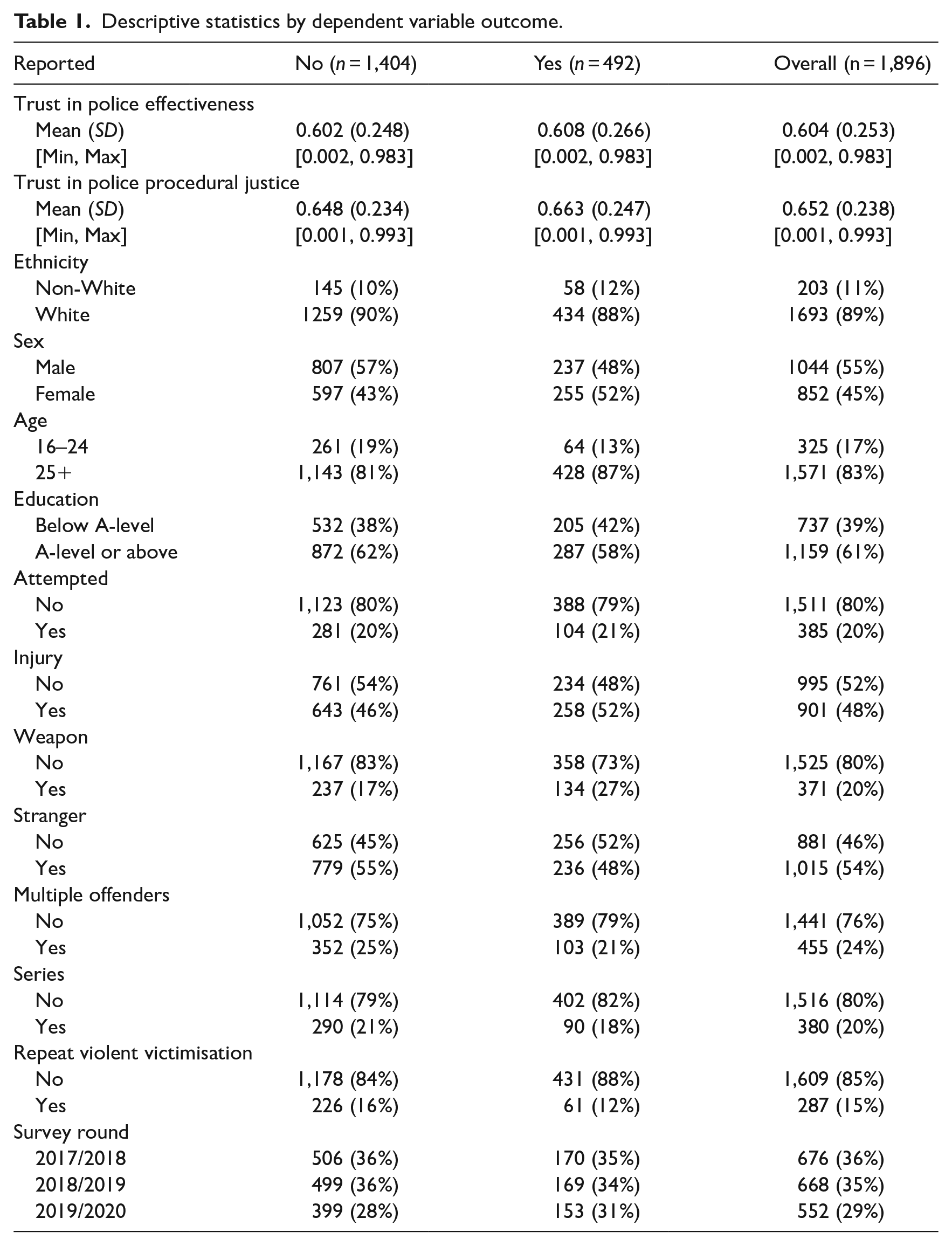
Table 1 shows descriptive statistics of the variables used in this study. Over a quarter of violent crime incidents were reported to the police. Victims of violent incidents in this sample have generally high levels of trust in the police, both in their effectiveness and procedural justice. In 89% of violent incidents, the victim was White and the majority (55%) of these crimes were against males. Only 17% of incidents involved younger victims, and 61% involved individuals with higher educational attainment. In total, 80% of the crimes were completed and 48% resulted in an injury to the victim. In a fifth of the cases, the offender had a weapon, and almost a quarter (24%) of violent incidents were committed by multiple offenders. In over a half (54%) of cases, the perpetrator was a stranger. A fifth of the incidents were part of a series of similar events. In total, 15% of violent incidents involved a victim that experienced violent crime more than once in the 12-month period prior to the interview. To elaborate, in this sample, almost 7% (120) of victims experienced more than one violent incident in the 12-month period prior to the interview that did not classify as series of similar incidents.
Descriptive statistics by dependent variable outcome.
Logistic regression analysis
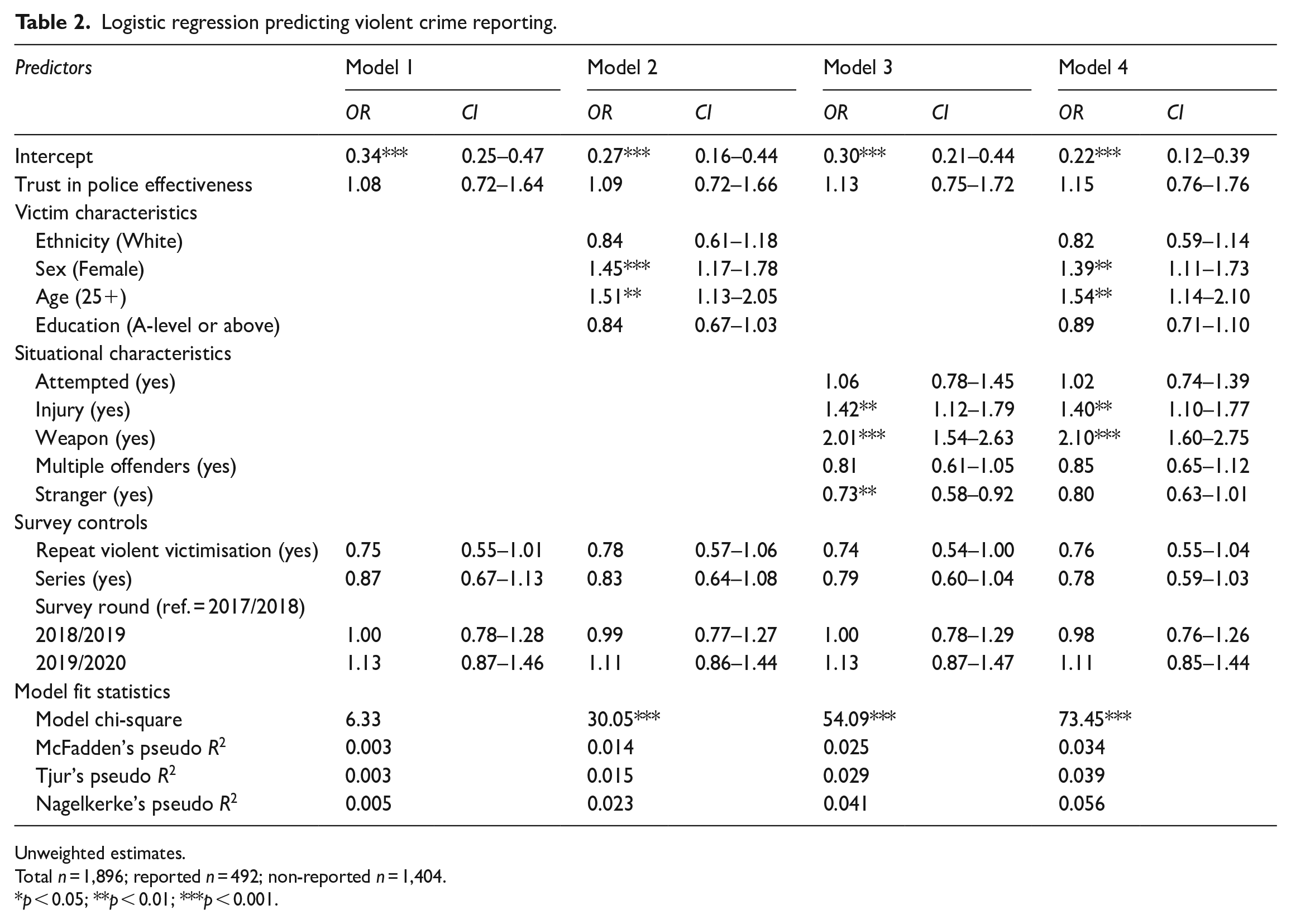
Logistic regression coefficients expressed as odds ratios (OR) and their confidence intervals (CI) are presented in Table 2. Variance inflation factor scores, which assess whether explanatory variables are independent of each other (Fox, 2015), have scores between 1 and 5, indicating that there is not an issue with multicollinearity (Menard, 1995).
Logistic regression predicting violent crime reporting.
Unweighted estimates.
Total n = 1,896; reported n = 492; non-reported n = 1,404.
p < 0.05; **p < 0.01; ***p < 0.001.
Trust in police effectiveness is not statistically significant across all models. This indicates that the reporting of violent crime to the police is not influenced by victims’ trust in police effectiveness. Furthermore, Model 1 is not a significant model (χ2 = 6.33, p > 0.05) and explains less than 1% of variation in the dependent variable. However, Model 2 is significantly better than the null model (χ2 = 30.05, p < 0.001) and about 2% of the variance in violent crime reporting is explained by the variables in this model. Specifically, victim sex and age are significant predictors. The odds of reporting violent crime for incidents in which the victim is a female are 45% higher than for incidents in which the victim is a male. The odds of reporting violent crimes involving victims aged 25 or more are 51% higher compared to incidents with younger victims. Victims’ ethnicity and educational attainment are not significantly associated with violent crime reporting.
Model 3 is a significant model (χ2 = 54.09, p < 0.001) and the situational factors in this model explain more of the variation in victims’ decisions to report violent crime than the victims’ characteristics. Specifically, the presence of a weapon and injury to the victim both significantly predict the decision to report. The odds of reporting the incident are 42% higher for those incidents that resulted in the injury to the victim, and twice as high if the offender had a weapon. Furthermore, contrary to this study’s hypothesis, the analysis suggests that the odds of reporting violent crime are 27% lower for incidents committed by a stranger. Completion of the crime and involvement of multiple offenders are not significantly associated with reporting.
Model 4 provides a significant fit to the data (χ2 = 73.45, p < 0.001). Likelihood ratio tests indicate that the combination of both victim and situational characteristics into one model offers a significant improvement in fit over the models with just victim or situational characteristics. The direction and magnitudes of individual variables did not markedly change in the full model compared to what was observed in previous models. Victim sex and age, the presence of a weapon and whether the incident resulted in an injury all remain significant predictors of violent crime reporting. However, the victim–offender relationship, which was statistically significant in Model 3, is no longer significant. The magnitude of this variable decreased after controlling for victim characteristics, suggesting that this association may be confounded or mediated by victim characteristics. Furthermore, all models suggested that repeat violent crime victimisation experienced by the victim and an incident being part of a series of similar events reduce the odds of reporting violent crime. However, these differences as well as the rounds of the survey are not significant predictors of reporting across all models.
Discussion
This study extends the findings of prior research by exploring the relationship between victims’ trust in police effectiveness and violent crime reporting. From a rational choice perspective, it is expected that victims who have more trust in police effectiveness would risk the costs associated with reporting for the benefits they believe the police can provide. However, the findings in this study indicate that the decision to report victimisation is not influenced by victims’ trust in police effectiveness. One possible explanation for this counterintuitive finding is that the victims’ reactions to violent crime may be less rational than what we previously thought, and rather the impact of violence on emotional states, such as fear, anger, guilt, stress or shame, may be distorting the rational assessment of the costs and benefits associated with reporting their victimisation (Greenberg and Ruback, 1992; Ruback et al., 1984). This may affect victims of violent crime more than other types of crimes. Another explanation that has also gained empirical support (Kochel et al., 2013; Murphy and Barkworth, 2014) is that normative concerns, such as procedural justice, are more important for cooperation with the police than outcome-based considerations. The null findings may also be due to a lack of variation in the trust in police measure to discern significant effects. This may happen in countries where people perceive the police in a generally positive manner (Brown and Benedict, 2002), which appears to be the case in England and Wales.
This study also examined the influence of victims’ characteristics on reporting behaviour. Consistent with prior research (Baumer, 2002; Boateng, 2018; Goudriaan et al., 2004; Slocum et al., 2010; Watkins, 2005), female and older victims of violent crimes are more likely to report their victimisation to the police than male and younger victims. Due to peer pressure, values of privacy, confidentiality, self-reliance and distrust in formal institutions (Ashley and Foshee, 2005; Bosick et al., 2012; Epstein, 2002; Syvertsen et al., 2009; Xie and Baumer, 2019), these victims may be more concerned with the negative consequences associated with reporting and, hence, less willing to disclose their victimisation to the police.
The findings of this study are consistent with previous research which suggests that the seriousness of the incident, specifically the presence of a weapon and injury, are positively associated with violent crime reporting. Victims of serious crimes are more willing to report because a certain degree of damage mitigates the perceived costs of reporting and increases the anticipated associated benefits, such as treatment, support and retribution (Torrente et al., 2017). Furthermore, after controlling for victims’ characteristics, the victim–offender social relationship did not affect reporting decision. This finding is not in line with this study’s hypothesis; however, some previous empirical research also observed null findings (Baumer, 2002; Felson et al., 1999). Felson et al. (1999) speculate that the reason for no observed relationship may be that the costs and benefits associated with reporting someone unknown to the victim balance out, which results in no overall effect.
It is important for policy makers and criminal justice institutions to understand the factors associated with under-reporting of violent crimes in order to appropriately structure resources and implement policies that will reduce the costs and increase the benefits of reporting. Consistent with previous research, these findings indicate that male and younger victims of violent crimes are less willing to report to the police. As such, the costs that these victims may associate with reporting prevent them from accessing victim services and seeking professional help, potentially placing them at greater risk of revictimisation. Therefore, it seems that efforts to promote reporting among male and younger victims should be taken. Finally, although these findings do not suggest that trust in police effectiveness affects crime reporting, police officers should continuously work to maintain a high level of public trust in this institution.
Limitations and future research
This study has several limitations that we have aimed to address where possible. First, due to the CSEW sampling design, incidents cluster within victims (MacDonald, 2001). The CSEW weights do not correct this issue because victimisation relates to many factors that cannot be inferred for the whole population (Walby et al., 2016). Second, due to the dichotomisation of the victim–offender relationship, incidents that involved both known and stranger offenders were excluded. Third, due to the availability of items in the CSEW questionnaire, the operationalisation of trust in police effectiveness does not include all items that have previously been used in research to measure perceived police effectiveness. In addition, due to the exclusion of the procedural justice latent construct from the analysis, this study does not explore whether process or outcome-based trust dominates the decision to report violent crime; future research could explore this. To reduce the risk that our model is affected by the decision to remove items of procedural justice from the measure of trust, we also estimated the models using the single-factor independent variable of trust in policing, with no discernible changes in model results (results reported in Appendix 1). Finally, although it is reasonable to assume that survey respondents differentiate between police as the most visible criminal justice system (CJS) agency and other criminal justice institutions, this study may be affected by the respondents’ perceptions of effectiveness of other CJS agencies. As a sensitivity analysis on our findings, we estimated the regression models of crime reporting with an additional binary predictor of trust in CJS effectiveness, finding no effect of trust in the CJS on crime reporting (results reported in the Appendix 1).
Model predictive capabilities should also be discussed. The full model correctly classified 74% of cases. However, sensitivity analysis revealed a low true positives rate (2%) using the conventional 50% probability threshold. The sensitivity is improved by lowering the cut-off point to 25%, which maximises the true positives rate (cut-off selected using the ‘Closest Top-left’ method). Specifically, using this threshold, 60% of reported incidents are correctly classified. Still, this model misclassifies a substantial number of reported incidents. In criminological research, it is often a goal to reduce the rate of false negatives (Berk, 2012); however, sensitivity analysis is often overlooked. There are costs associated with misclassifying reported incidents as it adds more to the dark figure of violent crime.
Finally, while this research revealed that victim and situational characteristics are important, they only accounted for a small fraction of variation in violent crime reporting. This suggests that the crime reporting decision is a complex multifaceted phenomenon affected by many factors that are beyond the scope of this study. Future research could explore broader contexts that affect victims’ cost-benefit considerations of violent crime reporting, and particularly examine the factors that may distort victims’ rationality, such as the victims’ emotional state following a violent incident, social influences and reporting to informal social institutions as an alternative response to crime.
Conclusion
This study demonstrates that victims’ trust in police effectiveness does not significantly affect their rational decision to report violent crime to police authorities. This study makes a significant contribution because the relationship between trust in the police as a multidimensional construct and violent crime reporting has not been examined in previous studies in England and Wales. Although trust in police effectiveness was not found to be significantly associated with violent crime reporting, it is crucial to uphold high levels of trust in the police. Trust in the police is key not only for cooperation with the police and subsequently more effective policing, but it can also encourage citizen involvement in setting local priorities which in turn may result in strengthened social cohesion between local community members and improved services. Finally, this study’s findings regarding victim and situational characteristics are largely consistent with prior research in this field. In summary, these findings inform about recent trends in violent crime reporting in England and Wales.
Footnotes
Appendix 1
Logistic regression models using one-factor confirmatory factor analysis (CFA) model latent scores are presented in Table 3. All other variables in this analysis are identical to the ones used for the main models in Table 2. Trust in the police as a single-factor construct is not statistically significant across all models. Furthermore, the direction, magnitudes and significance levels of victim and situational variables did not markedly change in the models that use trust in the police as a one-factor construct, compared to what was observed in the main models that use trust in police effectiveness latent factor from a two-factor trust in police construct. Finally, the predictive capabilities and variance explained by the variables in the models that use trust in the police as a one-factor construct do not markedly differ from those in the main analysis, indicating that these models do not provide a better fit for the data. Taking this into account, a model that uses a latent variable from a two-factor construct should be used as CFA confirmed that there are two underlying components of trust in the police, that is, the two-factor CFA model fits the data better than the single-factor structure.
Second, we present in Table 4 the full model displayed in Table 2 with an additional binary measure of overall trust in the criminal justice system (CJS), showing no statistically significant effects of trust in the CJS on violent crime reporting. Trust in the CJS has been measured using the variable ‘How confident are you that the Criminal Justice System as a whole is effective?’ with responses ‘very confident’ and ‘fairly confident’ coded as 1 (41% of responses) and responses ‘not at all confident’ and ‘not very confident’ coded as 0 (59%). Questions of trust in the CJS were only asked to a subset of respondents in the CSEW, and as such the effective sample size is much smaller than that of the main analysis.
