




Abstract
Law enforcement cooperation between the United Kingdom and the European Union has experienced substantial change. The practice and impact of police cooperation are aligned with various formal and informal arrangements previously based on a European framework, policy, legislation and process. Following Brexit, the United Kingdom became detached from some of these arrangements. Opposing sides of the Brexit debate argued that the implications of the United Kingdom leaving the European Union would result in outcomes ranging from improved police cooperation to fundamental damage to law enforcement combating cross-border and organised crime. While it is acknowledged that more change will occur in the policy and legislative framework that governs police cooperation between the United Kingdom and the European Union, this article explores the current situation from the perspective of interview accounts from police practitioners (n = 14) and academics (n = 3) working in the field. This article applied ‘nodes of governance’ to police cooperation between the United Kingdom and European Union. This article demonstrates a range of issues that have impeded the ability of the United Kingdom to work with its former partners. At the same time, good police relations remain, and informal police cooperation continues.
Introduction
Before Brexit, the United Kingdom enjoyed access to various European Union (EU) mechanisms to facilitate cross-border police and judicial cooperation via reciprocal arrangements for police officers from countries posted to the United Kingdom and vice versa. Most significantly, the initiatives developed under the aegis of the EU, such as membership of Europol, Eurojust and the European Arrest Warrant (EAW). In the run-up to the Brexit Referendum on 23 June 2016, there were several public assurances by government ministers that, should the United Kingdom vote to leave the EU, cooperation in these areas would be at least as good as before, if not better. The Trade and Cooperation Agreement (TCA), which came into effect on 31 December 2020, allowed the United Kingdom to maintain access to the Prüm databases and the Passenger Names Record but removed direct access to tools and information systems such as Schengen Information System (SIS) II (Hadfield et al., 2018). However, this has been replaced with a surrender agreement. These changes have been made in the context of substantial successes. For example, the EncroChat 1 investigations led to 746 arrests across the United Kingdom and over £54 million in criminal cash. In the United Kingdom, 77 firearms, including an AK47 assault rifle, sub-machine guns, handguns, 4 grenades and over 1800 rounds of ammunition were seized, alongside more than 2 tonnes of Class A and B drugs (National Crime Agency (NCA), 2020). This article will discuss the challenges to UK police cooperation post-Brexit, drawing upon the views of interviewees who engaged with this research.
The following section will examine the literature providing an overview of the development of police cooperation between the United Kingdom and Europe. It will then utilise nodes of governance as a theoretical framework to articulate an analysis of cooperation channels. By drawing on interviews from UK practitioners (14 law enforcement officers) and those with expertise in police cooperation (3 academics), this article presents views on police cooperation from those working and researching in this area of police work. The conclusion argues for more attention to support informal policing arrangements to provide efficient and effective police cooperation with EU law enforcement agencies and services.
International police cooperation
The research literature on international police cooperation can be traced back to the 1950s with early texts like Forrest’s (1955) ‘INTERPOL’ but was relatively sparse until the late 1980s, with key publications appearing from Anderson (1989) and Benyon et al. (1994). With increased academic literature from the 1990s, there has also been an increase in contrary definitions of police cooperation. For this article, international police cooperation will be conceived as a dynamic by which law enforcement activities, information and intelligence are shared across geo-political borders via ‘Formal’, ‘formal’ and ‘informal’ networks (Bigo, 2008; Deflem, 2000, 2004, 2006a, 2006b; Friedrichs, 2007; Gallagher, 2003; Gerspacher, 2005; Gerspacher, 2008; Robertson, 1994; Sheptycki, 2002a). Cooperation, where police services require ‘evidence’, is a far more ‘formal’ process where ‘Formal’ agreements are needed, while intelligence requirements for operation reasons can occur through more informal routes. Lemieux (2010) argued that intelligence sharing is one of the most important drivers of international police cooperation. It helps establish relationships and creates trust between police officers from different nation-states, based on the principles of reciprocity, in the intelligence field. Exchange promotes trust between police officers, where individuals perceive a willingness to share information. In return, they will voluntarily do the same, as individuals want to be seen as trustworthy and cooperative (Kahan, 2003).
There are different theoretical structures of international police cooperation described by academics. Bigo (1996, as cited by Lemieux, 2010) describes a ‘horizontal’ model, where international police cooperation occurs due to individual nation-state bureaucratic priorities and strategies. Deflem (2004, as cited by Lemieux, 2010: 5) describes a model based upon the ‘bureaucratic nature of police structures’, arguing that only when police organisations have appropriate autonomy from their political centres would there be information exchanges at operational levels. Comparatively, Benyon et al. (1994) present a ‘vertical’ model, where police cooperation is provided at three levels: macro, meso and micro. Each level represents different actors with separate functionalities to allow international police cooperation to work. The macro level is where governmental decisions are made, bilateral agreements are established, judicial issues encompassing extradition are harmonised and any issue involving national sovereignty is resolved. The meso level concerns the operational management of police cooperation. Benyon noted that this level of cooperation’s essential component is face-to-face meetings, where mid and senior police officers can discuss specific criminal investigations and collaboration and communication are imperative. Micro-level cooperation is where crime prevention and management take place. At the micro level, police officers work directly with foreign counterparts to assist each other. Commonly, micro-level cooperation is undertaken through informal police networks. However, they also depend on good relationships at a meso level.
All levels of cooperation have previously taken place via central communication points such as Europol, 2 Eurojust and INTERPOL (Guille, 2010); however, since 2010 (at the time Guille was writing), the NCA was created. This enabled greater direct cooperation with EU law enforcement agencies while facilitating international police cooperation through the central communication points. However, Brexit changed arrangements between law enforcement authorities and a recent emphasis on liaison officers (LOs) and informal direct contact to pursue intelligence and evidence has evolved. Yet, academics are conflicted on the effectiveness of multilateral cooperation, with Anderson et al. (1995) and Ekengren et al. (2006) arguing that ‘Formal’ mechanisms provide greater legal support. Equally, Klosek (1998) stated that members of international organisations such as INTERPOL, Europol and Eurojust, although each performs a different role, play a significant role in advancing harmonisation. At the same time, other authors argued that communication, often for intelligence purposes via ‘Formal’ routes, is slower and, therefore, less effective than bilateral and informal cooperation (Bigo, 1996; Robertson, 1994, as cited by Lemieux, 2010). Gallagher (2002) distinguishes ‘Formal’ and ‘informal’ cooperation while establishing an additional component. ‘Formal’ cooperation (with a capital ‘F’) is where legal cooperation occurs between the nation-states, such as extradition, which tends to be slow and bureaucratic (Hadfield et al., 2018). The ‘formal’ routes (with a lowercase ‘f’) are used for intelligence exchanges, such as Europol’s ‘Siena’ system or European Investigation Orders (EIO). This involves fewer legal processes than the ‘Formal’ routes, resulting in a greater speed of cooperation. As was the case before Brexit, the ‘informal’ level is used for information exchanges, which are subject to fewer accountability processes and are quicker than the ‘Formal’ and ‘formal’ routes but cannot be used to share evidence. ‘Formal’ policing networks are vital for the long-term and sustainable storage and analysis of intelligence, but Cotter (2017) recognised that informal networks among police officers are equally crucial in sharing intelligence among the policing community. Al-Alawi et al. (2007) added to this, accentuating that social relationships are essential for informal information and intelligence sharing. However, intelligence sharing via informal networks often resists accountability, so trust is integral to informal intelligence sharing. Academics (Guille, 2010; O’Donnell, 2011; Sheptycki, 2002b) have argued that trust developed through informal networks can help provide mutual assistance, which is hard to create at ‘Formal’ and ‘formal’ levels, though this is dependent on reciprocity. Trust between police officers influences intelligence exchanges’ efficiency, accuracy and quantity (Cotter, 2017).
Guille (2010) stated that the informal and bilateral levels of cooperation are more significant than the ‘formal’ and European levels, arguing that if police officers need intelligence or information quickly, they will not go through Europol, which could take several working days. Police officers prefer to use good contacts established from working partnerships, used in the United Kingdom at the juxtaposed border controls with France at the Channel Tunnel in Folkestone. Although evidential rules have to be respected, direct contact reduces bureaucracy within the process. Authors have historically analysed that direct contact between police officers formed the backbone for operational police cooperation within the EU (Benyon et al., 1994; den Boer and Spapens, 2002; Harfield, 2005, as cited by Block, 2008). Due to the previous history and connection that the United Kingdom has with EU member state police forces (such as the Kent and Nord/Pas-de-Calais; Gallagher, 2002), direct contact for operational support, as discussed by Block (2008), is a necessity. Mitsilegas has written several times on the consequences of Brexit across the EU (Carrera et al., 2018; Mitsilegas, 2016, 2017a, 2017b, 2017c, 2019). He argued the United Kingdom’s opt-in/opt-out approach to around 130 criminal justice measures of the Lisbon Treaty (Treaty of Lisbon amending the Treaty on European Union and the Treaty establishing the European Community, 2009), which aimed to maintain maximum levels of sovereignty in criminal law (Chalmers, 2013), has brought a series of paradoxes to Brexit. One is that the United Kingdom would not continue using EU legal instruments and mechanisms such as SIS II 3 if they do not fully comply with EU acquis. However, Baches (2017) stated that Brexit might not cause an abrupt end to all cooperation due to a shared common history and the use of the Council of Europe conventions in 1973 when the United Kingdom joined the European Economic Community.
In one of the few pieces of literature on post-Brexit police cooperation, Arnell et al. (2021) analysed the TCA. They stated that Part Three, Title V, allows the UK access to most of the UK accesses to most Europol resources, usually reserved only for EU member states. An operating agreement with Europol was signed on 21 October 2021, but this does not allow access to the Europol Management Board (Hadfield et al., 2022; Luckner, 2021; NCA, 2021). Therefore, the United Kingdom cannot make strategic and management-level decisions and guide the priorities of Europol as in the past (Hadfield et al., 2022). Part Three, Title V of the TCA also highlights Europol’s institutional independence, where the United Kingdom and Europol will negotiate their future in how they cooperate bilaterally without the influence of other EU member states, being guided by strict EU data protection laws, which Arnell et al. (2021) argued is beneficial for both the United Kingdom and EU.
In addition to data protection discussions, Arnell et al. (2021) drew attention to Art LAW.EUROPOL.49(1), where they believe that personal data protection is the core element of police forces sharing data between the United Kingdom and EU. The United Kingdom has maintained access to European Criminal Records Information System (ECRIS), where EU member states share criminal record information. However, the United Kingdom has lost access to information on the criminal records of third-country nationals under Part Three, Title IX of the TCA. Arnell et al. (2021) believe this will threaten UK security in the fight against terrorism and organised crime (OC). There is also little information on how UK and EU police forces will share information ‘as quickly as possible’ on a day-to-day basis.
Another area that should be highlighted under Part Three, Title II of the TCA regarding data sharing is the United Kingdom’s maintained access to the Prüm databases. Prüm facilitates sharing criminal DNA, fingerprint and vehicle registration data with EU member states. Arnell et al. (2021) argue that this area of police cooperation would not see significant changes in operational capability due to the United Kingdom using a new and slightly different version of the European Vehicle and Driving Licence Information System (EUCARIS). Although there are only minimal changes, it is unclear how UK law enforcement will be affected at an operational level as this system is yet to be tested.
Although the TCA has removed the United Kingdom’s access to the EAW, it has been replaced with the surrender system, substituting a ‘Norway/Iceland’ model sometimes called a ‘TCA Warrant’. This mirrors aspects of the EAW, implementing additional features such as proportionality, dual criminality, political offences and nationality exceptions as outlined in the study by O’Meara (2021; the UK Extradition Act 2003). Proportionality may prevent extradition, and the need for dual criminality (where the crime under consideration must exist in both countries) is the default position. However, it can be waived under certain circumstances. The political offence exclusion may still prevent the extradition of terrorist offenders, and the nationality principle allows member states, such as Germany and Austria, to refuse to extradite their nationals (O’Meara, 2021).
Schomburg and Oehmichen (2021) also reviewed the TCA, predominantly focusing on judicial issues. They stated that mutual trust and recognition no longer apply to the United Kingdom and have been replaced by a concept where parties respect their autonomy and sovereignty. Schomburg and Oehmichen (2021) highlight positives within the TCA for judicial cooperation. One of these is the proportionality principle, set under Article 5 of the Treaty of the EU (Treaty on European Union, 1992), which states that ‘action shall not exceed what is necessary to achieve the objectives’. As previously mentioned, this has been integrated into the framework of the TCA, becoming a requirement for extradition requests and will extend to multiple demands of Mutual Legal Assistance (MLA). However, Schomburg and Oehmichen (2021) argued that the TCA does not explain how authorities within the United Kingdom and EU will handle disproportionate requests. Overall, when looking at the minimal amount of literature that has reviewed the TCA, it is clear that it is currently unknown how UK police cooperation will be affected at an operational level where they seek to cooperate with EU-wide police forces. In addition, the ambiguity of the TCA on judicial matters will only create further issues.
Currently, there appeared to be little research focusing on UK police and law enforcement cooperation post-Brexit at the beginning of this research and very little now (see Hadfield et al., 2022 for the most recent study at the time of writing); therefore, this research aimed to contribute to the gap in the literature by exploring the following themes based on accounts of UK policing practitioners working in international cooperation following Brexit: (1) Has there been a decrease in police cooperation? (2) Has the experience of European policing cooperation changed? (3) Have there been any consequences?
Theoretical framework
The idea of ‘nodes’ and ‘ties’ has been used to describe social networks, governance (Shearing and Wood, 2003) and criminal activity (Menting, 2018). Nodes of governance can be applied to describe and explain how law enforcement bodies and agencies cooperate across borders and the problems surrounding such cooperation, such as maintaining a nation-state sovereignty. However, to enable practical police cooperation between the nation-states, law enforcement organisations must match their illicit counterparts working through nodes and networks (Gerspacher and Dupont, 2007). This indicates that the nation-states, police and other related bodies must work collectively through nodal networks to share intelligence and resources. Nodes of governance were described by Burris et al. (2005: 5) as ‘how a variety of actors operating within social systems interact along networks to govern the systems they inhabit’. This goes beyond governance theory and explores how individual governing agencies interact within a system by manoeuvring around a state-centred approach (Chhotray and Stoker, 2009). Linking nodes of governance theory to police cooperation could show the loss of access to other nodes within the police cooperation network. In addition, it may show how this diminishes the influence of UK law enforcement on the EU and how this could jeopardise UK security by impeding practical cooperation.
The term must be dissected to further elaborate on nodes of governance theory. Burris et al. (2005: 2) define governance as ‘the management of the course of events in a social system’. Today, governance is pluralised, containing various actors and organisations with decision-making authority. There is limited control over how they interact, giving freedom to actors to develop individual relationships and generating networks of interconnected governance networks (Burris et al., 2005).
Actors can vary in size and power, be it the EU, the NCA or police services and how they interact depends on the social space in which they interact. For example, the United Kingdom’s central point for tackling organised crime groups (OCGs) is the NCA. They work closely with other state police LOs working in the United Kingdom and post-UK LOs abroad due to the international nature of OCGs. The NCA will work with Border Force to stop drug importation at UK borders and the 43 regional police forces to deter and prevent criminality involving the sexual abuse of children or modern slavery. The NCA extends its cooperation beyond the United Kingdom to the EU, individual member states and police forces. These actors are of various sizes but work together to tackle crime, but all have collective and individual decision-making capabilities. The points where these actors intersect are called nodes.
Nodes are individual points where governance occurs, working within a network of other governing nodes (Quéro and Dupont, 2019). They are not equal and vary in the influence they exert through the node’s power and status. The power of a node can come from its resources, mentalities and technologies, but a node’s capacity to influence depends on how interconnected the node is to other nodes. Nodes regulate other nodes via the network they accommodate but can also function as contact points to a more extensive network. Together, nodes can create a central node with increased resources, such as the EU. This, in turn, facilitates the distribution of resources to influence the actions of other connected nodes within a network such as Europol.
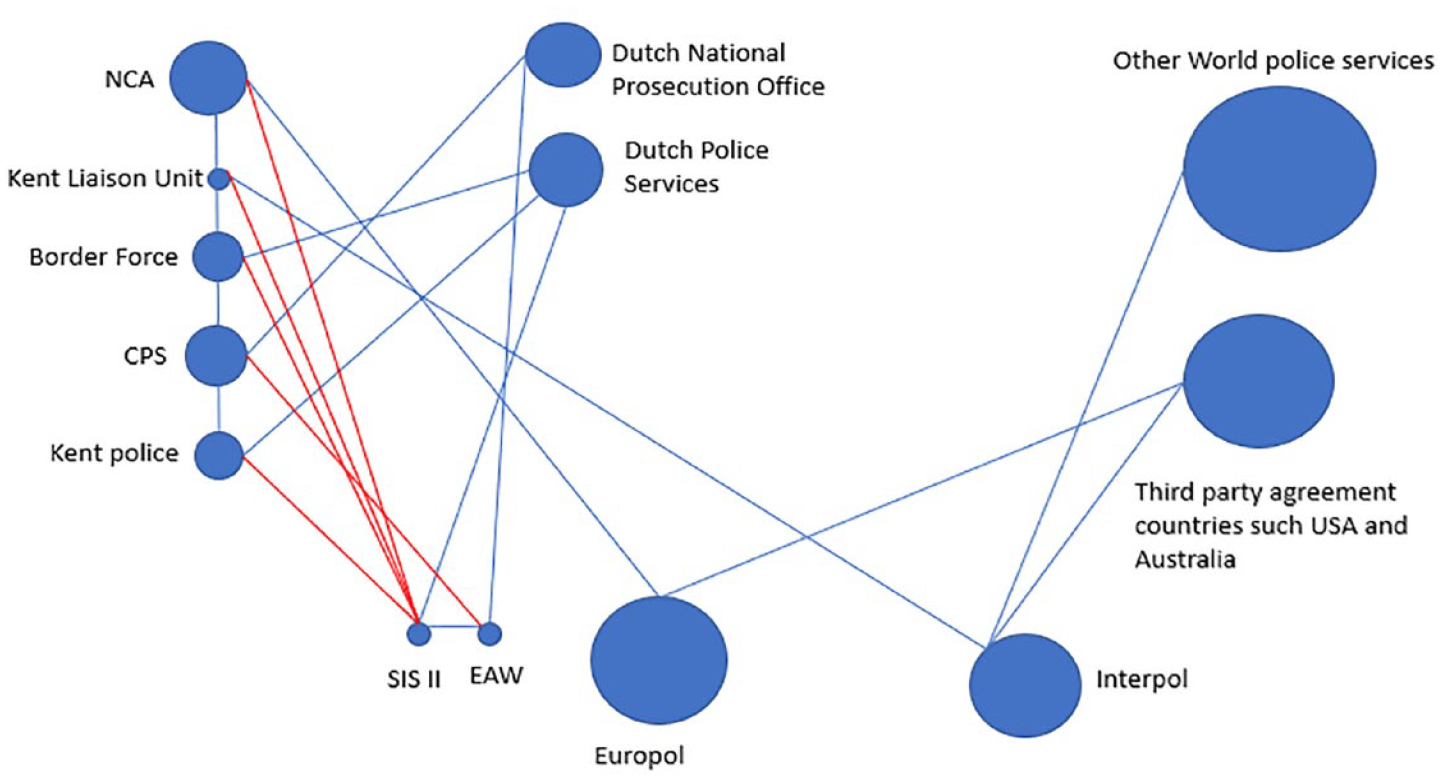
Within international police cooperation, it would be beneficial to view police cooperation tools and mechanisms as nodes, such as SIS II or the EAW, because they act as points of contact within a more extensive network. Policing services use these as a resource to influence other connected nodes, but how nodes interconnect can change over time (Burris et al., 2005). For example, as the United Kingdom has left the EU, nodes within the police cooperation network, such as SIS II, will disconnect from the United Kingdom. Therefore, the United Kingdom will rely on alternative nodes more strongly, such as INTERPOL. A nodal model of international police cooperation allows analysis of post-Brexit cooperation issues that may arise due to the loss of specific nodes.
Figure 1 shows a simplified example of international nodal police cooperation pre-Brexit (using the example of the Netherlands). Blue lines represent active node connections, whereas red lines represent lost connections due to Brexit. The number of links a node has indicated its influence on other connected nodes, and the node’s size is the extent of its resources.
Methodological note.
Qualitative methods appeared to be the most suitable approach to collecting data available to gain insight from practitioners and experts in the field. Semi-structured interviews were considered an appropriate style for an interview – conversations with a set of questions with an informal tone (Longhurst, 2003), instilling a ‘discussion’ style to the interview, empowering the researcher (and interviewee) to explore new topics and points of interest that may not have been considered initially (Gray, 2004, as cited by Doody and Noonan, 2013). The participant has more freedom to discuss and give details in their answers, elaborating on points of interest as the researcher asks probing and open-ended questions (Bryman, 2016), reducing issues such as acquiescence in structured interviews. Semi-structured interviews suit the research as they help the researcher understand the ‘nature of participants’ experiences’ (Morgan, 2020: 65) about police cooperation. Semi-structured interviews allow interviewees to discuss their experiences and perspectives, developing their ideas when answering wide and open-ended questions (Denscombe, 2017). This approach has been adopted throughout the interview process.
A further consideration was whether the interviews would be conducted face-to-face, over the phone or by video call. Due to the Covid-19 pandemic, face-to-face interviews were not conducted, reflecting government and university guidelines at the time. The lack of face-to-face interviews can restrict rapport with the participants, and telephone interviews have been regarded as more fatiguing than face-to-face interviews (Irvine et al., 2013). Due to these reasons, interviews were conducted via Microsoft Teams, an online videoconferencing platform.
Using a snowball approach to sampling, participants were identified by relevant roles (police officers) or knowledge (academics). All participants are from the United Kingdom; although invitations for interviews were sent to police officers in other jurisdictions, these were unsuccessful. Seventeen people were interviewed, including 14 police officers working in a range of organisations in a national and regional capacity in the field of international policing at a European level. A further three academics with expertise in international law enforcement were interviewed. They are named ‘Interviewee 1–17’, assigned randomly to preserve anonymity.
Analysis
During the TCA negotiations, the United Kingdom needed to maintain access to Europol to tackle OCGs across the United Kingdom and British criminals based abroad. Therefore, the continued access to Europol under the present working arrangements (NCA, 2021) is seen as a positive of post-Brexit police cooperation and the TCA. INTERPOL has been mentioned in the media as an alternative due to the loss of SIS II and the EAW. With this have come different views on the use of INTERPOL post-Brexit. Interviewee 4 (Police Officer) stated, People are still preferring to go through ‘police to police cooperation . . .’ [as opposed to going through INTERPOL]
Interviewees highlighted INTERPOL being ‘slower’ and ‘more clunky’ than Europol, Siena or SIS II when providing practical police cooperation. In addition, for the United Kingdom to receive arrest warrants from Europe, EU member state police forces must place warrants on both SIS II and INTERPOL databases. This is known as ‘double keying’. Although there is little evidence to support the idea that EU member states are currently not doing this, there are concerns about whether all police officers across the EU will do this continuously in the future.
A key issue with the loss of SIS II and the EAW and the need for EU member states to ‘double key’ information is that the UK officers will be unaware of the type and quantity of missing information and the risks that come with this. All interviewees highlighted that the loss of SIS II is already impacting UK security and borders. Interviewee 4 (Police Officer) also stated, I do ten checks a week on different names and different people. But I don’t know who’s not there . . . We wouldn’t even know they’re here; it wouldn’t flag up with a minor flag over the [UK] border. So, they could be in this country doing whatever they want, and we wouldn’t even know where they are . . . The cop on the street will stop someone, and then there’s no trace on the PNC (Police National Computer) . . . Unless other EU member states are making an effort to get them [criminals] on a [Interpol] Red Notice and then that notice is not getting onto the PNC . . . we’re not going to know about those criminals – Interviewee 12 We will end up missing criminals, and it could end up being quite catastrophic – Interviewee 11 We now have individuals crossing the border, and we haven’t got a clue who they are; it’s ridiculous – Interviewee 13
It is possible that the lack of access to SIS II and the EAW and the potential failure of EU member states to input data onto INTERPOL systems could mean that criminals will be less likely to be stopped at UK borders when entering or leaving the country, nor will they be traced on the Police National Computer (PNC). This could increase transnational crime in the United Kingdom, drug or human trafficking.
Interviewees were reassured that informal cooperation could help with these issues and were more concerned about judicial cooperation than police cooperation. However, judicial cooperation has been harder to harmonise than police cooperation due to the differences in legal systems across the EU. There has been a decrease in judicial harmonisation due to the United Kingdom reverting to the International Letter of Requests (ILoRs). 4 Interviewee 8 (Police Officer) shared their experiences relating to this when working with the Dutch.
They require CPS (Crown Prosecution Service) involvement in cases we wouldn’t normally want a CPS prosecutor to sign or authorise things because they want the equivalent.
Here, it is also highlighted that the CPS is having difficulties facilitating successful police cooperation, as Interviewee 5 (Police Officer) argued: The point is, if we’re starting a judicial process, we need to submit the ILoR!
Interviewee 2 (Police Officer) continued, Our European partners don’t appreciate just how difficult it is for UK colleagues to get an ILoR. It’s not like just going next door and asking your boss to write a letter . . . ILoRs are getting in the way and are slowing things down constantly.
Interviewee 5 discussed at length their involvement in cross-border surveillance and the difficulties they have encountered with the CPS post-Brexit: [Pre-Brexit] all requests had to be backed up by the EIO . . . now we’ve reverted to Article 17 [of the European Convention on Mutual Assistance in Criminal Matters 1959], which is an emergency document . . . and they [The Dutch] now want to receive an ILoR . . . One of the main things with Article 17 and the writing of the ILoR is that the CPS are basically saying ‘we don’t have to do them’. So, we’re now liaising with the Home Office and CPS to get it written into CPS policy, that they’ve got to write and submit the ILoR. One of the issues at the moment is that they are not complying with what the Dutch requested and if they don’t comply, that causes issues for the whole of the UK in relation to cross-border surveillance requests. And if that happens, the Dutch will turn around say you can’t do any under Article 17 . . . the relationship between the UK and Holland will become more difficult
If Article 17 is withdrawn from the United Kingdom, it would make cross-border surveillance harder and slower.
When comparing the ILoR to the EIO, interviewee 8 argued that the ease of submission and application of the EIO was helpful for police cooperation and that the ILoR would decrease the speed of intelligence sharing: [previously] it [cross border surveillance requests] could be done effectively on a ‘police to police level’, then we would only have to put in a request [EIO] afterwards if we wanted the evidence from that Within the current post-Brexit environment . . . The ILoR [has to be] written by a CPS lawyer and signed off by a senior prosecutor in the United Kingdom and then sent via judicial channels, and by the time the correct person over in Europe receives it, that could be 7-8-9 hours later, or just sat in someone’s inbox waiting to be answered – Interviewee 12.
This bureaucratic hurdle (required pre-Brexit) placed on UK police officers impeded cooperation between the UK and European law enforcement agencies and their prosecutors. Therefore, the CPS, the Home Office and UK law enforcement must remediate this issue not to damage their relationships.
Although the United Kingdom has maintained access to Prüm . . .
The Netherlands and Belgium have introduced a rule whereby if you get a hit on Prüm, you need an ILoR to find out the details for it . . . In my mind, that is not in the spirit of cooperation, and of course, it slows things down dramatically – Interviewee 2 (Police Officer)
This extra layer of bureaucracy will only further slow down information sharing between the UK, the Netherlands and Belgium policing bodies.
From the interviewees’ perspective, issues arise between the United Kingdom and other EU member states where bureaucracy is felt. Interviewee 2 (Police Officer) described how bureaucracy had affected police cooperation: The more bureaucracy you introduce, the more expensive the investigation becomes and more time-consuming it becomes, and both of those are in very short supply . . . It slows things down . . .
According to this participant, despite altered access to Europol and Eurojust, bureaucratic processes have worsened the cooperation between the UK and EU law enforcement organisations. The issues are highlighted by the additional work required by the CPS. Consequently, cooperation relies on trust and good working relationships and less bureaucracy.
Overall, bureaucracy continues to be an obstacle that UK officers must manoeuvre around. This relies on the UK government and the EU maintaining and adhering to the TCA. The total loss of the TCA could cease cooperation between the United Kingdom and EU member states. Before the TCA, direct contact between police officers had formed the backbone for operational police cooperation within the EU (Benyon et al., 1994; den Boer and Spapens, 2002; Harfield, 2005, as cited by Block, 2008). Therefore, it is essential to look at the informal cooperation of UK officers with their EU counterparts post-Brexit.
Informal cooperation
Officers mentioned that Brexit had not impacted their informal networks so far, and these remain an effective tool for police cooperation.
Informally, there’s not been a huge amount of change [post-Brexit]. I think our EU police partners, both before and after Brexit, have been super engaged with us. . . We have excellent interpersonal relationships, which ultimately always make things smoother – Interviewee 3 (Police Officer)
However, cooperation is better for all parties when sharing information is reciprocated, as Interviewee 17 (Academic) said: We are always more cooperative with people where there is the potential for reciprocity
No officers had any concerns or issues on an informal basis with the reciprocity of sharing criminal data and information. However, one area of informal cooperation that has been hindered is the Cross-Channel Intelligence Conference (CCIC). Interviewee 13 (Police Officer) discussed that although the CCIC has been running since 1968, due to the Brexit referendum in 2016 and the central powers within Paris, who withdrew their police forces from the conference, the CCIC has come to an end. A successful informal cooperation mechanism has been lost to the bureaucratic process.
A second area that has also been hindered by Brexit (but also Covid-19) is the joint initiative between the Chief Constable of Kent and their equivalent within France; the Préfet of the department of Pas-de-Calais has been in place since 2004. The joint initiative was established to improve the practice of daily trans-frontier police cooperation. It included regular meetings between the two parties to develop cooperation, improved daily cooperation tools such as bilingual crime report forms and a secure communication system that translated reports called LinguaNet. Beyond this, the initiative improved intelligence exchanges by developing local contacts regularly. Finally, it also looked to enhance levels of arrest and prosecution of British and French offenders in Kent and the Pas-de-Calais region (Snuggs, 2007).
Interviewee 17 (Academic) argued that due to the previous success of the two initiatives between Kent Police and the French, this could be a model that the United Kingdom should look at internationally.
I think people will always look around for successes and I think that the cross-channel initiatives can be seen as a success . . . So, I think that people will look to that model to create something . . .
Although informal routes are quicker for police-to-police cooperation, bilateral and ‘Formal’ arrangements are produced to harmonise different judicial systems. Therefore, the current issues surrounding TCA Warrants and ILoR will still be felt.
Overall, there was a wide range of experiences from all interviewees, yet clear common threads were displayed throughout the analysis. First, there has been a decrease in judicial harmonisation, seen with the loss of the EAW. This has resulted in greater use of INTERPOL and reliance of EU member states ‘double keying’ arrest warrants onto both SIS II and INTERPOL databases, decreasing the efficiency of information sharing. Second, the loss of the EIO and reduced possibilities to set up Joint Investigation Teams (JITs) have delivered the returned use of the ILoR; this has diminished judicial cooperation due to increased bureaucratic processes.
There is a need for UK officers to work closely with EU police forces despite the distancing that has taken place due to Brexit and the TCA. Informal cooperation can still be a valuable tool for UK officers. However, the United Kingdom has seen issues with this, such as the collapse of the CCIC and a decrease in meetings between the Chief Constable of Kent Police and the Préfet of Pas-de-Calais. The United Kingdom must stay connected to as many tools and EU police forces as possible to promptly ensure the safe and reliable reciprocal exchange of information, data, intelligence and evidence. A nodal model of international police cooperation could be established in the United Kingdom, ensuring connectivity across the EU.
This study has aimed to develop an understanding of the consequences of Brexit on police cooperation for UK police officers. The data revealed a few emerging issues. Issues Within Post-Brexit Police Cooperation
Police officers interviewed for this study have seen an increase in judicial issues, specifically with the loss of the EAW and SIS II. As highlighted in the analysis, UK police officers now depend on EU member states ‘double keying’ arrest warrants onto both SIS II and INTERPOL databases for the United Kingdom to identify EU foreign offenders with outstanding arrest warrants. This substitutes the EAW for Red Notices and Diffusions, the INTERPOL system by which INTERPOL informs its members of the existence of wanted people. From the interviews, it is believed that EU member states are endeavouring to do so. This is further supported by interviewees who stated that the number of Red Notices and Diffusions has increased. Yet, none of the interviewees knows, nor are there statistics available to show, if the United Kingdom is not receiving sufficient international arrest warrants. Therefore, the United Kingdom must work closely with police forces and judicial agencies within the EU to continue placing arrest warrants on both systems.
The decrease in judicial harmonisation caused by Brexit has also led to a reduction of speed in ‘Formal’ cooperation, notably where this involves collecting and sharing intelligence that may be used in evidence. It can now take months for UK police officers to obtain evidence and intelligence from abroad. Before Brexit, cross-border surveillance requests were submitted via an EIO. These were reactive and could be submitted to a European Prosecutor even after conducting surveillance. However, as mutual recognition no longer applies, the United Kingdom has had to revert to ILoRs, emphasising the decrease in harmonisation.
Law enforcement activities such as cross-border surveillance requests now require a CPS prosecutor to sign an ILoR within a given timescale set by European Prosecutors. This, so far, has been challenging to implement. Previously, EIOs were signed by senior police officers. However, the ILoR requires an additional signatory from the CPS, creating an extra layer of bureaucracy, thus further decreasing the speed of effective cooperation. The United Kingdom needs to streamline this process quickly between the police and CPS. Otherwise, the United Kingdom could decrease reciprocity, trust and police cooperation.
Suppose the United Kingdom wishes to cooperate with countries that have centralised criminal justice systems and have greater levels of bureaucracy. In that case, it could see a further decrease in police cooperation across the meso and micro levels. If improvements are not made, there may be another loss of intelligence and information from EU police forces, resulting in a lack of evidence from abroad to tackle OCGs. Ultimately, police cooperation could become less efficient and effective for the United Kingdom.
Compared to ‘Formal’ cooperation, informal and ‘formal’ cooperation have fewer impacts. Although access to Siena is retained, one issue is the United Kingdom’s increased use of INTERPOL. INTERPOL is not a suitable replacement for losing access to EU ‘Formal’ mechanisms. This is due to the lack of time, effort and money invested in INTERPOL’s development as a police cooperation tool by the United Kingdom. As well as INTERPOL having some accountability issues, sending and receiving information between the nation-states via INTERPOL can take several weeks, when compared to SIS II, which was instantaneous and was directly linked to the PNC. Speed and efficiency are critical to successful police cooperation, and an increase in bureaucratic processes across ‘formal’ levels may decrease police cooperation.
Comparatively, Brexit minimally affected informal cooperation due to the high levels of trust across long-standing working relationships. However, when informal cooperation begins to incorporate other bureaucratic processes, the speed of cooperation slows down. It would benefit the United Kingdom to develop their current informal networks further to ensure that trust and reciprocity will stand the test of time.
Although Brexit has led to the loss of the CCIC, ultimately decreasing informal network cooperation, police officers who have developed trust and good working relationships with SPOCs (Single Point of Contact) can still share information. In short, the speed of cooperation decreases when police officers move between the informal routes of cooperation to the ‘formal’ and ‘Formal’ routes. Inasmuch, ‘Formal’ cooperation has seen the most significant impact from Brexit, especially where judicial cooperation is concerned. The decrease in judicial harmonisation has decreased efficient police cooperation. However, the speed reduction could be mitigated by founding a new international police cooperation model.
Towards an ‘international nodal police cooperation’ model
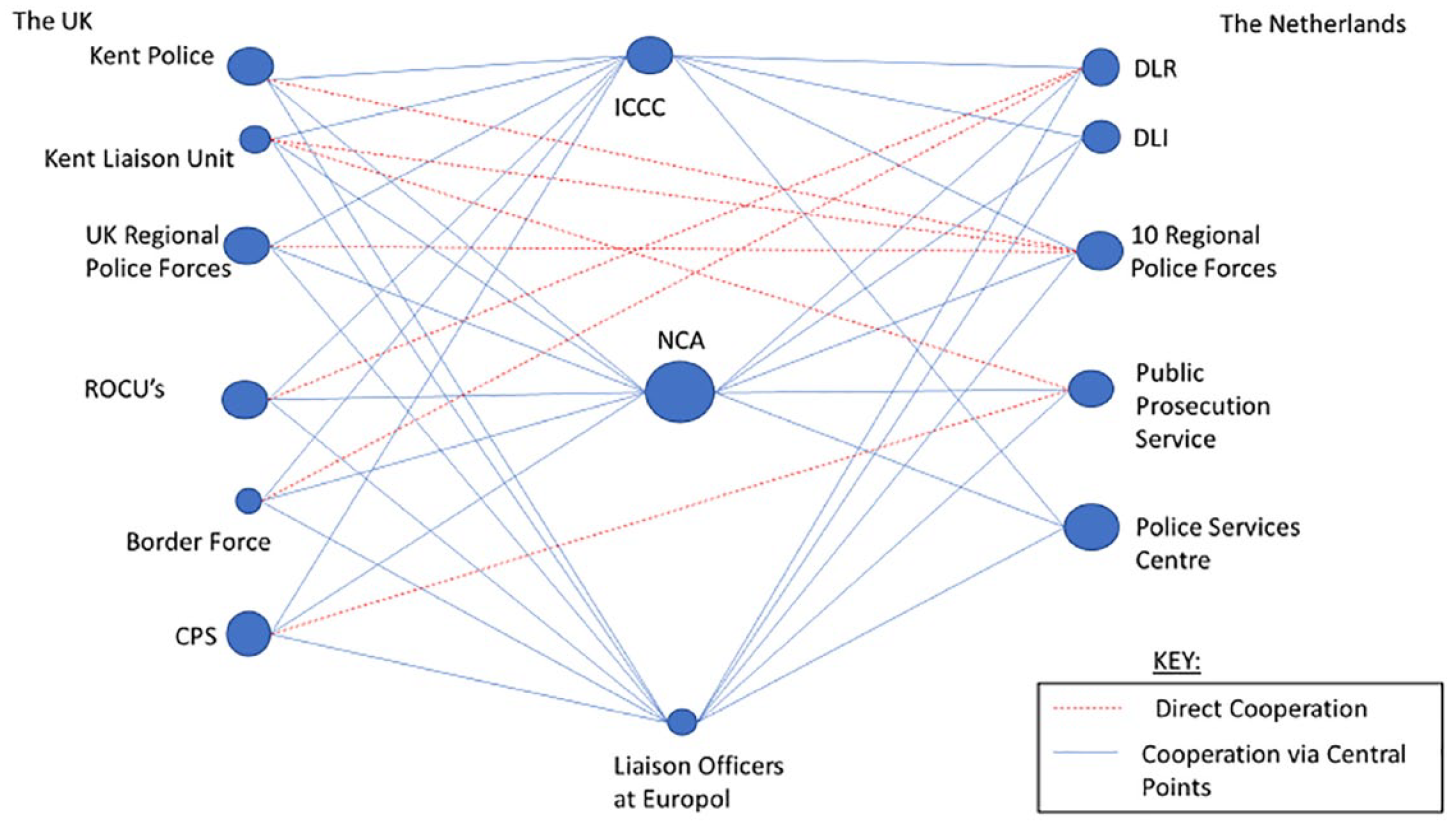
An international nodal police cooperation model could be a useful conceptual framework to examine police cooperation to enhance understanding and analysis beyond ‘traditional’ ideas of ‘Formal’, ‘formal’ and informal cooperation (Gallagher, 2003; Sheptycki, 2002a). However, informal relationships influenced by historical relationships could mean nodal structures will work between some states better than others. International nodal police cooperation, therefore, may rely on the establishment of greater bilateral agreements built upon the TCA. Enhanced use of bilateral agreements could help decrease bureaucratic processes by granting the United Kingdom and individual EU member states greater legal manoeuvrability. This, in turn, will licence police officers to share intelligence and information more freely. Figure 2 is a theoretical diagram of how nodal police cooperation between the United Kingdom using the Netherlands as an example could look.
Interviewees stated that UK police officers have a close relationship with the European law enforcement, which could help establish a nodal police cooperation network between the UK and European law enforcement. Again, this is still dependent on a bilateral agreement being established, which could generate greater legal harmonisation and decrease issues that have been seen with cross-border surveillance requests and the use of the ILoR. Some European law enforcement, like the United Kingdom, has several agencies which will help establish nodal links where information sharing and police cooperation will take place. The UK and European law enforcement currently appears to cooperate effectively but has also become inefficient via the traditional ‘Formal’ routes. The United Kingdom and Dutch require the ability to freely share information regarding any criminals travelling between the two countries.
Nodal police cooperation allows information sharing via bilateral agreements: direct cooperation and cooperation via central points. Direct cooperation occurs where legal matters are of less concern, which is currently referred to as informal and ‘formal’ cooperation. This is where information and intelligence sharing can be freely undertaken due to fewer bureaucratic processes, ensuring greater efficiency. Arrest warrants and evidence sharing would occur via central points to ensure data protection, human rights and greater accountability. Central points would remove the bureaucratic processes between nodes working via direct cooperation; this will increase information sharing between these nodes. Direct cooperation could further develop trust by removing these more difficult bureaucratic processes through bilateral agreements. By improving confidence, the legal and more bureaucratic work via the central points would also improve and, in turn, cooperation will become more effective and efficient via both methods.
Although this model moves towards an increase in bilateral agreements, the TCA is still vital for EU-wide police cooperation. It allows the use of databases such as Prüm, the United Kingdom’s use of JITs and an operating agreement to be developed with Europol. As Lemieux argued (2010, p. 1), international police cooperation relies on the nation-states to establish ‘bilateral agreements, regional accords and intergovernmental organisations’. Having established a foundation to build upon via the TCA, while having previous success in regional accords, the United Kingdom can now build upon its existing individual relationships with EU member states.
In summary, the decrease in speed in police cooperation across the ‘Formal’, ‘formal’ and informal levels is problematic for UK police officers. A nodal model of police cooperation can help decrease this. The establishment of bilateral agreements could improve speed in judicial issues by removing bureaucratic processes; in turn, this may also improve intelligence sharing across informal and ‘formal’ levels. Trust and reciprocity could improve by decreasing bureaucracy and increasing the ability to share intelligence, generating a closer working partnership between individual nodes. As nodes in the United Kingdom and EU begin to work closer, more information and intelligence may be shared, further improving trust across ‘Formal’ routes. Therefore, international nodal police cooperation could generate a cycle of trust and reciprocity across all levels of law enforcement, where information is freely shared and consequently will improve how transnational crime is tackled across the United Kingdom and EU. This could mean the United Kingdom may have to accept the jurisdiction of the European Court of Justice (ECJ). Yet this seems unlikely due to the concerns around the protection of UK sovereignty. Nonetheless, the United Kingdom’s future may have to include additional aspects of the EU.
Conclusion
It is possible to conclude that Brexit has brought changes to international law enforcement cooperation, most significantly where this involves judicial matters. However, ministers have previously stated that the United Kingdom will be able to cooperate more effectively outside of the EU and that the United Kingdom will benefit from taking back control of its borders, despite the loss of SIS and the EAW (Morris, 2020). Having discussed these issues at length with senior police officers and academics, it is evident that the loss of the EAW and SIS II is significant, as police officers at UK borders will not be able to know if they are missing offenders. Although, the United Kingdom stored and accumulated outstanding EAWs onto the PNC before the United Kingdom leaving the EU. The United Kingdom is now reliant on EU member states ‘double keying’ offenders onto EU and INTERPOL databases. This means that the United Kingdom needs to work more closely with EU member states post-Brexit to maintain high levels of information sharing.
Currently, there is no evidence to show that police officers within the EU are not ‘double keying’ arrest warrants. The United Kingdom has seen an increase in Diffusions and Red Notices, most notably for serious offences. However, UK police officers do not know if they are missing any warrants from the EU. This, in turn, would mean that the United Kingdom could see an increase in offenders coming to the United Kingdom to commit crimes undetected and then return to their country of origin. Due to the extradition bar that has been placed on the United Kingdom by several EU member states, these offenders will not be returned to the United Kingdom to be convicted of the crimes they have committed.
An additional consequence of Brexit on police cooperation is the loss of the EIO. This has become significant and has caused judicial problems within the United Kingdom as described previously. The EIO harmonised the UK judicial system with EU member states and allowed ‘Formal’ police cooperation to more smoothly. Today, the CPS has become increasingly involved in international policing matters to cater to different legal systems within the EU. The increase in bureaucracy has decreased the speed of police cooperation, while the loss of mutual recognition has reduced trust in judicial matters. Although work has been going on to improve this, the Dutch have now required the United Kingdom to submit ILoRs before cross-border surveillance and the additional involvement of a UK prosecutor to sign ILoRs. Although the United Kingdom has maintained access to Europol and Prüm databases, with the exception of increased numbers of LOs, the United Kingdom has decreased its interconnectivity to EU-wide police forces across the micro, meso and macro levels. This, according to the interviewees, has decreased information sharing between the United Kingdom and EU member states’ police forces, which is determinantal to the safety of the United Kingdom. The Nodal Police Cooperation Model can explore interconnectivity between law enforcement across different European countries. Moreover, a police cooperation model that provides interconnectivity in a globalised age may allow the United Kingdom to match the capabilities of OCGs across Europe.
In short, whereas the United Kingdom once had greater harmonisation with differing legal systems, Brexit has caused an increase in bureaucracy and a decrease in trust. Consequently, Brexit has affected the speed and effectiveness of police cooperation and has created judicial issues for UK police officers. These two aspects are detrimental to effective police cooperation. The loss of police cooperation tools such as SIS II, EAW and EIO is damaging to the United Kingdom. These issues can be addressed by generating a nodal police cooperation model to ensure police officers in the United Kingdom and the select nation-states can strengthen interconnectivity and share information more freely.
Footnotes
Declaration of Conflicting Interests
The author(s) declared no potential conflicts of interest with respect to the research, authorship and/or publication of this article.
Funding
The author(s) received no financial support for the research, authorship and/or publication of this article.
